𝗙𝗨𝗟𝗟 𝗦𝗧𝗢𝗥𝗬 The HOA President Tried to Take My First Home Over a Parking Spot He Didn’t Own
𝗙𝗨𝗟𝗟 𝗦𝗧𝗢𝗥𝗬
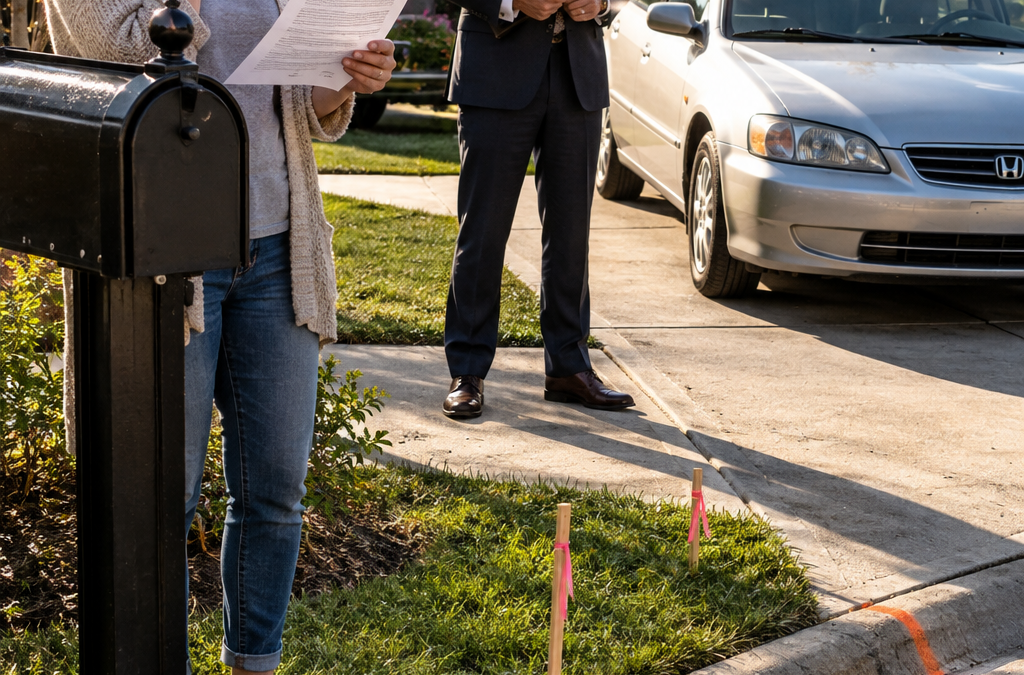
I stood in the driveway holding the paper, staring at my car.
There were no painted lines.
No markers.
No curb indentation.
No visible boundary except the edge of the concrete itself.
My car was not blocking the sidewalk. It was not in the street. It was not touching anyone else’s property.
Half an inch.
I laughed out loud.
Who actually measured a parking space with a ruler and a level?
Deborah, apparently.
I moved the car two inches to the left and threw the note into a kitchen drawer.
That was my first mistake.
Not moving the car.
Throwing away the warning without documenting it.
I thought the problem was silly.
Silly problems, I assumed, stayed small.
Within two weeks, I had three violation letters.
Grass too long.
Trash bin out four hours early.
Wind chime disturbing aesthetic harmony.
The wind chime was six inches long and hung beside the porch light. My mother had given it to me after closing. It made a soft sound only when the wind came from the west, and even then you could barely hear it from the front steps.
Deborah called it disruptive.
The trash bin accusation was worse. Collection came early on Thursdays. I had placed the bin at the curb Wednesday evening because I left for work before sunrise. Apparently, the approved window began at 6 a.m. Thursday.
I called the HOA office, polite as could be.
A young woman answered.
“Willow Creek Hollow Association.”
“Hi, this is Linda Carter at 112 Maple Finch Court. I received a few violation letters, and I’d like a copy of the current rulebook.”
There was a pause.
“Let me check.”
I heard typing.
Then she came back.
“Ms. Whitfield says the handbook is being updated.”
“I understand. But I need the current version.”
“She said revisions are pending.”
“I’m not asking for the future version. I need the rules I’m being fined under now.”
Another pause.
“Ms. Whitfield will get back to you.”
She did not.
Instead, I received another letter.
This one warned that continued noncompliance could result in increased fines.
That evening, I went to the mailbox and found Rosa Martinez standing beside hers.
Rosa lived two houses down from me. She was in her sixties, with short silver hair and the cautious way of speaking people develop after being punished for saying too much. She watched me open the envelope and sighed before I even read it.
“Deborah?”
I looked up.
“How did you know?”
Rosa stepped closer.
“Because she always starts with paper.”
I held up the letter.
“Apparently my wind chime is an existential threat.”
Rosa did not smile.
“Linda, be careful.”
“With the wind chime?”
“With Deborah.”
I lowered the letter.
“What do you mean?”
She glanced toward the end of the cul-de-sac where Deborah’s white SUV sat in front of a large brick house.
“She does this to everyone who doesn’t kiss her ring.”
The phrase startled me.
“Seriously?”
Rosa nodded.
“She makes it small at first. A note. A little fine. Something you feel foolish arguing over. Then it grows.”
I looked at her.
“Has she done it to you?”
Rosa’s mouth tightened.
“Fence dispute. Two years ago. I’m still paying it off.”
I stared.
“Two years?”
“Late fees. Administrative fees. Hearing fees. Legal review fees.”
“Over a fence?”
“Over a fence she didn’t like.”
She looked at the letter in my hand.
“Start keeping a folder.”
I thought of the note I had thrown into the drawer.
“I thought this was just annoying.”
“It is annoying,” Rosa said. “Until it becomes expensive.”
That night, I began my folder.
I pulled the windshield note from the kitchen drawer, smoothed the crease, and placed it inside a large envelope.
Then the grass violation.
The trash-bin letter.
The wind-chime warning.
I took timestamped photos of my driveway, my lawn, my porch, my trash bin inside the garage, and the little wind chime beside the light.
I photographed my car parked in front of my own house from several angles.
I did not know yet how important that folder would become.
I only knew that Rosa had looked scared, and fear from someone who had already lived through a thing is worth respecting.
The first accusation that truly shook me came two weeks later.
Deborah claimed I had been parking along her curb.
Not my driveway.
Not the curb in front of my house.
Her curb.
The one directly in front of her own house at the opposite end of the cul-de-sac.
The letter accused me of obstructing her sunset view, interfering with neighborhood aesthetics, and creating a traffic hazard by repeatedly parking in a restricted area.
I read it standing in my kitchen.
Then I laughed.
Not because it was funny.
Because the alternative was screaming.
My car had been parked in front of my house every night. I had photos because I had already started documenting everything. Timestamped photos. Metadata. Wide shots showing my driveway, my porch, my address numbers, and the car exactly where it belonged.
Deborah’s letter included no photograph.
Only her written assertion.
I emailed the HOA.
Please provide the evidence supporting this violation.
Deborah replied herself.
Your continued refusal to comply with community expectations has been documented.
No evidence.
No rule citation.
Just authority stated loudly enough to be mistaken for proof.
The next afternoon, two code enforcement officers showed up.
I saw their truck stop near my driveway while I was working from home. My stomach dropped. One officer stepped out with a clipboard. The other checked something on his phone, looked at my house, then looked toward Deborah’s house with visible confusion.
I walked outside.
“Can I help you?”
The older officer said, “Ma’am, we received a complaint about illegal parking and obstruction of private curb frontage.”
I blinked.
“Private curb frontage?”
He looked at the complaint again.
“Submitted by Deborah Whitfield.”
Of course.
“My car is in my driveway.”
“Yes, ma’am. We noticed.”
The younger officer looked down the street.
“Complaint says you were parking in front of her residence.”
“That’s forty feet away, and I don’t park there.”
The older officer looked at the curb in front of my house, then at the sidewalk.
“Even if you did, this is public right-of-way.”
I almost smiled.
“Could you repeat that?”
He gave me a sympathetic look.
“The curb and sidewalk are public right-of-way. The HOA may regulate certain things under its covenants, but she doesn’t own the street in front of her house. And she definitely doesn’t own the curb in front of yours.”
The younger officer muttered, “I don’t think she understands that.”
At that moment, Deborah emerged from her house.
She came down the sidewalk wearing a white blouse, slim black trousers, and the same sharp smile she had worn the day we met. Her clipboard was tucked under one arm.
“Officers,” she called. “Thank you for coming.”
The older officer turned.
“Ms. Whitfield, we inspected the complaint.”
“Excellent. Then you’ll instruct Ms. Carter to stop using restricted curb space.”
He paused.
“Ma’am, this is public right-of-way.”
Deborah’s smile froze.
“What?”
“You don’t own the sidewalk or curb in front of your own house, let alone hers.”
The younger officer looked like he was trying not to laugh.
Deborah’s face turned the color of a stop sign.
Her clipboard trembled in her hand.
“I am the HOA president,” she said.
The older officer stayed calm.
“That doesn’t change the public right-of-way.”
“She is harassing me.”
I stared at her.
“By parking in my own driveway?”
The officer looked between us.
“Ma’am, this appears to be an HOA dispute, but there’s no code violation here.”
Deborah’s mouth tightened.
“Then I’ll address it through association channels.”
She turned and walked back toward her house, spine stiff, shoes clicking against the sidewalk.
The officers left after giving me a copy of their response note.
I stood in my driveway holding it like a trophy.
That was twist number one.
The woman who claimed absolute authority over our street did not even understand the law she loved wielding.
I thought that would end it.
I was wrong.
It made her furious.
Furious people escalate.
The certified letter arrived the next week.
It was thick, formal, and designed to frighten.
The HOA assessed me a $2,000 fine for harassment of a board member.
Harassment.
For answering questions from code enforcement officers Deborah had sent to my house.
The letter claimed my behavior had caused emotional distress to association leadership and interfered with official community governance.
I sat at the kitchen table and read the sentence three times.
Then I looked toward my folder.
Rosa had been right.
Small problems become expensive when the wrong person controls the paper.
I appealed.
The hearing took place inside the clubhouse on a Thursday evening.
I arrived with my folder, photographs, the code enforcement note, and a written statement.
Deborah sat at the head of the table.
Beside her was her sister, Patricia, the board treasurer.
Next to Patricia was Patricia’s husband, Glen, the board secretary.
That was the entire board.
Deborah, her sister, and her brother-in-law.
For a moment, I thought I had misunderstood the seating.
Then Deborah smiled.
“We can begin.”
I looked at the three of them.
“This is the appeal board?”
“Correct.”
“You, your sister, and your sister’s husband?”
Patricia stiffened.
Glen looked at the table.
Deborah folded her hands.
“The bylaws establish the board composition.”
“That’s a conflict of interest.”
Her smile sharpened.
“It’s governance.”
I felt a hollow drop in my stomach.
That was twist number two.
This was not a homeowners association in any healthy sense.
It was a family business wearing a badge stitched together from bylaws.
I presented the photos.
The code enforcement note.
The public right-of-way statement.
Proof my car had been parked at my property.
Deborah listened with the expression of someone waiting for a child to finish explaining why bedtime was unfair.
When I finished, she said, “The board finds that your conduct toward the president created unnecessary hostility.”
“I answered officers you called.”
“You escalated the matter.”
“I did not call them.”
“You embarrassed association leadership.”
“That’s not a violation.”
Deborah looked at Patricia.
Patricia looked at Deborah.
Glen cleared his throat.
“The fine stands.”
I stared at them.
“You made that decision before I walked in.”
No one answered.
I gathered my folder.
Deborah leaned back.
“Linda, I suggest you decide what kind of neighbor you want to be.”
I looked at her.
“I already know.”
Then I walked out before my voice could shake.
Rosa came over that night.
I told her about the hearing.
She sat across from me at the kitchen table, both hands wrapped around a coffee mug.
“Her late husband wrote those bylaws,” Rosa said.
“What?”
“Years ago. He was the first president after the developer turned the association over. He rewrote the governance sections. Most people didn’t pay attention.”
“How does one family control the whole board?”
“Nobody challenged it.”
I stared at her.
“Why not?”
She gave a bitter little smile.
“Because challenging Deborah costs money.”
I looked at the fine letter on the table.
Two thousand dollars.
Then the earlier notices.
Then the folder.
I had been scared.
Now something else began to take shape beneath the fear.
Strategy.
I requested the HOA’s financial records.
I knew from the materials I had read that every homeowner had a legal right to inspect basic financial information. Budgets. Bank statements. Vendor payments. Assessment records. Fine ledgers.
Deborah refused.
Her response was two sentences.
The board exercises discretion regarding disclosure of sensitive association records. Your request is denied at this time.
I forwarded it to the state Department of Community Affairs with a formal complaint.
Then I kept documenting.
Deborah kept fining.
Four thousand dollars.
Then six.
Each letter more aggressive than the last.
Each one warning that unpaid balances could result in a lien on my home.
My first home.
The one I had saved ten years to buy.
The one with the little porch and sloped backyard.
The one place that was supposed to be mine.
The fear came back at night.
During the day, I could be practical.
I photographed.
Filed.
Scanned.
Labeled.
Called agencies.
Sent certified mail.
At night, the house was quiet, and I would sit at the kitchen table staring at the letters, imagining legal claims, court dates, legal bills, foreclosure threats, ruined credit, and everything I had built collapsing because Deborah Whitfield had decided my presence offended her.
One Friday, after receiving another threat letter, I called three attorneys.
The first didn’t handle HOA matters.
The second wanted a retainer I could not afford.
The third was Marcus Reed.
He specialized in HOA abuse cases.
His office was in Charlotte, tucked above a bakery that made the entire stairwell smell like cinnamon. Marcus was a large, calm man with tired eyes, a close-cropped beard, and the kind of voice that made panic feel slightly embarrassed to be in the room.
He read my folder from front to back.
All of it.
He did not rush.
He did not interrupt.
He read the first parking note, the grass citation, the trash-bin fine, the wind-chime letter, the public right-of-way complaint, the harassment fine, the appeal decision, the board list, Deborah’s refusal to produce records, and every lien warning.
At one point, he laughed out loud.
Not a cheerful laugh.
A professional laugh.
The kind that meant someone had made an ugly mistake.
“This is the sloppiest lien threat I’ve seen in years.”
I leaned forward.
“What does that mean?”
“It means she’s threatening legal action without doing the required groundwork.”
“Can she take my house?”
“Not lawfully based on what you’ve shown me.”
I exhaled, but only slightly.
He lifted one letter.
“Under state law and the governing documents, the HOA must give proper written notice before filing any lien. Specific notice. Opportunity to cure. Proper itemization. Compliance with required procedures.”
“She didn’t?”
“Not once.”
I closed my eyes.
“Thank God.”
“Don’t relax yet.”
I opened them.
Marcus placed the letters side by side.
“Someone willing to send sloppy legal threats may still create real problems if no one stops her. We need to act formally.”
“What do we do?”
“I send a cease-and-desist. I demand withdrawal of the improper charges. I request records again. And if she continues, we file.”
“What about the board being her family?”
“That matters.”
He tapped the financial-record refusal.
“And this matters more.”
“Why?”
“Because people who refuse records usually have a reason.”
Marcus sent the letter that afternoon.
It was firm, precise, and terrifying in ways my anger could never have been.
It demanded that Deborah withdraw the unsupported lien threats, preserve all association records, provide financial documents, cease publishing or circulating unsupported allegations, and stop using the HOA enforcement process for retaliation.
Deborah’s response was not to back down.
It was to post my violations on the community Facebook page.
She uploaded photos of my car, my porch, my trash bin, and my wind chime. She posted a long message about community standards, harassment of board members, and the burden of protecting property values from residents who believed rules did not apply to them.
She did not name me in the first sentence.
She did not need to.
Everyone knew.
For about ten minutes, I thought it was over.
I imagined neighbors reading the post and deciding I was exactly what Deborah said I was.
A problem.
A troublemaker.
A woman who moved into a quiet cul-de-sac and immediately began fighting.
Then Rosa commented.
I still remember the first line.
Deborah, why did you fine me for my fence after approving your sister’s identical fence?
The thread went quiet.
Then another neighbor commented.
I was fined for trash bins with no proper notice. Still waiting on records.
Then another.
Our appeal was heard by Deborah, Patricia, and Glen too. How is that impartial?
Within an hour, three other neighbors had posted their own stories.
Unpaid disputed fines.
Denied appeals.
Threat letters.
Selective enforcement.
One man uploaded a photo showing Deborah’s sister leaving trash bins in plain view on a day he had been fined for the same thing.
The post backfired spectacularly.
Instead of isolating me, Deborah had created a public record of the pattern.
Marcus called me that night.
“Save everything.”
“I am.”
“Screenshot the comments. Download the images. Preserve the post before she deletes it.”
“Already doing it.”
“Good.”
His voice was calm, but there was energy beneath it now.
“This is useful.”
By morning, Deborah had deleted the post.
But half the neighborhood had already saved it.
Three days later, the Department of Community Affairs response arrived.
The records inquiry had forced the HOA to produce financial documents through the state process.
Deborah had stalled when I asked.
She could not stall the state forever.
Marcus called me into his office.
He had a stack of papers on his desk and an expression I could not read.
“Linda, sit down.”
My stomach tightened.
“What did they find?”
“The HOA account is missing nearly forty thousand dollars.”
I sat slowly.
“What do you mean missing?”
“Maintenance fees collected. No corresponding maintenance work. No vendor invoices supporting the withdrawals. No new mulch, no private road resurfacing, no clubhouse repairs, no common-area improvements matching the amounts.”
He turned one page toward me.
“Funds moved out under vague descriptions.”
“To where?”
“That’s the part that matters.”
He placed another document on top.
The transfers led to a personal Venmo account.
Deborah Whitfield’s personal Venmo account.
For a few seconds, I could not speak.
Forty thousand dollars.
While she fined me over a wind chime.
While she threatened my house over a curb she didn’t own.
While Rosa was still paying off an old fence dispute.
While other neighbors quietly carried balances they could not afford.
Deborah had been moving association money to herself.
“That’s embezzlement,” I whispered.
“Potentially. The district attorney will decide criminal charges. But for civil purposes, this changes the case.”
Marcus leaned back.
“We’re filing suit.”
“Against Deborah?”
“Against Deborah, the HOA where appropriate, and on behalf of affected homeowners. Not just to void your lien threat. A broader action.”
“Class action?”
“Potentially. At minimum, a representative action covering homeowners fined or threatened without proper legal notice.”
I stared at the papers.
My fear did not disappear.
It changed shape.
Before, I had been afraid Deborah could take my house.
Now I was afraid of how many people she had already hurt before anyone looked closely enough.
Marcus filed the lawsuit the following week.
It sought to void the improper lien threats, recover damages, force production of records, address the improper fines, challenge the conflicted board structure, and pursue relief for homeowners Deborah had targeted without proper notice.
The filing was not small.
It was not polite.
It did not ask Deborah to behave better.
It asked the court to stop her.
The hearing date arrived faster than I expected.
I spent the night before barely sleeping, lying in bed while my mind replayed every mistake I feared I had made.
Should I have paid sooner?
Should I have moved?
Should I have stayed quiet?
Should I have taken the wind chime down the moment she complained?
Then I thought about Rosa.
I thought about the neighbors on the Facebook thread.
I thought about forty thousand dollars moving into Deborah’s personal account while she lectured everyone about harmony.
By morning, I was still terrified.
But I was done apologizing for wanting proof.
The courtroom was smaller than I expected.
Deborah arrived in a blazer sharp enough to cut glass.
White blouse.
Pearl earrings.
Hair perfect.
Expression calm.
She smiled when she entered, as if she still owned the room.
Patricia and Glen sat behind her, looking less confident.
Rosa sat beside me in the gallery, gripping my hand so hard it hurt.
Marcus sat at the table with our binders arranged neatly in front of him.
Deborah’s lawyer began by describing the dispute as ordinary HOA enforcement.
A new homeowner unwilling to follow rules.
A president attempting to protect community standards.
A misunderstanding inflamed by social media.
Marcus waited.
When it was his turn, he started with the simplest issue.
The curb.
He entered the code enforcement response showing the curb was public right-of-way and that Deborah’s ownership claim was baseless.
Then he addressed the harassment fine.
The appeal board.
The family-controlled governance structure.
The lack of proper notice.
Then the lien threats.
The judge looked at Deborah’s attorney.
“Where is the proof of statutory notice before the lien warning?”
Her lawyer shuffled papers.
Then more papers.
Then whispered to Deborah.
Deborah leaned forward, whispering back, her smile gone.
The judge waited.
Finally, Deborah’s lawyer said, “Your Honor, the association provided multiple violation letters.”
The judge’s expression did not change.
“I asked for proof of proper lien notice.”
There was no answer.
Marcus stood.
“Your Honor, there is none.”
He handed up the relevant documents.
“The association threatened Ms. Carter’s home without complying with required notice procedures, without proper itemization, and based in part on a harassment fine arising from a false parking complaint made by the president herself.”
The judge reviewed the papers.
Then Marcus entered the state auditor’s report.
That was when the room changed.
The missing funds.
The unsupported maintenance expenses.
The transfers.
The personal Venmo account.
Deborah’s personal Venmo account.
Her smile cracked.
Not dramatically.
Just a slight tightening around the mouth.
A small moment of panic before the mask came back.
But Rosa felt it.
Her grip on my hand tightened.
I could barely breathe.
Marcus continued.
He did not accuse louder than the evidence allowed.
He did something worse for Deborah.
He read the report carefully.
Line by line.
Dates.
Amounts.
Descriptions.
Missing invoices.
Transfers.
Account names.
Then he connected those findings to the pattern of fines and record refusals.
The judge listened without interruption.
When Marcus finished, Deborah’s attorney tried to argue that the financial matters were separate from my lien dispute.
The judge looked at him.
“They are not separate if the enforcement process was used improperly and the funds collected through that process are under credible question.”
Deborah stared at the table.
For the first time since I had met her, she looked smaller than her clothes.
The judge ruled on my lien first.
Voided on the spot.
No hesitation.
No long speech.
The HOA had failed to comply with required notice procedures, relied on improper charges, and escalated enforcement without adequate legal basis.
My lien threat was gone.
I covered my mouth with my free hand.
Rosa whispered, “Thank God.”
Then the judge awarded damages related to my legal fees and improper enforcement costs.
He ordered further review of the disputed fines.
He directed the financial evidence to the district attorney’s office for criminal review.
He also ordered the HOA to preserve records and refrain from retaliatory enforcement while the broader homeowner claims proceeded.
By the time the hearing ended, Deborah was no longer smiling.
Outside the courtroom, she walked past me without speaking.
No clipboard.
No silky smile.
No warning about community standards.
Just a woman whose power had finally met paperwork she could not edit.
That afternoon, the HOA held an emergency vote.
Patricia and Glen, terrified of personal exposure, turned on her so fast it almost would have been funny if the damage had not been real.
They voted to remove Deborah from the board pending the financial investigation and court proceedings.
The decision was unanimous.
Her own family removed her.
When Marcus called to tell me, I sat down on the stairs.
“Say that again.”
“She’s out.”
“Already?”
“Fear is a powerful governance tool when it turns around.”
I closed my eyes.
For the first time in months, I felt my shoulders drop.
Not completely.
But enough to notice how long I had been holding them tight.
The weeks that followed were messy.
Legal processes always are.
The court case continued on behalf of affected homeowners. The HOA appointed an independent interim manager. The financial records were reviewed more fully. Improper fines were identified. Residents were invited to submit documentation of disputed charges.
Rosa brought in two folders.
One for the fence.
One for everything that came after.
Three other households produced violation letters nearly identical to mine, each missing proper notice, each threatening escalation without the steps required to make that threat lawful.
The community learned what Deborah had counted on us never learning.
Most people do not challenge paperwork that looks official.
Most people panic when they see words like lien, foreclosure, enforcement, and legal fees.
Most people pay because they are afraid not to.
And Deborah had built an empire out of that fear.
Weeks later, she was formally charged with embezzlement.
The district attorney’s office moved after reviewing the auditor’s report, bank records, and supporting documents. The case would take time, and Marcus reminded me more than once that charges were not convictions.
But the woman who fined me for a wind chime was now facing actual prison time.
That fact sat heavily in the neighborhood.
Some people were relieved.
Some embarrassed.
Some tried to pretend they had always known something was wrong, though I remembered very well how many had stayed silent when Deborah first posted my violations online.
I did not blame them as much as I thought I would.
Fear makes people small.
I had been small too.
The difference was that Rosa had pulled me aside at the mailbox before I shrank completely.
Our little cul-de-sac elected an entirely new board that same season.
For the first time in years, multiple residents actually ran.
Rosa was one of them.
I watched her stand at the front of the clubhouse, hands trembling slightly as she gave her short speech.
“I don’t want power,” she said. “I want records. I want fairness. And I want no homeowner to be afraid to ask where their money went.”
She won by a landslide.
The first vote under the new board was full transparency for every dollar spent.
Monthly financial statements.
Vendor names.
Payment descriptions.
Conflict disclosures.
Formal notice procedures.
Open appeal panels with no family majority.
Clear records.
Clear rules.
Clear limits.
It was not glamorous reform.
It would not make headlines.
But to us, it felt revolutionary.
A few weeks after the new board took office, I received a letter from the interim manager confirming that my outstanding fines had been reviewed and withdrawn. The harassment fine was void. The improper lien threat was permanently canceled. The wind-chime violation was dismissed because the aesthetic harmony provision Deborah had cited had never been properly adopted.
I read that sentence three times.
The rule did not exist.
My mother’s wind chime had been innocent all along.
I went outside and rehung it beside the porch light.
The breeze moved softly through the metal tubes.
The sound was small.
Gentle.
Mine.
That evening, I parked in front of my own house.
Exactly where I had every right to park.
I sat in the car for a moment after turning off the engine, looking down the cul-de-sac toward Deborah’s house.
The curb in front of it was empty.
For months, she had acted as if the public street were a private extension of her authority. As if my driveway, my curb, my porch, my mailbox, and my peace existed only with her permission.
Now her windows were dark.
Her white SUV was gone.
The house looked ordinary.
That surprised me most.
Without fear attached to it, it was just brick and siding.
Marcus later told me the case became a template other lawyers began using in similar HOA abuse cases across the state.
Not because I was special.
Because the facts were clean.
A folder of receipts.
Timestamped photos.
A public right-of-way note.
A family-controlled board.
Missing notice.
Improper lien threats.
A state audit.
Transfers to a personal account.
The pattern was easy to understand once someone placed all the pieces side by side.
That was the lesson I carried from it.
Abuse hides in fragments.
One fine looks petty.
One denied appeal looks personal.
One missing record looks accidental.
One neighbor’s story sounds like drama.
But put enough fragments together, and a system appears.
Deborah had depended on keeping everyone isolated.
Rosa with her fence.
Me with my parking spot.
Another family with trash bins.
Another with landscaping.
Each of us alone, embarrassed, frightened, and unsure whether fighting was worth the cost.
She lost when we started comparing notes.
Justice did not come fast.
And it did not feel the way I imagined.
There was no perfect cinematic moment where every fear disappeared at once.
The judge’s ruling helped.
Deborah’s removal helped.
The criminal charges helped.
But for a while, I still checked my mailbox with a tight stomach.
I still saved every HOA email.
I still photographed my driveway now and then out of habit.
Fear leaves slower than the person who caused it.
But it does leave.
One night near the end of summer, I came home late from work.
The sky was deep blue, almost dark.
Porch lights glowed along the cul-de-sac.
Kids had left chalk drawings on the sidewalk.
Someone had grilled dinner recently, and the warm smell of charcoal hung in the air.
I parked in front of my house.
Straight.
Legal.
Normal.
Then I looked across the street at the empty curb Deborah had once claimed as hers.
I smiled.
Not because I had beaten her.
That kind of satisfaction burns hot and fades fast.
This was quieter.
Stronger.
I smiled because my hands were no longer shaking.
I smiled because the wind chime was hanging beside the porch light.
I smiled because Rosa was on the HOA board.
I smiled because every homeowner now had access to the financial records Deborah had once hidden behind “board discretion.”
I smiled because the house I had spent ten years saving for was still mine.
When I stepped onto the porch, the wind stirred.
The chime rang softly.
For a second, I stood there and listened.
That little sound had once been treated like a violation.
Now it sounded like proof.
Proof that a rule written nowhere could not control my life.
Proof that a woman with a clipboard did not own the street.
Proof that official-looking paper could be challenged.
Proof that one folder of receipts, if kept carefully enough, could topple a tyrant.
I unlocked my front door and looked back once more at the cul-de-sac.
The lawns were still trimmed.
The flagpoles still matched.
The houses still looked like a postcard.
But now the neighborhood felt different.
Not perfect.
No neighborhood is.
But honest in a way it had not been before.
The silence was no longer fear.
It was peace.
And every night after that, I parked in front of my own house.
Every night, I looked toward that empty curb across the street.
And every night, I remembered the Tuesday my hands shook over a lien notice Deborah Whitfield had no right to send.
She thought the letter would scare me into surrender.
Instead, it became the first page in the folder that ended her reign.
𝗧𝗛𝗘 𝗘𝗡𝗗
The HOA President Tried to Take My First Home Over a Parking Spot He Didn’t Own
The lien notice hit my mailbox on a Tuesday, and my hands were shaking before I finished the first line. It threatened my first home over a curb that Deborah Whitfield had never owned in the first place.
My name is Linda Carter, and six months before that letter arrived, I had believed buying a house would finally make me feel safe.
I was thirty-four years old, single, working full-time as an operations manager for a medical supply company outside Charlotte, North Carolina, and I had spent nearly a decade saving every dollar I could. I drove the same old silver Honda long after the air conditioner died. I packed lunches when my coworkers ordered takeout. I skipped vacations, repaired furniture instead of replacing it, and told myself that one day all of that restraint would turn into something solid.
A front door.
A driveway.
A kitchen where I could paint the walls any color I wanted.
A place where no landlord could raise the rent because the market shifted.
A place that was mine.
When I found the house in Willow Creek Hollow, I thought I had finally reached that day.
It sat at the end of a quiet cul-de-sac with young maple trees along the sidewalks and a narrow front porch facing the street. The siding was pale gray. The shutters were black. The driveway was short but clean, just wide enough for my Honda and a row of potted flowers I planned to buy once I recovered from closing costs.
The house was not large.
Two bedrooms.
A small office.
One-and-a-half baths.
A kitchen with older cabinets and a backyard that sloped slightly toward a line of trees.
But to me, it looked like freedom.
The neighborhood looked like something from a postcard. Trimmed lawns. Matching flagpoles. Children on bikes. Retired men watering grass at exactly 7 a.m. Dogs behind white fences. Everything neat enough to suggest stability, but not so fancy that I felt completely out of place.
At closing, the realtor mentioned the HOA as if it were nothing to worry about.
“Mostly basic maintenance rules,” she said. “Lawn height, trash bins, exterior changes. Standard stuff.”
I had rented long enough to understand rules.
Rules did not frighten me.
What frightened me was instability.
So when I received the keys and drove to the house that evening, I sat in my car for almost fifteen minutes before going inside. I stared at the porch, the mailbox, the little square of lawn, and I cried so quietly that no one walking past would have noticed.
I had done it.
That was what I kept thinking.
I had done it.
The welcome basket appeared on my porch the next morning.
It held a bag of local coffee, a candle shaped like a pinecone, a folder of HOA materials, and a handwritten note.
Welcome to Willow Creek Hollow.
Deborah Whitfield
HOA President
I met Deborah an hour later.
She came walking up the sidewalk while I was carrying flattened moving boxes to the garage. She was in her late fifties, sharply dressed in cream slacks and a fitted navy blazer despite the warm morning. Her blond-gray hair was shaped into a perfect bob. Her makeup was flawless. She carried a leather clipboard and smiled like a knife wrapped in silk.
At the time, I did not understand that yet.
“Linda Carter?” she asked.
“Yes.”
She extended her hand.
“Deborah Whitfield. HOA president.”
“Nice to meet you. Thank you for the basket.”
“Of course. We like to make newcomers feel welcome.”
The word newcomers landed oddly.
Not neighbors.
Not homeowners.
Newcomers.
Still, I smiled.
“I appreciate it.”
She looked past me toward the driveway.
“You’re still unpacking, I see.”
“Trying to.”
“Moving can be chaotic. We do allow a reasonable adjustment period, though of course community standards apply from day one.”
I laughed because I thought she was joking.
She did not laugh with me.
Instead, she glanced at my Honda.
“Please be mindful of driveway alignment. Cars should be parked within the established boundaries.”
I looked at the driveway.
My car sat straight.
At least, straight enough for any reasonable person.
“Sure,” I said.
Her smile sharpened.
“We care about details here.”
Then she handed me a glossy pamphlet titled COMMUNITY LIVING GUIDELINES and walked away as if she had just delivered a legal warning.
I should have taken that moment seriously.
Instead, I told myself she was simply a little intense.
Every neighborhood had one person who cared too much about the rules.
I had no idea that Deborah Whitfield had built an entire system around making other people afraid of them.
The first note appeared on my windshield four days later.
It was tucked beneath the wiper, printed on HOA letterhead.
Parking Alignment Courtesy Reminder
According to the notice, my front tire extended approximately half an inch beyond the proper driveway line.
I stood in the driveway holding the paper, staring at my car.
There were no painted lines.
No markers.
No curb indentation.
No visible boundary except the edge of the concrete itself.
My car was not blocking the sidewalk. It was not in the street. It was not touching anyone else’s property.
Half an inch.
I laughed out loud.
Who actually measured a parking space with a ruler and a level?
Deborah, apparently.
I moved the car two inches to the left and threw the note into a kitchen drawer.
That was my first mistake.
Not moving the car.
Throwing away the warning without documenting it.
I thought the problem was silly.
Silly problems, I assumed, stayed small.
Within two weeks, I had three violation letters.
Grass too long.
Trash bin out four hours early.
Wind chime disturbing aesthetic harmony.
The wind chime was six inches long and hung beside the porch light. My mother had given it to me after closing. It made a soft sound only when the wind came from the west, and even then you could barely hear it from the front steps.
Deborah called it disruptive.
The trash bin accusation was worse. Collection came early on Thursdays. I had placed the bin at the curb Wednesday evening because I left for work before sunrise. Apparently, the approved window began at 6 a.m. Thursday.
I called the HOA office, polite as could be.
A young woman answered.
“Willow Creek Hollow Association.”
“Hi, this is Linda Carter at 112 Maple Finch Court. I received a few violation letters, and I’d like a copy of the current rulebook.”
There was a pause.
“Let me check.”
I heard typing.
Then she came back.
“Ms. Whitfield says the handbook is being updated.”
“I understand. But I need the current version.”
“She said revisions are pending.”
“I’m not asking for the future version. I need the rules I’m being fined under now.”
Another pause.
“Ms. Whitfield will get back to you.”
She did not.
Instead, I received another letter.
This one warned that continued noncompliance could result in increased fines.
That evening, I went to the mailbox and found Rosa Martinez standing beside hers.
Rosa lived two houses down from me. She was in her sixties, with short silver hair and the cautious way of speaking people develop after being punished for saying too much. She watched me open the envelope and sighed before I even read it.
“Deborah?”
I looked up.
“How did you know?”
Rosa stepped closer.
“Because she always starts with paper.”
I held up the letter.
“Apparently my wind chime is an existential threat.”
Rosa did not smile.
“Linda, be careful.”
“With the wind chime?”
“With Deborah.”
I lowered the letter.
“What do you mean?”
She glanced toward the end of the cul-de-sac where Deborah’s white SUV sat in front of a large brick house.
“She does this to everyone who doesn’t kiss her ring.”
The phrase startled me.
“Seriously?”
Rosa nodded.
“She makes it small at first. A note. A little fine. Something you feel foolish arguing over. Then it grows.”
I looked at her.
“Has she done it to you?”
Rosa’s mouth tightened.
“Fence dispute. Two years ago. I’m still paying it off.”
I stared.
“Two years?”
“Late fees. Administrative fees. Hearing fees. Legal review fees.”
“Over a fence?”
“Over a fence she didn’t like.”
She looked at the letter in my hand.
“Start keeping a folder.”
I thought of the note I had thrown into the drawer.
“I thought this was just annoying.”
“It is annoying,” Rosa said. “Until it becomes expensive.”
That night, I began my folder.
I pulled the windshield note from the kitchen drawer, smoothed the crease, and placed it inside a large envelope.
Then the grass violation.
The trash-bin letter.
The wind-chime warning.
I took timestamped photos of my driveway, my lawn, my porch, my trash bin inside the garage, and the little wind chime beside the light.
I photographed my car parked in front of my own house from several angles.
I did not know yet how important that folder would become.
I only knew that Rosa had looked scared, and fear from someone who had already lived through a thing is worth respecting.
The first accusation that truly shook me came two weeks later.
Deborah claimed I had been parking along her curb.
Not my driveway.
Not the curb in front of my house.
Her curb.
The one directly in front of her own house at the opposite end of the cul-de-sac.
The letter accused me of obstructing her sunset view, interfering with neighborhood aesthetics, and creating a traffic hazard by repeatedly parking in a restricted area.
I read it standing in my kitchen.
Then I laughed.
Not because it was funny.
Because the alternative was screaming.
My car had been parked in front of my house every night. I had photos because I had already started documenting everything. Timestamped photos. Metadata. Wide shots showing my driveway, my porch, my address numbers, and the car exactly where it belonged.
Deborah’s letter included no photograph.
Only her written assertion.
I emailed the HOA.
Please provide the evidence supporting this violation.
Deborah replied herself.
Your continued refusal to comply with community expectations has been documented.
No evidence.
No rule citation.
Just authority stated loudly enough to be mistaken for proof.
The next afternoon, two code enforcement officers showed up.
I saw their truck stop near my driveway while I was working from home. My stomach dropped. One officer stepped out with a clipboard. The other checked something on his phone, looked at my house, then looked toward Deborah’s house with visible confusion.
I walked outside.
“Can I help you?”
The older officer said, “Ma’am, we received a complaint about illegal parking and obstruction of private curb frontage.”
I blinked.
“Private curb frontage?”
He looked at the complaint again.
“Submitted by Deborah Whitfield.”
Of course.
“My car is in my driveway.”
“Yes, ma’am. We noticed.”
The younger officer looked down the street.
“Complaint says you were parking in front of her residence.”
“That’s forty feet away, and I don’t park there.”
The older officer looked at the curb in front of my house, then at the sidewalk.
“Even if you did, this is public right-of-way.”
I almost smiled.
“Could you repeat that?”
He gave me a sympathetic look.
“The curb and sidewalk are public right-of-way. The HOA may regulate certain things under its covenants, but she doesn’t own the street in front of her house. And she definitely doesn’t own the curb in front of yours.”
The younger officer muttered, “I don’t think she understands that.”
At that moment, Deborah emerged from her house.
She came down the sidewalk wearing a white blouse, slim black trousers, and the same sharp smile she had worn the day we met. Her clipboard was tucked under one arm.
“Officers,” she called. “Thank you for coming.”
The older officer turned.
“Ms. Whitfield, we inspected the complaint.”
“Excellent. Then you’ll instruct Ms. Carter to stop using restricted curb space.”
He paused.
“Ma’am, this is public right-of-way.”
Deborah’s smile froze.
“What?”
“You don’t own the sidewalk or curb in front of your own house, let alone hers.”
The younger officer looked like he was trying not to laugh.
Deborah’s face turned the color of a stop sign.
Her clipboard trembled in her hand.
“I am the HOA president,” she said.
The older officer stayed calm.
“That doesn’t change the public right-of-way.”
“She is harassing me.”
I stared at her.
“By parking in my own driveway?”
The officer looked between us.
“Ma’am, this appears to be an HOA dispute, but there’s no code violation here.”
Deborah’s mouth tightened.
“Then I’ll address it through association channels.”
She turned and walked back toward her house, spine stiff, shoes clicking against the sidewalk.
The officers left after giving me a copy of their response note.
I stood in my driveway holding it like a trophy.
That was twist number one.
The woman who claimed absolute authority over our street did not even understand the law she loved wielding.
I thought that would end it.
I was wrong.
It made her furious.
Furious people escalate.
The certified letter arrived the next week.
It was thick, formal, and designed to frighten.
The HOA assessed me a $2,000 fine for harassment of a board member.
Harassment.
For answering questions from code enforcement officers Deborah had sent to my house.
The letter claimed my behavior had caused emotional distress to association leadership and interfered with official community governance.
I sat at the kitchen table and read the sentence three times.
Then I looked toward my folder.
Rosa had been right.
Small problems become expensive when the wrong person controls the paper.
I appealed.
The hearing took place inside the clubhouse on a Thursday evening.
I arrived with my folder, photographs, the code enforcement note, and a written statement.
Deborah sat at the head of the table.
Beside her was her sister, Patricia, the board treasurer.
Next to Patricia was Patricia’s husband, Glen, the board secretary.
That was the entire board.
Deborah, her sister, and her brother-in-law.
For a moment, I thought I had misunderstood the seating.
Then Deborah smiled.
“We can begin.”
I looked at the three of them.
“This is the appeal board?”
“Correct.”
“You, your sister, and your sister’s husband?”
Patricia stiffened.
Glen looked at the table.
Deborah folded her hands.
“The bylaws establish the board composition.”
“That’s a conflict of interest.”
Her smile sharpened.
“It’s governance.”
I felt a hollow drop in my stomach.
That was twist number two.
This was not a homeowners association in any healthy sense.
It was a family business wearing a badge stitched together from bylaws.
I presented the photos.
The code enforcement note.
The public right-of-way statement.
Proof my car had been parked at my property.
Deborah listened with the expression of someone waiting for a child to finish explaining why bedtime was unfair.
When I finished, she said, “The board finds that your conduct toward the president created unnecessary hostility.”
“I answered officers you called.”
“You escalated the matter.”
“I did not call them.”
“You embarrassed association leadership.”
“That’s not a violation.”
Deborah looked at Patricia.
Patricia looked at Deborah.
Glen cleared his throat.
“The fine stands.”
I stared at them.
“You made that decision before I walked in.”
No one answered.
I gathered my folder.
Deborah leaned back.
“Linda, I suggest you decide what kind of neighbor you want to be.”
I looked at her.
“I already know.”
Then I walked out before my voice could shake.
Rosa came over that night.
I told her about the hearing.
She sat across from me at the kitchen table, both hands wrapped around a coffee mug.
“Her late husband wrote those bylaws,” Rosa said.
“What?”
“Years ago. He was the first president after the developer turned the association over. He rewrote the governance sections. Most people didn’t pay attention.”
“How does one family control the whole board?”
“Nobody challenged it.”
I stared at her.
“Why not?”
She gave a bitter little smile.
“Because challenging Deborah costs money.”
I looked at the fine letter on the table.
Two thousand dollars.
Then the earlier notices.
Then the folder.
I had been scared.
Now something else began to take shape beneath the fear.
Strategy.
I requested the HOA’s financial records.
I knew from the materials I had read that every homeowner had a legal right to inspect basic financial information. Budgets. Bank statements. Vendor payments. Assessment records. Fine ledgers.
Deborah refused.
Her response was two sentences.
The board exercises discretion regarding disclosure of sensitive association records. Your request is denied at this time.
I forwarded it to the state Department of Community Affairs with a formal complaint.
Then I kept documenting.
Deborah kept fining.
Four thousand dollars.
Then six.
Each letter more aggressive than the last.
Each one warning that unpaid balances could result in a lien on my home.
My first home.
The one I had saved ten years to buy.
The one with the little porch and sloped backyard.
The one place that was supposed to be mine.
The fear came back at night.
During the day, I could be practical.
I photographed.
Filed.
Scanned.
Labeled.
Called agencies.
Sent certified mail.
At night, the house was quiet, and I would sit at the kitchen table staring at the letters, imagining legal claims, court dates, legal bills, foreclosure threats, ruined credit, and everything I had built collapsing because Deborah Whitfield had decided my presence offended her.
One Friday, after receiving another threat letter, I called three attorneys.
The first didn’t handle HOA matters.
The second wanted a retainer I could not afford.
The third was Marcus Reed.
He specialized in HOA abuse cases.
His office was in Charlotte, tucked above a bakery that made the entire stairwell smell like cinnamon. Marcus was a large, calm man with tired eyes, a close-cropped beard, and the kind of voice that made panic feel slightly embarrassed to be in the room.
He read my folder from front to back.
All of it.
He did not rush.
He did not interrupt.
He read the first parking note, the grass citation, the trash-bin fine, the wind-chime letter, the public right-of-way complaint, the harassment fine, the appeal decision, the board list, Deborah’s refusal to produce records, and every lien warning.
At one point, he laughed out loud.
Not a cheerful laugh.
A professional laugh.
The kind that meant someone had made an ugly mistake.
“This is the sloppiest lien threat I’ve seen in years.”
I leaned forward.
“What does that mean?”
“It means she’s threatening legal action without doing the required groundwork.”
“Can she take my house?”
“Not lawfully based on what you’ve shown me.”
I exhaled, but only slightly.
He lifted one letter.
“Under state law and the governing documents, the HOA must give proper written notice before filing any lien. Specific notice. Opportunity to cure. Proper itemization. Compliance with required procedures.”
“She didn’t?”
“Not once.”
I closed my eyes.
“Thank God.”
“Don’t relax yet.”
I opened them.
Marcus placed the letters side by side.
“Someone willing to send sloppy legal threats may still create real problems if no one stops her. We need to act formally.”
“What do we do?”
“I send a cease-and-desist. I demand withdrawal of the improper charges. I request records again. And if she continues, we file.”
“What about the board being her family?”
“That matters.”
He tapped the financial-record refusal.
“And this matters more.”
“Why?”
“Because people who refuse records usually have a reason.”
Marcus sent the letter that afternoon.
It was firm, precise, and terrifying in ways my anger could never have been.
It demanded that Deborah withdraw the unsupported lien threats, preserve all association records, provide financial documents, cease publishing or circulating unsupported allegations, and stop using the HOA enforcement process for retaliation.
Deborah’s response was not to back down.
It was to post my violations on the community Facebook page.
She uploaded photos of my car, my porch, my trash bin, and my wind chime. She posted a long message about community standards, harassment of board members, and the burden of protecting property values from residents who believed rules did not apply to them.
She did not name me in the first sentence.
She did not need to.
Everyone knew.
For about ten minutes, I thought it was over.
I imagined neighbors reading the post and deciding I was exactly what Deborah said I was.
A problem.
A troublemaker.
A woman who moved into a quiet cul-de-sac and immediately began fighting.
Then Rosa commented.
I still remember the first line.
Deborah, why did you fine me for my fence after approving your sister’s identical fence?
The thread went quiet.
Then another neighbor commented.
I was fined for trash bins with no proper notice. Still waiting on records.
Then another.
Our appeal was heard by Deborah, Patricia, and Glen too. How is that impartial?
Within an hour, three other neighbors had posted their own stories.
Unpaid disputed fines.
Denied appeals.
Threat letters.
Selective enforcement.
One man uploaded a photo showing Deborah’s sister leaving trash bins in plain view on a day he had been fined for the same thing.
The post backfired spectacularly.
Instead of isolating me, Deborah had created a public record of the pattern.
Marcus called me that night.
“Save everything.”
“I am.”
“Screenshot the comments. Download the images. Preserve the post before she deletes it.”
“Already doing it.”
“Good.”
His voice was calm, but there was energy beneath it now.
“This is useful.”
By morning, Deborah had deleted the post.
But half the neighborhood had already saved it.
Three days later, the Department of Community Affairs response arrived.
The records inquiry had forced the HOA to produce financial documents through the state process.
Deborah had stalled when I asked.
She could not stall the state forever.
Marcus called me into his office.
He had a stack of papers on his desk and an expression I could not read.
“Linda, sit down.”
My stomach tightened.
“What did they find?”
“The HOA account is missing nearly forty thousand dollars.”
I sat slowly.
“What do you mean missing?”
“Maintenance fees collected. No corresponding maintenance work. No vendor invoices supporting the withdrawals. No new mulch, no private road resurfacing, no clubhouse repairs, no common-area improvements matching the amounts.”
He turned one page toward me.
“Funds moved out under vague descriptions.”
“To where?”
“That’s the part that matters.”
He placed another document on top.
The transfers led to a personal Venmo account.
Deborah Whitfield’s personal Venmo account.
For a few seconds, I could not speak.
Forty thousand dollars.
While she fined me over a wind chime.
While she threatened my house over a curb she didn’t own.
While Rosa was still paying off an old fence dispute.
While other neighbors quietly carried balances they could not afford.
Deborah had been moving association money to herself.
“That’s embezzlement,” I whispered.
“Potentially. The district attorney will decide criminal charges. But for civil purposes, this changes the case.”
Marcus leaned back.
“We’re filing suit.”
“Against Deborah?”
“Against Deborah, the HOA where appropriate, and on behalf of affected homeowners. Not just to void your lien threat. A broader action.”
“Class action?”
“Potentially. At minimum, a representative action covering homeowners fined or threatened without proper legal notice.”
I stared at the papers.
My fear did not disappear.
It changed shape.
Before, I had been afraid Deborah could take my house.
Now I was afraid of how many people she had already hurt before anyone looked closely enough.
Marcus filed the lawsuit the following week.
It sought to void the improper lien threats, recover damages, force production of records, address the improper fines, challenge the conflicted board structure, and pursue relief for homeowners Deborah had targeted without proper notice.
The filing was not small.
It was not polite.
It did not ask Deborah to behave better.
It asked the court to stop her.
The hearing date arrived faster than I expected.
I spent the night before barely sleeping, lying in bed while my mind replayed every mistake I feared I had made.
Should I have paid sooner?
Should I have moved?
Should I have stayed quiet?
Should I have taken the wind chime down the moment she complained?
Then I thought about Rosa.
I thought about the neighbors on the Facebook thread.
I thought about forty thousand dollars moving into Deborah’s personal account while she lectured everyone about harmony.
By morning, I was still terrified.
But I was done apologizing for wanting proof.
The courtroom was smaller than I expected.
Deborah arrived in a blazer sharp enough to cut glass.
White blouse.
Pearl earrings.
Hair perfect.
Expression calm.
She smiled when she entered, as if she still owned the room.
Patricia and Glen sat behind her, looking less confident.
Rosa sat beside me in the gallery, gripping my hand so hard it hurt.
Marcus sat at the table with our binders arranged neatly in front of him.
Deborah’s lawyer began by describing the dispute as ordinary HOA enforcement.
A new homeowner unwilling to follow rules.
A president attempting to protect community standards.
A misunderstanding inflamed by social media.
Marcus waited.
When it was his turn, he started with the simplest issue.
The curb.
He entered the code enforcement response showing the curb was public right-of-way and that Deborah’s ownership claim was baseless.
Then he addressed the harassment fine.
The appeal board.
The family-controlled governance structure.
The lack of proper notice.
Then the lien threats.
The judge looked at Deborah’s attorney.
“Where is the proof of statutory notice before the lien warning?”
Her lawyer shuffled papers.
Then more papers.
Then whispered to Deborah.
Deborah leaned forward, whispering back, her smile gone.
The judge waited.
Finally, Deborah’s lawyer said, “Your Honor, the association provided multiple violation letters.”
The judge’s expression did not change.
“I asked for proof of proper lien notice.”
There was no answer.
Marcus stood.
“Your Honor, there is none.”
He handed up the relevant documents.
“The association threatened Ms. Carter’s home without complying with required notice procedures, without proper itemization, and based in part on a harassment fine arising from a false parking complaint made by the president herself.”
The judge reviewed the papers.
Then Marcus entered the state auditor’s report.
That was when the room changed.
The missing funds.
The unsupported maintenance expenses.
The transfers.
The personal Venmo account.
Deborah’s personal Venmo account.
Her smile cracked.
Not dramatically.
Just a slight tightening around the mouth.
A small moment of panic before the mask came back.
But Rosa felt it.
Her grip on my hand tightened.
I could barely breathe.
Marcus continued.
He did not accuse louder than the evidence allowed.
He did something worse for Deborah.
He read the report carefully.
Line by line.
Dates.
Amounts.
Descriptions.
Missing invoices.
Transfers.
Account names.
Then he connected those findings to the pattern of fines and record refusals.
The judge listened without interruption.
When Marcus finished, Deborah’s attorney tried to argue that the financial matters were separate from my lien dispute.
The judge looked at him.
“They are not separate if the enforcement process was used improperly and the funds collected through that process are under credible question.”
Deborah stared at the table.
For the first time since I had met her, she looked smaller than her clothes.
The judge ruled on my lien first.
Voided on the spot.
No hesitation.
No long speech.
The HOA had failed to comply with required notice procedures, relied on improper charges, and escalated enforcement without adequate legal basis.
My lien threat was gone.
I covered my mouth with my free hand.
Rosa whispered, “Thank God.”
Then the judge awarded damages related to my legal fees and improper enforcement costs.
He ordered further review of the disputed fines.
He directed the financial evidence to the district attorney’s office for criminal review.
He also ordered the HOA to preserve records and refrain from retaliatory enforcement while the broader homeowner claims proceeded.
By the time the hearing ended, Deborah was no longer smiling.
Outside the courtroom, she walked past me without speaking.
No clipboard.
No silky smile.
No warning about community standards.
Just a woman whose power had finally met paperwork she could not edit.
That afternoon, the HOA held an emergency vote.
Patricia and Glen, terrified of personal exposure, turned on her so fast it almost would have been funny if the damage had not been real.
They voted to remove Deborah from the board pending the financial investigation and court proceedings.
The decision was unanimous.
Her own family removed her.
When Marcus called to tell me, I sat down on the stairs.
“Say that again.”
“She’s out.”
“Already?”
“Fear is a powerful governance tool when it turns around.”
I closed my eyes.
For the first time in months, I felt my shoulders drop.
Not completely.
But enough to notice how long I had been holding them tight.
The weeks that followed were messy.
Legal processes always are.
The court case continued on behalf of affected homeowners. The HOA appointed an independent interim manager. The financial records were reviewed more fully. Improper fines were identified. Residents were invited to submit documentation of disputed charges.
Rosa brought in two folders.
One for the fence.
One for everything that came after.
Three other households produced violation letters nearly identical to mine, each missing proper notice, each threatening escalation without the steps required to make that threat lawful.
The community learned what Deborah had counted on us never learning.
Most people do not challenge paperwork that looks official.
Most people panic when they see words like lien, foreclosure, enforcement, and legal fees.
Most people pay because they are afraid not to.
And Deborah had built an empire out of that fear.
Weeks later, she was formally charged with embezzlement.
The district attorney’s office moved after reviewing the auditor’s report, bank records, and supporting documents. The case would take time, and Marcus reminded me more than once that charges were not convictions.
But the woman who fined me for a wind chime was now facing actual prison time.
That fact sat heavily in the neighborhood.
Some people were relieved.
Some embarrassed.
Some tried to pretend they had always known something was wrong, though I remembered very well how many had stayed silent when Deborah first posted my violations online.
I did not blame them as much as I thought I would.
Fear makes people small.
I had been small too.
The difference was that Rosa had pulled me aside at the mailbox before I shrank completely.
Our little cul-de-sac elected an entirely new board that same season.
For the first time in years, multiple residents actually ran.
Rosa was one of them.
I watched her stand at the front of the clubhouse, hands trembling slightly as she gave her short speech.
“I don’t want power,” she said. “I want records. I want fairness. And I want no homeowner to be afraid to ask where their money went.”
She won by a landslide.
The first vote under the new board was full transparency for every dollar spent.
Monthly financial statements.
Vendor names.
Payment descriptions.
Conflict disclosures.
Formal notice procedures.
Open appeal panels with no family majority.
Clear records.
Clear rules.
Clear limits.
It was not glamorous reform.
It would not make headlines.
But to us, it felt revolutionary.
A few weeks after the new board took office, I received a letter from the interim manager confirming that my outstanding fines had been reviewed and withdrawn. The harassment fine was void. The improper lien threat was permanently canceled. The wind-chime violation was dismissed because the aesthetic harmony provision Deborah had cited had never been properly adopted.
I read that sentence three times.
The rule did not exist.
My mother’s wind chime had been innocent all along.
I went outside and rehung it beside the porch light.
The breeze moved softly through the metal tubes.
The sound was small.
Gentle.
Mine.
That evening, I parked in front of my own house.
Exactly where I had every right to park.
I sat in the car for a moment after turning off the engine, looking down the cul-de-sac toward Deborah’s house.
The curb in front of it was empty.
For months, she had acted as if the public street were a private extension of her authority. As if my driveway, my curb, my porch, my mailbox, and my peace existed only with her permission.
Now her windows were dark.
Her white SUV was gone.
The house looked ordinary.
That surprised me most.
Without fear attached to it, it was just brick and siding.
Marcus later told me the case became a template other lawyers began using in similar HOA abuse cases across the state.
Not because I was special.
Because the facts were clean.
A folder of receipts.
Timestamped photos.
A public right-of-way note.
A family-controlled board.
Missing notice.
Improper lien threats.
A state audit.
Transfers to a personal account.
The pattern was easy to understand once someone placed all the pieces side by side.
That was the lesson I carried from it.
Abuse hides in fragments.
One fine looks petty.
One denied appeal looks personal.
One missing record looks accidental.
One neighbor’s story sounds like drama.
But put enough fragments together, and a system appears.
Deborah had depended on keeping everyone isolated.
Rosa with her fence.
Me with my parking spot.
Another family with trash bins.
Another with landscaping.
Each of us alone, embarrassed, frightened, and unsure whether fighting was worth the cost.
She lost when we started comparing notes.
Justice did not come fast.
And it did not feel the way I imagined.
There was no perfect cinematic moment where every fear disappeared at once.
The judge’s ruling helped.
Deborah’s removal helped.
The criminal charges helped.
But for a while, I still checked my mailbox with a tight stomach.
I still saved every HOA email.
I still photographed my driveway now and then out of habit.
Fear leaves slower than the person who caused it.
But it does leave.
One night near the end of summer, I came home late from work.
The sky was deep blue, almost dark.
Porch lights glowed along the cul-de-sac.
Kids had left chalk drawings on the sidewalk.
Someone had grilled dinner recently, and the warm smell of charcoal hung in the air.
I parked in front of my house.
Straight.
Legal.
Normal.
Then I looked across the street at the empty curb Deborah had once claimed as hers.
I smiled.
Not because I had beaten her.
That kind of satisfaction burns hot and fades fast.
This was quieter.
Stronger.
I smiled because my hands were no longer shaking.
I smiled because the wind chime was hanging beside the porch light.
I smiled because Rosa was on the HOA board.
I smiled because every homeowner now had access to the financial records Deborah had once hidden behind “board discretion.”
I smiled because the house I had spent ten years saving for was still mine.
When I stepped onto the porch, the wind stirred.
The chime rang softly.
For a second, I stood there and listened.
That little sound had once been treated like a violation.
Now it sounded like proof.
Proof that a rule written nowhere could not control my life.
Proof that a woman with a clipboard did not own the street.
Proof that official-looking paper could be challenged.
Proof that one folder of receipts, if kept carefully enough, could topple a tyrant.
I unlocked my front door and looked back once more at the cul-de-sac.
The lawns were still trimmed.
The flagpoles still matched.
The houses still looked like a postcard.
But now the neighborhood felt different.
Not perfect.
No neighborhood is.
But honest in a way it had not been before.
The silence was no longer fear.
It was peace.
And every night after that, I parked in front of my own house.
Every night, I looked toward that empty curb across the street.
And every night, I remembered the Tuesday my hands shook over a lien notice Deborah Whitfield had no right to send.
She thought the letter would scare me into surrender.
Instead, it became the first page in the folder that ended her reign.








