𝗙𝗨𝗟𝗟 𝗦𝗧𝗢𝗥𝗬 The HOA President Tried to Take My First Home Over a Garden Gnome
𝗙𝗨𝗟𝗟 𝗦𝗧𝗢𝗥𝗬
I stood under the porch light that evening, looking up at it while mosquitoes circled my ankles.
It was a normal bulb.
Warm white, maybe.
Nothing offensive.
Nothing that could ruin the aesthetic destiny of Brookstone Manor.
I checked the HOA packet from closing.
No bulb temperature chart.
No approved light spectrum.
No warning that my porch might glow with unauthorized warmth.
I emailed the management office and asked where I could find the rule.
Carol replied personally.
Exterior lighting must preserve neighborhood uniformity. The board appreciates your cooperation.
That was not an answer.
But $60 felt cheaper than a fight.
I paid it.
A few minutes later, I saw Carol near the mailboxes.
She smiled at me like nothing had happened.
That smile should have warned me.
Women like Carol do not smile at people they respect.
They smile at people they are deciding how to break.
The real trouble began with the tomatoes.
I planted them in a raised bed beside my kitchen window in early June.
It was a simple cedar box, waist-high, neat, clean, and small enough that I could reach every plant without stepping into the soil. I had grown tomatoes in pots for years on apartment balconies. Owning a house meant I could finally have a real little garden.
Three other houses in Brookstone had raised beds.
One near the corner of Birchwood and Alder.
One behind a split-rail fence on Maple Run.
One directly across from the clubhouse.
I had seen them.
So I did not think twice.
That Saturday, I filled the bed with soil, planted six tomato seedlings, tucked basil between them, and stood back feeling happier than I had in weeks.
The next morning, Carol arrived in her golf cart.
Clipboard in hand.
She stopped at the curb, stepped out, and walked straight toward the side yard.
“Melissa.”
I was watering the tomatoes.
“Good morning.”
Her eyes fixed on the raised bed.
“That will need to be removed.”
I looked at the box.
“What?”
“Vegetable gardens visible from the street are not permitted.”
I blinked.
“There are at least three others in the neighborhood.”
Carol’s smile did not move.
“Existing situations are being reviewed.”
“What rule says I can’t have this?”
“Last spring’s bylaw update.”
“I didn’t receive that.”
“It is in committee and will be formalized soon.”
I turned off the hose.
“In committee means it isn’t a rule yet.”
Carol’s eyes sharpened.
“It reflects the board’s current interpretation of the standards.”
“Can I see it in writing?”
“When finalized.”
“So you’re telling me to remove my garden based on a rule that doesn’t exist yet?”
Her voice cooled.
“I’m advising you that noncompliance may result in enforcement action.”
“Carol, it’s tomatoes.”
“It is an exterior modification.”
“It’s a box of dirt.”
She leaned closer, still smiling.
“Brookstone Manor is not a farm.”
I almost laughed.
But something in her face stopped me.
This was not about tomatoes.
At least not entirely.
That night, I created a folder on my laptop.
HOA — Carol.
Inside it, I saved every citation, every email, every receipt, and every photograph I had taken since moving in.
Call it instinct.
Call it stubbornness.
I called it survival.
Within a month, the fines had stacked to $900.
Grass.
Porch light.
Vegetable garden.
Improper planter placement.
Unapproved window box.
Side-yard visibility.
Then the letters began using a phrase that made my stomach drop.
Possible lien action.
A lien.
Against my first house.
Over tomatoes and a porch light.
I asked my neighbor Frank about it one evening while he was sweeping grass clippings off his driveway.
Frank had lived in Brookstone for eleven years. He was a retired postal worker, quiet, kind, and built like a man who had carried heavy mailbags through Ohio winters and had no interest in drama.
When I asked whether Carol’s fines were normal, his face went pale.
“Nobody fights Carol,” he said.
“Why?”
He looked toward the street.
“Nobody wins.”
That sentence stayed with me.
Because the more I thought about it, the less sense it made.
If nobody ever fought her, how would anyone know she could not be beaten?
The next morning, I bypassed Carol completely and requested the official bylaws from the HOA management company.
Not Carol’s welcome packet.
Not her practical folder.
The official recorded documents.
It took three days, but they arrived by email.
I printed them at the library and took them home in a thick stack.
Then I sat at my kitchen table with a yellow highlighter, coffee, and the tomato plants visible through the window like quiet witnesses.
There was no rule against vegetable gardens.
None.
Not this year.
Not last year.
No spring update.
No committee language.
No prohibition against raised beds visible from the street.
The bylaw Carol cited did not exist in any version on file.
I felt something shift in my chest.
Somewhere between rage and relief.
She had not been strict.
She had not been mistaken.
She had lied to my face.
After that, I changed strategy.
I kept mowing.
Kept smiling.
Kept nodding when Carol drove by in her golf cart.
I paid just enough to look compliant, but not enough to surrender the disputed balance.
And I began requesting records.
Financial records.
Meeting minutes.
Vendor contracts.
Fine schedules.
Insurance certificates.
Landscaping invoices.
Every document the HOA had a duty to make available to homeowners.
Carol responded with delays.
Then partial records.
Then excuses.
But some documents came through because the management company sent them directly before Carol could intercept everything.
Funny thing about HOA boards: most residents never ask for the paperwork, so nobody notices when the numbers stop making sense.
I noticed.
The first number that made no sense was landscaping.
Brookstone Manor had exactly one shared flower bed near the entrance sign, two narrow strips of grass beside the clubhouse, and a row of shrubs around the mail kiosk.
The invoices showed seasonal maintenance charges of $12,000 a month.
A month.
For one flower bed and some shrubs.
I stared at the total until my eyes hurt.
Maybe I was missing something.
Maybe snow removal was bundled in.
Maybe irrigation repairs.
Maybe the invoices covered more than I understood.
Then I brought muffins to my elderly neighbor Dot one Sunday.
Dot lived three houses down, in a yellow ranch with lace curtains and more bird feeders than any reasonable ecosystem could support. She had lived in Brookstone since the first houses went up and seemed to know every family scandal, fence dispute, and board election since 1994.
I brought the muffins mostly to be neighborly.
Also because Dot had once said, while watching Carol drive by, “That woman has been trouble since shoulder pads were legal.”
I thought she might know things.
We sat on her porch with coffee.
Dot broke a blueberry muffin in half and said, “You’re tangled up with Carol now.”
“I’m trying not to be.”
“That’s not how Carol works.”
I took a sip of coffee.
“Do you know anything about the landscaping company the HOA uses?”
Dot snorted.
“Whitmore Lawn and Stone?”
My hand tightened around the mug.
“Whitmore?”
“Carol’s nephew. Derek. Not a bad boy, but he wouldn’t know a hydrangea from a head of lettuce.”
I nearly choked.
“Her nephew owns the landscaping company?”
“Started it two years ago. Right after Carol got him the contract.”
I looked toward the entrance flower bed, barely visible from Dot’s porch.
“Twelve thousand dollars a month.”
Dot lowered her muffin.
“What?”
“That’s what the invoices show.”
“For that sad little flower bed?”
I nodded.
Dot’s eyes narrowed.
“Well,” she said, “that’s a sentence loud enough to wake the dead.”
It was also the beginning of the real case.
Carol’s fines against me tripled that week, as if she sensed I was circling something she did not want found.
The next citation was for my doormat.
Violation of exterior uniformity standards.
A doormat.
It was brown, rectangular, and said WELCOME in plain black letters.
The same style sat on porches all over Birchwood Lane.
I walked the neighborhood that evening and photographed twelve nearly identical doormats.
Twelve.
None had violation stickers.
None had fines.
Only mine.
I stood on the sidewalk, looking back toward my house, and understood the shape of it.
This was not about rules anymore.
It was about me specifically.
I still did not fully understand why.
Not yet.
Then came the letter that changed everything.
It arrived on a Thursday morning, thick and official, with the HOA seal at the top.
I opened it at the kitchen counter.
The first line made my stomach turn.
Notice of Intent to File Lien.
Thirty days.
I had thirty days before the HOA could proceed with lien action against my house unless unpaid fines were settled.
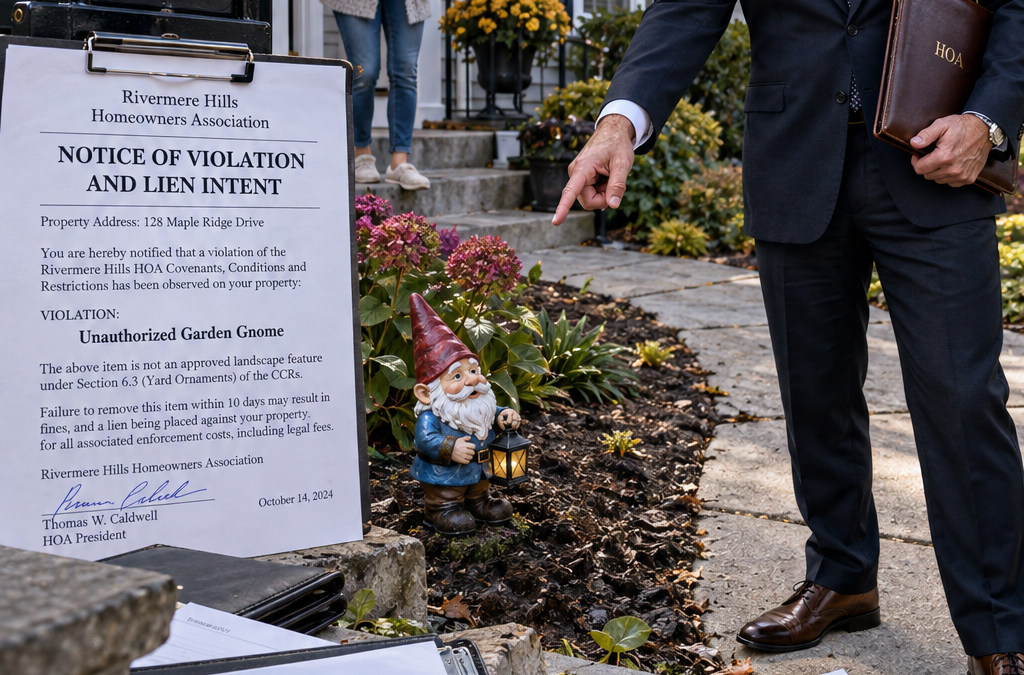
The violation referenced most prominently was a decorative garden ornament placed near my mailbox.
A garden gnome.
I had bought it at a flea market the week before.
It was small, ridiculous, red-hatted, and cheerful in a way I needed after weeks of Carol’s letters.
I placed it by the mailbox because my house still felt too new, too cautious, too afraid of itself.
Carol claimed the gnome violated exterior uniformity standards and constituted an unauthorized yard display.
The same woman had displayed a nearly identical gnome on her own porch for years.
I had seen it.
Everyone had seen it.
A ceramic gnome holding a watering can, tucked beside her front steps like a tiny witness to hypocrisy.
That night, I finally understood.
Carol was not punishing rule breakers.
She was punishing anyone who might question her.
And I had asked one question too many.
The next morning, I hired Diane Reyes.
Diane was a real estate attorney who worked out of a brick office downtown, the kind with creaky floors and law books that looked decorative until you realized she actually used them.
She was in her forties, sharp-eyed, with a calm voice and a way of reading that made silence feel like pressure.
I brought everything.
The citations.
Photos.
Emails.
Bylaws.
Financial records.
Landscaping invoices.
The lien notice.
The doormat pictures.
The garden gnome photo.
Diane read in silence for twenty minutes.
I sat across from her, gripping my purse strap.
Finally, she looked up.
“This is a paper trail of retaliation.”
I exhaled so hard I almost cried.
“So I’m not crazy.”
“No,” she said. “You’re organized.”
That was the first real comfort I had felt in weeks.
Diane filed a formal complaint with the state’s HOA oversight division.
She attached everything.
Fabricated bylaw references.
Selective enforcement.
Retaliatory fines.
Suspicious landscaping invoices.
The nepotism connection.
The lien threat.
Then she discovered something Carol never expected anyone to find.
The HOA insurance had lapsed eight months earlier.
Eight months.
The association had been collecting insurance assessment fees from residents the entire time.
But the policy was not active.
The money was going somewhere else.
That was the twist beneath the twist.
Carol was not harassing me only for control.
She was quietly pocketing money.
And nobody had been watching closely enough to notice.
Diane moved fast.
She requested an emergency HOA meeting, citing financial mismanagement, unlawful lien threats, and potential misuse of association funds.
Carol resisted, naturally.
She claimed the request was procedurally defective.
Diane corrected the defect.
Carol claimed insufficient resident support.
Diane produced signatures.
Carol claimed the clubhouse was unavailable.
Dot called three people and somehow had the clubhouse opened by noon.
The meeting was set for the following Thursday.
Residents packed the community clubhouse like it was opening night at the movies.
People who had avoided eye contact for weeks suddenly showed up holding folders. Frank sat near the aisle, pale but determined. Dot took the front row like she was ready for church and a boxing match.
Carol arrived seven minutes late.
Pearls.
Pink blazer.
White slacks.
Confidence.
She swept in like she expected the room to part for her.
It did, but not out of respect.
More like people making room for an approaching storm.
She smiled at the crowd.
“Well,” she said, “this is certainly dramatic.”
Diane Reyes stood near the projector.
“Yes,” she said. “Financial mismanagement often is.”
Carol’s smile tightened.
“This is an HOA meeting. Attorneys do not run our proceedings.”
Diane looked at her.
“Tonight, evidence does.”
A murmur moved through the room.
Diane began with the insurance.
She projected the assessment records showing residents had paid insurance fees.
Then she projected the policy lapse notice.
Eight months inactive.
Paid assessments during the lapse.
No reinstatement records.
No board disclosure.
The room went dead silent.
It was the kind of silence that means people are doing math in their heads.
Frank leaned forward.
Dot whispered, “Lord have mercy,” in a tone that sounded less like prayer and more like a verdict.
Carol stood.
“That is a clerical timing issue.”
Diane clicked to the next slide.
“Then let’s discuss the landscaping invoices.”
The screen changed.
Monthly invoices.
$12,000.
$12,000.
$12,000.
Then public business records showing Whitmore Lawn and Stone owned by Derek Whitmore, Carol’s nephew.
Someone gasped.
Not softly.
A full, honest gasp that cracked the room open.
Diane continued.
“Brookstone Manor’s common landscaping obligations are limited. One entrance flower bed, clubhouse perimeter shrubs, and mail kiosk maintenance. Yet residents have paid this vendor amounts wildly disproportionate to documented services.”
Carol’s face flushed.
“Derek’s company has served this community reliably.”
Dot stood.
“Derek’s company forgot to mulch the entrance bed for three months.”
A few people laughed nervously.
Frank stood next.
His voice shook, but he did not sit back down.
“I’ve paid three thousand dollars in fines over four years. I want every dollar back.”
The room erupted.
People began speaking over one another.
“I was fined for shutters.”
“She fined me for a wreath.”
“My son’s bike.”
“My fence gate.”
“My porch chair.”
Carol grabbed the microphone.
“These are misunderstandings.”
No one quieted.
“Clerical errors,” she said loudly.
Her voice cracked on the word clerical.
Everyone heard it.
Diane stood still beside the screen.
She did not need to shout.
That was the power of evidence.
It did not need volume.
Carol tried to regain control.
She accused me of stirring division.
She said I had brought hostility into a peaceful neighborhood.
She called the lien notice routine.
She called the missing insurance documentation unfortunate.
She called the landscaping issue a vendor relationship.
But every sentence landed weaker than the last.
Because numbers were on the screen.
Documents were in residents’ hands.
And for the first time, Carol Whitfield was not the only person in the room with paperwork.
The board voted that night.
Seven to zero.
Even two members who had never once voted against Carol raised their hands to remove her.
I watched her face as the count finished.
She looked stunned.
Not guilty.
Not sorry.
Stunned.
As if betrayal were the act of people noticing what she had done.
The state opened a formal investigation into embezzled HOA funds.
The lien against my house was voided within the week.
In writing.
Notarized.
Official.
Diane handed me the document in her office.
I stared at it for a long time.
“No lien?” I asked.
“No lien.”
“She can’t take my house?”
“No.”
My throat tightened.
I had not realized how much fear I had been carrying until it began to leave.
Six weeks later, I heard Carol had been charged with fraud.
Restitution was ordered for multiple families on Birchwood Lane and beyond, including people too scared to complain before.
Frank got his money back.
Dot got reimbursed for years of questionable assessment increases.
The Harpers recovered improper landscaping penalties.
The HOA began reviewing every fine Carol had issued during her presidency.
Some residents cried when they received refund checks.
Not because the money solved everything.
Because the checks proved they had not been crazy.
They had been targeted.
That matters.
People underestimate how damaging it is to be told over and over that you are the problem when the system itself is crooked.
Brookstone Manor changed after Carol.
Not overnight.
Neighborhoods do not heal in a single board meeting.
At first, everyone was suspicious of everything.
Every invoice.
Every email.
Every meeting agenda.
The new board had to earn trust slowly.
They posted financial records online.
Published vendor contracts.
Restored insurance coverage immediately.
Created a policy requiring disclosure of family relationships with contractors.
And, most importantly, stopped treating homeowners like subjects.
The first normal meeting after Carol’s removal lasted almost three hours because residents asked every question they had been afraid to ask for years.
It was exhausting.
It was messy.
It was exactly what should have been happening all along.
As for me, I kept the garden gnome.
At first, I moved it to the porch because I was still shaken by the lien notice.
Then one morning, after the investigation became public, I carried it back to the mailbox.
I set it exactly where it had been.
Red hat.
Crooked smile.
Tiny shovel.
A ridiculous little monument to the fact that I had survived Carol Whitfield’s kingdom.
Dot saw me from her porch.
She lifted her coffee mug in salute.
Frank walked by later and said, “Brave little guy.”
“He has legal representation,” I said.
Frank laughed so hard he had to lean on the mailbox.
Carol’s house sat across the street from mine.
After the charges, it went quiet.
No golf cart.
No clipboard.
No pearls at board meetings.
No morning patrols.
The porch gnome disappeared first.
Then the potted plants.
Then the curtains stayed closed.
I do not know if she sold the house or simply stopped coming outside.
I do know that Birchwood Lane felt different without her watching it.
People left porch chairs out.
Kids drew chalk flowers on driveways.
Someone put up a birdbath shaped like a frog.
Three raised vegetable beds appeared within a month.
Including mine.
My tomato plants grew taller than expected that summer.
By August, they were heavy with fruit, leaning against their stakes, wild and green and beautifully noncompliant with every imaginary rule Carol had ever invented.
Dot came over one evening with a basket.
“I’m here for contraband tomatoes,” she announced.
I filled the basket.
She looked toward Carol’s dark windows.
“Best kind.”
I still have the lien notice.
Not framed in the hallway.
Not somewhere guests can see it.
I keep it in the back of my file cabinet with the rest of the HOA records.
Sometimes, when I pay my mortgage or renew my insurance, I see the folder and remember how close fear came to making me smaller.
That was Carol’s real power.
Not the fines.
Not the letters.
Not even the lien threat.
Her power was convincing people they were alone.
Frank thought nobody won because nobody fought.
Dot thought Carol was too connected.
The board thought silence was safer.
I thought paying the first fine would buy peace.
We were all wrong in different ways.
Carol’s kingdom survived because everyone carried their fear separately.
It fell when we put our papers on the same table.
That is the part I remember most.
Not Carol’s face when the board voted.
Not the gasps when the invoices appeared.
Not even the official letter voiding the lien.
I remember the room changing.
People sitting up straighter.
Hands lifting.
Voices shaking, then strengthening.
Neighbors realizing their stories matched.
Carol had counted on isolation.
She had counted on residents being too embarrassed, too tired, too confused, or too afraid to compare notes.
But records do not stay quiet forever.
Not when one woman with a tomato bed starts asking why.
These days, Brookstone Manor is almost boring.
Beautifully boring.
The kind of boring I wanted when I bought my first home.
The lawns are still neat, but nobody measures them like a crime scene.
The mailboxes still look like tiny barns, but nobody threatens fines over invisible shades of navy.
Porch lights glow in different tones of white, and somehow civilization continues.
My garden gnome still stands by the mailbox, facing the empty house where the queen of Brookstone Manor used to live.
Sometimes I pause beside it after work and smile.
Not out of bitterness.
Out of proof.
Proof that a clipboard is not a crown.
Proof that bylaws are not weapons when residents actually read them.
Proof that the loudest person in the neighborhood is not always the one with power.
And proof that patience, paperwork, and a little quiet stubbornness can outlast even the most vindictive woman a cul-de-sac ever produced.
Carol nearly took my home over a garden gnome.
Instead, that gnome watched her empire fall.
𝗧𝗛𝗘 𝗘𝗡𝗗
The HOA President Tried to Take My First Home Over a Garden Gnome
The lien notice said I had thirty days before Brookstone Manor could move against the house I had just bought. The violation was a garden gnome, but the real crime was hiding in Carol Whitfield’s books.
My name is Melissa Carter, and six months before I found that notice on my kitchen counter, I believed buying my first home would finally make me feel safe.
I had spent most of my adult life renting.
Small apartments. Duplexes with thin walls. A second-floor unit above a man who practiced drums at midnight. A basement apartment that smelled like wet cardboard every spring. Every lease renewal felt like asking permission to keep existing.
So when I signed the closing documents for my little house in Brookstone Manor, I sat in my car afterward and cried.
Not loudly.
Not dramatically.
Just quiet tears behind the steering wheel, with the keys sitting in my lap.
The house was not large. It was a two-bedroom Cape Cod on Birchwood Lane in a quiet Ohio subdivision where the mailboxes were shaped like tiny red barns and every front yard looked like someone had trimmed it with nail scissors.
But it was mine.
The siding was pale gray. The shutters were navy. The kitchen window looked out over a small strip of side yard that got full sun most of the afternoon. The porch had just enough room for two chairs and a round table. The basement smelled faintly of old paint, and the upstairs bedroom had a slanted ceiling that made the room feel tucked away from the world.
I loved all of it.
The cracked walkway.
The squeaky back door.
The outdated brass light fixture in the hallway.
Even the patchy grass near the driveway.
After years of landlords telling me what I could paint, where I could park, and whether I could have a planter on the balcony, ownership felt like breathing room.
I should have known Brookstone Manor came with rules.
Of course it did.
The subdivision had an HOA.
I had read the packet before closing, or at least I thought I had. There were rules about trash bins, paint colors, fences, lawn height, exterior structures, and holiday decorations. Most seemed annoying but manageable.
I was a careful person.
I paid bills on time. I labeled folders. I kept receipts. I returned library books before the due date even when nobody cared. I did not move into a neighborhood planning to become anyone’s problem.
Then I met Carol Whitfield.
Carol was the president of the Brookstone Manor Homeowners Association, and she ran the board like a queen running a kingdom she had personally conquered.
She was in her early sixties, with silver-blond hair cut into a smooth bob, red lipstick, and a wardrobe built around pastel cardigans, pearl earrings, and capri pants so white they looked aggressive. She drove through the subdivision every morning in a green golf cart with a little HOA sticker on the front.
Clipboard in hand.
Sunglasses perched high on her head.
Always watching.
Everyone on Birchwood Lane knew better than to cross Carol.
I did not know that yet.
My first morning as a homeowner, I was sitting on the kitchen floor surrounded by boxes, eating cereal out of a coffee mug because I had not unpacked bowls, when someone knocked on the front door.
I opened it barefoot.
Carol stood on the porch holding a folder and smiling like she had caught me doing something wrong before I knew what it was.
“You must be Melissa,” she said.
“Yes. Hi.”
“Carol Whitfield. HOA president.”
“Oh. Nice to meet you.”
She handed me a packet.
“Welcome to Brookstone Manor.”
“Thank you.”
Her eyes moved over my shoulder, into the living room, where boxes were stacked almost to the window.
“Still settling in, I see.”
“Trying to.”
“Moving is so disruptive.”
“It is.”
Her smile stayed in place, but her eyes shifted toward the front lawn.
“I just wanted to make sure you received the current community standards.”
I glanced at the folder.
“I got a packet at closing.”
“This one is more practical.”
Practical.
That was the word she used.
Not updated.
Not official.
Practical.
I should have asked what that meant.
Instead, I thanked her.
She tapped one manicured finger on the folder.
“Brookstone is a very harmonious community when everyone does their part.”
I nodded.
“Of course.”
Her eyes moved to the grass near the walkway.
“It looks like your lawn is slightly above regulation height.”
I looked past her.
The grass was maybe a little long. I had closed on the house three days earlier. The moving truck had come the previous afternoon. My mower was still in my brother’s garage across town.
“I’m mowing this afternoon,” I said.
Carol’s smile widened.
“Wonderful. I’ll mark it as a courtesy conversation.”
I almost laughed.
A courtesy conversation.
About grass.
But I was new, and she had brought a folder, and I did not want to start my first week with neighborhood tension.
“That’s fine,” I said.
She turned to leave, then paused.
“One more thing, Melissa.”
“Yes?”
“Brookstone works best when residents respond promptly to reminders.”
I did not understand the warning then.
I do now.
The first citation was taped to my front door before I had even unpacked the last moving boxes.
Grass exceeding regulation height.
Fine: $50.
I stood on the porch reading it while a cardboard box labeled KITCHEN — FRAGILE sat behind me in the hallway.
I had mowed the lawn the same day Carol mentioned it.
Apparently, not fast enough.
Or not short enough.
Or perhaps the point had never been the grass at all.
I laughed it off.
New neighbor jitters, I told myself.
Some overzealous HOA president trying to establish authority.
I paid the fine online and moved on.
Two weeks later, a second violation letter arrived.
This one said my porch light bulb was the wrong shade of white.
Not too bright.
Not broken.
The wrong shade of white.
Fine: $60.
I stood under the porch light that evening, looking up at it while mosquitoes circled my ankles.
It was a normal bulb.
Warm white, maybe.
Nothing offensive.
Nothing that could ruin the aesthetic destiny of Brookstone Manor.
I checked the HOA packet from closing.
No bulb temperature chart.
No approved light spectrum.
No warning that my porch might glow with unauthorized warmth.
I emailed the management office and asked where I could find the rule.
Carol replied personally.
Exterior lighting must preserve neighborhood uniformity. The board appreciates your cooperation.
That was not an answer.
But $60 felt cheaper than a fight.
I paid it.
A few minutes later, I saw Carol near the mailboxes.
She smiled at me like nothing had happened.
That smile should have warned me.
Women like Carol do not smile at people they respect.
They smile at people they are deciding how to break.
The real trouble began with the tomatoes.
I planted them in a raised bed beside my kitchen window in early June.
It was a simple cedar box, waist-high, neat, clean, and small enough that I could reach every plant without stepping into the soil. I had grown tomatoes in pots for years on apartment balconies. Owning a house meant I could finally have a real little garden.
Three other houses in Brookstone had raised beds.
One near the corner of Birchwood and Alder.
One behind a split-rail fence on Maple Run.
One directly across from the clubhouse.
I had seen them.
So I did not think twice.
That Saturday, I filled the bed with soil, planted six tomato seedlings, tucked basil between them, and stood back feeling happier than I had in weeks.
The next morning, Carol arrived in her golf cart.
Clipboard in hand.
She stopped at the curb, stepped out, and walked straight toward the side yard.
“Melissa.”
I was watering the tomatoes.
“Good morning.”
Her eyes fixed on the raised bed.
“That will need to be removed.”
I looked at the box.
“What?”
“Vegetable gardens visible from the street are not permitted.”
I blinked.
“There are at least three others in the neighborhood.”
Carol’s smile did not move.
“Existing situations are being reviewed.”
“What rule says I can’t have this?”
“Last spring’s bylaw update.”
“I didn’t receive that.”
“It is in committee and will be formalized soon.”
I turned off the hose.
“In committee means it isn’t a rule yet.”
Carol’s eyes sharpened.
“It reflects the board’s current interpretation of the standards.”
“Can I see it in writing?”
“When finalized.”
“So you’re telling me to remove my garden based on a rule that doesn’t exist yet?”
Her voice cooled.
“I’m advising you that noncompliance may result in enforcement action.”
“Carol, it’s tomatoes.”
“It is an exterior modification.”
“It’s a box of dirt.”
She leaned closer, still smiling.
“Brookstone Manor is not a farm.”
I almost laughed.
But something in her face stopped me.
This was not about tomatoes.
At least not entirely.
That night, I created a folder on my laptop.
HOA — Carol.
Inside it, I saved every citation, every email, every receipt, and every photograph I had taken since moving in.
Call it instinct.
Call it stubbornness.
I called it survival.
Within a month, the fines had stacked to $900.
Grass.
Porch light.
Vegetable garden.
Improper planter placement.
Unapproved window box.
Side-yard visibility.
Then the letters began using a phrase that made my stomach drop.
Possible lien action.
A lien.
Against my first house.
Over tomatoes and a porch light.
I asked my neighbor Frank about it one evening while he was sweeping grass clippings off his driveway.
Frank had lived in Brookstone for eleven years. He was a retired postal worker, quiet, kind, and built like a man who had carried heavy mailbags through Ohio winters and had no interest in drama.
When I asked whether Carol’s fines were normal, his face went pale.
“Nobody fights Carol,” he said.
“Why?”
He looked toward the street.
“Nobody wins.”
That sentence stayed with me.
Because the more I thought about it, the less sense it made.
If nobody ever fought her, how would anyone know she could not be beaten?
The next morning, I bypassed Carol completely and requested the official bylaws from the HOA management company.
Not Carol’s welcome packet.
Not her practical folder.
The official recorded documents.
It took three days, but they arrived by email.
I printed them at the library and took them home in a thick stack.
Then I sat at my kitchen table with a yellow highlighter, coffee, and the tomato plants visible through the window like quiet witnesses.
There was no rule against vegetable gardens.
None.
Not this year.
Not last year.
No spring update.
No committee language.
No prohibition against raised beds visible from the street.
The bylaw Carol cited did not exist in any version on file.
I felt something shift in my chest.
Somewhere between rage and relief.
She had not been strict.
She had not been mistaken.
She had lied to my face.
After that, I changed strategy.
I kept mowing.
Kept smiling.
Kept nodding when Carol drove by in her golf cart.
I paid just enough to look compliant, but not enough to surrender the disputed balance.
And I began requesting records.
Financial records.
Meeting minutes.
Vendor contracts.
Fine schedules.
Insurance certificates.
Landscaping invoices.
Every document the HOA had a duty to make available to homeowners.
Carol responded with delays.
Then partial records.
Then excuses.
But some documents came through because the management company sent them directly before Carol could intercept everything.
Funny thing about HOA boards: most residents never ask for the paperwork, so nobody notices when the numbers stop making sense.
I noticed.
The first number that made no sense was landscaping.
Brookstone Manor had exactly one shared flower bed near the entrance sign, two narrow strips of grass beside the clubhouse, and a row of shrubs around the mail kiosk.
The invoices showed seasonal maintenance charges of $12,000 a month.
A month.
For one flower bed and some shrubs.
I stared at the total until my eyes hurt.
Maybe I was missing something.
Maybe snow removal was bundled in.
Maybe irrigation repairs.
Maybe the invoices covered more than I understood.
Then I brought muffins to my elderly neighbor Dot one Sunday.
Dot lived three houses down, in a yellow ranch with lace curtains and more bird feeders than any reasonable ecosystem could support. She had lived in Brookstone since the first houses went up and seemed to know every family scandal, fence dispute, and board election since 1994.
I brought the muffins mostly to be neighborly.
Also because Dot had once said, while watching Carol drive by, “That woman has been trouble since shoulder pads were legal.”
I thought she might know things.
We sat on her porch with coffee.
Dot broke a blueberry muffin in half and said, “You’re tangled up with Carol now.”
“I’m trying not to be.”
“That’s not how Carol works.”
I took a sip of coffee.
“Do you know anything about the landscaping company the HOA uses?”
Dot snorted.
“Whitmore Lawn and Stone?”
My hand tightened around the mug.
“Whitmore?”
“Carol’s nephew. Derek. Not a bad boy, but he wouldn’t know a hydrangea from a head of lettuce.”
I nearly choked.
“Her nephew owns the landscaping company?”
“Started it two years ago. Right after Carol got him the contract.”
I looked toward the entrance flower bed, barely visible from Dot’s porch.
“Twelve thousand dollars a month.”
Dot lowered her muffin.
“What?”
“That’s what the invoices show.”
“For that sad little flower bed?”
I nodded.
Dot’s eyes narrowed.
“Well,” she said, “that’s a sentence loud enough to wake the dead.”
It was also the beginning of the real case.
Carol’s fines against me tripled that week, as if she sensed I was circling something she did not want found.
The next citation was for my doormat.
Violation of exterior uniformity standards.
A doormat.
It was brown, rectangular, and said WELCOME in plain black letters.
The same style sat on porches all over Birchwood Lane.
I walked the neighborhood that evening and photographed twelve nearly identical doormats.
Twelve.
None had violation stickers.
None had fines.
Only mine.
I stood on the sidewalk, looking back toward my house, and understood the shape of it.
This was not about rules anymore.
It was about me specifically.
I still did not fully understand why.
Not yet.
Then came the letter that changed everything.
It arrived on a Thursday morning, thick and official, with the HOA seal at the top.
I opened it at the kitchen counter.
The first line made my stomach turn.
Notice of Intent to File Lien.
Thirty days.
I had thirty days before the HOA could proceed with lien action against my house unless unpaid fines were settled.
The violation referenced most prominently was a decorative garden ornament placed near my mailbox.
A garden gnome.
I had bought it at a flea market the week before.
It was small, ridiculous, red-hatted, and cheerful in a way I needed after weeks of Carol’s letters.
I placed it by the mailbox because my house still felt too new, too cautious, too afraid of itself.
Carol claimed the gnome violated exterior uniformity standards and constituted an unauthorized yard display.
The same woman had displayed a nearly identical gnome on her own porch for years.
I had seen it.
Everyone had seen it.
A ceramic gnome holding a watering can, tucked beside her front steps like a tiny witness to hypocrisy.
That night, I finally understood.
Carol was not punishing rule breakers.
She was punishing anyone who might question her.
And I had asked one question too many.
The next morning, I hired Diane Reyes.
Diane was a real estate attorney who worked out of a brick office downtown, the kind with creaky floors and law books that looked decorative until you realized she actually used them.
She was in her forties, sharp-eyed, with a calm voice and a way of reading that made silence feel like pressure.
I brought everything.
The citations.
Photos.
Emails.
Bylaws.
Financial records.
Landscaping invoices.
The lien notice.
The doormat pictures.
The garden gnome photo.
Diane read in silence for twenty minutes.
I sat across from her, gripping my purse strap.
Finally, she looked up.
“This is a paper trail of retaliation.”
I exhaled so hard I almost cried.
“So I’m not crazy.”
“No,” she said. “You’re organized.”
That was the first real comfort I had felt in weeks.
Diane filed a formal complaint with the state’s HOA oversight division.
She attached everything.
Fabricated bylaw references.
Selective enforcement.
Retaliatory fines.
Suspicious landscaping invoices.
The nepotism connection.
The lien threat.
Then she discovered something Carol never expected anyone to find.
The HOA insurance had lapsed eight months earlier.
Eight months.
The association had been collecting insurance assessment fees from residents the entire time.
But the policy was not active.
The money was going somewhere else.
That was the twist beneath the twist.
Carol was not harassing me only for control.
She was quietly pocketing money.
And nobody had been watching closely enough to notice.
Diane moved fast.
She requested an emergency HOA meeting, citing financial mismanagement, unlawful lien threats, and potential misuse of association funds.
Carol resisted, naturally.
She claimed the request was procedurally defective.
Diane corrected the defect.
Carol claimed insufficient resident support.
Diane produced signatures.
Carol claimed the clubhouse was unavailable.
Dot called three people and somehow had the clubhouse opened by noon.
The meeting was set for the following Thursday.
Residents packed the community clubhouse like it was opening night at the movies.
People who had avoided eye contact for weeks suddenly showed up holding folders. Frank sat near the aisle, pale but determined. Dot took the front row like she was ready for church and a boxing match.
Carol arrived seven minutes late.
Pearls.
Pink blazer.
White slacks.
Confidence.
She swept in like she expected the room to part for her.
It did, but not out of respect.
More like people making room for an approaching storm.
She smiled at the crowd.
“Well,” she said, “this is certainly dramatic.”
Diane Reyes stood near the projector.
“Yes,” she said. “Financial mismanagement often is.”
Carol’s smile tightened.
“This is an HOA meeting. Attorneys do not run our proceedings.”
Diane looked at her.
“Tonight, evidence does.”
A murmur moved through the room.
Diane began with the insurance.
She projected the assessment records showing residents had paid insurance fees.
Then she projected the policy lapse notice.
Eight months inactive.
Paid assessments during the lapse.
No reinstatement records.
No board disclosure.
The room went dead silent.
It was the kind of silence that means people are doing math in their heads.
Frank leaned forward.
Dot whispered, “Lord have mercy,” in a tone that sounded less like prayer and more like a verdict.
Carol stood.
“That is a clerical timing issue.”
Diane clicked to the next slide.
“Then let’s discuss the landscaping invoices.”
The screen changed.
Monthly invoices.
$12,000.
$12,000.
$12,000.
Then public business records showing Whitmore Lawn and Stone owned by Derek Whitmore, Carol’s nephew.
Someone gasped.
Not softly.
A full, honest gasp that cracked the room open.
Diane continued.
“Brookstone Manor’s common landscaping obligations are limited. One entrance flower bed, clubhouse perimeter shrubs, and mail kiosk maintenance. Yet residents have paid this vendor amounts wildly disproportionate to documented services.”
Carol’s face flushed.
“Derek’s company has served this community reliably.”
Dot stood.
“Derek’s company forgot to mulch the entrance bed for three months.”
A few people laughed nervously.
Frank stood next.
His voice shook, but he did not sit back down.
“I’ve paid three thousand dollars in fines over four years. I want every dollar back.”
The room erupted.
People began speaking over one another.
“I was fined for shutters.”
“She fined me for a wreath.”
“My son’s bike.”
“My fence gate.”
“My porch chair.”
Carol grabbed the microphone.
“These are misunderstandings.”
No one quieted.
“Clerical errors,” she said loudly.
Her voice cracked on the word clerical.
Everyone heard it.
Diane stood still beside the screen.
She did not need to shout.
That was the power of evidence.
It did not need volume.
Carol tried to regain control.
She accused me of stirring division.
She said I had brought hostility into a peaceful neighborhood.
She called the lien notice routine.
She called the missing insurance documentation unfortunate.
She called the landscaping issue a vendor relationship.
But every sentence landed weaker than the last.
Because numbers were on the screen.
Documents were in residents’ hands.
And for the first time, Carol Whitfield was not the only person in the room with paperwork.
The board voted that night.
Seven to zero.
Even two members who had never once voted against Carol raised their hands to remove her.
I watched her face as the count finished.
She looked stunned.
Not guilty.
Not sorry.
Stunned.
As if betrayal were the act of people noticing what she had done.
The state opened a formal investigation into embezzled HOA funds.
The lien against my house was voided within the week.
In writing.
Notarized.
Official.
Diane handed me the document in her office.
I stared at it for a long time.
“No lien?” I asked.
“No lien.”
“She can’t take my house?”
“No.”
My throat tightened.
I had not realized how much fear I had been carrying until it began to leave.
Six weeks later, I heard Carol had been charged with fraud.
Restitution was ordered for multiple families on Birchwood Lane and beyond, including people too scared to complain before.
Frank got his money back.
Dot got reimbursed for years of questionable assessment increases.
The Harpers recovered improper landscaping penalties.
The HOA began reviewing every fine Carol had issued during her presidency.
Some residents cried when they received refund checks.
Not because the money solved everything.
Because the checks proved they had not been crazy.
They had been targeted.
That matters.
People underestimate how damaging it is to be told over and over that you are the problem when the system itself is crooked.
Brookstone Manor changed after Carol.
Not overnight.
Neighborhoods do not heal in a single board meeting.
At first, everyone was suspicious of everything.
Every invoice.
Every email.
Every meeting agenda.
The new board had to earn trust slowly.
They posted financial records online.
Published vendor contracts.
Restored insurance coverage immediately.
Created a policy requiring disclosure of family relationships with contractors.
And, most importantly, stopped treating homeowners like subjects.
The first normal meeting after Carol’s removal lasted almost three hours because residents asked every question they had been afraid to ask for years.
It was exhausting.
It was messy.
It was exactly what should have been happening all along.
As for me, I kept the garden gnome.
At first, I moved it to the porch because I was still shaken by the lien notice.
Then one morning, after the investigation became public, I carried it back to the mailbox.
I set it exactly where it had been.
Red hat.
Crooked smile.
Tiny shovel.
A ridiculous little monument to the fact that I had survived Carol Whitfield’s kingdom.
Dot saw me from her porch.
She lifted her coffee mug in salute.
Frank walked by later and said, “Brave little guy.”
“He has legal representation,” I said.
Frank laughed so hard he had to lean on the mailbox.
Carol’s house sat across the street from mine.
After the charges, it went quiet.
No golf cart.
No clipboard.
No pearls at board meetings.
No morning patrols.
The porch gnome disappeared first.
Then the potted plants.
Then the curtains stayed closed.
I do not know if she sold the house or simply stopped coming outside.
I do know that Birchwood Lane felt different without her watching it.
People left porch chairs out.
Kids drew chalk flowers on driveways.
Someone put up a birdbath shaped like a frog.
Three raised vegetable beds appeared within a month.
Including mine.
My tomato plants grew taller than expected that summer.
By August, they were heavy with fruit, leaning against their stakes, wild and green and beautifully noncompliant with every imaginary rule Carol had ever invented.
Dot came over one evening with a basket.
“I’m here for contraband tomatoes,” she announced.
I filled the basket.
She looked toward Carol’s dark windows.
“Best kind.”
I still have the lien notice.
Not framed in the hallway.
Not somewhere guests can see it.
I keep it in the back of my file cabinet with the rest of the HOA records.
Sometimes, when I pay my mortgage or renew my insurance, I see the folder and remember how close fear came to making me smaller.
That was Carol’s real power.
Not the fines.
Not the letters.
Not even the lien threat.
Her power was convincing people they were alone.
Frank thought nobody won because nobody fought.
Dot thought Carol was too connected.
The board thought silence was safer.
I thought paying the first fine would buy peace.
We were all wrong in different ways.
Carol’s kingdom survived because everyone carried their fear separately.
It fell when we put our papers on the same table.
That is the part I remember most.
Not Carol’s face when the board voted.
Not the gasps when the invoices appeared.
Not even the official letter voiding the lien.
I remember the room changing.
People sitting up straighter.
Hands lifting.
Voices shaking, then strengthening.
Neighbors realizing their stories matched.
Carol had counted on isolation.
She had counted on residents being too embarrassed, too tired, too confused, or too afraid to compare notes.
But records do not stay quiet forever.
Not when one woman with a tomato bed starts asking why.
These days, Brookstone Manor is almost boring.
Beautifully boring.
The kind of boring I wanted when I bought my first home.
The lawns are still neat, but nobody measures them like a crime scene.
The mailboxes still look like tiny barns, but nobody threatens fines over invisible shades of navy.
Porch lights glow in different tones of white, and somehow civilization continues.
My garden gnome still stands by the mailbox, facing the empty house where the queen of Brookstone Manor used to live.
Sometimes I pause beside it after work and smile.
Not out of bitterness.
Out of proof.
Proof that a clipboard is not a crown.
Proof that bylaws are not weapons when residents actually read them.
Proof that the loudest person in the neighborhood is not always the one with power.
And proof that patience, paperwork, and a little quiet stubbornness can outlast even the most vindictive woman a cul-de-sac ever produced.
Carol nearly took my home over a garden gnome.
Instead, that gnome watched her empire fall.








