𝗙𝗨𝗟𝗟 𝗦𝗧𝗢𝗥𝗬 The HOA President Tried to Take Control of My Private Runway—Then Her Truck Smashed Into My Plane and Exposed a $26 Million Problem
𝗣𝗔𝗥𝗧 𝟮
That became her solution whenever facts became inconvenient.
End the conversation.
Threaten enforcement.
Move forward anyway.
A week later, everything changed.
I was at the runway preparing the aircraft when I heard a diesel engine behind me.
At first, I assumed one of the neighboring utility crews was passing along the service road.
Then the sound got louder.
Closer.
I turned.
The same white HOA utility truck was coming through the private access entrance.
Fast.
Much too fast.
My plane was parked beside the edge of the strip.
Chocked.
Engine off.
Nobody inside.
The truck continued toward it.
I raised both arms.
“Stop!”
It didn’t.
For half a second, I thought the driver had lost control.
Then I saw Linda.
She stood near the HOA boundary in her red dress, arms folded.
Watching.
The truck crossed the private-property marker.
Never slowed.
Never turned enough.
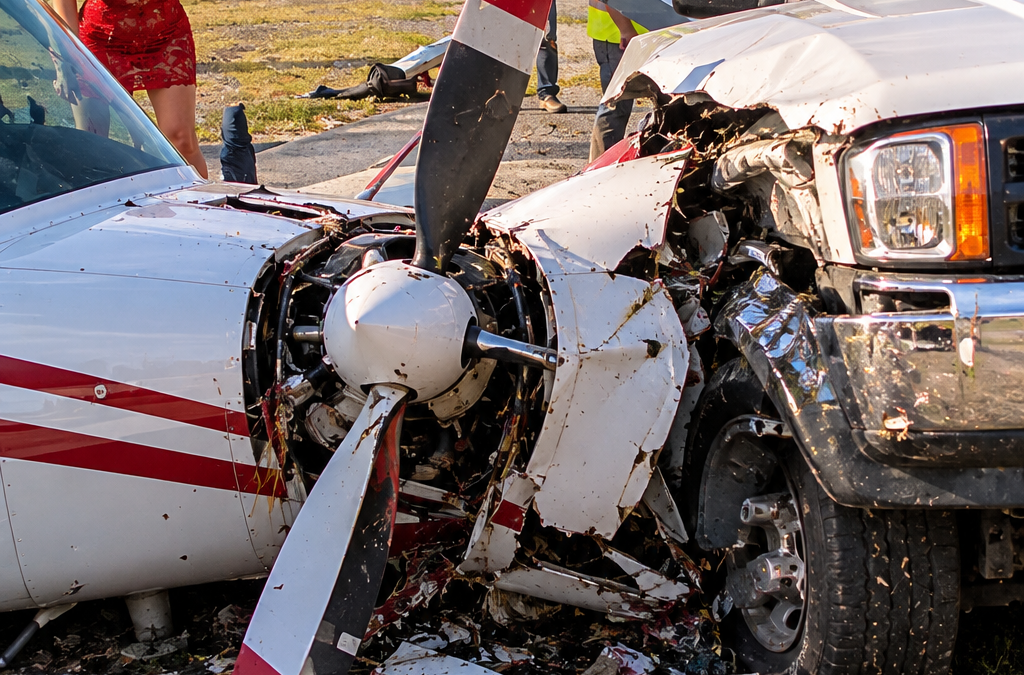
The front corner struck the aircraft’s wing.
The sound was sickening.
Metal shrieked.
The airplane rocked violently on its landing gear.
The wing buckled.
The truck finally stopped with its bumper buried against aluminum.
I ran.
“What the hell are you doing?”
The driver stumbled out looking stunned.
Linda walked toward us much more slowly.
I looked at the crushed wing.
Bent skin.
Damaged leading edge.
Possible structural damage underneath.
I had spent years maintaining that aircraft.
In seconds, it had become an insurance investigation.
I turned toward Linda.
“You drove a truck into my plane.”
She lifted her eyebrows.
“I didn’t drive anything.”
“Your truck.”
“There was an accident.”
“An accident?”
“The aircraft was improperly parked.”
For a moment I was speechless.
“Improperly parked?”
“In a restricted access zone.”
“This is my runway.”
“The HOA has repeatedly informed you that this area is under access review.”
I pointed toward the truck.
“Why was your vehicle driving across it?”
“HOA maintenance vehicles have access authority.”
“Show me.”
“Not this again.”
“Yes. This again.”
I stepped toward the painted private-boundary marker the truck had crossed.
“This is private property.”
Linda shrugged.
“According to you.”
That was when something inside me became completely calm.
I pulled out my phone.
“What are you doing?”
“Recording.”
Her expression changed.
“You may not record HOA personnel without authorization.”
I almost laughed.
“You just ran a utility truck into an airplane on my land.”
“It was an accident.”
“Then you should have no problem with evidence.”
She looked toward the driver.
He suddenly looked very uncomfortable.
“Move the truck,” Linda told him.
I held up one hand.
“No.”
She stared at me.
“What?”
“Nothing moves until everything is documented.”
“You do not give orders to HOA employees.”
“I’m not.”
I pointed toward the aircraft.
“I’m preserving an accident scene.”
Linda stepped closer.
“You are escalating this.”
“No.”
I looked at the crushed wing.
“You already did.”
What Linda didn’t know was that I had security cameras.
Several.
The hangar camera covered the runway entrance.
Another camera covered the aircraft parking area.
A third looked toward the access road.
By that evening, I had the footage.
I watched it once.
Then again.
Then a third time.
The utility truck entered my parcel.
It crossed the clearly marked boundary.
It did not appear to brake.
It did not make any meaningful evasive maneuver.
And Linda was visible in the frame.
Standing near the edge of the runway.
Watching before the impact.
Watching during the impact.
Watching afterward.
The footage did not tell me what she had ordered.
It did prove the story she had immediately tried to sell—that my aircraft was somehow responsible for being struck in a restricted HOA zone—was going to be difficult to defend.
I called my attorney.
His name was David.
He came to my house the next morning.
We watched the footage together.
He didn’t speak through the entire clip.
When it ended, he rewound it.
Watched the truck cross the boundary.
Paused.
“Where is this marker?”
“Property line.”
“You sure?”
“Yes.”
“Show me the survey.”
I brought out the original property survey.
It had been included with older family records and updated periodically over the years.
David spread it across the table.
He traced the runway boundary.
“Truck crossed here?”
“Exactly.”
He pointed.
“Jake, they crossed onto your land before they hit the plane.”
“I know.”
“No, I mean clearly.”
He compared distances.
Pulled up photographs.
Made notes.
Then stopped.
“What?”
He leaned closer to the survey.
“Where is the HOA clubhouse?”
“Northwest.”
“Show me.”
I pointed toward the new Maple Ridge recreation complex.
It was huge.
Indoor event space.
Fitness center.
Pool complex.
Restaurant.
Offices.
Meeting rooms.
Stone terraces.
The HOA had bragged endlessly about the development.
Reported project value: twenty-six million dollars.
David looked from the survey to a modern development map.
Then back again.
His expression changed.
“What?”
He said nothing.
“David.”
He traced an old boundary line with one finger.
“This line.”
“Yes?”
“Look where it runs.”
I followed it.
Straight beneath one edge of the clubhouse development.
I stared.
“No.”
“Maybe.”
“The clubhouse is on HOA land.”
“Most of it appears to be.”
“Most?”
He looked up.
“Part of that project may be sitting inside your parcel.”
For several seconds, I forgot about the damaged airplane.
“That can’t be right.”
“Maybe it isn’t.”
He pulled the newer HOA map closer.
“There’s a discrepancy.”
The modern HOA development plan showed the boundary farther south.
The original survey didn’t.
The line had moved.
Not physically.
On paper.
Someone had been using the wrong property boundary for years.
David sat back.
“This just became a much bigger case.”
“How much bigger?”
He tapped the clubhouse.
“Twenty-six-million-dollar bigger.”
We did not accuse anyone publicly.
Not yet.
David ordered certified title records.
Old surveys.
County maps.
Recorded plats.
Property transfers.
Boundary amendments.
Anything showing whether the line had ever been lawfully changed.
Meanwhile, Linda acted like the truck collision had somehow strengthened her position.
The HOA sent me a letter demanding that the aircraft remain grounded pending “community safety review.”
I forwarded it to David.
His response was three words.
Do not engage.
Then Linda called an emergency meeting.
I attended with David.
The clubhouse ballroom was packed.
The irony of sitting inside a building that might partially occupy my property was not lost on either of us.
Linda stood at the front.
Red lace dress.
Black heels.
Perfect makeup.
Angry eyes.
She began without preamble.
“Maple Ridge is under attack.”
People murmured.
“One individual has chosen to weaponize a minor vehicle accident as part of an ongoing campaign against this association.”
I almost stood.
David touched my arm.
“Wait.”
Linda continued.
“The board will not allow intimidation to compromise community property.”
David opened his briefcase.
Linda looked toward us.
“Jake, if you have something to say—”
“I don’t.”
That confused her.
She looked almost disappointed.
“Then perhaps your attorney does.”
David stood.
“Yes.”
He carried one rolled document to the front table.
Linda smiled.
“You have two minutes.”
David unrolled the original survey.
Silence spread across the room.
“Before discussing the aircraft incident, we need clarification regarding the property boundary used for this development.”
Linda frowned.
“What development?”
“This clubhouse.”
Her face went blank.
A board member leaned forward.
David placed the current HOA development map beside the original survey.
“The boundary lines do not match.”
Linda laughed.
“That survey is obsolete.”
David looked toward the HOA attorney.
“Is it?”
The attorney did not answer.
He pulled the documents closer.
Compared them.
Then asked another board member for the title binder.
Linda’s expression changed.
“What is wrong?”
Nobody answered.
“Mark?”
The HOA attorney kept flipping pages.
“What is he talking about?”
Still nothing.
Linda’s voice rose.
“What is wrong?”
Finally, the attorney leaned toward her and whispered.
I couldn’t hear everything.
I heard one sentence.
“The title record may be worse than we thought.”
Linda’s face lost color.
She looked toward me.
“You did this.”
I actually laughed once.
“I moved your boundary?”
“You’re manufacturing a dispute.”
David answered.
“The boundary predates your HOA.”
“This clubhouse was professionally surveyed.”
“Then we’ll review the survey.”
“It was approved.”
“Approval does not change title.”
Linda slammed her hand onto the table.
“This community spent twenty-six million dollars on this facility.”
David nodded.
“That is exactly why you should want the boundary correct.”
The emergency meeting ended without the triumphant statement Linda had expected.
By the following morning, David filed an emergency property action.
The HOA responded with a team of attorneys.
Not one.
A team.
They asked the court to dismiss the claim immediately.
They characterized the old survey as outdated.
They characterized my argument as opportunistic.
They called the aircraft collision unrelated.
They argued that decades of development records supported their interpretation.
The judge did not dismiss anything.
Instead, he ordered a full review of the title and boundary history.
Linda stopped smiling after that.
The case moved quickly.
Certified deed records came in.
Then old county plats.
Survey notes.
Historical property maps.
Development agreements.
The original boundary kept appearing.
Again.
Again.
Again.
The HOA’s newer boundary appeared much later.
But nobody could initially identify a recorded conveyance that moved the line.
That was the problem.
Maps can be redrawn.
Ownership requires legal documentation.
Then the truck footage entered the case.
The courtroom lights dimmed slightly.
My security video played on a screen.
The white utility truck appeared.
Entered the private access road.
Crossed the boundary marker.
Continued.
Hit the plane.
Metal folded.
Linda stood in the background.
Watching.
Nobody spoke until the video ended.
The HOA attorney stood.
“This was an accidental vehicle collision.”
David responded.
“We are presenting it to establish where the HOA was asserting access rights.”
The judge replayed part of the footage.
Paused as the truck crossed the marker.
“Whose property is the vehicle on at this point?”
David answered.
“According to the original survey, my client’s.”
The HOA attorney objected that the boundary itself remained disputed.
The judge nodded.
“Which is why we are reviewing it.”
Linda sat behind counsel.
For the first time since I had known her, she looked genuinely worried.
The judge examined my original deed.
Then the HOA development map.
Placed them side by side.
The lines did not match.
He requested county records.
Not summaries.
Original records.
The county produced decades-old property material.
Historical plats.
Transfer records.
Recorded surveys.
Old references.
They supported the original boundary.
The clubhouse problem became impossible to ignore.
The HOA’s attorneys changed tone.
They stopped describing the claim as absurd.
Started describing it as “complex.”
That was lawyer language for a problem that had become real.
Linda still refused to accept it.
Outside one hearing, she cornered me near the courthouse steps.
“This is vindictive.”
I stopped.
“What is?”
“You’re trying to seize our clubhouse because of an accident.”
“No.”
“You couldn’t control the board, so now you’re attacking the community.”
“I never tried to control your board.”
“You’ve hated Maple Ridge from the beginning.”
“I barely cared about Maple Ridge until you tried to control my runway.”
She crossed her arms.
“You could have cooperated.”
“With what?”
“Reasonable restrictions.”
“On my land?”
“Your aircraft affects everyone.”
“So you sent a truck onto my property?”
“It was an accident.”
“You keep saying that.”
“Because it was.”
I looked at her.
“Then why did you threaten me before it happened?”
Her eyes hardened.
“I never threatened you.”
“You told me I’d regret refusing the HOA.”
“Context matters.”
“So does video.”
For once, she said nothing.
The title review continued.
Experts compared monuments.
Older surveys.
Recorded bearings.
Distances.
The clubhouse expansion documents.
The old line was not some vague pencil mark.
It was supported by historical records.
Part of the twenty-six-million-dollar clubhouse complex had crossed it.
That fact changed everything.
My original dispute had been about a runway.
Then a damaged aircraft.
Now an enormous HOA asset had become entangled in the same boundary problem Linda had refused to acknowledge.
During another hearing, the judge asked the HOA attorney a simple question.
“What recorded instrument transferred this disputed portion of land from Mr. Jake’s chain of title to the association?”
The attorney requested time to answer.
Linda leaned toward him and whispered urgently.
The judge waited.
The attorney stood again.
“We are still reviewing historical conveyances.”
That answer said enough.
The court issued a protective order preserving my property interest while the title questions were resolved.
Then came the part nobody in Maple Ridge expected.
Assets connected to the disputed clubhouse parcel were placed under court control pending resolution.
Not demolished.
Not handed to me outright.
Controlled.
Preserved.
No unilateral transfer.
No casual changes.
No pretending the title dispute did not exist.
The HOA could no longer treat the disputed portion of the property as unquestioned association territory.
When David called me with the order, I had to ask him to repeat it.
“The court is protecting the parcel while the case proceeds.”
“What does that mean for the clubhouse?”
“It means they don’t get to behave like the title question is imaginary anymore.”
Linda understood by the next morning.
County deputies arrived at the clubhouse carrying court notices.
I didn’t arrange some public spectacle.
I didn’t call reporters.
I didn’t invite neighbors.
I happened to be there with David because we were meeting an investigator.
The notices went up.
One near the main entrance.
Another associated with the disputed property area.
HOA members gathered almost immediately.
People came out of the fitness center.
A couple stepped away from the pool entrance.
Board members started making phone calls.
Linda appeared from inside.
She stopped when she saw the deputies.
Then saw the notices.
Then saw me.
Her expression was something I had never seen before.
Not anger.
Shock.
The clubhouse had always been her throne.
She hosted meetings there.
Fundraisers.
Resident events.
Board sessions.
Every polished stone column and expensive window had been used as proof that Linda’s leadership had made Maple Ridge powerful.
Now part of that twenty-six-million-dollar symbol was tied to a court order because she had insisted property boundaries did not matter when they got in her way.
She walked toward me.
David quietly said, “Don’t engage unless you want to.”
I stayed.
Linda stopped several feet away.
“Why?”
I looked at her.
“What?”
“Why did you take it this far?”
I almost couldn’t believe she was asking.
Behind her was the clubhouse.
Behind me, miles away, sat my damaged aircraft.
I pointed toward the direction of the runway.
“You remember my plane?”
Her mouth tightened.
“That was an accident.”
“You remember telling me the HOA controlled my runway?”
“You refused every reasonable compromise.”
“Do you remember saying I would regret refusing you?”
Her eyes flicked toward David.
Then back.
“You’ve turned one disagreement into a war against an entire community.”
“No.”
I shook my head.
“You did.”
“That’s ridiculous.”
“You came onto my property.”
“You damaged my aircraft.”
“We did not intentionally—”
“You claimed authority over a runway you couldn’t prove you owned.”
“We relied on our records.”
“And when I asked you for the deed?”
Silence.
“You never produced one.”
Her face hardened again.
“This clubhouse belongs to Maple Ridge.”
“Then your lawyers can prove it.”
“You know what happens if this project gets tied up for months? Residents suffer.”
“Then maybe someone should have checked the boundary before spending twenty-six million dollars.”
She stepped closer.
“You’re enjoying this.”
That accusation made me angrier than the shouting.
“No.”
My voice came out colder than I expected.
“You think I enjoy looking at an airplane with a crushed wing?”
She stopped.
“You think I enjoy paying lawyers because your HOA couldn’t answer one basic question?”
I pointed toward the courthouse notice.
“I asked you for the deed before any of this happened.”
Linda said nothing.
“You could have checked.”
Nothing.
“You could have stopped.”
Nothing.
“You could have treated my property line like it mattered.”
Her eyes shifted toward the damaged-property case paperwork David held.
“You didn’t.”
For a few seconds, the performance disappeared.
No HOA president.
No red dress and perfect posture.
Just a woman realizing that every time she had responded to a boundary with more force, she had made her own position worse.
Finally she whispered, “This didn’t have to happen.”
I nodded.
“That’s the first thing you’ve said I agree with.”
Then I walked away.
The plane was repaired eventually.
New wing work.
Inspection.
Structural evaluation.
More expense and more time than I wanted to think about.
The first day I flew again, I spent almost twice as long on the preflight.
I checked everything.
Then checked again.
Partly because the aircraft had been repaired.
Partly because trust is difficult to restore once you have watched steel buckle in front of you.
When I finally opened the throttle, the aircraft rolled down the runway.
My runway.
The same strip Linda had tried to regulate.
The same land an HOA notice had called community-controlled.
The wheels lifted.
For a second, I felt nothing but relief.
Below me, Maple Ridge became smaller.
Rows of houses.
Roads.
Pool.
The enormous clubhouse.
From the air, property boundaries are invisible.
That is probably why people like Linda find them so easy to ignore.
You can look down at a landscape and convince yourself everything connects.
One community.
One road system.
One development.
But law doesn’t work from a thousand feet above the ground.
It works in deeds.
Recorded lines.
Surveys.
Transfers.
Easements.
Documents.
The things Linda treated as inconveniences were the things that eventually mattered most.
The court battle over the clubhouse continued beyond the first protective order.
That part was complicated.
Attorneys kept working.
Title records remained under review.
But one fact had become clear.
The HOA did not get to simply declare my property part of its domain.
My runway remained mine.
My legal property interest was protected.
And the association’s twenty-six-million-dollar development was forced to answer the same question I had asked Linda on the very first day.
Show me the deed.
Sometimes I think about how small the original dispute was.
Linda wanted control over when I could fly.
That was it.
She could have sent a letter.
I could have sent a reply.
Someone could have looked at the recorded property line.
They would have discovered the runway sat on my parcel.
The HOA would have stepped back.
End of story.
But Linda could not tolerate being told that something lay outside her authority.
So she escalated.
Warnings.
Threats.
Flight restrictions.
Utility vehicles.
Then the collision.
Every escalation created more evidence.
Her worst mistake was believing intimidation worked better than verification.
The truck footage showed the HOA crossing onto my land.
The survey showed why that mattered.
Then the same survey exposed the clubhouse.
One property line connected everything.
That was what finally broke Linda’s control over the story.
She had spent months insisting I was unreasonable.
Uncooperative.
Hostile.
A danger to community peace.
Then the county records arrived.
Records don’t care who speaks more confidently.
They don’t care who has the larger legal team.
They don’t care whether a clubhouse costs twenty-six million dollars or twenty-six dollars.
They say what was recorded.
And what was recorded did not match Linda’s version.
Months after the collision, I found the original HOA warning in an old folder.
The paper was slightly creased.
NOTICE OF AVIATION USE VIOLATION.
I reread the sentence claiming the HOA had authority to regulate operations on the runway.
It almost seemed funny.
Almost.
Then I remembered the sound of metal collapsing.
I folded the notice and returned it to the folder.
I kept the security footage too.
Not because I enjoyed watching it.
I hated watching it.
But evidence has value precisely because people’s stories change.
Linda’s did.
First the runway belonged to the HOA.
Then the truck had authorization to be there.
Then it was just an accident.
Then the boundary was wrong.
Then the old survey was obsolete.
Then the clubhouse dispute was an attack on the community.
Every time one explanation failed, another appeared.
The deed never changed.
The old county records never changed.
The footage never changed.
That was the difference.
Linda’s authority had always depended on people accepting her version before checking.
Once checking began, everything she had built around that certainty started cracking.
Not only her claim over my runway.
Her clubhouse.
Her map.
Her credibility.
All of it.
I still fly.
Usually early mornings.
Weather permitting.
I open the hangar while the sun is just touching the far end of the runway.
There is a moment before startup when everything is perfectly quiet.
I love that moment.
No board meetings.
No lawyers.
No Linda.
Just the aircraft and the strip ahead.
The HOA never got the schedule it demanded.
Nobody calls asking permission before I use my own runway.
Nobody sends me warnings about “community aviation operations.”
The boundary marker near the access road is more visible now.
I repainted it myself.
PRIVATE PROPERTY.
Not because I believe a sign can stop somebody determined to ignore a deed.
Linda proved otherwise.
I keep it there because I like the simplicity.
Two words.
No committee meeting required.
No board vote.
No twenty-page HOA interpretation.
Private property.
Linda once believed those words became negotiable whenever the HOA wanted something badly enough.
A runway.
Access.
Control.
Eventually, part of a twenty-six-million-dollar clubhouse site.
She was wrong.
The HOA had tried to make my runway theirs through repetition.
Then a truck crossed the line and damaged my airplane.
That collision forced people to look at the boundary.
And when they looked closely enough, they found something Linda never expected.
The boundary didn’t stop at the runway dispute.
It continued straight toward the most expensive symbol of HOA power in the entire community.
The courthouse did not care how impressive that building looked.
The county records did not care how many ribbon cuttings Linda had hosted.
The judge cared about title.
And once the original records were placed beside the HOA’s newer map, all the confidence in the world could not make those lines match.
Linda asked me why I took things so far.
I never did.
I stood still.
She was the one who kept crossing the line.
First with threats.
Then with a truck.
Then with a twenty-six-million-dollar building.
All I eventually did was make sure somebody looked down and saw where the line had been all along.
𝗧𝗛𝗘 𝗘𝗡𝗗
The HOA President Tried to Take Control of My Private Runway—Then Her Truck Smashed Into My Plane and Exposed a $26 Million Problem
The first time Linda told me the HOA controlled my runway, I laughed.
The second time, she threatened me.
The third time, one of her utility trucks drove straight across my property and slammed into my airplane while she stood twenty yards away watching.
That was when I stopped laughing.
My name is Jake, and the airstrip behind my house had existed long before the subdivision next door, long before the HOA, and certainly long before Linda decided a volunteer board position gave her authority over aircraft, property lines, and anything else she could point at from the clubhouse balcony.
The runway was simple.
A narrow private strip cut across acreage my family had owned for decades.
It wasn’t a commercial airport.
There was no terminal.
No tower.
No crowds.
Just a maintained grass-and-gravel strip, a small hangar, and the single-engine airplane I flew on weekends.
Flying was the one part of my life that still made the rest of the world go quiet.
I could spend an hour checking fuel, weather, control surfaces, tire pressure and oil, then climb into the cockpit and watch everything complicated become small beneath me.
I had one rule.
My land.
My runway.
My responsibility.
Apparently Linda found that offensive.
The first warning arrived on a Tuesday morning.
It was taped to the hangar door in a plastic sleeve like some kind of official enforcement notice.
NOTICE OF AVIATION USE VIOLATION.
According to the letter, operation of “private aircraft activity” within the community required HOA approval.
I read it twice.
Then I looked toward Maple Ridge Estates on the other side of the tree line.
The subdivision had been built years after my family acquired the land.
The HOA controlled its own roads, clubhouse, pool and landscaped common areas.
It did not control my runway.
I called the number on the notice.
Linda answered.
“Maple Ridge HOA.”
“This is Jake.”
A pause.
Then her voice cooled.
“You received the notice.”
“I did.”
“Good.”
“Why is your HOA sending violation notices to property outside your association?”
“The airstrip impacts community operations.”
“That wasn’t my question.”
“The board has determined that aviation activity requires regulation.”
“You can regulate aircraft on HOA property.”
“The runway services the community boundary.”
“It sits entirely on my parcel.”
“That’s disputed.”
It wasn’t.
“What exactly are you claiming?”
“That the runway falls within the expanded community-management zone.”
I almost laughed again.
“Management zone?”
“Yes.”
“Is that another phrase for land you don’t own?”
Her voice hardened.
“You would be wise not to make this hostile.”
“I’m asking you to show me a deed.”
“A what?”
“A deed. Easement. Recorded agreement. Anything giving your HOA authority over my runway.”
“We don’t need to send internal legal documents to every hostile homeowner who demands them.”
“I’m not an HOA homeowner.”
That silenced her for half a second.
Then she said quietly, “You’re going to regret making this difficult.”
That got my attention.
“What does that mean?”
“It means the board has options.”
“Is that a threat?”
“It’s advice.”
Then she hung up.
I saved the notice.
Wrote down the conversation.
And assumed the situation would eventually disappear once somebody with actual legal knowledge explained to Linda that an HOA did not acquire neighboring property by declaring an “expanded management zone.”
I underestimated her.
Linda was around forty and carried herself like she had been elected governor rather than president of a neighborhood association.
She was beautiful and knew precisely how much attention she commanded. Long dark hair, expensive makeup, heels even when walking gravel roads, and some variation of a tight red lace dress whenever cameras, board members or contractors were around.
At first, that made people underestimate her.
Then she started talking.
Linda did not ask.
She announced.
She did not disagree.
She corrected.
And whenever somebody produced evidence contradicting her, she treated the evidence itself as an act of disrespect.
Three days after the first notice, she came to my property.
She didn’t call.
A white HOA utility truck stopped beside the runway.
Linda stepped out.
Two maintenance employees stayed inside.
I was checking the aircraft before an afternoon flight.
She walked toward me.
“You’re not flying today.”
I actually looked around, wondering whether she could possibly be talking to someone else.
“Excuse me?”
“The HOA has temporarily restricted flight operations while we establish community-use procedures.”
I rested one hand against the airplane.
“On my runway?”
“Yes.”
“With my aircraft?”
“Yes.”
“On property you don’t own?”
Her jaw tightened.
“We’ve already covered this.”
“No. You’ve made claims. You still haven’t shown me a deed.”
“The board doesn’t answer to you.”
“Then I don’t answer to the board.”
Her face changed immediately.
That was the sentence she could never tolerate.
I continued.
“If the HOA owns the runway, prove it.”
“We have maps.”
“Maps aren’t deeds.”
“We have development documents.”
“Then show me.”
“You don’t dictate how the HOA operates.”
“And you don’t dictate when I fly from my land.”
She stepped closer.
“You need to understand something. People in those homes pay thousands of dollars a year for safety and peaceful enjoyment.”
“So?”
“Your aircraft disturbs that.”
“My airstrip predates most of those houses.”
“That doesn’t give you unlimited rights.”
“It gives me more rights over this runway than your HOA has.”
For several seconds, neither of us spoke.
Linda smiled.
It wasn’t friendly.
“Keep pushing.”
Then she turned and walked back toward the utility truck.
I should have realized that was not the end of the conversation.
It was the beginning of retaliation.
More notices arrived.
Noise.
Aircraft storage.
“Unauthorized mechanical activity.”
One letter claimed my plane was parked in a restricted buffer zone.
Another demanded twenty-four-hour advance notice before any takeoff.
The board even sent a proposed schedule specifying when I would be “permitted” to use the runway.
Monday through Friday.
No flights before 9:00 a.m.
No flights after 5:00 p.m.
Weekend activity “subject to board approval.”
I sent one response.
Please provide recorded documentation granting Maple Ridge HOA any property or aviation authority over my parcel.
They never did.
Instead, Linda became louder.
At an HOA meeting I attended only because they had placed my runway on the agenda, she stood behind the podium and announced that “one neighboring landowner believes his hobby is more important than the safety of hundreds of residents.”
I raised my hand.
She ignored me.
“Private aircraft cannot be allowed to operate without accountability.”
I raised my hand again.
Finally she sighed.
“Jake.”
“Do you have the deed?”
The room went quiet.
Her expression froze.
“What?”
“The deed giving Maple Ridge ownership or control over my runway.”
“This meeting is not about your personal interpretation of property law.”
“That sounds like no.”
People shifted in their chairs.
Linda leaned toward the microphone.
“The HOA’s counsel has reviewed the matter.”
“Great. Then the deed should be easy to produce.”
“You are being intentionally disruptive.”
“No. I’m asking one question.”
She struck the table with her palm.
“Enough.”
That became her solution whenever facts became inconvenient.
End the conversation.
Threaten enforcement.
Move forward anyway.
A week later, everything changed.
I was at the runway preparing the aircraft when I heard a diesel engine behind me.
At first, I assumed one of the neighboring utility crews was passing along the service road.
Then the sound got louder.
Closer.
I turned.
The same white HOA utility truck was coming through the private access entrance.
Fast.
Much too fast.
My plane was parked beside the edge of the strip.
Chocked.
Engine off.
Nobody inside.
The truck continued toward it.
I raised both arms.
“Stop!”
It didn’t.
For half a second, I thought the driver had lost control.
Then I saw Linda.
She stood near the HOA boundary in her red dress, arms folded.
Watching.
The truck crossed the private-property marker.
Never slowed.
Never turned enough.
The front corner struck the aircraft’s wing.
The sound was sickening.
Metal shrieked.
The airplane rocked violently on its landing gear.
The wing buckled.
The truck finally stopped with its bumper buried against aluminum.
I ran.
“What the hell are you doing?”
The driver stumbled out looking stunned.
Linda walked toward us much more slowly.
I looked at the crushed wing.
Bent skin.
Damaged leading edge.
Possible structural damage underneath.
I had spent years maintaining that aircraft.
In seconds, it had become an insurance investigation.
I turned toward Linda.
“You drove a truck into my plane.”
She lifted her eyebrows.
“I didn’t drive anything.”
“Your truck.”
“There was an accident.”
“An accident?”
“The aircraft was improperly parked.”
For a moment I was speechless.
“Improperly parked?”
“In a restricted access zone.”
“This is my runway.”
“The HOA has repeatedly informed you that this area is under access review.”
I pointed toward the truck.
“Why was your vehicle driving across it?”
“HOA maintenance vehicles have access authority.”
“Show me.”
“Not this again.”
“Yes. This again.”
I stepped toward the painted private-boundary marker the truck had crossed.
“This is private property.”
Linda shrugged.
“According to you.”
That was when something inside me became completely calm.
I pulled out my phone.
“What are you doing?”
“Recording.”
Her expression changed.
“You may not record HOA personnel without authorization.”
I almost laughed.
“You just ran a utility truck into an airplane on my land.”
“It was an accident.”
“Then you should have no problem with evidence.”
She looked toward the driver.
He suddenly looked very uncomfortable.
“Move the truck,” Linda told him.
I held up one hand.
“No.”
She stared at me.
“What?”
“Nothing moves until everything is documented.”
“You do not give orders to HOA employees.”
“I’m not.”
I pointed toward the aircraft.
“I’m preserving an accident scene.”
Linda stepped closer.
“You are escalating this.”
“No.”
I looked at the crushed wing.
“You already did.”
What Linda didn’t know was that I had security cameras.
Several.
The hangar camera covered the runway entrance.
Another camera covered the aircraft parking area.
A third looked toward the access road.
By that evening, I had the footage.
I watched it once.
Then again.
Then a third time.
The utility truck entered my parcel.
It crossed the clearly marked boundary.
It did not appear to brake.
It did not make any meaningful evasive maneuver.
And Linda was visible in the frame.
Standing near the edge of the runway.
Watching before the impact.
Watching during the impact.
Watching afterward.
The footage did not tell me what she had ordered.
It did prove the story she had immediately tried to sell—that my aircraft was somehow responsible for being struck in a restricted HOA zone—was going to be difficult to defend.
I called my attorney.
His name was David.
He came to my house the next morning.
We watched the footage together.
He didn’t speak through the entire clip.
When it ended, he rewound it.
Watched the truck cross the boundary.
Paused.
“Where is this marker?”
“Property line.”
“You sure?”
“Yes.”
“Show me the survey.”
I brought out the original property survey.
It had been included with older family records and updated periodically over the years.
David spread it across the table.
He traced the runway boundary.
“Truck crossed here?”
“Exactly.”
He pointed.
“Jake, they crossed onto your land before they hit the plane.”
“I know.”
“No, I mean clearly.”
He compared distances.
Pulled up photographs.
Made notes.
Then stopped.
“What?”
He leaned closer to the survey.
“Where is the HOA clubhouse?”
“Northwest.”
“Show me.”
I pointed toward the new Maple Ridge recreation complex.
It was huge.
Indoor event space.
Fitness center.
Pool complex.
Restaurant.
Offices.
Meeting rooms.
Stone terraces.
The HOA had bragged endlessly about the development.
Reported project value: twenty-six million dollars.
David looked from the survey to a modern development map.
Then back again.
His expression changed.
“What?”
He said nothing.
“David.”
He traced an old boundary line with one finger.
“This line.”
“Yes?”
“Look where it runs.”
I followed it.
Straight beneath one edge of the clubhouse development.
I stared.
“No.”
“Maybe.”
“The clubhouse is on HOA land.”
“Most of it appears to be.”
“Most?”
He looked up.
“Part of that project may be sitting inside your parcel.”
For several seconds, I forgot about the damaged airplane.
“That can’t be right.”
“Maybe it isn’t.”
He pulled the newer HOA map closer.
“There’s a discrepancy.”
The modern HOA development plan showed the boundary farther south.
The original survey didn’t.
The line had moved.
Not physically.
On paper.
Someone had been using the wrong property boundary for years.
David sat back.
“This just became a much bigger case.”
“How much bigger?”
He tapped the clubhouse.
“Twenty-six-million-dollar bigger.”
We did not accuse anyone publicly.
Not yet.
David ordered certified title records.
Old surveys.
County maps.
Recorded plats.
Property transfers.
Boundary amendments.
Anything showing whether the line had ever been lawfully changed.
Meanwhile, Linda acted like the truck collision had somehow strengthened her position.
The HOA sent me a letter demanding that the aircraft remain grounded pending “community safety review.”
I forwarded it to David.
His response was three words.
Do not engage.
Then Linda called an emergency meeting.
I attended with David.
The clubhouse ballroom was packed.
The irony of sitting inside a building that might partially occupy my property was not lost on either of us.
Linda stood at the front.
Red lace dress.
Black heels.
Perfect makeup.
Angry eyes.
She began without preamble.
“Maple Ridge is under attack.”
People murmured.
“One individual has chosen to weaponize a minor vehicle accident as part of an ongoing campaign against this association.”
I almost stood.
David touched my arm.
“Wait.”
Linda continued.
“The board will not allow intimidation to compromise community property.”
David opened his briefcase.
Linda looked toward us.
“Jake, if you have something to say—”
“I don’t.”
That confused her.
She looked almost disappointed.
“Then perhaps your attorney does.”
David stood.
“Yes.”
He carried one rolled document to the front table.
Linda smiled.
“You have two minutes.”
David unrolled the original survey.
Silence spread across the room.
“Before discussing the aircraft incident, we need clarification regarding the property boundary used for this development.”
Linda frowned.
“What development?”
“This clubhouse.”
Her face went blank.
A board member leaned forward.
David placed the current HOA development map beside the original survey.
“The boundary lines do not match.”
Linda laughed.
“That survey is obsolete.”
David looked toward the HOA attorney.
“Is it?”
The attorney did not answer.
He pulled the documents closer.
Compared them.
Then asked another board member for the title binder.
Linda’s expression changed.
“What is wrong?”
Nobody answered.
“Mark?”
The HOA attorney kept flipping pages.
“What is he talking about?”
Still nothing.
Linda’s voice rose.
“What is wrong?”
Finally, the attorney leaned toward her and whispered.
I couldn’t hear everything.
I heard one sentence.
“The title record may be worse than we thought.”
Linda’s face lost color.
She looked toward me.
“You did this.”
I actually laughed once.
“I moved your boundary?”
“You’re manufacturing a dispute.”
David answered.
“The boundary predates your HOA.”
“This clubhouse was professionally surveyed.”
“Then we’ll review the survey.”
“It was approved.”
“Approval does not change title.”
Linda slammed her hand onto the table.
“This community spent twenty-six million dollars on this facility.”
David nodded.
“That is exactly why you should want the boundary correct.”
The emergency meeting ended without the triumphant statement Linda had expected.
By the following morning, David filed an emergency property action.
The HOA responded with a team of attorneys.
Not one.
A team.
They asked the court to dismiss the claim immediately.
They characterized the old survey as outdated.
They characterized my argument as opportunistic.
They called the aircraft collision unrelated.
They argued that decades of development records supported their interpretation.
The judge did not dismiss anything.
Instead, he ordered a full review of the title and boundary history.
Linda stopped smiling after that.
The case moved quickly.
Certified deed records came in.
Then old county plats.
Survey notes.
Historical property maps.
Development agreements.
The original boundary kept appearing.
Again.
Again.
Again.
The HOA’s newer boundary appeared much later.
But nobody could initially identify a recorded conveyance that moved the line.
That was the problem.
Maps can be redrawn.
Ownership requires legal documentation.
Then the truck footage entered the case.
The courtroom lights dimmed slightly.
My security video played on a screen.
The white utility truck appeared.
Entered the private access road.
Crossed the boundary marker.
Continued.
Hit the plane.
Metal folded.
Linda stood in the background.
Watching.
Nobody spoke until the video ended.
The HOA attorney stood.
“This was an accidental vehicle collision.”
David responded.
“We are presenting it to establish where the HOA was asserting access rights.”
The judge replayed part of the footage.
Paused as the truck crossed the marker.
“Whose property is the vehicle on at this point?”
David answered.
“According to the original survey, my client’s.”
The HOA attorney objected that the boundary itself remained disputed.
The judge nodded.
“Which is why we are reviewing it.”
Linda sat behind counsel.
For the first time since I had known her, she looked genuinely worried.
The judge examined my original deed.
Then the HOA development map.
Placed them side by side.
The lines did not match.
He requested county records.
Not summaries.
Original records.
The county produced decades-old property material.
Historical plats.
Transfer records.
Recorded surveys.
Old references.
They supported the original boundary.
The clubhouse problem became impossible to ignore.
The HOA’s attorneys changed tone.
They stopped describing the claim as absurd.
Started describing it as “complex.”
That was lawyer language for a problem that had become real.
Linda still refused to accept it.
Outside one hearing, she cornered me near the courthouse steps.
“This is vindictive.”
I stopped.
“What is?”
“You’re trying to seize our clubhouse because of an accident.”
“No.”
“You couldn’t control the board, so now you’re attacking the community.”
“I never tried to control your board.”
“You’ve hated Maple Ridge from the beginning.”
“I barely cared about Maple Ridge until you tried to control my runway.”
She crossed her arms.
“You could have cooperated.”
“With what?”
“Reasonable restrictions.”
“On my land?”
“Your aircraft affects everyone.”
“So you sent a truck onto my property?”
“It was an accident.”
“You keep saying that.”
“Because it was.”
I looked at her.
“Then why did you threaten me before it happened?”
Her eyes hardened.
“I never threatened you.”
“You told me I’d regret refusing the HOA.”
“Context matters.”
“So does video.”
For once, she said nothing.
The title review continued.
Experts compared monuments.
Older surveys.
Recorded bearings.
Distances.
The clubhouse expansion documents.
The old line was not some vague pencil mark.
It was supported by historical records.
Part of the twenty-six-million-dollar clubhouse complex had crossed it.
That fact changed everything.
My original dispute had been about a runway.
Then a damaged aircraft.
Now an enormous HOA asset had become entangled in the same boundary problem Linda had refused to acknowledge.
During another hearing, the judge asked the HOA attorney a simple question.
“What recorded instrument transferred this disputed portion of land from Mr. Jake’s chain of title to the association?”
The attorney requested time to answer.
Linda leaned toward him and whispered urgently.
The judge waited.
The attorney stood again.
“We are still reviewing historical conveyances.”
That answer said enough.
The court issued a protective order preserving my property interest while the title questions were resolved.
Then came the part nobody in Maple Ridge expected.
Assets connected to the disputed clubhouse parcel were placed under court control pending resolution.
Not demolished.
Not handed to me outright.
Controlled.
Preserved.
No unilateral transfer.
No casual changes.
No pretending the title dispute did not exist.
The HOA could no longer treat the disputed portion of the property as unquestioned association territory.
When David called me with the order, I had to ask him to repeat it.
“The court is protecting the parcel while the case proceeds.”
“What does that mean for the clubhouse?”
“It means they don’t get to behave like the title question is imaginary anymore.”
Linda understood by the next morning.
County deputies arrived at the clubhouse carrying court notices.
I didn’t arrange some public spectacle.
I didn’t call reporters.
I didn’t invite neighbors.
I happened to be there with David because we were meeting an investigator.
The notices went up.
One near the main entrance.
Another associated with the disputed property area.
HOA members gathered almost immediately.
People came out of the fitness center.
A couple stepped away from the pool entrance.
Board members started making phone calls.
Linda appeared from inside.
She stopped when she saw the deputies.
Then saw the notices.
Then saw me.
Her expression was something I had never seen before.
Not anger.
Shock.
The clubhouse had always been her throne.
She hosted meetings there.
Fundraisers.
Resident events.
Board sessions.
Every polished stone column and expensive window had been used as proof that Linda’s leadership had made Maple Ridge powerful.
Now part of that twenty-six-million-dollar symbol was tied to a court order because she had insisted property boundaries did not matter when they got in her way.
She walked toward me.
David quietly said, “Don’t engage unless you want to.”
I stayed.
Linda stopped several feet away.
“Why?”
I looked at her.
“What?”
“Why did you take it this far?”
I almost couldn’t believe she was asking.
Behind her was the clubhouse.
Behind me, miles away, sat my damaged aircraft.
I pointed toward the direction of the runway.
“You remember my plane?”
Her mouth tightened.
“That was an accident.”
“You remember telling me the HOA controlled my runway?”
“You refused every reasonable compromise.”
“Do you remember saying I would regret refusing you?”
Her eyes flicked toward David.
Then back.
“You’ve turned one disagreement into a war against an entire community.”
“No.”
I shook my head.
“You did.”
“That’s ridiculous.”
“You came onto my property.”
“You damaged my aircraft.”
“We did not intentionally—”
“You claimed authority over a runway you couldn’t prove you owned.”
“We relied on our records.”
“And when I asked you for the deed?”
Silence.
“You never produced one.”
Her face hardened again.
“This clubhouse belongs to Maple Ridge.”
“Then your lawyers can prove it.”
“You know what happens if this project gets tied up for months? Residents suffer.”
“Then maybe someone should have checked the boundary before spending twenty-six million dollars.”
She stepped closer.
“You’re enjoying this.”
That accusation made me angrier than the shouting.
“No.”
My voice came out colder than I expected.
“You think I enjoy looking at an airplane with a crushed wing?”
She stopped.
“You think I enjoy paying lawyers because your HOA couldn’t answer one basic question?”
I pointed toward the courthouse notice.
“I asked you for the deed before any of this happened.”
Linda said nothing.
“You could have checked.”
Nothing.
“You could have stopped.”
Nothing.
“You could have treated my property line like it mattered.”
Her eyes shifted toward the damaged-property case paperwork David held.
“You didn’t.”
For a few seconds, the performance disappeared.
No HOA president.
No red dress and perfect posture.
Just a woman realizing that every time she had responded to a boundary with more force, she had made her own position worse.
Finally she whispered, “This didn’t have to happen.”
I nodded.
“That’s the first thing you’ve said I agree with.”
Then I walked away.
The plane was repaired eventually.
New wing work.
Inspection.
Structural evaluation.
More expense and more time than I wanted to think about.
The first day I flew again, I spent almost twice as long on the preflight.
I checked everything.
Then checked again.
Partly because the aircraft had been repaired.
Partly because trust is difficult to restore once you have watched steel buckle in front of you.
When I finally opened the throttle, the aircraft rolled down the runway.
My runway.
The same strip Linda had tried to regulate.
The same land an HOA notice had called community-controlled.
The wheels lifted.
For a second, I felt nothing but relief.
Below me, Maple Ridge became smaller.
Rows of houses.
Roads.
Pool.
The enormous clubhouse.
From the air, property boundaries are invisible.
That is probably why people like Linda find them so easy to ignore.
You can look down at a landscape and convince yourself everything connects.
One community.
One road system.
One development.
But law doesn’t work from a thousand feet above the ground.
It works in deeds.
Recorded lines.
Surveys.
Transfers.
Easements.
Documents.
The things Linda treated as inconveniences were the things that eventually mattered most.
The court battle over the clubhouse continued beyond the first protective order.
That part was complicated.
Attorneys kept working.
Title records remained under review.
But one fact had become clear.
The HOA did not get to simply declare my property part of its domain.
My runway remained mine.
My legal property interest was protected.
And the association’s twenty-six-million-dollar development was forced to answer the same question I had asked Linda on the very first day.
Show me the deed.
Sometimes I think about how small the original dispute was.
Linda wanted control over when I could fly.
That was it.
She could have sent a letter.
I could have sent a reply.
Someone could have looked at the recorded property line.
They would have discovered the runway sat on my parcel.
The HOA would have stepped back.
End of story.
But Linda could not tolerate being told that something lay outside her authority.
So she escalated.
Warnings.
Threats.
Flight restrictions.
Utility vehicles.
Then the collision.
Every escalation created more evidence.
Her worst mistake was believing intimidation worked better than verification.
The truck footage showed the HOA crossing onto my land.
The survey showed why that mattered.
Then the same survey exposed the clubhouse.
One property line connected everything.
That was what finally broke Linda’s control over the story.
She had spent months insisting I was unreasonable.
Uncooperative.
Hostile.
A danger to community peace.
Then the county records arrived.
Records don’t care who speaks more confidently.
They don’t care who has the larger legal team.
They don’t care whether a clubhouse costs twenty-six million dollars or twenty-six dollars.
They say what was recorded.
And what was recorded did not match Linda’s version.
Months after the collision, I found the original HOA warning in an old folder.
The paper was slightly creased.
NOTICE OF AVIATION USE VIOLATION.
I reread the sentence claiming the HOA had authority to regulate operations on the runway.
It almost seemed funny.
Almost.
Then I remembered the sound of metal collapsing.
I folded the notice and returned it to the folder.
I kept the security footage too.
Not because I enjoyed watching it.
I hated watching it.
But evidence has value precisely because people’s stories change.
Linda’s did.
First the runway belonged to the HOA.
Then the truck had authorization to be there.
Then it was just an accident.
Then the boundary was wrong.
Then the old survey was obsolete.
Then the clubhouse dispute was an attack on the community.
Every time one explanation failed, another appeared.
The deed never changed.
The old county records never changed.
The footage never changed.
That was the difference.
Linda’s authority had always depended on people accepting her version before checking.
Once checking began, everything she had built around that certainty started cracking.
Not only her claim over my runway.
Her clubhouse.
Her map.
Her credibility.
All of it.
I still fly.
Usually early mornings.
Weather permitting.
I open the hangar while the sun is just touching the far end of the runway.
There is a moment before startup when everything is perfectly quiet.
I love that moment.
No board meetings.
No lawyers.
No Linda.
Just the aircraft and the strip ahead.
The HOA never got the schedule it demanded.
Nobody calls asking permission before I use my own runway.
Nobody sends me warnings about “community aviation operations.”
The boundary marker near the access road is more visible now.
I repainted it myself.
PRIVATE PROPERTY.
Not because I believe a sign can stop somebody determined to ignore a deed.
Linda proved otherwise.
I keep it there because I like the simplicity.
Two words.
No committee meeting required.
No board vote.
No twenty-page HOA interpretation.
Private property.
Linda once believed those words became negotiable whenever the HOA wanted something badly enough.
A runway.
Access.
Control.
Eventually, part of a twenty-six-million-dollar clubhouse site.
She was wrong.
The HOA had tried to make my runway theirs through repetition.
Then a truck crossed the line and damaged my airplane.
That collision forced people to look at the boundary.
And when they looked closely enough, they found something Linda never expected.
The boundary didn’t stop at the runway dispute.
It continued straight toward the most expensive symbol of HOA power in the entire community.
The courthouse did not care how impressive that building looked.
The county records did not care how many ribbon cuttings Linda had hosted.
The judge cared about title.
And once the original records were placed beside the HOA’s newer map, all the confidence in the world could not make those lines match.
Linda asked me why I took things so far.
I never did.
I stood still.
She was the one who kept crossing the line.
First with threats.
Then with a truck.
Then with a twenty-six-million-dollar building.
All I eventually did was make sure somebody looked down and saw where the line had been all along.








