𝗙𝗨𝗟𝗟 𝗦𝗧𝗢𝗥𝗬 The HOA President Tried to Put My Montana Ranch Under Her Rules, but She Never Checked Where Her Authority Actually Ended
𝗙𝗨𝗟𝗟 𝗦𝗧𝗢𝗥𝗬
The place wasn’t picturesque in the way real estate brochures use the word.
It was beautiful because it worked.
Fence posts leaned where frost pushed them.
Barn siding faded under hard winters.
Tractors carried dents.
Mud appeared every spring.
Hay dust got everywhere.
Cattle didn’t arrange themselves for photographs.
I had never cared.
The land fed animals.
The animals supported the ranch.
The ranch supported me.
That was enough.
Then Riverbend Heights appeared.
A development company purchased several hundred acres east of us and turned them into an upscale subdivision.
Stone entrance.
Decorative lighting.
Walking trails.
Uniform mailboxes.
Perfect lawns.
The advertisements promised “Montana living without sacrificing refinement.”
I remember reading that phrase and laughing.
Actual Montana living involved frozen pipes, mud, snow drifts, livestock smells, equipment repairs, and weather that could kill you if you were stupid.
Riverbend Heights offered mountain views without most of the inconvenience.
That was fine.
People could live however they wanted.
Their houses stayed on their side.
My ranch stayed on mine.
For years, coexistence worked.
Then Karen Whitmore became HOA president.
She had been on the board before, but once she became president, everything changed.
Residents started receiving violation notices over flowerpots, mailbox finishes, holiday decorations, vehicle placement, and lawn color.
Yes.
Lawn color.
A retired teacher two streets inside the subdivision was apparently warned because his grass turned brown during a dry spell.
Karen called it “visual neglect.”
People inside the association complained quietly but mostly complied.
That was their choice.
I didn’t pay much attention because none of it involved me.
Until it did.
After Karen’s first visit, I took the notice into my workshop.
The shop smelled like grease, cedar dust, and cold metal.
I cleared a space beside the vise and read every page carefully.
The HOA cited several sections of its covenants.
Exterior structures.
Animal restrictions.
Fence uniformity.
Landscaping requirements.
Agricultural equipment storage.
Everything sounded official.
Nothing explained why those rules applied to Riverbend Ranch.
There was no parcel reference tying my property to the association.
No recorded covenant.
No membership agreement.
No annexation document.
No signature.
Nothing.
I pulled an old file cabinet open and found my closing records.
Deed.
Tax documents.
Survey.
Water agreements.
Agricultural classification paperwork.
I had reviewed all of it when I formally took over the ranch after my father died.
I remembered no HOA.
That didn’t mean something couldn’t be buried deeper.
Property records were full of old easements and legal language people missed.
So I decided to investigate before this became expensive.
That afternoon, I called Martin Ellis, the property attorney who had handled a water-access issue for us years earlier.
Martin listened without interrupting.
Then he asked one question.
“Did you ever sign anything joining the association?”
“No.”
“Did your father?”
“Not that I know of.”
“Grandfather?”
“HOA didn’t exist.”
“Good.”
He paused.
“Send me the deed, most recent survey, and everything the HOA gave you.”
I scanned the documents that night.
The next morning, Martin called.
“Don’t pay anything.”
“I wasn’t planning to.”
“Good.”
“Do they have any authority?”
“I don’t see one yet.”
“Yet?”
“I’m not giving you a definitive answer until I verify the recorded documents.”
I leaned against the workbench.
“So what do I do?”
“Nothing dramatic.”
That disappointed me.
I wanted to drive to the clubhouse and throw Karen’s notice across her desk.
Martin knew me well enough to understand that.
“Ethan.”
“Yeah?”
“Do not go argue with them.”
“I wasn’t going to.”
“You’re lying.”
I smiled.
“A little.”
“Let the records answer.”
That afternoon, Karen returned.
This time she came alone.
Same blonde hair.
Same red lace dress.
Same confident walk.
She held another notice.
“Your first penalty has increased.”
I looked at it.
“For what?”
“Failure to begin corrective action.”
“You gave me fourteen days.”
“Your refusal yesterday demonstrated noncompliance.”
I laughed.
“So now talking back costs money?”
“Attitude is irrelevant.”
“Apparently not.”
She handed me the notice.
Five hundred dollars.
The first one had been two hundred.
“You haven’t even established that your rules apply.”
“They apply.”
“Based on what?”
“Our jurisdiction.”
“What document creates that jurisdiction?”
“The ranch is within the community influence area.”
I stared at her.
“The what?”
“Riverbend Heights’ influence area.”
“Is that recorded with the county?”
Her lips tightened.
“You’re being deliberately difficult.”
“No. I’m asking you to show me the document that gives your HOA authority over my land.”
“You live adjacent to the development.”
“So does county land.”
“That is different.”
“Why?”
She stepped closer.
“Everyone around this neighborhood follows standards whether they like them or not.”
I felt anger move through me.
Slow.
Heavy.
“You keep using the word everyone.”
“Yes.”
“I never joined your association.”
“You don’t need to.”
“That’s not how property covenants work.”
Her smile vanished.
“Do you think because you own a few acres and some cattle you can ignore the standards everyone else follows?”
A few acres.
I looked toward the pasture.
My grandfather had worked that ground until arthritis bent his hands.
My father had rebuilt that barn after a winter storm tore half the roof away.
I had buried both of them on a hill beyond the cottonwoods.
Karen saw acreage.
I saw family history.
“You’re done here.”
She scoffed.
“More fines will follow.”
“Send whatever you want.”
“You’ll regret that.”
I took out my phone.
“What?”
“I said you’ll regret refusing to cooperate.”
“Say it again.”
Her eyes moved to the phone.
“You’re recording?”
“Yes.”
She immediately stepped backward.
“I was advising you about enforcement.”
“Good. Then you won’t mind being recorded.”
Her face tightened.
She turned toward her SUV.
Before climbing inside, she looked back.
“People who fight the association usually spend more money than they expect.”
I saved that sentence.
Then I sent the recording to Martin.
His reply was immediate.
Good. From now on, document everything.
Within a week, a surveyor named Nathan Brooks arrived at Riverbend Ranch.
Nathan had worked the county for nearly thirty years.
He carried old field notes, digital maps, and the calm personality of someone who trusted steel survey monuments more than human memory.
We drove the property line in my pickup.
He checked markers.
Compared bearings.
Reviewed the original subdivision plat for Riverbend Heights.
Then he stopped near the northeast corner.
“That’s it.”
“What?”
He pointed toward a marker.
“Your boundary.”
I looked toward the subdivision fence roughly sixty yards away.
“And theirs?”
“Over there.”
“So?”
Nathan folded the map.
“Riverbend Ranch sits outside the HOA plat.”
I felt tension leave my shoulders.
“You’re certain?”
“I wouldn’t sign a survey if I wasn’t.”
“What about covenants?”
“Survey doesn’t answer private covenant obligations. That’s Martin’s job.”
“But geographically?”
“Separate.”
He tapped the map.
“Clearly separate.”
Martin confirmed the rest two days later.
No recorded declaration bound Riverbend Ranch to Riverbend Heights.
No annexation.
No HOA membership agreement.
No covenant requiring my ranch to follow its private architectural standards.
The deed contained nothing.
The subdivision plat stopped east of my property.
For the first time since Karen arrived, I had something better than anger.
Proof.
Martin drafted a formal response.
The letter disputed every fine.
Included the deed.
Included Nathan’s survey.
Included certified copies of the recorded subdivision map.
And requested written confirmation that the HOA would withdraw its notices and cease attempting to regulate Riverbend Ranch.
I thought that would end it.
Any reasonable board would read the documents, realize the mistake, and back away.
Karen was not reasonable.
The day the HOA received Martin’s letter, she called an emergency board meeting.
I know because Susan Pike called me afterward.
She had obtained my number from a neighbor.
Her voice was low.
“Mr. Cole?”
“Yes.”
“This is Susan Pike.”
I recognized the name.
One of the directors who had come with Karen.
“I know.”
“I probably shouldn’t be calling.”
“Then why are you?”
A pause.
“Because the survey bothered me.”
“What about it?”
“Karen told us your ranch had been incorporated years ago.”
“It wasn’t.”
“I know that now.”
I waited.
Susan continued.
“We asked her tonight whether we should talk to a property lawyer.”
“What did she say?”
“That lawyers complicate simple enforcement.”
I laughed.
Not because it was funny.
“Sounds like Karen.”
“David asked whether the ranch actually belongs to our association.”
“And?”
“She said backing down would make the board look weak.”
That sentence told me everything.
This was no longer about landscaping.
Maybe it never had been.
Karen had publicly declared authority over my ranch.
Now the facts threatened her image.
Rather than admit she was wrong, she preferred escalation.
Two days later, a formal demand letter arrived.
The HOA demanded payment.
Threatened further fines.
Threatened legal action.
Warned that continued refusal could lead to “all remedies available under governing documents and applicable law.”
I forwarded it to Martin.
He called.
“She doubled down?”
“Apparently.”
“Don’t respond.”
“Nothing?”
“I’ll respond.”
I hated that.
I wanted to answer.
I wanted to tell Karen exactly where she could put her fines.
But Martin was right.
Angry responses created noise.
Documents created records.
His next letter was sharper.
It explained that Riverbend Ranch was outside the HOA’s recorded boundary.
It demanded that the association identify any valid recorded instrument supporting its claimed authority.
It warned against trespass, interference with agricultural operations, or attempts to place encumbrances against the property.
It also requested withdrawal of all fines.
Karen responded with one paragraph.
The ranch’s proximity to Riverbend Heights subjects it to legitimate community-impact regulation regardless of technical boundary arguments.
Martin read it aloud over the phone.
Then there was silence.
Finally, he said, “That’s not a legal theory.”
I laughed.
“What is it?”
“A woman refusing to admit she’s wrong.”
I repaired the front gate that weekend.
Not because it needed much work.
Because I wanted the entrance unmistakable.
I replaced two old posts.
Hung new signs.
PRIVATE PROPERTY.
WORKING RANCH.
NO ENTRY WITHOUT PERMISSION.
I added another sign closer to the barn.
LIVESTOCK — KEEP GATES CLOSED.
I wasn’t trying to provoke anyone.
I wanted clarity.
If Karen or anyone acting for the HOA entered after that, they could not pretend they were confused.
For three days, nothing happened.
Then I noticed tire tracks.
They ran from the gate into the lower pasture.
Someone had entered while I was checking cattle on the north acreage.
The gate had been closed when I left.
Now it was open.
My stomach tightened.
I followed the tracks.
They ended near the barn.
Fresh footprints marked the mud.
A small orange inspection sticker had been attached to the barn door.
HOA STRUCTURAL REVIEW PENDING.
I ripped it off.
Then stopped myself.
I photographed it first.
Every angle.
Timestamp.
Location.
Then I called Martin.
“They came in.”
“Anyone there now?”
“No.”
“Damage?”
“Not obvious.”
“Cameras?”
“One at the house. Doesn’t cover the lower gate.”
“Install more.”
I did.
Four cameras.
Gate.
Barn.
Workshop.
Driveway.
Two days later, they paid for themselves.
At 8:13 in the morning, Karen’s black SUV stopped outside the gate.
She stepped out.
Red lace dress beneath a long cream coat.
Bethany, the HOA manager, followed.
Karen looked directly at the PRIVATE PROPERTY sign.
Then opened the gate.
I watched from the workshop monitor.
She couldn’t claim ignorance.
I walked outside.
“Stop.”
Karen turned.
She smiled.
“We’re conducting an inspection.”
“No, you’re trespassing.”
“Don’t be dramatic.”
“Get back outside the gate.”
Bethany looked uncertain.
Karen continued walking.
I raised my phone.
“Karen, you are on recorded private property after receiving written notice that the HOA has no jurisdiction here.”
She stopped.
“You don’t get to dictate where association officers may inspect.”
“Yes, I do.”
“This property affects our residents.”
“Leave.”
“We have authority to document violations visible from adjoining community property.”
“Then document them from your property.”
Her jaw tightened.
“I don’t appreciate your tone.”
“I don’t care.”
Bethany quietly stepped backward.
Karen noticed.
“Stay where you are.”
Bethany froze.
I looked at her.
“You’re free to leave.”
Karen snapped.
“She works for me.”
“No. She works for the association.”
Bethany’s face flushed.
Karen pointed toward the barn.
“That structure is noncompliant.”
“With rules that don’t apply.”
“The board disagrees.”
“The recorded deed doesn’t.”
“I’m tired of hearing about your deed.”
That sentence stunned me.
Karen seemed to realize it too late.
I smiled without humor.
“That’s unfortunate, because land ownership tends to involve deeds.”
She stepped closer.
“People like you think paperwork gives you the right to ignore your neighbors.”
“My paperwork is ownership.”
“Your ranch lowers property values.”
There it was.
Finally.
The real complaint.
Not membership.
Not boundaries.
My ranch offended the image Karen wanted Riverbend Heights to project.
“Then your homeowners bought houses next to the wrong property.”
Her face hardened.
“You could modernize.”
“I run cattle.”
“You could sell.”
Silence.
Bethany looked at Karen.
I stared at her.
“What did you say?”
Karen recovered quickly.
“I said there are options.”
“No. You said sell.”
“Don’t twist my words.”
“Who wants my land?”
Her eyes changed.
Just slightly.
Enough.
I stepped closer.
“Is this about getting me to sell?”
She laughed.
“You really do think highly of yourself.”
“Get off my property.”
She turned.
“Fine.”
She walked back toward the gate.
Then looked over her shoulder.
“This doesn’t end because you put up signs.”
“No.”
I kept recording.
“It ends when you stop.”
That afternoon, Susan called again.
“What happened?”
“Karen trespassed.”
Susan sighed.
“She told us you threatened her.”
I laughed.
“Of course she did.”
“She also said you’re becoming unstable.”
“I have the recording.”
Silence.
“Send it.”
I did.
Thirty minutes later, she called back.
Her voice sounded different.
Shaken.
“She never mentioned telling you to sell.”
“Why would she?”
“Because last month a developer contacted the board.”
My pulse changed.
“What developer?”
“I don’t know all the details.”
“Susan.”
“I really don’t.”
“What do you know?”
“They asked about potential western expansion.”
Western.
My ranch sat west of Riverbend Heights.
“How much land?”
“I don’t know.”
“What did Karen say?”
Another pause.
“She said she could solve the agricultural-buffer problem.”
I looked toward my pasture.
Agricultural-buffer problem.
That was me.
That was Riverbend Ranch.
For the first time, I wondered whether Karen’s obsession with my property had another motive.
Martin took the information seriously.
He began digging into county planning records.
Nothing showed a formal application.
Yet.
But a development company had inquired about expanding residential lots along Riverbend Heights’ western boundary.
Without my land, the expansion would be awkward.
With my land, it would be easy.
Martin called.
“Do not accuse Karen of anything yet.”
“I wasn’t planning to.”
“Yes, you were.”
“Maybe.”
“We need facts.”
The next escalation came before we found them.
An HOA contractor arrived with two workers and a flatbed truck.
They came through my gate without permission.
One man carried tools.
Another carried rolled fencing material.
I drove down from the north pasture and found them measuring my fence.
“What are you doing?”
The supervisor looked at a work order.
“Replacing noncompliant fencing.”
“On whose authority?”
“Riverbend Heights HOA.”
I took out my phone.
“You’re on Riverbend Ranch.”
He frowned.
“Yeah.”
“This is not HOA property.”
He checked the paperwork.
“We were told it was.”
I pointed toward the private property signs.
“Now you’re being told it isn’t.”
The workers looked at each other.
The supervisor called someone.
I heard Karen’s voice through the phone.
Not every word.
Enough.
“Continue.”
The supervisor looked uncomfortable.
“She says proceed.”
I stared at him.
“If you cut that fence, I’m calling the sheriff.”
He lowered the phone.
“We’re not trying to cause trouble.”
“Then leave.”
They packed up.
Karen arrived twenty minutes later.
Furious.
Her heels sank into the gravel.
“You interfered with authorized work.”
“I prevented trespassers from cutting my cattle fence.”
“It does not meet community standards.”
“How many times are we doing this?”
“Until you comply.”
“Or sell?”
Her eyes flashed.
“There you go again.”
I stepped closer.
“No, Karen. You brought contractors onto my ranch after receiving a survey and legal notice proving you have no authority.”
“The board recognizes a community-interest corridor.”
“Show me the recorded document.”
“I don’t answer to you.”
“You do when you’re standing on my land.”
She smiled.
“You think this ranch makes you important.”
“No.”
I pointed toward the gate.
“I think ownership makes this decision mine.”
Her expression turned ugly.
“You won’t hold this land forever.”
That one went to Martin too.
By then, even Priya—my sister, who lived two towns away and normally told me I enjoyed conflict too much—said the situation felt dangerous.
“Why doesn’t she stop?”
“Pride.”
“Is that all?”
“I don’t know anymore.”
“Ethan, people don’t bring contractors onto land just because they dislike a fence.”
She was right.
Martin found the connection two days later.
The development company interested in western expansion had hired Karen as a real estate consultant the previous year.
Not full-time.
Not publicly connected to the HOA.
But there were payments.
Consulting.
Market evaluation.
Community integration.
I sat in Martin’s office staring at the records.
“She gets paid if the development expands?”
“We don’t know the compensation structure.”
“But she works for them.”
“Yes.”
“And she’s been fining me to remove barns and livestock.”
“Yes.”
“Then telling me to sell.”
“Yes.”
I leaned back.
“So this was never about landscaping.”
Martin closed the folder.
“It may have started that way. But now we have a conflict of interest that needs explanation.”
We prepared another letter.
This one went to the entire HOA board.
Not just Karen.
It disclosed her consulting relationship.
Requested preservation of meeting minutes, emails, development communications, and financial records.
Warned that further enforcement against Riverbend Ranch could be viewed as retaliatory.
Susan called me that night.
“She didn’t tell us.”
“About the consulting?”
“No.”
“What did the board do?”
“We scheduled another emergency meeting.”
“Will Karen chair it?”
“She says she will.”
I laughed.
“Of course.”
The meeting happened Thursday evening.
I attended with Martin.
Karen sat at the center of the clubhouse table in her red lace dress under a fitted black blazer.
She looked perfect.
Except for her hands.
They trembled slightly when she shuffled papers.
The room was packed.
Word had spread.
Karen opened by accusing me of conducting “a coordinated attack against community governance.”
Martin stood.
“No one is attacking community governance.”
She looked at him.
“And you are?”
“Martin Ellis. Counsel for Mr. Cole.”
The room changed.
Karen’s smile vanished.
Martin placed certified copies of the survey and deed on the table.
“Riverbend Ranch lies outside the recorded HOA boundary.”
Karen interrupted.
“We dispute that interpretation.”
“The county surveyor does not.”
“We are discussing impact authority.”
“There is no recorded covenant granting you impact authority over adjoining private ranchland.”
Karen leaned back.
“You lawyers love technicalities.”
Martin smiled slightly.
“A property boundary is not a technicality.”
A few residents murmured.
Karen struck the table with her palm.
“This ranch devalues every home on our western edge.”
I stood.
“You mean the ranch that existed before those homes?”
She looked at me.
“I mean an outdated agricultural operation beside a modern residential community.”
Susan spoke.
“Karen, that’s not the question.”
Karen turned sharply.
“What?”
“The question is whether we have authority.”
“We have responsibility.”
“That’s different.”
David finally spoke too.
“We need outside counsel.”
Karen stared at him.
“You want to spend member money because a rancher refuses basic standards?”
Martin slid another document forward.
“You may also want outside counsel because your president is a paid consultant for the developer seeking western expansion.”
The room erupted.
Karen went white.
Then red.
“That is private employment.”
“Employment directly connected to land beside Riverbend Ranch.”
“There is no conflict.”
Susan stared at her.
“You never told us.”
“I wasn’t required to.”
“You’ve been pushing enforcement against his land while working for a developer that wants expansion?”
Karen stood.
“This meeting is out of control.”
“No,” I said.
For once, my voice stayed perfectly calm.
“It’s finally asking the right question.”
She pointed at me.
“You are going to regret turning this into a public spectacle.”
Martin immediately said, “Threat noted.”
Karen realized what she’d done.
The meeting ended without a vote.
But her control had cracked.
The following morning, I found another envelope at my gate.
Final enforcement demand.
Total penalties: $18,750.
I laughed when I saw the number.
Then I stopped.
Attached was language threatening a lien.
That wasn’t funny.
Martin filed for an injunction.
The argument was simple.
An association with no recorded authority over my property was threatening financial encumbrance based on invalid fines.
We submitted the deed.
Survey.
Subdivision map.
Karen’s notices.
Contractor incident.
Trespass recordings.
Developer connection.
The judge issued temporary relief preventing the HOA from recording a lien or taking enforcement action against Riverbend Ranch until the jurisdiction question was resolved.
I thought Karen might finally stop.
Instead, she came to the ranch again.
This time with a sheriff’s deputy.
I was repairing a gate when her SUV rolled up.
The deputy stepped out first.
Karen followed.
Red dress.
Dark coat.
Clipboard.
The deputy looked uncomfortable.
“Mr. Cole?”
“Yes.”
“Ms. Whitmore says there’s an ongoing property-access dispute.”
“There is.”
“She says the HOA needs access to inspect boundary improvements.”
I looked at Karen.
“No.”
She smiled.
“Deputy, you see how unreasonable he is.”
I pulled a folder from my truck.
Court order.
Survey.
Deed.
Letter from Martin.
The deputy read the first page.
Then the second.
He looked at Karen.
“Ma’am, this order says the HOA is restrained from enforcement.”
“We’re not enforcing. We’re inspecting.”
“On his property?”
“Yes.”
“He doesn’t consent.”
“Association authority doesn’t require consent.”
The deputy looked at her for a long moment.
Then handed the papers back to me.
“I’m not ordering him to let you in.”
Karen’s jaw tightened.
“You were told this was association-adjacent land.”
“Adjacent isn’t the same as owned.”
I almost smiled.
She pointed toward the ranch.
“There are safety concerns.”
The deputy sighed.
“Then document them from public property and speak with your attorney.”
“I am the president.”
“Yes, ma’am.”
That was all.
No reverence.
No fear.
Just yes, ma’am.
Karen hated it.
As she turned toward her SUV, she looked at me.
“This isn’t over.”
The deputy heard her.
I said nothing.
Later that week, Riverbend Heights finally hired independent property counsel.
The attorney reviewed the documents.
Three days later, the HOA board received a memorandum.
Susan forwarded the summary to Martin.
It was devastating.
Riverbend Ranch was not part of the association.
No recorded covenant extended HOA restrictions onto my land.
No annexation had occurred.
No lawful basis existed for the fines.
Any attempt to lien the ranch based on those violations could expose the association to substantial liability.
And Karen’s developer relationship created a serious undisclosed conflict.
The board scheduled another meeting.
Karen tried to cancel it.
They held it anyway.
For the first time in years, she wasn’t controlling the agenda.
I attended.
Residents filled the clubhouse.
Susan opened.
Karen sat at the end of the table.
Not the center.
Same red dress.
Same hair.
But the posture had changed.
Susan read the attorney’s conclusions.
Then she asked Karen directly.
“Why did you continue enforcement after receiving the survey?”
Karen folded her arms.
“Because the ranch impacts us.”
“That isn’t legal authority.”
“It is practical authority.”
David shook his head.
“No, Karen.”
She snapped toward him.
“Don’t start.”
He stared back.
“No. You don’t get to do that anymore.”
The room went still.
David continued.
“You told us Ethan’s ranch was annexed.”
“It should have been.”
“That wasn’t what you said.”
Karen’s face tightened.
Susan asked, “Did you know the developer wanted his property?”
Karen hesitated.
“I knew they had expansion concepts.”
“Were you being paid by them?”
“My private consulting work is irrelevant.”
“Were you being paid by them?”
“Yes.”
Murmurs spread through the room.
Susan looked genuinely hurt.
“You used this board to pressure him.”
“No.”
“You sent fines.”
“He violated standards.”
“Standards we had no authority to impose.”
“I was protecting property values.”
“You sent contractors onto his ranch.”
“He was obstructing compliance.”
David leaned forward.
“Karen, stop.”
She stood.
“You’re all panicking because one rancher hired a lawyer.”
I rose too.
“No.”
She looked at me.
“They’re panicking because you lied to them.”
Her face changed.
“You think you’ve won?”
“I think my cows are still eating exactly where they ate before your subdivision existed.”
Several people laughed.
Karen looked around.
The sound crushed her more than anger would have.
For years, people had feared her.
Now they were laughing at her claims.
Susan made a motion to suspend Karen pending investigation.
David seconded.
The vote passed four to one.
Karen voted no.
Of course she did.
She grabbed her bag.
“This board will collapse without me.”
No one answered.
She walked out.
The red lace disappeared through the clubhouse doors.
I thought that was the end.
It wasn’t.
Two days after her suspension, someone cut the chain on my front gate.
I found it lying in the gravel.
The cameras showed Karen’s SUV stopping just after midnight.
No clear image of who exited.
But someone entered.
Nothing appeared stolen.
Then I found survey stakes in the west pasture.
Not the HOA boundary.
Future development markers.
That was the point of no return.
I called the sheriff.
Then Martin.
Then the county planning office.
A deputy photographed the cut chain.
The planning office confirmed no active authorization existed for survey work on Riverbend Ranch.
Martin contacted the developer.
Their attorney responded quickly.
They denied authorizing anyone to enter my property.
Then something interesting happened.
The development company terminated Karen’s consulting contract.
Immediately.
Their letter stated that she had acted outside authorized channels and that no land acquisition or survey work had been approved on Riverbend Ranch.
Karen had lost the HOA.
Now she had lost the developer too.
I expected her to disappear.
Instead, she filed a civil claim arguing that the HOA’s “community impact rights” entitled it to regulate my frontage and that I had interfered with neighborhood property values.
Martin read the filing.
Then put it down.
“This is desperation.”
“Can she win?”
“Anyone can file a lawsuit.”
“That wasn’t my question.”
He looked at me.
“On these facts? Her problem is simple.”
“What?”
“She still doesn’t have a recorded right.”
The court hearing took place six weeks later.
By then, winter had begun settling into the valley.
Snow edged the mountains.
The ranch fields had turned pale gold.
I sat beside Martin while Karen sat across the courtroom with an attorney I had never met.
She wore the red lace dress under a tailored coat.
Even there.
Even then.
The judge reviewed the deed.
The survey.
The Riverbend Heights plat.
The HOA declaration.
The enforcement letters.
Karen’s attorney argued that the association had legitimate interests because Riverbend Ranch directly affected subdivision aesthetics and market value.
The judge asked one question.
“Where is the recorded instrument binding Mr. Cole’s property?”
Silence.
The attorney began talking about community-impact doctrine.
The judge interrupted.
“Show me the instrument.”
He couldn’t.
Martin did.
Or rather, he showed the absence of one through the recorded chain of title.
Riverbend Ranch had never been annexed.
Never signed into the association.
Never subjected to Riverbend Heights’ covenants.
The subdivision’s boundary ended before mine began.
The judge ruled that the HOA had no authority to impose its private restrictions on my ranch.
The fines were invalid.
The lien threat was improper.
The association was ordered to cease enforcement attempts.
Any future entry onto Riverbend Ranch without permission could be treated as trespass.
I sat there listening.
The words should have made me feel triumphant.
Mostly, I felt exhausted.
Karen looked at me as we left.
“You destroyed my reputation.”
I stopped.
Martin touched my arm.
A warning not to engage.
But I looked at her.
“No.”
My voice was quiet.
“You kept choosing this.”
She laughed bitterly.
“You think these people care about your ranch? They care about money.”
“Maybe.”
I looked toward the courthouse doors.
“But at least they know where my fence is now.”
She didn’t answer.
The fallout inside Riverbend Heights moved quickly.
Residents demanded an audit of Karen’s enforcement decisions.
Several discovered fines they believed had been selectively imposed.
Board records showed Karen had pushed the ranch issue repeatedly despite warnings from Susan and David.
Her developer relationship became public.
The association’s insurer became involved.
So did attorneys.
Karen resigned before the board could formally remove her.
She framed it as a protest.
Said Riverbend Heights had become “ungovernable.”
Susan became interim president.
Her first letter to me was three sentences.
Riverbend Heights HOA acknowledges that Riverbend Ranch is separate private property outside the association’s governing authority. All notices and fines previously issued against Riverbend Ranch are withdrawn. We apologize for the board’s conduct.
I printed it.
Then hung it in my workshop beside the first violation.
Two pieces of paper.
One tried to tell me my barn was illegal.
The other admitted the HOA had never had authority over it.
I left them side by side.
Not because I wanted revenge.
Because I wanted to remember how much damage confidence can do when nobody asks for proof.
The chain-cutting incident remained under investigation.
There wasn’t enough evidence to charge Karen personally.
Her SUV had been present.
The timing was suspicious.
But suspicion isn’t proof.
I accepted that.
One of the biggest lessons Martin drilled into me was the difference between knowing what you believe happened and proving what you can actually establish.
I had spent months demanding Karen respect that distinction.
I wasn’t going to abandon it when the standard became inconvenient.
The developer formally withdrew its western expansion concept.
Without Riverbend Ranch, the geometry made little sense.
More importantly, the company wanted distance from the scandal.
A representative called and offered to discuss purchasing a small portion anyway.
I said no.
He offered more.
I said no again.
Eventually, he understood.
The ranch wasn’t a negotiation waiting for the right price.
It was home.
Spring came slowly that year.
Snow melted along the fence lines.
Mud returned.
Calves arrived.
The barn roof needed patching on the west side.
One section of fencing sagged after frost pushed a corner post.
Normal problems.
Wonderful problems.
One morning, I found Susan at the gate.
She stayed outside.
That detail mattered.
I walked down.
“Morning.”
“Morning.”
She held an envelope.
I smiled.
“Please tell me that’s not another violation.”
She laughed awkwardly.
“No.”
She handed it to me.
The board had reimbursed my legal costs related to responding to the improper fines and agreed to cover the cost of the damaged gate.
I looked at her.
“You didn’t have to come personally.”
“Yes, I did.”
I waited.
She looked toward the ranch.
“We should have stopped her earlier.”
“Probably.”
She looked surprised by the blunt answer.
I wasn’t interested in pretending.
Susan nodded.
“We were afraid of looking weak.”
I thought about Karen’s emergency meeting.
Backing down would make the board look weak.
“You know what made you look weak?”
“What?”
“Knowing she was wrong and following anyway.”
Susan nodded slowly.
“I know.”
We stood quietly.
Then she said, “I’m sorry.”
I believed her.
“Thank you.”
She turned to leave.
“Susan?”
She looked back.
“Tell the board they can come buy beef anytime.”
She smiled.
“That’s surprisingly generous.”
“Full price.”
She laughed.
“Of course.”
Life settled.
But I wasn’t the same.
Before Karen, I assumed property ownership was obvious.
You bought land.
Recorded the deed.
Paid taxes.
Maintained boundaries.
That was enough.
I learned that ownership can be clear and still require defense when someone with confidence, money, or institutional power decides clarity is inconvenient.
I also learned how quickly authority becomes dangerous when people confuse persistence with legitimacy.
Karen sent letters.
Then fines.
Then contractors.
Then inspectors.
Then legal threats.
Each escalation relied on the same assumption.
That eventually I would get tired.
That legal fees would scare me.
That public pressure would embarrass me.
That I would decide selling was easier than fighting.
For a while, she almost succeeded.
There were nights I sat alone in the workshop staring at invoices from Martin and Nathan and wondered how much peace was worth.
I asked myself whether one ranch was worth months of conflict.
Then I would look toward the barn.
And I remembered my father.
He had rebuilt that barn in a February windstorm when I was seventeen.
Half the roof had peeled away.
We worked until dark.
I remember complaining that we should just tear the old building down.
Dad looked at me.
“Why?”
“Because it’s old.”
“So am I.”
I laughed.
He didn’t.
“Old doesn’t mean useless.”
He pointed toward the rafters.
“This barn has protected cattle longer than you’ve been alive. Fix what still deserves to stand.”
Years later, Karen told me the same barn was visually inconsistent with neighborhood standards.
She never understood what she was looking at.
She saw weathered wood.
I saw history.
She saw pasture that could become houses.
I saw generations.
She saw fences she wanted painted.
I saw lines my family had respected for decades.
That difference was why we could never compromise.
Not because I hated development.
Not because I hated HOAs.
Because Karen believed everything had value only after someone like her approved it.
Riverbend Ranch didn’t need her approval.
One summer evening, nearly a year after the dispute ended, I sat on the porch watching cattle move through the lower pasture.
A Riverbend Heights family walked along the public road.
Their little boy stopped at the fence.
“Are those cows?”
His father laughed.
“Yes.”
The boy waved at them.
The cattle ignored him.
He waved harder.
I smiled.
The father saw me.
“Sorry. He loves them.”
“No problem.”
He hesitated.
“You’re Ethan?”
“Depends who’s asking.”
He laughed.
“I’m Mark. We moved into Riverbend Heights last month.”
I nodded.
He looked toward the ranch.
“This place is beautiful.”
That surprised me.
“Your old HOA president didn’t think so.”
His wife laughed.
“We’ve heard.”
“I’m sure you have.”
Mark leaned on the roadside fence.
“Honestly, the open land is one reason we bought.”
I looked at him.
“You’re kidding.”
“No.”
He gestured toward the subdivision.
“Plenty of houses already.”
Then toward my pasture.
“You can’t manufacture this.”
I thought about Karen calling the ranch an eyesore.
Wasted potential.
Outdated agricultural use.
I smiled.
“No.”
“You can’t.”
Later that evening, I walked the fence line.
The sun dropped behind the mountains.
Light turned the pasture gold.
The barn cast a long shadow.
From that angle, Riverbend Heights looked almost peaceful.
Stone entrance.
Perfect roofs.
Landscaped streets.
There had never been anything wrong with the subdivision.
The problem was never that suburban residents lived beside a ranch.
The problem was one person deciding coexistence required control.
Riverbend Ranch remained exactly what it had always been.
A working place.
Imperfect.
Useful.
Alive.
The HOA’s rules stopped where its recorded boundary stopped.
It shouldn’t have taken attorneys, surveys, injunctions, police reports, and a courtroom to establish that.
But it did.
I still keep the first violation notice.
It’s stained with grease from the morning I read it in the workshop.
Barn exterior inconsistent with approved architectural character.
I laugh when I see it now.
Not because the fight was funny.
Because Karen had written those words with absolute certainty.
She believed certainty could substitute for authority.
It couldn’t.
The deed mattered.
The survey mattered.
The county records mattered.
The truth mattered.
And eventually, reality caught up.
Karen moved out of Riverbend Heights the following year.
I heard she sold her house and relocated to Bozeman.
I never asked where.
I didn’t care.
She was no longer part of my life.
That was consequence enough for me.
The new HOA board adopted a policy requiring legal review before sending any enforcement notice involving property near the subdivision boundary.
They also prohibited board members from participating in decisions involving personal business relationships.
Susan told me that one came directly from the Karen situation.
Good.
If something useful came out of the mess, I was glad.
Riverbend Ranch never joined the association.
Never paid a fine.
Never changed the barn.
Never replaced the livestock fence with decorative vinyl.
Never removed cattle because someone thought they damaged a luxury view.
I repainted the barn eventually.
Red.
The same dark ranch red my father used.
I didn’t ask anyone.
I didn’t need to.
The day I finished, I stood back with a paint roller in one hand.
The building looked almost exactly like it had when I was twenty.
Weathered shape.
New color.
Same purpose.
The cattle didn’t care.
Neither did I.
Sometimes people ask whether I enjoyed beating the HOA.
That’s not how I think about it.
I didn’t beat Riverbend Heights.
Most of the residents had nothing to do with Karen’s campaign.
Some eventually helped stop her.
I defended a boundary.
Physical.
Legal.
Personal.
That boundary mattered because if you allow someone to erase one clear line simply because enforcing it becomes inconvenient, the next line becomes easier to erase.
First the barn.
Then the fence.
Then the livestock.
Then the land itself.
Karen never arrived with bulldozers.
She arrived with paperwork.
That’s what made the situation dangerous.
Threats printed on letterhead feel legitimate.
Fine schedules feel official.
Board titles sound authoritative.
Most people are busy.
They see legal language and assume someone else already checked whether it’s valid.
That is what Karen counted on.
I checked.
That’s why Riverbend Ranch is still mine.
On quiet mornings, I still wake before sunrise.
I make coffee.
Pull on boots.
Walk toward the barn.
The same routine I wanted before any of this started.
Frost on the grass.
Steam rising from cattle.
Wind moving through cottonwoods.
No black SUVs.
No clipboards.
No red lace dress appearing at the gate.
Just work.
Peace isn’t dramatic.
That’s what makes it valuable.
Karen thought winning meant forcing me to obey.
I learned winning meant reaching a point where I didn’t have to think about her anymore.
One morning, while replacing a broken fence staple, I noticed the PRIVATE PROPERTY sign we had installed during the dispute.
The paint was fading.
One corner had bent in the wind.
I considered replacing it.
Then decided not to.
The ranch boundary didn’t depend on a sign.
It existed whether Karen respected it or not.
Still, I left the sign hanging.
Not as a threat.
As a reminder.
I ran my fingers across the faded letters.
PRIVATE PROPERTY.
Two words.
Simple.
Clear.
Apparently powerful enough to start a war when someone decides they don’t apply.
Then I went back to fixing the fence.
Because Riverbend Ranch had cattle to feed, hay to cut, gates to maintain, and a hundred ordinary problems that mattered more than any HOA ever would.
And that was exactly how I wanted it.
𝗧𝗛𝗘 𝗘𝗡𝗗
The HOA President Tried to Put My Montana Ranch Under Her Rules, but She Never Checked Where Her Authority Actually Ended
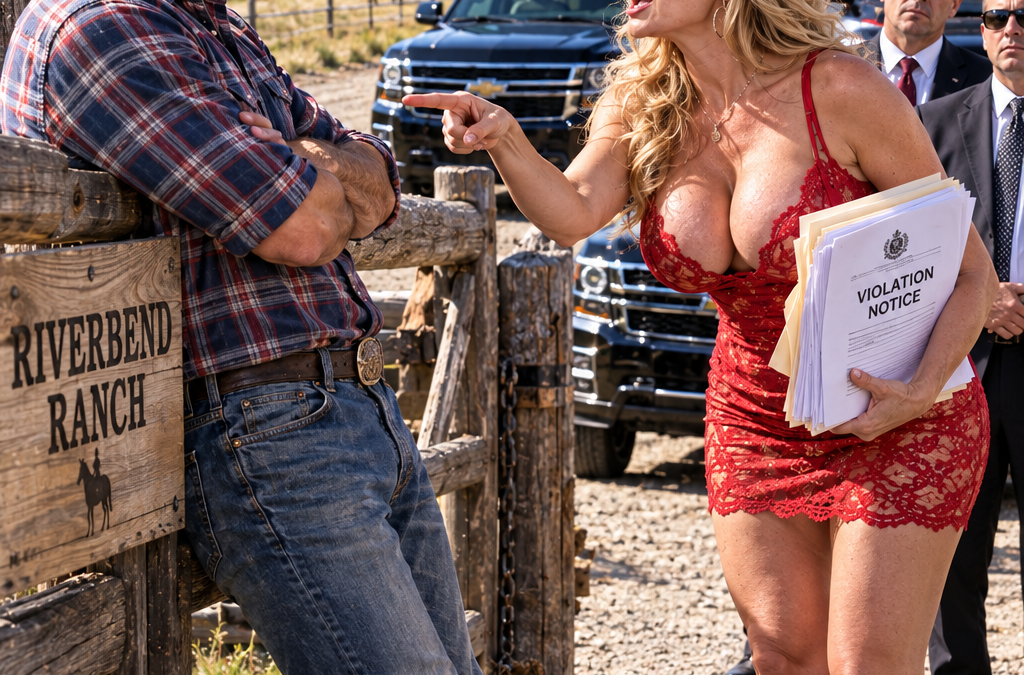
I thought it would be another quiet morning at Riverbend Ranch until three black SUVs rolled through the gravel turnout beside my gate and Karen Whitmore stepped out carrying a stack of violation notices thick enough to look like court papers.
Behind her came two HOA board members.
Neither looked particularly comfortable.
Karen did.
She always did.
She was forty years old, strikingly beautiful, and completely aware of the effect she had on people. Long blonde hair fell across her shoulders in carefully styled waves. Her makeup was immaculate despite the early hour. And, as always, she wore the same tight red lace dress that had somehow become her personal uniform—low-cut, fitted close around her full chest and narrow waist, wildly inappropriate for a Montana ranch at seven in the morning and apparently irrelevant to her.
Karen dressed like she expected every encounter to become a performance.
That morning, I was the audience she had chosen.
She clicked across the gravel in heels, stopped five feet from me, and held out a cream-colored envelope.
“You’ve ignored multiple community standards.”
I looked at the paper.
Then at her.
“What community?”
Her smile tightened.
“Riverbend Heights.”
I glanced beyond her toward the luxury subdivision built along the eastern ridge.
“That community?”
“Yes.”
I pointed down at the gravel beneath my boots.
“This is Riverbend Ranch.”
“I know where we are.”
“Then you know this isn’t Riverbend Heights.”
Karen’s eyes narrowed.
One board member shifted uncomfortably behind her.
She pushed the envelope closer.
“You should read the notice before becoming argumentative.”
I took it.
Not because I accepted anything she was saying.
Because I wanted evidence.
The first page listed violations.
My north barn.
My livestock fencing.
My cattle.
An equipment shed.
The appearance of my working pasture.
The absence of approved ornamental landscaping along the road frontage.
I read the list twice.
Then looked toward my barn.
It had stood there for thirty-eight years.
The fence separating the lower pasture from the hay field had been rebuilt by my father and me when I was sixteen.
The cattle were cattle.
They did what cattle generally did—ate, slept, produced calves, ignored architectural guidelines.
“This is a ranch,” I said.
Karen folded her arms.
“That doesn’t exempt you from community appearance standards.”
“I’m not in your community.”
“Your property impacts our community.”
“That isn’t the same thing.”
“The board disagrees.”
I looked at the two directors behind her.
One of them, a gray-haired man named David Mercer, immediately studied his shoes.
The woman beside him, Susan Pike, wouldn’t meet my eyes.
Karen noticed.
Her jaw tightened.
Then she looked back at me.
“You have fourteen days to correct the listed violations.”
I laughed once.
Not because it was funny.
Because I couldn’t believe she had driven onto a working Montana ranch to tell me my barns were visually unacceptable.
“What exactly do you want me to do with my barn?”
“Bring it into compliance.”
“With what?”
“Approved design standards.”
“It’s a livestock barn.”
“Then perhaps that use is no longer appropriate this close to residential development.”
That sentence changed the entire tone.
I stopped smiling.
Karen saw it.
For a moment, satisfaction flashed across her face.
The subdivision had been built years after my ranch was already here.
People had bought luxury homes beside working agricultural land and somehow Karen had decided the agriculture was now the intruder.
“You’re standing on property my family worked before your HOA existed.”
“That doesn’t mean surrounding land use can never evolve.”
“My land use hasn’t evolved.”
“Maybe it should.”
I stared at her.
“Get off my ranch.”
Susan looked up.
Karen’s expression hardened.
“Excuse me?”
“You delivered your letter. Now leave.”
She took a step closer.
“You need to understand something. Refusing to cooperate will only increase the penalties.”
“You need to understand something too.”
I held up the notice.
“This piece of paper doesn’t make my land yours.”
For a moment, nobody spoke.
Then Karen smiled.
Cold.
Controlled.
“We’ll see.”
She turned and walked back toward the SUVs.
The board members followed.
I stood in the driveway watching them leave.
At the time, I thought the entire thing was absurd.
I had no idea that Karen Whitmore had already convinced herself Riverbend Ranch belonged under her authority.
And once Karen believed something belonged to her, facts became obstacles rather than answers.
My name is Ethan Cole.
Riverbend Ranch had been in my family for three generations.
My grandfather bought the original acreage in the early 1960s, when the valley was mostly pasture, timber, and gravel roads.
My father expanded it parcel by parcel.
By the time I took over operations, the ranch covered enough ground to support cattle, hay production, several barns, equipment sheds, fencing, stock water, and the collection of patched-together infrastructure that keeps any working agricultural property alive.
The place wasn’t picturesque in the way real estate brochures use the word.
It was beautiful because it worked.
Fence posts leaned where frost pushed them.
Barn siding faded under hard winters.
Tractors carried dents.
Mud appeared every spring.
Hay dust got everywhere.
Cattle didn’t arrange themselves for photographs.
I had never cared.
The land fed animals.
The animals supported the ranch.
The ranch supported me.
That was enough.
Then Riverbend Heights appeared.
A development company purchased several hundred acres east of us and turned them into an upscale subdivision.
Stone entrance.
Decorative lighting.
Walking trails.
Uniform mailboxes.
Perfect lawns.
The advertisements promised “Montana living without sacrificing refinement.”
I remember reading that phrase and laughing.
Actual Montana living involved frozen pipes, mud, snow drifts, livestock smells, equipment repairs, and weather that could kill you if you were stupid.
Riverbend Heights offered mountain views without most of the inconvenience.
That was fine.
People could live however they wanted.
Their houses stayed on their side.
My ranch stayed on mine.
For years, coexistence worked.
Then Karen Whitmore became HOA president.
She had been on the board before, but once she became president, everything changed.
Residents started receiving violation notices over flowerpots, mailbox finishes, holiday decorations, vehicle placement, and lawn color.
Yes.
Lawn color.
A retired teacher two streets inside the subdivision was apparently warned because his grass turned brown during a dry spell.
Karen called it “visual neglect.”
People inside the association complained quietly but mostly complied.
That was their choice.
I didn’t pay much attention because none of it involved me.
Until it did.
After Karen’s first visit, I took the notice into my workshop.
The shop smelled like grease, cedar dust, and cold metal.
I cleared a space beside the vise and read every page carefully.
The HOA cited several sections of its covenants.
Exterior structures.
Animal restrictions.
Fence uniformity.
Landscaping requirements.
Agricultural equipment storage.
Everything sounded official.
Nothing explained why those rules applied to Riverbend Ranch.
There was no parcel reference tying my property to the association.
No recorded covenant.
No membership agreement.
No annexation document.
No signature.
Nothing.
I pulled an old file cabinet open and found my closing records.
Deed.
Tax documents.
Survey.
Water agreements.
Agricultural classification paperwork.
I had reviewed all of it when I formally took over the ranch after my father died.
I remembered no HOA.
That didn’t mean something couldn’t be buried deeper.
Property records were full of old easements and legal language people missed.
So I decided to investigate before this became expensive.
That afternoon, I called Martin Ellis, the property attorney who had handled a water-access issue for us years earlier.
Martin listened without interrupting.
Then he asked one question.
“Did you ever sign anything joining the association?”
“No.”
“Did your father?”
“Not that I know of.”
“Grandfather?”
“HOA didn’t exist.”
“Good.”
He paused.
“Send me the deed, most recent survey, and everything the HOA gave you.”
I scanned the documents that night.
The next morning, Martin called.
“Don’t pay anything.”
“I wasn’t planning to.”
“Good.”
“Do they have any authority?”
“I don’t see one yet.”
“Yet?”
“I’m not giving you a definitive answer until I verify the recorded documents.”
I leaned against the workbench.
“So what do I do?”
“Nothing dramatic.”
That disappointed me.
I wanted to drive to the clubhouse and throw Karen’s notice across her desk.
Martin knew me well enough to understand that.
“Ethan.”
“Yeah?”
“Do not go argue with them.”
“I wasn’t going to.”
“You’re lying.”
I smiled.
“A little.”
“Let the records answer.”
That afternoon, Karen returned.
This time she came alone.
Same blonde hair.
Same red lace dress.
Same confident walk.
She held another notice.
“Your first penalty has increased.”
I looked at it.
“For what?”
“Failure to begin corrective action.”
“You gave me fourteen days.”
“Your refusal yesterday demonstrated noncompliance.”
I laughed.
“So now talking back costs money?”
“Attitude is irrelevant.”
“Apparently not.”
She handed me the notice.
Five hundred dollars.
The first one had been two hundred.
“You haven’t even established that your rules apply.”
“They apply.”
“Based on what?”
“Our jurisdiction.”
“What document creates that jurisdiction?”
“The ranch is within the community influence area.”
I stared at her.
“The what?”
“Riverbend Heights’ influence area.”
“Is that recorded with the county?”
Her lips tightened.
“You’re being deliberately difficult.”
“No. I’m asking you to show me the document that gives your HOA authority over my land.”
“You live adjacent to the development.”
“So does county land.”
“That is different.”
“Why?”
She stepped closer.
“Everyone around this neighborhood follows standards whether they like them or not.”
I felt anger move through me.
Slow.
Heavy.
“You keep using the word everyone.”
“Yes.”
“I never joined your association.”
“You don’t need to.”
“That’s not how property covenants work.”
Her smile vanished.
“Do you think because you own a few acres and some cattle you can ignore the standards everyone else follows?”
A few acres.
I looked toward the pasture.
My grandfather had worked that ground until arthritis bent his hands.
My father had rebuilt that barn after a winter storm tore half the roof away.
I had buried both of them on a hill beyond the cottonwoods.
Karen saw acreage.
I saw family history.
“You’re done here.”
She scoffed.
“More fines will follow.”
“Send whatever you want.”
“You’ll regret that.”
I took out my phone.
“What?”
“I said you’ll regret refusing to cooperate.”
“Say it again.”
Her eyes moved to the phone.
“You’re recording?”
“Yes.”
She immediately stepped backward.
“I was advising you about enforcement.”
“Good. Then you won’t mind being recorded.”
Her face tightened.
She turned toward her SUV.
Before climbing inside, she looked back.
“People who fight the association usually spend more money than they expect.”
I saved that sentence.
Then I sent the recording to Martin.
His reply was immediate.
Good. From now on, document everything.
Within a week, a surveyor named Nathan Brooks arrived at Riverbend Ranch.
Nathan had worked the county for nearly thirty years.
He carried old field notes, digital maps, and the calm personality of someone who trusted steel survey monuments more than human memory.
We drove the property line in my pickup.
He checked markers.
Compared bearings.
Reviewed the original subdivision plat for Riverbend Heights.
Then he stopped near the northeast corner.
“That’s it.”
“What?”
He pointed toward a marker.
“Your boundary.”
I looked toward the subdivision fence roughly sixty yards away.
“And theirs?”
“Over there.”
“So?”
Nathan folded the map.
“Riverbend Ranch sits outside the HOA plat.”
I felt tension leave my shoulders.
“You’re certain?”
“I wouldn’t sign a survey if I wasn’t.”
“What about covenants?”
“Survey doesn’t answer private covenant obligations. That’s Martin’s job.”
“But geographically?”
“Separate.”
He tapped the map.
“Clearly separate.”
Martin confirmed the rest two days later.
No recorded declaration bound Riverbend Ranch to Riverbend Heights.
No annexation.
No HOA membership agreement.
No covenant requiring my ranch to follow its private architectural standards.
The deed contained nothing.
The subdivision plat stopped east of my property.
For the first time since Karen arrived, I had something better than anger.
Proof.
Martin drafted a formal response.
The letter disputed every fine.
Included the deed.
Included Nathan’s survey.
Included certified copies of the recorded subdivision map.
And requested written confirmation that the HOA would withdraw its notices and cease attempting to regulate Riverbend Ranch.
I thought that would end it.
Any reasonable board would read the documents, realize the mistake, and back away.
Karen was not reasonable.
The day the HOA received Martin’s letter, she called an emergency board meeting.
I know because Susan Pike called me afterward.
She had obtained my number from a neighbor.
Her voice was low.
“Mr. Cole?”
“Yes.”
“This is Susan Pike.”
I recognized the name.
One of the directors who had come with Karen.
“I know.”
“I probably shouldn’t be calling.”
“Then why are you?”
A pause.
“Because the survey bothered me.”
“What about it?”
“Karen told us your ranch had been incorporated years ago.”
“It wasn’t.”
“I know that now.”
I waited.
Susan continued.
“We asked her tonight whether we should talk to a property lawyer.”
“What did she say?”
“That lawyers complicate simple enforcement.”
I laughed.
Not because it was funny.
“Sounds like Karen.”
“David asked whether the ranch actually belongs to our association.”
“And?”
“She said backing down would make the board look weak.”
That sentence told me everything.
This was no longer about landscaping.
Maybe it never had been.
Karen had publicly declared authority over my ranch.
Now the facts threatened her image.
Rather than admit she was wrong, she preferred escalation.
Two days later, a formal demand letter arrived.
The HOA demanded payment.
Threatened further fines.
Threatened legal action.
Warned that continued refusal could lead to “all remedies available under governing documents and applicable law.”
I forwarded it to Martin.
He called.
“She doubled down?”
“Apparently.”
“Don’t respond.”
“Nothing?”
“I’ll respond.”
I hated that.
I wanted to answer.
I wanted to tell Karen exactly where she could put her fines.
But Martin was right.
Angry responses created noise.
Documents created records.
His next letter was sharper.
It explained that Riverbend Ranch was outside the HOA’s recorded boundary.
It demanded that the association identify any valid recorded instrument supporting its claimed authority.
It warned against trespass, interference with agricultural operations, or attempts to place encumbrances against the property.
It also requested withdrawal of all fines.
Karen responded with one paragraph.
The ranch’s proximity to Riverbend Heights subjects it to legitimate community-impact regulation regardless of technical boundary arguments.
Martin read it aloud over the phone.
Then there was silence.
Finally, he said, “That’s not a legal theory.”
I laughed.
“What is it?”
“A woman refusing to admit she’s wrong.”
I repaired the front gate that weekend.
Not because it needed much work.
Because I wanted the entrance unmistakable.
I replaced two old posts.
Hung new signs.
PRIVATE PROPERTY.
WORKING RANCH.
NO ENTRY WITHOUT PERMISSION.
I added another sign closer to the barn.
LIVESTOCK — KEEP GATES CLOSED.
I wasn’t trying to provoke anyone.
I wanted clarity.
If Karen or anyone acting for the HOA entered after that, they could not pretend they were confused.
For three days, nothing happened.
Then I noticed tire tracks.
They ran from the gate into the lower pasture.
Someone had entered while I was checking cattle on the north acreage.
The gate had been closed when I left.
Now it was open.
My stomach tightened.
I followed the tracks.
They ended near the barn.
Fresh footprints marked the mud.
A small orange inspection sticker had been attached to the barn door.
HOA STRUCTURAL REVIEW PENDING.
I ripped it off.
Then stopped myself.
I photographed it first.
Every angle.
Timestamp.
Location.
Then I called Martin.
“They came in.”
“Anyone there now?”
“No.”
“Damage?”
“Not obvious.”
“Cameras?”
“One at the house. Doesn’t cover the lower gate.”
“Install more.”
I did.
Four cameras.
Gate.
Barn.
Workshop.
Driveway.
Two days later, they paid for themselves.
At 8:13 in the morning, Karen’s black SUV stopped outside the gate.
She stepped out.
Red lace dress beneath a long cream coat.
Bethany, the HOA manager, followed.
Karen looked directly at the PRIVATE PROPERTY sign.
Then opened the gate.
I watched from the workshop monitor.
She couldn’t claim ignorance.
I walked outside.
“Stop.”
Karen turned.
She smiled.
“We’re conducting an inspection.”
“No, you’re trespassing.”
“Don’t be dramatic.”
“Get back outside the gate.”
Bethany looked uncertain.
Karen continued walking.
I raised my phone.
“Karen, you are on recorded private property after receiving written notice that the HOA has no jurisdiction here.”
She stopped.
“You don’t get to dictate where association officers may inspect.”
“Yes, I do.”
“This property affects our residents.”
“Leave.”
“We have authority to document violations visible from adjoining community property.”
“Then document them from your property.”
Her jaw tightened.
“I don’t appreciate your tone.”
“I don’t care.”
Bethany quietly stepped backward.
Karen noticed.
“Stay where you are.”
Bethany froze.
I looked at her.
“You’re free to leave.”
Karen snapped.
“She works for me.”
“No. She works for the association.”
Bethany’s face flushed.
Karen pointed toward the barn.
“That structure is noncompliant.”
“With rules that don’t apply.”
“The board disagrees.”
“The recorded deed doesn’t.”
“I’m tired of hearing about your deed.”
That sentence stunned me.
Karen seemed to realize it too late.
I smiled without humor.
“That’s unfortunate, because land ownership tends to involve deeds.”
She stepped closer.
“People like you think paperwork gives you the right to ignore your neighbors.”
“My paperwork is ownership.”
“Your ranch lowers property values.”
There it was.
Finally.
The real complaint.
Not membership.
Not boundaries.
My ranch offended the image Karen wanted Riverbend Heights to project.
“Then your homeowners bought houses next to the wrong property.”
Her face hardened.
“You could modernize.”
“I run cattle.”
“You could sell.”
Silence.
Bethany looked at Karen.
I stared at her.
“What did you say?”
Karen recovered quickly.
“I said there are options.”
“No. You said sell.”
“Don’t twist my words.”
“Who wants my land?”
Her eyes changed.
Just slightly.
Enough.
I stepped closer.
“Is this about getting me to sell?”
She laughed.
“You really do think highly of yourself.”
“Get off my property.”
She turned.
“Fine.”
She walked back toward the gate.
Then looked over her shoulder.
“This doesn’t end because you put up signs.”
“No.”
I kept recording.
“It ends when you stop.”
That afternoon, Susan called again.
“What happened?”
“Karen trespassed.”
Susan sighed.
“She told us you threatened her.”
I laughed.
“Of course she did.”
“She also said you’re becoming unstable.”
“I have the recording.”
Silence.
“Send it.”
I did.
Thirty minutes later, she called back.
Her voice sounded different.
Shaken.
“She never mentioned telling you to sell.”
“Why would she?”
“Because last month a developer contacted the board.”
My pulse changed.
“What developer?”
“I don’t know all the details.”
“Susan.”
“I really don’t.”
“What do you know?”
“They asked about potential western expansion.”
Western.
My ranch sat west of Riverbend Heights.
“How much land?”
“I don’t know.”
“What did Karen say?”
Another pause.
“She said she could solve the agricultural-buffer problem.”
I looked toward my pasture.
Agricultural-buffer problem.
That was me.
That was Riverbend Ranch.
For the first time, I wondered whether Karen’s obsession with my property had another motive.
Martin took the information seriously.
He began digging into county planning records.
Nothing showed a formal application.
Yet.
But a development company had inquired about expanding residential lots along Riverbend Heights’ western boundary.
Without my land, the expansion would be awkward.
With my land, it would be easy.
Martin called.
“Do not accuse Karen of anything yet.”
“I wasn’t planning to.”
“Yes, you were.”
“Maybe.”
“We need facts.”
The next escalation came before we found them.
An HOA contractor arrived with two workers and a flatbed truck.
They came through my gate without permission.
One man carried tools.
Another carried rolled fencing material.
I drove down from the north pasture and found them measuring my fence.
“What are you doing?”
The supervisor looked at a work order.
“Replacing noncompliant fencing.”
“On whose authority?”
“Riverbend Heights HOA.”
I took out my phone.
“You’re on Riverbend Ranch.”
He frowned.
“Yeah.”
“This is not HOA property.”
He checked the paperwork.
“We were told it was.”
I pointed toward the private property signs.
“Now you’re being told it isn’t.”
The workers looked at each other.
The supervisor called someone.
I heard Karen’s voice through the phone.
Not every word.
Enough.
“Continue.”
The supervisor looked uncomfortable.
“She says proceed.”
I stared at him.
“If you cut that fence, I’m calling the sheriff.”
He lowered the phone.
“We’re not trying to cause trouble.”
“Then leave.”
They packed up.
Karen arrived twenty minutes later.
Furious.
Her heels sank into the gravel.
“You interfered with authorized work.”
“I prevented trespassers from cutting my cattle fence.”
“It does not meet community standards.”
“How many times are we doing this?”
“Until you comply.”
“Or sell?”
Her eyes flashed.
“There you go again.”
I stepped closer.
“No, Karen. You brought contractors onto my ranch after receiving a survey and legal notice proving you have no authority.”
“The board recognizes a community-interest corridor.”
“Show me the recorded document.”
“I don’t answer to you.”
“You do when you’re standing on my land.”
She smiled.
“You think this ranch makes you important.”
“No.”
I pointed toward the gate.
“I think ownership makes this decision mine.”
Her expression turned ugly.
“You won’t hold this land forever.”
That one went to Martin too.
By then, even Priya—my sister, who lived two towns away and normally told me I enjoyed conflict too much—said the situation felt dangerous.
“Why doesn’t she stop?”
“Pride.”
“Is that all?”
“I don’t know anymore.”
“Ethan, people don’t bring contractors onto land just because they dislike a fence.”
She was right.
Martin found the connection two days later.
The development company interested in western expansion had hired Karen as a real estate consultant the previous year.
Not full-time.
Not publicly connected to the HOA.
But there were payments.
Consulting.
Market evaluation.
Community integration.
I sat in Martin’s office staring at the records.
“She gets paid if the development expands?”
“We don’t know the compensation structure.”
“But she works for them.”
“Yes.”
“And she’s been fining me to remove barns and livestock.”
“Yes.”
“Then telling me to sell.”
“Yes.”
I leaned back.
“So this was never about landscaping.”
Martin closed the folder.
“It may have started that way. But now we have a conflict of interest that needs explanation.”
We prepared another letter.
This one went to the entire HOA board.
Not just Karen.
It disclosed her consulting relationship.
Requested preservation of meeting minutes, emails, development communications, and financial records.
Warned that further enforcement against Riverbend Ranch could be viewed as retaliatory.
Susan called me that night.
“She didn’t tell us.”
“About the consulting?”
“No.”
“What did the board do?”
“We scheduled another emergency meeting.”
“Will Karen chair it?”
“She says she will.”
I laughed.
“Of course.”
The meeting happened Thursday evening.
I attended with Martin.
Karen sat at the center of the clubhouse table in her red lace dress under a fitted black blazer.
She looked perfect.
Except for her hands.
They trembled slightly when she shuffled papers.
The room was packed.
Word had spread.
Karen opened by accusing me of conducting “a coordinated attack against community governance.”
Martin stood.
“No one is attacking community governance.”
She looked at him.
“And you are?”
“Martin Ellis. Counsel for Mr. Cole.”
The room changed.
Karen’s smile vanished.
Martin placed certified copies of the survey and deed on the table.
“Riverbend Ranch lies outside the recorded HOA boundary.”
Karen interrupted.
“We dispute that interpretation.”
“The county surveyor does not.”
“We are discussing impact authority.”
“There is no recorded covenant granting you impact authority over adjoining private ranchland.”
Karen leaned back.
“You lawyers love technicalities.”
Martin smiled slightly.
“A property boundary is not a technicality.”
A few residents murmured.
Karen struck the table with her palm.
“This ranch devalues every home on our western edge.”
I stood.
“You mean the ranch that existed before those homes?”
She looked at me.
“I mean an outdated agricultural operation beside a modern residential community.”
Susan spoke.
“Karen, that’s not the question.”
Karen turned sharply.
“What?”
“The question is whether we have authority.”
“We have responsibility.”
“That’s different.”
David finally spoke too.
“We need outside counsel.”
Karen stared at him.
“You want to spend member money because a rancher refuses basic standards?”
Martin slid another document forward.
“You may also want outside counsel because your president is a paid consultant for the developer seeking western expansion.”
The room erupted.
Karen went white.
Then red.
“That is private employment.”
“Employment directly connected to land beside Riverbend Ranch.”
“There is no conflict.”
Susan stared at her.
“You never told us.”
“I wasn’t required to.”
“You’ve been pushing enforcement against his land while working for a developer that wants expansion?”
Karen stood.
“This meeting is out of control.”
“No,” I said.
For once, my voice stayed perfectly calm.
“It’s finally asking the right question.”
She pointed at me.
“You are going to regret turning this into a public spectacle.”
Martin immediately said, “Threat noted.”
Karen realized what she’d done.
The meeting ended without a vote.
But her control had cracked.
The following morning, I found another envelope at my gate.
Final enforcement demand.
Total penalties: $18,750.
I laughed when I saw the number.
Then I stopped.
Attached was language threatening a lien.
That wasn’t funny.
Martin filed for an injunction.
The argument was simple.
An association with no recorded authority over my property was threatening financial encumbrance based on invalid fines.
We submitted the deed.
Survey.
Subdivision map.
Karen’s notices.
Contractor incident.
Trespass recordings.
Developer connection.
The judge issued temporary relief preventing the HOA from recording a lien or taking enforcement action against Riverbend Ranch until the jurisdiction question was resolved.
I thought Karen might finally stop.
Instead, she came to the ranch again.
This time with a sheriff’s deputy.
I was repairing a gate when her SUV rolled up.
The deputy stepped out first.
Karen followed.
Red dress.
Dark coat.
Clipboard.
The deputy looked uncomfortable.
“Mr. Cole?”
“Yes.”
“Ms. Whitmore says there’s an ongoing property-access dispute.”
“There is.”
“She says the HOA needs access to inspect boundary improvements.”
I looked at Karen.
“No.”
She smiled.
“Deputy, you see how unreasonable he is.”
I pulled a folder from my truck.
Court order.
Survey.
Deed.
Letter from Martin.
The deputy read the first page.
Then the second.
He looked at Karen.
“Ma’am, this order says the HOA is restrained from enforcement.”
“We’re not enforcing. We’re inspecting.”
“On his property?”
“Yes.”
“He doesn’t consent.”
“Association authority doesn’t require consent.”
The deputy looked at her for a long moment.
Then handed the papers back to me.
“I’m not ordering him to let you in.”
Karen’s jaw tightened.
“You were told this was association-adjacent land.”
“Adjacent isn’t the same as owned.”
I almost smiled.
She pointed toward the ranch.
“There are safety concerns.”
The deputy sighed.
“Then document them from public property and speak with your attorney.”
“I am the president.”
“Yes, ma’am.”
That was all.
No reverence.
No fear.
Just yes, ma’am.
Karen hated it.
As she turned toward her SUV, she looked at me.
“This isn’t over.”
The deputy heard her.
I said nothing.
Later that week, Riverbend Heights finally hired independent property counsel.
The attorney reviewed the documents.
Three days later, the HOA board received a memorandum.
Susan forwarded the summary to Martin.
It was devastating.
Riverbend Ranch was not part of the association.
No recorded covenant extended HOA restrictions onto my land.
No annexation had occurred.
No lawful basis existed for the fines.
Any attempt to lien the ranch based on those violations could expose the association to substantial liability.
And Karen’s developer relationship created a serious undisclosed conflict.
The board scheduled another meeting.
Karen tried to cancel it.
They held it anyway.
For the first time in years, she wasn’t controlling the agenda.
I attended.
Residents filled the clubhouse.
Susan opened.
Karen sat at the end of the table.
Not the center.
Same red dress.
Same hair.
But the posture had changed.
Susan read the attorney’s conclusions.
Then she asked Karen directly.
“Why did you continue enforcement after receiving the survey?”
Karen folded her arms.
“Because the ranch impacts us.”
“That isn’t legal authority.”
“It is practical authority.”
David shook his head.
“No, Karen.”
She snapped toward him.
“Don’t start.”
He stared back.
“No. You don’t get to do that anymore.”
The room went still.
David continued.
“You told us Ethan’s ranch was annexed.”
“It should have been.”
“That wasn’t what you said.”
Karen’s face tightened.
Susan asked, “Did you know the developer wanted his property?”
Karen hesitated.
“I knew they had expansion concepts.”
“Were you being paid by them?”
“My private consulting work is irrelevant.”
“Were you being paid by them?”
“Yes.”
Murmurs spread through the room.
Susan looked genuinely hurt.
“You used this board to pressure him.”
“No.”
“You sent fines.”
“He violated standards.”
“Standards we had no authority to impose.”
“I was protecting property values.”
“You sent contractors onto his ranch.”
“He was obstructing compliance.”
David leaned forward.
“Karen, stop.”
She stood.
“You’re all panicking because one rancher hired a lawyer.”
I rose too.
“No.”
She looked at me.
“They’re panicking because you lied to them.”
Her face changed.
“You think you’ve won?”
“I think my cows are still eating exactly where they ate before your subdivision existed.”
Several people laughed.
Karen looked around.
The sound crushed her more than anger would have.
For years, people had feared her.
Now they were laughing at her claims.
Susan made a motion to suspend Karen pending investigation.
David seconded.
The vote passed four to one.
Karen voted no.
Of course she did.
She grabbed her bag.
“This board will collapse without me.”
No one answered.
She walked out.
The red lace disappeared through the clubhouse doors.
I thought that was the end.
It wasn’t.
Two days after her suspension, someone cut the chain on my front gate.
I found it lying in the gravel.
The cameras showed Karen’s SUV stopping just after midnight.
No clear image of who exited.
But someone entered.
Nothing appeared stolen.
Then I found survey stakes in the west pasture.
Not the HOA boundary.
Future development markers.
That was the point of no return.
I called the sheriff.
Then Martin.
Then the county planning office.
A deputy photographed the cut chain.
The planning office confirmed no active authorization existed for survey work on Riverbend Ranch.
Martin contacted the developer.
Their attorney responded quickly.
They denied authorizing anyone to enter my property.
Then something interesting happened.
The development company terminated Karen’s consulting contract.
Immediately.
Their letter stated that she had acted outside authorized channels and that no land acquisition or survey work had been approved on Riverbend Ranch.
Karen had lost the HOA.
Now she had lost the developer too.
I expected her to disappear.
Instead, she filed a civil claim arguing that the HOA’s “community impact rights” entitled it to regulate my frontage and that I had interfered with neighborhood property values.
Martin read the filing.
Then put it down.
“This is desperation.”
“Can she win?”
“Anyone can file a lawsuit.”
“That wasn’t my question.”
He looked at me.
“On these facts? Her problem is simple.”
“What?”
“She still doesn’t have a recorded right.”
The court hearing took place six weeks later.
By then, winter had begun settling into the valley.
Snow edged the mountains.
The ranch fields had turned pale gold.
I sat beside Martin while Karen sat across the courtroom with an attorney I had never met.
She wore the red lace dress under a tailored coat.
Even there.
Even then.
The judge reviewed the deed.
The survey.
The Riverbend Heights plat.
The HOA declaration.
The enforcement letters.
Karen’s attorney argued that the association had legitimate interests because Riverbend Ranch directly affected subdivision aesthetics and market value.
The judge asked one question.
“Where is the recorded instrument binding Mr. Cole’s property?”
Silence.
The attorney began talking about community-impact doctrine.
The judge interrupted.
“Show me the instrument.”
He couldn’t.
Martin did.
Or rather, he showed the absence of one through the recorded chain of title.
Riverbend Ranch had never been annexed.
Never signed into the association.
Never subjected to Riverbend Heights’ covenants.
The subdivision’s boundary ended before mine began.
The judge ruled that the HOA had no authority to impose its private restrictions on my ranch.
The fines were invalid.
The lien threat was improper.
The association was ordered to cease enforcement attempts.
Any future entry onto Riverbend Ranch without permission could be treated as trespass.
I sat there listening.
The words should have made me feel triumphant.
Mostly, I felt exhausted.
Karen looked at me as we left.
“You destroyed my reputation.”
I stopped.
Martin touched my arm.
A warning not to engage.
But I looked at her.
“No.”
My voice was quiet.
“You kept choosing this.”
She laughed bitterly.
“You think these people care about your ranch? They care about money.”
“Maybe.”
I looked toward the courthouse doors.
“But at least they know where my fence is now.”
She didn’t answer.
The fallout inside Riverbend Heights moved quickly.
Residents demanded an audit of Karen’s enforcement decisions.
Several discovered fines they believed had been selectively imposed.
Board records showed Karen had pushed the ranch issue repeatedly despite warnings from Susan and David.
Her developer relationship became public.
The association’s insurer became involved.
So did attorneys.
Karen resigned before the board could formally remove her.
She framed it as a protest.
Said Riverbend Heights had become “ungovernable.”
Susan became interim president.
Her first letter to me was three sentences.
Riverbend Heights HOA acknowledges that Riverbend Ranch is separate private property outside the association’s governing authority. All notices and fines previously issued against Riverbend Ranch are withdrawn. We apologize for the board’s conduct.
I printed it.
Then hung it in my workshop beside the first violation.
Two pieces of paper.
One tried to tell me my barn was illegal.
The other admitted the HOA had never had authority over it.
I left them side by side.
Not because I wanted revenge.
Because I wanted to remember how much damage confidence can do when nobody asks for proof.
The chain-cutting incident remained under investigation.
There wasn’t enough evidence to charge Karen personally.
Her SUV had been present.
The timing was suspicious.
But suspicion isn’t proof.
I accepted that.
One of the biggest lessons Martin drilled into me was the difference between knowing what you believe happened and proving what you can actually establish.
I had spent months demanding Karen respect that distinction.
I wasn’t going to abandon it when the standard became inconvenient.
The developer formally withdrew its western expansion concept.
Without Riverbend Ranch, the geometry made little sense.
More importantly, the company wanted distance from the scandal.
A representative called and offered to discuss purchasing a small portion anyway.
I said no.
He offered more.
I said no again.
Eventually, he understood.
The ranch wasn’t a negotiation waiting for the right price.
It was home.
Spring came slowly that year.
Snow melted along the fence lines.
Mud returned.
Calves arrived.
The barn roof needed patching on the west side.
One section of fencing sagged after frost pushed a corner post.
Normal problems.
Wonderful problems.
One morning, I found Susan at the gate.
She stayed outside.
That detail mattered.
I walked down.
“Morning.”
“Morning.”
She held an envelope.
I smiled.
“Please tell me that’s not another violation.”
She laughed awkwardly.
“No.”
She handed it to me.
The board had reimbursed my legal costs related to responding to the improper fines and agreed to cover the cost of the damaged gate.
I looked at her.
“You didn’t have to come personally.”
“Yes, I did.”
I waited.
She looked toward the ranch.
“We should have stopped her earlier.”
“Probably.”
She looked surprised by the blunt answer.
I wasn’t interested in pretending.
Susan nodded.
“We were afraid of looking weak.”
I thought about Karen’s emergency meeting.
Backing down would make the board look weak.
“You know what made you look weak?”
“What?”
“Knowing she was wrong and following anyway.”
Susan nodded slowly.
“I know.”
We stood quietly.
Then she said, “I’m sorry.”
I believed her.
“Thank you.”
She turned to leave.
“Susan?”
She looked back.
“Tell the board they can come buy beef anytime.”
She smiled.
“That’s surprisingly generous.”
“Full price.”
She laughed.
“Of course.”
Life settled.
But I wasn’t the same.
Before Karen, I assumed property ownership was obvious.
You bought land.
Recorded the deed.
Paid taxes.
Maintained boundaries.
That was enough.
I learned that ownership can be clear and still require defense when someone with confidence, money, or institutional power decides clarity is inconvenient.
I also learned how quickly authority becomes dangerous when people confuse persistence with legitimacy.
Karen sent letters.
Then fines.
Then contractors.
Then inspectors.
Then legal threats.
Each escalation relied on the same assumption.
That eventually I would get tired.
That legal fees would scare me.
That public pressure would embarrass me.
That I would decide selling was easier than fighting.
For a while, she almost succeeded.
There were nights I sat alone in the workshop staring at invoices from Martin and Nathan and wondered how much peace was worth.
I asked myself whether one ranch was worth months of conflict.
Then I would look toward the barn.
And I remembered my father.
He had rebuilt that barn in a February windstorm when I was seventeen.
Half the roof had peeled away.
We worked until dark.
I remember complaining that we should just tear the old building down.
Dad looked at me.
“Why?”
“Because it’s old.”
“So am I.”
I laughed.
He didn’t.
“Old doesn’t mean useless.”
He pointed toward the rafters.
“This barn has protected cattle longer than you’ve been alive. Fix what still deserves to stand.”
Years later, Karen told me the same barn was visually inconsistent with neighborhood standards.
She never understood what she was looking at.
She saw weathered wood.
I saw history.
She saw pasture that could become houses.
I saw generations.
She saw fences she wanted painted.
I saw lines my family had respected for decades.
That difference was why we could never compromise.
Not because I hated development.
Not because I hated HOAs.
Because Karen believed everything had value only after someone like her approved it.
Riverbend Ranch didn’t need her approval.
One summer evening, nearly a year after the dispute ended, I sat on the porch watching cattle move through the lower pasture.
A Riverbend Heights family walked along the public road.
Their little boy stopped at the fence.
“Are those cows?”
His father laughed.
“Yes.”
The boy waved at them.
The cattle ignored him.
He waved harder.
I smiled.
The father saw me.
“Sorry. He loves them.”
“No problem.”
He hesitated.
“You’re Ethan?”
“Depends who’s asking.”
He laughed.
“I’m Mark. We moved into Riverbend Heights last month.”
I nodded.
He looked toward the ranch.
“This place is beautiful.”
That surprised me.
“Your old HOA president didn’t think so.”
His wife laughed.
“We’ve heard.”
“I’m sure you have.”
Mark leaned on the roadside fence.
“Honestly, the open land is one reason we bought.”
I looked at him.
“You’re kidding.”
“No.”
He gestured toward the subdivision.
“Plenty of houses already.”
Then toward my pasture.
“You can’t manufacture this.”
I thought about Karen calling the ranch an eyesore.
Wasted potential.
Outdated agricultural use.
I smiled.
“No.”
“You can’t.”
Later that evening, I walked the fence line.
The sun dropped behind the mountains.
Light turned the pasture gold.
The barn cast a long shadow.
From that angle, Riverbend Heights looked almost peaceful.
Stone entrance.
Perfect roofs.
Landscaped streets.
There had never been anything wrong with the subdivision.
The problem was never that suburban residents lived beside a ranch.
The problem was one person deciding coexistence required control.
Riverbend Ranch remained exactly what it had always been.
A working place.
Imperfect.
Useful.
Alive.
The HOA’s rules stopped where its recorded boundary stopped.
It shouldn’t have taken attorneys, surveys, injunctions, police reports, and a courtroom to establish that.
But it did.
I still keep the first violation notice.
It’s stained with grease from the morning I read it in the workshop.
Barn exterior inconsistent with approved architectural character.
I laugh when I see it now.
Not because the fight was funny.
Because Karen had written those words with absolute certainty.
She believed certainty could substitute for authority.
It couldn’t.
The deed mattered.
The survey mattered.
The county records mattered.
The truth mattered.
And eventually, reality caught up.
Karen moved out of Riverbend Heights the following year.
I heard she sold her house and relocated to Bozeman.
I never asked where.
I didn’t care.
She was no longer part of my life.
That was consequence enough for me.
The new HOA board adopted a policy requiring legal review before sending any enforcement notice involving property near the subdivision boundary.
They also prohibited board members from participating in decisions involving personal business relationships.
Susan told me that one came directly from the Karen situation.
Good.
If something useful came out of the mess, I was glad.
Riverbend Ranch never joined the association.
Never paid a fine.
Never changed the barn.
Never replaced the livestock fence with decorative vinyl.
Never removed cattle because someone thought they damaged a luxury view.
I repainted the barn eventually.
Red.
The same dark ranch red my father used.
I didn’t ask anyone.
I didn’t need to.
The day I finished, I stood back with a paint roller in one hand.
The building looked almost exactly like it had when I was twenty.
Weathered shape.
New color.
Same purpose.
The cattle didn’t care.
Neither did I.
Sometimes people ask whether I enjoyed beating the HOA.
That’s not how I think about it.
I didn’t beat Riverbend Heights.
Most of the residents had nothing to do with Karen’s campaign.
Some eventually helped stop her.
I defended a boundary.
Physical.
Legal.
Personal.
That boundary mattered because if you allow someone to erase one clear line simply because enforcing it becomes inconvenient, the next line becomes easier to erase.
First the barn.
Then the fence.
Then the livestock.
Then the land itself.
Karen never arrived with bulldozers.
She arrived with paperwork.
That’s what made the situation dangerous.
Threats printed on letterhead feel legitimate.
Fine schedules feel official.
Board titles sound authoritative.
Most people are busy.
They see legal language and assume someone else already checked whether it’s valid.
That is what Karen counted on.
I checked.
That’s why Riverbend Ranch is still mine.
On quiet mornings, I still wake before sunrise.
I make coffee.
Pull on boots.
Walk toward the barn.
The same routine I wanted before any of this started.
Frost on the grass.
Steam rising from cattle.
Wind moving through cottonwoods.
No black SUVs.
No clipboards.
No red lace dress appearing at the gate.
Just work.
Peace isn’t dramatic.
That’s what makes it valuable.
Karen thought winning meant forcing me to obey.
I learned winning meant reaching a point where I didn’t have to think about her anymore.
One morning, while replacing a broken fence staple, I noticed the PRIVATE PROPERTY sign we had installed during the dispute.
The paint was fading.
One corner had bent in the wind.
I considered replacing it.
Then decided not to.
The ranch boundary didn’t depend on a sign.
It existed whether Karen respected it or not.
Still, I left the sign hanging.
Not as a threat.
As a reminder.
I ran my fingers across the faded letters.
PRIVATE PROPERTY.
Two words.
Simple.
Clear.
Apparently powerful enough to start a war when someone decides they don’t apply.
Then I went back to fixing the fence.
Because Riverbend Ranch had cattle to feed, hay to cut, gates to maintain, and a hundred ordinary problems that mattered more than any HOA ever would.
And that was exactly how I wanted it.








