𝗙𝗨𝗟𝗟 𝗦𝗧𝗢𝗥𝗬 The HOA President Tried to Foreclose on My House Over a Garden Hose, but Her Own Camera Exposed Everything
𝗙𝗨𝗟𝗟 𝗦𝗧𝗢𝗥𝗬
She said it the way a prosecutor might say previous administrations failed to punish crime.
I looked at her folder.
“Is there a problem?”
“Not yet,” she said, smiling again. “This is just a friendly conversation.”
That friendly conversation turned into a bright pink notice taped to my front door four days later.
Improper Storage of Outdoor Equipment.
It cited Clause 7 of the Briarwood Community Harmony Standards.
I stood on my porch reading it with one eyebrow raised.
Community Harmony Standards?
I had never heard that phrase in my life.
I went inside, opened the drawer where I kept HOA papers, and pulled out the bylaws. The most recent version I had was probably five years old, but I had never received a full replacement packet. I flipped through the pages until I found the outdoor-equipment section.
It said tools, construction materials, abandoned appliances, and visible maintenance equipment could not be stored in front yards for extended periods.
Nothing about garden hoses.
Nothing called Clause 7.
Nothing mentioning community harmony.
I should have been irritated.
Instead, I laughed.
Genuinely laughed.
After years of trauma calls, overdoses, cardiac arrests, and people screaming in hospital parking lots, a garden hose violation felt too small to take seriously.
I moved the hose behind the side gate, took a picture for my records, and emailed the management office.
Violation corrected. Please confirm no fine will apply.
No one answered.
A week later, another notice arrived.
This one said the hose remained improperly stored because it was visible from the street through the gap beside my gate.
Fine: $200.
That was when I stopped laughing.
I walked outside and stood at the curb, looking toward the side of my house. If I tilted my head and squinted through the hedge, I could see maybe six inches of green hose behind the gate.
Two hundred dollars.
For six inches of hose.
I called the HOA office. A woman named Brielle answered, sounding tired before I even finished saying my name.
“I need to dispute a fine,” I said.
“Address?”
I gave it to her.
A keyboard clicked.
“Oh,” she said.
Not a good “oh.”
“What does that mean?”
“Nothing, Mr. Cruz. I see the account.”
“The hose was moved behind the gate. The notice says it’s still visible from the street, but that’s absurd.”
“The violation was issued by President Whitfield.”
“Can I appeal?”
“Yes, technically.”
“Technically?”
“You can submit a written appeal.”
“Will the board review it?”
There was a pause.
“President Whitfield manages enforcement review.”
I leaned against the kitchen counter.
“So the person who issued the fine also reviews the appeal?”
Another pause.
“That’s the current procedure.”
I thanked her and hung up.
That evening, my neighbor Rosa leaned over the fence while I was trimming back the hedge.
Rosa Martinez had lived next door for almost twenty years. She was in her late sixties, sharp-eyed, with a voice that could slice through nonsense without rising above conversational volume. She had watched me grow from a younger man with a mortgage into a tired paramedic with back pain and opinions about lawn equipment.
“Daniel,” she said quietly.
I looked over. “Hey, Rosa.”
She nodded toward my front door. “Sandra leave you another pink love letter?”
I held up the notice.
Rosa sighed.
“She targets people who won’t grovel first.”
I frowned. “Targets?”
“Watch your mailbox closely.”
“Rosa, it’s a garden hose.”
“With Sandra, it’s never about the thing she writes on the paper.”
That should have stayed with me.
It did, but not deeply enough.
At work the next day, I told my buddy Marcus about it over cold vending-machine coffee between calls. Marcus had been my partner for years before he moved into supervisory work, and he had the rare gift of making terrible things sound survivable.
He nearly choked laughing.
“Bro, just paint your whole house Karen beige and surrender already.”
“She said community harmony.”
“Of course she did. Nothing says harmony like threatening a paramedic over a hose.”
I laughed because Marcus was laughing, and because joking made the situation feel smaller.
“Maybe I’ll just pay the two hundred and move on.”
Marcus stopped laughing.
“Don’t.”
I looked at him.
He tossed his empty coffee cup into the trash.
“People like that count on you being too tired to fight.”
I was tired.
That was the problem.
Tired from work. Tired from bills. Tired from living in a world where even coming home didn’t guarantee peace.
So I considered paying.
Then the next notice came.
This one involved a fence post.
According to Sandra, one post along my back fence exceeded the approved height by two inches. I measured it myself. She was right about the height difference, but the fence had been that way for nine years. It had passed inspection twice. Nobody had ever complained.
Fine: $150.
Then came a paint violation.
Sandra claimed the beige on my shutters violated Clause 7 because it disrupted community harmony by appearing too warm in afternoon light.
I read that one three times.
Too warm in afternoon light.
I carried the letter over to Rosa.
She read it once, handed it back, and said, “She’s building a file.”
“A file for what?”
Rosa looked toward Sandra’s house at the end of the street.
“Pressure.”
After that, the fines came faster.
Trash can left curbside beyond the approved retrieval window.
Two hundred dollars.
Grass improperly maintained.
Another two hundred.
The grass violation was especially interesting because two days before the notice, I had come home from a double shift and found the front strip oddly short, almost scalped near the sidewalk. I assumed the landscaping crew had accidentally crossed onto my property while mowing the common area.
Then Sandra posted a photo in the neighborhood app.
Ongoing grass-height violation at 1184 Briarwood Lane.
My house.
My lawn.
A patch of grass she or someone else had cut too short, now used as evidence against me.
That was when I started recording everything.
Not casually.
Obsessively.
I took photos every morning before work and every evening when I returned. I saved every notice, every envelope, every email, every app screenshot. I wrote down times. I backed files up to cloud storage. I built a spreadsheet with columns for alleged violation, date issued, fine amount, cited rule, evidence provided, and my response.
Paramedics learn documentation the hard way.
If you don’t write it down, it didn’t happen.
If the timeline doesn’t make sense, someone will eventually make it make sense in a way that hurts you.
One night, sitting at my kitchen table with a cold plate of leftovers beside me, I noticed the first real crack.
Sandra had uploaded several violation photos through the HOA app. Most people would just look at the images. I downloaded them.
The metadata was still attached.
The photos had been taken at 6:03 in the morning.
Not only that.
They came from a phone model Sandra didn’t use.
I knew what phone she had because she carried it everywhere in a bright white case with gold initials. The metadata listed a different device entirely.
I sat back.
Why would Sandra submit violation photos from someone else’s phone?
At first, I thought maybe another board member had taken them.
But the app listed Sandra as the uploader and certifying officer.
The same pattern appeared on several notices.
Different photo device.
Same early-morning timestamp.
Same Sandra login.
I didn’t know what it meant yet, so I filed it away.
In my job, you don’t diagnose too early. Chest pain could be anxiety, reflux, or a heart attack. A confused patient could be dehydrated, hypoglycemic, intoxicated, septic, or all of the above. You collect the pattern before you name the problem.
And the pattern kept growing.
Within six weeks, my alleged balance had climbed from $200 to $800.
Then came the certified letter.
I was leaving for work when I saw it wedged into my mailbox, taped crookedly against the metal like someone had slapped it there in a hurry.
The envelope was thick.
The paper inside was heavier than the usual notices.
Notice of Intent to Record Lien.
I stood beside the mailbox as a cold wind moved through the street and read the first paragraph twice.
Sandra claimed I owed unpaid fines, late fees, administrative processing charges, and special enforcement assessments. If the balance was not paid within ten days, the HOA would proceed with lien recording and potential foreclosure action under the governing documents.
Foreclosure.
That word turned the street quiet around me.
I had spent fifteen years paying my mortgage. I had worked Thanksgiving shifts, Christmas Eve shifts, double shifts, storm shifts. I had watched friends buy boats and new trucks while I put extra money toward principal whenever I could. The house wasn’t fully paid off yet, but I had built real equity, real roots, real safety.
And Sandra Whitfield was threatening to use a garden hose, a fence post, and a shade of beige to put that at risk.
I called the HOA office from my driveway.
Brielle answered.
“I need the bylaws,” I said.
“Mr. Cruz?”
“Yes. I need the current official bylaws and fine schedule. Full copy.”
“I can request that.”
“No. I am formally requesting it now. In writing also. Today.”
“I understand.”
“And I need a ledger explaining every charge on my account.”
“I’ll note the request.”
“How long?”
She hesitated. “The board has to make records available within a reasonable time.”
“Define reasonable.”
“President Whitfield controls document release.”
Of course she did.
I sent a written request by email before leaving for work. Then another by certified mail the next morning.
Sandra stalled for eleven days.
First, the board secretary was unavailable.
Then records needed review.
Then the current packet had to be compiled.
Then Sandra was “out of office for association business,” which Rosa confirmed meant she had been home all day overseeing the repainting of her own porch railings, a shade of white I was tempted to report as emotionally disruptive to community harmony.
When the documents finally arrived, I made coffee, cleared my kitchen table, and went through them line by line.
Half the cited violations didn’t exist.
No Clause 7 saying beige could be too warm.
No community-harmony rule about garden hoses visible through hedge gaps.
No provision allowing Sandra to personally certify fines without board review.
No authority for several of the administrative processing fees.
I sat there, highlighter in hand, realizing Rosa had been right.
Sandra wasn’t enforcing rules.
She was inventing them.
At the next board meeting, I brought everything.
The clubhouse smelled like old carpet and burnt coffee. Folding chairs filled half the room. Sandra sat at the front table in a navy blazer with gold buttons, her leather binder placed neatly before her like a judge’s case file.
I waited through the treasurer’s report and landscaping update.
Then public comment opened.
I stood.
“My name is Daniel Cruz, 1184 Briarwood Lane. I have questions about fines issued against my property.”
Sandra smiled.
“Mr. Cruz, you’ve submitted several messages already.”
“Yes. And now I have the governing documents.”
Her smile tightened.
I held up the notices.
“Several of these violations cite rules that do not appear in the bylaws or fine schedule.”
A few heads turned.
Sandra folded her hands.
“We enforce community standards.”
“Can you identify the rule about beige paint violating community harmony?”
A low murmur moved through the room.
Sandra’s eyes sharpened.
“Your tone is confrontational.”
“My tone is calm. My question is specific.”
“You have repeatedly challenged the association’s authority.”
“I’ve repeatedly asked for the written basis for fines threatening a lien on my home.”
Sandra leaned toward her microphone.
“Mr. Cruz, this board will not be intimidated by hostile behavior.”
I felt the room shift.
That was her move.
Make the questioner the problem.
A man asking for documents became hostile. A homeowner defending his property became confrontational. A paramedic who had spent his adult life controlling his voice in emergencies was suddenly dangerous because Sandra needed him to be.
I forced my hands to stay still.
“I’m asking for documentation.”
Sandra smiled sweetly.
“And I am simply enforcing our community standards.”
That sentence almost worked.
Then Mr. Alvarez stood.
He was two rows behind me, an elderly veteran with a silver cane and a deep scar along one cheek. His wife had died a few years earlier. He used a wheelchair ramp at the front of his house on difficult days, especially when his hip pain flared.
His voice was rough but steady.
“Like when you fined me for my ramp?”
The room went quiet.
Sandra’s face hardened.
“Mr. Alvarez, your ramp issue was resolved.”
“You charged me six hundred dollars before my daughter threatened to call a lawyer.”
Sandra looked down at her papers.
“The ramp lacked architectural approval.”
“It was medically necessary.”
“It still required review.”
I turned toward him.
He looked at me, then at the room.
“She knew I needed it. She fined me anyway.”
That was the moment it clicked.
This was never about community appearance.
Not really.
A garden hose.
A fence post.
A wheelchair ramp.
A paint color.
All of them were just handles Sandra could grab.
This was about control.
Who got to stand upright and who had to kneel.
After the meeting, three residents approached me quietly in the parking lot. Diane from the next street. Mr. Alvarez’s daughter, Elena. A younger couple named Owen and Melissa who had been fined for a child’s bicycle left beside their garage.
“She’s done this to us too,” Melissa said.
Diane looked toward the clubhouse door. “But people are afraid.”
“Then we stop being isolated,” I said.
That night, I started a private group chat.
Six neighbors joined first.
Then nine.
Then fourteen.
We kept it careful. No ranting. No threats. No insults. Just documents. Notices, fines, account ledgers, appeal denials, timestamps, photos.
Every single fine traced back to Sandra’s login.
Not board consensus.
Not recorded votes.
Sandra.
And then Owen found the second crack.
“Does anyone know what ‘administrative processing fee’ means?” he wrote.
We all had one.
Sometimes twenty-five dollars. Sometimes fifty. Sometimes seventy-five.
The amounts changed without explanation.
Elena pulled her father’s bank statements and HOA ledger. Melissa found her own receipts. Rosa, who still had old board contacts, helped us compare payments.
The fees weren’t going into the normal HOA operating account.
They were being routed separately.
Priya Shah, the attorney we eventually hired, found the receiving account in less than a week.
It was registered under Sandra’s husband’s name.
I remember sitting in Priya’s office as she turned her laptop toward me.
Priya was young, maybe early thirties, sharp-eyed and precise, with a voice that never got loud because it never needed to. She had a way of asking questions that made evasive answers sound ridiculous before they were even finished.
“This account receives recurring deposits connected to enforcement processing fees,” she said.
I stared at the screen.
“That’s her husband’s name.”
“Yes.”
“How much?”
“So far, we have identified a little over eleven thousand in the sample records your group provided. That may not represent the full amount.”
My stomach turned.
“So the more fines she writes, the more money moves into that account.”
“That is what the records suggest.”
Suddenly, the lien threats made brutal sense.
Sandra wasn’t protecting property values.
She was monetizing fear.
Priya sent a formal demand for financial disclosures, board authorizations, and complete enforcement records.
Sandra misplaced them.
Not once.
Repeatedly.
First, the treasurer was traveling.
Then records were being migrated to a new system.
Then the association had suffered a minor file-access problem.
Then Sandra claimed attorney-client privilege over financial ledgers she had no legal reason to hide.
“Classic,” Marcus said when I told him. “Karens always misplace inconvenient truths first.”
But jokes didn’t change the deadline.
Ten days remained before Sandra could begin actual foreclosure proceedings based on the lien notice.
I went to work with that number burning in my head.
Ten days.
Then nine.
Then eight.
Every time dispatch tones sounded, I flinched harder than usual. My body was at work, but my mind kept returning to the mailbox, the lien letter, the balance Sandra claimed I owed.
On the seventh night, I worked a double shift.
Fourteen hours into it, after one diabetic emergency, two transport calls, and a highway crash that left my uniform smelling like gasoline, my pager buzzed again.
Medical emergency.
Chest pain.
Address two streets over from mine.
I glanced at the screen.
Sandra Whitfield.
For one second, I just stared.
My partner that night was Jenna Price, a calm, competent EMT with no patience for drama. She looked from the call screen to my face.
“You good?”
“That’s my HOA president.”
“The one trying to take your house?”
“Yeah.”
She buckled in.
“Then we do this clean.”
That was all she had to say.
Because she knew me.
And because protocol is protocol.
No hesitation. No petty revenge. No rough handling. No sarcasm. No “funny seeing you here.” Nothing but the job.
We arrived in under five minutes.
Sandra’s front door was open. Lights blazed inside. Her husband stood near the entryway, pale and anxious.
“She’s in the living room,” he said.
Sandra sat on the sofa clutching her chest, breathing fast.
“My heart,” she gasped. “The stress. This HOA harassment is killing me.”
I knelt several feet away.
“Sandra, I’m Daniel Cruz with county EMS. This is Jenna. We’re going to assess you.”
She looked at me as if she had been waiting for exactly that line.
“You.”
I kept my voice even.
“Are you having chest pain right now?”
She lifted one trembling hand toward me.
“You shouldn’t be here.”
“I am the responding paramedic. If you prefer another unit, we can request one, but we need to assess your symptoms now.”
Jenna moved to set down the monitor.
Sandra’s breathing became louder.
“He’s retaliating,” she said.
Jenna glanced at me once, then continued.
I went through the questions.
Onset, provocation, quality, radiation, severity, time.
Sandra answered dramatically, sometimes sobbing, sometimes clutching at her blouse. Her pulse was elevated but not alarming. Her skin was warm and dry. No obvious signs of acute distress matched the performance she was giving, but chest pain is chest pain until proven otherwise.
We treated it seriously.
Jenna placed the blood pressure cuff.
I prepared the monitor leads.
Sandra suddenly grabbed her phone from the cushion beside her.
I noticed too late that it was already streaming.
“He’s hurting me,” she cried into the camera.
Jenna froze.
I stopped with my hands visible.
Sandra turned the phone toward us.
“They’re deliberately hurting me right now. This is retaliation for everything. He is abusing his position.”
My chest went cold.
On the screen, comments were already moving.
Little hearts. Shocked faces. Names I recognized from the neighborhood.
Four hundred viewers.
Jenna said firmly, “Ma’am, nobody is hurting you. We are attempting to assess reported chest pain.”
Sandra cried out before anyone touched her.
“Ow! Stop twisting my arm!”
I was three feet away.
Jenna looked at me.
I looked at Jenna.
This was no longer only a medical call.
It was a trap.
I stepped back and spoke clearly.
“For the record, patient is currently seated upright on the sofa. No physical contact is being made by EMS at this moment. Patient is live streaming and accusing responders of harm.”
Jenna nodded slightly and repeated, “No contact being made.”
Sandra screamed again.
Her husband stood frozen near the doorway, looking horrified but silent.
Then Sandra tried to stand.
“Ma’am, please remain seated,” I said.
She stepped sideways, tangled her foot in the edge of a decorative throw rug, and dropped heavily onto one knee.
Her phone bounced but stayed angled against the door frame, propped almost perfectly toward the room.
She shrieked.
“He pushed me!”
I had not moved.
Jenna immediately called for law enforcement backup while I documented aloud.
“Patient stood unassisted and tripped over rug. No contact from EMS.”
Sandra kept crying toward the phone.
The whole scene felt unreal.
A woman who had spent months fabricating violations was now trying to fabricate assault during a medical call.
And she was doing it on her own camera.
We continued professionally.
When law enforcement arrived, they separated everyone, secured the scene, and reviewed what they could. Sandra refused transport after repeated assessment attempts, signing the refusal form with a trembling hand and a look of theatrical betrayal.
Before leaving, I noted everything in the patient care report.
Every refusal.
Every accusation.
Every moment of no contact.
Jenna wrote her own statement.
The police took preliminary information.
I drove away feeling sick.
By sunrise, the clip was everywhere.
But not the version Sandra wanted.
Because her own phone had captured the entire room.
The recovered livestream showed her screaming before we touched her. It showed Jenna calmly explaining the blood pressure cuff. It showed me standing with my hands visible. It showed Sandra tripping over her own rug without any contact from us at all.
It showed the lie collapsing in real time.
Someone downloaded the stream before Sandra deleted it. Then another neighbor posted side-by-side timestamps in the group chat. By noon, local social media had it. By evening, a local news station ran a short segment.
HOA President Accused of Faking EMS Assault During Livestream.
I hated seeing my name anywhere near it.
I didn’t want attention.
I wanted my house safe.
I wanted my job untouched.
I wanted Sandra to stop.
But once investigators saw the video, everything changed.
A false accusation against EMS responders during a medical call is serious by itself. But the livestream also gave the county attorney’s office a reason to look harder at Sandra’s credibility, her HOA conduct, and the financial records Priya had been demanding for weeks.
The records Sandra had “misplaced” were subpoenaed.
And when actual investigators started asking, the documents suddenly became less misplaced.
What they uncovered was worse than we expected.
Forty-one thousand dollars in fabricated fines and administrative processing charges had been diverted over roughly two years.
Not eleven thousand.
Forty-one.
Money residents had paid because they were scared of liens, late fees, public shaming, and foreclosure threats. Money Sandra had framed as necessary for enforcement, compliance, and community standards. Money routed through accounts connected to her and her husband.
Priya called me the day the number was confirmed.
I was sitting in my truck outside the station, still wearing my uniform.
“Daniel,” she said, “we have the financial tracing.”
I closed my eyes.
“How bad?”
“Forty-one thousand dollars.”
I opened my eyes.
Across the parking lot, another unit was being washed down.
“From us?”
“From multiple residents. Fabricated fines, processing charges, improper administrative fees.”
I swallowed.
“And my lien?”
“Based on charges now directly tied to the fraudulent scheme.”
I leaned back against the seat.
For months, Sandra had made me feel like I was the one failing to comply.
Failing to understand.
Failing to respect authority.
Now the records showed what she had been doing.
She wasn’t protecting Briarwood.
She was using it.
Within seventy-two hours, the HOA board called an emergency session.
The clubhouse was packed.
I had never seen so many residents there. People stood along the walls, holding folders, phones, printed screenshots. Mr. Alvarez sat in the front row with Elena beside him. Rosa sat near me, arms folded, eyes fixed on the front table.
Sandra appeared ten minutes late.
She wore a charcoal blazer and pearls.
Her face looked drawn, but she still walked in like she expected the room to part for her.
It didn’t.
The acting vice president, a nervous man named Harold, opened the meeting. His hands shook slightly as he read the agenda.
“Emergency vote regarding removal of Sandra Whitfield from the office of board president.”
Sandra stood.
“This is a political ambush.”
No one responded.
She looked around the room.
“I have served this community for nine years.”
Rosa said quietly, “Served yourself.”
A few people murmured.
Sandra pointed toward me.
“This man started a campaign of harassment against me.”
I stood slowly.
“Don’t.”
The room went quiet.
I didn’t raise my voice.
“Don’t blame me for records you created, money you moved, rules you invented, or lies you filmed yourself telling.”
Sandra’s face went red.
“You are not allowed to speak to me that way.”
“I am a homeowner,” I said. “And you put a fraudulent lien threat on my house.”
Mr. Alvarez lifted his cane slightly.
“And fined my ramp.”
Melissa stood.
“And doubled our penalties.”
Another man spoke from the back.
“And waived your friend’s dues.”
One by one, the room came alive.
Sandra tried to talk over everyone.
Harold called for order.
Then the vote happened.
Unanimous.
Sandra Whitfield was removed from the presidency.
No more gavel.
No more smiling through clenched teeth while pretending she alone knew what the neighborhood needed.
She stood at the front of the room, white with anger, while the residents she had intimidated for years voted her out.
The lien against my home was dismissed shortly afterward.
Not reduced.
Not negotiated.
Dismissed as fraudulent.
The county clerk’s office issued a formal correction and written apology for the distress caused by the recording of a claim based on defective HOA submissions. Priya handed me the release document in her office.
I stared at it longer than necessary.
“That’s it?” I asked.
“That’s it,” she said.
“My house is clear?”
“Your house is clear.”
I looked down at the paper.
For weeks, I had imagined losing everything. I had pictured a foreclosure notice. A sheriff’s sale. Strangers walking through my living room while Sandra told everyone I had brought it on myself by refusing to follow rules.
Now the lien was gone.
The fines were reversed.
Every fabricated charge on my account was cleared.
I sat there in Priya’s office and felt my shoulders drop for the first time in months.
The refunds took longer.
They always do.
But they came.
Mr. Alvarez received his ramp fees back, along with a written apology from the new board acknowledging that the enforcement action had been improper and should never have happened. Elena cried when she told us.
Owen and Melissa got their bicycle fines reversed.
Diane recovered late charges Sandra had doubled after Diane questioned a vote.
Rosa, who had somehow avoided Sandra’s worst penalties through pure instinct and sarcasm, said the best refund was watching Sandra’s name disappear from the HOA website.
Criminal charges followed.
Embezzlement.
Filing false financial statements.
Filing a false police report related to the EMS incident.
The mugshot leaked online within hours, because small towns and neighborhood groups are crueler than newspapers when they smell hypocrisy.
I didn’t share it.
I didn’t need to.
The woman who had livestreamed herself pretending to be assaulted by paramedics had been undone by the same phone she thought would protect her.
That felt like enough.
A few weeks later, Marcus came over with beer.
We sat on my back patio, the same patio I had nearly imagined leaving forever. The evening was warm. My lawn needed cutting, but not urgently. My garden hose sat coiled exactly where I wanted it, beside the spigot.
Marcus looked at it and grinned.
“Careful, man. That thing is a felony waiting to happen.”
I laughed.
“Community harmony is very fragile.”
“Clearly.”
He took a sip.
Then his face softened.
“You okay?”
I looked toward the yard.
“I think so.”
“That doesn’t sound convincing.”
I sat back.
“I’m relieved. Angry. Tired. Embarrassed I almost paid her just to make it stop.”
Marcus shook his head.
“Don’t do that.”
“What?”
“Turn her crime into your shame.”
I stared at him.
He shrugged.
“She counted on you being tired. That’s not the same as you being weak.”
For a long moment, I didn’t answer.
Then I nodded.
Because he was right.
Sandra hadn’t targeted people who were careless. She targeted people who were busy, grieving, elderly, disabled, exhausted, or afraid of risking their homes. She understood that most people don’t have time to become experts in HOA bylaws. Most people see an official letter and assume it must be valid. Most people pay because they are trying to protect their families, not because they believe the charge is fair.
That was the cruelty of it.
She hid theft inside paperwork.
Control inside procedure.
Fear inside community standards.
And for a while, it worked.
The new board held its first open meeting one month after Sandra’s removal.
The room felt different immediately.
No leather binder at the head table.
No gavel.
No icy smile.
The agenda included financial transparency reforms, independent audits, enforcement review, and homeowner access to records. Priya attended as counsel for the resident group, and Sandra’s former allies looked like they wanted to be anywhere else.
When public comment opened, Mr. Alvarez spoke first.
He didn’t talk long.
He stood slowly, leaning on his cane, and said, “Rules matter. But only when they apply to everybody, and only when they are real.”
Then he sat down.
The room applauded.
I looked around and saw people who had once avoided eye contact now speaking openly. Asking questions. Challenging line items. Requesting timelines. Not screaming. Not threatening. Just participating in a community that belonged to them too.
That night, I went home and did something small.
I walked to the side of my house, uncoiled the garden hose, and watered my shrubs.
I didn’t hide it.
Didn’t check the street first.
Didn’t worry about Sandra’s phone appearing over the hedge.
Water darkened the soil around the roots, and the air smelled like wet grass and warm pavement. The sound was ordinary. Peaceful.
For three months, Sandra had turned that hose into an accusation.
Now it was just a hose again.
The trial would take time. Lawyers love time. Courts move slower than fear. Sandra would have hearings, motions, delays, explanations, and excuses. Maybe she would blame stress. Maybe she would blame accounting mistakes. Maybe she would claim the livestream had been misunderstood and the financial records misread.
But she no longer controlled my mailbox.
She no longer controlled the board.
She no longer controlled the story.
The evidence did that.
The metadata from another phone.
The missing bylaws.
The fake Clause 7.
The account under her husband’s name.
The livestream she staged and accidentally used to prove her own lie.
The paper trail she thought nobody would follow.
People like Sandra believe authority is a spotlight. They stand in it long enough and assume the whole room will see only what they want shown. But cameras point both ways. Records survive. Dates matter. So do neighbors willing to speak after years of swallowing fear.
I still work as a paramedic.
I still believe in rules.
Maybe more than before.
But now I understand something I didn’t fully understand then.
Rules don’t protect anyone unless ordinary people are willing to ask who wrote them, who benefits from them, and whether they are being applied honestly.
A fake rule with an official stamp is still fake.
A lien built on fabricated charges is still fraud.
A person in power is still just a person.
And sometimes the person screaming loudest about community standards is the one stealing from the community.
Sandra Whitfield tried to take my home over a garden hose.
She tried to make me look unstable for asking questions.
She tried to turn a medical emergency into a performance, certain that tears, a phone camera, and four hundred live viewers would make her lie stronger than my record.
But the truth was already standing in the room.
Calm.
Documented.
Recorded.
Waiting.
These days, when I come home from a long shift, I park in the driveway and sit for a minute before going inside. The house looks the same as it always did. Beige siding. White trim. A slightly crooked front step I keep meaning to fix. Shrubs along the walk. Grass that grows too fast after rain.
Nothing special to most people.
Everything to me.
Because I know how close I came to losing peace inside my own walls.
I know how easily official-looking paper can make your chest tighten.
And I know the relief of seeing a fraudulent lien released from your property records after weeks of wondering whether your home is truly safe.
One Saturday morning, Rosa saw me outside coiling the hose.
She leaned over the fence.
“Careful, Daniel. That thing caused a lot of trouble.”
I smiled.
“No. Sandra caused trouble.”
Rosa pointed at me.
“Good answer.”
We both laughed.
Then she looked toward the street, where Sandra’s house sat quiet behind trimmed hedges.
“Feels different now,” she said.
“Yeah.”
“Like the neighborhood can breathe.”
I followed her gaze.
She was right.
The houses hadn’t changed. The streets hadn’t changed. The clubhouse hadn’t changed. But the fear had thinned out. People waved more. They talked at mailboxes longer. They complained about normal things again, like dog poop and leaf pickup schedules, not secret fines and foreclosure threats.
I finished coiling the hose and hung it beside the faucet.
Exactly where it had always belonged.
The morning sun caught the brass nozzle.
For a second, I thought about the first pink notice and how small it had seemed.
Then I thought about the lien.
The board meeting.
Mr. Alvarez standing with his cane.
Sandra screaming into her own livestream.
Priya showing me the financial records.
The release document clearing my home.
Justice doesn’t always arrive like thunder.
Sometimes it shows up in metadata.
In bank transfers.
In a neighbor’s saved notice.
In a camera someone set up to tell a lie.
Sometimes justice arrives wrapped in a gym towel, a lawsuit, or a green garden hose lying exactly where one exhausted homeowner left it.
I went inside, closed the door, and made coffee.
No notice waited on the porch.
No certified letter sat in the mailbox.
No woman with a clipboard stood at the curb pretending she owned the street.
For the first time in months, my home felt like my home again.
And I had no intention of letting anyone make me feel otherwise.
𝗧𝗛𝗘 𝗘𝗡𝗗
The HOA President Tried to Foreclose on My House Over a Garden Hose, but Her Own Camera Exposed Everything
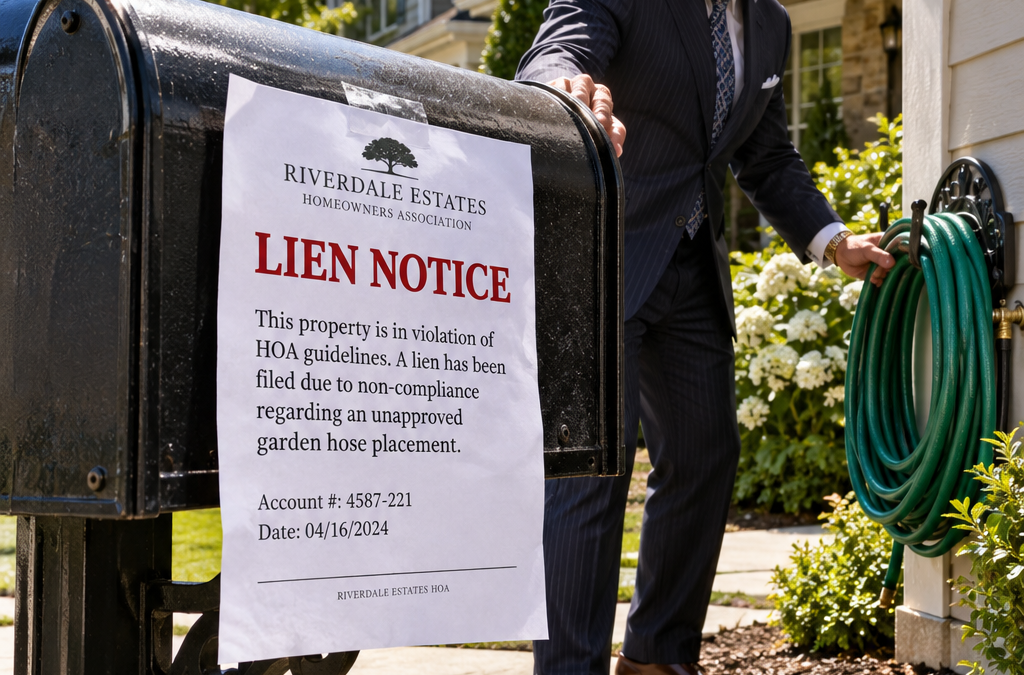
The lien notice arrived on a gray Tuesday morning, crookedly taped to my mailbox like Sandra Whitfield wanted me to feel the threat before I even read it. I had spent fifteen years saving, working overtime, and paying every bill on time, but somehow one woman with a clipboard had found a way to put my home in danger.
My name is Daniel Cruz, and for most of my adult life, I believed rules existed to protect people.
That probably came from my job.
I am a paramedic. I have pulled strangers out of wrecked cars at two in the morning. I have done chest compressions on kitchen floors while families prayed behind me. I have carried elderly men down narrow staircases, talked terrified kids through asthma attacks, and held pressure on wounds while waiting for backup.
In my line of work, rules matter.
Protocol matters.
You check the airway before you worry about anything else. You confirm the medication before you administer it. You document times, vitals, symptoms, and interventions because when people are scared, confused, or angry, the written record becomes the spine of the truth.
Rules keep chaos from swallowing people whole.
That was what I believed.
Then I met Sandra Whitfield.
She taught me that rules, in the wrong hands, can become weapons.
I had lived in Briarwood Estates for fifteen years before the first notice appeared. It was a quiet neighborhood outside Raleigh, mostly brick ranch houses and two-story colonials, with oak trees along the sidewalks and a small clubhouse near the entrance. It had an HOA, but for most of my time there, the association had been more background noise than threat.
I paid my dues.
I mowed my lawn.
I painted when things needed painting.
I showed up to the occasional meeting when my schedule allowed.
For years, nobody bothered me.
My house was a modest three-bedroom with a sloped front yard, beige siding, white trim, and a little stone path I had installed myself after three straight weekends of sweating under the Carolina sun. It was not fancy, but it was mine. Every square foot of it had been paid for through overtime shifts, holiday shifts, night shifts, and all the little sacrifices people don’t see when they say, “Must be nice to own a place.”
I missed birthdays.
I worked Christmas mornings.
I slept in my truck between shifts more times than I like admitting.
I didn’t buy that house because I wanted to impress anyone.
I bought it because I wanted somewhere stable to come home to after spending my life running toward other people’s emergencies.
The first time Sandra Whitfield knocked on my door, I had just come off a twenty-four-hour shift.
I was wearing sweatpants, one sock, and a shirt with coffee spilled near the collar. I remember that because Sandra looked me up and down before she even introduced herself, as if she were writing a violation notice in her head.
She stood on my porch in a cream blazer, pearl earrings, and white slacks that looked too expensive to be anywhere near an ordinary neighborhood sidewalk. Her hair was cut into a smooth silver bob, sprayed perfectly in place despite the humidity. She held a leather folder against her chest and smiled with a mouth that had learned the shape but not the meaning.
“Mr. Cruz,” she said.
“That’s me.”
“Sandra Whitfield. HOA board president.”
I nodded. “Nice to meet you.”
She glanced past me into the house for half a second, then turned her eyes toward the side yard.
“I wanted to introduce myself personally.”
“Sure.”
“And to let you know we’re tightening standards this quarter.”
That was an odd phrase to hear at nine in the morning from a woman standing on your porch like she had come to serve a warrant.
“Standards?”
“Community presentation standards,” she said. “Briarwood has slipped in several small ways over the past few years, and the board is correcting that.”
I was too tired to argue with a sentence that vague.
“Okay.”
Her eyes flicked toward the side of my house.
“Outdoor equipment storage will be one of our focus areas.”
I followed her gaze.
My green garden hose was coiled beside the spigot. Not across the walkway. Not in the street. Not wrapped around a mailbox like a python. Just coiled beside the house where I had left it after watering the front shrubs.
“That’s my hose,” I said.
“Yes,” Sandra said. “I noticed.”
I almost laughed.
“I’ve kept it there for years.”
“Previous boards were inconsistent.”
She said it the way a prosecutor might say previous administrations failed to punish crime.
I looked at her folder.
“Is there a problem?”
“Not yet,” she said, smiling again. “This is just a friendly conversation.”
That friendly conversation turned into a bright pink notice taped to my front door four days later.
Improper Storage of Outdoor Equipment.
It cited Clause 7 of the Briarwood Community Harmony Standards.
I stood on my porch reading it with one eyebrow raised.
Community Harmony Standards?
I had never heard that phrase in my life.
I went inside, opened the drawer where I kept HOA papers, and pulled out the bylaws. The most recent version I had was probably five years old, but I had never received a full replacement packet. I flipped through the pages until I found the outdoor-equipment section.
It said tools, construction materials, abandoned appliances, and visible maintenance equipment could not be stored in front yards for extended periods.
Nothing about garden hoses.
Nothing called Clause 7.
Nothing mentioning community harmony.
I should have been irritated.
Instead, I laughed.
Genuinely laughed.
After years of trauma calls, overdoses, cardiac arrests, and people screaming in hospital parking lots, a garden hose violation felt too small to take seriously.
I moved the hose behind the side gate, took a picture for my records, and emailed the management office.
Violation corrected. Please confirm no fine will apply.
No one answered.
A week later, another notice arrived.
This one said the hose remained improperly stored because it was visible from the street through the gap beside my gate.
Fine: $200.
That was when I stopped laughing.
I walked outside and stood at the curb, looking toward the side of my house. If I tilted my head and squinted through the hedge, I could see maybe six inches of green hose behind the gate.
Two hundred dollars.
For six inches of hose.
I called the HOA office. A woman named Brielle answered, sounding tired before I even finished saying my name.
“I need to dispute a fine,” I said.
“Address?”
I gave it to her.
A keyboard clicked.
“Oh,” she said.
Not a good “oh.”
“What does that mean?”
“Nothing, Mr. Cruz. I see the account.”
“The hose was moved behind the gate. The notice says it’s still visible from the street, but that’s absurd.”
“The violation was issued by President Whitfield.”
“Can I appeal?”
“Yes, technically.”
“Technically?”
“You can submit a written appeal.”
“Will the board review it?”
There was a pause.
“President Whitfield manages enforcement review.”
I leaned against the kitchen counter.
“So the person who issued the fine also reviews the appeal?”
Another pause.
“That’s the current procedure.”
I thanked her and hung up.
That evening, my neighbor Rosa leaned over the fence while I was trimming back the hedge.
Rosa Martinez had lived next door for almost twenty years. She was in her late sixties, sharp-eyed, with a voice that could slice through nonsense without rising above conversational volume. She had watched me grow from a younger man with a mortgage into a tired paramedic with back pain and opinions about lawn equipment.
“Daniel,” she said quietly.
I looked over. “Hey, Rosa.”
She nodded toward my front door. “Sandra leave you another pink love letter?”
I held up the notice.
Rosa sighed.
“She targets people who won’t grovel first.”
I frowned. “Targets?”
“Watch your mailbox closely.”
“Rosa, it’s a garden hose.”
“With Sandra, it’s never about the thing she writes on the paper.”
That should have stayed with me.
It did, but not deeply enough.
At work the next day, I told my buddy Marcus about it over cold vending-machine coffee between calls. Marcus had been my partner for years before he moved into supervisory work, and he had the rare gift of making terrible things sound survivable.
He nearly choked laughing.
“Bro, just paint your whole house Karen beige and surrender already.”
“She said community harmony.”
“Of course she did. Nothing says harmony like threatening a paramedic over a hose.”
I laughed because Marcus was laughing, and because joking made the situation feel smaller.
“Maybe I’ll just pay the two hundred and move on.”
Marcus stopped laughing.
“Don’t.”
I looked at him.
He tossed his empty coffee cup into the trash.
“People like that count on you being too tired to fight.”
I was tired.
That was the problem.
Tired from work. Tired from bills. Tired from living in a world where even coming home didn’t guarantee peace.
So I considered paying.
Then the next notice came.
This one involved a fence post.
According to Sandra, one post along my back fence exceeded the approved height by two inches. I measured it myself. She was right about the height difference, but the fence had been that way for nine years. It had passed inspection twice. Nobody had ever complained.
Fine: $150.
Then came a paint violation.
Sandra claimed the beige on my shutters violated Clause 7 because it disrupted community harmony by appearing too warm in afternoon light.
I read that one three times.
Too warm in afternoon light.
I carried the letter over to Rosa.
She read it once, handed it back, and said, “She’s building a file.”
“A file for what?”
Rosa looked toward Sandra’s house at the end of the street.
“Pressure.”
After that, the fines came faster.
Trash can left curbside beyond the approved retrieval window.
Two hundred dollars.
Grass improperly maintained.
Another two hundred.
The grass violation was especially interesting because two days before the notice, I had come home from a double shift and found the front strip oddly short, almost scalped near the sidewalk. I assumed the landscaping crew had accidentally crossed onto my property while mowing the common area.
Then Sandra posted a photo in the neighborhood app.
Ongoing grass-height violation at 1184 Briarwood Lane.
My house.
My lawn.
A patch of grass she or someone else had cut too short, now used as evidence against me.
That was when I started recording everything.
Not casually.
Obsessively.
I took photos every morning before work and every evening when I returned. I saved every notice, every envelope, every email, every app screenshot. I wrote down times. I backed files up to cloud storage. I built a spreadsheet with columns for alleged violation, date issued, fine amount, cited rule, evidence provided, and my response.
Paramedics learn documentation the hard way.
If you don’t write it down, it didn’t happen.
If the timeline doesn’t make sense, someone will eventually make it make sense in a way that hurts you.
One night, sitting at my kitchen table with a cold plate of leftovers beside me, I noticed the first real crack.
Sandra had uploaded several violation photos through the HOA app. Most people would just look at the images. I downloaded them.
The metadata was still attached.
The photos had been taken at 6:03 in the morning.
Not only that.
They came from a phone model Sandra didn’t use.
I knew what phone she had because she carried it everywhere in a bright white case with gold initials. The metadata listed a different device entirely.
I sat back.
Why would Sandra submit violation photos from someone else’s phone?
At first, I thought maybe another board member had taken them.
But the app listed Sandra as the uploader and certifying officer.
The same pattern appeared on several notices.
Different photo device.
Same early-morning timestamp.
Same Sandra login.
I didn’t know what it meant yet, so I filed it away.
In my job, you don’t diagnose too early. Chest pain could be anxiety, reflux, or a heart attack. A confused patient could be dehydrated, hypoglycemic, intoxicated, septic, or all of the above. You collect the pattern before you name the problem.
And the pattern kept growing.
Within six weeks, my alleged balance had climbed from $200 to $800.
Then came the certified letter.
I was leaving for work when I saw it wedged into my mailbox, taped crookedly against the metal like someone had slapped it there in a hurry.
The envelope was thick.
The paper inside was heavier than the usual notices.
Notice of Intent to Record Lien.
I stood beside the mailbox as a cold wind moved through the street and read the first paragraph twice.
Sandra claimed I owed unpaid fines, late fees, administrative processing charges, and special enforcement assessments. If the balance was not paid within ten days, the HOA would proceed with lien recording and potential foreclosure action under the governing documents.
Foreclosure.
That word turned the street quiet around me.
I had spent fifteen years paying my mortgage. I had worked Thanksgiving shifts, Christmas Eve shifts, double shifts, storm shifts. I had watched friends buy boats and new trucks while I put extra money toward principal whenever I could. The house wasn’t fully paid off yet, but I had built real equity, real roots, real safety.
And Sandra Whitfield was threatening to use a garden hose, a fence post, and a shade of beige to put that at risk.
I called the HOA office from my driveway.
Brielle answered.
“I need the bylaws,” I said.
“Mr. Cruz?”
“Yes. I need the current official bylaws and fine schedule. Full copy.”
“I can request that.”
“No. I am formally requesting it now. In writing also. Today.”
“I understand.”
“And I need a ledger explaining every charge on my account.”
“I’ll note the request.”
“How long?”
She hesitated. “The board has to make records available within a reasonable time.”
“Define reasonable.”
“President Whitfield controls document release.”
Of course she did.
I sent a written request by email before leaving for work. Then another by certified mail the next morning.
Sandra stalled for eleven days.
First, the board secretary was unavailable.
Then records needed review.
Then the current packet had to be compiled.
Then Sandra was “out of office for association business,” which Rosa confirmed meant she had been home all day overseeing the repainting of her own porch railings, a shade of white I was tempted to report as emotionally disruptive to community harmony.
When the documents finally arrived, I made coffee, cleared my kitchen table, and went through them line by line.
Half the cited violations didn’t exist.
No Clause 7 saying beige could be too warm.
No community-harmony rule about garden hoses visible through hedge gaps.
No provision allowing Sandra to personally certify fines without board review.
No authority for several of the administrative processing fees.
I sat there, highlighter in hand, realizing Rosa had been right.
Sandra wasn’t enforcing rules.
She was inventing them.
At the next board meeting, I brought everything.
The clubhouse smelled like old carpet and burnt coffee. Folding chairs filled half the room. Sandra sat at the front table in a navy blazer with gold buttons, her leather binder placed neatly before her like a judge’s case file.
I waited through the treasurer’s report and landscaping update.
Then public comment opened.
I stood.
“My name is Daniel Cruz, 1184 Briarwood Lane. I have questions about fines issued against my property.”
Sandra smiled.
“Mr. Cruz, you’ve submitted several messages already.”
“Yes. And now I have the governing documents.”
Her smile tightened.
I held up the notices.
“Several of these violations cite rules that do not appear in the bylaws or fine schedule.”
A few heads turned.
Sandra folded her hands.
“We enforce community standards.”
“Can you identify the rule about beige paint violating community harmony?”
A low murmur moved through the room.
Sandra’s eyes sharpened.
“Your tone is confrontational.”
“My tone is calm. My question is specific.”
“You have repeatedly challenged the association’s authority.”
“I’ve repeatedly asked for the written basis for fines threatening a lien on my home.”
Sandra leaned toward her microphone.
“Mr. Cruz, this board will not be intimidated by hostile behavior.”
I felt the room shift.
That was her move.
Make the questioner the problem.
A man asking for documents became hostile. A homeowner defending his property became confrontational. A paramedic who had spent his adult life controlling his voice in emergencies was suddenly dangerous because Sandra needed him to be.
I forced my hands to stay still.
“I’m asking for documentation.”
Sandra smiled sweetly.
“And I am simply enforcing our community standards.”
That sentence almost worked.
Then Mr. Alvarez stood.
He was two rows behind me, an elderly veteran with a silver cane and a deep scar along one cheek. His wife had died a few years earlier. He used a wheelchair ramp at the front of his house on difficult days, especially when his hip pain flared.
His voice was rough but steady.
“Like when you fined me for my ramp?”
The room went quiet.
Sandra’s face hardened.
“Mr. Alvarez, your ramp issue was resolved.”
“You charged me six hundred dollars before my daughter threatened to call a lawyer.”
Sandra looked down at her papers.
“The ramp lacked architectural approval.”
“It was medically necessary.”
“It still required review.”
I turned toward him.
He looked at me, then at the room.
“She knew I needed it. She fined me anyway.”
That was the moment it clicked.
This was never about community appearance.
Not really.
A garden hose.
A fence post.
A wheelchair ramp.
A paint color.
All of them were just handles Sandra could grab.
This was about control.
Who got to stand upright and who had to kneel.
After the meeting, three residents approached me quietly in the parking lot. Diane from the next street. Mr. Alvarez’s daughter, Elena. A younger couple named Owen and Melissa who had been fined for a child’s bicycle left beside their garage.
“She’s done this to us too,” Melissa said.
Diane looked toward the clubhouse door. “But people are afraid.”
“Then we stop being isolated,” I said.
That night, I started a private group chat.
Six neighbors joined first.
Then nine.
Then fourteen.
We kept it careful. No ranting. No threats. No insults. Just documents. Notices, fines, account ledgers, appeal denials, timestamps, photos.
Every single fine traced back to Sandra’s login.
Not board consensus.
Not recorded votes.
Sandra.
And then Owen found the second crack.
“Does anyone know what ‘administrative processing fee’ means?” he wrote.
We all had one.
Sometimes twenty-five dollars. Sometimes fifty. Sometimes seventy-five.
The amounts changed without explanation.
Elena pulled her father’s bank statements and HOA ledger. Melissa found her own receipts. Rosa, who still had old board contacts, helped us compare payments.
The fees weren’t going into the normal HOA operating account.
They were being routed separately.
Priya Shah, the attorney we eventually hired, found the receiving account in less than a week.
It was registered under Sandra’s husband’s name.
I remember sitting in Priya’s office as she turned her laptop toward me.
Priya was young, maybe early thirties, sharp-eyed and precise, with a voice that never got loud because it never needed to. She had a way of asking questions that made evasive answers sound ridiculous before they were even finished.
“This account receives recurring deposits connected to enforcement processing fees,” she said.
I stared at the screen.
“That’s her husband’s name.”
“Yes.”
“How much?”
“So far, we have identified a little over eleven thousand in the sample records your group provided. That may not represent the full amount.”
My stomach turned.
“So the more fines she writes, the more money moves into that account.”
“That is what the records suggest.”
Suddenly, the lien threats made brutal sense.
Sandra wasn’t protecting property values.
She was monetizing fear.
Priya sent a formal demand for financial disclosures, board authorizations, and complete enforcement records.
Sandra misplaced them.
Not once.
Repeatedly.
First, the treasurer was traveling.
Then records were being migrated to a new system.
Then the association had suffered a minor file-access problem.
Then Sandra claimed attorney-client privilege over financial ledgers she had no legal reason to hide.
“Classic,” Marcus said when I told him. “Karens always misplace inconvenient truths first.”
But jokes didn’t change the deadline.
Ten days remained before Sandra could begin actual foreclosure proceedings based on the lien notice.
I went to work with that number burning in my head.
Ten days.
Then nine.
Then eight.
Every time dispatch tones sounded, I flinched harder than usual. My body was at work, but my mind kept returning to the mailbox, the lien letter, the balance Sandra claimed I owed.
On the seventh night, I worked a double shift.
Fourteen hours into it, after one diabetic emergency, two transport calls, and a highway crash that left my uniform smelling like gasoline, my pager buzzed again.
Medical emergency.
Chest pain.
Address two streets over from mine.
I glanced at the screen.
Sandra Whitfield.
For one second, I just stared.
My partner that night was Jenna Price, a calm, competent EMT with no patience for drama. She looked from the call screen to my face.
“You good?”
“That’s my HOA president.”
“The one trying to take your house?”
“Yeah.”
She buckled in.
“Then we do this clean.”
That was all she had to say.
Because she knew me.
And because protocol is protocol.
No hesitation. No petty revenge. No rough handling. No sarcasm. No “funny seeing you here.” Nothing but the job.
We arrived in under five minutes.
Sandra’s front door was open. Lights blazed inside. Her husband stood near the entryway, pale and anxious.
“She’s in the living room,” he said.
Sandra sat on the sofa clutching her chest, breathing fast.
“My heart,” she gasped. “The stress. This HOA harassment is killing me.”
I knelt several feet away.
“Sandra, I’m Daniel Cruz with county EMS. This is Jenna. We’re going to assess you.”
She looked at me as if she had been waiting for exactly that line.
“You.”
I kept my voice even.
“Are you having chest pain right now?”
She lifted one trembling hand toward me.
“You shouldn’t be here.”
“I am the responding paramedic. If you prefer another unit, we can request one, but we need to assess your symptoms now.”
Jenna moved to set down the monitor.
Sandra’s breathing became louder.
“He’s retaliating,” she said.
Jenna glanced at me once, then continued.
I went through the questions.
Onset, provocation, quality, radiation, severity, time.
Sandra answered dramatically, sometimes sobbing, sometimes clutching at her blouse. Her pulse was elevated but not alarming. Her skin was warm and dry. No obvious signs of acute distress matched the performance she was giving, but chest pain is chest pain until proven otherwise.
We treated it seriously.
Jenna placed the blood pressure cuff.
I prepared the monitor leads.
Sandra suddenly grabbed her phone from the cushion beside her.
I noticed too late that it was already streaming.
“He’s hurting me,” she cried into the camera.
Jenna froze.
I stopped with my hands visible.
Sandra turned the phone toward us.
“They’re deliberately hurting me right now. This is retaliation for everything. He is abusing his position.”
My chest went cold.
On the screen, comments were already moving.
Little hearts. Shocked faces. Names I recognized from the neighborhood.
Four hundred viewers.
Jenna said firmly, “Ma’am, nobody is hurting you. We are attempting to assess reported chest pain.”
Sandra cried out before anyone touched her.
“Ow! Stop twisting my arm!”
I was three feet away.
Jenna looked at me.
I looked at Jenna.
This was no longer only a medical call.
It was a trap.
I stepped back and spoke clearly.
“For the record, patient is currently seated upright on the sofa. No physical contact is being made by EMS at this moment. Patient is live streaming and accusing responders of harm.”
Jenna nodded slightly and repeated, “No contact being made.”
Sandra screamed again.
Her husband stood frozen near the doorway, looking horrified but silent.
Then Sandra tried to stand.
“Ma’am, please remain seated,” I said.
She stepped sideways, tangled her foot in the edge of a decorative throw rug, and dropped heavily onto one knee.
Her phone bounced but stayed angled against the door frame, propped almost perfectly toward the room.
She shrieked.
“He pushed me!”
I had not moved.
Jenna immediately called for law enforcement backup while I documented aloud.
“Patient stood unassisted and tripped over rug. No contact from EMS.”
Sandra kept crying toward the phone.
The whole scene felt unreal.
A woman who had spent months fabricating violations was now trying to fabricate assault during a medical call.
And she was doing it on her own camera.
We continued professionally.
When law enforcement arrived, they separated everyone, secured the scene, and reviewed what they could. Sandra refused transport after repeated assessment attempts, signing the refusal form with a trembling hand and a look of theatrical betrayal.
Before leaving, I noted everything in the patient care report.
Every refusal.
Every accusation.
Every moment of no contact.
Jenna wrote her own statement.
The police took preliminary information.
I drove away feeling sick.
By sunrise, the clip was everywhere.
But not the version Sandra wanted.
Because her own phone had captured the entire room.
The recovered livestream showed her screaming before we touched her. It showed Jenna calmly explaining the blood pressure cuff. It showed me standing with my hands visible. It showed Sandra tripping over her own rug without any contact from us at all.
It showed the lie collapsing in real time.
Someone downloaded the stream before Sandra deleted it. Then another neighbor posted side-by-side timestamps in the group chat. By noon, local social media had it. By evening, a local news station ran a short segment.
HOA President Accused of Faking EMS Assault During Livestream.
I hated seeing my name anywhere near it.
I didn’t want attention.
I wanted my house safe.
I wanted my job untouched.
I wanted Sandra to stop.
But once investigators saw the video, everything changed.
A false accusation against EMS responders during a medical call is serious by itself. But the livestream also gave the county attorney’s office a reason to look harder at Sandra’s credibility, her HOA conduct, and the financial records Priya had been demanding for weeks.
The records Sandra had “misplaced” were subpoenaed.
And when actual investigators started asking, the documents suddenly became less misplaced.
What they uncovered was worse than we expected.
Forty-one thousand dollars in fabricated fines and administrative processing charges had been diverted over roughly two years.
Not eleven thousand.
Forty-one.
Money residents had paid because they were scared of liens, late fees, public shaming, and foreclosure threats. Money Sandra had framed as necessary for enforcement, compliance, and community standards. Money routed through accounts connected to her and her husband.
Priya called me the day the number was confirmed.
I was sitting in my truck outside the station, still wearing my uniform.
“Daniel,” she said, “we have the financial tracing.”
I closed my eyes.
“How bad?”
“Forty-one thousand dollars.”
I opened my eyes.
Across the parking lot, another unit was being washed down.
“From us?”
“From multiple residents. Fabricated fines, processing charges, improper administrative fees.”
I swallowed.
“And my lien?”
“Based on charges now directly tied to the fraudulent scheme.”
I leaned back against the seat.
For months, Sandra had made me feel like I was the one failing to comply.
Failing to understand.
Failing to respect authority.
Now the records showed what she had been doing.
She wasn’t protecting Briarwood.
She was using it.
Within seventy-two hours, the HOA board called an emergency session.
The clubhouse was packed.
I had never seen so many residents there. People stood along the walls, holding folders, phones, printed screenshots. Mr. Alvarez sat in the front row with Elena beside him. Rosa sat near me, arms folded, eyes fixed on the front table.
Sandra appeared ten minutes late.
She wore a charcoal blazer and pearls.
Her face looked drawn, but she still walked in like she expected the room to part for her.
It didn’t.
The acting vice president, a nervous man named Harold, opened the meeting. His hands shook slightly as he read the agenda.
“Emergency vote regarding removal of Sandra Whitfield from the office of board president.”
Sandra stood.
“This is a political ambush.”
No one responded.
She looked around the room.
“I have served this community for nine years.”
Rosa said quietly, “Served yourself.”
A few people murmured.
Sandra pointed toward me.
“This man started a campaign of harassment against me.”
I stood slowly.
“Don’t.”
The room went quiet.
I didn’t raise my voice.
“Don’t blame me for records you created, money you moved, rules you invented, or lies you filmed yourself telling.”
Sandra’s face went red.
“You are not allowed to speak to me that way.”
“I am a homeowner,” I said. “And you put a fraudulent lien threat on my house.”
Mr. Alvarez lifted his cane slightly.
“And fined my ramp.”
Melissa stood.
“And doubled our penalties.”
Another man spoke from the back.
“And waived your friend’s dues.”
One by one, the room came alive.
Sandra tried to talk over everyone.
Harold called for order.
Then the vote happened.
Unanimous.
Sandra Whitfield was removed from the presidency.
No more gavel.
No more smiling through clenched teeth while pretending she alone knew what the neighborhood needed.
She stood at the front of the room, white with anger, while the residents she had intimidated for years voted her out.
The lien against my home was dismissed shortly afterward.
Not reduced.
Not negotiated.
Dismissed as fraudulent.
The county clerk’s office issued a formal correction and written apology for the distress caused by the recording of a claim based on defective HOA submissions. Priya handed me the release document in her office.
I stared at it longer than necessary.
“That’s it?” I asked.
“That’s it,” she said.
“My house is clear?”
“Your house is clear.”
I looked down at the paper.
For weeks, I had imagined losing everything. I had pictured a foreclosure notice. A sheriff’s sale. Strangers walking through my living room while Sandra told everyone I had brought it on myself by refusing to follow rules.
Now the lien was gone.
The fines were reversed.
Every fabricated charge on my account was cleared.
I sat there in Priya’s office and felt my shoulders drop for the first time in months.
The refunds took longer.
They always do.
But they came.
Mr. Alvarez received his ramp fees back, along with a written apology from the new board acknowledging that the enforcement action had been improper and should never have happened. Elena cried when she told us.
Owen and Melissa got their bicycle fines reversed.
Diane recovered late charges Sandra had doubled after Diane questioned a vote.
Rosa, who had somehow avoided Sandra’s worst penalties through pure instinct and sarcasm, said the best refund was watching Sandra’s name disappear from the HOA website.
Criminal charges followed.
Embezzlement.
Filing false financial statements.
Filing a false police report related to the EMS incident.
The mugshot leaked online within hours, because small towns and neighborhood groups are crueler than newspapers when they smell hypocrisy.
I didn’t share it.
I didn’t need to.
The woman who had livestreamed herself pretending to be assaulted by paramedics had been undone by the same phone she thought would protect her.
That felt like enough.
A few weeks later, Marcus came over with beer.
We sat on my back patio, the same patio I had nearly imagined leaving forever. The evening was warm. My lawn needed cutting, but not urgently. My garden hose sat coiled exactly where I wanted it, beside the spigot.
Marcus looked at it and grinned.
“Careful, man. That thing is a felony waiting to happen.”
I laughed.
“Community harmony is very fragile.”
“Clearly.”
He took a sip.
Then his face softened.
“You okay?”
I looked toward the yard.
“I think so.”
“That doesn’t sound convincing.”
I sat back.
“I’m relieved. Angry. Tired. Embarrassed I almost paid her just to make it stop.”
Marcus shook his head.
“Don’t do that.”
“What?”
“Turn her crime into your shame.”
I stared at him.
He shrugged.
“She counted on you being tired. That’s not the same as you being weak.”
For a long moment, I didn’t answer.
Then I nodded.
Because he was right.
Sandra hadn’t targeted people who were careless. She targeted people who were busy, grieving, elderly, disabled, exhausted, or afraid of risking their homes. She understood that most people don’t have time to become experts in HOA bylaws. Most people see an official letter and assume it must be valid. Most people pay because they are trying to protect their families, not because they believe the charge is fair.
That was the cruelty of it.
She hid theft inside paperwork.
Control inside procedure.
Fear inside community standards.
And for a while, it worked.
The new board held its first open meeting one month after Sandra’s removal.
The room felt different immediately.
No leather binder at the head table.
No gavel.
No icy smile.
The agenda included financial transparency reforms, independent audits, enforcement review, and homeowner access to records. Priya attended as counsel for the resident group, and Sandra’s former allies looked like they wanted to be anywhere else.
When public comment opened, Mr. Alvarez spoke first.
He didn’t talk long.
He stood slowly, leaning on his cane, and said, “Rules matter. But only when they apply to everybody, and only when they are real.”
Then he sat down.
The room applauded.
I looked around and saw people who had once avoided eye contact now speaking openly. Asking questions. Challenging line items. Requesting timelines. Not screaming. Not threatening. Just participating in a community that belonged to them too.
That night, I went home and did something small.
I walked to the side of my house, uncoiled the garden hose, and watered my shrubs.
I didn’t hide it.
Didn’t check the street first.
Didn’t worry about Sandra’s phone appearing over the hedge.
Water darkened the soil around the roots, and the air smelled like wet grass and warm pavement. The sound was ordinary. Peaceful.
For three months, Sandra had turned that hose into an accusation.
Now it was just a hose again.
The trial would take time. Lawyers love time. Courts move slower than fear. Sandra would have hearings, motions, delays, explanations, and excuses. Maybe she would blame stress. Maybe she would blame accounting mistakes. Maybe she would claim the livestream had been misunderstood and the financial records misread.
But she no longer controlled my mailbox.
She no longer controlled the board.
She no longer controlled the story.
The evidence did that.
The metadata from another phone.
The missing bylaws.
The fake Clause 7.
The account under her husband’s name.
The livestream she staged and accidentally used to prove her own lie.
The paper trail she thought nobody would follow.
People like Sandra believe authority is a spotlight. They stand in it long enough and assume the whole room will see only what they want shown. But cameras point both ways. Records survive. Dates matter. So do neighbors willing to speak after years of swallowing fear.
I still work as a paramedic.
I still believe in rules.
Maybe more than before.
But now I understand something I didn’t fully understand then.
Rules don’t protect anyone unless ordinary people are willing to ask who wrote them, who benefits from them, and whether they are being applied honestly.
A fake rule with an official stamp is still fake.
A lien built on fabricated charges is still fraud.
A person in power is still just a person.
And sometimes the person screaming loudest about community standards is the one stealing from the community.
Sandra Whitfield tried to take my home over a garden hose.
She tried to make me look unstable for asking questions.
She tried to turn a medical emergency into a performance, certain that tears, a phone camera, and four hundred live viewers would make her lie stronger than my record.
But the truth was already standing in the room.
Calm.
Documented.
Recorded.
Waiting.
These days, when I come home from a long shift, I park in the driveway and sit for a minute before going inside. The house looks the same as it always did. Beige siding. White trim. A slightly crooked front step I keep meaning to fix. Shrubs along the walk. Grass that grows too fast after rain.
Nothing special to most people.
Everything to me.
Because I know how close I came to losing peace inside my own walls.
I know how easily official-looking paper can make your chest tighten.
And I know the relief of seeing a fraudulent lien released from your property records after weeks of wondering whether your home is truly safe.
One Saturday morning, Rosa saw me outside coiling the hose.
She leaned over the fence.
“Careful, Daniel. That thing caused a lot of trouble.”
I smiled.
“No. Sandra caused trouble.”
Rosa pointed at me.
“Good answer.”
We both laughed.
Then she looked toward the street, where Sandra’s house sat quiet behind trimmed hedges.
“Feels different now,” she said.
“Yeah.”
“Like the neighborhood can breathe.”
I followed her gaze.
She was right.
The houses hadn’t changed. The streets hadn’t changed. The clubhouse hadn’t changed. But the fear had thinned out. People waved more. They talked at mailboxes longer. They complained about normal things again, like dog poop and leaf pickup schedules, not secret fines and foreclosure threats.
I finished coiling the hose and hung it beside the faucet.
Exactly where it had always belonged.
The morning sun caught the brass nozzle.
For a second, I thought about the first pink notice and how small it had seemed.
Then I thought about the lien.
The board meeting.
Mr. Alvarez standing with his cane.
Sandra screaming into her own livestream.
Priya showing me the financial records.
The release document clearing my home.
Justice doesn’t always arrive like thunder.
Sometimes it shows up in metadata.
In bank transfers.
In a neighbor’s saved notice.
In a camera someone set up to tell a lie.
Sometimes justice arrives wrapped in a gym towel, a lawsuit, or a green garden hose lying exactly where one exhausted homeowner left it.
I went inside, closed the door, and made coffee.
No notice waited on the porch.
No certified letter sat in the mailbox.
No woman with a clipboard stood at the curb pretending she owned the street.
For the first time in months, my home felt like my home again.
And I had no intention of letting anyone make me feel otherwise.








