𝗙𝗨𝗟𝗟 𝗦𝗧𝗢𝗥𝗬 The HOA President Tried to Force Us Out of Our First Home, and Then Someone Broke Into Our House Looking for Something He Couldn’t Afford to Lose
𝗙𝗨𝗟𝗟 𝗦𝗧𝗢𝗥𝗬
I looked at the chairs.
They were stained a warm brown.
Marcus’s parents had given them to us as a housewarming present.
“We just moved in,” I said.
“That doesn’t suspend community standards.”
I smiled, assuming he was joking.
He wasn’t.
He pointed toward the chairs with a polished fingernail.
“The finish is not compliant.”
I stared at him.
“They’re rocking chairs.”
“Yes.”
“On our porch.”
“Correct.”
“And that’s a problem?”
His smile thinned.
“Mrs. Reyes, people invest substantial money to live in communities like this. Visual consistency protects property values.”
I looked around.
Our moving boxes were still visible through the front window.
A rolled-up rug leaned against the garage.
My husband was inside trying to figure out why the upstairs bathroom fan sounded like a lawn mower.
And this man had arrived to inspect our furniture.
“Well,” I said, “I’ll check the rules.”
“Excellent.”
He took a small booklet from his clipboard and handed it to me.
“Consider this a friendly reminder.”
Then he surveyed the flower bed beside the porch.
“That edging might need attention as well.”
I looked down.
“What edging?”
“The decorative stones. They aren’t consistent in height.”
I waited for him to smile.
Instead, he wrote something on his clipboard.
Then he turned toward his SUV.
“Rosewood maintains very high standards, Mrs. Reyes. I’m sure you and your husband will learn to appreciate them.”
He walked away before I could answer.
Marcus came outside a minute later.
“Who was that?”
“Our HOA president.”
“What’d he want?”
I pointed at the chairs.
“Apparently, they’re the wrong color.”
Marcus studied them.
Then looked at me.
“Should we apologize to the chairs?”
I laughed.
He grinned.
“Does he measure his own grass with a ruler?”
“Probably every morning.”
We thought we’d met an annoying neighbor.
That was all.
A man with too much time, too much authority, and an unfortunate obsession with uniform furniture colors.
We had no idea he was about to become the most frightening person in our lives.
The first fine arrived five days later.
A bright white envelope had been taped to our front door.
Inside was a notice charging us fifty dollars for violating the association’s aesthetic uniformity standards.
The offense?
A garden gnome.
Marcus had bought it at a hardware store during our first weekend in Rosewood.
It was ridiculous in the best possible way.
A small ceramic figure with a red pointed hat, blue jacket, and a watering can tucked beneath one arm.
We’d placed it beside the flower bed near the porch.
I liked it because it made the house feel less like a carefully staged real estate listing and more like somewhere people actually lived.
Derek apparently disagreed.
The notice included a photograph of the gnome, a reference to the architectural standards, and a payment deadline.
Marcus read it over dinner.
“Fifty dollars?”
I nodded.
“For a twelve-dollar gnome?”
“Apparently.”
He stared at the paper.
Then at me.
“We could buy four more gnomes for the price of that fine.”
I laughed, but I was beginning to feel uneasy.
I searched the welcome packet and found a general provision about exterior decorations.
It required approval for certain permanent installations but said nothing specifically prohibiting a small removable garden ornament.
I emailed the HOA office asking for clarification.
The reply arrived the next morning.
The president has determined that the item violates aesthetic uniformity requirements.
That was it.
No explanation.
No reference to a properly adopted restriction.
Just Derek’s decision.
We moved the gnome into the garage while we waited for an answer.
The answer never came.
Instead, three days later, another violation notice appeared.
This one involved our trash cans.
According to Derek, we’d placed the bins at the curb eleven minutes outside the approved seven o’clock collection window.
Eleven minutes.
Marcus stared at the notice in disbelief.
“How does he even know?”
I looked at the timestamp on the attached photograph.
“He took a picture.”
“At seven-eleven in the morning?”
“Yes.”
Marcus set the paper down.
“Does this man have a job?”
I wanted to laugh.
But something about the photograph disturbed me.
Derek hadn’t simply noticed our trash cans while driving past.
He had apparently been watching closely enough to document the exact minute he believed we’d violated a rule.
And he was doing it repeatedly.
That evening, I started a folder.
I put the gnome notice inside.
Then the trash-can citation.
Then copies of my emails to the management office.
I labeled it HOA Records.
At the time, it was nothing more than a practical habit.
My job involved keeping documents organized, and I had learned that when people disagreed about what happened, dates and written records were more reliable than memory.
I didn’t know that folder would eventually become something a stranger was willing to break into my home to find.
The next warning came from our neighbor, Sylvia Bennett.
She lived across the street in a white ranch-style house with blue shutters and a flower garden that seemed to bloom in every season.
Sylvia was in her late sixties, recently retired, and possessed the kind of calm intelligence that made people lower their voices when she spoke.
She stopped me one afternoon while I was pulling weeds near the sidewalk.
“Jean, sweetheart, can I ask you something?”
“Of course.”
“Has Derek been giving you trouble?”
I sat back on my heels.
“How did you know?”
She glanced toward the clubhouse.
“Because you’re new.”
I frowned.
“What does that mean?”
She hesitated.
Then stepped closer.
“He’s done this before.”
I stood.
“Done what?”
“Started with little violations. Then more fines. Then legal letters.”
My stomach tightened.
“To who?”
“Three families I know personally.”
I looked at her.
“What happened?”
“They sold their houses.”
I stared.
“Because of HOA fines?”
“Because they got tired of living under constant threats.”
She lowered her voice.
“And every time, Derek’s friend Gavin Pike appeared with an offer.”
“Who’s Gavin Pike?”
“A real estate agent.”
She looked toward the entrance.
“He buys distressed properties for investors. Or helps arrange the purchases. I don’t know exactly how the money moves.”
I felt a strange chill.
“You’re saying Derek fines people until they sell?”
“I’m saying I’ve watched three families get pressured right before selling, and the same real estate agent always seems to be involved.”
“Do you have proof they’re working together?”
She shook her head.
“No. That’s why I’m being careful.”
She looked directly at me.
“But don’t assume this is only about a garden gnome.”
I thought about Derek’s clipboard.
His photographs.
The way he had inspected our porch before we’d finished unpacking.
“What should we do?”
“Keep every letter.”
I almost smiled.
“Already started.”
“Good.”
She touched my arm.
“And don’t let him make you believe you’re the only family having trouble.”
That evening, I told Marcus everything.
He listened without interrupting.
When I finished, he leaned against the kitchen counter.
“Three families?”
“According to Sylvia.”
“And the same real estate agent?”
“Yes.”
He rubbed his jaw.
“That sounds bad.”
“It sounds suspicious. We don’t know if it’s connected.”
Marcus glanced toward the front window.
“So what do we do?”
“Keep records. Follow the actual rules. Don’t give Derek a legitimate reason to come after us.”
He nodded.
“All right.”
We thought we were being sensible.
We didn’t understand that compliance was exactly what Derek knew how to exploit.
Every time we corrected something, he found another problem.
Two weeks after the trash citation, we received a two-hundred-dollar fine for a supposedly noncompliant mailbox.
The notice claimed the post was the wrong height.
Marcus measured it.
Then measured it again.
It matched the diagram included in the HOA standards.
We took photographs showing the measurements.
Sent them to the management office.
Requested cancellation of the fine.
Derek denied the request.
His explanation was that the mailbox did not comply with the association’s overall appearance expectations.
Marcus called the office.
“Which expectation?” he asked.
I stood beside him, listening.
The woman on the other end said the president had reviewed the issue.
“Did he look at our measurements?”
She couldn’t say.
“Did anybody inspect the post?”
She didn’t know.
“Then what exactly are we paying two hundred dollars for?”
She referred him to the next board meeting.
Marcus hung up slowly.
He looked at me.
“He’s doing this on purpose.”
I nodded.
“I think so.”
The four-hundred-dollar landscaping violation arrived the following week.
That one accused us of unauthorized modifications to the front garden.
The so-called modification was a narrow bed of mulch we’d installed around two existing shrubs.
Marcus had checked the architectural standards before buying the materials.
There was nothing unusual about the mulch.
Half the neighborhood had similar beds.
But the notice claimed we had failed to obtain approval.
Derek attached another photograph.
The angle made the flower bed look larger than it was.
I printed the photograph and placed it in the folder beside my own dated pictures.
Then I wrote down something I’d noticed.
Every violation arrived shortly after we questioned the previous one.
The timing might have been a coincidence.
But I was no longer willing to assume it.
By the end of our first month in Rosewood, Marcus had stopped joking about the HOA.
He came home from work one evening looking exhausted.
Derek had left another message asking him to contact the compliance office immediately.
Marcus dropped his keys into the bowl beside the door.
“I’m going to that meeting.”
I looked up.
“Are you sure?”
“Yes.”
“He’s going to try to make you angry.”
Marcus shook his head.
“He can try.”
I knew my husband.
He wasn’t confrontational.
He didn’t enjoy arguments.
He was the kind of man who apologized when someone else bumped into him at the grocery store.
But he also hated watching people abuse authority.
And Derek had spent weeks trying to convince us that we were bad homeowners simply because we asked ordinary questions.
The board meeting took place in the clubhouse on a Thursday evening.
We arrived early.
The room had polished floors, leather chairs, and a long conference table beneath decorative lighting.
Derek sat at the head.
His navy suit was immaculate.
His hair looked as though every strand had been placed individually.
A gold watch rested against his wrist.
He smiled when he saw us.
“Mr. and Mrs. Reyes.”
Marcus nodded.
“Mr. Voss.”
“I understand you’ve requested another hearing.”
“We’re disputing several violations.”
Derek leaned back.
“Of course.”
There were six directors at the table.
Two residents sat behind us.
The atmosphere was strangely tense.
Marcus opened our folder.
He presented the mailbox measurements, the landscaping photographs, and copies of the governing rules.
He spoke calmly.
“We’re not asking for special treatment. We just want to understand why we’re being fined for things that appear to comply with the written standards.”
Derek looked at the documents without touching them.
“Rules are rules, Mr. Reyes.”
“Agreed. That’s why we’re asking you to identify the rule we’re violating.”
Derek smiled.
“Ignorance isn’t an excuse.”
Marcus paused.
“I’m not claiming ignorance. I’m reading from the documents your association gave us.”
Derek’s eyes narrowed.
“The board has authority to interpret community standards.”
“Within the governing documents, yes.”
The room went quiet.
Derek leaned forward.
“Are you challenging this board’s authority?”
Marcus took a breath.
“I’m asking a question.”
“You’re questioning decisions made by people elected to protect this community.”
“That’s part of being a homeowner, isn’t it?”
One director looked down at his papers.
Another shifted in his chair.
Nobody spoke.
Derek’s voice became colder.
“Mr. Reyes, you’re new here. Perhaps you don’t yet appreciate the expectations of this community.”
Marcus looked at him.
“We bought a home. We didn’t surrender the right to ask how rules are enforced.”
I felt my heart begin to pound.
Derek slowly closed the folder in front of him.
“The violations stand.”
Marcus stared.
“Without reviewing the evidence?”
“We’ve reviewed enough.”
“But—”
“Your comments are concluded.”
The silence was painful.
I looked around the room.
Several people avoided my eyes.
It was obvious that nobody wanted to become Derek’s next target.
We left without accomplishing anything.
In the parking lot, Marcus stopped beside our car.
His hands were trembling.
“I wanted to punch that table.”
I took his hand.
“You didn’t.”
“He’s humiliating us.”
“I know.”
“He acts like we don’t belong here.”
I looked toward the clubhouse windows.
Derek was standing inside, laughing with another board member.
“That’s what he wants us to feel.”
Marcus looked at me.
“Then we’re not giving him the satisfaction.”
I nodded.
But as we drove home, I realized something.
Derek didn’t need us to lose our tempers.
He had the ability to keep sending official-looking threats until we were exhausted.
And we had no idea how far he was willing to go.
That night, I changed the way I kept records.
Every letter received a date.
Every email was saved.
I photographed alleged violations before making any changes.
I kept a timeline of contacts with the association and wrote detailed notes after phone conversations.
When Derek stopped near our property, I recorded what happened from lawful vantage points.
I was determined that nobody would later be able to claim we had imagined the harassment.
By the middle of the second month, the fines had reached more than two thousand dollars.
Some were described as repeat violations.
Others were administrative penalties.
Several referred to rules we’d repeatedly asked to see but never received.
Then the certified letter arrived.
I was standing at the kitchen counter when I opened it.
The envelope contained a formal notice threatening to pursue a lien against our home for more than $2,200 in alleged unpaid fines and charges.
I felt my hands go cold.
A lien.
Against the first home Marcus and I had ever owned.
I read the letter again.
It warned that further collection action, potentially including foreclosure if legally authorized, could follow if the disputed balance remained unresolved.
For several seconds, I couldn’t move.
Marcus came into the kitchen.
“Jean?”
I handed him the letter.
He read it.
Then looked up.
“Over a gnome and some mulch?”
I nodded.
His face changed.
The anger was still there.
But now there was something underneath it.
Fear.
“We can’t lose this place,” he said.
“I know.”
“We put everything into the down payment.”
“I know.”
He sank into a chair.
I sat across from him.
For a while, we stared at each other.
Then he said, “Maybe we should pay.”
The words hurt more than I expected.
Not because he was wrong to consider it.
Because I knew how frightened he had to be before he’d suggest surrendering.
I reached for his hand.
“If we pay, what stops him from finding another violation next week?”
Marcus looked down.
“Nothing.”
“And another after that?”
He closed his eyes.
“I just want us to be safe.”
I squeezed his hand.
“So do I.”
That night, neither of us slept well.
The house we’d imagined growing old in had become a place where every knock at the door made us tense.
And somewhere in Rosewood Estates, Derek Voss was probably sleeping peacefully beneath expensive sheets, convinced that another frightened family would eventually do exactly what he wanted.
I stopped believing that two days later.
Sylvia knocked on our front door just after sunset.
She was carrying a manila envelope and looking over her shoulder as though she expected someone to follow her.
“Can I come in?”
“Of course.”
I stepped aside.
She walked into the kitchen, set the envelope on the table, and took a long breath.
“I talked to one of the families who sold last year.”
I pulled out a chair.
“Which family?”
“The Millers. They lived on Hawthorne Court.”
I remembered the house.
A beautiful two-story colonial with a wide front porch.
It had sold several months before we moved in.
Sylvia opened the envelope.
Inside were copies of HOA violation notices, payment demands, and a letter from Gavin Pike, the real estate agent she’d mentioned before.
The Millers had been fined repeatedly during the final months of their ownership.
Their landscaping supposedly violated neighborhood standards.
Then their fence.
Then their driveway.
When they challenged the fines, additional penalties appeared.
Eventually, the HOA threatened collection action.
Not long afterward, Gavin approached them with an offer to arrange a fast sale.
I examined the documents.
“Was Gavin working for Derek?”
“That’s what we’re trying to find out.”
I looked at the sale correspondence.
The offer had been considerably below the price of comparable homes in Rosewood.
“Did they accept?”
Sylvia nodded.
“They were exhausted. Their youngest daughter had just started college, and they didn’t want legal trouble.”
I felt something tighten in my chest.
“Did the HOA release the fines after they sold?”
“Most of the disputed charges were cleared during closing.”
I looked up sharply.
“Really?”
She nodded.
I studied the papers again.
That was the part I couldn’t explain.
If the violations were serious enough to threaten collection action, why had they suddenly become negotiable when the homeowners agreed to sell?
Sylvia leaned toward me.
“Jean, I think he’s trying to drive people out.”
I didn’t answer immediately.
It was a serious accusation.
And I had no intention of making the same mistake Derek made by treating suspicion as proof.
But there was enough here to justify asking more questions.
“Do you think the Millers would speak with me?”
“They already said yes.”
The next weekend, Marcus and I met them at a coffee shop outside Rosewood.
Mr. Miller looked about sixty, with tired eyes and thick hands. His wife sat beside him, holding a paper cup she barely touched.
They described nearly six months of fines.
A mailbox citation.
A fence dispute.
Landscaping penalties.
A threat involving the sale of their home.
Every time they tried to resolve one issue, another appeared.
Eventually, Gavin Pike contacted them and suggested selling before the alleged HOA debt became a serious title problem.
Mrs. Miller looked down at her coffee.
“We were scared.”
I nodded.
“I understand.”
“We didn’t know what was real anymore. Every letter sounded official. Every time we called, Derek said we were making things worse.”
Marcus leaned forward.
“Did anyone explain why Gavin could arrange for the fines to be waived?”
Mr. Miller shook his head.
“He told us the association wanted the property transferred without outstanding issues.”
I looked at the documents.
“And you sold below market value?”
Mrs. Miller nodded slowly.
“We just wanted to leave.”
That sentence stayed with me.
We just wanted to leave.
It sounded so much like the way Marcus had spoken about paying the fines.
Derek didn’t need to physically remove anyone.
He only needed to make living in Rosewood feel unbearable.
Over the following week, I spoke with two more former residents.
Their stories were disturbingly similar.
Escalating penalties.
Threats of liens.
Repeated denials of appeals.
Then a conversation with someone connected to Gavin Pike about selling quickly.
The transactions themselves might have had legitimate explanations. People sell homes for many reasons.
But the timing and similarities were impossible to ignore.
I added copies of the correspondence to my folder, with each person’s permission.
Then I started examining another part of the HOA’s operation.
Its contractors.
The discovery came from an ordinary repair notice.
Derek had instructed us to use a company called Premier Grounds & Property Services to correct our supposedly unauthorized landscaping.
The estimate was nearly fourteen hundred dollars.
I stared at it.
Fourteen hundred dollars to remove mulch, adjust two shrubs, and replace the edging around a flower bed.
Marcus took the paper from my hands.
“For that money, they should be planting gold.”
I looked up the company.
The registered business information identified its owner as Calvin Mercer.
The name didn’t mean anything to me initially.
Then Sylvia mentioned it during a phone call.
“Calvin? That’s Derek’s brother-in-law.”
I went quiet.
“Are you sure?”
“He’s married to Derek’s sister.”
I looked at the estimate again.
Derek had been ordering homeowners to correct alleged violations.
The approved contractor was his relative.
And the quoted prices were far higher than ordinary market rates.
I contacted three independent landscaping companies for comparable estimates.
Their prices varied, but all were substantially lower.
One contractor quoted less than five hundred dollars.
Another estimated about six hundred.
Premier’s price was nearly three times the middle of the range.
I didn’t assume an expensive quote automatically meant fraud.
Businesses could charge different rates.
But the connection was significant.
I requested the HOA’s vendor approval records and conflict-of-interest disclosures.
The management office acknowledged the request.
Then nothing happened.
Four days later, Derek came to our driveway again.
This time, Marcus was outside repairing a section of loose fence.
Derek walked over carrying his leather clipboard.
I saw him through the kitchen window and came outside.
“Mr. and Mrs. Reyes,” he said pleasantly.
His smile was almost convincing.
“Good afternoon.”
Marcus set down his drill.
“What can we do for you?”
Derek glanced toward the landscaping.
“I understand you’ve been contacting outside contractors.”
I felt my stomach tighten.
“Yes.”
“Why?”
“To compare prices.”
His smile faded.
“Premier Grounds is an approved vendor.”
“We’re aware.”
“Then I fail to see why you’re seeking unauthorized estimates.”
Marcus straightened.
“We’re allowed to ask what work costs.”
Derek’s eyes narrowed.
“Not when you’re attempting to circumvent association compliance procedures.”
I took a step forward.
“Is Calvin Mercer your brother-in-law?”
For a moment, Derek didn’t move.
Then he smiled coldly.
“My family relationships are none of your business.”
“They become relevant when homeowners are directed to pay his company.”
His expression hardened.
“Be very careful, Jean.”
Marcus stepped beside me.
“Don’t threaten my wife.”
Derek turned toward him.
“I’m explaining the consequences of spreading defamatory allegations.”
“We asked a question,” Marcus replied.
Derek looked between us.
“You two seem determined to create problems.”
I held his gaze.
“We want the actual rules, the basis for the fines, and an explanation of how your preferred contractor was selected.”
His jaw tightened.
“You’re not entitled to interrogate this board whenever you feel inconvenienced.”
“Then respond to the written records request.”
He stepped closer.
“You are going to regret pushing this.”
I felt my heartbeat quicken.
“Is that a threat?”
He smiled.
“Call it advice.”
Marcus moved slightly in front of me.
“Leave our property.”
Derek stared at him.
For one tense moment, I thought he might refuse.
Then he adjusted his cuff.
“You’re making a very serious mistake.”
He walked back to his SUV.
I watched him drive away.
Marcus remained beside me.
“Jean.”
I turned.
His expression was troubled.
“This isn’t normal.”
“I know.”
“No. I mean he’s starting to scare me.”
I looked toward the empty street.
For the first time, I admitted that he scared me too.
That evening, we contacted an attorney.
Her name was Caroline Brooks, and she specialized in real estate and HOA disputes.
We brought the fine notices, photographs, governing documents, contractor estimates, and correspondence from the former residents.
She reviewed everything carefully.
Then she asked us whether we had signed any new agreements since purchasing the home.
“No,” Marcus answered.
“Any acknowledgment accepting these additional penalties?”
“No.”
“Have you been given a meaningful opportunity to appeal?”
“We attended a board meeting,” I said. “Derek refused to address the actual provisions.”
Caroline marked several pages.
“The association may have authority to enforce valid restrictions, but that authority has limits. We’ll challenge the unsupported charges and demand the documentation necessary to evaluate the rest.”
Marcus leaned forward.
“What about the lien threat?”
“We’ll address that promptly. A threat to file a lien is not the same as having a valid, enforceable claim. They must meet the legal requirements.”
I looked at her.
“And the contractor?”
“The related-party relationship deserves scrutiny. We can request the applicable records and refer credible financial concerns to the appropriate authorities.”
I thought about the Millers.
“And the families who sold?”
Caroline studied the correspondence.
“Those transactions require careful investigation before anyone concludes they were fraudulent. But the pattern you’ve described is concerning.”
She closed the folder.
“Most importantly, neither of you should confront Mr. Voss alone. Preserve everything and let further communication go through my office.”
I nodded.
We left feeling slightly more secure.
That night, I moved the HOA Records folder into our home safe.
It was a heavy, portable steel box stored on the floor of our bedroom closet behind folded blankets.
Inside, Marcus and I kept our passports, emergency cash, certain family documents, and the records we didn’t want misplaced.
The cash totaled eleven thousand dollars.
It was most of our emergency savings, accumulated over years through overtime, tax refunds, and money we’d deliberately set aside. We had kept it physically secured while planning to move the bulk of it into a separate savings account.
I knew keeping that much cash at home carried risks.
But at the time, the safe seemed secure.
We had never had a burglary.
Rosewood was advertised as one of the safest neighborhoods in the area.
And I had no reason to believe anyone knew what the safe contained.
I placed the folder beside our passports and closed the door.
Marcus watched from the bedroom.
“Why are you putting the HOA papers in there?”
“Because I don’t trust Derek to stop.”
He looked toward the closet.
“You think he’d actually try something?”
I hesitated.
“I don’t know.”
That was the truth.
I didn’t know.
But I was beginning to understand that Derek had far more to lose from independent scrutiny than a few disputed fines.
The following week, Caroline submitted a formal notice disputing the penalties and requesting preservation of the association’s financial and governance records.
I continued speaking with affected residents.
Some shared old statements.
Others gave me copies of contractor invoices.
One former board member provided meeting summaries that raised questions about repairs supposedly approved during periods when no such meetings appeared in the records we’d been shown.
The material stretched across nearly two years.
I wasn’t conducting a criminal investigation.
I didn’t have authority to seize bank records or demand confidential information.
But I could preserve documents people lawfully possessed and share them with qualified professionals.
By the end of the second month, my folder contained more than our own complaints.
It contained a troubling history of how Rosewood had been managed.
Then came the night everything changed.
Marcus and I went out to dinner on a Friday.
We had barely spent any time together without discussing Derek, fines, or legal notices.
So Marcus suggested a small Italian restaurant about fifteen minutes from home.
“No paperwork tonight,” he told me.
I smiled.
“Not even one conversation about the HOA?”
“Especially not that.”
We ordered pasta and shared a piece of chocolate cake.
For the first time in weeks, I laughed without feeling guilty.
Marcus told me about a repair job that had gone completely wrong because a delivery company sent the wrong equipment three times.
I told him about a patient who had brought homemade cookies to the office after we helped resolve an insurance problem.
We talked about replacing the backyard fence.
About planting tomatoes.
About finally adopting that dog.
For ninety minutes, we were just a married couple enjoying dinner.
We left shortly after eight.
The sky had turned dark, and a light rain was beginning to fall.
As we drove into Rosewood, I leaned back against the passenger seat.
“That was nice.”
Marcus smiled.
“We should do it more often.”
“Maybe once the HOA stops trying to financially destroy us.”
He glanced at me.
“I thought we weren’t talking about them.”
I laughed.
“Sorry.”
He reached across the console and squeezed my hand.
Then we turned onto our street.
Our porch light was on.
The front windows were dark.
Everything looked normal.
Marcus pulled into the driveway.
I got out carrying my purse and a small container of leftover pasta.
He walked toward the garage while I went to unlock the front door.
The lock turned normally.
I stepped inside.
Then stopped.
Something felt wrong.
I couldn’t explain it immediately.
The house was quiet.
The living room looked undisturbed.
But the air was colder than it should have been.
I set my purse on the entry table.
“Marcus?”
He came through the garage door.
“What?”
“Did you leave a window open?”
He frowned.
“No.”
I walked toward the kitchen.
Then I saw it.
The back door wasn’t closed properly.
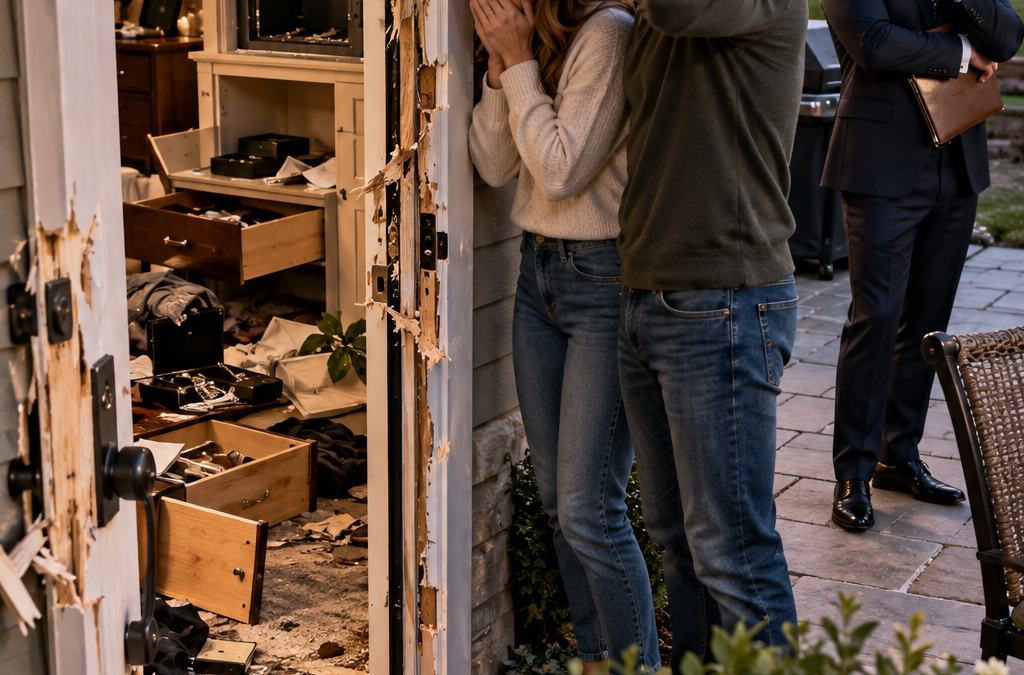
Its frame was splintered near the lock.
A section of wood hung loose beneath the strike plate.
I froze.
“Marcus.”
He heard something in my voice and came quickly.
“What happened?”
I pointed.
He stopped.
For a moment, neither of us moved.
Then he stepped in front of me.
“Stay here.”
“Marcus, don’t.”
He looked toward the dark hallway.
“We don’t know if someone’s still inside.”
I grabbed his arm.
“Then we’re not going farther.”
We backed out through the front door.
Marcus called 911.
I stood beside the driveway, staring at our house.
Our first home.
The place we’d saved for seven years to buy.
The place where I’d carefully arranged photographs, chosen curtains, and imagined growing old with my husband.
And now somebody had forced their way inside.
The police arrived within minutes.
Two officers approached us while another checked the perimeter.
They made sure the house was clear before allowing us to enter.
Nothing in the living room appeared damaged.
The television was still there.
Marcus’s laptop sat on the dining table.
My jewelry box remained on the dresser upstairs.
That confused me.
If somebody had broken in to steal valuables, why had they left so much behind?
Then I opened the bedroom closet.
The safe was gone.
I stared at the empty space.
The folded blankets had been thrown onto the floor.
There were marks in the carpet where the heavy box had been dragged.
I couldn’t breathe.
“Marcus.”
He appeared behind me.
I pointed.
“The safe.”
He looked into the closet.
His face went white.
“No.”
I shook my head.
“It’s gone.”
He stepped closer.
“Jean, the money—”
“Eleven thousand.”
He closed his eyes.
Our emergency savings.
Our passports.
Important documents.
And every HOA record I’d collected.
Gone.
My knees began to weaken.
Marcus caught my arm.
“Sit down.”
I sat on the edge of the bed.
An officer entered the room.
“What was stored in the safe?”
I tried to answer.
My throat had tightened.
Marcus spoke for me.
“Cash. Passports. Personal documents.”
The officer nodded and began taking notes.
Then I remembered the folder.
“The HOA records.”
He looked up.
“What records?”
I swallowed.
“Documents about a dispute with our homeowners association.”
He wrote it down.
“Anything especially valuable?”
“To me, yes.”
I looked toward Marcus.
“Letters. Fines. Photographs. Contractor invoices. Copies of records involving the HOA president.”
The officer studied my expression.
“Has anyone threatened you recently?”
I felt cold.
Marcus answered immediately.
“Yes.”
The officer looked between us.
“Who?”
I took a breath.
“Derek Voss. The HOA president.”
I explained the dispute.
The fines.
The lien threat.
The contractor records.
The meetings.
The way Derek had warned us that we’d regret asking questions.
The officer listened without interrupting.
Then he asked an important question.
“Did Mr. Voss know you kept those records in the safe?”
I shook my head.
“Not that I know of.”
“Did he know where the safe was?”
“No.”
I looked toward the closet.
At least, I didn’t think so.
The officer examined the room.
“Who else knew you had a safe?”
Marcus and I exchanged looks.
Very few people.
Family.
Perhaps a moving company employee who had carried it into the house.
But nobody we knew had reason to steal a folder of HOA paperwork.
And that was what frightened me most.
The intruder had ignored easier valuables.
He had gone upstairs.
Entered our bedroom.
Opened the closet.
And taken the safe.
I felt violated in a way I’d never experienced before.
Somebody had walked through our home while we were eating dinner.
He had stood in our bedroom.
Touched our belongings.
Entered the one space where we should have been able to close a door and feel safe.
I looked toward the bed.
The place where Marcus and I slept.
And wondered whether the stranger had stood right there.
I started crying.
Marcus sat beside me and wrapped his arms around my shoulders.
The officer quietly stepped into the hallway.
For several minutes, I couldn’t stop shaking.
Then Marcus whispered, “We’re okay.”
I nodded against his chest.
But I didn’t feel okay.
Because whoever had taken the safe might have known exactly when we’d be gone.
And I had no idea whether he would come back.
The investigation moved quickly.
One officer requested information about our security cameras.
We had a video doorbell covering the front porch and driveway, but the rear of the house wasn’t fully covered.
The footage showed us leaving.
Later, a dark sedan passed slowly along the street.
The camera didn’t clearly capture its driver.
A neighbor’s security camera showed a similar vehicle turning into the rear service lane.
The officers circulated a description.
About forty minutes after arriving at our house, one of them received a call over the radio.
A suspicious vehicle had been located roughly two blocks away.
The driver appeared nervous and had been parked in the area long enough to draw attention.
The officers investigating our burglary went to examine the situation.
I didn’t know any of that yet.
I was still sitting in our bedroom, staring at the empty closet.
Then an officer returned.
“Mrs. Reyes, we may have located property connected to your burglary.”
I stood so quickly that Marcus reached for me.
“Our safe?”
“We’re verifying the circumstances.”
“Where?”
“Nearby.”
My heart began pounding.
The next hour felt endless.
Police secured the vehicle and proceeded through the appropriate search process.
Inside its trunk, they found a heavy steel safe matching our description.
The exterior showed fresh marks.
When we were asked to identify it, I recognized a distinctive scratch near the handle.
Marcus recognized the manufacturer’s label.
It was ours.
The suspect was taken into custody in connection with the burglary investigation.
His name was Travis Cole.
He was in his thirties, thin, nervous, and had apparently believed the job would be simple.
The police didn’t disclose every detail of the interview immediately.
But investigators soon told us that Travis had provided information connecting the burglary to someone who wanted specific documents removed from our home.
I remember sitting across from a detective named Sarah Mitchell when she explained that.
Her office was small and practical.
A desk.
Two chairs.
A computer.
A stack of case folders.
Nothing about it looked dramatic.
Yet the words she said changed the way I understood the entire previous two months.
“Mrs. Reyes, we have reason to believe the person responsible wasn’t primarily interested in your cash.”
I stared at her.
“What?”
“The suspect has made statements indicating he was hired to retrieve documents.”
I felt my stomach turn.
“What documents?”
She studied me carefully.
“Records relating to your homeowners association.”
Marcus sat forward.
“Who hired him?”
Detective Mitchell paused.
Then said, “We are investigating evidence pointing toward Derek Voss.”
For several seconds, I couldn’t speak.
Derek.
The man who had inspected our rocking chairs.
The man who fined us for a garden gnome.
The man who threatened our first home over a pile of invented violations.
I had known he was vindictive.
I had known he was dishonest.
But I had never imagined he might send someone through our back door.
Marcus stood.
“That son of a—”
I grabbed his hand.
He stopped.
Detective Mitchell remained calm.
“We need to corroborate the suspect’s statements. We’re reviewing communications, financial evidence, and the circumstances of the burglary.”
I nodded slowly.
“Did he know about our safe?”
“That appears to have been part of the information provided to him.”
A wave of nausea passed through me.
Somebody had told Travis where to look.
Somebody had planned the timing.
Somebody had wanted what was inside badly enough to risk sending a burglar into our home.
I looked at the detective.
“Why?”
She folded her hands.
“That is one of the questions we’re working to answer.”
But I could already see the outline.
Derek hadn’t wanted the garden gnome removed.
He hadn’t wanted our mailbox fixed.
He hadn’t even wanted the fines paid.
He wanted us frightened, compliant, and quiet.
And when I began collecting documents that could challenge his control, he’d decided the documents themselves had to disappear.
The police investigation uncovered corroborating evidence.
Communications between Travis and a person connected to Derek.
A payment arrangement.
Instructions referring to a folder of HOA materials.
Information about our expected absence from the house.
The suspect’s account was not treated as sufficient by itself.
Detectives compared it with phone records, vehicle information, financial transactions, and other evidence obtained through lawful procedures.
The connection became increasingly difficult to dismiss.
Travis had been promised a portion of the money and an additional payment for retrieving and destroying documents that could damage Derek.
The irony was brutal.
Marcus and I had spent years saving that eleven thousand dollars.
To Travis, the money was an incentive.
To Derek, the paperwork was apparently the greater threat.
I thought about the folder lying inside the safe.
The fine notices.
The photographs.
The contractor estimates.
The statements from former residents.
All the records I’d gathered because I wanted to understand why a man was treating our first home like his personal property.
Those pages had become dangerous to Derek.
Not because I’d done anything extraordinary.
Because I’d preserved things he expected frightened homeowners to throw away.
Detective Mitchell asked me to provide digital copies of the documents.
Fortunately, I’d scanned most of them and stored copies outside the safe.
I brought the files to the investigators.
Then I explained how each had come into my possession.
I identified the original source whenever I could.
I distinguished firsthand records from statements supplied by other residents.
I pointed out inconsistencies without pretending I knew their final meaning.
The detective listened carefully.
When I finished, she looked at the folder on the table.
“You’ve kept a very detailed record.”
I nodded.
“I didn’t trust him.”
She looked at me.
“That may help us establish the timeline.”
I thought about the first fifty-dollar fine.
The garden gnome.
The trash cans.
The mailbox.
Things that had once seemed too ridiculous to take seriously.
Now those details showed how the pressure had developed.
Each notice was dated.
Each escalation documented.
Each confrontation connected to the next.
Derek hadn’t become dangerous in a single moment.
He had crossed boundaries repeatedly, discovering how much fear he could create without consequences.
And when that stopped working, he’d crossed the boundary of our home.
The police widened the investigation.
The county prosecutor’s office reviewed the burglary evidence, while detectives and financial investigators examined the association records.
Formal requests and legal process were used to obtain banking information, invoices, contracts, and relevant communications.
The findings went far beyond our disputed fines.
Over approximately two years, the HOA’s reserve accounts had been depleted through transactions that investigators alleged were unauthorized or fraudulently justified.
The records showed payments tied to maintenance and landscaping projects that either had not occurred as billed or had been substantially misrepresented.
Some invoices described repairs for locations where investigators could find no corresponding work.
Others involved services billed at amounts far beyond what the actual work supported.
Several payments connected to Premier Grounds & Property Services received particular scrutiny.
Calvin Mercer, Derek’s brother-in-law, had been involved in transactions supported by questionable invoices and approvals.
The evidence suggested that association money had been diverted through that relationship and other transactions.
Investigators traced a total amount exceeding one hundred thousand dollars in suspected improper withdrawals and expenditures.
I remember hearing the figure.
Six figures.
While ordinary homeowners were being threatened over a fifty-dollar gnome.
While Marcus and I had spent nights wondering whether we could lose our first home over $2,200 in disputed fines.
While the Millers had sold their house under pressure.
Derek had allegedly been draining money from the association meant to protect the very community he claimed to serve.
I didn’t know whether to feel angry or sick.
Mostly, I felt exhausted.
The case became public when investigators confirmed that a criminal inquiry was underway.
Residents began comparing their experiences.
Our quiet cul-de-sac turned into a place where people stood in driveways holding HOA letters and asking questions they’d been afraid to ask before.
Sylvia went from house to house encouraging homeowners to preserve documents and cooperate with investigators.
Patrick, who lived farther down the street, brought out old newsletters and meeting notices.
A retired accountant named Harold Finch began reviewing publicly available association financial summaries.
He discovered discrepancies that reinforced the need for independent examination.
People weren’t laughing at Derek’s authority anymore.
They were asking where their money had gone.
The HOA newsletters that once praised him as a visionary leader now looked painfully dishonest.
Every glowing report about community improvements was being compared with actual expenditures.
Every claim of responsible management raised another question.
And every resident who had been told not to challenge the president wanted to know why.
The emergency HOA meeting was held the following Tuesday.
I nearly didn’t attend.
The idea of walking back into that clubhouse made my chest tighten.
The last time we’d gone, Derek had humiliated Marcus in front of the board.
He’d declared the fines valid without examining our evidence.
He’d made it clear that our right to ask questions existed only as long as he permitted it.
Now the same man was being investigated in connection with a burglary at our home.
Marcus stood beside me while I put on my jacket.
“We don’t have to go,” he said.
I looked at him.
“I know.”
“Caroline can handle the paperwork.”
“I know.”
He waited.
I looked toward our back door.
The damaged frame had been temporarily secured, but the permanent replacement wasn’t finished.
Every time I saw it, I remembered coming home from dinner and discovering that a stranger had been inside.
I took a breath.
“I’m tired of being afraid in my own neighborhood.”
Marcus nodded.
“Then I’m coming with you.”
The clubhouse parking lot was packed.
People stood in small groups near the entrance.
Some nodded when they saw us.
Others approached quietly to ask how we were doing.
A woman I’d never spoken to before touched my arm.
“I’m so sorry about what happened.”
I thanked her.
Then Marcus and I walked inside.
Derek sat at the head of the table.
For the first time since meeting him, he didn’t look perfectly composed.
His hair was still styled.
His suit was still expensive.
His shoes still shone.
But the color had drained from his face.
There were dark circles beneath his eyes.
His hands rested tightly together on the table.
Beside him sat two attorneys.
The room was filled beyond capacity.
Residents stood along the walls.
Several board members whispered anxiously to one another.
When Derek saw me, his expression changed.
It wasn’t anger.
Not immediately.
It looked like fear.
Then he straightened and reached for the microphone.
“Good evening, everyone.”
The room barely quieted.
He cleared his throat.
“I understand there have been rumors concerning the association and certain personal allegations.”
Someone near the back shouted, “Rumors? The police are investigating!”
Derek lifted one hand.
“Please allow me to finish.”
Another voice called, “Where’s our reserve money?”
His jaw tightened.
“The association’s finances are being reviewed.”
“Why?”
“Because some people have misunderstood ordinary accounting practices.”
A bitter laugh moved through the crowd.
Derek leaned toward the microphone.
“These allegations are being exaggerated by individuals who have personal grievances against this board.”
Several residents turned toward me.
I felt the old panic rise.
He was doing it again.
Trying to turn the community against the person asking questions.
Marcus reached for my hand.
Then Sylvia stood.
“Derek, did you authorize those landscaping payments to Calvin’s company?”
Derek stared at her.
“That is a confidential contractual matter.”
Harold Finch rose from his chair.
“Association expenditures aren’t automatically confidential because they’re embarrassing.”
A few people applauded.
Derek’s face reddened.
“Mr. Finch, sit down.”
Harold didn’t move.
“Where are the approvals?”
Derek glanced toward his attorneys.
One leaned closer and whispered something.
Derek looked back at the crowd.
“All financial matters will be handled through the appropriate process.”
A woman near the front stood.
“Then why have we been denied records?”
Someone else called, “Why did you threaten to lien our house?”
Another voice shouted, “Why did Gavin Pike keep buying houses after you fined people?”
The questions came faster.
Derek raised both hands.
“This meeting is becoming disorderly.”
I almost laughed.
For two months, he’d used disorder as an excuse to silence Marcus and me.
Now dozens of people wanted answers, and he couldn’t control them with a clipboard.
The remaining board members conferred briefly.
Then the vice president announced that the association would consider a motion concerning Derek’s leadership.
One director explained that the ongoing investigation, the questions surrounding financial approvals, and the serious allegations connected to the burglary required immediate action to protect the association.
Derek stood.
“This is outrageous.”
The vice president looked at him.
“Please sit down.”
Derek stared.
For a second, I thought he might refuse.
Then he lowered himself into his chair.
The board followed its governing procedures.
The motion was presented.
The directors voted.
And before the meeting ended, Derek Voss was removed from his position as HOA president.
The association also suspended his authority over financial and enforcement decisions pending the necessary review.
He looked around the table as though expecting someone to rescue him.
Nobody did.
His title was gone.
The room remained quiet for several seconds.
Then a woman near the aisle began clapping.
Others joined.
Soon the applause filled the clubhouse.
I didn’t clap.
I watched Derek.
He stared at the table.
The man who had treated our neighborhood like a private kingdom had finally been forced to accept a decision he couldn’t overturn by raising his voice.
But I didn’t feel victorious yet.
Because I still had to go home to a damaged back door.
And the criminal case was only beginning.
The following morning, local reporters began calling the association office.
A camera crew appeared outside the clubhouse.
By evening, Rosewood Estates was on the local news.
The headline described an HOA president under investigation in connection with financial misconduct and a burglary targeting homeowner records.
Our quiet neighborhood had become a public scandal.
Marcus and I declined most interview requests.
I didn’t want our fear turned into entertainment.
I didn’t want strangers photographing our damaged door.
And I certainly didn’t want to provide details about our savings or home security.
But I gave a short statement through Caroline confirming that we were cooperating with investigators and that we expected the legal process to proceed fairly.
Soon afterward, criminal charges were filed.
Derek faced allegations involving embezzlement, conspiracy, and his alleged role in arranging the burglary of our home.
Calvin’s financial dealings were also examined, with charges and accountability pursued as supported by the evidence.
At Derek’s initial court appearance, the judge considered the applicable bail factors and imposed stringent conditions, including a substantial financial bond.
The man who had once delivered violation notices with a smug smile now sat beside defense counsel while a court reviewed the allegations against him.
He still wore an expensive suit.
But the suit couldn’t make the charges disappear.
The court wasn’t an HOA meeting.
He couldn’t declare questions out of order simply because he disliked them.
He couldn’t fine the prosecutor.
He couldn’t threaten a detective for requesting records.
And he couldn’t rewrite evidence by issuing another newsletter.
Meanwhile, Travis Cole, the man who had entered our home, negotiated a plea agreement.
He admitted his role in the burglary and agreed to testify truthfully about the arrangement that led him to our house.
In exchange, prosecutors agreed to recommend consideration of his cooperation when determining his sentence.
His testimony became important.
But it wasn’t the only evidence.
Detectives had corroborated key portions of his account through communications, payment information, surveillance footage, and recovered property.
Travis explained that he had been directed to retrieve paperwork and destroy it.
The cash inside the safe was an additional incentive.
He described receiving information about our home, our absence that evening, and the location of the records.
He had not chosen us randomly.
That was the part I struggled with most.
Burglary was frightening enough when it happened because a thief wanted valuables.
Knowing that someone had specifically targeted our house because I was preserving evidence made it feel far more personal.
It meant Derek had looked beyond our mailbox and lawn.
Beyond our fines.
Beyond the HOA’s ordinary power.
He had reached into our private life.
He had tried to make our home unsafe.
And he had done it because I refused to stop asking questions.
For weeks after the burglary, I had trouble sleeping.
Small noises woke me.
The click of the heating system.
A branch touching a window.
A car slowing on the street.
Sometimes I woke Marcus because I thought I’d heard someone near the back door.
He never complained.
He would get up, check the house, and return to bed.
Then he’d hold my hand until I could fall asleep again.
One night, I finally told him something I hadn’t admitted even to Caroline.
“I’m afraid to be here alone.”
He looked at me.
“I know.”
I swallowed.
“I hate that.”
He turned toward me.
“Why?”
“Because this is supposed to be our home.”
He brushed a strand of hair away from my face.
“It still is.”
I shook my head.
“It doesn’t feel like it.”
He was quiet for a moment.
Then he said, “Derek didn’t get to decide whether we deserved this house. And he doesn’t get to decide whether we keep living here.”
I looked at him.
“We were so happy when we moved in.”
“I remember.”
“Everything felt safe.”
Marcus pulled me closer.
“We’ll get that feeling back. Maybe not all at once. But we will.”
I rested my forehead against his chest.
For the first time, I realized that winning the legal dispute wouldn’t automatically erase the fear.
The damage to our sense of safety would take longer to repair than the door.
The criminal proceedings continued over the following months.
Investigators and forensic accountants organized the financial evidence.
Association records were compared with authentic banking transactions, vendor invoices, meeting minutes, and communications.
The prosecution presented evidence of falsified invoices and repair work that had been billed without legitimate supporting services.
Funds had been routed through transactions connected to Calvin’s business and other arrangements, with evidence showing that substantial amounts benefited Derek rather than the association.
The suspected losses extended into six figures over approximately two years.
Former residents also provided testimony and documents concerning the association’s pressure tactics.
The real estate transactions involving Gavin Pike were examined for possible connections to those tactics, although each transaction required its own evidence and legal analysis.
The prosecution’s principal financial case rested on the documented diversion of association funds, not merely the fact that homeowners had sold their houses after receiving fines.
I testified about our experience.
I described the initial welcome visit.
The fifty-dollar gnome fine.
The trash citation issued eleven minutes after the stated window.
The two-hundred-dollar mailbox penalty.
The four-hundred-dollar landscaping charge.
The board meeting where Derek refused to examine Marcus’s evidence.
The lien threat.
The contractor estimate.
The record requests.
And the night our safe disappeared.
I showed the court the photographs and correspondence I’d preserved.
I explained why I’d begun keeping the folder.
It wasn’t because I suspected a six-figure financial scheme on the day we moved in.
It was because I wanted to know whether a garden gnome was actually prohibited.
That simple beginning seemed almost unbelievable in the courtroom.
But every document had a date.
Every escalation could be traced.
The records allowed the jury to understand how an ordinary compliance dispute had developed into a campaign of intimidation.
The defense challenged my account.
Its attorney asked whether Marcus and I had been hostile toward Derek.
Whether we had refused valid rules.
Whether I might have misunderstood association policies.
I answered as carefully as I could.
I didn’t claim that every HOA notice was fraudulent simply because I disliked it.
I didn’t say Derek had committed crimes before investigators established the supporting evidence.
I explained what I’d seen, what I’d received, and what I’d done.
The evidence could speak for itself.
Travis testified about the burglary arrangement.
His cooperation was examined by both sides, including the sentence reduction he hoped to receive.
The prosecution presented the corroborating records alongside his account.
Other witnesses described the financial discrepancies.
The jury considered the documents, testimony, and applicable law.
And eventually, the criminal case reached its conclusion.
Derek was convicted of offenses arising from the embezzlement scheme and the arrangement to burglarize our home.
At sentencing, I sat beside Marcus near the back of the courtroom.
Derek entered wearing a dark suit.
His hair was still combed neatly back.
But his shoulders looked smaller.
His expression was drawn.
He never looked directly at me.
When the judge discussed the offenses, the courtroom was silent.
The court described the financial scheme as a calculated betrayal of the trust residents had placed in their association’s leadership.
The burglary was treated as a separate, serious violation of our safety and property.
Derek had not merely used his position to impose unreasonable fines.
The evidence showed he had abused that position for personal gain and then arranged a crime intended to destroy evidence that threatened his scheme.
The judge imposed a sentence involving years of imprisonment and ordered restitution as provided by law.
I listened without smiling.
I had imagined this moment many times.
During the worst weeks, when the HOA threatened our home, I’d thought about how satisfying it would feel to see Derek finally held accountable.
After the burglary, I’d imagined looking him in the eye and telling him what he’d taken from us.
But when the sentence was pronounced, I didn’t feel joy.
I felt an enormous release of tension.
The man who had made our home feel unsafe was finally facing consequences established through evidence and due process.
Marcus reached for my hand.
I squeezed it.
Neither of us spoke.
We walked out of the courthouse together.
Outside, the afternoon sun was bright.
Traffic moved past the building.
People hurried along the sidewalk carrying coffee and briefcases.
The world looked ordinary.
For a moment, that seemed strange.
Something that had consumed so much of our lives had reached its legal conclusion.
Yet the rest of the city simply continued.
Marcus stopped beside our car.
“How do you feel?”
I thought about the question.
Then I looked at him.
“Tired.”
He nodded.
“Me too.”
I leaned against him.
Then whispered, “But I think we can finally go home.”
The recovery process continued after the sentencing.
Our safe had been held as evidence while the necessary forensic examinations were completed.
Eventually, the property-release process allowed us to recover our belongings.
Our passports were returned.
The documents were returned.
The recovered emergency cash was accounted for and released through the proper procedures.
The safe itself was damaged, and Marcus refused to bring it back into our bedroom.
We replaced it and moved our savings into a more secure financial arrangement.
Caroline helped us address the remaining civil and HOA matters.
The association formally withdrew the unsupported fines against our property.
The threatened lien was abandoned.
We received written confirmation that the disputed balance had been removed from our account.
The new board then began reviewing enforcement actions issued during Derek’s presidency.
It took time.
Some notices had legitimate bases.
Others did not.
The board separated actual violations from charges that had been imposed without proper authorization or adequate evidence.
Refunds were issued for the unjust penalties.
Ours included.
Fifty dollars for the garden gnome.
The trash citation.
The mailbox fine.
The landscaping penalties.
And the additional unsupported charges that had pushed our alleged debt beyond $2,200.
I still remember opening the letter confirming the refund.
Marcus stood beside me.
I read the amount aloud.
He shook his head.
“All that over a gnome.”
I laughed.
Then, unexpectedly, I started crying.
Marcus wrapped his arms around me.
I couldn’t explain why the refund affected me so deeply.
The money mattered, of course.
But it wasn’t really about the money anymore.
It was the written acknowledgment that we’d been right to question what was happening.
We hadn’t imagined the harassment.
We hadn’t been unreasonable for asking to see the rules.
And we hadn’t deserved to be threatened for refusing to surrender.
Rosewood elected a new board within a month of Derek’s removal.
This time, the residents demanded meaningful oversight.
Meeting minutes were made more accessible.
Financial records underwent independent review.
Vendor relationships required documented conflict-of-interest disclosures.
Enforcement notices had to identify the applicable rule and provide a meaningful opportunity to contest the allegation.
No single board officer could impose penalties simply because a homeowner had challenged him.
The association also established clearer purchasing procedures and independent review for major expenditures.
It wasn’t a glamorous transformation.
Nobody held a ribbon-cutting ceremony for proper accounting.
But those changes mattered more than any decorative entrance sign.
They meant residents could question decisions without automatically becoming targets.
The neighborhood slowly changed.
People began talking to one another again.
Instead of whispering about Derek, they openly discussed board elections, budgets, and rules.
Sylvia joined a committee reviewing homeowner communications.
Harold helped explain financial reports to residents who had never examined association accounts before.
Marcus attended several meetings and discovered that he actually enjoyed helping make the neighborhood better when nobody treated disagreement as disobedience.
I watched all of it with cautious hope.
The community we’d believed we were moving into had never been completely imaginary.
The houses were real.
The gardens were real.
The neighbors were real.
What had poisoned Rosewood was the control Derek exercised over people who were afraid of losing those things.
Once that control disappeared, the neighborhood began looking like the place we’d wanted to live.
The final change happened on a Saturday morning almost a year after we’d first moved in.
Marcus was in the garage repairing a lawn mower.
I was cleaning the kitchen when I found a small cardboard box behind a stack of unused flowerpots.
I opened it.
Inside was our garden gnome.
His red hat was dusty.
One corner of his little blue jacket had chipped.
But his ridiculous smile was still there.
I picked him up.
For a moment, I remembered the day Derek had fined us fifty dollars for putting him beside the porch.
It seemed impossible that such a tiny object had been the beginning of something so frightening.
I carried him outside.
Marcus looked up.
“What’ve you got?”
I held up the gnome.
His face changed.
“Oh, no.”
I smiled.
“Oh, yes.”
“Jean, you aren’t seriously putting that thing back.”
“Absolutely.”
He laughed.
“After everything we’ve been through?”
“Especially after everything we’ve been through.”
We walked to the front flower bed.
The mulch had been replaced.
The shrubs were healthy.
The mailbox stood at the same height it had when we moved in.
I set the gnome beside the walkway.
His little watering can pointed toward the flowers.
Marcus stepped back.
“Looks terrible.”
I nodded seriously.
“An absolute threat to neighborhood harmony.”
He laughed.
I straightened the gnome.
Then I looked up at the house.
Our house.
The porch chairs were still brown.
The garden looked the way we liked it.
The back door had been properly repaired and reinforced.
The safe was gone from the bedroom closet.
The HOA folder was stored securely, with additional copies preserved elsewhere.
And for the first time in months, I could stand in our front yard without wondering whether Derek’s black Mercedes would appear around the corner.
Marcus slipped an arm around my waist.
“Remember the first morning here?”
I smiled.
“The floor scratch?”
He laughed.
“Yeah.”
“You were convinced the house was falling apart.”
He looked toward the front window.
“I thought that was going to be our biggest problem.”
I leaned against him.
“So did I.”
We stood there for a while.
Then Sylvia stepped onto her porch across the street.
She noticed the gnome.
Her face broke into a smile.
“Well, look who’s back!”
I laughed.
“Our most dangerous resident.”
She crossed the street.
Bent down to examine him.
Then straightened.
“Derek would lose his mind.”
Marcus grinned.
“Good thing he doesn’t get a vote anymore.”
Sylvia looked at me.
Her smile softened.
“I’m glad you stayed.”
I looked around the neighborhood.
Children were riding bicycles along the sidewalk.
A couple walked past with a golden retriever.
Someone was trimming a hedge.
Farther down the street, a neighbor waved while carrying groceries into the garage.
Ordinary life.
The kind we’d dreamed about for years.
“I’m glad too,” I said.
Sylvia touched my arm.
“You know, a lot of people wanted to speak up before all this happened.”
I nodded.
“I know.”
“They were afraid.”
“So were we.”
She looked toward the gnome.
“But you kept those papers.”
I smiled faintly.
“Best decision I ever made.”
She shook her head.
“No, Jean. The best decision was refusing to let him convince you that you were alone.”
I thought about that after she went home.
For a long time, I’d considered the HOA folder my protection.
And it had been.
The letters, photographs, timestamps, invoices, and testimony had helped expose the pattern of misconduct.
Without them, it might have been easier for Derek to deny what happened.
But Sylvia was right.
The documents mattered because people were willing to stand behind them.
The former homeowners had shared their experiences.
Marcus had refused to let Derek intimidate us.
Caroline had insisted on proper legal review.
Detective Mitchell had followed the evidence rather than accepting the burglary as a random crime.
Investigators had traced the money.
Neighbors had asked questions.
And eventually, an independent court had determined the consequences.
Derek had spent years convincing residents that his authority was absolute.
He had controlled meetings.
Threatened fines.
Pressured homeowners.
Directed business toward people connected to him.
And used fear to keep people from examining the records.
When ordinary intimidation failed, he crossed a boundary that couldn’t be explained away as HOA enforcement.
He sent a man into our home.
Not because he needed our money.
Not because he cared about beige rocking chairs or decorative garden ornaments.
But because he was terrified of the information I’d preserved.
That was the part I would never forget.
The same folder I had started because of a fifty-dollar fine had become something he wanted destroyed badly enough to arrange a burglary.
He had mistaken our patience for weakness.
Our willingness to follow procedures for surrender.
Our quiet lives for lives he could control.
And when we refused to behave the way he expected, he became desperate.
I looked down at the little ceramic gnome.
It had cost twelve dollars.
Derek had tried to fine us fifty for displaying it.
That seemed almost funny now.
Almost.
Because behind that ridiculous citation had been a much darker story.
Families frightened into selling.
Homeowners paying penalties they couldn’t afford.
Association money diverted through false or inflated expenses.
And a couple who had worked seven years to buy their first home coming back from dinner to discover that someone had broken through their back door.
I knelt beside the flower bed and brushed a little dirt from the gnome’s hat.
For a moment, I thought about putting it somewhere less visible.
An old instinct.
A tiny part of me still expected an official-looking envelope to appear whenever we did something Derek disliked.
Then I looked toward the street.
There was no black Mercedes.
No clipboard.
No man waiting to tell us we didn’t belong.
I left the gnome exactly where he was.
That evening, Marcus and I sat together on the front porch.
The rocking chairs creaked softly beneath us.
The sun was setting behind the houses across the street.
A warm breeze moved through the maple tree.
Marcus held my hand.
For a long time, neither of us spoke.
Then he said, “You know what I kept thinking about during the trial?”
I turned toward him.
“What?”
“The night we came home from dinner.”
I felt a familiar ache.
He continued.
“I remember you walking into the kitchen and stopping. I remember the look on your face when you saw the back door.”
I looked down.
“I remember.”
He squeezed my hand.
“I thought we’d lost everything.”
I leaned against his shoulder.
“So did I.”
He looked toward the garden.
“But we didn’t.”
I followed his gaze.
The little gnome stood beneath the porch light.
The house was quiet.
Our neighbors were outside enjoying the evening.
For the first time in a long while, nothing seemed to be waiting around the corner.
“No,” I said. “We didn’t.”
The criminal case had ended.
The restitution process was underway.
The unjust fines had been refunded.
The association had new leadership.
Our savings and documents had been recovered.
And the house we’d worked so hard to buy was still ours.
But the victory that mattered most was quieter than any courtroom verdict.
We could live in our own home without feeling that every ordinary decision required permission from a man who believed he owned the neighborhood.
I looked toward the place where Derek had first stood inspecting our rocking chairs.
I could almost see him there again.
Perfect suit.
Polished shoes.
Clipboard held against his chest.
That cold smile.
He had arrived believing we were simply another new family he could pressure into obedience.
He never imagined the records he wanted us to ignore would expose the damage he’d done to an entire community.
And he certainly never imagined that sending a stranger into our house would become the act that finally brought investigators to his door.
Marcus leaned back in his chair.
“Think we’ll ever have a normal year here?”
I smiled.
“I’d settle for a normal month.”
He laughed.
I rested my head against his shoulder.
The porch light clicked on as dusk settled over Rosewood Estates.
Inside the house, our replacement safe held the documents that mattered.
The old folder was still there.
The first gnome citation.
The trash notice.
The mailbox fine.
The landscaping estimate.
The lien threat.
And the records that had helped investigators reconstruct everything Derek tried to hide.
I would never throw it away.
Not because I wanted to spend my life remembering him.
But because I never wanted to forget what had protected us when our home felt most vulnerable.
Derek Voss had believed he could make the rules, control the residents, and destroy the evidence whenever somebody got too close to the truth.
He was wrong.
And when he finally lost the power he’d spent years abusing, the rest of us didn’t need to become like him to take our neighborhood back.
We only needed the courage to stop being silent, the discipline to preserve what we knew, and the determination to let the evidence reach people who could act on it.
I watched the last sunlight disappear behind the rooftops.
Marcus’s hand was warm around mine.
The little garden gnome stood proudly beside the flowers.
And the first home we’d ever owned finally felt like the home we’d believed we were buying.
This time, nobody was coming to tell us we didn’t belong.








