𝗙𝗨𝗟𝗟 𝗦𝗧𝗢𝗥𝗬 The HOA President Tried to Force Me Off My Father’s Farm—Then She Came Back After Midnight Carrying a Gas Can
𝗙𝗨𝗟𝗟 𝗦𝗧𝗢𝗥𝗬
I looked out the window at the tractor.
“Karen, my farm predates the HOA.”
“That’s not relevant to appearance standards.”
“It actually is.”
She sighed dramatically.
“Anna, this kind of resistance is exactly why communities deteriorate.”
I stared at the phone.
“Because of tractors?”
“Because certain homeowners believe rules shouldn’t apply to them.”
“The tractor has been here for decades.”
“Which doesn’t make it attractive.”
I almost laughed again.
Then she added, “If I were you, I’d start thinking seriously about whether agricultural clutter belongs next to a residential neighborhood anymore.”
Something in her voice stopped me.
Not the words.
The entitlement behind them.
“This farm was here first.”
Karen’s voice cooled.
“Things change.”
“So do HOA presidents.”
Silence.
I shouldn’t have said it.
Not because it was wrong.
Because Karen Doyle remembered humiliation the way other people remembered birthdays.
When she spoke again, her sweetness was gone.
“The fine is due within ten days.”
She hung up.
That was the first time I understood she wasn’t going to be reasonable.
The next notices arrived quickly.
Chicken coop too close to the perimeter fence.
One hundred dollars.
Goats creating an unreasonable noise nuisance.
One hundred fifty.
Compost pile potentially attracting vermin.
Two hundred.
The goats were quieter than most neighborhood lawn mowers.
My compost was enclosed.
The chicken coop had stood in the same place for years.
I tried calling again.
Karen stopped answering.
Instead, I received form emails.
COMMUNITY STANDARDS MUST BE MAINTAINED.
NONCOMPLIANCE WILL RESULT IN ESCALATING PENALTIES.
FAILURE TO REMEDY MAY TRIGGER COLLECTION ACTION.
Every message carried her electronic signature.
Karen Doyle, President.
As though the title itself ended the discussion.
Neighbors started warning me.
Not publicly.
Never publicly.
At the mailboxes.
Over fences.
In grocery store aisles.
“Don’t push her.”
“She doesn’t forget.”
“Two families already left because of her.”
One woman actually whispered, “She enjoys breaking people.”
At first, I thought that was dramatic.
Then I learned about the Alvarez family.
Karen had apparently buried them in citations over parking, landscaping, a fence modification, and trash storage.
When they argued, the inspections increased.
When they appealed, their appeals disappeared into committee review.
Eventually, they sold.
Then another family left.
Same pattern.
I told myself I wasn’t interested in fighting.
I had enough grief.
Enough bills.
Enough responsibilities.
I wasn’t going to let Karen turn my father’s farm into another battlefield.
I was going to survive her.
That was the plan.
Then the legal-looking summons appeared on my mailbox.
Tuesday morning.
White paper.
Bold lettering.
IMMEDIATE COMPLIANCE REQUIRED.
The HOA was threatening a lien against my property unless I removed all livestock within ten days.
My hands started shaking before I reached the bottom of the page.
Ten days.
Ten days to remove goats my father had helped me raise.
Ten days to dismantle a coop he had built himself.
Ten days to erase a way of life that had existed before Karen ever drove through Maple Crest in her white SUV.
I drove straight to the HOA office.
Karen was sitting behind a wide desk drinking coffee.
Of course she was wearing the red lace dress.
One manicured finger rested against the rim of her cup.
She looked completely relaxed.
Almost pleased.
“Anna,” she said. “I wondered how long it would take.”
I dropped the notice onto her desk.
“What is this?”
She glanced at it.
“You can read.”
“You’re threatening a lien against my farm.”
“Only if you remain noncompliant.”
“My farm is exempt from livestock restrictions.”
She gave me a sympathetic little smile.
“That’s what you keep saying.”
“My father had a grandfather agreement.”
“I’ve never seen it.”
“He fought the HOA on this decades ago.”
“Then perhaps your father should have kept better records.”
The cruelty of that landed before I could stop it.
Karen knew my father was dead.
Everybody did.
I stared at her.
“Don’t talk about him.”
She leaned back.
“I didn’t bring him into this.”
“You just did.”
“No, Anna. You keep hiding behind a dead man’s arrangements instead of complying with modern community standards.”
My hands curled into fists.
Karen saw it.
She smiled.
She liked provoking people.
Liked getting them emotional so she could pretend she was the reasonable one.
“The agreement exists.”
“Then produce it.”
“I will.”
“Good.”
She took a slow sip of coffee.
“Because according to our current files, no such exemption exists.”
“What happened to the old records?”
“Filing update.”
I stared at her.
“A filing update.”
“Yes.”
“And the exact document protecting my farm just disappeared?”
Karen shrugged.
“Things get misplaced.”
“Convenient.”
Her eyes narrowed.
“You have ten days.”
I leaned over her desk.
“You don’t own my farm.”
She didn’t move.
“No.”
Then she smiled.
“But if those fines become a lien, someone eventually might.”
I felt the blood drain from my face.
Karen watched it happen.
That was when I knew.
This wasn’t confusion.
This wasn’t overzealous rule enforcement.
She wanted me frightened.
I left without another word.
That night, I couldn’t sleep.
I sat at my father’s old desk beneath the yellow lamp he’d used for thirty years and opened boxes of paperwork.
Tax returns.
Feed receipts.
Veterinary bills.
Old county maps.
A warranty for a chainsaw that no longer existed.
My father’s filing system was terrible but strangely consistent.
Everything important was somewhere.
Around two in the morning, I found a torn brown folder wedged behind old property-tax statements.
Across the front, in my father’s handwriting:
HOA — DO NOT LOSE.
I laughed and cried at the same time.
Inside was the agreement.
Dated 1998.
Notarized.
Signed by three former HOA board members.
It permanently recognized the farm’s preexisting agricultural use and exempted it from livestock restrictions later imposed on neighboring residential parcels.
I ran my fingers across my father’s signature.
My throat tightened.
It didn’t feel like paper.
It felt like his voice.
Like he had known somehow that years later I’d sit at that desk needing him again.
I made four copies.
One for me.
One for my lawyer friend.
Two stored separately.
The next morning, I sent a certified copy to the board.
I thought that would end it.
Karen answered before lunch.
Her email contained three sentences.
The agreement was outdated.
It had been superseded by newer bylaws.
Continued violations would be enforced.
I read the message twice.
Then I searched the date of the newer bylaw amendment.
Karen had drafted it the previous year.
Before she’d even started targeting me directly.
She hadn’t discovered a conflict.
She had created one.
That was when the situation became terrifying.
Because I finally understood that Karen hadn’t inherited a bad rule.
She had rewritten the rules to erase the protection around my land.
I called Priya Shah.
Dolores, my neighbor across the road, had recommended her.
Priya was young, sharp, and visibly energized by unreasonable authority.
She read the 1998 agreement.
Then Karen’s amendment.
Then the violation notices.
“She’s bluffing.”
“She doesn’t sound like she’s bluffing.”
“People like this never do.”
Priya tapped the agreement.
“This is a negotiated property agreement. Karen can’t simply write a newer rule and make it disappear.”
“She’s already acting like she did.”
“Then we make her prove it.”
Priya smiled slightly.
“These boards overreach because homeowners panic and pay. Push back correctly and they tend to crumble.”
I wanted to believe her.
Then the fines passed four thousand dollars.
Karen added penalties for continued livestock presence.
Administrative charges.
Inspection fees.
Late penalties on fines I refused to acknowledge.
Priya told me not to pay.
“Payment may be used to argue you accepted the violations.”
“But what if she files the lien?”
“Then we challenge it.”
I looked at her.
“That’s my farm.”
“I know.”
“No, I mean that’s everything.”
Priya’s expression softened.
“Then document everything.”
So I did.
Every letter.
Every email.
Every timestamp.
Every phone call.
I photographed my property every morning.
The coop.
The barn.
The goats.
The compost enclosure.
The fences.
Proof that Karen’s descriptions were exaggerated or false.
I submitted a formal records request for HOA meeting minutes.
Karen waited almost two weeks before sending partial copies.
Large sections were blacked out.
Her explanation cited privacy concerns.
Privacy.
In meeting minutes discussing my chicken coop.
Priya stared at the pages.
“She’s hiding something.”
“What?”
“We’ll find out.”
She submitted a legal demand for complete records.
Karen’s office had thirty days.
I marked the deadline in red on the kitchen calendar.
Karen responded by escalating personally.
She began parking her SUV near my fence.
Sometimes she stayed fifteen minutes.
Sometimes forty.
Always with her phone raised.
Photographing my goats.
My barn.
My driveway.
Me.
One afternoon, I walked outside and found her halfway up my driveway with a tape measure.
Clipboard in hand.
Red dress.
High heels sinking into gravel.
“What are you doing?”
She didn’t even look embarrassed.
“Inspection.”
“You’re on my property.”
“I’m documenting the distance between this coop and the community boundary.”
“From inside my driveway?”
She smiled.
“HOA business supersedes personal boundaries, Anna.”
I stared at her.
For one dizzy second, her certainty almost made the statement sound legitimate.
Then common sense returned.
“No, it doesn’t.”
“It does when I’m investigating violations.”
“Get off my land.”
Her smile disappeared.
“You need to learn how to speak to board leadership.”
“You need to learn what trespassing means.”
I raised my phone.
“I’m recording.”
That changed her posture.
Slightly.
But enough.
“You think that’s going to intimidate me?”
“No.”
I kept recording.
“I think it’ll make you choose your lies more carefully.”
Her face flushed.
She walked past me slowly.
As she reached her SUV, she turned.
“You have no idea how difficult I can make your life.”
I kept the camera pointed at her.
“Say that again.”
She got in the SUV and slammed the door.
Two nights later, someone opened the chicken coop.
I knew I’d locked it.
I always locked it.
Every hen was gone the next morning.
Feathers lay across the yard.
The gate hung open.
Tire tracks cut through the soft dirt near the fence line.
I spent hours searching.
I found three hens hiding near the orchard.
Two near Dolores’s shed.
Others were gone.
One never came back.
I filed a police report.
The officer was polite but clearly thought this was a neighborhood dispute over chickens.
I didn’t care.
I wanted a record.
I photographed the tire tracks.
Measured them.
Saved everything.
Then Karen mentioned the incident in the next HOA newsletter.
Recent livestock escape incidents further demonstrate why agricultural activity is incompatible with modern Maple Crest standards.
I read the sentence slowly.
The police report hadn’t been public.
I hadn’t posted online.
Only a handful of people knew the hens had escaped.
How did Karen know?
I showed Priya.
She stopped reading and looked at me.
“Did you tell her?”
“No.”
“Did Dolores?”
“No.”
“Any board member?”
“Not that I know of.”
Priya tapped the newsletter.
“That’s not proof.”
“I know.”
“But it’s suspicious enough that we treat it seriously.”
I installed cameras.
Motion activated.
Cloud backup.
Night vision.
One covering the coop.
One aimed toward the driveway.
One on the rear fence.
Another facing the barn.
Within a week, one recorded a vehicle matching Karen’s SUV idling near my fence at two in the morning.
Lights off.
Engine running.
The plate was partly obscured with mud.
The image wasn’t perfect.
But the body shape in the driver’s seat looked like her.
I wanted to confront her.
Priya stopped me.
“No.”
“She’s driving around my property at two in the morning.”
“I know.”
“What are we waiting for?”
“Evidence she can’t explain.”
I stared at the screen.
Priya leaned closer.
“Gather everything. Strike once.”
The thirty-day records deadline arrived.
Karen requested an extension because the HOA office was supposedly relocating.
I drove past the office that morning.
Same sign.
Same furniture visible through the window.
Same red SUV parked outside.
No relocation.
Priya filed a formal complaint with the state HOA oversight office.
Karen emailed me that afternoon.
This situation is becoming unnecessarily hostile.
I laughed aloud.
Hostile.
I was documenting threats, surveillance, missing animals, and possible trespassing.
Karen believed my documentation was the hostility.
The next HOA meeting was the first time I decided to stop playing defense.
Priya came with me.
I carried the original 1998 agreement in a protective folder.
Karen’s smile faltered the instant I entered.
She rushed through the agenda.
Tried to eliminate public comment.
Dolores stood.
“Residents are entitled to speak.”
Marcus, another neighbor, joined her.
Karen glared at both of them.
“This meeting is already running long.”
“It started twelve minutes ago,” Marcus said.
Several people laughed.
Karen hated being laughed at.
Her cheeks darkened.
Finally, I was recognized.
I stood.
My hands were shaking.
But my voice wasn’t.
I read the 1998 agreement aloud.
Every clause.
Every signature.
Every guarantee.
Then Priya stood.
“This document was never legally superseded.”
Karen slammed her pen down.
“That is your interpretation.”
“It is the plain language of the agreement.”
“It’s fabricated.”
The room changed.
I looked at her.
“Excuse me?”
Karen leaned back.
“I have no confidence this document is authentic.”
I walked toward the board table.
Priya placed a hand lightly on my arm.
Calm.
I set the notarized original in front of the secretary.
“Check the seal.”
The secretary examined it.
Then the signatures.
Two board members leaned closer.
I watched concern spread across their faces.
Karen saw it too.
“This proves nothing,” she snapped.
One board member frowned.
“Karen, it appears valid.”
“You are not qualified to make that determination.”
Neither are you, I thought.
But I didn’t need to say it.
For the first time, doubt existed inside Karen’s own board.
She adjourned the meeting early.
Then Marcus stood.
“My sister went through something similar.”
Karen froze.
Marcus continued.
“Same fines. Same inspections. Same threats.”
Karen gripped her clipboard.
“That is not relevant.”
“It is if we’re talking about patterns.”
Then he added something none of us expected.
“I’ve also been reviewing old landscaping expenses.”
Walter, the HOA treasurer, looked up.
Marcus held several newsletters.
“Thousands withdrawn from reserves.”
Walter frowned.
“For landscaping?”
“According to the records.”
Walter went pale.
“I never approved that amount.”
Everyone looked at Karen.
She immediately said, “The detailed books are with the accountant.”
Of course they were.
Anything Karen didn’t want examined was always with someone else.
Being updated.
Relocated.
Temporarily unavailable.
Walter stood.
“I want the records.”
“You’ll get them.”
“When?”
Karen’s eyes narrowed.
“Don’t interrogate me in public, Walter.”
His expression changed.
That sentence may have been the worst possible thing she could have said.
Because Walter sat back slowly.
Then said, “I’m the treasurer.”
The room murmured.
Karen ended the meeting.
I left shaking.
But not from fear.
Momentum.
That was what Priya called it.
“The fight just changed.”
She was right.
Dolores texted me later that night.
A photograph.
Karen’s SUV outside a landscaping company I’d never heard of.
I searched the business.
No public listing.
No active website.
No credible registration under the name shown on the building.
I sent the photo to Walter.
Walter forwarded everything to the association’s insurance auditor.
Then suddenly Karen went quiet.
No new fine.
No SUV outside my fence.
No emails.
For four days, Maple Crest felt peaceful.
I should have known better.
Karen wasn’t retreating.
She was planning.
A certified letter arrived.
Emergency HOA vote.
Purpose: revoke all agricultural exemptions community-wide.
She couldn’t defeat my father’s agreement cleanly.
So she decided to bulldoze around it politically.
The proposal was written in dense legal language.
But Priya translated it.
Chicken coops could be eliminated.
Livestock prohibited.
Garden sizes restricted.
Rain barrels affected.
Certain outbuildings newly regulated.
“This isn’t just your farm,” she said.
“She buried everything.”
“Exactly.”
“What do we do?”
Priya smiled.
“Let her vote.”
I stared at her.
“Why?”
“Because a public vote creates a public record. And public records are easier to challenge than Karen’s private interpretations.”
I spent two weeks knocking on doors.
I hated it.
I was still grieving my father.
Still exhausted from farm work.
Still losing sleep.
But I talked to residents anyway.
I showed them the actual proposal.
Not Karen’s cheerful summary.
The real text.
People got angry.
Dolores created a group chat.
Forty-two homeowners joined.
Marcus began cross-checking landscaping expenses.
Walter demanded a third-party audit.
Karen fought it.
She called the audit wasteful.
Unnecessary.
An insult to volunteers.
“Trust should matter,” she said at the meeting.
Walter replied, “Trust is why we’re auditing.”
The board voted five to two.
Audit approved.
Karen was one of the two opposing votes.
That evening, I stood in the barn doorway watching rain fall beyond the orchard and felt something I hadn’t felt since this began.
Hope.
Not because Karen was defeated.
Because people had finally stopped being afraid of her.
Two nights before the exemption vote, my motion alert went off.
11:43 p.m.
I opened the camera feed.
Karen’s SUV.
Directly beside my property.
I watched her step out.
Red dress under a long coat.
Clipboard.
Phone.
She approached my fence.
Then climbed over the survey stake marking the property boundary.
My motion lights exploded on.
Karen froze.
The clipboard slipped from her hand and landed in the mud.
I stepped onto the porch.
“You’re trespassing.”
She spun toward me.
“Anna.”
“What are you doing?”
“Documenting violations.”
“From inside my property?”
“I have authority to inspect.”
“No, you don’t.”
She bent to retrieve the clipboard.
“Don’t be ridiculous.”
I raised my phone.
“I’m recording.”
Her eyes widened slightly.
“This is HOA business.”
“This is my farm.”
I walked closer.
“You are standing inside my property line after eleven at night.”
“I have every right—”
“No.”
My voice echoed across the yard.
“Get off my land.”
Karen straightened.
For the first time, I saw uncertainty.
Not fear.
Not yet.
But the first crack in her certainty.
“You’ll regret speaking to me like this.”
“Get off my property before I call the sheriff.”
She marched back to the SUV.
Her heel slipped once in the gravel.
She slammed the door.
The tires spun hard enough to throw stones.
The camera captured everything.
Face.
Voice.
Property line.
Timestamp.
Priya watched the video the next morning.
Her eyes lit up.
“That’s criminal trespass.”
“We finally have her.”
“We have leverage.”
She corrected me.
“Don’t get ahead of the evidence.”
We filed a police report.
Attached the video.
The emergency HOA meeting arrived.
Every chair was filled.
People stood along the walls.
Karen took the podium.
Perfect makeup.
Perfect blonde hair.
Red lace dress.
But her voice was tighter than usual.
She gave a long speech about property values.
Community cohesion.
Modernization.
Then Priya asked to present evidence before the vote.
Karen snapped, “This is not a trial.”
Walter said, “Let her speak.”
Karen glared at him.
The board allowed it.
Priya connected her laptop to the projector.
The trespassing footage filled the wall.
Karen climbing the boundary.
My voice.
Her response.
I have every right to document violations.
Gasps moved through the room.
Karen’s face went white.
Then red.
“That is taken completely out of context.”
Priya paused the video.
“This is the unedited recording.”
Karen looked toward the board.
“Anna has been harassing me for months.”
I stood.
“You came onto my land.”
“To enforce rules.”
“You came after eleven at night.”
“Because you hide violations.”
People murmured angrily.
Then Walter stood.
He held a thin folder.
“The audit came back early.”
Karen’s entire body changed.
“That isn’t on the agenda.”
Walter looked at her.
“It is now.”
He opened the folder.
Nearly eleven thousand dollars in reserve funds had been routed to a landscaping company that had dissolved three years earlier.
Karen’s brother-in-law was the registered agent.
The shell company had continued receiving payments after dissolution.
Someone shouted, “That’s our money!”
Karen slammed her hand on the table.
“This is a coordinated attack!”
Her voice cracked.
“Anna has turned all of you against me!”
Every face turned toward me.
For months, that would have frightened me.
Not anymore.
I stood.
“No, Karen.”
She pointed at me.
“You started this!”
I looked around the room.
“You put yourselves up to this.”
Then I looked at her.
“I just turned on the lights.”
The exemption repeal never reached a vote.
The board tabled it.
Karen stormed out.
By sunrise, screenshots had spread across local community pages.
I posted nothing.
I didn’t have to.
Forty-two angry homeowners did the talking.
The HOA’s regional management company announced an independent investigation.
Karen disappeared online.
Priya didn’t relax.
“Cornered people get dangerous.”
She looked at me.
“Watch your back.”
I upgraded the cameras.
Added locks.
Motion notifications.
Two days later, county zoning called.
Anonymous complaint.
Illegal livestock operation.
The timing was almost insulting.
Six hours after the investigation announcement.
Mr. Reyes from zoning came to inspect.
I greeted him with documents.
1998 agreement.
County agricultural classification.
Property maps.
He spent more than an hour walking the farm.
Then he closed his clipboard.
“Everything here is compliant.”
“Everything?”
“Everything.”
I laughed from pure exhaustion.
He studied me.
“Do you know who might have filed the complaint?”
“I have an educated guess.”
He couldn’t identify the complainant.
But he mentioned that the digital filing originated from a local business connection.
Priya subpoenaed the necessary information through the ongoing legal dispute.
The complaint had been filed from the HOA management office.
Karen’s login credentials.
Twenty minutes after the disastrous board meeting.
Even Priya looked astonished.
“She filed this after being exposed?”
“Apparently.”
“That’s not strategic.”
“No.”
“It’s rage.”
The investigation committee added the incident under:
PATTERN OF RETALIATORY CONDUCT.
Karen requested a private board meeting.
Walter refused.
His response became legendary in Maple Crest.
“Everything happens in open session now. That’s how we got here.”
Dolores told me Karen had started taking a longer route home to avoid driving past my farm.
I allowed myself to enjoy that.
After months of her SUV sitting outside my fence, Karen was finally uncomfortable on streets she once treated like personal territory.
Then Marcus uncovered the two families who had left before me.
Priya contacted them.
Both agreed to sworn statements.
Repeated inspections.
Escalating fines.
Surveillance.
Threats.
Attempts to make staying financially unbearable.
The investigation wasn’t about one farm anymore.
It was about years of harassment.
Karen mailed every resident a glossy brochure defending her presidency.
Full-color photographs.
Community achievements.
Pictures of flower beds.
Statements about service and sacrifice.
People mocked it immediately.
Somebody posted the trespassing still beside Karen’s smiling portrait.
Another posted the dissolved landscaping company’s registration next to her claims of fiscal responsibility.
The brochure became evidence against her own credibility.
I stayed quiet.
That surprised people.
But I had learned something.
When the truth has momentum, sometimes the strongest thing you can do is stop competing with it.
Management investigators interviewed me.
I brought everything.
The agreement.
The fines.
The missing hens.
The newsletter.
The footage.
The zoning complaint.
They asked whether I intended to sue.
I looked at Priya.
She nodded once.
“Yes.”
“For what?”
I thought about my father.
About Karen standing in my driveway telling me HOA business superseded personal boundaries.
“For the fines.”
I looked toward the barn.
“For the trespassing.”
Then back at them.
“And for every hour she spent trying to make me abandon my family’s land.”
Priya filed the civil suit.
Harassment.
Trespass.
Wrongful HOA assessments.
Damages.
Discovery began.
And that’s when we found the email.
Priya called me into her office.
No smile this time.
She turned her monitor toward me.
An email from Karen.
Months before my first tractor citation.
Sent to a board ally.
One sentence destroyed every excuse she’d made.
That farm sits on prime frontage. If we push hard enough, she’ll sell and we control the land use after.
I read it once.
Twice.
A third time.
The office felt like it tilted.
“So she planned it.”
Priya was quiet.
“Yes.”
“Before the tractor?”
“Before the tractor.”
“Before the goats?”
“Yes.”
“Before all of it.”
“Yes.”
I stared at the screen.
Every fine.
Every photograph.
Every threatening letter.
The missing hens.
The invented livestock problem.
Karen hadn’t become obsessed with my farm because I resisted.
She targeted me before I’d even understood there was a fight.
She wanted the land.
My father’s land.
She wanted me exhausted enough to sell.
Priya leaned back.
“This is motive in her own words.”
I couldn’t speak.
For months, I’d wondered whether I was overreacting.
Whether grief had made me defensive.
Whether I should have compromised.
Whether selling might have been easier.
Now I knew.
Karen had been counting on exactly that.
Two weeks later, the investigation concluded.
Retaliatory harassment.
Misuse of HOA funds.
Fiduciary violations.
Improper enforcement.
The board voted seven to zero to remove Karen as president.
Seven to zero.
She didn’t attend.
Instead, she emailed a resignation minutes before the vote, calling it a personal decision unrelated to recent allegations.
Nobody believed her.
The local paper ran the story two days later.
HOA PRESIDENT RESIGNS AMID FRAUD, HARASSMENT ALLEGATIONS
A photograph of my farm appeared below the headline.
Reporters called.
I gave them one sentence.
“I just wanted to keep my father’s land.”
That was all.
I thought it was over.
The fines were collapsing.
The board had turned against her.
The fraud investigation was moving.
The civil case had the email.
Karen no longer controlled Maple Crest.
I slept almost six straight hours for the first time in months.
Then, just after midnight on a Thursday, my phone vibrated.
Motion alert.
Rear gate.
I opened the camera feed.
At first, I couldn’t understand what I was seeing.
A figure climbing over the back gate.
Blonde hair.
Dark coat.
Then she stepped under the motion light.
Karen.
My heart started pounding.
She wasn’t holding a clipboard.
She wasn’t carrying a phone.
She had a red plastic gas can in one hand.
And she was walking toward the hay barn.
For a moment, I couldn’t move.
The barn held dry hay.
Feed.
Old wood.
My father’s tools.
One spark could turn the entire structure into a furnace.
My fingers shook so badly I nearly dropped my phone.
I called 911.
“There’s someone trespassing on my farm.”
“Are you in a safe location?”
“She’s carrying a gas can.”
The dispatcher became instantly sharper.
“Stay inside.”
“She’s walking toward my barn.”
“Ma’am, officers are responding. Do not approach her.”
I looked at the live feed.
Karen was almost there.
If she poured gasoline inside the barn, I didn’t know whether waiting was an option.
I grabbed my father’s old air horn.
A flashlight.
I ran outside.
Cold air hit my face.
Gravel cut beneath my boots.
I could see her ahead of me.
“Karen!”
She spun around.
The gas can swung in her hand.
“What the hell are you doing?”
For one second, neither of us moved.
Then Karen’s face twisted.
“You ruined me.”
I raised my phone.
“The police are coming.”
“You ruined everything!”
“You came onto my farm with gasoline.”
“You took my board!”
“You lost your board.”
“You turned them against me!”
“No.”
I moved closer but stayed beyond arm’s reach.
“You stole from them.”
Her eyes looked wild.
The polished HOA president was gone.
No flirtatious smile.
No controlled voice.
No clipboard.
Just rage.
“You think you’re better than me because you inherited dirt?”
My entire body went cold.
“This is my father’s farm.”
“And it should have been developed years ago!”
There it was.
No rules.
No community standards.
No concern for property values.
Just contempt.
“The frontage alone could have transformed this neighborhood,” she spat. “But you keep goats on it.”
I stared at her.
“You tried to drive me out for development rights.”
“I tried to improve this community!”
“You tried to steal my future.”
She lifted the gas can.
I blasted the air horn.
The sound ripped through the night.
Karen screamed.
The can slipped from her hand and hit the gravel.
Gasoline splashed out.
The smell hit immediately.
“Get away from my barn!”
She stepped backward.
My father’s old fence line was behind her.
The same fence she had photographed a dozen times.
Her heel caught.
She fell hard.
Then we heard sirens.
Karen’s face changed.
Real fear.
Finally.
She scrambled to stand.
Red and blue lights appeared at the far end of the driveway.
Two patrol cars.
She tried to run.
Made it ten feet.
One officer jumped from the cruiser.
“Stop!”
Karen froze.
Flashlights swept across the yard.
The gas can.
The spilled fuel.
My barn.
Me.
Her.
A deputy approached carefully.
“Ma’am, put your hands where I can see them.”
Karen straightened as much as she could.
“This is an HOA matter.”
I almost couldn’t believe it.
Even there.
After midnight.
With gasoline beside my hay barn.
She still reached for the title.
The deputy looked at the can.
Then at Karen.
“Can you explain why you’re on private property after midnight carrying an accelerant?”
“I was inspecting a violation.”
“At midnight?”
“She has agricultural code issues.”
I laughed.
The officer looked at me.
“Do you know this woman?”
“Karen Doyle. Former HOA president.”
Karen snapped, “Former only because she engineered a coup!”
The deputy looked toward the gate.
“How did you enter?”
Karen hesitated.
“I got lost.”
The second deputy shined his light toward the gate.
“By climbing over a locked fence?”
Karen’s mouth tightened.
“The gas can is for my generator.”
“Where’s your generator?”
Silence.
The camera had already uploaded the footage.
Gate climb.
Gas can.
Walk toward the barn.
Everything.
The deputies watched enough to stop listening to explanations.
Karen was handcuffed.
As they walked her toward the cruiser, she turned toward me.
“You’ll regret this.”
I stared at her.
That threat had frightened me the first time.
Not anymore.
“No, Karen.”
The deputy opened the patrol door.
“I think you finally will.”
She was arrested for criminal trespass.
Attempted arson charges followed.
By morning, the story had exploded.
Local news.
Regional news.
Facebook groups.
FORMER HOA PRESIDENT ARRESTED AFTER ALLEGED ATTEMPTED ARSON AT RESIDENT’S FARM
People came by with casseroles.
Coffee.
Apologies.
Dolores hugged me so hard I nearly dropped a mug.
“You did it.”
I shook my head.
“No.”
Walter.
Marcus.
Priya.
Forty-two residents.
The families who had left.
The zoning officer.
The auditor.
Everyone had carried part of this.
The fraud investigation concluded soon afterward.
Eleven thousand dollars in reserve money had gone through the dissolved landscaping business.
Some to Karen’s brother-in-law.
Some directly back to accounts connected to Karen.
Embezzlement charges were added.
My civil suit accelerated.
The judge reviewed the evidence in one hearing.
The 1998 agreement.
The wrongful fines.
The zoning retaliation.
The trespassing footage.
The email.
If we push hard enough, she’ll sell.
The judge lowered the papers.
“I’ve handled many HOA disputes.”
She looked toward Karen’s counsel.
“This is one of the clearest patterns of abuse of association authority I have seen.”
Every fine was reversed.
All payments refunded with interest.
The court awarded damages for harassment and emotional distress.
Karen faced trespass.
Attempted arson.
Embezzlement.
Rather than risk trial, she accepted a plea agreement.
Eighteen months.
Restitution of the stolen HOA funds.
Permanent statewide prohibition from serving in HOA leadership.
Then the judge added one more thing.
A restraining order.
Karen Doyle could never legally step onto my property again.
I sat in the courtroom watching the woman who had tried to erase my father’s legacy stand beside her attorney.
No red lace dress this time.
No clipboard.
No smile.
When the deputy approached, Karen looked at me.
I expected anger.
Instead, she looked tired.
Small.
But I didn’t feel sorry for her.
Because being tired didn’t erase what she’d done.
She had tried to destroy my finances.
Invade my property.
Drive me from my home.
And when none of that worked, she’d come back after midnight with gasoline.
The deputy cuffed her.
For a second, our eyes met.
I said nothing.
There was nothing left to say.
The HOA changed after that.
Walter became interim president.
The agricultural exemption was reaffirmed in writing.
Unanimous vote.
The board implemented public minutes.
Third-party audits.
Conflict-of-interest disclosures.
Transparent records requests.
Restrictions on unilateral enforcement.
Dolores joked that the agricultural clause should be renamed Anna’s Law.
People laughed.
Then somehow the name stuck.
The two families who had left years earlier received public apologies and partial reimbursement through the HOA’s insurance coverage.
Marcus helped organize it.
Walter personally delivered one apology.
I rebuilt the chicken coop in spring.
Stronger wood.
Better locks.
Cameras everywhere.
I told myself I didn’t need them anymore.
I kept them anyway.
Fear doesn’t disappear just because a judge signs a piece of paper.
Sometimes I still woke at two in the morning convinced I heard tires on gravel.
Sometimes the goats moved suddenly in the barn and my heart jumped.
But the chickens came back.
A new flock.
Brown hens.
White hens.
One angry little black hen who seemed offended by sunlight.
I planted sunflowers along the fence Karen used to photograph.
Tall ones.
Bright yellow.
Facing the road.
Impossible to ignore.
The tractor stayed exactly where it had always been.
I fixed the cracked seat.
Not because Karen had called it unsightly.
Because my father had always wanted to fix it.
Priya sent me a card the following spring.
Inside she wrote:
Told you. The truth wins if you’re patient enough to prove it.
I framed the 1998 agreement.
It hangs inside the farmhouse door.
My father’s signature catches the morning light.
Some days I stop and look at it before going outside.
I think about how close I came to leaving.
There were nights when selling seemed easier.
When I wondered whether six acres were worth the stress.
When I imagined handing the keys to someone else and disappearing somewhere Karen Doyle had never heard of.
Then I think about the two families before me.
They didn’t leave because they were weak.
They left because Karen understood attrition.
She understood that ordinary people have jobs.
Children.
Mortgages.
Grief.
Medical bills.
Exhaustion.
She didn’t need to beat people legally if she could exhaust them financially and emotionally.
That was her real weapon.
Not the clipboard.
Not the fines.
Not the HOA title.
Time.
Pressure.
Fear.
Make the fight expensive enough and people surrender.
I nearly did.
The only reason I didn’t was because Karen pushed too far.
Then she pushed again.
And again.
Until enough people saw what she was doing that the fear stopped working.
My father used to say land remembers who treats it honestly.
I never knew exactly what he meant.
I think I do now.
This farm remembers him.
The orchard he planted.
The fence posts he drove into hard ground.
The barn boards he replaced after storms.
The tractor tires packed with dried mud from years of work.
And now it remembers me too.
The nights I stayed awake looking through files.
The mornings I photographed every corner because I knew Karen would lie.
The chickens I searched for after she—or someone close enough to know—let them loose.
The night I stood between her and the barn while she held gasoline.
The sunflowers grew taller than the fence that year.
Almost obnoxiously tall.
Dolores came over one afternoon and looked at them.
“Those are aggressive.”
I laughed.
“Good.”
She pointed toward the road.
“Karen would hate them.”
“That’s not why I planted them.”
Dolores gave me a look.
“Not entirely.”
“Fine.”
We both laughed.
That was something else Karen had nearly stolen.
Laughter.
Ordinary conversation.
The ability to stand outside without wondering who was watching.
Maple Crest never became perfect.
No community does.
People still complained.
A resident argued about parking.
Someone got angry over pool hours.
Walter accidentally sent an email to the whole neighborhood that was supposed to go to one person.
But disagreements became disagreements again.
Not threats.
Not campaigns.
Not weapons.
My goats were just goats.
My chickens were just chickens.
My tractor was an old tractor.
And my farm was just my home.
One evening, almost a year after Karen’s arrest, I sat on the farmhouse porch while the sun went down behind the orchard.
The air smelled like cut grass.
Crickets had started.
The goats were settling.
I could hear the soft clucking of hens inside the coop.
Headlights appeared at the end of the road.
For half a second, my body tightened.
Old instinct.
Old fear.
The car slowed near the fence.
Then continued past.
I watched the taillights disappear.
My shoulders relaxed.
Inside the house, the framed 1998 agreement hung beside the door.
Outside, sunflowers nodded in the evening wind.
The barn stood dark and solid.
Safe.
Karen had believed a clipboard made her powerful.
She believed being HOA president entitled her to rewrite history.
My father’s agreement.
My land.
My rights.
She believed if she created enough fines, enough fear, enough paperwork, eventually I’d disappear.
What she never understood was that paperwork cuts both ways.
Her fines created a record.
Her emails created a record.
Her bogus zoning complaint created a record.
Her trespassing created a record.
Her money transfers created a record.
And finally, her own words gave us the motive.
If we push hard enough, she’ll sell.
She had written her plan down because she believed nobody would ever see it.
She was wrong.
The victory cost me more than I like admitting.
Sleep.
Money.
A year of my life wrapped in stress.
A kind of innocence about neighbors and community authority that I doubt I’ll ever fully recover.
But it gave me something too.
People who once whispered now speak openly.
Board meetings are boring.
That’s a compliment.
Financial statements are public.
The families who were pushed out know somebody finally proved they hadn’t imagined the abuse.
And I still wake every morning on the same six acres Karen wanted me to abandon.
The land is still mine.
The orchard still stands.
The tractor still starts after two attempts when it’s cold.
The hens still make too much noise at sunrise.
And Karen Doyle will never walk this property again.
Sometimes I stand near the back gate where she climbed over with the gas can.
I can still picture the motion lights snapping on.
Her face.
Her rage.
The sirens coming down the driveway.
But the memory doesn’t frighten me the way it used to.
Now it’s just part of the land’s history.
Another bad season that passed.
My father was right.
The land remembers.
And every sunflower along that fence is proof that sometimes the most powerful answer to someone trying to drive you away is simply refusing to leave.
𝗧𝗛𝗘 𝗘𝗡𝗗
The HOA President Tried to Force Me Off My Father’s Farm—Then She Came Back After Midnight Carrying a Gas Can
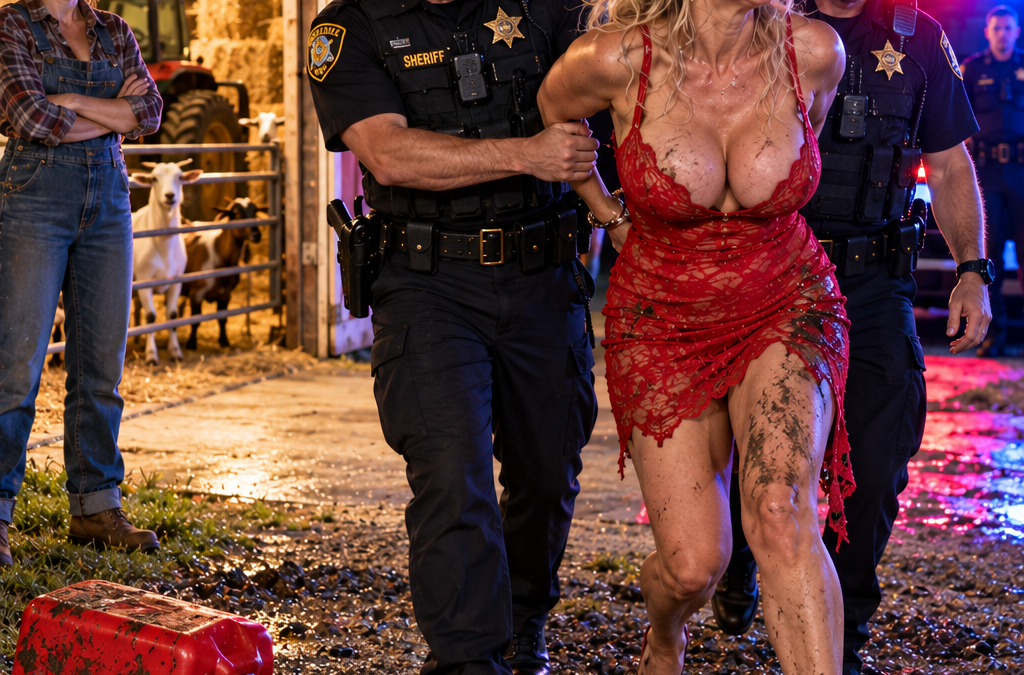
The red and blue lights flashed across my barn so violently that for a few seconds the entire property looked like it was breathing.
Red.
Blue.
Darkness.
Red again.
Two sheriff’s deputies were walking Karen Doyle down my gravel driveway in handcuffs while she screamed that they were making a mistake.
Her red lace dress was smeared with mud.
One heel was missing.
Her blonde hair, usually styled into flawless waves, hung across her face.
A metal gas can sat on its side twenty feet from my hay barn, gasoline darkening the gravel around it.
Karen twisted against the deputy holding her arm.
“You don’t understand who I am!”
The deputy didn’t even look at her.
“Keep walking, ma’am.”
“I am the president of this homeowners association!”
“Not tonight.”
“I have authority over this property!”
That finally made me laugh.
It wasn’t a happy sound.
It came out tired.
Disbelieving.
Almost hollow.
Three months earlier, Karen had stood in front of half the neighborhood and announced that people like me didn’t deserve to own land inside a respectable community.
Now she was being arrested on that same land.
My land.
Six acres with my name on the deed.
Six acres my father had spent his life protecting.
Six acres Karen had tried to fine, bully, manipulate, regulate, surveil, and finally burn me out of.
My name is Anna Whitfield.
I raise goats, chickens, tomatoes, apples, and one pear tree that refuses to produce anything useful no matter how politely I threaten it.
My farm sits just beyond the final cul-de-sac of Maple Crest Estates, where neat suburban lawns give way to pasture, orchard rows, and an old red barn my father rebuilt twice in his lifetime.
I bought the property with money he left me when cancer took him two winters earlier.
Calling it an inheritance never felt right.
It was more like the last chapter of a dream we’d been building together since I was a little girl.
He taught me to drive his tractor when I was nine.
Taught me to mend fencing at twelve.
Taught me that animals didn’t care whether you were tired, heartbroken, sick, or busy.
If they needed feeding, you fed them.
If a storm broke the fence, you fixed it.
If the land gave you something good, you treated it with respect.
After he died, the farm became the only place where grief made any kind of sense.
I didn’t want excitement.
I didn’t want politics.
I certainly didn’t want a war with a homeowners association.
I wanted quiet mornings.
Mud on my boots.
Coffee on the porch.
The smell of hay after rain.
I wanted to hear my father’s old tractor cough to life in the barn and remember his hands on the steering wheel.
Then Karen Doyle became HOA president.
And quiet became something I had to fight for.
Karen was forty years old and beautiful in a way she seemed determined to make everyone acknowledge.
She had long blonde hair, bright blue eyes, a carefully sculpted figure, and the kind of exaggerated confidence that made strangers assume she must be important.
She also wore the same style of red lace dress almost everywhere.
Board meetings.
Mailbox inspections.
Community picnics.
My driveway.
It was fitted tightly through her waist and hips, low across her very full chest, and revealing enough that even people who disliked her noticed when she entered a room.
Karen knew it.
She used flirtation the way other people used favors.
A warm touch on a man’s arm.
A soft laugh.
A lowered voice.
Then the moment she didn’t get what she wanted, all that charm vanished.
Underneath it was something hard.
Imperious.
Mean.
Karen didn’t want agreement.
She wanted submission.
And when she became HOA president, Maple Crest gave her the perfect little kingdom.
She entered office with a clipboard in one hand and a smile that never reached her eyes.
Within thirty days, I received my first violation notice.
UNSIGHTLY AGRICULTURAL EQUIPMENT VISIBLE FROM COMMUNITY ROADWAY.
I read the line twice.
Then I looked toward the barn.
My father’s tractor sat beside it.
Faded green paint.
Rust near the rear axle.
A cracked vinyl seat he’d always promised to replace.
That tractor was older than half the houses in Maple Crest.
It had plowed the property before the HOA even existed.
I laughed.
I honestly thought someone had made a mistake.
The fine was seventy-five dollars.
I called the HOA office.
Karen answered personally.
“Maple Crest Estates. President Doyle speaking.”
I almost smiled at the way she said president.
Like she expected trumpets afterward.
“Hi, Karen. This is Anna Whitfield from the farm.”
There was a pause.
“Oh.”
One syllable.
Already cold.
“I received a violation notice about my tractor.”
“Yes.”
“It’s agricultural equipment.”
“I know what a tractor is, Anna.”
“It’s also on agricultural property.”
“Property that is visible from Maple Crest.”
“So?”
“So community standards apply.”
I looked out the window at the tractor.
“Karen, my farm predates the HOA.”
“That’s not relevant to appearance standards.”
“It actually is.”
She sighed dramatically.
“Anna, this kind of resistance is exactly why communities deteriorate.”
I stared at the phone.
“Because of tractors?”
“Because certain homeowners believe rules shouldn’t apply to them.”
“The tractor has been here for decades.”
“Which doesn’t make it attractive.”
I almost laughed again.
Then she added, “If I were you, I’d start thinking seriously about whether agricultural clutter belongs next to a residential neighborhood anymore.”
Something in her voice stopped me.
Not the words.
The entitlement behind them.
“This farm was here first.”
Karen’s voice cooled.
“Things change.”
“So do HOA presidents.”
Silence.
I shouldn’t have said it.
Not because it was wrong.
Because Karen Doyle remembered humiliation the way other people remembered birthdays.
When she spoke again, her sweetness was gone.
“The fine is due within ten days.”
She hung up.
That was the first time I understood she wasn’t going to be reasonable.
The next notices arrived quickly.
Chicken coop too close to the perimeter fence.
One hundred dollars.
Goats creating an unreasonable noise nuisance.
One hundred fifty.
Compost pile potentially attracting vermin.
Two hundred.
The goats were quieter than most neighborhood lawn mowers.
My compost was enclosed.
The chicken coop had stood in the same place for years.
I tried calling again.
Karen stopped answering.
Instead, I received form emails.
COMMUNITY STANDARDS MUST BE MAINTAINED.
NONCOMPLIANCE WILL RESULT IN ESCALATING PENALTIES.
FAILURE TO REMEDY MAY TRIGGER COLLECTION ACTION.
Every message carried her electronic signature.
Karen Doyle, President.
As though the title itself ended the discussion.
Neighbors started warning me.
Not publicly.
Never publicly.
At the mailboxes.
Over fences.
In grocery store aisles.
“Don’t push her.”
“She doesn’t forget.”
“Two families already left because of her.”
One woman actually whispered, “She enjoys breaking people.”
At first, I thought that was dramatic.
Then I learned about the Alvarez family.
Karen had apparently buried them in citations over parking, landscaping, a fence modification, and trash storage.
When they argued, the inspections increased.
When they appealed, their appeals disappeared into committee review.
Eventually, they sold.
Then another family left.
Same pattern.
I told myself I wasn’t interested in fighting.
I had enough grief.
Enough bills.
Enough responsibilities.
I wasn’t going to let Karen turn my father’s farm into another battlefield.
I was going to survive her.
That was the plan.
Then the legal-looking summons appeared on my mailbox.
Tuesday morning.
White paper.
Bold lettering.
IMMEDIATE COMPLIANCE REQUIRED.
The HOA was threatening a lien against my property unless I removed all livestock within ten days.
My hands started shaking before I reached the bottom of the page.
Ten days.
Ten days to remove goats my father had helped me raise.
Ten days to dismantle a coop he had built himself.
Ten days to erase a way of life that had existed before Karen ever drove through Maple Crest in her white SUV.
I drove straight to the HOA office.
Karen was sitting behind a wide desk drinking coffee.
Of course she was wearing the red lace dress.
One manicured finger rested against the rim of her cup.
She looked completely relaxed.
Almost pleased.
“Anna,” she said. “I wondered how long it would take.”
I dropped the notice onto her desk.
“What is this?”
She glanced at it.
“You can read.”
“You’re threatening a lien against my farm.”
“Only if you remain noncompliant.”
“My farm is exempt from livestock restrictions.”
She gave me a sympathetic little smile.
“That’s what you keep saying.”
“My father had a grandfather agreement.”
“I’ve never seen it.”
“He fought the HOA on this decades ago.”
“Then perhaps your father should have kept better records.”
The cruelty of that landed before I could stop it.
Karen knew my father was dead.
Everybody did.
I stared at her.
“Don’t talk about him.”
She leaned back.
“I didn’t bring him into this.”
“You just did.”
“No, Anna. You keep hiding behind a dead man’s arrangements instead of complying with modern community standards.”
My hands curled into fists.
Karen saw it.
She smiled.
She liked provoking people.
Liked getting them emotional so she could pretend she was the reasonable one.
“The agreement exists.”
“Then produce it.”
“I will.”
“Good.”
She took a slow sip of coffee.
“Because according to our current files, no such exemption exists.”
“What happened to the old records?”
“Filing update.”
I stared at her.
“A filing update.”
“Yes.”
“And the exact document protecting my farm just disappeared?”
Karen shrugged.
“Things get misplaced.”
“Convenient.”
Her eyes narrowed.
“You have ten days.”
I leaned over her desk.
“You don’t own my farm.”
She didn’t move.
“No.”
Then she smiled.
“But if those fines become a lien, someone eventually might.”
I felt the blood drain from my face.
Karen watched it happen.
That was when I knew.
This wasn’t confusion.
This wasn’t overzealous rule enforcement.
She wanted me frightened.
I left without another word.
That night, I couldn’t sleep.
I sat at my father’s old desk beneath the yellow lamp he’d used for thirty years and opened boxes of paperwork.
Tax returns.
Feed receipts.
Veterinary bills.
Old county maps.
A warranty for a chainsaw that no longer existed.
My father’s filing system was terrible but strangely consistent.
Everything important was somewhere.
Around two in the morning, I found a torn brown folder wedged behind old property-tax statements.
Across the front, in my father’s handwriting:
HOA — DO NOT LOSE.
I laughed and cried at the same time.
Inside was the agreement.
Dated 1998.
Notarized.
Signed by three former HOA board members.
It permanently recognized the farm’s preexisting agricultural use and exempted it from livestock restrictions later imposed on neighboring residential parcels.
I ran my fingers across my father’s signature.
My throat tightened.
It didn’t feel like paper.
It felt like his voice.
Like he had known somehow that years later I’d sit at that desk needing him again.
I made four copies.
One for me.
One for my lawyer friend.
Two stored separately.
The next morning, I sent a certified copy to the board.
I thought that would end it.
Karen answered before lunch.
Her email contained three sentences.
The agreement was outdated.
It had been superseded by newer bylaws.
Continued violations would be enforced.
I read the message twice.
Then I searched the date of the newer bylaw amendment.
Karen had drafted it the previous year.
Before she’d even started targeting me directly.
She hadn’t discovered a conflict.
She had created one.
That was when the situation became terrifying.
Because I finally understood that Karen hadn’t inherited a bad rule.
She had rewritten the rules to erase the protection around my land.
I called Priya Shah.
Dolores, my neighbor across the road, had recommended her.
Priya was young, sharp, and visibly energized by unreasonable authority.
She read the 1998 agreement.
Then Karen’s amendment.
Then the violation notices.
“She’s bluffing.”
“She doesn’t sound like she’s bluffing.”
“People like this never do.”
Priya tapped the agreement.
“This is a negotiated property agreement. Karen can’t simply write a newer rule and make it disappear.”
“She’s already acting like she did.”
“Then we make her prove it.”
Priya smiled slightly.
“These boards overreach because homeowners panic and pay. Push back correctly and they tend to crumble.”
I wanted to believe her.
Then the fines passed four thousand dollars.
Karen added penalties for continued livestock presence.
Administrative charges.
Inspection fees.
Late penalties on fines I refused to acknowledge.
Priya told me not to pay.
“Payment may be used to argue you accepted the violations.”
“But what if she files the lien?”
“Then we challenge it.”
I looked at her.
“That’s my farm.”
“I know.”
“No, I mean that’s everything.”
Priya’s expression softened.
“Then document everything.”
So I did.
Every letter.
Every email.
Every timestamp.
Every phone call.
I photographed my property every morning.
The coop.
The barn.
The goats.
The compost enclosure.
The fences.
Proof that Karen’s descriptions were exaggerated or false.
I submitted a formal records request for HOA meeting minutes.
Karen waited almost two weeks before sending partial copies.
Large sections were blacked out.
Her explanation cited privacy concerns.
Privacy.
In meeting minutes discussing my chicken coop.
Priya stared at the pages.
“She’s hiding something.”
“What?”
“We’ll find out.”
She submitted a legal demand for complete records.
Karen’s office had thirty days.
I marked the deadline in red on the kitchen calendar.
Karen responded by escalating personally.
She began parking her SUV near my fence.
Sometimes she stayed fifteen minutes.
Sometimes forty.
Always with her phone raised.
Photographing my goats.
My barn.
My driveway.
Me.
One afternoon, I walked outside and found her halfway up my driveway with a tape measure.
Clipboard in hand.
Red dress.
High heels sinking into gravel.
“What are you doing?”
She didn’t even look embarrassed.
“Inspection.”
“You’re on my property.”
“I’m documenting the distance between this coop and the community boundary.”
“From inside my driveway?”
She smiled.
“HOA business supersedes personal boundaries, Anna.”
I stared at her.
For one dizzy second, her certainty almost made the statement sound legitimate.
Then common sense returned.
“No, it doesn’t.”
“It does when I’m investigating violations.”
“Get off my land.”
Her smile disappeared.
“You need to learn how to speak to board leadership.”
“You need to learn what trespassing means.”
I raised my phone.
“I’m recording.”
That changed her posture.
Slightly.
But enough.
“You think that’s going to intimidate me?”
“No.”
I kept recording.
“I think it’ll make you choose your lies more carefully.”
Her face flushed.
She walked past me slowly.
As she reached her SUV, she turned.
“You have no idea how difficult I can make your life.”
I kept the camera pointed at her.
“Say that again.”
She got in the SUV and slammed the door.
Two nights later, someone opened the chicken coop.
I knew I’d locked it.
I always locked it.
Every hen was gone the next morning.
Feathers lay across the yard.
The gate hung open.
Tire tracks cut through the soft dirt near the fence line.
I spent hours searching.
I found three hens hiding near the orchard.
Two near Dolores’s shed.
Others were gone.
One never came back.
I filed a police report.
The officer was polite but clearly thought this was a neighborhood dispute over chickens.
I didn’t care.
I wanted a record.
I photographed the tire tracks.
Measured them.
Saved everything.
Then Karen mentioned the incident in the next HOA newsletter.
Recent livestock escape incidents further demonstrate why agricultural activity is incompatible with modern Maple Crest standards.
I read the sentence slowly.
The police report hadn’t been public.
I hadn’t posted online.
Only a handful of people knew the hens had escaped.
How did Karen know?
I showed Priya.
She stopped reading and looked at me.
“Did you tell her?”
“No.”
“Did Dolores?”
“No.”
“Any board member?”
“Not that I know of.”
Priya tapped the newsletter.
“That’s not proof.”
“I know.”
“But it’s suspicious enough that we treat it seriously.”
I installed cameras.
Motion activated.
Cloud backup.
Night vision.
One covering the coop.
One aimed toward the driveway.
One on the rear fence.
Another facing the barn.
Within a week, one recorded a vehicle matching Karen’s SUV idling near my fence at two in the morning.
Lights off.
Engine running.
The plate was partly obscured with mud.
The image wasn’t perfect.
But the body shape in the driver’s seat looked like her.
I wanted to confront her.
Priya stopped me.
“No.”
“She’s driving around my property at two in the morning.”
“I know.”
“What are we waiting for?”
“Evidence she can’t explain.”
I stared at the screen.
Priya leaned closer.
“Gather everything. Strike once.”
The thirty-day records deadline arrived.
Karen requested an extension because the HOA office was supposedly relocating.
I drove past the office that morning.
Same sign.
Same furniture visible through the window.
Same red SUV parked outside.
No relocation.
Priya filed a formal complaint with the state HOA oversight office.
Karen emailed me that afternoon.
This situation is becoming unnecessarily hostile.
I laughed aloud.
Hostile.
I was documenting threats, surveillance, missing animals, and possible trespassing.
Karen believed my documentation was the hostility.
The next HOA meeting was the first time I decided to stop playing defense.
Priya came with me.
I carried the original 1998 agreement in a protective folder.
Karen’s smile faltered the instant I entered.
She rushed through the agenda.
Tried to eliminate public comment.
Dolores stood.
“Residents are entitled to speak.”
Marcus, another neighbor, joined her.
Karen glared at both of them.
“This meeting is already running long.”
“It started twelve minutes ago,” Marcus said.
Several people laughed.
Karen hated being laughed at.
Her cheeks darkened.
Finally, I was recognized.
I stood.
My hands were shaking.
But my voice wasn’t.
I read the 1998 agreement aloud.
Every clause.
Every signature.
Every guarantee.
Then Priya stood.
“This document was never legally superseded.”
Karen slammed her pen down.
“That is your interpretation.”
“It is the plain language of the agreement.”
“It’s fabricated.”
The room changed.
I looked at her.
“Excuse me?”
Karen leaned back.
“I have no confidence this document is authentic.”
I walked toward the board table.
Priya placed a hand lightly on my arm.
Calm.
I set the notarized original in front of the secretary.
“Check the seal.”
The secretary examined it.
Then the signatures.
Two board members leaned closer.
I watched concern spread across their faces.
Karen saw it too.
“This proves nothing,” she snapped.
One board member frowned.
“Karen, it appears valid.”
“You are not qualified to make that determination.”
Neither are you, I thought.
But I didn’t need to say it.
For the first time, doubt existed inside Karen’s own board.
She adjourned the meeting early.
Then Marcus stood.
“My sister went through something similar.”
Karen froze.
Marcus continued.
“Same fines. Same inspections. Same threats.”
Karen gripped her clipboard.
“That is not relevant.”
“It is if we’re talking about patterns.”
Then he added something none of us expected.
“I’ve also been reviewing old landscaping expenses.”
Walter, the HOA treasurer, looked up.
Marcus held several newsletters.
“Thousands withdrawn from reserves.”
Walter frowned.
“For landscaping?”
“According to the records.”
Walter went pale.
“I never approved that amount.”
Everyone looked at Karen.
She immediately said, “The detailed books are with the accountant.”
Of course they were.
Anything Karen didn’t want examined was always with someone else.
Being updated.
Relocated.
Temporarily unavailable.
Walter stood.
“I want the records.”
“You’ll get them.”
“When?”
Karen’s eyes narrowed.
“Don’t interrogate me in public, Walter.”
His expression changed.
That sentence may have been the worst possible thing she could have said.
Because Walter sat back slowly.
Then said, “I’m the treasurer.”
The room murmured.
Karen ended the meeting.
I left shaking.
But not from fear.
Momentum.
That was what Priya called it.
“The fight just changed.”
She was right.
Dolores texted me later that night.
A photograph.
Karen’s SUV outside a landscaping company I’d never heard of.
I searched the business.
No public listing.
No active website.
No credible registration under the name shown on the building.
I sent the photo to Walter.
Walter forwarded everything to the association’s insurance auditor.
Then suddenly Karen went quiet.
No new fine.
No SUV outside my fence.
No emails.
For four days, Maple Crest felt peaceful.
I should have known better.
Karen wasn’t retreating.
She was planning.
A certified letter arrived.
Emergency HOA vote.
Purpose: revoke all agricultural exemptions community-wide.
She couldn’t defeat my father’s agreement cleanly.
So she decided to bulldoze around it politically.
The proposal was written in dense legal language.
But Priya translated it.
Chicken coops could be eliminated.
Livestock prohibited.
Garden sizes restricted.
Rain barrels affected.
Certain outbuildings newly regulated.
“This isn’t just your farm,” she said.
“She buried everything.”
“Exactly.”
“What do we do?”
Priya smiled.
“Let her vote.”
I stared at her.
“Why?”
“Because a public vote creates a public record. And public records are easier to challenge than Karen’s private interpretations.”
I spent two weeks knocking on doors.
I hated it.
I was still grieving my father.
Still exhausted from farm work.
Still losing sleep.
But I talked to residents anyway.
I showed them the actual proposal.
Not Karen’s cheerful summary.
The real text.
People got angry.
Dolores created a group chat.
Forty-two homeowners joined.
Marcus began cross-checking landscaping expenses.
Walter demanded a third-party audit.
Karen fought it.
She called the audit wasteful.
Unnecessary.
An insult to volunteers.
“Trust should matter,” she said at the meeting.
Walter replied, “Trust is why we’re auditing.”
The board voted five to two.
Audit approved.
Karen was one of the two opposing votes.
That evening, I stood in the barn doorway watching rain fall beyond the orchard and felt something I hadn’t felt since this began.
Hope.
Not because Karen was defeated.
Because people had finally stopped being afraid of her.
Two nights before the exemption vote, my motion alert went off.
11:43 p.m.
I opened the camera feed.
Karen’s SUV.
Directly beside my property.
I watched her step out.
Red dress under a long coat.
Clipboard.
Phone.
She approached my fence.
Then climbed over the survey stake marking the property boundary.
My motion lights exploded on.
Karen froze.
The clipboard slipped from her hand and landed in the mud.
I stepped onto the porch.
“You’re trespassing.”
She spun toward me.
“Anna.”
“What are you doing?”
“Documenting violations.”
“From inside my property?”
“I have authority to inspect.”
“No, you don’t.”
She bent to retrieve the clipboard.
“Don’t be ridiculous.”
I raised my phone.
“I’m recording.”
Her eyes widened slightly.
“This is HOA business.”
“This is my farm.”
I walked closer.
“You are standing inside my property line after eleven at night.”
“I have every right—”
“No.”
My voice echoed across the yard.
“Get off my land.”
Karen straightened.
For the first time, I saw uncertainty.
Not fear.
Not yet.
But the first crack in her certainty.
“You’ll regret speaking to me like this.”
“Get off my property before I call the sheriff.”
She marched back to the SUV.
Her heel slipped once in the gravel.
She slammed the door.
The tires spun hard enough to throw stones.
The camera captured everything.
Face.
Voice.
Property line.
Timestamp.
Priya watched the video the next morning.
Her eyes lit up.
“That’s criminal trespass.”
“We finally have her.”
“We have leverage.”
She corrected me.
“Don’t get ahead of the evidence.”
We filed a police report.
Attached the video.
The emergency HOA meeting arrived.
Every chair was filled.
People stood along the walls.
Karen took the podium.
Perfect makeup.
Perfect blonde hair.
Red lace dress.
But her voice was tighter than usual.
She gave a long speech about property values.
Community cohesion.
Modernization.
Then Priya asked to present evidence before the vote.
Karen snapped, “This is not a trial.”
Walter said, “Let her speak.”
Karen glared at him.
The board allowed it.
Priya connected her laptop to the projector.
The trespassing footage filled the wall.
Karen climbing the boundary.
My voice.
Her response.
I have every right to document violations.
Gasps moved through the room.
Karen’s face went white.
Then red.
“That is taken completely out of context.”
Priya paused the video.
“This is the unedited recording.”
Karen looked toward the board.
“Anna has been harassing me for months.”
I stood.
“You came onto my land.”
“To enforce rules.”
“You came after eleven at night.”
“Because you hide violations.”
People murmured angrily.
Then Walter stood.
He held a thin folder.
“The audit came back early.”
Karen’s entire body changed.
“That isn’t on the agenda.”
Walter looked at her.
“It is now.”
He opened the folder.
Nearly eleven thousand dollars in reserve funds had been routed to a landscaping company that had dissolved three years earlier.
Karen’s brother-in-law was the registered agent.
The shell company had continued receiving payments after dissolution.
Someone shouted, “That’s our money!”
Karen slammed her hand on the table.
“This is a coordinated attack!”
Her voice cracked.
“Anna has turned all of you against me!”
Every face turned toward me.
For months, that would have frightened me.
Not anymore.
I stood.
“No, Karen.”
She pointed at me.
“You started this!”
I looked around the room.
“You put yourselves up to this.”
Then I looked at her.
“I just turned on the lights.”
The exemption repeal never reached a vote.
The board tabled it.
Karen stormed out.
By sunrise, screenshots had spread across local community pages.
I posted nothing.
I didn’t have to.
Forty-two angry homeowners did the talking.
The HOA’s regional management company announced an independent investigation.
Karen disappeared online.
Priya didn’t relax.
“Cornered people get dangerous.”
She looked at me.
“Watch your back.”
I upgraded the cameras.
Added locks.
Motion notifications.
Two days later, county zoning called.
Anonymous complaint.
Illegal livestock operation.
The timing was almost insulting.
Six hours after the investigation announcement.
Mr. Reyes from zoning came to inspect.
I greeted him with documents.
1998 agreement.
County agricultural classification.
Property maps.
He spent more than an hour walking the farm.
Then he closed his clipboard.
“Everything here is compliant.”
“Everything?”
“Everything.”
I laughed from pure exhaustion.
He studied me.
“Do you know who might have filed the complaint?”
“I have an educated guess.”
He couldn’t identify the complainant.
But he mentioned that the digital filing originated from a local business connection.
Priya subpoenaed the necessary information through the ongoing legal dispute.
The complaint had been filed from the HOA management office.
Karen’s login credentials.
Twenty minutes after the disastrous board meeting.
Even Priya looked astonished.
“She filed this after being exposed?”
“Apparently.”
“That’s not strategic.”
“No.”
“It’s rage.”
The investigation committee added the incident under:
PATTERN OF RETALIATORY CONDUCT.
Karen requested a private board meeting.
Walter refused.
His response became legendary in Maple Crest.
“Everything happens in open session now. That’s how we got here.”
Dolores told me Karen had started taking a longer route home to avoid driving past my farm.
I allowed myself to enjoy that.
After months of her SUV sitting outside my fence, Karen was finally uncomfortable on streets she once treated like personal territory.
Then Marcus uncovered the two families who had left before me.
Priya contacted them.
Both agreed to sworn statements.
Repeated inspections.
Escalating fines.
Surveillance.
Threats.
Attempts to make staying financially unbearable.
The investigation wasn’t about one farm anymore.
It was about years of harassment.
Karen mailed every resident a glossy brochure defending her presidency.
Full-color photographs.
Community achievements.
Pictures of flower beds.
Statements about service and sacrifice.
People mocked it immediately.
Somebody posted the trespassing still beside Karen’s smiling portrait.
Another posted the dissolved landscaping company’s registration next to her claims of fiscal responsibility.
The brochure became evidence against her own credibility.
I stayed quiet.
That surprised people.
But I had learned something.
When the truth has momentum, sometimes the strongest thing you can do is stop competing with it.
Management investigators interviewed me.
I brought everything.
The agreement.
The fines.
The missing hens.
The newsletter.
The footage.
The zoning complaint.
They asked whether I intended to sue.
I looked at Priya.
She nodded once.
“Yes.”
“For what?”
I thought about my father.
About Karen standing in my driveway telling me HOA business superseded personal boundaries.
“For the fines.”
I looked toward the barn.
“For the trespassing.”
Then back at them.
“And for every hour she spent trying to make me abandon my family’s land.”
Priya filed the civil suit.
Harassment.
Trespass.
Wrongful HOA assessments.
Damages.
Discovery began.
And that’s when we found the email.
Priya called me into her office.
No smile this time.
She turned her monitor toward me.
An email from Karen.
Months before my first tractor citation.
Sent to a board ally.
One sentence destroyed every excuse she’d made.
That farm sits on prime frontage. If we push hard enough, she’ll sell and we control the land use after.
I read it once.
Twice.
A third time.
The office felt like it tilted.
“So she planned it.”
Priya was quiet.
“Yes.”
“Before the tractor?”
“Before the tractor.”
“Before the goats?”
“Yes.”
“Before all of it.”
“Yes.”
I stared at the screen.
Every fine.
Every photograph.
Every threatening letter.
The missing hens.
The invented livestock problem.
Karen hadn’t become obsessed with my farm because I resisted.
She targeted me before I’d even understood there was a fight.
She wanted the land.
My father’s land.
She wanted me exhausted enough to sell.
Priya leaned back.
“This is motive in her own words.”
I couldn’t speak.
For months, I’d wondered whether I was overreacting.
Whether grief had made me defensive.
Whether I should have compromised.
Whether selling might have been easier.
Now I knew.
Karen had been counting on exactly that.
Two weeks later, the investigation concluded.
Retaliatory harassment.
Misuse of HOA funds.
Fiduciary violations.
Improper enforcement.
The board voted seven to zero to remove Karen as president.
Seven to zero.
She didn’t attend.
Instead, she emailed a resignation minutes before the vote, calling it a personal decision unrelated to recent allegations.
Nobody believed her.
The local paper ran the story two days later.
HOA PRESIDENT RESIGNS AMID FRAUD, HARASSMENT ALLEGATIONS
A photograph of my farm appeared below the headline.
Reporters called.
I gave them one sentence.
“I just wanted to keep my father’s land.”
That was all.
I thought it was over.
The fines were collapsing.
The board had turned against her.
The fraud investigation was moving.
The civil case had the email.
Karen no longer controlled Maple Crest.
I slept almost six straight hours for the first time in months.
Then, just after midnight on a Thursday, my phone vibrated.
Motion alert.
Rear gate.
I opened the camera feed.
At first, I couldn’t understand what I was seeing.
A figure climbing over the back gate.
Blonde hair.
Dark coat.
Then she stepped under the motion light.
Karen.
My heart started pounding.
She wasn’t holding a clipboard.
She wasn’t carrying a phone.
She had a red plastic gas can in one hand.
And she was walking toward the hay barn.
For a moment, I couldn’t move.
The barn held dry hay.
Feed.
Old wood.
My father’s tools.
One spark could turn the entire structure into a furnace.
My fingers shook so badly I nearly dropped my phone.
I called 911.
“There’s someone trespassing on my farm.”
“Are you in a safe location?”
“She’s carrying a gas can.”
The dispatcher became instantly sharper.
“Stay inside.”
“She’s walking toward my barn.”
“Ma’am, officers are responding. Do not approach her.”
I looked at the live feed.
Karen was almost there.
If she poured gasoline inside the barn, I didn’t know whether waiting was an option.
I grabbed my father’s old air horn.
A flashlight.
I ran outside.
Cold air hit my face.
Gravel cut beneath my boots.
I could see her ahead of me.
“Karen!”
She spun around.
The gas can swung in her hand.
“What the hell are you doing?”
For one second, neither of us moved.
Then Karen’s face twisted.
“You ruined me.”
I raised my phone.
“The police are coming.”
“You ruined everything!”
“You came onto my farm with gasoline.”
“You took my board!”
“You lost your board.”
“You turned them against me!”
“No.”
I moved closer but stayed beyond arm’s reach.
“You stole from them.”
Her eyes looked wild.
The polished HOA president was gone.
No flirtatious smile.
No controlled voice.
No clipboard.
Just rage.
“You think you’re better than me because you inherited dirt?”
My entire body went cold.
“This is my father’s farm.”
“And it should have been developed years ago!”
There it was.
No rules.
No community standards.
No concern for property values.
Just contempt.
“The frontage alone could have transformed this neighborhood,” she spat. “But you keep goats on it.”
I stared at her.
“You tried to drive me out for development rights.”
“I tried to improve this community!”
“You tried to steal my future.”
She lifted the gas can.
I blasted the air horn.
The sound ripped through the night.
Karen screamed.
The can slipped from her hand and hit the gravel.
Gasoline splashed out.
The smell hit immediately.
“Get away from my barn!”
She stepped backward.
My father’s old fence line was behind her.
The same fence she had photographed a dozen times.
Her heel caught.
She fell hard.
Then we heard sirens.
Karen’s face changed.
Real fear.
Finally.
She scrambled to stand.
Red and blue lights appeared at the far end of the driveway.
Two patrol cars.
She tried to run.
Made it ten feet.
One officer jumped from the cruiser.
“Stop!”
Karen froze.
Flashlights swept across the yard.
The gas can.
The spilled fuel.
My barn.
Me.
Her.
A deputy approached carefully.
“Ma’am, put your hands where I can see them.”
Karen straightened as much as she could.
“This is an HOA matter.”
I almost couldn’t believe it.
Even there.
After midnight.
With gasoline beside my hay barn.
She still reached for the title.
The deputy looked at the can.
Then at Karen.
“Can you explain why you’re on private property after midnight carrying an accelerant?”
“I was inspecting a violation.”
“At midnight?”
“She has agricultural code issues.”
I laughed.
The officer looked at me.
“Do you know this woman?”
“Karen Doyle. Former HOA president.”
Karen snapped, “Former only because she engineered a coup!”
The deputy looked toward the gate.
“How did you enter?”
Karen hesitated.
“I got lost.”
The second deputy shined his light toward the gate.
“By climbing over a locked fence?”
Karen’s mouth tightened.
“The gas can is for my generator.”
“Where’s your generator?”
Silence.
The camera had already uploaded the footage.
Gate climb.
Gas can.
Walk toward the barn.
Everything.
The deputies watched enough to stop listening to explanations.
Karen was handcuffed.
As they walked her toward the cruiser, she turned toward me.
“You’ll regret this.”
I stared at her.
That threat had frightened me the first time.
Not anymore.
“No, Karen.”
The deputy opened the patrol door.
“I think you finally will.”
She was arrested for criminal trespass.
Attempted arson charges followed.
By morning, the story had exploded.
Local news.
Regional news.
Facebook groups.
FORMER HOA PRESIDENT ARRESTED AFTER ALLEGED ATTEMPTED ARSON AT RESIDENT’S FARM
People came by with casseroles.
Coffee.
Apologies.
Dolores hugged me so hard I nearly dropped a mug.
“You did it.”
I shook my head.
“No.”
Walter.
Marcus.
Priya.
Forty-two residents.
The families who had left.
The zoning officer.
The auditor.
Everyone had carried part of this.
The fraud investigation concluded soon afterward.
Eleven thousand dollars in reserve money had gone through the dissolved landscaping business.
Some to Karen’s brother-in-law.
Some directly back to accounts connected to Karen.
Embezzlement charges were added.
My civil suit accelerated.
The judge reviewed the evidence in one hearing.
The 1998 agreement.
The wrongful fines.
The zoning retaliation.
The trespassing footage.
The email.
If we push hard enough, she’ll sell.
The judge lowered the papers.
“I’ve handled many HOA disputes.”
She looked toward Karen’s counsel.
“This is one of the clearest patterns of abuse of association authority I have seen.”
Every fine was reversed.
All payments refunded with interest.
The court awarded damages for harassment and emotional distress.
Karen faced trespass.
Attempted arson.
Embezzlement.
Rather than risk trial, she accepted a plea agreement.
Eighteen months.
Restitution of the stolen HOA funds.
Permanent statewide prohibition from serving in HOA leadership.
Then the judge added one more thing.
A restraining order.
Karen Doyle could never legally step onto my property again.
I sat in the courtroom watching the woman who had tried to erase my father’s legacy stand beside her attorney.
No red lace dress this time.
No clipboard.
No smile.
When the deputy approached, Karen looked at me.
I expected anger.
Instead, she looked tired.
Small.
But I didn’t feel sorry for her.
Because being tired didn’t erase what she’d done.
She had tried to destroy my finances.
Invade my property.
Drive me from my home.
And when none of that worked, she’d come back after midnight with gasoline.
The deputy cuffed her.
For a second, our eyes met.
I said nothing.
There was nothing left to say.
The HOA changed after that.
Walter became interim president.
The agricultural exemption was reaffirmed in writing.
Unanimous vote.
The board implemented public minutes.
Third-party audits.
Conflict-of-interest disclosures.
Transparent records requests.
Restrictions on unilateral enforcement.
Dolores joked that the agricultural clause should be renamed Anna’s Law.
People laughed.
Then somehow the name stuck.
The two families who had left years earlier received public apologies and partial reimbursement through the HOA’s insurance coverage.
Marcus helped organize it.
Walter personally delivered one apology.
I rebuilt the chicken coop in spring.
Stronger wood.
Better locks.
Cameras everywhere.
I told myself I didn’t need them anymore.
I kept them anyway.
Fear doesn’t disappear just because a judge signs a piece of paper.
Sometimes I still woke at two in the morning convinced I heard tires on gravel.
Sometimes the goats moved suddenly in the barn and my heart jumped.
But the chickens came back.
A new flock.
Brown hens.
White hens.
One angry little black hen who seemed offended by sunlight.
I planted sunflowers along the fence Karen used to photograph.
Tall ones.
Bright yellow.
Facing the road.
Impossible to ignore.
The tractor stayed exactly where it had always been.
I fixed the cracked seat.
Not because Karen had called it unsightly.
Because my father had always wanted to fix it.
Priya sent me a card the following spring.
Inside she wrote:
Told you. The truth wins if you’re patient enough to prove it.
I framed the 1998 agreement.
It hangs inside the farmhouse door.
My father’s signature catches the morning light.
Some days I stop and look at it before going outside.
I think about how close I came to leaving.
There were nights when selling seemed easier.
When I wondered whether six acres were worth the stress.
When I imagined handing the keys to someone else and disappearing somewhere Karen Doyle had never heard of.
Then I think about the two families before me.
They didn’t leave because they were weak.
They left because Karen understood attrition.
She understood that ordinary people have jobs.
Children.
Mortgages.
Grief.
Medical bills.
Exhaustion.
She didn’t need to beat people legally if she could exhaust them financially and emotionally.
That was her real weapon.
Not the clipboard.
Not the fines.
Not the HOA title.
Time.
Pressure.
Fear.
Make the fight expensive enough and people surrender.
I nearly did.
The only reason I didn’t was because Karen pushed too far.
Then she pushed again.
And again.
Until enough people saw what she was doing that the fear stopped working.
My father used to say land remembers who treats it honestly.
I never knew exactly what he meant.
I think I do now.
This farm remembers him.
The orchard he planted.
The fence posts he drove into hard ground.
The barn boards he replaced after storms.
The tractor tires packed with dried mud from years of work.
And now it remembers me too.
The nights I stayed awake looking through files.
The mornings I photographed every corner because I knew Karen would lie.
The chickens I searched for after she—or someone close enough to know—let them loose.
The night I stood between her and the barn while she held gasoline.
The sunflowers grew taller than the fence that year.
Almost obnoxiously tall.
Dolores came over one afternoon and looked at them.
“Those are aggressive.”
I laughed.
“Good.”
She pointed toward the road.
“Karen would hate them.”
“That’s not why I planted them.”
Dolores gave me a look.
“Not entirely.”
“Fine.”
We both laughed.
That was something else Karen had nearly stolen.
Laughter.
Ordinary conversation.
The ability to stand outside without wondering who was watching.
Maple Crest never became perfect.
No community does.
People still complained.
A resident argued about parking.
Someone got angry over pool hours.
Walter accidentally sent an email to the whole neighborhood that was supposed to go to one person.
But disagreements became disagreements again.
Not threats.
Not campaigns.
Not weapons.
My goats were just goats.
My chickens were just chickens.
My tractor was an old tractor.
And my farm was just my home.
One evening, almost a year after Karen’s arrest, I sat on the farmhouse porch while the sun went down behind the orchard.
The air smelled like cut grass.
Crickets had started.
The goats were settling.
I could hear the soft clucking of hens inside the coop.
Headlights appeared at the end of the road.
For half a second, my body tightened.
Old instinct.
Old fear.
The car slowed near the fence.
Then continued past.
I watched the taillights disappear.
My shoulders relaxed.
Inside the house, the framed 1998 agreement hung beside the door.
Outside, sunflowers nodded in the evening wind.
The barn stood dark and solid.
Safe.
Karen had believed a clipboard made her powerful.
She believed being HOA president entitled her to rewrite history.
My father’s agreement.
My land.
My rights.
She believed if she created enough fines, enough fear, enough paperwork, eventually I’d disappear.
What she never understood was that paperwork cuts both ways.
Her fines created a record.
Her emails created a record.
Her bogus zoning complaint created a record.
Her trespassing created a record.
Her money transfers created a record.
And finally, her own words gave us the motive.
If we push hard enough, she’ll sell.
She had written her plan down because she believed nobody would ever see it.
She was wrong.
The victory cost me more than I like admitting.
Sleep.
Money.
A year of my life wrapped in stress.
A kind of innocence about neighbors and community authority that I doubt I’ll ever fully recover.
But it gave me something too.
People who once whispered now speak openly.
Board meetings are boring.
That’s a compliment.
Financial statements are public.
The families who were pushed out know somebody finally proved they hadn’t imagined the abuse.
And I still wake every morning on the same six acres Karen wanted me to abandon.
The land is still mine.
The orchard still stands.
The tractor still starts after two attempts when it’s cold.
The hens still make too much noise at sunrise.
And Karen Doyle will never walk this property again.
Sometimes I stand near the back gate where she climbed over with the gas can.
I can still picture the motion lights snapping on.
Her face.
Her rage.
The sirens coming down the driveway.
But the memory doesn’t frighten me the way it used to.
Now it’s just part of the land’s history.
Another bad season that passed.
My father was right.
The land remembers.
And every sunflower along that fence is proof that sometimes the most powerful answer to someone trying to drive you away is simply refusing to leave.








