𝗙𝗨𝗟𝗟 𝗦𝗧𝗢𝗥𝗬 The HOA President Threatened to Take My House Over My Daughter’s Basketball Hoop, and I Was Running Out of Ways to Stop Him
𝗙𝗨𝗟𝗟 𝗦𝗧𝗢𝗥𝗬
So I paid it.
I told myself there had been a misunderstanding.
Maybe the inspector had photographed the bin before I’d moved it.
Maybe someone had entered the wrong address.
Maybe the HOA office had made an ordinary administrative mistake.
I didn’t know then that mistakes under Karen’s leadership were rarely acknowledged.
And they were almost never corrected.
Two weeks later, another letter arrived.
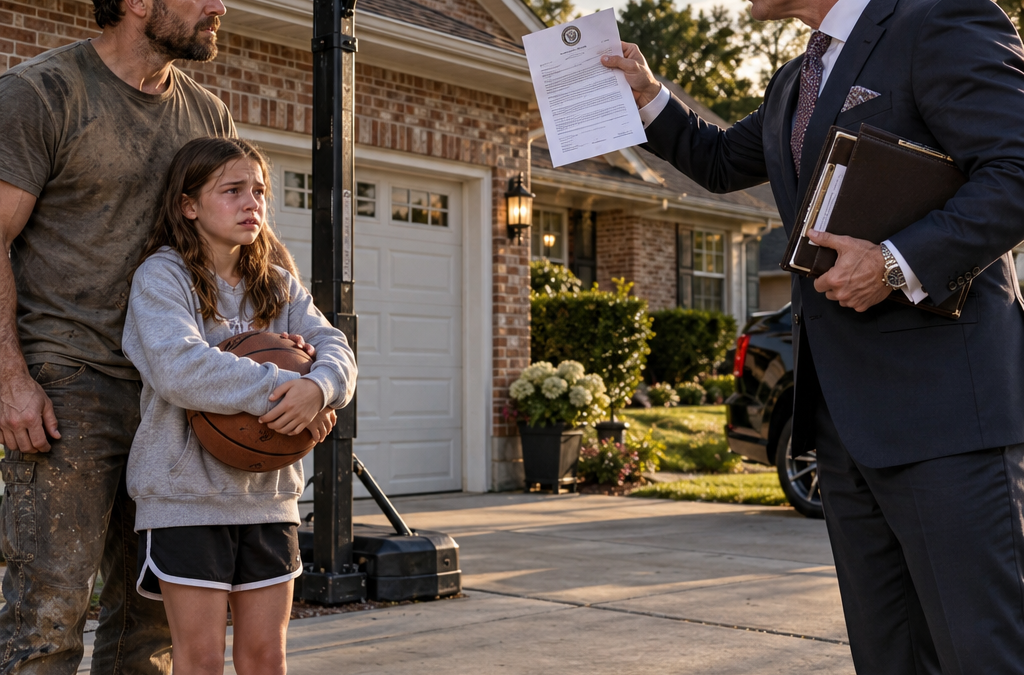
This one concerned Emma’s basketball hoop.
I opened it at the kitchen table while she worked on math homework.
The notice alleged that the hoop violated an obscure provision concerning unauthorized recreational structures.
It demanded removal and warned that penalties could accumulate if I failed to comply.
I read the cited section.
Then I read it again.
The wording concerned permanent structures and certain equipment requiring prior architectural approval.
Emma’s hoop was portable.
It wasn’t anchored to the driveway.
It didn’t obstruct the sidewalk.
And it wasn’t visible beyond what anyone would reasonably expect in a neighborhood where children lived.
I checked the rulebook carefully.
Nothing clearly prohibited the equipment as installed.
Emma noticed the letter.
“Is that about my hoop?”
I looked up.
“Why?”
“Because Mr. Hostetler was taking pictures of it yesterday.”
I felt something tighten in my chest.
“He was here?”
She nodded.
“He stopped his car and looked at the driveway.”
“Did he say anything to you?”
“No.”
She hesitated.
“Am I in trouble?”
I set the letter down.
“Absolutely not.”
“Then why was he taking pictures?”
I looked toward the front window.
“I think he has a problem with the hoop.”
Her expression changed.
“Do I have to take it down?”
“No.”
I said it more firmly than I’d intended.
She stared at me.
I softened my voice.
“Not until somebody shows me a legitimate reason.”
The next HOA board meeting was scheduled for Thursday.
I prepared carefully.
I photographed the driveway from the street.
Measured the distance between the hoop and the property line.
Printed the relevant section of the governing documents.
Then I put everything into a folder.
I wasn’t looking for a fight.
I wanted the board to recognize an obvious misunderstanding and withdraw the notice.
The meeting took place in the Maple Crest clubhouse.
About twenty residents sat in folding chairs facing a long table.
Karen occupied the center seat.
He wore a charcoal suit, a perfectly folded white pocket square, and polished black shoes.
His laminated rulebook lay in front of him.
When I raised my hand during the homeowner comment period, he looked almost amused.
“Yes, Mr. Ellis?”
“I’d like to discuss the violation notice concerning my daughter’s basketball hoop.”
Karen glanced toward the other board members.
“That matter has already been reviewed.”
“I don’t believe it has.”
His smile tightened.
“Excuse me?”
I held up the rulebook.
“The cited provision concerns permanent recreational structures. My daughter’s hoop is portable and sits entirely within my driveway.”
Karen folded his hands.
“The association has discretion in interpreting its covenants.”
“Then I’d like to know how you’re applying that discretion.”
A few residents looked toward me.
Karen’s expression hardened.
“Mr. Ellis, this isn’t a courtroom.”
“No. It’s a board meeting. I’m asking a question about a fine.”
He leaned toward the microphone.
“Your objection is out of order.”
I stared at him.
“On what basis?”
“Because the board has already reached its determination.”
“I haven’t been given a hearing.”
Karen smiled.
“And you’re currently demonstrating why additional discussion would be unproductive.”
Heat rose in my face.
I heard somebody shift in a chair behind me.
I took a breath.
“Mr. Hostetler, I have photographs and measurements.”
“We don’t need them.”
“You haven’t seen them.”
He tapped the laminated rulebook.
“Our position is clear.”
I looked toward the other board members.
“Does anyone else want to review the evidence?”
One woman opened her mouth.
Karen interrupted immediately.
“The chair has ruled.”
Then he looked directly at me.
“Please sit down, Mr. Ellis. You’re taking time away from homeowners with legitimate concerns.”
That sentence stayed with me.
Legitimate concerns.
As though my daughter’s happiness and my property rights were less important than whatever Karen had already decided.
I sat down.
The meeting continued.
But I barely heard another word.
That night, Emma found me in the garage examining the basketball hoop.
She stood in the doorway wearing pajamas.
“Dad?”
I turned.
“Hey, sweetheart.”
“Are they making us get rid of it?”
I hesitated.
She saw the hesitation.
Her face fell.
“I knew it.”
“Emma—”
“I didn’t do anything wrong.”
“I know.”
“I only play after school. I don’t block the sidewalk. I don’t leave the ball in the street.”
Her voice began trembling.
I stepped toward her.
“Sweetheart, listen—”
“Why does that hoop man hate me?”
The question hit harder than any fine.
I knelt in front of her.
“He doesn’t hate you.”
She looked away.
“Then why does he keep trying to take my stuff?”
I didn’t have an answer.
Not one I was willing to give a twelve-year-old.
She wiped her face with her sleeve.
“I liked this house.”
I felt my chest tighten.
“So did I.”
She looked at me.
“Are we going to have to move again?”
I pulled her into my arms.
“No.”
She held on tightly.
I closed my eyes.
For the first time since buying the house, I felt something stronger than irritation.
I felt afraid that someone else’s obsession with control could take away the stability I’d worked so hard to give my daughter.
After Emma went to bed, I returned to the kitchen.
I opened the HOA handbook.
Then the violation notices.
Then the meeting agenda.
And I started reading.
Page by page.
Clause by clause.
Not as an angry homeowner looking for an argument.
As a contractor accustomed to understanding exactly what a written agreement required.
I created a folder on my laptop.
HOA RECORDS.
Inside, I saved the trash-can citation, the basketball-hoop notice, payment records, photographs, emails, and copies of the governing documents.
I began comparing the notices with the actual rules.
The first discrepancies appeared almost immediately.
The trash-can notice cited a storage requirement that matched what I’d already done.
The basketball-hoop notice relied on language that did not clearly address portable equipment.
Both had been signed by Karen.
Both contained little explanation beyond his determination that a violation existed.
I requested copies of older meeting minutes.
The association maintained an archive for homeowners.
Much of it was poorly organized.
But I had spent years sorting through building permits, architectural plans, and contractor records.
I knew how to search.
Three evenings later, I found something that made me stop scrolling.
A meeting from the previous spring.
The minutes recorded an architectural review request involving a portable basketball hoop installed near a driveway.
I clicked the supporting photographs.
My stomach tightened.
The equipment was nearly identical to Emma’s.
Same style of base.
Same adjustable pole.
Same black backboard.
The board had approved it.
And the approval motion had been introduced personally by Karen.
I looked at the homeowner’s name.
It belonged to Karen’s nephew.
For several seconds, I sat motionless.
Then I checked the photograph again.
Same type of hoop.
Similar placement.
No meaningful difference in the installation.
Yet his nephew had received written approval while my daughter had received a violation notice.
I printed the minutes.
Then the photographs.
Then the approval record.
For the first time, I had concrete evidence that Karen’s enforcement decisions weren’t consistent.
I thought about Emma crying.
I thought about the meeting where he’d refused to review my photographs.
And I felt something hard settle inside me.
I wasn’t going to pay another fine just to make him leave us alone.
The following afternoon, I mentioned the discovery to Mrs. Alvarez.
She was watering flowers beside her porch.
I stopped near the fence.
“Can I ask you something?”
She looked up.
“Of course.”
“Have you ever noticed Karen enforcing rules differently depending on who owns the property?”
Her hand stopped moving.
“What do you mean?”
I explained the basketball-hoop approval.
Her face changed.
She glanced toward the street.
Then she stepped closer.
“Robert, please don’t mention my name.”
I frowned.
“Why?”
“Because I can’t afford another problem with him.”
I looked at her.
“What happened?”
She lowered her voice.
“Last year, I questioned a landscaping assessment at a public meeting.”
“And?”
“Two weeks later, I received three violations.”
“For what?”
“A flowerbed border. A garden ornament. And paint on my front steps.”
“Did you actually violate the rules?”
She shook her head.
“Not according to the documents I had.”
“Did you challenge them?”
Her eyes filled slightly.
“I tried.”
“What happened?”
“More letters.”
I stared at her.
She looked toward Karen’s usual inspection route.
“Half this cul-de-sac has stories like that.”
I felt my pulse quicken.
“Half?”
She nodded.
“People who disagreed with him. People who questioned spending. People who complained about special treatment.”
I looked toward the neighboring houses.
Suddenly, the quiet street felt different.
I had thought I was dealing with one unreasonable president.
Mrs. Alvarez was describing a pattern.
She touched my arm.
“Please be careful.”
I nodded.
“I will.”
But I wasn’t sure caution would be enough.
Over the next week, I spoke privately with several residents.
I didn’t pressure anyone to give statements.
I simply asked whether they’d experienced unexplained fines after disagreeing with Karen.
The stories were remarkably similar.
A retired couple had questioned an increase in landscaping fees.
Shortly afterward, they received violations for shrubs that had looked the same for years.
Another homeowner had objected to a clubhouse renovation expense.
Within a month, he was fined for exterior lighting.
A younger family challenged a parking restriction.
They were subsequently cited for a supposedly noncompliant mailbox.
Not every complaint proved retaliation.
Some might have involved legitimate violations.
But the timing and consistency were troubling.
And the residents’ fear was unmistakable.
People lowered their voices when they mentioned Karen.
They asked me not to use their names.
Several had paid fines they believed were unjustified because challenging them seemed too expensive or exhausting.
I added the information to my folder.
Then I wrote a formal request to the board.
I asked for reconsideration of the basketball-hoop violation and supplied the earlier approval involving Karen’s nephew.
I also requested an explanation of the standards being applied.
The response came four days later.
Karen rejected my request.
He described my comparison as misleading and said the association reserved the right to evaluate each property individually.
I replied with a simple question.
What material difference justified approval in one case and enforcement in the other?
He did not answer.
Instead, the next letter arrived by certified mail.
And this time, the threat wasn’t about a basketball hoop.
It was about my house.
The envelope contained a formal demand for payment of accumulated penalties and administrative charges.
It warned that continued noncompliance could result in a lien being recorded against my property.
I read the word twice.
Lien.
My hands went cold.
I was in the middle of refinancing my mortgage.
The house needed repairs, and I had arranged financing that would give me room to replace the aging roof, improve the heating system, and make several necessary upgrades.
A lien could complicate that process.
It could delay the closing.
It could create a title problem.
And if an association pursued enforcement through the available legal procedures, the financial consequences could become much more serious.
I knew enough about property law to understand that an HOA couldn’t automatically take a house simply by mailing a threatening letter.
But I also knew that defending against an improperly asserted claim could be expensive.
And expensive legal disputes were exactly how ordinary homeowners sometimes lost the ability to protect what they owned.
I called the mortgage lender.
The representative confirmed that any recorded lien or unresolved title claim could create problems during underwriting.
I thanked her.
Then I sat at the kitchen table staring at the letter.
Emma was upstairs doing homework.
I could hear her bouncing a basketball softly against the carpet.
My chest tightened.
I had bought this home to protect her future.
Now an HOA president was threatening that future because I had questioned his treatment of a portable hoop.
I looked toward the driveway.
The basketball net moved gently in the wind.
For the first time, I considered taking it down.
Not because Karen was right.
Because I was afraid.
I imagined telling Emma that we had to remove it temporarily.
I imagined her trying not to cry.
I imagined her deciding that the easiest way to live in our neighborhood was to stop doing things she loved.
Then I remembered the previous meeting minutes.
Karen’s nephew playing basketball without consequence.
Mrs. Alvarez paying fines after questioning an assessment.
Other homeowners being punished for speaking.
If I surrendered now, what would happen the next time Karen decided something about my property offended him?
Would he target the fence?
The truck?
The porch?
Would there ever be a point when compliance was enough?
I picked up the letter.
Then I found the number of a real estate attorney.
Her name was Priya Nandan.
I called the next morning.
Her assistant scheduled an appointment for the following afternoon.
When I arrived, Priya’s office was quiet and practical.
No expensive marble lobby.
No enormous conference table.
Just shelves filled with legal books, framed certificates, and organized case files.
Priya was in her early forties, with dark hair pulled neatly behind her head and the focused expression of someone who didn’t waste much time pretending bad arguments were good ones.
She listened while I explained the HOA dispute.
Then I handed her the certified letter.
She read it once.
Then again.
Finally, she looked up.
“Has Mr. Hostetler done anything like this to anyone else?”
I placed my folder on her desk.
“That’s what I’m beginning to find out.”
She opened it.
First came the trash-can fine.
Then the basketball-hoop notice.
The governing documents.
The earlier approval for Karen’s nephew.
The meeting minutes.
My correspondence.
The accounts from neighbors who had described similar experiences.
Priya reviewed everything carefully.
As she turned the pages, her expression changed.
“This is interesting.”
I leaned forward.
“Good interesting or bad interesting?”
“Potentially both.”
She pointed to the basketball-hoop approval.
“These two situations appear materially similar.”
“That’s what I’ve been saying.”
“Did the association explain why one was approved and the other wasn’t?”
“No.”
She continued reading.
Then she reached the lien threat.
Her expression hardened.
“They’re moving aggressively.”
“Can they take my house?”
“Not simply because the president dislikes your basketball hoop. Any lien or enforcement action has to comply with the governing documents and applicable law. But we need to address this before they create a title problem.”
I exhaled.
“That’s what I’m worried about.”
She looked at me.
“Are you current on your mortgage?”
“Yes.”
“Property taxes?”
“Yes.”
“Association dues?”
“Every payment.”
She nodded.
“Good. Keep those records available.”
Then she looked through the folder again.
“Robert, the pattern you’re describing may be more significant than the individual fines.”
I sat straighter.
“What do you mean?”
“Selective enforcement can become relevant when an association applies restrictions arbitrarily or retaliates against homeowners for exercising their rights.”
She tapped the papers.
“But we’ll need evidence, not just suspicion.”
“I understand.”
She examined another document.
It was an association payment record containing the HOA’s bank information.
For a moment, she stopped moving.
Then she pulled the page closer.
“Where did you get this?”
“From the association’s payment instructions.”
She studied the routing number.
Her eyebrows drew together.
“That’s unusual.”
My stomach tightened.
“What?”
“I recognize this number.”
“From what?”
She didn’t answer immediately.
Instead, she opened an older file on her computer.
She compared several details.
Then she looked back at me.
“Robert, I need to be careful here because this concerns a separate matter.”
I waited.
“But I’ve seen this banking information connected to another homeowners association case.”
“Another HOA?”
“Yes. In Arizona.”
I frowned.
“What does that have to do with Maple Crest?”
She leaned back.
“The earlier case involved allegations that a board treasurer had misappropriated association funds.”
I stared at her.
“Who?”
Priya looked at the screen.
“The individual used the name Kowalski.”
She paused.
“His name was Hoa Karen Kowalski.”
For several seconds, I couldn’t speak.
Then I looked at the letter on her desk.
Hoa Karen Hostetler.
The same first names.
Different surname.
Priya continued.
“We need to verify whether we’re talking about the same person. A matching name or financial detail is not enough by itself.”
I nodded slowly.
“Of course.”
But my pulse was racing.
She began checking publicly available records connected to the earlier litigation.
The allegations concerned a Phoenix-area community association.
Funds had reportedly disappeared from accounts during the period Karen Kowalski served as treasurer.
The matter had generated civil litigation and serious questions about financial management.
Later records showed that he had relocated and begun using the surname Hostetler.
Priya studied the identifying information.
Then she looked at me.
“It appears to be the same person.”
I sat back.
My first reaction was disbelief.
Then anger.
Then something almost resembling laughter.
Karen had spent years presenting himself as the guardian of neighborhood morality.
He lectured homeowners about two-inch mailbox differences.
He threatened my daughter’s basketball hoop.
He fined people for trash containers.
And he’d previously been associated with allegations involving missing HOA money.
I rubbed my forehead.
“You’re telling me this man may have done the same thing somewhere else?”
Priya held up one hand.
“I’m telling you we have a reason to examine the financial records. We are not going to assume guilt based on an old allegation.”
I nodded.
She continued.
“If there are irregularities here, we need to establish them properly.”
I looked at the folder.
“What do we do?”
“We request the association’s financial records through the procedures available under state law and its governing documents.”
“And if they refuse?”
“Then we consider appropriate legal remedies.”
I stared toward the window.
For days, I’d been trying to defend a trash can and a basketball hoop.
Now I was sitting in an attorney’s office discussing possible financial misconduct involving the entire neighborhood.
I felt the ground shifting beneath me.
Priya noticed.
“Robert.”
I looked back.
“Yes?”
“Don’t confront him about the Arizona case.”
I nodded.
“Understood.”
“Don’t spread allegations around the neighborhood. Don’t accuse him of stealing unless we have evidence.”
“All right.”
“And don’t give him a reason to claim you’re using this dispute to harass him.”
I looked down at my hands.
“He already thinks asking questions is harassment.”
Priya gave a small, humorless smile.
“Then we’ll let the documents do the asking.”
For the first time in weeks, I felt something I hadn’t expected.
Hope.
Not because I wanted Karen destroyed.
Because I finally had someone beside me who understood that the problem might be larger than one fine.
Priya sent the association a formal records request.
She asked for complete financial statements, account records, expenditure details, board approvals, and supporting documentation for significant administrative charges.
The request cited the applicable homeowner-association transparency requirements and the rights available to members.
The HOA didn’t respond immediately.
A week passed.
Then another.
Karen’s office acknowledged the request but claimed the records were being assembled.
Then they said certain documents required additional review.
Then they claimed some information was confidential.
Meanwhile, my outstanding violations remained active.
I continued receiving collection warnings.
My mortgage refinancing process slowed.
And Emma began noticing that I was spending more evenings at the kitchen table surrounded by paperwork.
One night, she brought me a glass of water.
“Dad?”
I looked up.
“Yeah, sweetheart?”
“Are we in trouble?”
I closed the folder.
“Why do you ask?”
“You’re always reading those HOA letters.”
I tried to smile.
“I’m working through a disagreement.”
“About my hoop?”
“Partly.”
She looked down.
“Maybe we should just get rid of it.”
I felt something twist in my chest.
“Why would you say that?”
“Because you weren’t stressed before we bought it.”
I stood and walked around the table.
Then I knelt beside her.
“Emma, listen to me.”
She looked at me.
“You didn’t do anything wrong by wanting to play basketball.”
“But—”
“No.”
My voice softened.
“Adults have responsibilities. One of those responsibilities is making sure rules are applied fairly.”
She hesitated.
“Is Mr. Hostetler being unfair?”
I took a breath.
“I believe he is.”
She looked toward the front window.
“Then why does everyone listen to him?”
The question stopped me.
I thought about Mrs. Alvarez.
The neighbors who had quietly paid questionable fines.
The board members who had watched Karen dismiss my objection.
I looked back at Emma.
“Sometimes people obey someone because they’re afraid of what happens if they don’t.”
She considered that.
“Are you afraid?”
I could have lied.
Instead, I nodded.
“A little.”
She looked startled.
Then I smiled.
“But being afraid doesn’t mean we stop doing the right thing.”
She threw her arms around my neck.
I held her tightly.
For a moment, the paperwork disappeared.
There was only my daughter, the small house we’d worked so hard to buy, and the fear that someone else’s greed might take it away.
The HOA finally produced part of the requested financial records nearly three weeks later.
Priya called me into her office.
The ledgers were spread across her desk.
Several entries had been blacked out.
Entire descriptions were missing.
Some expenditures appeared under broad headings such as administrative services, board travel, community relations, and executive expenses.
Priya pointed to one column.
“Look at the total.”
I leaned forward.
Nearly forty thousand dollars.
Unexplained administrative spending.
I stared at the number.
“Forty thousand?”
“Approximately.”
“For what?”
“That’s what we’re trying to determine.”
Several entries lacked supporting invoices.
Others were grouped together without adequate descriptions.
Priya traced one series of payments.
“The association has a responsibility to maintain proper financial records. These redactions don’t resolve that responsibility.”
I looked at her.
“Can we force them to produce the complete records?”
“We’ve already begun the appropriate legal process.”
She opened another folder.
“We’re asking the court for access to the relevant documents, including records necessary to trace the disputed transactions.”
I felt a chill.
“So this is getting serious.”
“It already was.”
She looked toward the lien letter.
“Mr. Hostetler made it serious when he began threatening your property while refusing to address the underlying questions.”
That evening, I drove home under a darkening sky.
The streetlights in Maple Crest had just come on.
Karen’s white SUV was parked near the clubhouse.
I slowed as I passed.
He stood beside it talking to another board member.
When he saw my truck, he stopped speaking.
Then he smiled.
A cold, satisfied smile.
I kept driving.
The following morning, a new HOA announcement appeared in my mailbox.
EMERGENCY BOARD MEETING.
The agenda included a proposed disciplinary action concerning a disruptive homeowner.
I didn’t need to ask who that meant.
Two days later, I attended the meeting with Priya.
The clubhouse was crowded.
Several neighbors had come specifically because they’d heard Karen intended to restrict my access to association meetings and privileges.
Karen stood behind the podium wearing a dark tailored blazer, a cream-colored shirt, and a gold tie clip.
His hair shone beneath the fluorescent lights.
He looked perfectly composed.
He also looked furious.
“Ladies and gentlemen,” he began, “our community has always prided itself on harmony, order, and mutual respect.”
I sat quietly beside Priya.
Karen continued.
“Unfortunately, one homeowner has chosen to undermine that harmony through repeated disruptions, hostile accusations, and unreasonable demands.”
Several people looked toward me.
Karen raised his voice.
“Robert Ellis has become a disruptive element in Maple Crest.”
My face grew hot.
He continued.
“He has challenged legitimate fines, interfered with association administration, and attempted to cast suspicion on the integrity of this board.”
I leaned toward Priya.
“He’s talking about the records request.”
She nodded slightly.
“Let him finish.”
Karen adjusted his cuffs.
“I am therefore proposing disciplinary measures, including suspension of certain association privileges and restrictions on his participation in nonmandatory board activities.”
A few residents applauded nervously.
Others remained silent.
I watched the room.
Mrs. Alvarez sat near the back, her hands clasped tightly in her lap.
A retired couple I’d spoken with stared at the floor.
Karen had done exactly what Priya predicted.
He wasn’t answering questions.
He was trying to make asking them dangerous.
I felt the urge to stand.
To confront him.
To demand that he explain the missing financial records in front of everyone.
But Priya touched my arm.
“Not yet,” she whispered.
I looked at her.
She leaned closer.
“We’ve already sought the necessary court order for the financial evidence. Don’t let him turn tonight into an argument about your behavior.”
I looked toward Karen.
He was smiling again.
I realized what he wanted.
He wanted me angry.
He wanted me shouting in front of the board.
He wanted a room full of witnesses who could later say Robert Ellis had been aggressive and disruptive.
So I remained seated.
I listened.
I took notes.
And when Karen finally finished his speech, I requested that my written objection be included in the official minutes.
Nothing more.
He looked disappointed.
That should have warned me.
Because Karen wasn’t finished escalating.
That night, somebody keyed my truck.
I discovered the damage the following morning.
A long, deep scratch ran along the driver’s side, cutting through the dark paint from the front door almost to the rear fender.
For several seconds, I simply stood there.
Then I walked around the vehicle.
The scratch was deliberate.
Too long.
Too consistent.
Too deep.
I felt my stomach drop.
The truck was my livelihood.
I used it to carry tools, collect supplies, visit job sites, and transport equipment.
It wasn’t new, but it was reliable.
And repairing that damage would cost money I didn’t have to spare.
I remembered seeing Karen’s white SUV parked near my driveway the previous evening.
But I hadn’t seen anyone touch the truck.
Suspicion wasn’t proof.
I knew that.
Still, I felt anger burning through me.
I photographed the damage.
Recorded the time.
Then called Priya.
She listened carefully.
“Did you see who did it?”
“No.”
“Any cameras?”
“Not yet.”
“Then document the damage and make a report. Don’t accuse anyone without evidence.”
I closed my eyes.
“I know.”
She paused.
“Robert, I understand you’re angry.”
I looked toward the house.
Emma was watching from the front window.
“I’m more than angry.”
“I know.”
I took a breath.
“What do I do now?”
“Protect yourself. And keep everything documented.”
That afternoon, I bought a doorbell camera.
I installed it above the porch, positioning it to cover the driveway, front walkway, and mailbox area.
I also installed an additional camera facing the side of the house.
It felt ridiculous.
I was a contractor, not a security consultant.
But the house no longer felt entirely safe.
Emma noticed the cameras immediately.
“Are we expecting somebody?”
I hesitated.
“No.”
“Then why do we need them?”
I looked toward the driveway.
“Sometimes it’s good to know what happens when we’re not watching.”
She was quiet.
Then she asked, “Is it because of the hoop man?”
I felt my heart sink.
I didn’t want her growing up believing that every disagreement ended with someone coming after your home.
I knelt beside her.
“These are just precautions.”
She nodded.
But I could tell she didn’t believe that was the whole answer.
Three nights later, the camera recorded something I still remember frame by frame.
It happened shortly before two in the morning.
I was asleep when headlights swept across the front of the house.
The motion detector activated.
A white SUV stopped near the curb.
The driver stepped out.
He wore dark clothes and moved quickly toward my mailbox.
At first, the camera captured only his outline.
Then he stepped beneath the streetlight.
I recognized the face immediately.
Karen.
I watched the recording the following morning while drinking coffee.
My hand froze around the mug.
Karen crouched beside the mailbox post.
He looked toward the house.
Then he reached down and began tugging at something near the base.
He pulled once.
Then again.
The post shifted slightly.
He cursed.
I leaned closer to the screen.
He grabbed the post with both hands and pulled harder.
For a moment, nothing happened.
Then the base suddenly gave way just enough to throw him backward.
Karen stumbled.
His polished shoes slid on the pavement.
He crashed into the driver’s side of his own SUV.
A sharp metallic crunch came through the recording.
I stared at the screen.
Karen staggered upright, grabbing his hip.
He shouted an obscenity loud enough for the camera microphone to capture.
Then he turned toward his vehicle.
A deep dent marked the driver’s door.
For several seconds, he simply stared at the damage.
Then, in a burst of blind anger, he kicked the door.
The second impact made the dent worse.
I almost dropped my coffee.
I watched the clip again.
Then a third time.
The situation was absurd.
The same man who had spent months lecturing homeowners about standards was sneaking around my property at two in the morning, tampering with my mailbox, and accidentally damaging his own luxury SUV.
But after the initial shock faded, I stopped laughing.
Because the implications were serious.
Karen had come to my house in the middle of the night.
He had interfered with my mailbox post.
And the footage showed him doing it.
I checked the mailbox outside.
The post was loose.
The mounting hardware had been disturbed.
I photographed everything.
Then I called Priya.
“You’re not going to believe this.”
She listened.
Then I sent the video.
Several minutes passed.
My phone rang.
“Robert.”
“Yes?”
“Preserve the original file.”
“I already saved copies.”
“Good. Don’t edit it. Don’t post it. Don’t confront him.”
I sat down.
“Priya, he was at my mailbox at two in the morning.”
“I saw.”
“He almost tore it out.”
“I saw that too.”
I took a breath.
“And he damaged his own car.”
She paused.
“Yes.”
For a moment, neither of us spoke.
Then she said, very carefully, “That is certainly an unusual development.”
I laughed despite myself.
But her voice became serious again.
“This evidence establishes more than a neighborhood disagreement. We’re going to document it properly.”
I nodded.
Then I looked toward the driveway.
For the first time in weeks, Karen had made a mistake that couldn’t be explained away with another HOA notice.
The camera showed him.
His movements.
His vehicle.
The time.
The location.
Everything.
And unlike the scratch on my truck, this incident did not depend on suspicion.
It was recorded.
The financial investigation was progressing too.
Priya had obtained access to additional records through the court process.
Some of the redacted entries could now be examined.
Bank documents and supporting transactions were being compared with association expenditures.
The unexplained administrative expenses were no longer just numbers on a ledger.
They led to identifiable payments.
And those payments were beginning to tell a very different story from the one Karen had been telling homeowners.
Priya called me into her office several days later.
She closed the door before we began.
Then she laid out a series of documents.
“Robert, we’ve confirmed where the disputed funds went.”
I sat down.
My stomach tightened.
“All of them?”
“The approximately forty thousand dollars we’ve been examining.”
She pointed to the first group of records.
Charges associated with golf travel.
Then luxury spa expenses.
Then payments connected to personal retreats.
Finally, she placed another document in front of me.
A significant transfer related to the down payment on a lakehouse.
I stared at it.
“Whose lakehouse?”
Priya looked directly at me.
“Karen’s.”
I felt as though the air had been pulled from the room.
For several seconds, I couldn’t speak.
Then I looked at the documents again.
The HOA ledger had described the transactions as administrative expenses.
But the supporting financial records showed payments serving Karen’s personal interests.
There were no corresponding authorizations establishing them as legitimate association expenditures.
I thought about the $200 trash-can fine.
The basketball hoop.
Mrs. Alvarez’s garden.
The retired couple’s shrubs.
Every homeowner who had quietly paid money because fighting Karen seemed too difficult.
I looked at Priya.
“Are you saying our fines helped pay for his lakehouse?”
She chose her words carefully.
“The records show that association funds were diverted into expenses benefiting him personally. The specific tracing and criminal findings belong to the investigators and the court.”
I nodded.
But the meaning was unmistakable.
Karen had spent years demanding compliance while association money was being used for his own benefit.
The rules weren’t merely a way to control people.
The enforcement system helped sustain the financial arrangement that benefited him.
I felt sick.
Priya continued.
“The relevant evidence has been referred to the appropriate authorities.”
I looked up.
“The police?”
“Yes. The financial misconduct allegations are being investigated.”
I stared at her.
“Does Karen know?”
“I can’t tell you what he knows about the investigation.”
I looked down at the records.
“What happens now?”
“The board needs to confront the evidence. And the authorities will make their own decisions based on what the investigation establishes.”
I sat quietly.
Then I asked the question that mattered most to me.
“What about the lien?”
Priya slid another document across the desk.
“We’re challenging the unsupported charges and taking steps to protect your property from improper enforcement.”
I looked at her.
“And Emma’s hoop?”
She gave a small smile.
“That should never have become a threat to your home.”
For the first time in months, I felt the possibility of an ending.
Not a simple victory.
Not a satisfying insult delivered to Karen at the clubhouse.
An actual ending.
One in which the association’s records were corrected, the financial misconduct was addressed, and homeowners could stop living in fear of one man’s retaliation.
The next full board meeting was scheduled for Friday.
Priya arranged for the relevant financial evidence to be presented.
The camera recording was preserved in its original form.
The association’s counsel had been informed of the serious discrepancies.
And law enforcement already had evidence for its separate investigation.
I spent the night before the meeting sitting at my kitchen table.
Emma was asleep upstairs.
The house was quiet.
I could hear the refrigerator humming and the faint ticking of the wall clock above the stove.
I looked at the stack of HOA notices.
The first $200 fine.
The basketball-hoop warning.
The lien threat.
The meeting minutes.
The financial records.
The photographs of my damaged truck.
The video still showing Karen at my mailbox.
For months, I’d felt as though every attempt to defend myself had made things worse.
I paid the first fine, and Karen issued another.
I challenged the hoop violation, and he threatened my house.
I collected evidence of selective enforcement, and he tried to silence me at a board meeting.
I requested financial records, and the harassment intensified.
I installed cameras only after someone damaged my truck.
And now those cameras had captured the president himself interfering with my property.
The entire situation had become something I never imagined when I bought the house.
I thought about Emma.
Her question after the first board meeting.
Why does that hoop man hate me?
I still couldn’t answer it completely.
Maybe Karen disliked being questioned.
Maybe he saw ordinary homeowners as obstacles to his authority.
Maybe he believed that the more frightened people were, the less likely they would be to examine where their money went.
Whatever his motives, he’d turned a neighborhood into a place where people obeyed because they were afraid.
I looked toward the driveway.
The basketball hoop stood beneath the streetlight.
Its net moved gently in the evening breeze.
I made myself a promise.
Whatever happened at the meeting, I would not let Karen turn my daughter into another frightened homeowner who believed she had to surrender something lawful just to keep the peace.
The clubhouse was packed on Friday evening.
More people had come than I’d ever seen at an HOA meeting.
Some stood near the back walls.
Others occupied every folding chair.
The atmosphere was tense.
People whispered in small groups.
Several residents held copies of their own violation notices.
Mrs. Alvarez sat near the front.
When she saw me, she gave a nervous nod.
I nodded back.
Priya walked beside me carrying a slim black case.
She looked composed.
I wished I felt the same.
Karen stood at the head of the long board table.
He wore a perfectly fitted dark suit, a white shirt, and a burgundy tie.
His black hair was slicked back.
His gold watch flashed beneath the fluorescent lights.
He looked exactly as he always did.
Controlled.
Elegant.
Certain of himself.
When he saw me, his expression hardened.
Then he smiled.
“Mr. Ellis.”
I stopped several feet away.
“Mr. Hostetler.”
He glanced at Priya.
“Still bringing your attorney to community meetings?”
I looked at him.
“Still making decisions without checking the facts?”
His smile vanished.
Priya touched my arm.
We took our seats.
The meeting began with routine business.
Maintenance updates.
Landscaping.
A discussion of clubhouse expenses.
Karen moved through the agenda quickly.
He clearly wanted to control the room.
Then he reached the item concerning financial records and homeowner complaints.
“Before we proceed,” he said, “I want to address the continuing disruption caused by certain individuals who have attempted to undermine the integrity of this association.”
I felt my pulse quicken.
He looked directly at me.
“Baseless accusations damage community trust.”
Several residents shifted in their chairs.
Karen continued.
“Maple Crest has always operated under clear rules and professional leadership.”
I heard Mrs. Alvarez exhale sharply.
Priya stood.
“Mr. Hostetler, I believe the board should review the documents that were formally requested.”
Karen’s smile tightened.
“Counsel, this is an association meeting.”
“Yes,” Priya replied. “And the association’s financial records are directly relevant to the business before it.”
He looked toward the other board members.
“We’ve already addressed these requests.”
Priya opened her case.
“Not completely.”
The room grew quiet.
She placed several documents on the table.
“The original ledgers contained substantial redactions. We have since obtained additional records through the appropriate legal process.”
Karen’s expression changed.
Only slightly.
But I saw it.
His jaw tightened.
Priya continued.
“Before reviewing those documents, Mr. Ellis has evidence concerning an incident at his property.”
Karen leaned forward.
“What incident?”
I stood.
My hands were cold.
I walked toward the projector.
Then I connected my laptop.
Karen watched me.
“Robert, whatever theatrical performance you’ve prepared, I suggest—”
I clicked the first video.
The screen showed my driveway.
A timestamp appeared.
1:57 a.m.
Headlights swept across the image.
A white SUV stopped near the curb.
Karen’s voice died.
I watched the room as the figure stepped out.
Several people leaned forward.
The man on the screen walked toward my mailbox.
Crouched.
Looked toward the house.
Then began pulling at the post.
The room became utterly silent.
Karen shifted in his chair.
On the screen, he yanked again.
The mailbox post moved.
He pulled harder.
Then stumbled backward and crashed into the driver’s side of his own SUV.
The sharp metallic impact echoed through the clubhouse speakers.
Several residents gasped.
Someone whispered, “Oh my God.”
Karen staggered upright in the video.
He grabbed his hip.
Then kicked the already dented car door.
I stopped the recording.
For several seconds, nobody spoke.
Karen’s face was bright red.
He stood abruptly.
“That video is being taken out of context!”
I looked at him.
“It’s the original camera recording.”
“You’ve edited it!”
“No.”
He pointed toward the projector.
“You’re attempting to humiliate me!”
I took a breath.
“Mr. Hostetler, you came to my house at two in the morning and interfered with my mailbox.”
His jaw tightened.
“I was inspecting a possible violation.”
Several residents reacted.
A man near the back laughed in disbelief.
I looked at Karen.
“At two in the morning?”
He opened his mouth.
I continued.
“Without notifying me? Without authorization? While trying to pull the mailbox post loose?”
Karen’s face darkened.
“You don’t understand the responsibilities of this office.”
I stared at him.
“No. I understand them very well. What I don’t understand is why you believed your position gave you the right to enter my property at night.”
He turned toward the board.
“This is harassment.”
Priya stepped forward.
“No, Mr. Hostetler. The video documents conduct that the board needs to address.”
Karen looked at her.
His expression had changed.
The polished confidence was beginning to crack.
But he wasn’t finished.
“This is a personal vendetta.”
Priya opened the financial folder.
“Then let’s discuss the association’s money.”
The room became quiet again.
She placed the first ledger on the projector.
Administrative expenses.
A series of entries.
Amounts.
Dates.
Payment references.
Then she displayed the corresponding records obtained through the legal process.
Several descriptions had originally been redacted.
Now the transactions could be examined.
Priya pointed to the first group.
“These payments were categorized as association administrative expenses.”
She displayed the supporting records.
Luxury golf travel.
Then spa charges.
Then personal retreat expenses.
Murmurs spread across the room.
Karen rose halfway from his chair.
“Those were business-related expenditures.”
Priya looked toward him.
“Where are the board approvals?”
He hesitated.
“The president has discretionary authority.”
“Then please identify the authorization and supporting invoices establishing these as legitimate association expenses.”
Karen stared at her.
She continued.
“These records do not show the required support.”
Another board member leaned forward.
“Wait. Those charges came from the HOA account?”
Priya nodded.
“Yes.”
Karen pointed toward her.
“You’re misrepresenting routine administrative spending.”
Priya changed the slide.
The next records concerned a substantial transfer connected to a lakehouse purchase.
The property was registered under Karen’s name.
I heard Mrs. Alvarez gasp.
Someone at the back said, “You’ve got to be kidding.”
Priya traced the transaction history.
“The records establish that approximately forty thousand dollars in questioned association expenditures were directed toward personal expenses, including a payment connected to this lakehouse.”
The room erupted.
Residents began speaking over one another.
“That’s our money!”
“Are you serious?”
“I paid hundreds in fines last year!”
“Where did those funds go?”
Karen slammed his hand against the table.
“ORDER!”
Nobody stopped.
He raised his voice.
“I SAID ORDER!”
The room gradually quieted.
Karen’s face was flushed.
His carefully maintained composure had vanished.
“This is a coordinated attempt to destroy my reputation.”
I looked at him.
“Then explain the payments.”
His eyes locked onto mine.
“You have been trying to bring me down since the basketball-hoop dispute.”
I stepped forward.
“No, Mr. Hostetler. I wanted you to leave my daughter alone.”
The room went silent.
I continued.
“I wanted to live in my house without receiving fines for things the rules didn’t prohibit.”
My throat tightened.
“I wanted to refinance my mortgage without worrying that you would place an unjustified lien against the home I’d worked twenty years to buy.”
Karen stared at me.
I looked around the room.
“Every time somebody asked this man to explain a rule, he threatened another fine.”
I pointed toward the documents.
“Every time someone questioned spending, he called them disruptive.”
I glanced at Mrs. Alvarez.
“People paid because they were frightened.”
Then I looked directly at Karen.
“And while homeowners were being threatened over trash cans, mailboxes, flowerpots, and basketball hoops, association funds were going toward your golf trips, spa retreats, and lakehouse.”
His face twisted.
“You don’t know what you’re talking about.”
Priya spoke calmly.
“The records speak for themselves.”
Karen turned toward the board.
“You cannot allow this.”
One board member pushed back his chair.
“Karen, did you authorize these payments?”
He hesitated.
“They were legitimate administrative expenses.”
“Did the board approve them?”
Silence.
“Did you disclose that the lakehouse was yours?”
Karen looked away.
The board member stood.
“Answer the question.”
Karen’s mouth tightened.
“No.”
A collective murmur moved through the room.
Then Mrs. Alvarez stood.
Her hands trembled.
For a moment, I thought she might sit down again.
But she looked directly at Karen.
“Last year, you fined me because I questioned the landscaping budget.”
Karen opened his mouth.
She continued.
“You told me I was damaging community harmony.”
Her voice grew stronger.
“I paid because I was afraid you’d come after my house.”
Another homeowner stood.
“And you fined me after I questioned the clubhouse renovation!”
Then another.
“And us over our shrubs!”
One by one, the stories emerged.
People who had been silent for years began speaking.
Not shouting at first.
Simply telling the truth.
The room filled with accounts of unexplained fines, inconsistent enforcement, and threats that had made residents afraid to challenge their own board.
Karen looked around.
For the first time, I saw him understand that his authority was no longer enough to silence the room.
He reached for his laminated rulebook.
The same one he’d carried during inspections.
The same one he’d used to lecture homeowners about minor violations.
He held it up.
“This community has rules!”
I looked at him.
“Then maybe you should have followed some yourself.”
His face tightened.
For a moment, I thought he might lunge toward me.
Instead, he turned toward the door.
That was when two police officers stepped inside.
They had been waiting outside the clubhouse.
The financial evidence had already been referred to law enforcement, and investigators had conducted their own review. The officers were there to carry out an arrest warrant issued in connection with the suspected embezzlement.
The room became absolutely silent.
Karen stopped moving.
One officer approached him.
“Mr. Hostetler?”
Karen stared.
“What’s this about?”
The officer identified himself and explained the warrant.
Karen looked toward Priya.
Then toward me.
His expression shifted from anger to disbelief.
“This is ridiculous.”
The officer remained professional.
“Sir, please turn around.”
Karen stepped backward.
“You can’t do this.”
“Mr. Hostetler.”
He looked toward the board.
“Tell them who I am!”
Nobody answered.
His eyes moved from face to face.
The neighbors who had once lowered their voices when he entered a room were now watching him in silence.
He looked toward me.
And something in his expression broke.
“You!”
His voice cracked.
“This is your fault!”
I didn’t move.
He pointed at me.
“ROBERT ELLIS!”
The officer reached for his arm.
Karen pulled back instinctively.
Then stopped when the second officer stepped closer.
“Sir, don’t make this more difficult.”
Karen’s breathing grew uneven.
He turned.
The first handcuff closed around his wrist.
The metallic click echoed through the clubhouse.
For months, Karen had used threats and notices to make homeowners feel powerless.
Now he was standing beneath the same fluorescent lights, his hands being secured behind his back while the people he’d intimidated watched the consequences of his own actions unfold.
His eyes filled.
Mascara wasn’t part of his carefully groomed appearance, but moisture streaked across his face as he struggled to keep his composure.
He began shouting again.
“ROBERT!”
I stood motionless.
He twisted toward me.
“You destroyed everything!”
I looked at him.
“No, Karen.”
My voice was quiet.
“You did.”
The officers guided him toward the door.
He continued protesting.
He accused the board of betrayal.
Accused Priya of manipulating evidence.
Accused me of orchestrating the entire situation.
But nobody followed him.
Nobody begged the officers to stop.
Nobody stepped forward to defend the man who had spent years insisting that his judgment was beyond question.
Through the clubhouse windows, I watched the officers escort him toward a patrol vehicle.
The door opened.
Karen was placed inside.
Then the vehicle pulled away.
For several seconds, the room remained silent.
I felt strangely empty.
I’d imagined that moment in different ways during the months of harassment.
I thought I would feel victorious.
I thought I’d want to shout.
Maybe laugh.
Maybe tell everyone I’d been right.
But standing there, surrounded by neighbors whose money had been misused and whose lives had been made miserable, I didn’t feel like celebrating.
I felt exhausted.
The entire nightmare had begun with a trash can and a basketball hoop.
And now the HOA president was being taken away in handcuffs because the financial records exposed a much larger betrayal.
Priya touched my arm.
“Robert.”
I looked at her.
“It’s over?”
She shook her head slightly.
“The immediate confrontation is over. The legal process still has to run its course.”
I nodded.
She continued.
“But your daughter can keep her basketball hoop.”
For the first time that night, I smiled.
A small, tired smile.
And then, unexpectedly, my eyes filled.
Because all I could think about was Emma.
Emma standing in the garage asking why the hoop man hated her.
Emma offering to give up basketball because she thought it might make my life easier.
Emma wondering whether we’d have to move again.
I wiped my face quickly.
Priya pretended not to notice.
The board remained in session after the officers left.
The vice president assumed temporary control of the meeting.
The association’s attorney recommended immediate measures to preserve financial records and prevent any further unauthorized access to the HOA’s accounts.
Karen was removed from his leadership role that evening under the applicable board procedures, and the association began the formal process of replacing him.
An independent financial audit followed.
The board reviewed previous enforcement decisions, including fines issued under Karen’s direction.
My trash-can citation was reconsidered.
The basketball-hoop violation was withdrawn.
The unsupported charges connected to my property were canceled, and the lien threat was formally rescinded.
I received written confirmation.
I read that letter sitting at the same kitchen table where I’d first opened the $200 citation months earlier.
Emma stood beside me.
“Is it good news?”
I looked up.
“Very good news.”
She smiled.
“Can I keep the hoop?”
I folded the letter.
“Yes.”
“Forever?”
I laughed softly.
“As long as it stays safe and follows the rules that actually apply.”
She threw her arms around me.
I held her tightly.
For a moment, I let myself remember what the house had felt like before Karen turned it into a battleground.
The quiet evenings.
The sound of basketballs bouncing in the driveway.
The smell of dinner.
Emma laughing when she missed an easy shot.
All the ordinary things I’d nearly allowed myself to forget.
The criminal case against Karen continued over the following months.
Investigators examined the association’s financial records, including transfers, expense claims, and payments connected to his personal accounts.
The evidence established that he had diverted association funds for his own benefit.
The earlier Arizona history became part of the background reviewed by the relevant authorities, but the Maple Crest case rested on the evidence of what he’d done here.
Karen was eventually convicted of embezzlement.
The court imposed financial restitution obligations, and related proceedings required repayment to affected homeowners, including amounts that had been improperly collected, together with applicable interest.
Recovering the money took time.
It required work by the new board, attorneys, auditors, and residents who had spent years believing that challenging the association would only make their problems worse.
But the repayment process was completed.
Every affected homeowner received the amounts owed under the final resolutions.
Mrs. Alvarez got her money back.
The retired couple whose shrubs had supposedly violated community standards received reimbursement.
Other residents saw old penalties reversed.
My own $200 trash-can payment was refunded.
It wasn’t a fortune.
But when the check arrived, I held it for a long moment.
Not because two hundred dollars could repair everything that had happened.
Because it represented the first fine Karen had ever made me pay.
And now the association was acknowledging that he had been wrong.
The Maple Crest board changed its procedures.
No single president could issue substantial enforcement actions without proper documentation and review.
Homeowners received clearer opportunities to challenge violations.
Financial records were reviewed independently.
Association expenditures required appropriate approvals and supporting records.
The board also adopted stricter conflict-of-interest requirements and more transparent reporting.
Those reforms weren’t exciting.
They didn’t make dramatic headlines.
But they changed daily life in Maple Crest.
Neighbors began talking openly again.
People attended meetings without appearing frightened of retaliation.
When someone questioned an expense, board members answered the question instead of treating it like an act of rebellion.
The atmosphere slowly changed.
I noticed it most in the little things.
Mrs. Alvarez began planting flowers again.
The retired couple on the next street stopped looking nervous whenever an HOA vehicle passed.
Children rode bicycles after school.
The clubhouse started hosting ordinary neighborhood gatherings instead of confrontations disguised as meetings.
And my daughter played basketball.
Every afternoon she could.
Some days, I stood beside the driveway and rebounded for her.
Other days, I sat on the porch after work, watching her practice while the sun lowered behind the houses.
The hoop was still the same.
Black metal pole.
Portable weighted base.
Adjustable backboard.
A little weathered from rain and heat.
But to me, it looked better than ever.
One Saturday morning, several months after Karen’s conviction, I was working in the garage when Emma appeared holding her basketball.
“Dad?”
I looked up.
“What’s up?”
“Can you come outside?”
I glanced at the tools on my workbench.
“Give me five minutes.”
She shook her head.
“Now.”
I sighed theatrically.
“Is something on fire?”
“No.”
“Did the hoop fall over?”
“No.”
“Then what’s the emergency?”
She grinned.
“I finally made ten free throws in a row.”
I stood immediately.
“Ten?”
She nodded.
“Ten.”
“That sounds suspicious.”
She rolled her eyes.
“Dad.”
“Maybe we need an official inspection.”
Her expression changed for a second.
Then she realized I was joking.
She laughed.
“You’re terrible.”
“I’ve been told.”
I followed her outside.
She positioned herself at the free-throw line we’d marked with a small piece of weather-resistant tape.
Then she bounced the ball.
Once.
Twice.
She looked toward the basket.
Raised her arms.
And shot.
The ball struck the backboard.
Rolled around the rim.
Then dropped through the net.
She threw both hands into the air.
“Eleven!”
I clapped.
“All right!”
She ran toward me.
I caught her in a hug.
For a moment, she was the little girl who’d begged me to buy the hoop when we first moved in.
Then she stepped back, smiling.
“Think I can make twelve?”
“I wouldn’t bet against you.”
She returned to the line.
I watched her prepare another shot.
And I realized how close Karen had come to taking that ordinary moment away from us.
Not because the hoop was dangerous.
Not because it violated some clearly established restriction.
But because he had decided that my refusal to submit deserved punishment.
I thought about the months of letters.
The lien threat.
The damaged truck.
The late-night camera footage.
The clubhouse meeting.
The police escorting him away.
And the financial records that had finally revealed what he’d been doing.
It would have been easy to believe the story was about one arrogant HOA president receiving the punishment he deserved.
But standing there watching Emma shoot baskets, I knew it was about something else.
It was about what happens when ordinary people become so frightened of authority that they stop asking whether that authority is legitimate.
Karen had built his power one fine at a time.
One warning letter.
One intimidated neighbor.
One board meeting where nobody dared disagree.
People had accepted his decisions because resisting them seemed more dangerous than obeying.
And as long as nobody questioned the system, he could use it to benefit himself.
I had nearly become another person who simply paid and moved on.
I had paid the first fine.
I had almost removed the basketball hoop.
I had considered surrendering because the cost of fighting seemed too high.
The thing that changed my mind wasn’t pride.
It was my daughter asking why someone hated her for playing a game in our driveway.
I didn’t want Emma to grow up believing that the safest response to unfairness was always silence.
But I also didn’t want her to think that justice meant shouting louder, making threats, or humiliating someone.
What Priya taught me was different.
Preserve the evidence.
Understand the rules.
Document what happens.
Use the proper process.
And don’t confuse a powerful person’s confidence with proof that they’re right.
The following spring, Maple Crest held another community meeting.
This time, the clubhouse was full for a different reason.
Residents were reviewing the budget.
Discussing landscaping.
Planning repairs to the playground.
And asking questions without looking over their shoulders.
Mrs. Alvarez stood beside me during the break.
“Robert?”
I turned.
“Yes?”
She smiled.
“Do you remember when I told you to keep my name out of everything?”
I nodded.
“Of course.”
She looked toward the board table.
“I was so frightened of him.”
“I know.”
She shook her head.
“I never thought things could change.”
I glanced around the room.
Several homeowners were discussing the new financial reporting procedures.
Others were talking about a summer picnic.
“I wasn’t sure either,” I admitted.
Mrs. Alvarez touched my arm.
“Thank you for not giving up.”
I looked at her.
“You helped too.”
She smiled.
“I barely did anything.”
“You told me the truth when everybody else was afraid to.”
Her eyes filled slightly.
Then she nodded.
“I suppose I did.”
When the meeting ended, I walked outside beneath a clear evening sky.
The clubhouse lights glowed behind me.
Cars moved slowly through the neighborhood.
A child rode past on a bicycle.
Somewhere nearby, somebody was grilling dinner.
It was an ordinary suburban evening.
Exactly what I’d wanted when I bought the house.
I drove home and parked beside the garage.
My truck still had the scratch along the driver’s side.
I’d eventually had the worst of the damage repaired, but a faint mark remained.
I could have paid more to make it disappear completely.
I didn’t.
Not because I enjoyed remembering the vandalism.
Because the mark reminded me that an accusation without evidence wasn’t enough.
I’d suspected Karen.
But I’d never proved he keyed the truck.
The mailbox incident was different.
That was captured on camera.
And learning to distinguish suspicion from proof had become one of the most important lessons of the entire experience.
I walked up the driveway.
Emma’s basketball rested beside the garage.
The hoop stood exactly where we’d installed it.
The trash bin sat behind the approved privacy screen.
The lawn was neatly edged.
The fence remained painted the required shade of beige.
Nothing about the property was extraordinary.
It was simply a home.
My home.
I unlocked the front door.
Emma called from the kitchen.
“Dad?”
“Yeah?”
“Can we have pizza tonight?”
I smiled.
“Depends.”
“On what?”
“Whether you finished your homework.”
She appeared in the hallway holding her notebook.
“Already done.”
“Then pizza it is.”
She grinned.
I set my keys on the counter.
For the first time in months, I didn’t check the front door for another violation notice.
I didn’t worry about a certified letter waiting in the mailbox.
I didn’t wonder whether the next HOA meeting would bring another threat against my property.
I just went into the kitchen and ordered dinner with my daughter.
Later that evening, I stepped outside while Emma practiced a few final shots before dark.
The sky was streaked orange and pink.
The street was quiet.
I stood beside the garage watching her move.
She dribbled twice.
Stepped forward.
Shot.
The ball went through the net.
She smiled.
I smiled back.
And for the first time since Karen Hostetler had turned our neighborhood into his private kingdom, I felt completely at home.
He had nearly cost me my house over a trash can and a basketball hoop.
He had used fines and threats to frighten homeowners into silence while association money funded his private luxuries.
He had believed nobody would look closely enough to discover what was happening.
But the rules he’d used to punish others had never protected him from accountability.
The records were examined.
The money was traced.
The truth came out.
And the people he’d spent years intimidating finally found the courage to speak.
I looked toward Emma.
She caught the basketball and tucked it beneath her arm.
“One more shot, Dad?”
I laughed.
“One more.”
She moved back to the line.
The ball left her fingertips.
For a moment, it hung against the fading evening sky.
Then it dropped cleanly through the net.
Emma threw her arms up.
I clapped.
And standing there in the driveway of the modest brick house I’d nearly been frightened into losing, I understood exactly what mattered.
The hoop was still standing.
My daughter was still smiling.
Our home was still ours.
And Maple Crest finally belonged to the people who lived there, not to the man who had tried to control them.








