𝗙𝗨𝗟𝗟 𝗦𝗧𝗢𝗥𝗬 The HOA President Threatened to Take My House Over a Half-Inch Mailbox Violation, and His Obsession With Controlling Me Turned Into Something Far More Dangerous
𝗙𝗨𝗟𝗟 𝗦𝗧𝗢𝗥𝗬
“Apparently conducting an investigation.”
“Into what?”
“Our dangerous porch lighting.”
She sighed.
“Another fine?”
“Two hundred dollars.”
She looked up at the bulb.
“You’re kidding.”
“I wish I were.”
I showed her the notice.
This one cited a different provision of the supposedly updated community standards.
Again, I couldn’t locate the language in the documents available to homeowners.
I emailed the association.
Again, I requested the applicable rule.
Again, the response offered no actual documentation.
Instead, it reminded me that fines could accumulate if violations remained unresolved.
I began to feel something I hadn’t experienced in eight years of living there.
Anxiety.
Not because I couldn’t afford a light bulb.
Because I was beginning to understand that the issue wasn’t the bulb.
Someone had decided I was a problem.
And that someone controlled the machinery the HOA used to issue penalties.
A few days later, I ran into my neighbor Rosa near the community mailbox cluster.
Rosa lived three houses down.
She was a sharp, practical woman who had lived in Willow Creek longer than I had.
She knew nearly everybody.
And she usually had an accurate understanding of what was happening in the neighborhood before anyone bothered to announce it officially.
She noticed the envelope in my hand.
“Another one?”
I glanced at her.
“What?”
She nodded toward the HOA logo.
“Another violation.”
I gave a tired smile.
“Apparently my porch light is threatening the property values.”
Rosa didn’t laugh.
Instead, she moved closer.
“Dalton, be careful.”
Something in her voice made me look up.
“What do you mean?”
She glanced toward the clubhouse.
Then she lowered her voice.
“Marlene already put a lien on the Hendersons’ house.”
I stared at her.
“The Hendersons?”
She nodded.
“They disputed a landscaping fine. He kept adding penalties and administrative charges until they couldn’t figure out what they supposedly owed.”
I felt my stomach tighten.
“Was the lien legitimate?”
“That’s what they’re trying to find out.”
She looked over her shoulder again.
“He’s doing this to more people than you realize.”
I thought of Marlene standing at the last HOA meeting, smiling while he explained that stricter enforcement would protect community values.
“Why hasn’t anybody challenged him?”
“Some have.”
“And?”
Rosa’s expression darkened.
“Things got worse for them.”
She moved a little closer.
Then she said something I would remember for a long time.
“He smiles while he ruins you.”
I looked toward the clubhouse.
Rosa followed my gaze.
“Don’t underestimate him, Dalton.”
I nodded slowly.
Then she added, “And don’t throw away a single letter.”
I didn’t.
That afternoon, I went home and created a folder on my computer.
I gathered every email, every violation notice, every photograph, and every envelope.
I saved the dates.
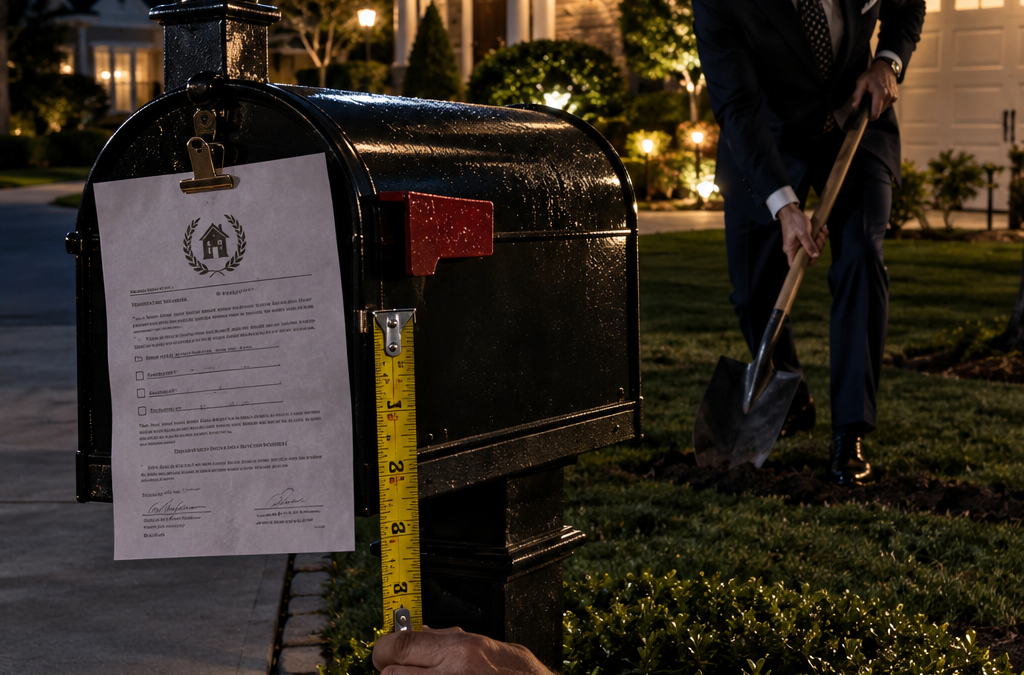
I photographed the mailbox from several angles with a measuring tape visible.
I documented the porch light, its fixture, and the type of bulb installed.
I also began keeping a notebook.
At first, I called it the HOA folder.
A few days later, without really thinking about it, I wrote Marlene File across the cover.
Denise noticed.
“You’re getting serious about this.”
I looked up.
“I think I have to.”
She sat beside me at the kitchen table.
“Just don’t let him consume your life.”
I understood what she meant.
We had worked hard for our home.
It was a three-bedroom house with a brick front, a comfortable porch, and a backyard where Denise spent most spring evenings tending her flowers.
We had planted the rose bushes together five years earlier.
There were six of them along the front flower bed, arranged beneath the porch windows.
Denise had chosen the varieties.
Deep red blooms.
Soft pink blossoms.
And one pale yellow rose that always flowered later than the others.
The garden wasn’t expensive.
It wasn’t elaborate.
But it was ours.
For years, it had been one of the things that made the house feel like home.
I had no intention of spending my evenings obsessing over Marlene Cobb.
I simply wanted the fines explained or withdrawn.
So I decided to attend the next HOA meeting.
The meeting was held on a Thursday evening in the Willow Creek clubhouse.
I arrived ten minutes early carrying a notebook and copies of the notices.
Marlene stood near the front of the room, talking to two board members.
He wore a charcoal suit jacket over a white shirt, with a burgundy pocket square tucked neatly into the breast pocket.
His gold watch caught the overhead light.
He looked completely comfortable.
Like a man who believed the room belonged to him.
When he noticed me, his smile sharpened.
“Dalton. Glad you could join us.”
I nodded.
“Evening, Marlene.”
He glanced at the folder in my hand.
“I assume you’re here about your outstanding violations.”
“I’m here to ask for the governing documents.”
His smile thinned.
“We have procedures for that.”
“Good. I’d like to follow them.”
For a moment, his eyes narrowed.
Then he turned away.
The meeting began.
Marlene talked about property values, neighborhood discipline, and the importance of consistent enforcement.
He spoke as though Willow Creek had been collapsing into chaos before his election.
According to him, residents had become careless.
Standards had slipped.
The board needed stronger tools to protect the community.
Every few minutes, he used the same phrase.
Accountability starts at home.
I sat quietly, listening.
Then the floor opened for homeowner questions.
I raised my hand.
Marlene looked toward me.
“Dalton.”
“I received two fines citing provisions that don’t appear in the governing documents available to residents.”
A few people turned.
I continued.
“I’d like to review the current master copy of the bylaws, covenants, and adopted rules that authorize those penalties.”
Marlene folded his hands.
“The master copy is currently being reprinted.”
I stared at him.
“Reprinted?”
“Yes.”
“Why?”
“We’re updating the document package.”
“Have the amendments already been properly adopted?”
His expression tightened.
“That’s an administrative matter.”
“I’m asking because the fine notices cite provisions I can’t find.”
“We’ve already explained that the association’s standards have been updated.”
“Then I’d like to see the approved amendments.”
Marlene smiled.
It was the same thin smile Rosa had warned me about.
“Dalton, we’re not going to turn this meeting into a personal dispute over your mailbox.”
Several homeowners looked uncomfortable.
I kept my voice steady.
“I’m not asking for special treatment. I’m asking to see the rule you’re fining me under.”
He leaned forward.
“And I’m telling you the documents are being prepared.”
“When will they be available?”
“Soon.”
“Can you give me a date?”
His smile disappeared.
“Are you questioning the board’s integrity?”
The room went quiet.
I felt heat rise behind my ears.
“No. I’m asking for documentation.”
Marlene looked around the room.
“This is precisely the problem with residents who focus on technicalities instead of community responsibility.”
I heard someone shift in a chair.
He turned back toward me.
“If everyone spent as much time maintaining standards as they did challenging enforcement, we wouldn’t need these penalties.”
I could feel my heartbeat in my throat.
He had turned a straightforward request into a public accusation.
For a moment, I wanted to argue.
Instead, I opened my notebook.
I wrote down his answer.
Master copy being reprinted. No date supplied. No amendments produced.
Marlene noticed.
“What are you writing?”
“Meeting notes.”
His eyes hardened.
Then he moved to the next question.
I went home with less information than I’d arrived with.
But I also had something important.
Marlene had publicly acknowledged that he couldn’t produce the updated documents he claimed authorized the fines.
And I wasn’t the only person who had heard it.
That night, Denise found me at the kitchen table.
I had the original HOA documents spread beside the computer.
“How did it go?”
“He said the master copy is being reprinted.”
She frowned.
“For how long?”
“He wouldn’t say.”
“That’s strange.”
“Very.”
I leaned back.
“I’ve been through the documents from when we bought the house. The provisions he’s citing don’t match the original numbering.”
“Maybe they amended them.”
“Then there should be a record of the amendment.”
Denise looked at the papers.
“So what are you going to do?”
“I’m going to find out what was actually approved.”
That became the next step.
I filed a public-records request for the association’s available nonprofit filings and relevant financial information held by the county.
I also requested access to the HOA records homeowners were entitled to inspect, including governing amendments, fine schedules, meeting minutes, and financial statements.
I didn’t expect the answer overnight.
But I wanted a paper trail.
While those requests were pending, Marlene escalated.
The next letter came by certified mail.
I was home when the postal carrier arrived.
I signed for it at the door.
Then I opened it standing in the hallway.
The notice claimed my unpaid violations had crossed the threshold for collection action.
The original mailbox fine was five hundred dollars.
The porch light fine was two hundred.
Now additional processing fees, late charges, and administrative costs had appeared.
The total demand had reached nineteen hundred dollars.
The letter warned that further action could include placing a lien against my home.
I stood there reading it.
Then I read it again.
Nineteen hundred dollars.
For a mailbox and a porch light.
My hands began to shake.
Not because the amount would immediately bankrupt us.
Because the notice threatened something much more serious than a payment.
Our house.
The place Denise and I had spent years paying for.
The place where we’d celebrated anniversaries, hosted family dinners, and planned the rest of our lives.
Marlene was using the possibility of a lien to make us afraid of losing it.
I sat down at the kitchen table.
The letter trembled slightly between my fingers.
Denise walked in.
“Dalton?”
I handed it to her.
She read it slowly.
Her face changed.
“Oh my God.”
I stared at the tabletop.
“He can’t be serious.”
Denise sat beside me.
“Can they really do this?”
“I don’t know.”
Those three words were the worst part.
I understood that associations sometimes had legitimate collection rights.
I knew unpaid assessments and certain authorized charges could lead to serious consequences depending on state law and the governing documents.
But I didn’t know whether these fines were enforceable.
And Marlene was counting on that uncertainty.
Denise read the notice again.
“Maybe we should just pay it.”
I looked at her.
“What?”
“I don’t mean he’s right. I mean maybe nineteen hundred dollars is cheaper than hiring attorneys and risking the house.”
I wanted to argue immediately.
But I stopped.
She wasn’t surrendering because she respected Marlene.
She was frightened.
And I understood why.
A house wasn’t just an asset on a balance sheet.
It was security.
It was the place where you expected to be safe.
Marlene had found a way to make that safety feel conditional.
I looked at Denise.
“I know what you’re saying.”
She reached for my hand.
“I don’t want this man taking over our lives.”
I nodded.
“Neither do I.”
Then I looked at the letter.
“But if we pay without challenging it, what stops him from sending another fine next month?”
She said nothing.
“What stops him from deciding our fence is the wrong color? Or our driveway needs approval? Or our roses violate some rule nobody’s allowed to read?”
Denise looked toward the front window.
The rose bushes were visible beneath the porch.
Then she turned back toward me.
“He’s not fighting you over a mailbox, Dalton.”
I looked at her.
“He’s fighting you because you asked questions.”
The words settled heavily.
I knew she was right.
Marlene had never shown the slightest interest in resolving a simple compliance issue.
Every time I requested documentation, the threats became more severe.
He wasn’t trying to correct half an inch of mailbox height.
He was trying to teach me that challenging him had consequences.
That realization changed the way I approached the problem.
I stopped thinking about the fines as isolated annoyances.
I began examining the entire pattern.
That night, I went through the HOA meeting minutes and spending reports that residents had posted in our community Facebook group.
Some documents were recent.
Others dated back several months.
I downloaded everything relevant.
Then I began comparing figures.
At first, nothing stood out.
Landscaping invoices.
Maintenance expenses.
Clubhouse supplies.
Routine administrative charges.
But one line caught my attention.
A substantial payment from the landscaping fund had been made to a paving contractor.
I frowned.
Willow Creek hadn’t recently repaved a community driveway.
As far as I knew, the common-area walking paths hadn’t been improved.
And the board hadn’t announced a major paving project.
I opened the supporting report.
The contractor’s name was listed.
So was the date.
Six weeks earlier.
I stared at the screen.
Then I remembered something.
Marlene had recently installed an expensive paver driveway at his own house.
I’d driven past it several times.
The work had been impossible to miss.
His old concrete driveway had been replaced with carefully arranged decorative stone.
The borders matched the landscaping.
New lights had been installed along the edges.
At the time, I’d assumed he was spending his own money.
Now I was looking at an HOA landscaping payment to a paving contractor from the same period.
I sat back.
Then I leaned forward and checked the records again.
The payment description was vague.
It referred to exterior hardscape improvements.
No common-area location was identified.
I compared the amount with the other landscaping expenses.
It stood out sharply.
My first reaction was disbelief.
The second was anger.
I couldn’t prove from one spending line that Marlene had used association money to pay for his private driveway.
But the timing and description were suspicious enough to demand an explanation.
I called Denise into the room.
“Look at this.”
She leaned over my shoulder.
“What am I looking at?”
“Landscaping fund payment. Paving contractor. Six weeks ago.”
She studied the screen.
“So?”
I looked at her.
“When did Marlene get his new driveway?”
Her expression changed.
“Dalton.”
“Exactly.”
She sat beside me.
“Are you sure?”
“No. Not yet.”
I opened another record.
“But I think we need to find out.”
I barely slept that night.
Every time I closed my eyes, I saw the nineteen-hundred-dollar demand beside the paving expense.
The possibility that residents were being threatened with financial penalties while their association funds were being misused made me sick.
The next morning, I called Rosa.
I told her I wanted to compare notes.
She arrived that evening carrying a thick folder.
She brought Priya with her.
Priya was another Willow Creek homeowner, a detail-oriented woman who had questioned several unexplained charges at earlier meetings.
The three of us sat around my kitchen table while Denise made coffee.
I placed my violation notices in the center.
Rosa added her correspondence.
Priya brought copies of financial reports and meeting records.
For the first hour, we simply compared dates.
The patterns were disturbing.
Marlene had issued fines for ordinary property conditions under rules residents couldn’t verify.
Some notices cited provisions that didn’t appear in the accessible governing documents.
Others referred vaguely to revised standards without identifying the adoption date.
Residents who requested clarification received warnings.
Residents who resisted were threatened with escalating charges.
Rosa spread several letters across the table.
“Look at these.”
I leaned forward.
One homeowner had been fined for decorative stones near a flower bed.
Another had received a warning about the placement of a garden hose reel.
A third had been cited for exterior lighting that had been installed years earlier.
Priya tapped one of the notices.
“Same language.”
I looked closer.
The paragraphs were nearly identical.
“He’s using a template.”
Rosa nodded.
“And adding whatever violation he wants.”
Denise sat beside me, reading.
“How many people have gotten these?”
“We don’t know yet,” Priya said.
She looked toward me.
“But I think it’s more than we realize.”
I showed them the landscaping expense.
Then I explained the timing of Marlene’s driveway installation.
Rosa stared at the figures.
For several seconds, she said nothing.
Then she let out a low whistle.
“You’re telling me he might have paid for that driveway with HOA money?”
“I’m saying the records raise that question.”
Priya examined the report.
“Do we have the contractor invoice?”
“Not yet.”
“Then we need it.”
I nodded.
“Exactly.”
We agreed not to spread accusations we couldn’t support.
That mattered.
I didn’t want to become like Marlene, turning assumptions into verdicts.
We needed documentation.
Actual financial records.
Invoices.
Bank statements.
Approved budgets.
Board authorizations.
Evidence that could withstand scrutiny.
We began organizing everything.
By the end of the evening, my kitchen table was covered with paper.
Denise looked around and shook her head.
“I can’t believe this started with a mailbox.”
I looked toward the window.
“Neither can I.”
Over the next several days, three more residents came forward.
Each had a similar story.
Unexpected violations.
Rules nobody could produce.
Warnings of penalties.
Threats of liens when they challenged the charges.
One elderly homeowner told us she’d paid a fine she didn’t understand because she was afraid of losing her house.
Another said Marlene had warned that continued complaints could result in increased scrutiny of his property.
The Hendersons provided copies of the lien-related documents they’d received.
By then, the situation had grown far beyond my personal dispute.
Willow Creek wasn’t simply dealing with an overly strict HOA president.
We were looking at a possible pattern of financial intimidation.
And perhaps something worse.
Marlene seemed to sense that residents were beginning to compare notes.
The next announcement arrived on a Wednesday.
NEIGHBORHOOD BEAUTIFICATION INSPECTION
The notice said the association would conduct a comprehensive exterior review of every property to ensure compliance with updated community standards.
I read it and immediately thought of Rosa.
She called less than ten minutes later.
“Did you see it?”
“Yes.”
“He’s retaliating.”
“We can’t prove that yet.”
She sighed.
“Dalton, he’s going to inspect everybody who’s been asking questions.”
I looked toward the stack of documents on my desk.
“Then we’d better document what happens.”
The inspection began two days later.
Marlene walked through Willow Creek carrying a clipboard, accompanied by another board representative.
He wore a light gray blazer despite the warm weather.
His hair was immaculate.
His shoes gleamed.
He looked less like someone examining neighborhood maintenance and more like a man performing authority for an audience.
When he reached my house, I was working near the garage.
He stopped beside the sidewalk.
“Dalton.”
I turned.
“Marlene.”
He looked toward the front flower bed.
“Your landscaping is not compliant.”
I stared at him.
“What?”
“The rose bushes.”
I followed his gaze.
Denise’s roses were growing beneath the porch windows.
The red bushes had begun producing new blooms.
The pink ones were full and healthy.
The pale yellow rose was covered with buds.
“What about them?”
“They’re unauthorized.”
I almost laughed.
“Those bushes have been there five years.”
“That doesn’t establish compliance.”
“They were approved by the previous board.”
Marlene smiled.
The same tight, carefully practiced smile.
“Rules change, Dalton.”
I felt my jaw tighten.
“Then show me the rule.”
He glanced at his clipboard.
“The updated landscaping standards.”
“Which section?”
“You’re welcome to submit a formal records request.”
“I already have.”
His smile thinned.
“Then wait for the response.”
I took out my phone.
By this point, I’d learned that conversations with Marlene had a habit of being remembered very differently afterward.
I made sure I was recording the encounter in a manner consistent with applicable law.
Then I asked him again.
“Are you telling me the roses are a violation even though the previous HOA board approved them?”
He looked directly at me.
“Yes.”
“On what basis?”
“Current standards.”
“Where are those standards published?”
He folded his arms.
“You’re becoming repetitive.”
“I’m asking the same question because you keep refusing to answer it.”
His face hardened.
“You seem determined to challenge every decision I make.”
“Because your decisions keep threatening my property.”
Marlene stepped closer.
“That’s an unfortunate way to look at community accountability.”
I held the phone steadily.
“Then explain why my roses were fine last spring and are suddenly a problem now.”
He leaned toward me.
“Rules change, Dalton.”
He said the words slowly.
Almost with satisfaction.
I felt something cold move through my chest.
He wasn’t interested in whether the roses met a legitimate standard.
He wanted me to understand that he could change the conditions whenever he wished.
And that there was nothing I could do about it.
I looked at the bushes.
Denise had planted them with her mother during one of the last visits before her mother’s health began declining.
Every spring, when the first red blossoms opened, Denise told the same story about how they’d argued over the spacing and eventually planted the bushes too close together.
They weren’t just landscaping.
They were memories.
Marlene had no idea how much those plants meant to us.
Or perhaps he didn’t care.
“I’ll need the violation in writing,” I said.
His smile returned.
“Oh, you’ll get it.”
Then he turned and walked away.
I watched him leave.
For several seconds, I remained beside the flower bed.
Then I looked at the phone.
The conversation had been recorded.
Every word.
I went inside.
Denise was in the kitchen.
She saw my expression immediately.
“What happened?”
“He says the roses are unauthorized.”
She stared at me.
“What?”
“He claims the landscaping standards changed.”
“But the old board approved them.”
“I know.”
She looked toward the front window.
For a moment, neither of us spoke.
Then her voice became very quiet.
“Those were Mom’s roses.”
I nodded.
“I know.”
Her eyes filled with tears.
That was the moment my anger changed.
Until then, Marlene’s behavior had been infuriating.
But it had mostly involved paperwork.
Fines.
Threats.
Letters.
Now he was targeting something personal.
Something that carried a part of our family’s history.
Denise pressed her lips together.
“Please don’t let him make us get rid of them.”
I reached for her hand.
“I won’t agree to remove them without a legitimate legal basis.”
She nodded.
But I could see the fear in her face.
And I hated Marlene for putting it there.
The lien notice arrived that Friday.
It was an official-looking document claiming that my outstanding penalties had advanced to the point where the association could pursue a lien and potential foreclosure proceedings if the balance wasn’t paid within thirty days.
The amount remained tied to the disputed fines and accumulated charges.
Nineteen hundred dollars.
I stood in the hallway reading it.
Then I went straight to the kitchen.
Denise was sitting at the table.
I handed her the notice.
She read it.
Her face went pale.
“Dalton, this has to stop.”
“I know.”
“No, I mean it. We could lose the house over this.”
I sat beside her.
“I don’t believe these penalties are valid.”
“But what if you’re wrong?”
The question hurt because it was reasonable.
I had spent weeks gathering documents.
I had found inconsistencies.
I had uncovered suspicious spending.
But I wasn’t an attorney.
I couldn’t guarantee what would happen if Marlene followed through.
And I wasn’t going to gamble our home on my own interpretation of HOA law.
So I made the call I should have made earlier.
I contacted a real estate attorney.
Her name was Patricia Okafor.
Ms. Okafor had years of experience with property disputes, homeowner associations, and litigation involving recorded covenants.
Her office was downtown, on the fourth floor of an older brick building.
I arrived carrying the Marlene File.
When I placed it on her desk, she raised an eyebrow.
“That’s a substantial amount of documentation.”
I gave a tired smile.
“You should see what’s still on my computer.”
She opened the folder.
Then she began reading.
The mailbox notice.
The porch light fine.
My requests for governing documents.
Marlene’s emails.
The meeting notes.
The landscaping violation.
The lien threat.
The spending report.
The older HOA approval for the roses.
She worked methodically.
Every so often, she asked a question.
Had I received proper notice of a hearing?
Had the board voted to adopt the cited rules?
Did I have the recorded declaration?
Had the association provided its current fine schedule?
Had I paid my regular assessments?
I answered each question and supplied the relevant paperwork.
After nearly an hour, she leaned back.
Then she said four words that changed everything.
“This isn’t enforceable, Dalton.”
I stared at her.
“What?”
“Based on the documents you’ve provided, these particular penalties have serious legal defects.”
I felt my chest tighten.
“Because the bylaws weren’t updated?”
“Because the association has not demonstrated that the cited restrictions and fine procedures were properly adopted or authorized under its operative governing documents and applicable law.”
She tapped the violation notices.
“An HOA can’t simply invent a new rule, assign it an official-looking section number, and impose penalties without the authority and procedures required to do so.”
I looked down at the letters.
For weeks, those pages had made me feel powerless.
Now they looked different.
Not harmless.
But challengeable.
Ms. Okafor continued.
“We’ll verify the complete recorded documents and the relevant board actions. But nothing here establishes that Marlene can lawfully use these disputed charges as the basis for the lien threat he’s making.”
I exhaled slowly.
I hadn’t realized how tightly I’d been holding my breath.
“So what do we do?”
“We challenge the notices formally. We demand the supporting records. And we preserve every piece of evidence.”
I nodded.
Then she turned to the financial report.
“Now, this concerns me for another reason.”
She pointed to the paving expense.
“Tell me about this.”
I explained the landscaping fund.
The payment to the contractor.
The timing of Marlene’s driveway installation.
The lack of a clearly identified community project.
Ms. Okafor listened carefully.
Then she looked at the report again.
“If association funds were diverted for a board president’s personal expenses, that could involve misappropriation or embezzlement.”
I felt my stomach drop.
“Criminal charges?”
“Potentially, if the evidence supports them and the appropriate authorities determine that criminal conduct occurred.”
She looked directly at me.
“But we don’t make that accusation publicly without proof. We request the records and let the financial evidence establish what happened.”
I nodded.
“That’s what we’ve been trying to do.”
“Then you’re on the right path.”
For the first time in weeks, I left a meeting feeling that the problem could actually be resolved.
Not because Marlene had suddenly become reasonable.
But because somebody who understood the law had examined the documents and identified a legitimate way forward.
Ms. Okafor helped us prepare a formal challenge to the fines and lien threat.
We also submitted a request for a financial audit through the appropriate county nonprofit oversight process.
The submission included the suspicious spending reports, correspondence, violation notices, meeting records, and other evidence relevant to the disputed charges.
We preserved the recorded conversation concerning the roses.
We attached the earlier landscaping approval.
We organized everything carefully.
Then we waited for the records review.
Marlene did not react well.
The first sign came three days later.
A new HOA announcement appeared in residents’ inboxes.
It proposed restricting drone flights over Willow Creek Estates.
The explanation referred to privacy, neighborhood security, and unauthorized aerial surveillance.
I read the message twice.
Then Rosa called.
“Dalton, please tell me you’ve seen this.”
“I have.”
She started laughing.
“He’s losing his mind.”
I leaned back in my chair.
“What now?”
“He thinks somebody’s flying a drone over his driveway.”
I couldn’t help laughing.
Neither of us had been flying drones.
We didn’t need to.
The spending records and contractor information were much more useful than aerial photographs.
Rosa continued.
“He’s gone from rules queen to hiding behind his own curtains.”
I laughed harder than I had in weeks.
It was ridiculous.
Marlene had spent months issuing fines over mailbox heights, light bulbs, and flower beds.
Now he appeared worried that someone might take pictures of his expensive new driveway.
But the humor didn’t last long.
A frightened authoritarian wasn’t necessarily a harmless one.
Sometimes people became more reckless when they realized they were losing control.
And Marlene still had access to the HOA’s enforcement process.
He still knew where we lived.
He still believed I had challenged his authority.
I began paying more attention to the security system around the house.
We already had a doorbell camera, but the view didn’t cover the entire front flower bed.
So I installed an additional porch camera.
I positioned it to capture the front steps, the driveway approach, and the roses beneath the windows.
It wasn’t an elaborate system.
Just a reliable camera with night vision, motion alerts, and timestamped recordings.
Denise watched me test it.
“Do you really think he’ll come here?”
“I don’t know.”
“Dalton.”
I turned toward her.
“I hope he doesn’t. But I want a record if anything happens.”
She looked toward the roses.
Then she nodded.
That evening, we tested the camera.
I walked across the porch.
Then around the flower bed.
Then toward the driveway.
The image was clear.
The night-vision setting showed the garden well enough to identify someone standing beside the roses.
I saved the test recording.
Then I went inside.
For the next two nights, nothing happened.
Marlene continued sending tense messages to the board.
Rosa reported that he had become increasingly suspicious of residents discussing HOA finances.
Priya said he had demanded to know who was sharing spending reports.
But there were no new visits to my house.
No confrontations.
No unexpected vehicles.
For a brief moment, I thought the situation might finally be moving toward a normal legal resolution.
Then came the night I will never forget.
It was just after midnight.
Denise and I were asleep.
The house was quiet.
Outside, a light breeze moved through the trees along the street.
I had left my phone charging on the nightstand.
At 12:47 a.m., it vibrated.
A motion alert.
Front porch camera.
At first, I barely registered it.
We occasionally received alerts when a neighborhood cat crossed the porch or a passing car’s headlights triggered the sensor.
I reached for the phone without opening my eyes completely.
Then I saw the image.
A figure was standing in our front flower bed.
Holding a shovel.
I sat upright.
The screen illuminated the bedroom.
For a second, I couldn’t understand what I was seeing.
The person was bent over near the red rose bushes.
He drove the shovel into the ground.
Then pulled backward.
I opened the live feed.
The night-vision image sharpened.
My mouth went dry.
It was Marlene Cobb.
The HOA president.
The man who had threatened liens and penalties.
The man who had claimed my roses were unauthorized.
He was standing in my yard after midnight, digging them out of the ground.
For several seconds, I couldn’t move.
I watched him lean into the shovel.
He was wearing dark pants and a jacket.
His carefully styled hair was disheveled.
The expensive polish that usually surrounded him had vanished.
He looked frantic.
He drove the shovel beneath another root.
Then he pulled.
The rose bush shifted violently.
I heard the scrape of metal against soil through the camera microphone.
My heart began pounding.
“Denise.”
She stirred.
“What’s wrong?”
“Wake up.”
She opened her eyes.
I handed her the phone.
She stared at the screen.
Then she made a small, broken sound.
“Dalton.”
“I know.”
“That’s Marlene.”
“I know.”
She watched him pull another bush from the ground.
“Oh my God. Those are Mom’s roses.”
Her voice cracked.
I felt anger so powerful that my vision seemed to narrow.
For one terrible second, I wanted to run outside.
I wanted to grab the shovel.
I wanted to demand that Marlene explain what he thought he was doing.
But I knew how dangerous that could become.
It was after midnight.
He had a shovel.
He was behaving irrationally.
And the last thing I wanted was a physical confrontation in the dark while Denise watched from the house.
I got out of bed.
“Stay inside,” I told her.
She grabbed my arm.
“Dalton, please don’t go out there.”
“I’m not going to confront him.”
I picked up my phone.
“I’m calling the police.”
I dialed 911.
When the dispatcher answered, I gave our address.
Then I explained that a man was on my private property, actively destroying landscaping with a shovel.
I identified him as the HOA president.
I told the dispatcher I had live security footage.
And I made it clear that he was still outside.
The dispatcher asked whether anyone was injured.
“No.”
“Are you inside the house?”
“Yes.”
“Stay inside. Do not confront him.”
“I understand.”
I looked toward the camera feed.
Marlene was still working.
He had already uprooted one of the red rose bushes.
Another lay at an angle with its roots exposed.
Soil covered the walkway.
He moved quickly, almost desperately, as though the destruction itself would erase the evidence that the plants had ever been approved.
I watched him attack the next bush.
The shovel cut into the flower bed.
He pulled hard.
The plant tore free.
Denise covered her mouth.
Tears ran down her face.
“Why would he do this?”
I couldn’t answer.
I had spent weeks trying to understand Marlene’s behavior.
The fines.
The threats.
The refusal to produce documents.
The suspicious payments.
But watching him dig up our roses in the middle of the night brought the cruelty into focus.
He wasn’t simply trying to enforce a rule.
He wanted to hurt us.
He wanted to take something personal because I had refused to give him control.
And he apparently believed he could do it without being seen.
I kept the camera recording.
The dispatcher remained on the line while officers responded.
The minutes felt endless.
Every movement Marlene made seemed louder through the microphone.
The scrape of the shovel.
The crunch of gravel beneath his shoes.
The rustling branches.
At one point, he stopped and looked toward the street.
I held my breath.
Then he returned to the flower bed.
He pulled another damaged bush away from the soil.
I could see dirt covering his hands.
The front garden Denise had cared for over five years was being destroyed in real time.
I looked at her.
She was crying silently.
I wanted to tell her everything would be all right.
But I couldn’t.
Not while Marlene was outside tearing apart something that mattered so much to her.
Then I saw headlights.
Two patrol cars turned onto our street.
Their lights swept across the front lawn.
Marlene froze.
The shovel remained in his hands.
For one extraordinary second, he stood perfectly still in the middle of the flower bed.
Then one patrol car stopped near the driveway.
The other pulled up along the curb.
Officers stepped out.
“Sir, put the shovel down.”
The command came clearly through the camera microphone.
Marlene looked toward them.
He didn’t move immediately.
“Sir. Put it down.”
The shovel dropped into the dirt.
An officer approached carefully.
Another remained near the sidewalk.
Marlene began talking.
Even through the camera speaker, I recognized his voice.
Sharp.
Indignant.
Trying to sound authoritative.
“I’m the president of the homeowners association.”
The officer answered.
“Keep your hands where I can see them.”
Marlene lifted his hands.
Dirt covered his fingers.
He started explaining that he was conducting community enforcement.
At 12:47 in the morning.
With a shovel.
In my flower bed.
I almost laughed.
But Denise was still crying.
And nothing about what he had done was funny.
An officer approached the front door.
I checked the camera before opening it.
He identified himself.
I stepped outside only after he indicated it was safe.
Denise remained just inside the doorway.
The officer looked at me.
“Are you the homeowner?”
“Yes. Dalton.”
“Do you know the man in your yard?”
“Yes. Marlene Cobb. He’s our HOA president.”
The officer glanced toward the flower bed.
“Do you have any idea why he’s digging here?”
I took a breath.
“He’s been threatening us with fines over those roses. We have documentation and security footage.”
The officer looked at my phone.
“Can you show me?”
I opened the recording.
The timestamp was visible.
12:47 a.m.
Marlene entered the camera’s view.
Walked toward the flower bed.
Positioned the shovel.
And began digging.
The officer watched silently.
Then he asked, “Did you give him permission to enter your property?”
“No.”
“Did you authorize removal of these plants?”
“Absolutely not.”
He nodded.
“Can you preserve that recording?”
“Yes.”
I explained that the system stored the original footage.
The officer asked me to keep it intact and provide a copy through the appropriate process.
Then he looked toward the yard.
Marlene was standing beside the second patrol car.
His jacket was wrinkled.
His hair had fallen out of its carefully arranged style.
Soil covered his hands.
For the first time since I’d met him, he looked nothing like a polished executive.
He looked like an angry man caught doing something he couldn’t explain away.
One of the officers was speaking with him.
Marlene kept gesturing toward the house.
Then toward the flower bed.
Finally, his voice rose.
“Those plants are in violation of community standards!”
The officer answered.
“That doesn’t authorize you to enter someone’s yard and destroy their property.”
Marlene looked toward me.
Our eyes met.
The expression on his face changed.
First anger.
Then recognition.
Then something that looked very much like fear.
He realized I was holding the phone.
He realized the camera had captured what he had done.
And for perhaps the first time in his HOA presidency, he understood that the evidence didn’t depend on his version of events.
I stepped closer to the porch railing.
I didn’t shout.
I didn’t insult him.
I didn’t need to.
“Marlene,” I said, “what are you doing?”
He stared at me.
For a second, I thought he might apologize.
Instead, he lifted his chin.
“Enforcing community standards.”
I looked toward the uprooted roses.
“At midnight?”
He said nothing.
“With a shovel?”
His jaw tightened.
“The plants were unauthorized.”
“They were approved five years ago.”
“That approval is no longer valid.”
I felt my hands tighten around the phone.
“Then you should have handled it through the proper process.”
He looked toward the officer.
“This is an HOA matter.”
The officer’s expression didn’t change.
“No, sir. We’re investigating a reported trespass and property damage.”
Marlene stared at him.
“You don’t understand the governing documents.”
The officer glanced toward the destroyed garden.
“Whatever the documents say, they don’t give you unlimited permission to enter private property and damage it.”
Marlene’s face reddened.
He looked at me again.
“You’ve been obstructing association enforcement for weeks.”
I held his gaze.
“I’ve been asking you to show me the rules.”
He opened his mouth.
Then closed it.
I continued.
“And now you’ve come into my yard in the middle of the night to destroy the roses my wife planted with her mother.”
For a moment, the anger drained out of me.
What remained was something heavier.
Disgust.
Disappointment.
Exhaustion.
I looked at the ruined flower bed.
“You knew those plants mattered to us.”
Marlene looked away.
I didn’t know whether he felt any shame.
But I knew he couldn’t deny what the camera had recorded.
The officers continued their investigation.
They documented the damaged bushes.
They photographed the shovel and disturbed soil.
They reviewed the footage.
They confirmed that Marlene had no permission to be on the property.
And after evaluating the circumstances, they took him into custody in connection with the trespass and criminal mischief allegations.
I watched an officer place him in handcuffs.
Marlene’s expression changed completely.
He looked shocked.
Almost offended.
As though the possibility of consequences had never occurred to him.
“Do you know who I am?” he demanded.
The officer answered calmly.
“We know your name, sir.”
Marlene looked toward my house.
Then toward the patrol car.
His gold watch flashed beneath the streetlight.
For years, he had used his position to make other people afraid.
Now he was standing in my front yard, surrounded by the consequences of his own conduct.
He had come to destroy evidence.
Instead, he had created the clearest evidence of all.
I didn’t celebrate.
I stood beside the porch watching the officers finish their work.
Denise came outside after they told us it was safe.
She walked slowly toward the flower bed.
I followed her.
The damage was worse up close.
The red bushes were uprooted.
Branches were broken.
Roots lay exposed.
The soil had been torn apart.
The pale yellow rose was leaning sideways, its base partly severed.
Denise knelt beside it.
She touched one of the broken branches.
Then she began to cry again.
I knelt beside her.
“I’m sorry.”
She shook her head.
“Mom loved this one.”
I looked at the yellow rose.
I remembered her mother standing in that exact place five years earlier.
She’d been wearing a wide straw hat and giving me instructions about where to dig.
I’d complained that we were planting too many bushes.
She had laughed.
“You can never have too many roses, Dalton.”
I smiled through the ache in my chest.
Denise touched the damaged roots.
“She was so proud when these started blooming.”
I put my arm around her.
For several minutes, we stayed there.
The patrol cars eventually left.
The street became quiet again.
But the garden looked like a storm had passed through it.
I wanted to fix everything immediately.
To put the bushes back in the ground.
To repair every damaged root.
To make the yard look exactly as it had that morning.
But the officers needed the damage documented, and I didn’t want to disturb anything until the necessary evidence had been preserved.
So we went inside.
Denise sat at the kitchen table.
I made tea neither of us really wanted.
Then I opened the security footage again.
I watched only enough to verify that the recording had been saved properly.
I couldn’t bring myself to sit through the entire destruction a second time.
At nearly three in the morning, Denise finally went back to bed.
I stayed in the kitchen.
The house was silent.
The folder containing Marlene’s letters sat beside the laptop.
I looked at it for a long time.
Three weeks earlier, this had begun with a mailbox.
A half-inch discrepancy.
Five hundred dollars.
Then a porch light.
Then a lien threat.
Then the roses.
And now the HOA president had been taken away by police after being caught destroying our garden.
I kept asking myself the same question.
How had it reached this point?
The answer wasn’t complicated.
Every time Marlene’s authority was questioned, he escalated.
He wasn’t trying to solve a problem.
He was trying to prove he could punish anyone who resisted him.
And the longer the dispute continued, the more desperate his actions became.
I looked through the window at the damaged flower bed.
I thought of Rosa’s warning.
He smiles while he ruins you.
She had been right.
But Marlene had finally made a mistake he couldn’t bury beneath another HOA notice.
The camera had recorded the truth.
The next morning, Rosa arrived before nine.
She had heard about the police.
I met her on the porch.
She looked at the destroyed roses.
For a moment, her face was blank.
Then she turned toward me.
“He actually did this?”
I nodded.
“Camera caught everything.”
She stared at the flower bed.
“Dalton, I knew he was awful. I didn’t think he’d do something like this.”
“Neither did I.”
She looked toward Denise through the window.
“How is she?”
“Upset.”
Rosa nodded.
“Of course.”
Then her expression hardened.
“He needs to be removed from the board.”
I looked at her.
“That decision belongs to the homeowners.”
“And the homeowners need to see what happened.”
I nodded.
“They will, through the proper process.”
By that afternoon, word had spread through Willow Creek.
Some residents were shocked.
Others admitted they had been afraid of Marlene for months.
The Hendersons called to ask whether we were all right.
Priya came over with copies of additional financial records.
People who had remained silent began talking.
For the first time, Marlene’s authority no longer seemed untouchable.
The president who had threatened neighbors with liens had been caught violating someone else’s property rights.
And the financial investigation was still underway.
Ms. Okafor called later that day.
I explained what had happened.
Then I sent her the police report information and preserved security footage.
She listened carefully.
“Dalton, I want you to keep the criminal investigation separate from the HOA financial dispute.”
“I understand.”
“The incident may be relevant to the broader pattern, but we don’t need to stretch the evidence. What he did last night can be evaluated on its own facts.”
I looked toward the damaged garden.
“Believe me, there are enough facts.”
She paused.
“How is Denise?”
“She’s taking it hard.”
“I’m sorry.”
I swallowed.
“Those roses meant a lot to her.”
“Document the damage. Preserve the footage. And let the police handle their investigation.”
I nodded.
“All right.”
For the next several days, I followed her advice.
I didn’t confront Marlene.
I didn’t send him angry messages.
I didn’t use the community Facebook group to celebrate his arrest.
I focused on the records.
And I helped Denise salvage what she could from the garden.
We contacted a local nursery.
A gardener came to examine the bushes.
Some roots had been badly damaged.
A few branches were beyond saving.
But not everything was lost.
The gardener showed us how to replant the surviving bushes and stabilize their roots.
The pale yellow rose needed special attention.
Denise insisted on helping.
I watched her kneel in the soil, carefully positioning the plant.
For the first time since the incident, she seemed less frightened.
Still hurt.
Still angry.
But doing something to reclaim the space Marlene had violated.
I helped her refill the flower bed.
We worked slowly.
Neither of us talked much.
At one point, Denise looked up.
“Do you think they’ll bloom again?”
I examined the damaged plant.
“I hope so.”
She nodded.
Then she went back to work.
A week after Marlene was caught on camera, the audit findings were released through the county oversight process.
I was sitting at my desk when Ms. Okafor called.
Her voice was serious.
“Dalton, we’ve received the findings.”
I straightened.
“And?”
“The financial discrepancies weren’t innocent bookkeeping errors.”
I felt my stomach tighten.
She continued.
“The review identified association funds used for personal expenses connected to Marlene’s property.”
I closed my eyes.
“The driveway?”
“Yes.”
For several seconds, I couldn’t speak.
The suspicion we’d uncovered at the kitchen table had been confirmed.
The landscaping fund had paid expenses associated with the decorative paver driveway at Marlene’s private residence.
The audit identified documentation connecting the payments to his personal improvement project.
There were also broader problems with the association’s handling of fine revenue and its financial controls.
I leaned back in my chair.
All those letters.
All those threats.
Residents frightened into paying penalties they didn’t understand.
And money intended for the community had been diverted toward the president’s own property.
I felt sick.
“What’s going to happen?” I asked.
“The findings have been referred for further review, including consideration by the district attorney.”
“Could he face embezzlement charges?”
“Yes, depending on the prosecutor’s evaluation of the evidence.”
I looked toward the window.
The repaired rose bed was visible beneath the porch.
“After everything he’s done, I still can’t believe he thought he’d get away with it.”
Ms. Okafor paused.
“People who control records sometimes begin believing they control the truth.”
I thought about Marlene’s confident smile at the HOA meeting.
His refusal to produce the governing documents.
His threats of liens.
His expensive driveway.
Then the shovel.
At last, the pieces fit together.
Marlene hadn’t simply become obsessed with strict community standards.
He had used enforcement as a tool to maintain control while the association’s finances remained under his influence.
The fines frightened residents.
The threats discouraged questions.
And the confusion surrounding the records made it easier for him to avoid scrutiny.
But the more aggressively he tried to silence us, the more evidence we collected.
His behavior had created the very investigation he wanted to prevent.
When I told Denise about the audit, she sat quietly for a long moment.
Then she said, “So we weren’t imagining it.”
“No.”
“All those people he threatened.”
I nodded.
“I know.”
She looked toward the garden.
“And he destroyed Mom’s roses because you wouldn’t stop asking questions.”
I reached for her hand.
“He tried.”
She looked at me.
“What do you mean?”
I nodded toward the window.
“We’ve replanted them.”
Her eyes filled with tears.
Then she smiled faintly.
“Yes. We have.”
The emergency HOA meeting was scheduled shortly afterward.
By then, nearly every resident in Willow Creek had heard about the audit findings.
The clubhouse was packed.
People stood along the walls.
Folding chairs filled the central room.
Some residents brought folders.
Others carried copies of fines and payment records.
The atmosphere was nothing like the ordinary HOA meetings I remembered.
There was anger.
Fear.
Embarrassment.
And a growing sense that the community had been manipulated by someone who was supposed to represent it.
I arrived with Denise.
Rosa and Priya were already there.
The Hendersons sat near the front.
Several homeowners who had previously avoided board meetings had come specifically to demand answers.
Marlene was present.
Seeing him was strange.
He wore a dark suit jacket and polished shoes.
His hair was once again combed into its familiar glossy style.
But the effortless confidence was gone.
His face looked tense.
His eyes moved repeatedly around the room.
He avoided looking directly at me.
For years, he had entered that clubhouse as though everyone owed him obedience.
Now people watched him with open distrust.
The meeting began with a summary of the financial findings and the board’s response.
The independent records review had identified improper expenditures.
The disputed fine procedures were under scrutiny.
Residents demanded to know how their dues and penalties had been handled.
One homeowner stood.
“How long has this been going on?”
Another asked, “Who approved the driveway payment?”
Someone else demanded, “Why were we threatened with liens when the board couldn’t even produce the rules?”
Marlene tried to answer.
He spoke about administrative complexity.
Accounting mistakes.
Miscommunication.
The burden of leadership.
But the old phrases weren’t working anymore.
Every explanation led to another question.
And the questions were supported by documents.
Priya rose and asked about the landscaping fund.
Rosa asked why residents had been denied access to governing records.
The Hendersons demanded an explanation for the lien-related action against their house.
I listened.
For weeks, I had felt almost alone.
Now the entire room was asking the same questions I’d been asking from the beginning.
What gave Marlene the authority to impose these penalties?
Where were the approved rules?
And why had association funds been used for his personal property?
At one point, Marlene looked toward me.
His expression was hard.
I could tell he wanted to blame me.
To say I had created the controversy.
To accuse me of dividing the neighborhood.
But the documents were already in front of everyone.
He couldn’t make the audit disappear.
He couldn’t explain away the driveway expense with another speech about community standards.
And he couldn’t erase the police incident from the record.
The board moved to consider his removal under the association’s procedures.
The vote was taken.
Every vote cast supported removing Marlene from his position.
Unanimous.
For several seconds, the room was silent.
Then people began exhaling, murmuring, and turning toward one another.
There was no wild celebration.
The mood was too serious for that.
The residents weren’t just removing a difficult president.
They were confronting the fact that the person entrusted with protecting their community had abused that trust.
Marlene sat motionless.
His face had gone pale.
The polished suit.
The expensive watch.
The perfect hair.
None of it mattered now.
The authority he had treated as his personal property was gone.
He gathered his papers.
For a moment, he looked toward the door.
Then he stood and left without addressing the room.
I watched him go.
I had imagined that moment more than once.
I thought I would feel victorious.
I thought I might smile.
Instead, I felt exhausted.
Marlene had caused so much unnecessary damage.
Not just to our roses.
To the neighborhood.
To the residents who had paid fines out of fear.
To the Hendersons, who had spent months worrying about their home.
To the trust people placed in their elected board.
And to Denise, who had spent nights wondering whether our house was safe from his threats.
Removing him was necessary.
But it didn’t erase what had happened.
The new board understood that.
Before the meeting ended, its representatives addressed the residents.
The disputed enforcement actions would be reviewed.
The penalties imposed under unsupported or improperly adopted provisions would be reversed.
Improper lien-related actions would be withdrawn or corrected through the appropriate legal process.
The association would conduct a full review of its governing documents and financial procedures.
Future spending would require clearer authorization and oversight.
And residents would receive proper access to the records they were entitled to inspect.
Then the board apologized.
Publicly.
Not just to me.
To everyone who had been threatened, fined, or ignored while Marlene exercised control.
I looked at Denise.
Her eyes were wet.
I squeezed her hand.
For the first time in weeks, I felt some of the pressure lift from my chest.
A few days later, Ms. Okafor confirmed that the fraudulent fines against our home had been reversed and the threatened lien action withdrawn.
The association also began correcting the other unsupported penalties issued throughout Willow Creek Estates.
The financial findings remained under review by the district attorney, and Marlene faced criminal proceedings connected to the alleged misuse of association funds.
The trespassing and property-damage matter continued through its separate process.
I didn’t pretend everything had been repaired overnight.
Legal cases take time.
Financial records require examination.
Damaged relationships don’t heal because somebody signs a new policy.
But the immediate threat to our home was gone.
Marlene no longer controlled the HOA.
The false penalties were being undone.
And the association had finally begun operating with the transparency residents had been demanding.
A few weeks after the emergency meeting, Rosa stopped by our house.
She stood near the porch, looking at the flower bed.
“Well,” she said, “would you look at that.”
I followed her gaze.
The pale yellow rose had produced a new bud.
It was small.
Almost delicate.
But unmistakable.
I smiled.
“Denise has been checking it every morning.”
Rosa leaned closer.
“That woman’s mother knew how to pick a stubborn plant.”
I laughed.
“Apparently.”
She straightened.
“How are you doing?”
I considered the question.
“Better.”
“Sleeping?”
“Finally.”
She nodded.
“Good.”
Then she looked toward Marlene’s house down the street.
“Hard to believe all of this started with your mailbox.”
I glanced toward the driveway.
The mailbox still stood in exactly the same place.
Same post.
Same height.
Same black paint.
“Half an inch,” I said.
Rosa shook her head.
“Unbelievable.”
I smiled faintly.
“The mailbox survived.”
She laughed.
Then her expression grew serious.
“You know, Dalton, a lot of people would have paid that first fine just to avoid trouble.”
“I almost did.”
“Really?”
“Denise wanted us to consider it. And I understood why.”
Rosa nodded.
“Fear can make nineteen hundred dollars look cheaper than standing up for yourself.”
I looked toward the roses.
“That’s exactly what Marlene was counting on.”
She was quiet for a moment.
Then she said, “You helped a lot of people by asking questions.”
I shook my head.
“We all did.”
And I meant it.
Without Rosa, I might never have understood that the fines were part of a larger pattern.
Without Priya, I might not have recognized how the spending reports fit together.
Without the Hendersons and the other residents, we wouldn’t have understood the scale of the intimidation.
Without Ms. Okafor, I might have challenged the wrong things in the wrong way.
And without Denise, I might have forgotten what I was actually trying to protect.
It had never been about winning an argument with Marlene.
It was about protecting our home.
Our security.
Our right to ask questions without being punished for them.
Rosa eventually went home.
I stayed on the porch.
The afternoon sunlight warmed the brick steps.
A light breeze moved through the garden.
For the first time in weeks, the street felt normal.
People walked dogs.
Children rode bicycles.
A neighbor waved from across the road.
Nobody was whispering about the latest violation.
Nobody was checking whether Marlene’s SUV had stopped in front of another house.
The atmosphere had changed.
Not because every problem had disappeared.
Because the source of so much fear had finally been removed from power.
Later that evening, Denise joined me outside.
She carried two mugs of tea.
She handed me one and sat beside me on the porch steps.
We watched the sun lower behind the houses.
After a while, she said, “I thought we were going to lose this place.”
I looked at her.
“I know.”
“When that lien notice came, I kept imagining somebody showing up and telling us we had to leave.”
I reached for her hand.
“I was scared too.”
She turned toward me.
“You didn’t act like it.”
I gave a small laugh.
“I was trying not to.”
She rested her head against my shoulder.
For several minutes, we sat quietly.
Then she looked toward the rose bushes.
“Mom would have been furious.”
I smiled.
“At Marlene?”
“At all of it.”
She laughed softly.
“She would have marched straight to the clubhouse with her gardening gloves on.”
I could picture it.
Her mother had never been afraid to speak her mind.
She would have taken one look at the destroyed flower bed and demanded an explanation nobody could comfortably give.
Denise smiled through tears.
“She always said roses were tougher than they looked.”
I looked at the pale yellow bush.
The new leaves were small but healthy.
“She was right.”
Denise squeezed my hand.
We didn’t say anything else for a while.
We didn’t need to.
The garden was recovering.
Our home was safe from the disputed penalties.
The association had begun correcting its mistakes.
And Marlene Cobb was no longer in a position to turn his personal grudges into neighborhood enforcement.
Months earlier, I had believed that paying my dues, keeping my lawn tidy, and avoiding HOA politics would be enough to live peacefully.
Marlene had taught me otherwise.
He had shown me how easily official-looking letters could be used to intimidate people.
How quickly a community president could begin confusing leadership with control.
And how dangerous it became when residents were too frightened to question the rules.
But the experience had taught me something else.
Authority needs evidence.
Rules need lawful foundations.
Financial power needs accountability.
And a person who demands obedience while refusing scrutiny should never be trusted simply because his name appears at the top of a letter.
I thought about the emergency meeting.
The unanimous vote.
The public apology.
The financial records that had finally exposed what Marlene had been doing.
For weeks, he had relied on the assumption that nobody would challenge him.
He had used the language of rules and property values to make his threats sound legitimate.
But once residents began comparing documents, his authority stopped looking impressive.
It started looking fragile.
Because it had been built on fear.
And fear could only hold the neighborhood together for so long.
I looked toward the mailbox.
It still stood beside the driveway.
Half an inch had started everything.
A tiny measurement that Marlene had turned into a five-hundred-dollar penalty.
Then another two hundred.
Then nineteen hundred.
Then a threat against our house.
Then a midnight attack on our garden.
Every escalation had been intended to make me surrender.
Instead, each one had left another piece of evidence.
Another letter.
Another recording.
Another financial discrepancy.
Another witness.
Until finally there was nowhere left for Marlene to hide.
I finished my tea.
Then I stood and walked toward the flower bed.
Denise followed me.
The red roses had begun recovering.
The pink bushes were producing new growth.
And the pale yellow rose carried its first fresh bud since the night Marlene destroyed the garden.
I knelt beside it.
The soil was dark and moist.
The leaves moved gently in the breeze.
I remembered watching Marlene pull those plants from the ground.
I remembered Denise crying.
I remembered the patrol cars.
The dirt on Marlene’s hands.
The shovel lying beside the flower bed.
And the shock on his face when he realized his title couldn’t protect him from the consequences of what he had done.
That memory would probably stay with me for years.
But standing there beside the recovering roses, I realized it was no longer the memory I wanted to hold on to most.
I wanted to remember Denise and her mother planting the bushes five years earlier.
I wanted to remember the way the garden looked every spring.
I wanted to remember neighbors gathering around a kitchen table to compare evidence instead of giving in to fear.
And I wanted to remember the moment Willow Creek finally decided that one man’s arrogance wasn’t more important than everybody else’s homes.
Denise knelt beside me.
She touched the yellow rose carefully.
“Look,” she whispered.
The small bud had begun opening.
Just enough to reveal a pale curl of petals.
I smiled.
“Looks like it’s coming back.”
She nodded.
“So are we.”
I looked at her.
Then at the house behind us.
The porch light glowed softly above the steps.
The mailbox stood beside the driveway.
The windows reflected the last orange light of evening.
Everything was familiar.
Everything was ours.
For three weeks, Marlene Cobb had made me feel as though those simple facts were under threat.
He had tried to turn a half-inch mailbox discrepancy into the loss of our home.
He had used questionable fines to frighten residents into silence.
He had hidden behind HOA procedures while association money was being misused.
And when the documents began exposing him, he came into my yard in the middle of the night with a shovel.
He thought he could destroy something important and make the evidence disappear.
Instead, the camera recorded every movement.
The police documented what happened.
The financial audit exposed the misuse of funds.
The homeowners removed him.
And the association finally began correcting the damage.
I stood beside Denise and looked at the recovering garden.
Marlene had spent his presidency trying to prove that nobody in Willow Creek could say no to him.
In the end, the entire neighborhood did.
I put my arm around my wife.
The evening breeze carried the faint scent of roses.
And somewhere among the leaves her mother had helped plant, a pale yellow flower was opening again.
For the first time in a long while, I didn’t feel the need to look toward the street for Marlene’s SUV.
I didn’t wonder whether another fine would be waiting in the mailbox.
I didn’t worry that the next knock at our door would bring another threat against our home.
The records had been examined.
The fraudulent penalties had been reversed.
The people responsible were being held accountable through the proper process.
And our house was still ours.
I looked at Denise.
“Ready to go inside?”
She smiled.
“In a minute.”
So I stayed beside her.
We watched the roses move gently in the evening wind.
And for once, there was nothing else we needed to defend.








