𝗙𝗨𝗟𝗟 𝗦𝗧𝗢𝗥𝗬 The HOA President Threatened to Take My Home Over Petty Fines, but I Refused to Let Her Destroy My Daughter’s Future.
𝗙𝗨𝗟𝗟 𝗦𝗧𝗢𝗥𝗬
At the time, I thought she meant it kindly.
Later, I realized how much Deborah enjoyed deciding who was making an acceptable effort and who wasn’t.
Her election had been almost uneventful.
Most residents didn’t pay much attention to HOA politics. The previous president was retiring from the position, and Deborah volunteered with the kind of confidence that made everyone else feel relieved they wouldn’t have to do the work.
She promised better enforcement, improved property values, and what she called “a new standard of excellence.”
People nodded.
A few applauded.
I didn’t attend the meeting because my daughter had a school event that evening.
That small decision would come back to haunt me.
The first violation notice arrived three weeks after Deborah took office.
I found it taped to my front door when I came home from work.
The paper was bright white, stamped with the Maple Ridge HOA seal, and covered in language that made a routine landscaping complaint sound like a federal offense.
NOTICE OF NONCOMPLIANCE.
Violation: Excessive lawn height.
Measured deviation: 0.5 inches.
Fine assessed: $50.
I read it twice.
Then I walked into the yard and looked down at my grass.
It had been cut four days earlier.
There were no weeds growing through the sidewalk. No abandoned equipment. No wild jungle swallowing the mailbox.
Just a normal suburban lawn.
Half an inch.
I actually laughed.
Not because I thought rules were meaningless, but because the idea of measuring somebody’s grass so precisely seemed ridiculous.
I called the HOA office.
The woman who answered sounded uncomfortable.
“Mrs. Kesler has instructed us to enforce the standards consistently,” she explained.
“Okay, but half an inch? Is there any kind of warning period?”
“The notice says the fine is effective immediately.”
“Has that always been the policy?”
A pause.
“That’s what I’ve been instructed to tell residents.”
I didn’t like that answer.
But fifty dollars wasn’t worth starting a neighborhood war.
I paid the fine, mowed the lawn again, and told myself Deborah was simply overenthusiastic about her new position.
My daughter watched me push the mower across grass that barely needed cutting.
“Mom, didn’t you do that already?”
“Apparently the grass grew without permission.”
She laughed.
I laughed too.
It would be the last time one of Deborah’s violations felt funny.
Eleven days later, I received another notice.
This time, my front door was the problem.
According to Deborah, the blue paint violated Maple Ridge’s approved exterior color standards.
I stared at the letter in disbelief.
I’d painted that door the previous summer.
Before buying the paint, I’d checked the association’s official color palette.
I still had the printed copy, dated three years earlier, tucked inside the folder where I kept all my house documents.
The shade was listed plainly.
Approved.
No qualifications.
No restrictions.
I pulled the folder from my desk and compared the information.
The paint company.
The color name.
The identifying code.
Everything matched.
I emailed the HOA office and attached a photograph of the approved palette.
Three hours later, Deborah replied personally.
Laura, the approved palette has been updated. Your door is out of compliance. Please correct the issue promptly to avoid additional enforcement.
I read the sentence several times.
There had been no announcement.
No updated color chart.
No vote I could find in the published meeting minutes.
I replied as politely as possible.
Could you please send me the updated palette and the meeting minutes showing when it was adopted? I purchased this color directly from the existing approved list.
Her response came the next morning.
The board is not required to debate every enforcement decision with individual homeowners. Compliance is expected.
I felt my face grow hot.
Debate?
I hadn’t asked for a debate.
I’d asked for the rules.
For the first time, I drove across the neighborhood and knocked on Deborah’s door.
She answered wearing her familiar red lace dress, a pair of high heels, and an expression of faint annoyance.
“Laura.”
“Hi, Deborah. Do you have a minute?”
“That depends.”
I held out the printed palette.
“I just wanted to clear up the door-color issue. This is the approved list I was given, and my color is right here.”
She didn’t take the paper.
Instead, she leaned against the doorframe and glanced down at it.
“That list is outdated.”
“Then could I see the current one?”
“You’ve already been informed of the violation.”
“Right, but if there’s a new list, I’d like to make sure I choose the correct color.”
Her smile tightened.
“Laura, some homeowners understand the spirit of community standards. Others spend all their time looking for technicalities.”
I blinked.
“I’m trying to follow the standard.”
“Then repaint your door.”
“Deborah, that’s going to cost money.”
“Homeownership costs money.”
She said it casually, as though I’d just complained about buying groceries.
I looked past her into the immaculate foyer. A chandelier hung above polished hardwood floors, and a flower arrangement sat on a marble table.
“Was there a board vote?” I asked.
Her eyes narrowed.
“Excuse me?”
“To change the colors.”
She folded her arms.
“Are you questioning my authority?”
“No. I’m asking when the rules changed.”
For a moment, neither of us spoke.
Then Deborah smiled again.
It was a thin, practiced expression.
“I suggest you learn the difference.”
She closed the door.
I stood on her porch for several seconds, holding the paper she’d refused to look at.
I wanted to knock again.
I wanted to demand an actual answer.
But I thought about my daughter waiting at home, the dinner I hadn’t made, and the workday starting early the next morning.
So I did what people often do when they’re exhausted and someone is being unreasonable.
I surrendered a little.
That weekend, I repainted my blue front door a plain, neutral gray.
The paint cost money I hadn’t planned to spend.
The afternoon cost me time I wanted to spend with my daughter.
And the humiliation stayed with me long after the paint dried.
I told myself it was over.
Deborah would see that I was cooperative.
She would move on.
That was my second mistake.
Two weeks later, a new envelope appeared in my mailbox.
TRASH CONTAINER STORAGE VIOLATION.
The letter claimed I’d left my bins beside the curb for several hours after the permitted collection window.
Another fine.
I stood in my driveway trying to remember the previous trash day.
Then I remembered something important.
I’d taken a picture that morning.
My daughter had been playing with our dog near the side of the house, and I’d snapped a photo before leaving for work.
In the background, the trash bins were clearly visible.
Already stored inside the proper enclosure.
The picture had a timestamp.
It showed that the containers had been moved well before the deadline.
I forwarded the photograph to the HOA.
Deborah responded with a single sentence.
The violation has been verified and will remain on your account.
Verified by whom?
Against what evidence?
I asked those questions.
She ignored them.
This time, I refused to pay.
I attended the next board meeting, carrying the photograph, the original citation, the approved paint palette, and copies of our email exchanges.
There were about twenty homeowners in the clubhouse that evening.
Deborah sat at the front of the room behind a folding table arranged to look like a courtroom bench.
Her red lace dress stood out against the dull beige walls. Her blonde hair fell over one shoulder, and a gold necklace rested above the deep neckline.
She smiled warmly at two male board members, touching one man’s forearm while whispering something that made him laugh.
When she saw me, her smile changed.
“Laura. How nice of you to participate.”
“I’d like to dispute a citation.”
“Of course.”
Her tone suggested she was indulging a child.
When public comments began, I stood.
“I received a fine for leaving my trash bins outside after the deadline,” I said. “But I have photographic evidence showing they were already put away.”
I passed the photograph to the board secretary.
“I also have a concern about the front-door color rules. I asked for the updated palette and haven’t received it.”
Deborah clasped her hands.
“The board has reviewed your situation.”
“Which situation?”
“Your repeated compliance issues.”
A few people shifted in their chairs.
I tried to keep my voice steady.
“My trash bins weren’t outside. The photograph proves that.”
Deborah glanced at the picture without touching it.
“The system doesn’t lie.”
I stared at her.
“What system?”
“Our enforcement system.”
“Was someone physically present at my house?”
“We have procedures.”
“Then I’d like to see the inspection report.”
Deborah’s expression hardened.
“Laura, this meeting isn’t an opportunity to interrogate the board.”
“I’m not interrogating anyone. I’m asking why I’m being fined for something I didn’t do.”
She leaned toward her microphone.
“Please lower your voice.”
I hadn’t raised it.
That was the part that made my stomach tighten.
She was changing the scene in front of everyone.
Turning an ordinary question into apparent misconduct.
“Mrs. Kesler,” one of the board members began, “perhaps we could review the photo—”
Deborah lifted one hand.
“The citation has already been verified.”
The man fell silent.
Then she looked directly at me.
“If every homeowner challenged every routine enforcement decision, this association would become unmanageable.”
Several residents avoided my eyes.
I felt exposed.
Twenty people were sitting there, and not one seemed willing to say that a photograph mattered more than Deborah’s declaration.
“Then what is the appeals process?” I asked.
Her smile returned.
“You can submit a written request.”
“I already did.”
“Then allow the process to work.”
She moved on to the next agenda item.
I sat down with my cheeks burning.
For the first time since moving to Maple Ridge, I felt like I didn’t belong in my own neighborhood.
And I couldn’t understand why.
Not yet.
The answer began forming a few days later.
It started with an online review.
Maple Ridge had recently renewed its landscaping contract, and several residents were complaining about rising HOA dues.
The lawns around the clubhouse looked worse than they had the previous summer. Flower beds were neglected. Bushes along the walking paths had grown unevenly. A sprinkler near the pond had been leaking for weeks.
Yet the landscaping budget seemed to keep increasing.
I posted a measured review in the neighborhood’s online community group.
I pointed out the rising costs, mentioned the visible maintenance problems, and asked whether the association had obtained competitive bids.
I didn’t accuse anyone of stealing.
I didn’t insult Deborah.
I simply asked why residents were paying more for work that seemed to be getting worse.
Two days later, another violation notice arrived.
This one concerned grass clippings allegedly left along the sidewalk.
A week afterward, I posted another comment asking why the landscaping contract hadn’t been discussed openly at a recent meeting.
Forty-eight hours later, I received a notice about an exterior maintenance issue.
I began seeing a pattern.
Every time I publicly questioned the landscaping expenses, another fine appeared.
Not a week later.
Not randomly throughout the month.
Almost exactly two days afterward.
I opened my email and began comparing dates.
The first review.
The grass-clipping citation.
The second comment.
The next violation.
The timing was so consistent that I felt cold looking at it.
I didn’t want to believe Deborah was deliberately punishing me.
It seemed too childish.
Too vindictive.
Too risky for someone holding an official position.
But the evidence was sitting in front of me.
And the amounts were getting larger.
What began with fifty dollars for grass had transformed into escalating penalties, administrative charges, and late fees.
After six weeks of increasingly aggressive enforcement, the HOA claimed I owed just over three thousand dollars.
Three thousand dollars.
For grass, paint, trash bins, and a rotating collection of accusations that seemed to change whenever I found evidence against the previous one.
I spread the letters across my kitchen table one evening while my daughter did homework nearby.
There were so many pages that I had to move our dinner plates aside.
She looked up from her notebook.
“Mom, why do they keep sending us letters?”
I forced a smile.
“Just some neighborhood paperwork.”
“Are we in trouble?”
“No, honey.”
She watched me carefully.
“Are you sure?”
I wanted to say yes without hesitation.
Instead, I reached over and brushed a strand of hair away from her face.
“I’m working on it.”
That was the truth.
It just wasn’t the reassurance she needed.
Three days later, I received the first formal lien warning.
The envelope arrived by certified mail.
Inside was a demand for payment accompanied by language describing the association’s ability to place a lien against my property.
I sat on the edge of my bed and read the letter until the words blurred.
I’d heard of HOA liens, but they had always seemed like something that happened to people who stopped paying dues for years or abandoned their properties.
Not someone who mowed the lawn every Saturday.
Not someone who repainted an approved door because the president demanded it.
Not a mother who had followed every instruction she was given and still couldn’t make the punishment stop.
I checked my savings account.
There was enough to cover the alleged balance, but barely.
That money wasn’t extra.
It was our emergency cushion.
Car repairs.
Unexpected medical bills.
A broken furnace in the middle of an Ohio winter.
It was the difference between one bad month and a genuine financial crisis.
Paying Deborah would mean taking money away from my daughter’s security.
Refusing might put the house itself at risk.
For the first time, I began to understand how someone could be pressured into surrendering even when they knew they were right.
The threat didn’t have to be immediate foreclosure.
It only had to make your home feel less safe than it had the day before.
That night, I lay awake listening to the furnace cycle on and off.
Every little sound seemed too loud.
I imagined having to explain to my daughter that we might need to move.
I pictured cardboard boxes stacked in her bedroom.
The pencil marks on the wall where we’d measured her height each birthday.
The little flower bed she’d helped me plant beside the porch.
Everything I had fought to give her suddenly felt vulnerable.
At two in the morning, I got out of bed and opened my laptop.
I began putting every document into chronological order.
I didn’t know it then, but that decision would become the most important thing I did during the entire ordeal.
The next breakthrough came from Rick.
Rick lived three houses down.
He was a friendly, practical man who spent weekends working on his garage and had an unfortunate habit of telling jokes before he’d properly thought them through.
We usually talked about weather, yard work, or the never-ending construction on the main road.
That Saturday, he found me standing beside my mailbox with another HOA envelope in my hand.
He glanced at it.
“Let me guess,” he said. “Deborah?”
I gave him a tired smile.
“How’d you know?”
“Because she sends those things like Christmas cards.”
I looked up.
“What do you mean?”
Rick glanced toward Deborah’s house before lowering his voice.
“She’s been after me too.”
My stomach tightened.
“For what?”
He gave a humorless laugh.
“You ready for this? My yard.”
“Your yard?”
“Apparently I’ve become a neighborhood disgrace.”
Rick’s lawn was immaculate.
I looked past him at the clean edges along his driveway.
“That doesn’t make sense.”
“Sure doesn’t.”
He leaned against my mailbox post.
“A couple months ago, Deborah had some patio furniture she wanted to sell. Big fancy set. She asked if I’d buy it.”
“Okay.”
“I told her I didn’t need it.”
“And?”
“And she wasn’t happy.”
He shook his head.
“She wanted way too much money. I said no thanks. A few days later, I got cited for yard maintenance. Then another fine. Then a warning that my property was becoming a problem.”
I stared at him.
“You’re serious?”
“Wish I wasn’t.”
“What did you do?”
“Paid the first one. Argued about the second. Now I keep getting letters.”
He studied my face.
“Why? What’d you do to make her mad?”
I hesitated.
“I asked questions about the landscaping contract.”
Rick let out a low whistle.
“Well, there you go.”
“What do you mean?”
“Deborah doesn’t like hearing no. Doesn’t matter what kind of no.”
I told him about the timing between my online comments and the fines.
His expression changed.
“Laura, that’s not normal.”
“I know.”
“No, I mean it’s really not normal.”
He folded his arms.
“You need to start keeping records.”
“I already am.”
“Good. Because she’s not going to stop just because you’re being nice.”
I looked down at the envelope in my hand.
That sentence hurt more than I expected.
For months, I’d tried to be reasonable.
Polite emails.
Calm explanations.
Photographs.
Compliance.
I had treated Deborah like someone who wanted a problem solved.
Rick was suggesting something much worse.
Maybe she didn’t want the problem solved.
Maybe the problem was exactly what she wanted.
That weekend, I started documenting everything with a kind of attention I’d never given to any personal dispute before.
I photographed my lawn after mowing it.
I photographed my trash bins before leaving for work and after bringing them inside.
I saved emails as PDFs and took screenshots of neighborhood posts.
I recorded dates, times, alleged violations, and the amount of every fine.
I copied the HOA bylaws and the published meeting minutes.
When Deborah claimed a rule had changed, I wrote down precisely what she’d said and searched for the corresponding amendment.
When the next violation notice arrived, I added it to the spreadsheet.
I wanted a record so detailed that nobody could dismiss it as a misunderstanding.
But as I became more organized, Deborah became more aggressive.
One morning, I found her standing near my driveway, holding a clipboard.
The red lace dress was unmistakable.
She was examining the edge of my lawn with the solemn attention of someone investigating a murder scene.
“Good morning, Deborah,” I said.
She glanced at me.
“Laura.”
“Is there a problem?”
“I’m conducting an inspection.”
“Of my property?”
“Of neighborhood compliance.”
I took out my phone.
“Would you mind telling me what you’re inspecting?”
Her gaze dropped to the phone.
“Why are you recording me?”
“I’m taking notes.”
“Put that away.”
“I’m standing in my own driveway.”
She stepped closer.
“You’re developing a very confrontational attitude.”
“I’ve received thousands of dollars in fines. I’m trying to understand them.”
“Perhaps you’d have fewer fines if you spent less time arguing and more time following the rules.”
I looked at the clipboard.
“What violation are you checking for today?”
She smiled.
“That depends on what I find.”
I felt a slow wave of anger move through me.
“Deborah, you can’t just keep looking until you find something wrong.”
Her face tightened.
“Watch your tone.”
“Then stop treating my home like a target.”
She stared at me.
For a brief moment, the confident smile disappeared completely.
What replaced it was cold enough to make me regret speaking.
“You should remember something, Laura.”
I waited.
“People who make trouble for this association often discover that living here becomes very expensive.”
I swallowed.
“Is that a threat?”
She tilted her head.
“It’s advice.”
Then she turned and walked away, her heels tapping steadily against the sidewalk.
I stood there long after she was gone.
My phone was still in my hand.
I hadn’t recorded our conversation.
I wished I had.
By that evening, I learned that Rick and I weren’t the only ones being targeted.
It began in the neighborhood group chat.
Someone mentioned receiving a sudden lien notice after criticizing a board decision.
Another homeowner replied that the same thing had happened to a family on the next street.
Then someone brought up a third household.
Three families.
Three liens.
All issued during Deborah’s presidency.
I contacted the homeowners privately and asked whether they’d be willing to compare timelines.
At first, they were cautious.
Nobody wanted to become Deborah’s next public target.
But when I explained what had happened to me, their stories began pouring out.
One family had questioned the cost of a community improvement project during an HOA meeting.
A few weeks later, they received multiple violations that eventually became a lien.
Another had challenged Deborah publicly over how board decisions were being communicated.
Soon afterward, the association began assessing unexpected fines.
The third family had criticized the landscaping budget online.
Their experience sounded painfully familiar.
I sat at my kitchen table comparing the dates.
Different people.
Different supposed violations.
The same sequence.
Public criticism.
A sudden increase in enforcement.
Growing financial penalties.
Threats against their homes.
I felt sick.
This wasn’t a personality conflict.
It wasn’t a single president being overly strict.
It was a pattern.
And what frightened me most was how effectively it worked.
One homeowner told me she’d stopped attending board meetings because she couldn’t afford more fines.
Another said her husband had wanted to challenge the charges but was afraid a legal dispute would damage their credit and interfere with refinancing.
The third had almost given up and paid everything just to end the stress.
I understood each of them.
That was what made it so disturbing.
Deborah didn’t need to win an argument.
She only needed to make resisting more expensive than surrendering.
The next morning, I called a real estate attorney.
I had delayed doing it because lawyers cost money and I kept hoping common sense would resolve the situation.
But common sense had become useless against someone who controlled the process and refused to acknowledge evidence.
The attorney listened quietly during our first phone call.
Then she asked me to bring every document I had.
Two days later, I sat across from her in a small conference room, my folder open between us.
I watched her read through the citations.
At first, she was expressionless.
Then she began making notes.
She compared the dates of the online posts with the enforcement notices.
She studied the front-door color palette.
She examined the photograph of my trash bins.
Finally, she leaned back in her chair.
“Laura, how long has this been going on?”
“About six months. The worst of the fines came over six weeks.”
“And you’ve tried to resolve these issues directly?”
“Repeatedly.”
“Have they given you inspection reports?”
“No.”
“Copies of the amended rules?”
“No.”
“An explanation for why their allegations contradict your photographs?”
“No.”
She looked down at the paperwork again.
“This is textbook HOA abuse.”
I didn’t realize how badly I needed to hear someone say that until my eyes filled with tears.
I pressed my lips together.
“I’m sorry.”
“Don’t apologize.”
She slid one of Deborah’s letters closer.
“This isn’t just about whether a homeowner violated a landscaping standard. We need to examine the enforcement authority, the required procedures, whether the fines were properly imposed, and whether enforcement is being used to retaliate against protected complaints or legitimate association participation.”
I nodded.
“Can she take my house?”
The question came out so quietly I barely recognized my own voice.
The attorney didn’t offer false reassurance.
“An HOA lien can create serious problems, and we need to take the threat seriously. But a demand letter is not proof that every charge is valid. There are procedures and legal limits. Your documentation gives us something substantial to work with.”
I looked down at my hands.
“What if she keeps inventing things?”
“Then we’ll document those too.”
She paused.
“But I want to ask you something. Why were you criticizing the landscaping contract?”
I explained the rising dues, the neglected maintenance, and the lack of competitive bids.
She wrote something down.
“Do you know which company holds the contract?”
I told her the name printed in the association’s budget summary.
Her pen stopped.
“Have you looked into the ownership?”
“No.”
“I think we should.”
That was the first time I realized the landscaping contract might be more than a background detail.
And it was the beginning of a much larger problem for Deborah Kesler.
By the end of that meeting, my attorney had a clear strategy.
First, we would challenge the fines and any resulting lien.
Second, we would demand the association’s financial records, including the landscaping contracts, payment histories, invoices, and documentation showing how vendors had been selected.
Third, we would preserve every communication from Deborah and the board.
“Do not delete anything,” my attorney instructed. “And don’t engage with her unnecessarily. If she approaches you, remain calm. Let her talk.”
“That’s going to be difficult.”
“I know.”
She closed the folder.
“People who use authority this way often become more aggressive when someone starts checking their authority.”
I remember that sentence because it proved painfully accurate.
The financial records request went out the following morning.
It was formal, detailed, and sent through my attorney.
We weren’t asking for anything exotic.
Homeowners had legitimate rights to inspect certain association records under applicable law and the governing documents. My attorney made sure our request identified the records we were entitled to examine and the basis for requesting them.
At first, Deborah didn’t respond.
A week passed.
Then another.
Every morning, I checked my email before doing anything else.
Nothing.
Meanwhile, another violation appeared on my account.
This one claimed my mailbox needed maintenance.
I walked outside and examined it.
The post was solid.
The paint wasn’t peeling.
The numbers were clearly visible.
I took photographs from four angles and emailed them to my attorney.
She added them to the case file.
“She’s escalating,” she said over the phone.
“Can we stop her?”
“We’re working on it.”
I hated that answer even though I knew she meant it.
While lawyers worked and documents moved slowly through formal channels, Deborah could still send letters that made my stomach twist.
She could still place accusations in my mailbox.
She could still make me wonder whether I’d wake up to something worse.
On the eighteenth day after our records request, I received an email directly from Deborah.
Laura, your ongoing conduct is becoming disruptive to the association. The board has serious concerns about your repeated attempts to obtain confidential administrative information.
I read it aloud to my attorney.
She interrupted me halfway through.
“Forward that to me.”
I did.
Then I asked, “Confidential? We’re asking for association financial records.”
“Exactly.”
“Why would she describe them that way?”
“That’s one of the questions we intend to answer.”
Three days later, Deborah finally responded to the formal request.
The records, she claimed, had been misplaced during an administrative transition.
Misplaced.
Three weeks of waiting, and the woman responsible for overseeing the association couldn’t locate the financial documents explaining how our money was being spent.
I stared at her email.
Then I laughed.
It wasn’t a happy laugh.
It was the kind that escapes when a situation has become so absurd that ordinary frustration no longer seems sufficient.
My attorney was less amused.
“Association records don’t simply become irrelevant because somebody says they’ve been lost,” she told me.
“What happens now?”
“We send a formal demand. If they continue refusing, we’ll pursue the appropriate legal remedies. And given what we’re seeing, we may need to bring these concerns to the state’s attorney general’s office.”
For the first time, Deborah’s behavior had created something beyond a neighborhood dispute.
There was now a documented refusal to provide records.
There were repeated enforcement actions that appeared connected to public criticism.
And there was a growing question about where our association dues were actually going.
I should have felt encouraged.
Instead, I was exhausted.
My daughter had started noticing every time the mail arrived.
She would look toward the front window when the delivery truck stopped.
If I opened an envelope with the Maple Ridge logo, she’d become quiet.
One evening, I found her sitting on her bedroom floor with her favorite stuffed animal in her lap.
“Mom?”
“Yeah, sweetheart?”
“Are we going to have to leave?”
I froze.
“What?”
“Our house.”
I sat beside her.
“Why would you think that?”
She looked down.
“I heard you talking on the phone.”
I closed my eyes.
I’d been discussing the lien with my attorney earlier that afternoon.
I’d thought my daughter was watching television.
She had heard enough.
“Listen to me,” I said gently. “I’m doing everything I can to make sure that doesn’t happen.”
“But the lady across the street wants us to leave?”
The question hit me harder than any fine.
I wanted to tell her Deborah was simply confused.
I wanted to offer some harmless explanation for the cruelty that had entered our lives.
But my daughter was old enough to recognize when adults were being dishonest.
“I don’t know exactly what she wants,” I said. “I know she’s making things difficult. And I know it isn’t fair.”
My daughter leaned against me.
“Why doesn’t she like us?”
I wrapped my arms around her.
“We haven’t done anything wrong.”
“Then why is she doing this?”
I had no answer that wouldn’t destroy some part of her innocence.
So I held her until she stopped asking.
Later that night, I sat alone in the kitchen with the financial demand letter open on my laptop.
I thought about all the compromises I’d made.
The first fine.
The door I repainted.
The meetings where I’d stayed calm while Deborah humiliated me.
The photographs I’d taken to prove I was innocent of things that never should have been accusations in the first place.
Every attempt to avoid confrontation had encouraged her to push harder.
And now my daughter was afraid of losing her home.
Something inside me finally shifted.
I wasn’t going to keep apologizing for existing in a neighborhood where I’d paid for the right to live.
I wasn’t going to hand over thousands of dollars simply because Deborah wanted me frightened.
And I wasn’t going to teach my daughter that the correct response to bullying was endless surrender.
The next morning, I called my attorney.
“Send the formal demand,” I said.
She paused.
“You’re certain?”
“Yes.”
“Deborah may react badly.”
“She already has.”
I looked out the window toward Deborah’s enormous house.
“I’m not giving her the house.”
The formal demand went out that afternoon.
It detailed our previous requests, the association’s failure to produce the records, and the potential consequences of continued obstruction.
It also challenged the enforcement actions and warned that we were prepared to escalate the matter through the appropriate legal channels.
For two days, nothing happened.
Then Deborah changed tactics.
Completely.
I was working at my dining room table when I noticed a police cruiser pull up outside.
My first thought was that there had been an accident.
Then I saw Deborah standing on the sidewalk beside the officer.
She was wearing the red lace dress.
Of course she was.
Her blonde hair was perfectly styled, and she held a thick folder against her chest while speaking rapidly.
A second officer got out of the patrol car.
Deborah pointed directly toward my house.
My stomach dropped.
A minute later, someone knocked on my door.
I opened it to find two uniformed officers standing on the porch.
“Ma’am, are you Laura?”
“Yes.”
“We’ve received a complaint from one of your neighbors. Could we speak with you for a moment?”
I looked across the street.
Deborah was watching.
“What kind of complaint?”
The older officer exchanged a glance with his partner.
“Mrs. Kesler believes you’ve been conducting surveillance on residents.”
I stared at him.
“I’m sorry?”
“She claims you’ve been monitoring people’s activities and collecting personal information.”
I could barely process the words.
“Monitoring people?”
“She also mentioned concerns about your communications.”
“What communications?”
“Emails, apparently.”
I blinked.
“Emails about HOA fines?”
The officer kept his expression neutral.
“That’s part of what we’re trying to clarify.”
I stepped aside and invited them into the foyer.
My hands were trembling, but I was determined not to let panic make me look suspicious.
I explained the dispute.
The false violations.
The financial records request.
The lien threats.
The attorney.
Then I opened my laptop and showed them the spreadsheet.
Dates.
Photographs.
Copies of notices.
Screenshots of public neighborhood posts.
Emails from Deborah herself.
One officer leaned closer.
“These are HOA records?”
“Yes.”
“And these photographs are of your own property?”
“Yes.”
He scrolled down.
“Trash bins, mailbox, lawn measurements?”
“That’s what she keeps fining me for.”
He looked toward his partner.
The younger officer pressed his lips together.
“Ma’am, has Mrs. Kesler explained why she believes this constitutes surveillance?”
“Not to me.”
The older officer hesitated.
“She’s suggested you may be working as some kind of undercover operative.”
For a moment, I couldn’t speak.
“An undercover what?”
“She used the term ‘secret agent.'”
I stared at him.
Then I looked at my spreadsheet.
A column titled Violation Date sat beside another titled Amount Assessed.
A photograph of my trash bins was open on the screen.
I felt something between disbelief and anger rise in my chest.
“She thinks I’m a secret agent because I took pictures of my garbage cans?”
The officer said nothing.
I let out a shaky breath.
“Look, I understand you have to investigate complaints. But this woman has been threatening my home for months. I hired an attorney. We requested financial records. And now she’s calling the police because I won’t stop asking questions.”
The older officer studied the documents again.
“Do you have your attorney’s contact information?”
“Yes.”
I gave it to him.
He wrote it down.
Then he said, “Based on what you’ve shown us, we don’t have evidence of criminal activity on your part.”
I felt my shoulders sag.
“But I would suggest you continue preserving these records,” he added. “And report any direct threats or harassment through the appropriate channels.”
I nodded.
“Thank you.”
Before leaving, the younger officer glanced toward Deborah’s house.
“Has she made similar accusations before?”
“Not that I know of.”
Something about his expression changed.
He didn’t say anything more.
But that question stayed with me.
Outside, Deborah hurried toward the officers as they returned to their cruiser.
I could see her lips moving rapidly.
She gestured toward my house, then toward the folder in her hands.
Her face was flushed.
I couldn’t hear everything, but when I opened my front door slightly, I caught part of the exchange.
“She has files on everyone!” Deborah insisted.
The older officer spoke calmly.
“Ma’am, documenting a civil dispute is not evidence of espionage.”
“You don’t understand what she’s doing.”
“Then you need to provide us with evidence of a crime.”
“I told you about the coded messages!”
The younger officer looked down at the paperwork she was holding.
“Mrs. Kesler, these appear to be emails disputing HOA charges.”
Deborah’s voice rose.
“That’s what she wants you to think!”
The older officer held up his hand.
“Ma’am, we’ve discussed your concerns. I also think it would be wise for you to speak with a mental health professional if these fears are causing you serious distress.”
Deborah recoiled.
“Are you suggesting something is wrong with me?”
“I’m suggesting you seek appropriate support for concerns that aren’t supported by the information we’ve seen.”
She stared at him.
Then she pointed toward my house.
“She’s manipulating you.”
Neither officer responded to that accusation.
They got into their cruiser and drove away.
Deborah remained on the sidewalk.
For several seconds, we looked at each other across the street.
The expression on her face was unlike anything I’d seen before.
She wasn’t smiling.
She wasn’t performing for a board meeting.
She looked furious.
And frightened.
Then she marched back into her house and slammed the door.
I closed mine and leaned against it.
My knees felt weak.
She had called the police.
Not because I threatened her.
Not because I’d broken a law.
Because I was collecting documents to defend my home.
I sat down at the kitchen table and immediately called my attorney.
“You’re not going to believe this,” I said.
After I explained, she went quiet.
Then she asked, “Did the officers give you an incident number?”
“Yes.”
“Good. Send it to me. And write down everything that happened while it’s fresh.”
“She told them I was a secret agent.”
“I heard you.”
“Who does that?”
My attorney didn’t answer immediately.
“Laura, this is no longer just a dispute over enforcement. She’s attempting to use outside authorities to intimidate you.”
I looked toward the window.
“And if she tries again?”
“We’ll be prepared.”
But I wasn’t prepared for what came next.
The police complaint had unsettled me enough that I seriously considered taking my daughter to stay with relatives for a few days.
I didn’t trust Deborah anymore.
A woman willing to invent espionage accusations over a records request might be willing to invent almost anything.
I started checking the locks twice before bed.
Every unfamiliar car made me look outside.
I kept my phone charged and my attorney’s number close.
My daughter sensed the tension.
She started asking whether the police were coming back.
I told her they were there to help people.
I wanted to believe that answer would restore some of the security Deborah had taken from our lives.
Then, about a week after the police incident, my attorney called.
Her voice sounded different.
More focused.
“Laura, I need you to come into the office.”
“What’s happened?”
“We found something about Deborah’s history.”
My stomach tightened.
“What kind of history?”
“I’d rather show you the records.”
I drove there the next morning.
When I entered the conference room, several folders were arranged on the table.
My attorney slid the first toward me.
It contained documents relating to a previous homeowners association where Deborah had held a leadership position.
Not Maple Ridge.
A different community.
Several years earlier.
There had been disputes involving enforcement actions against a homeowner who criticized board decisions.
The pattern sounded familiar.
Repeated fines.
Escalating warnings.
Pressure to leave the neighborhood.
Then a police complaint.
I read the summary twice.
“She accused that homeowner of being involved in covert surveillance?”
“Yes.”
I looked up.
“You’re kidding.”
My attorney shook her head.
“Keep reading.”
The second folder was from another association.
Different location.
Different residents.
The same disturbing accusations.
Again, Deborah had claimed that a resident who challenged her authority was engaging in secret intelligence activity.
Again, the complaint had been unsupported.
And again, the resident had faced a series of aggressive fines and enforcement actions.
According to the records and statements my attorney had obtained, both targeted homeowners eventually moved away after prolonged disputes.
I sat back in my chair.
For a moment, the room seemed strangely quiet.
“Twice?” I asked.
“Twice before Maple Ridge.”
“She did this to two other people?”
“The records support a recurring pattern of complaints and enforcement disputes.”
I looked down at the pages.
Two families had already been worn down.
Two people had apparently reached the point where leaving felt easier than continuing to fight.
I thought about the way Deborah had looked at me across the street after the police left.
The anger.
The fear.
Maybe she wasn’t frightened because she believed I was dangerous.
Maybe she was frightened because I hadn’t reacted the way she expected.
I hadn’t packed my boxes.
I hadn’t apologized.
I hadn’t paid to make her go away.
I was still there.
“How did you find all this?” I asked.
“Prior association records, publicly available filings, and statements from people familiar with those disputes. We’re verifying each piece carefully before using it.”
I touched the edge of one document.
“This is unbelievable.”
“What’s important is that it isn’t just your word against hers anymore.”
I looked at my attorney.
“Can we use it?”
“Some of it may be relevant in establishing a pattern, depending on the proceeding and the evidence rules. We’re not going to assume everything is admissible. But it gives us leads, witnesses, and context that we didn’t have before.”
I nodded slowly.
For months, Deborah had made me feel isolated.
Like I was the difficult homeowner.
The unreasonable woman.
The person who couldn’t accept ordinary rules.
Now there were records of other people who had been treated the same way.
I wasn’t imagining it.
And I wasn’t alone.
That realization almost made me cry.
But my attorney wasn’t finished.
“There’s something else.”
She opened another file.
“We’ve confirmed a family connection involving the landscaping contractor.”
I felt my pulse quicken.
“Deborah’s brother-in-law?”
“Yes.”
The company receiving Maple Ridge’s landscaping payments was controlled by a man related to Deborah through marriage.
The connection itself wasn’t automatically proof of wrongdoing.
A homeowners association could potentially hire a company connected to a board member’s family if conflicts were properly handled and the transaction complied with the rules.
But that wasn’t what concerned my attorney.
What concerned her was Deborah’s refusal to disclose the relationship, the absence of clear documentation showing an independent selection process, and her extraordinary resistance to releasing the financial records.
“Do we know how much they were paying him?” I asked.
“Not yet.”
“And she says the records are lost.”
“Yes.”
I stared at the company information.
I remembered the neglected flower beds.
The leaking sprinkler.
The rising dues.
The sarcastic comments Deborah made whenever anyone questioned the budget.
My attorney watched me.
“Don’t confront her about this yourself.”
“Why?”
“Because she already knows you’re asking questions. We don’t need to give her another excuse to accuse you of harassment.”
I nodded.
She closed the folder.
“We’re going to push for the records through formal channels. If there are discrepancies, we’ll handle them properly.”
I drove home with a mixture of hope and dread.
For the first time, I could imagine winning.
But I also understood that Deborah had more to lose than her reputation.
If the landscaping contract concealed financial misconduct, my records request threatened something far bigger than her HOA presidency.
It threatened her control.
And possibly her freedom.
Two days later, the lien appeared.
Not another warning.
Not another demand.
A recorded lien against my property.
When my attorney forwarded me the confirmation, my hands started shaking.
I had known Deborah might escalate.
I had prepared for it intellectually.
But seeing my home’s address attached to an official lien record felt like being punched in the stomach.
There it was.
The property I’d bought after years of saving.
The place where my daughter had learned to ride her bicycle.
The kitchen where we’d celebrated birthdays with homemade cakes because restaurant parties were too expensive.
Now it was tied to an alleged debt created by a woman who refused to explain her own enforcement decisions.
I called my attorney.
“She actually did it.”
“I know.”
“After everything we’ve sent her?”
“Yes.”
“Can she do that while we’re disputing the fines?”
“We’re reviewing the filing and the procedures she relied on. A recorded lien does not mean every underlying charge is enforceable.”
I pressed my fingers against my forehead.
“I can’t believe this.”
“Laura, listen carefully. This filing doesn’t end your case. It gives us another official action to challenge.”
I looked around my living room.
A framed school photograph sat on the mantel.
My daughter’s jacket hung beside the door.
There were shoes scattered near the stairs and a basket of unfolded laundry on the couch.
All the ordinary evidence of a life.
I suddenly felt desperate to protect every inch of it.
“What do I do?”
“Don’t pay the disputed fines just because you’re frightened. We’ll discuss the legal and financial options carefully. For now, don’t contact Deborah. Send me the notice and let me handle the response.”
After we hung up, I sat very still.
I considered paying.
I could draw down my savings.
Maybe borrow money if the penalties grew.
Maybe end it before the situation became even more destructive.
Then I imagined Deborah receiving that payment.
She would know exactly what had worked.
She could do the same thing to Rick.
To the other families.
To someone who didn’t have the resources to hire an attorney.
And there would be no reason for her to stop.
I opened my laptop and added the lien to my records.
My hands were still trembling.
But I entered the date correctly.
I attached the document.
Then I saved the file.
That was how I refused to surrender.
Not with a dramatic speech.
Not with threats.
With a document saved in the right folder.
A few days later, the missing financial records finally resurfaced.
They didn’t appear because Deborah suddenly became cooperative.
They emerged after sustained legal pressure and direct involvement from other association officials who could no longer ignore the dispute.
My attorney called me into her office again.
This time, she didn’t begin with an explanation.
She placed a stack of financial statements in front of me.
“These are the landscaping payments,” she said.
I studied the pages.
Invoices.
Payment approvals.
Vendor records.
Bank transactions.
At first, the numbers were just numbers.
Then she began walking me through the discrepancies.
The landscaping company had received payments that didn’t align cleanly with the documented services.
Certain invoices described work that residents had reported as unfinished or never performed.
Other charges appeared duplicated or inadequately supported.
And several transactions raised serious questions about whether association money had been directed through the vendor for purposes unrelated to legitimate maintenance.
I remembered the sprinkler leaking near the pond.
The dead flowers outside the clubhouse.
The way Deborah had dismissed every question about the budget.
“How much money are we talking about?” I asked.
“My concern isn’t one isolated charge. It’s the pattern across the records.”
She showed me the approval signatures.
Deborah’s name appeared repeatedly.
My throat tightened.
“She approved these?”
“Many of them, yes.”
“And the company belongs to her brother-in-law.”
“Correct.”
I leaned back.
For a moment, I couldn’t speak.
All those fines.
The threats.
The public humiliation.
The police complaint.
I’d thought Deborah was simply punishing me because she couldn’t tolerate criticism.
Now I saw another possibility.
Maybe every threat had served a larger purpose.
If she made people afraid to question the board, they might stop looking at the money.
If she drove critical homeowners away, the financial records might remain buried.
If she turned me into a neighborhood troublemaker, then anything I uncovered could be dismissed as revenge.
She had been fighting to control the story.
And the story was beginning to escape her.
My attorney closed the financial folder.
“Laura, this goes beyond the lien dispute.”
I nodded.
“We’ve identified information that warrants review by law enforcement. We’re preparing a referral to the county prosecutor.”
The words landed heavily.
“Criminal investigation?”
“Potentially, yes.”
I looked at the invoices.
I had started this because someone fined me fifty dollars for grass.
Now the evidence suggested that money collected from an entire neighborhood might have been misused.
“Does Deborah know?”
“She knows the records have been produced.”
“Then she knows we’re going to find this.”
My attorney’s expression was serious.
“That’s why I want you to be careful.”
I drove home that afternoon with both hands gripping the steering wheel.
I wasn’t celebrating.
Not yet.
I felt exposed in a different way.
If Deborah was willing to call the police with bizarre accusations merely because I requested records, what would she do when she learned those records had reached a prosecutor?
For the next several days, I avoided walking past her house.
I kept my conversations with neighbors brief.
I didn’t post anything online about the financial discovery.
My attorney had warned me not to turn an ongoing investigation into a public argument.
The evidence needed to speak for itself.
But Deborah didn’t stay quiet.
She began calling board members.
Rick heard from a neighbor that she was accusing me of orchestrating a campaign to destroy Maple Ridge.
Someone else said she’d described the records request as a hostile takeover attempt.
At one point, she reportedly suggested I had outside backers helping me undermine the association.
I almost laughed when Rick told me.
“Outside backers?”
“That’s what she said.”
“My outside backer is a lawyer I’m paying with my emergency savings.”
Rick shook his head.
“She’s losing control.”
I looked toward Deborah’s house.
“That’s what worries me.”
A week later, the county prosecutor’s office began examining the financial information.
My attorney explained that the records had been referred for investigation and that additional documentation might be requested.
For the first time, someone outside the HOA structure was looking at the underlying financial questions.
The dispute was no longer controlled by Deborah.
She couldn’t simply declare that the system was correct.
She couldn’t refuse to answer a question and move on to the next agenda item.
The transactions had dates.
The invoices had amounts.
The bank statements showed where money had gone.
And unlike lawn height, those numbers couldn’t be changed by the tone of her voice.
The other board members began asking questions too.
Some had apparently trusted Deborah to handle routine approvals.
Others had assumed someone else was checking the details.
That was another uncomfortable discovery.
Deborah hadn’t needed every board member to participate in wrongdoing.
She had benefited from their willingness to let her handle everything.
For months, people had treated her confidence as competence.
Her decisiveness as authority.
Her refusal to answer questions as evidence that she knew something they didn’t.
Now those same people had to confront the consequences of their silence.
An emergency board meeting was scheduled.
I received notice through my attorney.
Residents were encouraged to attend the open portion of the meeting, and I knew the room would be crowded.
I considered staying home.
I had already submitted everything.
My presence wasn’t necessary for the financial records to exist.
But then I remembered the meeting where Deborah had dismissed my photograph.
The room full of people who had watched me ask reasonable questions and said nothing.
I remembered sitting there feeling ashamed when I had done nothing wrong.
I wanted to be present when the board finally had to look at what had happened.
The evening of the meeting, I stood in front of my bathroom mirror longer than usual.
I chose a simple navy blouse and dark pants.
Nothing dramatic.
Nothing intended to make a statement.
I was going to a meeting about my home, not a performance.
My daughter appeared in the doorway.
“Are you going to talk to that lady?”
“Probably.”
“Is she going to be mean again?”
I turned toward her.
“She might.”
“Then why do you have to go?”
I thought about that.
“Because sometimes people need to hear the truth, even when they don’t want to.”
She frowned.
“Will it fix everything?”
I wanted to promise her it would.
Instead, I crouched in front of her.
“I don’t know. But it’s important.”
She hugged me.
“Be careful, Mom.”
I held her tightly.
“I will.”
When I arrived at the clubhouse, the parking lot was nearly full.
Rick stood near the entrance.
He gave me a small nod.
“You ready?”
“Not even a little.”
“Good. Me neither.”
We walked in together.
Every chair was occupied.
Residents stood along the walls.
The air felt heavy with whispered conversations and the nervous rustling of papers.
Deborah sat at the front table.
Her red lace dress was brighter than anything else in the room.
She had styled her hair into loose curls and wore the same polished makeup she always did.
But I noticed something different.
Her eyes kept moving toward the door.
She wasn’t scanning the room like a confident president preparing to run a meeting.
She looked like someone waiting to see who might arrive.
When she spotted me, her mouth tightened.
I sat beside Rick.
The board secretary called the meeting to order.
Deborah immediately leaned toward the microphone.
“Before we begin, I want to address the malicious accusations being spread throughout this community.”
Several residents shifted.
The secretary looked uncomfortable.
“Deborah, the agenda—”
“I am entitled to defend myself.”
Her voice sharpened.
“For months, certain individuals have attempted to undermine this association through harassment, false claims, and deliberate interference with official business.”
Her gaze settled on me.
I felt the familiar heat rise in my cheeks.
But I didn’t look away.
She continued.
“These individuals have created an atmosphere of suspicion and hostility that threatens everything we’ve worked to build.”
Rick leaned toward me.
“Here we go,” he whispered.
Deborah lifted a folder.
“I have personally been subjected to surveillance, intimidation, and an organized campaign of misinformation.”
My hands tightened around my notebook.
The board secretary interrupted.
“Deborah, this meeting concerns the financial review and the president’s conduct. The board needs to follow the agenda.”
Deborah turned toward her.
“I am the president.”
The secretary met her eyes.
“And this is a meeting of the board.”
A murmur moved through the room.
I had never heard anyone speak to Deborah that way.
Deborah stared at the secretary for several seconds.
Then she gave a brittle laugh.
“Fine. Let’s discuss the so-called financial concerns.”
One board member began summarizing the findings that had prompted the emergency meeting.
He spoke carefully.
The landscaping vendor’s relationship to Deborah.
Questions about the approval process.
Missing or incomplete supporting documentation.
Payments that required further investigation.
The matter now under review by the county prosecutor.
Deborah interrupted repeatedly.
“Those payments were authorized.”
“That invoice was standard.”
“You’re misinterpreting the records.”
“You’re allowing one disgruntled homeowner to manipulate the board.”
Finally, the board member stopped speaking.
“Deborah, the issue is not Laura’s opinion.”
She folded her arms.
“Then what is the issue?”
“The financial records.”
“The records are perfectly legitimate.”
“Then we need you to explain the discrepancies.”
“I don’t answer to a mob.”
The room fell silent.
The board member looked at her.
“You answer to the association.”
For a moment, Deborah appeared stunned.
Then her eyes moved toward me.
“This is because of her.”
I felt every head turn.
She pointed across the room.
“Laura has been obsessed with destroying me since I tried to enforce the rules.”
I stayed seated.
My heartbeat was so loud I could barely hear the room.
Deborah continued.
“She couldn’t accept that her property wasn’t up to our standards. So she started collecting private information, contacting residents, spreading accusations, and dragging attorneys into ordinary neighborhood matters.”
I stood.
My legs felt unsteady.
“May I respond?”
The secretary nodded.
“Briefly, Laura.”
Deborah laughed.
“Oh, I’m sure she has another speech prepared.”
I looked directly at her.
“No. I have a question.”
She raised her eyebrows.
“Of course you do.”
“Why did you fine me for trash bins that were already put away?”
She rolled her eyes.
“We’ve been through this.”
“Why did you refuse to provide the updated paint palette?”
“Because you refused to comply.”
“I repainted the door.”
“And yet you continued causing problems.”
I swallowed.
“Why did you issue fines two days after I criticized the landscaping contract?”
Her smile disappeared.
“That’s an outrageous accusation.”
“Then explain the timing.”
“You are not qualified to interpret enforcement procedures.”
I took a breath.
“Why did you call the police and tell them I was a secret agent?”
The room went completely quiet.
Someone near the back whispered, “What?”
Deborah’s face flushed.
“That was a legitimate security concern.”
“About what?”
“You know perfectly well.”
“About photographs of my lawn?”
She stood abruptly.
“Enough!”
Her chair scraped against the floor.
Several people flinched.
Deborah pointed at me.
“You have spent months undermining my authority. You have encouraged people to challenge board decisions, harass our vendors, and interfere with association business.”
I felt anger pushing through the fear.
“Yes,” I said. “I challenged you.”
She stared at me.
“Because I had a right to ask why I was being fined.”
“Sit down, Laura.”
“No.”
The word surprised even me.
I had never spoken to Deborah that way before.
I kept my voice steady.
“I came to you privately. I showed you the approved paint list. I showed you photographs. I attended meetings. I followed your instructions. Every time I tried to resolve something, you gave me another penalty.”
Deborah opened her mouth.
I continued before she could interrupt.
“You threatened my home. You frightened my daughter. You called the police because I kept records of what you were doing.”
My throat tightened.
I could feel tears burning behind my eyes.
But I didn’t let them stop me.
“I spent years saving for that house. I worked extra shifts. I skipped vacations. I did everything I could to give my child a place where she would feel safe.”
My voice shook.
“And you made her afraid to open the mail.”
The room was silent.
Deborah’s expression flickered.
For one second, I wondered whether the mention of my daughter might reach something human inside her.
Then she said, “Your personal circumstances do not excuse noncompliance.”
I stared at her.
Something inside me went still.
I understood, finally, that there would be no apology.
No moment when Deborah admitted she’d gone too far.
She wasn’t going to become reasonable because I explained my pain clearly enough.
So I stopped trying to make her understand.
“You’re right about one thing,” I said.
She lifted her chin.
“Homeowners have responsibilities. We have to follow legitimate rules. We have to pay legitimate dues. We have to maintain our properties.”
I looked toward the board.
“But the people enforcing those rules have responsibilities too.”
Several residents nodded.
“They have to act fairly. They have to keep accurate records. They have to use association money for association purposes. And they don’t get to threaten families because someone asks where the money went.”
Deborah stepped forward.
“How dare you!”
I held her gaze.
“You wanted me to be afraid to speak.”
My hands were shaking.
“But I’m speaking now.”
Deborah turned toward the board.
“Remove her from this meeting.”
Nobody moved.
She looked at the secretary.
“I’m ordering you to remove her.”
The secretary shook her head.
“Laura has finished her statement. She can take her seat.”
Deborah stared at her in disbelief.
I sat down beside Rick.
He quietly pushed a tissue toward me.
I hadn’t realized tears were running down my face.
The next part of the meeting felt almost unreal.
Board members reviewed the documented conduct.
They discussed the disputed enforcement actions, the failure to produce records, the unsupported police accusations, and the serious financial questions.
My attorney’s submissions were part of the record.
So were the timelines I had spent sleepless nights assembling.
The previous HOA complaints weren’t presented as proof of a criminal offense.
They were part of the broader record showing why the current allegations of harassment required careful scrutiny.
Deborah repeatedly insisted that everyone was conspiring against her.
But the board was no longer accepting her authority as a substitute for evidence.
Finally, a motion was made to remove Deborah from her position as HOA president under the association’s governing procedures.
She laughed.
A sharp, disbelieving sound.
“You can’t be serious.”
The board secretary confirmed the motion.
Another member seconded it.
Deborah looked from face to face.
“After everything I’ve done for this community?”
Nobody answered.
“You people begged me to take this position!”
The secretary asked for the vote.
One hand went up.
Then another.
Then another.
Every eligible board member voting on the motion supported her removal.
Unanimous.
Deborah stood frozen.
For the first time since I’d known her, she had nothing to say.
The secretary announced the result and explained that the board would take the necessary steps regarding Deborah’s officer role and the ongoing financial review.
A low murmur spread through the clubhouse.
Deborah’s face darkened.
She grabbed her purse and turned toward the door.
As she passed my row, she stopped.
Her perfume was overpowering.
“You think you’ve won?” she whispered.
I looked up.
“No.”
She seemed confused by the answer.
“I think the truth finally got a chance to be heard.”
Her lips tightened.
“You’ve ruined my life.”
I thought of my daughter asking whether we’d have to leave our home.
I thought of Rick’s growing stack of fines.
The three families facing liens.
The two people in previous neighborhoods who had apparently moved away rather than continue fighting.
I looked Deborah straight in the eyes.
“You had plenty of chances to stop.”
She held my gaze for another moment.
Then she walked out.
Her heels echoed through the clubhouse.
No one followed her.
The meeting didn’t end the criminal investigation.
It couldn’t.
The HOA board didn’t have the authority to determine whether a felony had been committed.
That responsibility belonged to investigators, prosecutors, and ultimately the courts.
But Deborah had lost the position she’d used to control Maple Ridge.
For the first time in six months, I drove home without wondering what new rule she might invent before morning.
The relief wasn’t complete.
My lien still needed to be removed.
The disputed fines had to be reversed.
The financial investigation was still active.
And Deborah still lived across the street.
But the balance of power had changed.
She couldn’t simply declare herself right and make everyone else comply.
The new board began reviewing enforcement records.
My attorney challenged the lien and the underlying fines using the documentation we’d assembled.
The association’s representatives eventually acknowledged that the charges against me could not be sustained as imposed.
The lien was released.
The fines were reversed.
And the money I’d paid at the beginning of the dispute was refunded.
The day I received confirmation that the lien had been cleared, I stood in my kitchen with the document pressed between my hands.
I read it three times.
Then I called my attorney.
“It’s really gone?”
“The lien has been released. Keep the confirmation with your property records.”
I sat down.
For a moment, I couldn’t say anything.
“Laura?”
“I’m here.”
“Are you all right?”
I looked toward the backyard.
My daughter was outside, running across the grass with the dog.
The afternoon sunlight made everything look soft and golden.
“I’m getting there,” I whispered.
After the call, I walked outside.
My daughter came running toward me.
“Mom!”
I knelt and caught her in my arms.
“What happened?” she asked.
I smiled through tears.
“Something good.”
“Really?”
“Really.”
I held her shoulders.
“Remember when you asked if we were going to have to leave our house?”
She nodded.
“The problem with our house has been fixed.”
Her eyes widened.
“So we can stay?”
“Yes.”
She threw her arms around my neck.
I closed my eyes and held her.
There were still bills to sort out.
I’d spent money on legal fees that should have remained in our savings.
I’d lost sleep, time, and a sense of security that couldn’t be restored by a single document.
But my daughter no longer had to wonder whether the next envelope would take her home away.
That mattered more than anything.
Meanwhile, the financial investigation continued.
Investigators examined payments to the landscaping company, the invoices supporting those payments, and the role Deborah had played in approving them.
Additional records were obtained and reviewed.
The prosecutor’s office built its case independently of my civil dispute.
I learned details gradually through official updates and my attorney.
The evidence suggested that association funds had been improperly directed through her brother-in-law’s business.
What had begun as questions about an overpriced landscaping contract had become an investigation into the misuse of money entrusted to the HOA.
Eventually, felony fraud charges were filed against Deborah.
I remember receiving that news and feeling almost nothing at first.
Not joy.
Not satisfaction.
Just exhaustion.
For months, I’d wondered whether anyone with authority would take the situation seriously.
Now the county prosecutor had.
I looked at the charging information and thought about the first fifty-dollar grass citation.
I wondered what would have happened if I’d simply continued paying.
Maybe Deborah would have targeted someone else.
Maybe another family would have moved away.
Maybe the landscaping payments would have continued without anyone asking questions.
Or maybe somebody else would eventually have uncovered them.
I’ll never know.
What I do know is that every attempt Deborah made to frighten me into silence had pushed me toward evidence she didn’t want examined.
And that brought me back to the morning the police cruisers arrived.
The same morning I stood in my kitchen with untouched coffee and watched the officers walk toward Deborah’s porch.
I’d heard about the charges before the cruisers appeared, but knowing she was facing criminal allegations was different from watching officers approach her home.
The first officer knocked.
No answer.
He knocked again.
A curtain moved.
Then the front door opened.
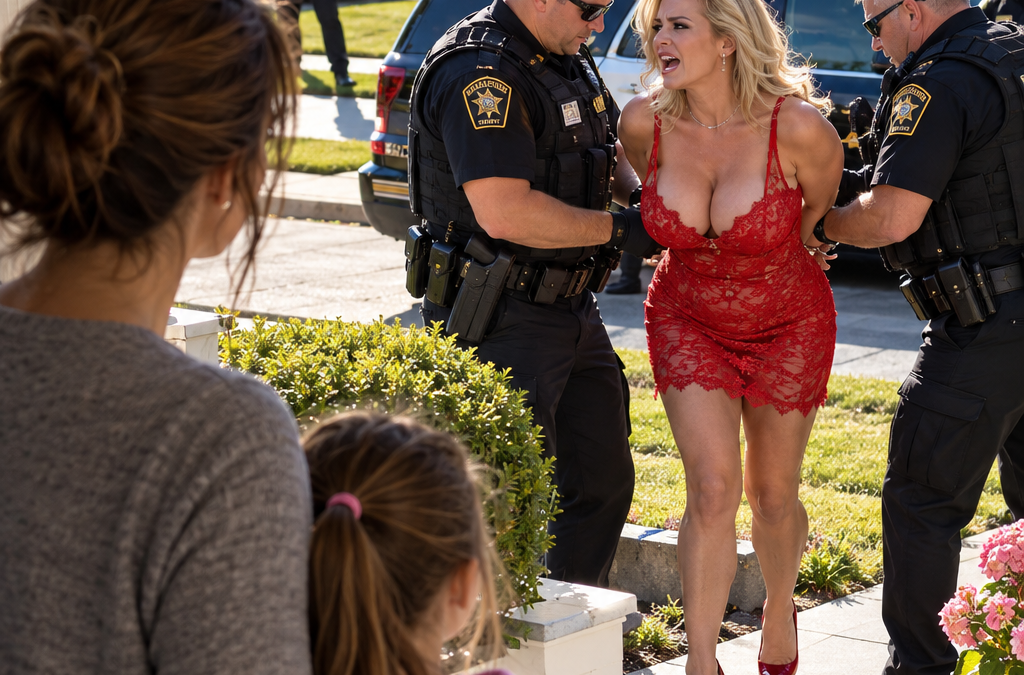
Deborah appeared in her familiar red lace dress.
Even at that early hour, her hair was brushed, and she wore makeup.
For a moment, she looked like the same confident woman who had once stood in my driveway and warned me that troublemakers found life in Maple Ridge expensive.
She smiled at the officers.
I recognized the expression immediately.
The soft, flirtatious smile.
The slight tilt of her head.
The assumption that charm would put her back in control.
One officer spoke.
I couldn’t hear every word from across the street.
But I saw Deborah’s smile fade.
She stepped backward.
The officer continued speaking.
Deborah shook her head.
Then she raised her voice.
“This is ridiculous!”
Her words carried across the quiet street.
Several neighbors came outside.
Rick appeared on his porch.
Deborah pointed toward my house.
“She’s responsible for this!”
I stood behind my window.
My hands were cold.
One officer said something calmly.
Deborah shook her head again.
“I was the president of this association!”
The officer continued explaining the situation.
She stepped forward, protesting.
“You don’t understand! I was protecting the neighborhood!”
Another officer moved beside her.
I could see the moment she realized that her title no longer carried the power she expected.
She looked toward the houses.
Toward the neighbors watching from their porches.
Toward the streets where she’d spent months deciding who deserved punishment.
Then her eyes found my window.
For a second, I thought about stepping away.
I didn’t want my presence to turn that moment into another performance for her.
But I stayed where I was.
Deborah stared at me.
Her face twisted with anger.
“You did this!” she shouted.
I heard her even through the glass.
The officer instructed her to turn around.
She kept protesting.
But the handcuffs came out.
And then, in front of the very neighborhood she’d tried to control, Deborah Kesler was placed under arrest.
There was nothing glamorous about it.
Nothing triumphant.
Her red dress looked suddenly out of place against the gray morning pavement.
The officers guided her toward the cruiser while she continued insisting the entire situation was a mistake.
I watched the rear door open.
Then close.
And for the first time in six months, Deborah had no authority to tell anyone else what to do.
The cruiser pulled away.
The second followed.
The street gradually became quiet again.
Rick crossed over a few minutes later.
I met him on the porch.
He looked toward Deborah’s empty house.
“Well,” he said, “I guess she finally got a notice she couldn’t ignore.”
Under different circumstances, I might have laughed.
Instead, I sat on the porch step.
Rick sat beside me.
For a while, neither of us spoke.
Then he said, “You did good, Laura.”
I shook my head.
“I didn’t feel like I did.”
“What do you mean?”
“I was scared almost the whole time.”
He looked at me.
“That doesn’t mean you weren’t brave.”
I watched a maple leaf drift across the sidewalk.
“I almost paid her everything.”
“I know.”
“I almost stopped asking questions.”
“But you didn’t.”
I looked at my hands.
There had been so many moments when giving up seemed like the easier choice.
So many nights when I wanted someone else to take over.
The fear hadn’t disappeared just because Deborah was arrested.
My body still reacted when the mail truck stopped.
I still felt anxious opening official-looking envelopes.
But those feelings didn’t mean she’d won.
They meant that what happened had been real.
And that recovery would take longer than the removal of a lien.
Over the following weeks, Maple Ridge began changing.
The new board reviewed its enforcement procedures.
Residents demanded clearer documentation, more transparent financial reporting, and safeguards against one person controlling fines without meaningful oversight.
Meetings that had once attracted a handful of people began filling with homeowners.
People asked questions.
They requested records.
They challenged unclear answers.
And slowly, the atmosphere that Deborah had created began to dissolve.
The three families who had faced liens during her presidency sought reviews of their own cases.
Rick continued disputing his charges.
Residents who had been too frightened to speak began sharing what they’d experienced.
Some had received fines for trivial issues.
Others described meetings where Deborah had publicly humiliated them.
A few admitted they’d paid penalties they believed were unfair because they couldn’t afford a legal fight.
I listened to them without judgment.
I understood those choices.
More than anyone, I understood how expensive resistance could become.
The new board arranged an independent review of the association’s financial controls and vendor relationships.
The criminal case remained with the county prosecutor.
Deborah’s arrest wasn’t a conviction, and the outcome of those felony charges would have to be determined through the legal process.
I didn’t need to pretend that the case had already been decided.
What mattered to me was that the records were no longer hidden, the allegations were being investigated, and Deborah no longer controlled the association.
Her brother-in-law’s landscaping arrangement became part of the financial scrutiny, and the board began reconsidering how outside contractors were selected and supervised.
For the first time since Deborah had taken office, homeowners could examine decisions without being treated like enemies.
I attended one of the new board meetings about a month later.
The clubhouse looked exactly the same.
Same beige walls.
Same folding tables.
Same uncomfortable chairs.
But the atmosphere was different.
No one sat at the front like a monarch.
The board members spoke to homeowners as neighbors.
When someone asked for clarification about a maintenance expense, a board member answered.
When another resident questioned a rule, the board agreed to review the relevant language.
Nobody threatened them.
Nobody suggested that asking questions proved they were disloyal.
It was such a basic level of courtesy that I almost cried watching it.
Afterward, the board secretary approached me.
“Laura, I wanted to say something.”
I braced myself out of habit.
She looked uncomfortable.
“I should have spoken up sooner.”
I didn’t answer immediately.
She continued.
“When you came to that meeting with the photographs, I knew we should have reviewed them. I let Deborah shut the discussion down.”
I remembered that night vividly.
The microphone.
The cold smile.
The words The system doesn’t lie.
“Why didn’t you say anything?” I asked.
The secretary lowered her eyes.
“I was afraid she’d come after me too.”
That answer hurt.
Not because I didn’t believe her.
Because I did.
Fear had kept an entire neighborhood quiet.
I nodded.
“Then don’t let it happen again.”
She looked up.
“I won’t.”
I hoped she meant it.
As autumn approached, life gradually settled into a rhythm I recognized.
My daughter returned to school.
I went to work.
Rick resumed arguing with his lawn mower instead of the HOA.
Children rode bicycles down the sidewalks.
Neighbors waved from porches without looking over their shoulders to see whether Deborah was watching.
The association still had rules.
We still had dues.
We still had occasional disagreements about landscaping and maintenance.
But disagreement no longer automatically meant punishment.
One Saturday morning, I was cutting the grass when my daughter came outside carrying two glasses of lemonade.
I shut off the mower.
She handed me one.
“Mom?”
“Yeah?”
“Can we paint the door blue again?”
I looked toward the front of the house.
The gray paint Deborah had forced me to apply was beginning to show a few scratches around the handle.
I’d hated that color from the moment it dried.
Not because gray was ugly.
Because every time I saw it, I remembered standing on Deborah’s porch with the approved color palette in my hand, asking politely for proof that the rules had changed.
I remembered how quickly I’d given in.
How certain I’d been that cooperation would make her stop.
I looked back at my daughter.
“What do you think?”
She grinned.
“The old blue.”
“Why?”
“Because it looked happy.”
I laughed softly.
“Then blue it is.”
Before repainting, I checked the association’s current approved palette.
The original shade was still listed.
It had never been properly removed.
I stood in the hardware store holding the same paint sample I’d purchased years earlier.
For a moment, I felt angry all over again.
That one tiny square of blue represented months of intimidation.
It reminded me how easily someone could turn an ordinary rule into a weapon when everyone else stopped checking whether the rule existed.
Then I put the paint in my cart.
That weekend, my daughter helped me repaint the front door.
She wore an old T-shirt and managed to get blue paint on her hands, her shoes, and somehow the back of her elbow.
I told her she was supposed to paint the door, not herself.
She laughed.
I laughed.
For the first time in months, laughter came easily.
When we finished, we stepped back to admire our work.
The blue looked beautiful against the white trim.
Bright.
Warm.
Familiar.
My daughter slipped her hand into mine.
“It looks like our house again.”
I looked at her.
Then at the door.
And I realized that was exactly how I felt.
The house had always legally belonged to me.
I’d paid the mortgage.
I’d maintained the property.
I’d followed the rules as carefully as I could.
But Deborah had made me feel like a temporary guest whose right to stay depended on pleasing her.
Now that feeling was beginning to disappear.
I still had the folders.
The photographs.
The emails.
The spreadsheet.
The lien release.
I didn’t throw them away.
They were part of what had happened, and I knew better than to assume important records would never be needed again.
But I stopped keeping them spread across my kitchen table.
I placed everything in a labeled storage box and put it in the closet.
The table was for dinner again.
For homework.
For birthday cakes and board games and all the ordinary things that had been crowded out by fear.
One evening, as my daughter finished her homework, I stood by the front window and looked across the street.
Deborah’s house was quiet.
Its perfect rosebushes still lined the walkway.
The white columns still gleamed beneath the porch lights.
From the outside, very little had changed.
But the woman who once controlled Maple Ridge through threats and intimidation no longer held power over our homes.
Her criminal case would proceed through the courts.
The association would continue correcting its records and repairing the damage caused by her leadership.
And I would continue raising my daughter in the house I’d worked so hard to buy.
I thought about the first time Deborah had told me that homeownership cost money.
She had been right about that.
She just hadn’t understood what my home was actually worth to me.
It wasn’t the property value.
It wasn’t the square footage or the fresh paint or the neighborhood amenities.
It was the feeling my daughter had when she ran through the front door after school.
The certainty that her bedroom would still be there tomorrow.
The safety of knowing that home was a place where she belonged.
For six months, Deborah had tried to turn that certainty into fear.
I couldn’t recover every sleepless night.
I couldn’t erase the anxiety she’d caused my daughter or the savings I’d spent defending us.
And I couldn’t undo what had happened to the families who had faced her before I did.
But I could make sure our experience meant something.
I could keep attending meetings.
Keep asking questions.
Keep supporting neighbors who felt intimidated by authority they didn’t know how to challenge.
Most importantly, I could teach my daughter something I’d learned at a painful cost.
Being peaceful doesn’t mean accepting mistreatment.
Following rules doesn’t mean surrendering your right to question them.
And being afraid doesn’t mean you have to give up.
That night, I locked the front door and turned off the porch light.
My daughter was upstairs getting ready for bed.
The house was quiet.
Not the tense, fragile quiet I’d known when every envelope and unexpected knock could make my heart race.
A different kind.
The ordinary, comfortable quiet I’d wanted when I first moved to Maple Ridge.
I stood there for a moment, looking at the newly painted blue door.
Then I went upstairs to say goodnight to my daughter.
For the first time in a long time, I wasn’t wondering what Deborah Kesler might do tomorrow.
I was thinking about what my daughter and I would do with the life we’d fought to protect.
And when I finally went to bed, I slept through the night.








