𝗙𝗨𝗟𝗟 𝗦𝗧𝗢𝗥𝗬 The HOA President Threatened to Take My Home Over Fines I Had Already Paid, and She Was Willing to Destroy My Reputation to Get What She Wanted.
𝗙𝗨𝗟𝗟 𝗦𝗧𝗢𝗥𝗬
The grass was green, evenly trimmed, and no higher than what I’d seen outside half the houses on the street.
“Two inches?”
“Approximately.”
“Did you measure it?”
Her smile tightened.
“I’ve been doing this long enough to recognize a violation.”
I laughed.
Not because I was mocking her.
Because I genuinely thought she was joking.
“Well, I was planning to mow tomorrow anyway.”
“Unfortunately, the violation has already been documented.”
She wrote something on her clipboard.
The pen made a sharp scratching sound.
“Wait,” I said. “You’re writing me up?”
“We don’t make exceptions simply because someone is new.”
“I’ve been here a week.”
“Which is why I’m being particularly understanding.”
She looked up at me.
“Usually, repeated noncompliance can lead to significant penalties.”
Something in her tone bothered me.
The words sounded rehearsed.
The threat sounded practiced.
But I had just moved in. I didn’t want to start trouble over grass.
“Okay,” I said. “I’ll take care of it.”
“Excellent.”
She stepped closer, lowering her voice in a way that might have seemed flirtatious if her eyes hadn’t remained so cold.
“People who cooperate with me generally find life here very pleasant.”
Then she turned and walked back toward her SUV.
I stood beside my bag of mulch, watching her drive away.
I told myself she was simply overzealous.
Every neighborhood probably had one person who took the rules too seriously.
I didn’t know I had just met the woman who would make me dread coming home.
The first fine arrived three days later.
Fifty dollars.
The violation was listed as an unauthorized landscaping variance.
I read that phrase twice, wondering how grass could become an unauthorized variance when I hadn’t changed the landscaping at all.
There was no measurement attached.
No photograph.
No explanation beyond a reference to a section of the HOA rules.
Just an invoice and a deadline.
I considered challenging it.
Then I thought about the pile of moving expenses on my dining room table.
Fifty dollars was annoying, but it wasn’t worth spending an afternoon fighting with the homeowners association.
I paid it online.
I printed the confirmation.
And because I was the kind of person who saved receipts for everything, I put it in a shoebox in my bedroom closet.
Two weeks later, a second notice arrived.
This one concerned my porch light.
Apparently, the bulb emitted the wrong shade of white.
Seventy-five dollars.
I stood on the porch that evening, flipping the switch on and off, trying to understand how anyone could find my ordinary white porch light offensive.
The light fixture had been there when I bought the property.
Nobody had complained during the inspection.
Nobody had mentioned it at closing.
But now, according to Denise, it was a community standards violation.
I sent her an email.
Denise, the porch light was already installed when I purchased the house. Can you clarify what specific requirement it violates?
Her response arrived less than an hour later.
The prior owner’s compliance history does not excuse your current noncompliance.
I wrote back.
I’m happy to replace the bulb. Can the fine be waived since I wasn’t aware of the issue?
She replied with one sentence.
Rules are only effective when applied consistently.
I stared at the screen.
Then I paid the seventy-five dollars.
And saved that receipt too.
A few evenings later, I was standing in the backyard trying to straighten a crooked fence panel when I heard someone speak from the other side.
“You’ve met Denise.”
I turned.
My next-door neighbor, Sophia, stood near the fence with a watering can in her hand.
She was in her late forties, with dark hair pulled into a loose ponytail and the tired expression of someone who had learned not to be surprised by bad behavior.
“What gave it away?” I asked.
“The look on your face when you checked your mailbox.”
I laughed.
She didn’t.
“Don’t keep paying without asking questions,” she said.
I leaned against the fence.
“She fined me for my grass and my porch light.”
Sophia gave a humorless smile.
“That’s how she starts.”
“Starts?”
She set down the watering can.
“She does this to everyone who doesn’t bow down.”
I studied her.
“Seriously?”
“My son used to have a basketball hoop in our driveway.”
She pointed toward a patch of concrete beyond her garage.
“He played after school. Nothing loud. Nothing dangerous. Just a kid shooting baskets.”
“What happened?”
“Denise said it violated the community’s visual harmony standards.”
I almost smiled at the phrase.
Sophia noticed.
“That’s what I did too. I thought it was ridiculous enough that nobody would enforce it.”
Her expression changed.
“Then the fines started. Fifty dollars. A hundred. Two hundred. Administrative fees. Late penalties. They kept adding up until I couldn’t justify fighting anymore.”
“So you moved it?”
“I took it down.”
She looked toward the garage.
“My son stopped playing outside after that.”
There was something quietly devastating about how she said it.
Not anger.
Not drama.
Just resignation.
“Did you challenge her?”
“At a board meeting. Denise made it sound like I was teaching my son to disrespect the neighborhood.”
“That’s absurd.”
“Didn’t matter. Nobody wanted to cross her.”
Sophia picked up her watering can.
“Be careful, Mark. She doesn’t care about your grass.”
“What does she care about?”
Sophia looked at me for a long moment.
“Making sure you understand she can hurt you.”
I wanted to believe she was exaggerating.
Within another month, I stopped believing that.
The next warning concerned a decorative planter near my front steps.
Then came a written complaint about the timing of my trash collection.
Then a reminder that residents were expected to participate in community events whenever possible.
That last one caught my attention.
The HOA had organized a Saturday afternoon social gathering at the clubhouse.
I hadn’t attended because I was working overtime.
Two days later, another violation notice appeared.
I checked my folder.
The first lawn fine had followed my failure to attend a neighborhood welcome reception.
The porch light fine had arrived after I skipped a community landscaping demonstration.
The planter complaint came after I declined an invitation to Denise’s volunteer beautification committee.
The pattern was too consistent to ignore.
I started paying closer attention.
Whenever Denise encountered me on the street, she found some excuse to mention participation.
“Community involvement is important, Mark.”
“I understand.”
“People who don’t contribute tend to become disconnected.”
“I work a lot.”
“Everyone works.”
“I don’t always have free Saturdays.”
She tilted her head.
“It’s remarkable how some residents have time for everything except the community that protects their property values.”
The words sounded ordinary.
Her tone did not.
One afternoon, she approached me while I was carrying groceries from my car.
Same red lace dress.
Same clipboard.
Same polished smile.
“You’re becoming rather difficult to reach.”
“You have my email.”
“I prefer personal communication.”
“About what?”
She stepped closer.
“I think there’s been some confusion about your attitude toward the board.”
I shifted the grocery bags in my hands.
“My attitude?”
“Several residents feel you aren’t embracing the spirit of Willow Creek.”
“Several residents?”
“Community concerns are confidential.”
I looked around our quiet street.
Nobody else was outside.
“Denise, I pay my dues. I maintain my house. I don’t bother anybody. What exactly do you want from me?”
For the first time, the smile disappeared completely.
“I want you to understand that living here comes with responsibilities.”
“Which responsibilities am I neglecting?”
She looked at my house.
“You’d be surprised what the board can discover during a compliance review.”
Then she walked away.
I stood there holding bags of melting frozen food, feeling a chill that had nothing to do with the weather.
That evening, I opened my HOA documents again.
I read the bylaws.
The enforcement rules.
The fine schedule.
The provisions describing notice and opportunities to challenge violations.
I began comparing the documents with the notices Denise had sent me.
Some violations were vague.
Others referenced sections that didn’t clearly describe the alleged offense.
Several lacked photographs or inspection measurements.
I didn’t yet understand what was happening.
But I had begun to understand something important.
Denise expected people to pay before they looked closely.
The mailbox violation arrived on a Thursday.
I remember because I had just finished a difficult week at work and was looking forward to doing absolutely nothing that evening.
The envelope contained an official violation form.
Mailbox door improperly hinged.
I walked to the curb.
Opened the mailbox.
Closed it.
Opened it again.
The little metal door swung normally.
The latch worked.
Nothing was broken.
Nothing was crooked.
I stood there feeling ridiculous, testing a mailbox while a passing driver slowed to look at me.
Back inside, I read the notice more carefully.
It claimed the issue had been reported through an anonymous resident complaint.
Anonymous.
I almost threw the paper away.
Then I noticed something in the lower corner.
Two handwritten initials.
D.H.
The handwriting was distinctive.
The same looping D appeared on the first welcome notice Denise had signed.
The same sharply angled H.
I pulled that earlier letter from my folder and laid the two pages side by side.
I couldn’t prove the handwriting belonged to her simply by looking at it.
But I knew what I was seeing.
The woman running the HOA was apparently submitting anonymous complaints about me while signing her initials on the paperwork.
I took photographs of both documents.
Then I opened a fresh notebook and wrote down every fine I’d received.
Date.
Description.
Amount.
Supporting evidence.
Payment confirmation.
Relevant HOA provision.
I listed every encounter with Denise I could remember.
Every warning.
Every threat disguised as advice.
Every community event I’d missed before a new complaint arrived.
By midnight, I had several pages of notes.
The next morning, I bought a larger file folder.
I didn’t think of myself as preparing for a legal fight.
Not yet.
I simply wanted a record in case someone finally asked me to explain what had happened.
That was the strange part about those first months.
I kept trying to solve the situation like a reasonable person.
I answered emails politely.
I made repairs that weren’t necessary.
I paid fines I didn’t believe were legitimate.
I avoided confrontations.
And every time I backed down, Denise seemed to interpret it as permission to go further.
The confrontation at the community mailboxes happened on a cool evening near the end of my third month in Willow Creek.
I had just picked up the mail when Denise appeared beside her SUV.
She was holding her clipboard and wearing that familiar red lace dress beneath a light jacket.
“Mark. Just the person I wanted to see.”
I stopped.
“What is it this time?”
Her eyebrows rose.
“That’s an unnecessarily hostile greeting.”
“I’m sorry. It’s been a long day.”
“Well, I’m afraid your day is about to become more complicated.”
She flipped through several pages.
“The board is preparing to pursue a lien against your property.”
I thought I had misheard her.
“A what?”
“A lien.”
“Against my house?”
“Over your outstanding violations and unpaid balances.”
I stared at her.
“Unpaid?”
“Correct.”
“I’ve paid every fine you’ve sent me.”
She made a sympathetic expression.
“Unfortunately, our records don’t reflect that.”
“Then your records are wrong.”
“Paperwork gets lost.”
I actually laughed.
It came out sharp and angry.
“Paperwork gets lost?”
“These things happen.”
“I have payment confirmations.”
“Then you should submit them.”
“I already sent confirmations when I paid.”
She gave me another smile.
“Perhaps you should simply pay again and make the problem disappear.”
For a moment, I couldn’t speak.
Cars moved slowly through the cul-de-sac behind her.
A dog barked somewhere down the street.
And this woman stood in front of me, casually suggesting that I pay thousands of dollars twice because her organization supposedly couldn’t keep accurate records.
“You want me to pay money I don’t owe?”
“I want you to avoid unpleasant consequences.”
“That’s not an answer.”
Her expression hardened.
“Be very careful how you speak to me.”
I stepped closer, not threatening her, simply refusing to let her end the conversation.
“Show me the unpaid balances.”
“You’ll receive the appropriate documentation.”
“Then show me where my previous payments went.”
“Mark.”
“No. You told me I might lose my house. You don’t get to say that and then refuse to explain why.”
Her eyes narrowed.
She glanced around, checking whether anyone was watching.
“People who work with the board don’t usually experience these difficulties.”
There it was again.
Cooperation.
Compliance.
Working with the board.
Words that sounded harmless until you understood what she meant.
“Are you telling me the lien goes away if I do what you want?”
“I’m telling you that antagonizing me is a very poor strategy.”
She returned to her vehicle.
I stood beside the mailboxes holding three envelopes and trying to control my breathing.
I had been annoyed before.
Now I was frightened.
Not because I believed Denise had unlimited power.
Because I was beginning to suspect she was willing to misuse whatever power she had.
And I had no idea how far she would go.
That night, I pulled the shoebox from beneath my bed.
There were receipts from grocery stores, vehicle repairs, utility bills, and moving expenses.
Buried underneath them were every HOA payment confirmation I had printed.
I spread them across my kitchen table.
Fifty dollars.
Seventy-five.
Another hundred.
Additional charges.
Every transaction had a date.
Every payment had a confirmation number.
I checked them against my bank statements.
The money had left my account.
There was no question about it.
Yet Denise was threatening a lien over an outstanding balance she claimed still existed.
I sat there until nearly two in the morning, building a spreadsheet.
The numbers didn’t make sense.
And the more carefully I examined them, the less this looked like sloppy administration.
If the association had received my payments, why did the notices keep listing them as unpaid?
If the board possessed evidence of violations, why was so much of it missing?
And why did Denise always seem more interested in collecting money than correcting the alleged problems?
The following Monday, I sent the HOA a formal request to inspect its financial records.
I asked for the association’s general ledgers, payment histories, budget reports, and documents explaining how member fines and special assessments were being handled.
Our state’s disclosure laws and the association’s own governing documents provided homeowners with access to certain records.
I wasn’t asking for Denise’s personal banking information.
I wasn’t asking for confidential details about my neighbors.
I wanted to know where the money went.
Denise responded the next afternoon.
Your request has been received. Processing may be delayed due to administrative workload.
I wrote back.
Please confirm when the records will be available.
No answer.
A week passed.
I followed up.
She said the treasurer was unavailable.
Another week passed.
She claimed the files were being reorganized.
Then she said some records had been transferred to storage.
Then she suggested my request was unnecessarily broad.
I narrowed it.
She still didn’t provide anything.
Each refusal went into my folder.
Every email.
Every date.
Every explanation that contradicted the one before it.
Sophia noticed that I’d stopped working in the front yard.
One evening, she knocked on my door.
When I opened it, she was holding a casserole dish.
“You look like you haven’t eaten.”
“I’ve eaten.”
“Coffee doesn’t count.”
I stepped aside and let her in.
She looked at the papers covering my dining room table.
“Good grief, Mark.”
“That’s about how I feel.”
She placed the dish on the counter.
“What’s happening?”
I showed her the latest threatened lien notice.
Her face changed.
“She’s doing it again.”
I looked up.
“Again?”
Sophia hesitated.
“Other people have gotten threatening letters. Most just pay.”
“Even when they don’t owe anything?”
“Especially then.”
She sat across from me.
“Denise makes people feel like the cost of fighting will be worse than the cost of surrendering.”
I rubbed my forehead.
“Well, she’s probably right about that.”
“Don’t say that.”
“I’ve already spent more time dealing with this than I spent moving into the house.”
“Then don’t let all that work be for nothing.”
I looked at her.
“Easy to say when it isn’t your house.”
The words came out harsher than I intended.
Sophia recoiled slightly.
I immediately regretted it.
“I’m sorry.”
She shook her head.
“No. You’re scared. I understand.”
She looked toward the window separating my backyard from hers.
“When she went after my son’s basketball hoop, I told myself taking it down was the smart thing. I told myself I was protecting us from more trouble.”
Her voice became quiet.
“But he asked me why somebody who didn’t live in our house got to decide whether he could play basketball.”
She swallowed.
“I didn’t have an answer.”
For a while, neither of us spoke.
Then she tapped the stack of documents.
“Maybe this time somebody should make her answer.”
That conversation stayed with me.
Not because Sophia gave me a perfect solution.
Because she reminded me that I wasn’t the only person Denise had intimidated into silence.
The next breakthrough came from someone I had never spoken to before.
His name was Gary.
He had served as the HOA’s treasurer before Denise consolidated more of the association’s financial operations under her own control.
He contacted me through a short email.
Mark, I understand you’ve been requesting financial records. I may have information you need. I’d prefer to speak privately.
I read the message three times.
Then I called him.
Gary answered after the first ring.
“Are you alone?”
That wasn’t the opening I’d expected.
“Yes.”
“Good.”
His voice sounded strained.
“I’ve been debating whether to contact you.”
“About what?”
“Denise.”
I sat down.
“What about her?”
There was a pause.
Then he said, “The money isn’t where it should be.”
I felt my stomach tighten.
“What money?”
“The special assessments.”
I knew about those.
Residents had paid substantial additional assessments for common-area maintenance, infrastructure work, and other neighborhood projects.
They were separate from the regular dues.
“What about them?”
“Some of those funds were moved.”
“Moved where?”
“Into an account Denise controls.”
I stared at the wall.
“An HOA account?”
“That’s the problem.”
He exhaled heavily.
“I don’t believe the transfers were handled properly. And I don’t believe the board received accurate information about them.”
“How much are we talking about?”
He hesitated.
“Hundreds of thousands.”
For a moment, I couldn’t process the number.
Hundreds of thousands of dollars.
My fines suddenly seemed tiny.
Then I realized the same woman who had spent months demanding fifty and seventy-five dollars from me had allegedly been controlling an enormous amount of neighborhood money without proper oversight.
“Gary, why are you telling me this?”
“Because I should have said something earlier.”
His voice broke slightly.
“I saw transactions that didn’t make sense. I asked questions. Denise told me they were authorized transfers and that I was misunderstanding the bookkeeping.”
“What happened?”
“She made it very clear that I was no longer welcome in financial discussions.”
“And you resigned?”
“Eventually.”
I heard movement on his end of the call.
Then he continued.
“I’ve been watching how she treats people. The fines. The threats. The way she makes everyone afraid to ask questions.”
He paused.
“I thought if I stayed quiet, she’d leave me alone.”
I understood that feeling too well.
“Do you have proof?”
“I have records from when I was treasurer. Copies of statements, transfer entries, and correspondence.”
My heart began beating faster.
“Would you be willing to give a statement?”
Another silence.
“That’s what scares me.”
“Why?”
“Because Denise doesn’t forgive people who challenge her.”
I looked at the documents spread across my table.
“I know.”
Gary let out a long breath.
“Then I guess we both have a problem.”
We arranged to meet privately.
When Gary showed me the documents, I didn’t pretend to understand every accounting entry.
I’m not an auditor.
I’m not a financial investigator.
But I could understand the concern.
Large transfers had occurred.
Some explanations were incomplete.
Certain funds appeared to have moved into an account subject to Denise’s exclusive control.
There were gaps between what had been presented to homeowners and what Gary’s records appeared to show.
He pointed to one line.
“This is what first bothered me.”
I leaned forward.
“What am I looking at?”
“A transfer from a special assessment account.”
“Was it authorized?”
“That’s what I kept asking.”
“And?”
“I never received satisfactory documentation.”
He looked at me.
“Those funds were supposed to pay for neighborhood improvements.”
I thought about the cracked pavement near the clubhouse and the faded fencing surrounding the community green.
Residents had been told repairs were expensive.
We’d been told maintenance costs were rising.
And now Gary was showing me financial activity that raised serious questions about where the money had gone.
Suddenly, Denise’s behavior seemed different.
The fines hadn’t necessarily created the entire financial problem.
But they could help conceal it.
Keep people busy disputing fifty-dollar charges.
Keep homeowners afraid of penalties.
Make questioning authority feel dangerous.
And perhaps nobody would look closely enough at the larger accounts.
I didn’t know how much Denise had taken, or whether every suspicious transfer would prove fraudulent.
But I knew I could no longer treat the problem as a disagreement over lawn maintenance.
I needed professional help.
The attorney I contacted specialized in property disputes and homeowners association litigation.
Her office was on the second floor of a brick building downtown.
I arrived carrying two thick folders and a shoebox of receipts.
She watched me arrange the papers across her conference table.
“That’s quite a collection.”
“I’ve had a difficult few months.”
She reviewed the violation notices first.
Then the payment records.
Then the threatening emails.
When she reached the message suggesting that I pay again to make the problem disappear, she stopped.
“She wrote this?”
“Yes.”
“After you had already provided payment confirmations?”
“Yes.”
My attorney made a note.
Then I handed her Gary’s statement and copies of the financial records he had provided.
She began reading.
The room became very quiet.
After several minutes, she looked up.
“Mark, where did you get these?”
“From the former treasurer.”
“Is he willing to testify?”
“He said he would.”
She turned another page.
“These records raise serious concerns.”
“About the fines?”
“About much more than the fines.”
She tapped one of the transfer entries.
“If the underlying documents confirm what he’s describing, this could be a significant misuse of association funds.”
I swallowed.
“Fraud?”
“Potentially. And possibly embezzlement. But we need authenticated records and a proper investigation before anyone can draw final conclusions.”
I appreciated that she didn’t make promises.
She didn’t tell me everything was guaranteed to work out.
She explained the legal risks.
She explained what a lien could mean.
She explained what it might cost to contest it.
And she explained that Denise’s conduct, if supported by the documents, could expose the association and Denise personally to serious consequences.
Then she looked directly at me.
“Have you told anyone you have these records?”
“Only Sophia.”
“Keep them secure.”
“Do you think Denise will retaliate?”
My attorney glanced at the collection of violation notices.
“I think you already know she’s willing to retaliate.”
That answer followed me home.
So did the invoice for the attorney’s initial work.
I had expected homeownership to cost money.
I had budgeted for a water heater, roof repairs, and property taxes.
I had not budgeted for defending myself against the woman who ran the HOA.
I started moving money out of my savings account to cover legal expenses.
Every transfer felt like losing another piece of the future I’d worked for.
I stopped shopping for furniture.
I postponed fixing a leaking faucet.
I ignored the worn flooring in the hallway.
I kept thinking about what would happen if Denise succeeded.
Would I have to refinance?
Would I need to sell?
What if legal fees ate through the emergency fund I’d spent years building?
And what if I fought and lost anyway?
Those questions were waiting for me every morning.
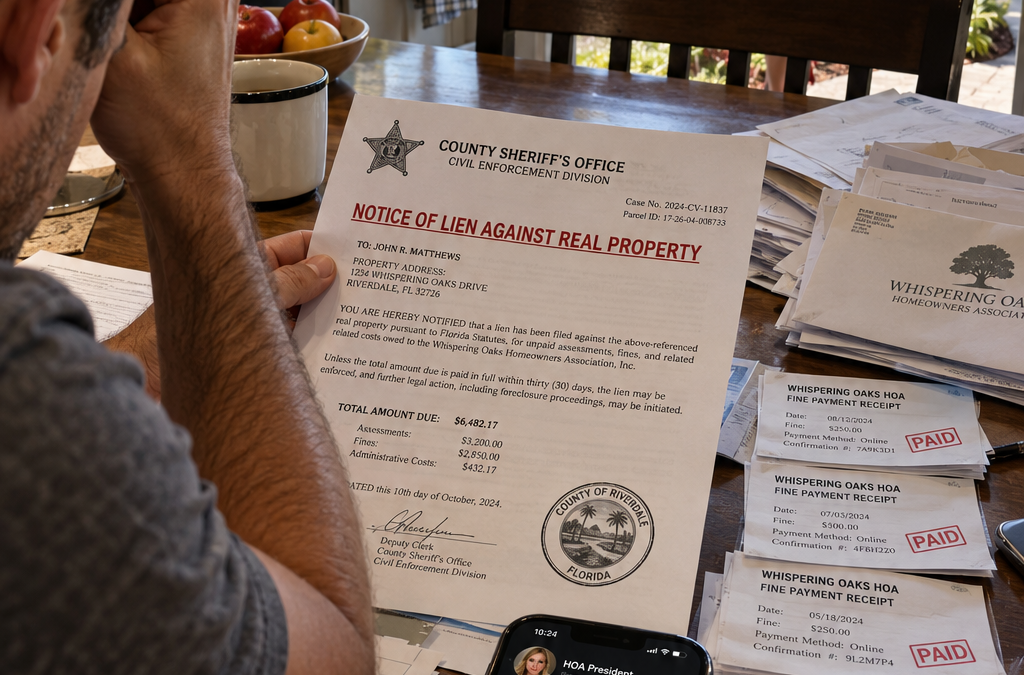
Then the sheriff’s letter arrived.
It was worse than Denise’s warnings because it was no longer just her words.
The lien was real.
The amount was real.
The threat to my financial stability was real.
I called my attorney immediately.
She asked me to send photographs of every page.
Then she told me not to communicate with Denise directly about the lien without preserving the exchange.
“We’ll challenge the claim,” she said.
“Can she take my house?”
“Not simply because she’s made an allegation. There are procedures and defenses. But we need to respond properly and quickly.”
I leaned against the kitchen counter.
“I paid everything.”
“I know.”
“I have every receipt.”
“I know, Mark.”
“Then how is this happening?”
She paused.
“Because someone filed paperwork claiming the money is owed. Now we have to make the record reflect the truth.”
I looked again at the notice.
The signature.
The official seal.
The amount.
My name printed beside a claim I knew was false.
“She’s not going to stop, is she?”
“That depends on what she’s trying to protect.”
After that conversation, I understood that ignoring Denise was no longer an option.
I either defended my home or allowed her false records to become the version of events everyone else relied upon.
My attorney began preparing the response.
She also advised Gary on preserving his evidence and making his statement available to the appropriate investigators.
Meanwhile, Denise learned that I had hired legal counsel.
I never found out exactly how.
Maybe someone from the board told her.
Maybe she guessed from the formal correspondence.
Maybe she had simply been expecting it.
But her behavior changed almost immediately.
She stopped trying to sound reasonable.
The emails became sharper.
The language more threatening.
She referred to me as a disruptive resident.
She accused me of wasting association resources.
She suggested I was harassing the board by demanding documents I was entitled to inspect.
And then she announced that my conduct would be discussed at the next community meeting.
I knew exactly what that meant.
She wanted an audience.
The meeting was scheduled for a Thursday evening at the clubhouse.
I almost didn’t go.
I had spent months being treated like a problem, and the thought of sitting in a room while Denise criticized me in front of my neighbors made my stomach turn.
But my attorney told me that if the meeting was open to homeowners, I had every right to attend.
“Take notes,” she said. “Don’t interrupt. Don’t let her provoke you into doing something she’ll use against you.”
“That sounds easier than it is.”
“It usually is.”
Sophia offered to go with me.
When she came to my door that evening, she looked at my button-down shirt and the folder under my arm.
“You look like you’re going to court.”
“Feels like it.”
“You don’t have to do this alone.”
I nodded.
I wanted to tell her how much that mattered.
Instead, I checked that I had my phone, keys, and notebook.
Then we walked to the clubhouse together.
There were approximately forty neighbors inside.
Some sat in folding chairs arranged in rows.
Others stood near the back wall.
A few whispered when I entered.
I recognized people who had waved at me from their driveways.
People whose dogs I had petted.
People I’d exchanged polite conversations with while taking out the trash.
That night, several looked away.
I wondered what Denise had been telling them.
The room smelled of coffee, floor cleaner, and old carpet.
A folding table stood at the front beside the clubhouse projector screen.
Denise was already there.
Of course she was wearing the red lace dress.
The low neckline and fitted fabric made her stand out against the bland room, and she seemed fully aware of it. She moved between chairs with practiced smiles, touching shoulders and leaning close when she spoke, switching from flirtatious warmth to icy authority depending on the person in front of her.
When she noticed me, her smile sharpened.
“Mark. How nice that you finally decided to participate.”
Sophia stopped beside me.
“He lives here, Denise. He has every right to attend.”
Denise’s gaze flicked toward her.
“Of course he does, Sophia. Nobody suggested otherwise.”
Then she turned to the room.
“Shall we begin?”
The first twenty minutes were ordinary.
Landscaping updates.
Maintenance schedules.
Discussion of community appearance standards.
Denise controlled every exchange.
When someone asked about repair costs, she redirected the question.
When another homeowner raised concerns about assessments, she said the financial information was being reviewed.
When someone asked when records would be available, she smiled and moved to the next agenda item.
I wrote everything down.
Then she placed both hands on the front table.
“Before we conclude, there’s an unfortunate matter involving the security of association property.”
My pen stopped moving.
Denise looked directly at me.
My chest tightened.
She continued.
“As many of you know, the clubhouse projector has recently gone missing.”
There were murmurs.
She waited for the room to settle.
Then she pointed.
“Mark stole the clubhouse projector.”
For a moment, I honestly thought I had misunderstood.
The room went silent.
Forty faces turned toward me.
Then the whispering started.
“Did she say stole?”
“Mark?”
“Are you serious?”
My mouth went dry.
I had been accused of many things by Denise.
Improper landscaping.
Poor community involvement.
Failure to comply.
But theft?
In front of my neighbors?
I felt heat rise from my chest into my face.
My hands curled around the folder in my lap.
Denise watched me with an expression of almost theatrical disappointment.
“It’s deeply troubling when a resident who already has compliance issues begins interfering with association property.”
I stood slowly.
“Denise.”
She raised one hand.
“Please wait until I’m finished.”
“No.”
The word came out louder than I intended.
Several people shifted in their chairs.
I could feel their attention pressing against me.
“You just accused me of stealing something.”
“Based on information provided to the board.”
“What information?”
“I can’t reveal confidential sources.”
“Do you have any evidence?”
She hesitated.
“We have reliable reports.”
“From whom?”
“Mark, your aggressive tone isn’t helping your situation.”
I took a breath.
My attorney’s advice echoed in my head.
Don’t let her provoke you.
I lowered my voice.
“Then let me ask clearly. Do you have any proof that I took the projector?”
Denise crossed her arms.
“Your pattern of behavior has raised concerns.”
“My behavior has nothing to do with a missing projector.”
“That’s your opinion.”
“No, Denise. That’s a fact.”
She leaned forward.
“I will not be intimidated in my own board meeting.”
I heard someone whisper my name.
My stomach twisted.
A few months earlier, I would have sat down.
I would have allowed her to humiliate me because I wanted the evening to end.
I might even have apologized for raising my voice.
But something had changed.
Maybe it was the lien.
Maybe it was Gary’s frightened voice admitting he should have spoken sooner.
Maybe it was the image of Sophia’s son losing his basketball hoop because his mother couldn’t afford to fight.
Whatever it was, I no longer had the strength to pretend this was normal.
“You can accuse me of being difficult,” I said. “You can send me letters about my grass. You can threaten me over fines I already paid.”
A few people looked up.
“But you cannot stand in front of my neighbors and call me a thief without evidence.”
Denise’s expression tightened.
“I suggest you sit down before this becomes a disciplinary matter.”
“Show us the evidence.”
She looked toward the other board members.
None spoke.
“Denise,” I said again, “where is the projector?”
“In association custody.”
I blinked.
“Then how did I steal it?”
Her eyes widened slightly.
“I mean it was in association custody before it disappeared.”
“Did anyone check the storage closet?”
“That isn’t your concern.”
“You’re accusing me of a crime. It absolutely is my concern.”
Then a chair scraped against the floor.
Sophia stood.
The sound seemed unnaturally loud.
“Denise, stop.”
Denise turned toward her.
“Sophia, this does not involve you.”
“It involves everyone in this room.”
“This is a board matter.”
“No. This is you accusing an innocent neighbor of stealing something you haven’t even bothered to look for.”
Denise’s face flushed.
“I assure you, we’ve investigated.”
Sophia folded her arms.
“Then your investigation wasn’t very good.”
“What exactly are you suggesting?”
Sophia looked at the other residents.
“The projector is in the clubhouse storage closet.”
Nobody moved.
Denise stared at her.
Sophia continued.
“I saw it there earlier today. It’s on the lower shelf, behind the folding chairs.”
For one extraordinary moment, the whole room seemed to stop breathing.
Then someone near the front spoke.
“Why don’t we check?”
Denise snapped her head toward him.
“That’s unnecessary.”
Another homeowner stood.
“She just said she saw it.”
“Please sit down.”
“If Mark stole it, shouldn’t we find out where it is?”
Denise’s voice became sharp.
“I am conducting this meeting.”
“And we’re asking a question,” someone answered.
I watched her lose control of the room one person at a time.
It wasn’t dramatic at first.
Nobody shouted.
Nobody overturned chairs.
People simply stopped treating her declarations as unquestionable facts.
A board member moved toward the storage closet.
Denise tried to stop him.
“That area contains association equipment.”
He looked at her.
“Exactly.”
Then he opened the door.
I could hear chairs being moved.
A moment later, he emerged carrying the projector.
It was an ordinary black machine with a power cord wrapped around it.
Nothing impressive.
Nothing worth stealing.
Yet when he placed it on the table, it felt heavier than anything else in the room.
Sophia pointed toward it.
“There it is.”
Someone laughed in disbelief.
Another neighbor whispered, “You’ve got to be kidding me.”
Denise looked from the projector to the board member.
Her face had gone pale beneath her makeup.
“That’s not where it was previously stored.”
The man frowned.
“It was behind the chairs.”
“Someone must have moved it.”
I stared at her.
“Are you suggesting I somehow moved it back before the meeting?”
“I didn’t say that.”
“You publicly accused me of theft.”
“Based on information available at the time.”
“What information?”
She said nothing.
I stepped into the aisle.
The room was so quiet I could hear the ceiling fan.
“You pointed at me and told forty people I stole association property.”
Denise lifted her chin.
“Mark, I think you’ve made your point.”
“No.”
My voice shook.
Not from fear anymore.
From everything I had been holding inside for months.
“You don’t get to humiliate someone and then decide the conversation is over.”
Several neighbors nodded.
“You don’t get to threaten my home over money I’ve already paid. You don’t get to invent violations and hide behind anonymous complaints. And you don’t get to call me a criminal because I asked to see financial records.”
Denise’s expression changed.
For the first time that evening, she looked genuinely alarmed.
“Financial records have nothing to do with this.”
“Then why haven’t you provided them?”
“That’s an administrative matter.”
“I’ve been asking for weeks.”
“We’ve already addressed your request.”
“No, you’ve delayed it.”
A man near the back raised his hand.
“I asked for the assessment breakdown last month.”
Denise turned.
“Not now.”
“I never got it either.”
Another resident spoke.
“Neither did I.”
Then someone else.
“What happened to the clubhouse renovation money?”
Denise banged her hand against the table.
“This meeting is out of order!”
But the room was no longer listening to her.
People were talking.
Asking questions.
Remembering their own strange fines and unanswered emails.
I saw Sophia looking at me.
She wasn’t smiling.
Her eyes were wet.
For months, she’d been telling me that Denise ruled through fear.
Now, for the first time, that fear had begun to break.
Denise grabbed her clipboard.
“This discussion is over.”
She turned toward the exit.
I didn’t follow her.
I didn’t need to.
As she passed me, she leaned close enough that only I could hear her.
“You are making a very serious mistake.”
I looked directly at her.
“No, Denise. I made my mistake when I thought paying you would make you leave me alone.”
Her eyes hardened.
Then she walked out.
For a few seconds, nobody moved.
After that, the questions came.
People wanted to know about my lien.
They wanted to know why I’d requested the financial records.
They wanted to know what Denise had been hiding.
I couldn’t share everything Gary had given me.
My attorney had been clear about protecting the evidence.
But I could tell them about my payment receipts.
I could show them the notices.
I could explain how Denise claimed I hadn’t paid money that had already left my bank account.
A neighbor who had barely spoken to me before approached.
“She fined me two hundred dollars for a landscaping issue last year.”
Another woman said, “She threatened collection fees when I asked to dispute a charge.”
I listened.
And I began to understand that the isolation I’d felt was part of what made Denise effective.
Each homeowner thought they were the only one.
Each family believed they had somehow angered the board.
Each person paid or surrendered because they didn’t know how many others were experiencing the same thing.
Denise hadn’t just enforced rules.
She had turned people against their own instincts.
She had made ordinary homeowners feel unreasonable for questioning unreasonable behavior.
By the time Sophia and I walked home, my hands were shaking again.
But this time, it wasn’t only fear.
It was adrenaline.
Anger.
Relief.
And the terrible realization that the fight had become public.
There was no going back to quiet emails and private complaints.
The next morning, I sat in my attorney’s office.
I gave her a written account of the meeting.
I listed everyone who had witnessed the accusation.
I explained the projector had been found in the storage closet.
I described Denise’s refusal to provide evidence and the words she’d used.
My attorney listened without interruption.
When I finished, she closed her notebook.
“She accused you of theft in front of forty people?”
“Yes.”
“And the projector was found on the property during the meeting?”
“Yes.”
“Did she retract the accusation?”
“No.”
“Did she apologize?”
I almost laughed.
“No.”
My attorney leaned back.
“Then we need to address the damage she caused.”
We moved forward with a defamation claim based on Denise’s public accusation.
The financial allegations were documented alongside the broader dispute, with Gary’s testimony and supporting records provided for review and appropriate legal action.
The lien was challenged separately.
My attorney made sure we didn’t confuse an allegation of financial wrongdoing with a proven criminal offense.
The documents would have to establish the truth.
But after months of being forced to defend myself against unsupported accusations, that sounded perfectly fair to me.
I wanted evidence to matter.
I wanted someone who couldn’t be intimidated by Denise’s title to examine the records.
Most of all, I wanted the truth recorded somewhere Denise couldn’t rewrite it with a clipboard.
The legal filings changed everything.
Denise had spent months making complaints that circulated only inside Willow Creek.
Now there were attorneys involved.
Formal statements.
Documents that could be reviewed by courts and investigators.
The financial records Gary had preserved were no longer sitting privately in his desk.
And the people who had watched Denise accuse me of theft were beginning to talk.
The first reporter contacted me shortly after the lawsuit became public.
She worked for a local news station.
“Mark, we’re looking into allegations involving the Willow Creek Estates homeowners association.”
I stood in my kitchen with the phone pressed against my ear.
“What kind of allegations?”
“Improper fines, financial misconduct, and a public accusation of theft that appears to have been unsupported.”
I closed my eyes.
Hearing someone else say it made the whole thing feel strange.
Like a story happening to another person.
“Have you spoken to Denise?”
“We’ve requested comment.”
“And?”
“She says the allegations are part of a campaign to undermine legitimate community governance.”
I let out a dry laugh.
“That sounds like her.”
The reporter asked whether I would speak on the record.
I hesitated.
Part of me wanted privacy.
I had never wanted to become the neighborhood’s public face of opposition.
I wanted to go to work, come home, mow my lawn, and live my life.
But another part of me remembered how Denise had stood in front of forty people and called me a thief.
She hadn’t worried about my privacy then.
She hadn’t worried about my reputation.
And I knew there were other homeowners who still believed nobody would listen if they complained.
“I’ll speak with you,” I said. “But I want the documents to speak for themselves.”
The interview took place outside my house.
The camera made me uncomfortable.
I kept glancing toward the street, half expecting Denise’s SUV to appear.
The reporter asked how the conflict began.
“With grass,” I said.
She looked surprised.
“Grass?”
“According to the HOA president, it was two inches too tall.”
“And that led to a lien?”
“It led to fines. Then more fines. Then claims that payments were missing even though I had receipts.”
I held up copies of the documents.
“I didn’t want a fight. I kept trying to comply. But every time I paid, there was another problem.”
“What changed?”
I thought about Gary.
About Sophia.
About the projector sitting on the clubhouse table.
“I started asking for proof.”
That evening, the story aired.
The headline described allegations of HOA fraud and public defamation.
They showed the entrance to Willow Creek Estates.
They showed the clubhouse.
They showed my house.
And they included Denise’s statement denying wrongdoing.
I watched from my couch with Sophia sitting beside me.
When my face appeared on the television, I felt exposed.
My voice sounded strange.
My house looked smaller.
The reporter described the threatened lien and the disputed payments.
Then she explained that questions had been raised about the handling of special assessment funds.
Sophia reached for the remote when the segment ended.
“Well,” she said softly, “everybody knows now.”
I stared at the blank screen.
“That’s what scares me.”
She looked at me.
“Why?”
“Because she has nothing left to lose by being nice.”
Sophia didn’t answer.
We both knew I was right.
Denise responded exactly as I’d feared.
She sent a message to residents accusing me of damaging neighborhood property values by bringing negative publicity to Willow Creek.
She called the lawsuit frivolous.
She insisted the association’s accounts were sound.
She described Gary’s concerns as misleading.
And she warned homeowners against spreading unverified rumors.
Then she sent me one final email.
You have caused extraordinary harm to this community, Mark. I hope you are prepared to accept responsibility for the consequences.
I read it sitting alone in my bedroom.
For several minutes, I considered responding.
I typed three different messages.
I deleted every one.
Then I forwarded the email to my attorney and closed the laptop.
I was tired of giving Denise an audience.
The reporters, however, were not.
They began speaking with other residents.
One by one, the stories emerged.
A retired homeowner who had paid penalties he couldn’t understand.
A family that had been threatened with escalating fines after disputing a fabricated compliance issue.
Another resident who had been pressured into paying charges without receiving supporting documentation.
Three additional victims were identified in the reporting.
They weren’t simply repeating rumors.
They had letters.
Receipts.
Payment histories.
The same threatening language.
The same pattern of fines followed by demands for compliance.
Watching their interviews was difficult.
Not because their stories were identical to mine.
Because I could see how carefully Denise had chosen her pressure points.
With one family, she used fear of financial penalties.
With another, she exploited their desire to avoid conflict.
With an elderly homeowner, she emphasized the danger of a lien.
The rules were never merely rules.
They were leverage.
Gary eventually agreed to speak with investigators.
I learned afterward that he’d barely slept the night before.
He was terrified of being blamed for the transactions he’d questioned.
He had signed documents during his time as treasurer.
He worried people would assume that meant he had approved everything.
But he went anyway.
He provided the records he’d preserved.
He explained which transfers concerned him.
He described his attempts to obtain clarification.
And he identified the account Denise had controlled.
I called him afterward.
“How did it go?”
He sighed.
“They asked a lot of questions.”
“That sounds good.”
“It was terrifying.”
“Did you tell them everything?”
“Everything I know.”
I heard his voice catch.
“Mark, if I’d spoken sooner, maybe none of this would have happened to you.”
I looked toward the stack of legal papers on my kitchen counter.
“Gary, she was doing this before I moved in.”
“Still.”
“You came forward when it mattered.”
He was quiet for a moment.
Then he said, “I hope you’re right.”
The state agency responsible for overseeing the relevant HOA financial issues became involved.
Investigators examined the association’s records.
The suspicious transfers.
The special assessment accounts.
The inconsistent reporting.
The handling of fines and payments.
As the review intensified, the association’s accounts were frozen pending further examination.
That news hit Willow Creek like a thunderclap.
Residents were suddenly confronted with the possibility that the money they’d trusted the association to manage had not been properly safeguarded.
People who had defended Denise began demanding answers.
Board members who had previously supported her started distancing themselves.
The same neighbors who once avoided discussing HOA business now gathered in driveways comparing letters and assessment notices.
I didn’t celebrate the account freeze.
It frightened me.
Those funds were supposed to maintain our neighborhood.
They weren’t Denise’s money.
They belonged to all of us.
A financial investigation could uncover wrongdoing, but it couldn’t magically erase the damage.
Repairs still needed funding.
Bills still had to be paid.
Homeowners still needed an association that functioned.
And for the first time, I understood the full cost of allowing one person to operate without meaningful scrutiny.
The problem wasn’t simply that Denise had targeted me.
It was that the entire neighborhood had trusted an organization whose president had made questioning her feel dangerous.
A few days later, the board moved to remove her.
The news spread quickly.
Sophia knocked on my door carrying her phone.
“Mark, they’re holding a special meeting.”
I looked at her.
“When?”
“Tomorrow.”
“What for?”
She held out the screen.
The notice described an emergency board action concerning Denise’s position and control of association property.
I read it twice.
My first reaction wasn’t happiness.
It was disbelief.
After everything she’d done, after all the times she’d threatened people and dismissed complaints, I couldn’t imagine her simply surrendering control.
“Do you think she’ll show up?” I asked.
Sophia gave me a grim smile.
“You know Denise.”
She was right.
Of course Denise showed up.
The next afternoon, residents gathered outside the clubhouse.
A local news crew stood near the sidewalk.
Several board members were already inside.
I arrived with Sophia and found people waiting in small, anxious groups.
Some greeted me.
Others nodded.
A few apologized for having believed Denise’s accusation about the projector.
I told them I appreciated it.
But I couldn’t stop looking toward the parking lot.
Then the white SUV appeared.
Denise pulled into a space near the entrance.
When she stepped out, I almost couldn’t believe what I was seeing.
The same red lace dress.
The same heels.
The same blonde hair arranged perfectly around her face.
She carried herself as if she were arriving at a party rather than a meeting that could end her control over the neighborhood.
But her expression betrayed her.
She looked furious.
She moved through the small crowd without acknowledging anyone.
When she saw me, she stopped.
“This is what you wanted?”
Her voice carried far enough for nearby residents to hear.
I met her eyes.
“I wanted you to stop threatening my home.”
“You’ve destroyed this association.”
“No, Denise.”
I could feel my pulse in my throat.
“You did that yourself.”
She stepped closer.
“You think you’re some kind of hero because you found a disgruntled former treasurer willing to make accusations?”
“Gary brought records.”
“Gary doesn’t understand what he was looking at.”
“Then explain the transfers.”
Her face tightened.
“That’s none of your business.”
“It’s our money.”
She laughed bitterly.
“You people have no understanding of what it takes to manage a community.”
Sophia moved beside me.
“We understand that we’re supposed to be able to see where our money goes.”
Denise turned on her.
“And you have been bitter ever since the board enforced the rules against your son’s basketball hoop.”
Sophia didn’t flinch.
“My son was twelve years old.”
“Rules apply to everyone.”
“Then they should apply to you too.”
For a moment, I thought Denise might actually shout.
Instead, she looked around and realized people were watching.
Her posture straightened.
The familiar smile returned.
She adjusted her clipboard.
“This is a disgraceful misunderstanding. And when the facts come out, you’ll all regret participating in it.”
Then she walked into the clubhouse.
The meeting that followed was nothing like the gatherings she’d once controlled.
There was no cheerful announcement about landscaping standards.
No lecture on beige mailboxes.
No warnings about the importance of community harmony.
The remaining board members addressed the financial investigation and Denise’s conduct.
They explained that she was being removed from her position and stripped of authority over association property and operations.
The investigation would continue.
The accounts would remain under the applicable restrictions until the relevant authorities permitted normal financial activity.
New oversight procedures would be needed.
And the association would have to rebuild trust with its own homeowners.
Denise tried to interrupt.
More than once.
She challenged the board’s authority.
She claimed the proceedings were improper.
She insisted everyone was overreacting to allegations that hadn’t been proven.
Some of what she said about due process was true in principle.
An allegation wasn’t a conviction.
Nobody should be punished merely because somebody disliked them.
I believed that.
I’d spent months fighting for that exact principle.
But the board no longer needed to let her control its records and property while the investigation proceeded.
And Denise could no longer make the problem disappear simply by raising her voice.
When the motion to remove her was finalized, the room fell silent.
A board member turned toward her.
“Denise, we’ll need the clubhouse keys.”
She stared at him.
“What?”
“Your keys.”
“I am the president of this association.”
“Not anymore.”
The words landed with a force I could almost feel.
She looked toward the other board members.
Nobody intervened.
Outside, through the glass doors, I could see the television camera pointed toward the entrance.
Denise noticed it too.
Her face flushed.
She gripped her handbag.
“You can’t humiliate me like this.”
The board member extended his hand.
“Please return the keys.”
I watched her look around the room.
She had spent months making people afraid to challenge her.
Now, surrounded by the same homeowners, she seemed unable to understand why nobody was rushing to defend her.
Finally, she opened her handbag.
For a moment, all I could hear was the metallic rattle of keys.
Then she pulled out the clubhouse key ring.
She held it tightly.
“You’re all making a terrible mistake.”
Nobody answered.
The board member kept his hand extended.
Denise dropped the keys into his palm.
The sound was small.
Just metal striking skin.
Yet after months of fines, threats, missing records, and public humiliation, it felt like the first honest sound I’d heard inside that clubhouse.
The news camera captured her leaving the building.
She tried to turn away from it.
But there was nowhere to hide the fact that the authority she’d wielded so aggressively had been taken from her.
As she passed me, she stopped one last time.
“You think this changes anything?”
I looked at her.
“Yes.”
She gave a bitter little smile.
“You’re still going to have to live here.”
I glanced around at my neighbors.
At Sophia.
At Gary, standing quietly near the back of the room.
At the people who had finally started asking questions.
Then I looked back at Denise.
“So are we.”
She walked away without answering.
I had imagined that moment many times.
I thought I would feel triumphant.
I thought I might laugh.
Instead, I felt exhausted.
The kind of exhaustion that follows months of being afraid and only begins to surface when the immediate danger finally eases.
Sophia touched my shoulder.
“She’s gone.”
I watched the white SUV pull out of the parking lot.
“From the board,” I said.
“That’s a start.”
And it was.
But the investigation wasn’t over.
The lien still had to be formally removed.
The fines still had to be corrected.
The missing funds still had to be accounted for.
Denise had lost her position.
Now the evidence had to determine what consequences would follow.
In the weeks that came next, the financial investigation expanded.
Investigators obtained records that homeowners had been unable to access.
They examined special assessment transfers, authorizations, account activity, and the association’s financial reporting.
Gary cooperated.
Other former board members provided information.
Residents submitted copies of suspicious invoices and payment confirmations.
I turned over everything I had.
Every notice.
Every receipt.
Every threatening email.
Even the ridiculous mailbox complaint with Denise’s initials in the corner.
What had begun as a shoebox of paperwork became part of a much larger record of how the association had been operated.
My attorney kept me informed as the lien dispute proceeded.
One afternoon, she called and told me the documentation supporting the association’s claim was falling apart.
The payment confirmations matched my bank records.
The claimed balances could not be justified.
The fees had been inflated through disputed enforcement actions and questionable accounting.
I sat at my kitchen table listening to her explain what came next.
“Does that mean it’s over?” I asked.
“It means we have a strong basis to obtain dismissal of the lien and correct the account.”
I stared out the window.
For months, I’d dreamed of hearing those words.
Yet I was almost afraid to believe them.
“I just want my house back.”
There was a pause.
“Mark, you’re still in your house.”
“I know.”
My throat tightened.
“That’s not what I mean.”
She understood.
For months, my home had stopped feeling like a refuge.
Every envelope might contain another penalty.
Every car stopping near the curb made me wonder whether someone had come to deliver legal papers.
Every time I looked at my lawn, I saw something Denise might use against me.
I was still living inside the house I’d bought.
But I hadn’t felt safe there in a long time.
Eventually, the lien was dismissed.
Not reduced.
Not negotiated into some smaller amount I had to pay just to be left alone.
Dismissed.
The fraudulent fines were reversed.
The money I’d paid was refunded, with interest.
The false balance was removed from my account.
And the legal claim against my property was cleared.
When my attorney sent me the final confirmation, I printed it.
I placed it on the same kitchen table where the sheriff’s letter had once sat.
For a long time, I simply looked at it.
The house was quiet.
The refrigerator hummed.
A breeze moved through the trees outside.
Nothing spectacular happened.
Nobody cheered.
No music played.
I didn’t even smile at first.
I sat down and covered my face with both hands.
Then I cried.
Not loudly.
Not dramatically.
Just the kind of tears that come when you’ve been holding yourself together for so long that your body no longer knows what to do with relief.
I had spent eleven years saving for that house.
Then six months defending my right to enjoy it.
And at last, the official record reflected what I’d known all along.
I had paid what I owed.
I had not stolen anything.
I had not deserved to be threatened.
I wasn’t the dishonest person Denise had tried to make me appear to be.
My name was cleared.
When Sophia came over that evening, I handed her the confirmation.
She read it.
Then she looked up.
“It’s gone?”
I nodded.
“The lien is gone.”
She set the paper down carefully.
Then she hugged me.
For a moment, I couldn’t move.
I hadn’t realized how badly I needed someone to share that relief.
When she stepped back, she wiped her eyes.
“My son asked about you yesterday.”
“How’s he doing?”
“Good.”
She smiled faintly.
“He asked whether the neighborhood was finally going to stop being weird.”
I laughed.
A real laugh.
One that surprised me.
“What did you tell him?”
“I told him we’re working on it.”
That was exactly right.
We were working on it.
Denise’s removal hadn’t repaired everything.
The association needed proper accounting controls.
Residents needed clear access to records.
The board needed procedures that prevented any single person from using the organization as a personal weapon.
And the neighborhood needed time to recover from years of mistrust.
But the atmosphere had already begun to change.
People spoke more openly at meetings.
Financial questions were no longer treated as acts of disloyalty.
Homeowners challenged vague fines instead of automatically paying them.
Neighbors who had previously avoided one another began sharing information.
The fear that once surrounded Denise’s authority was fading.
Then came the criminal charges.
Prosecutors charged Denise with embezzlement in connection with the association funds.
The news didn’t surprise me.
Not after everything Gary had shown me.
Not after the investigation.
But hearing the charges announced still made my stomach tighten.
This wasn’t an HOA dispute anymore.
It was a criminal case.
Denise faced the possibility of substantial restitution obligations and prison time if convicted.
I didn’t know what sentence a court might eventually impose.
That decision belonged to the justice system.
I didn’t need to invent a punishment in my head.
The charges themselves made clear how serious the allegations had become.
The woman who had threatened my property over an allegedly improper porch light was now facing accusations of stealing money entrusted to her by an entire neighborhood.
I thought about the people who had paid their special assessments on time.
Retirees.
Working parents.
Families balancing mortgages and bills.
People who had trusted the association to use their money responsibly.
The damage was bigger than my own experience.
And I was grateful that Gary had finally found the courage to speak.
When I called him after the charges were announced, he sounded exhausted.
“I saw the news,” I said.
“So did I.”
“How are you?”
He was silent for a moment.
“Relieved. Scared. Angry. All of it.”
“That’s understandable.”
“I keep thinking about how long I waited.”
“Gary.”
“What?”
“You didn’t create this.”
“I know.”
“Then don’t carry all of it.”
He sighed.
“I should’ve stood up sooner.”
“Maybe. But you stood up.”
I looked at the framed photograph of my house hanging near the kitchen.
“And that made a difference.”
We didn’t say much after that.
We didn’t need to.
The final image of Denise that stays with me happened outside the clubhouse.
By then, the lien against my home had been cleared, my disputed fines had been refunded, and the embezzlement case was moving through the criminal process.
I had gone to the community center to review some new association information.
The day was warm and clear.
The grass around the clubhouse had recently been cut.
Neighbors were coming and going.
It felt almost ordinary.
Then I noticed a patrol car near the entrance.
At first, I didn’t understand what was happening.
A few people stood near the sidewalk.
A deputy was speaking with someone beside the clubhouse doors.
Then Denise appeared.
The red lace dress.
The heels.
The carefully arranged blonde hair.
Even then, with her authority gone and criminal charges hanging over her, she looked determined to maintain the image of a woman who controlled every room she entered.
But she wasn’t carrying her clipboard.
And nobody was asking her permission.
The deputies were escorting her toward the patrol car.
I stopped walking.
For a moment, I felt as though I had stepped into a scene I’d once imagined but never believed would happen.
Denise was speaking rapidly.
I couldn’t hear every word.
I caught fragments.
A misunderstanding.
An attorney.
Unfair treatment.
She insisted the accusations were wrong.
She insisted someone had made a mistake.
But the deputies continued directing her toward the vehicle.
Several neighbors watched from a distance.
Nobody cheered.
Nobody approached her.
There was only the low murmur of conversation and the sound of shoes against pavement.
Then Denise saw me.
Our eyes met.
For a second, the noise around us seemed to fade.
I remembered the first morning she’d appeared on my lawn with a clipboard.
The way she’d pointed at grass without measuring it.
The first fifty-dollar fine.
The porch light.
The mailbox.
The missing payment records.
The moment she’d suggested I pay again to make the problem disappear.
I remembered standing in my kitchen with the sheriff’s letter shaking in my hands.
I remembered the clubhouse meeting and forty people turning toward me when she called me a thief.
And now here she was, standing beside a patrol car, unable to dismiss what was happening with a sentence about community standards.
She looked angry.
Then, for a moment, something else crossed her face.
Fear.
I recognized it immediately.
I had lived with that feeling for months.
But I didn’t enjoy seeing it.
That surprised me.
I’d imagined revenge so many times during the worst of it.
Imagined watching Denise lose her confidence.
Imagined confronting her with every false accusation.
Imagined telling her exactly what she’d done to me.
Yet when the moment came, I didn’t want to shout.
I didn’t want to humiliate her.
I didn’t even want an apology.
The charges would be handled by the courts.
The financial consequences would be determined through the proper process.
What I wanted was to go home.
Denise looked away first.
A deputy opened the rear door.
She got into the patrol car.
The door closed.
I heard the solid mechanical click of the latch.
It was such a small sound.
But it marked the end of something that had nearly consumed my life.
Sophia appeared beside me.
She had been walking toward the clubhouse when she’d noticed the police.
For a moment, we stood together watching the vehicle.
“Well,” she said quietly, “that’s one HOA meeting she’s not running.”
I laughed despite myself.
Then I exhaled.
It felt as if I’d been holding that breath for six months.
The patrol car pulled away.
We watched it turn onto the main road and disappear beyond the neighborhood entrance.
Then Sophia looked at me.
“You okay?”
I considered the question.
My home was safe.
My name had been cleared.
The lien was gone.
The money I’d been forced to pay had been returned.
Denise was no longer in control of the association.
And the financial wrongdoing she was accused of was being handled by investigators and prosecutors rather than hidden inside a boardroom.
But the experience had changed me.
I was more suspicious than I used to be.
More careful with paperwork.
Less willing to assume that someone holding an official title deserved my trust.
I knew now how quickly a peaceful life could become a series of threatening letters.
I knew how expensive it could be to defend yourself, even when you were right.
And I knew that people could become trapped not only by rules, but by their belief that challenging those rules would only make things worse.
“I’m getting there,” I told Sophia.
She nodded.
“That’s good enough.”
We walked home together.
The neighborhood looked different.
Not because the houses had changed.
The beige mailboxes were still beige.
The lawns were still trimmed.
The clubhouse still stood beside the central green.
But the silence had changed.
People stopped to talk.
A neighbor waved from his driveway.
Someone laughed from a backyard.
Near the corner, two children were tossing a basketball to each other.
I watched them for a moment.
Then I looked at Sophia.
“Think your son will ever get another hoop?”
She smiled.
“He’s been asking.”
“Maybe he should.”
“Maybe he will.”
We both knew it wasn’t really about basketball anymore.
It was about whether ordinary families could enjoy their homes without fearing that one vindictive person would punish them for stepping out of line.
That evening, I took the old shoebox from beneath my bed.
Inside were the receipts that had helped save my house.
The first fifty-dollar fine.
The seventy-five-dollar porch light charge.
The payment confirmations.
Copies of letters.
Notes I’d written while frightened and exhausted.
I arranged them beside the final lien dismissal.
For months, those papers had felt like ammunition.
Now they were evidence of something I didn’t want to forget.
I put everything into a proper file box and placed it in the closet.
Then I walked outside.
The evening air was warm.
A faint breeze moved across the yard.
The maple tree beside my driveway had grown since I’d planted it.
I noticed a few weeds near the porch and bent down to pull them.
Then I stopped.
For an instant, I could almost hear Denise’s voice.
Unauthorized landscaping variance.
I stood up and laughed.
It was absurd.
All that fear.
All those nights.
All that anger.
And here I was, still half expecting an HOA violation because I’d touched a weed.
I walked to the mailbox.
Opened it.
Closed it.
The hinge worked perfectly.
Of course it did.
Across the fence, Sophia called out.
“Everything okay over there?”
I looked toward her.
“Just checking the mailbox.”
She grinned.
“Careful. That sounds suspicious.”
We both laughed.
Then I went inside and made dinner.
Nothing special.
Just chicken, rice, and vegetables in the kitchen I’d once been afraid of losing.
I ate at my own table.
I left the porch light on.
And for the first time in months, when a car drove slowly past my house, I didn’t rush to the window to see whether Denise was inside.
Later that night, I stepped onto the porch.
Willow Creek was quiet.
Not the fearful, watchful quiet I’d come to associate with Denise’s rule.
A different quiet.
The kind I’d fallen in love with on my first night in the house.
The kind that had made me believe all those years of saving had been worth it.
I stayed there for a while, listening to the crickets and watching the porch light fall across my freshly cut grass.
Denise had tried to make me feel powerless.
She had threatened my home, attacked my reputation, and used her position to turn ordinary neighborhood rules into weapons.
For a long time, I believed the only way to survive was to keep paying, keep apologizing, and keep hoping she’d eventually leave me alone.
But the moment I started demanding records, the truth began to emerge.
And when Gary, Sophia, and the other homeowners found the courage to stand beside me, Denise lost the one thing she’d relied upon more than her title.
Our fear.
I didn’t win because I was louder than she was.
I didn’t win because I knew how to intimidate people.
I won because I kept the receipts, refused to accept a lie as an official fact, and trusted that the truth was worth defending even when defending it was terrifying.
The legal system still had work to do.
Our neighborhood still had rebuilding ahead.
And nothing could give me back those months of anxiety.
But the house was mine.
My name was clear.
And the people of Willow Creek were finally free to enjoy the place they called home without wondering what Denise Hullbrook might do to them next.
I looked one last time at the quiet street, then turned off the porch light and went inside.
For the first time since moving to Willow Creek Estates, I closed my front door without feeling like someone on the other side was waiting for an excuse to take my home away.








