𝗙𝗨𝗟𝗟 𝗦𝗧𝗢𝗥𝗬 The HOA President Threatened to Take My Home Over Backyard Barbecues, and I Refused to Give Him Another Dollar
𝗣𝗔𝗥𝗧 𝟮
That was when I began to suspect the problem wasn’t my grass.
It was Gary.
Still, I tried to cooperate.
I mowed twice a week.
I moved the trash cans exactly when the rules allowed.
I repainted the mailbox Heritage White, although the difference was practically invisible.
Then came the flagpole.
Two inches too tall.
Another fine.
I stood in the driveway holding the violation notice while Gary walked past with his clipboard.
“Morning, Mark.”
“Gary, can we talk?”
He stopped.
“Of course.”
“This is getting ridiculous.”
His eyebrows rose.
“What is?”
“The mailbox. The trash cans. The grass. Now my flagpole?”
“If you’re unhappy with the standards, perhaps you should have reviewed them more carefully before purchasing.”
“I reviewed them.”
“Then compliance shouldn’t be difficult.”
“I haven’t done anything that affects anyone else.”
Gary adjusted his cuff.
“That’s where you’re mistaken. Every homeowner’s conduct affects the collective character of this community.”
“It’s a flagpole.”
“It’s a standard.”
I took a breath.
“Can you tell me why you’re photographing my backyard at six in the morning?”
His expression hardened.
“I inspect common visibility areas.”
“From behind my fence?”
“Anything visible from an accessible vantage point may be documented.”
“You’re walking along my fence line before sunrise.”
He leaned slightly closer.
“Mr. Carter, I’d caution you against making accusations you can’t substantiate.”
Then he looked toward my front window.
“Your wife seems to understand the importance of maintaining appearances. Perhaps she could help you.”
I felt my jaw tighten.
“Leave Denise out of this.”
He smiled again.
“Then take responsibility for yourself.”
He walked away before I could answer.
That evening, Denise found me standing at the kitchen counter with three violation letters spread in front of me.
“You’re letting him get under your skin,” she said.
“He keeps sending fines for nonsense.”
“Then appeal them.”
“I did.”
“And?”
“He denied the appeal.”
She frowned.
“Gary denied the appeal against Gary?”
“Exactly.”
Denise picked up the lawn photograph.
“That can’t be how the whole system works.”
“I’d like to think not.”
She sat down.
“Maybe we should introduce ourselves to the other board members.”
I nodded.
“Good idea.”
It seemed reasonable.
At the time, I still believed reasonable solutions would work on reasonable people.
The following Sunday, Denise invited two coworkers over for dinner. We grilled chicken, opened a bottle of wine, and sat outside talking until the evening cooled.
Nobody was drunk.
Nobody was shouting.
At nine-fifteen, one of my friends told a story about accidentally sending an embarrassing email to his entire department.
We laughed.
Loudly, perhaps.
But not unusually.
At nine-twenty-three, the doorbell rang.
Gary stood on the porch in a charcoal blazer and black trousers, his silver hair shining beneath the porch light.
He held a white envelope.
“Good evening, Mark.”
“Gary.”
“I apologize for interrupting.”
He didn’t sound apologetic.
“What’s going on?”
He extended the envelope.
“Formal notice.”
I opened it.
Excessive laughter after 9:00 p.m.
Fine: one hundred fifty dollars.
For several seconds, I couldn’t speak.
Then I looked up.
“You’re fining us for laughing?”
“Excessive recreational noise.”
“We’re having dinner.”
“After quiet hours.”
“There are four adults on my patio.”
“Volume is the relevant consideration, not attendance.”
“Did you measure the volume?”
“I heard it.”
“From your house?”
“Clearly.”
Denise appeared behind me.
“Is everything okay?”
Gary’s entire face changed.
His smile widened.
“Mrs. Carter. I’m terribly sorry your husband’s guests have created a disturbance.”
Denise looked at the letter.
“You came over to fine us because someone laughed?”
“The rules exist for everyone’s comfort.”
“Gary, we’re eating dinner.”
“And I’m asking you to respect your neighbors.”
I watched Denise’s face.
She had been patient through the earlier letters.
Now she was staring at him as though he’d walked into our home and accused us of stealing our own furniture.
“Which neighbor complained?” she asked.
“Confidential.”
“Was it you?”
Gary’s smile thinned.
“Good evening, Mrs. Carter.”
He turned and walked away.
Denise shut the door.
For a moment, neither of us spoke.
Then she sat down slowly at the kitchen table.
“Okay,” she said. “I believe you now.”
I looked through the window.
Gary was halfway across his lawn.
His house was the largest on our section of the cul-de-sac, with perfectly edged flower beds, tall windows, and a three-car garage.
Every light along his walkway was illuminated.
He moved with the unhurried confidence of a man who had never expected consequences.
I watched him disappear through his front door.
Then I returned to the kitchen.
“He’s going to keep doing this,” I said.
Denise looked at the envelope.
“Then we need to keep everything.”
That was the night I started the folder.
At first, it was an ordinary blue binder from an office supply store.
I labeled the front MAPLE RIDGE HOA.
Every violation notice went inside.
Every envelope.
Every photograph.
Every email.
I recorded dates, times, alleged offenses, and Gary’s exact wording.
I photographed the mailbox after repainting it.
I measured the flagpole.
I saved the mowing company’s invoices.
I printed the HOA governing documents and highlighted sections about inspections, fines, appeals, and board authority.
I didn’t do it because I expected a scandal.
I did it because I needed to prove that I wasn’t imagining what was happening.
For ten years, I’d worked as a county compliance auditor.
My job had involved examining permits, financial statements, regulatory filings, and the occasional business owner who thought a missing document would disappear if he shouted loudly enough.
I had learned something during those years.
People could argue about intentions.
They could argue about fairness.
They could argue about whether something was reasonable.
But dates, signatures, account entries, and written decisions were considerably harder to argue with.
I had left auditing for a better-paying position in corporate operations, partly because I was tired of spending my days inside other people’s paperwork.
Now I was building another audit file at my own kitchen table.
A few days later, Priya Shah knocked on our door.
She lived two houses down, in a yellow home with hanging ferns and a blue front door.
She was a small woman in her late thirties, sharp-eyed and direct, with an expression that suggested she had very little patience for nonsense.
She brought banana bread.
And a warning.
“Gary’s targeting you,” she said.
We were sitting at the kitchen island while Denise made coffee.
I hesitated.
“Is that obvious?”
“Mark, everybody knows.”
Denise turned.
“Everybody?”
Priya nodded.
“He walks around with that clipboard like a general inspecting a military base.”
“Why does nobody stop him?” I asked.
Priya looked down at her coffee.
“Because people tried.”
She told us about the Henderson family, who had lived near the entrance.
Gary had fined them repeatedly over their children’s bicycles and eventually threatened legal action when they contested the charges.
They sold their house the following spring.
Another couple had moved after a dispute involving driveway repairs.
A third family had left after months of parking citations.
“Three families,” Priya said. “All within two years.”
“That’s insane.”
“Maybe. But Gary knows exactly how to make staying feel more expensive than leaving.”
Denise crossed her arms.
“What does he get out of it?”
Priya stirred her coffee.
“Power.”
She looked toward Gary’s house.
“That’s the only hobby that man’s got left.”
I leaned back.
“He can’t keep doing this forever.”
Priya gave me a long look.
“That’s what the Hendersons said.”
Her warning should have frightened me more than it did.
Instead, it made me angry.
I hadn’t spent fifteen years saving for a home just to let some polished neighborhood dictator chase my family out.
So I decided to do something simple.
I would behave like a normal homeowner.
I would invite friends over.
I would grill.
I would enjoy the backyard I was paying a mortgage on.
And if Gary didn’t like it, he could learn to live with disappointment.
Our first summer barbecue began on a Saturday afternoon.
The sky was bright, the temperature was comfortable, and the backyard smelled of hickory smoke.
Denise made potato salad.
I put two racks of ribs in the smoker.
A handful of coworkers arrived with their spouses, and two children played in a shallow inflatable pool near the patio.
Someone connected a speaker to play old soul music at a low volume.
It was the kind of afternoon I’d imagined when we bought the house.
Nothing elaborate.
Just people relaxing.
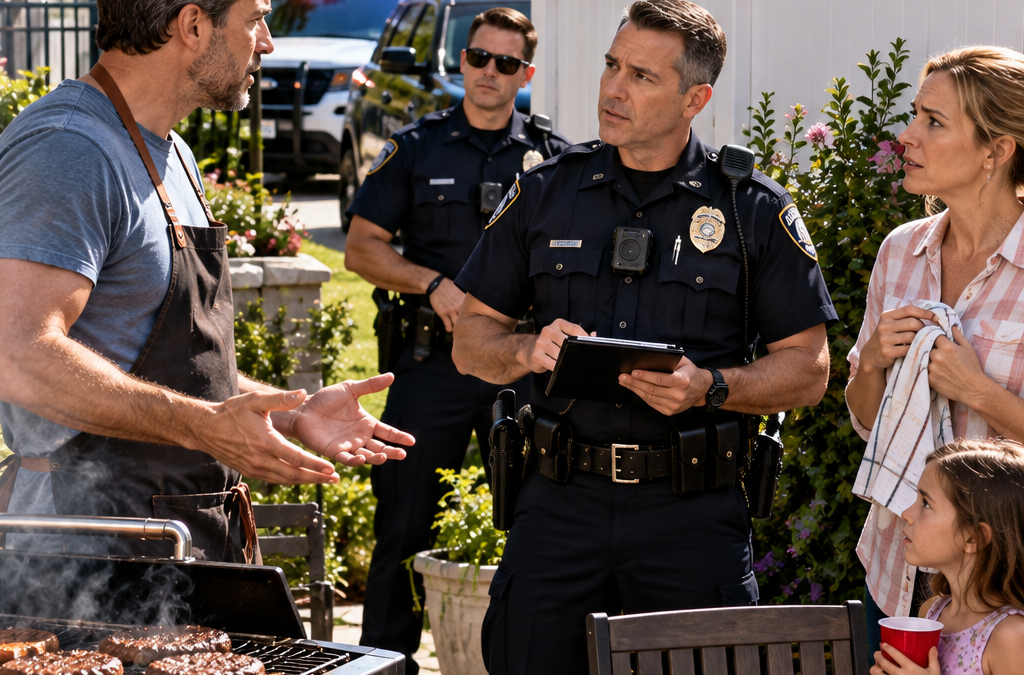
About forty minutes after everyone arrived, I heard sirens.
Not close enough to worry about initially.
Then the sound stopped outside our house.
Two police cars pulled to the curb.
Their lights painted the garage door red and blue.
My first thought was that someone on the street had suffered a medical emergency.
Then I saw both officers walking toward my driveway.
“Are you the homeowner?” one asked.
“Yes.”
“We received a noise complaint.”
I looked at the speaker.
It was barely louder than the conversations around it.
“A noise complaint?”
“Filed through the HOA community safety hotline.”
I felt my stomach tighten.
“Who filed it?”
“We aren’t given that information.”
The officer was courteous.
He explained that they needed to investigate the report.
I agreed.
They checked the noise level from the sidewalk.
Then they checked again near the property line.
The reading was below the applicable limit.
There was no violation.
No citation.
No warning beyond a request to remain considerate.
One officer looked almost embarrassed.
“Everything appears fine, Mr. Carter.”
“Then why are you here?”
“Someone reported a disturbance.”
I wanted to ask whether they could penalize people for filing malicious complaints.
Instead, I looked toward Gary’s porch.
There he was.
White linen shirt.
Sunglasses.
Glass of lemonade.
Watching.
When our eyes met, he gave me a small wave.
The officer followed my gaze but said nothing.
After the police left, the children returned to the pool.
My coworkers tried to restart their conversations.
But something had changed.
One of the spouses kept glancing toward the street.
Another checked her watch.
A child asked Denise whether the police would come back if she laughed.
Denise knelt beside her.
“No, sweetheart. You haven’t done anything wrong.”
I heard the answer.
I also heard the uncertainty Denise tried to hide.
By six o’clock, everyone had gone home.
We had enough food left for another entire party.
I stood beside the smoker watching the charcoal burn down.
Denise came outside and slipped her hand into mine.
“We can’t let him make us afraid of our own backyard,” she said.
I nodded.
But I wasn’t thinking about the backyard anymore.
I was thinking about how easily Gary had turned an ordinary family gathering into something that looked suspicious.
Two police cars.
Flashing lights.
Neighbors peering through curtains.
Children frightened.
Friends leaving early.
And Gary hadn’t even needed to confront me himself.
He had discovered a more effective weapon.
He could make other people do it.
That night, after Denise went to bed, I opened my laptop.
I downloaded every HOA document available through the community portal.
Bylaws.
Covenants.
Architectural standards.
Meeting summaries.
Fine schedules.
Annual budgets.
Financial disclosures.
I began with the noise rules.
The governing documents required complaints to be evaluated using specific criteria. They allowed enforcement for documented violations but didn’t authorize fines based solely on a board member’s personal irritation.
Gary’s excessive-laughter citation looked increasingly questionable.
Then I checked the financial reports.
At first, nothing stood out.
Landscaping.
Common-area electricity.
Insurance.
Administrative expenses.
Reserve contributions.
Typical association costs.
But when I opened the current year’s fine ledger, I stopped scrolling.
The HOA had collected more than thirty-eight thousand dollars in fines.
I checked the number again.
Thirty-eight thousand.
And the year wasn’t even over.
For a neighborhood our size, that seemed extraordinary.
I opened the corresponding budget summary.
Under improvements, the amount spent was blank.
There were no substantial projects listed.
No pool renovation.
No road improvements.
No new playground.
No security upgrades.
The landscaping appeared unchanged.
The entrance sign was the same.
So where was the money going?
I opened the general administrative category.
There were payments, but the descriptions were vague.
“Management support.”
“Executive administration.”
“Compliance services.”
No clear breakdown.
I leaned closer to the screen.
I had seen bookkeeping like this before.
Not necessarily fraud.
Sometimes just incompetence.
But every time a financial report became less specific as the money increased, my old auditing instincts started making noise.
At one-thirty in the morning, I began taking screenshots.
At two, I had copies of the fine ledger, budget summaries, available board minutes, and every financial statement the portal allowed me to download.
I saved them on my laptop, an external drive, and a separate cloud account.
Then I printed the most important pages.
Denise found me asleep at the kitchen table the next morning.
She picked up a financial statement.
“What are you doing?”
I rubbed my eyes.
“Trying to figure out why our HOA collects more fine money than some small businesses earn in a quarter.”
She examined the page.
“Thirty-eight thousand?”
“Yeah.”
“From us?”
“From everyone.”
She sat down beside me.
“Is that normal?”
“I don’t know yet.”
“What do you think?”
I stared at the administrative payments.
“I think Gary really likes writing tickets.”
The second barbecue happened the following weekend.
This time, I invited fewer people.
No music.
No children’s pool.
Just Denise, two coworkers, and me sitting outside with burgers and ribs.
I checked the clock.
Three-fifteen.
I looked at the noise regulations again.
We were nowhere near quiet hours.
At three-fifty, a patrol car pulled up.
My shoulders dropped.
Denise stared through the patio door.
“You have got to be kidding me.”
The officer who approached was younger than me, with closely cropped hair and a familiar face.
He stopped halfway up the driveway.
“Mark?”
I looked at him more carefully.
“Officer Reynolds?”
He smiled in surprise.
“Didn’t you work at county compliance?”
“Ten years.”
“I remember you from an inspection at the municipal maintenance facility.”
I laughed once.
“Small world.”
His smile faded when he looked toward the backyard.
“Another noise complaint.”
“Of course.”
He checked the situation, just as the previous officers had.
There was no violation.
When we walked back toward the driveway, he lowered his voice.
“You seem to be having trouble with the neighborhood association.”
“That obvious?”
He gave me a measured look.
“I’ve heard the name Whitmore before.”
I glanced toward Gary’s house.
“Can I ask you something?”
“Go ahead.”
“HOAs organized as nonprofits have financial reporting requirements, right?”
“Generally, yes. Depends on the state’s laws and the association’s structure.”
“And somebody has to keep records of where collected fines go?”
“Usually.”
“Who actually checks?”
He shrugged.
“Not as many people as you’d think.”
That answer stayed with me.
Before leaving, Reynolds said something else.
“Mark, I’m not going to tell you how to handle your neighbor. But if you think there’s a problem, document it. Don’t get into a shouting match.”
I almost smiled.
“Funny. That’s what I used to tell people.”
He nodded.
“Then you already know.”
After he left, I stood in the driveway looking at Gary’s house.
His curtains moved.
Just slightly.
I went inside, opened my laptop, and started drafting a public records request.
I asked the county records office for the HOA’s available annual disclosures, filed financial reports, and associated registration documents.
I also requested the underlying records supporting the association’s published financial summaries directly from the HOA, citing the inspection rights in the governing documents.
I kept the requests precise.
No accusations.
No emotional language.
Just records.
Gary responded to the HOA request two days later.
“Your inquiry appears unnecessarily broad and burdensome. The association does not exist to satisfy personal grievances.”
I wrote back.
“I’m requesting financial records available to members under the association’s governing documents. Please provide the applicable inspection procedure.”
His response came six minutes later.
“Further frivolous requests may constitute harassment of board personnel.”
I printed it.
Filed it.
Dated it.
And waited.
The next three weeks were quiet enough to make me nervous.
No visits from Gary.
No police.
No citations.
Denise started sleeping better.
I caught myself wondering whether he had finally lost interest.
Then the certified letter arrived.
It was a Tuesday afternoon.
Denise signed for it because I was still at work.
When I came home, she was sitting at the kitchen table.
The envelope lay open in front of her.
She looked pale.
“Mark, sit down.”
I didn’t.
“What happened?”
She pushed the document toward me.
NOTICE OF INTENT TO RECORD LIEN.
Outstanding assessment-related charges and fines: $2,400.
Payment required within thirty days.
Failure to comply could result in further collection action against the property.
I read every line.
Then I read the total again.
Two thousand four hundred dollars.
Some of the charges were familiar.
Mailbox.
Trash cans.
Lawn.
Flagpole.
Noise.
Others were administrative penalties and late fees I hadn’t even realized Gary had added.
One entry was labeled “noncompliance escalation.”
Another was “enforcement processing.”
Neither explanation identified a separate violation.
Denise’s voice trembled.
“He can’t take our house over a barbecue.”
I wanted to tell her she was right.
I wanted to laugh.
I wanted to tear the letter in half and throw it away.
Instead, I pulled out a chair.
“I need to talk to an attorney.”
Denise pressed her palms together.
“We just got here.”
“I know.”
“We spent everything we had getting this place.”
“I know.”
“Mark, what if he actually can?”
I looked at the notice.
For the first time since we’d moved into Maple Ridge, I felt something beyond anger.
Fear.
Not because I believed Gary was right.
Because I understood that being wrong didn’t always prevent someone from hurting you.
Sometimes it only meant you had a stronger argument after the damage was done.
I called a real estate attorney the following morning.
Her name was Rebecca Stone.
She listened without interrupting while I explained the fines, the police complaints, and the certified letter.
Then she asked me to email the documents.
An hour later, she called back.
“Mr. Carter, I don’t want you to panic, but I also don’t want you to underestimate this.”
“Can they put a lien on my property?”
“An association may have lien and collection rights under state law and its governing documents. Whether these particular fines qualify is another question.”
“And foreclosure?”
“There are circumstances where HOA-related debts can lead to foreclosure proceedings. The limitations matter, and your case has several potential defenses. But you cannot ignore the notice.”
I stared at the wall.
Denise was sitting across from me, watching my expression.
“How much to fight it?”
Rebecca gave me an initial estimate.
I closed my eyes.
It was money we had planned to keep as an emergency fund.
Money we would need if the air conditioner failed or the car broke down.
Money we had promised ourselves we wouldn’t touch unless absolutely necessary.
“Do you think Gary knows what he’s doing?” I asked.
“I think whoever drafted that notice understands how frightening it looks.”
I thanked her.
Then I hung up.
Denise didn’t ask for the amount.
She could tell.
“We could pay it,” she said quietly.
I looked at her.
“We’d be admitting the fines were valid.”
“We’d be protecting the house.”
“Until next month.”
Her eyes filled.
“What do you want me to say, Mark? That I’m not scared? I am.”
That stopped me.
I had been so focused on proving Gary wrong that I’d forgotten Denise was paying for the fight too.
Every strange car outside made her look through the blinds.
Every envelope made her tense.
Every time the police arrived, she worried about what the neighbors thought.
Now she was frightened that the home we’d worked fifteen years to buy could become another thing we lost.
I reached across the table.
“I’m scared too.”
She squeezed my hand.
For a while, we sat in silence.
Then she said, “If we’re going to fight him, we need something stronger than the fact that he’s a bully.”
She was right.
And I didn’t yet have it.
That afternoon, Priya called.
She didn’t say hello.
“Mark, have you looked at the March board minutes?”
“I’ve looked at some of them.”
“Look at March.”
“Why?”
“Just do it.”
I opened the community portal.
The March meeting minutes were buried beneath several newer documents.
I downloaded the file.
Halfway through, I found a section labeled ADMINISTRATIVE COMPENSATION.
Gary had proposed a five-hundred-dollar monthly stipend for what he described as exceptional executive oversight and enforcement responsibilities.
According to the minutes, there had been discussion.
But no motion approving payment.
No recorded second.
No successful vote.
The next agenda item began without any resolution.
I read it again.
Then I opened the financial summary.
Five hundred dollars had been paid in April.
Another five hundred in May.
Another in June.
The payments were classified as administrative expenses.
I called Priya back.
“There’s no approval.”
“I know.”
“Has he actually been taking the money?”
“That’s what it looks like.”
I leaned back in my chair.
For the first time, the fines and the financial ledger seemed connected.
But I needed proof.
Not suspicion.
I spent the next several evenings comparing the financial entries month by month.
Gary’s five-hundred-dollar stipend appeared regularly.
There were additional payments categorized as administrative reimbursements, executive compliance support, and special processing compensation.
Some were hundreds of dollars.
Others were larger.
None had the clear approval documentation I expected to find.
The more fines the HOA collected, the more administrative spending seemed to follow.
The timing was especially troubling.
After heavy fine collections, vague payments appeared.
And despite the substantial revenue, the association reported almost no meaningful community improvements.
I couldn’t prove from the portal alone that Gary had pocketed every suspicious payment.
But I knew the pattern deserved examination.
One evening, Denise found me comparing two spreadsheets.
“What is that?”
“Gary’s payments.”
She leaned over my shoulder.
“Five hundred dollars?”
“That’s the monthly stipend he proposed.”
“Proposed?”
“Never approved, according to the minutes.”
She frowned.
“Then why is he getting paid?”
“That’s what I want to know.”
I opened another document.
“And these other administrative payments could be related.”
Denise studied the screen.
“How much?”
“Potentially thousands.”
She looked toward the living room window.
“Mark, if he’s doing something illegal, won’t he get worse when he realizes you know?”
I didn’t answer immediately.
Because she had asked the one question I’d been avoiding.
Gary had already threatened our property over trivial fines.
He had repeatedly sent police officers to our house.
He seemed to enjoy frightening us.
What would happen if he believed I could expose something much more serious?
That night, I checked the locks before going to bed.
Then I checked them again.
The next morning, I drove to the county records office.
It was a plain brick building downtown, with old fluorescent lights and rows of metal filing cabinets behind the service counter.
A woman in her late fifties sat beneath a sign reading PUBLIC RECORDS.
Her nameplate said SANDRA.
She looked exhausted.
“Can I help you?”
“I’m following up on a records request involving Maple Ridge Estates HOA.”
She typed the name into her computer.
“Give me a moment.”
I waited.
She clicked through several screens.
Then frowned.
“Huh.”
My pulse quickened.
“Something wrong?”
She leaned closer.
“That’s strange.”
“What’s strange?”
She turned the monitor slightly.
“The association appears to be missing two required annual disclosures from the county’s file.”
I stared at her.
“Two years?”
“According to this record.”
“Is that a problem?”
“It may be. Depends on the filing requirements and whether they’ve submitted the documents elsewhere. But this kind of gap can trigger additional review.”
“By whom?”
“The appropriate state regulatory authorities. In some circumstances, the attorney general’s consumer protection division.”
I tried to keep my voice steady.
“Can I get a copy showing what’s missing?”
She nodded.
“I can print the filing history and the available records.”
While she worked, I looked through the glass doors toward the parking lot.
I had walked into that building hoping to find an accounting discrepancy.
Now I was staring at what might be a much larger failure.
An association that collected tens of thousands of dollars from homeowners had apparently neglected basic reporting obligations for two years.
And the man running it was threatening to place a lien on my house.
Sandra returned with a packet.
She slid it across the counter.
“There’s information here about reporting suspected financial misconduct.”
I looked at the pages.
“Thank you.”
She gave me a tired but sympathetic smile.
“Keep copies of everything.”
I nearly laughed.
“Oh, I have.”
On the drive home, I made a decision.
I was no longer going to treat Gary’s behavior as a personality problem.
It had become a financial accountability problem.
And if he wanted to use official procedures against me, I would use the proper procedures to examine him.
I contacted Rebecca Stone and provided the new records.
She cautioned me against publicly accusing Gary of embezzlement without verified evidence.
“Let the records establish what happened,” she said. “And protect yourself first.”
Together, we prepared a formal complaint requesting review of the association’s financial practices.
We included the missing filing history, discrepancies in the published summaries, questionable administrative disbursements, and evidence that some fine records did not match the governing rules.
I submitted it to the appropriate state office.
Then I waited.
The waiting was worse than I expected.
Every morning, I checked my email.
Every evening, I checked the mailbox.
Gary continued walking the neighborhood in his expensive clothes, smiling at residents, pointing at lawns, and occasionally stopping beneath streetlights to inspect something on his clipboard.
One afternoon, he cornered me near the mailbox.
“Mark.”
I looked up.
“Gary.”
“I understand you’ve been requesting association financial records.”
“They’re association records.”
“You’re creating unnecessary administrative burdens.”
“I’m exercising my rights as a homeowner.”
He smiled.
“Rights are accompanied by responsibilities.”
“So are leadership positions.”
His smile faded.
I could see him measuring the meaning of my words.
“Be careful,” he said softly.
“About what?”
“Making enemies in a community where you’ve only recently arrived.”
For a second, I felt the old impulse to argue.
Instead, I kept my voice even.
“I’m asking for records, Gary.”
His eyes narrowed.
“You seem to believe you can come into this neighborhood and challenge the people who built it.”
“I believe people who collect money from homeowners should be able to explain where it goes.”
His jaw tightened.
“Are you accusing me of something?”
“Did I?”
We stood facing each other.
He was close enough that I could smell his cologne.
His shoes were spotless.
His gold watch gleamed.
Everything about him looked controlled.
But his eyes had changed.
The pleasant neighborhood president had disappeared.
Underneath was a man who genuinely believed disagreement was a form of insubordination.
“You should consider your family’s position before continuing this,” he said.
I felt a chill.
“Don’t talk about my family.”
“I simply mean that an extended legal dispute could be unfortunate for a new homeowner.”
Then he straightened his jacket.
“Good afternoon, Mark.”
He walked away.
I stood beside the mailbox until he reached his porch.
Only then did I realize my hands were shaking.
That evening, I told Denise exactly what he had said.
She listened quietly.
Then she asked, “Do you think he’s dangerous?”
I looked toward the front window.
“I think he’s used to people being afraid of him.”
“That’s not what I asked.”
I took a moment.
“I don’t know.”
She nodded slowly.
“Then we need to be careful.”
For the next two weeks, we were.
I avoided direct conversations with Gary.
I documented every interaction.
I forwarded relevant correspondence to Rebecca.
And when I noticed Gary walking along our fence line one morning, I photographed him from the kitchen window rather than confronting him.
The accumulated fines kept growing.
The thirty-day deadline approached.
Rebecca prepared objections to the disputed charges and outlined how we would respond if the association proceeded with a lien.
But no one could promise us that legal costs wouldn’t become significant.
One evening, Denise brought our savings statement to the kitchen table.
She placed it beside the HOA notice.
“This is what we have left after closing,” she said.
I looked at the number.
It wasn’t much.
“We can survive the legal fees for a while,” she continued. “But not indefinitely.”
“I know.”
“And if we pay the fines, he’ll probably keep sending them.”
“Yes.”
She rubbed her forehead.
“Then either way, he gets to take something from us.”
I looked at her.
Her face seemed older than it had three months earlier.
The woman who had been excited about roses and Sunday dinners was now sitting at our kitchen table calculating how long we could afford to defend our own home.
I hated Gary for that more than I hated the fines.
He wasn’t simply irritating me.
He was turning our home into a source of constant dread.
I reached for her hand.
“I don’t want to lose this place.”
“Neither do I.”
“But I can’t keep paying him to leave us alone.”
She studied me for a long moment.
Then she nodded.
“Then don’t.”
The lien deadline arrived on a Friday.
I had barely slept.
The blue binder sat on the kitchen counter beside a second folder containing the financial evidence.
Denise watched as I signed a certified letter addressed to Gary and the HOA board.
The letter disputed the charges, identified the records we had requested, and notified the association that I had submitted a formal complaint seeking state review of its financial practices.
It also demanded that any collection action comply with applicable law and the association’s governing documents.
I made copies.
Attached supporting documents.
And drove to the post office.
At the counter, I watched the clerk stamp the certified-mail receipt.
It was a small sound.
Just ink meeting paper.
But it felt like crossing a line I couldn’t uncross.
Until then, Gary had controlled the pace.
He issued fines.
I responded.
He sent police.
I explained.
He threatened a lien.
I worried.
Now I had forced the dispute into a different arena.
One where expensive shoes and a clipboard meant very little.
When I returned home, Denise was standing by the kitchen window.
“He’s outside,” she said.
Gary was on his porch, speaking into his phone.
He looked agitated.
I couldn’t hear what he was saying.
But I could see the way he paced.
For the first time since we’d moved in, Gary didn’t come over to confront us.
He didn’t ring the bell.
Didn’t hand-deliver a notice.
Didn’t ask me to step outside.
The following morning, he drove away before sunrise.
His house remained quiet all day.
Denise noticed it first.
“He’s not patrolling.”
I looked toward his driveway.
Empty.
“Maybe he’s busy.”
“Mark, that man once measured our lawn before breakfast.”
She was right.
The silence felt wonderful.
And deeply suspicious.
Three days later, Priya knocked on our door carrying her phone.
She was smiling.
Not politely.
Grinning.
“You have to see this.”
She showed me a photograph of Gary’s rear fence.
A measuring tape lay across the setback line.
According to the neighborhood’s own standards, a section of his fence extended two inches beyond the permitted placement.
“The same rule he used against you,” she said.
I looked at the image.
“Are you sure?”
“Checked it twice against the approved survey references.”
I shook my head.
“Unbelievable.”
“Want to know the best part?”
“What?”
“I sent it to the board.”
I stared at her.
“Priya.”
“Anonymously.”
“Priya.”
She raised a finger.
“With the applicable regulation attached.”
Despite everything, I laughed.
I couldn’t help it.
“You’re terrible.”
“No,” she said. “I’m community-minded.”
Then her smile softened.
“People are starting to talk, Mark.”
“About Gary?”
“About the fines. About the board. About why he never explains anything.”
I leaned against the counter.
“Good.”
She nodded.
“Some of them kept records too.”
I looked up.
“What?”
She glanced toward the street.
“The Hendersons weren’t the only ones he went after. And some of the people still here have folders.”
That was the first sign that something had changed.
Gary’s control had always depended on keeping each homeowner isolated.
Every fine was treated as a private failure.
Every dispute as a personal disagreement.
If someone complained, Gary told the other residents they were difficult.
If someone moved away, he said they couldn’t handle community standards.
He had made each family believe it was standing alone.
Now people were comparing notes.
A week later, I received a formal acknowledgment from the state office.
My complaint had been referred for review.
Additional records were being requested from the association.
I read the message twice.
Then I forwarded it to Rebecca.
She called that afternoon.
“This is meaningful,” she said. “But don’t mistake a review for a conclusion.”
“I won’t.”
“Gary may respond aggressively.”
“I expect that.”
“Then stay disciplined.”
I looked at the blue binder.
“I intend to.”
Gary’s response came four days later.
An email went out to every homeowner.
Subject: IMPORTANT COMMUNITY GOVERNANCE NOTICE.
The message accused unnamed residents of spreading misinformation, harassing volunteer leadership, and threatening the reputation of Maple Ridge Estates.
It described financial inquiries as “politically motivated disruptions.”
It warned that legal and administrative costs caused by irresponsible complaints could eventually affect everyone through increased assessments.
I read the email at my desk.
Then my phone rang.
Denise.
“Did you see it?”
“Yes.”
“He’s trying to make everyone blame you.”
“I know.”
“He hasn’t used your name, but everybody knows.”
I looked around the office.
My coworkers were working quietly at their computers.
Nobody knew that an HOA dispute was threatening to consume my entire life.
“Don’t respond,” I told her.
“I wasn’t going to.”
“We’ll let the records speak.”
There was a pause.
Then she said, “Mark, I hate that he’s making us live like this.”
I closed my eyes.
“So do I.”
That evening, I found another envelope taped to our front door.
Notice of continuing collection action.
It referred to the disputed balance and asserted that the HOA reserved all available legal remedies.
No explanation of the accounting concerns.
No response to our objections.
Just another threat.
I took it inside.
Denise read it.
Then she started crying.
Not loudly.
She sat down on the edge of the sofa and covered her face with both hands.
I sat beside her.
“I’m sorry,” I said.
She shook her head.
“Stop apologizing.”
“I keep thinking I can fix this.”
“You are trying.”
“Then why does it keep getting worse?”
She looked at me.
“Because Gary wants us to quit.”
I stared at her.
She wiped her cheeks.
“Every time you ask a question, he makes the punishment bigger. That’s not a coincidence.”
I knew she was right.
But hearing it from her made the pattern impossible to ignore.
Gary wasn’t enforcing rules to improve the neighborhood.
He was teaching the neighborhood what happened when someone challenged him.
And he wanted our house to become the example.
Two weeks later, the formal investigation began.
I received notice that the attorney general’s office was examining allegations of financial mismanagement involving Maple Ridge Estates HOA.
The inquiry concerned the association’s financial records, payments, reporting practices, and use of member-generated revenue.
I sat at the kitchen table holding the letter.
For the first time in months, I felt something close to hope.
Denise read it over my shoulder.
“Does this mean the lien is gone?”
“Not yet.”
“Does it mean Gary’s in trouble?”
“It means someone with authority is asking questions.”
She let out a long breath.
“That’s something.”
It was.
But it also made Gary desperate.
The following Monday, an emergency board meeting appeared on the community calendar.
The stated purpose was to clarify administrative compensation policies and address recent allegations concerning financial procedures.
The meeting was scheduled for Thursday evening.
Seven o’clock.
Maple Ridge Community Center.
Attendance open to homeowners.
Priya called within minutes of the announcement.
“You’re going, right?”
“Absolutely.”
“Good.”
“Why?”
“Because you’re not going alone.”
Thursday arrived under a heavy gray sky.
All afternoon, I found it difficult to concentrate at work.
By five o’clock, I had reviewed the records so many times I could almost recite the important entries from memory.
Denise stood in our bedroom doorway while I changed into a clean shirt.
“You don’t have to do this alone,” she said.
“I know.”
“Rebecca said the board meeting isn’t a courtroom.”
“I remember.”
“Then don’t let him turn it into one.”
I nodded.
She stepped closer and straightened my collar.
It was such an ordinary gesture that it nearly broke me.
Three months earlier, she had been helping me choose where to put our furniture.
Now she was preparing me to confront a man who had threatened our home.
“We’re not moving,” she said.
I looked at her.
“Not because of him.”
“No,” I agreed.
“Whatever happens tonight, we don’t let him decide whether we belong here.”
I kissed her forehead.
Then I picked up the binder.
When we arrived at the community center, the parking lot was unusually crowded.
Gary’s black luxury sedan sat near the entrance.
Inside, folding chairs had been arranged in rows facing a long table.
Seven voting board members were seated or standing near the front, including Gary, who occupied the center chair.
He wore a navy suit with a pale silver tie.
His shoes gleamed.
His hair was immaculate.
A pair of designer reading glasses rested beside his clipboard.
Even under the harsh fluorescent lights, he looked polished enough to appear on a magazine cover.
But when he saw me walk in, his face changed.
Only for a moment.
Then the familiar smile returned.
“Mr. Carter,” he said loudly. “How nice of you to attend.”
I didn’t answer.
I took a seat beside Denise.
Priya sat on my other side.
Then three homeowners I barely knew approached us.
One was a retired mechanic named Walter Jennings.
Another was a single mother named Elena Brooks.
The third was an older man, Thomas Reed, who had lived in Maple Ridge almost since the subdivision opened.
Each carried a folder.
Walter held his up slightly.
“Figured you shouldn’t be the only one.”
I stared at him.
“What’s in there?”
“Sixteen hundred dollars in fines Gary gave me for driveway violations that didn’t exist.”
Elena lifted hers.
“Parking citations. Late fees. Photographs of my son’s car.”
Thomas tapped a thick brown envelope.
“Five years of correspondence.”
I looked toward the front table.
Gary was watching us.
His smile had disappeared.
Priya leaned closer.
“Told you people were keeping receipts.”
At seven sharp, Gary struck the table with a wooden gavel.
“The emergency meeting of Maple Ridge Estates Homeowners Association will come to order.”
His voice filled the room.
He began with a prepared statement about community unity, volunteer service, and the dangers of irresponsible allegations.
He described the financial questions as “misunderstandings created by incomplete information.”
Then he turned to the administrative stipend.
“As president,” he said, “I have devoted extraordinary hours to preserving the standards that make Maple Ridge such a desirable place to live. The board previously discussed reasonable compensation for these responsibilities.”
A board member named Carol Bennett interrupted.
“Discussed, Gary. We discussed it.”
Gary looked annoyed.
“Yes, Carol. And the understanding was that the arrangement would proceed.”
Carol shook her head.
“That’s not what I remember.”
He adjusted his glasses.
“The minutes may not reflect the full spirit of the conversation.”
I felt Denise’s fingers tighten around mine.
Gary continued.
“In any case, I have called this meeting to formally clarify and ratify the administrative compensation previously provided.”
A man near the back raised his hand.
“How much compensation?”
Gary glanced toward him.
“That information is contained in our financial records.”
“Then tell us.”
Gary’s jaw tightened.
“We are not going to turn this into an interrogation.”
Walter stood.
“Why not?”
Several people turned.
Walter held up his folder.
“You interrogated me about a crack in my driveway for six months.”
Gary struck the gavel.
“Mr. Jennings, sit down.”
Walter remained standing.
“You threatened to send my account to collections.”
“Sit down.”
“You photographed my house at five-thirty in the morning.”
The room began murmuring.
Gary struck the gavel again.
“Order!”
Elena rose.
“You charged me four hundred dollars because my son’s car was parked on the street when he came home from college.”
“Mrs. Brooks, your parking violations are not relevant to this agenda.”
“They’re relevant to the money.”
Gary’s eyes flashed.
“This is precisely the disorder I warned everyone about.”
I stood.
The room quieted.
Gary stared at me.
“Mr. Carter, I assume you intend to contribute to this circus.”
I held the binder against my chest.
“No, Gary. I intend to ask a question.”
He gave a contemptuous smile.
“Of course you do.”
I looked at the board.
“The March minutes show a proposal for a five-hundred-dollar monthly stipend.”
“Correct,” Gary said.
“But they don’t show an approving vote.”
“The board understood the arrangement.”
Carol shook her head again.
“No, we didn’t.”
Gary turned toward her.
“Carol, please.”
She looked directly at him.
“Gary, I never voted to pay you.”
Silence fell.
I opened the binder.
“The published financial summaries show payments under several administrative categories. Some match the proposed stipend. Others are listed as executive services and compliance reimbursements.”
Gary sat straighter.
“Those payments compensated legitimate work.”
“Then where are the authorizations?”
He stared at me.
“Excuse me?”
“Where are the recorded votes approving those payments?”
“You’re not qualified to interpret association finances.”
“I spent ten years as a county compliance auditor.”
A few heads turned.
Gary knew that.
I had told him during one of our earlier conversations.
But now, hearing it in front of the room, he looked briefly unsettled.
I continued.
“I’m not asking anyone here to take my interpretation on faith. I’m asking the board to produce the documentation.”
Gary laughed sharply.
“A former county employee believes he can conduct a personal audit from his kitchen table.”
I didn’t raise my voice.
“Then show us the documents that prove I’m wrong.”
Gary looked toward the other board members.
Nobody spoke.
He turned back to me.
“You have spent months refusing to comply with basic community standards.”
“And you’ve spent months charging me fines you won’t explain.”
“Your account is delinquent.”
“Your association’s financial disclosures are delinquent.”
A murmur spread across the room.
Gary’s face reddened.
“That is a reckless statement.”
“The county filing history shows missing annual disclosures.”
“Administrative oversight.”
“Two years?”
He struck the gavel.
“Mr. Carter, you are out of order.”
I closed the binder.
“Then put me in order. Answer the question.”
His eyes narrowed.
For a moment, the polished exterior cracked completely.
“You moved into this community three months ago,” he snapped. “Three months. And you have done nothing but challenge the authority of people who spent years building it.”
I met his gaze.
“I bought a house, Gary. I didn’t enlist in your private army.”
Someone in the back laughed.
Gary slammed the gavel down.
“This is not a joke.”
“No,” I said. “It isn’t.”
I took a breath.
“You threatened a lien on my home over a mailbox, my lawn, and people laughing on my patio. You called—or had someone call—the police on family barbecues. You sent inspectors to my fence before sunrise. And now we’re finding payments that were never properly approved.”
Gary stood.
“Those accusations are defamatory.”
“Then let the investigation determine the facts.”
The room fell quiet.
Gary stared at me.
“What investigation?”
I didn’t answer immediately.
I looked toward the board.
“The attorney general’s office has opened a financial misconduct investigation into Maple Ridge Estates HOA.”
For the first time that evening, Gary seemed to lose the ability to speak.
His mouth opened slightly.
Then closed.
Carol looked at another board member.
“What?”
I held up the notice.
“The state has requested records.”
Gary pointed at me.
“You did this.”
“I submitted a complaint.”
“You had no right.”
“I had every right.”
He stepped around the table.
“Do you understand what you’ve done to this community?”
I could feel Denise tense beside me.
Gary moved closer.
His voice dropped.
“You think you’re clever because you worked in an office pushing papers?”
I stood still.
“Gary, step back.”
“You have no idea what it takes to maintain a neighborhood like this.”
“I know it shouldn’t require threatening families.”
He jabbed a finger toward my chest.
“People like you are why communities deteriorate.”
The words hung in the air.
I could hear someone shifting in a chair behind me.
I looked at his finger.
Then at his face.
“People like me?”
He didn’t answer.
“Homeowners who pay their mortgages? Who mow their lawns? Who invite friends to dinner?”
Gary’s breathing had become heavier.
“You deliberately undermine standards.”
“No,” I said. “I refused to let you decide whether my family deserved to live here.”
His hand dropped.
For a second, I saw something I hadn’t expected.
Fear.
Not remorse.
Not shame.
Fear that the room was no longer his.
Carol stood behind the board table.
“Gary, sit down.”
He turned.
“Excuse me?”
“Sit down.”
Her voice was firm.
“We need to address the payments.”
Gary looked from one board member to another.
“You are seriously entertaining this man’s allegations?”
Carol didn’t blink.
“We need the records.”
Walter spoke from the second row.
“So do we.”
Elena lifted her folder.
“And we need our fines reviewed.”
Thomas stood.
“Every questionable fine. Not just Mark’s.”
More voices joined.
People who had sat quietly through years of Gary’s lectures began speaking.
One woman described being fined because a flowerpot was visible from the street.
A retired teacher said Gary had threatened collection proceedings after she questioned a landscaping assessment.
Another homeowner reported being photographed through a side gate.
The stories weren’t identical.
But the pattern was.
Small violations.
Growing penalties.
Denied appeals.
Threats.
Silence.
Gary looked around the room as though he were seeing the neighborhood for the first time.
He had spent years convincing people they were alone.
Now they were standing together.
The board recessed into an emergency executive discussion while the homeowners remained in the room.
Gary objected.
He argued that the investigation was politically motivated.
He insisted the stipend had been understood.
He claimed his aggressive enforcement had preserved property values.
But the other directors demanded documentation.
The more he talked, the more obvious it became that he could not produce the authorizations they were asking for.
When the public session resumed, Carol stood at the front.
She looked pale but determined.
“The board has reviewed the concerns raised tonight and the documents currently available to us.”
Gary sat with his arms crossed.
His clipboard lay untouched.
Carol continued.
“Effective immediately, the board is suspending the disputed compensation arrangements and initiating an independent review of association financial records and enforcement practices.”
Gary gave a bitter laugh.
“This is absurd.”
Carol looked at him.
“Gary, the board has also considered your continued service as president.”
He straightened.
“You can’t seriously—”
“We can.”
She paused.
“Under the board’s governing procedures, a motion has been made to remove you from the presidency.”
The room went completely still.
I could hear the air conditioner humming overhead.
Gary’s face drained of color.
“You wouldn’t dare.”
Carol didn’t look away.
“The motion has been seconded.”
Gary turned toward the directors.
“After everything I’ve done?”
Nobody answered.
He pointed toward me.
“Because of him?”
Carol’s voice sharpened.
“Because we cannot continue governing without accountability.”
Gary stared at the table.
Then he began speaking rapidly.
He talked about his years of service.
About his reputation.
About residents who didn’t appreciate the work he did.
About sacrifices.
About discipline.
About how the neighborhood would fall apart without him.
But nobody interrupted to defend him.
Finally, Carol called for the vote.
The seven directors eligible to vote on the motion, excluding Gary, cast their votes.
Seven in favor.
Zero opposed.
Gary was removed as HOA president.
For several seconds, he didn’t move.
Then he looked around the room.
His expensive suit still fit perfectly.
His silver hair was still immaculately styled.
His gold watch still gleamed under the fluorescent lights.
But the authority he had carried like a weapon was gone.
Carol placed a resignation document before him, offering him the opportunity to resign his remaining board position rather than force another formal removal process.
Gary stared at it.
“You people will regret this.”
Nobody responded.
He picked up the pen.
For a moment, I thought he might throw it.
Instead, he signed.
His signature was sharp and angry.
He pushed the page away.
Then he looked directly at me.
“This isn’t over.”
I felt Denise’s hand find mine.
I looked back at him.
“You’re right,” I said.
“The financial investigation isn’t over.”
His eyes hardened.
But he had no answer.
He gathered his clipboard and walked out.
Nobody followed him.
The door closed behind his polished shoes.
And for the first time since I’d moved into Maple Ridge, I heard the community center fill with voices that weren’t afraid of being heard.
I didn’t celebrate that night.
Not immediately.
I was too exhausted.
Denise and I walked to the parking lot after most of the crowd had left.
Priya caught up with us.
“You did it,” she said.
I shook my head.
“We did something.”
She smiled.
“Gary’s gone.”
“From the presidency.”
“That’s a pretty good start.”
I looked toward the darkened community center.
My chest felt tight.
For months, I’d imagined confronting Gary and saying something brilliant enough to silence him.
But in the end, the most important moment hadn’t been anything I said.
It was when Carol admitted she hadn’t approved the stipend.
When Walter stood up.
When Elena raised her folder.
When the other homeowners stopped pretending their experiences were isolated.
Gary hadn’t lost control because one man finally shouted louder.
He lost control because people stopped accepting his authority without evidence.
Denise slipped her arm through mine.
“Come home,” she said.
I nodded.
For once, the word home didn’t make me anxious.
The financial investigation continued for several weeks.
State investigators obtained records the homeowners hadn’t been able to see.
Bank statements.
Payment authorizations.
Accounting files.
Fine histories.
Board correspondence.
The independent review ordered by the new board uncovered additional discrepancies and helped establish the financial picture.
Gary’s five-hundred-dollar monthly stipend had been only part of the problem.
He had also received payments classified as administrative services, compliance reimbursements, and special executive compensation.
The review found no valid board authorization for those payments.
Combined, the unauthorized compensation exceeded nineteen thousand dollars.
The investigators also identified falsified fine records and accounting entries that obscured how money had moved through the association’s accounts.
Some penalties had been overstated.
Others lacked documentation.
Certain charges had been recorded in ways that made the financial statements misleading.
The published fine ledger had shown more than thirty-eight thousand dollars collected that year.
A substantial portion of the association’s available cash had flowed into administrative categories while homeowners received threats, penalties, and almost no visible improvements.
The findings were more serious than I had imagined when I first opened the community portal at two in the morning.
I remember sitting in Rebecca Stone’s office as she walked me through the conclusions.
She slid a copy of the audit summary across her desk.
“Nineteen thousand?” I asked.
“More than nineteen thousand in unauthorized compensation.”
I looked at the page.
“And the false records?”
“Those are particularly significant. Investigators determined that some entries were deliberately manipulated.”
I thought of Gary standing on my porch in his expensive blazer, lecturing me about community responsibility.
I thought of the elderly teacher frightened by collection notices.
Of Walter.
Of Elena.
Of the three families Priya said had moved away.
Of Denise crying over our savings statement.
“All that over fine money,” I murmured.
Rebecca looked at me.
“Mark, this wasn’t really about mailbox colors.”
I nodded.
“I know.”
A criminal referral followed the investigation.
Gary was charged with felony embezzlement involving nonprofit association funds, along with allegations connected to the falsified financial records.
The charges did not mean every allegation had already been decided in court.
But they meant the case had moved far beyond a neighborhood dispute.
The authorities believed the evidence was serious enough to prosecute.
When the story reached the local paper, a reporter called me.
At first, I refused the interview.
I didn’t want to become another public spectacle.
But the reporter already had information about the repeated police visits and the disputed HOA fines.
She asked whether I would explain what had happened from a homeowner’s perspective.
I thought about Denise.
About whether strangers would start driving past our house.
About Gary’s anger.
Then I thought about all the families who had been too frightened or exhausted to challenge him.
I agreed to a brief interview.
I showed the reporter the disputed notices, the police call documentation, and the records that had prompted my complaint.
I also showed her the smoker in my backyard.
She laughed when she saw it.
“That’s the barbecue equipment that started all this?”
“Apparently, it’s a threat to public order.”
She took a photograph.
A few days later, Gary’s booking photograph appeared in the local newspaper beside a picture of my smoker.
The headline described financial misconduct allegations involving the former Maple Ridge HOA president.
I stared at the article for a long time.
The man in the booking photograph looked nothing like the untouchable Gary who had appeared in my driveway on moving day.
His hair was still combed back.
His face was still recognizable.
But the carefully polished confidence was missing.
I didn’t feel the satisfaction I’d expected.
Not exactly.
I felt relief.
And anger.
And a strange sadness that one man’s obsession with control had caused so much unnecessary damage.
I didn’t know what Gary had been like before he became HOA president.
I didn’t know whether he’d always been this way or whether years of unquestioned authority had slowly convinced him that the neighborhood belonged to him.
But I knew what he had done while he held power.
And that was enough.
The following week, the new HOA board sent us a letter.
The disputed lien process had been withdrawn.
The penalties on our account had been reviewed and reversed.
The fines we’d already paid were scheduled for reimbursement.
I read the letter standing in our kitchen.
Then I handed it to Denise.
She looked at the first page.
Then the second.
Then she read it again.
“Does this mean what I think it means?”
I nodded.
“They’re clearing the account.”
“And the lien?”
“Withdrawn.”
She pressed a hand to her mouth.
For a moment, she didn’t say anything.
Then she started crying.
This time, the tears were different.
I put my arms around her.
We stood in the kitchen where we’d spent so many evenings arguing about whether to pay Gary, whether to fight, whether to call a lawyer, whether we’d made a mistake buying our home.
I felt her shoulders finally relax.
“We get to stay,” she whispered.
I held her tighter.
“We were always supposed to.”
The HOA refund arrived soon afterward.
It wasn’t a fortune.
It didn’t erase the stress.
It didn’t reimburse every hour I’d spent gathering records.
It didn’t give Denise back the nights she’d lain awake worrying about the house.
But I deposited it.
Then I took her out to dinner.
Not somewhere expensive.
A small restaurant on the other side of town where the waitress remembered how she liked her iced tea.
We sat by the window and ordered dessert.
Halfway through the meal, Denise looked at me.
“Do you know what I haven’t thought about once tonight?”
“What?”
“Gary.”
I laughed.
She smiled.
“I think that’s the first time in three months.”
It was the first time I’d seen her genuinely relaxed in weeks.
The new HOA leadership began reviewing other residents’ fines.
Some were refunded.
Others were adjusted or dismissed after the board found inadequate evidence supporting them.
The association introduced clearer appeal procedures and required multiple directors to authorize collection actions.
Financial statements became available to homeowners.
Administrative payments had to be supported by proper approvals.
The board also established guidelines for handling complaints so that a single officer could not repeatedly use enforcement procedures against one family without meaningful review.
The changes weren’t glamorous.
There was no ribbon-cutting ceremony for financial transparency.
No parade celebrating corrected meeting minutes.
But those small procedures mattered.
Because the absence of them had allowed Gary to turn a neighborhood association into his personal instrument of pressure.
Thomas Reed told me something at one of the follow-up meetings that stayed with me.
“I used to think fighting him wasn’t worth the trouble,” he said.
We were standing near the coffee table while board members collected feedback.
“What changed your mind?” I asked.
He looked toward the folding chairs.
“My granddaughter asked why I was afraid to put flowers on my own porch.”
I didn’t know what to say.
Thomas smiled sadly.
“Hard thing to explain to a kid.”
I nodded.
“Yeah.”
“Then I saw you walk into that meeting with your folder.”
He paused.
“And I figured maybe I was tired of explaining fear.”
That meant more to me than anything the newspaper had written.
Because I hadn’t felt brave.
Most days, I’d felt exhausted.
Often frightened.
Sometimes completely outmatched.
I’d spent hours wondering whether I was making everything worse.
Whether Denise would someday resent me for refusing to pay.
Whether our savings would vanish.
Whether Gary would find another way to hurt us.
I hadn’t walked into that meeting certain I’d win.
I’d walked in because I couldn’t stand the idea of letting him decide what our lives were worth.
By late summer, Maple Ridge began feeling like the neighborhood I’d imagined when we bought the house.
Children rode bicycles along the cul-de-sac.
Neighbors talked on their driveways without glancing over their shoulders.
People planted flowers, repaired fences, and hosted family gatherings without expecting Gary to appear with a measuring tape.
His house remained on the street for a while, but the porch that had once served as his observation post was usually empty.
I stopped looking toward it every time I stepped outside.
That took longer than I expected.
Fear becomes a habit when you practice it long enough.
Sometimes I still heard a car slow near our driveway and felt my stomach tighten.
Sometimes an unexpected envelope made me stop breathing for a second.
Then I’d remember.
The lien was gone.
The account was cleared.
Gary was no longer running the association.
And the criminal case was in the hands of people who had the authority to pursue it.
One Saturday, I finally built the picnic table I’d promised Denise.
I’d bought the lumber months earlier.
It had been sitting in the garage through the entire dispute.
Every time I looked at it, I remembered the man who had turned our backyard into a battlefield.
Now I carried the boards onto the patio.
Denise came outside with two glasses of iced tea.
“You’re finally building it?”
“Figured it was time.”
She examined the lumber.
“Do we need to submit an architectural application?”
I looked at her.
She held a perfectly serious expression for about two seconds.
Then we both burst out laughing.
I laughed harder than I had in months.
Not because the joke was particularly funny.
Because nobody was going to send us a fine for it.
A week later, the HOA held its annual community potluck.
The new president, Carol Bennett, asked if I would attend.
Denise and I brought barbecue.
Naturally.
I smoked ribs that morning and made enough for twenty people.
The community center was full when we arrived.
Families crowded around folding tables covered in casseroles, salads, desserts, and aluminum trays.
Children ran between chairs.
Someone had brought a speaker and was playing music.
Nobody seemed particularly worried about the exact decibel level.
Carol approached us near the food table.
“Mark. Denise.”
She looked nervous.
“I wanted to say something.”
I set down the tray.
“Sure.”
Carol took a breath.
“On behalf of the association, I’m sorry.”
Denise looked at her.
Carol continued.
“We should have questioned what was happening sooner. We allowed Gary to make decisions without the oversight he should have had. And your family paid for that.”
For a moment, I didn’t know how to answer.
I’d spent so long preparing responses to accusations that a sincere apology caught me off guard.
“Thank you,” I said.
Carol nodded.
“I know it doesn’t undo everything.”
“No,” Denise said quietly. “It doesn’t.”
Carol accepted that.
Then she said, “But we’re going to do better.”
I looked around the room.
Walter was laughing with Thomas near the dessert table.
Elena’s son was helping two younger children carry paper plates.
Priya stood near the entrance talking animatedly with a group of neighbors.
These were the same people who had once avoided discussing Gary in public.
Now they were gathered without fear.
“I think you’re already starting,” I told Carol.
She smiled.
Later that evening, Priya joined us at a table.
She took one bite of my ribs and closed her eyes.
“Mark.”
“What?”
“These are criminally good.”
I laughed.
“Careful with that word around here.”
She nearly choked on her lemonade.
Denise shook her head.
“Both of you are terrible.”
Priya wiped her mouth.
“Seriously, though. You should host another barbecue.”
I looked at Denise.
She smiled.
“Next Saturday?”
I raised my eyebrows.
“You sure?”
“Absolutely.”
Priya grinned.
“Invite the whole street.”
I considered it.
Then I nodded.
“Why not?”
The following Saturday, I woke early.
Sunlight was just beginning to touch the rooftops.
The house was quiet.
Denise was still asleep.
I made coffee, opened the sliding glass door, and stepped onto the patio.
The morning air smelled of cut grass.
A few birds were calling from the trees beyond our fence.
I stood there looking at the backyard we’d almost come to associate with police lights and threatening letters.
The smoker sat beside the garden.
Denise’s roses were finally blooming along the fence.
The picnic table stood beneath the shade of a maple tree.
Everything looked ordinary.
And that was exactly what made it beautiful.
By noon, neighbors began arriving.
Walter brought baked beans.
Elena brought corn salad.
Thomas arrived with homemade lemonade.
Priya appeared carrying a dessert she’d warned us not to ask too many questions about.
Denise wore a yellow summer dress and moved between the kitchen and patio with a smile I hadn’t seen since moving day.
I seasoned the burgers.
Checked the ribs.
Adjusted the smoker.
The backyard filled with conversation.
Laughter rose above the fence.
Children splashed in the little inflatable pool.
Someone asked whether they could put on music.
I glanced toward the street.
For a brief moment, my mind returned to that first afternoon when the police had arrived.
I could almost see the red and blue lights.
Hear the officer asking about a noise complaint.
See Gary across the fence raising his lemonade glass.
Then I looked at Denise.
She was laughing with Priya beneath the maple tree.
Nobody was watching from Gary’s porch.
Nobody was recording the time our guests arrived.
Nobody was photographing our lawn.
Nobody was waiting to punish us for enjoying ourselves.
“Mark!” Denise called.
I looked up.
“Yeah?”
“You’re burning the burgers!”
I turned.
A little flame had jumped through the grill grate.
“That’s called flavor!”
She laughed.
A few neighbors joined in.
I looked toward the fence out of habit.
Then I caught myself.
There was nobody there.
I turned back to the grill.
For fifteen years, I’d worked toward owning a place where my family could live without feeling temporary.
Gary had tried to make that home feel like something we had to earn permission to keep.
He’d threatened it with fines.
With legal notices.
With police visits.
With the kind of quiet intimidation that makes ordinary people wonder whether standing up for themselves is worth the cost.
For a while, he’d almost succeeded.
But he had made one mistake.
He assumed that because we were afraid, we would remain silent.
He never considered that fear could push people to start asking questions.
And once those questions were written down, dated, documented, and shared, his authority stopped looking so impressive.
It became what it had always been.
One man’s abuse of a position that was supposed to serve everyone.
That afternoon, we ate ribs and burgers until the sun began dropping behind the houses.
The children played.
The adults laughed.
Denise sat beside me at our new picnic table, her shoulder resting against mine.
“Remember our first day here?” she asked.
I nodded.
“The mailbox?”
She smiled.
“The mailbox.”
I looked toward the front of the house.
The post was still painted Heritage White.
I hadn’t touched it since that first ridiculous fine.
Denise followed my gaze.
“Funny how something so small started all this.”
I shook my head.
“It wasn’t the mailbox.”
She looked at me.
“What was it?”
I watched our neighbors talking beneath the trees.
“It was a man who thought everybody else existed to obey him.”
Denise considered that.
Then she squeezed my hand.
“Well, he doesn’t get to decide anything about us anymore.”
I looked at her.
At the roses.
At the smoker.
At the people enjoying our backyard.
And I realized that was the part I had wanted all along.
Not Gary’s humiliation.
Not a newspaper article.
Not even the refund.
I wanted to stop thinking about him.
I wanted my home back.
As darkness settled over Maple Ridge Estates, the last guests began gathering their things.
Priya took home a container of leftover ribs.
Walter promised to bring his famous chili next time.
The children were sleepy and sticky with lemonade.
Denise carried plates into the kitchen while I covered the smoker.
I checked the gate.
Turned off the patio lights.
And stood for one final moment beneath the quiet evening sky.
No police cars.
No cameras.
No violation notices.
No man in a spotless suit standing over our happiness with a clipboard.
Just our home.
Our yard.
Our life.
I went inside, closed the sliding glass door, and joined my wife.
For the first time in three months, we weren’t waiting for the next knock.
And that was worth more than every dollar Gary had ever tried to take from us.








