𝗙𝗨𝗟𝗟 𝗦𝗧𝗢𝗥𝗬 The HOA President Threatened to Take My Home Over a Mailbox Flag, and One Night I Saw Him Doing Something He Never Expected Me to Record
𝗣𝗔𝗥𝗧 𝟮
I stared at the wall while he spoke.
Something about his tone bothered me more than the amount.
He enjoyed this.
Not the money.
The submission.
Every conversation ended the same way.
Dean stating a rule.
Me explaining reality.
Dean reminding me that reality didn’t matter if he controlled the paperwork.
The truck violation came next.
I parked my pickup in my own driveway.
The rear bumper allegedly extended eleven inches beyond an “approved parking alignment.”
There was no line.
No painted marker.
Nothing.
I walked outside with a tape measure.
Then I checked the neighborhood rules.
No eleven-inch restriction existed.
That fine was six hundred dollars.
By then, I wasn’t paying automatically anymore.
I requested written proof.
Dean responded with another notice.
Late fee.
Administrative charge.
Compliance review cost.
The total jumped again.
My first instinct had been irritation.
Then disbelief.
Eventually, something closer to fear settled in.
I had spent almost a decade building enough savings to buy that house.
Dean could generate a piece of paper in ten minutes and place hundreds of dollars of debt against it.
One evening, I found my neighbor, Marcus, washing his car.
“Can I ask you something?”
He turned off the hose.
“Sure.”
“Has Dean always been like this?”
Marcus looked toward Dean’s house before answering.
Dean lived on the corner in the largest house in Cedar Hollow.
Stone facade.
Three-car garage.
Landscaping that looked professionally groomed every morning.
“Depends what you mean.”
“The fines.”
Marcus gave a humorless laugh.
“Yeah.”
“Why doesn’t anyone challenge him?”
Marcus lowered his voice.
“Some have.”
“And?”
“He makes their lives miserable.”
“How?”
“Inspections. Fines. Hearings. Letters. Lawyer threats.”
He wiped his hands on his shorts.
“There was a family on Birch Lane. They argued with him over a fence. Six months later they had eleven violations.”
“Were they legitimate?”
Marcus looked at me.
“What do you think?”
I felt something in my stomach tighten.
“He targets people.”
“He targets people who don’t bow.”
That sentence stayed with me.
I went home and bought a large accordion folder the following morning.
Every HOA letter went inside.
Every envelope.
Every photograph.
Every email.
I started saving screenshots.
I downloaded the neighborhood bylaws.
I created folders by date.
At first, it felt excessive.
Then the fines escalated.
Eight hundred dollars for landscaping.
My hedges were described as “aggressively asymmetrical.”
I stood outside reading the letter aloud because I couldn’t believe those words existed on official paper.
“Aggressively asymmetrical.”
My dog looked up at me.
“Apparently the bushes are violent now.”
I didn’t pay.
Dean added penalties.
Then came the certified letter.
I signed for it at my front door.
The envelope was thick.
Official letterhead.
Association seal.
A statement claiming my account was delinquent and warning that Cedar Hollow could pursue a lien against my property if I failed to resolve outstanding violations.
I read the word twice.
Lien.
Against my house.
Over hedges.
A mailbox flag.
A garden gnome.
And eleven inches of invisible parking space.
My hands began shaking.
That was when the situation stopped being funny.
I sat at my kitchen table and laid out every notice in chronological order.
Something looked wrong.
I couldn’t identify it at first.
Then I saw the dates.
The grass violation claimed an inspection happened on May 14 at 2:20 p.m.
I remembered that day because contractors had been replacing a section of sidewalk in front of my house.
My exterior security camera recorded continuously.
I opened the footage.
2:00.
2:10.
2:20.
2:30.
No Dean.
No board member.
No inspection vehicle.
Nobody measuring grass.
I checked another notice.
The mailbox citation claimed inspection at 9:15 on a Thursday morning.
Camera footage showed the flag already repaired before eight.
I checked the truck violation.
The letter was dated one day before Dean’s own compliance photograph had been taken.
I stared at my computer.
Then went through everything again.
The dates weren’t mistakes.
They formed a pattern.
Dean was backdating violation records.
Why?
At first, I assumed it was merely to make his enforcement appear legitimate.
Then I noticed something else.
Administrative fine revenue appeared in a quarterly HOA statement that had been circulated before some residents even received the underlying violation letters.
Money was being accounted for before the supposed violations had completed the normal dispute process.
I didn’t fully understand what I was seeing.
But I knew enough not to confront him yet.
Dean wanted arguments.
Arguments happened in private.
He could deny private conversations.
Documents were different.
Cameras were different.
So I stopped arguing.
Every time another notice arrived, I photographed it.
Every time Dean walked near my property, my cameras recorded him.
If he approached me, I stayed calm.
One afternoon, he found me collecting mail.
“Garrett.”
“Dean.”
“I understand you’re refusing to resolve your account.”
“I’ve requested supporting documentation.”
“You’ve received everything you’re entitled to.”
“Then I guess we’re waiting.”
He smiled.
“You should reconsider your posture.”
“My posture?”
“Hostility toward the association rarely ends well.”
I looked at him.
“Is that another rule?”
His smile vanished.
“I’d hate to see this become expensive for you.”
“It already is.”
“Then perhaps learn from that.”
He walked away.
I watched him cross the street.
Perfect jacket.
Perfect hair.
Perfect confidence.
He believed fear was another HOA service.
A week later, Marcus knocked on my door.
He carried a lien warning nearly identical to mine.
Then another couple came over.
The Bradleys.
Same kind of letter.
Their alleged violation involved drainage rocks beside their garage.
A fourth homeowner had received threats concerning exterior paint.
None could remember valid hearings.
All of us had penalties escalating faster than we could contest them.
And all four lien notices had been issued shortly before Dean left for a ten-day vacation in Cabo San Lucas.
I wouldn’t have cared where he vacationed.
Except Dean’s public social-media account was full of photographs.
Oceanfront resort.
Private cabana.
Premium tequila.
Deep-sea fishing charter.
One photograph showed him beside a sparkling pool with the caption:
Finally enjoying the backyard I deserve.
I remember staring at those words.
The backyard I deserve.
Something about them bothered me.
I couldn’t explain why until the next board meeting.
Dean stood at the clubhouse podium wearing a cream blazer and dark shirt, perfectly tanned from his trip.
He announced that Cedar Hollow required a special assessment for “urgent community infrastructure.”
Homeowners would each contribute additional money.
He used phrases like deferred maintenance, liability exposure, emergency capital requirements.
The room went quiet.
People were already struggling with ordinary dues.
Then he mentioned clubhouse and pool repairs.
I looked through the window toward the pool.
The water was clear.
The concrete deck had been resurfaced the previous summer.
The landscaping was healthy.
I raised my hand.
Dean saw me.
His expression told me he wished he hadn’t.
“Garrett.”
“Could you explain which repairs qualify as emergencies?”
“They’re listed in the board materials.”
“I reviewed the packet. It just says infrastructure.”
“That’s the appropriate accounting classification.”
“What infrastructure?”
Dean smiled.
It was his courtroom smile.
Controlled.
Patient.
Designed to make the other person seem unreasonable.
“Garrett, these are complex budgetary matters.”
“I’m capable of hearing an answer.”
A few people laughed quietly.
Dean’s eyes sharpened.
“The board has determined the expenditures are necessary.”
“Can homeowners see the invoices?”
“The records contain confidential vendor information.”
“HOA financial records aren’t automatically confidential because you say they are.”
The room became silent.
Dean leaned on the podium.
“You appear to be misunderstanding your role here.”
“I’m a homeowner paying the assessment.”
“You’re not an auditor.”
“Then show us an audit.”
His jaw tightened.
“We’re moving on.”
“Where did the emergency repair money go?”
Dean’s voice changed.
“Sit down.”
I felt everyone watching.
Six months earlier, I would have.
Instead, I remained standing.
“That’s a reasonable question.”
“Sit. Down.”
I looked around the room.
Then I slowly sat.
Not because he had won.
Because I had seen something.
For the first time, Dean looked scared.
Only for half a second.
But it was there.
That night, I returned home and found another certified envelope wedged into my door.
Four thousand dollars.
Outstanding fines and fees.
The notice stated that foreclosure-related proceedings could begin within ninety days if the debt remained unresolved.
I stood in my hallway staring at the page.
The letters blurred.
My chest felt tight.
Four thousand dollars wasn’t enough to buy my house.
But the threat wasn’t about four thousand dollars.
It was about the mechanism behind it.
Liens.
Attorney fees.
Collections.
Legal filings.
A process that could grow faster than an ordinary homeowner could fight.
I imagined everything I had put into that house.
Ten years of savings.
Weekends working overtime.
Eating takeout in my first empty living room because I hadn’t bought furniture yet.
Painting the bedroom myself.
Installing shelves.
Planting the maple near the driveway.
Dean had reduced all of that to leverage.
Pay me.
Obey me.
Stop asking questions.
Or see how far I can push.
My hands were shaking.
But underneath the fear came something colder.
Focus.
I sat down at my computer and started researching Dean Halloway.
Not gossip.
Public records.
Archived newsletters.
Association websites.
Search results.
I eventually found an old newsletter from another community twenty miles away.
Three years earlier.
There was Dean.
Same polished smile.
Same expensive jacket.
Listed as a board officer.
I read farther.
A later bulletin announced that he had been “temporarily relieved of financial responsibilities pending internal reconciliation of association accounts.”
The language was diplomatic.
Almost deliberately vague.
Financial mismanagement.
Incomplete documentation.
Unapproved expenditures.
Dean later resigned.
I leaned back from the screen.
He hadn’t learned these habits at Cedar Hollow.
This wasn’t a first attempt by an arrogant board president who had accidentally crossed legal lines.
It looked like a playbook.
Control the board.
Control the records.
Create financial pressure.
Keep people confused.
Punish anyone who asks too many questions.
I saved everything.
The next morning, I called a real estate attorney named Priya Desai.
My coworker had used her years earlier during a property dispute.
Priya’s office was small and crowded with binders.
She listened without interrupting while I explained the gnome, the grass, the mailbox, the truck, the backdated violations, the lien threat, and the emergency assessment.
Then I placed my accordion folder on her desk.
She opened it.
Twenty minutes later, she laughed.
Not because it was funny.
The laugh sounded like disbelief.
“He actually wrote ‘aggressively asymmetrical’?”
“That’s the hedge violation.”
Priya shook her head.
“Remarkable.”
Then her expression became serious.
She checked the security timestamps against the violation dates.
Reviewed the foreclosure notice.
Read the old newsletter.
Finally, she looked at me.
“Garrett, this isn’t an ordinary HOA disagreement anymore.”
“I figured.”
“No.”
She tapped the file.
“I mean legally. This appears to contain evidence of fabricated violations, retaliatory enforcement, potentially false accounting records, and possibly misuse of association funds.”
“So what do we do?”
“We stop treating Dean like he’s the final authority.”
That sentence felt better than it should have.
Priya drafted a formal request demanding complete HOA financial records under applicable state disclosure requirements and Cedar Hollow’s governing documents.
Bank statements.
Invoices.
Receipts.
Meeting minutes.
Special assessment records.
Vendor payments.
Fine revenue.
Reserve accounts.
Dean had thirty days to respond.
Priya also formally disputed the lien basis and demanded the association preserve all enforcement records relating to me.
Dean’s response arrived three days later.
Not through Priya.
At my front door.
He knocked at 6:45 in the evening.
When I opened it, he stood there in a black blazer, pale shirt, expensive loafers, and the kind of expression people wear when they expect obedience.
“You hired an attorney.”
“Yes.”
“That was unnecessary.”
“So were four thousand dollars in fake fines.”
His eyes narrowed.
“Careful.”
“I am.”
“You have created considerable administrative expense for your neighbors.”
“I requested records.”
“Through a lawyer.”
“Because you wouldn’t provide them.”
Dean took one step closer.
“This community has operated successfully for years.”
“Then the records should look great.”
His nostrils flared.
“You think this is clever.”
“No. I think it’s overdue.”
For a moment, neither of us spoke.
Then Dean lowered his voice.
“Withdraw the records demand.”
I actually smiled.
“Why?”
“Because you’re creating a problem far larger than your original dispute.”
“You created the original dispute.”
“You paid the first fine.”
The words hit me strangely.
“So?”
“You accepted enforcement authority.”
“No. I paid two hundred dollars because I didn’t want an argument.”
“The distinction is meaningless.”
“Not to me.”
Dean’s face changed.
The polished mask slipped.
“Men like you,” he said, “never understand governance until consequences arrive.”
“Men like me?”
“People who think ownership means freedom from rules.”
I stepped into the doorway.
“No, Dean. Ownership means you don’t get to threaten my home because you don’t like being questioned.”
He stared at me.
Then smiled again.
Cold.
Controlled.
“I hope your attorney explained what happens when an owner remains delinquent.”
“She explained a lot.”
“Good.”
He turned.
Before walking away, he looked back.
“Thirty days can pass quickly.”
I closed the door.
That night, I checked every lock twice.
Twenty-eight days later, Dean produced the records.
Or something pretending to be records.
Entire pages were blacked out.
Payee names removed.
Account numbers removed, which was reasonable.
Transaction descriptions removed, which wasn’t.
Several invoices were missing.
Other entries contained nothing except vague terms like maintenance expense or administrative services.
Priya stared at the copies.
“They look like ransom notes.”
“That was my thought.”
“This isn’t compliance.”
“What happens now?”
“We notify him his response is deficient.”
Meanwhile, the lien clock kept running.
Priya was working to block enforcement, but nothing moved as quickly as fear.
Every time a certified truck slowed near my street, my stomach tightened.
Every time someone knocked unexpectedly, I imagined legal papers.
I was sleeping badly.
Eating badly.
Checking my bank balance obsessively.
I started wondering whether I should borrow money and pay the four thousand simply to protect the house while continuing the fight.
Priya told me not to make a payment that might be interpreted as acknowledging disputed charges without discussing it first.
I trusted her.
But trust didn’t stop me waking at 3:00 a.m. imagining somebody auctioning the place where I had intended to grow old.
The turning point came on a Wednesday night.
I took my dog, Milo, for a walk around nine.
The neighborhood was quiet.
Warm air.
Crickets.
Sprinklers clicking across lawns.
When we passed the clubhouse, I heard a chirp.
Beep.
Pause.
Beep.
Pause.
Low-battery smoke detector.
I almost kept walking.
Then Milo stopped to sniff near the entrance.
Another beep sounded.
The clubhouse windows were dark except for one narrow hallway light.
I glanced through the glass.
Dean was inside.
Alone.
At first, I assumed he was doing some late-night board work.
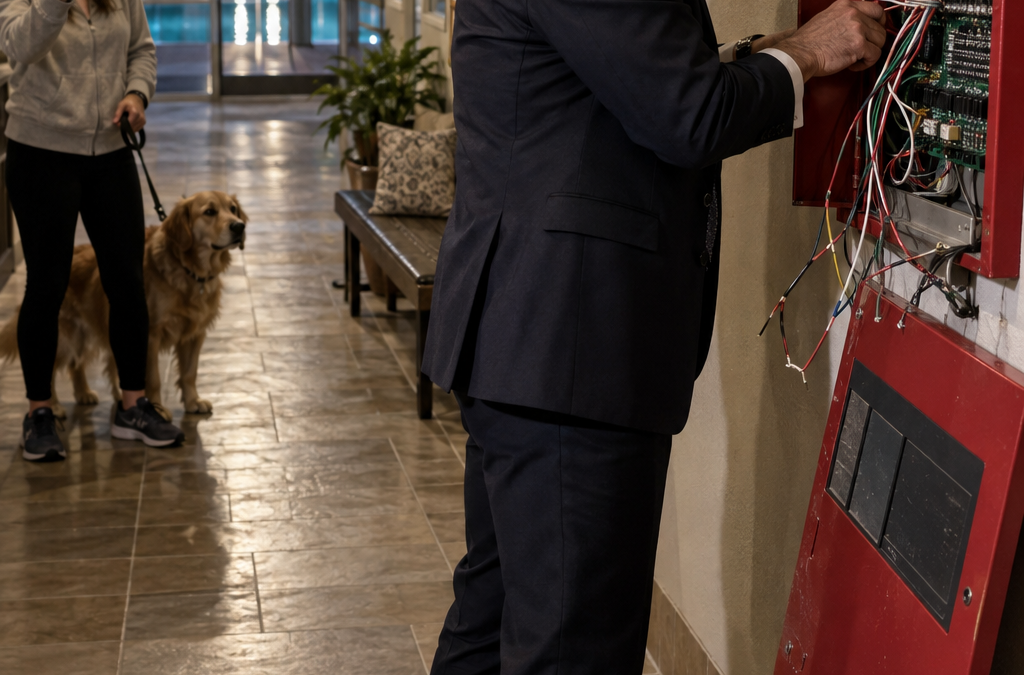
Then I noticed the screwdriver.
Dean stood in front of the wall-mounted fire alarm control panel.
The cover was open.
He looked over his shoulder twice.
Then he removed a wire.
I froze.
Milo tugged the leash.
I shortened it gently.
Dean muttered something I couldn’t hear.
He unscrewed another terminal.
Pulled another wire loose.
I knew enough about electrical panels to understand that he wasn’t replacing anything.
He was disconnecting it.
I took out my phone.
My first video was shaky.
I forced myself to breathe.
Then I started another recording.
Dean’s face was visible.
The screwdriver.
The open alarm panel.
His hands removing wiring.
He leaned toward the panel and whispered something.
This time the audio caught part of it.
“Not finding anything now.”
My skin went cold.
I kept filming.
He pushed the loose wires deeper into the housing and started replacing the panel cover.
Then a thought hit me.
The fire marshal.
Two weeks earlier, a notice had been posted near the clubhouse entrance stating that the fire alarm system required corrective work after an inspection.
Emergency repairs.
The special assessment.
I opened my email and searched.
There it was.
A community notice describing part of the assessment as necessary for life-safety upgrades and emergency clubhouse repairs.
I looked through the window again.
Dean had collected money to fix the system.
The system still hadn’t been fixed.
And now he was physically disabling evidence of the problem before inspectors returned.
Suddenly everything connected.
The emergency assessment.
The redacted accounts.
The unexplained spending.
The pool.
Cabo.
The fake fines.
Dean wasn’t merely bullying me because he enjoyed control.
He was using enforcement as camouflage.
Keep homeowners fighting about hedges and mailboxes.
Keep them scared of liens.
Keep them too busy defending themselves to ask where the money went.
My heart was pounding so hard I worried Dean might hear it through the glass.
He closed the panel.
Turned.
I stepped away from the window immediately.
Milo followed.
I walked normally until we rounded the corner.
Then I practically dragged us home.
The moment I locked the door, I copied the video to my computer.
Then an external drive.
Then cloud storage.
I emailed it to Priya.
Subject line:
YOU NEED TO SEE THIS NOW.
She called nine minutes later.
“Where are you?”
“Home.”
“Stay there.”
“What?”
“Do not confront him.”
“I wasn’t planning to.”
“Good. Tell me exactly what you saw.”
I explained.
She watched the recording while we were on the phone.
There was a long silence.
Then she said, “Garrett.”
“Yeah?”
“This may have just changed the entire case.”
I sat down.
“Because of the fire panel?”
“Because if that system was under an active correction order and he’s intentionally disabling or tampering with life-safety equipment, we’re beyond civil HOA misconduct.”
I rubbed my forehead.
“The assessment was supposed to pay for those repairs.”
“I know.”
“What if he took the money?”
“We don’t guess. We document.”
She gave me the fire marshal’s non-emergency contact information and told me how to preserve the original video metadata.
I called that same night.
The person who answered took the report seriously enough to ask me to email the footage immediately.
I barely slept.
At 7:30 the next morning, an inspector called me.
He asked when the video had been recorded.
I told him.
“Did you enter the clubhouse?”
“No.”
“Did you touch the panel?”
“No.”
“Did Mr. Halloway know you were recording?”
“Not that I’m aware of.”
He paused.
“Keep the original file.”
“Already done.”
“Do not alter it.”
“I won’t.”
Two days later, county inspectors entered the clubhouse.
Dean tried to tell residents it was a routine follow-up.
It wasn’t.
The alarm panel showed clear evidence of manual tampering.
The required repairs had not been completed as represented.
And the funds allocated for emergency work didn’t reconcile cleanly with the invoices Dean had produced.
The financial review widened.
Priya submitted our documentation alongside the fire marshal findings.
Then something broke loose.
Once investigators began comparing accounts, they discovered that fine payments, special assessments, pool spending, clubhouse expenses, and several unexplained transfers led back to a single operating structure Dean effectively controlled.
There were supposed to be safeguards.
Board approvals.
Multiple signatures.
Documented votes.
Actual invoices.
Instead, the system had gradually become Dean.
Dean approving.
Dean recording.
Dean enforcing.
Dean explaining.
Dean threatening anyone who asked questions.
One shared account became especially important.
It received special-assessment funds, administrative charges, and transfers from operating reserves.
Dean had exercised sole practical control over it.
Priya spread the statements across her desk.
“Look at these.”
I leaned forward.
Transactions.
Withdrawals.
Vendor payments.
Transfers.
Some vendor names existed.
Some addresses didn’t match legitimate businesses.
Some payments lacked supporting invoices altogether.
Then she showed me charges around the dates of Dean’s Cabo trip.
I felt physically sick.
“You’re saying our assessment paid for his vacation?”
“I’m saying investigators will determine what each expenditure represents.”
She tapped another page.
“But the timing is significant.”
“What about the pool?”
“There’s a payment coded as aquatic surface restoration.”
“The Cedar Hollow pool wasn’t resurfaced this year.”
“I know.”
She turned her laptop toward me.
One of Dean’s Cabo photographs showed the pool behind him.
Blue mosaic border.
Stone waterfall.
Distinctive curved edge.
Priya stared at it.
“Don’t jump ahead.”
“I’m trying not to.”
“But you’re seeing what I’m seeing.”
“Yes.”
The money trail wasn’t complete yet.
But it was no longer difficult to understand why Dean had panicked when I asked where the emergency funds went.
I thought back to the first garden gnome fine.
Two hundred dollars.
Such a ridiculous beginning.
But that fine had taught me the most important thing about Dean.
He needed people to obey without asking why.
The HOA called another board meeting the following week.
By then, rumors were everywhere.
Fire inspectors had been seen at the clubhouse.
Residents knew attorneys were involved.
Several homeowners had received calls requesting documentation of past fines and assessments.
Dean responded the only way he knew how.
He announced the meeting as a “community clarification session.”
Marcus laughed when he showed me the email.
“Clarification?”
“He probably plans to explain why cutting wires is good governance.”
“You’re going?”
“Absolutely.”
So was Priya.
The meeting room filled before seven.
Not just the usual dozen homeowners.
Almost everybody.
People carried folders.
Old fine notices.
Bank statements.
Receipts.
The Bradleys brought photographs proving a drainage violation Dean had fined them for didn’t exist on the date listed.
An elderly woman named Susan brought seven years of violation letters.
Another homeowner had emails showing Dean denied an appeal before the appeal hearing supposedly occurred.
It was as if everyone had been storing little pieces of the same nightmare separately.
Now they were placing them on one table.
Dean arrived five minutes late.
He wore a charcoal suit.
White shirt.
Dark blue tie.
Silver cuff links.
His hair was perfect.
His shoes were perfect.
His face was not.
He looked tired.
But the moment he reached the front of the room, the familiar smile appeared.
“Good evening, everyone.”
Nobody answered.
Dean arranged his papers.
“I understand there has been considerable misinformation circulating.”
Marcus muttered beside me, “Here we go.”
Dean continued.
“Recent routine inspections have unfortunately been mischaracterized as investigations.”
Priya wrote something in her notebook.
“The board remains in excellent financial condition. Cedar Hollow remains fully compliant with its obligations. Certain residents have attempted to exploit ordinary administrative matters to create unnecessary fear.”
His eyes moved toward me.
There it was.
The target.
Me.
The troublemaker.
The man who had turned a mailbox into a crisis.
Dean spread both hands.
“I want to reassure responsible homeowners that the board will not be intimidated by harassment, legal theatrics, or defamatory accusations.”
I raised my hand.
He ignored it.
“We will continue enforcement actions against delinquent accounts.”
My stomach tightened.
He was still doing it.
Even now.
Dean reached for another document.
“This includes lien enforcement where necessary.”
Priya leaned toward me.
“Stay calm.”
Dean looked directly at me.
“Mr. Garrett’s account remains unresolved.”
I stood.
The room turned.
Dean’s smile tightened.
“I wasn’t finished.”
“I’ve listened to you for six months.”
“This isn’t your meeting.”
“It belongs to the homeowners.”
“You are out of order.”
“So answer one question.”
“I’m not obligated—”
“Was the fire alarm system repaired with the emergency assessment money?”
The room went silent.
Dean’s face didn’t move.
But his hand tightened around the podium.
“Life-safety systems are handled by licensed contractors.”
“Was it repaired?”
“I just answered you.”
“No.”
My voice was louder now.
“You gave me a sentence. I asked for an answer.”
Someone near the back said, “Yeah.”
Dean looked toward the voice.
Then back at me.
“The fire system is operational.”
Priya’s pen stopped moving.
I stared at him.
He had chosen the lie.
Right there.
In front of everyone.
“Operational?”
“Yes.”
“When?”
“I don’t have contractor dates memorized.”
“Because two nights ago I watched you remove wires from the panel yourself.”
Everything stopped.
Even Dean.
For half a second, there was no expression on his face.
Then he laughed.
A controlled little laugh.
“That’s absurd.”
I took out my phone.
“I filmed it.”
The room exploded.
“What?”
“You what?”
“Jesus Christ.”
Dean raised his hand.
“Enough!”
People kept talking.
He looked at me.
For the first time since I’d known him, I saw pure panic.
“Any video obtained by spying through private association property—”
“I was standing outside the clubhouse window on the sidewalk.”
“You were surveilling me.”
“I was walking my dog.”
“This is harassment.”
“You were pulling wires out of a fire alarm panel.”
Dean slammed one hand against the podium.
“I was performing an authorized inspection!”
“With a screwdriver?”
“Yes.”
“Are you a licensed fire alarm technician?”
His face reddened.
“You have no understanding of maintenance procedure.”
“Then maybe the fire marshal does.”
That sentence changed him.
His eyes widened.
Only slightly.
But enough.
He knew.
“You contacted them?”
I didn’t answer.
He looked toward Priya.
Then toward the room.
Then back at me.
“You had no authority.”
Marcus stood.
“He had more authority than you did to rip out a fire alarm.”
Applause broke out.
Dean’s control cracked.
“Sit down!”
Nobody did.
Susan raised her stack of fines.
“What about our money?”
Dean pointed toward her.
“Ma’am, if you have an individual account concern—”
“You fined me twelve hundred dollars for a porch railing your own contractor installed!”
The Bradleys stood.
“You threatened us with a lien over drainage stones.”
Another man shouted, “Where’s the pool repair money?”
Dean stepped away from the podium.
“This meeting is adjourned.”
“No,” I said.
He turned toward me.
“No?”
“You’re not walking away this time.”
His expression became vicious.
“Watch yourself, Garrett.”
I felt the old fear.
The automatic reaction he’d trained into me.
The fear of the next letter.
The next fine.
The next threat against my house.
But then I remembered the fire panel.
The wires.
The lien notices.
The nights I couldn’t sleep.
The families who had paid because they were afraid.
“No,” I said quietly. “You watch yourself.”
Dean started around the podium.
For one second, I thought he might come toward me.
Then the clubhouse doors opened.
Two men in plain clothes entered.
A uniformed county officer came behind them.
The taller man held up identification.
“Dean Halloway?”
Dean stopped.
The entire room fell silent.
“I’m Dean Halloway.”
“I’m Detective Mercer with the county financial crimes unit. This is Detective Lane.”
Dean’s eyes moved rapidly from one man to the other.
“What is this about?”
“We’d like to speak with you regarding Cedar Hollow association funds and tampering with life-safety equipment.”
Dean smiled.
I had seen that smile dozens of times.
The courtroom smile.
The patient smile.
The expression that told homeowners he was the adult in the room and everyone else was emotional.
“I’m sure this can be cleared up very quickly.”
Detective Mercer didn’t smile back.
“We hope so.”
Dean glanced toward the homeowners.
“This is obviously the result of malicious complaints.”
Mercer held up a document.
“We have a warrant concerning association financial records and electronic devices.”
Dean’s face drained of color.
“You have what?”
“A warrant.”
“This is an HOA matter.”
“Not anymore.”
Nobody moved.
Dean looked at Priya.
Then me.
Then the detectives.
His voice became lower.
“I am president of this association.”
Detective Lane said, “Sir, we need you to step away from the table.”
Dean laughed once.
“You don’t understand. Those records contain confidential homeowner information.”
“They’ll be handled according to the warrant.”
“You cannot simply confiscate association property.”
Mercer remained calm.
“Step away from the table.”
Dean didn’t.
For years, people had stepped away from him.
Moved cars.
Removed decorations.
Paid fines.
Cut hedges.
Signed forms.
Accepted his version of events.
He seemed genuinely unable to process a command that didn’t originate from him.
“I’ll contact counsel.”
“You’re free to do that.”
“This is politically motivated.”
No one answered.
“This man—”
Dean pointed directly at me.
“—has engaged in a six-month campaign of harassment.”
Detective Mercer looked at me briefly, then back at Dean.
“Mr. Halloway, we’re not discussing Mr. Garrett’s HOA account.”
“You should be.”
“We’re discussing financial records, alleged embezzlement, fraudulent documentation, and the intentional tampering with a fire alarm system.”
The word embezzlement changed the room.
Somebody gasped.
Dean’s mouth opened.
Nothing came out.
Mercer continued.
“We also have evidence relating to retaliatory financial penalties imposed against homeowners during the relevant period.”
Dean looked around desperately.
“Trent!”
Trent was sitting near the wall.
He had served as board treasurer in name, although everyone now understood Dean controlled the actual finances.
Trent slowly stood.
Dean pointed toward him.
“Tell them how these accounts operate.”
Trent swallowed.
Then said, “You operated them.”
Dean stared.
“What?”
“You controlled the transfers.”
“That’s a lie.”
“You told me where to sign.”
“Trent.”
“You prepared minutes before meetings.”
People began murmuring.
Dean’s face twisted.
“You spineless little—”
Detective Lane stepped forward.
“Sir.”
Dean stopped.
The detective’s voice was calm.
“That’s enough.”
Dean’s chest rose and fell.
For the first time, the immaculate fifty-year-old king of Cedar Hollow looked small.
Not physically.
He was still tall.
Still broad-shouldered.
Still dressed better than anyone else in the room.
But power had left him.
It turned out authority had never been in the suit.
Or the clipboard.
Or the letterhead.
It had existed because people believed resisting him would cost too much.
Now detectives were standing between Dean and the people he’d spent years frightening.
His words sounded different.
“These accusations are false.”
Mercer nodded.
“You’ll have an opportunity to address them.”
“I want my lawyer.”
“That’s your right.”
Dean looked toward the exit.
Then back at the table.
Detective Lane moved beside him.
“Turn around, please.”
Dean froze.
A sound went through the room.
Not cheering.
Shock.
He stared at the detective.
“You’re arresting me?”
Mercer read the charges being investigated and the basis for custody.
Fraud.
Embezzlement involving association funds.
Falsification of financial and board records.
Tampering with life-safety equipment.
Multiple felony allegations.
Dean’s lips parted.
“You can’t.”
Lane repeated the instruction.
“Turn around.”
Dean looked at me.
That was the moment I will remember longest.
Not the handcuffs.
Not the detectives.
Not even the charges.
His face.
He looked offended.
Almost wounded.
As though I had broken an agreement I never knew existed.
The agreement that he was allowed to hurt people and we were supposed to absorb it quietly.
“This is because of you,” he said.
I stood.
“No.”
My voice was steady.
“This is because of you.”
Lane guided Dean’s hands behind his back.
The cuffs clicked.
Dean flinched.
The sound was quieter than I expected.
Metal against metal.
For six months, official envelopes had terrified me.
A signature had terrified me.
An HOA seal had terrified me.
Now Dean stood in front of everyone with his own name printed across legal paperwork that he couldn’t rewrite.
His courtroom smile was gone.
He was escorted through the clubhouse doors.
Past the same alarm panel he had tried to disable.
Past the same homeowners he had threatened.
Outside, a county vehicle waited under the parking lot lights.
Nobody followed him.
Nobody begged.
Nobody apologized.
The door closed.
And Cedar Hollow went silent.
For several seconds, all I could hear was the hum of the clubhouse air conditioner.
Then Susan started crying.
Not dramatically.
She simply sat down and covered her mouth.
Marcus put a hand on her shoulder.
Someone behind me whispered, “It’s over.”
Priya leaned toward me.
“Not completely.”
I knew what she meant.
Arrest wasn’t conviction.
Investigations took time.
Financial accounts had to be traced.
Charges had to be proven.
Liens still had to be removed properly.
Money had to be recovered.
But something fundamental had ended that night.
Dean could no longer threaten us from behind the board president’s title.
Within forty-eight hours, the remaining directors voted to remove him from the presidency.
An interim board was formed.
Outside professionals were appointed to review the association’s books.
Every enforcement action initiated under Dean’s disputed records was temporarily frozen.
Then the court process began unraveling the fraudulent liens.
Mine was among the first challenged.
The day Priya called me with the news, I was standing in my kitchen.
“Garrett?”
“Yeah.”
“The lien is being voided.”
I didn’t answer immediately.
“Garrett?”
“I’m here.”
“The underlying charges have been determined to lack valid support. The court order is being processed.”
I sat down.
“So he can’t take the house?”
“No.”
I closed my eyes.
I had imagined hearing those words for months.
I thought I would shout.
Maybe laugh.
Instead, I put my forehead against my hand and cried.
Quietly.
My body seemed to release every night of fear at once.
The certified envelopes.
The four-thousand-dollar demand.
The ninety-day foreclosure threat.
Every time a vehicle slowed in front of my house.
Every time Dean told me consequences were coming.
“It’s over?” I asked.
“Your lien issue is.”
Priya paused.
“The broader case isn’t.”
“That’s fine.”
And for the first time, I meant it.
My house was safe.
The criminal investigation continued for months.
Forensic accountants reconstructed Cedar Hollow’s finances.
The pattern was worse than we had known.
Dean had used bogus violations and inflated administrative charges to generate revenue.
He had moved money between accounts to make shortages harder to detect.
Certain vendors receiving association payments were connected to businesses controlled by acquaintances.
Invoices had been altered.
Meeting records had been manipulated to create the appearance of board authorization.
Emergency assessment funds were diverted.
Some pool-related expenses had little or nothing to do with Cedar Hollow’s actual pool.
Investigators also traced expenditures surrounding Dean’s Cabo vacation.
I never learned every accounting detail, nor did I need to.
What mattered was that the story Dean had told for years finally met records he couldn’t intimidate.
The fire alarm system became one of the most serious elements.
The fire marshal’s earlier correction order had required actual repairs.
Dean apparently feared a follow-up inspection would reveal that the assessment funds collected for emergency work had not been used properly.
So instead of fixing the problem, he tried to manipulate the evidence.
The image still bothered me.
Dean standing alone in that dim hallway with a screwdriver.
Pulling wires from a system designed to warn families about fire.
All because exposure mattered more to him than safety.
That was the line I could never rationalize.
He had gone from vanity to retaliation.
From retaliation to financial abuse.
From financial abuse to threatening homes.
And finally, when the possibility of discovery became real, he had interfered with equipment whose only purpose was to save lives.
Each step made the next step easier.
That was the most frightening part.
Dean hadn’t woken up one morning and suddenly become capable of risking other people’s lives.
He had practiced.
One petty abuse at a time.
One false letter.
One frightened homeowner.
One board member too nervous to object.
One payment nobody questioned.
One fake record nobody inspected.
Power had trained him to expect surrender.
For years, it worked.
Then one crooked mailbox flag became too much.
Homeowners who had quietly paid Dean’s fines began filing claims.
Susan recovered money she’d paid over several years.
The Bradleys recovered penalties tied to violations the association couldn’t document.
Marcus received reimbursement.
Other residents came forward with records nobody had known existed.
A court-supervised review identified homeowners entitled to repayment.
Eventually, many received their money back with interest.
The new board issued a formal apology.
Nobody believed the apology meant much.
Most of the people signing it hadn’t created the problem.
And words couldn’t restore the years some residents had spent afraid.
But changes followed.
Real changes.
No single board officer could control an operating account.
Two authorized signatures became mandatory for significant expenditures.
Monthly bank statements went to every director.
Annual independent financial reviews became required.
Meeting minutes were approved after meetings, not written as fiction beforehand.
Violation evidence had to include dated photographs.
Homeowners received meaningful appeal rights.
Lien action required documented board review and outside legal verification.
Life-safety repairs required direct confirmation from licensed contractors.
In other words, Cedar Hollow finally installed the boring safeguards that should have existed all along.
Dean hated boring safeguards.
They made dictatorships inconvenient.
The clubhouse fire alarm was professionally repaired.
I happened to be there the day technicians tested it.
A loud electronic tone exploded through the hallway.
I nearly jumped out of my skin.
The technician laughed.
“Working.”
I looked at the new panel.
Green indicator light.
Secured cover.
Inspection label.
“Good,” I said.
He probably thought my reaction was strange.
He didn’t know how beautiful that noise sounded to me.
Dean eventually pleaded not guilty initially, then faced the accumulating financial evidence through the criminal process.
By the time the major counts moved forward, the public record showed allegations involving fraud, embezzlement, falsified records, and tampering with life-safety systems.
He lost the HOA position immediately.
Later, his freedom depended on a judge rather than a neighborhood board.
When I heard he was awaiting sentencing, I expected to feel victorious.
Instead, I felt tired.
Dean had spent years threatening people with losing their homes.
Now he faced losing his own freedom.
There was symmetry in that.
But I didn’t enjoy it as much as I’d once imagined.
Mostly, I wished none of it had happened.
I wished the gnome had remained beside my hydrangeas.
I wished I had never learned the phrase aggressively asymmetrical.
I wished Susan had never paid fraudulent fines.
I wished the Henderson-like families in our community had never considered moving.
I wished Dean had looked at a neighborhood full of people and seen neighbors instead of subjects.
But wishing didn’t rewrite anything.
Evidence did.
Accountability did.
One afternoon, nearly a year after the first garden gnome fine, I was trimming the hedges.
Or trying to.
I have never been particularly good at landscaping.
I stepped backward and looked at them.
The left side was clearly taller than the right.
Marcus walked past.
He stopped.
“Garrett.”
“Yeah?”
He looked at the hedge.
Then at me.
“That’s aggressive.”
I laughed.
“Extremely.”
“Asymmetrical too.”
“Criminally.”
He nodded solemnly.
“I’ll notify the board.”
“Better make it eight hundred dollars.”
“Minimum.”
We both laughed.
It felt good.
Normal laughter.
Not nervous laughter.
Not the kind residents used when Dean made some joke at a board meeting and everyone understood they were expected to smile.
Just two neighbors standing beside an ugly hedge.
No fear.
The little garden gnome eventually came back too.
I’d stored it in my garage after Dean’s first violation.
One Saturday morning, I found it behind a stack of paint cans.
Faded red hat.
White beard.
One arm raised.
I wiped off the dust.
Then I carried it outside.
I placed it beside the hydrangeas exactly where it had been when I bought the house.
I stood there waiting to feel rebellious.
Instead, I felt ridiculous.
It was just a gnome.
That was the point.
It had always been just a gnome.
The danger had never been ceramic decorations.
Or mailbox flags.
Or grass height.
The danger was giving one man enough unchecked authority that his personal preferences became punishments backed by people’s homes.
Dean had used small rules because small rules were easier to defend.
He could tell himself he was protecting property values.
Tell homeowners he was preserving standards.
Tell board members he was maintaining order.
But when someone needs a lien to win an argument about hedge symmetry, the argument stopped being about landscaping a long time ago.
I understood something else after it was over.
For months, I had been embarrassed by how frightened I became.
I had thought courage meant never feeling that fear.
It doesn’t.
When someone threatens the house you worked ten years to afford, fear is rational.
When legal-looking documents arrive telling you foreclosure may begin, fear is rational.
When the man creating those documents controls the association supposedly empowered to enforce them, fear is rational.
The problem is what fear convinces you to surrender.
Dean had built his entire system around that calculation.
Two hundred dollars wasn’t worth fighting.
Then three hundred.
Then eight hundred.
Then four thousand.
Then a lien.
Each step made the previous surrender seem like proof that surrendering again was easier.
Until eventually people weren’t protecting their peace.
They were financing their own intimidation.
I nearly did the same thing.
The only reason I didn’t was because the dates didn’t match.
A camera timestamp.
A small inconsistency.
One detail that told me the official paper in my hand wasn’t reality.
After that, every document mattered.
Every envelope mattered.
Every photograph.
Every video.
Especially that final video.
Sometimes I still think about what would have happened if Milo hadn’t stopped outside the clubhouse that night.
If I hadn’t heard the chirping.
If I had kept walking.
The fire marshal might have returned.
Dean might have invented another explanation.
The financial records might have remained hidden longer.
Maybe someone else would eventually have exposed him.
Maybe not.
I don’t like thinking about the other possibility.
A clubhouse full of residents.
A disabled alarm.
A real fire.
People trusting a life-safety system Dean had interfered with to hide what he’d done with their money.
That possibility erased whatever sympathy I might once have had for him.
Because there is a difference between arrogance and recklessness.
Dean crossed it.
Today, Cedar Hollow looks almost exactly like it did when I moved in.
Same curved streets.
Same oak trees.
Same brick mailboxes.
Same clubhouse.
Same pool.
If you drove through, you would never guess how close the neighborhood came to being financially and emotionally controlled by one man.
That’s how these things happen.
They rarely look dramatic from the outside.
They look like letters.
Fees.
Meetings.
Procedures.
Clipboards.
Rules.
People saying, “It’s easier if you just pay.”
But peace purchased by surrendering every right someone decides to challenge isn’t peace.
It’s permission.
My mailbox flag still tilts sometimes.
The screw loosens when the wind is strong.
I tighten it when I notice.
Nobody photographs it.
Nobody sends a fine.
My grass occasionally grows past the preferred height after heavy rain.
I mow it when I can.
Nobody threatens my title.
My pickup doesn’t always sit perfectly straight in the driveway.
No invisible ruler appears overnight.
And the hedges?
Still aggressively asymmetrical.
I could fix them.
Probably should.
But every time I look at the taller left side leaning slightly over the shorter right, I smile.
Not because uneven hedges represent freedom.
They’re just uneven hedges.
I smile because that’s what they are allowed to be now.
A landscaping problem.
Nothing more.
The fire alarm panel in the clubhouse hallway works perfectly.
Green light.
Sealed cover.
Current inspection sticker.
Every time I pass it, I remember the dead panel.
The exposed wires.
Dean’s hands.
The screwdriver.
The moment I realized the man threatening my home wasn’t protecting Cedar Hollow from rule breakers.
We were protecting Cedar Hollow from him.
And now, when I lock my front door at night, I don’t wonder whether another certified envelope is coming.
I don’t wonder whether some invented violation will become a lien.
I don’t wake at three in the morning calculating how much of my savings I can sacrifice before my house becomes collateral in somebody else’s power game.
Cedar Hollow is quiet again.
Not the frightened quiet Dean created.
Real quiet.
The kind I thought I was buying when I first moved in.
The kind where a man can leave a crooked mailbox flag alone for a few days.
Where a six-inch ceramic gnome can stand beside a hydrangea without becoming evidence.
Where an ugly hedge doesn’t threaten a mortgage.
Where emergency assessment money actually pays for emergencies.
And where the fire alarm rings when it’s supposed to.
Dean spent years convincing us that he alone kept Cedar Hollow under control.
In the end, the neighborhood didn’t fall apart without him.
It finally became a community.








