𝗙𝗨𝗟𝗟 𝗦𝗧𝗢𝗥𝗬 The HOA President Threatened to Take My Home After I Refused to Sign His New Property Agreement
𝗙𝗨𝗟𝗟 𝗦𝗧𝗢𝗥𝗬
The legal description was clear.
The lot number matched.
The boundaries matched.
The existing recorded restrictions were identifiable.
Nothing in the documents established the sweeping new authority Victor was claiming.
I checked the notices against the deed again.
Then I went through the original closing papers.
I wanted to make sure I wasn’t overlooking a properly recorded amendment or some later transaction that affected the property.
I found nothing that supported Victor’s demands.
That didn’t necessarily mean every HOA rule was invalid.
Associations could lawfully adopt some rules and enforce properly authorized covenants.
But a board resolution wasn’t magic.
It couldn’t rewrite my deed merely because the president wanted it to.
By Thursday morning, I had organized the relevant papers into a single folder.
I planned to send a formal records request and ask the association to identify exactly what legal authority it believed justified the changes.
I thought a careful written response might prevent the dispute from escalating.
That assumption lasted until Victor pulled into my driveway.
I was standing near the garage, reviewing the deed one final time, when a black Mercedes SUV turned off the street and stopped behind my car.
The driver’s door opened.
Victor stepped out in a charcoal suit, white shirt, and deep burgundy tie.
A gold watch flashed beneath his cuff.
He carried a leather portfolio in one hand and a thick stack of HOA notices in the other.
He didn’t knock.
He didn’t ask whether it was a convenient time.
He simply walked up the driveway as though he were arriving to inspect property already under his control.
“Good morning,” he said.
His smile was practiced and cold.
“Victor.”
“I see you’ve received our correspondence.”
I glanced at the papers in his hand.
“Several times.”
“Then I assume you’re finally ready to resolve this.”
“That depends on what you mean by resolve.”
He stepped closer.
“Signing the required documents. Paying the outstanding assessments. Bringing your property into compliance.”
I closed the folder.
“I’ve asked your office to provide the legal authority for the new declaration.”
He sighed.
“You’re still questioning that?”
“Yes.”
“Why?”
“Because the documents you’re asking me to sign don’t match my recorded property interests.”
Victor gave a small laugh.
“That’s precisely why the records need updating.”
I studied his face.
“On what legal basis?”
He smiled.
“The association has adopted a revised property compliance framework.”
“That doesn’t answer my question.”
His expression tightened.
“Listen. Brookfield Heights has undergone significant administrative modernization. Certain older property records are no longer consistent with our community management requirements.”
“Community management requirements don’t automatically change recorded ownership.”
He glanced at the folder.
“Are you an attorney?”
“No.”
“Then perhaps you should leave legal interpretation to people who understand it.”
I didn’t respond.
He continued.
“The board has voted. The policy is effective. Your signature is required.”
I opened the folder.
“Then this should be easy.”
Victor looked down.
I removed the original recorded deed and placed it carefully on the flat surface of a worktable beside the garage.
“Here’s my deed. Show me where it authorizes the changes you’re demanding.”
His smile vanished.
“That’s an outdated document.”
“It’s the recorded deed.”
“It predates the revised HOA requirements.”
“Yes. It also establishes my ownership interest.”
He looked irritated.
“You’re confusing title with compliance.”
“Then explain the distinction as it applies to your new agreement.”
He straightened his tie.
“I don’t have time to give every difficult homeowner a legal seminar.”
“You came to my house.”
“And I came prepared to resolve a simple administrative problem.”
I pointed to the deed.
“Show me the recorded instrument that changes this legal description.”
He stared at the page.
Then at me.
For several seconds, he said nothing.
I waited.
A man who was certain of his authority should have been able to identify its source.
Instead, Victor’s eyes moved across the document without settling on any particular provision.
Finally, he said, “Where did you get this?”
“From the county recording office when I bought the house.”
“That doesn’t prove it’s authentic.”
I felt my eyebrows rise.
“Are you accusing me of presenting a forged deed?”
“I’m saying homeowners frequently misunderstand what documents they possess.”
“It’s a certified recorded document.”
His cheeks reddened.
“Anyone can print something that looks official.”
I looked at him.
“Then compare it with the county’s records.”
He took a step closer.
“Let me see that.”
“It’s right there.”
“No. Give it to me.”
I placed one hand beside the paper.
“You’re welcome to examine it without removing it.”
His eyes narrowed.
“I am the president of this homeowners association.”
“I know.”
“And I have authority to inspect compliance documentation.”
“You can inspect the copy I’ve provided. You don’t need to take possession of my original.”
He stared at me.
Then he reached across the table.
At first, I thought he intended to point at the legal description.
Instead, his fingers closed around the upper edge of the deed.
“Mr. Reynolds,” I said firmly. “Let go.”
He pulled.
I held the document down with my other hand, trying to prevent him from taking it.
“Let go of my deed.”
“This is suspicious paperwork, and I intend to have it examined.”
“Then request a certified copy from the county.”
His face twisted.
He pulled harder.
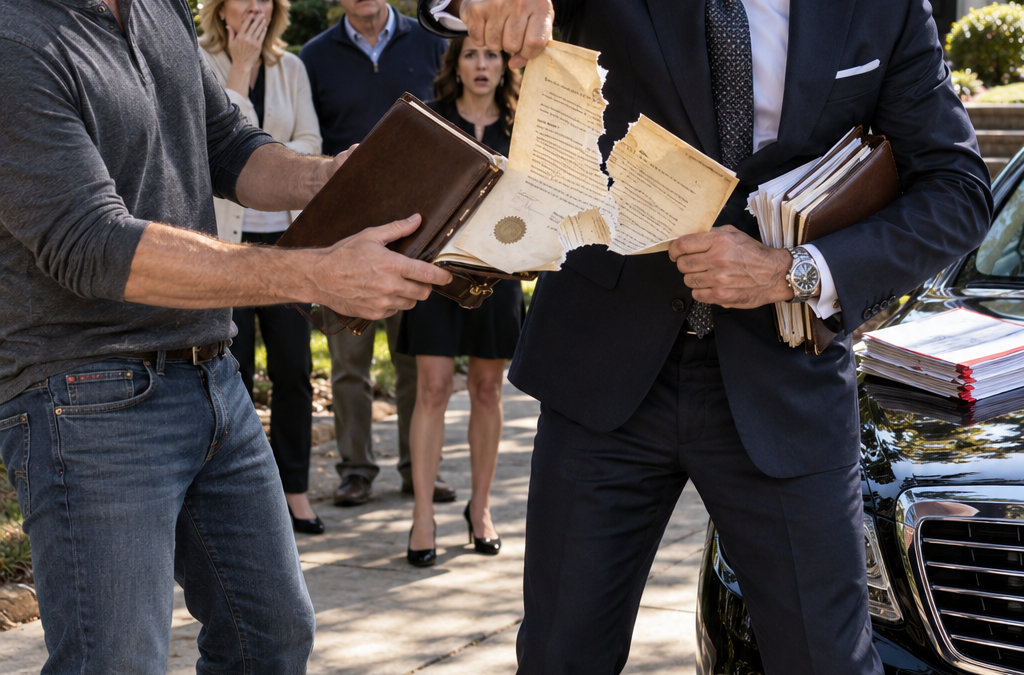
The paper tore.
The sound was small.
A sharp, dry ripping noise.
But it seemed to cut straight through the morning.
The upper corner separated beneath his fingers, leaving a jagged tear across part of the margin and into the printed area.
For a moment, neither of us moved.
Victor stared at the torn corner in his hand.
I looked down at the damaged deed.
My pulse was pounding.
Not because the paper itself established ownership.
I understood that the county’s recorded instrument did not disappear because somebody damaged my copy.
But this was my official document.
A piece of evidence.
A record I had preserved for more than a decade.
And the president of my homeowners association had just damaged it because he couldn’t answer a question.
“Put that down,” I said.
My voice was so quiet that Victor looked startled.
He released the torn corner onto the table.
Then his expression changed.
The anger became calculation.
He glanced toward the street.
Three neighbors were outside.
Mrs. Alvarez stood beside her mailbox across the road.
A younger man named Aaron Turner was unloading groceries from his car two houses away.
And a retired schoolteacher, Helen Brooks, had been watering flowers near her front steps.
All three were looking toward my driveway.
They had seen it.
Victor realized that at the same moment I did.
He straightened his jacket.
“You damaged that yourself.”
I stared at him.
“What?”
“You pulled against the paper.”
“You grabbed it.”
“I was trying to examine suspicious documentation.”
“You tore my deed.”
He lifted his chin.
“You shouldn’t have resisted an authorized inspection.”
I looked toward my neighbors.
Then back at him.
I could feel anger gathering behind my ribs.
Part of me wanted to shout.
To tell him exactly what I thought of his arrogance.
To demand that he apologize.
Instead, I stepped away from the table.
I took out my phone and photographed the deed exactly where it lay.
The torn corner.
The damaged margin.
The worktable.
The notices beside it.
Then I photographed the separated piece of paper.
Victor watched me.
“What are you doing?”
“Preserving the condition of the document.”
He gave a dismissive laugh.
“You’re being theatrical.”
I continued taking photographs.
He moved closer.
“I strongly suggest you stop treating this as some kind of criminal incident.”
I lowered my phone.
“I haven’t characterized it yet.”
“Then let’s be reasonable.”
“Leave my property.”
His face hardened.
“I still need your signature.”
“You’re not getting it today.”
“You understand that fines will continue accumulating?”
“If the association believes a lawful obligation exists, it can identify that obligation in writing.”
He stepped closer.
“You’re making a serious mistake.”
I looked directly at him.
“No. I asked you to show me the legal authority for your demand. You responded by damaging my deed.”
His voice dropped.
“You have no idea how much trouble I can cause for you.”
I held his gaze.
“I understand exactly what you said.”
For several seconds, neither of us moved.
Then he gathered his violation notices.
He left the unsigned agreement on the table.
And he walked toward his SUV.
Before opening the door, he turned.
“This neighborhood has rules. You’re going to learn that eventually.”
I looked at the torn document.
“So does the law.”
His expression darkened.
Then he climbed into his vehicle and drove away.
I stood beside the worktable until the sound of his engine disappeared.
Only then did I realize my hands were shaking.
Mrs. Alvarez was the first person to cross the street.
She had lived in Brookfield Heights for nearly twenty years and possessed the kind of quiet authority that came from raising three children, surviving a difficult marriage, and refusing to be intimidated by anyone.
She stopped beside the worktable.
“Are you all right?”
I looked at the deed.
“I’m fine.”
She examined the torn corner.
“That man ripped your paper.”
I nodded.
“I know.”
“I saw him grab it.”
I turned toward her.
“Are you certain you saw the whole thing?”
She gave me a sharp look.
“Young man, I was standing at my mailbox before his car even stopped. I heard him demanding your signature. I saw him reach across that table. And I saw the paper tear.”
My throat tightened.
“Thank you.”
Aaron approached from the sidewalk.
“I saw it too,” he said.
He was carrying his phone.
“Didn’t catch the whole argument, but I was recording part of it after he started raising his voice.”
I looked at him.
“You recorded the confrontation?”
“Some of it.”
He hesitated.
“I wasn’t trying to get involved. That guy fined me two hundred dollars last month because my moving trailer was in the driveway for three hours.”
Mrs. Alvarez snorted.
“He’d fine the birds for landing on the wrong roof if he could.”
Under different circumstances, I might have laughed.
But I was staring at a damaged document and thinking about what Victor had said before driving away.
You have no idea how much trouble I can cause for you.
Helen Brooks joined us a moment later.
She looked at the torn deed, then at me.
“I heard him accuse you of using fake paperwork.”
“He did.”
“That doesn’t give him permission to destroy it.”
“No,” I said. “It doesn’t.”
For several moments, we stood quietly.
Then I asked them something important.
“If anyone contacts you about this, would you be willing to describe what you actually saw?”
Mrs. Alvarez nodded immediately.
“Of course.”
Aaron agreed.
Helen folded her arms.
“I’ll tell the truth. Whatever that turns out to be.”
That was exactly what I wanted.
Not loyalty.
Not exaggeration.
Not people taking my side because Victor had made himself unpopular.
I wanted three independent witnesses who could describe the same event without being coached.
I thanked them.
Then I carefully collected the torn deed and its separated corner.
I placed each piece in a protective sleeve.
I did not attempt to repair the tear.
There would be time later to obtain another certified copy.
For now, the condition of the document was evidence of what had happened.
That afternoon, I made a contemporaneous account of the incident.
I wrote down when Victor arrived, what he demanded, what I showed him, and the sequence leading to the damaged document.
I included his accusation that the deed was fake and his warning about future trouble.
Then I saved the photographs in more than one location.
I contacted the nonemergency police line and reported the confrontation.
An officer took the information, examined the photographs, and recorded the names of the witnesses.
He made no dramatic promises.
He didn’t declare Victor guilty of anything.
He explained that the facts would be reviewed and that any applicable criminal or civil issues would have to proceed through the appropriate channels.
I appreciated that.
I wasn’t interested in having someone arrested because I was angry.
I wanted a reliable record of the event.
But by the following morning, Victor had already begun rewriting what happened.
A new HOA notice appeared in my email.
It claimed I had refused a routine compliance inspection, behaved aggressively toward the association president, and interfered with his attempt to examine questionable property records.
It also announced an additional five-hundred-dollar fine.
I stared at the screen.
Then I read the message again.
The letter was dated the same afternoon Victor had damaged my deed.
At the bottom was his electronic signature.
Victor Reynolds, President, Brookfield Heights HOA.
I printed the letter.
Placed it beside the previous notices.
And opened a new folder.
By the end of that week, it was already becoming thick.
I sent the association a written response disputing the allegations and requesting preservation of all relevant records.
I asked for the meeting minutes supporting the revised declaration.
The recorded amendments supposedly affecting my property.
The voting records.
The authority for the fines.
And the documents used to create the updated ownership acknowledgment.
I also disputed the association’s account of the driveway confrontation.
The response arrived two days later.
Victor had denied my request for an in-person records review pending what he called a preliminary compliance determination.
He also warned that further challenges to the board’s authority could result in additional enforcement action.
I sat at my desk, reading that sentence.
It wasn’t the amount of money that concerned me anymore.
It was the pattern.
Every time I asked for documents, another violation appeared.
Every time I questioned his authority, the supposed consequences became more severe.
Victor wasn’t trying to settle a dispute.
He was trying to make the cost of questioning him higher than the cost of surrendering.
A week after the driveway incident, the HOA sent a notice threatening collection action over the accumulating balance.
I checked the figures.
The new total was nearly two thousand dollars.
Some of the charges were described as administrative penalties.
Others were labeled document reconciliation fees.
I had never seen those categories in the governing documents I’d received when I purchased the house.
I read the notice three times.
Then I placed it beside the revised declaration.
There was something about the signatures that bothered me.
The first page contained an acknowledgment supposedly approved by the association secretary.
The second referenced a compliance committee authorization.
The signature beneath that authorization was unusually familiar.
I opened an older HOA document.
The same person’s signature appeared there.
But it didn’t look quite right.
I compared the two.
On the old form, the signature leaned forward and ended with a distinctive upward stroke.
On the new one, the letters appeared compressed, with a different ending.
That alone proved nothing.
People sign their names differently all the time.
But then I noticed a third document.
The signature on that page was almost identical to the one on the revised declaration.
Not merely similar.
The shape and spacing looked unusually alike.
I leaned closer.
Something was wrong.
I searched through my earlier HOA correspondence.
Minutes.
Annual notices.
Budget approvals.
Voting summaries.
The association had sent several of those documents to homeowners over the years, and I’d kept copies.
As I arranged them chronologically, the inconsistencies became harder to dismiss.
Some signatures differed substantially from earlier examples.
Certain approvals appeared under the names of board members who hadn’t attended the meetings described.
One document referred to an authorization supposedly adopted before the committee named in the authorization had formally existed.
I checked the dates again.
Then I sat back.
I had started by examining whether the HOA could require me to sign a revised property agreement.
Now I was looking at paperwork that raised a much more troubling question.
Had the association been creating records to justify actions that were never properly approved?
I didn’t know.
And that uncertainty was precisely why I needed to be careful.
I wasn’t qualified to declare a signature forged merely because it looked different.
I couldn’t know whether a meeting had occurred based solely on a document I possessed.
But the discrepancies were serious enough to deserve independent examination.
I contacted the appropriate state authorities responsible for complaints involving association governance and potentially fraudulent records.
I also arranged to speak with an attorney about protecting my property interests.
I provided the documents, the suspicious signatures, the notices, and the photographs of the damaged deed.
I didn’t ask anyone to punish Victor.
I asked that the records be examined.
The attorney listened while I explained the sequence.
When I finished, she organized the documents into three piles.
“The property dispute is one issue,” she said.
“The damaged deed is another.”
Then she touched the third stack.
“And these potentially inconsistent approvals are something we should not ignore.”
I nodded.
“That’s what worries me.”
“Have you accused Mr. Reynolds publicly of forging signatures?”
“No.”
“Good. Don’t speculate beyond the evidence.”
“I haven’t.”
“We’ll preserve the records and let the appropriate investigators determine what they show.”
She studied the revised declaration.
“Have other homeowners received similar documents?”
“I don’t know.”
“That may become important.”
I left her office feeling more unsettled than when I’d arrived.
I had hoped the review would simplify the dispute.
Instead, it had revealed questions I couldn’t answer.
And Victor was still sending notices.
Two weeks later, Mrs. Alvarez knocked on my front door.
She was carrying a thick envelope.
“I think you should see this.”
Inside was a letter requiring her to sign an updated property acknowledgment.
The format was almost identical to mine.
The same language about outdated records.
The same expanded association authority.
The same warning about penalties.
I looked at her.
“When did you receive it?”
“Yesterday.”
“Did you sign?”
“Of course not.”
She sat at my kitchen table.
“I’ve lived here since before Reynolds joined the board. My husband and I paid off the house years ago. I don’t understand why some man with a clipboard suddenly gets to tell me our deed isn’t good enough.”
I examined the document.
There was another signature.
Different name.
Same unusual formatting.
Mrs. Alvarez watched my expression.
“What is it?”
“I don’t know yet.”
She leaned forward.
“Then tell me what you’re looking for.”
I explained that some of the newer HOA documents contained inconsistencies and that I’d submitted them for review.
Her face tightened.
“Do you think somebody is making these things up?”
“I think the records need to be verified.”
She was quiet for a moment.
Then she said, “Helen got one too.”
I looked up.
“Helen Brooks?”
She nodded.
“And the Turners.”
I felt my stomach tighten.
“How many others?”
“I don’t know. But people are starting to talk.”
That afternoon, I learned that Victor had recently held a special compliance session attended by several homeowners.
Residents who questioned the revised declarations were told that signing was necessary to keep their properties in good standing.
Some were warned about fines.
Others were told the HOA might pursue liens.
A few had signed because they feared the consequences of refusing.
The situation was no longer limited to my house.
I forwarded the new information to the authorities handling my complaint.
Then I stopped.
I had done what I could appropriately do.
The evidence needed to be examined independently.
And my personal involvement was becoming more complicated than most people understood.
For sixteen years, I had served in the federal judiciary.
I was a United States district judge.
Before that, I’d worked as an attorney, handling complex civil cases involving commercial disputes, contracts, and financial records.
My professional life had taught me something important.
People frequently mistake confidence for credibility.
A person can speak firmly, dress well, and repeat a claim a hundred times without producing a single piece of reliable evidence.
I had seen sophisticated professionals lose cases because the documents contradicted their testimony.
I’d also seen ordinary people prevail because they preserved the one record everyone else had overlooked.
That experience shaped how I handled Victor.
But I kept my professional position separate from my neighborhood life.
I didn’t tell HOA presidents I was a judge.
I didn’t use my chambers to contact county officials.
I didn’t call prosecutors to demand action.
And I never suggested that anyone should treat my complaint differently because of where I worked.
At home, I was simply a homeowner questioning documents that affected my property.
My title gave me no special right to win a private dispute.
And it certainly gave me no right to influence an investigation in which I might become a witness.
I provided records through ordinary channels.
I answered questions when contacted.
I referred requests for evidence to the appropriate people.
Then I returned to my regular work.
It wasn’t always easy.
Victor continued escalating.
One afternoon, I found another notice taped to my front door.
This one claimed that my continued refusal to sign the revised declaration demonstrated willful noncompliance.
It threatened additional legal action.
Attached was a schedule of proposed penalties that could increase the disputed balance by hundreds of dollars each month.
I removed the notice carefully.
Photographed it.
And placed it with the others.
I was beginning to understand Victor’s method.
He wanted me exhausted.
He wanted me anxious every time I opened the mailbox.
He wanted me to believe the easiest way to protect my house was to sign whatever he put in front of me.
And he wanted other homeowners to learn the same lesson.
There were nights when I sat at the kitchen table wondering how long the process would take.
Not because I feared Victor could lawfully rewrite my deed by himself.
Because even baseless claims can cause real damage when someone is determined to pursue them.
A disputed lien can complicate a sale.
Collection threats can create stress.
False records can require expensive corrections.
And ordinary people without legal experience may sign away rights simply because they don’t know how to challenge the paperwork.
One evening, Aaron Turner called me.
His voice sounded strained.
“Can I ask you something?”
“Of course.”
“Did the HOA ever tell you that you signed a compliance agreement you don’t remember signing?”
I sat upright.
“What happened?”
He exhaled.
“My wife and I got a letter saying we accepted updated parking restrictions last spring. They’re using it to justify fines against us.”
“Did you sign anything?”
“Not that I remember.”
“Have you asked for a copy?”
“Yes. They sent one.”
He paused.
“The signature looks like mine. But something’s wrong.”
I closed my eyes.
“Don’t make any accusations until you’ve had the record reviewed.”
“That’s what I figured.”
He sounded frightened now.
“Can they really do this?”
I looked at the growing stack of notices on my desk.
“I don’t know what happened in your case, Aaron. But you have the right to question a document you believe is inaccurate.”
He was silent.
Then he said, “I’m going to report it.”
“Preserve the original communication and anything they sent you.”
“I will.”
After hanging up, I sat in the dark for a long time.
Victor’s behavior had seemed petty at first.
Cruel, perhaps.
But familiar in the way abusive authority often is.
A fine.
A warning.
A threat.
A demand for obedience.
Now the possibility of fabricated records had transformed the situation.
And other families were caught in it.
The official investigation began expanding during the following month.
Investigators contacted homeowners who had submitted similar complaints.
They requested association records.
They examined meeting minutes, approval documents, payment histories, and signatures.
Residents were interviewed separately.
Mrs. Alvarez described the property acknowledgment she’d been ordered to sign.
Aaron discussed the disputed parking agreement.
Helen provided records from previous HOA meetings.
Other homeowners described fines and compliance notices that appeared to rely on authorizations they couldn’t verify.
The investigators weren’t simply collecting stories about an unpopular president.
They were comparing documents.
Looking for corroboration.
Checking dates.
Examining transaction records.
And establishing whether the apparent inconsistencies reflected errors, misunderstandings, or deliberate misconduct.
I was contacted more than once.
Each time, I answered only what I personally knew.
I provided the records in my possession.
I identified the witnesses to the driveway confrontation.
I explained when Victor had arrived, what he’d demanded, and how the deed had been damaged.
I didn’t speculate about his intentions beyond what his actions and statements supported.
And I made my professional status known to the investigators so that appropriate boundaries could be maintained.
As the inquiry continued, the financial side of the association came under examination.
Investigators obtained relevant accounting records and compared assessments collected from homeowners with the documented approvals authorizing those charges.
They reviewed payments to contractors and administrative service providers.
They examined transactions that had moved through financial institutions and electronic payment systems.
Some of those transactions raised questions extending beyond ordinary disputes over HOA policy.
What had started as a complaint about an allegedly unauthorized property declaration was now part of a broader inquiry into potentially fraudulent approvals and financial activity.
I didn’t know the full scope.
I wasn’t supposed to.
I had supplied evidence.
That didn’t entitle me to confidential investigative details.
Still, certain things became visible around the neighborhood.
Board members stopped answering questions about the new declaration.
Several scheduled compliance hearings were postponed.
The management office announced that some disputed penalties were under review.
Victor became less visible.
He no longer walked through the neighborhood inspecting every driveway.
His SUV still appeared near the clubhouse occasionally, but he didn’t seem eager to speak with residents.
One evening, I saw him at the entrance while returning from the grocery store.
He was standing beside his vehicle, talking sharply into his phone.
When he spotted me, he ended the call.
I lowered my window.
“Good evening, Victor.”
He walked toward the truck.
His hair was still immaculate.
His suit still looked expensive.
But his face had changed.
There were dark circles beneath his eyes.
He seemed thinner.
“Are you satisfied?” he asked.
I looked at him.
“With what?”
“Dragging this association through an investigation.”
I kept my hands on the steering wheel.
“I submitted documents I believed needed review.”
He laughed bitterly.
“You’ve turned a simple paperwork disagreement into a spectacle.”
“Then the records should resolve it.”
His jaw tightened.
“People are being questioned. Financial documents are being demanded. Homeowners are spreading accusations.”
I studied his expression.
“Then cooperate with the review.”
He stepped closer.
“You think you’re untouchable because you know how the courts work.”
For the first time, I wondered whether he’d discovered my profession.
I didn’t ask.
Instead, I said, “I think everyone involved should follow the law.”
He shook his head.
“You’ve made an enemy you didn’t need.”
I looked toward the clubhouse.
“Victor, this could have ended the morning you came to my house. All you had to do was explain the legal basis for your demand.”
His face hardened.
“I don’t owe you explanations.”
I nodded slowly.
“That’s what you’ve believed from the beginning.”
He stared at me.
Then he turned and walked away.
I drove home without another word.
That was the last private confrontation we had.
Several months passed.
The investigation continued through formal channels.
Documents were examined.
Witnesses were interviewed.
Financial records were compared.
And eventually, the matter became serious enough to involve federal authorities because the suspected fraud included transactions and communications within federal jurisdiction.
The allegations were no longer merely that HOA rules had been misapplied.
Investigators had identified evidence suggesting that association documents and financial processes had been used to obtain money through deceptive means.
Victor’s name appeared repeatedly in the relevant records.
His signatures.
His approvals.
His correspondence.
His instructions.
But I reminded myself that appearing in paperwork wasn’t the same as proving criminal guilt.
That determination belonged to a properly conducted legal process.
I returned to my ordinary responsibilities and waited for the case to proceed without my interference.
Then, one morning, I received confirmation that a federal grand jury had returned an indictment.
Victor Reynolds was among those charged.
The allegations included a scheme involving false HOA authorizations, fraudulent assessments, and electronic financial transactions.
I sat at my kitchen table when I learned the news.
The same table where I’d first compared the suspicious signatures.
For a moment, I thought about the damaged deed.
The torn corner.
Victor’s hand reaching across the worktable.
His face when he realized the neighbors had witnessed what happened.
I hadn’t imagined that confrontation would become one small part of a much larger case.
But the investigation had followed evidence that extended far beyond my driveway.
And now the legal system would have to determine what that evidence proved.
I didn’t celebrate.
An indictment wasn’t a conviction.
Victor was entitled to counsel.
He was entitled to challenge the evidence.
He was entitled to the presumption of innocence.
And every allegation would have to be established through the applicable legal standards.
Those principles weren’t technicalities.
They were the foundation of the work I’d devoted my life to.
A few weeks later, the case reached the federal district court’s assignment process.
Ordinarily, potential conflicts were reviewed before a matter reached a judge.
But the routing of this case encountered an administrative problem.
The first electronic assignment information reached my chambers in a form that did not include the complete connection between the charges, the neighborhood, and my prior role as a complainant.
When the full materials were reviewed, the conflict became obvious.
Victor Reynolds.
Brookfield Heights.
The disputed association records.
My own damaged deed was identified among the investigative materials.
I recognized the matter immediately.
I contacted the appropriate court personnel and the chief judge’s office.
I made clear that I had been personally involved in events connected to the allegations and might be a fact witness.
There could be no question of my making substantive decisions in Victor’s case.
My impartiality could reasonably be questioned.
That was enough.
The matter required reassignment.
But the administrative correction reached the court on the morning a previously scheduled proceeding had already been placed on the calendar.
The parties had been notified of the assigned courtroom.
Victor and his attorneys were already present.
The court arranged for the conflict to be disclosed formally and the recusal to be entered before any substantive proceedings took place.
I would not hear evidence.
I would not rule on motions.
I would not decide anything about Victor’s guilt or innocence.
My involvement would end with the necessary disclosure and disqualification.
That morning, I entered the courthouse through the judges’ entrance as I had countless times before.
The security officers greeted me.
I walked down the familiar corridor toward my chambers.
Everything looked ordinary.
The same polished floors.
The same framed judicial portraits.
The same quiet atmosphere that existed before court began.
But I felt an unusual weight beneath my ribs.
For years, I’d worked carefully to separate my public responsibilities from my private life.
I had never wanted a neighborhood dispute to become part of my professional world.
Now it had.
Not because I’d sought it.
Because the evidence from that dispute had become connected to a federal prosecution.
I entered my chambers and reviewed the relevant administrative materials.
Then I put on my black judicial robe.
I stood for a moment beside the desk.
I thought about Victor standing in my driveway, his hand wrapped around the edge of my deed.
I remembered his expensive watch.
His polished shoes.
His certainty that nobody could question him.
Then I looked toward the courtroom door.
I knew what needed to happen.
The proceedings would be transferred to another judge.
There would be no personal score settled from the bench.
No dramatic sentence.
No punishment delivered because someone had embarrassed me at home.
The law demanded something more disciplined.
It demanded that I remove myself from a matter in which my personal involvement could undermine confidence in the court.
The clerk informed me that the parties were present.
I nodded.
Then I walked toward the bench for the limited purpose of placing the conflict and recusal on the record.
“All rise.”
The words echoed through the courtroom.
I entered in my robe.
The attorneys stood.
The courtroom became quiet.
Victor Reynolds sat beside his defense counsel.
He wore a dark charcoal suit, a white shirt, and a pale silver tie.
His hair was perfectly styled.
His posture was straight.
Even facing federal charges, he looked determined to maintain the appearance of control.
Then he raised his eyes toward the bench.
He saw me.
For a fraction of a second, nothing happened.
His expression remained composed.
Then his eyes narrowed.
He looked again.
Recognition arrived slowly.
I watched his face change.
First confusion.
Then disbelief.
Then a visible loss of color.
His gaze moved from my face to the black robe.
From the robe to the bench.
Then back to me.
The man who had once stood in my driveway demanding that I accept his authority was now looking at the same homeowner seated in a federal courtroom.
He leaned toward his attorney.
Whispered something.
The attorney looked up.
Then looked back at him.
Victor’s hands closed tightly around the edge of the table.
He said nothing else.
The courtroom remained still.
I took my seat and addressed the record.
“Before any substantive matter is taken up, the court must address a conflict arising from my prior personal involvement in events connected to this prosecution.”
The attorneys listened.
I continued.
“I am a homeowner in the community referenced in the case materials. I previously submitted records concerning events involving one of the defendants, and those events may be relevant to the allegations.”
Victor stared at the bench.
I kept my voice measured.
“Because of that personal involvement, my impartiality could reasonably be questioned. I will not preside over this case.”
There was no dramatic pause.
No expression of anger.
No attempt to make Victor feel small.
I explained that the matter would be reassigned in accordance with the court’s established procedures and that I would make no substantive rulings.
The appropriate order was entered.
The proceeding before me ended.
And the case was transferred to a judge who had no comparable personal involvement.
Before leaving the bench, I looked briefly toward counsel’s table.
Victor was still sitting motionless.
His shoulders had dropped.
The polished confidence that had carried him through years of HOA meetings had vanished.
For the first time, he seemed to understand that the courthouse was not another neighborhood clubhouse.
He couldn’t threaten his way past a question.
He couldn’t issue a fine against somebody who disagreed with him.
And he couldn’t decide the rules simply because he disliked the person applying them.
But neither could I use my position against him.
That was the point.
The law had limits for both of us.
And those limits were what made the process legitimate.
I left the courtroom.
Removed my robe.
And returned to my chambers.
I felt no triumph.
Only the deep seriousness of having done what my position required.
The case continued before another federal judge.
I had no role in its judicial management.
I did not review confidential filings.
I did not discuss the evidence with the presiding judge.
I did not attempt to influence the prosecution or the defense.
When the government later required testimony about the driveway confrontation, I participated through the appropriate witness process.
I appeared as a fact witness.
Not as the judge deciding the case.
I described what I’d personally observed.
Victor’s arrival.
His demands.
The original deed.
His accusation that the document was fake.
The moment he reached for it.
The tear.
The photographs.
The witnesses.
I was questioned about my own actions, too.
Why had I held the document?
Had I raised my voice?
Had I pulled against Victor’s grip?
Had there been hostility between us before that morning?
I answered each question carefully.
The defense had every right to test my account.
I did not resent that.
I understood why it mattered.
A witness’s professional title doesn’t make his recollection infallible.
His testimony still has to be evaluated against the other evidence.
Mrs. Alvarez described what she’d seen from her mailbox.
Aaron’s recording was examined.
Helen confirmed the sequence she had observed.
The photographs showed the damaged deed shortly after the incident.
Investigators established how the document had been preserved and how it fit into the broader timeline.
The original recorded deed remained available through the county records.
The damaged copy was not proof that Victor had changed ownership.
It was evidence of a confrontation during which he had attempted to assert authority over my property records.
And it was only one part of the case.
The more consequential evidence concerned the association’s documents and financial transactions.
The prosecution presented records showing how disputed approvals had been created and used.
Witnesses described being told to sign revised declarations under threats of escalating penalties.
Other homeowners testified about agreements bearing signatures they challenged.
Document examination and independent records helped establish which approvals were authentic and which were not.
Financial evidence connected certain disputed assessments with transfers and expenditures that could not be explained by ordinary authorized HOA business.
The jury heard those facts.
The defense challenged the government’s interpretation.
Attorneys questioned witnesses.
Documents were admitted or excluded according to the rules of evidence.
And the presiding judge ensured that both sides received the process the law required.
I followed only what I was permitted to know through my role as a witness and the public record.
It was difficult hearing about the experiences of other homeowners.
One woman had paid assessments she later learned were not properly authorized because she feared a lien against her home.
Another had spent savings on legal advice after receiving threats based on a document she said she had never signed.
A retired couple had struggled for months to obtain copies of the approvals supposedly justifying penalties against them.
Their stories weren’t identical.
Their properties were different.
Their financial circumstances varied.
But the same method appeared repeatedly.
Authority asserted first.
Documents questioned later.
Pressure applied when residents resisted.
Victor had turned that approach into a governing style.
And when the records were finally examined independently, his polished explanations could no longer conceal the inconsistencies.
The jury ultimately returned guilty verdicts on multiple federal fraud charges supported by the financial and documentary evidence.
The verdict did not depend on the fact that I was a judge.
It did not depend on Victor’s arrogance.
It did not depend on whether he had embarrassed himself in my driveway.
It depended on whether the government had proven the charged offenses beyond a reasonable doubt.
That distinction mattered to me more than anything else.
The later sentencing took place before the independent judge, after the required proceedings.
The resulting judgment included criminal penalties and financial accountability under the law.
Questions of restitution and loss were addressed through the applicable process.
I did not decide the sentence.
I did not recommend that Victor be punished more severely because of our personal dispute.
And I took no satisfaction in imagining him humiliated.
But I did feel relief that the wrongdoing established at trial had consequences.
A consequence supported by evidence was different from revenge.
The neighborhood changed after the case.
Brookfield Heights had spent years treating the president’s signature as the final word on almost every disagreement.
That ended.
The HOA board commissioned an independent review of its records and finances.
Disputed assessments were examined.
Questionable agreements were identified for correction or challenge through appropriate procedures.
Homeowners were given clearer access to governing documents, meeting minutes, and financial information.
Several directors who had failed to exercise meaningful oversight resigned or were replaced.
The association adopted stricter requirements for documenting votes and verifying authorization before major decisions were implemented.
Residents began attending meetings in numbers I’d never seen before.
Some brought copies of the original covenants.
Others asked for budget explanations.
A few learned how to search county land records for the first time.
It wasn’t an instant transformation.
People were still angry.
Some had lost money.
Others had spent months frightened about their homes.
Restoring trust required more than removing one president.
But the atmosphere changed.
Board members could no longer silence reasonable questions by accusing homeowners of being difficult.
Residents had seen what happened when authority went unexamined.
And they weren’t eager to repeat the experience.
The new board eventually contacted me about my property dispute.
A representative apologized for the unsupported demands and confirmed that the association was no longer relying on the disputed declarations and penalties.
The relevant records were corrected through the appropriate procedures.
Any valid HOA obligations continued to be governed by the lawful recorded restrictions.
But the extraordinary claims Victor had attempted to impose were withdrawn.
My property had not changed hands.
The original ownership remained exactly where it had been before the first violation notice arrived.
And the damaged deed had never altered that fact.
I obtained a fresh certified copy from the county recording office.
The clerk located the recorded instrument.
Verified the reference information.
And provided a properly certified copy.
It was an ordinary administrative process.
No dramatic hearing.
No judge’s order.
No confrontation.
Just a document retrieved from the official land records.
When I returned home, I placed the new copy beside the damaged one.
The difference was almost comical.
One was clean and complete.
The other had a jagged tear near the top.
Yet both referred to the same recorded ownership.
Victor had tried to make the paper in my driveway the center of the dispute.
He had acted as though damaging it could weaken my position.
But the legal record didn’t depend on his willingness to recognize it.
The county’s recording system still contained the deed.
The title history still existed.
And the facts were still available for anyone willing to examine them.
I preserved the damaged document with the evidence from the case.
Then I stored the replacement with my other property records.
For the first time in months, I closed the filing cabinet without wondering what new threat might arrive in the mailbox.
A few weeks later, Mrs. Alvarez invited me over for coffee.
She had baked a lemon cake and insisted that I take half home.
We sat on her porch watching a pair of squirrels chase each other along the fence.
For a while, we talked about ordinary things.
The weather.
Her granddaughter’s new job.
A neighbor who was finally repairing his roof.
Then she looked at me.
“You know what I keep thinking about?”
“What?”
“That morning in your driveway.”
I set down my cup.
She shook her head.
“That man thought he could take whatever he wanted just because he’d been elected president of an association.”
I looked toward my house.
“He certainly acted that way.”
She smiled faintly.
“And you never told him what you did for a living.”
“No.”
“Why not?”
I considered the question.
“Because it wasn’t relevant.”
She raised her eyebrows.
“Not relevant?”
“Whether my deed was authentic didn’t depend on my job. Neither did his authority to demand a new agreement.”
She looked thoughtful.
I continued.
“If I had told him I was a federal judge, maybe he would have walked away. But that wouldn’t have established the truth. It would only have meant he was willing to respect my rights because of my position.”
Mrs. Alvarez slowly nodded.
“And he should’ve respected them anyway.”
“Exactly.”
She looked down at her coffee.
“Most of us don’t have that kind of title.”
“I know.”
For a moment, neither of us spoke.
Then she said, “That’s what frightened me most. He treated people like they didn’t have rights unless they had enough money or influence to fight him.”
I thought about the homeowners who had signed agreements because they were afraid.
The people who had paid disputed fines.
The retired couple who had spent savings on legal advice.
Aaron, standing in his driveway with his phone, uncertain whether he should get involved.
Helen, quietly watching from beside her garden.
All of them had been ordinary people trying to live peacefully in their homes.
None should have needed an impressive title to be heard.
“The law is supposed to protect people without asking whether they’re important,” I said.
Mrs. Alvarez gave me a small smile.
“Well, maybe it finally did.”
I looked toward the street.
“People helped make that happen.”
She followed my gaze.
“By telling the truth?”
“Yes.”
She nodded.
“That part wasn’t difficult.”
I smiled.
“Sometimes it’s the hardest part.”
The afternoon passed quietly.
When I returned home, I noticed that my mailbox had begun leaning slightly to one side.
Under Victor’s leadership, that probably would have earned me another violation notice.
I went into the garage, found my tools, and straightened the post.
It took ten minutes.
No letters.
No hearing.
No fines.
Just a small repair on a quiet afternoon.
When I finished, I stepped back and looked at the house.
The front fence was still the same color.
The flowerpots were still beside the porch.
The old oak tree still cast its shadow across the driveway.
Nothing about the place looked different.
But it felt different.
For months, I’d approached my mailbox with a small sense of dread.
I’d wondered whether another accusation would be waiting.
Another demand.
Another threat.
Now the driveway was simply a driveway again.
The place where I parked my car.
Carried groceries.
Talked with neighbors.
And watched the seasons change.
I thought about the morning Victor had arrived.
His tailored suit.
His polished shoes.
The stack of notices in his hand.
The certainty in his voice.
He had looked at my home and seen a property he believed he could control.
He had looked at my deed and seen an obstacle.
And when I asked him to identify his legal authority, he had reacted as though the question itself were an insult.
That had been his mistake from the beginning.
He believed authority meant never having to explain yourself.
My experience had taught me the opposite.
Real authority carries obligations.
It requires restraint.
It demands a willingness to examine facts even when those facts are inconvenient.
And when personal interests threaten impartial judgment, it sometimes requires stepping aside.
I had done exactly that when Victor’s case came before the court.
I knew some people expected a different kind of ending.
They imagined me remaining on the bench.
Watching Victor recognize me.
Then using my judicial position to deliver some devastating personal punishment.
But that would have meant becoming precisely the kind of person I’d challenged.
Someone who confused public authority with private power.
Someone who believed his position entitled him to control the outcome.
Someone who placed personal satisfaction above procedure.
I would not do that.
Victor was entitled to an impartial court, even after everything he had done.
And the homeowners were entitled to a legitimate investigation, even when the accused was the man who had once controlled their association.
That was how justice maintained its credibility.
Not by favoring the people we liked.
Not by punishing people because we disliked them.
By applying the same rules to everyone.
The damaged deed became one small part of a much larger history.
It showed when my dispute with Victor escalated.
It helped establish the sequence of his conduct.
It was examined alongside witness statements, photographs, correspondence, association records, and financial evidence.
But it was never the thing that made my house mine.
My ownership existed before Victor arrived.
It existed while he threatened me.
It existed after he tore the paper.
And it continued unchanged when the courthouse proceedings ended.
Late one evening, several months after the case was resolved, I was sitting on my porch when Aaron walked past with his dog.
He stopped at the bottom of the driveway.
“Everything quiet?”
I smiled.
“For once.”
He nodded toward the house.
“Looks like you survived the HOA.”
I laughed softly.
“I think the neighborhood survived the HOA.”
He smiled.
Then his expression grew serious.
“That video I took. I almost deleted it.”
I looked at him.
“Why?”
“Didn’t want trouble. Reynolds had already fined me once. I figured he’d make my life miserable if he knew I’d recorded him.”
I nodded.
“I understand.”
Aaron looked toward the street.
“Then I saw what happened to your deed, and I thought, if nobody keeps proof, people like that can say anything.”
I considered his words.
“That’s why the recording mattered.”
He rubbed the back of his neck.
“I wasn’t sure it would.”
“Neither was I.”
He smiled.
“Well, I’m glad I kept it.”
“So am I.”
He continued walking.
I watched him disappear around the corner.
Then I looked across the neighborhood.
Porch lights glowed beneath the trees.
A car pulled into a driveway.
Somewhere, a dog barked.
Everything seemed ordinary.
And perhaps that was the best possible ending.
Not a dramatic victory.
Not a public celebration.
Simply a neighborhood returning to the quiet life its residents had wanted all along.
I went inside and opened the filing cabinet one final time.
The replacement deed rested in its protective folder.
Beside it were the relevant surveys, title documents, correspondence, and records confirming the resolution of the dispute.
I touched the folder briefly.
Then I closed the drawer.
Victor Reynolds had once believed that if he could damage my deed and intimidate me into signing his agreement, he could make the legal record say whatever he wanted.
He had underestimated the records.
He had underestimated the witnesses.
He had underestimated the other homeowners who were tired of being threatened.
And he had underestimated the importance of procedures he couldn’t control.
The irony was that my professional title had never been necessary to establish my rights.
The original deed did that.
The county records supported it.
The witnesses described what happened.
The investigators followed the broader evidence.
And an independent court reached its decision.
Victor had spent years treating Brookfield Heights like a private kingdom.
He learned that a homeowners association was not a court.
A president was not a judge.
And a stack of violation notices was not a substitute for lawful authority.
I turned off the study light and walked toward the kitchen.
Outside, the oak tree moved gently in the evening breeze.
My driveway was empty.
My home was secure.
And the law had done what it was supposed to do without becoming anybody’s instrument of revenge.
Because the strongest protection I’d possessed that morning wasn’t my judicial robe.
It was the truth recorded long before Victor ever stepped onto my property.
He could tear the paper.
He could threaten me.
He could accuse me of presenting a fake deed.
But he could never change the ownership of my home by refusing to acknowledge what the records said.
And when his own conduct was finally examined, the same principle applied to him.
The evidence mattered.
The procedure mattered.
The law mattered.
His authority ended where those things began.








