𝗙𝗨𝗟𝗟 𝗦𝗧𝗢𝗥𝗬 The HOA President Threatened to Take Control of My Grandfather’s 680-Acre Ranch When I Questioned Who Owned His Neighborhood Roads
𝗙𝗨𝗟𝗟 𝗦𝗧𝗢𝗥𝗬
The western access road had washed out slightly after the previous winter’s storms.
The old cattle trough behind the barn was leaking.
Ordinary problems.
The sort of things my grandfather would have noticed before breakfast.
By early afternoon, I was approaching the eastern boundary when I saw something that made me slow down.
Houses.
Not one or two scattered rural homes.
An entire residential development.
Rows of large houses with pale stucco walls, tiled roofs, ornamental landscaping, and smooth paved streets.
Beyond them stood a stone entrance monument.
WILLOW CREEK ESTATES.
I knew the name.
My grandfather had mentioned the development occasionally during his final years.
He didn’t like how much farmland was disappearing around the valley.
But he had never told me the neighborhood was an immediate threat.
From the main ranch house, the development was hidden behind a low ridge.
I hadn’t realized how far it had expanded.
I drove closer.
That was when I noticed the road.
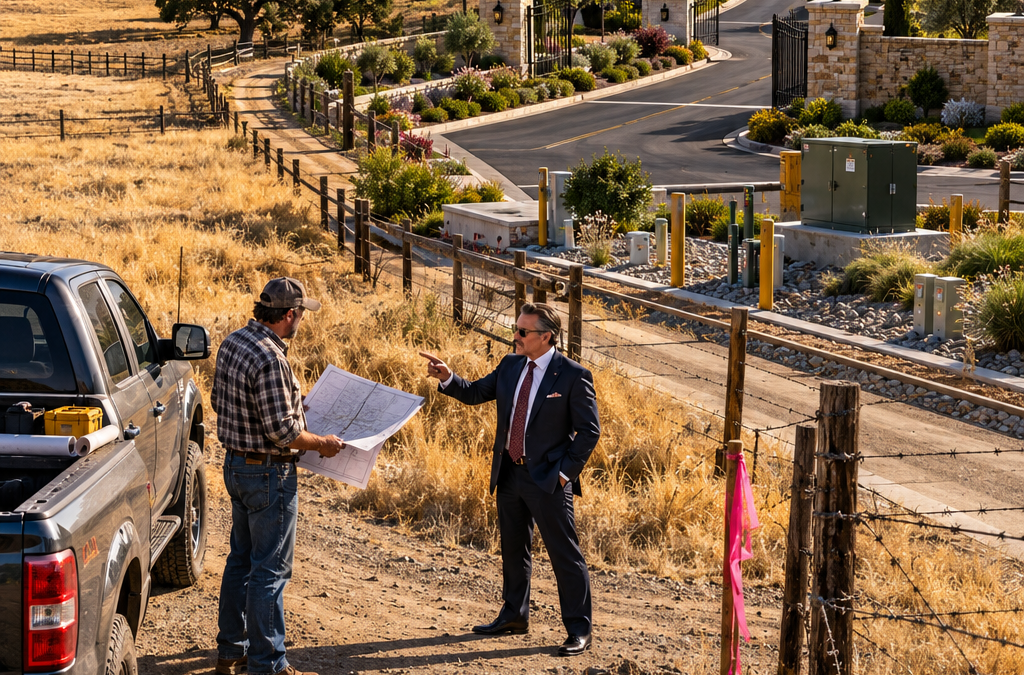
The development’s southern entrance connected to a paved section that ran directly across the old ranch access corridor.
I recognized the alignment immediately.
The gentle bend near the large oak.
The shallow drainage ditch.
The place where the ground dipped before rising toward the eastern fence.
I had driven that route with my grandfather hundreds of times.
Only now, instead of gravel and cattle tracks, there was black asphalt bordered by landscaped strips of ornamental grass.
Decorative lights lined the roadway.
A stone sign welcomed residents into Willow Creek Estates.
And a small notice near the entrance announced that the area was maintained by the homeowners association.
I stopped my truck.
For several seconds, I simply stared.
I knew that road.
More importantly, I knew where the recorded ranch boundary ran.
And if I remembered correctly, a substantial portion of that entrance corridor lay inside my grandfather’s property.
I climbed out and walked toward the pavement.
Fresh mulch covered the ground beside the road.
Irrigation lines disappeared beneath neatly trimmed shrubs.
Several utility cabinets stood near the edge of the landscaping.
Farther along, a paved pedestrian path curved toward the houses.
I looked toward the old oak tree.
It was still there.
Older.
Larger.
Its trunk scarred by decades of weather.
And suddenly I remembered my grandfather crouching beside the survey marker all those years earlier.
Never confuse what somebody uses with what somebody owns.
A cold sensation moved through my stomach.
I wasn’t ready to accuse anyone of anything.
Perhaps my grandfather had granted an easement.
Perhaps there was a recorded agreement I hadn’t seen.
Perhaps the development had purchased a narrow strip years earlier.
There were reasonable explanations.
But I needed to find one.
I returned to the ranch house before sunset.
Inside my grandfather’s study, an old metal filing cabinet stood beside his desk.
The top drawer held property records.
I knew because he had shown me that drawer countless times.
I pulled it open.
Inside were folders labeled in his unmistakable block handwriting.
DEEDS.
SURVEYS.
TAX RECORDS.
EASEMENTS.
BOUNDARY NOTES.
I carried the folders to the kitchen table.
Then I spread the documents beneath the yellow light above the sink.
The original deed was old enough that the paper had begun to discolor.
The boundary descriptions referred to landmarks, bearings, distances, and recorded survey monuments.
There were maps showing the ranch before the surrounding land had been subdivided.
I found the eastern boundary.
Then the road.
Then the parcel references.
My stomach tightened.
The development’s entrance road appeared to cross directly through land included in my grandfather’s recorded property.
And the problem didn’t stop there.
The landscaping extended beyond the roadway.
Utility corridors ran through additional portions of the ranch.
Several maintained strips that Willow Creek treated as neighborhood property appeared on the wrong side of the boundary.
I stared at the map.
Then I looked at the county parcel diagram on my laptop.
The two records supported each other.
The ranch boundary had not simply disappeared when Willow Creek Estates was developed.
The next morning, I called a licensed surveyor.
His name was Daniel Ortiz.
He had worked on agricultural boundaries throughout the region for more than twenty years.
When I explained the situation, he didn’t sound surprised.
“Old ranches and new subdivisions,” he said. “Those combinations can get complicated.”
“I need to know whether I’m reading the boundary correctly.”
“Then we’ll start with the recorded documents and find the monuments.”
“How soon can you come?”
“Tomorrow morning.”
I barely slept that night.
Every time I closed my eyes, I saw the entrance road.
The stone columns.
The utility cabinets.
The landscaped strips.
I kept imagining the possibility that an entire neighborhood had been using my grandfather’s land without anyone bothering to establish the limits of that use.
By sunrise, I was already outside.
Daniel arrived shortly after eight in a white survey truck.
He was a compact man with graying hair, weathered hands, and the quiet confidence of someone who trusted measurements more than opinions.
He studied the old deed.
Then the county records.
Then he unfolded a large map across the hood of his truck.
“Show me what concerns you.”
I pointed toward the eastern boundary.
“The subdivision entrance follows the old ranch road.”
He nodded.
“And this is the recorded property line?”
“That’s what I believe.”
He studied it.
Then looked toward the development.
“Let’s find out.”
We spent hours crossing the property.
Daniel located old survey monuments, checked recorded bearings, compared historical descriptions, and used his equipment to verify the positions.
I followed him through dry grass and under low branches.
At the old oak tree, he stopped.
He brushed away soil from a small iron marker.
I recognized it instantly.
My grandfather had shown it to me when I was a boy.
Daniel checked the coordinates.
Then looked toward the paved road.
He said nothing for several seconds.
“Is something wrong?” I asked.
He straightened.
“That road is farther inside the recorded ranch boundary than I expected.”
I looked toward the asphalt.
“How far?”
“I need to finish checking the remaining monuments before giving you a defensible number.”
He studied his equipment.
“But this isn’t looking like a minor landscaping encroachment.”
We continued.
The afternoon grew hot.
My shirt stuck to my back.
Daniel checked markers along the southern boundary, then followed the road corridor toward the utility installations.
Near one decorative stone wall, he stopped again.
He looked from his screen to the county map.
Then back toward the neighborhood.
“Who told you the HOA owned this section?”
“Nobody yet. I’m trying to establish what they actually have rights to.”
“Good.”
He glanced toward the utility cabinets.
“Because you’re going to need the easement documents, not just the boundary survey.”
By sunset, he had enough information to explain his preliminary findings.
We stood beside his truck while the hills turned orange behind us.
“The recorded ranch boundary includes portions of the subdivision’s road system, maintained landscaping, and utility corridors,” he said.
I stared at him.
“You’re certain?”
“I’m confident enough to tell you there’s a serious overlap. I’ll finish the calculations and prepare the certified drawing, but the monuments and records support what you’ve been seeing.”
I looked toward Willow Creek Estates.
Cars moved along the entrance road.
A landscaping crew was finishing work near the stone sign.
Residents walked dogs beside the neatly trimmed shrubs.
None of them knew that the ground beneath their feet had become the center of a property dispute.
“What does this mean?” I asked.
Daniel folded his map.
“It means you need to find out exactly what rights were granted over that land.”
“And if the HOA doesn’t have those rights?”
He looked at me seriously.
“Then somebody has been using your property beyond what the records authorize.”
The completed survey confirmed his preliminary findings.
The 680-acre ranch boundary remained identifiable in the recorded documents.
Sections of Willow Creek’s entrance road, landscaping areas, utility corridors, and maintained land crossed that boundary.
It wasn’t a matter of a fence being misplaced by a few feet.
The overlap involved infrastructure the community depended on every day.
I spent the next evening staring at the survey.
My grandfather had never told me that the HOA paid him for this expanded arrangement.
I found no document granting Willow Creek unlimited rights to enlarge roads, install landscaping, or occupy additional strips of land.
But I still didn’t want to jump to conclusions.
There might be easements.
There might be limited rights established when the neighborhood was first developed.
I needed to understand them before doing anything.
So I contacted the association.
The office administrator answered on the third ring.
“Willow Creek Estates Homeowners Association.”
I introduced myself and explained that I had inherited the neighboring ranch.
“I’d like to arrange a meeting with the board president concerning a property boundary issue.”
There was a pause.
“What kind of boundary issue?”
“Your association is using portions of my property for roads, landscaping, and utilities.”
Another pause.
Then her tone became more guarded.
“I’ll need to speak with the president.”
“That’s fine.”
“His name is Preston Whitcomb.”
I wrote it down.
“Please tell him I have a professional survey and the original ownership records.”
She said she would pass along the message.
The next afternoon, I received a call.
A man’s voice came through the speaker.
“This is Preston Whitcomb.”
He didn’t introduce himself beyond that.
I explained why I wanted to meet.
He interrupted before I finished.
“Are you the gentleman who inherited the old ranch?”
“Yes.”
“Then I think you’re misunderstanding how the neighborhood was developed.”
“I’d like to review the documents with you.”
A brief silence followed.
Then he gave a short laugh.
“Very well. I’ll come out tomorrow.”
He ended the call without asking whether the time worked for me.
That should have told me something.
But I still believed the problem could be solved with a straightforward conversation.
The following morning, a black luxury SUV rolled down my driveway.
It looked painfully out of place beside the old barn.
The paint was flawless.
The windows were tinted.
Chrome accents flashed in the sun.
The vehicle stopped in front of the ranch house, and a man stepped out.
He appeared to be about fifty years old, tall, broad-shouldered, and carefully groomed.
His dark hair was brushed backward with just enough silver at the temples to make him look distinguished.
He wore a tailored charcoal suit, a pale blue shirt, an expensive silk tie, and polished black shoes.
A heavy watch sat on his wrist.
He looked like a man who spent considerable time making sure people noticed his success.
He walked toward me with a practiced smile.
“Preston Whitcomb. President of Willow Creek Estates.”
He extended his hand.
I shook it.
“Thanks for coming.”
His eyes moved briefly toward the barn.
Then the house.
Then my pickup.
“Quite a property.”
“My grandfather thought so.”
Whitcomb smiled.
“Yes, well, things have changed considerably around here.”
I nodded toward the kitchen.
“I have the documents inside.”
He glanced at his watch.
“I can give you twenty minutes.”
I looked at him.
“We’ll see how far that gets us.”
His smile tightened.
Inside, I spread the certified survey across the kitchen table.
Whitcomb placed a thick leather folder beside it.
Before sitting, he examined the room with an expression I couldn’t quite identify.
Maybe curiosity.
Maybe contempt.
He looked at the old cabinets and worn table as though he expected the surroundings to explain something about my ability to challenge him.
Then he sat.
“Let’s make this efficient,” he said.
I pointed toward the survey.
“This is the current boundary of the ranch.”
He glanced at it.
“And?”
“These portions of your entrance road, landscaping, and utility corridors are inside my recorded property.”
Whitcomb leaned back.
Then laughed.
Not a surprised laugh.
A dismissive one.
“That’s what this is about?”
I stared at him.
“That’s a significant amount of land use.”
He waved one hand.
“Willow Creek has operated those facilities for years.”
“That doesn’t tell me what rights the association has.”
“The community has always used that road.”
“I know.”
“And maintained the landscaping.”
“I can see that.”
“And the utilities serve our homeowners.”
“Yes.”
He spread his hands.
“Then what’s the problem?”
I pointed to the survey.
“The problem is that the HOA is treating privately owned ranchland as though it belongs to the community.”
Whitcomb’s expression changed.
He leaned forward.
“Let me explain something. Longstanding community use establishes expectations. You can’t simply inherit a piece of property and start rewriting arrangements that have existed for years.”
“I’m not trying to rewrite anything.”
“Then why are we having this conversation?”
“Because I want to know the legal basis for the land your association occupies.”
He gave another impatient laugh.
“Young man, I’ve been president of this association for six years. I understand our property arrangements.”
“Then showing me the recorded documents should be easy.”
His eyes narrowed.
“Are you questioning my competence?”
“I’m asking for evidence.”
“You’re splitting hairs.”
“No. We’re talking about ownership and easement rights.”
Whitcomb opened his leather folder.
He removed a map showing Willow Creek’s roads, landscaped areas, and common facilities.
“There,” he said, sliding it toward me. “Our community master plan.”
I compared it with Daniel’s survey.
The HOA map showed the entrance road and adjacent landscaping as part of the development’s operating area.
It didn’t distinguish clearly between land owned by the association and land it merely used.
I pointed to the difference.
“This map shows what your neighborhood uses. It doesn’t establish what the HOA owns.”
Whitcomb’s jaw tightened.
“You’re determined to make this difficult.”
“I’m trying to make it accurate.”
He leaned back and crossed his arms.
“Let me be very clear. We have operated this neighborhood for years without interference from your grandfather.”
I felt something tighten in my chest.
“My grandfather isn’t here to explain what he permitted.”
“Exactly.”
I stared at him.
He seemed to realize how that sounded.
Then he continued.
“The point is that the community has relied on these arrangements for a very long time. You can’t appear after an inheritance and suddenly demand that everything change.”
“Did the HOA pay my grandfather for the expanded uses?”
Whitcomb blinked.
“What?”
“Did your association pay him for the landscaping strips, utility corridors, and additional occupied areas?”
He looked irritated.
“Why would we pay for land we’ve been using for years?”
I sat back.
There it was.
The assumption I had been afraid of.
To Whitcomb, the simple fact that the HOA had used land long enough made the use permanent and free.
He wasn’t interested in the difference between ownership, easement rights, and informal permission.
He believed continued convenience had become entitlement.
“Mr. Whitcomb,” I said, “longstanding use can raise legal questions, but it doesn’t automatically transfer ownership.”
He smiled coldly.
“You’ve been reading things on the internet.”
“I hired a licensed surveyor.”
“And I’m sure he told you exactly what you wanted to hear.”
“He identified the recorded property boundary.”
“Surveyors don’t run communities.”
“Neither do HOA presidents own every parcel their communities use.”
His face reddened.
For several seconds, he said nothing.
Then he leaned across the table.
“You need to think carefully about what you’re doing.”
I met his eyes.
“Meaning?”
“Willow Creek has more than a hundred homeowners. These are people with families, mortgages, investments, and expectations.”
“I understand.”
“If you start interfering with our operations, you’re going to have a serious problem.”
“I’m not proposing interference. I’m proposing that we clarify the rights.”
His voice hardened.
“Challenge this association, and you’ll regret it.”
The kitchen went quiet.
Outside, a breeze moved through the trees.
I could hear the old wind chime my grandfather had hung near the porch.
For a moment, I looked at Whitcomb and tried to imagine my grandfather sitting across from him.
He would have been furious.
But he would not have raised his voice.
He would have opened the deed.
Then asked the same question until somebody answered it.
I folded my hands.
“Are you threatening me?”
Whitcomb adjusted his tie.
“I’m explaining the consequences of irresponsible behavior.”
“By irresponsible behavior, you mean asking you to document your use of my land?”
“I mean attempting to destabilize a functioning neighborhood.”
I took a slow breath.
“I’m not trying to destabilize anything. I want a lawful agreement.”
Whitcomb stood abruptly.
“We’re finished.”
I remained seated.
“You’re welcome to have your attorney contact me.”
His mouth tightened.
“Our legal counsel will have plenty to say about this.”
He picked up his folder.
Then he looked down at the survey.
“You should be careful with claims like these. People who inherit property sometimes develop an exaggerated idea of what they control.”
That sentence stayed with me.
Not because it was clever.
Because he said it in my grandfather’s kitchen.
Standing on land my family had protected for decades.
I rose slowly.
“Mr. Whitcomb, you came here to discuss the boundary. I showed you the survey. You haven’t shown me a deed or an easement authorizing everything your association is doing.”
He walked toward the door.
I followed.
At the porch, he stopped and turned.
“One last piece of advice.”
I waited.
“Don’t interfere with Willow Creek’s roads or maintenance crews.”
“I haven’t.”
“Keep it that way.”
He stepped into the sunlight.
Then walked toward his SUV.
I watched him drive away.
For several minutes, I stood on the porch, listening to the engine fade.
I had expected a disagreement.
I hadn’t expected a man to look me in the eye and imply that inheriting my grandfather’s ranch made me less qualified to understand it.
I went back inside and looked at the survey.
The lines hadn’t changed.
Neither had the deed.
But I understood something now.
Preston Whitcomb wasn’t going to cooperate because I politely asked him to.
He saw the ranch boundary as a threat to his authority.
And he was prepared to make me pay for questioning it.
That afternoon, I called a property attorney.
Her name was Elena Ruiz.
She had spent more than twenty years handling California real estate disputes, easements, agricultural property rights, and development conflicts.
When I described the situation, she listened without interrupting.
Then she asked me to send every document I had.
Three days later, I sat across from her in a conference room.
Daniel’s survey was spread across the table.
Beside it were the original deed, county maps, recorded easements, and old ranch records.
Elena read carefully.
She didn’t make dramatic statements.
She didn’t promise that I would win some enormous lawsuit.
She simply followed the documents.
After nearly half an hour, she looked up.
“Your grandfather kept excellent records.”
“He was particular about land.”
“That may save you a considerable amount of trouble.”
She pointed toward the eastern boundary.
“The ranch ownership is well documented. The next question is the extent of the rights granted to the development or its predecessors.”
“Can the HOA claim permanent ownership because it has been using the land for years?”
“Not automatically. Longstanding use can matter under certain legal doctrines, but ownership, easements, and the scope of permitted activities are separate questions. We need to examine the actual instruments and facts.”
I nodded.
“That’s what I wanted them to do.”
She looked at the HOA map.
“This map is not enough.”
“Whitcomb thinks it is.”
“Then Mr. Whitcomb needs better advice.”
For the first time in days, I smiled.
Elena continued.
“You’re right to be concerned. But we also need to be careful about how we handle this.”
“Because of the homeowners?”
“Exactly.”
She pointed toward the road corridor.
“If this is an important entrance, hundreds of people may depend on it. Utility providers may also have rights or infrastructure interests separate from the HOA. We should not interfere with any established lawful access.”
“I don’t want to.”
“Good. Because this is an opportunity to solve a problem, not create a bigger one.”
She folded her hands.
“The cleanest outcome may be a formal land-use agreement.”
I leaned forward.
“What would that look like?”
“We identify every area the HOA legitimately needs beyond its existing recorded rights. We establish precise boundaries. We define permitted uses, maintenance responsibilities, insurance, liability, and compensation.”
“Compensation?”
“Yes. If the association wants to lease additional portions of your land for ongoing community purposes, it can negotiate reasonable rent.”
I looked at the survey.
For years, my grandfather had maintained a ranch that the neighborhood was using in ways no one had fully explained to me.
Roads.
Landscaping.
Utility corridors.
Maintenance access.
The HOA benefited from the arrangement every day.
Yet Whitcomb acted as though asking for a documented agreement was an attack.
Elena watched me.
“What are you thinking?”
“That my grandfather probably didn’t want to fight with the neighborhood.”
“That may be true.”
“But he also wouldn’t have wanted someone claiming ownership just because he was too polite to argue.”
She nodded.
“Then let’s create a proposal that respects both things.”
We spent the next week preparing it.
Daniel provided measurements for the areas in question.
Elena reviewed the recorded documents.
We separated existing access rights from the additional areas and uses that required clarification or consent.
We discussed the entrance landscaping, the utility corridors, and maintenance arrangements.
The goal wasn’t to charge people twice for rights they already legally possessed.
It was to document the expanded uses and provide a fair commercial arrangement for what the HOA actually needed.
The initial proposal was reasonable.
At least, I believed it was.
It offered continued use of the relevant portions of the ranch under clearly defined terms.
It proposed rent based on the land involved and the nature of the HOA’s use.
It addressed maintenance obligations and access.
It also made clear that I wasn’t attempting to interfere with recorded rights or create hardship for residents.
Elena sent the proposal to the association.
Then we waited.
Whitcomb rejected it almost immediately.
His response arrived by email the following afternoon.
He called the proposal an attempt to exploit the community.
He claimed the HOA had no obligation to pay for land it had historically maintained.
He accused me of trying to profit from my grandfather’s death.
I read that sentence twice.
Then I closed the laptop.
For several minutes, I stared at the wall.
My grandfather’s death.
That was the thing Whitcomb had chosen to use against me.
I could tolerate him being arrogant.
I could tolerate him misunderstanding the documents.
But accusing me of exploiting the death of the man who raised me was something else.
I called Elena.
“Did you see his response?”
“I did.”
“He thinks I’m trying to cash in on my grandfather dying.”
“I saw that.”
I could hear the anger in my own voice.
“I’m asking him to pay for additional use of property the HOA doesn’t own.”
“That’s what the proposal says.”
“And he acts like I’m extorting his neighborhood.”
Elena was quiet for a moment.
Then she said, “Don’t answer him while you’re angry.”
I looked toward the kitchen window.
Outside, the ranch stretched toward the western ridge.
“That may take a while.”
“Then take the time. We don’t need an emotional argument. We need the records.”
She paused.
“There’s something else. We’re still reviewing the historic easements. I want to make sure we haven’t missed an older instrument.”
That turned out to be the most important sentence of the entire dispute.
Two days later, Elena called again.
“I found something.”
I was checking the fence near the northern pasture.
I stopped beside an old wooden post.
“What?”
“An older recorded document connected to the original development access arrangement.”
My grip tightened around the phone.
“What does it say?”
“It’s limited.”
“Limited how?”
“It establishes a particular access arrangement under defined conditions. It does not convey ownership of the ranch to the HOA, and it doesn’t appear to grant unlimited rights over the landscaping and additional areas now being used.”
I stared toward the hills.
“Are you sure?”
“I’ve reviewed the recording information and the relevant language. We still need to reconcile it with the present improvements, but this is significant.”
She explained the instrument carefully.
The historic arrangement identified a particular access corridor associated with the early development.
It provided limited passage rights and addressed specific conditions of use.
It was not a blanket transfer of ranch acreage.
It did not make Willow Creek Estates the owner of the surrounding land.
And it did not automatically authorize every later expansion of pavement, landscaping, irrigation, maintenance operations, or utility installation beyond the rights described in the recorded documents.
The distinction was enormous.
The HOA had a legitimate basis for certain access.
But Whitcomb had been treating that limited arrangement as if it gave the association unlimited control.
He had expanded a narrow right into an entire theory of ownership.
I drove directly to Elena’s office.
When I arrived, she placed the old document beside the survey.
“Here,” she said.
I leaned forward.
The language was dated.
The formatting looked nothing like a modern development agreement.
But the meaning was clear enough.
The permitted access was described.
The conditions were specified.
The extent was limited.
I traced the relevant line with my finger.
“And the landscaping?”
“Not covered by a blanket grant in this document.”
“The additional maintenance areas?”
“Not automatically covered.”
“The expanded utility corridors?”
“Those need to be checked against their own recorded rights and utility agreements. We cannot assume the HOA has everything it claims.”
I sat back.
For the first time since discovering Willow Creek’s entrance road, I felt the problem becoming something I could actually define.
The entire ranch wasn’t mysteriously lost.
The neighborhood wasn’t entitled to everything simply because it had operated that way for years.
There were recorded rights.
There were areas beyond those rights.
And there was a lawful way to deal with the difference.
Elena looked at me.
“This changes our negotiating position.”
“How much?”
“Enough that we should prepare a more precise proposal.”
I nodded.
“Let’s do it.”
We revisited the land-use calculations.
Daniel separated the existing access corridor from the additional occupied areas.
Elena identified which uses could remain under recorded rights and which required new agreements.
We reviewed comparable local arrangements involving private land, commercial access, and long-term infrastructure use.
The more accurately we defined the HOA’s expanded use, the clearer its value became.
The updated proposal was substantially higher than the figure Whitcomb had been expecting.
Roughly twice what the association had informally set aside for the arrangement.
I knew that would make him furious.
But the number wasn’t retaliation.
It reflected a more complete assessment of the additional land and rights the HOA wanted to use.
I asked Elena one final question before sending it.
“Am I being unreasonable?”
She looked at me.
“You’re offering a negotiated lease for property interests your records support, while preserving the community’s lawful access. The price is supported by the analysis we’ve done.”
I looked toward the map.
“I don’t want to hurt the homeowners.”
“Then keep that principle in the agreement.”
She paused.
“But don’t confuse protecting them with giving their association unlimited use of your property.”
I thought about my grandfather.
He had always been generous.
He had also paid every property tax bill that arrived.
He repaired fences.
Cleared roads.
Maintained drainage.
He took responsibility for the land because it belonged to him.
And the HOA had benefited from that same land without fully acknowledging the responsibility or compensation involved.
“Send it,” I said.
The next morning, Whitcomb received the updated proposal.
He called me before lunch.
I answered while standing beside the equipment shed.
“Yes?”
His voice exploded through the phone.
“Have you lost your mind?”
I pulled the phone away from my ear.
“Good morning, Mr. Whitcomb.”
“Do not patronize me.”
“What seems to be the problem?”
“You know exactly what the problem is. This lease proposal is outrageous.”
“It’s based on the land-use analysis.”
“It’s nearly twice what we budgeted.”
“Your budget doesn’t determine what my property is worth.”
His breathing grew louder.
“You’re trying to bankrupt the association.”
“I’m offering terms for additional land use.”
“You’re attempting to destroy an established community.”
“No. I’m offering the community a way to continue operating lawfully.”
He laughed bitterly.
“You think I don’t understand what you’re doing?”
“Then tell me.”
“You’re using the fact that our roads and utilities are already in place to demand money.”
“I’m asking for a formal agreement covering uses beyond the rights already established.”
“Those facilities have existed for years.”
“That doesn’t automatically give the HOA unlimited control.”
He raised his voice.
“People depend on those roads!”
“I haven’t blocked the roads.”
“You could.”
“I’m not proposing to.”
“But you’re threatening us with a lease.”
“A lease isn’t a threat.”
“It is when you know we need the land.”
I stopped walking.
“Mr. Whitcomb, no one is forcing your board to accept my proposal.”
He went quiet.
Then I continued.
“You can review the records. You can negotiate different terms. You can ask your attorney to identify any rights you believe already exist. But you cannot demand that I ignore my ownership because your association prefers the old arrangement.”
His voice turned cold.
“You have no idea who you’re dealing with.”
I looked toward the barn.
“Actually, I’m starting to understand.”
“You’ll regret this.”
I had heard those words before.
In my grandfather’s kitchen.
Across the old table.
From a man who believed threats could settle questions that deeds had already answered.
I took a slow breath.
“Have your attorney call mine.”
Then I ended the conversation.
I stood beside the shed for several minutes.
My hands were shaking.
Part of me wanted to get back into my truck, drive to the HOA office, and tell Whitcomb exactly what I thought of him.
But I knew that wouldn’t help.
He wanted a confrontation.
Something loud.
Something emotional.
Something he could describe to residents as proof that I was dangerous or unreasonable.
I wasn’t going to give him that.
Instead, I returned to the house and placed the phone beside my grandfather’s old property folder.
Then I read the recorded access document again.
The words didn’t change.
Neither did the boundary.
Whitcomb could shout all he wanted.
The association still needed to address what the records actually allowed.
That evening, Willow Creek held an emergency HOA meeting.
I wasn’t invited.
Whitcomb had told the board that an outside ranch owner was attempting to take control of neighborhood infrastructure.
By the next morning, several residents had heard his version of the story.
I knew because one of them called me.
His name was Michael Bennett.
He lived near the southern entrance and had occasionally spoken with my grandfather.
“Can I ask you something?” he said.
“Sure.”
“Are you trying to shut down our entrance road?”
I closed my eyes.
“No.”
“Preston says you’re demanding an enormous payment or we’ll lose access.”
“That’s not what the proposal says.”
“Then what does it say?”
I explained the distinction.
The existing recorded access rights were one thing.
Additional land use beyond those rights was another.
I wasn’t blocking the lawful entrance.
I wanted the HOA to document the extra areas it occupied and pay a reasonable amount for the use it actually needed.
Michael was quiet.
Then he asked, “Did the HOA ever pay your grandfather?”
“Not for the current expanded arrangement, as far as the records I’ve found show.”
“Did the board know that?”
“I don’t know.”
He sighed.
“People are getting nervous.”
“I understand.”
“Some think you’re going to put a gate across the road.”
“I’m not doing that.”
Another silence followed.
Then he said, “Preston didn’t explain any of this.”
I looked toward the old barn.
“That’s why I’ve been asking him to show everyone the documents.”
The next evening, I attended a board meeting open to the residents.
The clubhouse was larger than I expected.
Tall windows overlooked manicured lawns.
A large stone fireplace dominated one wall.
Rows of chairs faced a long table where Whitcomb sat with the other board members.
He wore another expensive suit.
His hair was immaculate.
His watch caught the light every time he moved his hand.
When he saw me enter, his expression hardened.
I sat near the back.
The meeting began with ordinary announcements.
Landscaping.
Maintenance.
A discussion about parking restrictions.
Then Whitcomb announced the property issue.
“As many of you know,” he said, “an individual claiming ownership of portions of our community has demanded significant payments from the association.”
Several people turned toward me.
He continued.
“These demands threaten the financial stability of Willow Creek Estates and could interfere with essential services.”
A woman in the second row raised her hand.
“Is he trying to close the road?”
Whitcomb leaned toward the microphone.
“He’s attempting to place our access under his control.”
I stood.
“That’s not what I’ve proposed.”
Whitcomb looked toward me.
“Please wait until public comment.”
I sat back down.
He smiled thinly.
“As I was saying, the association has maintained these areas for many years. We consider that history important.”
A man near the front raised his hand.
“Do we own the land?”
Whitcomb paused.
“We have longstanding rights.”
“That’s not what I asked.”
Several people murmured.
The man continued.
“Does the HOA own the property under the road?”
Whitcomb adjusted his tie.
“The situation is legally complex.”
Another homeowner spoke.
“Then why haven’t we seen the deed?”
Whitcomb’s expression tightened.
“The board has relied on historical arrangements.”
“Are those arrangements recorded?”
The question came from Michael Bennett.
He stood near the aisle, holding several printed pages.
Whitcomb looked irritated.
“Michael, we’ve discussed this.”
“You told me the road belonged to the association.”
“It serves the association.”
“That’s different.”
The room grew quiet.
Michael held up the papers.
“I obtained a copy of the old access document. It doesn’t say the HOA owns the ranch.”
Whitcomb’s face changed.
“Where did you get that?”
“County records.”
A few residents leaned forward.
Michael continued.
“It describes limited access. It doesn’t say we own every landscaped area or utility corridor beyond it.”
Whitcomb raised one hand.
“That document is being reviewed.”
A woman stood.
“Did we ever pay the ranch owner?”
Whitcomb hesitated.
“The association has invested considerable money in maintenance.”
“Did we pay him?”
“We’ve maintained the property.”
The woman shook her head.
“That’s not the same thing.”
I watched the board members exchange glances.
For the first time, Whitcomb wasn’t controlling the conversation.
The residents were asking questions about deeds, recorded rights, and money.
Questions he had dismissed when I asked them.
Another homeowner stood.
“If the HOA has been using additional private land without an agreement, why haven’t we fixed it?”
Whitcomb’s jaw tightened.
“Because we didn’t believe an additional agreement was necessary.”
“Based on what?”
Silence.
Then Michael spoke again.
“Preston, you told us this man was trying to take our neighborhood. But the documents seem to say his grandfather owned the ranch long before Willow Creek existed.”
Whitcomb turned red.
“Nobody is disputing that the ranch existed.”
“Then why are we acting like the HOA gets to use whatever it wants?”
A murmur of agreement spread through the room.
Whitcomb struck the table lightly with his palm.
“Let’s maintain order.”
The room quieted.
He looked toward me.
“Since our guest is so eager to involve himself in association affairs, perhaps he’d like to explain why his proposal would impose such a heavy financial burden on our residents.”
Every face turned toward me.
I felt my pulse quicken.
This was what Whitcomb wanted.
He wanted me standing in front of frightened homeowners, defending a payment they had been told would threaten their neighborhood.
I rose slowly.
“I’ll explain.”
I walked toward the front with a copy of the survey.
Whitcomb leaned back in his chair.
His expression was almost satisfied.
I placed the document on the table.
“My grandfather owned this ranch long before Willow Creek Estates was built.”
I looked around the room.
“His recorded property boundary includes portions of your entrance roads, landscaping, utility corridors, and maintenance areas.”
Several residents leaned forward.
I continued.
“The old access document grants limited rights under specific conditions. I’m not trying to revoke those lawful rights.”
A woman raised her hand.
“So you’re not closing the road?”
“No.”
She lowered her hand.
I went on.
“But the HOA is also using additional areas of my property that aren’t automatically covered by that limited grant. My proposal would formally document the uses you need beyond your existing rights.”
Whitcomb interrupted.
“At an outrageous price.”
I turned toward him.
“The terms were calculated using the acreage involved and comparable land-use arrangements.”
“According to your attorney.”
“And a professional survey.”
He smiled coldly.
“Professionals you hired.”
“Professionals whose work you can independently review.”
The room grew quiet.
I faced the residents again.
“I don’t want your neighborhood to lose access. I don’t want utility interruptions. I don’t want a fight.”
I paused.
“But my grandfather maintained this land for generations. He paid taxes on it. He protected the boundaries. The fact that a development eventually grew beside it doesn’t mean the HOA acquired everything it found convenient.”
A man near the back nodded.
Another homeowner asked, “Could the HOA negotiate a different amount?”
“Yes.”
Whitcomb shifted in his chair.
I continued.
“That’s what negotiation means. My proposal isn’t a demand that your board accept every term without discussion.”
Michael stood.
“Then why were we told this was an ultimatum?”
Whitcomb’s face tightened.
“I was explaining the seriousness of the situation.”
Michael looked directly at him.
“You were telling us we’d lose our entrance road.”
Whitcomb opened his mouth.
Then stopped.
I looked around the room.
“The lawful access already documented isn’t something I’m proposing to block. What I want is a clear agreement for the additional uses.”
The woman who had asked about payment spoke again.
“Then why didn’t the board negotiate before calling this an attack?”
No one answered.
I looked toward Whitcomb.
He stared down at the table.
The man who had warned me that I’d regret challenging him now had an audience asking him to explain the legal basis of his authority.
He didn’t like it.
But the records had finally entered the conversation.
And once people understood the difference between ownership and convenience, his threats became much less convincing.
The meeting ended without a decision.
Whitcomb promised that the board would consult its attorneys.
Several homeowners approached me afterward.
Some were suspicious.
Others apologized for assuming I intended to close the roads.
One elderly woman took my hand.
“Your grandfather used to let us walk along the edge of his pasture.”
I smiled.
“He liked good neighbors.”
“He was a kind man.”
“He was.”
She looked toward the clubhouse.
“I don’t think he’d like the way this has been handled.”
I felt something tighten in my throat.
“No,” I said quietly. “I don’t think he would.”
I drove home that night feeling exhausted.
The dispute had become public.
Residents were nervous.
Whitcomb was angry.
And my grandfather’s ranch had somehow turned into the subject of an HOA emergency meeting.
All I had wanted was to understand what I owned.
Now I was being portrayed as a threat to people who had never done anything to me.
I knew the next step had to be careful.
The following morning, I met Daniel at the eastern boundary.
We walked the disputed areas again.
He showed me which portions were clearly inside my recorded property and how the historic access corridor related to the newer improvements.
I had professional signs prepared.
They were simple.
PRIVATE RANCH PROPERTY.
RECORDED BOUNDARY.
NO UNAUTHORIZED MAINTENANCE OR EXPANSION BEYOND ESTABLISHED ACCESS RIGHTS.
There were no insults.
No threats.
No dramatic warnings.
I placed them only where they accurately identified the private portions of the ranch without obstructing lawful travel.
The existing road stayed open.
The signs did not block any documented access.
They simply made the boundary visible.
For years, people had treated the landscaped strips and adjoining ground as though the entire area belonged to Willow Creek.
Now they could see where the private ranch began.
It felt strange putting up signs.
My grandfather had never enjoyed marking the property with warnings.
He believed most people would respect a boundary if they understood it.
I hoped he was right.
The next afternoon, three HOA maintenance workers arrived near the eastern landscaping area.
They drove a white utility truck with Willow Creek Estates printed on the doors.
One man carried a string trimmer.
Another unloaded tools.
The third began opening an irrigation control box near the private portion of the boundary.
I walked over.
“Afternoon.”
The foreman looked up.
“Afternoon.”
“What work are you doing?”
“Regular maintenance.”
He gestured toward the shrubs.
“Trimming, checking irrigation, cleaning the drainage strip.”
I nodded.
“I need you to hold off on work in this section for now.”
He frowned.
“Why?”
“This portion is inside my recorded property. We’re working with the HOA to clarify its maintenance rights.”
He glanced toward the signs.
“We’ve always maintained it.”
“I understand.”
He looked confused.
“So what’s changed?”
“The ownership hasn’t changed. The documentation is finally being reviewed.”
I showed him the survey.
He studied the boundary line.
Then looked toward the irrigation box.
“Nobody told us about this.”
“I’m not surprised.”
He turned toward the other workers.
“Hold up a minute.”
The men stopped.
I explained that the existing road access wasn’t being obstructed and that I wasn’t asking anyone to interfere with essential utilities.
I simply wanted them to avoid discretionary work on the additional private areas until the rights were clarified.
The foreman nodded.
“All right. We’ll call the office.”
“Thank you.”
He looked at the survey again.
“That’s a lot of land.”
“Six hundred and eighty acres.”
He whistled softly.
“Didn’t know the ranch went this far.”
“Neither did the HOA, apparently.”
He gave a small, uncomfortable smile.
The crew packed up the tools they hadn’t used.
They were professional.
They didn’t argue.
They didn’t threaten me.
They simply wanted to know what they were authorized to maintain.
I appreciated that.
But Whitcomb didn’t.
Less than an hour later, my phone rang.
I recognized his number.
I answered.
“Mr. Whitcomb.”
His voice was already raised.
“You ordered our maintenance crew off community property?”
“I asked them to pause work on a privately owned section while the agreement is being resolved.”
“You have no right to interfere with our contractors.”
“I showed them the survey.”
“That doesn’t give you authority over association operations.”
“It’s my land.”
He laughed bitterly.
“There it is again.”
I looked toward the road.
“What exactly do you want?”
“I want you to stop harassing our employees.”
“I didn’t harass anyone.”
“You interfered with maintenance.”
“I requested that they not perform work beyond the documented rights until we clarify the arrangement.”
Whitcomb lowered his voice.
It was the same cold tone he’d used in my grandfather’s kitchen.
“You’ve crossed a line.”
I closed my eyes.
“Mr. Whitcomb, you need to stop treating every disagreement as disobedience.”
“I’ll have the police explain the consequences.”
“You’re free to contact them.”
He gave a sharp laugh.
“Good. Because I’m done being patient.”
The call ended.
I stood beside the fence for several minutes.
My heart was pounding.
I hadn’t stopped any lawful road access.
I hadn’t damaged property.
I hadn’t threatened a worker.
Yet Whitcomb was once again presenting a boundary question as though it were an act of aggression against his authority.
I called Elena.
She listened.
Then said, “Do not move the signs or interfere with the existing access. Keep the survey and recorded documents available.”
“I already have them.”
“If deputies arrive, cooperate fully. Explain what happened. This is primarily a civil property issue.”
I looked toward the ranch road.
“He’s going to tell them I’m blocking the neighborhood.”
“Then show them that you’re not.”
She paused.
“And remember something. His confidence isn’t evidence.”
Twenty minutes later, two sheriff’s vehicles came down the eastern road.
I watched them approach.
The first stopped near my truck.
The second parked a short distance behind it.
Two deputies stepped out.
Whitcomb’s black SUV arrived moments later.
He climbed out wearing the same immaculate suit he’d worn at the meeting.
His expression was controlled.
But his eyes were hard.
He walked toward the deputies before they reached me.
“Officers. Preston Whitcomb. President of Willow Creek Estates.”
The older deputy nodded.
“I’m Deputy Harris. This is Deputy Collins.”
Whitcomb immediately began talking.
“We have a neighboring landowner attempting to interfere with our community’s access and maintenance operations.”
Harris looked toward the road.
“Is the road blocked?”
Whitcomb hesitated.
“Not physically.”
“Are vehicles able to pass?”
“Yes, but that’s not the point.”
The deputy looked at him.
“What is the point?”
“He’s asserting control over community property and ordering our maintenance crews to leave.”
Harris turned toward me.
“Sir, can you explain what happened?”
I nodded.
“This is my grandfather’s ranch. I inherited the property recently. A licensed survey confirmed that portions of the HOA’s roads, landscaping, and utility corridors cross the recorded ranch boundary.”
I held up the folder.
“We’ve also identified a historic access agreement that grants limited rights. My attorney is negotiating with the HOA about additional land use.”
Collins looked toward the signs.
“Did you place those?”
“Yes.”
“Are you preventing vehicles from using the road?”
“No.”
“Have you damaged any utilities?”
“No.”
“Did you threaten the workers?”
“No. I showed them the survey and asked them to pause discretionary maintenance in the disputed private area until the legal rights were clarified.”
The deputies exchanged a glance.
Harris turned toward Whitcomb.
“Do you have documentation showing the association owns this land?”
Whitcomb opened his folder.
“We have our master plan.”
Harris looked at it.
Then at me.
“Do you have the deed?”
I handed him a certified copy.
“And the survey.”
Collins examined the map while Harris read the recorded access document.
Neither man spoke for several minutes.
Whitcomb shifted impatiently.
“Officers, with respect, the association has operated this infrastructure for years.”
Harris looked up.
“That may be relevant to the legal rights involved. But I’m asking what the recorded documents establish.”
Whitcomb adjusted his tie.
“Our residents depend on this access.”
“I understand.”
“And this man is threatening those operations.”
I spoke quietly.
“I haven’t blocked the road.”
Harris held up one hand.
“Let’s keep this orderly.”
He turned back to the survey.
Collins pointed toward the recorded ranch boundary.
“This line runs through the landscaping strip?”
“Yes,” I answered.
“And the access corridor is shown separately?”
“Correct.”
He studied the historic agreement.
“This document provides limited access rights under specified conditions.”
“That’s my understanding.”
Collins nodded.
Then looked toward Whitcomb.
“Does the association have additional recorded rights for these landscaped areas?”
Whitcomb hesitated.
“Our attorneys are reviewing that.”
“All right.”
Harris folded the document.
“Here’s where we are. The ownership records support this gentleman’s claim to the ranch parcel. There’s a recorded access arrangement, and there are questions about the scope of other uses.”
Whitcomb leaned forward.
“So you’ll tell him to stop interfering?”
Harris shook his head slightly.
“This is primarily a civil property matter.”
Whitcomb’s expression changed.
“What?”
“We’re not going to decide the scope of easement rights at the roadside.”
“But he’s ordered our employees away.”
“He’s explained that he asked them to pause work on an area he claims is beyond the recorded rights. Nobody has reported violence, damage, or a blocked road.”
Whitcomb’s face reddened.
“The HOA has authority over its community.”
“That doesn’t automatically establish ownership of land outside its recorded property.”
Whitcomb stared at him.
For the first time, the polished confidence disappeared.
He looked like a man who had made a phone call expecting immediate obedience and discovered that the law required something more substantial.
Harris continued.
“Both parties should follow the recorded agreements and resolve the disputed uses through their attorneys or the appropriate civil process.”
Whitcomb pointed toward me.
“So you’re taking his side?”
“No.”
“Then why aren’t you making him remove those signs?”
“Because the records we’ve reviewed indicate that the signs identify private property, and they aren’t blocking established access. If there’s a legal dispute about their placement or effect, that needs to be addressed through the proper process.”
Whitcomb opened his mouth.
Then closed it.
Collins handed back the survey.
“Nobody is being arrested today.”
I nodded.
“Thank you.”
He looked toward the entrance road.
“Keep it open for lawful access. Don’t interfere with utilities. And don’t let this turn into a physical confrontation.”
“I won’t.”
Harris turned toward Whitcomb.
“The same goes for the association. If you believe your maintenance rights extend beyond what’s documented here, have your attorney address it.”
Whitcomb stood silently.
His jaw was tight.
His hands were clenched at his sides.
He had threatened me with the police.
But the deputies weren’t going to force me off land recorded in my name.
They weren’t going to turn his HOA map into a deed.
And they weren’t going to use criminal enforcement to settle a civil disagreement about property rights.
The deputies returned to their vehicles.
I watched the patrol cars disappear down the road.
Then I turned back.
Whitcomb was still standing beside his SUV.
For several seconds, neither of us spoke.
Finally, he said, “You’ve made an enormous mistake.”
I looked at him.
“By showing the sheriff the deed?”
“By turning a cooperative community arrangement into a legal war.”
“I offered you a lease.”
“At an absurd price.”
“I offered to negotiate.”
He stepped closer.
“You know what’s going to happen now? Our attorneys will spend months dealing with this. Residents will be angry. The board will have to explain expenses. All because you decided your inheritance was worth more than our community.”
I felt my patience thinning.
“My grandfather paid taxes on this land for decades.”
Whitcomb stared at me.
“He maintained roads and fences. He protected the boundaries. He allowed people to use parts of the property without treating every neighbor as an enemy.”
I took a step closer.
“And now you’re standing here telling me I’m destroying the community because I asked your HOA to put its expanded land use in writing.”
Whitcomb’s face hardened.
“Don’t lecture me.”
“Then stop threatening me.”
He looked startled.
I continued.
“You came to my grandfather’s kitchen and warned that I’d regret challenging you. You rejected a reasonable proposal without reviewing the documents. You told residents I wanted to shut down their neighborhood. And today you called the police because maintenance workers agreed to pause work on land whose use is disputed.”
He opened his mouth.
I didn’t let him interrupt.
“I’m not taking Willow Creek away from anybody. I’m not closing your roads. I’m not cutting off utilities.”
I pointed toward the ranch behind me.
“But I’m not giving you unlimited rights over six hundred and eighty acres because you think being HOA president means nobody can tell you no.”
His expression turned icy.
For several seconds, he looked directly into my eyes.
Then he said quietly, “This isn’t finished.”
I nodded.
“No. It isn’t.”
He climbed into his SUV.
The engine started.
Then he drove away.
I watched the dust settle behind him.
For the first time since the dispute began, I felt something close to fear.
Not fear of Whitcomb’s threats.
Fear of the possibility that he would rather spend the association’s money fighting than admit he had misunderstood the property records.
I had inherited the ranch only recently.
There were still repairs to make.
Taxes to pay.
Fences to maintain.
I didn’t have unlimited resources.
And now I was facing an HOA with lawyers, a board, and more than a hundred homeowners who might believe I was responsible for threatening their access.
That night, I sat alone at the kitchen table.
My grandfather’s old deed lay open in front of me.
I traced the boundary line with one finger.
I thought about walking away from the dispute.
Letting the HOA keep using everything.
Avoiding the legal fees.
Avoiding the stress.
Avoiding another confrontation with Whitcomb.
Then I thought about what that would mean.
If I allowed the association to act as though the entire disputed area belonged to it, what would happen in ten years?
Would the landscaping expand farther?
Would another road be widened?
Would the board install new utilities without asking?
Would some future president point to Whitcomb’s decisions as proof that the ranch owner had surrendered all control?
My grandfather had spent a lifetime maintaining those boundaries.
I couldn’t let them become meaningless because I was exhausted.
The next morning, I called Elena.
“Let’s finish this properly.”
She didn’t sound surprised.
“I was hoping you’d say that.”
Her office sent the association a formal notice.
It explained the recorded ranch boundary.
The historic access rights.
The areas requiring additional agreement.
The survey findings.
And the proposed lease structure.
There were no insults.
No threats to shut down roads.
No demands that homeowners suffer.
Just a clear statement of the property interests and the lawful options for resolving the dispute.
This time, the notice went directly to the HOA’s legal counsel.
That changed the conversation.
A week later, Elena called me.
“The association’s attorney has reviewed the records.”
“And?”
“They understand that Whitcomb’s position is broader than the documentation supports.”
I leaned against the kitchen counter.
“Are they willing to negotiate?”
“They want a formal meeting.”
For several seconds, I didn’t answer.
Then I looked toward the hills beyond the window.
“Set it up.”
The negotiation took place in a conference room near Willow Creek.
I arrived with Elena.
Whitcomb was already there, sitting beside the association’s attorney and two board members.
He wore a perfectly fitted dark suit.
His hair was slicked neatly back.
A gold watch rested against his cuff.
But there was something different about him.
He didn’t smile when I entered.
He didn’t extend his hand.
And he didn’t begin with a lecture.
The association’s attorney opened the meeting.
“We’ve reviewed the certified survey and recorded access documents.”
Elena nodded.
“Then we can focus on the rights that actually exist.”
The attorney placed several maps on the table.
“The association acknowledges that portions of its maintained areas lie within the ranch property.”
Whitcomb shifted in his chair.
I watched him.
For weeks, he had refused to acknowledge even that much.
Now his own lawyer had said it aloud.
The attorney continued.
“Our client wishes to preserve lawful access and maintain essential infrastructure without creating unnecessary disruption for residents.”
“That’s consistent with our objective,” Elena said.
Whitcomb finally spoke.
“The community cannot operate with constant uncertainty over access.”
I looked at him.
“Neither can the ranch.”
His jaw tightened.
But he didn’t interrupt.
Elena placed our revised land-use exhibit on the table.
“We’re proposing clearly defined areas for the HOA’s additional use, with terms addressing maintenance, insurance, permitted activities, improvements, and compensation.”
The association’s attorney studied the document.
“Some of these maintenance provisions are more restrictive than our client expected.”
“They’re intended to prevent further expansion without consent.”
One board member leaned forward.
“What happens if we need to repair a utility line?”
Elena answered.
“Existing lawful utility rights remain subject to their terms. The lease can provide procedures for maintenance and emergency access in the additional areas it covers.”
The board member nodded.
“That sounds reasonable.”
Whitcomb looked toward him sharply.
But the man continued studying the agreement.
Another board member asked about landscaping.
I answered.
“I don’t object to the neighborhood maintaining the areas it legitimately leases. I just want the limits documented.”
“And if we want to change something?”
“Then the agreement should tell us how to request approval.”
The board member looked toward the attorney.
“That seems manageable.”
Whitcomb leaned back.
His expression was sour.
He had spent weeks framing the issue as a battle for control.
Now the discussion sounded like an ordinary business negotiation.
Measurements.
Responsibilities.
Insurance.
Access.
Rent.
Nothing dramatic.
Nothing personal.
Just people defining rights they should have documented years earlier.
Then we reached the financial terms.
The association’s attorney cleared his throat.
“Our client considers the proposed amount high.”
Elena nodded.
“We anticipated that concern.”
He pointed to a table.
“We would like to discuss the valuation assumptions.”
For the next hour, we did exactly that.
We reviewed acreage.
The value of continued infrastructure use.
Maintenance obligations.
Comparable land arrangements.
The difference between existing recorded access and newly leased areas.
Whitcomb interrupted several times.
Each time, his attorney redirected the conversation toward the actual terms.
Finally, Whitcomb leaned forward.
“I still believe the ranch owner is taking advantage of the association’s position.”
I looked at him.
“I’m not forcing your board to accept anything.”
“You know we need these areas.”
“Then we should agree on a fair way to use them.”
“You could simply allow the existing arrangement to continue.”
I thought about my grandfather.
Then I answered quietly.
“That’s what happened for years. It left everyone relying on assumptions instead of clear documentation.”
Whitcomb opened his mouth.
I continued.
“And those assumptions brought sheriff’s deputies to my property.”
He went silent.
The room felt heavy.
I looked around the table.
“I want to make something clear.”
Everyone turned toward me.
“I didn’t inherit this ranch to fight a homeowners association.”
I placed one hand on the survey.
“My grandfather spent his life taking care of this place. When he died, I thought my biggest responsibility would be repairing fences and keeping the pastures healthy.”
I paused.
“Instead, I discovered that your neighborhood was using portions of the property under arrangements nobody could fully explain.”
One board member lowered his eyes.
“I could have reacted badly. I could have started demanding that every activity stop. But I didn’t.”
I looked toward Whitcomb.
“I kept the lawful access open. I cooperated with the surveyor, attorneys, and deputies. I made a proposal.”
Whitcomb stared at the table.
“I’m not asking your homeowners to pay for something they already legally own. I’m asking the association to pay fairly for additional rights it wants over land that remains mine.”
The association’s attorney nodded slowly.
“Understood.”
I continued.
“If we can agree on that principle, the rest is business.”
For several seconds, nobody spoke.
Then the older board member leaned forward.
“I think we should finish the negotiation.”
Whitcomb glanced at him.
But the man didn’t back down.
“We’ve spent enough time arguing about whether the problem exists. It does. Let’s solve it.”
That was the moment the dispute truly changed.
Not when the survey was completed.
Not when the deputies arrived.
Not even when the HOA’s attorney acknowledged the boundary.
It changed when the board stopped treating cooperation as surrender.
We negotiated for several more hours.
Not everything was easy.
The association wanted flexibility for maintenance.
I wanted protection against further expansion without approval.
They wanted predictable costs.
I wanted fair compensation and clear responsibilities.
There were disagreements about how certain shared-use areas should be handled.
There were questions about future road repairs, drainage work, and utility access.
But this time, the disagreements stayed focused on the documents.
Nobody threatened me.
Nobody called the police.
Nobody accused me of destroying the neighborhood.
We had another meeting the following week.
Then additional discussions between the attorneys.
Finally, the terms came together.
The HOA would pay for the additional land-use rights it needed under a formal commercial lease.
The leased areas would be precisely identified by survey.
Existing recorded rights would be respected rather than improperly charged as new rights.
Maintenance responsibilities would be written down.
Future improvements beyond the agreement would require the appropriate approval.
The association would remain responsible for its authorized operations.
My ranch would remain private property.
And the neighborhood would retain the access it legitimately needed.
The final agreement wasn’t exactly my first proposal.
Negotiations rarely work that way.
Some provisions changed.
The payment structure was refined.
Maintenance responsibilities were adjusted.
Both sides made practical concessions.
But the central principle remained.
Willow Creek could no longer treat convenience as ownership.
And I would no longer be expected to accept undefined use of my grandfather’s land simply because the association had become accustomed to it.
The day we signed the agreement, I arrived early.
Elena was already seated at the conference table.
She looked up.
“Ready?”
I glanced at the documents.
“More than ready.”
The association’s representatives arrived a few minutes later.
Whitcomb came last.
His suit was immaculate.
His shoes polished.
His expression carefully controlled.
But he didn’t look at me with the same contempt he’d shown in my grandfather’s kitchen.
He sat down quietly.
The attorneys reviewed the final terms.
Each document was checked.
Each exhibit was confirmed.
Then the signature pages were passed around.
When it was my turn, I looked at the agreement for several seconds before picking up the pen.
I thought about the old survey marker beneath the oak.
The paved entrance road.
The first morning I realized something was wrong.
Whitcomb’s laughter.
The threats.
The emergency meeting.
The sheriff’s vehicles.
The nights I had spent wondering whether protecting the ranch would cost more than I could afford.
Then I signed.
The pen moved smoothly across the paper.
My name appeared beneath the agreement.
For a moment, I simply stared at it.
There was no applause.
No dramatic announcement.
No sudden transformation in Whitcomb’s personality.
But something important had happened.
The uncertainty had become an agreement.
The dispute had become a business relationship.
And the property rights my grandfather had protected were finally being treated with the seriousness they deserved.
The association’s attorney collected the signed copies.
“We’ll proceed with the required recording and implementation steps.”
Elena nodded.
“Thank you.”
Whitcomb rose.
He adjusted his jacket.
Then looked toward me.
“I hope this satisfies you.”
I met his eyes.
“It resolves the issue.”
He gave a small, stiff nod.
For a second, I thought he might say something else.
Perhaps an apology.
Perhaps an acknowledgment that his threats had been unnecessary.
He didn’t.
He turned and left.
I watched the conference room door close behind him.
Then Elena handed me my copy of the agreement.
“Well,” she said, “you now have a properly documented arrangement.”
I looked down at the papers.
“Something we should have had years ago.”
“Probably.”
I smiled faintly.
“My grandfather would’ve liked that.”
Elena nodded.
“I suspect he would.”
The first payment arrived after the agreement took effect.
It wasn’t a fortune.
It didn’t suddenly make me wealthy.
But when I saw the payment recorded, I sat at my kitchen table for a long time.
The amount represented something larger than money.
For generations, my family had protected that land.
My grandfather had paid taxes on it.
Maintained it.
Turned down offers to sell it.
And preserved the documents proving where it began and ended.
Now a neighboring association was formally acknowledging the value of the rights it needed.
The payment wasn’t a reward for fighting.
It was compensation under a lawful arrangement.
There was a difference.
I opened the old property folder.
The original deed lay near the top.
Beside it, I placed a copy of the signed agreement.
Two generations of documents.
One establishing what my grandfather owned.
The other establishing how part of that land could be used without pretending ownership had changed.
I thought about the afternoon he had shown me the old survey marker.
I could still hear his voice.
Never confuse what somebody uses with what somebody owns.
He had understood something that Preston Whitcomb had needed months, lawyers, and a visit from the sheriff to appreciate.
A property line wasn’t an act of hostility.
It was a starting point for respecting another person’s rights.
After the agreement, the atmosphere around Willow Creek changed.
The maintenance crews knew exactly where they were authorized to work.
The association had clear procedures for additional improvements.
The utility corridors were addressed according to the applicable documented rights.
Residents continued using their roads.
Landscaping crews maintained the agreed areas.
And my ranch remained mine.
The private boundary signs stayed where they were needed.
They no longer felt confrontational.
They were simply markers.
Like the old iron monuments my grandfather had shown me.
One afternoon, I saw the same maintenance foreman who had stopped work during the dispute.
He was trimming shrubs near the leased landscaping area.
When he noticed my truck, he waved.
I pulled over.
“Afternoon.”
He smiled.
“Afternoon. Looks like we finally know where we’re supposed to work.”
I laughed.
“That’s the idea.”
He gestured toward the survey markers.
“Office gave us the new maintenance map. Clear as day.”
“Good.”
He shook his head.
“Would’ve saved everyone a lot of trouble if we’d had that from the beginning.”
I looked toward Willow Creek.
“Yes. It would.”
He returned to his work.
I drove on.
The road was open.
The residents were going about their day.
No one was standing beside the entrance demanding that I explain why I was driving near my own property.
The conflict had become ordinary.
And that was exactly what I wanted.
Several weeks later, Michael Bennett stopped by the ranch.
He brought a small bag of peaches from a tree in his backyard.
I invited him onto the porch.
We sat looking across the western pasture while the afternoon breeze moved through the grass.
“Things seem calmer,” he said.
“They are.”
He took a sip of water.
“People were worried for a while.”
“I know.”
“Preston made it sound like we were going to lose everything.”
I looked toward the eastern ridge.
“I never wanted that.”
Michael nodded.
“I think most people understand that now.”
We sat quietly.
Then he looked at me.
“Can I ask you something?”
“Sure.”
“Why didn’t you just let it go? The HOA had been using the land for years. You probably could’ve avoided a lot of trouble.”
I thought about the question.
It was fair.
There had been moments when I asked myself the same thing.
I could have ignored the overlap.
Kept the ranch.
Let the neighborhood continue using everything.
Avoided the legal fees.
Avoided Whitcomb.
Avoided the meetings and deputies.
For a while, that might have seemed easier.
But easier wasn’t always safer.
“My grandfather spent his life making sure this place stayed in the family,” I said.
Michael listened.
“He kept the deed. Checked the markers. Maintained the roads. Paid the taxes. If I inherited all that and then ignored people treating the ranch like it belonged to them, I wouldn’t be protecting what he left me.”
Michael nodded slowly.
“So it wasn’t just about rent.”
“No.”
I looked across the pasture.
“The rent matters. It’s fair compensation. But the bigger thing is knowing exactly what everyone has the right to do.”
He smiled faintly.
“That makes sense.”
We sat for a while longer.
Then he stood.
“Well, I’m glad we worked it out.”
“So am I.”
He shook my hand.
Then drove back toward Willow Creek.
I watched his truck disappear beyond the trees.
For the first time since inheriting the ranch, the neighboring development no longer felt like a threat.
It was simply a neighborhood.
People lived there.
They drove to work.
Raised children.
Maintained lawns.
Walked dogs.
And used certain parts of my property under rights everyone now understood.
That was all it ever needed to be.
By late summer, the ranch had settled into a routine.
I repaired the northern fence.
Graded part of the old access road.
Cleared brush near the creek.
Replaced several boards on the barn.
Ordinary work.
The kind my grandfather would have approved of.
One evening, I drove toward the eastern boundary just before sunset.
The hills were turning gold.
Long shadows stretched across the pasture.
Dust rose behind my truck as I followed the ranch road toward the old oak tree.
I stopped near the survey marker.
The same one my grandfather had shown me when I was eleven.
I climbed out and walked toward it.
The marker was still there.
Its iron top was dark with age.
Grass grew around its base.
I crouched beside it and brushed away the dirt.
Then I looked toward Willow Creek Estates.
The stone entrance stood in the distance.
Cars moved along the road.
Landscape lighting was beginning to glow.
Everything looked peaceful.
And for the first time, I could look at the neighborhood without feeling anger tighten my chest.
I knew the boundary.
The HOA knew the boundary.
The maintenance crews knew where they could work.
The attorneys had documented the rights.
The payments were being made.
No one needed to argue about what had once been assumed.
I rested one hand on the old marker.
I remembered my grandfather standing beside me in the summer heat.
His old work shirt.
His sunburned neck.
The folded map in his hand.
I remembered telling him that property lines were boring.
He had laughed.
“Maybe,” he said. “But someday you’ll be glad somebody cared enough to mark them.”
I smiled at the memory.
He had been right.
Again.
For a long time, I stayed beside the oak.
I thought about Preston Whitcomb.
His expensive suits.
His carefully controlled voice.
His belief that years of association use entitled him to dictate what happened on my ranch.
He had tried to turn a reasonable request for documentation into a confrontation about power.
When I asked questions, he threatened me.
When I offered a proposal, he rejected it.
When residents began examining the records, he accused me of trying to destroy their community.
And when I marked my private boundary, he called the police.
But none of those actions changed the deed.
None changed the survey.
None expanded the old access rights.
He had mistaken the authority to manage a neighborhood for the authority to control land his association didn’t own.
And that mistake had nearly turned a solvable property issue into a destructive legal fight.
In the end, his board had a choice.
Keep arguing over assumptions.
Or negotiate from the actual records.
Fortunately, they chose the second.
I stood and looked across the pasture.
Six hundred and eighty acres.
That was what my grandfather had left me.
But the longer I owned the ranch, the more I realized that the number itself wasn’t what mattered.
It was the history beneath it.
The long summers.
The fences repaired in winter rain.
The roads maintained before sunrise.
The stubborn refusal to sell everything simply because developers offered enough money.
The idea that land should be cared for rather than treated as something to control for the sake of appearances.
My grandfather had never wanted to make enemies out of his neighbors.
He also never believed that generosity meant surrender.
I finally understood the balance.
I could respect Willow Creek’s legitimate needs without allowing its HOA to claim unlimited rights.
I could negotiate a commercial agreement without becoming greedy.
I could protect my property without threatening the families who lived beside it.
And I could insist on the truth without needing revenge against the man who had tried to intimidate me.
The sun sank lower.
A warm breeze moved through the dry grass.
In the distance, a hawk circled above the ridge.
I walked back to my truck.
Before climbing in, I turned toward the old oak one last time.
“Kept the lines straight, Grandpa,” I said quietly.
The wind moved through the branches.
I smiled.
Then I drove home.
That night, I placed the signed land-use agreement in the same filing cabinet where my grandfather had kept the original deed.
I closed the drawer.
For the first time since inheriting the ranch, I no longer felt as though I was waiting for the next threatening letter.
There was no need to argue with the HOA president.
No reason to stand beside a sheriff’s vehicle explaining the same boundary again.
No uncertainty about which areas the association could legitimately maintain under the new arrangement.
The ranch remained private.
The community retained its lawful access.
And the expanded uses were finally governed by a clear agreement with fair compensation.
Nothing about the resolution required anyone to lose their home.
Nothing required the neighborhood to shut down.
Nothing required me to surrender my grandfather’s property.
It only required everyone to recognize that ownership and convenience were not the same thing.
The following morning, I woke before sunrise.
I poured coffee into my grandfather’s old mug and carried it onto the porch.
The sky was pale above the western hills.
The barn stood quietly beyond the yard.
A thin layer of mist rested over the lower pasture.
Somewhere near the creek, birds were beginning to call.
I sat in the old wooden chair beside the door.
It creaked beneath me.
My grandfather had sat there almost every morning of his life.
I could still picture him watching the ranch wake up, making mental notes about fences and cattle and whatever equipment needed repair.
He never spoke much about leaving a legacy.
He simply did the work.
Day after day.
Year after year.
And when his time came, he left me something more valuable than a bank account.
He left me a place worth defending.
I looked toward the eastern boundary.
Beyond the hills, Willow Creek Estates was waking up too.
People were driving to work.
Children were getting ready for school.
Maintenance crews would soon begin their rounds.
And the association would use the land it had agreed to lease under terms everyone could understand.
That thought no longer bothered me.
It felt right.
For years, the HOA had operated under assumptions.
Now it operated under an agreement.
For years, portions of my grandfather’s ranch had been treated like convenient extensions of the neighborhood.
Now their ownership and permitted uses were documented.
And for months, Preston Whitcomb had insisted that challenging his authority would bring consequences.
He had been right about one thing.
There were consequences.
Just not the ones he expected.
The HOA had to acknowledge the recorded boundaries, negotiate fair terms, and pay for the additional rights it wanted.
I had to learn how to protect my inheritance without allowing anger to dictate every decision.
And the residents learned that the most useful question in a property dispute wasn’t who had been using the land the longest.
It was who owned it, what rights had actually been granted, and what agreement was needed for everyone to move forward.
I took a sip of coffee.
The sun rose above the hills.
For the first time in months, I wasn’t thinking about Whitcomb.
I wasn’t thinking about lawyers.
I wasn’t thinking about emergency HOA meetings or deputies standing beside the entrance road.
I was thinking about repairing the old fence near the creek.
About whether the barn roof would survive another winter.
About the work my grandfather would have expected me to do.
Ordinary things.
Important things.
The ranch was still there.
The boundaries were still there.
And the promise I’d made to myself after his funeral—to protect what he had trusted me with—was still intact.
I set the coffee mug on the porch railing and watched the morning light spread across the pasture.
Six hundred and eighty acres had brought me a problem I never expected.
But they had also taught me something I would never forget.
A man’s authority ends where his legal rights end, no matter how expensive his suit is or how confidently he gives orders.
And sometimes the strongest way to defend what belongs to you isn’t to lock a gate, raise your voice, or threaten your neighbors.
Sometimes it’s to unfold an old survey, point to the recorded boundary, and refuse to let anyone pretend the line isn’t there.
My grandfather had known that all along.
Now I did too.
And as the sunlight reached the old barn, I finally understood why he had spent so many years keeping those property records safe.
He wasn’t preserving paper.
He was preserving the truth about the land he loved.
And that truth was still ours.








