𝗙𝗨𝗟𝗟 𝗦𝗧𝗢𝗥𝗬 The HOA President Threatened to Have Me Arrested for Living in My Abandoned Mountain Lodge and Swore He Would Take the House Away
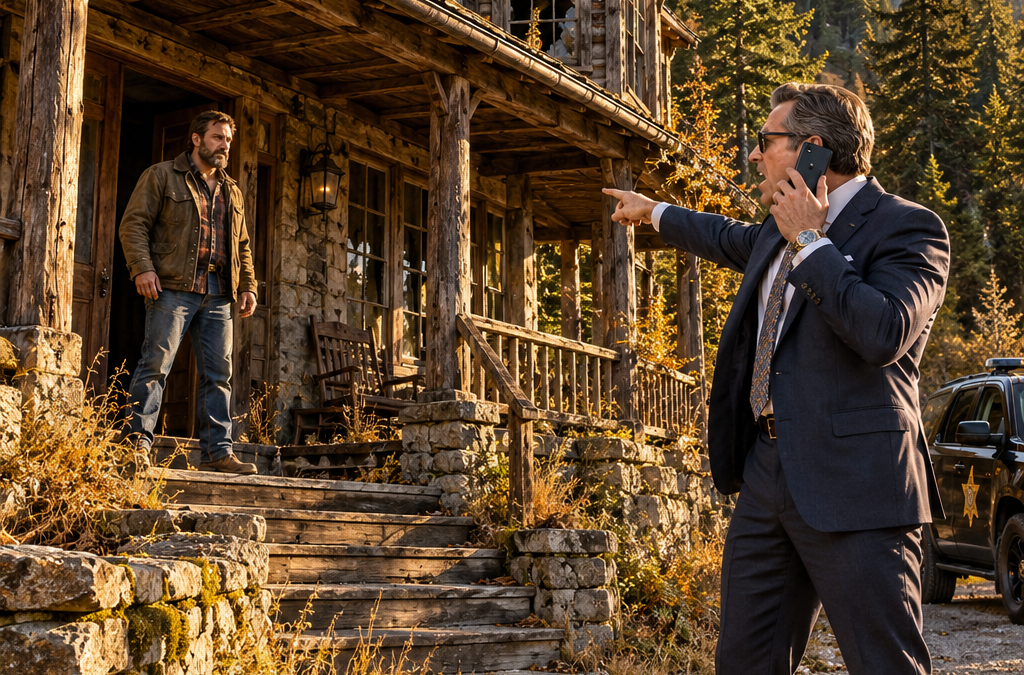
𝗙𝗨𝗟𝗟 𝗦𝗧𝗢𝗥𝗬
I stepped out.
The mountain air was cool and carried the scent of pine needles and damp earth.
Somewhere below the property, water moved over rocks.
There was no traffic noise.
No construction equipment.
No voices.
Just wind in the trees.
I stood there looking at the lodge, and for the first time in years, I could imagine myself staying somewhere.
Inside, the house was every bit as neglected as the agent had warned.
Dust covered the floors.
A water stain spread across the ceiling near the upper staircase.
The kitchen cabinets were scratched, and the old refrigerator had been unplugged so long that I didn’t want to know what had once been inside it.
A few windows were cracked.
The stone fireplace needed inspection before anyone could safely use it.
But the main structural members appeared sound.
The staircase was solid.
The foundation showed no obvious major movement.
And the great room was magnificent.
Exposed cedar beams crossed a high ceiling. A broad stone chimney rose along one wall. Through the dirty windows, the mountains seemed close enough to touch.
I stood in that room for a long time.
The agent watched me.
“Well?”
I ran my hand over one of the timber posts.
“Somebody loved this place once.”
She looked around.
“That was a long time ago.”
“Doesn’t mean it can’t happen again.”
I knew the renovation would consume months of work and a substantial amount of my savings.
I also knew I wanted the house.
After the inspection, I made an offer.
Then I did something that would later prove more important than any repair I made.
I checked the ownership records carefully.
The property was located near a wealthy residential development called Summit Pines Estates, a private mountain community with guarded entrances, landscaped roads, and vacation homes worth several million dollars.
The lodge sat outside the developed neighborhood on a separate parcel, near the eastern boundary.
I specifically asked the title company whether the property was subject to the neighboring homeowners association.
The documents available for closing identified the lodge as a separate privately owned tract.
I reviewed the legal description, the chain of title, the recorded access arrangements, and the seller’s authority to convey the property.
Nothing established that the HOA owned the lodge.
The seller had moved away years earlier, but moving away hadn’t ended his ownership.
He still held title.
He could legally sell the house.
And after the closing, I would legally own it.
The transaction was completed on a Thursday afternoon.
I signed more papers than I cared to count.
When the closing agent finally handed me the keys, I stared at them for several seconds.
Two ordinary brass keys on a faded leather tag.
Nothing remarkable.
Yet they represented everything I had been working toward.
For the first time in my adult life, I owned a house I intended to keep.
That evening, I loaded my pickup with tools, cleaning supplies, a folding bed, a coffee maker, and the first few boxes of my belongings.
I slept badly because I was excited.
The following morning, I left before sunrise.
By the time I reached the lodge, pale light was spreading across the mountain peaks.
I parked beside the porch and got out.
The house looked even better than I remembered.
Or maybe I was just seeing it differently.
It was mine now.
I unlocked the front door, stepped inside, and stood quietly in the great room.
“Well,” I said aloud, “looks like we’re stuck with each other.”
The building creaked softly in the morning cold.
I decided that counted as agreement.
I spent the first few hours carrying boxes inside.
The kitchen supplies went into the least damaged cabinets. My tools went into a temporary workspace near the back entrance. I set up a folding bed in a downstairs room where the windows were intact.
I was unloading another box when I heard a vehicle coming up the driveway.
A black Mercedes SUV emerged between the trees.
It was polished so perfectly that the surrounding forest reflected across its doors.
The SUV stopped beside my old pickup.
A man stepped out.
He was about fifty, with slicked-back black hair, a carefully shaped beard, and the kind of artificial perfection that comes from spending considerable time and money on personal appearance.
He wore tailored charcoal trousers, a fitted navy jacket, an expensive white shirt, and polished leather shoes that looked ridiculous on a muddy mountain driveway.
A heavy gold watch rested against his cuff.
He removed his sunglasses slowly.
Then he looked at my truck.
My boxes.
The open front door.
And finally, me.
“You bought this?”
There was no greeting.
No introduction.
Just three words delivered with obvious disbelief.
I set the box on the porch.
“Good morning.”
He didn’t respond.
“Did you purchase this property?”
“Yes.”
“When?”
“Yesterday.”
His expression changed.
He looked toward the lodge again.
“That shouldn’t have happened.”
I frowned.
“What shouldn’t have happened?”
“The sale.”
I stared at him.
“Do I know you?”
He straightened his jacket.
“Hoa Karen. President of the Summit Pines Homeowners Association.”
He said it like I was supposed to recognize the title and immediately become nervous.
I held out my hand.
“Ethan Walker.”
He barely touched it.
Then he looked toward the house.
“I’m surprised anyone authorized the transfer.”
“Why?”
“Because this property has been under our community’s oversight for years.”
I glanced at the surrounding trees.
“Your neighborhood is on the other side of the road.”
“Our jurisdiction is more complicated than simple road boundaries.”
“All right. What exactly are you saying?”
He folded his hands in front of him.
“I’m saying this lodge has been considered community property since the previous owner abandoned it.”
For a moment, I honestly thought he was joking.
I smiled.
Then I noticed he wasn’t smiling back.
“Community property?” I repeated.
“Correct.”
“As in, your HOA owns my house?”
“That’s essentially the situation.”
I looked toward my pickup, where the closing folder sat on the passenger seat.
Then I looked back at him.
“Mr. Karen, this house was sold by its legal owner through a title company. The deed is recorded. I have the closing papers.”
His expression remained calm.
“Documents can be misleading.”
“Not when they establish actual ownership.”
He gave a small, patronizing laugh.
“You’re new here, Mr. Walker. I wouldn’t expect you to understand how this community operates.”
I felt the first irritation settle into my chest.
“I understand how buying property operates.”
“Then you should understand that abandoned properties can create complicated community obligations.”
“Obligations aren’t ownership.”
His smile thinned.
“The association has treated this lodge as a community asset for years.”
“Did the previous owner transfer it to the HOA?”
Karen hesitated.
“The building has been vacant.”
“That’s not what I asked.”
His jaw tightened.
I continued.
“Do you have a deed showing the association owns it?”
He removed his sunglasses again, although they were already in his hand.
A small gesture, but one that seemed designed to give him time to regain control.
“We have governing documents.”
“Then bring them over. I’ll look at them.”
He stared at me.
“You don’t seem to appreciate the seriousness of this situation.”
“I appreciate it. You’re standing in my driveway telling me your association owns a house I purchased yesterday. That’s pretty serious.”
His expression hardened.
“Until the board reviews this transaction, you should refrain from moving in.”
I looked toward the boxes already inside.
“That’s not happening.”
He blinked.
“Excuse me?”
“I’m moving in. I’m going to repair the house. And I’m going to live here.”
His voice dropped.
“You need to be very careful how you proceed.”
I folded my arms.
“Are you threatening me?”
“I’m advising you.”
“Then here’s some advice in return. Before accusing someone of occupying your property, make sure you actually own it.”
For the first time, the polished smile disappeared completely.
He looked at me with open contempt.
“I see you’re going to be difficult.”
“No. I think you’re confusing disagreement with disobedience.”
His face reddened.
He stepped closer.
“You have no idea how much influence this association has.”
I stayed where I was.
“And you have no idea how little that matters without legal authority.”
For several seconds, we stared at each other.
Then Karen straightened his jacket and returned to his Mercedes.
As he opened the driver’s door, he looked back.
“You’ll hear from us.”
I watched him drive away.
Then I picked up my box and went inside.
I told myself the matter would end as soon as someone at the HOA checked the county records.
That was my first mistake.
I assumed Karen wanted to know who owned the lodge.
What he actually wanted was for me to accept that he did.
The next morning, I found a thick envelope taped to my front door.
The paper carried the Summit Pines HOA logo.
Across the top, in bold letters, were the words FORMAL NOTICE OF UNAUTHORIZED OCCUPANCY AND RENOVATION ACTIVITY.
I opened it at the kitchen table.
The notice instructed me to stop all renovation work until the board approved my ownership.
It also questioned whether I possessed a lawful right to occupy the lodge.
The final paragraph warned that continued use of the property could result in enforcement proceedings and additional action to recover what the association considered a community asset.
I read it twice.
Then I looked at the keys lying beside my coffee.
I had been in the house less than forty-eight hours.
And a man who couldn’t produce a deed was already accusing me of occupying it illegally.
I pulled out my closing folder.
The recorded deed identified the lodge parcel.
The purchase documents showed the transaction.
The title records established the seller’s ownership before the transfer.
Nothing in the documents made the HOA the owner.
I considered calling Karen and demanding an explanation.
But I remembered his expression when I asked him to prove his claim.
He wasn’t confused by a technicality.
He was offended that someone had questioned him.
So I did something simpler.
I photographed the envelope and notice.
I scanned the pages.
Then I sent a short email to the association’s administrative office.
I confirmed that I was the recorded owner and requested copies of any deed, agreement, or other recorded instrument supporting the HOA’s ownership claim.
I also stated that I did not consent to unauthorized inspections or entry onto my property.
Then I went back to work.
The porch was my first priority.
Several boards were rotten, and the railing near the front steps leaned dangerously outward.
I removed the worst sections and began measuring replacement lumber.
By noon, I had stripped away enough damaged material to expose the solid support framing beneath it.
That felt good.
After weeks of searching, negotiating, and handling paperwork, I was finally doing something tangible.
I could see progress.
For almost an hour, I forgot Karen existed.
Then three vehicles came up my driveway.
The black Mercedes led the way.
Behind it were two SUVs carrying HOA representatives.
Karen emerged wearing a cream-colored shirt beneath a perfectly fitted dark blazer.
He looked at the tools on my porch.
Then at the exposed framing.
His face twisted.
“I specifically told you not to continue renovations.”
I climbed down from the porch.
“Good afternoon.”
“Did you receive our notice?”
“Yes.”
“Then why are you still working?”
“Because I own the house.”
Karen turned toward the two people accompanying him.
“Document the continued violation.”
A woman holding a clipboard began writing.
The younger man beside her raised a tablet.
I stepped forward.
“Hold on. What violation?”
Karen stared at me.
“Unauthorized alteration of community property.”
“Show me the document proving it’s community property.”
His eyes narrowed.
“We’re not going through this again.”
“We are if you expect me to let you inspect my house.”
Karen pointed toward the front door.
“We need access to the interior.”
“No.”
The woman with the clipboard looked up.
Karen blinked.
“What did you say?”
“I said no.”
“We have a responsibility to inspect the property.”
“Then show me where that responsibility comes from.”
“The HOA.”
“That’s an organization, not a property deed.”
Karen’s face darkened.
“You’re deliberately obstructing an authorized inspection.”
“Nobody has established that it’s authorized.”
He took a step toward the porch.
I moved into the walkway.
I didn’t touch him.
I didn’t raise my hands.
I simply stood between him and my front door.
Karen stopped inches away.
“Move.”
“Not until you explain why you think you can enter my house.”
His voice grew louder.
“I am the president of this association!”
“And I’m the owner of this property.”
His eyes widened.
For a moment, his carefully controlled expression gave way to outright fury.
Then he reached for his phone.
“Fine.”
I waited.
“If you won’t cooperate voluntarily, I’ll call the police.”
I looked directly at him.
“Go ahead.”
His hand stopped.
He seemed to expect fear.
An apology.
Maybe a desperate promise that I would stop working.
Instead, I stepped aside, took my closing folder from the truck, and waited while he made the call.
Karen paced beside his Mercedes.
I heard enough to understand how he was describing the situation.
“Unauthorized occupant.”
“Community property.”
“Refusing lawful inspection.”
“Possibly attempting to alter evidence of ownership.”
That last accusation made my stomach tighten.
I looked at the woman with the clipboard.
“Did you hear what he just told dispatch?”
She lowered her eyes.
“I don’t want to get involved.”
“You’re already involved.”
She said nothing.
About twenty minutes later, a county sheriff’s SUV pulled into the driveway.
Two deputies stepped out.
The older man introduced himself as Deputy Robert Mallory.
His partner was Deputy Sarah Cole.
Mallory surveyed the scene.
“All right. What’s going on?”
Karen rushed forward.
“Thank you for coming, officers. I’m Hoa Karen, president of Summit Pines Estates.”
Mallory nodded.
“And?”
“This gentleman has occupied association property without authorization. He’s performing unauthorized renovations and refusing to cooperate with a lawful inspection.”
I took a breath.
Mallory turned toward me.
“Sir?”
“My name is Ethan Walker. I purchased this house yesterday. I have the deed, closing documents, and title information. Mr. Karen insists the HOA owns it, but he hasn’t shown me a single ownership document.”
Mallory looked at the folder in my hand.
“May I see those?”
“Of course.”
I handed him my identification and the recorded deed.
Cole joined him.
They examined the legal description and compared the property information.
Mallory asked a few questions about the closing.
I answered each one.
Then he turned toward Karen.
“Do you have documentation showing the association owns this parcel?”
Karen straightened.
“We have community rules.”
Mallory waited.
“Do those rules include a recorded conveyance of this property to the HOA?”
Karen hesitated.
“The house has been abandoned for years.”
“That wasn’t my question.”
Karen’s smile tightened.
“The association has maintained an interest in it.”
“What legal interest?”
“A community interest.”
I saw Cole glance briefly at Mallory.
He looked back at the deed.
“Mr. Karen, the document presented here identifies Mr. Walker as the recorded owner. If you’re alleging a competing ownership claim, we need something more than an assertion that the community considered the house abandoned.”
Karen’s face reddened.
“Our board has authority over community assets.”
“That doesn’t establish that this house is one.”
The silence that followed was uncomfortable.
Karen looked at the deputies as though they had personally betrayed him.
Then he pointed toward me.
“So you’re allowing him to occupy property under dispute?”
Mallory remained calm.
“We’re not removing a recorded owner from his home based on an unsupported allegation. If the association believes it has a valid claim, its attorney can pursue the appropriate civil process.”
Karen folded his arms.
“This is unbelievable.”
I couldn’t resist speaking.
“What’s unbelievable is that you called the police before checking the deed.”
Karen rounded on me.
“Stay out of this.”
Mallory’s voice hardened.
“Mr. Karen, that’s enough.”
Karen stopped.
The deputy handed back my documents.
“Mr. Walker, make sure your renovations comply with county permitting requirements.”
“They will.”
“And keep copies of these records available.”
“I will.”
Karen stared at him.
“So that’s it?”
“Unless somebody has evidence of a crime, this is a civil property disagreement.”
Karen shook his head.
“You’ll be hearing from our attorney.”
Mallory nodded.
“That would be the appropriate person to involve.”
Karen walked toward his Mercedes.
As he passed me, he leaned close enough that only I could hear.
“You’ve made a very expensive mistake.”
I looked at him.
“Then I suggest you send the bill to whoever sold me the house.”
His jaw tightened.
He got into the SUV and slammed the door.
When the HOA vehicles finally disappeared, Mallory remained beside my truck.
“Mr. Walker,” he said, “document any further visits.”
I looked toward the road.
“You think he’ll be back?”
The deputy studied me.
“I think you should keep your records.”
That answer troubled me more than a warning would have.
After the deputies left, I went inside and locked the door.
For the first time since buying the lodge, the silence didn’t feel peaceful.
It felt like the quiet between two storms.
The next morning, Karen returned at eight-fifteen.
I was standing in the kitchen with a cup of coffee when his Mercedes appeared through the trees.
I watched him stop beside the porch.
He didn’t get out immediately.
For almost a minute, he sat behind the wheel looking at the house.
Then he opened the door, straightened his jacket, and walked toward the entrance.
I stepped outside before he reached it.
“You’re back.”
He gave me a thin smile.
“We have unfinished business.”
“The police seemed fairly clear yesterday.”
“Police officers don’t determine property ownership.”
“You’re right. Recorded deeds do.”
His smile vanished.
“I’ve spoken with the association office. Our position remains unchanged.”
“Did you find the deed?”
He frowned.
“What deed?”
“The one proving you own my house.”
His eyes narrowed.
“You think this is amusing?”
“No. I think it’s exhausting.”
Karen opened a leather folder and removed another notice.
“The board is directing you to cease all renovation and occupancy activities while the property’s status is reviewed.”
I looked at the paper.
“You already sent me that.”
“This is an updated notice.”
“Does it contain any new evidence?”
He hesitated.
“It contains a formal directive.”
“Then it doesn’t change anything.”
I handed it back.
Karen refused to take it.
“Keep that document. You’re going to need it.”
I placed it on the porch railing.
“Fine. I’ll add it to the others.”
He stepped closer.
“You’re acting as though the association is powerless.”
“I’m acting as though you haven’t established any authority over this property.”
He looked toward the open front door.
“You should voluntarily vacate until this is resolved.”
I stared at him.
“Where exactly do you expect me to go?”
“That’s your responsibility.”
“And what happens to the house while I’m gone?”
“The association would determine appropriate safeguards.”
I felt a cold sensation in my stomach.
“You want me to leave you the keys.”
“That would simplify matters.”
There it was.
Not an inspection.
Not a concern about repairs.
He wanted control of the building.
I took a slow breath.
“Mr. Karen, I didn’t save for twenty-three years to hand my house over to a man who can’t prove he owns it.”
His face darkened.
“You are being extraordinarily disrespectful.”
“Then stop demanding things you have no right to demand.”
Karen looked past me toward the interior.
“Every day you remain here makes the situation worse.”
I felt my anger rising.
“For whom?”
He didn’t answer.
“For me? Or for you?”
He adjusted his cuffs.
“I’ll return when you’re prepared to cooperate.”
He left the notice on the railing and drove away.
At two-thirty that afternoon, he came back.
This time I was repairing a damaged gutter along the front roofline.
I heard his voice from below.
“Mr. Walker!”
I stopped drilling.
He shouted again.
I climbed down the ladder.
“What?”
Karen stood near the driveway, his face tight with irritation.
“You’re continuing construction.”
“I’m repairing a gutter.”
“Despite another warning.”
“Despite your inability to produce a deed.”
He pointed toward my ladder.
“That work presents a safety concern.”
“It presents a safety concern if I leave it broken and let water run into the wall.”
“The association has standards.”
“So does the county. I’m following the requirements that actually apply.”
He took a photograph.
Then another.
I walked toward him.
“Are you documenting a violation or trying to provoke an argument?”
His expression became almost delighted.
“So you admit you’re angry.”
“I admit I’m tired of you showing up.”
He lowered his phone.
“You should get used to seeing me.”
“Why?”
“Because the association is not going to surrender this property merely because you produced some papers.”
I stared at him.
“You can’t surrender something you never owned.”
His smile disappeared.
“You’ll regret taking that attitude.”
Then he walked back to his vehicle.
I watched him leave, gripping the cordless drill so tightly my knuckles ached.
That evening, I installed a small security camera above the entrance.
The camera covered the porch and driveway.
I also created an incident log.
I recorded every visit, every written notice, every statement I could remember, and the time of the first police response.
It felt absurd.
I had spent years managing construction projects worth millions of dollars, and now I was keeping a diary because a wealthy man in a private mountain community refused to acknowledge my deed.
But the records gave me something to hold on to.
A clear account of what had actually happened.
Karen could describe me as aggressive or uncooperative.
He could tell his board that I had refused reasonable requests.
But the emails, photographs, and recordings would show that I had repeatedly asked for one thing.
Proof.
By the third day, I dreaded hearing vehicles approach the house.
Every engine made me stop working.
Every knock made my shoulders tighten.
The lodge had been empty for years, and I had imagined bringing it back to life would be the difficult part.
Instead, I found myself watching the driveway more often than the building.
Still, I refused to let the harassment stop the renovation.
The weather was changing.
Cold nights were arriving earlier, and the mountains had already received their first dusting of snow.
Several windows were cracked badly enough to allow wind and moisture into the upstairs rooms.
If I didn’t replace them before winter, the damage could spread.
I had arranged the necessary county permits and inspections for the work that required them.
I also brought in a licensed electrician to assess the older wiring and a contractor to inspect the roof.
The repair costs were higher than expected.
Every delay made them worse.
One afternoon, a window supplier called to ask whether there was a legal problem with the property.
I froze.
“What do you mean?”
“Someone contacted the scheduling office and said the home might belong to an HOA that’s disputing your authority to renovate.”
I closed my eyes.
“Did they give a name?”
“He identified himself as the association president.”
My grip tightened around the phone.
“The house is legally mine. I can provide the deed and permits.”
“I believe you, Mr. Walker. We just need to make sure we’re not delivering materials into a situation that’s going to cause problems.”
After hanging up, I stood in the half-finished upstairs hallway, surrounded by exposed trim and broken plaster.
I had already spent thousands of dollars on materials.
Now Karen was threatening the schedule too.
I called the supplier back and sent the documents.
The delivery remained scheduled, but the delay cost me most of an afternoon.
I thought about confronting Karen.
Driving to his house.
Demanding he stop interfering.
Then I looked at my incident log.
He would love that.
A furious homeowner appearing at his door.
A new complaint about harassment.
Another chance to portray himself as the victim.
I put the keys back on the kitchen counter.
Instead, I sent a formal written notice to the HOA office disputing the ownership claim and requesting that its representatives stop interfering with my lawful renovation.
There was no reply.
Two days later, I was installing the first replacement window when Deputy Mallory’s SUV appeared again.
I recognized the vehicle immediately.
My stomach dropped.
Deputy Cole stepped out beside him.
Mallory looked at the window frame.
“Mr. Walker.”
“Deputy.”
He sighed.
“We’ve received another complaint.”
I leaned against the wall.
“Let me guess. Unauthorized construction.”
“That’s what was reported.”
I retrieved my permit folder.
“Everything’s in here.”
Mallory reviewed the documents while Cole examined the visible work from the driveway.
The permits were valid.
The work matched the described repairs.
There was no indication of a criminal offense.
Mallory handed the folder back.
“You’re keeping your paperwork organized.”
“At this point, I spend almost as much time organizing it as I do renovating.”
He gave a sympathetic half-smile.
Then Karen’s Mercedes arrived.
He stepped out wearing a black overcoat and charcoal trousers.
His expression changed when he saw the deputies standing beside me.
“Officers, thank you for coming.”
Mallory turned toward him.
“Mr. Karen.”
Karen pointed at the new window.
“As you can see, he’s continuing unauthorized construction.”
Mallory held up the folder.
“He has county permits for the work requiring them.”
Karen barely looked.
“County permits don’t eliminate HOA architectural requirements.”
“That’s not necessarily the issue,” Mallory replied. “You still haven’t established that the HOA has jurisdiction over this property.”
Karen’s face reddened.
“We sent him notices.”
“Notices aren’t proof of ownership.”
“Our board considers the lodge a community asset.”
I felt my patience breaking.
“Then why can’t your board produce a deed?”
Karen spun toward me.
“Because you’re deliberately complicating the matter!”
I stepped forward.
“I’m complicating it by asking whether you own the house?”
Mallory raised one hand.
“Both of you, stop.”
I immediately fell silent.
Karen kept talking.
“He’s creating a hostile environment. He’s refusing inspections. He’s doing construction without our permission.”
Mallory looked directly at him.
“Mr. Karen, why have you called us back to the same property without providing new evidence of criminal wrongdoing?”
Karen blinked.
“Because the violations are continuing.”
“We already explained the difference between a civil ownership claim and a criminal offense.”
“The HOA has an obligation to protect its assets.”
“Then establish which assets it actually owns.”
Karen’s jaw tightened.
For the first time, I saw something beneath his anger.
Fear of looking weak.
He had called the police expecting them to reinforce his authority.
Instead, they were asking him the same question I had been asking for days.
And he still couldn’t answer it.
Mallory continued.
“Do you have a recorded document proving the HOA owns this lodge?”
Karen looked down.
“No. Not with me.”
“Have you reviewed one?”
A long pause.
“Our office is conducting that review.”
“Then complete it before making another criminal allegation.”
Karen’s face turned crimson.
He pointed toward me.
“When this is settled, he’s going to discover exactly how much trouble he’s caused.”
Mallory’s voice hardened.
“Mr. Karen. Enough.”
Karen looked stunned.
He straightened his jacket, turned sharply, and walked back to his vehicle.
The Mercedes disappeared down the driveway.
Mallory watched it go.
Then he looked at me.
“Keep documenting everything.”
“I am.”
“And don’t let him provoke you into something you’ll regret.”
I nodded.
“I won’t.”
But after the deputies left, I sat on the unfinished porch steps and stared at the mountains.
For the first time, I considered selling the property.
Not because I believed Karen had a valid claim.
Because I was tired.
I was tired of explaining myself.
Tired of checking the driveway.
Tired of wondering whether another contractor would call about a rumor.
Tired of hearing someone describe my home as stolen property.
I had wanted peace.
Instead, I had bought a house that came with an enemy.
The idea of walking away stayed with me all evening.
I could put the lodge back on the market.
Take a loss.
Find another property farther from an HOA.
Maybe a small cabin somewhere that nobody cared about.
I sat in the great room with a sandwich on a paper plate, looking at the cold stone fireplace.
The walls were stripped where I had removed damaged trim.
Tools lay across the floor.
A temporary lamp cast shadows against the cedar beams.
I thought about how excited I’d been when I first unlocked the front door.
How I’d stood in that same room and imagined a warm fire, clean windows, and a quiet evening.
Then I imagined Karen driving past an empty house again.
Telling people he’d forced out an unauthorized occupant.
Claiming the HOA had recovered its property.
The thought made me set down the sandwich.
I hadn’t spent half my life working so that a stranger could decide whether I deserved the home I’d purchased.
I stood.
Picked up my renovation notebook.
And wrote one sentence across a blank page.
Finish what you started.
The following morning, Karen’s office generated another complaint, this time alleging that my work interfered with a maintenance area near the development boundary.
It became the third police-related report.
The authorities recorded the allegation, but no new evidence of criminal conduct was established.
I added the report to my growing file.
Then I continued repairing the house.
Over the following days, the porch began to look different.
I replaced damaged boards.
Reinforced the railing.
Repaired the stair supports.
I installed new windows and removed rotten trim.
Each improvement made the lodge feel less abandoned.
Each repair also seemed to make Karen angrier.
He drove past several times.
Sometimes slowly enough that I could see him looking toward the porch.
Sometimes he stopped near the road, made a phone call, then continued.
I didn’t confront him.
I took photographs when appropriate.
I saved the dates.
I worked.
By the end of the second week, the front porch was structurally sound, and most of the broken windows had been replaced.
The building was beginning to look like a home again.
Then, while inspecting water damage in the attic, I discovered something I almost threw away.
The attic was narrow and dusty, with exposed rafters and old insulation packed between the ceiling joists.
I was examining a stained board near the eastern roofline when I noticed a small wooden platform behind a stack of empty cardboard boxes.
Something metal rested beneath a filthy canvas cover.
I pulled the cover aside.
It was an old dark-green document box.
The handle was rusted.
The corners were dented.
A thin layer of dust covered the lid.
I assumed it contained obsolete receipts or maintenance manuals.
Still, I carried it downstairs.
The latch was stiff.
I worked it open carefully.
Inside were folded surveys, old correspondence, property tax records, and copies of documents dating back decades.
The papers belonged to the lodge’s previous owner.
I spread them across the kitchen table.
At first, nothing seemed remarkable.
There were records of repairs.
Old utility correspondence.
A letter concerning access-road maintenance.
Then I found an envelope marked ORIGINAL DEVELOPMENT AGREEMENT.
My pulse quickened.
I opened it.
The agreement concerned the creation of Summit Pines Estates and the relationship between the development and several neighboring parcels.
I read the first pages.
Then I found a reference to the lodge.
My lodge.
It was identified as a separate private tract.
I pulled out another folded document.
An old property survey.
The paper was yellowed, with deep creases and a faded surveyor’s seal.
I carefully flattened it across the table.
The map showed the lodge, its surrounding acreage, the access road, and the neighboring development.
The property lines were clearly marked.
The HOA common areas appeared beyond the lodge boundaries.
I leaned closer.
The survey didn’t merely show the lodge standing outside a fence.
It identified the tract as separate from the subdivision’s common property.
I checked the parcel description.
Then I opened my current deed.
The descriptions aligned.
I sat back.
For several seconds, I could only stare at the documents.
Karen had been claiming the lodge belonged to his association because it had been abandoned.
But these records suggested something much more definite.
The property hadn’t accidentally fallen outside the development.
It had been established as a separate privately owned parcel.
The HOA’s common areas had been described independently.
I picked up a letter from the old document box.
It referred to maintenance arrangements along sections of the neighboring boundary.
The correspondence made clear that certain maintenance responsibilities had been addressed through separate agreements.
That was significant.
Karen might have confused limited maintenance rights with property ownership.
Or he might have simply assumed that any vacant building near the neighborhood could be treated as an association asset.
Either way, the documents gave me a way to determine the truth.
I kept reading until after midnight.
The house creaked around me.
Wind pressed against the new windows.
My coffee went cold.
But for the first time since Karen arrived, I felt something stronger than frustration.
Hope.
I wasn’t relying only on my current deed anymore.
I had found the historical explanation for why the lodge was private property.
The next morning, I drove straight to the county records office.
I brought the old survey, the development agreement, the previous owner’s correspondence, and my closing documents.
The clerk listened as I explained what I needed.
Then she retrieved the historical property records.
One document after another confirmed the same ownership structure.
The lodge had been established as a separate parcel.
The neighboring development’s common areas were identified independently.
The recorded chain of title showed no transfer of the lodge into HOA ownership.
The previous owner had retained title despite leaving the building vacant.
And his subsequent sale to me was reflected in the current records.
I stared at the certified documents spread across the counter.
“So the HOA never acquired this house?”
The clerk answered carefully.
“These records do not show a conveyance of this parcel to the association. The current recorded ownership identifies you.”
I exhaled.
“And the maintenance agreements?”
She retrieved another record.
“They concern limited rights and obligations in nearby areas. They’re separate from ownership of the lodge itself.”
I nodded.
That distinction explained more than Karen probably realized.
A maintenance agreement wasn’t a deed.
A community rule wasn’t a deed.
An empty building wasn’t ownerless property.
I requested certified copies of the relevant documents.
The clerk organized them in a folder.
“Keep these safe,” she said.
I smiled tiredly.
“You have no idea how much I intend to.”
I drove home with the folder on the passenger seat.
For the first time in weeks, I didn’t look nervously toward the entrance when I turned into the driveway.
I looked at the house.
The porch.
The new windows.
The cedar beams visible through the great-room glass.
I felt almost excited again.
That afternoon, I prepared a written summary of the ownership history.
I attached the certified records and sent everything to the HOA board.
I asked them to withdraw the unsupported notices and confirm that they would stop interfering with my renovation.
I believed no reasonable board could ignore those documents.
But Karen had one more accusation to make.
And it was worse than anything he’d said before.
That evening, the sheriff’s SUV appeared just as I was preparing dinner.
I saw the headlights sweep across the great-room windows.
My first reaction was disbelief.
Then anger.
I set the knife down on the kitchen counter and walked toward the door.
Deputy Mallory was standing beneath the porch light.
Cole stood beside him.
Neither looked happy.
“Evening, Mr. Walker,” Mallory said.
I glanced toward the patrol vehicle.
“Please tell me you’re here about something unrelated to this house.”
He gave a tired sigh.
“I wish I could.”
I stepped onto the porch.
“What is it this time?”
Mallory opened his notebook.
“We received another complaint from Mr. Karen.”
I waited.
“He claims you’ve unlawfully taken possession of property belonging to the Summit Pines Homeowners Association.”
I stared at him.
“He’s saying I stole the house?”
“That’s the allegation.”
For several seconds, I couldn’t speak.
I had purchased the lodge through a legitimate closing.
I had recorded the deed.
I had shown that deed to the police twice.
I had requested ownership evidence from Karen repeatedly.
And now he was accusing me of stealing an entire building.
I laughed once.
It wasn’t a happy sound.
“Deputy, I think you’re going to want to see what I found today.”
Mallory looked up.
“What did you find?”
“Forty years of property history.”
I went inside.
When I returned, I was carrying the certified documents from the county records office.
Mallory followed me to the hood of his patrol SUV.
We spread the papers beneath the porch light.
I showed him the original survey.
Then the development agreement.
Then the recorded chain of title.
Finally, I showed him the current deed.
Cole examined the documents beside him.
“These are certified county records?” she asked.
“Yes, ma’am.”
Mallory studied the historical survey.
“That’s the lodge parcel?”
I pointed.
“Right here.”
“And this shaded area?”
“The neighboring HOA common property.”
He compared the descriptions.
Then he looked toward the forest separating the lodge from Summit Pines.
“So the lodge was a separate private tract when the development was established.”
“Exactly.”
“And the current deed identifies you as owner.”
“Yes.”
Before he could respond, another set of headlights appeared.
A black Mercedes turned into my driveway.
Karen stepped out wearing an immaculate dark overcoat, tailored trousers, and polished shoes.
He carried his familiar leather folder.
I felt my jaw tighten.
Of course he’d come.
He wanted to watch.
He wanted to be present when the deputies told me to leave.
He approached the patrol vehicle with a confident smile.
“Officers, thank you for responding. I’m glad this is finally being taken seriously.”
Mallory didn’t return the smile.
“We’re reviewing the ownership records.”
Karen glanced at the documents.
“Mr. Walker has been producing questionable paperwork from the beginning.”
I stared at him.
“These are certified county records.”
Karen ignored me.
He opened his folder.
“I’ve brought the association’s governing documents.”
Mallory held out his hand.
“Let’s see them.”
Karen handed over several pages.
The deputy read them.
Then he compared them with the certified property records.
Cole pointed to a section of the development agreement.
Mallory nodded.
For nearly two minutes, nobody spoke.
The wind moved through the pines.
The porch light flickered once.
I could hear my own breathing.
Finally, Mallory looked at Karen.
“Mr. Karen, these documents identify the lodge as a separate private parcel.”
Karen’s smile tightened.
“Those records are decades old.”
“That’s why we’re comparing them with the current deed.”
“The association has maintained an interest in the property.”
“What recorded interest?”
Karen hesitated.
“A community interest.”
Mallory looked at him.
“That isn’t a legal description.”
Karen’s face reddened.
“Our association has treated that building as a community asset for years.”
Cole spoke quietly.
“Was the property ever conveyed to the association?”
Karen opened his mouth.
Then closed it.
He looked through his folder.
“There are maintenance agreements.”
Mallory nodded toward the certified copies.
“We’ve reviewed those.”
“Then you understand.”
“What I understand is that the maintenance agreements concern adjoining areas. They don’t convey ownership of the lodge.”
Karen looked stunned.
“That’s your interpretation.”
Mallory remained calm.
“It’s what the documents presented here establish.”
Karen pointed toward the house.
“The building was abandoned!”
I felt anger rush through me.
“So you keep saying.”
He turned on me.
“Stay out of this!”
I took one step forward.
“This is my house. How exactly am I supposed to stay out of it?”
Mallory raised his hand.
“Both of you.”
I stopped.
Karen continued.
“The previous owner left years ago. Nobody maintained the building. The community had every reason to assume responsibility for it.”
Cole looked directly at him.
“Did the previous owner ever sign the property over to the HOA?”
Karen’s jaw tightened.
“He abandoned it.”
“Did he transfer title?”
Silence.
Cole waited.
Finally, Karen said, “Not that I’m aware of.”
The words hung in the cold air.
Mallory looked down at the certified deed.
Then back at Karen.
“Mr. Karen, leaving a house vacant does not automatically transfer ownership to a homeowners association.”
Karen’s expression changed.
For the first time, he seemed genuinely uncertain.
But he recovered quickly.
“The property has been a nuisance for years. It affected community appearance, property values, and neighborhood security.”
“Those concerns don’t establish ownership,” Mallory replied.
Karen gestured angrily toward the house.
“Then what am I supposed to do when somebody comes along and claims a community asset?”
Mallory’s voice became firm.
“Verify whether it’s actually a community asset before accusing someone of stealing it.”
The silence that followed was complete.
Karen stared at him.
I watched his perfectly controlled expression begin to crack.
Mallory closed the folder.
“Mr. Walker has presented a recorded deed identifying him as the owner. He has also provided certified historical records showing the lodge was established as a separate private tract. You have not presented a document establishing HOA ownership.”
Karen looked toward Cole.
She said nothing.
Mallory continued.
“We have now received repeated complaints concerning this property. Repeating an allegation does not change the ownership records.”
Karen’s face darkened.
“So you’re refusing to intervene?”
“We’re telling you there is no evidence presented tonight that Mr. Walker stole this house.”
Karen took a step backward.
His hand tightened around the leather folder.
For several seconds, he looked as though he might argue again.
Then he turned toward me.
“You think this is over?”
I looked directly at him.
“I think you’ve been given the answer four times.”
His eyes narrowed.
“You have no idea what you’re dealing with.”
I shook my head.
“No, Mr. Karen. I know exactly what I’m dealing with. A man who would rather accuse somebody of a crime than admit he never checked a property deed.”
His face flushed.
He took a step toward me.
Mallory immediately moved between us.
“That’s enough.”
Karen stopped.
The deputy looked at him.
“If the HOA believes it has a legitimate competing property claim, have your attorney pursue it through the appropriate civil process. But stop treating repeated allegations as proof.”
Karen looked from one officer to the other.
Then he turned sharply.
He walked to his Mercedes without another word.
The driver’s door slammed.
A moment later, the SUV reversed down my driveway and disappeared into the darkness.
I stood beside the patrol vehicle watching the taillights fade.
My hands were trembling.
I hated that they were trembling.
I had worked on dangerous construction sites.
I’d dealt with electrical failures, unstable framing, and emergencies where one wrong movement could injure somebody.
But this was different.
I had been forced to defend my right to exist inside my own home against a man who seemed willing to say anything to make me leave.
Mallory handed back the folder.
“Keep these documents safe.”
“I will.”
“And preserve your incident records.”
I looked at him.
“Deputy, I just want to renovate my house.”
His expression softened.
“I know.”
“I’ve spent weeks dealing with this. Every time I show him evidence, he comes back with a worse accusation.”
Mallory nodded.
“Your records will help establish that history if further action becomes necessary.”
Cole looked toward the newly installed windows.
“You’re making progress with the renovations.”
I followed her gaze.
The lodge stood beneath the porch light.
The new windows reflected the dark trees.
Fresh cedar boards covered the repaired railing.
For a moment, I saw the house as I’d seen it the first day.
Not as the center of a dispute.
Just a building worth saving.
“Slowly,” I said.
Cole smiled faintly.
“Keep going.”
After the deputies left, I carried the documents inside and placed them on the kitchen table.
I sat down.
Then, finally, I let myself feel everything I had been holding back.
The anger.
The exhaustion.
The humiliation.
The fear that this wouldn’t stop until somebody got hurt or I gave up.
My throat tightened.
I stared at the old survey.
A faded piece of paper had survived for decades inside an attic.
It had outlasted the previous owner’s departure, years of neglect, and the expansion of a wealthy mountain neighborhood.
And now it was helping defend my home against a man who had never bothered to learn its history.
I closed the folder.
For the first time, I understood what I needed to do.
I couldn’t keep responding to Karen alone.
The entire board needed to see the records.
The following morning, I received a call from Margaret Collins, the HOA board secretary.
Her voice was cautious.
“Mr. Walker, I’m calling concerning the property dispute.”
I leaned against the kitchen counter.
“Yes?”
“The board has received the documents you submitted.”
“Good.”
“We’ve also been informed about the police responses.”
I looked toward the driveway.
“There have been four complaints.”
“I understand.”
“Then you probably understand why I’m not interested in another argument.”
She paused.
“Mr. Walker, I’m not calling to argue. The board has scheduled an emergency meeting. We’d like you to attend and present your records.”
I said nothing for a moment.
Then I asked, “Will your president be there?”
“Yes.”
“Will your attorney be there?”
“Yes.”
“And will somebody actually examine the property documents?”
Her answer came immediately.
“That’s the purpose of the meeting.”
I took a slow breath.
“All right. I’ll come.”
The meeting was scheduled for Thursday evening.
I spent the next day organizing everything.
The current deed.
The historical survey.
The original development agreement.
The maintenance records.
The certified ownership history.
The HOA notices.
My photographs.
The police incident information.
I placed the documents in chronological order.
Then I prepared a simple timeline.
I didn’t need to exaggerate anything.
Karen had already made the situation outrageous enough.
On Thursday evening, I drove to the Summit Pines clubhouse.
The building looked like a luxury mountain resort.
Stone columns supported a broad entrance roof. Warm light shone through enormous windows. Expensive artwork decorated the lobby, and a massive fireplace dominated the waiting area.
I walked inside wearing clean jeans, a dark jacket, and work boots.
Several residents watched me pass.
Some looked curious.
Others looked uncomfortable.
I wondered what Karen had told them.
The conference room was crowded.
Seven board members sat around a polished table.
The association’s attorney occupied a chair near the end.
Karen sat at the head.
He wore a perfectly fitted black suit, silver cuff links, and a white shirt so crisp it looked freshly ironed.
His hair was immaculate.
His expression was not.
He watched me enter with open hostility.
Margaret Collins approached.
“Mr. Walker. Thank you for coming.”
I nodded.
“Thank you for inviting me.”
She directed me to a chair facing the board.
Karen cleared his throat.
“As everyone knows, we’ve been dealing with an unfortunate situation concerning the abandoned lodge along our eastern boundary.”
I felt my shoulders tighten.
He continued.
“Mr. Walker has attempted to establish private ownership over property that has long been regarded as a community asset.”
I opened my folder.
Karen glanced toward me.
“He has refused inspections, ignored association directives, and continued unauthorized renovations.”
Margaret raised her hand.
“Mr. Karen.”
He stopped.
“We agreed that this meeting would focus on the recorded property documents.”
“I’m providing necessary context.”
“We have your written reports. Now we need to examine the evidence.”
Karen looked irritated.
The association attorney leaned forward.
“I agree. We need to determine whether the association actually holds title or another enforceable property interest.”
Karen folded his arms.
“Our records establish longstanding community responsibility.”
The attorney looked at him.
“Responsibility isn’t necessarily ownership.”
Karen’s face tightened.
Margaret turned toward me.
“Mr. Walker, please proceed.”
I stood.
For a moment, I looked around the table.
These were the people whose president had been threatening me for weeks.
I wondered how much they knew.
Whether they believed I was a squatter.
Whether they thought I’d forged documents.
Whether they understood how close I’d come to abandoning the home I’d worked so hard to buy.
I placed the current deed on the table.
“This is the recorded deed transferring ownership of the lodge to me.”
The attorney examined it.
I continued.
“The seller held legal title before the transaction. The title company reviewed the records. The purchase closed properly.”
Then I unfolded the historical survey.
“This is the original parcel map.”
Several board members leaned forward.
I pointed toward the lodge.
“The property is identified here as a separate private tract.”
Then I moved my finger toward the neighboring subdivision.
“These are the HOA common areas.”
Margaret frowned.
“There’s a clear boundary between them.”
“Yes.”
I placed the development agreement beside the survey.
“This document explains the original arrangement.”
The attorney began reading.
I waited.
After several minutes, he looked up.
“These records appear to establish that the lodge was retained separately from the association’s common-property holdings.”
A board member named Richard leaned forward.
“Was it ever transferred to Summit Pines afterward?”
I handed him the certified ownership history.
“The recorded chain of title shows the subsequent transfers. None identifies the HOA as the owner.”
The attorney reviewed the documents.
He nodded slowly.
“That’s consistent with what I’m seeing.”
Karen shifted in his chair.
“You’re overlooking the maintenance agreements.”
I placed those documents on the table.
“No. I’m not.”
The attorney examined them.
His expression changed.
“These concern limited access and maintenance responsibilities involving adjoining areas.”
Karen nodded quickly.
“Exactly.”
The attorney looked at him.
“They do not establish ownership of the lodge.”
Karen stopped smiling.
“That depends on interpretation.”
The attorney shook his head.
“An agreement to maintain an area does not automatically convey title to an entire residential parcel.”
Margaret looked toward Karen.
“Why weren’t these documents reviewed before the first notice was sent?”
Karen straightened.
“We acted based on the property’s long-abandoned condition.”
Richard frowned.
“What does that mean?”
“The previous owner left years ago. Nobody maintained the building.”
“Did the previous owner transfer the property to the association?”
Karen looked away.
“We understood that the property was available for community use.”
I stared at him.
Available.
That word again.
Richard leaned forward.
“Who told you that?”
Karen hesitated.
“It was the longstanding understanding of the community.”
Margaret spoke slowly.
“Mr. Karen, did you ever verify that the HOA owned the lodge?”
His jaw tightened.
“We knew it had been abandoned.”
“That isn’t what I asked.”
Silence.
Margaret looked directly at him.
“Did you see a deed transferring ownership to the HOA?”
Karen’s fingers tightened around the edge of the table.
“No.”
“Did you obtain a title report?”
“No.”
“Did you consult counsel before accusing Mr. Walker of occupying association property?”
Karen looked toward the attorney.
The attorney didn’t speak.
Finally, Karen answered.
“Not initially.”
Richard leaned back.
“Then what evidence did you have?”
Karen’s face reddened.
“I believed the property had effectively become part of our community.”
Margaret stared at him.
“You believed?”
Karen looked around the table.
“The house had been sitting empty for years. Our residents considered it an eyesore. I thought the association had the responsibility to bring it under control.”
I felt something turn cold inside me.
There it was.
The truth.
Not a complicated legal theory.
Not a missing deed.
Not an undiscovered ownership transfer.
He had seen a neglected building and decided that his authority extended over it.
And when someone purchased the building, he had treated that person as an intruder.
The attorney removed his glasses.
“Mr. Karen, vacancy does not transfer ownership.”
Karen looked toward him.
“I understand that now.”
Margaret’s voice grew sharper.
“Then why did you keep making accusations after Mr. Walker provided his deed?”
Karen said nothing.
I opened my second folder.
“I can answer what happened next.”
Everyone looked toward me.
I placed my incident timeline on the table.
“After I provided the deed, Mr. Karen issued a stop-work notice questioning my right to occupy the property.”
I placed the notice beside the timeline.
“Then he arrived with representatives and demanded access to the house.”
Another document.
“When I refused an inspection without legal authority, he called the police.”
I looked toward the board.
“The deputies reviewed my deed and found no basis to remove me.”
I continued.
“Mr. Karen returned the next morning. Then again that afternoon. He threatened additional enforcement and suggested I should surrender the keys.”
Karen’s head snapped toward me.
“That is a mischaracterization.”
I looked directly at him.
“You told me to vacate and said handing over the keys would simplify matters.”
His face tightened.
Margaret raised her hand.
“Let him finish.”
I turned back to the board.
“Then he made another police complaint concerning my renovation work.”
I placed the permit copies on the table.
“The deputies verified the permits.”
Another page.
“A further complaint concerned alleged interference with a maintenance area.”
Another.
“And last night, the fourth police complaint alleged that I had stolen the entire lodge.”
The room went completely silent.
Richard looked at Karen.
“You accused him of stealing a house?”
Karen shifted.
“I believed the sale was unauthorized.”
“Based on what?”
“The circumstances.”
Richard stared at him.
“What circumstances?”
Karen’s face flushed.
“The property had been abandoned.”
Margaret closed her eyes for a moment.
When she opened them, her expression was hard.
“So every accusation came back to the same assumption.”
Karen looked down.
The attorney reviewed my timeline.
Then he turned toward the board.
“The recorded documentation presented here supports Mr. Walker’s ownership. We have no demonstrated basis for claiming the association owns the lodge.”
He paused.
“Nor should the association have repeatedly treated an unverified civil ownership claim as evidence of criminal wrongdoing.”
Karen leaned forward.
“I was protecting the community!”
His voice echoed across the room.
Several board members flinched.
He stood suddenly.
“I have spent years protecting property values in Summit Pines. I’ve enforced standards, dealt with difficult residents, and made decisions other people were too weak to make.”
He pointed toward me.
“And now I’m being treated like the villain because this man bought a building everyone knew belonged to our community.”
The attorney looked up.
“Mr. Karen, that’s exactly the problem.”
Karen stared at him.
“What?”
“You keep saying everyone knew. The documents show something different.”
Karen’s face darkened.
The attorney continued.
“The association can’t acquire private property because enough people assume it belongs to the neighborhood.”
I watched Karen’s expression collapse.
For weeks, he had relied on the same argument.
His position.
His authority.
His belief.
His association.
Now every one of those things was being measured against the actual records.
And they weren’t enough.
Margaret turned toward me.
“Mr. Walker, would you like to say anything before the board makes its decision?”
I looked down at my hands.
They were rough from weeks of construction.
A small cut crossed one knuckle.
There was dried paint near my thumbnail.
I thought about the first day I’d stood on the porch holding my keys.
I thought about the excitement I’d felt.
And how quickly Karen had turned that excitement into anxiety.
I stood.
“I bought that house because I wanted somewhere quiet to live.”
My voice sounded steadier than I felt.
“I spent twenty-three years working construction. I saved what I could. I found a place nobody else wanted because it needed more repairs than most people were willing to take on.”
I looked toward Karen.
“I didn’t come here looking for trouble.”
He stared at the table.
“I wanted to fix the windows, restore the porch, make the fireplace safe, and sit outside at night without hearing traffic.”
I took a breath.
“Instead, I’ve spent weeks proving I own a house that was already legally mine.”
The board remained silent.
I continued.
“Mr. Karen came to my property before I had unpacked my boxes. He told me the HOA owned it. When I asked for a deed, he threatened me.”
My throat tightened.
“When I showed him my deed, he questioned it. When the police confirmed my ownership documents, he came back. When I produced permits, he made another complaint. And when I finally found the historical records, he accused me of stealing the building.”
I looked around the table.
“Do you know what that does to a person?”
Nobody answered.
“It makes you afraid to hear a car coming up your own driveway.”
Margaret lowered her eyes.
“It makes you wonder whether every knock on the door is going to be another demand that you leave.”
I swallowed.
“I thought about selling the place. Taking the loss. Walking away.”
Karen shifted slightly.
I looked directly at him.
“And I think that’s what you wanted.”
His jaw tightened.
“You don’t know what I wanted.”
I held his gaze.
“You wanted me gone. You wanted me to stop questioning you. You wanted the house empty again so nobody would challenge your assumption that it belonged to the association.”
He opened his mouth.
I continued before he could interrupt.
“But you never asked the one question that mattered.”
I placed my hand on the certified deed.
“Who actually owns it?”
For several seconds, the room remained silent.
Then Margaret spoke.
“You’re right.”
I turned toward her.
She looked around the table.
“This never should have reached this point.”
Richard nodded.
“We should have verified the ownership records before issuing anything.”
The attorney closed his folder.
“The association’s claim is unsupported by the documents presented.”
Margaret looked toward Karen.
“Mr. Karen, the board has to correct this.”
He sat down slowly.
For the first time since I’d met him, he looked uncertain about whether anyone would follow his instructions.
The board reviewed the attorney’s recommendation.
Then Margaret called for a formal decision.
The previous notices challenging my ownership and right to occupy the lodge would be withdrawn.
The association would acknowledge the property as privately owned and outside its claimed common-property holdings.
No further enforcement action would be initiated on the unsupported basis Karen had asserted.
The board would also revise its procedures to require documentary verification before making ownership allegations or requesting police intervention over disputed property rights.
Every board member agreed.
Karen did not argue.
He sat at the end of the table with his hands folded and his eyes lowered.
Margaret turned toward me.
“Mr. Walker, on behalf of the Summit Pines Homeowners Association, I apologize.”
I looked at her.
She continued.
“You were subjected to unnecessary interference and repeated accusations that were not supported by the property records. We acknowledge that the lodge belongs to you.”
For a moment, I couldn’t speak.
I’d imagined those words countless times.
But hearing them in that room, with Karen sitting only a few feet away, felt strangely quiet.
No cheering.
No dramatic confrontation.
Just the truth finally being spoken aloud.
I nodded.
“Thank you.”
Then I looked around the table.
“I appreciate the apology. But I want one more thing.”
Margaret leaned forward.
“What is it?”
“Make sure this never happens to somebody else.”
She nodded slowly.
I continued.
“Don’t let a president decide a property belongs to the HOA because it looks abandoned. Don’t send people onto private land without checking your authority. And don’t keep calling the police because somebody refuses to surrender property you can’t prove you own.”
The attorney spoke.
“Those are reasonable expectations.”
I looked toward Karen one last time.
“You could have ended this on the first day.”
He didn’t answer.
“You could have looked at the deed and walked away.”
His eyes lifted briefly.
For a moment, I saw the anger still there.
But there was something else now.
Embarrassment.
Not because he had suddenly become humble.
Because everyone in the room had seen exactly how his authority had been used.
He lowered his gaze.
I picked up my documents and left.
Three days later, the HOA’s formal letter arrived.
It acknowledged my ownership, withdrew the notices, and confirmed that the association would no longer assert ownership of the lodge based on the abandoned-property claim.
I read it twice.
Then I filed it beside the deed.
For the first time since moving in, I felt the weight begin to lift.
There were no more threatening visits.
No more police complaints.
No more demands to surrender my keys.
The security camera stayed above the porch, but I gradually stopped checking it every time an engine passed on the road.
I returned to the renovation.
And slowly, the lodge began to change.
I replaced the remaining broken windows.
Restored the cedar siding.
Rebuilt sections of the porch.
Repaired the gutters and cleaned years of debris from the roof valleys.
The great-room fireplace passed inspection, and I finally lit the first fire.
I remember standing in front of it that evening, watching flames move across the old stone.
The room smelled of cedar and warm timber.
Outside, snow was falling between the pines.
I had imagined that moment for months.
And when it finally came, I simply stood there smiling.
The following spring, I cleared the overgrown landscaping.
I trimmed back the brush, restored the stone walkway, and planted native mountain flowers beside the porch.
The property that had once looked forgotten began attracting attention for a different reason.
Neighbors slowed as they passed.
A few stopped to compliment the work.
One older man who lived farther up the road told me he’d driven past the lodge for fifteen years and never believed anyone would restore it.
“Looks like a different house,” he said.
I glanced toward the cedar beams.
“Same house. Just finally getting the care it needed.”
He smiled.
“Glad somebody saw what was worth saving.”
That evening, I sat on the porch and thought about his words.
For months, people had looked at the lodge and seen an abandoned building.
The real estate agent saw a difficult sale.
Most buyers saw expensive repairs.
Karen saw an opportunity to expand his association’s control.
But I had seen a home.
The difference mattered.
One afternoon, several months after the board meeting, I was carrying tools back to the workshop when a familiar black Mercedes appeared on the road.
I recognized it immediately.
Karen.
He slowed near the driveway.
For a moment, I wondered whether he was going to stop.
He looked toward the restored lodge.
The freshly finished cedar.
The repaired porch.
The clean windows reflecting the mountains.
Then his eyes moved toward me.
I stood beside the steps holding my toolbox.
I didn’t wave.
I didn’t smile.
I didn’t walk toward him.
I simply watched.
Karen’s expression was unreadable behind his sunglasses.
Then he turned his attention back to the road.
The Mercedes moved forward.
And he drove away.
No argument.
No threat.
No demand.
For once, he passed my property without trying to control what happened on it.
I carried the tools inside.
That evening, I made dinner in the restored kitchen.
I ate beside the window while the last sunlight settled across the peaks.
Afterward, I poured a cup of coffee and walked onto the porch.
The rocking chair I’d bought months earlier sat near the railing.
I settled into it and looked across the valley.
The mountains were turning gold.
Long shadows stretched through the pines.
The air smelled of cedar, damp earth, and the distant woodsmoke drifting from a chimney farther down the ridge.
I thought about the first time I’d stood in that same spot.
The porch had been rotten.
The windows were cracked.
The driveway was overgrown.
I had been holding a cardboard box when a polished man in an expensive suit arrived and informed me that my home wasn’t mine.
I remembered how absurd it had sounded.
Then I remembered how much of my life he’d consumed trying to make that claim real.
Four police complaints.
Repeated notices.
Threatened inspections.
Delayed renovations.
Weeks of anxiety.
And an accusation that I’d stolen a house.
All because Karen believed an empty building was something he could claim.
But the lodge had never been ownerless.
It had belonged to the previous owner even while the rooms gathered dust.
It had remained private property even while weeds covered the driveway.
And when I purchased it, the ownership passed to me through the recorded transaction.
No amount of HOA pressure could replace that legal history.
I had nearly walked away.
That was the part I still thought about sometimes.
Not the argument.
Not Karen’s expression at the board meeting.
The night I’d sat beside the cold fireplace and considered selling the house because I was exhausted from defending it.
I knew now how close I’d come to surrendering something important simply to escape a bully.
I’m glad I didn’t.
But I also understood that standing my ground hadn’t required becoming like Karen.
I hadn’t needed to threaten him.
I hadn’t needed to invent authority.
I hadn’t needed to involve the police against him.
I had kept my records, preserved the evidence, followed the proper process, and insisted that the people making accusations prove what they were saying.
Eventually, the truth became impossible to ignore.
The mountains grew darker.
Warm light spilled through the lodge windows behind me.
I could hear the familiar creak of restored cedar boards beneath the rocking chair.
There was still work to do.
A closet needed shelves.
The workshop required insulation.
I wanted to build a small garden beside the south-facing wall.
But those were the kinds of problems I had dreamed of having.
Problems that belonged to an ordinary life.
My life.
I stood and rested one hand against the porch railing.
Across the valley, the last strip of sunlight disappeared behind the mountains.
I thought about how many years the lodge had stood empty, waiting for someone willing to see more than broken windows and weathered siding.
Then I looked back at the warm rooms I’d spent months restoring.
Karen had believed that because nobody was living in the house, nobody had the right to keep him from claiming it.
He had been wrong.
An abandoned house doesn’t become community property because an HOA president likes the idea.
A title doesn’t change because someone in an expensive suit says it should.
And the truth doesn’t become less important because the person refusing to hear it happens to control a neighborhood board.
I went inside and closed the front door.
The lock clicked softly.
For the first time since buying the lodge, that sound carried no anxiety.
I wasn’t wondering who might arrive tomorrow.
I wasn’t expecting another violation notice.
I wasn’t rehearsing another explanation of why I had the right to stand inside my own home.
I was thinking about the firewood stacked beside the hearth and the mountain sunrise I’d see through the windows in the morning.
The lodge had been forgotten for years.
It had been neglected, threatened, and nearly swallowed by the ambitions of a man who mistook authority for ownership.
But it was standing strong again.
And so was I.
The house was finally home.








