𝗙𝗨𝗟𝗟 𝗦𝗧𝗢𝗥𝗬 The HOA President Threatened to Have Me Arrested for Building a Cabin on My Grandfather’s Private Riverfront
𝗙𝗨𝗟𝗟 𝗦𝗧𝗢𝗥𝗬
Then came the roads.
Utilities.
Streetlights.
Rows of large houses with stone facades and matching mailboxes.
The development called itself Riverstone Heights.
Eventually, it formed a homeowners association.
I knew the neighborhood existed, but I didn’t pay much attention to its internal affairs.
My property wasn’t included in the subdivision.
I had never signed its governing declaration.
I had never paid its assessments.
And I had no intention of asking its board for permission to maintain land that my family had owned long before the first house appeared.
Some residents occasionally walked near the river.
For years, my grandfather had allowed respectful neighbors to enjoy parts of the shoreline.
I continued that approach.
If someone stopped to admire the water or asked whether they could walk along an old trail, I usually had no objection.
I only expected people to respect the property, avoid damaging anything, and understand that permission wasn’t ownership.
For a while, that arrangement worked.
The neighborhood grew.
My land remained quiet.
And I believed the two could exist beside each other without trouble.
Then I decided to build the cabin.
It happened one November afternoon when I was cleaning out my grandfather’s old workshop.
I found a small sketch folded inside a rusted toolbox.
It was drawn on yellowing graph paper.
A rectangular cabin.
One bedroom.
A compact kitchen.
A narrow deck facing the river.
He had even written a note beside the drawing.
Keep the porch facing west. Best evening light.
I sat on an overturned bucket and stared at it.
My grandfather had talked about that cabin for years.
He had always found a reason to postpone it.
Another fence needed replacing.
A truck needed repairs.
A family expense came up.
Then his knees began bothering him, and walking the property became harder.
Eventually, the project turned into something he spoke about rather than something he expected to finish.
Holding that sketch, I felt an unexpected ache in my chest.
He had spent his life protecting the land.
The least I could do was finish one small dream.
I decided the cabin would be simple.
One bedroom.
A small kitchen.
A living area large enough for a couch and a woodstove.
And a deck facing the river.
I didn’t want a mansion.
I didn’t want an investment property.
I wanted somewhere I could drink coffee, listen to the current, and remember the man who had taught me why that place mattered.
Before beginning construction, I did what my grandfather would have expected.
I checked the paperwork.
I hired a licensed surveyor to confirm the cabin location and the relevant property boundaries.
We walked the old survey lines.
Located the original markers.
Compared the historic deed with current county records.
And verified the proposed building site.
The surveyor confirmed that the cabin would sit well inside my recorded property boundaries.
The access road was also within my tract.
So was the shoreline where I intended to build the deck overlooking the river.
The newer survey corresponded with the old family records.
I obtained the construction approvals required by the county for the project, including the applicable building and site requirements.
I took special care with the riverfront regulations because I didn’t want to damage the bank or interfere with drainage.
The cabin site was selected above the more vulnerable floodplain area.
We kept the footprint small.
The contractor agreed to avoid unnecessary clearing.
I wanted the place to look as though it belonged among the trees.
By early spring, construction was underway.
The foundation was finished first.
Then the floor framing.
Walls rose slowly above the surrounding grass.
Every evening, I drove out to inspect the progress.
Sometimes I brought coffee for the crew.
Sometimes I simply stood where the deck would be and looked toward the river.
I could already imagine the finished cabin.
A worn rocking chair.
A small kitchen window.
My grandfather’s old fishing rod hanging above the door.
For the first time since his death, the place felt as though it was moving toward something he had wanted.
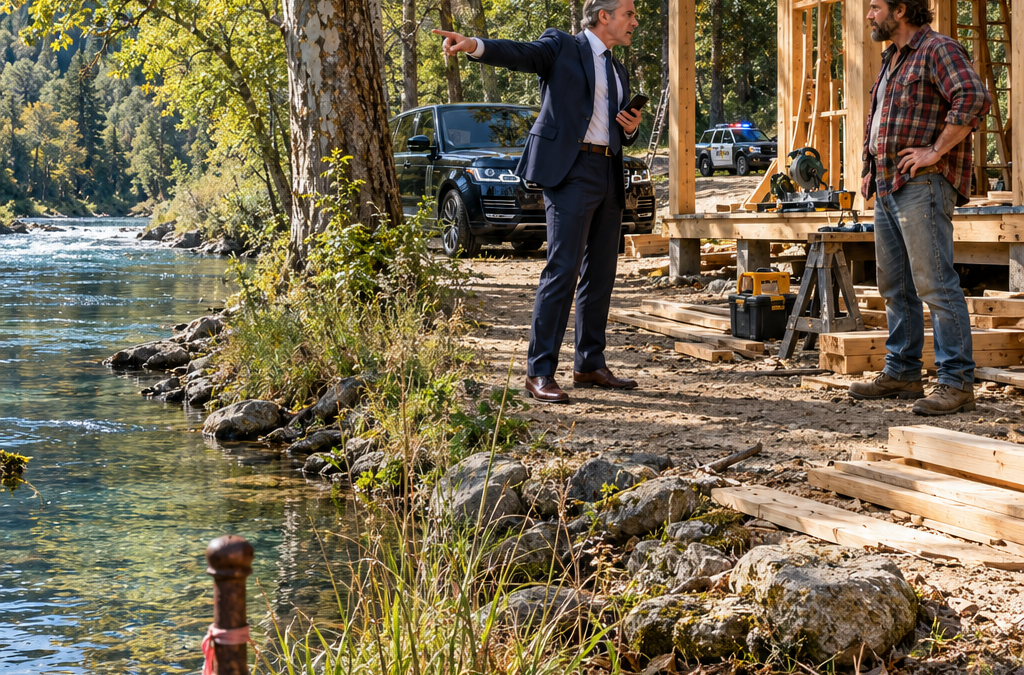
Then, one Thursday morning, a black luxury SUV appeared at the end of my access road.
I was standing beside the unfinished cabin when I heard the engine.
The vehicle moved slowly between the trees, its glossy paint reflecting patches of sunlight.
It stopped near the temporary construction entrance.
The driver’s door opened.
A man stepped out.
He looked to be about fifty, tall and slightly heavy through the shoulders, with carefully styled dark hair touched by silver at the temples.
He wore a fitted navy suit, an expensive white shirt, and polished leather shoes that looked ridiculous on the gravel.
A gold watch gleamed beneath his cuff.
Everything about him seemed deliberately arranged.
The haircut.
The tie.
The posture.
Even the way he closed his vehicle door.
He didn’t look like a man visiting a construction site.
He looked like a man arriving to inspect something he believed belonged to him.
He stood beside the SUV for nearly a minute, studying the cabin.
His eyes moved from the foundation to the roof framing.
Then toward the river.
Finally, he walked directly toward me.
“Good morning.”
His voice was smooth.
Practiced.
He extended his hand.
“Preston Whitaker. President of the Riverstone Heights Homeowners Association.”
I shook his hand briefly.
“Morning.”
He looked toward the cabin.
“Interesting project you’ve got going here.”
“Thank you.”
“Quite a substantial structure for this location.”
“It’s a small cabin.”
“Perhaps by your standards.”
I glanced at the unfinished walls.
One bedroom.
A tiny kitchen.
Barely enough space for a couch.
I couldn’t imagine what he considered small.
Whitaker adjusted his cuff.
“I happened to notice the construction from the eastern access trail. Naturally, I wanted to come see what was happening.”
“All right.”
He waited.
I said nothing.
His expression shifted slightly.
He seemed accustomed to people filling silence for him.
Finally, he continued.
“You understand, of course, that Riverstone Heights has strict regulations concerning construction near the river.”
I looked at him.
“Does it?”
“Very strict.”
“That’s good for your neighborhood.”
His smile tightened.
“Those regulations also protect the surrounding river corridor.”
“Which corridor?”
“The entire protected riverfront adjoining the community.”
I glanced toward the water.
Then back at him.
“And what does that have to do with my cabin?”
Whitaker blinked.
“Excuse me?”
“My cabin is being built on my property.”
“That may be your understanding.”
I studied him more carefully.
He wasn’t making casual conversation anymore.
His expression had become firm.
His shoulders were squared.
And his eyes had the impatient look of someone who believed he was already being challenged.
“Mr. Whitaker,” I said, “are you claiming your HOA controls this property?”
“I’m informing you that the riverfront falls within the community’s protected recreational area.”
“According to whom?”
“The association’s governing documents.”
“Does the association own the land?”
He gave a short laugh.
“That’s a rather simplistic question.”
“It’s a simple question.”
Whitaker folded his arms.
“Riverstone Heights has managed access to this river for years.”
“That wasn’t what I asked.”
His smile disappeared.
“I don’t think you understand how community development works.”
“I understand property ownership.”
“Then you should understand that restrictions can apply beyond an individual residential lot.”
“I do. That’s why I checked the recorded restrictions, survey, and county requirements before starting construction.”
He glanced toward the cabin.
“Did you obtain approval from our architectural committee?”
“No.”
His eyebrows rose.
“You didn’t?”
“No.”
“Then we already have a serious problem.”
I looked at him steadily.
“Why would I need approval from an HOA I never joined?”
Whitaker’s face hardened.
“Because this is a protected community riverfront.”
“Protected by whom?”
“By the association.”
“Through what legal authority?”
He exhaled sharply.
“You’re being unnecessarily argumentative.”
“I’m asking you to explain why you believe your association can stop construction on my land.”
He stepped closer.
“Because allowing every property owner to build whatever he wants near the river would destroy the environmental and aesthetic standards we’ve worked to establish.”
I looked toward the cabin.
The crew had left only a few minutes earlier to pick up additional lumber.
The unfinished building stood on a small cleared site surrounded by trees.
There was no sprawling development.
No concrete parking lot.
No commercial operation.
Just a modest cabin on private land.
“What environmental standard am I violating?” I asked.
Whitaker gestured toward the river.
“The association has designated this corridor as protected open space.”
“You can’t designate somebody else’s property as your open space without a legal basis.”
His jaw tightened.
“We have an established map.”
“Then I’d like to see it.”
He stared at me.
For a moment, I thought he might refuse.
Instead, he gave a small, irritated smile.
“Fine.”
He turned toward his SUV.
“I’ll show you exactly what I’m talking about.”
I followed him to the vehicle.
He opened the rear passenger door and removed a leather document case.
From it, he produced a large folded map.
He spread it across the hood.
The heading read:
RIVERSTONE HEIGHTS COMMUNITY MASTER PLAN.
I recognized the layout immediately.
The neighborhood streets curved along the eastern side of my land.
The clubhouse was marked near the main entrance.
Several walking paths extended toward the river.
And across the western portion of the map was a broad green area labeled:
PROTECTED COMMUNITY RIVERFRONT.
Whitaker tapped it with one finger.
“There.”
I studied the page.
It looked official enough.
Colored boundaries.
Printed labels.
A developer’s logo.
Approval notations.
But one thing caught my attention immediately.
The green shading extended well beyond the neighborhood’s actual recorded property boundary.
It crossed into land my grandfather had owned for decades.
Including the cabin site.
I looked at Whitaker.
“Where did this map come from?”
“The developer’s original planning documents.”
“Is it a recorded deed?”
“It’s the community master plan.”
“That doesn’t answer my question.”
He sighed.
“You’re getting hung up on legal terminology.”
“Because legal terminology matters when you’re claiming ownership.”
He tapped the map again.
“The entire river corridor was designated for community protection.”
“By your developer?”
“Yes.”
“Did my grandfather sign anything transferring the land?”
Whitaker hesitated.
“That predates my presidency.”
“Then who owns this riverfront?”
“The community.”
“Show me the deed.”
He gave a humorless laugh.
“You people always think waving around some old family paperwork overrides modern development.”
I felt my patience tighten.
“You people?”
“Landowners who refuse to acknowledge the interests of the surrounding community.”
I looked at him for several seconds.
“My grandfather owned this property before Riverstone Heights existed.”
“History doesn’t give you the right to ignore current regulations.”
“Neither does a developer’s map give your HOA the right to take my land.”
Whitaker leaned toward me.
“Listen carefully. I am president of an association representing more than a hundred homeowners. We have established standards, legal counsel, and a responsibility to protect community assets.”
“Then protecting those assets should start with knowing which ones you own.”
His expression turned cold.
“I would strongly advise you to stop construction until this matter is resolved.”
“No.”
He blinked.
“What did you say?”
“I said no.”
His jaw tightened.
“You haven’t received our approval.”
“I don’t need your approval to build on property outside your association.”
“You’re making a mistake.”
“Then show me where my deed is wrong.”
He stared at me.
And in that moment, I realized the conversation wasn’t about a cabin.
Not anymore.
Whitaker had arrived expecting to give instructions.
He believed his position entitled him to control the riverfront.
And he was furious that someone standing on a construction site in worn work boots was asking him to prove it.
I took out my phone.
“I have the current survey inside my truck.”
Whitaker smirked.
“Of course you do.”
“You’re welcome to compare it with your map.”
He shrugged.
“Fine. Let’s put this nonsense to rest.”
I retrieved the survey folder from my truck and carried it to a temporary worktable beside the cabin.
The table was covered with sawdust and construction notes.
I brushed the surface clean and unfolded the certified survey.
Whitaker approached reluctantly.
I placed his HOA map beside it.
“Here’s the community boundary,” I said, pointing to the county survey.
“And here’s the recorded boundary of my property.”
The lines were unmistakably different.
The HOA map shaded a large area as protected community riverfront.
The certified survey showed that same area within my family’s recorded tract.
The cabin stood well inside the boundary.
So did the access road.
So did the shoreline where I planned to build the deck.
And the river corridor followed the description established in the original deed.
Whitaker leaned closer.
For the first time, he stopped talking.
His eyes moved across the page.
Then he looked toward the river.
“That can’t be right.”
“It is.”
“You’re saying all this land belongs to you?”
“My family’s recorded property extends along this riverfront for a considerable distance.”
He looked back at the map.
“How much?”
“Hundreds of acres.”
His eyes widened slightly.
“That’s impossible.”
I pointed toward the survey references.
“Those are the recorded boundaries.”
Whitaker straightened.
“No. The riverfront was included in the development’s protected area.”
“Your developer drew it that way.”
“The plan was approved.”
“Approval of a development plan doesn’t transfer somebody else’s property.”
He stared at me.
His face reddened beneath his carefully groomed hair.
“You’re interpreting these documents to suit yourself.”
“I hired a licensed surveyor to verify the boundaries before construction.”
“Of course you did.”
“The survey matches the original deed.”
“That doesn’t mean the HOA’s rights disappeared.”
“Then show me the recorded easement or ownership document establishing those rights.”
His expression tightened.
For a moment, he seemed to be searching for another argument.
Then he pulled out his phone.
“This is ridiculous.”
He stepped away from the table and called someone.
I could hear parts of the conversation.
“Yes, I’m at the riverfront.”
A pause.
“No, he’s already started building.”
Another pause.
“He’s claiming the entire corridor is private property.”
Whitaker glanced toward me.
“He’s produced some survey that doesn’t match our plan.”
He listened.
Then his voice grew sharper.
“Well, somebody needs to do something. We can’t allow him to establish a precedent.”
I looked toward the river.
The current moved steadily past the rocks.
A breeze rustled the branches overhead.
I tried to imagine what my grandfather would have thought about a man in a tailored suit standing beside his unfinished cabin, arguing that a neighborhood map mattered more than the original deed.
He would have been furious.
But he would have stayed calm.
He always believed anger was most useful when it made you careful.
Whitaker ended the call.
He walked back toward me with a hard expression.
“The board agrees this cannot continue.”
“Did they review the deed?”
“Don’t be absurd.”
“Then what exactly did they agree about?”
He ignored the question.
“I’ve been advised to contact the authorities.”
I studied his face.
“Over a property boundary?”
“Over unauthorized construction on protected community land.”
“My land.”
“That’s your allegation.”
I pointed toward the survey.
“That’s the recorded boundary.”
He slipped his phone into his jacket.
“You have one opportunity to stop this voluntarily.”
“What are you asking me to do?”
“Shut down construction immediately. Remove any unauthorized materials. Submit your plans to the association for review.”
“And if I refuse?”
Whitaker’s voice dropped.
“Then I’ll have the sheriff remove you.”
For a moment, the words hung between us.
I looked toward the half-built cabin.
The roof framing was exposed.
The windows hadn’t been installed.
Stacks of lumber rested beneath a tarp.
I had already spent a significant amount of money on the project.
The contractor had scheduled workers, ordered materials, and arranged inspections.
A forced shutdown could delay everything.
Materials could be damaged.
Appointments could be missed.
Costs could rise quickly.
More importantly, I was being threatened with removal from land I had inherited.
Land my grandfather had spent his life protecting.
I felt something cold settle in my stomach.
Not because I believed Whitaker owned the property.
Because I understood how dangerous a confident false accusation could become when police officers arrived without knowing the history.
“Mr. Whitaker,” I said carefully, “you should think very seriously before calling law enforcement and claiming I’m trespassing.”
He smiled.
“There it is.”
“What?”
“The threat.”
“I’m warning you that the information you’re presenting is wrong.”
He pulled out his phone.
“I think I’ll let the professionals decide.”
He dialed 911.
I watched him.
Part of me expected him to reconsider.
He didn’t.
When the dispatcher answered, Whitaker straightened his posture.
His voice changed instantly.
The angry man who had been arguing over a map disappeared.
Now he sounded like a concerned community official reporting a serious violation.
“Yes, I’d like to report an illegal construction operation on protected community property.”
I felt my chest tighten.
He continued.
“A man has entered the Riverstone Heights riverfront area and started building a structure without authorization.”
I stared at him.
Entered.
As though I had arrived there that morning with a truck full of lumber and decided to claim somebody else’s land.
Whitaker listened to the dispatcher.
“Yes, he’s still here.”
Another pause.
“He refuses to stop.”
Then he added, “I’m concerned the situation could escalate.”
I looked at the unfinished cabin.
No shouting.
No threats.
No violence.
Just a construction site, an old deed, and a man who couldn’t accept what the survey showed.
Whitaker ended the call.
He smiled at me with thin satisfaction.
“Deputies are coming.”
“All right.”
He seemed disappointed.
“That’s all you have to say?”
“What would you like me to say?”
“That you’ll cooperate.”
“I’ve been cooperating since you arrived.”
“You’ve refused a direct instruction.”
“From someone who hasn’t established authority over this property.”
Whitaker’s expression hardened.
“Let’s see how brave you are when the sheriff gets here.”
I didn’t answer.
I picked up the survey and placed it back inside the folder.
Then I took several photographs of the HOA map while it was still spread across the table.
Whitaker noticed.
“What are you doing?”
“Documenting the map you’re relying on.”
“That’s association property.”
“I’m photographing a document you showed me while making claims about my land.”
He snatched the map away.
“You’re unbelievable.”
I closed my folder.
“And you’re standing on my construction site threatening to have me arrested.”
His eyes narrowed.
“Don’t start that again.”
I looked directly at him.
“Before the deputies arrive, I want to make one thing clear.”
He crossed his arms.
“I’m listening.”
“I haven’t threatened you. I haven’t touched you. I haven’t interfered with your vehicle. I’ve shown you the property records and explained the boundary.”
“So?”
“So don’t tell those deputies I did something I didn’t do.”
His expression changed.
Only slightly.
But enough for me to notice.
Then he gave a dismissive laugh.
“You’re very concerned about what the deputies might think.”
“I’m concerned about the truth.”
He turned away.
I took a slow breath.
My hands were shaking.
I hated that.
I hated how easily one man had transformed a peaceful morning into something that felt dangerous.
I hated the possibility that my contractor might arrive and find police cars beside the cabin.
And I hated that the very place my grandfather had dreamed about building was now being treated as stolen land.
I pulled out my phone and called the contractor.
He answered on the second ring.
“Everything okay?”
“Not exactly.”
I explained the situation.
He went quiet.
Then he said, “You want me to hold the crew?”
I looked toward the cabin.
Stopping voluntarily felt like giving Whitaker what he wanted.
But bringing workers into an active police confrontation didn’t seem right either.
“Keep them off the site until I call you back,” I said.
“You sure?”
“Yes.”
He sighed.
“All right. But we’ve got materials coming today.”
“I know.”
“We may lose the delivery window.”
“I know.”
He paused.
“What’s going on out there?”
I looked at Whitaker standing beside his SUV.
“Somebody thinks the HOA owns my grandfather’s land.”
The contractor swore quietly.
“Call me when it’s sorted out.”
I ended the call.
There was the first real cost.
A delayed crew.
A delivery at risk.
Hours of work potentially lost.
All because a man who had never seen my grandfather’s deed had decided the community should control the river.
Whitaker watched me put away my phone.
“Calling your lawyer?”
“My contractor.”
“Good. Tell him to stop.”
“I told him not to bring workers into this situation until the deputies arrive.”
He smiled.
“Smart decision.”
“Don’t mistake it for agreement.”
The smile disappeared.
Several minutes later, we heard engines approaching along the gravel road.
Two county sheriff’s vehicles appeared between the trees.
They came slowly.
No sirens.
No dramatic arrival.
Just two marked vehicles moving carefully through the woods toward my construction site.
Still, seeing them made my stomach tighten.
I had done nothing wrong.
But I was suddenly watching law enforcement arrive at a place where my family had lived and worked without conflict for generations.
The first vehicle stopped near the worktable.
The second pulled in behind it.
Two deputies stepped out.
The older one appeared to be in his late forties, broad-shouldered, with close-cropped graying hair.
The younger deputy was perhaps in his thirties.
Both looked from the unfinished cabin to the river and then toward the two of us.
Whitaker moved immediately.
He walked toward the older deputy with his hand extended.
“Officers. Preston Whitaker. President of the Riverstone Heights Homeowners Association. I’m the one who called.”
The deputy shook his hand.
“Deputy Harris. This is Deputy Collins.”
Whitaker gestured toward the cabin.
“Thank you for coming. We’ve got an unauthorized construction situation on community riverfront property.”
Harris looked toward me.
I remained beside the worktable.
“All right,” he said. “Let’s get everybody’s understanding of what’s happening.”
Whitaker continued before the deputy finished speaking.
“This man has begun building a structure inside our protected river corridor. I informed him of the association’s restrictions and asked him to stop. He refused.”
Deputy Harris raised one hand.
“Okay. Slow down.”
Whitaker stopped.
Harris looked at the cabin.
“Is there an immediate safety issue?”
“The issue is illegal construction.”
“Are there workers here?”
“Not at the moment.”
“Is anyone injured or threatening anyone?”
Whitaker hesitated.
“No, but he’s refusing to comply.”
Harris nodded.
“All right.”
He turned toward me.
“Sir, are you the person building this cabin?”
“Yes.”
“Can you tell me what’s going on?”
I held up the folder.
“I inherited this property from my grandfather. The cabin is being built inside my recorded boundary. Mr. Whitaker arrived this morning and claimed the HOA controls the riverfront. I’ve shown him my deed and certified survey, but he insists this is community land.”
Whitaker interrupted.
“Because it is community land.”
Harris looked at him.
“Sir, I’ll hear from both of you. Let him finish.”
Whitaker pressed his lips together.
I continued.
“He showed me an old development map that shades a large part of my property as community riverfront. That map doesn’t match the county survey. When I refused to stop construction based on his HOA rules, he called 911.”
Deputy Collins glanced toward the river.
“Do you have the property documents here?”
“Yes.”
“May we see them?”
“Of course.”
I opened the folder.
Before handing anything over, I arranged the papers on the worktable.
The original deed copy.
The recorded ownership documents.
The updated certified survey.
The county parcel map.
The construction permits.
Deputy Harris leaned over the table.
Collins stood beside him.
Whitaker moved closer.
“Officers, I think we’re getting sidetracked. The important thing is that our association has designated this riverfront as protected community property.”
Harris looked up.
“Do you have proof the association owns this parcel?”
Whitaker blinked.
“We have the approved community master plan.”
“Is that a deed?”
“It’s the governing development map.”
“Does the association have a recorded conveyance for this property?”
Whitaker adjusted his tie.
“Those documents are maintained by the association’s legal department.”
“Do you have one with you?”
“No.”
“Have you reviewed one?”
Whitaker hesitated.
“I’m familiar with our governing documents.”
Harris nodded slowly.
“Okay.”
He returned his attention to my deed.
For several moments, both deputies read quietly.
The only sound was the wind moving through the trees and the faint rush of water beyond the cabin.
Collins pointed toward a section of the property description.
“This refers to the river boundary?”
“Yes.”
He looked at the survey.
“And this is the current survey?”
“Prepared by a licensed surveyor before construction started.”
“Do you have the surveyor’s certification?”
I showed him.
He examined it.
Then he looked toward the old boundary markers.
“Those stakes out there?”
“Yes.”
“Are they shown on the survey?”
“They are.”
Harris turned toward Whitaker.
“Mr. Whitaker, do you have a boundary survey showing this property belongs to the association?”
Whitaker’s face tightened.
“We have our community map.”
“Is it a certified boundary survey?”
“It’s an approved development document.”
Harris looked at him steadily.
“That’s not the same thing.”
Whitaker’s cheeks reddened.
“Officer, with all due respect, I’m not sure you understand the association’s responsibilities.”
The deputy didn’t react.
“I’m trying to understand the ownership claim.”
“The HOA has managed this riverfront for years.”
“Management and ownership aren’t necessarily the same thing.”
Whitaker folded his arms.
“Then perhaps you should speak with our legal counsel.”
“That may be necessary if there’s a civil dispute,” Harris replied. “But right now, I’m looking at the documents each of you brought.”
Collins examined the county survey again.
Then he looked toward the river.
“I’d like to see the markers.”
I nodded.
“I can show you.”
Whitaker stepped forward.
“There’s no reason to walk through the property.”
Collins looked at him.
“Actually, that would help us understand the location being disputed.”
“But our map already establishes the protected area.”
Harris glanced at the map Whitaker was now pulling from his leather case.
“Then we can compare it with the actual boundary.”
Whitaker looked genuinely offended.
As though physically checking the land were beneath the dignity of an HOA president.
He unfolded the map across the table.
“There. That entire section is designated community riverfront.”
Harris examined it.
Then he placed the county survey beside it.
The difference was immediately visible.
The HOA map shaded the river corridor as part of the neighborhood’s protected area.
The certified survey placed the cabin, access road, and adjoining shoreline within my recorded tract.
Harris looked from one document to the other.
Then he pointed to the HOA map.
“What’s the basis for this boundary?”
Whitaker lifted his chin.
“The developer’s original plan.”
“Was the land purchased from this gentleman’s family?”
Whitaker hesitated.
“The development was approved years ago.”
“That’s not what I asked.”
For the first time, Whitaker seemed to lose his rhythm.
He glanced toward the river.
Then toward me.
Finally, he said, “I don’t have the original transaction documents with me.”
Harris nodded.
“All right. Let’s look at the actual property line.”
We started walking.
I led the deputies along the narrow path beside the cabin.
Whitaker followed a few steps behind.
His polished shoes slipped slightly on the loose gravel.
He muttered something under his breath.
I didn’t respond.
The first boundary marker stood near a large oak where the old access road curved toward the lower meadow.
I stopped beside it.
“Here.”
Collins crouched and examined the marker.
Then he checked the survey.
He looked toward Harris.
“Matches the location indicated here.”
We continued.
The path descended gradually toward the river.
The trees grew closer together.
The ground softened beneath the shade.
A few minutes earlier, the place had been filled with hammering and the sound of saws.
Now four men walked through the woods in near silence.
I had walked that route with my grandfather countless times.
I remembered him stopping at the same oak to rest his knees.
I remembered carrying a bucket of tools when we repaired the old access gate.
I remembered him pointing toward the river and saying, “Everything down there has a story.”
Now I was showing two deputies the same markers because a stranger had declared the property community land.
We reached the next stake.
Collins checked it.
Then another.
Each one corresponded with the survey information.
Whitaker grew quieter with every stop.
At the third marker, he finally spoke.
“These stakes could have been moved.”
I stopped walking.
“Moved?”
“How do we know they haven’t been repositioned?”
Collins looked toward him.
“The survey references multiple monuments and recorded measurements. We’re not relying on one loose stake.”
Whitaker looked irritated.
“I’m simply raising a possibility.”
I turned toward him.
“Mr. Whitaker, these markers have been checked against the original survey.”
“According to your surveyor.”
“According to the professional survey you refused to examine.”
He glared at me.
Harris stepped between us slightly.
“Let’s keep this focused on the documents.”
I nodded.
“Of course.”
We continued toward the river.
When the trees opened, the water came into view.
The river was running clear that morning.
Sunlight flashed across the current.
Large stones broke the surface near the opposite bank.
A pair of ducks drifted through a quiet pool before disappearing around the bend.
For one strange moment, I forgot Whitaker was behind me.
I could almost hear my grandfather’s voice.
Best evening light.
We stopped near the shoreline.
I pointed toward the old marker beneath the sycamore.
“That’s the one my grandfather showed me when I was a boy.”
Collins approached it.
He checked the survey again.
Then he looked downriver.
“The boundary follows this course?”
“According to the deed and survey, yes.”
Harris studied the map.
“And the cabin site is back inside the recorded tract?”
“Well inside.”
“The access road?”
“Also inside.”
Collins pointed along the riverfront.
“And the land running along this bank?”
“Part of the same recorded property.”
He nodded.
Whitaker stepped forward.
“You’re missing the larger issue.”
Harris looked at him.
“Which is?”
“This entire riverfront has always been treated as a community amenity.”
“By the HOA?”
“Yes.”
“And your ownership document is?”
Whitaker opened his mouth.
Then closed it.
Harris waited.
Whitaker finally said, “We have the community map.”
The deputy looked toward Collins.
Then back at him.
“Mr. Whitaker, a community map does not automatically establish ownership.”
Whitaker’s face flushed.
“The development was designed around this river.”
“That doesn’t tell us who owns the land.”
“Our residents have used this shoreline for years.”
“Use and ownership are different questions.”
Whitaker stared at him.
I watched the words register.
He had arrived at my cabin convinced that historic community use gave the HOA authority.
Now two deputies were explaining that the association’s assumptions could not replace the recorded ownership history.
But he still wasn’t ready to accept it.
He pointed toward the river.
“So you’re saying all these homeowners have been using somebody else’s land?”
I answered carefully.
“Some neighbors have had permission to enjoy the shoreline. Others may have access rights that need to be checked against the actual records.”
Whitaker turned toward me.
“You admit residents use it.”
“I never denied that.”
“Then the association has established rights.”
“Permission isn’t the same as ownership.”
“Years of public use mean something.”
“They may raise questions about access, depending on the facts and applicable law,” Harris said. “But they don’t automatically make the HOA the owner of this property.”
Whitaker looked at him in disbelief.
“Then what exactly are we supposed to tell our residents?”
“The truth,” I said.
He turned sharply.
I continued.
“Tell them the riverfront is privately owned. Tell them the association needs to verify any rights it claims. And stop pretending your map is a deed.”
His expression became cold.
“You seem to enjoy humiliating people.”
I stared at him.
“No.”
“Then why are you making this so difficult?”
I felt my anger rise.
Because I had spent years keeping this place peaceful.
Because my grandfather had left it to me trusting that I would care for it.
Because I had spent money verifying every boundary before driving a single foundation post.
And because this man had walked onto my land, threatened my construction project, and called 911 as though I were stealing something.
But I kept my voice controlled.
“I’m not trying to humiliate you, Mr. Whitaker.”
“Then what are you trying to do?”
“Build my grandfather’s cabin.”
The words came out quietly.
For a moment, nobody spoke.
I looked toward the river.
“He spent most of his life talking about that cabin,” I continued. “He wanted a place where he could sit and watch the water. He never got around to building it.”
Whitaker looked away.
“I inherited this land after he died. I checked the deeds. Hired a surveyor. Followed the county requirements. Kept the construction inside my boundary.”
I turned back toward him.
“And then you showed up and told me I needed your permission because your neighborhood liked looking at the river.”
His jaw tightened.
“That’s an unfair characterization.”
“Is it?”
He didn’t answer.
Deputy Collins cleared his throat.
“Let’s return to the documents.”
We walked back toward the cabin.
By now, Whitaker’s shoes were coated with damp soil.
His trousers had picked up bits of grass.
The polished image he had carefully maintained seemed to be coming apart with every step.
But his attitude hadn’t softened.
If anything, he looked more determined to find something that would restore his authority.
When we reached the worktable, Harris asked whether he could verify the parcel information against available county property records.
I gave him the parcel number.
Whitaker immediately produced his phone.
“I have the association’s records right here.”
He began scrolling.
The deputy waited.
Whitaker opened a document.
Then another.
He enlarged an image of the community master plan.
Then a page from the association’s rules.
Then a diagram of the protected riverfront.
Every document referred back to the HOA’s internal management of the area.
None showed a recorded conveyance of my property to the association.
Collins checked the parcel information available through the county records.
He compared the listed ownership with the certified survey and the deed.
Then he looked at Harris.
“The parcel record matches the family ownership documentation.”
Harris nodded.
He turned toward Whitaker.
“Mr. Whitaker, the property records we’ve reviewed identify this parcel under the ownership represented by this gentleman’s documents.”
Whitaker stood motionless.
The deputy continued.
“The association isn’t shown as the owner of this riverfront tract.”
Whitaker swallowed.
“But the map—”
“The map isn’t a deed.”
“The community has managed the area.”
“That may be something your association believes gives it certain rights, but it doesn’t establish ownership of the land.”
Whitaker stared at the documents.
For the first time since he arrived, his expression showed genuine uncertainty.
Not irritation.
Not arrogance.
Uncertainty.
The kind that comes when a person realizes the facts may not support a position he has defended for years.
He looked toward the cabin.
Then toward the river.
Then back at the survey.
“You’re telling me this entire stretch belongs to him?”
Harris answered carefully.
“The available recorded documents support his ownership of the parcel, including the cabin site, access road, and adjoining riverfront described in the survey. Any unresolved title or access issues would belong in the proper civil process.”
Whitaker looked stunned.
I could almost see him replaying the morning.
The arrival.
The instructions.
The threats.
The call to 911.
He had expected the deputies to remove me.
Instead, they were examining documents that supported my ownership.
He had tried to turn a private construction project into an illegal encroachment.
Now the only questionable authority was his own.
Harris handed my deed back.
“Sir, based on what we’ve seen, there’s no basis for treating you as a criminal trespasser here because of this HOA claim.”
I nodded.
“Thank you.”
He glanced at the cabin.
“We’re not issuing a construction permit or making a final civil title ruling. Those are separate matters. But the documents you’ve presented are consistent with the county records, and the association hasn’t produced anything establishing ownership of this site.”
Whitaker stepped forward.
“So you’re just going to let him continue?”
Harris looked at him.
“Do you have evidence of an immediate violation that requires law enforcement action?”
“He doesn’t have HOA approval.”
“Does his property belong to your HOA?”
Whitaker hesitated.
“That’s what we’re disputing.”
“Then that’s not a reason for us to remove him.”
Whitaker’s voice rose.
“But this affects the entire neighborhood.”
“Then your association should review its records and consult the appropriate legal professionals.”
Whitaker shook his head.
“I cannot believe this.”
Collins looked toward the cabin.
“Mr. Whitaker, you called 911 reporting illegal construction on community property. We’ve reviewed the documents available and walked the boundary. Nothing we’ve seen supports treating this land as HOA-owned property.”
Whitaker’s face turned dark red.
“Are you accusing me of lying?”
“No. I’m explaining what the records show.”
“You have no idea how difficult it is to manage a neighborhood.”
“That may be true,” Harris said. “But managing a neighborhood doesn’t authorize you to claim land outside its legal boundaries.”
For several seconds, Whitaker stared at the deputy.
Then he turned away.
He walked toward his SUV, stopped halfway, and turned back.
“This is not over.”
I looked at him.
“Then bring the deed next time.”
His eyes narrowed.
“You think you’ve won something because two deputies looked at your paperwork?”
“No.”
“Then what?”
“I think the people who came here to examine the facts found something different from what you told them.”
He gave a bitter laugh.
“We’ll see what our attorney says.”
“That’s your right.”
He adjusted his jacket.
“I can assure you, the association will not surrender its community interests without a fight.”
I looked toward the river.
“You can’t surrender ownership you never had.”
He opened his mouth.
Then stopped.
Deputy Harris spoke before the argument could begin again.
“Mr. Whitaker, I’d recommend taking your concerns through the proper civil channels. There’s no reason for this to become another confrontation at the construction site.”
Whitaker glared at him.
Then at me.
Finally, he walked back toward his SUV.
But before he reached it, another vehicle appeared on the access road.
Then a second.
I recognized both.
They belonged to homeowners from Riverstone Heights.
Apparently, the sight of two sheriff’s vehicles near the river had attracted attention.
A middle-aged man stepped out of the first car.
A woman emerged from the second.
They looked confused.
The man approached cautiously.
“Everything all right?”
Whitaker turned immediately.
“Yes. Just a property misunderstanding.”
I almost laughed.
A misunderstanding.
Less than an hour earlier, he had threatened to have me arrested.
The neighbor looked toward the deputies.
“Somebody said there was illegal construction by the river.”
Whitaker answered.
“We’re handling it.”
The woman glanced toward my cabin.
“Is that the building the HOA said wasn’t allowed?”
I looked at her.
“Yes.”
She frowned.
“But I thought that land belonged to the community.”
Whitaker stiffened.
“It is part of our protected riverfront.”
Deputy Harris looked toward him.
“Mr. Whitaker, we’ve already discussed that the ownership documents don’t support that description.”
The woman blinked.
“What?”
I opened the survey.
“This property belonged to my grandfather. The cabin is being built within the recorded boundary.”
The man stepped closer.
“The whole riverfront?”
“The portion shown within my recorded property, including the cabin site and the adjoining shoreline.”
He looked toward the map.
“That’s not what we were told.”
Whitaker’s jaw tightened.
“Residents have always understood this area to be part of the community.”
The woman turned toward him.
“Did the HOA buy it?”
He hesitated.
“The development plan designated it as protected space.”
“That isn’t what I asked.”
The question landed heavily.
Whitaker looked toward the deputies.
Neither spoke.
Finally, he answered.
“The association will need to review the records.”
The woman stared at him.
“So you called the police before checking?”
His face reddened.
“I acted to protect the community.”
“From what?” she asked.
He gestured toward the cabin.
“Unauthorized construction.”
I spoke quietly.
“Construction on my own land.”
The neighbor looked at Whitaker.
“You told us nobody was allowed to build along the river because the HOA controlled it.”
“That remains our policy for association property.”
“But this isn’t association property?”
Whitaker’s silence said more than any explanation.
The man looked toward the cabin.
Then back at me.
“Your grandfather owned all this?”
I nodded.
“He did.”
The man shook his head slowly.
“I had no idea.”
“Most people didn’t.”
He looked embarrassed.
“I’ve walked along the lower trail for years.”
“I know. My grandfather allowed neighbors to enjoy parts of the riverfront, and I’ve generally continued that where it was appropriate.”
The woman looked surprised.
“You knew people were using it?”
“Yes.”
“And you didn’t stop them?”
“Not when they were respectful and had permission.”
She glanced toward Whitaker.
“Then why were we told it was community property?”
Nobody answered immediately.
Deputy Collins stepped forward.
“Folks, the distinction here is important. A neighborhood may have access arrangements or permissions, and those questions can be reviewed separately. But using land over time doesn’t automatically make the association its owner.”
The man nodded.
“That makes sense.”
Whitaker crossed his arms.
“I would caution everyone against jumping to conclusions.”
The woman looked directly at him.
“Preston, you’ve spent years telling people this riverfront belonged to the neighborhood.”
He looked away.
She continued.
“Now you’re saying we need to check?”
His jaw tightened.
“Yes.”
For the first time, the authority in his voice had disappeared.
He sounded like a man trying to escape a conversation rather than control it.
Harris closed his notebook.
“I think we’ve clarified what we can today.”
He looked toward me.
“Keep your documents available. If additional civil questions come up, you’ll want your attorney or the appropriate county office involved.”
“I understand.”
Then he turned toward Whitaker.
“And I’d strongly recommend the association review its maps and recorded documents before making further ownership claims about this property.”
Whitaker said nothing.
The deputies thanked everyone for keeping the situation calm.
Then they returned to their vehicles.
I watched the patrol cars move slowly along the gravel road.
The engines faded between the trees.
The morning grew quiet again.
But Whitaker still stood beside his SUV.
His shoulders were rigid.
His face looked pale beneath the flush of anger.
He glanced toward the neighbors.
Then toward me.
“You’ve made quite a spectacle of this.”
I stared at him.
“You’re the one who called 911.”
“Because you refused to cooperate.”
“I showed you the deed.”
“You challenged my authority.”
“Because you claimed authority over land you didn’t own.”
He stepped closer.
“You don’t understand the problems you’ve created.”
I felt my patience finally begin to break.
“Problems I’ve created?”
He pointed toward the neighborhood.
“Do you have any idea how many residents believe this riverfront is protected community space?”
“Then you should tell them the truth.”
“That’s not so simple.”
“It should have been simple before you came here.”
His face hardened.
I continued.
“You could have asked to see the property records. You could have checked the county survey. You could have spoken with your board’s attorney before threatening a private landowner.”
Whitaker said nothing.
“But you didn’t do any of those things.”
He looked away.
“You came down my road, ordered me to stop building, and called the police when I wouldn’t obey.”
I stepped closer.
“And now you’re angry because they looked at the documents instead of your title.”
His jaw tightened.
“You think this is funny?”
“No.”
My voice dropped.
“I think it’s sad.”
For the first time, that seemed to unsettle him.
I glanced toward the river.
“My grandfather spent decades protecting this place. He worked those roads. Cleared those trees. Maintained those boundaries. He dreamed about building this cabin.”
Whitaker looked toward the unfinished structure.
I continued.
“He never got the chance. So I’m building it.”
There was a long silence.
Then I looked back at him.
“And you’re not going to turn his dream into an HOA violation.”
Whitaker swallowed.
He looked toward the neighbors, who were standing quietly nearby.
Then he adjusted his cuffs.
The old polished manner returned, but weaker now.
“The association will conduct a formal review.”
“Good.”
“And we reserve whatever lawful rights we may have.”
“You’re entitled to establish them through the proper process.”
He stared at me.
Then he turned and walked toward his SUV.
Before opening the door, he stopped.
“This could have been handled differently.”
I nodded.
“Yes. It could have.”
He looked back.
I continued.
“You could have knocked, introduced yourself, and asked whose land this was.”
His face tightened.
Then he climbed into the vehicle.
The engine started.
The black SUV rolled away, throwing a thin cloud of dust across the gravel.
I watched until it disappeared beyond the trees.
The two neighbors remained.
The man approached me slowly.
“I owe you an apology.”
I shook my head.
“You didn’t do anything.”
“We’ve always called this the community riverfront.”
“I know.”
“I never realized your family owned it.”
“Most people didn’t.”
He glanced toward the cabin.
“Your grandfather wanted that?”
“Since I was a kid.”
He smiled faintly.
“Looks like a good place for it.”
I looked at the unfinished walls.
“That’s what I thought.”
The woman stepped closer.
“Will people still be able to walk near the river?”
I considered the question.
“I don’t want to punish people for an assumption they were given. My grandfather was generous about respectful access, and I intend to be reasonable. But any permissions or established rights need to be understood correctly.”
She nodded.
“That’s fair.”
“I also need people to respect the cabin site and the areas where construction is happening.”
“Of course.”
The man looked toward the river.
“Preston made it sound like somebody was trying to steal community land.”
I gave a tired smile.
“That’s why I wanted everyone to look at the survey.”
He nodded.
Then he said something I hadn’t expected.
“I think people are going to have questions for him.”
I looked toward the road where Whitaker had disappeared.
“I’m sure they will.”
After the neighbors left, I stood alone beside the cabin.
The worktable was still covered with papers.
The air smelled of fresh lumber and disturbed soil.
My contractor’s truck wasn’t there.
The crew hadn’t returned.
I took out my phone and called him.
He answered immediately.
“Well?”
“It’s settled for now.”
“What happened?”
“Two deputies reviewed the deed and survey. They walked the boundary. The HOA couldn’t show ownership.”
He let out a long breath.
“Good.”
“Can you get the crew back?”
“Not today. They’ve been reassigned, and the delivery’s already delayed.”
I closed my eyes.
“How much did we lose?”
He hesitated.
“Mostly time. I’ll have to reshuffle the schedule.”
I looked at the cabin.
“All right.”
He paused.
“You okay?”
I looked toward the river.
“Yeah.”
Then I corrected myself.
“I’m angry.”
“Can’t blame you.”
“I just wanted to build a cabin.”
He was quiet for a moment.
Then he said, “We’ll finish it.”
Those three words meant more than he probably realized.
After the call, I sat on a stack of lumber.
My grandfather’s sketch was folded inside my jacket pocket.
I had brought it to the site that morning because I wanted to compare the deck layout with his original drawing.
I took it out.
The pencil lines were faint.
The paper had softened at the folds.
There was the little cabin.
The small kitchen.
The deck facing west.
I stared at it until my vision blurred.
All the anger I’d been holding back suddenly felt heavier.
It wasn’t only about Preston Whitaker.
It was about how quickly someone could transform a place you loved into a battlefield simply by claiming authority.
I had spent years maintaining that road.
Checking those markers.
Protecting the riverbank.
I had done everything carefully.
And still, one man with a title and an old map had managed to threaten the entire project.
I sat there for a long time.
Then I folded the sketch and placed it back in my pocket.
I wasn’t going to let him take this away.
The following week, the construction crew returned.
The first morning was tense.
Every time I heard a vehicle approaching, I glanced toward the access road.
Part of me expected Whitaker’s SUV to appear again.
But it didn’t.
The contractor brought his workers.
The delivery truck arrived.
The cabin began taking shape.
Walls were finished.
Roofing went on.
Windows were installed.
The small kitchen was framed.
And the deck finally extended toward the river, exactly where my grandfather had imagined it.
I visited nearly every evening.
Some days I helped carry materials.
Other days I simply watched the progress.
The workers knew what had happened with the HOA.
They occasionally joked about whether we needed permission to hammer nails.
I laughed with them.
But underneath the humor, I remained careful.
I kept copies of the deed and certified survey in my truck.
I photographed construction progress.
I maintained the relevant permits and inspection records.
And I checked the boundary markers whenever I walked the property.
Not because I enjoyed preparing for another argument.
Because I had learned that even a baseless claim could become expensive when someone was determined to enforce it.
A few weeks after the confrontation, I received a letter from the HOA.
This time, the language was different.
There were no threats.
No demands to stop construction.
No accusation that I had entered community property.
The letter explained that the association was reviewing its historic riverfront map and related records.
It acknowledged that the privately owned parcel shown in my certified survey was not established as HOA-owned land by the community master plan.
The board would revise its materials accordingly.
I read the letter twice.
Then I placed it inside the property folder.
It wasn’t an apology.
Whitaker hadn’t suddenly become humble.
But the board was finally addressing the actual records.
And that mattered.
Over the next several months, I noticed changes around the eastern boundary.
A few old signs that had referred to the riverfront as HOA property disappeared.
Neighbors began asking permission before entering areas that had long been treated casually.
Some residents contacted the association to clarify where its common areas ended.
Others asked questions about any recorded access rights.
I appreciated those questions.
They showed that people were beginning to distinguish legal ownership from neighborhood assumptions.
I didn’t close the land to everyone.
I didn’t install a row of angry warning signs.
I didn’t build a massive fence around the river simply to prove I could.
I kept the property much as my grandfather had wanted it.
Quiet.
Natural.
Respected.
One afternoon, an older neighbor stopped along the access road while I was carrying boards toward the cabin.
He lowered the window of his pickup.
“How’s the project coming?”
“Getting close.”
He smiled.
“Looks good from the trail.”
“Thanks.”
He hesitated.
“Mind if I ask you something?”
“Go ahead.”
“Why didn’t your grandfather ever put up private property signs everywhere?”
I looked toward the river.
“He didn’t believe he had to make people feel unwelcome just to protect what belonged to him.”
The neighbor nodded slowly.
“He sounds like a good man.”
“He was.”
The man looked toward the cabin.
“Guess he’d be proud you’re finishing that.”
I smiled.
“I hope so.”
When he drove away, I stood there for a moment, listening to the river beyond the trees.
My grandfather had always believed ownership was a responsibility.
He had never confused that responsibility with the need to control everyone who came near the property.
Whitaker had done exactly that.
He had looked at a beautiful river and seen something his association should command.
My grandfather had looked at the same river and seen something worth preserving.
That difference explained the entire confrontation.
By late summer, the cabin was nearly complete.
The kitchen cabinets were installed.
The bedroom walls were painted.
The woodstove sat in the corner of the living room.
The deck railing was finished.
And when I opened the front door, I could see the river through the large windows beyond the living area.
The first time I stepped onto the completed deck, I stopped breathing for a moment.
The view was almost exactly what my grandfather had described.
The river curved below the cabin.
Trees lined both banks.
The afternoon sun filtered through the leaves.
There were no streetlights.
No traffic.
No neighborhood signs.
Just the water moving through the valley.
I rested my hands on the railing.
I could almost picture him standing beside me.
His old work jacket.
His weathered hands.
That quiet smile he used when something turned out the way he hoped.
He would have walked the deck twice.
Checked the railings.
Complained about the cost of lumber.
Then sat down and refused to leave until the sun disappeared.
I laughed softly at the thought.
Then I felt tears sting my eyes.
For years, I’d been afraid that completing the cabin would somehow make his absence more obvious.
Instead, standing there, I felt closer to him than I had in a long time.
The property wasn’t frozen in the past anymore.
It was still part of our family.
Still being cared for.
Still becoming something meaningful.
And no HOA president had the right to take that away.
The final inspection came without trouble.
The required approvals were completed.
The construction crew packed up its tools.
The temporary materials were removed.
And one afternoon, the contractor handed me the keys.
“She’s yours.”
I looked at the small brass key in my palm.
Then at the cabin.
“Looks like it.”
He smiled.
“Your grandfather would have liked it.”
I nodded.
“Yeah.”
He glanced toward the river.
“Some view.”
“The best one I know.”
He shook my hand.
Then drove away.
I stood beside the cabin until the sound of his truck faded.
For the first time, there were no workers.
No equipment.
No unfinished tasks.
No argument waiting at the access road.
Just a completed cabin and the river beyond it.
I walked inside.
The floorboards creaked slightly beneath my boots.
The small kitchen smelled of fresh wood and paint.
The bedroom window looked toward the trees.
I placed my grandfather’s old fishing rod above the living room doorway.
Then I set his sketch in a simple wooden frame on a shelf.
It seemed right to keep it there.
A reminder that the cabin had begun as his dream long before it became my project.
The next morning, I drove out before sunrise.
I brought coffee, a small bag of groceries, and the old property folder.
I placed the folder in a cabinet inside the cabin.
The original deed copies.
The certified survey.
The county parcel records.
The building documents.
And the letter from the HOA acknowledging the need to correct its riverfront map.
Everything was organized.
Everything was protected.
I wasn’t expecting Whitaker to return.
But I had learned something important from the confrontation.
A person’s confidence could be manufactured.
A title could sound impressive.
A map could look official.
And a rule could be printed in bold letters.
None of those things automatically established ownership.
The real answers were in the recorded documents.
The deeds.
The surveys.
The actual legal boundaries.
My grandfather had known that.
He had taught me to check those markers long before I understood why it mattered.
And when Whitaker tried to claim the riverfront, those records had been the difference between an unsupported accusation and a defensible right.
I carried my coffee onto the deck.
The sun was just beginning to rise.
Mist hung above the water.
A heron stood near the shallow bend.
The same quiet beauty that had drawn my grandfather to the place all those years ago stretched before me.
I sat down in the rocking chair.
For a while, I did nothing.
I simply listened.
The river moved steadily past the stones.
Leaves rustled overhead.
A distant bird called from the opposite bank.
And somewhere beneath those ordinary sounds, I felt the tension of the past several months finally begin to loosen.
I thought about Whitaker.
The immaculate suit.
The polished shoes.
The expensive SUV.
The way he had stood beside my unfinished cabin and spoken as though he already owned everything around him.
He had called 911 believing the deputies would enforce his authority.
He expected them to see a construction site, hear the words protected community property, and order me to leave.
Instead, they had asked for proof.
They had compared the documents.
Walked the boundary.
Checked the markers.
And verified that the county records supported my family’s ownership.
The call that was supposed to stop my cabin had exposed the weakness in the HOA’s claim.
But I didn’t feel triumphant thinking about it.
Mostly, I felt grateful that I had kept the records.
Grateful that I had hired the surveyor before construction.
Grateful that the deputies had listened to both sides instead of accepting Whitaker’s confidence as evidence.
And grateful that the confrontation hadn’t become something worse.
Because it could have.
A contractor could have been falsely accused.
Someone could have lost his temper.
A misunderstanding could have turned into a physical confrontation.
A perfectly lawful project could have been delayed for months while people argued about a map that had never conveyed ownership.
That was what bothered me most.
How easily authority could be mistaken for truth.
Whitaker hadn’t arrived with a deed.
He hadn’t produced a recorded transfer.
He hadn’t shown a legal document proving the HOA owned the cabin site.
He had arrived with a title, an old map, and the certainty that everyone else should obey.
When I questioned him, he treated the question as defiance.
When I showed him proof, he treated the proof as an insult.
When I refused to stop construction, he called the police.
And when the facts failed to support him, he discovered that an HOA presidency did not extend beyond the association’s actual legal authority.
I took another sip of coffee.
The river continued moving below me.
It didn’t care about neighborhood politics.
It didn’t care who drove the most expensive vehicle.
It didn’t care whose name appeared at the top of an association letter.
It simply flowed through the same valley my grandfather had loved.
I smiled.
He had always said that the best things in life weren’t necessarily the things that made you wealthy.
Sometimes they were the things that gave you a reason to slow down.
A morning without a schedule.
A familiar path through the woods.
A quiet stretch of river.
A porch where nobody told you what to do.
I looked around the cabin.
One bedroom.
A small kitchen.
A deck facing west.
Exactly what he had wanted.
For a moment, I imagined him sitting in the chair beside me.
He would have looked toward the river.
Then at the cabin.
Then back toward the water.
And after a long silence, he probably would have said, “Took you long enough.”
I laughed.
The sound surprised me.
It had been a long time since I had laughed on that property without some worry lingering in the back of my mind.
Now the worry was gone.
The construction was finished.
The ownership records had been respected.
The HOA’s unsupported claim had been exposed.
And the riverfront remained part of the property my grandfather had entrusted to me.
I leaned back in the chair.
The morning sunlight touched the deck railing.
Below me, the current curled around the same rocks I remembered from childhood.
I could still see the old sycamore where my grandfather had shown me the boundary marker.
The tree was larger now.
Its branches stretched farther over the water.
But the marker remained.
So did the deed.
So did the history.
And so did the lesson my grandfather had taught me when I was nine years old.
People might forget where things belonged.
Some might even decide the boundaries should be different because a different arrangement would benefit them.
But a belief wasn’t a deed.
An assumption wasn’t a survey.
And a neighborhood association couldn’t claim hundreds of acres merely because its president liked the sound of calling them community property.
I had never needed to take anything away from Riverstone Heights.
I had only needed to protect what was already mine.
As the sun climbed above the trees, I set my coffee on the small table beside the rocking chair.
The river shimmered in the morning light.
For the first time since construction began, there were no threats, no deputies, no arguments, and no polished stranger standing on my property pretending to own it.
There was only the cabin.
The trees.
The river.
And the quiet my grandfather had spent his life protecting.
I stayed on the deck until the coffee went cold.
Then I smiled toward the water.
“Finally built it, Grandpa.”
The river kept flowing.
And this time, nobody was coming to tell me I needed permission to enjoy it.








