𝗙𝗨𝗟𝗟 𝗦𝗧𝗢𝗥𝗬 The HOA President Threatened My Pregnant Wife Over a Parking Spot—and That Was When I Realized Her Rules Were Hiding Something Much Worse
𝗙𝗨𝗟𝗟 𝗦𝗧𝗢𝗥𝗬
Then she walked away.
I turned toward Sarah.
“How did she know?”
Sarah watched Karen cross the room.
“I told Denise.”
“Only Denise?”
“Yes.”
I wanted to believe Denise had mentioned it innocently.
Sarah wasn’t convinced.
“She collects information,” she said.
I thought she was exaggerating.
By our second month, I knew she wasn’t.
The fines came faster whenever we spent time outside.
A lawn chair positioned too close to the driveway.
A garden hose visible from the street.
A planter supposedly exceeding approved dimensions.
It began to feel less like enforcement and more like surveillance.
I started keeping everything.
Letters.
Photographs.
Emails.
Dates.
Times.
I had spent years working as a claims auditor, and one lesson had followed me into every part of my life:
If something feels wrong, document it before someone convinces you it never happened.
Sarah initially thought I was becoming obsessed.
Then we painted the shutters.
The HOA’s approved color booklet showed a soft sage green on page fourteen. Sarah loved it. We bought the exact recommended shade and spent a Saturday repainting them.
Three days later, a violation notice appeared.
UNAPPROVED EXTERIOR COLOR.
Remove within ten days or daily fines would begin.
I called the HOA office.
A woman answered.
I read her the notice.
Then I told her the color appeared in the association’s own approved booklet.
There was a pause.
“You’re correct,” she said quietly. “Sage green is listed.”
I barely had time to answer before another voice appeared on the line.
Karen.
“That booklet is outdated.”
I recognized her immediately.
“Then send me the current one.”
“There isn’t a printed revision yet.”
“So what standard did I violate?”
“My decision.”
I thought I had misheard.
“Excuse me?”
“I make the final architectural determination.”
“Based on what?”
“Community standards.”
“Which are written where?”
Her voice hardened.
“Mr. Webb, I strongly recommend you stop trying to turn every conversation into an argument.”
Then she hung up.
I wanted to fight.
Sarah was six months pregnant.
She wanted peace.
So I repainted the shutters beige.
I remember standing on the ladder, rolling beige paint across the sage green Sarah had chosen, feeling something ugly growing inside me.
Not because of the paint.
Because Karen had proven she could invent a rule, punish us under it, and force us to obey.
And nothing happened to her.
Two weeks later, she took something from me that mattered more.
My father had given us a ridiculous little ceramic garden gnome as a housewarming gift before he died.
He had laughed when he handed it over.
“Every respectable homeowner needs something ugly enough to annoy the neighbors.”
After his funeral, the joke stopped being funny.
The gnome became one of those stupid objects grief attaches itself to.
One morning, it disappeared.
In its place sat an HOA notice.
UNAUTHORIZED LAWN ORNAMENT REMOVED UNDER SANITATION CODE 4.2.
I walked the neighborhood looking for it.
When I passed Karen’s house, her garage door was open.
There was my father’s gnome.
Sitting on a shelf.
Beside three other decorations I recognized from neighbors’ yards.
I stopped on the sidewalk.
Karen was nowhere in sight.
I pulled out my phone and took several photographs.
That changed everything.
Until then, Karen could claim she was aggressively enforcing HOA rules.
But HOA bylaws required confiscated property to be documented and stored at the community office.
Not inside Karen Dalton’s garage.
At the next board meeting, I raised my hand.
Karen was seated at the front table in another red lace dress, smiling at two male board members while reviewing papers.
“Yes, Mr…”
She paused theatrically.
“Webb.”
“Right.”
A few people shifted in their chairs.
I stood.
“Why is confiscated homeowner property being stored inside your garage?”
The smile remained.
Her eyes changed.
“I have no idea what you’re talking about.”
“My garden gnome.”
Someone laughed quietly.
Karen looked toward the sound.
Nobody laughed again.
I continued.
“Section 7.3 requires confiscated property to be logged and stored at the HOA office.”
She leaned back.
“Perhaps you should read the bylaws before attempting to quote them.”
“I did.”
The room became still.
“Twice.”
Karen’s jaw tightened.
I pulled out my phone.
“I also photographed my property in your garage.”
For the first time, she had nothing ready.
Frank, an older man sitting near the rear, murmured loudly enough for everyone to hear.
“Finally.”
Karen slammed the meeting agenda onto the table.
“This meeting is adjourned.”
“We still have eleven minutes.”
“Adjourned.”
Outside, Frank caught me before I reached my car.
“You’re the first person to challenge her publicly in years.”
“What happens when people challenge her?”
His face lost what little humor it had.
“Nothing good.”
“Meaning?”
He shook his head.
“Watch your back.”
That night, Sarah found a folded note beneath our windshield wiper.
Some fights aren’t worth your baby’s peace.
No signature.
No explanation.
Sarah stood beneath the porch light reading it twice.
I expected her to tell me we were done.
Instead she looked up.
“Start recording everything.”
I studied her face.
“You sure?”
“Every meeting. Every conversation. Every letter.”
Something in my wife had changed.
Sarah had grown up with a controlling stepmother. She recognized the pattern before I did: little humiliations, shifting rules, denial, punishment, threats disguised as concern.
And she had another advantage Karen knew nothing about.
Before stepping away from work for the pregnancy, Sarah had spent six years as a paralegal specializing in real-estate and HOA litigation.
That night our kitchen table disappeared beneath governing documents, fine notices, screenshots, and highlighted statutes.
“Let her keep sending fines,” Sarah said.
“You want more?”
“I want evidence.”
She looked at the growing stack.
“People like Karen survive because everyone treats each incident separately. One fine. One threat. One missing decoration. But put everything in chronological order…”
She tapped the stack.
“…and suddenly you don’t have incidents. You have a pattern.”
We stopped fighting emotionally.
We started building a case.
I submitted a formal written request for three years of financial records and violation histories.
Karen delayed.
The accountant was on vacation.
Then the computer system had supposedly corrupted files.
Then records were being migrated.
Sarah laughed when I showed her the third excuse.
“She’s panicking.”
“How do you know?”
“Because refusing this request creates another violation.”
Then Denise came to us.
She showed us three years of fines over a wheelchair ramp installed for her disabled son.
Karen claimed it violated uniform aesthetic standards.
Denise had been terrified to challenge the HOA.
Sarah read the paperwork and went silent.
“They can’t do this.”
Denise’s eyes filled.
“They already did.”
“No. They sent paper. That doesn’t make it lawful.”
Word spread quietly.
Neighbors approached us in driveways.
At mailboxes.
Inside grocery-store aisles.
Frank told us Karen had pushed him off the finance committee after he questioned invoices.
Mrs. Chin had been fined repeatedly for a wind chime.
A veteran had been threatened over the size of his American flag under a restriction that did not appear anywhere in the official bylaws.
A single father had been fined for a basketball hoop that had stood in the same driveway for years.
Sarah created a private group chat.
Eleven homeowners joined.
Then Karen escalated.
She hired a private compliance inspector.
His name was Roy.
He was also her cousin.
Roy drove slowly past our house several times a day, taking photographs through his truck window.
Sometimes he parked across the street for twenty minutes without moving.
By then Sarah was seven months pregnant.
One afternoon she closed the curtains and whispered, “He’s watching the house again.”
That was the first time I heard fear in her voice.
I installed security cameras.
Two days later, one recorded Roy walking directly onto our property with a tape measure.
He measured the grass.
Not from the sidewalk.
From our lawn.
Trespassing in full 4K.
I wanted to confront him.
Sarah stopped me.
“No.”
“He’s on our property.”
“And now we have proof.”
Her instinct was always the same.
Don’t give them the scene they want.
Give the court the evidence it needs.
Frank brought us the next piece.
He came over after dark.
No banana bread.
No small talk.
He sat at our kitchen table and spoke quietly.
“Look at the landscaping company.”
“What about it?”
“Karen controls it.”
He told us the HOA landscaping contracts had been routed for years through Greenscape Solutions LLC.
Sarah searched the state business registry.
The registered owner was Gary Dalton.
Karen’s husband.
Maple Ridge was paying Greenscape roughly $4,200 every month.
The neighborhood did not look like it received $4,200 worth of landscaping in a season, much less every month.
Even Karen’s own flower beds were full of weeds.
I stared at the invoices.
“So she isn’t just harassing people.”
Sarah’s expression was grim.
“No.”
“She might be stealing.”
“We don’t know that yet.”
“What do we know?”
“We know there’s enough here to force an audit.”
North Carolina procedures and the association’s governing documents allowed homeowners to trigger a financial review if enough members demanded one.
Maple Ridge had 140 homes.
We needed thirty-five signatures.
We collected forty-one.
We did it quietly.
Door to door.
Mostly after dark.
Some homeowners signed immediately.
Others looked terrified.
Priya, a woman three streets over, held the petition in both hands before signing.
“She foreclosed on a family once,” she whispered.
“For what?”
“Unpaid fines.”
“Legitimate?”
Priya looked toward the street.
“That depends on whether you think Karen inventing them makes them legitimate.”
The night before we planned to file the petition, Sarah began having contractions.
I drove her to the hospital terrified that our fight with Karen had pushed my wife into premature labor.
Hours later, doctors confirmed it was a false alarm.
Sarah lay in the bed, pale and exhausted.
I held her hand.
“We stop.”
“No.”
“Sarah.”
“We stop.”
She squeezed my fingers.
“Marcus, if we stop every time she frightens us, she learns that frightening people works.”
“I care more about you and Grace than some HOA.”
“So do I.”
She swallowed.
“That’s why we finish it.”
The next morning, we submitted the audit petition to both the management company and the county.
Karen received formal notice forty-eight hours later.
She did not know with certainty who organized it.
She knew.
Our fines tripled almost overnight.
Seventy-five dollars for a garden hose.
Fifty dollars for a doormat supposedly exceeding permitted dimensions.
Warnings over plants, parking, recycling, lighting.
The more she retaliated, the stronger Sarah’s timeline became.
Karen called an emergency HOA meeting.
She arrived in red lace and heels, smiling as though the room belonged to her.
“This so-called audit,” she announced, “is the result of a personal vendetta by disgruntled residents.”
Sarah sat beside me recording.
Karen scanned the audience.
“Whoever began this witch hunt will be dealt with according to HOA policy.”
The room became silent.
Frank stood.
“Homeowners have a legal right to request an audit.”
Karen turned toward him.
“This community ran smoothly before certain people started causing trouble.”
“Smoothly?” Frank asked.
A few people laughed.
Karen’s eyes flashed.
That was the first moment I saw her lose control in front of a room.
Afterward, Roy followed our car for two miles.
He stayed so close I could barely see his headlights.
Sarah twisted in her seat.
“Marcus.”
“I see him.”
“Don’t go home.”
I pulled into a busy gas station.
Roy slowed as he passed.
He stared directly at Sarah.
Then accelerated away.
Her hands were shaking when she wrote down his license plate.
The next morning, our mailbox had been pried open.
Several pieces of mail were missing.
One was a bank statement.
We called police.
There was no direct proof Karen or Roy had done it.
But from that day forward, every sensitive document went to a PO box.
The pressure stopped feeling financial.
It became physical.
Personal.
Dangerous.
Two weeks before the scheduled audit, Karen proposed an emergency bylaw amendment restricting what she called “excessive homeowner correspondence with county agencies.”
Sarah almost smiled when she read it.
“She’s trying to stop residents from reporting her.”
At the meeting, Sarah stood.
Eight months pregnant.
Ankles swollen.
Tired.
Still unshakable.
She read section 11.4 of the governing documents aloud.
“You cannot amend away a homeowner’s legal right to contact government agencies.”
Karen leaned forward.
“Sit down, Mrs. Webb.”
Sarah remained standing.
“You don’t have authority to pass this.”
“You’re not a lawyer.”
“No.”
Sarah lifted the documents.
“But I spent six years drafting filings in cases where HOA boards tried exactly this.”
The room erupted in murmurs.
Someone laughed.
Then another person.
Not at Sarah.
At Karen.
The amendment failed six votes to two.
For the first time, even some of Karen’s allies refused to follow her.
She waited for us in the parking lot.
Sarah was walking slowly toward our car when Karen appeared from between two vehicles.
That red lace dress.
That perfect hair.
That smiling mouth.
“You think you’re clever?” she asked.
I stepped closer to Sarah.
Karen’s eyes dropped toward Sarah’s stomach.
“Pregnant women have accidents all the time.”
Everything inside me stopped.
She continued softly.
“Stress is dangerous this late in pregnancy.”
I moved between them.
“Are you threatening my wife?”
Karen’s expression transformed instantly.
Sweet.
Concerned.
Innocent.
“I’m simply worried about her health.”
Sarah reached into her purse and raised her phone.
“Still recording.”
Karen’s smile vanished.
She walked away without another word.
We filed for a protective order Monday morning.
The judge heard the recording.
Karen was ordered to remain at least fifty feet away from Sarah and prohibited from contacting our household directly.
That order changed Maple Ridge.
People who had been silent for years began speaking.
Mrs. Chin brought us records showing nearly $3,000 in wind-chime penalties over eighteen months.
Another homeowner produced text messages from Karen offering to waive fines in exchange for favorable votes.
Sarah read the messages twice.
“This is it.”
“What?”
“Proof she uses fines as leverage.”
By then our evidence occupied multiple binders.
We hired Diane Marsh, an attorney specializing in HOA governance and financial misconduct.
She spent two hours reviewing the material.
When she finally looked up, she didn’t look amused.
“This may be much larger than an HOA dispute.”
“How much larger?”
“If the Greenscape payments are what they appear to be, potentially criminal.”
We filed a complaint with the state attorney general’s consumer-protection division.
Karen responded by attacking us publicly.
She wrote a long post in the community Facebook group accusing “troublemakers” of harassing volunteer board members.
It detonated in her face.
Residents filled the comments with their own stories.
Fines.
Threats.
Confiscated property.
Selective enforcement.
More than two hundred comments appeared within a day.
Karen deleted the post.
Too late.
Sarah had screenshots.
Then the audit date changed.
The management company had apparently realized it might face liability for ignoring warning signs. Instead of giving Karen weeks to prepare, the auditors advanced the review.
Karen received four days’ notice.
That was when she panicked.
Roy’s own dash camera eventually became the evidence that exposed it.
At approximately two in the morning, it recorded Karen moving boxes of HOA financial records into a storage unit.
The woman who had spent months accusing everyone else of violating rules was now being filmed trying to move records days before a mandatory audit.
Three days later, Sarah went into labor.
At 6:47 in the morning, Grace Elizabeth Webb entered the world weighing seven pounds, two ounces.
She screamed immediately.
Sarah laughed through tears.
“She already has opinions.”
For one week, Maple Ridge disappeared.
No bylaws.
No Karen.
No invoices.
No cameras.
Just bottles, diapers, exhaustion and the strange terror of loving something more than yourself.
Then someone knocked.
A process server stood outside.
Greenscape Solutions LLC was under active state investigation.
For the first time in months, hope felt stronger than fear.
Karen was unraveling.
Neighbors heard her screaming at Gary in their driveway.
Investigators began questioning vendors.
Records were subpoenaed.
And despite the protective order, Karen still could not leave Sarah alone.
Two weeks after Grace’s birth, she approached Sarah near the mailbox.
She came within thirty feet, screaming that we had ruined her life.
A neighbor’s doorbell camera captured everything.
At the hearing, the judge watched the footage.
He extended the restraining order for a full year.
Then he looked directly at Karen.
“Any further violation may result in criminal contempt.”
Karen walked out furious.
Sarah and I carried Grace toward the parking lot.
I believed the warning would finally stop her.
I was wrong.
Sarah had just begun fastening Grace into the back seat when we heard heels striking pavement.
Karen.
She stormed toward us in red lace.
“You have ten seconds to move that car before I call a tow truck.”
Sarah stared at her.
I stepped between them.
“You were just ordered to stay away from her.”
“I don’t care.”
“You should.”
“This is my courthouse too.”
“No, Karen. It isn’t your anything.”
She pointed toward Sarah.
“You destroyed my reputation.”
“No,” Sarah said from behind me. “You did.”
Karen took another step.
Then a voice came from behind her.
“Ma’am, stop.”
A courthouse security officer had seen enough.
Karen turned.
He asked her to step away.
She began arguing.
Sarah quietly said, “There’s a protective order.”
The officer radioed for confirmation.
Karen kept talking.
Kept blaming.
Kept insisting she was being harassed.
Within minutes, another officer arrived.
They confirmed the order had been extended less than half an hour earlier.
Karen Dalton was arrested in the courthouse parking lot for violating it.
As officers placed her in handcuffs, she twisted toward us.
“You ruined my life!”
I looked at Sarah.
Then back at Karen.
“No.”
I had spent six months wanting to scream at her.
Instead, my voice came out almost calm.
“You kept getting chances to stop.”
They placed her into the patrol car.
The audit uncovered nearly $380,000 in diverted HOA funds over six years.
Duplicate invoices.
Inflated labor charges.
Work never performed.
Payments routed through accounts disguised as equipment reserves.
Money homeowners thought was being saved for the community pool had been drained while Karen kept demanding special assessments for a renovation that existed mostly on paper.
The cruelty suddenly had arithmetic behind it.
Denise had paid thousands over her disabled son’s wheelchair ramp while Karen’s company collected fraudulent landscaping payments.
Mrs. Chin’s wind-chime fines.
Our shutter fines.
Our doormat fines.
The garden hose.
The mailbox.
The gnome.
Every petty humiliation suddenly looked different.
Karen had not merely enjoyed control.
The fine system had helped create fear, compliance and cash flow while discouraging homeowners from asking harder questions.
The district attorney’s office reviewed Sarah’s evidence.
An investigator told Diane it was one of the most organized civilian files their office had received in years.
Dates.
Photographs.
Audio.
Video.
Invoices.
Witness statements.
Financial records.
Everything connected.
Karen was charged with embezzlement, forgery, obstruction of justice and criminal contempt.
Gary cooperated.
Investigators discovered Karen had forged his signature on multiple Greenscape documents.
He admitted he had suspected something was wrong but had been afraid of confronting his own wife.
Roy made a deal as well.
His trespassing problems suddenly seemed small compared with what investigators wanted from him.
The same dash-cam footage that captured Karen moving records became evidence against her.
Four months after Grace was born, the trial began.
Nearly thirty Maple Ridge residents filled the courtroom.
Sarah testified for almost two hours.
The defense tried to portray her as a vindictive newcomer who had become obsessed with Karen.
Sarah never raised her voice.
She walked through the evidence chronologically.
The defense attorney asked, “You disliked Mrs. Dalton, correct?”
Sarah thought for a moment.
“I disliked what she did.”
“That wasn’t my question.”
“I didn’t know her well enough to dislike her when this began.”
The attorney frowned.
“But you eventually wanted her removed.”
“I wanted her to stop hurting people.”
When the prosecution introduced Karen’s messages offering to waive fines for votes, I watched the jury.
Something changed.
Faces hardened.
Pens stopped moving.
One juror glanced toward Karen with open disgust.
Frank testified about being pushed off the finance committee.
Mrs. Chin testified about the wind chime.
Denise cried while describing the wheelchair ramp and how close her family came to financial disaster.
I testified about the gnome.
It sounded absurd until the prosecutor displayed the photograph.
My father’s cheap ceramic gnome sat in Karen Dalton’s garage surrounded by property taken from other homeowners.
The prosecutor asked me why that photograph mattered.
“Because that was when I understood she didn’t believe the rules applied to her.”
The courtroom went quiet.
On the final day, the prosecutor stood before the jury.
“This was not community governance.”
He turned slightly toward Karen.
“This was control used to conceal theft.”
The jury deliberated for less than four hours.
Guilty.
Embezzlement.
Guilty.
Forgery.
Guilty.
Obstruction.
Guilty.
Criminal contempt.
Karen sat perfectly still.
Six weeks later, the judge sentenced her to three years in state prison, ordered full restitution of approximately $380,000, and permanently barred her from serving on an HOA board in North Carolina.
He described her behavior as “calculated cruelty disguised as civic duty.”
Gary filed for divorce the same week.
Maple Ridge rebuilt.
Frank became interim HOA president after a unanimous vote.
One of the first things the new board did was begin reviewing years of fines.
Denise received more than $6,000 back and a formal apology for what had been done to her family.
Mrs. Chin was reimbursed.
So were dozens of others.
Sarah and I received nearly $2,400.
Every ridiculous fine.
Every retaliatory charge.
Every dollar Karen had extracted because she thought fear made people obedient.
Even my father’s garden gnome came home.
The police had held it as evidence.
One corner of its hat was chipped.
I put it back on the porch anyway.
Sarah looked at it and laughed.
“Still ugly.”
“He’d be proud.”
The neighborhood changed slowly.
Roy moved away.
The board published financial statements.
Meetings were recorded.
Violation appeals were reviewed by multiple people instead of one president with a personal grudge.
And six months after Karen’s conviction, construction finally began on the community pool residents had paid toward for years.
Sarah joined the new oversight committee under one condition:
Complete financial transparency.
Quarterly reports.
Open records.
No exceptions.
Denise joined the compliance-review committee.
The woman who had once been too frightened to challenge a wheelchair-ramp fine now questioned every enforcement decision that looked selective.
Grace spent her first summer splashing in a little plastic baby pool near our porch while the real community pool was being built.
Our shutters were still beige.
For some reason, I never changed them back.
They reminded me of where everything started.
Karen wrote us once from prison.
Sarah opened the letter at the kitchen table.
She read the first page.
Then the second.
“What does she say?” I asked.
Sarah folded it.
“No apology.”
I wasn’t surprised.
Karen claimed she had only wanted what was best for Maple Ridge.
She blamed residents.
The board.
The management company.
Gary.
The investigation.
Anyone but herself.
Sarah placed the letter inside the final evidence binder.
“You’re keeping it?”
“Yes.”
“Why?”
She slid the binder shut.
“Because this is where it belongs.”
We never answered.
We didn’t need to.
Karen had spent eleven years believing power meant deciding whose grass was too high, whose decorations were acceptable, whose flag was too large, whose wheelchair ramp was too ugly and whose voice needed to be silenced.
She mistook fear for respect.
She mistook obedience for loyalty.
And because nobody challenged her for so long, she eventually mistook herself for untouchable.
That was her real mistake.
Not the forged documents.
Not Greenscape.
Not the storage unit.
Not even threatening my wife.
Her biggest mistake was believing that every frightened homeowner would remain frightened forever.
She never imagined Denise would speak.
Or Frank.
Or Mrs. Chin.
Or Priya.
She never imagined forty-one homeowners would sign the audit petition.
She certainly never imagined Sarah sitting at our kitchen table, eight months pregnant, quietly turning every threat Karen made into another dated line in an evidence file.
Sometimes I think about the anonymous note left on our windshield.
Some fights aren’t worth your baby’s peace.
For months, I wondered whether it had been a threat or a warning.
Eventually I stopped caring.
Because whoever wrote it had been wrong.
The fight was for Grace’s peace.
For the kind of neighborhood where my daughter could grow up without learning that powerful people were allowed to hurt others simply because resisting them was inconvenient.
For a community where Denise’s son could use his wheelchair ramp without his mother fearing another envelope in the mail.
For homeowners who could ask where their money went without worrying that someone would retaliate against their families.
Justice did not arrive dramatically at first.
It arrived as paperwork.
One photograph.
One recording.
One signature.
One frightened neighbor deciding to tell the truth.
Then another.
Then another.
By the time Karen understood what was happening, the people she had isolated had begun talking to one another.
And once that happened, her power collapsed faster than I ever imagined possible.
Today, Maple Ridge Estates still has manicured lawns and matching mailboxes.
Kids still ride bicycles beneath the oak trees.
The new pool is open every summer.
The quarterly financial reports are posted where everyone can see them.
People complain at meetings sometimes.
They disagree.
They vote.
They argue.
And nobody is afraid.
That matters more than perfect landscaping ever did.
Grace will never remember Karen Dalton.
She will never remember the fines stacked across our kitchen table or her mother recording HOA meetings with one hand resting protectively over her stomach.
She will never remember being strapped into a car seat while a woman in a red lace dress screamed about towing our vehicle outside a courthouse.
Good.
I hope she never has to.
What I want her to inherit is what came afterward.
A neighborhood where authority has limits.
Where questions are allowed.
Where rules apply to the people enforcing them too.
The garden gnome still sits beside our porch.
Its chipped hat catches the afternoon sun.
Every once in a while someone new to Maple Ridge asks why we keep such an ugly thing in such a visible spot.
I usually smile.
“It belonged to my father.”
That answer is true.
It just isn’t the whole truth.
The whole truth would take hours.
It would require explaining how a twenty-five-dollar mailbox fine became a pattern, how a pattern became an investigation, how an investigation uncovered $380,000, and how one woman who believed she controlled an entire neighborhood eventually discovered that fear only works until people compare notes.
Karen once told me she made the final call.
For eleven years, everyone believed her.
In the end, she was right about one thing.
Someone eventually did make the final call.
It just wasn’t Karen.
𝗧𝗛𝗘 𝗘𝗡𝗗
The HOA President Threatened My Pregnant Wife Over a Parking Spot—and That Was When I Realized Her Rules Were Hiding Something Much Worse
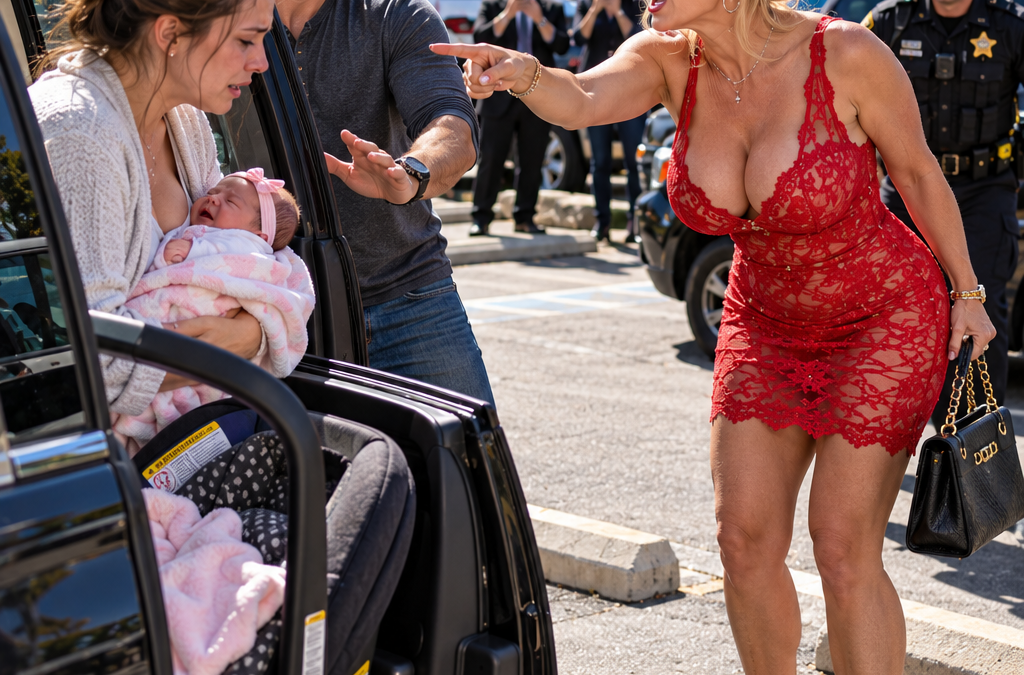
“You have ten seconds to move that car before I call a tow truck.”
Karen Dalton’s voice cracked across the courthouse parking lot so sharply that people twenty yards away turned to look.
My wife Sarah froze beside our SUV.
Our newborn daughter, Grace, was half strapped into her car seat, crying softly beneath a pink blanket. Sarah was exhausted, barely two weeks postpartum, one hand braced against the open door as she stared at the woman who had spent months tormenting us.
Karen stood less than twenty feet away.
She was forty, strikingly beautiful in the calculated way that made people underestimate her cruelty at first. She wore the same kind of red lace dress she seemed to wear everywhere—tight, low-cut, deliberately provocative, showing far more cleavage than anyone expected from the president of a suburban homeowners association. Her dark hair fell perfectly around her shoulders. Her nails were manicured. Her makeup was flawless.
And she was screaming at my wife in a courthouse parking lot minutes after a judge had ordered her to stay away from us.
“You heard me,” Karen snapped, pointing a manicured finger toward Sarah. “Move it. Now.”
I stepped between them.
“Karen, back away.”
Her eyes moved to me.
There was something different in them now.
For months, I had watched that woman lie, threaten, fine, manipulate, steal, intimidate, and smile while doing all of it.
But that afternoon, she looked desperate.
Not angry.
Cornered.
And desperate people were dangerous.
A courthouse security officer was already moving toward us.
Karen either didn’t see him or no longer cared.
“You two have destroyed everything,” she hissed. “You think this is over?”
“No,” I said quietly. “I think you’re about to make it worse.”
She took another step.
The security officer reached her seconds later.
And what happened next had begun six months earlier, with a twenty-five-dollar fine and a mailbox flag.
Back then, Sarah and I thought Maple Ridge Estates was where our life was finally going to become quiet.
We had just moved outside Charlotte, North Carolina. We were newlyweds, expecting our first child, and tired of apartment walls, unpredictable landlords, and hearing strangers argue through drywall at two in the morning.
Maple Ridge looked almost unreal the first time we drove through it.
Tree-lined streets.
Freshly painted mailboxes.
Wide sidewalks.
Identical black streetlamps.
Kids riding bicycles beneath enormous oak trees.
It felt stable.
Safe.
Permanent.
Sarah was pregnant, though barely showing, and I remember driving past the clubhouse and imagining our daughter learning to swim in the community pool everyone kept talking about renovating.
“This could be it,” Sarah said.
I looked at her.
“What?”
“The place we stay.”
I smiled.
“The forever house?”
She rested a hand on her stomach.
“The forever house.”
We closed three weeks later.
Our first warning came before we had finished unpacking.
Denise, a woman who lived two doors down, arrived carrying banana bread.
She was friendly but nervous, the kind of person who glanced toward the street before saying something private.
She welcomed us, asked when the baby was due, admired the house.
Then her expression changed.
“One thing,” she said.
Sarah looked at her.
“What?”
Denise lowered her voice.
“Watch your grass.”
I laughed.
She didn’t.
“I’m serious. Karen measures it.”
“Measures what?”
“The grass.”
“With what?”
“A ruler.”
I laughed again because the alternative was believing her.
Denise looked almost embarrassed.
“You’ll meet her.”
We did.
Karen Dalton had been president of the Maple Ridge HOA for eleven years.
Nobody ran against her anymore.
Nobody seemed willing to.
She was forty years old and carried herself more like the owner of the subdivision than an elected volunteer. Every time I saw her, she seemed to be wearing some variation of the same red lace dress—form-fitting, revealing, usually paired with heels completely inappropriate for walking suburban sidewalks.
At first glance, she was charming.
She laughed easily.
Touched people’s arms while speaking.
Leaned close when she wanted someone’s attention.
Karen knew she was attractive and understood how to use it. Around contractors and male board members, her voice became softer and playful. Around residents she disliked, that softness disappeared instantly.
Two weeks after we moved in, I received our first violation letter.
MAILBOX FLAG IMPROPERLY ALIGNED.
Fine: $25.
I read it twice.
Then I walked outside and stared at the mailbox.
The flag looked completely normal.
Sarah came up behind me.
“What are you doing?”
“Apparently committing a crime.”
I handed her the letter.
She read it, rolled her eyes, and gave it back.
“Pay it.”
“It’s ridiculous.”
“It’s twenty-five dollars.”
“That isn’t the point.”
She smiled.
“Marcus, we have boxes in the nursery and a baby coming. Pick your battles.”
So I paid it.
That was my first mistake.
The second letter arrived nine days later.
Our porch light bulb was supposedly the wrong shade of white.
Another twenty-five dollars.
Then came the recycling-bin violation because our bin remained visible from the street four minutes beyond the permitted pickup window.
Four minutes.
That one bothered me enough that I started paying attention.
Karen’s trash can sat beside her garage until nearly midnight the following week.
No fine.
Her flower beds were full of weeds.
No fine.
One of her hedges extended onto the sidewalk.
No fine.
It became obvious very quickly that Maple Ridge did not have one set of rules.
It had two.
There were rules for Karen Dalton.
And there were rules for everyone else.
Still, Sarah and I tried to fit in.
We attended the community mixer at the clubhouse, brought a fruit tray, introduced ourselves to neighbors, smiled at people whose names we immediately forgot.
Karen found us near the refreshments.
Her eyes went directly to Sarah’s stomach.
“Oh,” she said. “You’re pregnant.”
Sarah stiffened.
At that point she was barely showing.
Only a few people knew.
Karen smiled.
“Congratulations.”
“Thank you.”
“Just remember that strollers aren’t allowed on the clubhouse lawn.”
Sarah stared at her.
“I don’t own a stroller yet.”
Karen gave a small laugh.
“I’m just helping.”
Then she walked away.
I turned toward Sarah.
“How did she know?”
Sarah watched Karen cross the room.
“I told Denise.”
“Only Denise?”
“Yes.”
I wanted to believe Denise had mentioned it innocently.
Sarah wasn’t convinced.
“She collects information,” she said.
I thought she was exaggerating.
By our second month, I knew she wasn’t.
The fines came faster whenever we spent time outside.
A lawn chair positioned too close to the driveway.
A garden hose visible from the street.
A planter supposedly exceeding approved dimensions.
It began to feel less like enforcement and more like surveillance.
I started keeping everything.
Letters.
Photographs.
Emails.
Dates.
Times.
I had spent years working as a claims auditor, and one lesson had followed me into every part of my life:
If something feels wrong, document it before someone convinces you it never happened.
Sarah initially thought I was becoming obsessed.
Then we painted the shutters.
The HOA’s approved color booklet showed a soft sage green on page fourteen. Sarah loved it. We bought the exact recommended shade and spent a Saturday repainting them.
Three days later, a violation notice appeared.
UNAPPROVED EXTERIOR COLOR.
Remove within ten days or daily fines would begin.
I called the HOA office.
A woman answered.
I read her the notice.
Then I told her the color appeared in the association’s own approved booklet.
There was a pause.
“You’re correct,” she said quietly. “Sage green is listed.”
I barely had time to answer before another voice appeared on the line.
Karen.
“That booklet is outdated.”
I recognized her immediately.
“Then send me the current one.”
“There isn’t a printed revision yet.”
“So what standard did I violate?”
“My decision.”
I thought I had misheard.
“Excuse me?”
“I make the final architectural determination.”
“Based on what?”
“Community standards.”
“Which are written where?”
Her voice hardened.
“Mr. Webb, I strongly recommend you stop trying to turn every conversation into an argument.”
Then she hung up.
I wanted to fight.
Sarah was six months pregnant.
She wanted peace.
So I repainted the shutters beige.
I remember standing on the ladder, rolling beige paint across the sage green Sarah had chosen, feeling something ugly growing inside me.
Not because of the paint.
Because Karen had proven she could invent a rule, punish us under it, and force us to obey.
And nothing happened to her.
Two weeks later, she took something from me that mattered more.
My father had given us a ridiculous little ceramic garden gnome as a housewarming gift before he died.
He had laughed when he handed it over.
“Every respectable homeowner needs something ugly enough to annoy the neighbors.”
After his funeral, the joke stopped being funny.
The gnome became one of those stupid objects grief attaches itself to.
One morning, it disappeared.
In its place sat an HOA notice.
UNAUTHORIZED LAWN ORNAMENT REMOVED UNDER SANITATION CODE 4.2.
I walked the neighborhood looking for it.
When I passed Karen’s house, her garage door was open.
There was my father’s gnome.
Sitting on a shelf.
Beside three other decorations I recognized from neighbors’ yards.
I stopped on the sidewalk.
Karen was nowhere in sight.
I pulled out my phone and took several photographs.
That changed everything.
Until then, Karen could claim she was aggressively enforcing HOA rules.
But HOA bylaws required confiscated property to be documented and stored at the community office.
Not inside Karen Dalton’s garage.
At the next board meeting, I raised my hand.
Karen was seated at the front table in another red lace dress, smiling at two male board members while reviewing papers.
“Yes, Mr…”
She paused theatrically.
“Webb.”
“Right.”
A few people shifted in their chairs.
I stood.
“Why is confiscated homeowner property being stored inside your garage?”
The smile remained.
Her eyes changed.
“I have no idea what you’re talking about.”
“My garden gnome.”
Someone laughed quietly.
Karen looked toward the sound.
Nobody laughed again.
I continued.
“Section 7.3 requires confiscated property to be logged and stored at the HOA office.”
She leaned back.
“Perhaps you should read the bylaws before attempting to quote them.”
“I did.”
The room became still.
“Twice.”
Karen’s jaw tightened.
I pulled out my phone.
“I also photographed my property in your garage.”
For the first time, she had nothing ready.
Frank, an older man sitting near the rear, murmured loudly enough for everyone to hear.
“Finally.”
Karen slammed the meeting agenda onto the table.
“This meeting is adjourned.”
“We still have eleven minutes.”
“Adjourned.”
Outside, Frank caught me before I reached my car.
“You’re the first person to challenge her publicly in years.”
“What happens when people challenge her?”
His face lost what little humor it had.
“Nothing good.”
“Meaning?”
He shook his head.
“Watch your back.”
That night, Sarah found a folded note beneath our windshield wiper.
Some fights aren’t worth your baby’s peace.
No signature.
No explanation.
Sarah stood beneath the porch light reading it twice.
I expected her to tell me we were done.
Instead she looked up.
“Start recording everything.”
I studied her face.
“You sure?”
“Every meeting. Every conversation. Every letter.”
Something in my wife had changed.
Sarah had grown up with a controlling stepmother. She recognized the pattern before I did: little humiliations, shifting rules, denial, punishment, threats disguised as concern.
And she had another advantage Karen knew nothing about.
Before stepping away from work for the pregnancy, Sarah had spent six years as a paralegal specializing in real-estate and HOA litigation.
That night our kitchen table disappeared beneath governing documents, fine notices, screenshots, and highlighted statutes.
“Let her keep sending fines,” Sarah said.
“You want more?”
“I want evidence.”
She looked at the growing stack.
“People like Karen survive because everyone treats each incident separately. One fine. One threat. One missing decoration. But put everything in chronological order…”
She tapped the stack.
“…and suddenly you don’t have incidents. You have a pattern.”
We stopped fighting emotionally.
We started building a case.
I submitted a formal written request for three years of financial records and violation histories.
Karen delayed.
The accountant was on vacation.
Then the computer system had supposedly corrupted files.
Then records were being migrated.
Sarah laughed when I showed her the third excuse.
“She’s panicking.”
“How do you know?”
“Because refusing this request creates another violation.”
Then Denise came to us.
She showed us three years of fines over a wheelchair ramp installed for her disabled son.
Karen claimed it violated uniform aesthetic standards.
Denise had been terrified to challenge the HOA.
Sarah read the paperwork and went silent.
“They can’t do this.”
Denise’s eyes filled.
“They already did.”
“No. They sent paper. That doesn’t make it lawful.”
Word spread quietly.
Neighbors approached us in driveways.
At mailboxes.
Inside grocery-store aisles.
Frank told us Karen had pushed him off the finance committee after he questioned invoices.
Mrs. Chin had been fined repeatedly for a wind chime.
A veteran had been threatened over the size of his American flag under a restriction that did not appear anywhere in the official bylaws.
A single father had been fined for a basketball hoop that had stood in the same driveway for years.
Sarah created a private group chat.
Eleven homeowners joined.
Then Karen escalated.
She hired a private compliance inspector.
His name was Roy.
He was also her cousin.
Roy drove slowly past our house several times a day, taking photographs through his truck window.
Sometimes he parked across the street for twenty minutes without moving.
By then Sarah was seven months pregnant.
One afternoon she closed the curtains and whispered, “He’s watching the house again.”
That was the first time I heard fear in her voice.
I installed security cameras.
Two days later, one recorded Roy walking directly onto our property with a tape measure.
He measured the grass.
Not from the sidewalk.
From our lawn.
Trespassing in full 4K.
I wanted to confront him.
Sarah stopped me.
“No.”
“He’s on our property.”
“And now we have proof.”
Her instinct was always the same.
Don’t give them the scene they want.
Give the court the evidence it needs.
Frank brought us the next piece.
He came over after dark.
No banana bread.
No small talk.
He sat at our kitchen table and spoke quietly.
“Look at the landscaping company.”
“What about it?”
“Karen controls it.”
He told us the HOA landscaping contracts had been routed for years through Greenscape Solutions LLC.
Sarah searched the state business registry.
The registered owner was Gary Dalton.
Karen’s husband.
Maple Ridge was paying Greenscape roughly $4,200 every month.
The neighborhood did not look like it received $4,200 worth of landscaping in a season, much less every month.
Even Karen’s own flower beds were full of weeds.
I stared at the invoices.
“So she isn’t just harassing people.”
Sarah’s expression was grim.
“No.”
“She might be stealing.”
“We don’t know that yet.”
“What do we know?”
“We know there’s enough here to force an audit.”
North Carolina procedures and the association’s governing documents allowed homeowners to trigger a financial review if enough members demanded one.
Maple Ridge had 140 homes.
We needed thirty-five signatures.
We collected forty-one.
We did it quietly.
Door to door.
Mostly after dark.
Some homeowners signed immediately.
Others looked terrified.
Priya, a woman three streets over, held the petition in both hands before signing.
“She foreclosed on a family once,” she whispered.
“For what?”
“Unpaid fines.”
“Legitimate?”
Priya looked toward the street.
“That depends on whether you think Karen inventing them makes them legitimate.”
The night before we planned to file the petition, Sarah began having contractions.
I drove her to the hospital terrified that our fight with Karen had pushed my wife into premature labor.
Hours later, doctors confirmed it was a false alarm.
Sarah lay in the bed, pale and exhausted.
I held her hand.
“We stop.”
“No.”
“Sarah.”
“We stop.”
She squeezed my fingers.
“Marcus, if we stop every time she frightens us, she learns that frightening people works.”
“I care more about you and Grace than some HOA.”
“So do I.”
She swallowed.
“That’s why we finish it.”
The next morning, we submitted the audit petition to both the management company and the county.
Karen received formal notice forty-eight hours later.
She did not know with certainty who organized it.
She knew.
Our fines tripled almost overnight.
Seventy-five dollars for a garden hose.
Fifty dollars for a doormat supposedly exceeding permitted dimensions.
Warnings over plants, parking, recycling, lighting.
The more she retaliated, the stronger Sarah’s timeline became.
Karen called an emergency HOA meeting.
She arrived in red lace and heels, smiling as though the room belonged to her.
“This so-called audit,” she announced, “is the result of a personal vendetta by disgruntled residents.”
Sarah sat beside me recording.
Karen scanned the audience.
“Whoever began this witch hunt will be dealt with according to HOA policy.”
The room became silent.
Frank stood.
“Homeowners have a legal right to request an audit.”
Karen turned toward him.
“This community ran smoothly before certain people started causing trouble.”
“Smoothly?” Frank asked.
A few people laughed.
Karen’s eyes flashed.
That was the first moment I saw her lose control in front of a room.
Afterward, Roy followed our car for two miles.
He stayed so close I could barely see his headlights.
Sarah twisted in her seat.
“Marcus.”
“I see him.”
“Don’t go home.”
I pulled into a busy gas station.
Roy slowed as he passed.
He stared directly at Sarah.
Then accelerated away.
Her hands were shaking when she wrote down his license plate.
The next morning, our mailbox had been pried open.
Several pieces of mail were missing.
One was a bank statement.
We called police.
There was no direct proof Karen or Roy had done it.
But from that day forward, every sensitive document went to a PO box.
The pressure stopped feeling financial.
It became physical.
Personal.
Dangerous.
Two weeks before the scheduled audit, Karen proposed an emergency bylaw amendment restricting what she called “excessive homeowner correspondence with county agencies.”
Sarah almost smiled when she read it.
“She’s trying to stop residents from reporting her.”
At the meeting, Sarah stood.
Eight months pregnant.
Ankles swollen.
Tired.
Still unshakable.
She read section 11.4 of the governing documents aloud.
“You cannot amend away a homeowner’s legal right to contact government agencies.”
Karen leaned forward.
“Sit down, Mrs. Webb.”
Sarah remained standing.
“You don’t have authority to pass this.”
“You’re not a lawyer.”
“No.”
Sarah lifted the documents.
“But I spent six years drafting filings in cases where HOA boards tried exactly this.”
The room erupted in murmurs.
Someone laughed.
Then another person.
Not at Sarah.
At Karen.
The amendment failed six votes to two.
For the first time, even some of Karen’s allies refused to follow her.
She waited for us in the parking lot.
Sarah was walking slowly toward our car when Karen appeared from between two vehicles.
That red lace dress.
That perfect hair.
That smiling mouth.
“You think you’re clever?” she asked.
I stepped closer to Sarah.
Karen’s eyes dropped toward Sarah’s stomach.
“Pregnant women have accidents all the time.”
Everything inside me stopped.
She continued softly.
“Stress is dangerous this late in pregnancy.”
I moved between them.
“Are you threatening my wife?”
Karen’s expression transformed instantly.
Sweet.
Concerned.
Innocent.
“I’m simply worried about her health.”
Sarah reached into her purse and raised her phone.
“Still recording.”
Karen’s smile vanished.
She walked away without another word.
We filed for a protective order Monday morning.
The judge heard the recording.
Karen was ordered to remain at least fifty feet away from Sarah and prohibited from contacting our household directly.
That order changed Maple Ridge.
People who had been silent for years began speaking.
Mrs. Chin brought us records showing nearly $3,000 in wind-chime penalties over eighteen months.
Another homeowner produced text messages from Karen offering to waive fines in exchange for favorable votes.
Sarah read the messages twice.
“This is it.”
“What?”
“Proof she uses fines as leverage.”
By then our evidence occupied multiple binders.
We hired Diane Marsh, an attorney specializing in HOA governance and financial misconduct.
She spent two hours reviewing the material.
When she finally looked up, she didn’t look amused.
“This may be much larger than an HOA dispute.”
“How much larger?”
“If the Greenscape payments are what they appear to be, potentially criminal.”
We filed a complaint with the state attorney general’s consumer-protection division.
Karen responded by attacking us publicly.
She wrote a long post in the community Facebook group accusing “troublemakers” of harassing volunteer board members.
It detonated in her face.
Residents filled the comments with their own stories.
Fines.
Threats.
Confiscated property.
Selective enforcement.
More than two hundred comments appeared within a day.
Karen deleted the post.
Too late.
Sarah had screenshots.
Then the audit date changed.
The management company had apparently realized it might face liability for ignoring warning signs. Instead of giving Karen weeks to prepare, the auditors advanced the review.
Karen received four days’ notice.
That was when she panicked.
Roy’s own dash camera eventually became the evidence that exposed it.
At approximately two in the morning, it recorded Karen moving boxes of HOA financial records into a storage unit.
The woman who had spent months accusing everyone else of violating rules was now being filmed trying to move records days before a mandatory audit.
Three days later, Sarah went into labor.
At 6:47 in the morning, Grace Elizabeth Webb entered the world weighing seven pounds, two ounces.
She screamed immediately.
Sarah laughed through tears.
“She already has opinions.”
For one week, Maple Ridge disappeared.
No bylaws.
No Karen.
No invoices.
No cameras.
Just bottles, diapers, exhaustion and the strange terror of loving something more than yourself.
Then someone knocked.
A process server stood outside.
Greenscape Solutions LLC was under active state investigation.
For the first time in months, hope felt stronger than fear.
Karen was unraveling.
Neighbors heard her screaming at Gary in their driveway.
Investigators began questioning vendors.
Records were subpoenaed.
And despite the protective order, Karen still could not leave Sarah alone.
Two weeks after Grace’s birth, she approached Sarah near the mailbox.
She came within thirty feet, screaming that we had ruined her life.
A neighbor’s doorbell camera captured everything.
At the hearing, the judge watched the footage.
He extended the restraining order for a full year.
Then he looked directly at Karen.
“Any further violation may result in criminal contempt.”
Karen walked out furious.
Sarah and I carried Grace toward the parking lot.
I believed the warning would finally stop her.
I was wrong.
Sarah had just begun fastening Grace into the back seat when we heard heels striking pavement.
Karen.
She stormed toward us in red lace.
“You have ten seconds to move that car before I call a tow truck.”
Sarah stared at her.
I stepped between them.
“You were just ordered to stay away from her.”
“I don’t care.”
“You should.”
“This is my courthouse too.”
“No, Karen. It isn’t your anything.”
She pointed toward Sarah.
“You destroyed my reputation.”
“No,” Sarah said from behind me. “You did.”
Karen took another step.
Then a voice came from behind her.
“Ma’am, stop.”
A courthouse security officer had seen enough.
Karen turned.
He asked her to step away.
She began arguing.
Sarah quietly said, “There’s a protective order.”
The officer radioed for confirmation.
Karen kept talking.
Kept blaming.
Kept insisting she was being harassed.
Within minutes, another officer arrived.
They confirmed the order had been extended less than half an hour earlier.
Karen Dalton was arrested in the courthouse parking lot for violating it.
As officers placed her in handcuffs, she twisted toward us.
“You ruined my life!”
I looked at Sarah.
Then back at Karen.
“No.”
I had spent six months wanting to scream at her.
Instead, my voice came out almost calm.
“You kept getting chances to stop.”
They placed her into the patrol car.
The audit uncovered nearly $380,000 in diverted HOA funds over six years.
Duplicate invoices.
Inflated labor charges.
Work never performed.
Payments routed through accounts disguised as equipment reserves.
Money homeowners thought was being saved for the community pool had been drained while Karen kept demanding special assessments for a renovation that existed mostly on paper.
The cruelty suddenly had arithmetic behind it.
Denise had paid thousands over her disabled son’s wheelchair ramp while Karen’s company collected fraudulent landscaping payments.
Mrs. Chin’s wind-chime fines.
Our shutter fines.
Our doormat fines.
The garden hose.
The mailbox.
The gnome.
Every petty humiliation suddenly looked different.
Karen had not merely enjoyed control.
The fine system had helped create fear, compliance and cash flow while discouraging homeowners from asking harder questions.
The district attorney’s office reviewed Sarah’s evidence.
An investigator told Diane it was one of the most organized civilian files their office had received in years.
Dates.
Photographs.
Audio.
Video.
Invoices.
Witness statements.
Financial records.
Everything connected.
Karen was charged with embezzlement, forgery, obstruction of justice and criminal contempt.
Gary cooperated.
Investigators discovered Karen had forged his signature on multiple Greenscape documents.
He admitted he had suspected something was wrong but had been afraid of confronting his own wife.
Roy made a deal as well.
His trespassing problems suddenly seemed small compared with what investigators wanted from him.
The same dash-cam footage that captured Karen moving records became evidence against her.
Four months after Grace was born, the trial began.
Nearly thirty Maple Ridge residents filled the courtroom.
Sarah testified for almost two hours.
The defense tried to portray her as a vindictive newcomer who had become obsessed with Karen.
Sarah never raised her voice.
She walked through the evidence chronologically.
The defense attorney asked, “You disliked Mrs. Dalton, correct?”
Sarah thought for a moment.
“I disliked what she did.”
“That wasn’t my question.”
“I didn’t know her well enough to dislike her when this began.”
The attorney frowned.
“But you eventually wanted her removed.”
“I wanted her to stop hurting people.”
When the prosecution introduced Karen’s messages offering to waive fines for votes, I watched the jury.
Something changed.
Faces hardened.
Pens stopped moving.
One juror glanced toward Karen with open disgust.
Frank testified about being pushed off the finance committee.
Mrs. Chin testified about the wind chime.
Denise cried while describing the wheelchair ramp and how close her family came to financial disaster.
I testified about the gnome.
It sounded absurd until the prosecutor displayed the photograph.
My father’s cheap ceramic gnome sat in Karen Dalton’s garage surrounded by property taken from other homeowners.
The prosecutor asked me why that photograph mattered.
“Because that was when I understood she didn’t believe the rules applied to her.”
The courtroom went quiet.
On the final day, the prosecutor stood before the jury.
“This was not community governance.”
He turned slightly toward Karen.
“This was control used to conceal theft.”
The jury deliberated for less than four hours.
Guilty.
Embezzlement.
Guilty.
Forgery.
Guilty.
Obstruction.
Guilty.
Criminal contempt.
Karen sat perfectly still.
Six weeks later, the judge sentenced her to three years in state prison, ordered full restitution of approximately $380,000, and permanently barred her from serving on an HOA board in North Carolina.
He described her behavior as “calculated cruelty disguised as civic duty.”
Gary filed for divorce the same week.
Maple Ridge rebuilt.
Frank became interim HOA president after a unanimous vote.
One of the first things the new board did was begin reviewing years of fines.
Denise received more than $6,000 back and a formal apology for what had been done to her family.
Mrs. Chin was reimbursed.
So were dozens of others.
Sarah and I received nearly $2,400.
Every ridiculous fine.
Every retaliatory charge.
Every dollar Karen had extracted because she thought fear made people obedient.
Even my father’s garden gnome came home.
The police had held it as evidence.
One corner of its hat was chipped.
I put it back on the porch anyway.
Sarah looked at it and laughed.
“Still ugly.”
“He’d be proud.”
The neighborhood changed slowly.
Roy moved away.
The board published financial statements.
Meetings were recorded.
Violation appeals were reviewed by multiple people instead of one president with a personal grudge.
And six months after Karen’s conviction, construction finally began on the community pool residents had paid toward for years.
Sarah joined the new oversight committee under one condition:
Complete financial transparency.
Quarterly reports.
Open records.
No exceptions.
Denise joined the compliance-review committee.
The woman who had once been too frightened to challenge a wheelchair-ramp fine now questioned every enforcement decision that looked selective.
Grace spent her first summer splashing in a little plastic baby pool near our porch while the real community pool was being built.
Our shutters were still beige.
For some reason, I never changed them back.
They reminded me of where everything started.
Karen wrote us once from prison.
Sarah opened the letter at the kitchen table.
She read the first page.
Then the second.
“What does she say?” I asked.
Sarah folded it.
“No apology.”
I wasn’t surprised.
Karen claimed she had only wanted what was best for Maple Ridge.
She blamed residents.
The board.
The management company.
Gary.
The investigation.
Anyone but herself.
Sarah placed the letter inside the final evidence binder.
“You’re keeping it?”
“Yes.”
“Why?”
She slid the binder shut.
“Because this is where it belongs.”
We never answered.
We didn’t need to.
Karen had spent eleven years believing power meant deciding whose grass was too high, whose decorations were acceptable, whose flag was too large, whose wheelchair ramp was too ugly and whose voice needed to be silenced.
She mistook fear for respect.
She mistook obedience for loyalty.
And because nobody challenged her for so long, she eventually mistook herself for untouchable.
That was her real mistake.
Not the forged documents.
Not Greenscape.
Not the storage unit.
Not even threatening my wife.
Her biggest mistake was believing that every frightened homeowner would remain frightened forever.
She never imagined Denise would speak.
Or Frank.
Or Mrs. Chin.
Or Priya.
She never imagined forty-one homeowners would sign the audit petition.
She certainly never imagined Sarah sitting at our kitchen table, eight months pregnant, quietly turning every threat Karen made into another dated line in an evidence file.
Sometimes I think about the anonymous note left on our windshield.
Some fights aren’t worth your baby’s peace.
For months, I wondered whether it had been a threat or a warning.
Eventually I stopped caring.
Because whoever wrote it had been wrong.
The fight was for Grace’s peace.
For the kind of neighborhood where my daughter could grow up without learning that powerful people were allowed to hurt others simply because resisting them was inconvenient.
For a community where Denise’s son could use his wheelchair ramp without his mother fearing another envelope in the mail.
For homeowners who could ask where their money went without worrying that someone would retaliate against their families.
Justice did not arrive dramatically at first.
It arrived as paperwork.
One photograph.
One recording.
One signature.
One frightened neighbor deciding to tell the truth.
Then another.
Then another.
By the time Karen understood what was happening, the people she had isolated had begun talking to one another.
And once that happened, her power collapsed faster than I ever imagined possible.
Today, Maple Ridge Estates still has manicured lawns and matching mailboxes.
Kids still ride bicycles beneath the oak trees.
The new pool is open every summer.
The quarterly financial reports are posted where everyone can see them.
People complain at meetings sometimes.
They disagree.
They vote.
They argue.
And nobody is afraid.
That matters more than perfect landscaping ever did.
Grace will never remember Karen Dalton.
She will never remember the fines stacked across our kitchen table or her mother recording HOA meetings with one hand resting protectively over her stomach.
She will never remember being strapped into a car seat while a woman in a red lace dress screamed about towing our vehicle outside a courthouse.
Good.
I hope she never has to.
What I want her to inherit is what came afterward.
A neighborhood where authority has limits.
Where questions are allowed.
Where rules apply to the people enforcing them too.
The garden gnome still sits beside our porch.
Its chipped hat catches the afternoon sun.
Every once in a while someone new to Maple Ridge asks why we keep such an ugly thing in such a visible spot.
I usually smile.
“It belonged to my father.”
That answer is true.
It just isn’t the whole truth.
The whole truth would take hours.
It would require explaining how a twenty-five-dollar mailbox fine became a pattern, how a pattern became an investigation, how an investigation uncovered $380,000, and how one woman who believed she controlled an entire neighborhood eventually discovered that fear only works until people compare notes.
Karen once told me she made the final call.
For eleven years, everyone believed her.
In the end, she was right about one thing.
Someone eventually did make the final call.
It just wasn’t Karen.








