𝗙𝗨𝗟𝗟 𝗦𝗧𝗢𝗥𝗬 The HOA President Threatened My Pregnant Wife Over a Parking Spot, and I Knew She Wouldn’t Stop Until Our Family Was Gone
𝗙𝗨𝗟𝗟 𝗦𝗧𝗢𝗥𝗬
Something in her voice made me look more closely.
She shifted the bread into Sarah’s hands.
“Just watch your grass height.”
I laughed.
“Our grass?”
“Karen measures it.”
“With what?”
“A ruler.”
I waited for her to smile.
She didn’t.
“You’re serious?”
Denise lowered her voice.
“Very.”
Sarah looked at me.
I grinned.
“Well, I guess we’d better keep the lawn mower ready.”
Denise didn’t laugh.
“Just be careful.”
Then she thanked us for inviting her inside and walked back toward her house.
I watched her go.
“That was strange,” I said.
Sarah remained quiet.
When I turned toward her, she was staring at the banana bread.
“What?”
“Nothing.”
“Come on.”
She looked up.
“I’ve known people like that before.”
“Like what?”
“People who use tiny rules to make everyone else feel small.”
Sarah had grown up with a controlling stepmother, someone who could turn the smallest household mistake into an hours-long interrogation.
She recognized that kind of behavior more quickly than I did.
I kissed her forehead.
“It’s an HOA, sweetheart. How bad can it be?”
She didn’t answer.
I wish I’d listened to that silence.
The first violation letter arrived two weeks later.
It was taped to our front door.
MAILBOX FLAG IMPROPERLY ALIGNED — $25 FINE.
I read it twice.
Then walked down the driveway and examined our mailbox.
The little red flag was resting at a slight angle.
Apparently, that was enough to violate community standards.
I adjusted it with one finger.
Problem solved.
Or so I thought.
When I called the HOA office, the woman answering the phone informed me that the fine remained payable because the violation had already been documented.
“It’s twenty-five dollars,” I told Sarah that evening. “I’m not wasting an afternoon fighting it.”
She shrugged.
“Pick your battles.”
I paid.
A week later, we received another letter.
Our porch light bulb was allegedly the wrong shade of white.
Another twenty-five dollars.
I replaced it.
Then came the recycling bin.
According to the notice, we’d left it visible from the street four minutes beyond the approved collection period.
Four minutes.
I checked the time written on the letter.
Then looked at Sarah.
“Does this woman stand outside with a stopwatch?”
Sarah sighed.
“Apparently.”
That was when I started paying attention.
Karen’s own lawn had weeds growing beside the driveway.
Her trash can sometimes remained outside overnight.
One house had decorative lighting far brighter than ours.
Another had mismatched mailbox fixtures.
Nobody seemed concerned.
But our house received notice after notice.
I first met Karen properly at the community mixer near the end of our first month.
Sarah and I brought a fruit tray because we still wanted to be friendly neighbors.
The clubhouse was filled with folding tables, paper decorations, and residents balancing plastic plates of food.
Karen stood near the entrance greeting people.
She was forty years old and strikingly beautiful, with long blonde hair, flawless makeup, and an exaggerated hourglass figure she clearly enjoyed displaying.
She wore a tight red lace dress with a deep neckline, showing a generous amount of cleavage, and heels that made her taller than almost everyone around her.
The dress hugged her full bust and narrow waist so closely that several people turned when she entered a room.
Her appearance was deliberate.
So was her charm.
She had a warm, flirtatious smile for the men she wanted to impress and a talent for touching someone’s arm while delivering an instruction that sounded suspiciously like an order.
I quickly discovered that her smile could disappear in an instant.
“Marcus Webb,” she said when we approached.
I blinked.
“You know me?”
“Of course. I make it my business to know everyone in Maple Ridge.”
She extended her hand.
“I’m Karen Dalton.”
I shook it.
“This is my wife, Sarah.”
Karen looked Sarah up and down.
Her gaze settled on my wife’s stomach.
“Oh, you’re pregnant.”
Sarah smiled politely.
“Yes.”
“How lovely.”
For a moment, Karen sounded genuinely pleasant.
Then she added, “I hope you understand strollers aren’t permitted on the clubhouse lawn.”
I stared at her.
“Strollers?”
“Some new parents think the common areas are their personal playground.”
Sarah’s smile faded.
“We don’t even have a stroller yet.”
Karen laughed lightly.
“Then consider yourself informed.”
She turned toward another couple, effectively dismissing us.
I stood there holding the fruit tray.
“What was that about?”
Sarah didn’t answer immediately.
Instead, she watched Karen move across the room.
Then she said quietly, “I only told one neighbor about the pregnancy last week.”
I frowned.
“So?”
“That conversation was private.”
I looked back at Karen.
She was laughing with a man near the refreshment table, one manicured hand resting lightly on his sleeve.
Suddenly, I understood what bothered Sarah.
Karen didn’t simply know people’s names.
She seemed to know details about their lives that hadn’t been offered to her.
And she enjoyed demonstrating that knowledge.
We stayed at the mixer for another twenty minutes.
Then went home.
By our second month in Maple Ridge, the fines had developed a pattern.
They often arrived after Sarah and I spent an afternoon outside together.
If we planted flowers, a landscaping notice followed.
If we sat on the porch after dinner, Karen found something wrong with the exterior appearance of the house.
If we spent Saturday cleaning the driveway, another letter appeared within days.
It began to feel as though ordinary happiness attracted punishment.
I knew that sounded irrational.
So I did what my old job had trained me to do.
I started documenting.
Before changing careers, I’d spent years working as a claims auditor.
I knew the difference between suspicion and evidence.
I knew that memories became unreliable under stress.
And I knew that a properly dated document could be more useful than an angry argument.
I created a folder on my computer.
Every violation letter went into it.
Every receipt.
Every photograph.
Every email.
I recorded the dates, times, amounts, and exact rules cited.
Sarah thought I was taking things too far.
“It’s just a few hundred dollars, Marcus.”
I sat at the kitchen table scanning another notice.
“Then why does she keep doing it?”
“Because she’s controlling.”
“That’s not an excuse.”
“I know.”
She rested a hand on her stomach.
“But I don’t want to spend this pregnancy fighting over trash cans.”
I looked at her.
The exhaustion in her voice made me feel guilty.
I closed the laptop.
“You’re right.”
She smiled faintly.
“Thank you.”
I wanted that to be the end of it.
Then we painted our shutters.
The original shutters were faded dark brown.
Sarah wanted something softer.
We looked through the HOA’s approved exterior-color booklet and found a pale sage green on page fourteen.
It was listed as an acceptable accent color.
We checked the paint code twice.
Then spent a Saturday repainting.
Sarah sat in a lawn chair beneath the oak tree, directing me while I climbed the ladder.
“A little more on the left.”
I moved the brush.
“Yes, boss.”
“You’re missing the corner.”
“Are you supervising or criticizing?”
“Both.”
I laughed.
She smiled, one hand resting over the baby.
It was a good day.
One of the few we’d had without thinking about Karen.
Three days later, a violation notice arrived.
UNAPPROVED EXTERIOR COLOR.
We were ordered to remove the paint within ten days or face daily fines.
I stood on the porch staring at it.
Then went inside and opened the approved-color booklet.
Page fourteen.
Sage green.
Exact paint code.
I called the HOA office.
The receptionist sounded confused when I explained.
“That color is listed in the booklet,” she admitted.
“Exactly.”
“Let me check the current guidance.”
I heard another voice in the background.
Then Karen came onto the line.
“Mr. Webb.”
“Karen. We’ve apparently been fined for using an approved color.”
“That booklet is outdated.”
“Then where’s the updated one?”
“We’re revising the standards.”
“Can you send me the current approved-color list?”
“It will take several weeks to formalize.”
I frowned.
“So there’s no written list replacing the one you gave us?”
“Community standards evolve.”
“But you’ve already fined us.”
“Correct.”
“Based on a rule that hasn’t been published?”
Her voice sharpened.
“I make the final call on architectural compliance.”
I gripped the phone.
“No. The governing documents determine compliance.”
A pause.
Then she laughed.
“You sound very confident for someone who’s lived here only a few weeks.”
I forced myself to breathe.
“Karen, my wife is pregnant. I’m trying to avoid unnecessary stress. We followed your written instructions.”
“Then I suggest you follow the updated expectations as well.”
“What expectations?”
“Repaint the shutters, Mr. Webb.”
She hung up.
I stood in the kitchen listening to the dead line.
For several seconds, I didn’t move.
Then Sarah came in.
“What did she say?”
I looked at her.
“She says we have to repaint.”
“But the color was approved.”
“I know.”
Sarah closed her eyes.
“Marcus, please.”
I looked toward the window.
The shutters looked beautiful.
Exactly the way she’d imagined them.
I wanted to fight.
I wanted to march into the clubhouse and demand that Karen explain how an unpublished rule could override a written one.
Instead, I looked at my pregnant wife.
And I gave in.
The following weekend, I painted the shutters beige.
Plain, forgettable beige.
Sarah watched from the porch.
Neither of us joked.
When I finished, she came over and took my hand.
“I’m sorry.”
I shook my head.
“You didn’t do anything wrong.”
“Neither did you.”
That was the worst part.
We had followed the rules.
We had spent the money.
We had done everything a reasonable association could ask.
And somehow, we’d still been punished.
Two weeks later, Karen took something I couldn’t replace with a can of paint.
Our garden gnome disappeared.
It was a small ceramic figure with a crooked red hat and a white beard.
My father had given it to me years earlier.
He’d found it at a roadside shop and bought it because he thought the ridiculous expression looked like mine when I was concentrating.
I hated it at first.
Then it became a joke between us.
When my father died, I kept the gnome.
It was chipped, faded, and worth almost nothing.
But it was one of the few things I owned that could still make me hear his laugh.
I’d placed it beside the flower bed near our porch.
One morning, it was gone.
In its place was a violation notice.
UNAUTHORIZED LAWN ORNAMENT REMOVED UNDER HOA SANITATION CODE 4.2.
My chest tightened.
I read the notice again.
Removed.
Not cited.
Not requested for removal.
Taken.
I called the office immediately.
Nobody answered.
I left a message.
Then another.
By afternoon, I was furious.
Sarah found me pacing the kitchen.
“Marcus, it’s a gnome.”
I stopped.
She saw my expression and immediately regretted saying it.
“I know what it meant to you.”
“It was Dad’s.”
She approached me.
“I know.”
I swallowed.
“They had no right.”
She took my hand.
“Then we get it back.”
That evening, I went for a walk.
I wasn’t looking for trouble.
I simply needed to calm down.
As I passed Karen’s house, her garage door stood open.
And there, sitting on a shelf beside three other lawn decorations, was my father’s garden gnome.
I stopped so abruptly that I nearly stumbled.
I recognized the chipped hat.
The white beard.
The little scratch across the base.
It was mine.
I stood on the public sidewalk, took out my phone, and photographed the open garage.
Then I zoomed in on the shelf.
The gnome was clearly visible.
My hands began shaking.
This wasn’t enforcement.
Karen had taken private property and stored it in her own garage.
I wanted to walk straight up the driveway and demand it back.
Instead, I remembered the folder.
The timestamps.
The documentation.
I saved the photographs.
Then went home.
At the next HOA meeting, I waited until the resident-comment period.
Karen sat at the head of the table wearing her familiar red lace dress beneath a cropped jacket.
When I raised my hand, her smile tightened.
“Yes, Mr. Webb?”
“I have a question about confiscated property.”
She tilted her head.
“Be specific.”
“Where does the association store decorations removed during enforcement?”
“In an appropriate location.”
“Which location?”
She looked annoyed.
“The association handles confiscated items according to established procedures.”
I opened my copy of the bylaws.
“Section 7.3 requires a written inventory and storage at the community office.”
Karen’s eyes narrowed.
“Mr. Webb, perhaps you should read the bylaws before quoting them.”
“I did.”
I held up the document.
“Twice.”
A few people shifted in their chairs.
I continued.
“My garden gnome was removed from my property. I haven’t received an inventory receipt. And it’s currently sitting in your garage.”
The room went silent.
Karen stopped smiling.
For the first time since meeting her, I saw genuine surprise cross her face.
Then anger.
“That is a completely inappropriate accusation.”
“I have a photograph.”
A woman near the back whispered something to her husband.
Karen struck the gavel.
“Order.”
I stayed standing.
“I’m asking when my property will be returned.”
“This discussion is finished.”
“No, Karen. My question hasn’t been answered.”
Her face flushed.
“Mr. Webb, sit down.”
I looked at her.
Then at the two board members beside her.
Neither said a word.
“I’d like the minutes to reflect that I requested the return of property removed from my yard.”
Karen struck the gavel again.
“Meeting adjourned.”
I stared at her.
We had barely begun.
She’d ended the meeting eleven minutes early.
As residents began gathering their belongings, I heard someone near the rear of the room whisper, “Finally, somebody said it.”
Outside, an elderly man approached me.
He was tall and thin, with silver hair and a weathered face.
“My name’s Frank.”
I shook his hand.
“Marcus.”
“I know.”
He glanced toward the clubhouse door.
“You’re the first person to push back in years.”
I gave a humorless laugh.
“Apparently, asking for my garden gnome makes me a revolutionary.”
Frank didn’t smile.
“Watch your back.”
I studied him.
“What does that mean?”
He looked toward Karen’s car.
Then shook his head.
“Just be careful.”
He walked away before I could ask another question.
That night, Sarah found a folded piece of paper tucked beneath our windshield wiper.
There was no signature.
Only one sentence.
Some fights aren’t worth your baby’s peace.
I stood in the driveway reading it.
The porch light illuminated the paper.
Sarah stood beside me.
For several seconds, neither of us spoke.
“Is that a threat?” she finally asked.
“I don’t know.”
“Who would leave something like this?”
I looked toward the dark houses along the street.
“I don’t know.”
She touched her stomach.
I saw the fear in her eyes.
And something inside me changed.
Until then, I had thought Karen’s behavior was petty and vindictive.
Now someone was invoking our unborn child to frighten us into silence.
I folded the note carefully.
Then took a photograph.
Sarah watched me.
“Marcus.”
I looked at her.
“Start recording everything.”
I blinked.
“What?”
“Every meeting. Every letter. Every conversation.”
Her voice was steady.
“We’re done pretending this is normal.”
I stared at her.
For weeks, she’d been asking me to let things go.
Now she was standing in our driveway, pregnant and frightened, telling me to fight.
“You sure?”
She nodded.
“Completely.”
What Karen didn’t know was that Sarah had spent six years working as a paralegal specializing in homeowners association litigation before stepping away from work to prepare for the baby.
She knew how HOA governing documents were supposed to function.
She knew what legitimate enforcement looked like.
And she knew what happened when a board president started treating an association like personal property.
That evening, she spread the bylaws across our kitchen table.
She highlighted provisions on financial records, confiscated property, resident appeals, and board accountability.
Then she opened my evidence folder.
“You’re going to help me organize this properly.”
I sat beside her.
“Okay.”
“Every letter gets a date.”
“Already done.”
“Every violation gets matched to the exact rule.”
“Done.”
“Every photograph needs an original file preserved.”
I nodded.
She looked at me.
“And from now on, we don’t argue with Karen unless we have to.”
I leaned back.
“What’s the plan?”
Sarah picked up another notice.
“Let her keep writing.”
I stared at her.
She smiled, but there was no humor in it.
“Every improper fine is evidence. Every threat is evidence. Every time she oversteps, she strengthens our case.”
I looked at the growing pile of papers.
For the first time, I understood that my wife’s experience might be the one thing Karen hadn’t anticipated.
She thought she was bullying an ordinary young couple who would eventually get tired and leave.
She had no idea Sarah could read her own bylaws better than she could.
And she had no idea that the folder on our kitchen table was about to become the most dangerous thing in Maple Ridge Estates.
The next morning, Sarah drafted a formal request for three years of HOA financial records and violation histories.
She cited Section 9.1 of the association’s governing documents and requested invoices, vendor contracts, payment approvals, enforcement logs, and board meeting minutes.
I read the letter before she sent it.
“You’re asking for everything.”
“Everything we’re entitled to inspect.”
“Karen’s going to lose her mind.”
Sarah looked up from her laptop.
“Then she can put that in writing too.”
The first response arrived four days later.
The HOA accountant was supposedly on vacation.
Sarah waited until the stated return date and followed up.
This time, we were told the records had been temporarily unavailable because of a server migration.
Two weeks passed.
No records.
No accounting statements.
No meeting minutes.
Just excuses.
Sarah kept every email.
One evening, she sat at the kitchen table highlighting the latest response.
“She’s making a mistake.”
I looked up from my phone.
“By refusing?”
“By documenting her refusal.”
She tapped the screen.
“An association can’t simply invent excuses to avoid its recordkeeping obligations. If there’s a legitimate delay, they should explain it and provide a lawful inspection process.”
I looked at the growing folder.
“You sound almost happy.”
“I’m not happy, Marcus.”
She looked toward the nursery.
“I’m furious.”
Then she turned back to the papers.
“But being furious doesn’t help unless we can prove why.”
Our first real ally was Denise.
She came over one afternoon carrying another stack of paperwork.
This time, there was no banana bread.
She looked exhausted.
“Can I show you something?”
Sarah invited her inside.
Denise sat at the kitchen table and removed a collection of HOA notices from a folder.
The fines concerned a wheelchair ramp installed for her disabled son.
Karen had repeatedly claimed the ramp interfered with neighborhood uniformity.
Denise explained that she’d provided medical documentation and requested an accommodation.
The fines continued anyway.
“I thought the HOA could make us remove it,” she whispered.
Sarah read the documents carefully.
“Denise, disability-related housing accommodations are protected under federal law. There are procedures and standards that apply. Karen can’t simply ignore them because she dislikes how the ramp looks.”
Denise stared at her.
“She told me the rules were the same for everyone.”
“Equal treatment doesn’t mean refusing legally required accommodations.”
Denise’s eyes filled with tears.
“I’ve been paying these fines for three years.”
I felt something twist inside my chest.
I had been angry about our mailbox and shutters.
This woman had been punished for helping her son enter his own home.
Sarah reached across the table.
“We’re going to document this.”
Denise wiped her cheeks.
“Karen will come after me if she finds out.”
I looked at her.
“She’s already coming after you.”
Denise was silent.
Then she nodded.
Word spread quietly.
A single father contacted us about fines for a temporary basketball hoop.
A military veteran showed us notices claiming his American flag exceeded a size restriction that didn’t appear in the official bylaws.
Another homeowner described being charged repeatedly for landscaping changes that the board had originally approved.
Each story was different.
The structure was the same.
A small accusation.
A fine.
An attempted correction.
Another fine.
Then a warning that continuing to challenge the association could place the homeowner’s property at risk.
Sarah created a private group chat.
Eleven residents joined.
Nobody wanted publicity.
Most were afraid Karen would discover they were talking.
We began comparing dates, rules, payment demands, and photographs.
The inconsistencies were staggering.
People who supported Karen received exceptions.
People who questioned her received penalties.
What I’d initially dismissed as petty neighborhood politics was beginning to look like a deliberate system of intimidation.
Karen responded by hiring a private compliance inspector.
His name was Roy.
He was a heavyset man in his forties who drove a dark pickup and spent long stretches parked near our house.
Sometimes he sat there for twenty minutes, photographing the lawn, mailbox, windows, and driveway.
Sarah was seven months pregnant by then.
She found his presence deeply disturbing.
One afternoon, she called me at work.
“Marcus, that man is outside again.”
I stood immediately.
“Roy?”
“He’s been sitting there almost half an hour.”
“Keep the doors locked.”
“I am.”
“Don’t go outside.”
Her voice trembled.
“He’s taking pictures of the nursery window.”
My stomach tightened.
“Call me if he approaches the house.”
I left work early.
By the time I arrived, Roy was gone.
Sarah sat on the couch holding a pillow against her stomach.
I sat beside her.
“Are you okay?”
She nodded.
Then shook her head.
“I don’t like someone watching our home.”
Neither did I.
That evening, I ordered security cameras.
I installed them around the porch, driveway, and side yard.
Two days later, the cameras recorded Roy walking onto our property.
He crossed the lawn without knocking.
Then crouched beside the grass and began measuring it with a tape measure.
The footage was clear.
His face.
His vehicle.
The time.
His movements.
Everything.
I watched the recording twice.
Then saved the original file.
Sarah stood behind me.
“Don’t confront him.”
I nodded.
“I’m not going to.”
“Promise?”
“I promise.”
I’d finally learned that an argument could satisfy my anger for five minutes while a recording might protect us for years.
We reported the unauthorized entry and continued preserving evidence.
Then Frank came to our house one evening.
He asked whether we could speak privately.
Sarah made coffee, and we sat around the kitchen table.
Frank stared at his cup for a moment.
“I used to serve on the HOA finance committee.”
I looked at him.
“I didn’t know that.”
“Most people don’t.”
“What happened?”
He gave a bitter smile.
“Karen decided I was asking too many questions.”
Sarah leaned forward.
“What kind of questions?”
“Landscaping contracts. Reserve expenditures. Vendor payments.”
I felt my pulse quicken.
Frank continued.
“She routes a lot of money through a company called Greenscape Solutions.”
Sarah picked up her pen.
“Who owns it?”
“Her husband.”
I stared at him.
“Gary Dalton?”
Frank nodded.
“His name is on the company.”
Sarah opened her laptop.
Within minutes, she found the business registration.
Greenscape Solutions LLC.
Gary Dalton.
Then she compared the information with the vendor disclosures we’d obtained.
The same company was receiving approximately forty-two hundred dollars every month for landscaping services.
I thought about Maple Ridge’s common areas.
The neglected flower beds.
The cracked edging near the clubhouse.
The weeds growing through Karen’s own decorative landscaping.
“Forty-two hundred a month?” I asked.
Frank nodded.
“For work that doesn’t always seem to happen.”
Sarah looked up.
“That doesn’t prove fraud by itself.”
“No,” Frank said. “But I saw enough discrepancies to make me uncomfortable.”
“What did Karen do when you asked?”
His expression darkened.
“She told me my services were no longer needed.”
I sat back.
Suddenly, the fines made a different kind of sense.
Karen controlled enforcement.
She influenced spending.
She resisted financial scrutiny.
And a company owned by her husband was receiving substantial association payments.
Sarah closed her laptop.
“We need an audit.”
Frank nodded slowly.
“That’s what I wanted years ago.”
“Then we’ll do it properly.”
The association’s governing procedures, together with the audit rights Sarah was reviewing under applicable state law, provided a route for homeowners to demand financial examination.
Under Maple Ridge’s petition threshold, twenty-five percent of owners could initiate the required audit process.
There were 140 homes.
We needed thirty-five signatures.
I looked at Sarah.
“Thirty-five people willing to put their names on something Karen will hate.”
She nodded.
“Exactly.”
I looked toward the window.
“That’s going to be difficult.”
Sarah reached for the first petition sheet.
“Then we’d better start.”
We went door to door discreetly.
Usually in the evenings.
Sometimes Sarah stayed home while I visited neighbors.
Other times, when she felt well enough, we went together.
Most residents signed immediately after reading the request.
A few were frightened.
One woman named Priya held the paper with both hands and whispered, “Karen got a family foreclosed on over fines that shouldn’t have existed.”
I thought of Denise’s warning on our first week.
“Do you know them?”
She nodded.
“They moved away.”
“Would you be willing to sign?”
She looked toward the street.
Then picked up the pen.
“Yes.”
Another resident refused to sign but quietly wished us luck.
A retired couple asked whether Karen would be allowed to see their names.
Sarah answered honestly.
“We can’t guarantee the petition will remain confidential. That’s why we’re explaining the risks before anyone signs.”
The couple talked privately for several minutes.
Then both signed.
We collected signatures slowly.
Each one felt like a small act of courage.
By the end of the third week, we had forty-one.
Six more than required.
I spread the petition pages across the kitchen table.
Sarah stood beside me with one hand against her lower back.
“We did it,” I whispered.
She smiled.
“We have enough.”
For the first time in months, I felt genuine hope.
Then, the night before we planned to submit the petition, Sarah began having contractions.
At first, she thought it was ordinary discomfort.
Then the pain became more regular.
I found her sitting on the edge of our bed, gripping the mattress.
“Sarah?”
She looked up.
“Marcus, I think we need to go.”
My entire body went cold.
I grabbed the hospital bag.
Helped her into the car.
And drove toward the hospital with my heart pounding.
She was only about seven and a half months pregnant.
Too early.
Far too early for the birth we’d imagined.
At the hospital, monitors beeped softly beside the bed.
A nurse adjusted the equipment while a doctor examined Sarah.
I stood holding her hand, trying not to show how frightened I was.
Every time the monitor changed rhythm, I looked toward the doctor.
Finally, after evaluation and observation, we were told the contractions had stopped and there was no immediate indication that delivery was beginning.
It had been a false alarm.
The baby was doing well.
I felt my knees weaken.
Sarah lay against the pillow, exhausted.
I sat beside her.
“We’re stopping this,” I said.
She turned her head.
“What?”
“The petition. The fighting. All of it.”
“Marcus—”
“No.”
My voice cracked.
“I don’t care about Karen anymore. I care about you and the baby.”
Sarah watched me silently.
“I almost thought I was going to lose you both tonight.”
Her eyes filled.
I wiped my face.
“We’re not doing this anymore.”
She reached for my hand.
“Listen to me.”
I shook my head.
“Sarah, please.”
She squeezed my fingers.
“We’re not fighting because we enjoy it.”
I looked at her.
“We’re fighting because people like Karen count on everyone being too scared to stop them.”
“That doesn’t matter more than you.”
“I know.”
She rested her free hand on her stomach.
“But I don’t want our daughter growing up somewhere people are afraid to speak.”
I swallowed.
Our daughter.
The doctor had recently confirmed we were having a girl.
We had chosen the name Grace.
Sarah smiled through her tears.
“Submit the petition tomorrow.”
“You’re supposed to rest.”
“Then you can do the walking.”
I almost laughed.
She pulled my hand toward her stomach.
“Do it for Grace.”
The following morning, with Sarah recovering at home, I delivered the audit petition to the county office and the HOA’s management company.
Every signature was included.
Every page copied.
Every receipt preserved.
Forty-eight hours later, formal notice was issued that Maple Ridge’s financial audit process had been triggered.
The review was scheduled within sixty days under the applicable process.
Karen had no idea who organized the effort.
But she suspected.
Almost immediately, the fines against our house tripled.
Seventy-five dollars for a garden hose allegedly visible from the street.
Fifty dollars for a doormat that supposedly exceeded permitted dimensions.
Another charge for an exterior maintenance issue that had never appeared in previous inspections.
Each new notice went into Sarah’s evidence folder.
We stopped arguing about the individual amounts.
Instead, we documented the timing.
The increase had occurred immediately after the audit petition became known.
That mattered.
Karen called an emergency board meeting.
Sarah insisted on attending, despite my objections.
She sat in the third row, visibly pregnant, with her phone ready to record the meeting where permitted.
Karen stood at the front wearing her red lace dress, her blonde hair falling over one shoulder.
The room was packed.
“Certain disgruntled residents,” she announced, “have launched a personal vendetta against this board.”
I felt Sarah’s hand tighten around mine.
Karen continued.
“They have attempted to undermine our community through unnecessary financial demands.”
A man near the back raised his hand.
“Isn’t the audit a homeowner right?”
Karen ignored him.
“Whoever organized this witch hunt will be dealt with according to HOA policy.”
The threat hung in the air.
Frank stood.
“Karen, homeowners have a right to request financial accountability.”
She stared at him.
“This community ran smoothly before people started causing trouble.”
Frank shook his head.
“Smoothly for whom?”
Several residents murmured in agreement.
Karen struck the gavel.
“Sit down.”
Frank remained standing for another second.
Then slowly returned to his chair.
I looked around the room.
People were no longer staring at the floor.
They were watching Karen.
Listening.
Comparing her words with everything they’d experienced.
Her control was weakening.
That frightened her.
And frightened people who are accustomed to power can become dangerous.
After the meeting, Roy followed our car.
I noticed his truck behind us before we reached the main road.
At first, I assumed he was going in the same direction.
Then he began following too closely.
Every turn I made, he made.
Every time I slowed, he slowed.
Sarah looked over her shoulder.
“Marcus.”
“I see him.”
“He’s too close.”
“I know.”
Her hands moved protectively toward her stomach.
For nearly two miles, Roy remained behind us.
I didn’t drive home.
Instead, I pulled into a busy gas station.
Roy slowed near the entrance.
He stared toward our car.
Then accelerated away.
Sarah immediately wrote down his license plate and the time.
I took a photograph of the road behind us.
Neither of us spoke for several seconds.
Finally, Sarah whispered, “This is getting worse.”
I stared at the place where Roy’s truck had disappeared.
“Yeah.”
That night, I discovered our mailbox had been pried open.
The metal latch was bent.
Several pieces of mail were missing.
Among them was a bank statement we had been expecting.
I stood at the curb holding the damaged mailbox door.
The violation letters suddenly seemed almost harmless compared with what was happening now.
Someone had entered our property.
Someone had damaged our truck’s security.
Someone might have taken financial correspondence.
We filed a police report.
There was no identified suspect.
No proof that Karen or Roy had touched the mailbox.
But the timing was deeply troubling.
When another HOA notice arrived referencing details about our mail-delivery routine, Sarah went pale.
“We’re getting a PO box.”
I nodded.
That afternoon, we changed the delivery address for our sensitive correspondence.
I also contacted the bank and reviewed our accounts.
No suspicious transactions appeared.
That was a relief.
But it didn’t remove the fear.
For the first time, I worried about our family’s physical safety as much as our money.
Two weeks before the audit was due to begin, Karen tried another maneuver.
She proposed an emergency bylaw amendment restricting what she described as excessive homeowner correspondence with county authorities.
In plain English, she wanted to punish residents for reporting the HOA.
Sarah read the proposed amendment at the kitchen table.
Then laughed.
Not because it was funny.
Because the attempt was so blatant.
“She wants to make complaining to the government an HOA violation.”
I shook my head.
“Can she do that?”
“Not lawfully in the way she’s proposing.”
Sarah pointed to Section 11.4 of the governing documents.
The provision protected homeowners’ ability to contact government agencies regarding association concerns.
At the meeting, Karen presented the amendment as an effort to reduce administrative harassment.
“These unnecessary complaints waste association resources,” she declared.
Sarah stood.
Every head turned toward her.
My wife was eight months pregnant.
Her ankles were swollen, and she’d been uncomfortable all afternoon.
But her voice was steady.
“Section 11.4 expressly protects a homeowner’s right to contact government agencies.”
Karen’s smile vanished.
“Mrs. Webb, sit down.”
Sarah remained standing.
“The proposed amendment conflicts with the association’s existing protections.”
Karen folded her arms.
“You’re not an attorney.”
“No.”
Sarah looked directly at her.
“But I spent six years preparing documents exactly like the one you’re trying to pass.”
A low murmur moved through the room.
Sarah continued.
“You cannot eliminate a protected right simply because homeowners are exercising it against your wishes.”
Karen’s face flushed.
“You’re deliberately disrupting this meeting.”
“I’m asking the board not to approve an unlawful restriction.”
Someone laughed.
Then another person.
For the first time, the laughter wasn’t supporting Karen.
It was directed at the absurdity of her proposal.
Karen gripped the gavel.
“Order!”
But the room had changed.
After debate, the amendment failed by a vote of six to two, with two of Karen’s usual allies abstaining.
I felt Sarah’s hand find mine.
She was shaking slightly.
I leaned toward her.
“You okay?”
She nodded.
“Let’s go home.”
We were crossing the parking lot when Karen intercepted us.
Her heels struck the pavement sharply.
“Marcus.”
I turned.
She approached with her shoulders back and a cold smile on her face.
“You think you’re clever?”
I stepped slightly in front of Sarah.
“We’re going home.”
Karen glanced toward my wife.
“Pregnancy can be very delicate this late.”
I felt something tighten in my chest.
Sarah stood perfectly still.
Karen continued.
“Women have accidents all the time. Stress can be dangerous.”
I stared at her.
“Are you threatening my wife?”
She smiled.
“I’m simply concerned for her health.”
“Don’t talk about her.”
“Someone should be concerned, considering how much unnecessary stress she’s creating for herself.”
My hands curled into fists.
I wanted to shout.
But before I could answer, Sarah lifted her phone.
“Still recording, by the way.”
Karen froze.
Sarah looked at the screen.
“Every word.”
For one second, Karen’s expression was pure hatred.
Then she turned and walked away.
I stood watching her.
My heart was hammering.
Sarah lowered the phone.
“Marcus?”
I looked at her.
She was pale.
“Take me home.”
I put an arm around her and guided her toward the car.
That evening, we listened to the recording together.
Karen’s voice sounded even more disturbing when separated from her practiced smile.
The insinuation was unmistakable.
The next morning, we contacted the court and began seeking legal protection.
We presented the recording, the history of harassment, and the circumstances surrounding the confrontation.
A judge granted temporary protective relief restricting Karen from approaching within fifty feet of Sarah or directly contacting our household.
When we received the order, I read it repeatedly.
For the first time, there was a clear legal boundary Karen couldn’t simply rewrite during an HOA meeting.
I showed Sarah.
She sat on the couch with her feet elevated.
“Fifty feet,” she whispered.
“Fifty feet.”
She closed her eyes.
“Maybe she’ll finally leave us alone.”
I wanted to believe it.
But Karen’s behavior had taught me not to confuse a legal order with voluntary compliance.
News of the protective order spread quickly.
Within days, twelve additional homeowners contacted us.
Several had been afraid to speak before.
Now they began sharing documents.
Mrs. Chin, an elderly widow, brought us a folder containing eighteen months of fines.
Karen had charged her nearly three thousand dollars over a wind chime.
A wind chime almost identical to one hanging from Karen’s own porch.
Mrs. Chin sat at our table, looking embarrassed.
“I know it sounds foolish.”
Sarah shook her head.
“It doesn’t.”
“I should have fought.”
“You were trying to protect your home.”
Mrs. Chin wiped her eyes.
“I thought paying would make her stop.”
I looked down at the notices.
That sentence was becoming painfully familiar.
Another resident provided text messages in which Karen appeared to offer fine waivers in exchange for support on a board vote.
Sarah read them twice.
Then looked at me.
“This is serious.”
“How serious?”
“She’s using enforcement penalties as leverage to influence association decisions.”
The messages were added to our timeline.
By then, our kitchen table could barely hold the documents.
Sarah organized everything into a master index.
Date.
Homeowner.
Violation.
Amount.
Evidence.
Witnesses.
Corresponding bylaw.
Supporting photographs.
Her work was meticulous.
She could spend an hour verifying one date rather than risk a single inconsistency.
I occasionally told her to rest.
She would look at me over her glasses.
“One more entry.”
“That’s what you said forty minutes ago.”
“Then I must be nearly finished.”
She never was.
Finally, we hired Diane Marsh, a real estate attorney experienced in HOA governance disputes and financial misconduct.
Diane reviewed the binder for nearly two hours.
She barely spoke.
Occasionally, she’d mark a page or ask Sarah to explain the source of a document.
When she finished, she closed the file and looked at us.
“These financial records raise potential criminal issues.”
My stomach tightened.
“Embezzlement?”
“If the transactions are what they appear to be, yes.”
Sarah leaned forward.
“What do we need?”
“Independent verification. The full audit. Original records. Evidence of who approved the payments and where the money went.”
Diane paused.
“And we need to preserve everything.”
I looked at the binder.
“There’s more?”
She gave me a serious look.
“Potentially much more.”
We filed a civil action addressing the harassment and enforcement disputes.
We also submitted the documented financial concerns to the appropriate state investigative and consumer-protection authorities for review.
For the first time, the issue was moving beyond the HOA’s private boardroom.
Karen responded publicly.
She posted a long message in the community Facebook group accusing a small number of troublemakers of harassing dedicated volunteer leaders.
She claimed the audit was unnecessary.
That the allegations were malicious.
That residents were being manipulated by people with personal grudges.
The response was immediate.
Homeowners began posting their own stories.
Photographs of violation letters.
Screenshots of fines.
Accounts of threats.
Questions about landscaping contracts.
Within twenty-four hours, the post had more than two hundred comments.
Karen deleted it.
But Sarah had already saved screenshots.
I watched her add them to the folder.
“You really don’t miss anything.”
She smiled faintly.
“Not when somebody keeps making our job easier.”
Then the audit schedule changed.
The management company notified the board that the financial examination would begin earlier than originally planned.
Instead of having several additional weeks, Karen received only four days’ notice.
The management company had become concerned about its own exposure as the complaints multiplied.
Diane called us that evening.
“This is significant.”
“Why?”
“Because the review is beginning before anyone anticipated.”
I thought about Karen.
About the missing records.
The delayed responses.
The contracts.
“Do you think she’ll try to hide something?”
Diane paused.
“I think we should assume all relevant records need to be preserved immediately.”
We didn’t know then just how right she was.
The crucial evidence surfaced later through Roy’s own dash camera.
Investigators eventually obtained footage showing Karen moving boxes of HOA financial documents to a storage unit at approximately two in the morning.
The recording showed her vehicle.
The boxes.
The location.
The time.
The footage did not, by itself, establish what she intended to do with the documents.
But the timing, combined with the audit notice and subsequent investigation, raised serious questions about whether records were being concealed or removed from ordinary access.
Those questions would become central to the obstruction case.
Three days after the storage-unit footage was recorded, Sarah went into labor.
This time, there was no uncertainty.
Her contractions began shortly after midnight.
I drove her to the hospital with the emergency bag we’d kept beside the front door.
She gripped my hand through each contraction.
I had never felt so frightened and so helpless.
“You’re doing great,” I kept telling her.
She looked at me through clenched teeth.
“Stop saying that.”
I nodded immediately.
“Okay.”
A moment later, she grabbed my hand again.
“Don’t stop talking.”
I almost laughed.
Then another contraction came, and she squeezed my fingers so hard I thought she might break them.
Hours passed.
The room filled with soft instructions, monitor sounds, and the overwhelming reality that our daughter was finally coming into the world.
Then, at 6:47 in the morning, Grace Elizabeth Webb was born.
Seven pounds, two ounces.
Healthy.
Loud.
Perfect.
The nurse placed her against Sarah’s chest.
My wife looked down at our daughter.
Her face changed completely.
The exhaustion was still there.
The tears.
The pain.
But beneath everything was a joy so enormous that I felt like the room could barely contain it.
I leaned toward them.
“Hi, Grace.”
Our daughter opened her mouth and cried.
Sarah laughed through her tears.
“She’s got your attitude.”
I smiled.
“Definitely yours.”
Then Sarah looked at me.
For a moment, neither of us spoke.
All the letters.
All the fines.
All the threats.
Everything Karen had done suddenly seemed distant.
There was only Sarah.
Grace.
And the impossible happiness of finally holding our child.
For one perfect week, we forgot Maple Ridge’s problems almost entirely.
Our world became bottles, diapers, tiny socks, and broken sleep.
I learned how to hold Grace without feeling like I might accidentally damage something priceless.
Sarah learned to recognize the difference between her hungry cry and her angry cry.
We sat together at three in the morning, exhausted and smiling at a baby who had absolutely no intention of sleeping.
The nursery we’d imagined months earlier was finally occupied.
It should have been the beginning of our peaceful life.
Then someone knocked on the front door.
A process server delivered formal documents connected to the investigation of Greenscape Solutions LLC.
The company was under active state scrutiny.
I read the notice while Sarah fed Grace in the living room.
“Is it bad?” she asked.
I looked at the pages.
“For Karen, probably.”
Sarah nodded.
Then looked down at our daughter.
“Good.”
It wasn’t a triumphant declaration.
It was exhaustion.
The exhausted relief of a woman who had spent months protecting her family from someone who refused to stop.
Neighbors began reporting arguments between Karen and Gary Dalton.
Their voices could be heard from the driveway.
People speculated that Gary hadn’t known the full extent of the questionable invoices issued in his company’s name.
There were rumors that Karen had forged his signature on financial documents.
We didn’t repeat those claims publicly.
Not without evidence.
But the investigation was moving toward the truth.
Two weeks after Grace’s birth, Sarah and I went to court for a hearing concerning Karen’s violation of the temporary protective order.
Karen had approached Sarah near our mailbox after Grace came home.
She’d stood close enough to violate the existing distance restriction and shouted that Sarah was ruining her life.
A neighbor’s doorbell camera captured the confrontation.
The footage showed Karen approaching.
The distance.
The argument.
Sarah moving away.
And Karen continuing to shout.
Diane submitted the recording with the supporting documentation.
The judge reviewed the evidence and extended the protective order for a full year.
The order also carried a clear warning about further violations and potential criminal consequences.
I remember Sarah’s hand trembling as the ruling was announced.
I squeezed it beneath the table.
She looked toward me.
For the first time in months, I saw relief in her face.
We had a newborn daughter.
A home.
A future.
And now, we had a court order meant to protect us from Karen.
I thought we could finally leave the courthouse and go home.
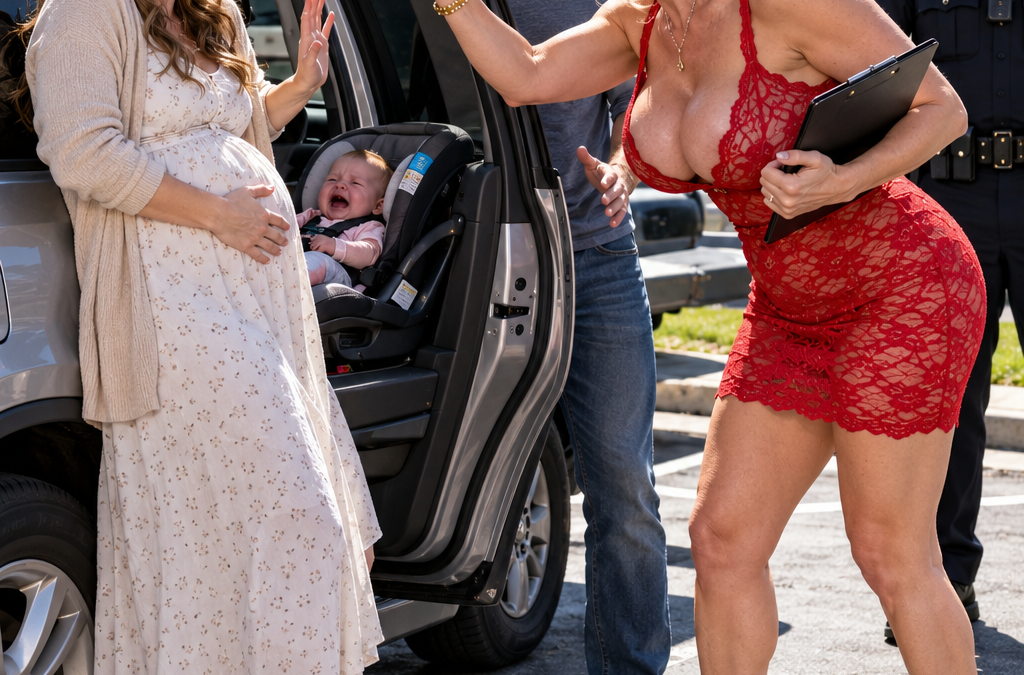
Instead, Karen followed us into the parking lot.
Sarah was securing Grace into her rear-facing car seat.
I stood beside the passenger door holding the diaper bag.
Our daughter began fussing as Sarah adjusted the straps.
Then I heard heels striking the pavement.
Fast.
Angry.
I turned.
Karen Dalton was coming toward us.
Her face was flushed.
She wore the familiar tight red lace dress, her blonde hair falling loose around her shoulders.
She looked beautiful in the same aggressive, carefully maintained way she always had.
But her expression was vicious.
“Marcus!”
I stepped away from the car.
“Karen, stop right there.”
She ignored me.
Her eyes moved toward Sarah.
“You think you can humiliate me in court?”
I looked toward the courthouse entrance.
“You’re violating the order.”
She laughed sharply.
“Don’t lecture me.”
Sarah continued fastening Grace into the car seat.
Our daughter’s crying grew louder.
Karen moved closer.
I positioned myself between her and the passenger door.
“Back away.”
She pointed toward our car.
“You have ten seconds to move that vehicle before I call a tow truck!”
For a moment, I couldn’t believe what I was hearing.
We were legally parked in a courthouse parking area.
We had just attended a hearing where Karen had been ordered to stay away from my wife.
And she was standing within feet of us threatening to tow our vehicle.
“Karen,” I said, “you’re not allowed near Sarah.”
She jabbed a manicured finger toward my wife’s stomach, then toward the baby seat.
“Your wife thinks she can hide behind that baby!”
Something inside me went cold.
“Don’t you dare bring my daughter into this.”
Sarah stood upright.
“Marcus, don’t argue.”
Karen laughed.
“Oh, look. The little legal expert has something to say.”
Sarah held her phone at her side.
“You’re violating a court order.”
“I don’t care what you think!”
“Then explain it to the judge.”
Karen took another step.
“That judge doesn’t understand what you’ve done to me!”
I heard Grace crying behind us.
That sound cut through everything.
My daughter was two weeks old.
She should have been sleeping safely in her car seat while we drove home.
Instead, she was hearing an angry stranger scream at her parents.
I stepped forward.
“Enough.”
Karen looked at me.
“You ruined my reputation.”
“No.”
My voice was low.
“You did that yourself.”
She moved closer again.
Then a voice rang out behind her.
“Ma’am! Step away from that vehicle!”
A courthouse security officer was approaching.
He had apparently been alerted by the shouting.
Karen turned.
For half a second, she seemed ready to launch into one of her familiar explanations about being the HOA president.
But the officer was already asking why she was approaching people who had just obtained protective relief against her.
Sarah showed him the order.
We explained what had happened.
The officer had witnessed enough of the encounter to confirm that Karen had approached us despite the restriction.
Additional officers arrived.
Karen began shouting that we were harassing her.
That the court was corrupt.
That everyone was conspiring against her.
Then an officer told her she was being detained for violating the protective order.
Her expression changed completely.
“What?”
“Turn around, ma’am.”
“You can’t arrest me!”
“Turn around.”
She looked toward me.
Pure disbelief.
For eleven years, she’d threatened people with fines, collections, and property consequences.
Now the consequences were hers.
The officer secured her wrists.
Karen began screaming.
“This is harassment!”
Our daughter cried harder.
Sarah stood beside the open car door, her face pale.
I moved toward her.
“Are you okay?”
She nodded shakily.
I put an arm around her.
Behind us, Karen continued shouting as officers led her toward a patrol vehicle.
The woman who had threatened my wife over parking rules had just been arrested in the courthouse parking lot for violating the very order issued to protect us from her.
I should have felt triumphant.
Instead, I felt profoundly tired.
Sarah rested her head against my shoulder.
“Can we please go home?”
I kissed her forehead.
“Yes.”
We carefully checked Grace’s seat, climbed into the car, and left.
For the first time in months, I didn’t look in the rearview mirror expecting Roy’s truck.
I just wanted to get my family home.
Karen’s courthouse arrest spread through Maple Ridge within hours.
Residents shared news of the incident.
Some expressed disbelief.
Others said they’d always expected her arrogance to catch up with her.
But the arrest wasn’t the end of the financial investigation.
It was only another sign that the control she’d exercised for years was collapsing.
The completed audit revealed something far worse than the suspicious landscaping invoices we’d first discovered.
Investigators identified approximately three hundred eighty thousand dollars in HOA funds diverted through improper transactions over six years.
Greenscape Solutions had invoiced the association throughout Karen’s eleven-year presidency.
Some charges were inflated.
Some appeared duplicated.
Some related to services that hadn’t been performed.
Forensic accountants also found payments routed toward personal accounts through misleading financial descriptions, including entries presented as equipment reserves.
Then came the discovery that made the entire neighborhood furious.
Money intended for the community pool renovation had been diverted.
For years, homeowners had paid special assessments toward a project that never materialized.
We had walked past that neglected pool area when we first toured Maple Ridge.
The realtor had told us renovations were planned.
Residents had been paying for those improvements.
And according to the audit findings, substantial funds had been moved away from their intended purpose.
I sat at our kitchen table reading the summary Diane sent us.
Three hundred eighty thousand dollars.
I couldn’t stop looking at the number.
Sarah sat opposite me holding Grace.
She read the report carefully.
Then looked up.
“All those special assessments.”
I nodded.
“People paid them for years.”
She glanced toward our daughter’s face.
“Denise’s fines. Mrs. Chin’s wind chime. Our shutters.”
I thought about the endless letters.
The twenty-five-dollar penalties.
The threats.
The families who had sacrificed groceries, savings, and peace of mind because Karen insisted every dollar was necessary to preserve community standards.
The betrayal was bigger than stolen money.
She had used the language of responsibility to hide exploitation.
She’d told people that paying her demands was part of being a good neighbor.
Meanwhile, the reserves meant to benefit those same neighbors were being depleted.
Denise’s accumulated fines involving her son’s wheelchair ramp were comparable to the cost of one of the questionable monthly landscaping charges.
That realization made me feel sick.
A mother had been threatened over an accessibility ramp while community money flowed toward a connected business.
Sarah lowered the report.
“She knew what she was doing.”
I looked at her.
“We’ll let the court decide exactly what can be proved.”
Sarah nodded.
But her expression remained hard.
The district attorney’s office reviewed the audit findings alongside our documentation.
Diane later told us an investigator had praised the organization of Sarah’s evidence.
Every notice dated.
Every photograph preserved.
Every witness identified.
Every inconsistency cross-referenced.
What had begun as a folder on our kitchen table had become a carefully assembled timeline covering months of intimidation and financial questions.
Karen faced charges involving embezzlement, forgery, obstruction of justice, and criminal contempt relating to the protective-order violations.
Gary Dalton cooperated with investigators.
He acknowledged that signatures on multiple Greenscape documents had been forged.
He also admitted he’d suspected irregularities for years but had been afraid of Karen’s reactions when he questioned her.
I didn’t know Gary well.
I’d seen him at community gatherings.
He always seemed quiet beside his wife.
At the time, I assumed that was simply his personality.
Hearing that he’d been frightened of confronting her made me think differently about the atmosphere she’d created.
Even inside her own home, control appeared to have mattered more than trust.
Roy also cooperated with investigators.
He reached an agreement concerning his own misconduct and provided testimony about Karen’s activities.
His dash camera footage of the late-night storage-unit trip became important evidence.
I remembered seeing him parked outside our house for twenty minutes at a time.
Photographing our windows.
Measuring our lawn.
Following our car.
He had seemed confident when he believed Karen could protect him.
Now he was describing her conduct to investigators.
Four months after Grace’s birth, Karen’s trial began in Mecklenburg County.
The courtroom was packed.
Nearly thirty Maple Ridge residents attended.
Denise sat beside Frank.
Mrs. Chin arrived with her daughter.
Several homeowners from our original group chat occupied two entire rows.
Sarah held Grace for a few minutes before leaving her with a trusted family member for the proceedings.
Our daughter was too young to understand what was happening.
I was grateful for that.
I wanted her earliest memories to be of laughter, warm blankets, and people who loved her.
Not courthouse hallways and a woman who had spent months threatening her parents.
Karen entered the courtroom looking markedly different from the person who had once ruled every HOA meeting.
She no longer had her clipboard.
No gavel.
No loyal board members waiting for instructions.
She wore a conservative jacket over her familiar red dress, but the confidence that had once made her seem untouchable was gone.
I watched her sit beside her attorney.
For a moment, her eyes moved toward us.
Then away.
The prosecution began presenting the evidence.
Contracts.
Invoices.
Bank records.
Approval histories.
Statements from homeowners and former board members.
The accounting testimony explained how money had moved through Greenscape and how records had allegedly been falsified to conceal improper payments.
The defense attempted to portray Karen as a dedicated community volunteer who had been unfairly targeted by angry residents.
According to her attorney, the disputes were ordinary disagreements about strict enforcement.
The financial problems were supposedly accounting mistakes.
The vendor contracts were legitimate.
And the allegations had been exaggerated by homeowners who resented being asked to follow rules.
I listened in disbelief.
After everything we’d endured, Karen was still trying to turn the story into one about irresponsible residents and unfair criticism.
Then Sarah testified.
She sat in the witness chair for nearly two hours.
The prosecutor asked her to explain the evidence timeline.
She described our first notices.
The approved shutter color.
The confiscated garden gnome.
The financial records requests.
The audit petition.
The threatening statements.
The protective order.
The retaliation that followed.
She spoke calmly.
Precisely.
When asked about a date, she referred to the document.
When asked about an amount, she gave the exact figure.
When asked about a conversation, she identified the recording or contemporaneous note.
The defense tried to suggest she had spent months plotting against Karen because of a personal grudge.
Sarah looked directly at the attorney.
“We were trying to protect our family.”
He pressed her.
“Isn’t it true you encouraged other residents to make complaints?”
“I encouraged them to preserve documents and describe what happened to them.”
“Because you wanted Mrs. Dalton removed?”
“Because I wanted the association to follow its own rules.”
The attorney paused.
Sarah continued.
“And because I didn’t want my daughter growing up in a neighborhood where people were afraid to ask where their money went.”
The courtroom became quiet.
I sat watching my wife.
I had never been prouder of her.
Not because she was defeating someone in an argument.
Because she had endured months of pregnancy, fear, exhaustion, and threats without allowing those experiences to distort the truth she was presenting.
When my turn came, I testified about the events I had personally witnessed.
The garden gnome.
The meetings.
Roy’s surveillance.
The damage and missing mail we’d reported.
The courthouse parking lot confrontation.
I explained how Karen had continued approaching us despite the protective order.
I described hearing Grace cry while Karen threatened to have our legally parked vehicle towed.
The defense questioned my motives.
Suggested I had been confrontational.
Suggested that I resented authority.
I answered carefully.
I wasn’t interested in embellishing anything.
The facts were strong enough.
Mrs. Chin testified about her wind-chime fines.
Frank described being removed from financial oversight after questioning expenditures.
Denise testified about the fines imposed over her son’s wheelchair ramp and the years she’d spent afraid of losing her home.
At one point, her voice broke.
She apologized to the judge.
Then continued.
I felt my throat tighten.
She had spent so long believing there was nothing she could do.
Now she was speaking openly in a courtroom filled with neighbors who supported her.
One of the most damaging exhibits involved messages showing Karen offering to waive fines in exchange for board votes.
The prosecution introduced the communications and explained their relevance to her misuse of authority.
Karen’s attorney requested a recess.
I watched the jurors study the documents.
There was no need for dramatic speeches.
The messages spoke plainly.
Karen had treated fines not merely as enforcement measures, but as tools to secure obedience.
The prosecution also presented the financial evidence concerning forged signatures and the movement of records before the audit.
Gary testified about the documents bearing his name.
Roy testified about the storage-unit trip and the footage recovered from his camera.
The defense challenged witnesses and offered alternate explanations.
But as the trial progressed, the documentary evidence remained difficult to reconcile with the claim that everything had been an innocent misunderstanding.
On the final day, the prosecutor addressed the jury.
He explained that the case concerned more than poor management or harsh neighborhood rules.
It involved allegations of deliberate financial deception, falsified documents, and actions intended to prevent accountability.
Then the jury retired.
We waited in the courthouse hallway.
Sarah sat beside me, her hands clasped tightly.
I could tell she was frightened.
“Are you okay?” I asked.
She nodded.
Then whispered, “I just want it finished.”
I looked toward the courtroom doors.
“So do I.”
The jury deliberated for just under four hours.
When we were called back inside, my heart pounded.
Karen sat beside her attorney.
Her face was pale.
The verdicts were read.
Guilty on the embezzlement counts.
Guilty on forgery.
Guilty on obstruction.
Guilty on criminal contempt connected to the protective-order violations.
I heard Sarah gasp softly.
For several seconds, I couldn’t move.
I had imagined this moment so many times.
While opening fine notices.
While painting shutters beige.
While standing in a hospital room terrified that stress might harm our baby.
While watching Karen approach our car outside the courthouse.
Now it was real.
The jury had reached its decision.
Karen sat motionless.
Her attorney leaned toward her and spoke quietly.
She did not respond visibly.
I looked at Sarah.
Tears were running down her face.
I pulled her close.
“We did it,” she whispered.
I shook my head.
“All of us.”
Six weeks later, sentencing took place.
The judge addressed the prolonged nature of the misconduct, the financial harm, and the repeated abuse of authority established through the proceedings.
Karen was sentenced to three years in state prison.
The judgment included restitution totaling three hundred eighty thousand dollars and a prohibition against future HOA board service under the court’s disposition.
I watched her stand before the judge.
For eleven years, she’d believed power meant being able to control someone else’s mailbox, lawn, driveway, or financial security.
Now she couldn’t control what happened next.
There was no satisfying smile on her face.
No flirtatious charm.
No clipboard.
No gavel.
Only silence.
Gary filed for divorce that same week.
Roy moved away from Maple Ridge shortly afterward.
The old board was reorganized under oversight intended to correct the financial failures that had allowed Karen’s scheme to continue.
Frank was unanimously chosen as interim HOA president.
He accepted reluctantly.
At his first meeting, he stood at the front of the clubhouse and looked around.
“I’m not interested in being anybody’s king.”
People laughed.
He smiled.
“I’m serious. This board belongs to the homeowners.”
Then he announced a review of fines that had been improperly imposed.
Homeowners whose charges were determined to be unjustified would receive reimbursement through the lawful recovery and restitution process.
Denise eventually recovered more than six thousand dollars associated with the fines imposed over her son’s wheelchair ramp.
She also received a formal written apology.
When she came over to show us the letter, she was crying.
“Six thousand dollars,” she whispered.
Sarah hugged her.
Denise wiped her eyes.
“It was never just the money.”
“I know,” Sarah said.
“It was the way she made me feel ashamed for taking care of my son.”
Sarah held her a little tighter.
Our family recovered nearly twenty-four hundred dollars in improper charges.
The mailbox fine.
The porch light.
The recycling bin.
The shutters.
The garden gnome.
Every petty amount Karen had extracted while trying to convince us resistance was pointless.
But the most emotional recovery involved something that wasn’t expensive at all.
My father’s garden gnome.
It had been held with other property collected during the investigation.
Eventually, it was returned.
I picked it up carefully.
The red hat was chipped.
There was a small scratch near the base.
But the ridiculous face was the same.
I stood in the kitchen holding it.
Sarah watched me.
“Your dad would be laughing right now.”
I smiled.
“Yeah.”
I rubbed my thumb over the chipped ceramic.
“He really would.”
Then I carried it outside and placed it beside our porch.
Exactly where it belonged.
Six months after the trial, construction finally began on the community pool renovation.
The project was funded through a combination of recovered money and newly managed association funds.
I stood beside the construction fence one afternoon watching workers unload equipment.
For years, residents had been paying toward a project that existed mostly on paper.
Now there were actual workers.
Actual materials.
Actual progress.
Frank came over and stood beside me.
“Hard to believe, isn’t it?”
I nodded.
“Never thought I’d be excited to see somebody digging a hole.”
He laughed.
“First time for everything.”
Sarah accepted a position on the association’s new financial oversight committee.
She agreed on one condition.
Quarterly financial reports had to remain transparent and accessible to homeowners.
Frank gladly accepted.
At the next meeting, he joked that Maple Ridge finally had a paralegal reviewing the numbers instead of a dictator controlling them.
Everyone laughed.
Together.
Not nervously.
Not because they were afraid of who might be watching.
Because the joke was funny.
That difference mattered more than I can explain.
Grace grew quickly.
One morning, she began crawling across the living room floor with the determined expression of someone who had discovered an entirely new way to cause trouble.
Sarah laughed and tried to catch her.
Our daughter squealed.
I sat on the floor and opened my arms.
“Come here, Grace.”
She crawled straight past me toward a toy.
Sarah laughed harder.
“She’s definitely your daughter.”
I smiled.
“She already ignores instructions.”
During her first summer, we set up a small baby pool on the porch.
Grace splashed happily while Sarah sat beside her.
I watched from a lawn chair with a cup of coffee.
The shutters were still beige.
Plain, ordinary beige.
For months, that color had reminded me of surrender.
Now I looked at it differently.
We could repaint them whenever we chose to follow the properly approved process.
Or leave them as they were.
The important thing was that Karen no longer controlled the decision through fear.
The story spread beyond Maple Ridge.
A local news station covered the investigation and the association’s reforms.
Other homeowners began contacting Sarah, asking how to organize records requests, document retaliation, and pursue financial oversight.
She never pretended to be their attorney.
She explained what our family had done, encouraged them to consult qualified professionals, and emphasized the importance of preserving accurate records.
Our evidence folder had become something unexpected.
A practical example of how ordinary residents could challenge misconduct without resorting to threats or violence.
Denise joined the new compliance review committee.
The woman who’d once been terrified to question a twenty-five-dollar fine was now helping evaluate whether enforcement decisions were consistent and fair.
Frank remained active in the board’s transition.
Mrs. Chin hung her wind chime again.
Every afternoon, the gentle sound drifted across her porch.
Nobody fined her.
Nobody knocked on her door with a warning.
It was simply a wind chime.
Sometimes, I would hear it while walking Grace in her stroller.
And I would think about how strange it was that something so harmless had once become a weapon against an elderly woman.
Eight months into Karen’s prison sentence, a letter arrived addressed to Sarah and me.
The return address was a state correctional facility.
I knew who had sent it before opening the envelope.
Sarah read it first.
Her expression didn’t change much.
Then she handed it to me.
Karen had not apologized.
She wrote that she’d always wanted what was best for Maple Ridge.
That residents had misunderstood her efforts.
That her commitment to standards had been twisted by people who resented discipline.
Even from prison, she was still trying to justify what she’d done.
I finished reading.
Then looked at Sarah.
“What do we do with it?”
She took the letter.
“File it.”
“Don’t respond?”
“No.”
She walked toward the office.
“We’ve given that woman enough of our lives.”
I watched her place the letter in the folder.
Then close the drawer.
That was our answer.
We didn’t need Karen to admit she was wrong.
The court had heard the evidence.
The residents had reclaimed their association.
The money was being recovered.
The neighborhood was healing.
And our daughter was growing up in a home where people no longer lowered their voices when the HOA president drove past.
Sometimes I still think about the anonymous note left beneath our windshield wiper.
Some fights aren’t worth your baby’s peace.
For months, those words frightened me.
They made me question whether I was exposing Sarah to unnecessary danger.
Whether standing up to Karen was selfish.
Whether we should simply leave and begin again somewhere else.
But looking back, I understand something I couldn’t see at the time.
The fight was never separate from our daughter’s peace.
It was for her peace.
For a neighborhood where she could draw on the sidewalk without being threatened.
Where a disabled child could have a wheelchair ramp without his mother being punished.
Where elderly homeowners didn’t have to choose between paying unjust fines and risking their savings.
Where association money could be used to build a community pool instead of disappearing through questionable contracts.
And where nobody had to pretend that cruelty was acceptable simply because the person committing it held a title.
Karen Dalton spent eleven years treating Maple Ridge like her private kingdom.
She believed authority meant obedience.
She believed residents existed to follow instructions, pay fines, and stay silent.
She mistook fear for respect.
And because people had surrendered for so long, she stopped imagining that anyone would ever challenge her.
What finally ended her control wasn’t one dramatic speech or one furious confrontation.
It was a collection of small decisions.
A photograph taken from a sidewalk.
A receipt saved.
A letter preserved.
A woman refusing to accept that her son’s wheelchair ramp was shameful.
A retired neighbor finally telling the truth.
Forty-one homeowners signing a petition despite their fear.
A husband who refused to leave his family unprotected.
And a pregnant wife who sat at a kitchen table organizing evidence when she should have been thinking only about the arrival of her baby.
Sarah was the strongest person I knew.
Not because she never felt afraid.
She felt it every day.
I saw it when Roy followed our car.
When our mailbox was damaged.
When Karen threatened her in the parking lot.
When Grace was born and we wondered whether the harassment would ever stop.
But Sarah kept going.
Carefully.
Legally.
Methodically.
She never allowed Karen’s cruelty to turn her into the same kind of person.
That mattered.
Because winning by becoming another bully wouldn’t have been a victory.
We wanted a place where our daughter could grow up knowing that rules existed to protect people, not to humiliate them.
Today, Maple Ridge Estates has a renovated community pool, a transparent budget, and a board that answers questions instead of punishing the people who ask them.
The neighbors look after one another.
Denise still brings banana bread.
Frank still complains about landscaping expenses, though now he does it with a smile and a properly documented budget.
Mrs. Chin’s wind chime rings gently whenever the breeze passes her porch.
And my father’s garden gnome sits beside our front door, chipped and ridiculous, exactly where I want it.
Grace is too young to understand any of that.
She doesn’t know what a lien is.
She doesn’t know how close her parents came to surrendering their first home.
She has no memory of the woman in the red lace dress who threatened her mother in a courthouse parking lot.
And I intend to keep it that way.
One evening, Sarah and I sat on the porch watching Grace play with a small plastic watering can.
Our daughter was trying to water the garden gnome.
Most of the water ended up on her shoes.
Sarah laughed.
I leaned back in my chair.
Across the street, children were riding bicycles.
A neighbor waved.
The clubhouse lights glowed softly beyond the trees.
Nothing extraordinary was happening.
No threats.
No fines.
No court dates.
Just an ordinary evening in the neighborhood we’d once been afraid to call home.
Sarah reached for my hand.
“Do you ever think about what would’ve happened if we’d just paid that first fine and stopped asking questions?”
I looked toward the garden.
Grace was laughing at the water spilling onto the porch.
“Sometimes.”
“And?”
I squeezed her hand.
“I think Karen would’ve found another reason.”
Sarah nodded.
“Me too.”
We watched our daughter for a moment.
Then I looked at the little ceramic gnome.
My father used to tell me that courage wasn’t about winning every argument.
It was about knowing which things mattered enough that you couldn’t surrender them.
For a long time, I thought our fight was about a mailbox flag, a paint color, and a ridiculous little lawn ornament.
Then I thought it was about money.
Later, I thought it was about exposing Karen.
But sitting there beside Sarah, watching our daughter laugh in the evening sunlight, I finally understood what we’d really been fighting for.
The right to live without fear in a home we’d worked hard to build.
The right to raise our child surrounded by neighbors instead of enemies.
The right to be treated like people rather than problems to be controlled.
Karen never understood that.
She thought power was the ability to make people obey.
But the most powerful thing I’d ever witnessed was forty-one frightened homeowners signing their names because they believed their community deserved better.
And the bravest person I’d ever known was sitting beside me, holding my hand.
Grace tipped the watering can one more time.
The last drops splashed onto the garden gnome.
Sarah burst out laughing.
I laughed with her.
And as the evening settled over Maple Ridge, I realized that the woman who had once controlled nearly every corner of our lives had become completely irrelevant to our happiness.
Grace would grow up knowing nothing about Karen’s eleven-year reign.
She would know the sound of Mrs. Chin’s wind chime, the laughter of neighbors at the pool, and the smell of Denise’s banana bread.
She would know a community where questions were welcome and kindness wasn’t treated as weakness.
She would never remember the fear that brought us to the courthouse parking lot.
She would simply inherit the peace we’d fought so hard to protect.
And that was enough.








