𝗙𝗨𝗟𝗟 𝗦𝗧𝗢𝗥𝗬 The HOA President Thought My Folder Was Harmless Until Every Photo Pointed Back to Her Own Yard
𝗣𝗔𝗥𝗧 𝟮
Her smile did not move.
“Of course not. That would be improper.”
She looked me dead in the eye while she lied.
I had video proof in my pocket.
That was twist number one.
Diane had lied to the entire board, on record, without blinking.
I said nothing yet.
People like Diane love an audience, and I wanted the whole street watching when the truth finally landed.
Then the real trouble started.
A new notice arrived claiming I had an unauthorized shed violating setback rules.
The letter stated that unless I corrected the violation and paid outstanding fines, the HOA could begin foreclosure proceedings within sixty days.
I read it twice.
Then I walked outside into my backyard and looked around.
No shed.
I had never built a shed.
I did not own a shed.
There was no structure on my property except the house, the garage, and a small plastic storage box where I kept a hose nozzle and a bag of soil.
Diane had cited me for a shed that did not exist.
That was the moment my fear changed.
Before then, she had exaggerated.
Twisted.
Invaded.
But this was fabrication.
The kind that could cost me my house if I treated it like a misunderstanding.
I drove to the county assessor’s office the next morning.
A woman behind the counter helped me pull property records, permits, and filings tied to the HOA, my parcel, and Diane’s address.
I expected to confirm that my house had no shed.
I did.
But that was not what stopped me cold.
Diane’s own backyard had an unpermitted pool house.
A real structure.
Not fictional.
Not mistaken.
A full pool house tucked behind tall hedges, filed under a shell LLC connected to her husband’s name.
No final permit approval.
No recorded variance.
No HOA architectural approval on file.
The woman fining me for a fictional shed was hiding a very real illegal structure behind her own house.
I sat in my car outside the county office with the printed records spread across the passenger seat.
My hands were steady now.
That surprised me.
Selective enforcement was not just petty.
It was actionable.
And suddenly, my quiet folder had become a legal weapon.
I hired an attorney named Priya Desai.
She specialized in HOA abuse cases, which I had not known was a field until Diane made it necessary for me to search the phrase.
Priya’s office was in a brick building downtown, second floor, no-nonsense furniture, shelves full of property-code books, and a coffee machine that sounded like it was grinding gravel.
She was sharp, direct, and had the kind of calm that made people tell the truth because lying would feel inefficient.
I handed her my folder.
She opened it.
Read.
Read more.
Paused at the backyard footage.
Watched Diane enter my side gate.
Then read the fake shed notice.
Then reviewed the county documents showing Diane’s unpermitted pool house.
When she finally looked up, she smiled.
Not warmly.
Strategically.
“This is not a violation dispute anymore,” she said.
“What is it?”
“Fraud. Trespass. Selective enforcement. Potential discriminatory enforcement. All documented with timestamps.”
I swallowed.
“Can she actually put a lien on my house?”
“She can try. We will stop it.”
For the first time in months, I believed someone.
Priya filed a formal complaint with the county and requested an independent audit of the HOA’s fine history and finances.
She also sent the board a preservation letter demanding they keep all records, photos, emails, financial documents, and meeting materials intact.
Diane responded the way cornered people with power usually respond.
She escalated.
Two nights before the board hearing, someone smashed my mailbox with a bat.
The sound woke me at 1:18 a.m.
A metallic crack.
Then another.
Then an engine revving.
I jumped out of bed and ran to the window, heart punching against my ribs.
A silver Lexus pulled away from the curb.
Diane’s silver Lexus.
She had not even covered the plate.
Too confident.
Too used to nobody challenging her.
By morning, my mailbox hung sideways, the door bent open like a broken jaw.
My doorbell camera caught everything.
The car.
The plate.
A figure stepping out with a bat.
The swing.
The second swing.
The hurried retreat.
It was not a perfect face shot, but it was enough.
I sent the footage to Priya.
Then to Marcus.
Marcus texted back a meme of a raccoon in handcuffs with the caption:
DIANE’S MUGSHOT LEAKED EARLY.
I stared at it.
Then I laughed until I cried.
I needed that ridiculous raccoon more than I expected.
Because fear had started living in my body.
In my shoulders.
In my jaw.
In the way I checked the mailbox like it might bite me.
That joke gave me ten seconds where Diane did not own the inside of my head.
The emergency board meeting happened two nights later.
The clubhouse was packed.
Word had spread that I had hired an attorney. Word had spread that Diane had cited me for a shed nobody could find. Word had spread that something bigger was coming.
People filled the folding chairs, lined the walls, stood near the back doors.
Diane sat at the front table in a white blazer and pearls, looking colder than I had ever seen her. The board members sat beside her, stiff and uncertain.
Priya and I sat in the front row.
Marcus sat behind me.
He leaned forward and whispered, “No raccoon jokes unless legally advised.”
I almost smiled.
Diane opened the meeting by accusing me of spreading misinformation.
She did not use my name at first.
She said certain residents had chosen hostility over cooperation.
She said Maple Ridge standards protected everyone.
She said the HOA could not function if homeowners weaponized partial information to discredit leadership.
Priya rose when homeowner comment opened.
“My client has evidence relevant to the board’s enforcement practices.”
Diane’s smile tightened.
“This is not a courtroom, Ms. Desai.”
Priya’s voice stayed calm.
“No. But it may become evidence in one.”
That silenced the room.
Priya connected her laptop to the projector.
The first video played.
Diane’s silver Lexus pulling up at 1:18 a.m.
The figure stepping out.
The bat.
The mailbox breaking under the first swing.
A gasp moved through the crowd.
Diane’s face hardened.
“That proves nothing.”
Priya did not answer.
She played the second clip.
Diane entering my side gate at 6:40 a.m.
Crouching by my fence.
Photographing my recycling bin.
Adjusting it with her foot.
Leaving.
The room went dead quiet.
Then came the recording from the prior meeting.
My voice asking, “No board member or officer enters private property?”
Diane’s voice answering, “Of course not. That would be improper.”
The room shifted.
People understood.
Diane had lied on record.
Then Priya pulled up the fake shed notice.
No shed visible in county aerial images.
No shed listed on my property.
No shed in inspection records.
No shed in any permit history.
Then she pulled up Diane’s pool-house filing.
Shell LLC.
Her husband’s name.
No final permit.
No approved variance.
No HOA violation.
No fine.
No enforcement.
The board members stared at the screen.
None of them could meet Diane’s eyes.
Then Priya said, “Selective enforcement is not a personality flaw. It is a legal problem.”
The room broke open.
People started talking all at once.
Mrs. Okafor said she had been fined for paint trim while Diane’s friend had the same color.
A retired teacher named Evelyn said Diane had threatened her with legal fees over a fence that matched two houses on the west side.
Marcus stood and said Diane had deleted his Facebook comments every time he asked about fine revenue.
That opened the next door.
The county audit.
Priya placed the preliminary findings on screen.
Nearly $40,000 in special assessment fees could not be matched to reported maintenance work, resident notices, or proper accounting entries.
Forty thousand dollars.
That was twist number three.
Diane had not just been abusing power for control.
She had been quietly embezzling from the same community she claimed to protect.
The room went completely still.
No whispers.
No shifting.
Just the heavy silence that comes when everyone realizes the story is worse than they feared.
Diane stood.
“This is defamatory.”
Her voice shook.
“This is a coordinated attack.”
Priya looked at the board.
“The county has opened review based on these findings. I strongly advise preservation of records and immediate independent counsel.”
A board member named Harold cleared his throat.
“Diane, did you know about the missing assessment money?”
She spun toward him.
“Do not question me in front of them.”
Them.
That word hung in the air.
Them.
Not neighbors.
Not homeowners.
Not residents.
Them.
For the first time, the board looked afraid of Diane in the same way the rest of us had been.
Then Harold said quietly, “We need a vote.”
Diane’s head snapped toward him.
“You wouldn’t dare.”
He swallowed.
But he did not sit down.
The vote removed Diane as president pending full investigation.
It was not unanimous at first.
One board member hesitated.
Then Marcus said from the back, “You want your name attached to that audit?”
The hand went up.
Unanimous.
Diane stood frozen as the decision passed.
I watched the mask fall from her face.
No smile.
No polish.
No authority.
Only rage.
Two weeks later, after the board formally terminated her authority and turned over records, Diane backed out of her driveway in a fury.
I was on my porch when it happened.
So were half the neighbors.
By then, everybody watched Diane’s house the way people watch a storm cloud.
Her garage door opened.
The silver Lexus reversed too fast.
She cut the wheel hard.
Too hard.
The rear bumper clipped the fire hydrant at the edge of her driveway.
For half a second, nothing happened.
Then water exploded twenty feet into the air.
A white column roared upward, shimmering in the morning sun.
It flooded her front lawn first.
Then spilled across the sidewalk.
Then ran into the yards on both sides.
Diane sat frozen behind the wheel, mascara running, hair dampening in the spray, mouth open in pure shock.
I should have looked away.
I did not.
After everything she had done, I stood on my porch and watched the water fall around her like the neighborhood itself had finally decided to wash something clean.
The city fined her ten thousand dollars for the hydrant damage.
On top of the legal problems.
On top of the HOA investigation.
On top of the criminal charges that later followed for embezzlement, fraud, and trespassing.
That was the fine I saw delivered on a Tuesday.
The one addressed to her.
The one that made her scream behind her front door.
Within a month, Diane was formally charged.
Embezzlement tied to missing special assessment fees.
Fraud connected to false enforcement documents.
Trespassing based on the backyard footage and other complaints uncovered later.
The mailbox incident became part of the broader investigation, too, because arrogance had made her sloppy enough to let a camera catch her car.
The lien threat against my home was dissolved in writing.
Every fine tied to the fake shed was withdrawn.
The wind-chime fine was refunded.
So was the mailbox violation.
So were several late fees that had never been properly authorized.
Priya filed a civil complaint that included discriminatory and selective enforcement claims, trespass, emotional distress, improper fines, and abuse of HOA authority.
Other residents joined.
Mrs. Okafor.
Marcus.
Evelyn.
Two families who had paid thousands because they were afraid of liens.
The neighborhood changed slowly after that.
Not magically.
There were still arguments about lawn care.
Still meetings.
Still people who believed any rule was better than uncertainty.
But Diane no longer sat at the front of the room, deciding whose lives could be made expensive.
The new board adopted inspection policies.
No entering private property without written permission or legal authority.
No anonymous violation photos.
No fines without equal enforcement review.
No special assessments without line-item disclosure.
No board officer connected to vendor payments without full conflict disclosure.
It sounded basic.
It was basic.
That was the point.
A decent neighborhood does not need secret rules.
One evening, Marcus came over with two beers and another raccoon meme.
This one wore sunglasses and sat behind a judge’s bench.
I groaned.
“You need help.”
He handed me a beer.
“I need justice-themed raccoon merchandise.”
I laughed.
A real laugh this time.
The kind that did not break in the middle.
We sat on my porch watching the sun lower over Maple Ridge.
Across the street, Diane’s house sat with the blinds closed. The damaged lawn near the hydrant had been patched but still looked uneven, like the ground itself remembered.
Marcus nodded toward it.
“You okay?”
I thought about the question.
For months, I had been scared.
Scared of opening mail.
Scared of losing the house I had worked so hard to buy.
Scared that everyone saw me as the difficult neighbor.
Scared that Diane’s version of events would become official just because she printed it first.
“I’m getting there,” I said.
He nodded.
“That counts.”
It did.
Healing from something like that is strange.
People think once the villain falls, everything inside you resets.
It does not.
For a while, I still photographed my bins.
Still saved every HOA email.
Still checked my side gate before bed.
Still felt a pulse of panic when certified mail appeared in the neighborhood.
Fear is practical before it becomes trauma.
Mine had been very practical.
Diane had made my home feel conditional.
But slowly, ordinary life returned.
I repainted the mailbox myself.
Not because the old color violated anything.
Because I wanted a fresh coat that belonged to me.
I rehung my mother’s wind chime near the back door.
When it rang, I did not think of Diane’s letter anymore.
I thought of my mother telling me every home needed one thing that answered the wind.
The pool house behind Diane’s yard was eventually ordered removed or brought into legal compliance at her expense. I did not follow every detail. I did not need to.
The $40,000 audit led to restitution proceedings.
The special assessment records were corrected.
Residents received notices explaining where funds had gone and which accounts were under review.
For once, the paperwork told the truth.
Months later, the certified mail truck stopped at Diane’s again.
Different letter.
Different agency.
I watched from inside this time.
Not hiding.
Just choosing peace over performance.
The driver knocked.
No one answered.
He left the notice.
I turned away before Diane opened the door.
I had already seen enough of her downfall.
Justice had come with a lien, a lawsuit, a busted fire hydrant, and more paperwork than I ever wanted to read again.
But the part that mattered most was quieter.
My house stayed mine.
My folder had turned into evidence.
My camera had told the truth when Diane lied.
And every neighbor who thought they were alone finally understood they were not.
One Saturday morning, I stood in my backyard while the wind chime moved above the door.
The grass was a little long.
Not terrible.
Just long enough that Diane would have photographed it before breakfast.
I looked at it.
Then I went back inside and made coffee.
The old fear tugged at me for a second.
A reflex.
Then it passed.
Because a lawn is just a lawn when nobody is using it as a weapon.
I sat on the porch with my mug and watched Marcus walk his dog past Diane’s house.
He glanced over and raised one hand.
I raised mine back.
The street was quiet.
Real quiet.
Not the silence Diane created by making people afraid to speak.
A better kind.
The quiet of ordinary people living in homes they no longer felt they had to defend every minute.
Diane had once believed she owned Maple Ridge because she controlled the envelopes, the signatures, the fines, and the meeting agenda.
She had forgotten something simple.
Paper can threaten.
But paper can also prove.
And when enough proof gathers in one folder, even the most powerful person on the street can end up watching the mail truck stop at her house instead.
𝗧𝗛𝗘 𝗘𝗡𝗗
The HOA President Thought My Folder Was Harmless Until Every Photo Pointed Back to Her Own Yard
Every certified letter made my own house feel less mine. Then the camera caught Diane Whitfield standing where she swore she had never been.
The fine arrived on a Tuesday.
Ten thousand dollars.
For the first time in three years, the envelope was not addressed to me.
It was addressed to Diane Whitfield, president of the Maple Ridge Homeowners Association, the woman who had turned my first house into a battlefield of certified mail, late fees, clipped photographs, and threats printed on HOA letterhead.
I stood on my porch that morning and watched the mail truck stop in front of her house.
Same truck.
Same white-and-blue uniform.
Same careful walk up the driveway.
For almost two years, that truck had felt like a bad omen whenever it slowed near my mailbox. It carried violation notices, lien warnings, demand letters, and every ugly little reminder that Diane believed she could make my life smaller one envelope at a time.
But that morning, the driver walked past my mailbox.
He carried the certified letter to Diane’s front door instead.
The city seal was visible even from across the street.
Diane opened the door wearing a cream blouse and pearls, looking as polished as ever until she saw the return address. Her face tightened. She signed with short, angry strokes and took the envelope inside.
Five minutes later, I heard her scream.
Not loudly enough for the whole neighborhood to call 911.
Just loudly enough for the people she had bullied to know the sound of her confidence finally cracking.
My name is Young Park, and I need to tell you how the most powerful woman on our street ended up owing the city a fortune, facing criminal charges, and watching every secret she buried in HOA paperwork crawl into daylight.
Two years earlier, I bought my first house in Maple Ridge.
It was a modest three-bedroom on Larks Lane, outside Columbus, Ohio, with pale siding, a cracked driveway, and a small backyard bordered by old maples. The roof was solid. The windows needed replacing eventually. The kitchen had cabinets from another decade, and the downstairs bathroom sink made a noise like a dying bird if you turned the hot water too quickly.
I loved it anyway.
I had grown up in apartments.
Nice ones sometimes, cramped ones other times, depending on how well my parents were doing. My mother worked at a dry cleaner. My father drove delivery routes until his knees gave out, then took night shifts as a security guard because sitting still hurt less than climbing stairs all day.
They never complained in front of me.
Not directly.
But I knew what money sounded like in our house.
It sounded like my mother counting bills at the kitchen table after midnight.
It sounded like my father saying, “Next month,” when the car made a new noise.
It sounded like me learning early that asking for something expensive made the air heavy.
So when I stood in the empty living room of my own house at thirty-one years old, holding the keys in one hand and a cheap bottle of grocery-store champagne in the other, I cried.
Not dramatic movie crying.
Quiet crying.
The kind that comes from finally reaching something you trained yourself not to want too much.
The neighborhood looked perfect then.
Trimmed lawns.
Matching mailboxes.
American flags on porch brackets.
Kids riding bikes past driveways after dinner.
Neighbors waving from behind leaf blowers.
Maple Ridge had the kind of order that looks peaceful when you have not yet learned who maintains it and how.
Diane Whitfield came by the second day.
She brought a fruit basket and a seventeen-page handbook.
Diane was fifty-six, with silver-blond hair cut into a smooth bob that never moved, even in wind. She wore crisp white pants, gold earrings, and cardigans that probably cost more than my first month’s groceries after closing. Her smile was bright and careful, the kind of smile people use when they are deciding whether you are useful, harmless, or a problem.
“Welcome to Maple Ridge,” she said.
“Thank you. That’s very kind.”
She handed me the basket.
“This community runs beautifully because we all do our part.”
I nodded.
“Of course.”
Her eyes moved past me, scanning the entryway, then the porch, then the mailbox.
“It can be a lot for first-time homeowners,” she said gently. “The rules, I mean.”
“I read most of the packet.”
“You’ll want to read all of it.”
There was no warmth in that sentence.
Only instruction.
Still, I smiled.
“I will.”
She smiled back.
Like a shark testing the water.
Within a month, my first violation arrived.
Mailbox color.
Wrong shade of black.
I stood outside holding the notice, staring at the mailbox I had inherited from the previous owner.
It looked black to me.
Maybe a little faded.
Maybe more charcoal in direct sunlight.
But it was a mailbox, not a tuxedo.
The fine was fifty dollars.
I paid it.
At the time, it felt like a new-neighbor initiation. Annoying, but not worth a fight.
That was how she started.
Small enough that resisting felt silly.
Then came the grass.
Half an inch too tall.
Trash bins out one hour early.
A wind chime disrupting neighborhood harmony.
The wind chime had belonged to my mother. She had given it to me after closing, saying every home needed one thing that made sound when the wind passed through it. I hung it near the back door, where it could barely be heard from the street.
Diane’s letter described it as an auditory nuisance.
Every fine came from her desk.
Every letter carried her looping signature.
Every citation referenced some obscure bylaw nobody else seemed to know existed.
At first, I thought I was simply unlucky.
Then I started noticing the difference.
My white neighbors got friendly reminders.
A knock on the door.
A smile.
A casual, “Hey, just so you know.”
I got certified mail.
I got late fees stacked on late fees.
I got notices printed in bold, legal-sounding language that made every mistake feel like the beginning of a lawsuit.
Marcus, my friend three houses down, noticed it before I wanted to admit it.
Marcus was a Black man in his forties with a wide laugh and a talent for making horrible situations sound temporarily survivable. He worked from home as a network engineer and had lived in Maple Ridge long enough to know where every buried body was, metaphorically and maybe otherwise.
One evening, he saw me at the mailbox holding another envelope and said, “Diane’s got you as a personal project.”
I forced a laugh.
“Feels that way.”
“I’m not joking, Young.”
I looked up.
His expression had lost its humor.
“Watch her.”
I did.
By month eight, my fines totaled $2,200.
That was when Diane used the word lien for the first time.
A lien.
On my house.
Over grass clippings, a wind chime, and a mailbox shade only she could apparently see.
I remember standing in my kitchen with the letter in my hand, laughing because the alternative was putting my fist through a cabinet door.
The sound that came out of me did not feel like laughter.
It felt like pressure escaping.
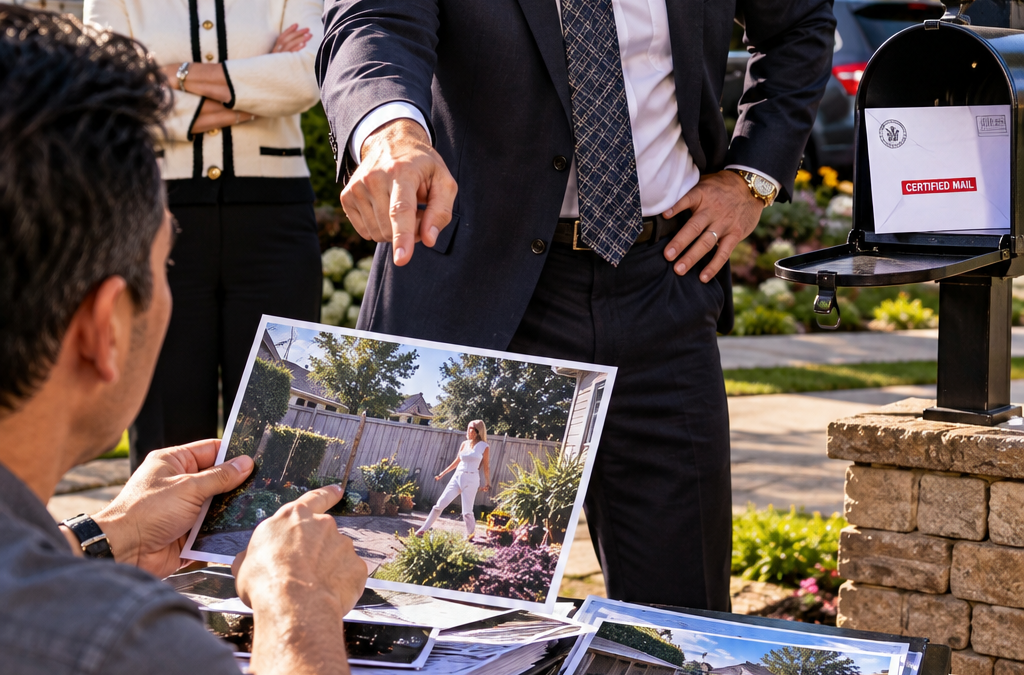
That night, I started keeping a folder.
Every notice.
Every envelope.
Every photo she attached.
Every date and timestamp.
Every email.
Every receipt proving I had paid.
Every screenshot from the community portal before comments disappeared.
At first, it felt like paranoia.
Then it became habit.
Then it became the only reason I survived her.
The first real twist came in month ten.
It began with a photograph.
Diane had cited me for improper placement of my recycling bin. The notice included a close-up image of the bin beside the back corner of my house.
Not the front.
Not the driveway.
The back corner.
I stared at the photo for a long time, feeling my pulse slow.
The angle was wrong.
No one standing on the street could have taken it.
The photo looked down the side path beside my house, past the gate, into my backyard.
Someone had been on my property.
Camera in hand.
Without permission.
I checked the other notices.
There it was.
A photo of my backyard grass taken from inside the fence.
A picture of my wind chime shot from near the patio.
A close-up of my recycling bin from beside the garage wall.
Diane was not documenting violations from the street.
She was trespassing.
I installed a cheap doorbell camera that weekend.
Then another small motion camera covering the side yard.
I did not confront her.
I simply waited.
Two weeks later, at 6:40 in the morning, the camera caught her.
Diane Whitfield crouched beside my fence, wearing cream pants, expensive flats, and a navy jacket, holding her phone through the gate to photograph my recycling bin.
She looked around once.
Not like someone who believed she had authority.
Like someone checking whether she was being watched.
Then she opened the side gate.
My side gate.
Walked onto my property.
Took three more photos.
Adjusted one bin with the toe of her shoe to make it more visible from the path.
And walked out.
I sat at my kitchen table watching the footage, my coffee going cold.
I wanted to run to her house.
I wanted to bang on her door and ask who she thought she was.
Instead, I saved the video.
Then I backed it up twice.
At the next HOA meeting, I raised my hand during homeowner comments.
Diane sat at the front of the room in a pale blue blazer, a stack of papers arranged neatly in front of her. The board sat beside her, nodding before she even spoke.
I kept my voice casual.
“I have a question about violation documentation.”
Diane smiled.
“Of course, Mr. Park.”
“How are violations normally documented?”
She folded her hands.
“Standard drive-by observation from the street or common areas.”
“From the street?”
“Yes.”
“No board member or officer enters private property?”
Her smile did not move.
“Of course not. That would be improper.”
She looked me dead in the eye while she lied.
I had video proof in my pocket.
That was twist number one.
Diane had lied to the entire board, on record, without blinking.
I said nothing yet.
People like Diane love an audience, and I wanted the whole street watching when the truth finally landed.
Then the real trouble started.
A new notice arrived claiming I had an unauthorized shed violating setback rules.
The letter stated that unless I corrected the violation and paid outstanding fines, the HOA could begin foreclosure proceedings within sixty days.
I read it twice.
Then I walked outside into my backyard and looked around.
No shed.
I had never built a shed.
I did not own a shed.
There was no structure on my property except the house, the garage, and a small plastic storage box where I kept a hose nozzle and a bag of soil.
Diane had cited me for a shed that did not exist.
That was the moment my fear changed.
Before then, she had exaggerated.
Twisted.
Invaded.
But this was fabrication.
The kind that could cost me my house if I treated it like a misunderstanding.
I drove to the county assessor’s office the next morning.
A woman behind the counter helped me pull property records, permits, and filings tied to the HOA, my parcel, and Diane’s address.
I expected to confirm that my house had no shed.
I did.
But that was not what stopped me cold.
Diane’s own backyard had an unpermitted pool house.
A real structure.
Not fictional.
Not mistaken.
A full pool house tucked behind tall hedges, filed under a shell LLC connected to her husband’s name.
No final permit approval.
No recorded variance.
No HOA architectural approval on file.
The woman fining me for a fictional shed was hiding a very real illegal structure behind her own house.
I sat in my car outside the county office with the printed records spread across the passenger seat.
My hands were steady now.
That surprised me.
Selective enforcement was not just petty.
It was actionable.
And suddenly, my quiet folder had become a legal weapon.
I hired an attorney named Priya Desai.
She specialized in HOA abuse cases, which I had not known was a field until Diane made it necessary for me to search the phrase.
Priya’s office was in a brick building downtown, second floor, no-nonsense furniture, shelves full of property-code books, and a coffee machine that sounded like it was grinding gravel.
She was sharp, direct, and had the kind of calm that made people tell the truth because lying would feel inefficient.
I handed her my folder.
She opened it.
Read.
Read more.
Paused at the backyard footage.
Watched Diane enter my side gate.
Then read the fake shed notice.
Then reviewed the county documents showing Diane’s unpermitted pool house.
When she finally looked up, she smiled.
Not warmly.
Strategically.
“This is not a violation dispute anymore,” she said.
“What is it?”
“Fraud. Trespass. Selective enforcement. Potential discriminatory enforcement. All documented with timestamps.”
I swallowed.
“Can she actually put a lien on my house?”
“She can try. We will stop it.”
For the first time in months, I believed someone.
Priya filed a formal complaint with the county and requested an independent audit of the HOA’s fine history and finances.
She also sent the board a preservation letter demanding they keep all records, photos, emails, financial documents, and meeting materials intact.
Diane responded the way cornered people with power usually respond.
She escalated.
Two nights before the board hearing, someone smashed my mailbox with a bat.
The sound woke me at 1:18 a.m.
A metallic crack.
Then another.
Then an engine revving.
I jumped out of bed and ran to the window, heart punching against my ribs.
A silver Lexus pulled away from the curb.
Diane’s silver Lexus.
She had not even covered the plate.
Too confident.
Too used to nobody challenging her.
By morning, my mailbox hung sideways, the door bent open like a broken jaw.
My doorbell camera caught everything.
The car.
The plate.
A figure stepping out with a bat.
The swing.
The second swing.
The hurried retreat.
It was not a perfect face shot, but it was enough.
I sent the footage to Priya.
Then to Marcus.
Marcus texted back a meme of a raccoon in handcuffs with the caption:
DIANE’S MUGSHOT LEAKED EARLY.
I stared at it.
Then I laughed until I cried.
I needed that ridiculous raccoon more than I expected.
Because fear had started living in my body.
In my shoulders.
In my jaw.
In the way I checked the mailbox like it might bite me.
That joke gave me ten seconds where Diane did not own the inside of my head.
The emergency board meeting happened two nights later.
The clubhouse was packed.
Word had spread that I had hired an attorney. Word had spread that Diane had cited me for a shed nobody could find. Word had spread that something bigger was coming.
People filled the folding chairs, lined the walls, stood near the back doors.
Diane sat at the front table in a white blazer and pearls, looking colder than I had ever seen her. The board members sat beside her, stiff and uncertain.
Priya and I sat in the front row.
Marcus sat behind me.
He leaned forward and whispered, “No raccoon jokes unless legally advised.”
I almost smiled.
Diane opened the meeting by accusing me of spreading misinformation.
She did not use my name at first.
She said certain residents had chosen hostility over cooperation.
She said Maple Ridge standards protected everyone.
She said the HOA could not function if homeowners weaponized partial information to discredit leadership.
Priya rose when homeowner comment opened.
“My client has evidence relevant to the board’s enforcement practices.”
Diane’s smile tightened.
“This is not a courtroom, Ms. Desai.”
Priya’s voice stayed calm.
“No. But it may become evidence in one.”
That silenced the room.
Priya connected her laptop to the projector.
The first video played.
Diane’s silver Lexus pulling up at 1:18 a.m.
The figure stepping out.
The bat.
The mailbox breaking under the first swing.
A gasp moved through the crowd.
Diane’s face hardened.
“That proves nothing.”
Priya did not answer.
She played the second clip.
Diane entering my side gate at 6:40 a.m.
Crouching by my fence.
Photographing my recycling bin.
Adjusting it with her foot.
Leaving.
The room went dead quiet.
Then came the recording from the prior meeting.
My voice asking, “No board member or officer enters private property?”
Diane’s voice answering, “Of course not. That would be improper.”
The room shifted.
People understood.
Diane had lied on record.
Then Priya pulled up the fake shed notice.
No shed visible in county aerial images.
No shed listed on my property.
No shed in inspection records.
No shed in any permit history.
Then she pulled up Diane’s pool-house filing.
Shell LLC.
Her husband’s name.
No final permit.
No approved variance.
No HOA violation.
No fine.
No enforcement.
The board members stared at the screen.
None of them could meet Diane’s eyes.
Then Priya said, “Selective enforcement is not a personality flaw. It is a legal problem.”
The room broke open.
People started talking all at once.
Mrs. Okafor said she had been fined for paint trim while Diane’s friend had the same color.
A retired teacher named Evelyn said Diane had threatened her with legal fees over a fence that matched two houses on the west side.
Marcus stood and said Diane had deleted his Facebook comments every time he asked about fine revenue.
That opened the next door.
The county audit.
Priya placed the preliminary findings on screen.
Nearly $40,000 in special assessment fees could not be matched to reported maintenance work, resident notices, or proper accounting entries.
Forty thousand dollars.
That was twist number three.
Diane had not just been abusing power for control.
She had been quietly embezzling from the same community she claimed to protect.
The room went completely still.
No whispers.
No shifting.
Just the heavy silence that comes when everyone realizes the story is worse than they feared.
Diane stood.
“This is defamatory.”
Her voice shook.
“This is a coordinated attack.”
Priya looked at the board.
“The county has opened review based on these findings. I strongly advise preservation of records and immediate independent counsel.”
A board member named Harold cleared his throat.
“Diane, did you know about the missing assessment money?”
She spun toward him.
“Do not question me in front of them.”
Them.
That word hung in the air.
Them.
Not neighbors.
Not homeowners.
Not residents.
Them.
For the first time, the board looked afraid of Diane in the same way the rest of us had been.
Then Harold said quietly, “We need a vote.”
Diane’s head snapped toward him.
“You wouldn’t dare.”
He swallowed.
But he did not sit down.
The vote removed Diane as president pending full investigation.
It was not unanimous at first.
One board member hesitated.
Then Marcus said from the back, “You want your name attached to that audit?”
The hand went up.
Unanimous.
Diane stood frozen as the decision passed.
I watched the mask fall from her face.
No smile.
No polish.
No authority.
Only rage.
Two weeks later, after the board formally terminated her authority and turned over records, Diane backed out of her driveway in a fury.
I was on my porch when it happened.
So were half the neighbors.
By then, everybody watched Diane’s house the way people watch a storm cloud.
Her garage door opened.
The silver Lexus reversed too fast.
She cut the wheel hard.
Too hard.
The rear bumper clipped the fire hydrant at the edge of her driveway.
For half a second, nothing happened.
Then water exploded twenty feet into the air.
A white column roared upward, shimmering in the morning sun.
It flooded her front lawn first.
Then spilled across the sidewalk.
Then ran into the yards on both sides.
Diane sat frozen behind the wheel, mascara running, hair dampening in the spray, mouth open in pure shock.
I should have looked away.
I did not.
After everything she had done, I stood on my porch and watched the water fall around her like the neighborhood itself had finally decided to wash something clean.
The city fined her ten thousand dollars for the hydrant damage.
On top of the legal problems.
On top of the HOA investigation.
On top of the criminal charges that later followed for embezzlement, fraud, and trespassing.
That was the fine I saw delivered on a Tuesday.
The one addressed to her.
The one that made her scream behind her front door.
Within a month, Diane was formally charged.
Embezzlement tied to missing special assessment fees.
Fraud connected to false enforcement documents.
Trespassing based on the backyard footage and other complaints uncovered later.
The mailbox incident became part of the broader investigation, too, because arrogance had made her sloppy enough to let a camera catch her car.
The lien threat against my home was dissolved in writing.
Every fine tied to the fake shed was withdrawn.
The wind-chime fine was refunded.
So was the mailbox violation.
So were several late fees that had never been properly authorized.
Priya filed a civil complaint that included discriminatory and selective enforcement claims, trespass, emotional distress, improper fines, and abuse of HOA authority.
Other residents joined.
Mrs. Okafor.
Marcus.
Evelyn.
Two families who had paid thousands because they were afraid of liens.
The neighborhood changed slowly after that.
Not magically.
There were still arguments about lawn care.
Still meetings.
Still people who believed any rule was better than uncertainty.
But Diane no longer sat at the front of the room, deciding whose lives could be made expensive.
The new board adopted inspection policies.
No entering private property without written permission or legal authority.
No anonymous violation photos.
No fines without equal enforcement review.
No special assessments without line-item disclosure.
No board officer connected to vendor payments without full conflict disclosure.
It sounded basic.
It was basic.
That was the point.
A decent neighborhood does not need secret rules.
One evening, Marcus came over with two beers and another raccoon meme.
This one wore sunglasses and sat behind a judge’s bench.
I groaned.
“You need help.”
He handed me a beer.
“I need justice-themed raccoon merchandise.”
I laughed.
A real laugh this time.
The kind that did not break in the middle.
We sat on my porch watching the sun lower over Maple Ridge.
Across the street, Diane’s house sat with the blinds closed. The damaged lawn near the hydrant had been patched but still looked uneven, like the ground itself remembered.
Marcus nodded toward it.
“You okay?”
I thought about the question.
For months, I had been scared.
Scared of opening mail.
Scared of losing the house I had worked so hard to buy.
Scared that everyone saw me as the difficult neighbor.
Scared that Diane’s version of events would become official just because she printed it first.
“I’m getting there,” I said.
He nodded.
“That counts.”
It did.
Healing from something like that is strange.
People think once the villain falls, everything inside you resets.
It does not.
For a while, I still photographed my bins.
Still saved every HOA email.
Still checked my side gate before bed.
Still felt a pulse of panic when certified mail appeared in the neighborhood.
Fear is practical before it becomes trauma.
Mine had been very practical.
Diane had made my home feel conditional.
But slowly, ordinary life returned.
I repainted the mailbox myself.
Not because the old color violated anything.
Because I wanted a fresh coat that belonged to me.
I rehung my mother’s wind chime near the back door.
When it rang, I did not think of Diane’s letter anymore.
I thought of my mother telling me every home needed one thing that answered the wind.
The pool house behind Diane’s yard was eventually ordered removed or brought into legal compliance at her expense. I did not follow every detail. I did not need to.
The $40,000 audit led to restitution proceedings.
The special assessment records were corrected.
Residents received notices explaining where funds had gone and which accounts were under review.
For once, the paperwork told the truth.
Months later, the certified mail truck stopped at Diane’s again.
Different letter.
Different agency.
I watched from inside this time.
Not hiding.
Just choosing peace over performance.
The driver knocked.
No one answered.
He left the notice.
I turned away before Diane opened the door.
I had already seen enough of her downfall.
Justice had come with a lien, a lawsuit, a busted fire hydrant, and more paperwork than I ever wanted to read again.
But the part that mattered most was quieter.
My house stayed mine.
My folder had turned into evidence.
My camera had told the truth when Diane lied.
And every neighbor who thought they were alone finally understood they were not.
One Saturday morning, I stood in my backyard while the wind chime moved above the door.
The grass was a little long.
Not terrible.
Just long enough that Diane would have photographed it before breakfast.
I looked at it.
Then I went back inside and made coffee.
The old fear tugged at me for a second.
A reflex.
Then it passed.
Because a lawn is just a lawn when nobody is using it as a weapon.
I sat on the porch with my mug and watched Marcus walk his dog past Diane’s house.
He glanced over and raised one hand.
I raised mine back.
The street was quiet.
Real quiet.
Not the silence Diane created by making people afraid to speak.
A better kind.
The quiet of ordinary people living in homes they no longer felt they had to defend every minute.
Diane had once believed she owned Maple Ridge because she controlled the envelopes, the signatures, the fines, and the meeting agenda.
She had forgotten something simple.
Paper can threaten.
But paper can also prove.
And when enough proof gathers in one folder, even the most powerful person on the street can end up watching the mail truck stop at her house instead.








