𝗙𝗨𝗟𝗟 𝗦𝗧𝗢𝗥𝗬 The HOA President Taped a Lien to My Door Beside My Kids’ Chalk Drawings
𝗙𝗨𝗟𝗟 𝗦𝗧𝗢𝗥𝗬
Then she hung up.
I stood in the kitchen, phone still against my ear, while Captain Harold smiled innocently outside the window.
That was the beginning.
The fines multiplied fast.
Grass height.
Mailbox paint.
The wind chime Lily made at summer camp, cited as disturbing communal tranquility.
Whatever that meant.
Every letter came with a photo, a fine, and a warning that further violations would escalate rapidly. Every appeal I submitted disappeared into the same board mailbox Deborah alone controlled. I sent emails. No response. I mailed printed appeal letters. Nothing. I dropped one off at the clubhouse office in person and watched the volunteer receptionist place it in a tray labeled BOARD REVIEW.
Three weeks later, Deborah told me no appeal had been received.
When I asked for proof, she smiled.
“Courtney, paperwork gets lost when residents don’t follow procedure.”
“What procedure?”
“The one in the updated rules.”
I had never seen updated rules.
That night, after the kids went to bed, I opened the HOA portal and started digging.
Minutes.
Bylaws.
Board notices.
PDF attachments.
Old newsletters.
It was boring enough to make my eyes burn, but I kept reading because Deborah had said updated rules, and I wanted to know what she had changed.
That was how I found the first twist.
The appeal deadline had quietly changed.
The original bylaws gave homeowners thirty days to appeal fines.
The updated language gave them seven.
Seven days.
Most of my appeals had been filed after seven days but well within thirty.
No wonder she kept rejecting them.
But the change had not been voted on.
No meeting minutes.
No amendment.
No recorded board approval.
Just an email from Deborah months earlier titled Clarification of Appeal Timing, buried in a community update full of pool hours, landscaping reminders, and a recipe for peach cobbler.
Clarification.
That was the word she used.
She had not amended the bylaws, because that would have required a vote.
She had clarified them in an email nobody read closely enough.
By month three, my fines topped two thousand dollars.
That was when the certified letter mentioned the word lien for the first time.
I read it sitting in my car after work because I had opened the mailbox before going inside.
My hands started shaking so badly I dropped the envelope between the seat and the console.
A lien.
Against my home.
Over a gnome, grass, a wind chime, and trash bins.
I thought about the eleven years it had taken me to buy that house.
The overtime.
The kids sleeping on air mattresses after the move because I had spent every spare dollar on closing costs.
The first night eating pizza on the floor.
The chalk drawings.
The strawberry plants Lily had put in crooked rows behind the garage.
I could not let Deborah turn that into paperwork.
That night, I started a folder.
I labeled it with one word.
EVIDENCE.
Every letter.
Every envelope.
Every photo.
Every email.
Every timestamp.
Every appeal.
Every receipt showing payment.
Every screenshot from the HOA portal.
The appeal deadline email.
The original bylaws.
The changed language.
Photos of other houses with gnomes, flamingos, wind chimes, tall grass, and mailboxes in ten different shades of white, cream, gray, and black.
At first, the folder felt like a shield made of paper.
Thin.
Not enough.
Then my neighbor Frank leaned over the back fence and changed everything.
Frank Wheeler was a retired postal worker with a thick gray mustache, a vegetable garden, and the kind of memory that made people nervous when they tried to lie around him. He had lived in Maplerest for twenty-four years and knew everyone’s business, though he rarely volunteered it unless he believed you needed to know.
He saw me photographing the flamingos across the street and called out, “Deborah finally got to you?”
I lowered my phone.
“Is it that obvious?”
He rested both forearms on the fence.
“She did this to the Alvarezes too.”
I had heard the name but did not know the story.
“They sold last year, right?”
“At a loss.”
My stomach sank.
“Why?”
“Fines. Threats. Legal letters. Deborah said their fence violated setback rules even though it had been there fifteen years. They fought for a while, then gave up.”
“Why didn’t anyone help them?”
Frank looked toward the street.
“People were afraid of becoming next.”
That answer made me angry.
Then ashamed.
Because I understood it.
Fear does not always look like cowardice.
Sometimes it looks like a mortgage you cannot risk.
Kids you need to protect.
Savings you do not have.
A legal system you cannot afford.
Frank nodded toward my phone.
“Keep taking pictures.”
“I have a folder.”
“Good. Make two copies.”
I almost smiled.
“You sound like you’ve done this before.”
He disappeared from the fence for a moment, then returned holding a thick accordion file.
“Oh, honey,” he said, “I’ve been waiting for someone else to get mad enough.”
The funny part happened three weeks later.
Deborah fined herself by accident.
Not publicly, of course. Deborah would never accidentally humiliate herself where the whole community could see it unless technology helped.
The HOA portal had an automated compliance log attached to resident accounts. Usually, homeowners could only see their own notices, but for one glorious afternoon, after a software update, a board-review folder became visible to everyone with a login.
I saw it by chance.
There, under pending decorative violations, was a photo of Deborah’s own front garden.
Seven gnomes.
Seven.
Not one.
Not a small boy’s chipped yard-sale gnome.
Seven glossy, expensive garden gnomes arranged beneath her hydrangeas like a tiny council of hypocrites.
The notice had been generated by an outside inspection company the board apparently used once a quarter.
Violation: Unapproved Decorative Structures.
Account: Whitlock, Deborah.
Status: Waived.
I opened the waiver.
Deborah had signed it herself.
Reason: Board discretion.
I photographed the screen before it disappeared.
Then I noticed the date.
The waiver was signed the same week Deborah claimed the board could not meet due to quorum issues.
That mattered.
Because during that same week, she had issued new fines against me and several others, citing board authority.
But if there was no quorum, no meeting, and no valid board action, how had she authorized any fines?
How had she waived her own gnomes?
How had she enforced mine?
The whole structure began to wobble.
I brought the question to a lawyer named Priya Desai.
Frank gave me her number.
“She does HOA abuse cases sometimes,” he said. “Pro bono for veterans and retirees mostly, but she’ll listen if the facts are ugly enough.”
Apparently, my facts were ugly enough.
Priya’s office was small, on the second floor above a pharmacy, with a waiting room full of old magazines and one plant fighting for its life near the window. She was in her forties, with sharp eyes, a low voice, and the unsettling habit of reading documents so carefully that silence started to feel productive.
I put my folder on her desk.
She opened it.
Read.
Turned pages.
Read more.
Stopped at the appeal deadline email.
Stopped longer at the self-waiver.
Then Frank’s file.
Then the lien letter.
When she finally looked up, her eyes were bright.
“This is not just harassment, Courtney.”
I swallowed.
“What is it?”
“This might be fraud.”
The word felt too large for the room.
Priya explained it piece by piece.
The appeal deadline change had not been properly adopted.
The self-waiver suggested Deborah treated board authority as personal authority.
The no-quorum period created questions about every fine issued during that time.
Selective enforcement became stronger when compared with neighborhood photos.
And then Priya found something I had not understood in the financial records Frank had saved.
Special assessment fees.
Six families had been charged special assessments over the previous year for compliance remediation and common-area restoration. The payments did not appear in the HOA’s published financial report.
Instead, they had been deposited into an account connected to a name I did not recognize.
Elaine Porter.
Priya searched quietly for three minutes.
Then turned her laptop slightly toward me.
Elaine Porter was Deborah’s maiden name.
Eighteen thousand dollars.
Collected from six different families.
All funneled into an account tied to Deborah’s maiden name.
I felt sick and thrilled at once.
Sick for my neighbors.
Thrilled because Deborah had finally overreached.
The lien notice on my door was not just a threat anymore.
It was her last big swing, meant to scare me into silence or into selling before anyone looked too closely.
Instead, I mailed Priya’s demand letter the same afternoon.
The letter challenged the lien.
Demanded withdrawal of the fines.
Cited invalid meetings, unauthorized bylaw changes, questionable self-waivers, selective enforcement, and missing funds.
It also demanded preservation of all HOA documents, bank records, emails, waiver forms, meeting notices, and assessment ledgers.
Deborah’s response came fast, furious, and reckless.
She sent a community-wide email calling me disruptive.
She did not name me directly, but everyone knew.
She wrote about “certain homeowners” spreading misinformation, attacking volunteers, and refusing to maintain basic standards.
Then she threatened to make an example of me at the next open meeting.
Those were her words.
Make an example.
I printed the email and placed it in the folder.
By then, the folder barely closed.
The open meeting was scheduled for the following Thursday.
I spent the week knocking on doors.
Not all of them.
Just the ones Frank suggested.
The Nguyen family, who had paid a special assessment after Deborah claimed their drainage ditch affected the common area.
Mrs. Caldwell, who had been fined for a fence color while Deborah’s friend had the same stain.
The Martins, who had received a lawn-remediation assessment after a single warning letter.
Every conversation began stiffly.
People did not trust easily in a neighborhood Deborah had trained into silence.
Then I showed them the self-waiver.
The appeal deadline change.
The Elaine Porter account.
After that, the folders came out.
Receipts.
Letters.
Cancelled checks.
Screenshots.
One by one, people realized they had not been targeted because they were careless.
They had been targeted because Deborah believed they were easier to scare.
On the afternoon of the meeting, Frank called me.
“I’ve got something.”
His voice sounded different.
“What?”
“A recording.”
I sat down.
“Of Deborah?”
“She came by last year after I pushed back on a gutter fine. I had my phone recording because I don’t trust anyone who smiles that hard.”
“What did she say?”
Frank paused.
“That she adjusts enforcement based on who annoys her most.”
I closed my eyes.
“Please tell me you’re serious.”
“I’m retired, Courtney. Not bored enough to make up evidence.”
At the meeting, the clubhouse was packed.
I had never seen that many residents in one room.
People stood along the walls, holding folders, envelopes, bank statements, and years of resentment. The air felt tight, like everybody was waiting for the first crack of thunder.
Deborah stood at the podium wearing a cream blazer and pearls.
Of course she wore pearls.
Her hair was perfect. Her posture was perfect. Her smile was sharp enough to draw blood.
She opened with a speech about order.
Community standards.
Financial responsibility.
The danger of misinformation.
Then she looked directly at me.
“Some residents,” she said, “mistake accountability for persecution.”
I felt every face turn.
My mouth went dry.
Priya sat beside me, calm as stone.
Frank sat on my other side, holding his phone in one hand and a paper cup of lemonade in the other like we were at a school play.
Deborah continued.
“This board has always acted within its authority.”
Her voice cracked slightly on the word authority.
Just enough.
Priya stood.
“Then you should have no issue answering a few questions about that authority.”
Deborah’s smile tightened.
“This is a homeowner meeting, not a courtroom.”
“No,” Priya said. “But several of these documents may be shown in one.”
The room went silent.
Priya walked to the front and placed copies of the original bylaws and the so-called clarification email on the projector.
Thirty-day appeal period.
Seven-day appeal period.
No board vote.
No amendment.
No adoption record.
Then the no-quorum notice.
Then Deborah’s self-waiver for her gnome collection, signed during the same week she claimed no board business could be conducted.
People began whispering.
Deborah’s face flushed.
“This is being taken out of context.”
Priya clicked again.
Photos appeared.
Deborah’s seven gnomes.
My son’s single gnome.
A comparison chart of decorative items across the neighborhood.
Fined.
Not fined.
Fined.
Not fined.
Then Frank stood.
“My turn.”
Deborah’s head snapped toward him.
“No, Frank.”
He smiled.
It was the sweetest thing I had seen in months.
He tapped his phone.
Deborah’s recorded voice filled the clubhouse.
“Enforcement is about priorities, Frank. I adjust based on who creates problems. If someone annoys the board, they can expect closer attention.”
The room froze.
Then erupted.
People stood.
Someone cursed.
Mrs. Caldwell shouted, “You fined me because I questioned the budget!”
Deborah slammed her hand against the podium.
“That recording is illegal!”
Frank lifted one eyebrow.
“Ohio’s a one-party consent state, Deborah.”
I did not know if that was legally complete enough for court, but it landed beautifully in that room.
Then the final domino fell.
Mr. Nguyen stood near the front, holding printed bank statements.
His hands shook, but his voice did not.
“If you always acted within your authority,” he said, “then why is my assessment in your maiden name?”
The room went dead silent.
Not quieter.
Dead silent.
He held up the papers.
“My family paid twelve hundred dollars for common-area restoration. The check cleared into an account labeled E. Porter. Priya showed us who that is.”
Deborah’s mouth opened.
Closed.
Opened again.
No words came.
The silence broke all at once.
Neighbors were shouting now.
Not random anger.
Names.
Amounts.
Dates.
Questions.
Where did the money go?
Who approved the account?
Why were there no receipts?
Why did the board never disclose this?
Why were appeals ignored?
Why were Deborah’s gnomes waived?
Why did the Alvarezes lose their house?
The board members behind Deborah looked terrified.
For years, they had let her run everything because it was easier than doing the work themselves. Now every easy nod and rubber-stamped decision had turned into exposure.
One of them, a man named Harold Price, stood slowly.
“I move to remove Deborah Whitlock as president pending investigation.”
Deborah spun toward him.
“You don’t have the authority.”
Harold looked at Priya.
Priya simply pointed to the bylaws.
“You do.”
Another board member seconded.
The vote happened before the meeting ended.
Deborah stood at the podium, pale and furious, while her own board voted her out.
No crown.
No control.
No sharp smile.
Just a woman watching the room she had ruled decide it was done being afraid.
Weeks later, the county filed embezzlement charges.
The lien against my house was voided.
Erased.
Gone.
Every fine tied to the invalid appeal rule and no-quorum period was reviewed. Many were dismissed outright. Mine were wiped clean.
Deborah was ordered to repay the stolen assessment money, plus damages. The HOA’s insurer became involved. The state regulator barred her from serving on any HOA board again.
The Alvarezes could not get back the house they had sold, and that still makes me angry.
Some damage cannot be perfectly repaired.
But their case became part of the civil action. Their loss was finally recognized as part of the pattern, not dismissed as a personal choice.
For the rest of us, the neighborhood changed slowly.
The new board adopted rules that should have existed all along.
No bylaw change without a recorded vote.
No appeal deadline modification without proper notice.
No special assessment without account disclosure.
No board member waiving their own violations.
No enforcement without comparable neighborhood review.
No single person controlling the appeal mailbox.
Simple things.
Basic things.
The kind of safeguards only sound dramatic after someone abuses the absence of them.
Captain Harold, Mason’s gnome, still stands beside the porch steps.
Prouder than ever.
Mason painted his chipped shoe gold after the lien was voided because, according to him, “heroes need armor.”
Lily added a tiny paper crown at first, but rain destroyed it.
Mason said that was fine because “kings get weird anyway.”
He was not wrong.
Frank brings lemonade over now.
He walks across the yard without calling first, carrying a pitcher and two plastic cups like this is a sacred ritual. We sit on the porch while the kids draw with chalk, and sometimes we laugh about the woman who tried to steal a house over grass height.
Not because it was funny when it happened.
It was not.
There were nights I sat at the kitchen table after the kids went to bed and stared at those letters until the words blurred. Nights I imagined packing boxes because I could not afford a legal fight. Mornings I smiled through breakfast while my stomach twisted so badly I could barely swallow.
Fear makes you practical.
It makes you calculate how much equity you have, how much credit you can access, who might lend you money, where your children would sleep if everything fell apart.
Deborah did that to me.
To us.
And she did it with pearls around her neck and community standards on her lips.
So yes, Frank and I laugh now.
Because laughter is what comes after fear when fear finally loses.
One evening, about three months after Deborah was removed, I stood at the end of the driveway watching Mason and Lily redraw the same chalk flowers that had been partly covered by the lien notice.
The sun was low.
The grass was slightly too tall.
I had meant to mow it after work but got home late.
For a second, old panic rose in my chest.
Then I remembered.
No one was coming with a ruler.
No one was taping a threat to my door.
No one was turning my children’s chalk drawings into a backdrop for legal intimidation.
I sat down on the porch step beside Captain Harold.
His gold shoe gleamed in the sunset.
Frank called from across the yard, “You know your grass is criminally high.”
I looked at him.
“Better call Deborah.”
He raised his lemonade.
“Can’t. She’s busy repaying eighteen grand.”
I laughed so hard Lily asked what was funny.
“Grown-up stuff,” I said.
She rolled her eyes.
Kids hate that answer.
Later that night, after the kids were asleep, I opened the folder one more time.
The one labeled EVIDENCE.
It was thick now, packed with everything from the first trash-bin fine to the county notice voiding the lien.
I ran my hand over the cover.
For months, that folder had been my fear in paper form.
Then my shield.
Then my weapon.
Now it was a record of what happened when ordinary people finally stopped being isolated.
I placed it on the top shelf of the hall closet.
Not hidden.
Not displayed.
Just stored.
I did not need to stare at it anymore.
My house was still mine.
The porch still had chalk dust on it.
The roof still had crooked shingles.
The kitchen floor still squeaked near the sink.
The strawberry plants in the backyard had survived Lily’s uneven watering.
The garden gnome stood guard.
And for the first time in a long time, Maplerest Estates felt like peace instead of a trap.
Justice tastes better than any settlement check.
It tastes like your child asking if the gnome can stay and being able to say yes.
It tastes like lemonade on a porch with a neighbor who refused to forget.
It tastes like grass growing a little too tall because life got busy, and no one turning that into a weapon.
Deborah lost her crown.
Maplerest finally got its peace.
And my children’s chalk drawings stayed exactly where they belonged—on the porch of a home nobody was going to steal.
𝗧𝗛𝗘 𝗘𝗡𝗗
\
The HOA President Taped a Lien to My Door Beside My Kids’ Chalk Drawings
The notice said they could take my house over grass and a garden gnome. My children’s chalk flowers were still on the porch when I realized Deborah Whitlock had stopped fining me and started trying to erase me.
My name is Courtney Hayes, and I want you to understand exactly how a homeowners association tried to steal my home.
Not inconvenience me.
Not annoy me.
Not make me repaint a mailbox or move a trash bin.
Steal my home.
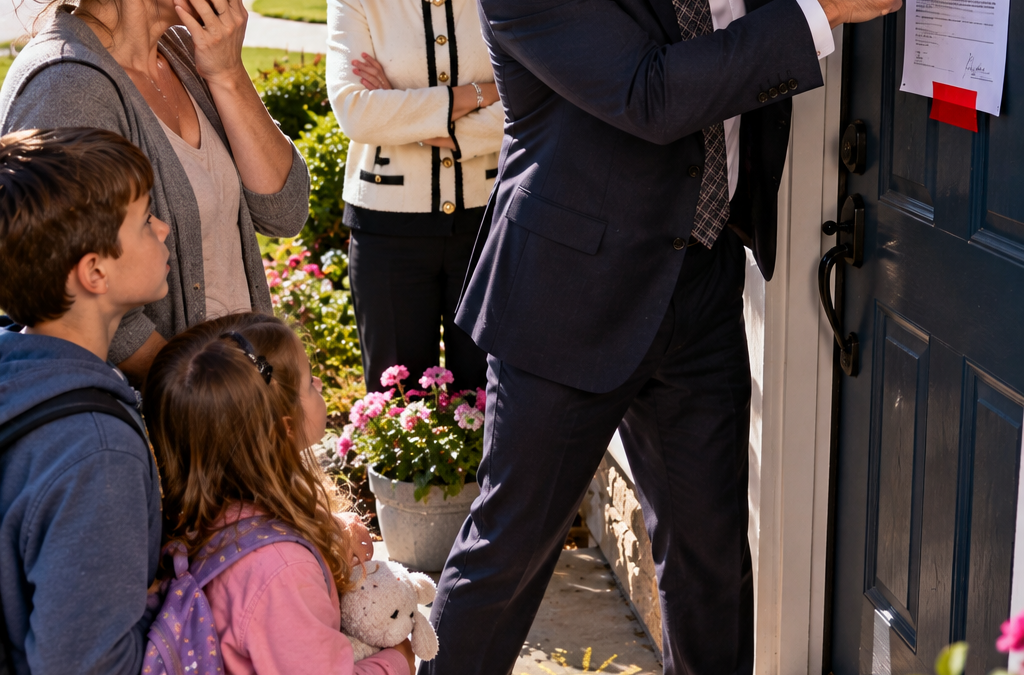
The lien notice was taped to my front door on a Tuesday morning, crooked and ugly, right beside the chalk drawings my kids had made the night before. Blue flowers. A crooked yellow sun. My son Mason’s attempt at a dragon that looked more like a tired alligator. My daughter Lily had written **WELCOME HOME MOM** in pink chalk underneath it, because she was seven and still believed a porch could be protected by pretty colors.
The paper nearly covered the word **HOME**.
I stood there in my work shoes, one hand on my purse strap, staring at the words **NOTICE OF LIEN INTENT** while my coffee went cold in the travel mug beside my car.
Thousands in fines.
Grass height.
Unauthorized decorative structure.
Repeated noncompliance.
Administrative penalties.
Failure to cure.
Possible foreclosure.
All of it printed in official language designed to make a single mother feel small before breakfast.
I remember the sound of Mason behind me, opening the storm door.
“Mom?”
I turned fast, blocking the notice with my body.
“Go grab your backpack, bud.”
“What’s that?”
“Nothing.”
He was ten, old enough to know when nothing meant something.
His eyes moved from my face to the paper taped beside his chalk dragon.
“Are we in trouble?”
That question almost broke me.
Because six months earlier, I would have said no without thinking.
Six months earlier, I believed Maplerest Estates was the safest choice I had ever made.
I had saved for eleven years to buy that little three-bedroom house.
Eleven years of double shifts at the dental office.
Eleven years of telling myself a cheaper apartment was fine because the down payment mattered more than comfort.
Eleven years of saying no to vacations, no to new furniture, no to replacing my old car, no to every little luxury people use to convince themselves they are doing okay.
I wanted my children to have a yard.
A front door that belonged to us.
A kitchen where I could put magnets on the refrigerator without asking permission.
A bedroom for each of them, even if Lily’s was barely bigger than a walk-in closet.
When I finally found the house on Willow Bend Drive, I loved every crooked shingle on the roof.
The siding needed washing.
The upstairs hallway creaked.
The kitchen floor had a permanent scuff near the stove that no cleaner could touch.
But it had a maple tree out front, a little porch wide enough for two chairs, and a backyard where Mason immediately imagined a soccer goal and Lily announced she would plant strawberries.
I signed the closing papers with a hand that shook from exhaustion and pride.
That first night, we ate pizza on the living room floor.
Lily fell asleep against a moving box.
Mason walked around with a flashlight, claiming he was “inspecting the perimeter.”
I stood in the doorway between the living room and kitchen and thought, *I did it.*
For the first time in my adult life, I owned the walls around me.
Maplerest Estates looked like a postcard.
Quiet and green, with trimmed lawns, white mailboxes, kids on bikes, and neighbors who waved from driveways. There were little flags beside porch steps, wind chimes under eaves, and planters full of petunias near garage doors. It looked orderly in the kind of way that makes people think nothing bad can happen there.
Then Deborah Whitlock became HOA president.
To be fair, she had already been on the board when I moved in, but she took over the presidency two months later after the previous president moved to Florida. No election drama. No campaign. Nobody else wanted the job badly enough to challenge her.
That was the first thing we all learned too late.
Power goes to the person willing to sit in the chair everyone else ignores.
Deborah was in her late fifties, maybe early sixties, though she dressed like a woman who considered age an insult and order a virtue. She wore pearls to mow her own lawn. I am not exaggerating. I saw it with my own eyes on a humid Saturday morning: Deborah Whitlock pushing a mower in pressed capris, a sleeveless blouse, and a strand of pearls resting against her throat like she was maintaining curb appeal for a magazine cover.
Her hair was always smooth.
Her lipstick never smudged.
Her smile never warmed anything.
She ruled the board like a queen guarding a castle nobody else realized had been conquered.
The first violation letter came six weeks after we moved in.
Trash bin left out four hours past the approved window.
Fifty-dollar fine.
I opened it at the kitchen counter after work, still wearing my scrubs, while Mason practiced spelling words at the table and Lily tried to convince me that cereal counted as dinner if it had marshmallows.
The notice had a photo attached.
My green trash bin, sitting at the curb in broad daylight.
I had forgotten to bring it in before leaving for work.
It felt ridiculous, but it was not wrong.
So I paid it.
I even laughed.
“Apparently the garbage can committed a crime,” I told the kids.
Mason looked up.
“Does it go to trash jail?”
“That’s what the garage is.”
He grinned.
I thought that would be the end of it.
A one-time mistake.
A picky neighborhood.
A woman who liked rules.
Didn’t everyone know an HOA Karen?
Two weeks later, another letter arrived.
This one cited my son’s garden gnome as an unapproved decorative structure violating community aesthetics.
The gnome was eighteen inches tall, red-hatted, chipped on one shoe, and deeply beloved by Mason. He had bought it at a yard sale with his own money because he said every house needed “a guard.”
He named it Captain Harold.
Captain Harold stood beside the porch steps holding a tiny shovel and smiling like he had never met Deborah Whitlock.
I called the HOA number listed on the notice.
Deborah answered herself.
“Maplerest Homeowners Association.”
“This is Courtney Hayes at 118 Willow Bend. I got a violation letter about a garden gnome.”
“Yes.”
“My son’s gnome.”
“The item is not approved.”
“I walked the neighborhood yesterday. Three other houses have gnomes. One has pink flamingos. There’s a plastic unicorn on Rose Court.”
A pause.
Not confusion.
Irritation.
“Selective enforcement is a myth, Courtney.”
I gripped the phone.
“Excuse me?”
“I simply notice things you don’t.”
That sentence should have scared me more than it did.
At the time, it just made me angry.
“You notice my son’s gnome, but not the flamingos?”
“Tone will not help your appeal.”
“I’m appealing?”
“You may submit a formal appeal within the allowed period.”
“What period?”
“It is in the bylaws.”
“Can you tell me?”
“You received the handbook at closing.”
Then she hung up.
I stood in the kitchen, phone still against my ear, while Captain Harold smiled innocently outside the window.
That was the beginning.
The fines multiplied fast.
Grass height.
Mailbox paint.
The wind chime Lily made at summer camp, cited as disturbing communal tranquility.
Whatever that meant.
Every letter came with a photo, a fine, and a warning that further violations would escalate rapidly. Every appeal I submitted disappeared into the same board mailbox Deborah alone controlled. I sent emails. No response. I mailed printed appeal letters. Nothing. I dropped one off at the clubhouse office in person and watched the volunteer receptionist place it in a tray labeled BOARD REVIEW.
Three weeks later, Deborah told me no appeal had been received.
When I asked for proof, she smiled.
“Courtney, paperwork gets lost when residents don’t follow procedure.”
“What procedure?”
“The one in the updated rules.”
I had never seen updated rules.
That night, after the kids went to bed, I opened the HOA portal and started digging.
Minutes.
Bylaws.
Board notices.
PDF attachments.
Old newsletters.
It was boring enough to make my eyes burn, but I kept reading because Deborah had said updated rules, and I wanted to know what she had changed.
That was how I found the first twist.
The appeal deadline had quietly changed.
The original bylaws gave homeowners thirty days to appeal fines.
The updated language gave them seven.
Seven days.
Most of my appeals had been filed after seven days but well within thirty.
No wonder she kept rejecting them.
But the change had not been voted on.
No meeting minutes.
No amendment.
No recorded board approval.
Just an email from Deborah months earlier titled **Clarification of Appeal Timing**, buried in a community update full of pool hours, landscaping reminders, and a recipe for peach cobbler.
Clarification.
That was the word she used.
She had not amended the bylaws, because that would have required a vote.
She had clarified them in an email nobody read closely enough.
By month three, my fines topped two thousand dollars.
That was when the certified letter mentioned the word **lien** for the first time.
I read it sitting in my car after work because I had opened the mailbox before going inside.
My hands started shaking so badly I dropped the envelope between the seat and the console.
A lien.
Against my home.
Over a gnome, grass, a wind chime, and trash bins.
I thought about the eleven years it had taken me to buy that house.
The overtime.
The kids sleeping on air mattresses after the move because I had spent every spare dollar on closing costs.
The first night eating pizza on the floor.
The chalk drawings.
The strawberry plants Lily had put in crooked rows behind the garage.
I could not let Deborah turn that into paperwork.
That night, I started a folder.
I labeled it with one word.
**EVIDENCE.**
Every letter.
Every envelope.
Every photo.
Every email.
Every timestamp.
Every appeal.
Every receipt showing payment.
Every screenshot from the HOA portal.
The appeal deadline email.
The original bylaws.
The changed language.
Photos of other houses with gnomes, flamingos, wind chimes, tall grass, and mailboxes in ten different shades of white, cream, gray, and black.
At first, the folder felt like a shield made of paper.
Thin.
Not enough.
Then my neighbor Frank leaned over the back fence and changed everything.
Frank Wheeler was a retired postal worker with a thick gray mustache, a vegetable garden, and the kind of memory that made people nervous when they tried to lie around him. He had lived in Maplerest for twenty-four years and knew everyone’s business, though he rarely volunteered it unless he believed you needed to know.
He saw me photographing the flamingos across the street and called out, “Deborah finally got to you?”
I lowered my phone.
“Is it that obvious?”
He rested both forearms on the fence.
“She did this to the Alvarezes too.”
I had heard the name but did not know the story.
“They sold last year, right?”
“At a loss.”
My stomach sank.
“Why?”
“Fines. Threats. Legal letters. Deborah said their fence violated setback rules even though it had been there fifteen years. They fought for a while, then gave up.”
“Why didn’t anyone help them?”
Frank looked toward the street.
“People were afraid of becoming next.”
That answer made me angry.
Then ashamed.
Because I understood it.
Fear does not always look like cowardice.
Sometimes it looks like a mortgage you cannot risk.
Kids you need to protect.
Savings you do not have.
A legal system you cannot afford.
Frank nodded toward my phone.
“Keep taking pictures.”
“I have a folder.”
“Good. Make two copies.”
I almost smiled.
“You sound like you’ve done this before.”
He disappeared from the fence for a moment, then returned holding a thick accordion file.
“Oh, honey,” he said, “I’ve been waiting for someone else to get mad enough.”
The funny part happened three weeks later.
Deborah fined herself by accident.
Not publicly, of course. Deborah would never accidentally humiliate herself where the whole community could see it unless technology helped.
The HOA portal had an automated compliance log attached to resident accounts. Usually, homeowners could only see their own notices, but for one glorious afternoon, after a software update, a board-review folder became visible to everyone with a login.
I saw it by chance.
There, under pending decorative violations, was a photo of Deborah’s own front garden.
Seven gnomes.
Seven.
Not one.
Not a small boy’s chipped yard-sale gnome.
Seven glossy, expensive garden gnomes arranged beneath her hydrangeas like a tiny council of hypocrites.
The notice had been generated by an outside inspection company the board apparently used once a quarter.
Violation: Unapproved Decorative Structures.
Account: Whitlock, Deborah.
Status: Waived.
I opened the waiver.
Deborah had signed it herself.
Reason: Board discretion.
I photographed the screen before it disappeared.
Then I noticed the date.
The waiver was signed the same week Deborah claimed the board could not meet due to quorum issues.
That mattered.
Because during that same week, she had issued new fines against me and several others, citing board authority.
But if there was no quorum, no meeting, and no valid board action, how had she authorized any fines?
How had she waived her own gnomes?
How had she enforced mine?
The whole structure began to wobble.
I brought the question to a lawyer named Priya Desai.
Frank gave me her number.
“She does HOA abuse cases sometimes,” he said. “Pro bono for veterans and retirees mostly, but she’ll listen if the facts are ugly enough.”
Apparently, my facts were ugly enough.
Priya’s office was small, on the second floor above a pharmacy, with a waiting room full of old magazines and one plant fighting for its life near the window. She was in her forties, with sharp eyes, a low voice, and the unsettling habit of reading documents so carefully that silence started to feel productive.
I put my folder on her desk.
She opened it.
Read.
Turned pages.
Read more.
Stopped at the appeal deadline email.
Stopped longer at the self-waiver.
Then Frank’s file.
Then the lien letter.
When she finally looked up, her eyes were bright.
“This is not just harassment, Courtney.”
I swallowed.
“What is it?”
“This might be fraud.”
The word felt too large for the room.
Priya explained it piece by piece.
The appeal deadline change had not been properly adopted.
The self-waiver suggested Deborah treated board authority as personal authority.
The no-quorum period created questions about every fine issued during that time.
Selective enforcement became stronger when compared with neighborhood photos.
And then Priya found something I had not understood in the financial records Frank had saved.
Special assessment fees.
Six families had been charged special assessments over the previous year for compliance remediation and common-area restoration. The payments did not appear in the HOA’s published financial report.
Instead, they had been deposited into an account connected to a name I did not recognize.
Elaine Porter.
Priya searched quietly for three minutes.
Then turned her laptop slightly toward me.
Elaine Porter was Deborah’s maiden name.
Eighteen thousand dollars.
Collected from six different families.
All funneled into an account tied to Deborah’s maiden name.
I felt sick and thrilled at once.
Sick for my neighbors.
Thrilled because Deborah had finally overreached.
The lien notice on my door was not just a threat anymore.
It was her last big swing, meant to scare me into silence or into selling before anyone looked too closely.
Instead, I mailed Priya’s demand letter the same afternoon.
The letter challenged the lien.
Demanded withdrawal of the fines.
Cited invalid meetings, unauthorized bylaw changes, questionable self-waivers, selective enforcement, and missing funds.
It also demanded preservation of all HOA documents, bank records, emails, waiver forms, meeting notices, and assessment ledgers.
Deborah’s response came fast, furious, and reckless.
She sent a community-wide email calling me disruptive.
She did not name me directly, but everyone knew.
She wrote about “certain homeowners” spreading misinformation, attacking volunteers, and refusing to maintain basic standards.
Then she threatened to make an example of me at the next open meeting.
Those were her words.
Make an example.
I printed the email and placed it in the folder.
By then, the folder barely closed.
The open meeting was scheduled for the following Thursday.
I spent the week knocking on doors.
Not all of them.
Just the ones Frank suggested.
The Nguyen family, who had paid a special assessment after Deborah claimed their drainage ditch affected the common area.
Mrs. Caldwell, who had been fined for a fence color while Deborah’s friend had the same stain.
The Martins, who had received a lawn-remediation assessment after a single warning letter.
Every conversation began stiffly.
People did not trust easily in a neighborhood Deborah had trained into silence.
Then I showed them the self-waiver.
The appeal deadline change.
The Elaine Porter account.
After that, the folders came out.
Receipts.
Letters.
Cancelled checks.
Screenshots.
One by one, people realized they had not been targeted because they were careless.
They had been targeted because Deborah believed they were easier to scare.
On the afternoon of the meeting, Frank called me.
“I’ve got something.”
His voice sounded different.
“What?”
“A recording.”
I sat down.
“Of Deborah?”
“She came by last year after I pushed back on a gutter fine. I had my phone recording because I don’t trust anyone who smiles that hard.”
“What did she say?”
Frank paused.
“That she adjusts enforcement based on who annoys her most.”
I closed my eyes.
“Please tell me you’re serious.”
“I’m retired, Courtney. Not bored enough to make up evidence.”
At the meeting, the clubhouse was packed.
I had never seen that many residents in one room.
People stood along the walls, holding folders, envelopes, bank statements, and years of resentment. The air felt tight, like everybody was waiting for the first crack of thunder.
Deborah stood at the podium wearing a cream blazer and pearls.
Of course she wore pearls.
Her hair was perfect. Her posture was perfect. Her smile was sharp enough to draw blood.
She opened with a speech about order.
Community standards.
Financial responsibility.
The danger of misinformation.
Then she looked directly at me.
“Some residents,” she said, “mistake accountability for persecution.”
I felt every face turn.
My mouth went dry.
Priya sat beside me, calm as stone.
Frank sat on my other side, holding his phone in one hand and a paper cup of lemonade in the other like we were at a school play.
Deborah continued.
“This board has always acted within its authority.”
Her voice cracked slightly on the word authority.
Just enough.
Priya stood.
“Then you should have no issue answering a few questions about that authority.”
Deborah’s smile tightened.
“This is a homeowner meeting, not a courtroom.”
“No,” Priya said. “But several of these documents may be shown in one.”
The room went silent.
Priya walked to the front and placed copies of the original bylaws and the so-called clarification email on the projector.
Thirty-day appeal period.
Seven-day appeal period.
No board vote.
No amendment.
No adoption record.
Then the no-quorum notice.
Then Deborah’s self-waiver for her gnome collection, signed during the same week she claimed no board business could be conducted.
People began whispering.
Deborah’s face flushed.
“This is being taken out of context.”
Priya clicked again.
Photos appeared.
Deborah’s seven gnomes.
My son’s single gnome.
A comparison chart of decorative items across the neighborhood.
Fined.
Not fined.
Fined.
Not fined.
Then Frank stood.
“My turn.”
Deborah’s head snapped toward him.
“No, Frank.”
He smiled.
It was the sweetest thing I had seen in months.
He tapped his phone.
Deborah’s recorded voice filled the clubhouse.
“Enforcement is about priorities, Frank. I adjust based on who creates problems. If someone annoys the board, they can expect closer attention.”
The room froze.
Then erupted.
People stood.
Someone cursed.
Mrs. Caldwell shouted, “You fined me because I questioned the budget!”
Deborah slammed her hand against the podium.
“That recording is illegal!”
Frank lifted one eyebrow.
“Ohio’s a one-party consent state, Deborah.”
I did not know if that was legally complete enough for court, but it landed beautifully in that room.
Then the final domino fell.
Mr. Nguyen stood near the front, holding printed bank statements.
His hands shook, but his voice did not.
“If you always acted within your authority,” he said, “then why is my assessment in your maiden name?”
The room went dead silent.
Not quieter.
Dead silent.
He held up the papers.
“My family paid twelve hundred dollars for common-area restoration. The check cleared into an account labeled E. Porter. Priya showed us who that is.”
Deborah’s mouth opened.
Closed.
Opened again.
No words came.
The silence broke all at once.
Neighbors were shouting now.
Not random anger.
Names.
Amounts.
Dates.
Questions.
Where did the money go?
Who approved the account?
Why were there no receipts?
Why did the board never disclose this?
Why were appeals ignored?
Why were Deborah’s gnomes waived?
Why did the Alvarezes lose their house?
The board members behind Deborah looked terrified.
For years, they had let her run everything because it was easier than doing the work themselves. Now every easy nod and rubber-stamped decision had turned into exposure.
One of them, a man named Harold Price, stood slowly.
“I move to remove Deborah Whitlock as president pending investigation.”
Deborah spun toward him.
“You don’t have the authority.”
Harold looked at Priya.
Priya simply pointed to the bylaws.
“You do.”
Another board member seconded.
The vote happened before the meeting ended.
Deborah stood at the podium, pale and furious, while her own board voted her out.
No crown.
No control.
No sharp smile.
Just a woman watching the room she had ruled decide it was done being afraid.
Weeks later, the county filed embezzlement charges.
The lien against my house was voided.
Erased.
Gone.
Every fine tied to the invalid appeal rule and no-quorum period was reviewed. Many were dismissed outright. Mine were wiped clean.
Deborah was ordered to repay the stolen assessment money, plus damages. The HOA’s insurer became involved. The state regulator barred her from serving on any HOA board again.
The Alvarezes could not get back the house they had sold, and that still makes me angry.
Some damage cannot be perfectly repaired.
But their case became part of the civil action. Their loss was finally recognized as part of the pattern, not dismissed as a personal choice.
For the rest of us, the neighborhood changed slowly.
The new board adopted rules that should have existed all along.
No bylaw change without a recorded vote.
No appeal deadline modification without proper notice.
No special assessment without account disclosure.
No board member waiving their own violations.
No enforcement without comparable neighborhood review.
No single person controlling the appeal mailbox.
Simple things.
Basic things.
The kind of safeguards only sound dramatic after someone abuses the absence of them.
Captain Harold, Mason’s gnome, still stands beside the porch steps.
Prouder than ever.
Mason painted his chipped shoe gold after the lien was voided because, according to him, “heroes need armor.”
Lily added a tiny paper crown at first, but rain destroyed it.
Mason said that was fine because “kings get weird anyway.”
He was not wrong.
Frank brings lemonade over now.
He walks across the yard without calling first, carrying a pitcher and two plastic cups like this is a sacred ritual. We sit on the porch while the kids draw with chalk, and sometimes we laugh about the woman who tried to steal a house over grass height.
Not because it was funny when it happened.
It was not.
There were nights I sat at the kitchen table after the kids went to bed and stared at those letters until the words blurred. Nights I imagined packing boxes because I could not afford a legal fight. Mornings I smiled through breakfast while my stomach twisted so badly I could barely swallow.
Fear makes you practical.
It makes you calculate how much equity you have, how much credit you can access, who might lend you money, where your children would sleep if everything fell apart.
Deborah did that to me.
To us.
And she did it with pearls around her neck and community standards on her lips.
So yes, Frank and I laugh now.
Because laughter is what comes after fear when fear finally loses.
One evening, about three months after Deborah was removed, I stood at the end of the driveway watching Mason and Lily redraw the same chalk flowers that had been partly covered by the lien notice.
The sun was low.
The grass was slightly too tall.
I had meant to mow it after work but got home late.
For a second, old panic rose in my chest.
Then I remembered.
No one was coming with a ruler.
No one was taping a threat to my door.
No one was turning my children’s chalk drawings into a backdrop for legal intimidation.
I sat down on the porch step beside Captain Harold.
His gold shoe gleamed in the sunset.
Frank called from across the yard, “You know your grass is criminally high.”
I looked at him.
“Better call Deborah.”
He raised his lemonade.
“Can’t. She’s busy repaying eighteen grand.”
I laughed so hard Lily asked what was funny.
“Grown-up stuff,” I said.
She rolled her eyes.
Kids hate that answer.
Later that night, after the kids were asleep, I opened the folder one more time.
The one labeled EVIDENCE.
It was thick now, packed with everything from the first trash-bin fine to the county notice voiding the lien.
I ran my hand over the cover.
For months, that folder had been my fear in paper form.
Then my shield.
Then my weapon.
Now it was a record of what happened when ordinary people finally stopped being isolated.
I placed it on the top shelf of the hall closet.
Not hidden.
Not displayed.
Just stored.
I did not need to stare at it anymore.
My house was still mine.
The porch still had chalk dust on it.
The roof still had crooked shingles.
The kitchen floor still squeaked near the sink.
The strawberry plants in the backyard had survived Lily’s uneven watering.
The garden gnome stood guard.
And for the first time in a long time, Maplerest Estates felt like peace instead of a trap.
Justice tastes better than any settlement check.
It tastes like your child asking if the gnome can stay and being able to say yes.
It tastes like lemonade on a porch with a neighbor who refused to forget.
It tastes like grass growing a little too tall because life got busy, and no one turning that into a weapon.
Deborah lost her crown.
Maplerest finally got its peace.
And my children’s chalk drawings stayed exactly where they belonged—on the porch of a home nobody was going to steal.








