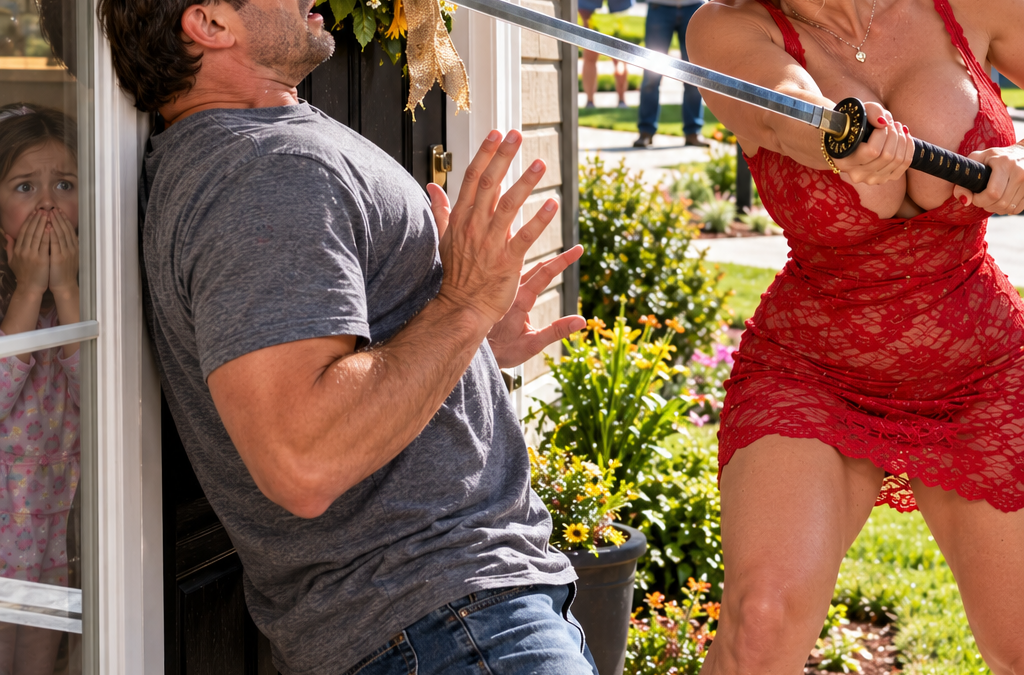
𝗙𝗨𝗟𝗟 𝗦𝗧𝗢𝗥𝗬 The HOA President Swung a Samurai Sword Inches From My Face Over a Sunflower Wreath While My Seven-Year-Old Daughter Was Inside.
𝗙𝗨𝗟𝗟 𝗦𝗧𝗢𝗥𝗬
I stared at him.
“It’s the middle of the afternoon.”
“Noise disturbances are prohibited at all hours.”
“Ken, they’re laughing.”
His expression tightened.
“The intensity of the sound exceeds reasonable neighborhood expectations.”
I felt anger rise in my chest.
“My daughter is seven years old.”
“Then she’s old enough to learn that rules matter.”
I looked past him.
Lily had stopped laughing.
She was watching us.
Her party hat tilted sideways.
“Mommy?”
I forced a smile.
“Go play, honey.”
Then I turned back to Ken.
“You need to leave.”
He straightened.
“Excuse me?”
“This is my daughter’s birthday party. We’re not disturbing anyone. You’re not going to stand here and frighten the children.”
He wrote something on his clipboard.
“I’ll document your refusal to cooperate.”
“Do whatever you need to do.”
He gave me a cold smile.
“I certainly will.”
Then he walked away.
Lily came over a few minutes later.
“Mommy, was that man mad at me?”
My throat tightened.
“No, sweetheart.”
“Did I do something bad?”
I crouched beside her.
“No. You were having fun at your birthday party.”
She looked toward the gate.
“Then why did he look so angry?”
I brushed a strand of hair from her forehead.
“Sometimes grown-ups forget how to be kind.”
She nodded, although I could tell she didn’t fully understand.
I didn’t either.
Not yet.
That evening, after the guests left, my neighbor Alana Reyes knocked on the door.
She was sixty-two, retired, originally from Puerto Rico, and had lived in Sycamore Ridge for fourteen years.
She carried a plate of sweet plantains.
“Thought you might need something better than leftover birthday cake,” she said.
I invited her inside.
Lily was upstairs playing with her presents.
Alana sat at my kitchen table while I poured coffee.
Then she looked directly at me.
“Mija, that man isn’t going to stop.”
I knew exactly who she meant.
“Ken?”
She nodded.
“I saw what happened today.”
I sighed.
“I’m trying not to make a big deal out of it.”
“That’s what he counts on.”
I looked at her.
Alana folded her hands.
“He’s done this before.”
Then she told me about the Henderson family.
They had lived near the entrance to the neighborhood.
According to Alana, Ken had repeatedly cited them for landscaping violations, parking issues, and exterior maintenance problems.
The fines grew.
The disputes became exhausting.
Eventually, they sold their home.
Then she told me about the Patels.
They had planted a vegetable garden behind their house.
Ken claimed it constituted an unauthorized commercial agricultural operation.
They weren’t selling anything.
They were growing tomatoes, peppers, and herbs for their family.
That hadn’t stopped him from threatening legal action.
Then came the Kowalskis, an elderly couple whose grandchildren used to visit every weekend.
Ken had repeatedly complained about toys, bicycles, and children’s noise.
Eventually, the family visits became less frequent.
“Those children used to fill that street with laughter,” Alana said quietly. “Now I barely see them.”
I stared at my coffee.
“Why hasn’t anyone stopped him?”
Alana gave me a sad smile.
“Because most people think it’s easier to pay fifty dollars than spend five thousand fighting.”
I understood that.
I’d made the same calculation over my welcome mat.
She leaned forward.
“But he doesn’t stop because you pay him.”
I looked up.
“He stops when someone makes him answer for what he’s doing.”
I sat silently for a moment.
Then I asked, “What should I do?”
“Be smarter than him.”
She nodded toward the stack of HOA letters near my refrigerator.
“Keep everything. Read the rules. Don’t argue just because he wants an argument.”
She stood to leave.
At the door, she touched my arm.
“And remember something, Mara. That house belongs to you and Lily. Not to Ken.”
I watched her walk across the street.
Then I went upstairs to check on my daughter.
She was asleep beneath her yellow curtains, hugging the stuffed rabbit she’d owned since she was three.
I stood in the doorway for a long time.
I had bought this house so she could feel safe.
And already, someone was making her afraid of being happy in her own backyard.
That night, I started documenting everything.
At first, I used the notes app on my phone.
Each entry included a date, time, description, and any witnesses.
I photographed every warning.
Every fine.
Every letter.
Whenever Ken appeared unexpectedly, I wrote down what he said as soon as the conversation ended.
Then I downloaded the complete Sycamore Ridge governing documents and began reading.
Every page.
Every section.
Every amendment I could find.
One Sunday afternoon, while Lily watched Encanto for what must have been the fourth time, I found something that made me sit upright.
Section 11.3.
The association’s own rules required seventy-two hours’ written notice before board members conducted certain property inspections.
I read the provision again.
Then I opened my log.
Ken had entered my side yard without notice.
He’d examined windows.
He’d inspected landscaping.
He’d appeared at our gate during Lily’s birthday party.
He had never provided seventy-two hours’ written notice.
Not once.
I felt a slow, cold satisfaction.
Ken had spent months insisting that every minor deviation from the rules justified punishment.
Yet he apparently considered himself exempt from the procedures governing his own authority.
I didn’t confront him immediately.
I kept reading.
I wanted to understand the rules better than the man who claimed to have memorized them.
Then I began attending board meetings.
I sat in the back row with a legal pad, taking notes.
Ken ran those meetings like a stage performance.
He interrupted homeowners.
Dismissed questions.
Declared motions out of order whenever he disliked the subject.
And repeatedly reminded people that serving as president required making difficult decisions.
At one meeting, a man named Tom Brandt asked about the association’s reserve fund audit.
Tom was fifty, a former Marine, and one of the calmest people I’d ever met.
He didn’t raise his voice.
He didn’t accuse anyone of wrongdoing.
He simply asked when homeowners could review the audit.
Ken leaned toward his microphone.
“Mr. Brandt, you need to settle down.”
Tom stared at him.
“I’m perfectly calm.”
“Your tone is becoming emotional.”
There was a long silence.
Tom glanced across the room.
Our eyes met.
I raised one eyebrow.
He almost smiled.
After the meeting, we stood in the parking lot for forty minutes.
Tom had his own records.
Two years of warnings and fines.
Three unanswered requests for financial information.
Documents showing that he had paid certain penalties under protest because he feared further escalation.
I showed him my notes.
We compared dates and violations.
A pattern emerged.
Ken wasn’t enforcing the rules consistently.
The Branson family, close friends of his, had kept a rusted boat trailer in their driveway for sixteen months.
No violation.
No warning.
Nothing.
Meanwhile, Alana had been fined four hundred dollars because Ken suddenly declared her azaleas unauthorized landscaping.
Those bushes had been growing outside her house since 2009.
They were healthy.
Beautiful.
And visible in photographs taken years before Ken became president.
The issue wasn’t property appearance.
It was selective punishment.
Tom looked at my notebook.
“You’re putting together quite a file.”
“I didn’t plan to.”
“Neither did I.”
He paused.
“Maybe we should compare what we’ve got with other residents.”
I nodded.
For the first time, I felt that someone besides Alana understood the scale of the problem.
But Ken was about to give me evidence far more damaging than another questionable citation.
It happened on a Tuesday in early June.
The air was humid, and my clothes dryer had been malfunctioning for several days.
The heating element wasn’t working properly.
Rather than spend another afternoon waiting for damp clothes to finish tumbling, I washed three loads and placed them on a portable drying rack on my back patio.
Our backyard was enclosed by a six-foot privacy fence.
The rack wasn’t visible from the street.
I checked.
I even moved it closer to the house so it wouldn’t interfere with anything.
Then I went inside.
At noon, I found a white envelope in my mailbox.
Violation notice HOA 2024-0119.
The alleged offense was outdoor laundry.
The cited rule prohibited displaying clothes in areas visible to neighboring properties.
I stared at the letter.
Then I walked into the backyard.
The drying rack sat exactly where I’d left it.
The fence surrounded the patio.
There was no ordinary line of sight from the sidewalk.
Someone would have to be elevated above the fence to see the laundry.
I stood there thinking.
Then I remembered the security cameras.
I’d installed a full set six months earlier after several package thefts occurred in the neighborhood.
One camera covered the garage.
Another monitored the front entrance.
A third included the side yard and the fence line.
I opened the recordings.
At 10:47 that morning, Ken appeared beside my side yard.
He was carrying a small plastic step stool.
I watched him look around.
Then he positioned the stool beside my fence.
He climbed onto it.
Raised his head above the fence line.
And peered directly into my private backyard.
He remained there long enough to examine the patio.
Then he climbed down, retrieved his clipboard, and began writing.
I watched the footage three times.
My hands were trembling by the third viewing.
He had deliberately positioned himself to see an area not visible from the street.
He had entered my side yard without permission.
He had used a step stool to look over a privacy fence.
And he had issued a citation based on what he’d seen.
There had been no inspection notice.
No emergency.
No legitimate reason to climb beside my fence.
I felt violated.
Not just angry.
Violated.
My backyard was where Lily played.
Where we ate dinner on warm evenings.
Where I sometimes sat alone after a difficult day at work.
It was supposed to be private.
And Ken had treated that privacy as another obstacle he was entitled to overcome.
I saved the footage.
Then I copied it to multiple secure locations and an external hard drive that I kept at my office.
I printed the violation notice.
Attached it to the recording log.
And added another entry to my growing file.
The next morning, I called Prestige Property Services, the company managing Sycamore Ridge.
A woman named Sandra answered.
I explained what the camera had recorded.
I cited Section 11.3 and asked how a board president could conduct an unannounced inspection by climbing onto a stool beside my privacy fence.
Sandra sounded uncomfortable.
“Board members have a certain amount of latitude in enforcement matters.”
“Does that include entering private property without notice?”
“I’d have to review the circumstances.”
“Then please review them.”
She hesitated.
“Mrs. Callaway, I don’t want to give you incorrect information.”
“That’s fine. Send me the policy in writing.”
Another pause.
“I’ll look into it.”
She never called back.
The following day, I sent a certified letter formally requesting the management company’s written policy on property access.
I included the relevant covenant language and referenced Ohio’s planned-community laws.
I had spent several evenings researching the legal framework governing homeowners associations.
I wasn’t pretending to be a lawyer.
But I wanted to know which rules actually existed and which ones Ken merely claimed existed.
Two weeks passed.
Prestige sent a generic acknowledgment.
Ken continued issuing violations.
This time, he targeted my front flower bed.
I had planted yellow and purple pansies.
Nothing unusual.
Just cheerful flowers that Lily loved watering.
According to Ken, they violated the approved Sycamore Ridge Botanical Palette.
I searched every version of the governing documents in my possession.
There was no Botanical Palette.
No attached schedule of flower colors.
No recorded amendment establishing a botanical approval system.
I requested a copy.
Ken replied personally.
The palette is an administrative guideline and is not subject to member review.
I printed the email.
Placed it in my evidence folder.
And labeled the tab Exhibit H.
By then, my file had become an accordion folder filled with photographs, correspondence, inspection records, and contradictory statements.
I took no pleasure in building it.
Every document represented time I should have spent with Lily.
Every evening researching HOA law was an evening I wasn’t relaxing.
But the file was becoming the only thing that made me feel less powerless.
Alana called that Sunday.
“He’s talking about you at coffee hour.”
I sighed.
“What now?”
“He’s telling people you’re trying to destroy the community.”
I looked toward the kitchen table.
Lily was drawing a rainbow.
“Good,” I said.
Alana became quiet.
“Mara?”
“Let him talk. I’ll keep the records.”
“Mija, be careful.”
“I am.”
“No. I mean really careful.”
Her voice tightened.
“He’s had people fined into financial trouble before. He knows how to turn neighbors against someone.”
I watched Lily color the last stripe of her rainbow.
“I know.”
After the call, I stood beside my daughter.
She looked up.
“Mommy, why do you have so many papers?”
I smiled faintly.
“Some grown-up paperwork.”
“Is it about that angry man?”
I froze.
Lily hadn’t forgotten her birthday party.
“Sometimes.”
She placed down her crayon.
“Can he make us leave?”
The question hit me harder than any citation.
I crouched beside her.
“This is our home, sweetheart.”
“But can he?”
I wanted to promise that nothing bad could ever happen.
Instead, I said, “I’m going to do everything I can to make sure we’re okay.”
She studied my face.
Then she wrapped her arms around my neck.
I held her tightly.
That night, after she fell asleep, I made an appointment with an attorney.
Her name was Patricia Inguin.
She ran a small Columbus firm specializing in HOA disputes and community association law.
During our first conversation, she listened for twenty minutes without interrupting.
I described the warnings.
The birthday party.
The selective enforcement.
The seventy-two-hour notice provision.
The step-stool footage.
The management company’s refusal to explain its policy.
When I finished, Patricia remained quiet for a moment.
Then she said, “Mara, you’ve been documenting this extremely well.”
I felt a rush of relief.
“So I’m not imagining it?”
“No. The evidence raises serious questions about unauthorized inspections and retaliatory enforcement.”
I swallowed.
“What happens next?”
“We need to preserve everything and examine the association’s full enforcement history.”
She explained that we should pursue appropriate records, identify other affected homeowners, and challenge the procedures Ken had used.
She also warned me not to confront him unnecessarily.
“People who rely on intimidation sometimes escalate when they realize it’s stopped working.”
I thought about Ken standing on the step stool.
“How much will this cost?”
Patricia gave me an honest estimate.
My stomach tightened.
I’d worked so hard to build savings after buying the house.
Now I was facing legal expenses simply to defend my right to live peacefully.
But Alana had already offered to contribute.
So had Tom.
Four other neighbors quietly volunteered to help support the legal effort.
I resisted at first.
I didn’t want anyone spending money because of my problems.
Tom corrected me.
“These aren’t just your problems, Mara.”
He placed his own file beside mine.
“He’s been doing this to people for years.”
I accepted Patricia’s representation.
We organized the documents.
We prepared formal requests.
And we began building a coalition.
I thought we were finally taking control of the situation.
I had no idea that Ken was about to abandon his clipboard and reach for a sword.
The incident happened on Saturday, July 27.
It was late afternoon.
The air felt heavy with summer humidity, and Lily was inside watching cartoons while I hung a new sunflower wreath on the front door.
The wreath was twenty-two inches across.
I’d checked the HOA’s decoration guidelines the night before.
The maximum permitted dimension was twenty-four inches.
I even measured it twice.
After everything Ken had done, I wasn’t giving him another excuse to claim I had broken a rule.
I stood on the porch in a sundress and flip-flops, adjusting the ribbon.
That’s when I heard footsteps.
Ken appeared at the end of my driveway.
At first, I barely recognized him.
He wasn’t wearing his usual polo shirt.
He was dressed in a bathrobe and slippers.
His hair looked disheveled.
And in his right hand was a Japanese katana.
For a moment, I couldn’t process what I was seeing.
The sword looked like a display piece.
A ceremonial weapon someone might hang on a wall.
But the polished blade was exposed.
And Ken was holding it with both hands.
“That wreath is not compliant,” he announced.
I stared at the weapon.
“Ken?”
He pointed the blade toward my front door.
“Take it down.”
I felt my heartbeat accelerate.
“Why are you carrying a sword?”
“Because I’ve had enough of your defiance.”
I took a cautious step backward.
“Put that down.”
He lifted his chin.
“I am the president of this homeowners association.”
“Ken, you’re holding a weapon.”
“The wreath violates Section 6.4.”
“It’s twenty-two inches. The limit is twenty-four.”
He ignored me.
“You deliberately challenge every instruction I give.”
“I checked the guidelines.”
“You think you’re smarter than everyone.”
My mouth went dry.
Across the street, Jake was washing his car.
Mrs. Kowalski was walking her terrier along the sidewalk.
I could see both of them watching.
I wanted to call for help.
But Ken was standing between me and the sidewalk, and I didn’t know how he’d react if I shouted.
“Please leave my property,” I said.
He took two steps forward.
Then he swung the katana.
The blade cut through the air in a broad arc.
I jerked backward.
The point passed terrifyingly close to my face.
I heard the whistle.
Felt the rush of air.
And stumbled against the porch railing.
For a split second, everything seemed silent.
I had spent years helping patients recover from injuries.
I knew what sharp trauma could do to the human body.
I knew how quickly an artery could be severed.
I knew how little protection my bare arms and summer dress offered against a sharpened steel blade.
And I knew that if he’d stepped slightly closer, Lily might have lost her mother right there on the front porch.
“Ken!” Jake shouted from across the street.
The garden hose fell from his hand.
Ken barely glanced at him.
He raised the sword again.
“I suggest you remove that wreath, Mrs. Callaway.”
His voice was calm.
Almost polite.
That was the moment fear became something physical.
My fingers went numb.
My knees felt weak.
My lungs wouldn’t take a full breath.
I realized he wasn’t bluffing in the way I’d always assumed he was.
He had already swung a deadly weapon within striking distance.
And he still believed he was the person in charge.
I slowly reached for my phone.
Ken watched me.
“What are you doing?”
“Calling the police.”
His expression changed.
“You wouldn’t dare.”
I dialed 911.
The dispatcher answered.
“My name is Mara Callaway. I need police at 14 Birchwood Lane. A man is threatening me with a sword.”
The dispatcher asked whether he was still there.
“Yes.”
“Are you inside?”
“No. I’m on my porch.”
“Can you get inside safely?”
I looked at Ken.
He was staring at the phone in my hand.
I stepped backward.
Then again.
I reached the door.
Opened it.
And slipped inside.
The lock clicked behind me.
Only then did I realize I was crying.
The dispatcher kept speaking.
“Ma’am, stay inside. Officers are on the way.”
I nodded even though she couldn’t see me.
Through the window, Ken stood on the porch holding the sword.
He remained there for what felt like an eternity.
In reality, it was about two minutes.
Lily appeared in the hallway.
“Mommy?”
I turned so quickly she stopped walking.
“Go into the living room, sweetheart.”
“Why are you crying?”
I wiped my face.
“There’s something happening outside. I need you to stay away from the windows.”
She looked frightened.
“Is the angry man here?”
I couldn’t answer immediately.
“Please do what I say.”
She nodded and returned to the living room.
I watched Ken through the sidelight.
He looked confused now.
Almost annoyed that the situation had stopped following his expectations.
Then the sirens became audible.
He looked toward the street.
His shoulders stiffened.
He glanced down at the katana.
And suddenly, the confidence disappeared.
He hurried toward his house, carrying the weapon at his side.
The police arrived within minutes.
Two cruisers stopped near my driveway.
Officers Daniela Ruiz and Marcus Webb approached.
I opened the door only after identifying them.
My hands were shaking so badly that Officer Ruiz immediately asked whether I needed medical attention.
“No,” I managed. “He didn’t touch me.”
She looked at my face.
“Tell me what happened.”
I explained the wreath.
The argument.
The sword.
The swing.
The distance between the blade and my head.
As I spoke, Alana came across the street.
She pointed toward her doorbell camera.
“I have it recorded.”
Jake approached with his phone.
“I filmed the last part.”
Mrs. Kowalski stood nearby, pale and visibly upset.
“I called 911 too,” she said.
She looked at me.
“That man could have killed you.”
I felt my knees weaken.
Officer Ruiz asked to see the video.
We played my doorbell recording first.
Then the porch camera.
Then Alana’s footage.
The images showed Ken approaching with the katana.
The confrontation.
The swing.
The blade passing dangerously close to me.
Officer Ruiz watched the footage twice.
Her expression hardened.
“This is very serious.”
Officer Webb had already begun walking toward Ken’s house.
I sat on the porch step.
The air felt too warm.
My hands wouldn’t stop trembling.
Alana sat beside me and placed her hand over mine.
Neither of us spoke.
At 4:47 that afternoon, officers arrested Renard Kelner at his front door.
They recovered the katana as evidence.
The incident became a criminal matter involving a deadly weapon, alleged assault, and threatening conduct.
I watched officers lead him toward a cruiser.
He was no longer carrying his binder.
There was no clipboard.
No opportunity to declare the officers out of order.
For the first time since I’d moved into Sycamore Ridge, Ken was being confronted by rules he didn’t control.
He looked toward my house as they guided him into the vehicle.
I don’t know what he expected to see.
Anger?
Satisfaction?
A triumphant smile?
I was sitting on my porch holding Alana’s hand, trying not to fall apart.
There was nothing victorious about that afternoon.
A man had nearly struck me with a sword.
My daughter had been inside.
And all of it had happened because I refused to remove a legal sunflower wreath.
That evening, after Lily went to bed, I sat beside her until she fell into a deep sleep.
She had asked why the police came.
I told her that a grown-up had behaved dangerously and the officers had come to keep everyone safe.
She asked whether he would return.
I said I didn’t know.
Then she asked whether I was going to die.
I held her so tightly that she complained I was squeezing her.
“No, sweetheart. I’m right here.”
She eventually fell asleep with one hand gripping my sleeve.
I stayed until her breathing became steady.
Only when I was alone did the full weight of what happened hit me.
I went into the bathroom, closed the door, and began shaking.
Not a little trembling.
My entire body.
I gripped the sink and stared at myself in the mirror.
I could still hear the blade.
Still feel the air against my cheek.
I had spent months preparing for a legal fight.
I’d imagined presenting evidence at meetings.
I’d imagined making Ken answer questions about the bylaws.
I’d never imagined that my determination to defend our home would end with a deadly weapon inches from my face.
I cried until I was exhausted.
Then I washed my face and went back to check on Lily.
The next morning, Patricia called at seven.
I’d already sent her the video files.
“Mara,” she said, “I need you to understand that this is no longer simply an HOA dispute.”
“I know.”
“There’s now a criminal investigation, potential civil liability, and possibly broader issues involving discriminatory enforcement.”
I sat at the kitchen table.
“What do you mean?”
“I’ve been reviewing the violation records you collected. I want to compare them against the full enforcement history.”
She explained that we needed the association’s complete violation logs and relevant homeowner records for the previous three years.
I’d already requested much of that information.
Ken had blocked access.
But after his arrest, Prestige Property Services suddenly became far more cooperative.
Sandra called me personally.
Her voice sounded strained.
“We’ll have the relevant documents to your attorney by Friday.”
They arrived Thursday.
Patricia spent the evening reviewing them.
The following morning, she called.
“Mara, sit down.”
I was already sitting.
“What happened?”
“In three years, Ken issued one hundred forty-seven violation notices.”
I looked toward the folder beside my laptop.
“That sounds like him.”
“There’s more.”
She explained that she’d compared the records with available demographic information and the identities of affected homeowners.
The results showed an alarming disparity.
Approximately eighty-three percent of the violations had been directed toward Black, Latino, or Asian residents.
Meanwhile, seven households had received no violations during the same period.
All seven were white households whose owners were personally acquainted with Ken.
I stared at the wall.
I thought about Alana.
The Patels.
The family on the back street who had been fined for a birdbath.
The Hendersons.
The selective enforcement we’d already documented.
“That can’t be coincidence,” I whispered.
“The disparity is significant,” Patricia said. “Combined with the individual records and Ken’s conduct, it supports a serious fair housing discrimination complaint.”
My stomach tightened.
I’d been focused on protecting myself and Lily.
Now the evidence suggested Ken had been targeting residents in a way that reached far beyond personal grudges.
“What’s next?”
“We file with HUD.”
The following Monday, Patricia submitted the complaint to the U.S. Department of Housing and Urban Development.
The allegations addressed discriminatory enforcement patterns and the association’s treatment of affected homeowners.
I knew statistics alone didn’t tell every family’s story.
But the numbers were supported by individual accounts, records of inconsistent enforcement, and years of complaints.
For the first time, the possibility of federal oversight entered the dispute.
Ken’s arrest also attracted media attention.
A local Columbus television station reported that an HOA president had been arrested after allegedly threatening a resident with a sword during an argument over a door decoration.
The footage was startling.
A man in a bathrobe.
A katana.
A woman standing on her porch.
A perfectly ordinary sunflower wreath.
Within a day, the story had spread beyond local news.
Videos circulated across social media.
Commentators discussed the incident.
People who had never heard of Sycamore Ridge suddenly knew its name.
My phone rang constantly.
Reporters wanted interviews.
Strangers sent messages.
Some people made jokes about the absurdity of the situation.
Others expressed genuine concern for Lily and me.
I gave two careful interviews.
I didn’t want to turn the worst afternoon of my life into entertainment.
I described the incident factually.
I explained that the wreath complied with the written guidelines.
I confirmed that the police had responded and the matter was under investigation.
Then I let the video speak.
But Ken had no intention of accepting responsibility quietly.
His attorney, Douglas Featherman, filed a countercomplaint with the HOA board.
Featherman was polished, confident, and fond of expensive suits with perfectly folded pocket squares.
His argument was that I’d spent months provoking Ken through bad-faith complaints and that the sword incident represented an excessive but understandable response by a community leader subjected to sustained harassment.
When Patricia showed me the filing, I couldn’t believe what I was reading.
“He’s saying I provoked a man into swinging a sword at me?”
“That’s the argument.”
“By hanging a wreath?”
“Among other allegations.”
I looked at her.
“Does he actually think that will work?”
“We’ll respond with the evidence.”
What Featherman didn’t know was that our neighborhood coalition had already collected sixty-one signatures supporting Ken’s removal.
Sixty-one households out of eighty-nine.
For three months, Tom, Alana, and several other residents had quietly spoken with neighbors.
They had explained the evidence.
Shared relevant documents.
And asked homeowners whether they were willing to support a formal petition.
Some people signed immediately.
Others hesitated.
A few said they were afraid Ken would retaliate.
But eventually, the signatures accumulated.
The petition was complete before the sword incident.
After the arrest, the board could no longer pretend the concerns were merely personal disagreements.
An emergency meeting was scheduled for August 3.
I arrived with Patricia, Alana, Tom, and several other homeowners.
The community center was packed.
People stood against the walls.
Additional folding chairs had been brought from storage.
Someone had placed a casserole on a side table because apparently no community gathering in suburban Ohio was complete without one.
Ken arrived wearing a dark suit.
He was out on bail and accompanied by Featherman.
He didn’t look at me when he entered.
His attorney sat beside him and arranged several documents across the table.
Prestige Property Services sent its regional director, Gil Harmon.
Gil looked like a man who had walked into a crisis he wished someone else would handle.
The meeting began tensely.
Featherman spoke first.
He argued that Ken had been subjected to a coordinated campaign of homeowner hostility.
He characterized Ken’s conduct as an attempt to enforce community standards under unusually stressful circumstances.
I sat quietly.
My hands were clasped together so tightly that my fingers ached.
When Featherman finished, Patricia stood.
She placed three sets of documents on the table.
The first contained the enforcement disparity analysis.
The second included footage of Ken’s unauthorized inspection beside my fence.
The third contained the criminal arrest documentation and evidence from the sword incident.
Patricia looked at the board.
“Mr. Kelner violated the association’s notice procedures on numerous documented occasions.”
She indicated the footage.
“He entered private property without appropriate notice and used a step stool to inspect an enclosed backyard.”
Then she indicated the arrest record.
“He later approached a homeowner while carrying a deadly weapon and swung it within striking distance.”
The room was silent.
Patricia continued.
“The enforcement records also raise serious concerns about discriminatory treatment of residents.”
Gil shifted in his chair.
Featherman whispered something to Ken.
Ken’s face tightened.
Patricia looked directly at the board members.
“You have a duty to respond appropriately to documented misconduct. Ignoring these issues will expose the association to further legal risk.”
No one interrupted her.
For eighteen months, Ken had dominated every meeting with his voice.
Now he sat almost motionless while someone else presented facts he couldn’t simply dismiss.
The board withdrew to confer.
When the members returned, the vote was taken.
Three to zero.
Renard Kelner was removed as HOA president.
The board also imposed interim restrictions on his association role pending the appropriate proceedings.
The entire decision took only minutes.
Ken stood when the result was announced.
He looked around the room.
At Tom.
At Alana.
At the homeowners who had signed the petition.
Then at me.
His expression was strangely blank.
He didn’t seem furious.
He seemed stunned.
As though he’d spent so many years controlling consequences for other people that he’d forgotten consequences could apply to him.
He gathered his papers.
Featherman followed him toward the exit.
His briefcase struck the doorframe as they left.
Then the room erupted.
Someone cheered.
Another homeowner began crying.
Alana grabbed my arm.
“We did it, mija.”
I looked around the room.
People were hugging.
Talking.
Laughing in disbelief.
I wanted to feel the same relief.
But I couldn’t forget the sound of the blade.
Ken had lost his title.
He hadn’t yet answered for what he’d done on my porch.
And the broader investigation was still unfolding.
The criminal case advanced.
The prosecutor, Assistant District Attorney Joanna Marsh, reviewed the recordings and witness statements.
The evidence was unusually direct.
My doorbell camera showed the confrontation.
Alana’s camera captured another angle.
Jake’s phone preserved the final portion.
Mrs. Kowalski had independently called police.
Ken couldn’t credibly claim that no weapon had been involved.
His defense focused on intent.
Featherman argued that the katana was ceremonial and that Ken had not genuinely intended to injure me.
But the weapon had a metal blade.
He had swung it within striking distance.
And several witnesses had seen what happened.
The grand jury reviewed the evidence and returned an indictment.
Attempts to suppress the video recordings were unsuccessful.
The case was moving toward trial.
Then, two weeks before proceedings were scheduled to begin, Patricia received an unexpected call.
A woman named Beverly Hatch wanted to speak with her.
Beverly had lived in Sycamore Ridge before I moved there.
She had sold her house in 2021 after a long series of disputes with Ken.
I’d heard her name mentioned by neighbors but had never met her.
Now she had something important.
A thumb drive.
Patricia arranged to examine the material and verify its origin.
The drive contained archived email correspondence from the HOA’s administrative systems.
According to Beverly, her son, who worked in information technology, had helped preserve messages that had reached the family through an administrative email error and related backup records.
The material included correspondence involving Ken and two former board members.
What the emails showed was devastating.
Ken hadn’t merely interpreted rules aggressively.
He had discussed creating violation notices against particular residents he wanted to pressure.
The Hendersons.
The Patels.
Other families who’d challenged him.
Certain messages referred to enforcement actions that didn’t correspond to actual observed violations.
Others discussed increasing pressure on residents until they stopped complaining or left.
I sat in Patricia’s office reading the excerpts.
My stomach turned.
“He knew the violations weren’t real.”
Patricia nodded.
“The messages strongly support that conclusion.”
I thought about the Henderson family selling their home.
The Patels fighting to keep their vegetable garden.
Alana paying four hundred dollars over flowers she’d grown for years.
And Lily asking whether the angry man could make us leave.
Ken had made ordinary families fear for their homes.
Not because they had damaged the neighborhood.
Because he wanted control.
Patricia immediately arranged for the evidence to be provided to the appropriate investigators and HUD.
The potential legal consequences expanded.
Authorities began reviewing possible fraud, discriminatory enforcement, and coordinated misconduct beyond the sword incident.
Ken’s attorney sought to resolve the criminal case through a plea agreement.
But the prosecution proceeded toward trial on the charges it intended to prove.
The trial lasted six days.
I testified on the second day.
I wore a navy blazer and flat shoes.
Before entering the courtroom, I stood in the hallway holding a small bottle of water.
My hands were trembling.
Patricia approached.
“Are you ready?”
“I don’t know.”
She nodded.
“That’s okay.”
I looked toward the courtroom doors.
“What if I get emotional?”
“Then take a moment. You don’t have to perform for anyone.”
I swallowed.
“Just tell the truth?”
“Exactly. The facts are strong enough.”
When I entered the witness box, I could see Ken sitting beside Featherman.
He didn’t look at me.
The prosecutor asked me to describe the events of July 27.
I explained that I had been hanging a twenty-two-inch sunflower wreath.
I described Ken approaching with the katana.
His clothing.
His words.
The argument about the decoration guidelines.
Then the swing.
As I reached that moment, my throat tightened.
“What did you experience when the blade passed you?” the prosecutor asked.
I stared at my hands.
“I felt the air move against my face.”
“How close was the sword?”
“Approximately three inches.”
The room became very still.
I took a breath.
“I thought he was going to kill me.”
My voice shook.
I waited until I could speak again.
“My daughter was inside. I remember thinking she was going to hear something happen to me and come outside.”
The prosecutor gave me a moment.
Then she continued.
I explained how I called 911 and locked myself inside.
I described the sirens.
The officers arriving.
The recordings.
I didn’t exaggerate.
I didn’t need to.
During cross-examination, Featherman suggested that I had intentionally provoked Ken by installing a noncompliant wreath.
I looked at him.
“The wreath complied with the rules.”
He raised a document.
“Are you certain?”
“Yes.”
“Mr. Kelner believed it exceeded the permitted dimensions.”
“Then he was mistaken.”
Featherman approached the witness stand.
“Isn’t it true that you had been engaged in an ongoing dispute with him?”
“Yes.”
“And that you repeatedly challenged his authority?”
“I challenged unsupported violations.”
“Would you agree that your relationship had become hostile?”
I thought carefully.
“I would agree that he repeatedly accused me of wrongdoing and eventually threatened me with a sword.”
There was a brief silence.
Featherman changed direction.
He returned to the wreath.
He suggested that its twenty-two-inch diameter violated the association’s decorative limit.
The prosecutor responded by introducing the governing provision.
The maximum diameter was twenty-four inches.
Featherman read the language aloud.
For a moment, nobody spoke.
The wreath was legal.
The supposedly provocative decoration had complied with the rules all along.
Ken had carried a sword onto my property because he wanted me to submit, not because he was defending any legitimate community interest.
The remaining testimony included witness accounts and video evidence.
Joanna Marsh presented the recordings carefully.
The jury saw Ken approaching in his bathrobe.
They heard his voice.
Watched him advance.
Saw the blade swing.
I looked down while the footage played.
I couldn’t watch it again.
The sound alone brought back the terror.
Later testimony addressed the harassment pattern and fabricated enforcement actions.
The archived emails helped establish that Ken’s conduct was not simply an isolated moment of poor judgment.
For years, he’d used association procedures to punish residents he disliked.
Now he was trying to explain why swinging a deadly weapon at one of those residents should be excused.
When closing arguments ended, the jury began deliberating.
They returned after approximately three hours.
I sat beside Alana.
Tom was behind us.
Patricia sat nearby.
My heart pounded as the foreperson stood.
The jury found Ken guilty of felony assault and the additional harassment and attempted-fraud counts presented in the case.
I heard the verdicts.
But for several seconds, I couldn’t process them.
I just stared straight ahead.
Alana reached for my hand.
“Mija.”
I turned toward her.
Her eyes were filled with tears.
“It’s over.”
I wanted to believe her.
But I had spent eighteen months living under constant tension.
Relief didn’t arrive all at once.
It came slowly.
In pieces.
A breath I could finally take.
A night when I didn’t check the cameras five times.
A morning when the mail no longer made my stomach tighten.
Sentencing took place thirty-one days later.
Judge Kora Simmons reviewed the seriousness of Ken’s conduct, the use of the weapon, and the established pattern of harassment.
Ken stood beside his attorney.
He wore a dark suit.
His posture was stiff.
He looked older than he had at the HOA meetings.
The judge sentenced him to four years in state prison.
The sentence also included a fifteen-year prohibition on serving in HOA leadership or comparable community governance roles after his release.
When the judge addressed him, her words were direct.
He had used a position of neighborhood authority to intimidate and punish residents.
The law did not protect that abuse.
Ken stood motionless.
He didn’t look toward me.
I had imagined that seeing him sentenced would make me feel triumphant.
Instead, I felt a strange mixture of relief, exhaustion, and sadness.
Not because I doubted the consequences were deserved.
But because so much harm had been caused by a man who could have chosen to behave differently at any point.
He could have ignored my welcome mat.
He could have left Lily’s birthday party alone.
He could have respected my fence.
He could have accepted that a legal sunflower wreath was none of his business.
He had been given countless opportunities to stop.
Instead, he’d escalated until someone could have died.
The civil case continued after sentencing.
Additional homeowners pursued remedies for the harm caused by discriminatory and retaliatory enforcement.
Three months later, a settlement was reached involving seven affected families.
The agreement was funded through the appropriate association and insurance arrangements.
Its financial terms remained confidential.
But the affected households received compensation and other relief addressing years of improper treatment.
Alana called me after the settlement was finalized.
“Well, mija.”
I could hear the smile in her voice.
“What?”
“Let’s just say I can finally fix my roof.”
I laughed.
“And?”
“And maybe take my sister to Cancun.”
For the first time in months, the laughter felt uncomplicated.
The HUD proceedings also produced meaningful reforms.
A formal consent order required Sycamore Ridge to implement anti-discrimination training and independent oversight of enforcement notices for five years.
The association had to address how violations were documented, reviewed, and communicated.
Prestige Property Services eventually ended its management contract with the neighborhood.
A new management company took over.
Its representatives reviewed the recorded covenants, existing procedures, and previous enforcement practices.
The seventy-two-hour notice requirement was clarified and incorporated into written inspection protocols.
It had been there all along.
Ken simply hadn’t wanted to follow it.
At the November annual meeting, Tom Brandt was elected HOA president.
He ran unopposed.
When his name was announced, several homeowners applauded.
Tom stood at the front of the room looking faintly uncomfortable.
“I didn’t think I’d be doing this,” he admitted.
Someone laughed.
He looked around the clubhouse.
“But I can promise you one thing. Nobody is going to have to fight this board just to get a straight answer.”
His first major initiative was reviewing the violation notices issued during Ken’s final three years.
Every notice had to be supported by independent evidence.
The review took time.
There were documents to examine.
Old inspection records to locate.
Homeowners to contact.
And a great deal of paperwork that had never been properly organized.
Ultimately, one hundred nine notices were rescinded because they couldn’t be substantiated.
One hundred nine.
I stared at that number when Tom announced it.
I thought about the hours people had spent worrying over those letters.
The money they’d paid.
The arguments they’d had at kitchen tables.
The family visits canceled.
The gardens changed.
The feeling that someone could punish them whenever he wanted.
One hundred nine notices.
And behind every one was a person or family who had been forced to respond to an accusation.
Alana’s azaleas were officially recognized as approved, grandfathered landscaping.
She invited me over the afternoon she received the confirmation.
We stood beside the bushes.
They were covered in flowers.
“Can you believe it?” she asked.
I smiled.
“They’ve been growing here since 2009.”
“And apparently they finally learned how to behave.”
We laughed.
Then she hugged me.
A few weeks later, I saw Mrs. Kowalski’s grandchildren riding bicycles down the cul-de-sac.
Bright pink helmets.
Blue handlebars.
Training wheels rattling over the pavement.
The children were laughing loudly.
Their grandfather stood near the driveway watching them.
Nobody came outside with a clipboard.
Nobody complained.
Nobody threatened a fine.
I stood on my porch listening to their laughter and realized how much I’d missed that sound.
A neighborhood should be allowed to sound alive.
Still, recovery wasn’t as simple as changing the HOA president.
For months after the incident, I startled whenever someone knocked unexpectedly.
I sometimes woke at night convinced I’d heard footsteps outside.
I avoided standing too close to the edge of the porch.
When I saw someone holding a long metal object, even a garden tool, my body reacted before my mind could reason through what I was seeing.
I understood those responses professionally.
As a physical therapist, I’d worked with people recovering from serious injuries and traumatic experiences.
But understanding something clinically doesn’t make it easy to live with.
I had spent so long being strong for Lily that I’d forgotten how frightened I was allowed to feel.
The night before Ken’s sentencing had been particularly difficult.
I lay awake thinking about the man who had spent years building his identity around controlling a small suburban community.
I wondered whether he genuinely believed he had been protecting Sycamore Ridge.
Maybe, in his mind, every warning had been justified.
Every argument had been evidence of disrespect.
Every homeowner who challenged him had represented a threat to the order he thought he maintained.
That didn’t excuse anything.
But I began to understand how someone could become so consumed by authority that ordinary disagreement felt like an attack.
At sentencing, Ken had been almost completely alone.
His wife sat toward the back of the courtroom.
His adult son hadn’t attended.
No neighbors appeared to support him.
Nobody stood to describe him as a generous leader or beloved friend.
I found that unexpectedly sad.
He’d spent years demanding obedience from an entire neighborhood.
Yet when the consequences arrived, the people he’d tried to control wanted nothing more to do with him.
The power he’d valued had cost him the relationships that might have mattered.
I never felt responsible for that.
He had made his choices.
But I didn’t need to celebrate his isolation to recognize that justice had been served.
Eventually, Lily asked about him.
We were sitting at the kitchen table one afternoon.
She was coloring while I sorted paperwork for Tom’s first full board meeting.
“Mommy?”
“Yes, sweetheart?”
“Why did Mr. Ken go away?”
I set down my pen.
She looked up at me with the solemn expression children sometimes have when they’re asking questions adults would rather avoid.
“He broke the rules,” I said.
She frowned.
“But he was always talking about rules.”
“I know.”
“Then why did he break them?”
I thought for a moment.
“Because sometimes people think rules are only for other people. But the important rules are supposed to protect everyone.”
She considered that.
“Even grown-ups?”
“Especially grown-ups.”
Lily looked down at her drawing.
Then she asked, “Was he sad?”
I remembered him standing in the courtroom.
His rigid shoulders.
His empty expression.
The people who hadn’t come to support him.
“I think so,” I said.
“Why?”
I took a slow breath.
“Maybe because he made choices that hurt people, and now he has to live with what happened.”
Lily nodded.
Then she looked at me with sudden excitement.
“Can we get a dog?”
I stared at her.
Then I burst out laughing.
After everything we’d been through, my daughter had somehow managed to move from prison sentencing to pet ownership in less than a minute.
I laughed until tears filled my eyes.
Lily laughed too, even though she didn’t understand why I found it so funny.
For the first time in a long while, the sound of her laughter didn’t make me look toward the window.
I didn’t expect a violation notice.
I didn’t wonder whether someone was measuring the noise.
I just laughed with my daughter in our kitchen.
That ordinary moment meant more to me than I could explain.
Our life gradually returned to something peaceful.
Alana and I began having coffee on her porch most Sunday mornings.
She usually brought out something she’d cooked.
I brought stories from work.
Sometimes we talked about the old HOA days.
More often, we discussed ordinary things.
Lily’s school.
The weather.
Alana’s garden.
Tom waved from his driveway when he saw us.
He sometimes stopped to complain about how much paperwork being HOA president involved.
Alana would smile sweetly.
“Careful, Tom. We know where you live.”
He always laughed.
The Kowalskis’ grandchildren started visiting regularly again.
Their bicycles appeared on sidewalks.
Their laughter carried through the afternoon air.
The Patels continued growing vegetables.
The Henderson family received acknowledgment of the wrongful enforcement that had contributed to their decision to leave.
Not every consequence could be reversed.
Some families had already moved on.
Some relationships had been damaged too deeply.
Some money and time were gone forever.
But the neighborhood began becoming the place its brochures had promised.
I also kept my records.
The folders.
The photographs.
The security footage.
The correspondence.
The court documents.
I organized them in a locked cabinet in my office.
Sometimes people asked why I didn’t throw everything away.
The case was finished.
Ken was in prison.
The association had changed.
Why keep reminders of such a terrible period?
Because those records had made the difference.
Not dramatic speeches.
Not angry confrontations.
Not my ability to outshout someone who enjoyed intimidating people.
The quiet work.
The notes entered at eleven at night.
The certified letters.
The screenshots.
The photographs.
The careful comparison between what the bylaws actually said and what Ken claimed they said.
Each small action had seemed insignificant when I was doing it.
But together, they formed something stronger than his authority.
Evidence.
And evidence didn’t need to shout.
I thought about that whenever I looked at the sunflower wreath.
The original wreath had been taken into evidence after the sword incident.
Once it was no longer needed, I replaced it with an identical one.
Twenty-two inches.
Bright yellow petals.
A simple brown center.
Perfectly compliant with the written guidelines.
It hung on my front door through the following summer.
Sometimes I looked at it and remembered the blade.
The sound.
The fear.
The moment I believed my daughter might lose her mother.
But increasingly, I remembered something else.
Jake dropping his hose.
Mrs. Kowalski calling 911.
Alana crossing the street to sit beside me.
Tom standing up at the board meeting.
The sixty-one homeowners who signed the petition.
Patricia laying out the evidence.
The jury returning its verdict.
The community deciding, together, that one man’s obsession with control would no longer define their lives.
One evening, almost a year after the sword incident, I stood on the porch while Lily drew with sidewalk chalk.
The sun was setting behind the trees.
The street was quiet except for distant laughter and the sound of a basketball bouncing somewhere down the cul-de-sac.
Lily had drawn a large yellow sun beside our front steps.
Then she added a house underneath it.
Our house.
She colored the roof red, the windows blue, and the front door purple.
I smiled.
“Purple door?”
She nodded.
“Because purple is pretty.”
“What do you think the HOA would say?”
She looked up at me.
For a moment, her expression became serious.
Then she smiled.
“We could ask.”
I felt something warm settle in my chest.
That was exactly how things were supposed to work.
We could ask.
We could read the rules.
We could discuss a change.
And nobody needed to be afraid of punishment simply for having a question.
I sat beside her on the porch step.
She leaned against my shoulder.
“Mommy?”
“Yes?”
“I’m glad we didn’t move.”
I looked at her.
“Me too.”
She pointed toward the house.
“Because this is our forever house.”
I wrapped my arm around her.
For eighteen months, I’d been afraid Ken could take that promise away from us.
Not because he’d owned the property.
Not because he’d had a legitimate claim.
But because he’d understood how to make ordinary people feel powerless.
He’d relied on fear, confusion, exhaustion, and the assumption that nobody would spend the time necessary to challenge him.
He had controlled a small neighborhood by making everyone believe that resistance would cost more than surrender.
And then he’d crossed a line that no amount of HOA paperwork could conceal.
He had brought a sword to my front porch.
The blade had passed within inches of my face.
That moment could have ended everything.
Instead, it exposed everything.
The selective enforcement.
The unauthorized inspections.
The fabricated violations.
The discrimination.
The years of intimidation that had made so many people afraid to speak.
But the deepest change didn’t come from seeing Ken sentenced.
It came from watching my neighbors rediscover what a community was supposed to be.
People looking out for each other.
Speaking when something was wrong.
Refusing to let one person’s title become an excuse for cruelty.
Lily finished drawing her sun.
Then she stood and held out her hand.
“Come on, Mommy. I want to show you something in the backyard.”
I took her hand.
We walked past the sunflower wreath and through the house.
The same house I’d bought because I wanted to give my daughter a peaceful childhood.
The same house someone had tried to turn into a place of fear.
Now it was full of ordinary sounds again.
Her laughter.
The dog’s barking from a neighbor’s yard.
The dishwasher running.
The breeze moving through the trees outside.
I stopped briefly at the back door and looked toward the yard.
For the first time in a long while, I wasn’t thinking about violation notices, legal arguments, or security footage.
I wasn’t listening for footsteps on the porch.
I wasn’t worrying about whether someone was watching through the fence.
I was simply home.
And as Lily pulled me outside into the warm evening, I finally understood something I’d been trying to learn since the day Ken measured my welcome mat.
Peace isn’t the absence of disagreement.
It’s the confidence that disagreement won’t cost you your safety, your dignity, or your home.
The rules that mattered had never belonged to Renard Kelner.
They belonged to everyone.
And after eighteen months of fear, Lily and I could finally enjoy the life I’d worked so hard to give her.
Our house was still standing.
The sunflower wreath was still on the door.
And my daughter was laughing in the backyard.
This time, nobody was coming to tell her to stop.








