𝗙𝗨𝗟𝗟 𝗦𝗧𝗢𝗥𝗬 The HOA President Stood Between an Ambulance and a Dying Man, Certain Her Rules Mattered More Than the Sirens
𝗙𝗨𝗟𝗟 𝗦𝗧𝗢𝗥𝗬
Sometimes my neighbor Priscilla came over because she knew I would forget to eat something other than soup.
Priscilla was fifty-eight, widowed herself, and had the kind of personality Ruth would have called unavoidable.
She lived next door and treated my reluctance to ask for help as a personal challenge.
If she made lasagna, I received half.
If she baked bread, a loaf appeared on my porch.
If I failed to collect my mail by noon, she noticed.
I returned the favor with vegetables from the garden.
Tomatoes mostly.
Cucumbers.
Green beans.
I never knocked.
I simply left a paper bag on her porch.
She pretended not to know who had done it.
We both preferred the arrangement that way.
The trouble with Diane’s rules became harder to ignore when she introduced the Verified Visitor Protocol.
She unveiled it at an HOA meeting as if she were announcing a security initiative for an embassy.
Every nonresident vehicle entering Ridgerest had to be preregistered in the community portal.
Guests.
Contractors.
Delivery services.
Repair technicians.
Private nurses.
House cleaners.
Everyone.
Residents were expected to enter the visitor’s name, vehicle description, plate number if available, and expected arrival window at least twenty-four hours in advance.
The gate attendant, or Diane through the remote access system, could then approve entry.
At the meeting, a man named Henry Dobbs raised his hand.
“What about pizza delivery?”
Diane did not laugh.
“If residents order food, they should anticipate the arrival.”
Henry looked around.
“You want me to register a teenager from Domino’s twenty-four hours before I know I’m hungry?”
Several people laughed.
Diane waited.
Then she said, “If residents refuse to participate responsibly in community security, they shouldn’t complain when security fails.”
The room quieted.
That was Diane’s gift.
She could turn almost any disagreement into a moral deficiency.
Question the rule, and you weren’t merely questioning the rule.
You didn’t care about safety.
You didn’t care about property values.
You didn’t care about your neighbors.
Someone else asked about plumbers called for emergencies.
Diane said the protocol allowed board discretion.
Someone asked about relatives arriving unexpectedly.
Board discretion.
Someone asked about caregivers.
Board discretion.
Nobody asked about an ambulance.
I wish someone had.
The laminated rules went up at the gate the following week.
Large type.
Black border.
NO VERIFIED REGISTRATION — NO ENTRY.
Diane loved that sign.
I once saw her standing beside it talking to a landscaping contractor while pointing at the wording as if she had drafted the Constitution.
I didn’t say anything.
That was my mistake.
Not because I could have predicted what would happen.
I couldn’t.
But because I had spent thirty-one years watching bad policies become dangerous when reasonable people assumed someone else would challenge them.
I should have known better.
Tuesday, October fourteenth, began without anything unusual.
I spent the morning trimming dead tomato vines.
By noon, the weather had warmed enough that I opened the kitchen window.
Priscilla called around two.
“I’m bringing dinner.”
“I have food.”
“You have ingredients.”
“Those are generally considered food.”
“Not when you eat them standing over the sink.”
“I own plates.”
“You don’t use them.”
“I resent this level of surveillance.”
“I’ll be there around six.”
She hung up before I could object.
I remember smiling.
That was shortly before the pain started.
At first, it felt like pressure.
Not pain exactly.
A heaviness behind my breastbone.
I sat down at the kitchen table and waited.
Old men become skilled negotiators with their own bodies.
You learn which aches deserve attention and which ones are merely rent for occupying the same skeleton too long.
I thought it might be indigestion.
I drank water.
The pressure increased.
Then it moved into my left shoulder.
I knew.
Not intellectually.
Physically.
There was a moment when every legal argument I had ever made to myself disappeared.
Something was wrong.
I reached for my phone.
It was on the counter.
Eight feet away.
I stood.
The room tilted.
My right hand caught the edge of the table.
I remember the sound of the chair falling.
Then the floor.
Cold tile against my cheek.
I tried to breathe slowly.
Couldn’t.
I tried to call out.
Nothing useful came.
My chest felt as though a heavy steel band had been tightened around it.
I thought of Ruth.
That is not sentimental memory.
It was immediate.
Her face.
Her voice.
The way she used to tap twice on the kitchen window when I was working in the garden and dinner was ready.
I remember thinking, absurdly, that I had left tomatoes on the counter.
Then I heard knocking.
Priscilla.
She arrived early.
Later she told me she had decided the casserole would keep better if she brought it before six.
She knocked once.
Then again.
When I didn’t answer, she walked around to the side door.
That door had a large glass pane.
She saw me on the floor.
“Walter!”
I heard her voice as if it were coming through water.
She tried the handle.
Locked.
She called 911.
I didn’t hear all of that.
I remember fragments.
Her shouting through the glass that help was coming.
Her telling me not to move.
Her crying while trying not to sound as if she were crying.
Then silence.
Then sirens.
If you’ve never waited for an ambulance while believing you may be dying, sirens sound different.
They aren’t noise.
They are direction.
Hope has a sound, and that evening it was coming toward me.
Then it stopped.
Too far away.
I could still hear it faintly.
But it did not get closer.
I remember thinking the ambulance had gone to the wrong street.
I later learned it had reached Ridgerest’s front gate in five minutes and forty-eight seconds.
Terrence Cole was the senior paramedic.
Nine years on the job.
His partner that evening was Melissa Grant.
They had received the dispatch as a possible cardiac event involving a seventy-nine-year-old male who had collapsed inside a locked residence.
Priscilla was still on the phone with dispatch.
Terrence later told me they were prepared before the ambulance reached the gate.
Cardiac bag out.
Monitor ready.
Medication kit positioned.
Everything.
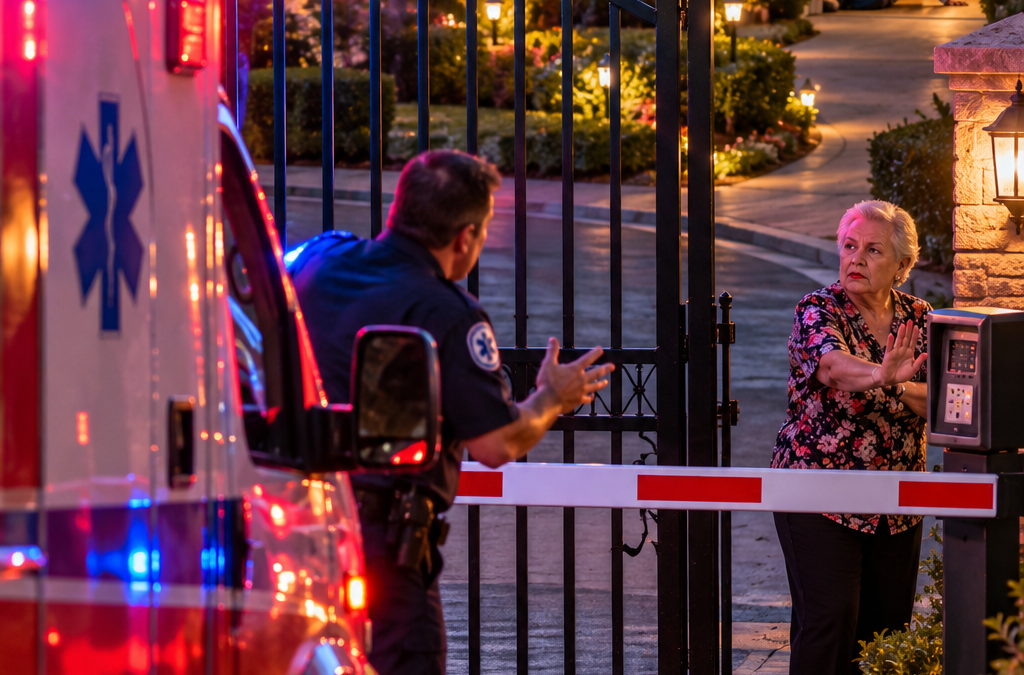
Then they encountered Diane Holloway.
Ridgerest’s gate was heavy black steel set between stone columns.
Residents used transponders or keypad codes.
Visitors used the intercom.
Emergency services should have had immediate access.
They didn’t.
The ambulance stopped at the call box.
Terrence pressed the emergency intercom.
Diane answered remotely from her house two doors away from the gate.
She had installed the gate camera feed on her phone months earlier.
“Ridgerest security.”
Terrence identified himself.
“County EMS. We have a cardiac emergency at 118 Hawthorne Lane. Open the gate.”
There was a pause.
Then Diane asked, “Do you have a visitor registration number?”
Terrence thought he had misunderstood.
“I’m sorry?”
“Your registration number.”
“Ma’am, we’re an ambulance.”
“I understand that.”
“We’re responding to a seventy-nine-year-old man with chest pain who is down inside his home.”
“The protocol requires vehicles to be verified before entry.”
Terrence looked at Melissa.
Melissa later told me she thought Diane was joking.
Terrence pressed the button again.
“Ma’am, this is an emergency vehicle.”
“I can see that.”
“Then open the gate.”
“Emergency services are still required to follow entry verification procedures.”
Terrence’s voice changed.
The recording captured it.
Not angry yet.
Controlled.
“Listen carefully. We have a suspected cardiac emergency. Every minute matters. Open the gate now.”
Diane responded, “I appreciate the urgency.”
Terrence closed his eyes.
“Then open the gate.”
“I’m not authorized to admit unverified vehicles.”
That was false.
Diane was the person who had written the policy.
She was the person with the gate control.
She had all the authority necessary to open it.
What she meant was something different.
She did not want to violate her own rule.
Terrence said, “Call whoever you need to call while you’re opening the gate.”
Diane’s answer became the sentence the whole county later heard.
“Rules exist for a reason. If I make exceptions, the whole system breaks down.”
Melissa stepped toward the intercom.
“Ma’am, there is a man dying inside.”
“And I’m sure that’s very serious.”
Melissa stared at the speaker.
Diane continued.
“But I cannot allow unverified entry.”
Inside my kitchen, Priscilla was still beside the side door.
She could hear the siren.
She could see the lights reflecting faintly through the trees.
But no ambulance came.
She called dispatch again.
“Where are they?”
“They’re at the community entrance.”
“Why aren’t they here?”
“We’re working on access.”
“What do you mean access?”
That was when Priscilla understood.
“The gate?”
The dispatcher didn’t answer directly.
Priscilla started swearing.
I had never heard her swear before.
Apparently she was very good at it.
At the gate, Terrence was considering using the ambulance to push through.
That fact came out later during the emergency services review.
He had already requested sheriff assistance.
Melissa was trying to determine whether there was another entrance.
There wasn’t.
The seconds accumulated.
Thirty.
Sixty.
Ninety.
Two minutes.
Three.
Diane remained on the intercom.
At one point Terrence said, “If this patient dies because you are blocking us, this conversation is being recorded.”
Diane replied, “Do not threaten me.”
“I’m informing you.”
“The association has legal security requirements.”
“Open the gate.”
“I need verification.”
“You have a county ambulance sitting on camera with emergency lights running.”
“That does not bypass policy.”
Four minutes.
Behind the ambulance, headlights appeared.
A resident named Paul Bennett was coming home from work.
He stopped his SUV.
Got out.
Walked toward Terrence.
“What’s happening?”
“We need the gate opened.”
Paul looked at the ambulance.
Then the gate.
“You’ve been sitting here?”
“Open it.”
Paul punched his resident code into the keypad.
Diane’s voice came through the intercom.
“Paul, do not override the visitor protocol.”
He stared at the speaker.
“What?”
“The vehicle hasn’t been verified.”
Paul looked at Terrence.
Then back at the call box.
“It’s an ambulance.”
“I know what it is.”
Paul entered the code.
The gate began to move.
Diane said his name again.
He stepped away from the keypad.
The ambulance accelerated through before the gate had completely opened.
Four minutes and thirty-two seconds had passed.
There are many measurements in law.
Money.
Distance.
Percentage.
Probability.
Damage.
Four minutes and thirty-two seconds is a small number if you’re waiting for coffee.
It is a very large number when blood is not reaching heart muscle.
Terrence and Melissa reached my house.
Priscilla directed them to the side door.
Terrence forced entry.
I remember his face above me.
“Mr. Gaines? Walter? Can you hear me?”
I tried to answer.
He placed oxygen.
Melissa attached leads.
The monitor began alarming.
Terrence asked questions.
Pain scale.
Medical history.
Medications.
I knew the answers.
I had spent my life asking other people to remain calm under pressure.
Now I could barely speak my own birth date.
They stabilized me enough to move.
As they lifted me onto the stretcher, I heard Priscilla ask, “What took you so long?”
Nobody answered immediately.
Terrence looked toward her.
“The gate.”
Priscilla stopped.
“What about the gate?”
He shook his head.
“We’ll explain later.”
I lost consciousness in the ambulance.
The next clear memory I have is hospital light.
White ceiling.
Monitor.
A nurse adjusting something near my arm.
My daughter Sarah sitting beside the bed.
She lived two states away.
Seeing her there told me more than any doctor could have.
Whatever happened had been serious enough for someone to call my children.
“You scared us,” she said.
My voice felt dry.
“Apparently.”
She started crying.
I didn’t.
Not then.
The cardiologist came later.
He explained what had happened in careful language.
Acute coronary event.
Significant blockage.
Intervention successful.
I was fortunate.
Then he said, “The delay concerns me.”
“What delay?”
Sarah looked at him.
He looked at her.
Then back at me.
“The ambulance was held at your community entrance.”
I thought I had misunderstood.
“Held?”
“For several minutes.”
“By whom?”
Sarah reached for my hand.
“The HOA president.”
I stared at her.
“Diane?”
She nodded.
“Why?”
“She wanted a visitor pass.”
I actually laughed.
Once.
It hurt my chest.
The doctor didn’t.
“I’m serious, Mr. Gaines.”
“So am I.”
He pulled a chair closer.
“In cardiac events like yours, response time matters. I can’t tell you exactly how different the outcome would have been without those minutes. Medicine doesn’t work that cleanly. But the delay was medically significant.”
“How long?”
“More than four minutes at the gate.”
I closed my eyes.
For most of my professional life, I had dealt with consequences after people made terrible decisions.
A company dumped chemicals.
An officer crossed a legal boundary.
An executive falsified records.
A government agency ignored warnings.
Every defendant eventually had an explanation.
Procedure.
Confusion.
Pressure.
Miscommunication.
Good intentions.
Nobody entered my courtroom announcing that they had behaved recklessly because they enjoyed it.
People construct reasons.
Then they hide behind them.
I knew before anyone explained the rest that Diane would have a reason.
I also knew it wouldn’t matter nearly as much as she believed.
What I didn’t know was that someone had recorded everything.
Marcus Reed was seventeen.
He lived two streets from me.
I knew his parents.
I had seen him mowing their lawn.
We had never had a real conversation.
That Tuesday, Marcus had been sitting on his front porch doing algebra homework.
The Ridgerest entrance was partly visible from his house because his street curved toward the main road.
He saw the ambulance arrive.
Saw it stop.
Saw it remain there.
At first he assumed someone was opening the gate.
Then a minute passed.
Then another.
Teenagers understand phones in a way my generation never will.
Marcus didn’t debate whether the situation was important enough to document.
He simply took out his phone and started recording.
He walked closer.
The video captured the ambulance.
The flashing red lights.
Terrence at the intercom.
Paul arriving.
Diane’s voice through the speaker.
Not every word was perfectly clear.
Enough was.
Marcus uploaded the clip that night.
His caption was brutally simple.
HOA lady blocked an ambulance at our neighborhood gate. Old man almost died.
By the time I woke properly the next morning, the video had more than two hundred thousand views.
By lunch, local reporters were calling residents.
By the following afternoon, it had passed four million.
I did not understand the scale until Sarah showed me.
My face wasn’t visible.
I wasn’t even in the video.
That made it stranger.
Millions of people were watching an ambulance trying to reach me while I lay on a kitchen floor beyond the frame.
Comments scrolled too quickly to read.
People were angry.
Former paramedics.
Nurses.
Firefighters.
Lawyers.
People who had lost parents to heart attacks.
People who hated HOAs on principle.
People who had never heard of Ridgerest Estates until that week.
Local television stations requested statements.
The county emergency services commissioner announced an internal review of access delays.
A state senator’s office contacted the HOA.
The fire marshal requested gate records.
Three attorneys with large online audiences posted videos explaining that private community rules do not give residents authority to obstruct emergency responders.
Diane’s name initially stayed out of the reports.
That lasted less than two days.
The internet is remarkably efficient at identifying people who would prefer anonymity.
Someone posted meeting minutes.
Another person found Ridgerest HOA newsletters carrying Diane’s photograph.
Then somebody found her professional biography.
That was when the story changed.
Diane Holloway was not merely an HOA president.
She was Director of Community Relations for Maplewood Regional Health System.
Maplewood was the largest hospital network in the county.
It operated clinics.
Urgent care centers.
Two hospitals.
Community health initiatives.
And, through one of its contracted divisions, the emergency ambulance service covering Ridgerest Estates.
The same system whose ambulance Diane had refused to admit.
Her biography remained publicly visible for several hours after her identity spread.
I saw a screenshot later.
Diane smiling professionally.
Dark blazer.
Hospital logo behind her.
Underneath was a quote attributed to her:
Access to care begins by removing barriers between people and the help they need.
You couldn’t invent something more damaging.
By Thursday morning, that screenshot was everywhere.
Someone placed it beside a still image of the ambulance trapped outside the gate.
No commentary was necessary.
Maplewood Regional Health System issued a short statement saying it was reviewing the incident and that the conduct shown in the video did not reflect established emergency access practices.
Diane stopped answering reporters.
The HOA emailed residents asking them not to speak publicly until the board had completed an internal review.
Almost everyone ignored that request.
I remained in the hospital.
That gave me an advantage.
Distance.
Anger is useful in limited quantities.
It can sharpen.
Too much makes people careless.
I had no interest in shouting at Diane.
I wanted the record.
So I asked Sarah to bring my laptop.
Then I started reading.
Ridgerest bylaws.
Gate policies.
Board minutes.
State statutes.
County emergency access regulations.
Fire code requirements.
The Verified Visitor Protocol Diane had drafted.
I read it the way I had once read briefs.
Slowly.
Without assumptions.
By evening, I had a legal pad full of notes.
Sarah walked in carrying coffee.
She stopped when she saw the papers.
“Dad.”
“What?”
“You had a heart attack.”
“I noticed.”
“You’re working.”
“I’m reading.”
“Same thing.”
I put down the pen.
She looked at the pages.
“What are you doing?”
“Trying to understand what authority Diane thought she had.”
“Does it matter?”
“Very much.”
“She blocked an ambulance.”
“That is the conduct. I want to know the structure around it.”
Sarah pulled a chair beside the bed.
“You’ve been retired seven years.”
“I remain literate.”
She rolled her eyes.
Exactly like her mother.
That nearly broke me.
I looked away for a moment.
Then I said, “I’m not trying to punish her, Sarah.”
“Why not?”
The question was so immediate that I laughed.
She didn’t.
“She almost got you killed.”
“Maybe.”
“The doctor said the delay mattered.”
“It did.”
“Then why are you protecting her?”
“I’m not.”
“What are you doing?”
I thought about it.
“Separating anger from responsibility.”
Sarah stared at me.
“That sounds like something you’d say from the bench.”
“It probably is.”
“You’re not the judge here.”
“No.”
I looked down at Diane’s policy.
“But someone should still read the rules before claiming they were followed.”
Three days after my heart attack, the Ridgerest board scheduled an emergency meeting.
I was still hospitalized.
My cardiologist did not consider HOA governance a medically necessary reason to discharge me early.
I disagreed.
He won.
So Priscilla went in my place.
I wrote a statement for her to read.
It was two pages.
Measured.
Specific.
No insults.
No moral language.
I cited three state provisions dealing with interference with emergency services and obstruction of first responders.
I referenced county emergency access standards.
I noted a federal accessibility issue that Priya—an attorney I had used professionally in retirement—believed could become relevant depending on how the gate protocol affected medical access.
Most importantly, I described the four minutes and thirty-two seconds.
Time is persuasive when adjectives aren’t.
The meeting room was full.
Marcus attended with his parents.
Terrence and Melissa did not; their department had asked them not to participate while the incident review remained open.
Diane sat at the head of the table.
According to Priscilla, she looked composed.
That did not surprise me.
Diane’s entire public identity depended on appearing composed while other people became emotional.
The vice president opened the meeting.
Priscilla stood when recognized.
Diane interrupted before she could begin.
“I want it noted that Mr. Gaines is not present.”
Priscilla looked at her.
“Walter had a heart attack.”
A few people murmured.
Diane said, “I’m simply noting that written statements do not allow questions.”
Priscilla answered, “If you wanted him available for questions, opening the gate faster would have helped.”
The room erupted.
The vice president called for order.
I wish I had heard that line in person.
Priscilla began reading.
She told me later that the room changed when she reached the legal citations.
People had expected anger.
Maybe accusations.
Instead, they heard statute numbers.
Definitions.
Duties.
Possible exposure.
The language Diane liked to use—policy, authorization, procedure—was suddenly being used correctly.
When Priscilla finished, the room stayed quiet.
Then Diane spoke.
“The Verified Visitor Protocol was adopted for safety.”
One board member asked, “Was it?”
Diane looked at him.
“Excuse me?”
“Was the full policy adopted by board vote?”
“It was implemented under presidential authority after security consultation.”
“That’s not what I asked.”
Diane’s mouth tightened.
Another board member opened a folder.
“I went through the minutes. I can’t find a vote approving emergency vehicles under this protocol.”
“Emergency vehicles were not singled out.”
“Exactly.”
Diane leaned back.
“The policy applied to all nonresident vehicles.”
The vice president stared at her.
“You’re saying that like it helps.”
“It shows consistency.”
Someone in the audience said, “You consistently blocked an ambulance.”
The vice president called for order again.
Diane began talking about unauthorized access.
Insurance exposure.
Residents who had complained about security breaches.
Contractors entering without registration.
Package theft.
Gate integrity.
All of it may even have been true.
None of it answered the question.
Finally, Gloria Benton—who had recently joined the board and had spent most of the meeting silent—leaned toward her microphone.
“Diane.”
Diane stopped.
Gloria was seventy-one.
Retired teacher.
Small woman.
Quiet voice.
The kind of person who made people lean closer instead of talking over her.
“Did you know the ambulance was responding to a cardiac emergency when you refused to open the gate?”
Diane looked at her.
No one moved.
Gloria repeated the question.
“Did you know?”
Diane adjusted a paper.
“I knew they stated they had an emergency call.”
“Cardiac?”
“They used that word.”
“Did you know a resident might be dying?”
Diane’s expression changed.
“I understood there was a reported medical situation.”
Gloria waited.
“That’s a yes.”
Diane didn’t answer.
Gloria leaned back.
“Thank you.”
That was the moment the meeting effectively ended.
Everything afterward was procedure.
The board entered closed discussion.
When they returned, the vice president presented a motion to remove Diane Holloway as HOA president effective immediately.
Five voted yes.
One voted no.
Diane did not vote.
The motion passed.
The Verified Visitor Protocol was suspended that same night.
Two days later, it was permanently rescinded.
The board issued a written apology to me.
A separate apology went to Terrence, Melissa, and county emergency services.
Gate access rules were rewritten on an emergency basis.
None of that gave me back four minutes and thirty-two seconds.
But it mattered.
Monday morning, while I was still recovering at home, Diane received a call from Maplewood Regional Health System.
I only know the timing because the press contacted me afterward.
She was placed on administrative leave pending investigation.
Her employer had a problem the HOA did not.
Diane’s job was literally community relations in health care.
She represented an organization that publicly promoted emergency access, health equity, and removal of barriers to care.
The video showed her doing the opposite while invoking a rule she had created.
Her title did not cause the gate incident.
But it made the contradiction impossible to contain.
Maplewood reviewed the footage.
The intercom recording.
The public statements.
Internal job expectations.
Two weeks later, they terminated her employment.
The press release was brief.
Conduct inconsistent with the organization’s mission and values.
People celebrated online.
I didn’t.
By then, I had seen enough consequences for one lifetime to know that watching another person lose everything should never become entertainment.
Diane had made a dangerous decision.
She deserved accountability.
But there is a difference between accountability and appetite.
I did not need to hate her.
I needed the gate to open the next time somebody’s life depended on it.
Eleven days after collapsing in my kitchen, I came home.
Priscilla had cleaned the house.
Of course she had.
My refrigerator was full.
Also because of Priscilla.
There were cards on the counter.
Flowers near the window.
A paper bag containing what appeared to be enough baked goods to create a second cardiac event.
I stood in the kitchen for a long time.
The chair was back where it belonged.
The tile had been cleaned.
Nothing looked different.
Everything felt different.
I placed my hand on the counter.
Closed my eyes.
For the first time, I allowed myself to remember the floor.
The pressure in my chest.
Priscilla shouting through the glass.
The siren stopping somewhere beyond the trees.
I had spent the hospital stay treating the incident like evidence.
That was familiar.
Evidence could be organized.
Time measured.
Rules read.
Liability analyzed.
Fear was less orderly.
It arrived all at once.
My knees weakened.
I sat at the kitchen table.
Then I cried.
Not loudly.
There was no dramatic breakdown.
Just an old man alone in the room where he had nearly died, finally understanding how close the distance had been between an ordinary Tuesday and never seeing his children again.
I thought of Ruth.
I wondered if she would have been frightened.
Then I knew better.
She would have been furious.
That made me laugh through the tears.
A knock came at the front door that afternoon.
Priscilla was beside me, reorganizing food I had not asked her to reorganize.
“I’ll get it.”
She opened the door.
A teenage boy stood on the porch.
Marcus.
He looked far more nervous than he had in the viral video.
“Mr. Gaines?”
I walked over.
“Yes.”
“I’m Marcus Reed.”
“I know who you are.”
His face changed.
“Oh.”
“Come in.”
He stepped inside carefully.
Priscilla disappeared into the kitchen with the discretion of someone who planned to hear every word anyway.
Marcus shoved his hands into his sweatshirt pockets.
“I’m glad you’re okay.”
“Thank you.”
“I wasn’t trying to make everything go crazy.”
“I know.”
“I just saw the ambulance sitting there.”
“You did the right thing.”
He looked down.
“My parents said I should have called someone instead of recording.”
“Did someone already call 911?”
“Yeah.”
“Did the paramedics already ask for access?”
“Yeah.”
“Then recording created a record.”
He nodded.
“I guess.”
I held out my hand.
He looked surprised.
Then he shook it.
His grip was awkward.
Seventeen years old.
Still a child in some ways.
Old enough to understand when something was wrong.
“I hear you’re the reason I’m standing here,” I said.
His eyes widened.
“No, sir. The paramedics—”
“I’m aware.”
“I just recorded it.”
“Exactly.”
He looked confused.
“I was doing homework.”
“So I’ve heard.”
“It was algebra.”
“I’m sorry.”
He laughed.
That helped.
Then I said, “Son, sometimes doing the right thing looks exactly like noticing something is wrong and refusing to look away.”
He became serious again.
“I almost deleted it.”
“Why?”
“I thought maybe people would say I was causing drama.”
“People often say that when documentation makes them uncomfortable.”
He thought about that.
“Did you really used to be a judge?”
So that part had spread too.
“Thirty-one years.”
“Federal?”
“Yes.”
His expression changed in the way young people’s expressions sometimes do when an ordinary adult suddenly becomes historical.
“Did you send people to prison?”
“Sometimes.”
“Whoa.”
I smiled.
“There was considerably more paperwork involved than television suggests.”
He looked toward the kitchen.
“Did you know she was breaking the law?”
“Diane?”
“Yeah.”
“I knew she was taking a serious risk.”
“Then why didn’t you say that before?”
“I wasn’t at the gate.”
He frowned.
“But you’re a judge.”
“Former judge.”
“Still.”
I considered the question.
“Knowing law doesn’t mean you get to invent facts after they happen.”
He nodded slowly.
“That’s why the video mattered?”
“Exactly.”
He smiled.
I liked him immediately.
The following month, Ridgerest rebuilt its emergency access system.
Not metaphorically.
Physically.
The gate received a direct emergency override compatible with county response systems.
Registered ambulances.
Fire apparatus.
Law enforcement.
Automatic opening.
No visitor code.
No intercom approval.
No HOA officer making a judgment call from a phone.
Emergency dispatch received updated gate information.
The board installed a manual emergency release accessible to authorized responders.
They also rewrote the visitor policy.
The new version was dramatically shorter.
That pleased me.
Long rules often exist because someone is trying to anticipate every form of human behavior.
Good rules identify purpose and leave enough room for judgment.
The first line under emergency access read:
Emergency response vehicles shall receive immediate and unconditional entry.
I framed a copy.
Not publicly.
It’s in my office drawer.
Diane eventually sold her house.
I saw the listing sign one morning while walking.
People told stories about why.
Financial pressure.
Embarrassment.
Anger at the neighborhood.
I never asked.
It wasn’t my business.
I did see her once before she left.
I was walking back from Priscilla’s house carrying an empty casserole dish.
Diane was standing beside her mailbox.
For a moment, I considered crossing the street.
Then she spoke.
“Walter.”
I stopped.
She looked different.
Not physically.
The posture.
Less certainty.
“How are you?”
“Recovering.”
She nodded.
“I’m glad.”
“Thank you.”
A car passed between us.
Neither of us spoke until it was gone.
Then Diane said, “I never wanted you hurt.”
I believed her.
That may surprise people.
But intent and consequence are different things.
“I know.”
Her eyes filled slightly.
“I thought I was protecting the neighborhood.”
“I know that too.”
“I didn’t understand how serious it was.”
“The paramedic told you.”
She looked away.
“I thought he was exaggerating to force the gate.”
I let the silence sit.
That answer explained more than she probably intended.
She had become so accustomed to interpreting resistance as manipulation that even an emergency professional saying a man might die sounded, to her, like an attempt to bypass her authority.
“I lost everything,” she said.
I looked at her.
“No.”
She turned back.
“You didn’t.”
“My job. The board. Friends. People won’t even speak to me.”
“Those are consequences.”
“What would you call losing everything?”
I thought about Ruth.
About waking in a hospital.
About Sarah sitting beside my bed trying not to cry.
“Not being here to complain about it.”
Diane flinched.
I hadn’t intended cruelty.
But I didn’t retract it.
She folded her arms.
Not the rigid way she used to at meetings.
More like she was cold.
“I made one mistake.”
“No.”
Her expression hardened slightly.
“There it is.”
“What?”
“The judge.”
“I’m not judging you.”
“You just said I didn’t make one mistake.”
“Because you didn’t.”
She stared.
“You wrote the policy.”
Silence.
“You defended it.”
Silence.
“You heard an ambulance crew say they were responding to a cardiac emergency.”
Her jaw tightened.
“You had more than four minutes to reconsider.”
She looked down.
“Every second was another decision.”
That hurt her.
I saw it.
It also happened to be true.
People like to describe serious failures as moments.
A bad second.
A lapse.
Sometimes that is fair.
But Diane had thirty seconds to open the gate.
Then sixty.
Then two minutes.
Terrence explained the risk.
Melissa explained it.
Dispatch pressure increased.
Paul arrived.
Every one of those moments gave Diane another opportunity to choose differently.
She didn’t.
“I don’t know what you want from me,” she said.
“Nothing.”
She looked surprised.
“I don’t want an apology.”
“I was going to—”
“I know.”
“Then what?”
“I want you to understand something.”
She waited.
“Rules are tools.”
I shifted the casserole dish under my arm.
“They are not morality.”
She looked at me.
“A rule can be written badly.”
“It was intended for safety.”
“I understand.”
“I was trying to keep strangers out.”
“I understand that too.”
“Then you understand why I followed it.”
“No.”
That stopped her.
“I understand why you wrote it. I do not understand why you followed it after the reason for breaking it became obvious.”
She said nothing.
“Authority requires judgment, Diane. If the only thing a person can do is follow a procedure regardless of consequence, that person isn’t exercising authority. They’re hiding from responsibility.”
For the first time, she looked at me without defensiveness.
I continued.
“I spent thirty-one years applying rules written by people much smarter than either of us.”
She gave a faint, humorless smile.
“That’s debatable.”
“It isn’t.”
That almost made her laugh.
Almost.
“And do you know what I learned?”
She shook her head.
“Every rule exists in a world where human beings have to interpret it.”
I looked toward the entrance gate in the distance.
“You forgot the human being.”
Diane followed my eyes.
For a while, neither of us spoke.
Then she said, “I’m sorry.”
I nodded.
“I believe you.”
That was enough.
She moved away three weeks later.
Ridgerest continued.
The lawns remained manicured.
Mailboxes still matched.
People still argued about ridiculous things.
A board meeting six months later spent forty-five minutes debating whether residents could install solar path lights without architectural approval.
I attended.
Not because I cared about the lights.
Because after what happened, I decided complete withdrawal from community life was a luxury I no longer believed in.
Reasonable people leave rooms because unreasonable discussions exhaust them.
Then they wonder why only unreasonable people remain.
Gloria became HOA president.
Her first major proposal limited the president’s unilateral authority.
I supported it.
So did almost everyone else.
The board created a written emergency exception for every access policy.
They also established an annual review with county fire and EMS officials.
Terrence attended the first one.
When he saw me afterward, he walked over.
“Mr. Gaines.”
“Terrence.”
“How’s the heart?”
“Still inconveniently active.”
He laughed.
“That’s what we like.”
I shook his hand.
“I owe you.”
“No, sir.”
“You sat at that gate for four and a half minutes and didn’t drive the ambulance through it.”
He looked uncomfortable.
“I considered it.”
“I heard.”
“I probably would have.”
“I’m glad Paul arrived.”
“Me too.”
He looked toward the clubhouse.
“People give us trouble at gates more often than you’d think.”
“Over access?”
“Codes. Guards. Private roads. Construction. People want verification.”
He paused.
“Usually they understand when we say emergency.”
“Usually.”
He nodded.
Then he said, “That night changed policies in three other communities.”
I looked at him.
“How?”
“The county sent advisories. HOAs started checking their access systems.”
That mattered to me more than Diane losing her job.
Far more.
One dangerous rule had exposed a weakness beyond Ridgerest.
Other communities fixed gates before another patient had to wait.
Maybe someone I will never meet reached a hospital faster because Marcus held up his phone.
Consequences sometimes move in directions we never see.
I think about that often now.
My heart healed as much as a seventy-nine-year-old heart heals.
I take more medication.
I walk every morning.
Priscilla has become unbearable about sodium.
She reads labels like a prosecutor.
I tell her repeatedly that after surviving federal court and Diane Holloway, I refuse to be defeated by canned soup.
She remains unconvinced.
Marcus graduated high school the following spring.
He invited me.
I sat with his parents.
When his name was called, I stood.
Probably shouldn’t have.
My cardiologist would have disapproved.
I did it anyway.
He saw me from the stage.
For a moment, he smiled like the nervous boy on my porch again.
Then he walked across, received his diploma, and moved into whatever comes next.
I gave him a book afterward.
A collection of Supreme Court opinions.
He looked at the title.
“Is this homework?”
“Possibly.”
“That’s messed up, Judge.”
“Former judge.”
“Right.”
Inside the cover, I wrote one sentence.
Pay attention when everyone else looks away.
That was the lesson.
Not cameras.
Not viral videos.
Not revenge.
Attention.
Diane’s greatest mistake was assuming everyone would accept her version because she held a title.
Marcus had no title.
No authority.
No legal training.
He was seventeen and doing algebra.
But he paid attention.
Terrence had authority.
He used it responsibly.
He explained.
He escalated.
He kept trying.
Paul had a gate code.
He used it when the system failed.
Priscilla had concern.
She showed up with a casserole at the exact moment concern mattered.
Every person in the story possessed some form of power.
Only Diane confused hers with ownership.
That’s what I think about when I walk past the gate now.
The old laminated sign is gone.
No more giant warning.
The intercom remains.
The camera remains.
The gate still closes.
Security still exists.
But tucked inside the stone column is a system that recognizes emergency vehicles automatically.
When sirens approach, the gate opens.
No argument.
No vote.
No permission.
A machine now understands something a human being once refused to understand.
That is the part that stays with me.
Not Diane losing the presidency.
Not Maplewood firing her.
Not the millions of views.
Not even the legal language I wrote from a hospital bed.
The gate.
Opening.
That’s all it ever needed to do.
Sometimes the difference between authority and abuse is not dramatic.
Sometimes it’s four minutes and thirty-two seconds.
Sometimes it’s one person believing a procedure matters more than the reason the procedure exists.
Sometimes it’s an ambulance on the wrong side of steel bars while an old man waits on a kitchen floor.
Diane thought making an exception would break the system.
She was wrong.
The system had already broken.
Opening the gate would have been the first act of common sense.
Now it opens every time.
And whenever I hear an ambulance somewhere beyond the neighborhood, I still stop what I’m doing.
I listen.
The siren grows louder.
The gate mechanism engages.
Steel slides aside.
The sound continues without interruption.
Then it fades down the street toward whoever needs help.
No visitor pass.
No argument.
No woman on an intercom deciding whether the emergency is important enough.
Just an open road.
That is how I know Ridgerest finally learned the lesson Diane never understood until it cost her almost everything.
Rules can protect people.
Authority can protect people.
Systems can protect people.
But only when the people controlling them remember who those systems were built to serve.
That night, Diane protected the rule.
Everyone else protected the man.
I am alive because, eventually, enough of them refused to let her rule win.
𝗧𝗛𝗘 𝗘𝗡𝗗
The HOA President Stood Between an Ambulance and a Dying Man, Certain Her Rules Mattered More Than the Sirens
The ambulance was already screaming at the gate when a seventy-nine-year-old man lay on his kitchen floor clutching his chest, and the woman controlling the entrance refused to open it because the paramedics did not have a visitor pass.
For four minutes and thirty-two seconds, Diane Holloway stood behind a rule she had written herself, never realizing the man on the other side of that gate understood exactly what happened when authority forgot its limits.
My name is Walter Gaines, and until that Tuesday evening in October, I had spent most of my retirement trying very hard to become ordinary.
That may sound strange.
Most people spend their working lives trying to be noticed.
They want promotions.
Recognition.
Titles.
Some proof that the years they gave away meant something.
I had spent thirty-one years in federal courtrooms where every word I spoke could affect somebody else’s future.
By the time I retired, I had heard enough arguments, watched enough men in expensive suits lie without blinking, and signed enough orders with consequences that stretched far beyond my courtroom to know exactly how exhausting authority could become.
I wanted tomatoes.
That was the truth of it.
Tomatoes.
A quiet porch.
Coffee before sunrise.
A place where the most difficult decision I made all day might be whether the peppers needed more water.
Ridgerest Estates gave me that for a while.
I had lived there nineteen years.
My wife, Ruth, and I bought the house after our children were grown and gone.
She chose the place because of the kitchen windows.
I chose it because there was room behind the house for a garden.
Neither of us cared about the clubhouse.
We rarely used the pool.
We never attended neighborhood cocktail events.
Ruth used to say the HOA existed for people who had too much free time and an emotional relationship with mailbox paint.
I would tell her that was unfair.
Then we would receive another newsletter reminding residents that holiday wreaths had to be removed by January tenth, and she would raise one eyebrow at me.
After that, I usually conceded the argument.
For most of those nineteen years, Ridgerest was tolerable.
Predictable.
Well maintained.
A little self-important, perhaps, but not malicious.
The streets were wide.
The grass stayed cut.
People waved.
Children rode bicycles until sunset.
Everyone complained about HOA dues and then admitted the landscaping around the entrance looked good.
There had been disputes, of course.
There are always disputes when a group of adults agrees to let a committee decide what color a shed should be.
But the earlier boards generally understood proportion.
That changed when Diane Holloway became president.
Diane had lived in Ridgerest about six years before she joined the board.
She was efficient.
That was the word people used in the beginning.
Organized.
Prepared.
Always early.
Always carrying a folder.
She remembered dates.
She quoted bylaws from memory.
She answered email within minutes.
Those qualities can look like competence when you first encounter them.
Sometimes they are.
Sometimes they are simply control wearing sensible shoes.
Within her first year as president, Diane issued more violation notices than the previous board had issued in three.
Garbage containers visible from the street.
Unapproved planters.
Driveway stains.
Grass edging.
Basketball hoops.
Decorative flags.
A wind chime that one neighbor was informed could be considered a nuisance if it exceeded an unspecified “reasonable auditory threshold.”
Nobody knew how that threshold would be measured.
Diane probably did.
She also replaced two board members who challenged her.
Officially, they resigned.
Unofficially, everyone knew Diane had made remaining on the board so unpleasant that resignation became the most peaceful option.
I stayed out of it.
That was partly habit.
Judges learn not to rush into disputes that do not require them.
It was also grief.
Ruth died two years before the ambulance came.
Cancer.
Eleven months from diagnosis to funeral.
There are losses that create noise.
Ours created silence.
After she died, I stopped caring about most things that once irritated me.
I didn’t care whether the HOA overreached on flowerpots.
I didn’t care about committee elections.
I didn’t care that Diane sent a six-page memo explaining the proper procedure for guest parking.
I watered my garden.
I read.
I cooked badly for one person.
Sometimes my neighbor Priscilla came over because she knew I would forget to eat something other than soup.
Priscilla was fifty-eight, widowed herself, and had the kind of personality Ruth would have called unavoidable.
She lived next door and treated my reluctance to ask for help as a personal challenge.
If she made lasagna, I received half.
If she baked bread, a loaf appeared on my porch.
If I failed to collect my mail by noon, she noticed.
I returned the favor with vegetables from the garden.
Tomatoes mostly.
Cucumbers.
Green beans.
I never knocked.
I simply left a paper bag on her porch.
She pretended not to know who had done it.
We both preferred the arrangement that way.
The trouble with Diane’s rules became harder to ignore when she introduced the Verified Visitor Protocol.
She unveiled it at an HOA meeting as if she were announcing a security initiative for an embassy.
Every nonresident vehicle entering Ridgerest had to be preregistered in the community portal.
Guests.
Contractors.
Delivery services.
Repair technicians.
Private nurses.
House cleaners.
Everyone.
Residents were expected to enter the visitor’s name, vehicle description, plate number if available, and expected arrival window at least twenty-four hours in advance.
The gate attendant, or Diane through the remote access system, could then approve entry.
At the meeting, a man named Henry Dobbs raised his hand.
“What about pizza delivery?”
Diane did not laugh.
“If residents order food, they should anticipate the arrival.”
Henry looked around.
“You want me to register a teenager from Domino’s twenty-four hours before I know I’m hungry?”
Several people laughed.
Diane waited.
Then she said, “If residents refuse to participate responsibly in community security, they shouldn’t complain when security fails.”
The room quieted.
That was Diane’s gift.
She could turn almost any disagreement into a moral deficiency.
Question the rule, and you weren’t merely questioning the rule.
You didn’t care about safety.
You didn’t care about property values.
You didn’t care about your neighbors.
Someone else asked about plumbers called for emergencies.
Diane said the protocol allowed board discretion.
Someone asked about relatives arriving unexpectedly.
Board discretion.
Someone asked about caregivers.
Board discretion.
Nobody asked about an ambulance.
I wish someone had.
The laminated rules went up at the gate the following week.
Large type.
Black border.
NO VERIFIED REGISTRATION — NO ENTRY.
Diane loved that sign.
I once saw her standing beside it talking to a landscaping contractor while pointing at the wording as if she had drafted the Constitution.
I didn’t say anything.
That was my mistake.
Not because I could have predicted what would happen.
I couldn’t.
But because I had spent thirty-one years watching bad policies become dangerous when reasonable people assumed someone else would challenge them.
I should have known better.
Tuesday, October fourteenth, began without anything unusual.
I spent the morning trimming dead tomato vines.
By noon, the weather had warmed enough that I opened the kitchen window.
Priscilla called around two.
“I’m bringing dinner.”
“I have food.”
“You have ingredients.”
“Those are generally considered food.”
“Not when you eat them standing over the sink.”
“I own plates.”
“You don’t use them.”
“I resent this level of surveillance.”
“I’ll be there around six.”
She hung up before I could object.
I remember smiling.
That was shortly before the pain started.
At first, it felt like pressure.
Not pain exactly.
A heaviness behind my breastbone.
I sat down at the kitchen table and waited.
Old men become skilled negotiators with their own bodies.
You learn which aches deserve attention and which ones are merely rent for occupying the same skeleton too long.
I thought it might be indigestion.
I drank water.
The pressure increased.
Then it moved into my left shoulder.
I knew.
Not intellectually.
Physically.
There was a moment when every legal argument I had ever made to myself disappeared.
Something was wrong.
I reached for my phone.
It was on the counter.
Eight feet away.
I stood.
The room tilted.
My right hand caught the edge of the table.
I remember the sound of the chair falling.
Then the floor.
Cold tile against my cheek.
I tried to breathe slowly.
Couldn’t.
I tried to call out.
Nothing useful came.
My chest felt as though a heavy steel band had been tightened around it.
I thought of Ruth.
That is not sentimental memory.
It was immediate.
Her face.
Her voice.
The way she used to tap twice on the kitchen window when I was working in the garden and dinner was ready.
I remember thinking, absurdly, that I had left tomatoes on the counter.
Then I heard knocking.
Priscilla.
She arrived early.
Later she told me she had decided the casserole would keep better if she brought it before six.
She knocked once.
Then again.
When I didn’t answer, she walked around to the side door.
That door had a large glass pane.
She saw me on the floor.
“Walter!”
I heard her voice as if it were coming through water.
She tried the handle.
Locked.
She called 911.
I didn’t hear all of that.
I remember fragments.
Her shouting through the glass that help was coming.
Her telling me not to move.
Her crying while trying not to sound as if she were crying.
Then silence.
Then sirens.
If you’ve never waited for an ambulance while believing you may be dying, sirens sound different.
They aren’t noise.
They are direction.
Hope has a sound, and that evening it was coming toward me.
Then it stopped.
Too far away.
I could still hear it faintly.
But it did not get closer.
I remember thinking the ambulance had gone to the wrong street.
I later learned it had reached Ridgerest’s front gate in five minutes and forty-eight seconds.
Terrence Cole was the senior paramedic.
Nine years on the job.
His partner that evening was Melissa Grant.
They had received the dispatch as a possible cardiac event involving a seventy-nine-year-old male who had collapsed inside a locked residence.
Priscilla was still on the phone with dispatch.
Terrence later told me they were prepared before the ambulance reached the gate.
Cardiac bag out.
Monitor ready.
Medication kit positioned.
Everything.
Then they encountered Diane Holloway.
Ridgerest’s gate was heavy black steel set between stone columns.
Residents used transponders or keypad codes.
Visitors used the intercom.
Emergency services should have had immediate access.
They didn’t.
The ambulance stopped at the call box.
Terrence pressed the emergency intercom.
Diane answered remotely from her house two doors away from the gate.
She had installed the gate camera feed on her phone months earlier.
“Ridgerest security.”
Terrence identified himself.
“County EMS. We have a cardiac emergency at 118 Hawthorne Lane. Open the gate.”
There was a pause.
Then Diane asked, “Do you have a visitor registration number?”
Terrence thought he had misunderstood.
“I’m sorry?”
“Your registration number.”
“Ma’am, we’re an ambulance.”
“I understand that.”
“We’re responding to a seventy-nine-year-old man with chest pain who is down inside his home.”
“The protocol requires vehicles to be verified before entry.”
Terrence looked at Melissa.
Melissa later told me she thought Diane was joking.
Terrence pressed the button again.
“Ma’am, this is an emergency vehicle.”
“I can see that.”
“Then open the gate.”
“Emergency services are still required to follow entry verification procedures.”
Terrence’s voice changed.
The recording captured it.
Not angry yet.
Controlled.
“Listen carefully. We have a suspected cardiac emergency. Every minute matters. Open the gate now.”
Diane responded, “I appreciate the urgency.”
Terrence closed his eyes.
“Then open the gate.”
“I’m not authorized to admit unverified vehicles.”
That was false.
Diane was the person who had written the policy.
She was the person with the gate control.
She had all the authority necessary to open it.
What she meant was something different.
She did not want to violate her own rule.
Terrence said, “Call whoever you need to call while you’re opening the gate.”
Diane’s answer became the sentence the whole county later heard.
“Rules exist for a reason. If I make exceptions, the whole system breaks down.”
Melissa stepped toward the intercom.
“Ma’am, there is a man dying inside.”
“And I’m sure that’s very serious.”
Melissa stared at the speaker.
Diane continued.
“But I cannot allow unverified entry.”
Inside my kitchen, Priscilla was still beside the side door.
She could hear the siren.
She could see the lights reflecting faintly through the trees.
But no ambulance came.
She called dispatch again.
“Where are they?”
“They’re at the community entrance.”
“Why aren’t they here?”
“We’re working on access.”
“What do you mean access?”
That was when Priscilla understood.
“The gate?”
The dispatcher didn’t answer directly.
Priscilla started swearing.
I had never heard her swear before.
Apparently she was very good at it.
At the gate, Terrence was considering using the ambulance to push through.
That fact came out later during the emergency services review.
He had already requested sheriff assistance.
Melissa was trying to determine whether there was another entrance.
There wasn’t.
The seconds accumulated.
Thirty.
Sixty.
Ninety.
Two minutes.
Three.
Diane remained on the intercom.
At one point Terrence said, “If this patient dies because you are blocking us, this conversation is being recorded.”
Diane replied, “Do not threaten me.”
“I’m informing you.”
“The association has legal security requirements.”
“Open the gate.”
“I need verification.”
“You have a county ambulance sitting on camera with emergency lights running.”
“That does not bypass policy.”
Four minutes.
Behind the ambulance, headlights appeared.
A resident named Paul Bennett was coming home from work.
He stopped his SUV.
Got out.
Walked toward Terrence.
“What’s happening?”
“We need the gate opened.”
Paul looked at the ambulance.
Then the gate.
“You’ve been sitting here?”
“Open it.”
Paul punched his resident code into the keypad.
Diane’s voice came through the intercom.
“Paul, do not override the visitor protocol.”
He stared at the speaker.
“What?”
“The vehicle hasn’t been verified.”
Paul looked at Terrence.
Then back at the call box.
“It’s an ambulance.”
“I know what it is.”
Paul entered the code.
The gate began to move.
Diane said his name again.
He stepped away from the keypad.
The ambulance accelerated through before the gate had completely opened.
Four minutes and thirty-two seconds had passed.
There are many measurements in law.
Money.
Distance.
Percentage.
Probability.
Damage.
Four minutes and thirty-two seconds is a small number if you’re waiting for coffee.
It is a very large number when blood is not reaching heart muscle.
Terrence and Melissa reached my house.
Priscilla directed them to the side door.
Terrence forced entry.
I remember his face above me.
“Mr. Gaines? Walter? Can you hear me?”
I tried to answer.
He placed oxygen.
Melissa attached leads.
The monitor began alarming.
Terrence asked questions.
Pain scale.
Medical history.
Medications.
I knew the answers.
I had spent my life asking other people to remain calm under pressure.
Now I could barely speak my own birth date.
They stabilized me enough to move.
As they lifted me onto the stretcher, I heard Priscilla ask, “What took you so long?”
Nobody answered immediately.
Terrence looked toward her.
“The gate.”
Priscilla stopped.
“What about the gate?”
He shook his head.
“We’ll explain later.”
I lost consciousness in the ambulance.
The next clear memory I have is hospital light.
White ceiling.
Monitor.
A nurse adjusting something near my arm.
My daughter Sarah sitting beside the bed.
She lived two states away.
Seeing her there told me more than any doctor could have.
Whatever happened had been serious enough for someone to call my children.
“You scared us,” she said.
My voice felt dry.
“Apparently.”
She started crying.
I didn’t.
Not then.
The cardiologist came later.
He explained what had happened in careful language.
Acute coronary event.
Significant blockage.
Intervention successful.
I was fortunate.
Then he said, “The delay concerns me.”
“What delay?”
Sarah looked at him.
He looked at her.
Then back at me.
“The ambulance was held at your community entrance.”
I thought I had misunderstood.
“Held?”
“For several minutes.”
“By whom?”
Sarah reached for my hand.
“The HOA president.”
I stared at her.
“Diane?”
She nodded.
“Why?”
“She wanted a visitor pass.”
I actually laughed.
Once.
It hurt my chest.
The doctor didn’t.
“I’m serious, Mr. Gaines.”
“So am I.”
He pulled a chair closer.
“In cardiac events like yours, response time matters. I can’t tell you exactly how different the outcome would have been without those minutes. Medicine doesn’t work that cleanly. But the delay was medically significant.”
“How long?”
“More than four minutes at the gate.”
I closed my eyes.
For most of my professional life, I had dealt with consequences after people made terrible decisions.
A company dumped chemicals.
An officer crossed a legal boundary.
An executive falsified records.
A government agency ignored warnings.
Every defendant eventually had an explanation.
Procedure.
Confusion.
Pressure.
Miscommunication.
Good intentions.
Nobody entered my courtroom announcing that they had behaved recklessly because they enjoyed it.
People construct reasons.
Then they hide behind them.
I knew before anyone explained the rest that Diane would have a reason.
I also knew it wouldn’t matter nearly as much as she believed.
What I didn’t know was that someone had recorded everything.
Marcus Reed was seventeen.
He lived two streets from me.
I knew his parents.
I had seen him mowing their lawn.
We had never had a real conversation.
That Tuesday, Marcus had been sitting on his front porch doing algebra homework.
The Ridgerest entrance was partly visible from his house because his street curved toward the main road.
He saw the ambulance arrive.
Saw it stop.
Saw it remain there.
At first he assumed someone was opening the gate.
Then a minute passed.
Then another.
Teenagers understand phones in a way my generation never will.
Marcus didn’t debate whether the situation was important enough to document.
He simply took out his phone and started recording.
He walked closer.
The video captured the ambulance.
The flashing red lights.
Terrence at the intercom.
Paul arriving.
Diane’s voice through the speaker.
Not every word was perfectly clear.
Enough was.
Marcus uploaded the clip that night.
His caption was brutally simple.
HOA lady blocked an ambulance at our neighborhood gate. Old man almost died.
By the time I woke properly the next morning, the video had more than two hundred thousand views.
By lunch, local reporters were calling residents.
By the following afternoon, it had passed four million.
I did not understand the scale until Sarah showed me.
My face wasn’t visible.
I wasn’t even in the video.
That made it stranger.
Millions of people were watching an ambulance trying to reach me while I lay on a kitchen floor beyond the frame.
Comments scrolled too quickly to read.
People were angry.
Former paramedics.
Nurses.
Firefighters.
Lawyers.
People who had lost parents to heart attacks.
People who hated HOAs on principle.
People who had never heard of Ridgerest Estates until that week.
Local television stations requested statements.
The county emergency services commissioner announced an internal review of access delays.
A state senator’s office contacted the HOA.
The fire marshal requested gate records.
Three attorneys with large online audiences posted videos explaining that private community rules do not give residents authority to obstruct emergency responders.
Diane’s name initially stayed out of the reports.
That lasted less than two days.
The internet is remarkably efficient at identifying people who would prefer anonymity.
Someone posted meeting minutes.
Another person found Ridgerest HOA newsletters carrying Diane’s photograph.
Then somebody found her professional biography.
That was when the story changed.
Diane Holloway was not merely an HOA president.
She was Director of Community Relations for Maplewood Regional Health System.
Maplewood was the largest hospital network in the county.
It operated clinics.
Urgent care centers.
Two hospitals.
Community health initiatives.
And, through one of its contracted divisions, the emergency ambulance service covering Ridgerest Estates.
The same system whose ambulance Diane had refused to admit.
Her biography remained publicly visible for several hours after her identity spread.
I saw a screenshot later.
Diane smiling professionally.
Dark blazer.
Hospital logo behind her.
Underneath was a quote attributed to her:
Access to care begins by removing barriers between people and the help they need.
You couldn’t invent something more damaging.
By Thursday morning, that screenshot was everywhere.
Someone placed it beside a still image of the ambulance trapped outside the gate.
No commentary was necessary.
Maplewood Regional Health System issued a short statement saying it was reviewing the incident and that the conduct shown in the video did not reflect established emergency access practices.
Diane stopped answering reporters.
The HOA emailed residents asking them not to speak publicly until the board had completed an internal review.
Almost everyone ignored that request.
I remained in the hospital.
That gave me an advantage.
Distance.
Anger is useful in limited quantities.
It can sharpen.
Too much makes people careless.
I had no interest in shouting at Diane.
I wanted the record.
So I asked Sarah to bring my laptop.
Then I started reading.
Ridgerest bylaws.
Gate policies.
Board minutes.
State statutes.
County emergency access regulations.
Fire code requirements.
The Verified Visitor Protocol Diane had drafted.
I read it the way I had once read briefs.
Slowly.
Without assumptions.
By evening, I had a legal pad full of notes.
Sarah walked in carrying coffee.
She stopped when she saw the papers.
“Dad.”
“What?”
“You had a heart attack.”
“I noticed.”
“You’re working.”
“I’m reading.”
“Same thing.”
I put down the pen.
She looked at the pages.
“What are you doing?”
“Trying to understand what authority Diane thought she had.”
“Does it matter?”
“Very much.”
“She blocked an ambulance.”
“That is the conduct. I want to know the structure around it.”
Sarah pulled a chair beside the bed.
“You’ve been retired seven years.”
“I remain literate.”
She rolled her eyes.
Exactly like her mother.
That nearly broke me.
I looked away for a moment.
Then I said, “I’m not trying to punish her, Sarah.”
“Why not?”
The question was so immediate that I laughed.
She didn’t.
“She almost got you killed.”
“Maybe.”
“The doctor said the delay mattered.”
“It did.”
“Then why are you protecting her?”
“I’m not.”
“What are you doing?”
I thought about it.
“Separating anger from responsibility.”
Sarah stared at me.
“That sounds like something you’d say from the bench.”
“It probably is.”
“You’re not the judge here.”
“No.”
I looked down at Diane’s policy.
“But someone should still read the rules before claiming they were followed.”
Three days after my heart attack, the Ridgerest board scheduled an emergency meeting.
I was still hospitalized.
My cardiologist did not consider HOA governance a medically necessary reason to discharge me early.
I disagreed.
He won.
So Priscilla went in my place.
I wrote a statement for her to read.
It was two pages.
Measured.
Specific.
No insults.
No moral language.
I cited three state provisions dealing with interference with emergency services and obstruction of first responders.
I referenced county emergency access standards.
I noted a federal accessibility issue that Priya—an attorney I had used professionally in retirement—believed could become relevant depending on how the gate protocol affected medical access.
Most importantly, I described the four minutes and thirty-two seconds.
Time is persuasive when adjectives aren’t.
The meeting room was full.
Marcus attended with his parents.
Terrence and Melissa did not; their department had asked them not to participate while the incident review remained open.
Diane sat at the head of the table.
According to Priscilla, she looked composed.
That did not surprise me.
Diane’s entire public identity depended on appearing composed while other people became emotional.
The vice president opened the meeting.
Priscilla stood when recognized.
Diane interrupted before she could begin.
“I want it noted that Mr. Gaines is not present.”
Priscilla looked at her.
“Walter had a heart attack.”
A few people murmured.
Diane said, “I’m simply noting that written statements do not allow questions.”
Priscilla answered, “If you wanted him available for questions, opening the gate faster would have helped.”
The room erupted.
The vice president called for order.
I wish I had heard that line in person.
Priscilla began reading.
She told me later that the room changed when she reached the legal citations.
People had expected anger.
Maybe accusations.
Instead, they heard statute numbers.
Definitions.
Duties.
Possible exposure.
The language Diane liked to use—policy, authorization, procedure—was suddenly being used correctly.
When Priscilla finished, the room stayed quiet.
Then Diane spoke.
“The Verified Visitor Protocol was adopted for safety.”
One board member asked, “Was it?”
Diane looked at him.
“Excuse me?”
“Was the full policy adopted by board vote?”
“It was implemented under presidential authority after security consultation.”
“That’s not what I asked.”
Diane’s mouth tightened.
Another board member opened a folder.
“I went through the minutes. I can’t find a vote approving emergency vehicles under this protocol.”
“Emergency vehicles were not singled out.”
“Exactly.”
Diane leaned back.
“The policy applied to all nonresident vehicles.”
The vice president stared at her.
“You’re saying that like it helps.”
“It shows consistency.”
Someone in the audience said, “You consistently blocked an ambulance.”
The vice president called for order again.
Diane began talking about unauthorized access.
Insurance exposure.
Residents who had complained about security breaches.
Contractors entering without registration.
Package theft.
Gate integrity.
All of it may even have been true.
None of it answered the question.
Finally, Gloria Benton—who had recently joined the board and had spent most of the meeting silent—leaned toward her microphone.
“Diane.”
Diane stopped.
Gloria was seventy-one.
Retired teacher.
Small woman.
Quiet voice.
The kind of person who made people lean closer instead of talking over her.
“Did you know the ambulance was responding to a cardiac emergency when you refused to open the gate?”
Diane looked at her.
No one moved.
Gloria repeated the question.
“Did you know?”
Diane adjusted a paper.
“I knew they stated they had an emergency call.”
“Cardiac?”
“They used that word.”
“Did you know a resident might be dying?”
Diane’s expression changed.
“I understood there was a reported medical situation.”
Gloria waited.
“That’s a yes.”
Diane didn’t answer.
Gloria leaned back.
“Thank you.”
That was the moment the meeting effectively ended.
Everything afterward was procedure.
The board entered closed discussion.
When they returned, the vice president presented a motion to remove Diane Holloway as HOA president effective immediately.
Five voted yes.
One voted no.
Diane did not vote.
The motion passed.
The Verified Visitor Protocol was suspended that same night.
Two days later, it was permanently rescinded.
The board issued a written apology to me.
A separate apology went to Terrence, Melissa, and county emergency services.
Gate access rules were rewritten on an emergency basis.
None of that gave me back four minutes and thirty-two seconds.
But it mattered.
Monday morning, while I was still recovering at home, Diane received a call from Maplewood Regional Health System.
I only know the timing because the press contacted me afterward.
She was placed on administrative leave pending investigation.
Her employer had a problem the HOA did not.
Diane’s job was literally community relations in health care.
She represented an organization that publicly promoted emergency access, health equity, and removal of barriers to care.
The video showed her doing the opposite while invoking a rule she had created.
Her title did not cause the gate incident.
But it made the contradiction impossible to contain.
Maplewood reviewed the footage.
The intercom recording.
The public statements.
Internal job expectations.
Two weeks later, they terminated her employment.
The press release was brief.
Conduct inconsistent with the organization’s mission and values.
People celebrated online.
I didn’t.
By then, I had seen enough consequences for one lifetime to know that watching another person lose everything should never become entertainment.
Diane had made a dangerous decision.
She deserved accountability.
But there is a difference between accountability and appetite.
I did not need to hate her.
I needed the gate to open the next time somebody’s life depended on it.
Eleven days after collapsing in my kitchen, I came home.
Priscilla had cleaned the house.
Of course she had.
My refrigerator was full.
Also because of Priscilla.
There were cards on the counter.
Flowers near the window.
A paper bag containing what appeared to be enough baked goods to create a second cardiac event.
I stood in the kitchen for a long time.
The chair was back where it belonged.
The tile had been cleaned.
Nothing looked different.
Everything felt different.
I placed my hand on the counter.
Closed my eyes.
For the first time, I allowed myself to remember the floor.
The pressure in my chest.
Priscilla shouting through the glass.
The siren stopping somewhere beyond the trees.
I had spent the hospital stay treating the incident like evidence.
That was familiar.
Evidence could be organized.
Time measured.
Rules read.
Liability analyzed.
Fear was less orderly.
It arrived all at once.
My knees weakened.
I sat at the kitchen table.
Then I cried.
Not loudly.
There was no dramatic breakdown.
Just an old man alone in the room where he had nearly died, finally understanding how close the distance had been between an ordinary Tuesday and never seeing his children again.
I thought of Ruth.
I wondered if she would have been frightened.
Then I knew better.
She would have been furious.
That made me laugh through the tears.
A knock came at the front door that afternoon.
Priscilla was beside me, reorganizing food I had not asked her to reorganize.
“I’ll get it.”
She opened the door.
A teenage boy stood on the porch.
Marcus.
He looked far more nervous than he had in the viral video.
“Mr. Gaines?”
I walked over.
“Yes.”
“I’m Marcus Reed.”
“I know who you are.”
His face changed.
“Oh.”
“Come in.”
He stepped inside carefully.
Priscilla disappeared into the kitchen with the discretion of someone who planned to hear every word anyway.
Marcus shoved his hands into his sweatshirt pockets.
“I’m glad you’re okay.”
“Thank you.”
“I wasn’t trying to make everything go crazy.”
“I know.”
“I just saw the ambulance sitting there.”
“You did the right thing.”
He looked down.
“My parents said I should have called someone instead of recording.”
“Did someone already call 911?”
“Yeah.”
“Did the paramedics already ask for access?”
“Yeah.”
“Then recording created a record.”
He nodded.
“I guess.”
I held out my hand.
He looked surprised.
Then he shook it.
His grip was awkward.
Seventeen years old.
Still a child in some ways.
Old enough to understand when something was wrong.
“I hear you’re the reason I’m standing here,” I said.
His eyes widened.
“No, sir. The paramedics—”
“I’m aware.”
“I just recorded it.”
“Exactly.”
He looked confused.
“I was doing homework.”
“So I’ve heard.”
“It was algebra.”
“I’m sorry.”
He laughed.
That helped.
Then I said, “Son, sometimes doing the right thing looks exactly like noticing something is wrong and refusing to look away.”
He became serious again.
“I almost deleted it.”
“Why?”
“I thought maybe people would say I was causing drama.”
“People often say that when documentation makes them uncomfortable.”
He thought about that.
“Did you really used to be a judge?”
So that part had spread too.
“Thirty-one years.”
“Federal?”
“Yes.”
His expression changed in the way young people’s expressions sometimes do when an ordinary adult suddenly becomes historical.
“Did you send people to prison?”
“Sometimes.”
“Whoa.”
I smiled.
“There was considerably more paperwork involved than television suggests.”
He looked toward the kitchen.
“Did you know she was breaking the law?”
“Diane?”
“Yeah.”
“I knew she was taking a serious risk.”
“Then why didn’t you say that before?”
“I wasn’t at the gate.”
He frowned.
“But you’re a judge.”
“Former judge.”
“Still.”
I considered the question.
“Knowing law doesn’t mean you get to invent facts after they happen.”
He nodded slowly.
“That’s why the video mattered?”
“Exactly.”
He smiled.
I liked him immediately.
The following month, Ridgerest rebuilt its emergency access system.
Not metaphorically.
Physically.
The gate received a direct emergency override compatible with county response systems.
Registered ambulances.
Fire apparatus.
Law enforcement.
Automatic opening.
No visitor code.
No intercom approval.
No HOA officer making a judgment call from a phone.
Emergency dispatch received updated gate information.
The board installed a manual emergency release accessible to authorized responders.
They also rewrote the visitor policy.
The new version was dramatically shorter.
That pleased me.
Long rules often exist because someone is trying to anticipate every form of human behavior.
Good rules identify purpose and leave enough room for judgment.
The first line under emergency access read:
Emergency response vehicles shall receive immediate and unconditional entry.
I framed a copy.
Not publicly.
It’s in my office drawer.
Diane eventually sold her house.
I saw the listing sign one morning while walking.
People told stories about why.
Financial pressure.
Embarrassment.
Anger at the neighborhood.
I never asked.
It wasn’t my business.
I did see her once before she left.
I was walking back from Priscilla’s house carrying an empty casserole dish.
Diane was standing beside her mailbox.
For a moment, I considered crossing the street.
Then she spoke.
“Walter.”
I stopped.
She looked different.
Not physically.
The posture.
Less certainty.
“How are you?”
“Recovering.”
She nodded.
“I’m glad.”
“Thank you.”
A car passed between us.
Neither of us spoke until it was gone.
Then Diane said, “I never wanted you hurt.”
I believed her.
That may surprise people.
But intent and consequence are different things.
“I know.”
Her eyes filled slightly.
“I thought I was protecting the neighborhood.”
“I know that too.”
“I didn’t understand how serious it was.”
“The paramedic told you.”
She looked away.
“I thought he was exaggerating to force the gate.”
I let the silence sit.
That answer explained more than she probably intended.
She had become so accustomed to interpreting resistance as manipulation that even an emergency professional saying a man might die sounded, to her, like an attempt to bypass her authority.
“I lost everything,” she said.
I looked at her.
“No.”
She turned back.
“You didn’t.”
“My job. The board. Friends. People won’t even speak to me.”
“Those are consequences.”
“What would you call losing everything?”
I thought about Ruth.
About waking in a hospital.
About Sarah sitting beside my bed trying not to cry.
“Not being here to complain about it.”
Diane flinched.
I hadn’t intended cruelty.
But I didn’t retract it.
She folded her arms.
Not the rigid way she used to at meetings.
More like she was cold.
“I made one mistake.”
“No.”
Her expression hardened slightly.
“There it is.”
“What?”
“The judge.”
“I’m not judging you.”
“You just said I didn’t make one mistake.”
“Because you didn’t.”
She stared.
“You wrote the policy.”
Silence.
“You defended it.”
Silence.
“You heard an ambulance crew say they were responding to a cardiac emergency.”
Her jaw tightened.
“You had more than four minutes to reconsider.”
She looked down.
“Every second was another decision.”
That hurt her.
I saw it.
It also happened to be true.
People like to describe serious failures as moments.
A bad second.
A lapse.
Sometimes that is fair.
But Diane had thirty seconds to open the gate.
Then sixty.
Then two minutes.
Terrence explained the risk.
Melissa explained it.
Dispatch pressure increased.
Paul arrived.
Every one of those moments gave Diane another opportunity to choose differently.
She didn’t.
“I don’t know what you want from me,” she said.
“Nothing.”
She looked surprised.
“I don’t want an apology.”
“I was going to—”
“I know.”
“Then what?”
“I want you to understand something.”
She waited.
“Rules are tools.”
I shifted the casserole dish under my arm.
“They are not morality.”
She looked at me.
“A rule can be written badly.”
“It was intended for safety.”
“I understand.”
“I was trying to keep strangers out.”
“I understand that too.”
“Then you understand why I followed it.”
“No.”
That stopped her.
“I understand why you wrote it. I do not understand why you followed it after the reason for breaking it became obvious.”
She said nothing.
“Authority requires judgment, Diane. If the only thing a person can do is follow a procedure regardless of consequence, that person isn’t exercising authority. They’re hiding from responsibility.”
For the first time, she looked at me without defensiveness.
I continued.
“I spent thirty-one years applying rules written by people much smarter than either of us.”
She gave a faint, humorless smile.
“That’s debatable.”
“It isn’t.”
That almost made her laugh.
Almost.
“And do you know what I learned?”
She shook her head.
“Every rule exists in a world where human beings have to interpret it.”
I looked toward the entrance gate in the distance.
“You forgot the human being.”
Diane followed my eyes.
For a while, neither of us spoke.
Then she said, “I’m sorry.”
I nodded.
“I believe you.”
That was enough.
She moved away three weeks later.
Ridgerest continued.
The lawns remained manicured.
Mailboxes still matched.
People still argued about ridiculous things.
A board meeting six months later spent forty-five minutes debating whether residents could install solar path lights without architectural approval.
I attended.
Not because I cared about the lights.
Because after what happened, I decided complete withdrawal from community life was a luxury I no longer believed in.
Reasonable people leave rooms because unreasonable discussions exhaust them.
Then they wonder why only unreasonable people remain.
Gloria became HOA president.
Her first major proposal limited the president’s unilateral authority.
I supported it.
So did almost everyone else.
The board created a written emergency exception for every access policy.
They also established an annual review with county fire and EMS officials.
Terrence attended the first one.
When he saw me afterward, he walked over.
“Mr. Gaines.”
“Terrence.”
“How’s the heart?”
“Still inconveniently active.”
He laughed.
“That’s what we like.”
I shook his hand.
“I owe you.”
“No, sir.”
“You sat at that gate for four and a half minutes and didn’t drive the ambulance through it.”
He looked uncomfortable.
“I considered it.”
“I heard.”
“I probably would have.”
“I’m glad Paul arrived.”
“Me too.”
He looked toward the clubhouse.
“People give us trouble at gates more often than you’d think.”
“Over access?”
“Codes. Guards. Private roads. Construction. People want verification.”
He paused.
“Usually they understand when we say emergency.”
“Usually.”
He nodded.
Then he said, “That night changed policies in three other communities.”
I looked at him.
“How?”
“The county sent advisories. HOAs started checking their access systems.”
That mattered to me more than Diane losing her job.
Far more.
One dangerous rule had exposed a weakness beyond Ridgerest.
Other communities fixed gates before another patient had to wait.
Maybe someone I will never meet reached a hospital faster because Marcus held up his phone.
Consequences sometimes move in directions we never see.
I think about that often now.
My heart healed as much as a seventy-nine-year-old heart heals.
I take more medication.
I walk every morning.
Priscilla has become unbearable about sodium.
She reads labels like a prosecutor.
I tell her repeatedly that after surviving federal court and Diane Holloway, I refuse to be defeated by canned soup.
She remains unconvinced.
Marcus graduated high school the following spring.
He invited me.
I sat with his parents.
When his name was called, I stood.
Probably shouldn’t have.
My cardiologist would have disapproved.
I did it anyway.
He saw me from the stage.
For a moment, he smiled like the nervous boy on my porch again.
Then he walked across, received his diploma, and moved into whatever comes next.
I gave him a book afterward.
A collection of Supreme Court opinions.
He looked at the title.
“Is this homework?”
“Possibly.”
“That’s messed up, Judge.”
“Former judge.”
“Right.”
Inside the cover, I wrote one sentence.
Pay attention when everyone else looks away.
That was the lesson.
Not cameras.
Not viral videos.
Not revenge.
Attention.
Diane’s greatest mistake was assuming everyone would accept her version because she held a title.
Marcus had no title.
No authority.
No legal training.
He was seventeen and doing algebra.
But he paid attention.
Terrence had authority.
He used it responsibly.
He explained.
He escalated.
He kept trying.
Paul had a gate code.
He used it when the system failed.
Priscilla had concern.
She showed up with a casserole at the exact moment concern mattered.
Every person in the story possessed some form of power.
Only Diane confused hers with ownership.
That’s what I think about when I walk past the gate now.
The old laminated sign is gone.
No more giant warning.
The intercom remains.
The camera remains.
The gate still closes.
Security still exists.
But tucked inside the stone column is a system that recognizes emergency vehicles automatically.
When sirens approach, the gate opens.
No argument.
No vote.
No permission.
A machine now understands something a human being once refused to understand.
That is the part that stays with me.
Not Diane losing the presidency.
Not Maplewood firing her.
Not the millions of views.
Not even the legal language I wrote from a hospital bed.
The gate.
Opening.
That’s all it ever needed to do.
Sometimes the difference between authority and abuse is not dramatic.
Sometimes it’s four minutes and thirty-two seconds.
Sometimes it’s one person believing a procedure matters more than the reason the procedure exists.
Sometimes it’s an ambulance on the wrong side of steel bars while an old man waits on a kitchen floor.
Diane thought making an exception would break the system.
She was wrong.
The system had already broken.
Opening the gate would have been the first act of common sense.
Now it opens every time.
And whenever I hear an ambulance somewhere beyond the neighborhood, I still stop what I’m doing.
I listen.
The siren grows louder.
The gate mechanism engages.
Steel slides aside.
The sound continues without interruption.
Then it fades down the street toward whoever needs help.
No visitor pass.
No argument.
No woman on an intercom deciding whether the emergency is important enough.
Just an open road.
That is how I know Ridgerest finally learned the lesson Diane never understood until it cost her almost everything.
Rules can protect people.
Authority can protect people.
Systems can protect people.
But only when the people controlling them remember who those systems were built to serve.
That night, Diane protected the rule.
Everyone else protected the man.
I am alive because, eventually, enough of them refused to let her rule win.








