𝗙𝗨𝗟𝗟 𝗦𝗧𝗢𝗥𝗬 The HOA President Stole Half My Firewood During a Deadly Snowstorm—Then Came Back With a Truck to Take the Rest
𝗙𝗨𝗟𝗟 𝗦𝗧𝗢𝗥𝗬
I’d managed to avoid most of her attention because my cabin sat near the outer edge of the development.
My nearest neighbor was several hundred yards away, and the woods concealed most of my property from the road.
Still, Linda had complained about my firewood before.
The first time happened during a neighborhood inspection the previous spring.
She stopped near my driveway and stared at the shelter.
“That structure isn’t very attractive,” she said.
“It’s a woodshed.”
“I’m aware of what it is.”
“Then what’s the problem?”
“The appearance.”
I looked at the roof, the treated wooden posts, and the orderly stacks beneath it.
“Looks like a woodshed to me.”
Linda folded her arms.
“We’re trying to establish a higher standard of visual consistency throughout Pine Hollow.”
“Then maybe you should start with the potholes on the main road.”
She didn’t appreciate that.
Her smile tightened.
“You have a very dismissive attitude toward community improvement.”
“And you have a very strong opinion about a shed you can barely see.”
She left with a warning that the board might review outdoor storage requirements.
Nothing came of it.
There wasn’t a rule prohibiting firewood shelters, and mine complied with the requirements that actually existed.
But Linda never forgot being contradicted.
Over the following months, she’d occasionally mention my woodpile at meetings.
Too large.
Too visible.
Possibly attracting pests.
Possibly affecting neighboring property values.
She even suggested that privately stored firewood should be included in the HOA’s seasonal property inventory.
That proposal went nowhere.
Homeowners living in mountain cabins weren’t eager to have their emergency heating supplies monitored by a woman who seemed more concerned about decorative wreaths than winter safety.
But Linda kept watching my property.
I didn’t understand how closely until the snowstorm arrived.
The storm began on a Thursday afternoon.
At first, it was beautiful.
Large white flakes drifted past the cabin windows while gray clouds moved across the mountain ridge.
By evening, the snowfall had intensified.
The wind shook the pines.
Snow accumulated on the porch railing.
My driveway disappeared beneath a thick white blanket.
I fed several logs into the stove, made dinner, and checked the weather.
The forecast had worsened.
The county was warning residents about hazardous roads, drifting snow, and the possibility of power interruptions.
I brought extra firewood inside, filled several containers with water, and checked my emergency supplies.
Before going to bed, I looked out the kitchen window toward the woodshed.
The roof was covered with snow.
Beneath it, the stacks of firewood were exactly where I’d left them.
I remember feeling satisfied.
Not because I expected trouble.
Because I’d prepared properly.
That night, the storm became violent.
Wind hammered the cabin walls.
Branches scraped against the roof.
At one point, the electricity flickered three times before stabilizing.
I woke around two in the morning and added wood to the stove.
The fire caught quickly.
Warmth spread through the living room.
Outside, the world was buried beneath darkness and snow.
Inside, I felt safe.
That’s what the firewood represented.
Security.
Independence.
The peace of knowing that even if the road closed or the electricity failed, I could keep my home warm.
By morning, the storm had transformed Pine Hollow.
The snow was so deep that the lower sections of my porch railing had disappeared.
Pine branches sagged under the weight.
The mountains beyond the cabin looked like something from a Christmas postcard.
I put on insulated boots, heavy gloves, and my thickest jacket.
Then I stepped outside with a shovel.
The air bit at my face.
Every breath formed a white cloud.
I cleared a narrow path from the porch to the woodshed.
The shelter had held up well.
Snow covered the roof, but the wood beneath it remained dry.
I checked the stacks.
Everything looked fine.
I brought several armloads into the cabin and spent most of the day clearing access around the property.
The roads remained difficult.
County crews were working their way through the higher elevations.
A few neighbors exchanged messages about fallen branches and blocked driveways.
Linda sent out an HOA announcement congratulating the board for its emergency preparedness.
I read it while sitting beside my stove.
There was something almost comical about it.
As far as I knew, the board hadn’t cleared a single road or delivered a single emergency supply.
But Linda had managed to write three paragraphs praising her own leadership.
I deleted the message and went back to my book.
The next morning, I discovered the theft.
I was carrying an empty firewood basket toward the shelter when I noticed the first gap.
At a distance, something looked wrong.
I stopped.
Then walked closer.
A large section of the front stack was missing.
Not a few logs.
Not an armload.
Several full rows had vanished.
I stared at the empty space.
For a moment, I wondered whether I’d misjudged how much wood I’d already burned.
But that made no sense.
I had carried in only a small supply the previous day.
I stepped beneath the shelter.
The remaining stacks had been disturbed.
Loose bark covered the ground.
A few pieces of wood lay scattered in the snow.
Then I noticed the tire tracks.
They crossed the fresh snow beside the shelter, leading from the driveway to a stopping point near the woodpile.
Large tires.
The kind used on a pickup truck.
There were boot prints too.
Several sets.
I followed them toward the driveway.
The tracks continued down the access road.
Someone had driven onto my property after the storm.
Someone had loaded a substantial amount of firewood.
And someone had left without asking permission.
My first reaction was disbelief.
Who steals firewood from a private cabin during a dangerous winter storm?
My second reaction was anger.
I spent nearly twenty minutes walking around the shelter, trying to determine what had been taken.
The missing section was too large to explain as a simple mistake.
This wasn’t a neighbor grabbing a few logs because they’d run out during an emergency.
This was organized.
Someone had brought a vehicle and enough manpower to remove a significant amount of wood.
Then I remembered the cameras.
I’d installed a small security system two years earlier after several cabins in the area experienced break-ins.
One camera watched the driveway.
Another covered the side of the cabin.
A third had a clear view of the woodshed.
I hurried inside and opened the recording system.
My hands were still cold as I scrolled through the previous night’s footage.
Most of the video showed blowing snow and an empty driveway.
Then, shortly after midnight, headlights appeared.
A dark HOA maintenance pickup moved slowly into view.
I leaned closer.
The truck stopped beside the woodshed.
Two men climbed out.
Both wore heavy winter jackets and gloves.
One opened the tailgate.
The other walked directly toward my firewood.
I watched them begin loading logs.
They worked steadily, carrying armloads from the shelter and stacking them in the truck bed.
There was no hesitation.
No knocking on my door.
No attempt to contact me.
No indication they were checking whether anyone was home.
They simply took the wood.
Several times, one of the men looked toward the cabin.
Then he kept loading.
After a substantial amount had been taken, they closed the tailgate and drove away.
The HOA emblem was visible on the truck door.
I sat perfectly still.
Then I replayed the footage.
I wanted to be certain.
I was.
The vehicle belonged to the association.
The men were acting like workers following instructions.
And I had a very strong suspicion about who had given those instructions.
I saved the recording immediately.
Then I backed it up.
If Linda had anything to do with this, I wasn’t going to rely on her version of events.
For the next hour, I counted what remained.
The more carefully I checked, the angrier I became.
Almost half my winter supply was gone.
Half.
Months of work.
Hours spent cutting, splitting, carrying, stacking, and protecting those logs.
Gone in one night.
I calculated how much wood I could reasonably expect to use during the remaining cold season.
The numbers weren’t encouraging.
If the temperatures stayed below freezing and another major storm arrived, I’d have to conserve carefully.
Replacing seasoned wood wouldn’t be easy.
Most local suppliers had already sold their best stock.
Some roads were still dangerous.
And even if I could locate a reliable seller, the replacement cost would be substantial.
I wasn’t worried about a few dollars.
I was worried about the principle.
Someone had decided that my emergency heating supply belonged to them.
And they had taken it while I slept.
Around noon, I called the HOA office.
Nobody answered.
I left a message asking for an immediate explanation.
An hour later, I sent an email attaching a still image of the truck.
I requested the return of my firewood and the identification of whoever authorized its removal.
No response.
Then, shortly after three, Linda arrived.
I heard tires crunching over the packed snow.
When I stepped outside, her white luxury SUV was parked near the cabin.
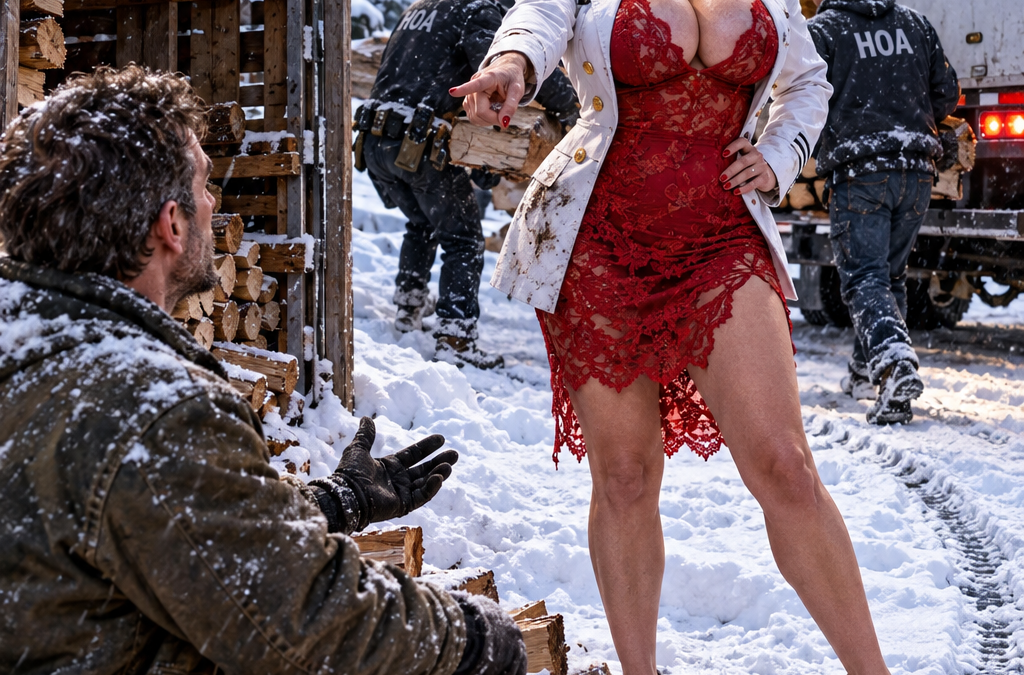
She emerged wearing her familiar low-cut red lace dress beneath an expensive winter coat, her blonde hair spilling over the collar.
Her boots had high heels that made very little sense on an icy driveway.
But Linda had never been particularly interested in practicality.
She was interested in making an entrance.
“Ethan,” she called brightly. “I understand you have some concerns.”
I looked at her.
“Some concerns?”
She smiled.
“About the emergency firewood distribution.”
I felt my jaw tighten.
“Is that what you’re calling it?”
“That’s what it was.”
“You mean the firewood taken from my property after midnight?”
Linda waved one manicured hand.
“Don’t be so dramatic.”
“Almost half my supply is gone.”
“The community is experiencing an emergency.”
“So am I.”
She looked toward my cabin.
“You have heat.”
“Because I spent months preparing.”
“And now your preparation is helping the neighborhood.”
I stared at her.
“Where is my wood?”
“At the community center.”
“Why?”
“The association has established an emergency warming location. The center needs firewood for its outdoor gathering area.”
I blinked.
“You took my dry firewood to burn outside?”
She folded her arms.
“Residents need a place to gather during power interruptions. The fire pit is an important amenity.”
“My cabin depends on that wood for heat.”
“You still have plenty.”
“That’s not your decision to make.”
Her smile vanished.
“Ethan, every time the HOA asks you to cooperate, you become hostile.”
“I’m asking why you stole my property.”
Her eyes narrowed.
“Be careful with that word.”
“What word?”
“Stole.”
I stepped closer.
“Then tell me which word you’d prefer for taking something that doesn’t belong to you without permission.”
She lifted her chin.
“Reallocation.”
For a moment, I thought she was joking.
She wasn’t.
“Reallocation?”
“Yes. The board determined that excess private firewood could be made available for emergency community use.”
I shook my head slowly.
“You can’t reallocate what you don’t own.”
“We have emergency responsibilities.”
“Then buy firewood.”
“That would be an unnecessary expense when suitable resources already exist within the community.”
I stared at her.
“So you decided to save HOA money by taking mine.”
Linda’s expression turned icy.
“That’s a very selfish way to describe neighbors helping neighbors.”
“Neighbors ask.”
“The board doesn’t need permission for every operational decision.”
“Which rule says that?”
She looked away briefly.
I noticed.
“Show me the rule, Linda.”
“The emergency plan covers community resources.”
“Then show me the emergency plan.”
“I don’t have it with me.”
“Send it to me.”
“The board has already approved the action.”
“That wasn’t my question.”
She turned back toward me.
“You’re being intentionally difficult.”
“No. I’m being very clear.”
I pointed toward the woodshed.
“Those logs are mine. I cut them. I split them. I seasoned them. I stacked them. Your workers came onto my property in the middle of the night and took them. Now I want them returned.”
Linda’s face reddened.
“You don’t get to issue orders to me.”
“And you don’t get to steal from me.”
She stepped closer.
“Do you understand that I can have your property inspected for violations?”
I stared at her.
“Are you threatening me?”
“I’m reminding you that community membership comes with responsibilities.”
“Responsibilities don’t include surrendering my heating supply.”
She gave a short, humorless laugh.
“You mountain men are all the same. You think because you know how to swing an ax, you’re above the rules.”
I felt my anger rise.
But I held it.
“Linda, show me one recorded HOA rule that authorizes taking a homeowner’s firewood.”
Her eyes flashed.
“The board made the decision.”
“Which rule?”
“I’ve answered you.”
“No, you’ve avoided answering.”
She leaned toward me.
“Listen carefully, Ethan. You are not going to embarrass me in front of this community over a pile of logs.”
I looked directly into her eyes.
“Then stop taking them.”
For a second, I thought she might slap me.
Her face twisted with fury.
Instead, she stepped back and adjusted her coat.
“I’ll have the compliance committee review your property.”
I almost laughed.
“For what?”
“Outdoor storage. Unapproved structures. Possible safety violations.”
“My woodshed complies with the rules.”
“We’ll see.”
Then she pointed toward the remaining firewood.
“And if the community center needs additional fuel, the board will address that too.”
A chill went through me that had nothing to do with the weather.
“Are you saying you’re going to take more?”
She smiled again.
“I said the board will handle it.”
Then she climbed into her SUV and drove away.
I stood in the driveway until her taillights disappeared around the bend.
My hands were shaking.
Not from the cold.
From the realization that she had no intention of stopping.
That evening, I spread the HOA documents across my kitchen table.
The governing declaration.
The bylaws.
The architectural standards.
The community rules.
The emergency procedures I’d been able to obtain.
I read through them while the wood stove burned beside me.
Some sections were irritatingly detailed.
Parking restrictions.
Exterior lighting.
Fence materials.
Shed placement.
Seasonal decorations.
Trash containers.
Landscaping maintenance.
There were pages of rules concerning how homeowners should maintain their property.
But nowhere did I find a provision authorizing the board to enter a homeowner’s land and seize privately owned firewood.
Not during ordinary conditions.
Not during snowstorms.
Not during community emergencies.
Nothing.
The HOA had responsibilities for shared facilities and common property.
That didn’t magically convert my woodshed into a public supply depot.
I printed the relevant pages.
Then I printed still images from the security footage.
The truck.
The workers.
The missing wood.
I placed everything in a folder.
I considered calling the sheriff’s office immediately.
I probably should have.
But I also knew Linda would try to turn the situation into another public performance.
She’d claim a misunderstanding.
She’d accuse me of refusing to help my neighbors.
She’d insist the workers were following an emergency directive.
Then she’d send three more threatening letters and declare victory.
I wanted my property protected.
And I wanted her to stop.
For good.
The next morning brought another problem.
The temperature inside my cabin had dropped more than usual overnight.
The stove was working, but the weather was becoming colder.
The forecast predicted another wave of heavy snow within several days.
I stood beside the remaining firewood and did the math again.
If Linda took another substantial load, I’d be facing a serious problem.
My cabin was not a place where I could simply turn up an electric thermostat and forget about the weather.
The wood stove was the primary heating system.
Without enough fuel, I’d have to arrange emergency deliveries or find somewhere else to stay during severe cold.
I had enough money to buy replacement firewood.
That wasn’t the issue.
The issue was finding properly seasoned wood when everyone in the region was already preparing for another storm.
And every supplier I called seemed to be dealing with the same thing.
High demand.
Limited inventory.
Difficult deliveries.
One supplier told me he could provide green wood immediately.
That was practically useless for my situation.
Another said he might have seasoned hardwood available in two weeks.
Two weeks.
In the middle of winter.
I thanked him and ended the call.
Then I sat on the porch steps and looked at my woodshed.
Linda had managed to do something I hadn’t experienced in years.
She’d made me feel uncertain about whether I could keep my own home warm.
I hated that feeling.
Not because I was too proud to ask for help.
Because the danger was completely unnecessary.
The wood had been there.
I had prepared it.
The problem existed only because someone in a position of authority had decided that my property was hers to distribute.
My phone buzzed.
It was an HOA email.
I opened it.
The subject line read:
NOTICE OF COMMUNITY COOPERATION REVIEW.
I read the message twice.
Linda claimed I had behaved aggressively toward an association officer during emergency operations.
She stated that my refusal to cooperate could result in additional inspections and possible enforcement action.
The email ended with a warning about potential fines for obstructing community welfare activities.
I looked up from my phone.
Beyond the porch, snow glittered beneath a pale winter sun.
My firewood was gone.
My home was becoming harder to heat.
And the woman who had ordered the theft was threatening to fine me for objecting.
Something inside me changed.
Until that moment, I’d been thinking about how to make Linda return what she’d taken.
Now I understood that returning the wood wouldn’t solve the problem.
If I won one argument, she’d invent another.
If I proved one rule didn’t exist, she’d cite a different imaginary authority.
If I secured the shed, she’d accuse me of obstructing community access.
Linda wasn’t interested in rules.
She was interested in obedience.
And I was tired of being her target.
I walked back into the cabin, sat beside the stove, and stared at the fire.
A half-burned log shifted against the grate.
A few sparks moved upward.
And an idea began forming.
It wasn’t a conventional solution.
It certainly wasn’t the kind of response Linda would expect.
But it had one advantage.
If she left my property alone, nothing would happen.
If she returned to take more firewood, she’d create her own embarrassment.
I remembered several old hollow logs stored behind my workshop.
They weren’t suitable for normal heating.
Over time, decay had eaten through their centers, leaving uneven wooden shells.
I had kept them out of curiosity, thinking I might eventually use them for a decorative project.
Now I wondered whether they could serve another purpose.
I didn’t want anyone injured.
I didn’t want to damage the community center.
And I had absolutely no interest in putting anything explosive, toxic, or dangerous near a fire.
Linda’s theft was infuriating, but I wasn’t going to become reckless simply because she had.
What I wanted was simpler.
A consequence she couldn’t ignore.
Something that would make her very publicly regret treating my woodshed like an HOA supply cabinet.
The next morning, I drove into town.
The main road had been cleared enough to travel, although tall walls of snow still bordered both sides.
Several businesses were operating with reduced hours.
The hardware store had a small crowd of customers buying snow shovels, batteries, heating supplies, and other winter essentials.
I bought additional security hardware for my woodshed.
Then I stopped at a specialty shop that sold novelty outdoor products.
One item caught my attention.
A commercially manufactured skunk-scent prank product.
It was designed to produce an unpleasant odor without involving firecrackers, pressure devices, or anything explosive.
The smell was supposed to be remarkably convincing.
I purchased it.
On the drive home, I kept thinking about Linda standing in my driveway.
The HOA has reallocated your wood.
Her voice had been so smug.
So certain.
She’d spoken as though my months of labor were nothing more than a convenient resource for her to command.
I remembered how she’d threatened inspections.
How she’d called me selfish.
How she’d warned that the board might need more wood.
I wanted to believe she’d reconsider.
But after three years of watching her bully residents, I knew better.
Linda rarely backed down.
Especially when she thought someone had challenged her publicly.
Back at the cabin, I carried the old hollow logs into the workshop.
I prepared a small group of them as harmless odor-bearing decoys, keeping them entirely separate from my usable heating supply.
They looked like ordinary weathered logs from the outside.
There was nothing dangerous hidden inside them.
No flammable chemical trap.
No pressure mechanism.
No explosive device.
Just the distinctive, deeply unpleasant scent associated with the novelty product.
I wasn’t trying to hurt anyone.
I was making certain that stolen property would be a lot less enjoyable to use than Linda expected.
When I finished, I placed the decoy logs in a separate, easily identifiable section of the exposed outdoor stack.
I kept them away from my stove wood.
Then I secured the rest of my genuine firewood properly.
I also checked the security cameras.
Every angle was recording.
The driveway.
The shelter.
The path leading from the road.
I made sure the recording system had enough storage and that the timestamps were correct.
Then I put the HOA documents, email threats, and previous footage into a single folder.
If Linda came back, there would be no confusion about what happened.
I wasn’t going to chase anyone.
I wasn’t going to threaten anyone.
I wasn’t going to start a fight.
I would simply document her decision.
That night, I sat beside the stove listening to the wind.
The fire cracked softly.
Snow tapped against the window.
My dog, Cooper, a twelve-year-old Labrador who had become increasingly devoted to sleeping near the stove, lay stretched out on the rug.
I looked toward the woodshed through the dark glass.
Part of me hoped Linda would leave it alone.
I genuinely did.
If she never returned, I’d be satisfied.
The decoys would remain outside, and eventually I’d dispose of them.
I’d pursue reimbursement for the stolen wood through ordinary channels.
But I couldn’t forget the way she’d smiled when she said the association would handle everything.
It wasn’t the smile of someone who thought she’d made a difficult emergency decision.
It was the smile of someone who enjoyed taking something away from another person.
And I suspected she wasn’t finished.
The next day passed quietly.
I shoveled snow from the driveway.
Checked the stove.
Brought in another basket of dry wood.
Around noon, I received a message from a neighbor named Margaret Ellis.
Margaret was a retired schoolteacher in her late sixties.
She lived several cabins down the road and had been one of the few residents willing to challenge Linda openly.
Her message was brief.
Ethan, have you heard the HOA is collecting more firewood for the community center?
My stomach tightened.
I called her.
“Where did you hear that?”
“Linda announced it in the neighborhood group.”
“What exactly did she say?”
“That additional emergency resources were being collected from properties with surplus supplies.”
I closed my eyes.
“Did she ask anyone to donate?”
Margaret hesitated.
“Not exactly.”
“Of course not.”
She lowered her voice.
“Ethan, I’m worried about you. She mentioned that some residents are refusing to contribute.”
I looked toward my woodshed.
“I know who she means.”
“She also said the compliance committee would be reviewing properties after the storm.”
I let out a humorless laugh.
“She already threatened me with that.”
Margaret was quiet for a moment.
Then she asked, “Did she really take your wood?”
“Almost half.”
“Oh, Ethan.”
“Security camera caught the truck.”
“Did she admit it?”
“To my face.”
Margaret sounded disgusted.
“That woman has gone too far.”
I looked through the window at the falling snow.
“She went too far a long time ago.”
“Are you going to the next board meeting?”
“I have the documents ready.”
“Good.”
She hesitated.
“Just be careful. Linda doesn’t handle embarrassment well.”
“I know.”
After we hung up, I sat still for several minutes.
Margaret’s warning confirmed what I had suspected.
Linda wasn’t treating the first theft as a one-time emergency decision.
She had turned it into a precedent.
If she could take my wood once, she believed she could do it again.
And if nobody stopped her, she might eventually decide that other private supplies belonged to the association too.
Generators.
Fuel.
Tools.
Emergency equipment.
Whatever she wanted.
That was the danger of allowing someone like Linda to invent authority without consequences.
The first violation became the justification for the next.
Two days after I prepared the decoy logs, Linda returned.
It was shortly after ten in the morning.
The temperature had risen slightly, but snow still covered nearly everything.
I was in the kitchen drinking coffee when Cooper lifted his head and began growling toward the driveway.
Then I heard an engine.
I looked through the window.
An HOA pickup was pulling into my property.
My heart began pounding.
Behind the truck came Linda’s white SUV.
I watched both vehicles stop beside the woodshed.
Two workers climbed out of the pickup.
Linda emerged from her SUV wearing her familiar red lace dress beneath a white fur-trimmed coat.
She looked around my property with an expression of complete ownership.
Then she pointed toward the woodpile.
The workers began walking toward it.
I set down my coffee.
For a moment, I considered staying inside.
But I knew Linda would later claim she hadn’t realized I was home.
So I put on my jacket and stepped onto the porch.
“Can I help you?”
Linda looked up.
She smiled.
“Good morning, Ethan.”
I walked down the steps.
“What’s going on?”
“The community center needs another delivery.”
“Of what?”
“Firewood.”
I glanced toward the shed.
“From my property?”
Linda sighed.
“We’ve already discussed this.”
“Yes. And I told you not to take any more.”
She tilted her head.
“Unfortunately, emergencies don’t wait for individual preferences.”
I felt my pulse quicken.
“Linda, I am telling you directly. You do not have my permission to take that wood.”
Her smile disappeared.
“And I’m telling you that the association has made an emergency determination.”
One worker stopped walking.
He looked toward me.
Then at Linda.
“Ma’am, does he know we’re taking it?”
Linda spun toward him.
“Keep working.”
The man hesitated.
She pointed at the pile.
“I said load the truck.”
He lowered his head and continued.
I watched the exchange carefully.
That was all I needed to understand.
The workers weren’t acting on their own initiative.
Linda was ordering them.
Right in front of me.
I took out my phone and started recording openly.
Linda noticed immediately.
“Oh, for heaven’s sake.”
“Just documenting.”
“You are unbelievably petty.”
“I’m documenting you taking my property after I’ve explicitly refused permission.”
Her cheeks flushed.
“You think a phone camera makes you powerful?”
“No.”
I held it steady.
“I think it makes the facts clear.”
She walked toward me.
The heels of her boots crunched against the frozen snow.
“I am warning you, Ethan. The HOA is not going to tolerate your constant hostility.”
I didn’t move.
“Then stop coming onto my property.”
She leaned closer.
“You are one complaint away from a complete compliance investigation.”
I looked past her toward the workers.
They were loading logs.
Several pieces from the decoy section disappeared into the truck bed.
Linda followed my gaze.
Then smiled.
“See? That wasn’t so difficult.”
My stomach twisted.
I hated watching anyone take my property.
Even knowing what those particular logs were, I felt the same surge of anger I’d experienced after the first theft.
Linda was standing on my land, openly disregarding my wishes, treating my emergency supply as if it belonged to her.
And she was enjoying every second.
One of the workers called out.
“How much do you want?”
Linda didn’t hesitate.
“Fill what you can. The center needs a good supply.”
I raised my voice.
“Linda, those logs aren’t available for community use.”
She turned.
“Everything doesn’t have to revolve around you.”
“I’m telling you not to take them.”
She laughed.
“You’re only making yourself look selfish.”
I lowered my phone slightly.
“Are you sure you want to continue?”
For a moment, she studied my face.
Then she smiled in a way I would remember for a long time.
“Watch me.”
She turned toward the workers.
“Keep loading.”
That was the moment the dispute crossed a line even she couldn’t later pretend was a misunderstanding.
I had told her no.
Clearly.
Repeatedly.
In front of witnesses.
She had chosen to proceed anyway.
I watched the workers load several more armloads.
The hollow decoys went into the truck along with some ordinary pieces from the accessible stack.
When the bed was nearly full, Linda inspected the load.
Then she looked at me with obvious satisfaction.
“Wasn’t that easier than creating another argument?”
I held her gaze.
“You’re going to remember this.”
Her smile broadened.
“Is that a threat?”
“No.”
I slipped my phone into my pocket.
“It’s a fact.”
She laughed.
“Honestly, Ethan, you should learn when you’ve lost.”
Then she climbed into her SUV.
The workers followed in the pickup.
Both vehicles drove away toward the community center.
I stood beside the woodshed until the sound of their engines disappeared.
My heart was pounding.
I wasn’t celebrating.
Not yet.
Linda had taken another load of property she didn’t own.
I had recorded her ordering it.
And now those strange old decoy logs were heading directly toward the outdoor fire pit at the community center.
Whatever happened next would happen because she’d refused to accept a very simple answer.
No.
That afternoon, Pine Hollow’s neighborhood message group became unusually active.
Linda posted photographs of the community center.
The building was a large timber structure near the center of the development, with a broad covered patio and a circular stone fire pit in the courtyard.
It had originally been intended for holiday gatherings, neighborhood meetings, and occasional social events.
During the storm, residents had been using the building as a place to charge phones, get information, and spend time in a heated common area when their homes lost power.
That was a legitimate use of HOA resources.
Nobody objected to the center being open.
What bothered me was Linda’s determination to portray stolen private supplies as an act of generosity by the board.
Her latest post included a photograph of the new firewood stack.
I recognized several of my logs immediately.
She had written:
Pine Hollow HOA leadership continues to provide essential resources during the winter emergency. Our community fire will be available this evening thanks to decisive planning and responsible resource management.
I stared at the screen.
Responsible resource management.
She had taken wood from my cabin without permission.
Twice.
And now she was publicly congratulating herself for it.
Several residents responded with thanks.
Others asked where the firewood had come from.
Linda didn’t answer those questions directly.
Instead, she wrote that the materials had been obtained through the HOA’s emergency allocation program.
There was no such program in the governing documents.
I knew because I’d read them.
I saved screenshots of the posts.
Then I contacted Margaret.
“Are you going to the community center tonight?” I asked.
“Probably. Why?”
“I think Linda’s going to have some explaining to do.”
Margaret sounded suspicious.
“Ethan, what are you planning?”
“I’m planning to bring my camera footage and the HOA rules.”
There was a pause.
“That’s all?”
I looked toward the woodshed.
“That’s all I’m bringing.”
Margaret sighed.
“Good. Because if anyone deserves to be confronted in front of the neighborhood, it’s Linda.”
I didn’t tell her about the decoy logs.
Not because I wanted anyone frightened.
Because I wanted to see whether Linda would admit what she’d done when the consequences became impossible to ignore.
As evening approached, the temperature dropped sharply.
The sunset painted the snow-covered mountains pink and orange.
Smoke drifted from cabin chimneys across the valley.
I fed Cooper, checked the stove, and made sure he had plenty of water.
Then I put on my winter coat and drove toward the community center.
The roads were narrow but passable.
Snowbanks rose above my truck’s hood in several places.
By the time I reached the central courtyard, dozens of residents had gathered.
Some were standing outside near the fire pit.
Others moved between the courtyard and the warm interior of the building.
Children played near a cleared section of snow.
Parents talked over steaming cups of coffee.
A few elderly residents sat beneath the covered patio.
For the first time since the storm, the neighborhood seemed almost cheerful.
Then I saw Linda.
She stood beside the stone fire pit, wearing her red lace dress beneath an open designer coat.
A thick scarf was arranged loosely around her shoulders, but she appeared more interested in being seen than staying warm.
Several board members stood nearby.
Two HOA workers were arranging logs beside the pit.
Linda was talking loudly enough for half the courtyard to hear.
“This is exactly why strong leadership matters during a crisis.”
I stopped near the edge of the gathering.
She continued.
“When roads close and supplies become scarce, we cannot allow individual selfishness to interfere with the needs of the community.”
A few people nodded.
Others looked uncomfortable.
Linda smiled.
“The association has taken decisive steps to ensure that essential resources are available to everyone.”
I felt my jaw tighten.
Those essential resources had come from my woodshed.
Without payment.
Without permission.
Without even the courtesy of a phone call.
One of the workers brought a log toward the fire pit.
I recognized its shape.
The uneven curve.
The weathered exterior.
The hollow decoy I’d seen him load into the truck earlier that morning.
I felt a sudden nervous flutter in my stomach.
This was really happening.
The worker placed the log beside the existing fire, close enough to warm but not directly within the flames.
Then he stepped back.
Linda continued speaking.
“Community cooperation is not optional when lives and property are at stake.”
I almost laughed at the hypocrisy.
She wasn’t asking anyone to cooperate.
She’d simply taken what she wanted.
Margaret appeared beside me.
“Ethan.”
“Hi, Margaret.”
She followed my gaze.
“That’s your wood, isn’t it?”
“Some of it.”
She shook her head.
“I can’t believe she’s actually using it for a speech.”
“Neither can I.”
Margaret looked at the pile.
“Did you bring the footage?”
I tapped my coat pocket.
“Right here.”
“Good.”
We stood together while Linda continued praising the board.
Then something changed.
At first, I noticed a faint, unpleasant odor drifting across the courtyard.
It was subtle enough that someone unfamiliar with the smell might have mistaken it for a nearby garbage container.
A man standing near the fire pit wrinkled his nose.
He glanced around.
Then took a step away from the woodpile.
A woman lifted her scarf over her mouth.
“What’s that smell?”
Nobody answered.
Linda kept talking.
“…and that is why our association will always put community welfare ahead of individual complaints.”
A second gust of wind moved across the courtyard.
The odor became stronger.
Much stronger.
Someone coughed.
Another resident turned toward the parking lot.
“Good Lord. Did something die?”
Margaret looked around.
Her eyes widened.
“Ethan.”
I kept my face still.
The smell spread through the area near the fire pit.
It had the unmistakable character of skunk spray.
Sharp.
Pungent.
Offensive enough that several people immediately began backing away.
One of the HOA workers stepped away from the logs.
“Whoa!”
He covered his nose.
“What the hell is that?”
Linda stopped speaking.
She looked annoyed.
“What’s going on?”
A woman near the patio called out.
“Something smells awful!”
Linda frowned.
“Then move away from it.”
Another resident shouted.
“It’s coming from the fire pit!”
Linda turned.
The worker was now several feet away from the woodpile, waving a gloved hand in front of his face.
The odor grew harder to ignore.
People began dispersing from the courtyard toward the community center doors.
Parents moved their children away from the area.
Several residents were laughing in disbelief.
Others were complaining loudly.
Someone opened the building door and called for people to come inside.
Linda stood near the center of the commotion.
Then the wind shifted.
The full force of the smell reached her.
She froze.
Her eyes widened.
One hand flew to her nose.
“Oh, my God!”
She staggered backward.
“What is that?”
A man near the fire pit shouted, “Smells like a skunk crawled into the wood!”
Another resident bent forward, laughing.
“Who brought this stuff?”
Linda looked at the workers.
“Do something!”
One worker stared at her.
“What do you want us to do?”
“Get rid of the smell!”
He looked around helplessly.
“How?”
“I don’t care! Fix it!”
The worker stepped farther away.
“Ma’am, I’m not going near that pile again.”
Linda’s face turned crimson.
She looked toward the wood.
Then toward the truck parked beside the community center.
I saw the realization begin.
She knew where that load had come from.
She knew whose shed her workers had entered.
And she knew exactly who had warned her not to take those logs.
Her head turned slowly toward the crowd.
Then her eyes found me.
“Ethan.”
I didn’t move.
She stared at me.
“Ethan!”
The conversation around us quieted.
I stepped forward.
“Yes, Linda?”
She pointed toward the fire pit.
“What did you do?”
I glanced at the wood.
“What do you mean?”
“Don’t play games with me!”
Several residents turned toward us.
Linda marched across the courtyard.
Her heels slipped slightly on the packed snow, forcing her to catch herself before she reached me.
She looked furious.
“What did you put in that firewood?”
I held her gaze.
“Which firewood?”
She made an angry sound.
“You know exactly which firewood!”
“Are you talking about the wood your workers took from my property this morning?”
Her mouth opened.
Then closed.
A murmur moved through the crowd.
Someone asked, “Wait. They took that from Ethan?”
Linda spun toward the speaker.
“Stay out of this!”
The man frowned.
“You were just giving a speech about community resources.”
Linda ignored him.
She stepped closer to me.
“You deliberately sabotaged the community fire!”
I shook my head.
“I didn’t bring any firewood here.”
“Don’t lie!”
“I didn’t load it into an HOA truck.”
Her face reddened further.
“I know you did something!”
I looked around at the gathering residents.
Then back at her.
“Linda, this morning I told you not to take anything from my woodshed. You ordered your workers to load the truck anyway.”
She clenched her fists.
“You knew those logs smelled!”
“I knew they weren’t part of my usable heating supply.”
She stared at me.
I continued.
“They were old hollow logs I had set aside on my own property. The odor came from a harmless novelty scent. No explosives, no dangerous chemicals, no hidden device intended to injure anyone.”
A few people exchanged astonished looks.
Linda pointed at me.
“So you admit it!”
“I admit they were my logs.”
“Your logs poisoned our community event!”
The word poisoned sent an immediate wave of alarm through the nearby residents.
I raised my voice.
“Nothing was poisoned.”
Several people stopped moving.
I continued carefully.
“It was an unpleasant novelty odor, not a toxic substance. The workers placed the logs beside the fire pit. The smell spread, and people moved away. Nobody was injured.”
Linda glared at me.
“You intentionally humiliated me!”
I looked directly at her.
“You took something from my property after I told you not to.”
Her lips trembled with fury.
“You set me up!”
I shook my head.
“Linda, you came onto my property. You ordered the workers to take my firewood. You put it beside the community fire pit. Every decision that brought those logs here was yours.”
A woman in the crowd spoke up.
“Wait a minute. Did the HOA really take someone’s private firewood?”
Linda turned sharply.
“This is an internal association matter.”
“No,” the woman said. “It’s not.”
Another man stepped forward.
“You told us the wood was provided by the HOA.”
“It was allocated through emergency procedures.”
“From whose property?”
Linda hesitated.
The man pointed toward me.
“Did you pay him for it?”
Her jaw tightened.
“Compensation can be addressed later.”
Someone behind him shouted.
“So you didn’t pay him!”
Linda raised both hands.
“Everyone needs to calm down!”
But it was too late.
The crowd had begun asking questions she didn’t want to answer.
A man wearing a dark winter jacket stepped forward.
“I’ve got a wood stove too,” he said. “Are you saying the HOA can just come to my house and take my firewood?”
Linda glared at him.
“That’s not what I said.”
“Then what did you do to Ethan?”
She looked away.
Margaret stepped forward beside me.
“I’d like an answer to that too.”
Linda stared at her.
“Margaret, don’t start.”
“Why not?”
“Because you’re making a scene.”
Margaret looked around at the residents moving away from the smelly fire pit.
“Linda, I think you already made the scene.”
A few people laughed.
Linda’s expression became murderous.
She turned back toward me.
“You think this is funny?”
I shook my head.
“No.”
“Then why are you standing there smiling?”
I hadn’t realized I was.
The truth was, seeing Linda lose control of a situation she’d created felt satisfying.
But the laughter wasn’t what mattered.
What mattered was the number of people finally asking why she believed private property belonged to the HOA.
I took my phone from my pocket.
“Linda, I asked you twice to show me the rule authorizing the first removal.”
She folded her arms.
“The emergency procedures—”
“I read them.”
She stopped.
I continued.
“There’s nothing in them giving the board permission to take a homeowner’s firewood.”
Several residents moved closer.
I opened the saved security footage.
“This is the first removal.”
I showed the screen to one of the board members standing nearby.
The recording displayed an HOA truck entering my property after midnight.
Two workers stepped out and began loading firewood.
The board member stared at it.
“That was during the storm?”
“Yes.”
“Did you approve it?”
“No.”
He looked toward Linda.
“Linda, you told us the wood had been made available for emergency use.”
She lifted her chin.
“It was.”
“Voluntarily?”
Her silence answered the question.
I opened the second recording.
“And this was this morning.”
The video showed Linda standing beside my woodshed.
Her voice was clear.
The association has made an emergency determination.
Then my own voice.
You do not have my permission to take that wood.
Linda’s voice followed.
Keep loading.
The board member watched the entire exchange.
When it ended, he slowly lowered the phone.
For several seconds, he said nothing.
Then he turned toward Linda.
“Did you knowingly order association employees to remove private property after the owner refused permission?”
Linda looked offended.
“Robert, don’t embarrass yourself.”
“Answer the question.”
Her eyes flashed.
“I was acting as HOA president.”
“That doesn’t answer it.”
“I made an emergency decision!”
Robert shook his head.
“On whose authority?”
“Mine!”
The word cracked across the courtyard.
Several residents fell silent.
Linda seemed to realize how it sounded.
She straightened her coat.
“As president, I am responsible for protecting community interests.”
Robert looked at the phone again.
“You never told the board he refused.”
“That was irrelevant.”
“No,” he said quietly. “That was the most relevant part.”
I watched Linda’s expression change.
For the first time that evening, she looked uncertain.
Robert wasn’t simply another homeowner she could threaten with a violation notice.
He was a sitting board member.
And he was publicly questioning her.
Linda immediately tried to regain control.
“Robert, we can discuss internal procedures at the next executive session.”
“No.”
She blinked.
“What?”
“We’re discussing it now.”
Her face darkened.
“You are undermining the board.”
Robert took a breath.
“I’m trying to find out whether the board was misled.”
Linda looked around desperately.
“This is exactly what Ethan wants! He wants to turn the community against me!”
I stepped forward.
“I want my firewood back.”
She rounded on me.
“Oh, stop pretending this is about a few logs!”
“Almost half my winter supply.”
She waved a hand.
“You still have a perfectly warm cabin!”
“Because I’m conserving what you left.”
“You should have been willing to share!”
“Then you should have asked.”
She stared at me.
I continued, my voice rising despite my effort to stay calm.
“Do you understand how long it took me to prepare that wood? Do you understand what it means to heat a cabin through a mountain winter? You didn’t take decorations. You didn’t take spare furniture. You took the fuel I rely on when the power goes out.”
Linda opened her mouth.
I didn’t let her interrupt.
“You took it during a snowstorm. You threatened me when I demanded it back. Then you returned two days later and ordered your workers to take more.”
My throat tightened.
For the first time, I realized how much anger I’d been holding inside.
“Do you know what it’s like to spend an entire summer preparing for winter, only to wake up and find that someone has stolen the very thing you worked so hard to secure?”
Linda looked away.
I stepped closer.
“I checked my woodpile every morning because I was worried about keeping my house warm. I called suppliers who couldn’t deliver. I sat beside my stove calculating how long my remaining wood would last. And while I was doing that, you were sending me emails threatening fines.”
Several people in the crowd looked shocked.
Robert turned toward Linda.
“You threatened him with fines over this?”
Linda lifted her chin.
“He was obstructing emergency operations.”
A man near the fire pit let out an angry laugh.
“Emergency operations? You stole his firewood!”
Linda snapped.
“I did not steal anything!”
I held up my phone.
“Then what do you call that?”
She stared at the recording.
For a moment, she seemed ready to scream.
Instead, she turned toward the workers.
“You two! Explain why you were taking that wood!”
One worker looked confused.
“You told us to.”
Linda’s eyes widened.
“Don’t be ridiculous.”
The worker pointed toward me.
“He came outside and said not to take it. You told us to keep loading.”
A heavy silence settled over the courtyard.
The second worker nodded reluctantly.
“That’s what happened.”
Linda stared at both men.
“You work for the association.”
The first worker swallowed.
“Yes, ma’am.”
“Then I suggest you remember who signs your paychecks.”
Robert stepped between them.
“Linda, that’s enough.”
She turned on him.
“Stay out of this!”
“No.”
The single word surprised everyone.
Robert’s expression hardened.
“You don’t get to threaten employees because they answered a question.”
Linda looked around.
The workers had stopped speaking.
Residents watched her with growing disgust.
The faint skunk odor still lingered near the fire pit, but most people were no longer paying attention to it.
They were watching their HOA president unravel.
Linda’s voice rose.
“I have spent three years protecting this neighborhood from people who refuse to follow the rules!”
Margaret crossed her arms.
“Then perhaps you should try following them yourself.”
Linda pointed at her.
“You’ve always been a troublemaker!”
Margaret smiled thinly.
“Only when someone gives me a reason.”
A few residents laughed again.
Linda’s face burned red.
She turned toward Robert.
“I demand that the board issue an immediate violation against Ethan for contaminating a community event.”
Robert shook his head.
“That’s not happening tonight.”
She stared at him.
“You don’t have the authority to make that decision.”
He held her gaze.
“Neither do you have the authority to seize private property.”
Linda looked as though she’d been slapped.
For years, she’d used the word authority like a weapon.
Now the same word was being used against her.
And she couldn’t stand it.
“You’re all being manipulated!” she shouted.
Nobody answered.
She pointed at the crowd.
“Every single one of you has benefited from my leadership!”
A man near the patio called out.
“We didn’t ask you to steal anyone’s firewood!”
Another resident shouted.
“Did you take supplies from other homes?”
Linda shook her head.
“Of course not!”
“Then why Ethan?”
She looked toward me.
Because I had challenged her.
Because I had refused her demands.
Because my woodshed had become a symbol of something she couldn’t control.
She didn’t say any of that.
Instead, she whispered through clenched teeth.
“Because he wouldn’t cooperate.”
The crowd heard her.
Robert heard her.
And I heard her.
For several seconds, nobody spoke.
Then Margaret said quietly, “There it is.”
Linda looked at her.
“What?”
“The real reason.”
Margaret stepped forward.
“You weren’t trying to help the neighborhood. You were punishing someone who told you no.”
Linda’s face twisted.
“That’s a lie!”
“Then why did you threaten him with inspections? Why take his wood after he refused? Why keep calling him selfish instead of asking for volunteers?”
Linda looked around.
Nobody came to her defense.
She had spent years surrounding herself with people who agreed because they were afraid.
But fear doesn’t survive forever.
Not when everyone finally sees what obedience costs.
The community fire had been extinguished, and the courtyard was gradually emptying into the main building.
Someone from the maintenance crew moved the odor-bearing logs away from the gathering area without further incident.
The smell was still unpleasant, but the situation was under control.
Nobody had been hurt.
No equipment had been damaged.
The only thing suffering serious damage was Linda’s reputation.
She stood near the fire pit, breathing hard.
Her expensive coat had slipped from one shoulder.
The red lace dress she’d worn to make herself the center of attention now made her impossible to ignore.
But not in the way she wanted.
Residents were looking at her with anger.
Disappointment.
Disbelief.
And, in some cases, open contempt.
Robert spoke again.
“Linda, I’m requesting an emergency board discussion first thing tomorrow.”
She stared at him.
“About what?”
“Your conduct.”
Her lips parted.
“My conduct?”
“The unauthorized removal of private property. Your representations to the board. And the threats made against a homeowner who objected.”
Linda gave a bitter laugh.
“You can’t be serious.”
“I am.”
She pointed toward me.
“And what about him?”
Robert looked at me.
“Ethan has provided footage. We’ll review it properly.”
Linda’s voice rose.
“He admitted those logs smelled!”
I nodded.
“They were on my property, and I warned you not to take them.”
She glared at me.
“You wanted this to happen!”
I held her gaze.
“I wanted you to leave my firewood alone.”
That was the truth.
I hadn’t invited her to my cabin.
I hadn’t placed an order with the HOA.
I hadn’t offered those logs for community use.
Every opportunity she’d had to walk away, she’d refused.
And now she was standing in front of her own neighbors trying to argue that the person whose property she’d taken was responsible for her humiliation.
The crowd wasn’t buying it.
Linda turned toward her SUV.
“I’m leaving. This meeting is over.”
Robert shook his head.
“This wasn’t a board meeting, Linda.”
She stopped.
“What?”
“It was supposed to be a community gathering.”
He looked toward the cleared fire pit.
“You made it something else.”
Linda’s face tightened.
Then she marched toward the parking lot.
A few people moved aside as she passed.
Nobody tried to stop her.
Nobody thanked her.
Nobody offered sympathy.
She reached her SUV, yanked open the door, and climbed inside.
A moment later, the engine roared to life.
She backed out too quickly, forcing one of the workers to step aside.
Then she drove away.
The crowd watched her taillights disappear between the snowbanks.
For several seconds, there was silence.
Then somebody started laughing.
It was a low, disbelieving laugh.
Another person joined in.
Soon half the courtyard was shaking their heads, laughing at the sheer absurdity of what had happened.
The neighborhood’s self-appointed queen had taken a truckload of stolen firewood to a public celebration.
She had praised herself for providing it.
And the entire event had collapsed under a cloud of skunk odor.
But the laughter didn’t last long.
Because beneath the ridiculous spectacle was a serious question.
How had we allowed one person to become powerful enough to believe she could take what belonged to someone else?
Robert approached me.
“Ethan, I’m sorry.”
I shook my head.
“You didn’t order the truck.”
“No. But I should have questioned where the firewood came from.”
He looked toward the empty parking space where Linda’s SUV had been.
“She told us the resources were being donated or made available voluntarily.”
“They weren’t.”
“I see that now.”
I took a breath.
“Robert, I don’t want to punish the neighborhood.”
“I know.”
“I want my wood replaced. I want the threats withdrawn. And I want written confirmation that the HOA doesn’t have authority to take private supplies.”
He nodded.
“That’s reasonable.”
I glanced toward the building.
“And I don’t want anyone losing access to the community center because of this. People need it during storms.”
Robert looked relieved.
“Thank you.”
Then he lowered his voice.
“Can you send me the full footage?”
“I can.”
“And the emails?”
“All of them.”
He nodded.
“We’re going to need them.”
Margaret joined us.
She looked at the cleared fire pit.
“Well,” she said, “that’s one way to end a winter party.”
I couldn’t help smiling.
“Not exactly what the HOA advertised.”
She laughed.
Then her expression softened.
“Ethan, are you all right?”
The question caught me off guard.
I looked toward the snowy road.
“Ask me when my woodshed is full again.”
She nodded.
“Fair enough.”
I drove home shortly afterward.
The cabin was dark except for the warm light spilling through the living room windows.
Cooper greeted me at the door, wagging his tail as though I’d been gone for a week.
I fed the stove.
Hung my coat near the entryway.
Then sat in my favorite chair.
For the first time since discovering the missing wood, I felt as though I could breathe normally.
Linda had been confronted.
The residents knew the truth.
The board had seen the evidence.
But I wasn’t foolish enough to believe the problem was completely solved.
A public embarrassment doesn’t automatically restore stolen property.
And someone like Linda rarely accepts consequences without a fight.
The next morning, I was right.
At eight-thirty, an HOA email arrived.
It came from Linda’s official account.
The subject line was:
FORMAL NOTICE OF MISCONDUCT.
I stared at it for a moment.
Then opened it.
The message accused me of deliberately disrupting a community emergency event through an offensive prank.
It claimed I had created a nuisance and caused embarrassment to the association.
Linda demanded a written apology and threatened disciplinary action.
I read the email twice.
Then I laughed.
Not because I thought the situation was trivial.
Because even after everything that happened, she was still trying to make herself the victim.
I forwarded the email to Robert.
Then I attached the security footage, the first theft recording, the second day’s video, the HOA rules, and the earlier threats.
My message was simple.
Please include this latest notice in the board’s review. I continue to demand reimbursement for the removed firewood and written assurance that no further unauthorized removal will occur.
I also began arranging proper replacement firewood through a local supplier, keeping receipts and estimates for the full amount that had been taken.
I wasn’t going to leave my heating supply dependent on how quickly the HOA made a decision.
Later that morning, Robert called.
His voice sounded tired.
“Linda sent that notice without board approval.”
I looked at the ceiling.
“Of course she did.”
“We’ve informed her that no enforcement action should proceed until the matter is reviewed.”
“Has she agreed?”
Robert hesitated.
“She wasn’t happy.”
I smiled without humor.
“That’s becoming a pattern.”
He sighed.
“Ethan, I need to ask something. Did anyone get hurt last night?”
“No.”
“Was there any fire damage?”
“No.”
“Property damage?”
“None that I’m aware of.”
“Good.”
He paused.
“Because she’s telling people you planted dangerous devices in the firewood.”
My expression hardened.
“That’s false.”
“I thought so.”
“The logs contained no explosives or hazardous trap. The scent was from a commercial novelty product. They were sitting on my own property, separate from the wood I use for heating.”
Robert was quiet.
Then he said, “She’s trying to change the subject.”
“Exactly.”
“From the theft.”
“Exactly.”
He let out a long breath.
“The board is going to address this.”
I wanted to believe him.
But I’d heard similar promises before.
So I told him I expected everything in writing.
He agreed.
The following week brought an extraordinary change in Pine Hollow.
Residents began speaking openly about their experiences with Linda.
A retired couple shared the warning letters they’d received over harmless porch decorations.
Another homeowner described being threatened with repeated inspections after questioning an assessment increase.
A younger family revealed that Linda had demanded they remove a children’s play structure even though their property complied with the recorded standards.
People who had spent years believing they were alone discovered that dozens of neighbors had experienced the same intimidation.
The firewood incident became the moment everything surfaced.
Not because the smell was especially important.
Not because the prank was particularly clever.
But because Linda’s behavior had finally become impossible to excuse.
She had taken something essential from a homeowner during a severe winter storm.
She had threatened him for objecting.
Then she had returned and taken more, in front of witnesses and a camera.
That was no longer a personality dispute.
It was an abuse of authority.
And the community wanted to know how far that abuse had gone.
Robert and the other board members began reviewing the emergency procedures Linda had repeatedly cited.
They discovered what I already knew.
There was no provision authorizing the seizure of privately owned firewood.
The governing documents allowed the association to coordinate community resources, maintain common property, and respond to emergencies within its actual authority.
They did not give its president permission to confiscate personal property.
The board also reviewed Linda’s claim that emergency collection of firewood had been approved.
The available minutes and records didn’t support the authorization she’d described.
The workers had been acting on her instructions.
The association had not received my permission.
And the wood had been removed without payment.
The facts were painfully simple.
Linda had invented a justification.
Then acted as if repeating it made it lawful.
A formal meeting was scheduled to determine the association’s response and review Linda’s continued role as president.
I attended.
Not because I wanted another argument.
Because I wanted the issue finished.
The meeting took place inside the community center.
The same building where Linda had made her triumphant speech beside the ill-fated fire pit.
This time, the gathering was quiet.
Residents filled the chairs.
Board members sat at a long table.
A copy of the relevant HOA rules lay beside each member.
Linda arrived several minutes late.
She wore the same tight red lace dress beneath a black winter coat.
Her hair was perfectly styled.
Her makeup was immaculate.
She walked into the room as though the previous week’s disaster had never happened.
Then she saw the crowd.
Almost every chair was occupied.
People stood along the walls.
Several residents held copies of the messages and documents that had circulated since the firewood incident.
Linda paused.
Just for a second.
Then she lifted her chin and approached the board table.
“This meeting has been called under highly irregular circumstances,” she announced.
Robert looked up.
“The board followed the required procedures.”
Linda gave a sharp laugh.
“That’s debatable.”
She took her seat.
Then she glanced toward me.
Her eyes narrowed.
I didn’t react.
The meeting began with a review of the emergency response.
The board acknowledged that keeping the community center available during the storm had been appropriate.
It also acknowledged that collecting supplies required lawful authorization, proper purchasing procedures, or voluntary contributions.
Then Robert addressed the firewood.
“The board has reviewed the security footage, the property owner’s statements, the workers’ accounts, and the association’s governing documents.”
Linda shifted in her chair.
He continued.
“We found no provision authorizing the removal of Mr. Walker’s private firewood without his consent.”
A murmur passed through the room.
Linda leaned forward.
“I object to that characterization.”
Robert looked at her.
“You’ll have an opportunity to respond.”
She folded her arms.
“I should have been consulted before this conclusion was announced.”
“You were.”
“Not adequately.”
He didn’t argue.
Instead, he turned to the documents.
“The workers’ accounts confirm that you instructed them to remove the firewood.”
Linda stiffened.
“They were carrying out emergency duties.”
“The owner refused permission.”
“He was being unreasonable.”
Robert looked directly at her.
“His refusal was legally relevant.”
Linda’s cheeks reddened.
She opened her mouth.
Then closed it.
I sat three rows back, listening.
For once, the discussion wasn’t controlled by whoever shouted loudest.
Facts were being reviewed.
Documents were being read.
People were being allowed to speak.
It was remarkable how different an HOA meeting felt when Linda wasn’t permitted to dominate every exchange.
Then Robert asked whether I wanted to address the board.
I stood.
My heart was pounding, but my voice remained steady.
“I’ve lived in Pine Hollow for twelve years. I pay my assessments. I maintain my property. I’ve never asked the HOA to provide my winter heating supply.”
Several residents nodded.
I continued.
“I cut and season my firewood every year because living in these mountains requires preparation. During the recent storm, an HOA truck entered my property after midnight and removed almost half my supply.”
I looked toward Linda.
“She later admitted ordering it.”
Her expression hardened.
I turned back toward the board.
“When I demanded the wood be returned, she threatened inspections. When I asked which rule authorized the removal, she refused to identify one.”
I paused.
“Then she came back with two workers and ordered them to take more after I explicitly refused permission.”
The room was silent.
I lifted the folder I’d brought.
“I have the footage. The emails. The inventory. The replacement estimates.”
I laid them on the table.
“I’m not asking for special treatment.”
I looked around the room.
“I’m asking for the same thing every homeowner here deserves. The right to keep their own property without having it taken by someone who claims an HOA title gives them unlimited power.”
Several people applauded.
I waited until the room quieted.
“Emergencies require neighbors to help each other. I understand that. I’ve helped clear roads. I’ve checked on elderly residents. I’ve loaned tools and supplies. If someone had knocked on my door and explained that they were cold, I would have done what I could.”
My throat tightened.
“But nobody knocked.”
I looked at Linda.
“They took what they wanted and threatened me when I complained.”
I returned to my seat.
For several seconds, nobody spoke.
Then Margaret stood.
“I’d like to say something.”
Robert nodded.
She turned toward the room.
“For three years, many of us have been afraid to disagree with the president.”
Linda rolled her eyes.
Margaret continued.
“Every time someone questions a decision, they’re told they aren’t supporting the community. Every time someone asks for proof, they’re accused of causing trouble.”
She glanced toward me.
“Ethan didn’t create this problem. He simply refused to surrender something that belonged to him.”
Her voice grew firmer.
“And if we don’t address that, any one of us could be next.”
A heavy silence followed.
Linda abruptly pushed back her chair.
“This is a disgrace.”
Everyone turned.
She stood.
“You are allowing a vindictive homeowner to manipulate this association over a childish prank.”
Robert spoke.
“Linda, please sit down.”
“No.”
She pointed toward me.
“He deliberately embarrassed me in front of the entire community!”
I looked at her.
“You ordered the wood taken.”
She snapped.
“And you’ve enjoyed watching me suffer for it!”
I stood slowly.
“Linda, I spent weeks worrying about heating my cabin because you took my firewood.”
Her lips tightened.
“You had enough.”
“That wasn’t your decision.”
“I was protecting this neighborhood!”
“By stealing from it?”
She stared at me.
I continued.
“You keep saying you were protecting people. But you threatened a homeowner who refused you. You misled the board about where the wood came from. You ordered workers to take private property. And when everything went wrong, you blamed everyone except yourself.”
Linda’s breathing quickened.
“You have no idea how difficult it is to lead a community.”
I shook my head.
“Leadership isn’t getting everything you want.”
The room went quiet.
I looked directly into her eyes.
“Leadership is respecting the people you’re supposed to serve.”
For once, she had no immediate answer.
Robert called the meeting back to order.
The board proceeded with its review under the association’s governing procedures.
Linda continued objecting.
She accused other board members of disloyalty.
She claimed residents had become ungrateful.
She insisted the emergency justified extraordinary action.
But each time someone asked her to identify a specific authority allowing the removal of private firewood, she returned to the same circular argument.
The community needed it.
She was president.
Therefore, she believed she could take it.
Eventually, even her remaining supporters stopped defending that position.
The board formally withdrew the threatened enforcement notices related to my objection and agreed that the unauthorized removals required restitution.
It also initiated the procedures for removing Linda from her leadership position.
A later properly convened board action completed that process.
Linda lost the presidency she had used for years to intimidate the neighborhood.
The association also agreed to reimburse the documented replacement cost of the firewood removed from my property.
I received the agreement in writing.
For the first time since the storm, I felt something close to relief.
Not because Linda had been embarrassed.
Because the association had finally acknowledged a boundary that should never have been crossed.
The days that followed were quieter.
Linda stopped driving past my cabin.
The threatening emails ended.
The compliance committee did not suddenly discover imaginary violations in my woodshed.
And no more HOA trucks appeared in my driveway.
The association arranged for my missing firewood to be replaced with properly seasoned wood from a legitimate supplier.
When the delivery truck arrived, I stood beside the shelter watching the workers unload the logs.
It was a strange feeling.
I had spent weeks staring at the empty spaces in the stack.
Now those spaces were being filled again.
The replacement wood wasn’t identical to the logs I’d cut myself.
It didn’t carry the same memories of summer afternoons, aching muscles, and quiet evenings working under the trees.
But it was dry.
It was usable.
And it was mine.
The supplier finished unloading the last section and handed me the delivery paperwork.
I checked the quantity carefully.
Then signed.
When the truck pulled away, I stood beneath the woodshed roof and looked at the restored stack.
For the first time in weeks, I didn’t have to calculate whether I’d make it through another cold spell.
I had enough.
That night, another storm moved into the mountains.
Snow began falling before sunset.
By eight o’clock, the wind was blowing hard against the cabin.
The electricity flickered once.
Then twice.
Cooper lifted his head from the rug.
I looked toward the window.
The darkness outside was thick with snow.
A year earlier, this would have been an ordinary winter evening.
After everything Linda had done, it felt different.
I went to the woodshed and brought in a fresh basket of seasoned firewood.
The logs were dry and heavy in my arms.
I stacked them beside the stove.
Then I opened the door and added two pieces to the fire.
The flames caught.
Warmth spread through the room.
Cooper settled back onto his rug.
I sat down with a cup of coffee and listened to the storm.
For several minutes, I did nothing.
I simply enjoyed the quiet.
No HOA truck.
No threatening email.
No woman in a red dress standing in my driveway pretending my property belonged to her.
Just the stove, the snow, and the home I’d worked so hard to maintain.
A few days later, Margaret stopped by.
She brought homemade bread and a jar of apple butter.
I invited her inside.
She stood near the stove, warming her hands.
“Well,” she said, looking at the firewood basket, “I see the supply’s back.”
“It is.”
“Good.”
She smiled.
“And how’s our former president taking retirement?”
I raised an eyebrow.
“From what I hear, not gracefully.”
Margaret laughed.
“Some people don’t know what to do when they can’t order everyone around.”
I poured her a cup of coffee.
She looked toward the window.
“You know, people are still talking about that night at the community center.”
“I’m sure they are.”
“The smell was unforgettable.”
I shook my head.
“I imagine it was.”
Margaret chuckled.
“Every time someone mentions emergency resource management, somebody else starts laughing.”
I smiled.
It wasn’t exactly the legacy Linda had intended.
Margaret grew quiet.
Then she looked at me.
“Ethan, I’m glad you stood up to her.”
I shook my head.
“I didn’t do anything extraordinary.”
“Maybe not to you.”
She held her coffee with both hands.
“But there are people here who spent years thinking they couldn’t challenge her. Seeing someone refuse to be bullied made a difference.”
I looked toward the stove.
“I just wanted to keep my house warm.”
“I know.”
She smiled.
“Sometimes that’s enough.”
After she left, I walked outside to check the woodshed.
The sky had cleared.
Fresh snow covered the surrounding trees.
The air was cold enough to sting my cheeks.
I stood beside the shelter and looked at the stacks.
Everything was orderly again.
Each log had its place.
The security cameras were recording.
The remaining firewood was secured.
And beside the woodshed entrance, I’d mounted a small sign.
It wasn’t threatening.
It didn’t mention Linda.
It simply read:
PRIVATE FIREWOOD
NOT HOA PROPERTY
I stepped back and looked at it.
Then I laughed.
There was something absurd about needing a sign to explain that personally owned firewood belonged to the person who owned it.
But after living through Linda Whitmore’s version of community leadership, I wasn’t taking common sense for granted anymore.
I thought about the first morning I’d discovered the theft.
The empty spaces.
The tire tracks.
The security footage.
The anger of watching strangers carry away months of work.
I remembered Linda standing in my driveway, smiling as she explained that the board had reallocated my property.
I remembered her threatening fines while I worried about keeping my cabin warm.
And I remembered that final evening at the community center.
The crowd gathering around the fire.
Linda congratulating herself.
The first confused expressions.
The sudden terrible smell.
And the look on her face when she realized exactly whose firewood she’d ordered her workers to take.
The prank had been ridiculous.
I knew that.
But the problem behind it had been serious.
Linda had confused authority with ownership.
She had confused community welfare with personal power.
And she’d confused my willingness to remain calm with a willingness to surrender.
Those were expensive mistakes.
Not because of the smell.
Because her decisions had finally been examined in public, where no amount of shouting could change what the cameras showed.
The HOA had replaced my wood.
The threats were withdrawn.
The board had reaffirmed that emergency planning did not authorize taking private supplies.
And Linda no longer held the position she’d used to intimidate homeowners.
I wasn’t naive enough to think Pine Hollow would never have another disagreement.
Neighborhoods always do.
There would be arguments about roads, snow removal, assessments, landscaping, and all the ordinary things that come with living around other people.
But I hoped the next board would remember something Linda never understood.
A community doesn’t become stronger when one person can bully everyone else into obedience.
It becomes stronger when people respect one another’s boundaries.
That winter, the residents of Pine Hollow learned the difference.
And I learned something too.
I had spent months cutting and preparing those logs because I believed a responsible person should be ready for hard times.
I never expected the greatest threat to my winter supply to come from someone who claimed to be protecting the neighborhood.
But it did.
And when Linda returned for a second load, convinced that no homeowner could stop her, she carried away something far more damaging to her authority than a stack of firewood.
She carried away the evidence of her own arrogance.
I took one last look at the newly secured woodshed.
Then I turned toward the cabin.
Warm light glowed through the windows.
Smoke rose steadily from the chimney.
Cooper was probably asleep beside the stove, waiting for me to come back inside.
The snow was deep.
The night was cold.
And another long stretch of winter lay ahead.
But this time, I wasn’t worried.
My firewood was where it belonged.
My home was warm.
And the HOA had finally learned that a president’s title didn’t give her the right to take whatever she wanted.
Especially from a man who had already told her no.








