𝗙𝗨𝗟𝗟 𝗦𝗧𝗢𝗥𝗬 The HOA President Smiled at the Camera While a Bobcat Tore Out My Mother’s Garden
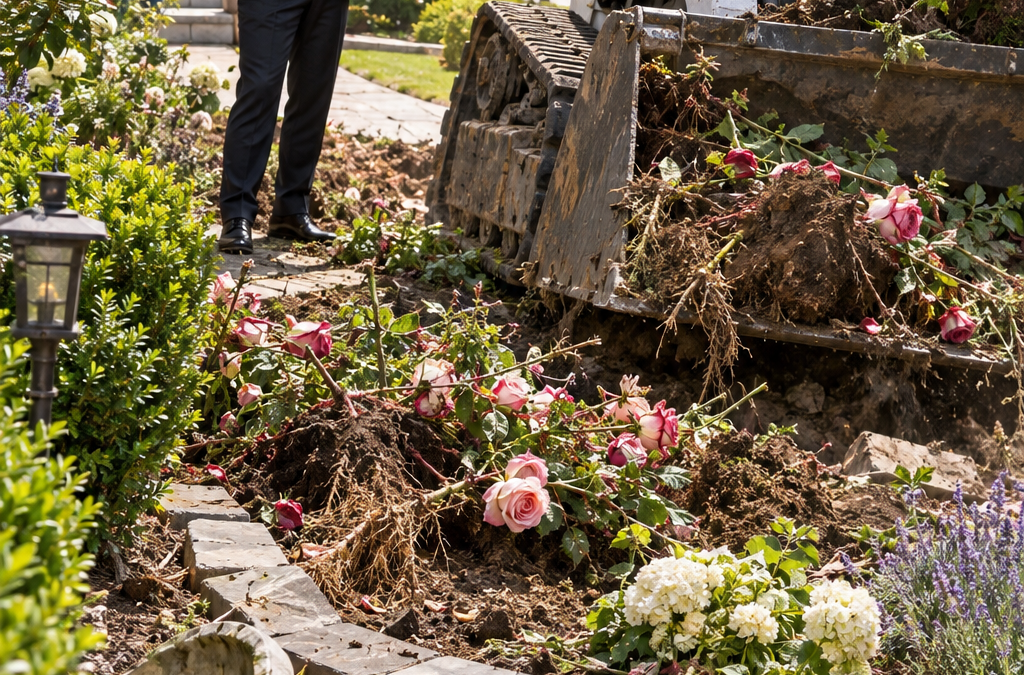
𝗙𝗨𝗟𝗟 𝗦𝗧𝗢𝗥𝗬
When she died, the house changed.
People say grief makes a place feel empty.
For me, it made the house feel too full.
Her mug in the cabinet.
Her cardigan on the chair.
Her handwriting on labels in the pantry.
The garden was the only part of the house where missing her didn’t feel like suffocation.
Out there, she still seemed active.
The roses bloomed because she had planted them deep.
The hydrangeas changed color because she had fussed over the soil.
The lavender came back every summer because she had chosen the sunniest spot.
When I watered those flowers, I could almost hear her telling me I was drowning the roots.
That garden kept me sane.
Karen Colton knew that.
He had to know.
Everyone in Willow Creek knew the garden belonged to my mother.
They had seen her out there for years, straw hat tilted sideways, hands in the dirt, waving at passing neighbors.
But Karen had a talent for noticing the one thing a person loved most and finding a rule to threaten it.
He was fifty, polished, and always overdressed for ordinary life.
He wore crisp shirts, expensive loafers, and cardigans that probably cost more than my monthly grocery bill. His hair was silver-black and styled with such precision that even a humid Carolina afternoon didn’t seem to move it. He carried a leather folder or clipboard everywhere, like authority might evaporate if he weren’t holding paperwork.
Karen was the president of the Willow Creek Estates HOA.
He didn’t serve the neighborhood.
He ruled it.
People called him “the queen of Willow Creek” behind his back, though never where he might hear. He ran board meetings like court proceedings. He patrolled the neighborhood in a white SUV, slowing down in front of houses as if hunting for weakness. He spoke softly, smiled often, and turned every conversation into a reminder that he had power over something you cared about.
At first, I thought people exaggerated.
Every neighborhood has someone dramatic.
Every HOA has a few rules.
Then the first notice came.
Mailbox flag exceeds approved brightness standard. Fine: $60.
I stood in my kitchen reading it, honestly confused.
Mailbox flag.
Too bright.
The little red flag on my mailbox had been there since before I bought the house.
I called the HOA office and asked whether this was a joke.
The woman on the phone didn’t laugh.
“President Colton documented the violation personally.”
Of course he did.
I paid the fine.
Sixty dollars was annoying, but I told myself it wasn’t worth a fight.
That was my first mistake.
Karen understood that kind of surrender. He counted on it. A small fine feels cheaper than resistance, and by the time the fines stop being small, you’ve already taught him you can be pressured.
The second notice came two weeks later.
Trash bin left visible four hours after pickup.
Another fine.
I paid that one too.
Then came a warning about my front porch wreath being displayed outside the approved seasonal window.
Then another letter saying my exterior hose reel was visible from the street.
Each notice carried Karen’s signature.
Looping, elegant, smug.
He signed them like he was gifting punishment instead of paperwork.
I mentioned it to Big Tom one Saturday morning while we were both checking mail.
His real name was Thomas Blevins, but nobody called him that. Big Tom was six-foot-four, broad-shouldered, retired from long-haul trucking, and built like someone who had once moved vending machines for fun. He lived three houses down with a grumpy old dachshund named Pickles.
Tom had been fined the year before for what Karen described as “noncompliant whimsical ornamentation.”
It was a garden gnome.
One gnome.
Wearing a trucker hat.
Big Tom never forgave him.
When I showed him the trash-bin notice, he grunted.
“Karen found you.”
“What does that mean?”
“It means he thinks you’ll pay and keep quiet.”
“I did pay.”
“I know.”
He looked toward Karen’s house down the street.
“That’s why he’ll come back.”
He was right.
The letter about the flower bed arrived on a Thursday.
I had just come home from work and was still wearing my clinic badge when I saw the envelope tucked into the front door.
The letterhead was formal.
The language was cold.
Notice of Required Landscape Removal.
According to Karen, my side-yard flower bed violated newly adopted setback regulations. All plantings, decorative objects, and hardscape features within the restricted area had to be removed within fourteen days.
Fourteen days.
My mother had spent six years shaping that garden.
Karen gave me two weeks to erase it.
I read the letter once.
Then again.
Then I walked outside and stood beside the roses.
The late afternoon sun was warm on my arms. Bees moved lazily through the lavender. The stone birdbath held rainwater from the night before.
Everything looked exactly as it had that morning.
Alive.
Peaceful.
Hers.
I called Karen directly.
He answered on the third ring.
“Donna.”
He said my name like he had been expecting the call.
“Karen, I received a removal notice for my mother’s garden.”
“Yes.”
“There has to be a mistake.”
“There isn’t.”
“That garden has been there for years.”
“The setback regulation has been updated.”
“Updated when?”
“Recently.”
“By who?”
“The board.”
I closed my eyes.
“My mother planted that garden. You know that.”
His voice stayed smooth.
“Rules are rules, Donna.”
I gripped the phone.
“This isn’t a fence or a shed. These are flowers.”
“Sentiment doesn’t pay the HOA’s landscaping budget.”
For a moment, I couldn’t speak.
The cruelty was so casual that it stunned me.
He continued.
“You have fourteen days. If the area is not cleared, the association will take corrective action and assess the costs to your account.”
“Corrective action?”
“Removal.”
“You are not touching my mother’s garden.”
His voice sharpened slightly.
“Be careful, Donna. Emotional attachment does not exempt you from community standards.”
I hung up before I said something he could quote later.
That night, I did what I should have done months earlier.
I read the bylaws.
Not the summary packet.
Not the cheerful homeowner guide.
The actual governing documents.
The 2019 architectural standards clearly allowed existing side-yard plantings as long as they did not obstruct utilities, drainage, or designated access paths.
My garden did none of those things.
Then I found the amendment Karen had cited.
It had been uploaded two months earlier.
The setback language had been changed, narrowing permitted planting zones near common-area boundaries.
The amendment had exactly one signature.
Karen Colton.
No board vote attached.
No homeowner comment period.
No meeting minutes showing adoption.
Just Karen’s signature and the date.
The same week, I remembered, contractors had started renovating his own backyard.
I stared at the document until my eyes burned.
Then I printed the 2019 rule, printed the new amendment, photographed the online record, and placed everything into a folder.
I wrote on the tab:
JUST IN CASE.
For fourteen days, I waited.
No one came.
I hoped Karen was bluffing.
On Tuesday morning, I learned he wasn’t.
I had gone to the grocery store early because I was scheduled for an afternoon shift at the clinic. I was standing in the cereal aisle when my phone buzzed.
Motion detected.
Front side yard camera.
I opened the security app.
At first, I couldn’t process what I was seeing.
A Bobcat excavator sat beside my house.
Two men in work boots were unloading tools.
And Karen Colton stood near my side yard wearing sunglasses, a pale blue shirt, and one of his expensive cardigans tied neatly over his shoulders.
He was holding an iced tea.
My mother’s garden filled the lower half of the camera frame.
The roses.
The hydrangeas.
The lavender.
The birdbath.
I abandoned my cart in the aisle and ran to my car.
By the time I reached the neighborhood, the excavator was already moving.
I parked crooked in my driveway and ran toward the side yard.
“Stop!” I screamed.
The machine’s bucket had already torn through the first rose bed.
Roots and soil lifted together in one ugly mass.
One worker looked toward me, startled.
Karen raised one hand calmly.
“Donna, this has been authorized.”
“Stop them!”
He took a sip of iced tea.
“The compliance period expired.”
“You had no right.”
“The association has every right to correct violations.”
The Bobcat reversed.
The bucket dropped again.
Hydrangeas disappeared under the blade.
I ran toward the worker.
Karen stepped in front of me.
“Do not interfere with contractors.”
“My mother planted those.”
“I know.”
He said it quietly.
That made it worse.
“You know?”
“Yes.”
“And you’re still doing this?”
His smile barely moved.
“You’ll thank me when we build your accessibility ramp.”
I stared at him.
“What ramp?”
“The ramp approved for this area.”
“I never requested a ramp.”
“It isn’t for you.”
“Then who is it for?”
His smile thinned.
“That doesn’t concern you.”
I looked at the mangled soil where the roses had been.
The Bobcat bucket caught the edge of the stone birdbath.
It tipped, cracked against a root, and split in half.
Something inside me broke with it.
I shouted until my throat hurt.
Karen lifted his phone and began filming me.
“For documentation,” he said.
That was the image that stayed with me longest.
Not the Bobcat.
Not the broken birdbath.
Karen filming my grief as evidence against me.
I stopped yelling.
He expected screaming.
He expected me to look unstable.
So I went quiet.
I turned away from him and looked up at my security camera mounted beneath the eave.
Its red light was on.
Recording.
Karen followed my gaze.
For the first time that morning, his smile flickered.
I said nothing.
I walked into the house, closed the door, and saved every second of footage.
Later, after the crew left, I went outside.
The garden was gone.
Not trimmed.
Not relocated.
Gone.
The roses were piled near the curb like yard waste.
Hydrangea roots stuck out of the mud.
Lavender stems had been crushed into the dirt.
The birdbath lay in two pieces.
I knelt beside it and put my hand on the broken stone.
For the first time since my mother’s funeral, I made a sound I did not recognize as my own.
Big Tom found me there.
He didn’t say anything at first.
He simply stood beside me, massive hands hanging at his sides, face hard as concrete.
Then he said, “He finally did it.”
I looked up.
“Finally?”
Tom’s jaw tightened.
“Donna, this wasn’t about flowers.”
That night, I found the first piece of truth in the meeting minutes.
Buried inside a PDF labeled Community Access Improvements — Supplemental Notes, there was a short entry.
President Colton discussed proposed accessibility ramp installation adjacent to clubhouse approach. Preliminary alignment affects side common area near Mercer property.
Mercer property.
My property.
I kept reading.
The ramp had been discussed as part of an “accessibility improvement” allegedly requested for an elderly resident requiring easier passage between the clubhouse and the side common walkway.
But no resident was named.
No accessibility study was attached.
No professional design.
No county permit.
No board vote approving use of my side-yard area.
Just Karen’s language.
Vague enough to sound official.
Specific enough to justify tearing out my garden.
The next day, Big Tom knocked on my door.
He held a folded sheet of paper.
“You need to see this.”
It was a printed screenshot from a neighborhood Facebook post six weeks earlier.
Karen standing in front of the clubhouse beside his father.
His father lived in another county.
Not Willow Creek.
In the caption, Karen wrote:
Excited to make our community more accessible for family and visitors of all ages.
I looked up at Tom.
“The ramp is for his father.”
Tom nodded.
“His father doesn’t live here.”
“No.”
“And he used my garden.”
“Yes.”
I sat down.
My grief sharpened into something colder.
Karen hadn’t removed the garden because of a setback rule.
The setback rule existed because he needed the garden gone.
The ramp was not an accommodation request from a Willow Creek resident.
It was a private convenience disguised as community compliance.
And my mother’s flowers had been sitting on the strip of land he wanted.
That was when I stopped crying.
I started building a case.
I attended every HOA meeting.
I recorded them where legally permitted.
I smiled politely when Karen spoke.
I took notes while he recited rules he had quietly rewritten.
I requested minutes, financial reports, board approvals, contractor invoices, and copies of architectural amendments.
Karen ignored my first request.
Delayed the second.
Answered the third with incomplete documents.
Big Tom became my unlikely partner.
He knew people.
Truckers, mechanics, county clerks, old contractors, retired cops, and at least one man who seemed to know how to find public business filings faster than Google.
“People underestimate retired men,” he told me.
“You’re retired?”
“Mostly.”
Together, we started tracing the landscaping work.
The company that removed my garden was listed on the invoice as Carolina Common Grounds LLC.
The bill to the HOA was $15,000.
For “access preparation, landscape removal, grading, and preliminary ramp clearance.”
I checked the state business registry.
Carolina Common Grounds LLC did not legally exist.
Not as an active company.
Not as a dissolved company.
Not at all.
But the invoice listed an address.
Karen’s home.
I stared at the screen, then called Big Tom.
He came over ten minutes later.
I turned the laptop toward him.
He read silently.
Then he let out a low whistle.
“Well, that’s stupid.”
“Fraud usually is,” I said, though my voice shook.
“He’s been paying himself.”
“Looks like it.”
“Through a fake company?”
“Looks like it.”
Tom leaned back.
“He fined me a hundred dollars for a gnome.”
I looked at him.
“This feels bigger than your gnome.”
“Everything is bigger than the gnome. But the gnome was the beginning.”
Over the next week, the numbers got worse.
Financial statements showed repeated payments to vendors that were hard to verify.
Small landscaping jobs billed at inflated rates.
Emergency maintenance with vague descriptions.
Compliance work routed through companies with addresses tied to Karen, relatives, or properties associated with him under his maiden family name.
At least $15,000 had gone through the nonexistent landscaping contractor connected to the garden removal.
Other transactions suggested the pattern may have gone on much longer.
We took everything to a real estate attorney named Priya Shah.
I had used her name before in my own head like a threat I hoped I wouldn’t need.
Now I needed her.
Priya’s office was clean, quiet, and brutally organized. She wore a dark blazer, no nonsense in her expression, and the focused calm of a person who enjoyed taking apart bad paperwork.
I placed the folder on her desk.
Security footage.
Original bylaws.
New amendment.
Meeting minutes.
Ramp references.
Invoices.
Business registry searches.
Financial statements.
Photos of the destroyed garden.
Photos of my mother in the garden.
Priya read for almost forty minutes without speaking.
Big Tom sat beside me, knees too large for the guest chair, arms crossed.
Finally, Priya reached the fake company invoice and laughed once.
Not because it was funny.
Because it was absurd.
“This isn’t just a bad HOA,” she said.
I swallowed.
“What is it?”
“Fraud, self-dealing, breach of fiduciary duty, possible conversion of association funds, and property destruction.”
Big Tom leaned forward.
“In English?”
Priya looked at him.
“He may have used the HOA to pay himself, changed rules without authority, and destroyed Donna’s property to support a fake project.”
“That’s what I thought,” Tom said.
Priya turned to me.
“You have a real case, Donna.”
For the first time since the garden was destroyed, I felt air move fully into my lungs.
“What do we sue for?”
“Property destruction, breach of fiduciary duty, improper rule amendment, damages tied to the garden, and financial fraud claims depending on what records confirm.”
“The garden wasn’t just plants.”
“I understand.”
“No,” I said quietly. “You don’t.”
Priya paused.
I opened the folder with photographs of my mother.
There she was in her straw hat, kneeling beside the roses.
There she was laughing next to the birdbath.
There she was with dirt on her cheek and pruning shears in one hand.
Priya looked through the photographs slowly.
Then her voice softened.
“I understand enough to make sure the court sees more than dirt.”
We filed suit.
Karen did not panic at first.
That bothered me.
He held an emergency board meeting and arrived dressed like a man prepared to win.
Dark blazer.
White shirt.
Polished shoes.
Gold watch.
He stood at the front of the clubhouse and told residents that I had consented to the garden removal.
I sat in the third row beside Big Tom.
My whole body went cold.
Karen spread his hands.
“Ms. Mercer was notified. She failed to comply. The association took corrective action after the compliance period expired. Claims that this was somehow unauthorized are exaggerated.”
I stood.
“I never consented.”
Karen smiled.
“You were given notice.”
“That is not consent.”
He turned toward the room.
“You see how some residents confuse disagreement with process?”
Big Tom stood slowly.
The room shifted.
Big Tom was not a man people ignored.
“Karen,” he said, “you want to talk process?”
Karen’s smile tightened.
“This meeting will remain orderly, Tom.”
“Oh, it will.”
Big Tom held up his phone.
“I have audio from the March meeting.”
Karen’s face changed.
It was quick, but I saw it.
Tom pressed play.
The recording was slightly muffled, but clear enough.
Karen’s voice came through.
The ramp alignment would make it easier for my father to reach the clubhouse patio when he visits.
Another board member asked something.
Karen answered.
No, he doesn’t live here, but accessibility upgrades benefit the whole community. The Mercer side strip is the cleanest path if we clear the bed.
The room went dead silent.
Big Tom stopped the recording.
Then he said, “Donna never requested a ramp. Nobody in her household requested a ramp. You wanted it for your father.”
Karen stared at him.
“That recording lacks context.”
Big Tom smiled slightly.
“Funny thing about context. We’ve got the whole meeting.”
One board member looked at Karen.
“Is that true?”
Karen adjusted his blazer.
“The ramp served multiple interests.”
“Did Donna consent?”
Karen did not answer.
Another board member asked, “Did we vote to authorize removal of her garden?”
Karen looked around the table.
His control was slipping.
The board members could feel the legal danger now. Their names were attached to an HOA that had destroyed private landscaping, fabricated or manipulated accessibility reasoning, and paid a questionable company tied to its own president.
Nobody wanted to go down with him.
Not anymore.
Priya had warned me that boards often protect bad presidents until liability becomes personal.
That night, liability became personal.
One by one, board members began distancing themselves.
“I never saw the final invoice.”
“I thought the company was licensed.”
“I didn’t know his father was the reason for the ramp.”
“I didn’t approve changing the setback rule alone.”
Karen’s smile disappeared.
For the first time, he looked less like a ruler and more like a man watching the floor give way.
A week later, the county contacted us.
My case was not isolated.
Two other residents had been fined and forced into unnecessary compliance work involving vendors linked to Karen’s shell companies.
One had paid for a drainage correction that county records suggested had never required work.
Another had been forced to remove a decorative retaining wall and then billed through a contractor with ties to Karen’s family.
The pattern was clear.
Karen would create or reinterpret a rule.
Declare a violation.
Order corrective work.
Route payment through a shell or related entity.
Fine the resident.
And call it community maintenance.
The local news picked up the story after Priya provided documentation on the fake company and the destruction of my garden.
I almost refused to speak.
I didn’t want cameras on my grief.
But then I thought of Karen filming me while my mother’s roses were being ripped from the ground.
He had tried to turn my pain into evidence against me.
So I turned the evidence back toward him.
The news segment showed the security footage.
Not all of it.
Enough.
The Bobcat bucket tearing through the garden.
Karen standing there with his iced tea.
Me running up, begging them to stop.
Then the reporter showed the invoice from Carolina Common Grounds LLC and the business registry search showing no active legal company by that name.
Karen refused an interview.
His attorney sent a statement denying wrongdoing and claiming the HOA had acted within its authority.
The statement did not explain why the contractor’s address matched Karen’s home.
It did not explain the single-signature amendment.
It did not explain the audio of him admitting the ramp was for his father.
After the story aired, my phone didn’t stop buzzing.
Neighbors called.
Former residents messaged.
People I barely knew sent photos, letters, invoices, and old fines.
Big Tom came over the next morning with coffee and a grin.
“You’re famous.”
“I hate it.”
“You’re effective.”
“I hate that too.”
He handed me a paper bag.
“Brought biscuits.”
“That helps.”
Karen tried one last desperate move.
An email came from his attorney offering $2,000 to settle all claims.
In exchange, I would release Karen, the HOA, all associated parties, and agree to a strict nondisclosure clause.
I read the offer three times.
Two thousand dollars.
For my mother’s garden.
For the birdbath.
For the public humiliation.
For the fake ramp.
For the illegal rule change.
For the shell company.
For every resident he had fined while paying himself.
I forwarded it to Priya with one sentence.
Not a chance.
Her reply came back quickly.
Correct answer.
The final hearing was held in a county courtroom that smelled faintly of paper, old wood, and floor polish.
Karen sat at the opposite table in a blazer that probably cost more than every fine he had ever sent me.
He refused to look at me.
I wore the navy dress my mother always said made me look like I had “a plan and a backbone.”
Big Tom sat behind me.
So did several neighbors.
Priya presented the case cleanly.
The original bylaws.
The unauthorized amendment.
The destruction footage.
The fake contractor invoice.
The security video.
The meeting audio.
The shell company records.
The payments.
The witness statements.
The photographs of the garden before and after.
Karen’s attorney tried to argue that the HOA had broad discretion to enforce landscaping rules and maintain common access areas.
The judge listened.
Then asked whether the contractor legally existed.
Karen’s attorney shifted.
Then asked whether Karen had disclosed the address conflict.
No clear answer.
Then asked whether Donna Mercer had requested or consented to an accessibility ramp.
No.
Then asked whether the ramp served a resident of Willow Creek.
No.
Then asked whether Karen had signed the setback amendment alone.
Yes.
The courtroom felt very quiet.
The judge read the ruling slowly.
Fraud.
Breach of fiduciary duty.
Property destruction.
Damages awarded to me: $25,000.
The number landed with a weight I did not expect.
Money could not bring back my mother.
It could not restore the exact roses she planted with her hands.
It could not glue the original birdbath back together in a way that made it whole.
But it did something important.
It said what happened mattered.
It said Karen was wrong.
It said the garden was not trash, not noncompliance, not an obstacle to his father’s convenience or his shell company’s invoice.
It was my property.
It had value.
Destroying it had consequences.
Karen was removed from the HOA board that same week.
The court also barred him from serving on any HOA board in the state for ten years.
The county attorney’s office opened a separate criminal investigation into the shell company activity and related HOA payments.
I later heard Karen had hired a criminal defense attorney.
That was no longer my burden to carry.
My part was done.
Or almost done.
Because there was still the garden.
For a few weeks after the ruling, I avoided the side yard.
The dirt had been leveled, but it felt empty.
A flat scar beside the house.
Then one Saturday morning, Big Tom knocked on my door wearing work gloves.
Behind him, his pickup bed was full of plants.
Roses.
Hydrangeas.
Lavender.
Mulch.
Soil.
And, somehow, a stone birdbath.
Not identical to my mother’s.
But close.
I stared at it.
“Tom.”
He shrugged.
“Estate sale.”
I put my hand over my mouth.
“You didn’t have to do that.”
“Yeah,” he said. “I did.”
Denise arrived twenty minutes later with pruning shears.
Then Mrs. Alvarez from the corner came with lemonade.
Then the Patels came with garden stakes.
By noon, half the block was in my side yard.
Nobody asked the HOA for permission.
Nobody mentioned setback regulations.
Nobody said Karen’s name.
We planted all afternoon.
I placed the roses where my mother had kept them.
The hydrangeas went along the walkway.
The lavender returned to the sunny strip near the fence.
Big Tom carried the new birdbath into place with a tenderness that made me tear up.
When we were almost done, he disappeared to his truck and came back holding something behind his back.
A garden gnome.
The same noncompliant one.
Trucker hat and all.
He placed it at the edge of the property line, facing the clubhouse like a tiny witness.
I laughed so hard I cried.
“Really?”
He crossed his arms.
“Let somebody complain.”
Nobody did.
Weeks passed.
Then months.
The new HOA board adopted rules requiring independent approval for contractor payments, conflict disclosures, recorded votes for bylaw changes, and homeowner notice before any corrective work.
The fake contractor payments became part of the criminal investigation.
The neighborhood changed.
Not perfectly.
People still argued about lawn care and parking and pool hours.
But Karen’s kingdom was gone.
Willow Creek became, slowly and imperfectly, a neighborhood again.
Every morning now, I water the garden before work.
I start with the roses.
Then the hydrangeas.
Then the lavender.
I refill the birdbath last.
Sometimes the water catches the light just right, and for half a second I see my mother’s old garden superimposed over the new one.
Not identical.
Never identical.
But alive.
That matters.
Grief teaches you that rebuilding is not the same as replacing.
The new roses are not my mother’s roses.
The new birdbath is not the one she found at the estate sale.
But the act of planting them was mine.
The act of defending them was mine.
The act of refusing to let Karen Colton turn memory into debris was mine.
One morning, not long after the new blooms opened, I stood in the side yard with the hose in my hand and saw Karen drive past.
He slowed.
For a moment, he looked toward the garden.
Then toward Big Tom’s gnome.
Then toward me.
He didn’t wave.
I didn’t either.
He drove on.
I looked down at the roses.
They were beginning to open, red and full and stubborn.
My mother would have loved them.
I could almost hear her voice.
“Don’t overwater, Donna.”
I smiled.
“I know, Mom.”
Then I watered them anyway, just a little.
Because justice finally bloomed in Willow Creek.
And this time, nobody dared cut it down.
𝗧𝗛𝗘 𝗘𝗡𝗗
The HOA President Smiled at the Camera While a Bobcat Tore Out My Mother’s Garden
They bulldozed my mother’s flower garden on a Tuesday morning, and I watched the security footage later with my hands shaking so badly I could barely hold the mouse. What hurt worst wasn’t only seeing the roses torn out by the roots, but seeing the HOA president stand there smiling as if grief itself had finally been brought into compliance.
My name is Donna Mercer.
I’m fifty-three years old, and I live in Willow Creek Estates, a tidy little subdivision outside Charlotte, North Carolina, where the lawns are cut in perfect stripes and the front porches look like something from a real estate brochure.
People wave when you drive by.
Children ride bikes in the cul-de-sacs.
The houses are painted soft, respectable colors.
The entrance sign has stacked stone columns and flower beds that are maintained so carefully they look almost fake.
From the outside, Willow Creek looks peaceful.
That was why I bought here.
After my mother died, I wanted quiet. Not excitement. Not drama. Not a fresh start in the inspirational sense people talk about when they don’t know what grief feels like. I just wanted a place where I could wake up, make coffee, go to work, come home, water the flowers, and not feel like the ground beneath my life was still moving.
My mother, Evelyn, had lived with me during the last six years of her life.
She was the one who made that house feel alive.
When I first bought it, the side yard was nothing but hard clay, crabgrass, and a narrow strip of sunlight between my house and the common green that ran toward the clubhouse.
My mother looked at that ugly little patch and saw a garden.
I saw dirt.
She saw roses.
I saw a drainage problem.
She saw hydrangeas, salvia, lavender, creeping thyme, and a little curved path made from flat stones she insisted we could haul ourselves from a garden center if we “took it slow and didn’t act dramatic.”
She was seventy-four then, already walking with a slight limp, but she had more stubborn energy than I did at forty-seven.
That first spring, she spent entire mornings kneeling in the dirt with gloves on, humming old Motown songs under her breath while I tried to convince her to rest.
“Mom, it’s ninety degrees.”
“Plants don’t care if I’m comfortable.”
“You care if you pass out.”
She looked up at me beneath the brim of her straw hat.
“Then bring me lemonade instead of lectures.”
That was my mother.
Sharp tongue, soft hands, impossible to manage.
Over six years, that side-yard strip became hers.
Roses climbed a trellis near the fence.
Hydrangeas bloomed fat and blue along the walkway.
She planted lavender because she said every house needed one smell that made people breathe deeper.
Near the center, she placed a small stone birdbath she found at an estate sale. It had a crack along the base and a carved bird on the rim that looked more like a confused pigeon than anything elegant.
She loved it.
Every morning, even after the cancer came back, she would shuffle outside with her coffee and inspect the garden as if reporting to duty.
After chemotherapy weakened her, I begged her to stop working in the heat.
She told me, “Donna, when I can’t make something grow anymore, then you can worry.”
When she died, the house changed.
People say grief makes a place feel empty.
For me, it made the house feel too full.
Her mug in the cabinet.
Her cardigan on the chair.
Her handwriting on labels in the pantry.
The garden was the only part of the house where missing her didn’t feel like suffocation.
Out there, she still seemed active.
The roses bloomed because she had planted them deep.
The hydrangeas changed color because she had fussed over the soil.
The lavender came back every summer because she had chosen the sunniest spot.
When I watered those flowers, I could almost hear her telling me I was drowning the roots.
That garden kept me sane.
Karen Colton knew that.
He had to know.
Everyone in Willow Creek knew the garden belonged to my mother.
They had seen her out there for years, straw hat tilted sideways, hands in the dirt, waving at passing neighbors.
But Karen had a talent for noticing the one thing a person loved most and finding a rule to threaten it.
He was fifty, polished, and always overdressed for ordinary life.
He wore crisp shirts, expensive loafers, and cardigans that probably cost more than my monthly grocery bill. His hair was silver-black and styled with such precision that even a humid Carolina afternoon didn’t seem to move it. He carried a leather folder or clipboard everywhere, like authority might evaporate if he weren’t holding paperwork.
Karen was the president of the Willow Creek Estates HOA.
He didn’t serve the neighborhood.
He ruled it.
People called him “the queen of Willow Creek” behind his back, though never where he might hear. He ran board meetings like court proceedings. He patrolled the neighborhood in a white SUV, slowing down in front of houses as if hunting for weakness. He spoke softly, smiled often, and turned every conversation into a reminder that he had power over something you cared about.
At first, I thought people exaggerated.
Every neighborhood has someone dramatic.
Every HOA has a few rules.
Then the first notice came.
Mailbox flag exceeds approved brightness standard. Fine: $60.
I stood in my kitchen reading it, honestly confused.
Mailbox flag.
Too bright.
The little red flag on my mailbox had been there since before I bought the house.
I called the HOA office and asked whether this was a joke.
The woman on the phone didn’t laugh.
“President Colton documented the violation personally.”
Of course he did.
I paid the fine.
Sixty dollars was annoying, but I told myself it wasn’t worth a fight.
That was my first mistake.
Karen understood that kind of surrender. He counted on it. A small fine feels cheaper than resistance, and by the time the fines stop being small, you’ve already taught him you can be pressured.
The second notice came two weeks later.
Trash bin left visible four hours after pickup.
Another fine.
I paid that one too.
Then came a warning about my front porch wreath being displayed outside the approved seasonal window.
Then another letter saying my exterior hose reel was visible from the street.
Each notice carried Karen’s signature.
Looping, elegant, smug.
He signed them like he was gifting punishment instead of paperwork.
I mentioned it to Big Tom one Saturday morning while we were both checking mail.
His real name was Thomas Blevins, but nobody called him that. Big Tom was six-foot-four, broad-shouldered, retired from long-haul trucking, and built like someone who had once moved vending machines for fun. He lived three houses down with a grumpy old dachshund named Pickles.
Tom had been fined the year before for what Karen described as “noncompliant whimsical ornamentation.”
It was a garden gnome.
One gnome.
Wearing a trucker hat.
Big Tom never forgave him.
When I showed him the trash-bin notice, he grunted.
“Karen found you.”
“What does that mean?”
“It means he thinks you’ll pay and keep quiet.”
“I did pay.”
“I know.”
He looked toward Karen’s house down the street.
“That’s why he’ll come back.”
He was right.
The letter about the flower bed arrived on a Thursday.
I had just come home from work and was still wearing my clinic badge when I saw the envelope tucked into the front door.
The letterhead was formal.
The language was cold.
Notice of Required Landscape Removal.
According to Karen, my side-yard flower bed violated newly adopted setback regulations. All plantings, decorative objects, and hardscape features within the restricted area had to be removed within fourteen days.
Fourteen days.
My mother had spent six years shaping that garden.
Karen gave me two weeks to erase it.
I read the letter once.
Then again.
Then I walked outside and stood beside the roses.
The late afternoon sun was warm on my arms. Bees moved lazily through the lavender. The stone birdbath held rainwater from the night before.
Everything looked exactly as it had that morning.
Alive.
Peaceful.
Hers.
I called Karen directly.
He answered on the third ring.
“Donna.”
He said my name like he had been expecting the call.
“Karen, I received a removal notice for my mother’s garden.”
“Yes.”
“There has to be a mistake.”
“There isn’t.”
“That garden has been there for years.”
“The setback regulation has been updated.”
“Updated when?”
“Recently.”
“By who?”
“The board.”
I closed my eyes.
“My mother planted that garden. You know that.”
His voice stayed smooth.
“Rules are rules, Donna.”
I gripped the phone.
“This isn’t a fence or a shed. These are flowers.”
“Sentiment doesn’t pay the HOA’s landscaping budget.”
For a moment, I couldn’t speak.
The cruelty was so casual that it stunned me.
He continued.
“You have fourteen days. If the area is not cleared, the association will take corrective action and assess the costs to your account.”
“Corrective action?”
“Removal.”
“You are not touching my mother’s garden.”
His voice sharpened slightly.
“Be careful, Donna. Emotional attachment does not exempt you from community standards.”
I hung up before I said something he could quote later.
That night, I did what I should have done months earlier.
I read the bylaws.
Not the summary packet.
Not the cheerful homeowner guide.
The actual governing documents.
The 2019 architectural standards clearly allowed existing side-yard plantings as long as they did not obstruct utilities, drainage, or designated access paths.
My garden did none of those things.
Then I found the amendment Karen had cited.
It had been uploaded two months earlier.
The setback language had been changed, narrowing permitted planting zones near common-area boundaries.
The amendment had exactly one signature.
Karen Colton.
No board vote attached.
No homeowner comment period.
No meeting minutes showing adoption.
Just Karen’s signature and the date.
The same week, I remembered, contractors had started renovating his own backyard.
I stared at the document until my eyes burned.
Then I printed the 2019 rule, printed the new amendment, photographed the online record, and placed everything into a folder.
I wrote on the tab:
JUST IN CASE.
For fourteen days, I waited.
No one came.
I hoped Karen was bluffing.
On Tuesday morning, I learned he wasn’t.
I had gone to the grocery store early because I was scheduled for an afternoon shift at the clinic. I was standing in the cereal aisle when my phone buzzed.
Motion detected.
Front side yard camera.
I opened the security app.
At first, I couldn’t process what I was seeing.
A Bobcat excavator sat beside my house.
Two men in work boots were unloading tools.
And Karen Colton stood near my side yard wearing sunglasses, a pale blue shirt, and one of his expensive cardigans tied neatly over his shoulders.
He was holding an iced tea.
My mother’s garden filled the lower half of the camera frame.
The roses.
The hydrangeas.
The lavender.
The birdbath.
I abandoned my cart in the aisle and ran to my car.
By the time I reached the neighborhood, the excavator was already moving.
I parked crooked in my driveway and ran toward the side yard.
“Stop!” I screamed.
The machine’s bucket had already torn through the first rose bed.
Roots and soil lifted together in one ugly mass.
One worker looked toward me, startled.
Karen raised one hand calmly.
“Donna, this has been authorized.”
“Stop them!”
He took a sip of iced tea.
“The compliance period expired.”
“You had no right.”
“The association has every right to correct violations.”
The Bobcat reversed.
The bucket dropped again.
Hydrangeas disappeared under the blade.
I ran toward the worker.
Karen stepped in front of me.
“Do not interfere with contractors.”
“My mother planted those.”
“I know.”
He said it quietly.
That made it worse.
“You know?”
“Yes.”
“And you’re still doing this?”
His smile barely moved.
“You’ll thank me when we build your accessibility ramp.”
I stared at him.
“What ramp?”
“The ramp approved for this area.”
“I never requested a ramp.”
“It isn’t for you.”
“Then who is it for?”
His smile thinned.
“That doesn’t concern you.”
I looked at the mangled soil where the roses had been.
The Bobcat bucket caught the edge of the stone birdbath.
It tipped, cracked against a root, and split in half.
Something inside me broke with it.
I shouted until my throat hurt.
Karen lifted his phone and began filming me.
“For documentation,” he said.
That was the image that stayed with me longest.
Not the Bobcat.
Not the broken birdbath.
Karen filming my grief as evidence against me.
I stopped yelling.
He expected screaming.
He expected me to look unstable.
So I went quiet.
I turned away from him and looked up at my security camera mounted beneath the eave.
Its red light was on.
Recording.
Karen followed my gaze.
For the first time that morning, his smile flickered.
I said nothing.
I walked into the house, closed the door, and saved every second of footage.
Later, after the crew left, I went outside.
The garden was gone.
Not trimmed.
Not relocated.
Gone.
The roses were piled near the curb like yard waste.
Hydrangea roots stuck out of the mud.
Lavender stems had been crushed into the dirt.
The birdbath lay in two pieces.
I knelt beside it and put my hand on the broken stone.
For the first time since my mother’s funeral, I made a sound I did not recognize as my own.
Big Tom found me there.
He didn’t say anything at first.
He simply stood beside me, massive hands hanging at his sides, face hard as concrete.
Then he said, “He finally did it.”
I looked up.
“Finally?”
Tom’s jaw tightened.
“Donna, this wasn’t about flowers.”
That night, I found the first piece of truth in the meeting minutes.
Buried inside a PDF labeled Community Access Improvements — Supplemental Notes, there was a short entry.
President Colton discussed proposed accessibility ramp installation adjacent to clubhouse approach. Preliminary alignment affects side common area near Mercer property.
Mercer property.
My property.
I kept reading.
The ramp had been discussed as part of an “accessibility improvement” allegedly requested for an elderly resident requiring easier passage between the clubhouse and the side common walkway.
But no resident was named.
No accessibility study was attached.
No professional design.
No county permit.
No board vote approving use of my side-yard area.
Just Karen’s language.
Vague enough to sound official.
Specific enough to justify tearing out my garden.
The next day, Big Tom knocked on my door.
He held a folded sheet of paper.
“You need to see this.”
It was a printed screenshot from a neighborhood Facebook post six weeks earlier.
Karen standing in front of the clubhouse beside his father.
His father lived in another county.
Not Willow Creek.
In the caption, Karen wrote:
Excited to make our community more accessible for family and visitors of all ages.
I looked up at Tom.
“The ramp is for his father.”
Tom nodded.
“His father doesn’t live here.”
“No.”
“And he used my garden.”
“Yes.”
I sat down.
My grief sharpened into something colder.
Karen hadn’t removed the garden because of a setback rule.
The setback rule existed because he needed the garden gone.
The ramp was not an accommodation request from a Willow Creek resident.
It was a private convenience disguised as community compliance.
And my mother’s flowers had been sitting on the strip of land he wanted.
That was when I stopped crying.
I started building a case.
I attended every HOA meeting.
I recorded them where legally permitted.
I smiled politely when Karen spoke.
I took notes while he recited rules he had quietly rewritten.
I requested minutes, financial reports, board approvals, contractor invoices, and copies of architectural amendments.
Karen ignored my first request.
Delayed the second.
Answered the third with incomplete documents.
Big Tom became my unlikely partner.
He knew people.
Truckers, mechanics, county clerks, old contractors, retired cops, and at least one man who seemed to know how to find public business filings faster than Google.
“People underestimate retired men,” he told me.
“You’re retired?”
“Mostly.”
Together, we started tracing the landscaping work.
The company that removed my garden was listed on the invoice as Carolina Common Grounds LLC.
The bill to the HOA was $15,000.
For “access preparation, landscape removal, grading, and preliminary ramp clearance.”
I checked the state business registry.
Carolina Common Grounds LLC did not legally exist.
Not as an active company.
Not as a dissolved company.
Not at all.
But the invoice listed an address.
Karen’s home.
I stared at the screen, then called Big Tom.
He came over ten minutes later.
I turned the laptop toward him.
He read silently.
Then he let out a low whistle.
“Well, that’s stupid.”
“Fraud usually is,” I said, though my voice shook.
“He’s been paying himself.”
“Looks like it.”
“Through a fake company?”
“Looks like it.”
Tom leaned back.
“He fined me a hundred dollars for a gnome.”
I looked at him.
“This feels bigger than your gnome.”
“Everything is bigger than the gnome. But the gnome was the beginning.”
Over the next week, the numbers got worse.
Financial statements showed repeated payments to vendors that were hard to verify.
Small landscaping jobs billed at inflated rates.
Emergency maintenance with vague descriptions.
Compliance work routed through companies with addresses tied to Karen, relatives, or properties associated with him under his maiden family name.
At least $15,000 had gone through the nonexistent landscaping contractor connected to the garden removal.
Other transactions suggested the pattern may have gone on much longer.
We took everything to a real estate attorney named Priya Shah.
I had used her name before in my own head like a threat I hoped I wouldn’t need.
Now I needed her.
Priya’s office was clean, quiet, and brutally organized. She wore a dark blazer, no nonsense in her expression, and the focused calm of a person who enjoyed taking apart bad paperwork.
I placed the folder on her desk.
Security footage.
Original bylaws.
New amendment.
Meeting minutes.
Ramp references.
Invoices.
Business registry searches.
Financial statements.
Photos of the destroyed garden.
Photos of my mother in the garden.
Priya read for almost forty minutes without speaking.
Big Tom sat beside me, knees too large for the guest chair, arms crossed.
Finally, Priya reached the fake company invoice and laughed once.
Not because it was funny.
Because it was absurd.
“This isn’t just a bad HOA,” she said.
I swallowed.
“What is it?”
“Fraud, self-dealing, breach of fiduciary duty, possible conversion of association funds, and property destruction.”
Big Tom leaned forward.
“In English?”
Priya looked at him.
“He may have used the HOA to pay himself, changed rules without authority, and destroyed Donna’s property to support a fake project.”
“That’s what I thought,” Tom said.
Priya turned to me.
“You have a real case, Donna.”
For the first time since the garden was destroyed, I felt air move fully into my lungs.
“What do we sue for?”
“Property destruction, breach of fiduciary duty, improper rule amendment, damages tied to the garden, and financial fraud claims depending on what records confirm.”
“The garden wasn’t just plants.”
“I understand.”
“No,” I said quietly. “You don’t.”
Priya paused.
I opened the folder with photographs of my mother.
There she was in her straw hat, kneeling beside the roses.
There she was laughing next to the birdbath.
There she was with dirt on her cheek and pruning shears in one hand.
Priya looked through the photographs slowly.
Then her voice softened.
“I understand enough to make sure the court sees more than dirt.”
We filed suit.
Karen did not panic at first.
That bothered me.
He held an emergency board meeting and arrived dressed like a man prepared to win.
Dark blazer.
White shirt.
Polished shoes.
Gold watch.
He stood at the front of the clubhouse and told residents that I had consented to the garden removal.
I sat in the third row beside Big Tom.
My whole body went cold.
Karen spread his hands.
“Ms. Mercer was notified. She failed to comply. The association took corrective action after the compliance period expired. Claims that this was somehow unauthorized are exaggerated.”
I stood.
“I never consented.”
Karen smiled.
“You were given notice.”
“That is not consent.”
He turned toward the room.
“You see how some residents confuse disagreement with process?”
Big Tom stood slowly.
The room shifted.
Big Tom was not a man people ignored.
“Karen,” he said, “you want to talk process?”
Karen’s smile tightened.
“This meeting will remain orderly, Tom.”
“Oh, it will.”
Big Tom held up his phone.
“I have audio from the March meeting.”
Karen’s face changed.
It was quick, but I saw it.
Tom pressed play.
The recording was slightly muffled, but clear enough.
Karen’s voice came through.
The ramp alignment would make it easier for my father to reach the clubhouse patio when he visits.
Another board member asked something.
Karen answered.
No, he doesn’t live here, but accessibility upgrades benefit the whole community. The Mercer side strip is the cleanest path if we clear the bed.
The room went dead silent.
Big Tom stopped the recording.
Then he said, “Donna never requested a ramp. Nobody in her household requested a ramp. You wanted it for your father.”
Karen stared at him.
“That recording lacks context.”
Big Tom smiled slightly.
“Funny thing about context. We’ve got the whole meeting.”
One board member looked at Karen.
“Is that true?”
Karen adjusted his blazer.
“The ramp served multiple interests.”
“Did Donna consent?”
Karen did not answer.
Another board member asked, “Did we vote to authorize removal of her garden?”
Karen looked around the table.
His control was slipping.
The board members could feel the legal danger now. Their names were attached to an HOA that had destroyed private landscaping, fabricated or manipulated accessibility reasoning, and paid a questionable company tied to its own president.
Nobody wanted to go down with him.
Not anymore.
Priya had warned me that boards often protect bad presidents until liability becomes personal.
That night, liability became personal.
One by one, board members began distancing themselves.
“I never saw the final invoice.”
“I thought the company was licensed.”
“I didn’t know his father was the reason for the ramp.”
“I didn’t approve changing the setback rule alone.”
Karen’s smile disappeared.
For the first time, he looked less like a ruler and more like a man watching the floor give way.
A week later, the county contacted us.
My case was not isolated.
Two other residents had been fined and forced into unnecessary compliance work involving vendors linked to Karen’s shell companies.
One had paid for a drainage correction that county records suggested had never required work.
Another had been forced to remove a decorative retaining wall and then billed through a contractor with ties to Karen’s family.
The pattern was clear.
Karen would create or reinterpret a rule.
Declare a violation.
Order corrective work.
Route payment through a shell or related entity.
Fine the resident.
And call it community maintenance.
The local news picked up the story after Priya provided documentation on the fake company and the destruction of my garden.
I almost refused to speak.
I didn’t want cameras on my grief.
But then I thought of Karen filming me while my mother’s roses were being ripped from the ground.
He had tried to turn my pain into evidence against me.
So I turned the evidence back toward him.
The news segment showed the security footage.
Not all of it.
Enough.
The Bobcat bucket tearing through the garden.
Karen standing there with his iced tea.
Me running up, begging them to stop.
Then the reporter showed the invoice from Carolina Common Grounds LLC and the business registry search showing no active legal company by that name.
Karen refused an interview.
His attorney sent a statement denying wrongdoing and claiming the HOA had acted within its authority.
The statement did not explain why the contractor’s address matched Karen’s home.
It did not explain the single-signature amendment.
It did not explain the audio of him admitting the ramp was for his father.
After the story aired, my phone didn’t stop buzzing.
Neighbors called.
Former residents messaged.
People I barely knew sent photos, letters, invoices, and old fines.
Big Tom came over the next morning with coffee and a grin.
“You’re famous.”
“I hate it.”
“You’re effective.”
“I hate that too.”
He handed me a paper bag.
“Brought biscuits.”
“That helps.”
Karen tried one last desperate move.
An email came from his attorney offering $2,000 to settle all claims.
In exchange, I would release Karen, the HOA, all associated parties, and agree to a strict nondisclosure clause.
I read the offer three times.
Two thousand dollars.
For my mother’s garden.
For the birdbath.
For the public humiliation.
For the fake ramp.
For the illegal rule change.
For the shell company.
For every resident he had fined while paying himself.
I forwarded it to Priya with one sentence.
Not a chance.
Her reply came back quickly.
Correct answer.
The final hearing was held in a county courtroom that smelled faintly of paper, old wood, and floor polish.
Karen sat at the opposite table in a blazer that probably cost more than every fine he had ever sent me.
He refused to look at me.
I wore the navy dress my mother always said made me look like I had “a plan and a backbone.”
Big Tom sat behind me.
So did several neighbors.
Priya presented the case cleanly.
The original bylaws.
The unauthorized amendment.
The destruction footage.
The fake contractor invoice.
The security video.
The meeting audio.
The shell company records.
The payments.
The witness statements.
The photographs of the garden before and after.
Karen’s attorney tried to argue that the HOA had broad discretion to enforce landscaping rules and maintain common access areas.
The judge listened.
Then asked whether the contractor legally existed.
Karen’s attorney shifted.
Then asked whether Karen had disclosed the address conflict.
No clear answer.
Then asked whether Donna Mercer had requested or consented to an accessibility ramp.
No.
Then asked whether the ramp served a resident of Willow Creek.
No.
Then asked whether Karen had signed the setback amendment alone.
Yes.
The courtroom felt very quiet.
The judge read the ruling slowly.
Fraud.
Breach of fiduciary duty.
Property destruction.
Damages awarded to me: $25,000.
The number landed with a weight I did not expect.
Money could not bring back my mother.
It could not restore the exact roses she planted with her hands.
It could not glue the original birdbath back together in a way that made it whole.
But it did something important.
It said what happened mattered.
It said Karen was wrong.
It said the garden was not trash, not noncompliance, not an obstacle to his father’s convenience or his shell company’s invoice.
It was my property.
It had value.
Destroying it had consequences.
Karen was removed from the HOA board that same week.
The court also barred him from serving on any HOA board in the state for ten years.
The county attorney’s office opened a separate criminal investigation into the shell company activity and related HOA payments.
I later heard Karen had hired a criminal defense attorney.
That was no longer my burden to carry.
My part was done.
Or almost done.
Because there was still the garden.
For a few weeks after the ruling, I avoided the side yard.
The dirt had been leveled, but it felt empty.
A flat scar beside the house.
Then one Saturday morning, Big Tom knocked on my door wearing work gloves.
Behind him, his pickup bed was full of plants.
Roses.
Hydrangeas.
Lavender.
Mulch.
Soil.
And, somehow, a stone birdbath.
Not identical to my mother’s.
But close.
I stared at it.
“Tom.”
He shrugged.
“Estate sale.”
I put my hand over my mouth.
“You didn’t have to do that.”
“Yeah,” he said. “I did.”
Denise arrived twenty minutes later with pruning shears.
Then Mrs. Alvarez from the corner came with lemonade.
Then the Patels came with garden stakes.
By noon, half the block was in my side yard.
Nobody asked the HOA for permission.
Nobody mentioned setback regulations.
Nobody said Karen’s name.
We planted all afternoon.
I placed the roses where my mother had kept them.
The hydrangeas went along the walkway.
The lavender returned to the sunny strip near the fence.
Big Tom carried the new birdbath into place with a tenderness that made me tear up.
When we were almost done, he disappeared to his truck and came back holding something behind his back.
A garden gnome.
The same noncompliant one.
Trucker hat and all.
He placed it at the edge of the property line, facing the clubhouse like a tiny witness.
I laughed so hard I cried.
“Really?”
He crossed his arms.
“Let somebody complain.”
Nobody did.
Weeks passed.
Then months.
The new HOA board adopted rules requiring independent approval for contractor payments, conflict disclosures, recorded votes for bylaw changes, and homeowner notice before any corrective work.
The fake contractor payments became part of the criminal investigation.
The neighborhood changed.
Not perfectly.
People still argued about lawn care and parking and pool hours.
But Karen’s kingdom was gone.
Willow Creek became, slowly and imperfectly, a neighborhood again.
Every morning now, I water the garden before work.
I start with the roses.
Then the hydrangeas.
Then the lavender.
I refill the birdbath last.
Sometimes the water catches the light just right, and for half a second I see my mother’s old garden superimposed over the new one.
Not identical.
Never identical.
But alive.
That matters.
Grief teaches you that rebuilding is not the same as replacing.
The new roses are not my mother’s roses.
The new birdbath is not the one she found at the estate sale.
But the act of planting them was mine.
The act of defending them was mine.
The act of refusing to let Karen Colton turn memory into debris was mine.
One morning, not long after the new blooms opened, I stood in the side yard with the hose in my hand and saw Karen drive past.
He slowed.
For a moment, he looked toward the garden.
Then toward Big Tom’s gnome.
Then toward me.
He didn’t wave.
I didn’t either.
He drove on.
I looked down at the roses.
They were beginning to open, red and full and stubborn.
My mother would have loved them.
I could almost hear her voice.
“Don’t overwater, Donna.”
I smiled.
“I know, Mom.”
Then I watered them anyway, just a little.
Because justice finally bloomed in Willow Creek.
And this time, nobody dared cut it down.








