𝗙𝗨𝗟𝗟 𝗦𝗧𝗢𝗥𝗬 The HOA President Smiled at Me Every Morning While Quietly Preparing to Take My House
𝗙𝗨𝗟𝗟 𝗦𝗧𝗢𝗥𝗬
Better than the warped chain-link section it replaced.
For three days, I enjoyed my backyard again.
On the fourth day, Deborah’s first citation arrived.
Unauthorized Fence Materials.
Fine amount: two hundred dollars.
Her initials sat at the bottom.
D.W.
I stood in my kitchen holding the notice and laughed.
That was my first mistake.
People like Deborah don’t hear laughter as disbelief.
They hear it as disrespect.
I called the HOA office.
Deborah answered personally.
“Maple Ridge Estates. Deborah speaking.”
“This is Clark Mercer on Maple Ridge Court. I received a citation about my fence.”
“Yes, Clark.”
Her voice was smooth.
Almost friendly.
“I submitted the application. The board didn’t respond within thirty days. Under the bylaws, that means approval.”
“The board determined the materials are inconsistent with community standards.”
“I used cedar.”
“We prefer vinyl.”
“The bylaws don’t say vinyl is required.”
“The bylaws give the board discretion to preserve visual harmony.”
I looked out the kitchen window at the fence.
“Can you point me to the section banning wood fences?”
There was a brief pause.
“Clark, the issue is not whether one specific word appears. The issue is whether the improvement conforms to the overall standards of Maple Ridge Estates.”
“That sounds like no.”
Her voice cooled slightly.
“I would advise you to correct the violation rather than debate language.”
I should have pushed harder.
Instead, I paid the two hundred dollars.
I told myself I was buying quiet.
It was only money.
The fence mattered more than being right.
I thought payment would close the matter.
It wasn’t even the beginning.
Within a month, new letters piled up.
Mailbox flag angle.
Garden gnome obstructing sight lines.
Grass allegedly half an inch too tall.
Improper hedge placement.
Exterior hose visibility.
Unauthorized landscaping alteration.
Each notice was slightly more absurd than the last.
Each one had Deborah’s initials at the bottom.
Each one demanded a check.
The garden gnome nearly made me lose my mind.
It was a small stone gnome my daughter had bought me as a joke when she was sixteen. She’d found it at a flea market, painted the hat blue, and placed it beside my walkway. He had been sitting there for nearly eight years.
According to Deborah, he obstructed sight lines.
From what?
Ants?
I called again.
Deborah answered again.
“Your decorative figure is positioned within a regulated visibility zone.”
“Deborah, it’s twelve inches tall.”
“Community standards apply regardless of size.”
“It’s been there for years.”
“Longevity does not equal compliance.”
“Can you show me the rule?”
“You have access to the bylaws.”
“I’ve read them.”
“Then you should understand them.”
That was Deborah’s gift.
She could say something insulting without ever raising her voice.
I began keeping copies of everything.
At first, it was just irritation.
A folder in my desk.
Fine notices.
Envelopes.
Payment receipts.
Photos of my yard.
Copies of the fence application.
Screenshots of the bylaws.
Then I started logging dates.
When I received a letter.
When it was postmarked.
What rule Deborah cited.
Whether the rule actually appeared in the documents.
A habit, nothing more.
One that would later save my house.
At the next board meeting, I asked Deborah in public to point out the exact bylaw section banning wood fences.
The clubhouse room was half full.
Maybe twenty residents.
A few board members sat behind the folding table at the front.
Deborah sat in the center with her binder open, sunglasses pushed up onto her head.
When homeowner questions began, I stood.
“I’d like clarification on fence materials.”
Deborah smiled.
“Of course, Clark.”
“My cedar fence was cited as using unapproved materials. I’ve reviewed the bylaws and can’t find any provision banning wood. Could you identify the exact section?”
She opened her binder.
Flipped a page.
Then another.
The room stayed quiet.
Thirty seconds passed.
A minute.
She stopped flipping and looked up.
“The board’s interpretation is based on the broader architectural harmony standards.”
“That’s not what I asked.”
Her smile tightened.
“Clark, individual enforcement matters are not appropriate for prolonged discussion during general meetings.”
“It affects every homeowner if the board is enforcing rules that aren’t written down.”
A few people shifted in their chairs.
Deborah’s fingers tightened around her pen.
“The board will review your concern.”
Then she moved to the next agenda item.
After the meeting, I walked into the parking lot feeling half angry, half embarrassed.
That was when my neighbor Priya caught up with me.
Priya Shah lived three houses down.
She was an accountant, widowed, direct, and not easily impressed. She had served briefly on a budget committee years earlier before resigning after what she called “strategic incompetence disguised as governance.”
She touched my arm near my truck.
“Clark.”
I turned.
“You handled that better than most.”
“That didn’t feel like handling it.”
She glanced toward the clubhouse door.
“Deborah doesn’t answer questions she can’t control.”
“I noticed.”
Priya lowered her voice.
“She did this to the Hendersons two years ago.”
“The Hendersons?”
“They lived on Cedar Bend.”
“I remember them. They moved.”
Priya looked at me carefully.
“They didn’t just move. They sold at a loss.”
I frowned.
“Why?”
“Deborah placed a lien on their home over a disputed six-hundred-dollar fine.”
I stared at her.
“What was the violation?”
“Satellite dish angle. Then landscaping. Then paint. Then late fees. It kept growing.”
“Did they fight it?”
“They tried.”
“What happened?”
“They ran out of money and patience before she ran out of paper.”
The phrase stayed with me.
Before she walked away, Priya said one more thing.
“Be careful, Clark. Once Deborah decides you’re a problem, she doesn’t correct behavior. She applies pressure.”
That night, I searched old property listings.
The Henderson house had indeed sold below market value.
Quickly.
Too quickly.
At the time, I had assumed they moved for work or family reasons. Now I wondered whether they had fled.
A week later, I requested the HOA’s financial records.
Every homeowner had the right to review certain association documents under state law and the HOA’s own bylaws. I requested budgets, bank statements, fine revenue, reserve fund reports, contracts, special assessment records, and board vote minutes for the past three years.
Deborah stalled.
First, she said the request needed board review.
No such process appeared in the bylaws.
Then she said the records were being compiled.
Then that the treasurer was unavailable.
Then that certain documents were confidential.
I kept every email.
Every delay.
Every explanation.
When the records finally arrived, they were incomplete.
Pages missing.
Minutes without attachments.
Vendor payments summarized without invoices.
And one column in the expense ledger labeled simply:
Miscellaneous Community Expenses — $10,874.62
No vendor.
No description.
No supporting paperwork.
Nearly eleven thousand dollars floating in a vague category while Deborah fined me over a gnome.
At the next meeting, I mentioned it.
“I have a question about the financial records,” I said.
Deborah’s smile appeared before I finished the sentence.
“Financial questions should be submitted in writing.”
“I did submit them in writing. The records I received were incomplete.”
Her smile did not move.
“What specifically concerns you?”
“There’s a miscellaneous expense category totaling nearly eleven thousand dollars with no supporting detail.”
The room shifted.
Deborah lifted her coffee mug.
Her knuckles went white around the handle.
“The treasurer can provide clarification at the appropriate time.”
“When is that?”
“When the board completes its internal review.”
“There’s no internal review procedure for a basic records request.”
Deborah set the mug down carefully.
“Clark, your misunderstanding of association procedure does not create misconduct.”
There it was again.
That polished insult.
But this time, something in her face had changed.
She wasn’t just annoyed.
She was worried.
Two days later, a new fine appeared in my account.
Eight hundred dollars.
Unauthorized landscaping alteration.
The fence again.
Except this time, it had been recoded under a different violation category.
The notice stated that failure to pay could result in lien action.
A week after that, the lien threat arrived.
Pay within thirty days, or the HOA would file against my property.
I sat at my kitchen table holding the notice and felt genuine fear settle into my bones.
Until that moment, part of me still believed Deborah was just abusing process.
Annoying.
Petty.
Power hungry.
But a lien was different.
A lien attached to the house.
A lien could lead to legal fees.
Credit damage.
Foreclosure pressure.
I had watched the Hendersons vanish.
I understood now how it happened.
Not one dramatic blow.
A thousand small cuts.
Fine.
Late fee.
Letter.
Threat.
Lien.
Exhaustion.
Sale.
I didn’t sleep that night.
I kept walking from room to room.
Kitchen.
Living room.
Hallway.
Bedroom.
Office.
I touched the door frame where I had marked my daughter’s height when she was younger. I stood in the backyard looking at the cedar fence that had started all this. I stared at the gnome near the walkway and wondered whether an object that silly could really become evidence in a fight over my home.
By morning, I knew I needed help.
That was when I hired Renata Cole.
Renata was a real estate attorney who specialized in HOA disputes.
She was in her early forties, sharp-eyed, direct, and clearly enjoyed a good fight when the facts were on her side.
Her office was small but orderly, with file boxes stacked neatly behind her desk and a framed newspaper article on the wall about a homeowners association she had defeated in court three years earlier.
I brought my folder.
She read through everything without speaking.
Fence application.
Bylaws.
Fine notices.
Financial record requests.
Incomplete ledgers.
Lien threat.
Emails.
Photos.
When she finished, she looked up.
“Clark, this is not just about your fence.”
“I know.”
“No. I mean legally. The pattern matters.”
She tapped the lien notice.
“This is leverage.”
“Can they take my house?”
“They can try to create enough pressure that you pay or leave. Whether they can lawfully enforce this is another matter.”
I leaned forward.
“What do we do?”
Her answer was simple.
“We request every fine issued in the past three years, sorted by homeowner, violation type, board vote record, and resolution.”
“Will they give that to us?”
“They may resist.”
“And if they do?”
Renata smiled faintly.
“Then they document their resistance.”
Her first formal records demand went out that afternoon.
Deborah did not respond personally this time.
The HOA’s secretary sent a message acknowledging receipt and saying the board would comply as required.
That told me Deborah had already realized the situation had changed.
When the fine records arrived, Renata built a spreadsheet.
Names.
Dates.
Violation categories.
Fine amounts.
Disputes.
Board votes.
Outcomes.
The pattern stopped us cold.
Nearly sixty percent of contested fines had gone to homeowners who had recently disagreed with Deborah publicly at meetings or in the community forum.
People who asked about dues.
People who questioned contracts.
People who opposed rule amendments.
People who criticized the board’s spending.
Then Renata cross-referenced property sales.
Three of those homeowners had sold under pressure.
The Hendersons.
The Waller family.
A retired couple named Margaret and Paul Devlin.
All three homes sold quickly.
All three below comparable neighborhood value.
All three were later purchased through an LLC called Courtline Residential Holdings.
Renata traced the LLC’s registered agent.
Gary Whitfield.
Deborah’s brother-in-law.
I remember staring at the paperwork in Renata’s office.
The name was printed plainly.
No dramatic hidden clue.
No secret code.
Just there.
Gary Whitfield.
Renata folded her hands.
“Your fence was never the real problem.”
I sat back slowly.
“She’s clearing out homeowners.”
“That appears to be the pattern.”
“And buying through her family.”
“Through an LLC connected to her brother-in-law.”
“To flip the houses?”
“That’s what we need to investigate.”
I thought about the Hendersons.
About Priya whispering in the parking lot.
About Deborah smiling at me every morning near the mailbox.
“She wanted me gone.”
“She wanted you compliant first,” Renata said. “Gone if necessary.”
I looked down at the lien notice.
The fear was still there.
But now it had company.
Rage.
We requested a forensic audit of the HOA accounts under state disclosure law, citing irregular financial records, suspicious fine patterns, incomplete expense categories, and potential conflicts involving properties purchased through a family-connected LLC.
The board was spooked.
For once, Deborah didn’t control the vote.
Maybe the other members were tired.
Maybe they finally saw the danger.
Maybe they realized that once an attorney started connecting fines, sales, and missing money, silence could become liability.
Whatever the reason, they approved the audit.
Everyone except Deborah.
She suddenly discovered she had family obligations and stopped attending meetings.
That was almost funny.
The woman who had spent years attending every inspection, every committee session, every violation hearing, and every budget discussion now could not make time to defend the records.
A funny thing happened during audit preparation.
The clubhouse locksmith mentioned something offhand to Priya.
He had come to change a storage closet lock because the auditor needed access to old files. While working, he said Deborah had asked him months earlier to duplicate keys “for storage access.”
Priya asked what storage.
The locksmith shrugged.
“Some unit she said the board was using.”
There was no storage unit in the budget.
No contract.
No board approval.
No record.
Nobody could explain what Deborah had supposedly stored or why she needed duplicate keys.
Priya told Renata.
Renata told the auditor.
Two weeks later, the auditor found the bigger problem.
Over thirty thousand dollars in special assessments had been collected from residents for community improvement projects that never appeared in any contract, vendor invoice, or completed work record.
Thirty thousand dollars.
No project.
No vendor.
No accounting trail that made sense.
Just money collected under the authority of the HOA and disappearing into fog.
I still had the lien deadline hanging over me.
The audit was underway, but Deborah’s enforcement action had not vanished.
Renata filed for an emergency injunction, arguing that the lien threat was based on disputed and potentially fraudulent fines, issued as part of a retaliatory enforcement pattern, while the HOA itself was under financial investigation.
The hearing felt like holding my breath underwater.
Deborah did not appear personally.
The HOA’s attorney tried to frame the matter as a simple unpaid assessment issue.
Renata calmly walked the judge through the fence application, the missing bylaw language, the recoded violation, the fine pattern, the LLC connection, and the ongoing audit.
The judge granted a temporary hold.
The lien could not move forward while the court reviewed the underlying claims.
For the first time in months, I slept through the night.
Not perfectly.
Not peacefully.
But without waking at three in the morning imagining a foreclosure notice on my door.
Deborah didn’t go quietly.
People like Deborah never do.
She called an emergency board meeting and insisted the audit was a personal vendetta orchestrated by disgruntled homeowners.
Meaning me.
The clubhouse was packed that night.
Standing room only.
Residents who hadn’t attended a meeting in years showed up with folders, letters, old notices, and expressions that said they had finally realized this wasn’t someone else’s problem.
Deborah sat at the front table.
No sunglasses this time.
Her hair was perfect.
Her blouse was immaculate.
But she looked thinner somehow.
Sharper.
Like a blade worn down by overuse.
She opened with a prepared statement.
She said the audit was unnecessary.
She said the board had always acted in good faith.
She said certain homeowners were weaponizing legal processes to avoid compliance.
Then Priya stood.
“I’d like to read my own fine history.”
Deborah’s face tightened.
“Priya, this meeting has an agenda.”
Priya ignored her.
She read from the first notice.
Then the second.
Then the third.
She explained that each one arrived after she questioned budget increases.
Another neighbor stood after her.
Then another.
Then another.
The pattern became undeniable in real time.
Ask a question.
Receive a fine.
Dispute a charge.
Receive three more.
Request records.
Get threatened.
Residents who had whispered for years began speaking publicly.
Deborah tried to interrupt.
Her voice cracked.
“You don’t understand how hard this job is.”
For one brief second, I almost felt sorry for her.
Almost.
Then Renata stood.
She connected her laptop to the projector.
The screen lit up.
Courtline Residential Holdings LLC.
Registered agent: Gary Whitfield.
Purchase history.
Henderson property.
Waller property.
Devlin property.
Dates.
Sale prices.
Resale prices.
The room went dead silent.
Renata didn’t embellish.
She didn’t need to.
“This LLC is connected to Ms. Whitfield’s brother-in-law,” she said. “It purchased multiple homes from owners who had been subject to contested HOA fines and lien pressure.”
Deborah stood too quickly.
“This is private business information.”
Renata looked at her.
“It became relevant when your enforcement practices aligned with those purchases.”
Someone in the back whispered, “Oh my God.”
The board members stared at the screen as if seeing Deborah clearly for the first time.
The state HOA oversight office arrived the following week.
They subpoenaed full financial records.
Bank accounts.
Assessment records.
Vendor invoices.
Board minutes.
Fine ledgers.
Property-related communications.
The association’s accounts were frozen pending review.
That move shook Maple Ridge harder than any fine letter Deborah had ever sent.
Suddenly, everyone understood this was no longer a neighborhood squabble.
It was a state investigation.
The audit revealed the final twist.
Deborah had forged two board members’ signatures on special assessment approvals.
Not sloppy initials.
Not a misunderstanding.
Signatures.
On documents authorizing charges tied to the missing thirty thousand dollars.
That changed everything.
Forgery was not an ethics violation.
It was a felony.
Within forty-eight hours, Deborah was removed from the board.
The vote was unanimous.
Even members who had defended her for years raised their hands.
I sat in the back row watching it happen.
Deborah wasn’t there.
For years, she had ruled every meeting from the center of the table.
Now her name was being erased from authority while her chair sat empty.
My lien was dismissed entirely.
The temporary hold became permanent as part of the legal resolution.
The disputed fines were voided.
The HOA issued a written apology.
Every fine tied to my fence, mailbox, gnome, grass, and recoded landscaping violation was refunded.
When the apology arrived, I read it twice.
It was formal.
Carefully worded.
Probably written by an attorney terrified of saying too much.
But one line mattered.
The association acknowledges that enforcement against Mr. Mercer was not supported by proper procedure and has been withdrawn in full.
I placed the letter beside the lien notice.
One threatened my home.
The other admitted the threat should never have been made.
Deborah tried one last move.
She came to my door on a Sunday afternoon.
I saw the white Lexus pull up before she knocked.
The vanity plate still read RULES1.
She stood on my porch wearing a pale green blouse, no clipboard, no sunglasses.
Without those things, she looked smaller.
Still composed, but strained.
When I opened the door, she smiled.
“Clark.”
I lifted my phone.
Recording.
Her smile faltered.
“What are you doing?”
“Documenting.”
She inhaled slowly.
“I was hoping we could speak privately.”
“No.”
Her eyes hardened.
“This has gone too far.”
“Yes,” I said. “It has.”
“I made mistakes.”
“You forged signatures.”
Her face flushed.
“That has not been adjudicated.”
“You put a lien threat on my house over fines you couldn’t justify.”
“I was trying to protect the community.”
“No. You were trying to control it.”
She looked past me into the house.
For years, that might have worked.
The implied inspection.
The reminder that she was watching.
This time, I didn’t move.
“Leave,” I said.
Her mouth tightened.
“You should be careful, Clark.”
I almost laughed.
Even now.
Even standing on my porch with an investigation closing around her, she could not resist one more warning.
I held up the phone slightly.
“You should be too.”
She turned and walked away.
That was the last time Deborah Whitfield came to my door.
Two months later, the district attorney filed formal charges.
Fraud.
Forgery.
Misappropriation of association funds.
Gary Whitfield’s LLC was named as a co-defendant in the civil action connected to the property scheme.
The Hendersons came forward.
Their sworn statement became the anchor of the prosecution’s case.
I read part of it later.
They described the first fine.
Then the second.
Then the lien notice.
The pressure.
The fear.
The decision to sell because they could not keep fighting.
Mrs. Henderson wrote that she had cried in the driveway on moving day because she felt like she had failed her family.
That sentence stayed with me.
Deborah had done that.
Not with a weapon.
Not with a shouted threat.
With paper.
Policy.
Deadlines.
Fees.
Smiles.
At the sentencing hearing months later, I watched Deborah walk out in handcuffs for probation intake after pleading down to a lesser charge.
She did not look at me.
Her pearl earrings were gone.
So were the sunglasses.
For once, nobody in the room was waiting for her interpretation of the rules.
As part of the resolution, she lost the right to serve on any HOA board in the state for life and was ordered to pay restitution.
It wasn’t everything some people wanted.
People always imagine justice as a lightning strike.
In real life, it often looks like paperwork, negotiated pleas, restitution schedules, and quiet consequences that arrive slowly.
But Deborah was no longer president.
No longer in control of our homes.
No longer able to turn a gnome into a weapon.
That mattered.
My fence still stands.
Six feet tall.
Cedar.
Unbothered.
The hedge I planted inside it has grown thick and green.
The garden gnome remains near the walkway, though someone placed a tiny cardboard sign beside him after the final board meeting.
APPROVED MATERIALS.
I still don’t know who did it.
Every neighbor on Maple Ridge Court waves at that fence now like it’s a monument.
Maybe it is.
Not to me.
To what happens when people stop letting one person define the truth.
We elected Priya as the new HOA president.
Her first meeting was nothing like Deborah’s.
No sunglasses.
No threats.
No binder treated like holy text.
She opened by saying, “The board works for the homeowners. Not the other way around.”
People applauded for nearly a minute.
Then she did something nobody expected.
She brought out the old fine log.
The original one Deborah had used to track violations, late fees, and enforcement notes.
Priya had received permission to destroy obsolete copies after the records were digitized and preserved for the investigation.
She carried the old paper log to the clubhouse fire pit.
Residents gathered outside.
Someone brought marshmallows as a joke.
Priya opened the cover, looked at all of us, and said, “May the next board use less paper and more common sense.”
Then she dropped it into the flames.
People cheered.
I did too.
Maybe it was symbolic.
Maybe it was ridiculous.
But as the edges curled and blackened, I thought about every letter I had opened with a knot in my stomach.
Every person who had paid because they were afraid.
Every family that had left.
Every question Deborah punished.
The fire did not erase what happened.
Nothing could.
But it marked the end of something.
Later that night, I stood in my backyard, listening to the quiet behind the cedar fence.
No letters on the table.
No lien deadline.
No board president watching from a Lexus.
Just the hedge rustling lightly in the wind.
I thought about the Tuesday the foreclosure notice arrived.
The way my hands shook.
The way I believed, for one terrifying moment, that a woman smiling at the mailbox might actually take my house.
She almost did.
That was the truth.
Had I paid and stayed quiet, she would have kept going.
Had Priya not warned me, I might have dismissed the Hendersons as old neighborhood gossip.
Had Renata not traced the LLC, Deborah’s pattern might have remained hidden beneath polite language and official forms.
That was the lesson Maple Ridge learned the hard way.
Abuse does not always announce itself with cruelty.
Sometimes it arrives as a rule reminder.
A fine.
A board vote.
A letter with your name spelled correctly and your address printed at the top.
Sometimes the person trying to take your home smiles at you every morning and asks how your day is going.
My house is still mine.
My fence still stands.
And every time I see that white gnome beside the walkway, I remember how close I came to letting embarrassment keep me quiet.
I do not laugh off fines anymore.
I do not assume official paper is honest simply because it looks formal.
And I do not believe anyone who says, “Rules are rules,” unless they can show me the rule.
Maple Ridge Court is quieter now.
Not silent.
Better than silent.
People talk again.
They ask questions.
They attend meetings.
They disagree without fearing a lien notice will appear the next week.
That is what Deborah never understood.
A good neighborhood is not one where everyone obeys the loudest clipboard.
It is one where power can be questioned without punishment.
And if anyone forgets that, all they have to do is walk past my backyard.
The cedar fence will remind them.
𝗧𝗛𝗘 𝗘𝗡𝗗
The HOA President Smiled at Me Every Morning While Quietly Preparing to Take My House
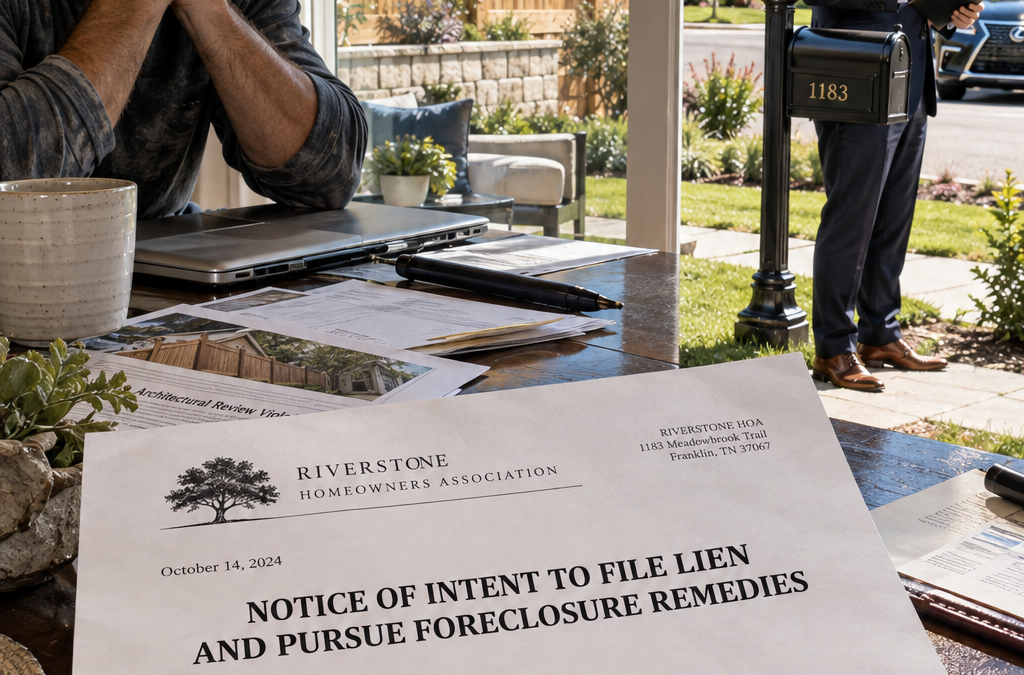
The foreclosure notice had her signature at the bottom and my address at the top. Three months earlier, all I had done was build a fence in my own backyard.
The letter arrived on a Tuesday, folded inside a certified envelope that felt too stiff in my hands.
I had just come in from trimming the hedge along the driveway, still wearing old work gloves and a shirt damp with sweat. The mail carrier had left the envelope on the kitchen table after I signed for it at the door, and for some reason I knew before I opened it that whatever was inside would not be ordinary.
Maple Ridge Estates Homeowners Association.
That name sat in the upper left corner like a warning.
I tore the envelope open with my thumb.
The first line made my hands start shaking.
Notice of Intent to File Lien and Pursue Foreclosure Remedies.
I read it once.
Then again.
Then a third time, because my mind refused to accept the words in front of me.
The HOA was no longer just fining me.
They were threatening to take my house.
The notice claimed I owed unpaid fines, late fees, administrative charges, compliance penalties, and collection costs tied to multiple property violations. If I failed to pay within thirty days, Maple Ridge Estates would proceed against my home.
My home.
The house I had bought eleven years earlier.
The house where I had replaced the kitchen floor myself.
The house where I had planted two maples in the front yard after my father died because he always said a man should leave shade for people he might never meet.
The house where my daughter had learned to ride a bicycle in the cul-de-sac before she grew up and moved two states away.
The house I had paid for through years of long shifts, side jobs, careful saving, and refusing to take vacations I probably needed.
And now Deborah Whitfield, a woman who smiled at me every morning near the mailboxes, had put my home in danger over a fence.
At least, that was what she wanted everyone to believe.
I lowered myself into the kitchen chair and spread the notice flat on the table.
The room was quiet except for the refrigerator humming and the soft tick of the wall clock above the pantry door.
Outside, a lawn mower started somewhere down the street.
Normal sounds.
Normal neighborhood.
But nothing felt normal anymore.
Three months earlier, all I had done was plant a hedge and build a fence.
That was the beginning.
Or at least, that was the beginning I could see.
The real beginning had probably happened long before I ever questioned Deborah in public.
My name is Clark Mercer, and I bought my house on Maple Ridge Court eleven years before Deborah tried to take it.
Back then, Maple Ridge Estates was different.
The HOA fees were forty dollars a month.
The board meetings were boring.
Nobody measured the angle of a mailbox flag or argued over whether a shutter was charcoal, slate, or smoke gray.
The old HOA president, Mr. Albright, mostly cared about keeping the pool clean and making sure people didn’t park broken-down cars in their driveways for six months.
If your grass got too tall, he gave you a friendly reminder.
If your trash bin sat out an extra day, someone might mention it while walking a dog.
It felt like a neighborhood, not a courtroom.
Then Deborah Whitfield became HOA president.
She ran unopposed the first time.
Most people thought that was lucky.
Nobody else wanted the headache.
Deborah was organized, energetic, and always willing to volunteer for committees other people avoided. She wore crisp blouses, pearl earrings, and sunglasses that seemed permanently fixed on her face even on cloudy mornings. She drove a white Lexus with a vanity plate that read RULES1.
At first, people joked about it.
Then they stopped joking.
Deborah treated the community bylaws like scripture, except she believed she was the only person qualified to interpret them.
She walked the neighborhood with a leather binder tucked under her arm and a phone ready in her hand. She sent notices that sounded polite but read like threats. She corrected people in meetings with a smile that made you feel as though you had disappointed an elementary school principal who secretly enjoyed detention.
By her second year as president, people had started lowering their voices when her Lexus turned the corner.
By her third year, nobody ran against her.
By her fourth, she had become the board.
Technically, there were other members.
Practically, there was Deborah.
I stayed away from the drama for years.
I paid my dues.
Kept my lawn trimmed.
Replaced the roof when hail damaged it.
Didn’t complain about the pool fee increase.
Didn’t argue when the board changed the mailbox design.
Didn’t ask questions when the landscaping budget doubled.
I had enough going on in my life.
Work.
Family.
Repairs.
The ordinary fatigue of adulthood.
I didn’t need to become one of those people who fought with the HOA over every bush and fence post.
Then I decided to build a wooden privacy fence along my backyard.
The back of my property bordered a narrow common area path that cut between two streets. When I bought the house, the path didn’t get much use. Over the years, more residents started walking dogs there, and teenagers used it as a shortcut in the evenings.
I didn’t mind people walking.
I minded feeling watched every time I sat on my own back patio.
I also wanted to plant a hedge along the inside of the fence to soften the view. Nothing dramatic. Just a row of green shrubs, a cedar fence, and some peace.
Before I started, I read the bylaws three times.
Height restrictions.
Setback requirements.
Architectural review.
Permitted structures.
The documents said backyard privacy fences could be up to six feet tall. They had to be maintained, structurally sound, and consistent with community appearance.
Nothing said wood was prohibited.
Nothing said cedar was prohibited.
Nothing required vinyl.
I still submitted an architectural request because I didn’t want trouble.
I included the contractor’s drawing, materials list, height, location, and photographs of similar fences in the neighborhood.
No response came for thirty days.
Under the version of the rules I had, if the board failed to respond within thirty days, the request was deemed approved.
So I built it.
Six feet tall.
Cedar.
Straight lines.
Clean posts.
No garish stain.
Nothing visible from the street except a small section near the side gate.
It looked good.
Better than the warped chain-link section it replaced.
For three days, I enjoyed my backyard again.
On the fourth day, Deborah’s first citation arrived.
Unauthorized Fence Materials.
Fine amount: two hundred dollars.
Her initials sat at the bottom.
D.W.
I stood in my kitchen holding the notice and laughed.
That was my first mistake.
People like Deborah don’t hear laughter as disbelief.
They hear it as disrespect.
I called the HOA office.
Deborah answered personally.
“Maple Ridge Estates. Deborah speaking.”
“This is Clark Mercer on Maple Ridge Court. I received a citation about my fence.”
“Yes, Clark.”
Her voice was smooth.
Almost friendly.
“I submitted the application. The board didn’t respond within thirty days. Under the bylaws, that means approval.”
“The board determined the materials are inconsistent with community standards.”
“I used cedar.”
“We prefer vinyl.”
“The bylaws don’t say vinyl is required.”
“The bylaws give the board discretion to preserve visual harmony.”
I looked out the kitchen window at the fence.
“Can you point me to the section banning wood fences?”
There was a brief pause.
“Clark, the issue is not whether one specific word appears. The issue is whether the improvement conforms to the overall standards of Maple Ridge Estates.”
“That sounds like no.”
Her voice cooled slightly.
“I would advise you to correct the violation rather than debate language.”
I should have pushed harder.
Instead, I paid the two hundred dollars.
I told myself I was buying quiet.
It was only money.
The fence mattered more than being right.
I thought payment would close the matter.
It wasn’t even the beginning.
Within a month, new letters piled up.
Mailbox flag angle.
Garden gnome obstructing sight lines.
Grass allegedly half an inch too tall.
Improper hedge placement.
Exterior hose visibility.
Unauthorized landscaping alteration.
Each notice was slightly more absurd than the last.
Each one had Deborah’s initials at the bottom.
Each one demanded a check.
The garden gnome nearly made me lose my mind.
It was a small stone gnome my daughter had bought me as a joke when she was sixteen. She’d found it at a flea market, painted the hat blue, and placed it beside my walkway. He had been sitting there for nearly eight years.
According to Deborah, he obstructed sight lines.
From what?
Ants?
I called again.
Deborah answered again.
“Your decorative figure is positioned within a regulated visibility zone.”
“Deborah, it’s twelve inches tall.”
“Community standards apply regardless of size.”
“It’s been there for years.”
“Longevity does not equal compliance.”
“Can you show me the rule?”
“You have access to the bylaws.”
“I’ve read them.”
“Then you should understand them.”
That was Deborah’s gift.
She could say something insulting without ever raising her voice.
I began keeping copies of everything.
At first, it was just irritation.
A folder in my desk.
Fine notices.
Envelopes.
Payment receipts.
Photos of my yard.
Copies of the fence application.
Screenshots of the bylaws.
Then I started logging dates.
When I received a letter.
When it was postmarked.
What rule Deborah cited.
Whether the rule actually appeared in the documents.
A habit, nothing more.
One that would later save my house.
At the next board meeting, I asked Deborah in public to point out the exact bylaw section banning wood fences.
The clubhouse room was half full.
Maybe twenty residents.
A few board members sat behind the folding table at the front.
Deborah sat in the center with her binder open, sunglasses pushed up onto her head.
When homeowner questions began, I stood.
“I’d like clarification on fence materials.”
Deborah smiled.
“Of course, Clark.”
“My cedar fence was cited as using unapproved materials. I’ve reviewed the bylaws and can’t find any provision banning wood. Could you identify the exact section?”
She opened her binder.
Flipped a page.
Then another.
The room stayed quiet.
Thirty seconds passed.
A minute.
She stopped flipping and looked up.
“The board’s interpretation is based on the broader architectural harmony standards.”
“That’s not what I asked.”
Her smile tightened.
“Clark, individual enforcement matters are not appropriate for prolonged discussion during general meetings.”
“It affects every homeowner if the board is enforcing rules that aren’t written down.”
A few people shifted in their chairs.
Deborah’s fingers tightened around her pen.
“The board will review your concern.”
Then she moved to the next agenda item.
After the meeting, I walked into the parking lot feeling half angry, half embarrassed.
That was when my neighbor Priya caught up with me.
Priya Shah lived three houses down.
She was an accountant, widowed, direct, and not easily impressed. She had served briefly on a budget committee years earlier before resigning after what she called “strategic incompetence disguised as governance.”
She touched my arm near my truck.
“Clark.”
I turned.
“You handled that better than most.”
“That didn’t feel like handling it.”
She glanced toward the clubhouse door.
“Deborah doesn’t answer questions she can’t control.”
“I noticed.”
Priya lowered her voice.
“She did this to the Hendersons two years ago.”
“The Hendersons?”
“They lived on Cedar Bend.”
“I remember them. They moved.”
Priya looked at me carefully.
“They didn’t just move. They sold at a loss.”
I frowned.
“Why?”
“Deborah placed a lien on their home over a disputed six-hundred-dollar fine.”
I stared at her.
“What was the violation?”
“Satellite dish angle. Then landscaping. Then paint. Then late fees. It kept growing.”
“Did they fight it?”
“They tried.”
“What happened?”
“They ran out of money and patience before she ran out of paper.”
The phrase stayed with me.
Before she walked away, Priya said one more thing.
“Be careful, Clark. Once Deborah decides you’re a problem, she doesn’t correct behavior. She applies pressure.”
That night, I searched old property listings.
The Henderson house had indeed sold below market value.
Quickly.
Too quickly.
At the time, I had assumed they moved for work or family reasons. Now I wondered whether they had fled.
A week later, I requested the HOA’s financial records.
Every homeowner had the right to review certain association documents under state law and the HOA’s own bylaws. I requested budgets, bank statements, fine revenue, reserve fund reports, contracts, special assessment records, and board vote minutes for the past three years.
Deborah stalled.
First, she said the request needed board review.
No such process appeared in the bylaws.
Then she said the records were being compiled.
Then that the treasurer was unavailable.
Then that certain documents were confidential.
I kept every email.
Every delay.
Every explanation.
When the records finally arrived, they were incomplete.
Pages missing.
Minutes without attachments.
Vendor payments summarized without invoices.
And one column in the expense ledger labeled simply:
Miscellaneous Community Expenses — $10,874.62
No vendor.
No description.
No supporting paperwork.
Nearly eleven thousand dollars floating in a vague category while Deborah fined me over a gnome.
At the next meeting, I mentioned it.
“I have a question about the financial records,” I said.
Deborah’s smile appeared before I finished the sentence.
“Financial questions should be submitted in writing.”
“I did submit them in writing. The records I received were incomplete.”
Her smile did not move.
“What specifically concerns you?”
“There’s a miscellaneous expense category totaling nearly eleven thousand dollars with no supporting detail.”
The room shifted.
Deborah lifted her coffee mug.
Her knuckles went white around the handle.
“The treasurer can provide clarification at the appropriate time.”
“When is that?”
“When the board completes its internal review.”
“There’s no internal review procedure for a basic records request.”
Deborah set the mug down carefully.
“Clark, your misunderstanding of association procedure does not create misconduct.”
There it was again.
That polished insult.
But this time, something in her face had changed.
She wasn’t just annoyed.
She was worried.
Two days later, a new fine appeared in my account.
Eight hundred dollars.
Unauthorized landscaping alteration.
The fence again.
Except this time, it had been recoded under a different violation category.
The notice stated that failure to pay could result in lien action.
A week after that, the lien threat arrived.
Pay within thirty days, or the HOA would file against my property.
I sat at my kitchen table holding the notice and felt genuine fear settle into my bones.
Until that moment, part of me still believed Deborah was just abusing process.
Annoying.
Petty.
Power hungry.
But a lien was different.
A lien attached to the house.
A lien could lead to legal fees.
Credit damage.
Foreclosure pressure.
I had watched the Hendersons vanish.
I understood now how it happened.
Not one dramatic blow.
A thousand small cuts.
Fine.
Late fee.
Letter.
Threat.
Lien.
Exhaustion.
Sale.
I didn’t sleep that night.
I kept walking from room to room.
Kitchen.
Living room.
Hallway.
Bedroom.
Office.
I touched the door frame where I had marked my daughter’s height when she was younger. I stood in the backyard looking at the cedar fence that had started all this. I stared at the gnome near the walkway and wondered whether an object that silly could really become evidence in a fight over my home.
By morning, I knew I needed help.
That was when I hired Renata Cole.
Renata was a real estate attorney who specialized in HOA disputes.
She was in her early forties, sharp-eyed, direct, and clearly enjoyed a good fight when the facts were on her side.
Her office was small but orderly, with file boxes stacked neatly behind her desk and a framed newspaper article on the wall about a homeowners association she had defeated in court three years earlier.
I brought my folder.
She read through everything without speaking.
Fence application.
Bylaws.
Fine notices.
Financial record requests.
Incomplete ledgers.
Lien threat.
Emails.
Photos.
When she finished, she looked up.
“Clark, this is not just about your fence.”
“I know.”
“No. I mean legally. The pattern matters.”
She tapped the lien notice.
“This is leverage.”
“Can they take my house?”
“They can try to create enough pressure that you pay or leave. Whether they can lawfully enforce this is another matter.”
I leaned forward.
“What do we do?”
Her answer was simple.
“We request every fine issued in the past three years, sorted by homeowner, violation type, board vote record, and resolution.”
“Will they give that to us?”
“They may resist.”
“And if they do?”
Renata smiled faintly.
“Then they document their resistance.”
Her first formal records demand went out that afternoon.
Deborah did not respond personally this time.
The HOA’s secretary sent a message acknowledging receipt and saying the board would comply as required.
That told me Deborah had already realized the situation had changed.
When the fine records arrived, Renata built a spreadsheet.
Names.
Dates.
Violation categories.
Fine amounts.
Disputes.
Board votes.
Outcomes.
The pattern stopped us cold.
Nearly sixty percent of contested fines had gone to homeowners who had recently disagreed with Deborah publicly at meetings or in the community forum.
People who asked about dues.
People who questioned contracts.
People who opposed rule amendments.
People who criticized the board’s spending.
Then Renata cross-referenced property sales.
Three of those homeowners had sold under pressure.
The Hendersons.
The Waller family.
A retired couple named Margaret and Paul Devlin.
All three homes sold quickly.
All three below comparable neighborhood value.
All three were later purchased through an LLC called Courtline Residential Holdings.
Renata traced the LLC’s registered agent.
Gary Whitfield.
Deborah’s brother-in-law.
I remember staring at the paperwork in Renata’s office.
The name was printed plainly.
No dramatic hidden clue.
No secret code.
Just there.
Gary Whitfield.
Renata folded her hands.
“Your fence was never the real problem.”
I sat back slowly.
“She’s clearing out homeowners.”
“That appears to be the pattern.”
“And buying through her family.”
“Through an LLC connected to her brother-in-law.”
“To flip the houses?”
“That’s what we need to investigate.”
I thought about the Hendersons.
About Priya whispering in the parking lot.
About Deborah smiling at me every morning near the mailbox.
“She wanted me gone.”
“She wanted you compliant first,” Renata said. “Gone if necessary.”
I looked down at the lien notice.
The fear was still there.
But now it had company.
Rage.
We requested a forensic audit of the HOA accounts under state disclosure law, citing irregular financial records, suspicious fine patterns, incomplete expense categories, and potential conflicts involving properties purchased through a family-connected LLC.
The board was spooked.
For once, Deborah didn’t control the vote.
Maybe the other members were tired.
Maybe they finally saw the danger.
Maybe they realized that once an attorney started connecting fines, sales, and missing money, silence could become liability.
Whatever the reason, they approved the audit.
Everyone except Deborah.
She suddenly discovered she had family obligations and stopped attending meetings.
That was almost funny.
The woman who had spent years attending every inspection, every committee session, every violation hearing, and every budget discussion now could not make time to defend the records.
A funny thing happened during audit preparation.
The clubhouse locksmith mentioned something offhand to Priya.
He had come to change a storage closet lock because the auditor needed access to old files. While working, he said Deborah had asked him months earlier to duplicate keys “for storage access.”
Priya asked what storage.
The locksmith shrugged.
“Some unit she said the board was using.”
There was no storage unit in the budget.
No contract.
No board approval.
No record.
Nobody could explain what Deborah had supposedly stored or why she needed duplicate keys.
Priya told Renata.
Renata told the auditor.
Two weeks later, the auditor found the bigger problem.
Over thirty thousand dollars in special assessments had been collected from residents for community improvement projects that never appeared in any contract, vendor invoice, or completed work record.
Thirty thousand dollars.
No project.
No vendor.
No accounting trail that made sense.
Just money collected under the authority of the HOA and disappearing into fog.
I still had the lien deadline hanging over me.
The audit was underway, but Deborah’s enforcement action had not vanished.
Renata filed for an emergency injunction, arguing that the lien threat was based on disputed and potentially fraudulent fines, issued as part of a retaliatory enforcement pattern, while the HOA itself was under financial investigation.
The hearing felt like holding my breath underwater.
Deborah did not appear personally.
The HOA’s attorney tried to frame the matter as a simple unpaid assessment issue.
Renata calmly walked the judge through the fence application, the missing bylaw language, the recoded violation, the fine pattern, the LLC connection, and the ongoing audit.
The judge granted a temporary hold.
The lien could not move forward while the court reviewed the underlying claims.
For the first time in months, I slept through the night.
Not perfectly.
Not peacefully.
But without waking at three in the morning imagining a foreclosure notice on my door.
Deborah didn’t go quietly.
People like Deborah never do.
She called an emergency board meeting and insisted the audit was a personal vendetta orchestrated by disgruntled homeowners.
Meaning me.
The clubhouse was packed that night.
Standing room only.
Residents who hadn’t attended a meeting in years showed up with folders, letters, old notices, and expressions that said they had finally realized this wasn’t someone else’s problem.
Deborah sat at the front table.
No sunglasses this time.
Her hair was perfect.
Her blouse was immaculate.
But she looked thinner somehow.
Sharper.
Like a blade worn down by overuse.
She opened with a prepared statement.
She said the audit was unnecessary.
She said the board had always acted in good faith.
She said certain homeowners were weaponizing legal processes to avoid compliance.
Then Priya stood.
“I’d like to read my own fine history.”
Deborah’s face tightened.
“Priya, this meeting has an agenda.”
Priya ignored her.
She read from the first notice.
Then the second.
Then the third.
She explained that each one arrived after she questioned budget increases.
Another neighbor stood after her.
Then another.
Then another.
The pattern became undeniable in real time.
Ask a question.
Receive a fine.
Dispute a charge.
Receive three more.
Request records.
Get threatened.
Residents who had whispered for years began speaking publicly.
Deborah tried to interrupt.
Her voice cracked.
“You don’t understand how hard this job is.”
For one brief second, I almost felt sorry for her.
Almost.
Then Renata stood.
She connected her laptop to the projector.
The screen lit up.
Courtline Residential Holdings LLC.
Registered agent: Gary Whitfield.
Purchase history.
Henderson property.
Waller property.
Devlin property.
Dates.
Sale prices.
Resale prices.
The room went dead silent.
Renata didn’t embellish.
She didn’t need to.
“This LLC is connected to Ms. Whitfield’s brother-in-law,” she said. “It purchased multiple homes from owners who had been subject to contested HOA fines and lien pressure.”
Deborah stood too quickly.
“This is private business information.”
Renata looked at her.
“It became relevant when your enforcement practices aligned with those purchases.”
Someone in the back whispered, “Oh my God.”
The board members stared at the screen as if seeing Deborah clearly for the first time.
The state HOA oversight office arrived the following week.
They subpoenaed full financial records.
Bank accounts.
Assessment records.
Vendor invoices.
Board minutes.
Fine ledgers.
Property-related communications.
The association’s accounts were frozen pending review.
That move shook Maple Ridge harder than any fine letter Deborah had ever sent.
Suddenly, everyone understood this was no longer a neighborhood squabble.
It was a state investigation.
The audit revealed the final twist.
Deborah had forged two board members’ signatures on special assessment approvals.
Not sloppy initials.
Not a misunderstanding.
Signatures.
On documents authorizing charges tied to the missing thirty thousand dollars.
That changed everything.
Forgery was not an ethics violation.
It was a felony.
Within forty-eight hours, Deborah was removed from the board.
The vote was unanimous.
Even members who had defended her for years raised their hands.
I sat in the back row watching it happen.
Deborah wasn’t there.
For years, she had ruled every meeting from the center of the table.
Now her name was being erased from authority while her chair sat empty.
My lien was dismissed entirely.
The temporary hold became permanent as part of the legal resolution.
The disputed fines were voided.
The HOA issued a written apology.
Every fine tied to my fence, mailbox, gnome, grass, and recoded landscaping violation was refunded.
When the apology arrived, I read it twice.
It was formal.
Carefully worded.
Probably written by an attorney terrified of saying too much.
But one line mattered.
The association acknowledges that enforcement against Mr. Mercer was not supported by proper procedure and has been withdrawn in full.
I placed the letter beside the lien notice.
One threatened my home.
The other admitted the threat should never have been made.
Deborah tried one last move.
She came to my door on a Sunday afternoon.
I saw the white Lexus pull up before she knocked.
The vanity plate still read RULES1.
She stood on my porch wearing a pale green blouse, no clipboard, no sunglasses.
Without those things, she looked smaller.
Still composed, but strained.
When I opened the door, she smiled.
“Clark.”
I lifted my phone.
Recording.
Her smile faltered.
“What are you doing?”
“Documenting.”
She inhaled slowly.
“I was hoping we could speak privately.”
“No.”
Her eyes hardened.
“This has gone too far.”
“Yes,” I said. “It has.”
“I made mistakes.”
“You forged signatures.”
Her face flushed.
“That has not been adjudicated.”
“You put a lien threat on my house over fines you couldn’t justify.”
“I was trying to protect the community.”
“No. You were trying to control it.”
She looked past me into the house.
For years, that might have worked.
The implied inspection.
The reminder that she was watching.
This time, I didn’t move.
“Leave,” I said.
Her mouth tightened.
“You should be careful, Clark.”
I almost laughed.
Even now.
Even standing on my porch with an investigation closing around her, she could not resist one more warning.
I held up the phone slightly.
“You should be too.”
She turned and walked away.
That was the last time Deborah Whitfield came to my door.
Two months later, the district attorney filed formal charges.
Fraud.
Forgery.
Misappropriation of association funds.
Gary Whitfield’s LLC was named as a co-defendant in the civil action connected to the property scheme.
The Hendersons came forward.
Their sworn statement became the anchor of the prosecution’s case.
I read part of it later.
They described the first fine.
Then the second.
Then the lien notice.
The pressure.
The fear.
The decision to sell because they could not keep fighting.
Mrs. Henderson wrote that she had cried in the driveway on moving day because she felt like she had failed her family.
That sentence stayed with me.
Deborah had done that.
Not with a weapon.
Not with a shouted threat.
With paper.
Policy.
Deadlines.
Fees.
Smiles.
At the sentencing hearing months later, I watched Deborah walk out in handcuffs for probation intake after pleading down to a lesser charge.
She did not look at me.
Her pearl earrings were gone.
So were the sunglasses.
For once, nobody in the room was waiting for her interpretation of the rules.
As part of the resolution, she lost the right to serve on any HOA board in the state for life and was ordered to pay restitution.
It wasn’t everything some people wanted.
People always imagine justice as a lightning strike.
In real life, it often looks like paperwork, negotiated pleas, restitution schedules, and quiet consequences that arrive slowly.
But Deborah was no longer president.
No longer in control of our homes.
No longer able to turn a gnome into a weapon.
That mattered.
My fence still stands.
Six feet tall.
Cedar.
Unbothered.
The hedge I planted inside it has grown thick and green.
The garden gnome remains near the walkway, though someone placed a tiny cardboard sign beside him after the final board meeting.
APPROVED MATERIALS.
I still don’t know who did it.
Every neighbor on Maple Ridge Court waves at that fence now like it’s a monument.
Maybe it is.
Not to me.
To what happens when people stop letting one person define the truth.
We elected Priya as the new HOA president.
Her first meeting was nothing like Deborah’s.
No sunglasses.
No threats.
No binder treated like holy text.
She opened by saying, “The board works for the homeowners. Not the other way around.”
People applauded for nearly a minute.
Then she did something nobody expected.
She brought out the old fine log.
The original one Deborah had used to track violations, late fees, and enforcement notes.
Priya had received permission to destroy obsolete copies after the records were digitized and preserved for the investigation.
She carried the old paper log to the clubhouse fire pit.
Residents gathered outside.
Someone brought marshmallows as a joke.
Priya opened the cover, looked at all of us, and said, “May the next board use less paper and more common sense.”
Then she dropped it into the flames.
People cheered.
I did too.
Maybe it was symbolic.
Maybe it was ridiculous.
But as the edges curled and blackened, I thought about every letter I had opened with a knot in my stomach.
Every person who had paid because they were afraid.
Every family that had left.
Every question Deborah punished.
The fire did not erase what happened.
Nothing could.
But it marked the end of something.
Later that night, I stood in my backyard, listening to the quiet behind the cedar fence.
No letters on the table.
No lien deadline.
No board president watching from a Lexus.
Just the hedge rustling lightly in the wind.
I thought about the Tuesday the foreclosure notice arrived.
The way my hands shook.
The way I believed, for one terrifying moment, that a woman smiling at the mailbox might actually take my house.
She almost did.
That was the truth.
Had I paid and stayed quiet, she would have kept going.
Had Priya not warned me, I might have dismissed the Hendersons as old neighborhood gossip.
Had Renata not traced the LLC, Deborah’s pattern might have remained hidden beneath polite language and official forms.
That was the lesson Maple Ridge learned the hard way.
Abuse does not always announce itself with cruelty.
Sometimes it arrives as a rule reminder.
A fine.
A board vote.
A letter with your name spelled correctly and your address printed at the top.
Sometimes the person trying to take your home smiles at you every morning and asks how your day is going.
My house is still mine.
My fence still stands.
And every time I see that white gnome beside the walkway, I remember how close I came to letting embarrassment keep me quiet.
I do not laugh off fines anymore.
I do not assume official paper is honest simply because it looks formal.
And I do not believe anyone who says, “Rules are rules,” unless they can show me the rule.
Maple Ridge Court is quieter now.
Not silent.
Better than silent.
People talk again.
They ask questions.
They attend meetings.
They disagree without fearing a lien notice will appear the next week.
That is what Deborah never understood.
A good neighborhood is not one where everyone obeys the loudest clipboard.
It is one where power can be questioned without punishment.
And if anyone forgets that, all they have to do is walk past my backyard.
The cedar fence will remind them.








