𝗙𝗨𝗟𝗟 𝗦𝗧𝗢𝗥𝗬 The HOA President Showed Up at My New Lake House With a Stack of Rules and Never Checked the One Document That Mattered
𝗙𝗨𝗟𝗟 𝗦𝗧𝗢𝗥𝗬
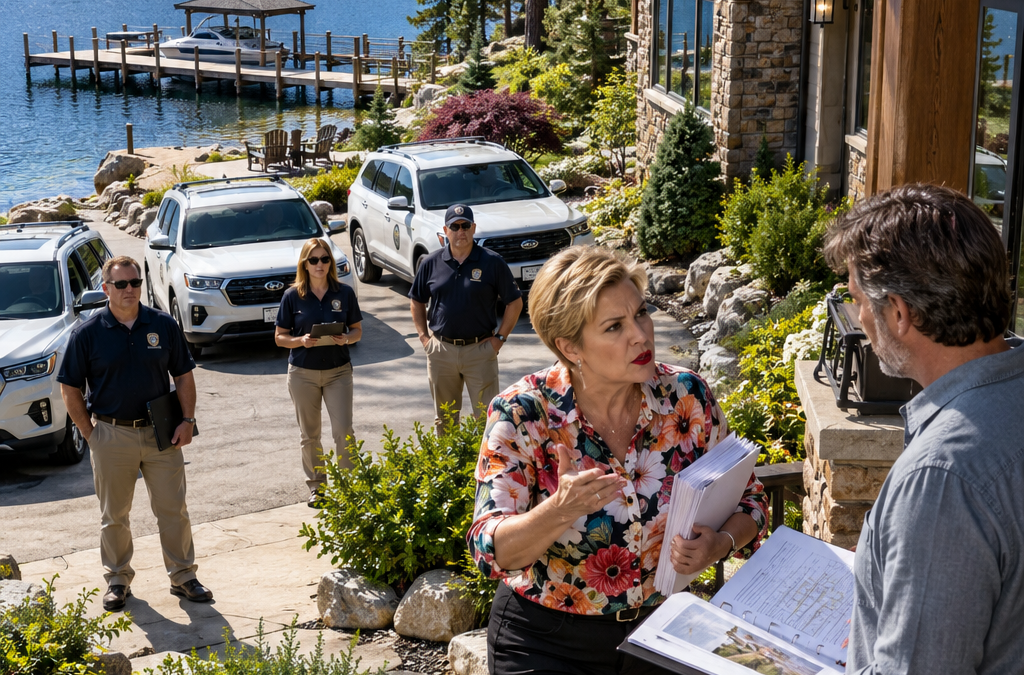
Three vehicles stopped near the house.
White SUV.
Gray crossover.
Pickup truck.
Doors opened.
Five people got out.
Two women.
Three men.
All carrying either folders, clipboards, or tablets.
That combination rarely means someone has arrived to welcome you.
The woman in front wore dark slacks and a navy jacket.
She had a thick folder tucked under one arm.
She began walking toward the lake.
The others followed.
I stepped off the dock.
“Morning.”
She gave me a professional smile.
“You must be Jake Carter.”
“Depends who’s asking.”
That was probably more defensive than necessary.
She didn’t seem bothered.
“Linda Hayes. President of Lakeshore Heights Homeowners Association.”
I nodded.
I’d seen the HOA name in documents.
Our parcel bordered the association and shared certain road-related obligations, but the closing attorney had been very clear that the waterfront tract attached to our house had its own recorded rights.
Linda introduced the others.
Board treasurer.
Architectural committee member.
Property manager.
Maintenance representative.
I forgot names almost immediately.
Five HOA representatives standing in my yard before breakfast was enough information.
Linda looked toward the dock.
“We need to discuss the lake.”
I picked up my coffee.
“What about it?”
“Your use of the waterfront.”
That got my attention.
“My use?”
“Specifically the dock.”
I looked behind me.
The dock had existed for years.
Nothing about it had changed overnight except the identity of the owner.
“What problem is there with the dock?”
Linda opened the folder.
“Lakeshore Heights manages all waterfront facilities within the community.”
“Okay.”
“That includes maintenance, access, safety compliance, and resident use.”
I waited.
She waited too, apparently expecting agreement.
“So what exactly do you want from me?”
Her expression changed slightly.
“We need acknowledgment that the dock remains under HOA management.”
“Remains?”
“Correct.”
“According to what?”
The treasurer shifted his weight.
Linda kept her eyes on me.
“The HOA has always managed the docks.”
“All of them?”
“Within the community waterfront area.”
“And you’re saying mine is part of that?”
“Yes.”
I looked at the dock.
Then back at her.
“That’s not what my closing documents say.”
Linda smiled as though she had expected that.
“There are sometimes misunderstandings during property transfers.”
“About ownership?”
“About lake rights.”
“That’s a fairly large misunderstanding.”
She opened the folder.
Pulled out a community map.
It showed the shoreline divided into colored areas.
Several docks were numbered.
My dock appeared to fall inside a section shaded as HOA-managed lakefront.
But the map didn’t look like a recorded survey.
No metes and bounds.
No surveyor’s seal.
No legal description.
It looked like a community planning map.
“Where did this come from?”
“Our association records.”
“Is it recorded?”
“It’s the map we use.”
“That isn’t what I asked.”
One of the men looked down.
Linda’s smile tightened.
“Mr. Carter, no one is trying to create difficulty on your first week here.”
“Good.”
“We just need to make sure you understand the existing system.”
“I’d like to.”
“Then there shouldn’t be a problem.”
“There won’t be once I see the document giving the HOA authority over this dock.”
Her expression cooled.
“The community has managed it for years.”
“Managing something and owning it are different things.”
She paused.
“Nobody said anything about ownership.”
“You told me my use of my dock is under HOA control.”
“It’s community-managed.”
“Then show me why.”
Silence.
Not long.
But enough.
Linda closed the folder.
“Perhaps you should review your closing materials.”
“I have.”
“Review them again.”
That irritated me.
She said it the way a teacher might tell a student he’d missed an obvious instruction.
“Fine.”
I turned toward the house.
“Give me a few minutes.”
I went inside.
Emily was awake now.
She stood in the kitchen wearing one of my old sweatshirts.
“Why are there five strangers in our yard?”
“HOA.”
Her face fell.
“Already?”
“Apparently they manage our dock.”
“No, they don’t.”
“I know.”
She walked toward the window.
Linda and the others had gathered near the shoreline.
One man pointed toward the dock.
Another toward a neighboring parcel.
They were discussing something among themselves.
Emily looked at me.
“Did you show them the paperwork?”
“That’s what I’m getting.”
Our closing files were still in a plastic storage crate labeled IMPORTANT—DO NOT PUT ON MOVING TRUCK.
One of my better decisions.
I pulled out the binder.
Deed.
Survey.
Title report.
Then the waterfront documents.
I sat at the kitchen table.
Emily stood behind me.
“Here.”
I pointed.
Private waterfront rights appurtenant to parcel.
Dock identified by location.
Exclusive use language.
Maintenance obligations assigned to owner.
Then I found the original survey.
The parcel ran all the way to the shoreline.
The dock attachment point sat inside our boundary.
There was also an older agreement referenced in the title materials.
I had read it before closing but hadn’t focused on every detail.
It described several docks built during an earlier phase of lakefront development.
Certain structures had been maintained collectively even though the underlying shoreline parcels remained privately controlled.
There was the source of confusion.
Maintenance.
Not blanket ownership.
The HOA had apparently spent years treating historical maintenance arrangements as proof that every dock fell under its authority.
I looked at Emily.
“This is going to be annoying.”
“Are we okay?”
“Yes.”
“Are you sure?”
I tapped the survey.
“Very.”
She smiled.
“Go enjoy yourself.”
“I don’t enjoy arguing.”
“You alphabetized our closing documents.”
“That was practical.”
“You are going to enjoy this.”
I took the survey outside.
Linda and the others were now standing near the dock.
One of the men had stepped onto it.
“Please step off for a minute.”
He looked surprised.
Then at Linda.
Then back at me.
I kept my voice calm.
“I’d like to understand who’s asserting what before anyone treats this as common property.”
He stepped off.
Good.
I placed the documents on the patio table.
“Let’s start again.”
Linda folded her arms.
“Fine.”
“What exactly is the HOA claiming?”
“That waterfront docks within Lakeshore Heights are managed through the association.”
“Managed how?”
“Maintenance standards, access, safety, repairs, resident use.”
“Does the HOA claim ownership of this shoreline?”
“No.”
“Ownership of my dock?”
She hesitated.
“Community authority over it.”
“Where?”
She tapped her map.
I slid my survey beside it.
“This is recorded.”
She looked down.
“My parcel boundary runs here.”
I traced it.
“The dock connects here.”
Then I opened the waterfront rights section.
“Exclusive private waterfront rights associated with this property.”
Linda read silently.
The treasurer leaned over.
One of the other representatives asked:
“Is that the current title package?”
“Closed yesterday.”
He looked toward Linda.
She ignored him.
“That language may be subject to the historic dock agreement.”
“Good.”
I opened that too.
“You mean this?”
Now everyone moved closer.
I read the relevant section.
Historical maintenance coordination.
Shared standards for certain structures.
Access conditions tied to specific docks.
Nothing granting the HOA universal control over every dock.
Nothing transferring my dock.
Nothing granting general resident access through my waterfront.
Linda took the document from me.
She read longer than before.
I watched her expression.
At first, certainty.
Then concentration.
Then irritation.
Not necessarily at me.
At the paper.
“This needs legal review.”
“That’s fine.”
“We shouldn’t make assumptions.”
I almost laughed.
Five HOA representatives had arrived at my house before eight in the morning based entirely on one.
But I let that go.
“I agree.”
She closed the folder.
“Until the board reviews this, don’t make modifications to the dock.”
“I’m not planning any.”
“And don’t interfere with existing access.”
“What existing access?”
She looked toward the others.
“Resident use.”
“No.”
Her eyes came back to me.
“No?”
“No one uses this dock until we establish whether they have a recorded right.”
“Mr. Carter—”
“You came here telling me the HOA controls it. I’m showing you documents suggesting otherwise. I’m not going to let more assumptions become facts while everyone reviews the paperwork.”
Her voice became sharper.
“The community has used docks around this lake for decades.”
“Maybe.”
“Restricting access could create unnecessary conflict.”
“So could sending five people onto a new homeowner’s waterfront without checking the deed.”
That landed.
Nobody spoke.
Linda gathered her papers.
“We’ll discuss this tonight.”
“Tonight?”
“I’m calling an emergency board meeting.”
“Good.”
She turned to leave.
Then stopped.
“I hope you’re willing to cooperate with the community.”
“I am.”
“That doesn’t sound like cooperation.”
“It is if the rules are real.”
She walked away.
The vehicles left.
Emily came outside.
She handed me my coffee.
Cold.
“How bad?”
“Emergency meeting.”
“That seems dramatic.”
“I bought the house yesterday.”
“Maybe this is the welcome package.”
I laughed despite myself.
Then I looked at the dock.
The peace I had felt forty minutes earlier was gone.
That bothered me more than the argument.
I hadn’t bought the property to become the man fighting with an HOA over maps.
I bought it because Emily and I wanted a quieter life.
Now, less than a day into it, strangers were debating access to the one feature that made the house feel special.
I told myself something my father used to say.
Don’t argue harder than the documents require.
So I waited.
The emergency meeting was scheduled for seven that evening.
The clubhouse sat about half a mile from our house.
It was nicer than I expected.
Stone exterior.
Large windows facing the lake.
Meeting room with folding chairs.
About thirty residents attended.
More than I expected for a dock dispute.
Word travels quickly near water.
Emily came with me.
“Backup?”
“Moral support.”
“Same thing.”
Linda sat at the front with the board.
Her folder was now joined by several larger binders.
That told me someone had spent the afternoon looking.
Good.
I carried the original survey and copies of every relevant closing document.
Linda called the meeting to order.
“This special session concerns waterfront access and dock management following the transfer of the Carter property.”
Transfer.
At least she wasn’t calling me uncooperative yet.
Then she continued.
“Mr. Carter has raised questions regarding the association’s historical authority over a dock adjacent to his parcel.”
Historical authority.
Interesting phrasing.
One board member asked:
“Do we have counsel on the line?”
A speakerphone sat in the middle of the table.
An attorney introduced herself.
Linda looked toward me.
“Mr. Carter, would you like to explain your position?”
“My position is mostly a map.”
A few people laughed.
That helped.
I stood.
Unrolled the survey.
Placed it on the table.
People leaned forward.
“This is the recorded survey included in my closing package.”
I traced the parcel.
“House.”
Then the shoreline.
“Property boundary.”
Then the dock.
“This dock attaches entirely within the private waterfront section assigned to my parcel.”
A resident asked:
“But doesn’t the HOA own the docks?”
“That’s the question.”
Linda started to answer.
I raised one hand.
“Let me show you the second document.”
I opened the historical agreement.
“This appears to be why people think that.”
The document went back years.
Certain docks had originally been built or maintained under a cooperative arrangement involving the developer and then the HOA.
But not all docks were identical.
Some were common.
Some served designated parcels.
Some involved shared maintenance but private access.
The agreements were annoyingly specific.
Exactly what good property documents should be.
I read the relevant sections.
The room grew quieter.
One older resident raised his hand.
“I’ve lived here twenty-three years.”
Linda acknowledged him.
He looked at me.
“Your dock used to belong to the Harrison place.”
“That’s what the chain of title says.”
“Nobody used that dock except the Harrisons.”
That mattered.
“Ever?”
“Not that I remember.”
Another woman spoke.
“I thought all the maintenance came from our dues.”
The treasurer opened one of his binders.
“Not exactly.”
Everybody looked at him.
He seemed reluctant to continue.
“Some docks were historically billed individually.”
Linda turned.
“Which ones?”
He flipped pages.
“Dock twelve. Fourteen. Seventeen.”
“Which is Carter’s?”
He checked.
“Seventeen.”
The room became noticeably still.
Emily squeezed my hand beneath the table.
There it was.
Not a dramatic revelation.
A maintenance ledger.
Boring paperwork.
The best kind.
The treasurer continued.
“The previous owner was assessed separately for dock maintenance.”
Linda looked at him.
“Why wasn’t that in the waterfront summary?”
“I don’t know.”
The attorney on speakerphone asked:
“Can someone provide the current recorded access agreement number?”
The property manager gave it.
The attorney searched.
A few minutes passed.
Nobody spoke.
Finally:
“I’m looking at the recorded instrument now.”
Linda sat straighter.
The attorney continued.
“It does not appear to create blanket HOA access to every dock.”
Someone whispered:
“Oh.”
“The agreement distinguishes between common facilities and parcel-associated docks.”
Linda asked:
“What about management authority?”
“There may be maintenance standards depending on the structure, but that is not the same as a general right of use.”
Exactly.
Managing something and owning it were two different things.
So were maintaining and accessing.
I didn’t say it.
I didn’t need to.
Linda looked at my documents again.
For the first time since I’d met her, she wasn’t preparing her next answer.
She was reading.
That made a difference.
I explained calmly:
“I’m not trying to shut down anyone’s lake access.”
A woman near the back asked:
“Then why stop people using your dock?”
“Because I moved in yesterday and five HOA representatives arrived this morning telling me the dock was under association control. Before I accept that, I want the recorded rights understood.”
She nodded.
Fair enough.
I continued.
“If residents have access through an agreement, I’ll respect it. If the dock is private, I expect that to be respected too.”
Linda looked toward me.
“That sounds reasonable.”
The tone had changed completely.
Not friendly.
Professional.
Enough.
The board voted to pause any enforcement related to my dock while counsel reviewed the full record.
I agreed not to make structural modifications without notice until the review was complete.
That was easy.
I had no plans to tear anything apart.
By nine, the meeting ended.
On the walk home, Emily said:
“You look disappointed.”
“I am.”
“Why?”
“No yelling.”
She laughed.
“I knew you enjoyed it.”
“I did not.”
“The maintenance ledger made your whole face light up.”
“That’s because evidence is beautiful.”
“You’re deeply strange.”
We walked the rest of the way holding hands.
The next morning, I returned to the dock.
Same coffee.
Different feeling.
I checked everything more carefully than before.
The pilings.
Connection point.
Shoreline markers.
Neighboring docks.
I began to understand why the confusion had developed.
From the water, all the docks looked like part of one system.
Same basic construction.
Similar railings.
Similar spacing.
If you didn’t know the recorded arrangements, you’d assume they were managed together.
Some were.
Some weren’t.
The physical landscape hid the legal distinctions.
That meant the problem wasn’t simply Linda being aggressive.
The records themselves had been poorly summarized over time.
One board copied a map from the previous board.
Management produced simplified diagrams.
New residents received condensed rules.
Twenty years later, nuance vanished.
By noon, I had decided what I wanted.
Not victory.
Clarity.
If our dock was private, mark it correctly.
If any historical access existed, write it clearly.
If maintenance standards applied, identify them.
If neighboring residents needed passage through specific shoreline areas, define where.
No assumptions.
That afternoon, Linda returned.
Only two people with her this time.
The treasurer and property manager.
No parade of vehicles.
No confrontational folder.
She stopped at the edge of the yard.
“Do you have a minute?”
“Sure.”
She held up copies.
“We pulled the recorded documents.”
“Good.”
“Would you mind walking the boundary with us?”
That question alone made the conversation different.
Would you mind?
Not:
We manage this.
Not:
You need to cooperate.
I got the survey.
Emily watched from the porch.
We started at the northern corner marker.
The property manager had brought a measuring wheel.
We matched the survey to the physical shoreline.
Marker.
Tree line.
Retaining wall.
Dock location.
Linda looked at the map.
Then at the land.
“So this entire section is yours.”
“According to the survey.”
“And the community shoreline path begins there.”
“Yes.”
She pointed toward a narrow strip farther east.
“What about this?”
“Recorded common access.”
The treasurer checked.
“He’s right.”
Linda sighed.
“Apparently we’ve been explaining this badly for a long time.”
“Apparently.”
We walked to the dock.
“This is dock seventeen,” I said.
She nodded.
“Parcel-associated.”
“Yes.”
“Maintenance standards still apply.”
“According to the agreement.”
“But not resident access.”
“Not that I can find.”
The property manager agreed.
Linda looked across the lake.
“I owe you an apology for yesterday morning.”
I didn’t expect that so quickly.
“I should have checked these records before coming over.”
“That would’ve helped.”
She gave me a tired look.
“I deserved that.”
“Probably.”
The treasurer laughed.
Linda ignored him.
“I believed our summary map was accurate.”
“I believe you.”
“You do?”
“Yes.”
That seemed to surprise her.
I continued.
“The problem wasn’t being wrong. The problem was arriving with five people and treating your assumption like an established right.”
She looked down at the dock boards.
“Fair.”
That was enough for me.
We kept walking.
Once the emotional part disappeared, the practical problems became obvious.
Several shoreline areas had old arrangements nobody could explain without reading documents.
A walkway crossed near private property.
One launching area had mixed rights.
Two docks apparently shared a maintenance agreement but not access.
Years of simplified rules had blurred everything.
Linda said:
“We may need to review every waterfront parcel.”
“You probably should.”
“That’s going to be a nightmare.”
“Better now than after someone sues you.”
She gave me another look.
“Also fair.”
The board met again two days later.
This time, the tone was almost technical.
Good.
They had assembled:
Recorded surveys.
Dock schedules.
Maintenance ledgers.
Access agreements.
Developer documents.
Recent HOA maps.
The contradictions were obvious.
Not necessarily fraud.
Not intentional theft.
Mostly bad recordkeeping and assumptions repeated until they sounded official.
I attended with Emily.
The board attorney joined by video.
Linda began:
“We need a waterfront access clarification plan.”
No accusation.
No refusal to cooperate.
Progress.
I proposed something simple.
Every dock gets classified.
Private parcel dock.
Shared-access dock.
Common HOA dock.
For each:
Who owns the shoreline?
Who maintains the structure?
Who may use it?
What recorded document supports that?
The attorney liked it.
The property manager liked it less because it created work.
That was not my problem.
Then we discussed my property.
Dock seventeen.
Private parcel-associated waterfront structure.
Owner responsibility subject to general safety standards.
No community right of use.
No HOA right of entry except limited circumstances defined by the agreement, such as approved maintenance coordination or emergency safety issues.
That solved almost everything.
One resident asked:
“What if somebody needs to use the dock in an emergency?”
The attorney answered:
“Actual emergencies are different from recreational access.”
Exactly.
Another asked whether the HOA could inspect structural safety.
According to the older agreement, limited inspection rights existed if conditions threatened adjacent common areas.
Fine.
I wasn’t trying to create a fortress.
I was trying to stop assumed recreational access.
Linda asked:
“Would you object to a small private-dock marker?”
“No.”
“What wording?”
I thought.
“PRIVATE DOCK — ACCESS BY OWNER PERMISSION.”
She nodded.
“No HOA logo.”
Emily whispered:
“Definitely no HOA logo.”
I smiled.
The board approved development of a formal waterfront access plan.
Not only for me.
For the entire lake.
That was better than I had expected.
A conflict that started at my driveway was forcing the HOA to clean up decades of vague documentation.
Sometimes that is the useful part of a dispute.
It reveals where everybody has been surviving on assumptions.
The following week, draft maps circulated.
Color-coded this time, but tied to actual recorded documents.
Green.
Community access.
Blue.
Shared.
Gray.
Private.
Dock seventeen:
Private.
Clear.
No argument.
The HOA also updated its resident handbook.
The old sentence:
All lake docks are managed by the Association.
Became:
Lakefront facilities are subject to ownership, access, and maintenance rights established by recorded parcel documents and applicable association agreements. Residents must verify access classification before using a dock not designated as common.
Longer.
Less elegant.
Much better.
Emily read it over my shoulder.
“That’s extremely boring.”
“Exactly.”
“You’re happy about that.”
“Very.”
“You bought a lake house and found joy in footnotes.”
“Good documents prevent bad mornings.”
She couldn’t argue with that.
A few weeks after moving in, life finally began feeling normal.
I learned the names of neighbors.
Some had watched the early confrontation and assumed I was trying to privatize something communal.
Once the maps were corrected, most understood.
An older couple named Frank and Carol lived two houses east.
Frank came by one evening.
“Mind if I ask something?”
“Sure.”
“Did Linda really tell you all the docks belonged to the HOA?”
“Pretty much.”
He laughed.
“She’s never been shy.”
“So I’ve noticed.”
He looked toward my dock.
“I used that thing once about fifteen years ago.”
“Oh?”
“Harrison invited me.”
That distinction mattered.
Invited.
Not community right.
“Catch anything?”
“Nothing.”
“Then I’m sorry the tradition continues.”
He laughed.
After that, Frank occasionally waved from his kayak.
Never pulled up without asking.
Exactly how neighbors should behave.
The tension with Linda faded too.
We weren’t friends.
Didn’t need to be.
But our communication changed.
Instead of:
The HOA requires…
Her emails began:
The recorded agreement indicates…
That was improvement.
One afternoon, a storm damaged part of the common shoreline path near my property.
Linda emailed:
Jake, the maintenance crew may need temporary access near the northern edge of your parcel to reach the damaged section. The recorded map does not show HOA access across that area. Would you permit entry Tuesday between 8:00 and noon?
Perfect.
I replied:
Yes. Please have the crew check in before entering.
Nothing more.
Tuesday morning, the crew arrived.
Called first.
Used the edge of my property.
Repaired the path.
Left.
No argument.
Permission did not weaken ownership.
It made cooperation possible.
That became the larger lesson of the entire conflict.
The first morning, Linda acted as though respecting private property would somehow undermine the community.
The opposite was true.
Once everyone knew which areas were private, shared, or common, cooperation became easier.
People stopped wondering.
The HOA stopped overreaching.
Owners stopped becoming defensive.
A line clearly drawn creates less conflict than a line everybody pretends isn’t there.
Emily noticed something else.
One evening, we sat at the end of the dock.
Same folding chairs from the first night, because apparently buying actual dock furniture remained below unpacking boxes on our priority list.
She looked toward the neighboring docks.
“Funny.”
“What?”
“The lake doesn’t care.”
I smiled.
“About what?”
“All those lines.”
She gestured.
“The water looks the same.”
“That’s because boundaries are for people.”
“Exactly.”
She took a drink.
“We spent three weeks arguing over invisible lines.”
“Recorded invisible lines.”
“Of course.”
I laughed.
She leaned against me.
“Still worth moving here?”
I looked at the mountains.
“Ask me after the first HOA assessment.”
She groaned.
“Jake.”
“Yes.”
“Completely.”
Months passed.
The access plan became formal policy.
Not new ownership.
Just clear administration of existing rights.
Every lakefront owner received a parcel-specific summary.
The HOA retained records supporting each classification.
Residents could request copies.
The old simplified waterfront map was retired.
That made me happier than it should have.
Linda came to our house one last time specifically to close out the issue.
No board entourage.
No folder thick enough to stop a bullet.
Just an envelope.
She stood on the porch.
“Final access plan.”
I opened it.
Dock seventeen.
Private.
Shoreline rights.
Owner access.
Maintenance notes.
Recorded document references.
Everything correct.
“Looks good.”
She nodded.
“I wanted to give it to you personally.”
“Thanks.”
She looked toward the lake.
“Can I tell you something?”
“Sure.”
“When you asked me that first morning to show you the document giving us authority, I thought you were being difficult.”
“I probably was.”
“No.”
She shook her head.
“You were asking the only question I should’ve asked before coming here.”
I said nothing.
“I inherited that waterfront map from the previous president. She inherited it from somebody before her. I never checked the underlying records.”
“Most people don’t until something breaks.”
“This almost broke.”
“Almost.”
She looked embarrassed.
“I told the board you were refusing to cooperate.”
“I know.”
“You were actually asking us to prove what we were saying.”
“That’s usually a good idea.”
She smiled.
“I’m aware now.”
I handed the access plan back.
She shook her head.
“Keep it.”
“Obviously.”
She laughed.
“I forgot who I was talking to.”
I put it with the rest of the property file.
Of course.
After she left, Emily came downstairs.
“What did Karen want?”
“To give us the final agreement.”
“Everything okay?”
I held up the envelope.
“Paperwork finally did the talking.”
Emily smiled.
“Your favorite language.”
“Very reliable.”
That evening, we walked down to the dock.
The sunset turned the lake copper.
A fishing boat crossed in the distance.
Families sat on common shoreline farther down.
A couple launched kayaks from an HOA dock.
Nobody used ours.
Nobody complained.
The community had not collapsed because one dock became clearly private.
That’s the absurd part of property conflicts.
People sometimes treat one boundary clarification as though it threatens everybody.
Usually, clarity simply tells people where to go instead.
Residents who wanted public dock access used the common docks.
Those with shared arrangements used the areas designated for them.
Private owners controlled their own structures.
The lake remained busy.
The mountain remained in the same place.
Civilization survived.
I eventually installed proper chairs at the end of our dock.
Emily chose them.
I assembled them incorrectly the first time.
She reminded me of that often.
On Saturday mornings, I began bringing coffee down again.
The first morning after the final plan was recorded, I sat in one of those chairs and listened.
Birds.
Water.
Nothing else.
The peace I had wanted from the beginning finally returned.
But it felt different.
More valuable.
Before the HOA dispute, I assumed peace meant nobody bothering me.
Afterward, I understood peace often depends on people knowing exactly what they are allowed to do.
Good boundaries aren’t hostile.
They’re preventive maintenance.
I had spent years in project management before buying that house.
Most failures I saw at work didn’t begin with malicious people.
They began with unclear responsibility.
Everyone assumes someone else checked.
Everyone thinks one team owns a task.
Nobody reads the original specification.
Then something breaks.
Property disputes are often the same.
Linda wasn’t secretly plotting to steal my dock.
She had bad information.
But bad information paired with authority becomes dangerous quickly.
That first morning, she had five people in my yard because nobody stopped to verify the source.
That’s why I never forgot what she told me months later.
I thought you were being difficult.
People with authority sometimes confuse requests for evidence with resistance.
That’s where problems grow.
Someone says:
Show me the rule.
The authority hears:
I refuse to obey.
Those are not the same thing.
If the rule exists, show it.
If the ownership exists, record it.
If the access right exists, identify it.
Nothing is weakened by verification unless it was never real.
A year after we moved in, Lakeshore Heights held its annual community meeting.
Emily convinced me to attend.
“Why?”
“Because you live here.”
“We aren’t even under every HOA covenant.”
“You still share the roads and lake issues.”
“That sounds dangerously reasonable.”
We went.
The waterfront access plan appeared in the annual report.
Zero disputes that year.
That caught my attention.
Linda was still president.
She stood at the front.
“We completed the waterfront record audit.”
She looked toward me briefly.
“That project began after a discrepancy involving one of our lakefront transfers.”
Discrepancy.
A diplomatic word for five people in my driveway.
She continued.
“We found that several historical summaries did not adequately distinguish ownership, maintenance, and access.”
Good.
She didn’t blame the prior board.
Didn’t blame me.
Didn’t pretend nothing happened.
“All lake facilities are now cross-referenced to recorded agreements.”
A resident asked:
“Why didn’t we do that before?”
Linda smiled slightly.
“Because sometimes organizations keep using documents long after they’ve forgotten to verify them.”
That was a good answer.
I respected it.
After the meeting, an older board member approached me.
“You’re Jake?”
“Yes.”
“I’ve heard about dock seventeen.”
“I hope that’s not my permanent identity.”
He laughed.
“No. I wanted to thank you.”
“For what?”
“Making us do the audit.”
“I didn’t exactly volunteer.”
“Still.”
He looked toward Linda.
“Nobody likes discovering they’re wrong.”
“No.”
“Especially publicly.”
“Definitely not.”
“She handled it better than most.”
I agreed.
Because she had.
That mattered.
People love stories where the arrogant HOA president is exposed, removed, humiliated, sued, arrested, whatever ending makes the audience feel justice.
Life doesn’t always need that.
Sometimes the person is wrong.
They check.
They admit it.
They improve the system.
That is a successful ending too.
Maybe better.
Linda remained assertive.
I doubt anything could change that.
But after the dock dispute, she started carrying source documents to meetings.
If someone challenged a rule, she identified the covenant.
If an access question came up, the board checked the recorded agreement.
A resident joked once:
“Jake trained you.”
Linda looked across the room at me.
“No.”
Then she smiled.
“Jake annoyed us into reading.”
Fair.
Emily laughed so loudly several people turned around.
Years later, the house still feels like home.
The dock has needed repairs.
The first winter loosened two boards.
A storm took out a section of railing.
I replaced it according to the applicable maintenance requirements.
Not because Linda told me to.
Because the agreement actually required safe construction.
That’s another distinction.
I never wanted freedom from every rule.
I wanted rules tied to legitimate authority.
There is a difference between:
You can’t do that because I said so.
And:
You agreed to this recorded standard when you purchased the property.
The second one doesn’t bother me.
I signed it.
Know your obligations.
Know your rights.
Respect both.
One summer afternoon, a new family moved into a house across the cove.
The father paddled over with his teenage son.
They slowed near my dock.
“Is this one common?”
He asked before touching it.
“No. Private.”
“Got it.”
He pointed farther east.
“Common one around the corner?”
“Yes.”
“Thanks.”
They paddled away.
Five seconds.
That was the whole interaction.
I watched them go and thought about the first morning.
Five representatives.
Folders.
Emergency meeting.
Weeks of document review.
Now the system worked so well that a stranger could ask one question and receive one answer.
That’s what good records do.
They turn arguments into information.
Emily came down the dock carrying lemonade.
“What are you smiling at?”
“Nothing.”
“That’s suspicious.”
“The access plan worked.”
She stared at me.
“You are smiling because strangers didn’t use our dock.”
“I’m smiling because they knew enough to ask.”
“You need hobbies.”
“I live on a lake.”
“Normal hobbies.”
I took the glass.
“This counts.”
She sat beside me.
The mountains reflected in the water.
Somewhere downshore, children jumped from a common dock.
A boat started.
Someone laughed.
Our dock remained quiet.
Our little piece.
Their little pieces.
Shared lake.
Different rights.
No contradiction.
I think that was the thing Linda and I both had to learn in different ways.
Community does not require pretending ownership doesn’t matter.
Respecting one person’s private dock does not damage everybody else’s enjoyment of the lake.
In fact, it strengthens the system.
Because people cooperate more easily when cooperation is voluntary and clearly defined.
Assumptions create resentment.
Permission creates relationships.
Records preserve them.
My father would have liked that.
He died years before Emily and I bought the house, but I thought about him often during the dispute.
Especially his warning.
If property involves a fence, driveway, waterline, access road, dock, or shared feature, somebody will eventually remember the arrangement differently.
He was right.
Again.
The day we signed the closing papers, I had imagined the survey as protection against some future stranger.
I didn’t expect the future to arrive the next morning.
But when it did, the paper worked exactly as intended.
Not as a weapon.
A reference.
Linda had one story.
The HOA manages all docks.
I had another.
This dock belongs with my property.
Neither story mattered until we opened the records.
Once we did, the conflict became solvable.
I keep the original survey framed now.
Not prominently.
Emily refused to let me hang a giant property map in the living room.
Fair.
It hangs in my office.
Small frame.
Black border.
Every once in a while, somebody asks why.
“Sentimental?”
“In a way.”
The survey reminds me of our first morning.
Coffee.
Lake.
Three vehicles.
Linda walking toward me with documents.
Me wondering whether I had misunderstood the most expensive purchase of my life.
Then opening the file and realizing uncertainty disappears quickly when the right records exist.
That is a good feeling.
Not triumph.
Ground beneath your feet.
The closing documents did more than establish ownership.
They prevented me from reacting emotionally.
Without them, I might have shouted.
Threatened lawyers.
Locked the dock.
Assumed Linda was trying to steal something.
Instead, I could say:
Show me your document.
Here’s mine.
Let’s compare.
That kept the conflict smaller than it might have become.
It also gave Linda room to correct herself without being destroyed.
That matters if you actually have to live near people afterward.
Victory is less useful when the person you defeat remains three houses away.
Resolution is better.
The final written access plan remains in effect.
It has survived new residents.
Board elections.
Management changes.
One new HOA president called me several years later.
“Mr. Carter, I’m reviewing shoreline facilities.”
I almost laughed.
Here we go again.
Then she said:
“Your dock is classified private, maintenance standards only, no general association access. I’m confirming that’s still accurate.”
“Yes.”
“Thank you.”
Thirty seconds.
She had read the records first.
Progress.
That night, I told Emily.
She smiled.
“Your life’s work is complete.”
“Apparently.”
“Can you relax now?”
“No.”
“Of course not.”
I walked down to the dock.
The same lake.
The same mountain line.
Different chair.
A few more gray hairs.
I sat with a cup of coffee even though it was evening.
Bad habit.
Good view.
I thought about how fragile peace can feel when you first get something you value.
You buy a place.
Move in.
Look at the water.
Think:
Mine.
Not mine in the sense of owning the whole world.
Mine in the sense of responsibility.
This is where I will take care of things.
This is where my life happens now.
When Linda arrived the first morning, the threat wasn’t really the dock.
It was uncertainty.
Had I misunderstood?
Had my attorney missed something?
Did the HOA possess rights hidden somewhere in decades of agreements?
Was the peaceful home Emily and I had just purchased already tangled in a dispute?
For a few minutes, I genuinely didn’t know.
That’s what made me angry.
The answer was sitting in a binder.
Private waterfront rights.
Recorded survey.
Historic dock agreement.
The truth had existed before either Linda or I began arguing.
All we needed to do was read it.
That is the lesson I carried from the entire experience.
Not that HOAs are always wrong.
Not that homeowners are always right.
Not that every dispute needs a lawyer.
Something simpler.
Before you make a demand, find the document.
Before you surrender a right, find the document.
Before you accuse someone of violating access, find the document.
Before you tell a new homeowner that the dock behind his house belongs to everybody, definitely find the document.
Memory is useful.
Tradition is useful.
Community practice is useful.
None of them should replace recorded facts when ownership is at stake.
Linda learned that.
I learned something too.
Being right does not require turning the other person into an enemy.
She arrived badly.
I reacted cautiously.
The documents corrected the problem.
We built a better system.
Then life continued.
That’s more valuable than revenge.
The lake behind our house is still my favorite place.
Most Saturday mornings, I wake early.
Make coffee.
Walk down the same path.
Birds.
Gentle waves.
Sometimes I fish.
Sometimes I don’t.
Emily occasionally joins me, though she insists fishing is just “sitting near water while pretending to have a task.”
She’s not entirely wrong.
Every once in a while, someone paddles past.
They wave.
I wave.
Nobody steps onto the dock without permission.
Nobody needs to.
There are plenty of common areas now clearly marked on the updated lake map.
Everything works.
Peace doesn’t always come from eliminating rules.
Sometimes it comes from finally knowing which ones are real.
On the first evening after the access plan was completed, Emily and I stood at the end of the dock as the sun disappeared behind the mountains.
She asked:
“Does it feel like home again?”
I looked toward the house.
Then across the water.
“Yeah.”
“Finally?”
“Finally.”
She slipped her hand into mine.
The whole conflict had started because people assumed control based on history.
It ended because everyone stopped assuming and read the records.
No dramatic lawsuit.
No ruined neighborhood.
No revenge.
Just boundaries.
Permission.
Paper.
And a lake quiet enough that I could hear water moving under the dock again.
That was all I had wanted when I bought the place.
And once everybody understood what belonged to whom, I finally had it.
𝗧𝗛𝗘 𝗘𝗡𝗗
The HOA President Showed Up at My New Lake House With a Stack of Rules and Never Checked the One Document That Mattered
I had owned my lakefront home for less than twenty-four hours when three HOA vehicles rolled into my driveway and the president informed me that the dock outside my back door was under her authority.
I had spent nearly everything I was willing to spend for that view, so before I surrendered a single foot of shoreline, I went back inside and opened the closing file everyone else had apparently forgotten existed.
My name is Jake Carter, and when Emily and I first pulled into that driveway, I thought the difficult part of moving was finally over.
We had spent months looking for a place.
Not just a house.
A place.
There is a difference.
A house can satisfy a checklist.
Three bedrooms.
Two bathrooms.
Garage.
Good roof.
Reasonable taxes.
A place does something else.
You stand there and imagine your life continuing inside it.
That was what happened the first time Emily and I saw the lake.
The road curved downhill through tall pines before opening toward the water.
The house itself sat on a narrow lakefront parcel with enough elevation that the main windows looked directly across the surface toward the mountains.
There was a small private dock extending from the western shoreline.
Not fancy.
Weathered boards.
Two tie posts.
A little bench near the end.
Exactly what I wanted.
Emily walked through the back door during our first showing and stopped.
I almost walked into her.
“Jake.”
“What?”
She pointed.
The whole lake filled the window.
Late-afternoon light moved across the surface.
Mountains rose beyond it.
No highway.
No shopping center.
No apartment building staring back at us.
Just water.
“I know,” I said.
“No, you don’t.”
She smiled.
“This is it.”
I laughed.
“You said that about the place with the stone fireplace.”
“The stone fireplace had a freeway behind it.”
“True.”
“And the kitchen was terrible.”
“You hated the cabinets.”
“They were orange.”
“They were wood.”
“They were orange wood.”
I looked at the lake again.
“You’re right.”
That became our new home.
The purchase wasn’t cheap.
Lakefront property rarely is.
But we were careful.
Our agent knew the question I asked about everything.
What exactly do we own?
I didn’t care about glossy brochures describing “exclusive lakeside living.”
I wanted parcel boundaries.
Recorded rights.
Dock permits.
Shoreline access.
Road maintenance obligations.
Anything that could become an argument later.
My father had spent much of his life in construction, and he taught me something that stuck.
If property involves a fence, driveway, waterline, access road, dock, or shared feature, assume somebody will eventually remember the arrangement differently.
Get it on paper.
So I did.
The closing package was thick enough to stop a door.
Deed.
Title report.
Property survey.
Waterfront rights.
Dock documentation.
Older access agreement.
Plat map.
Disclosure forms.
I read everything.
Emily made fun of me.
“You’ve read the dock agreement three times.”
“Four.”
“Why?”
“Because someday somebody will tell me the dock isn’t mine.”
She laughed.
That joke stopped being funny very quickly.
We moved in on a Thursday.
By the time the moving truck left, both of us were exhausted.
Boxes sat everywhere.
The dining room looked like a warehouse.
Half the kitchen was still wrapped in paper.
But before sunset, Emily and I carried two folding chairs down to the dock.
We had no proper outdoor furniture yet.
Didn’t matter.
She brought two glasses of wine.
I brought the bottle because neither of us felt like walking back to the house.
We sat facing the water.
“This feels unreal,” she said.
“It feels expensive.”
She nudged me with her shoulder.
“Don’t ruin it.”
“I’m serious.”
“We can afford it.”
“I know.”
“You checked.”
“Many times.”
She smiled.
“Then stop calculating.”
I tried.
The lake helped.
There was almost no wind.
A pontoon boat crossed far from shore.
Somewhere down the lake, children were laughing.
A heron stood motionless near reeds on the opposite side.
Emily put her head against my shoulder.
“We’re actually here.”
“Yeah.”
“Our house.”
“Our ridiculous mortgage.”
“Jake.”
“Sorry.”
She laughed.
The sun dropped behind the mountain.
For the first time in months, I felt the tension of buying, signing, packing, negotiating, inspecting, and moving begin to leave my body.
This was home now.
The next morning, I woke earlier than Emily.
Partly excitement.
Partly the fact that none of our curtains had been installed and sunlight hit me directly in the face at six.
I made coffee.
Found a mug in the one kitchen box we’d labeled correctly.
Then walked down to the dock.
That first morning remains one of my favorite memories of the property.
No meetings.
No paperwork.
No contractors.
No moving boxes.
Birds in the trees.
Soft waves against the dock supports.
Coffee steam in the cool air.
I stood at the end of the dock looking across the water and thought:
I get to wake up here.
Maybe that sounds sentimental.
I didn’t care.
I had spent enough years waking to alarm clocks, traffic, neighbors above me, neighbors below me, parking garages, and construction noise.
I wanted stillness.
I got approximately twenty minutes of it.
Then I heard engines.
More than one.
At first, I assumed residents were leaving for work.
The neighborhood road passed behind our parcel and connected several homes farther along the shore.
But the vehicles slowed.
One turned into our driveway.
Then another.
Then a third.
I set the coffee down.
Three vehicles stopped near the house.
White SUV.
Gray crossover.
Pickup truck.
Doors opened.
Five people got out.
Two women.
Three men.
All carrying either folders, clipboards, or tablets.
That combination rarely means someone has arrived to welcome you.
The woman in front wore dark slacks and a navy jacket.
She had a thick folder tucked under one arm.
She began walking toward the lake.
The others followed.
I stepped off the dock.
“Morning.”
She gave me a professional smile.
“You must be Jake Carter.”
“Depends who’s asking.”
That was probably more defensive than necessary.
She didn’t seem bothered.
“Linda Hayes. President of Lakeshore Heights Homeowners Association.”
I nodded.
I’d seen the HOA name in documents.
Our parcel bordered the association and shared certain road-related obligations, but the closing attorney had been very clear that the waterfront tract attached to our house had its own recorded rights.
Linda introduced the others.
Board treasurer.
Architectural committee member.
Property manager.
Maintenance representative.
I forgot names almost immediately.
Five HOA representatives standing in my yard before breakfast was enough information.
Linda looked toward the dock.
“We need to discuss the lake.”
I picked up my coffee.
“What about it?”
“Your use of the waterfront.”
That got my attention.
“My use?”
“Specifically the dock.”
I looked behind me.
The dock had existed for years.
Nothing about it had changed overnight except the identity of the owner.
“What problem is there with the dock?”
Linda opened the folder.
“Lakeshore Heights manages all waterfront facilities within the community.”
“Okay.”
“That includes maintenance, access, safety compliance, and resident use.”
I waited.
She waited too, apparently expecting agreement.
“So what exactly do you want from me?”
Her expression changed slightly.
“We need acknowledgment that the dock remains under HOA management.”
“Remains?”
“Correct.”
“According to what?”
The treasurer shifted his weight.
Linda kept her eyes on me.
“The HOA has always managed the docks.”
“All of them?”
“Within the community waterfront area.”
“And you’re saying mine is part of that?”
“Yes.”
I looked at the dock.
Then back at her.
“That’s not what my closing documents say.”
Linda smiled as though she had expected that.
“There are sometimes misunderstandings during property transfers.”
“About ownership?”
“About lake rights.”
“That’s a fairly large misunderstanding.”
She opened the folder.
Pulled out a community map.
It showed the shoreline divided into colored areas.
Several docks were numbered.
My dock appeared to fall inside a section shaded as HOA-managed lakefront.
But the map didn’t look like a recorded survey.
No metes and bounds.
No surveyor’s seal.
No legal description.
It looked like a community planning map.
“Where did this come from?”
“Our association records.”
“Is it recorded?”
“It’s the map we use.”
“That isn’t what I asked.”
One of the men looked down.
Linda’s smile tightened.
“Mr. Carter, no one is trying to create difficulty on your first week here.”
“Good.”
“We just need to make sure you understand the existing system.”
“I’d like to.”
“Then there shouldn’t be a problem.”
“There won’t be once I see the document giving the HOA authority over this dock.”
Her expression cooled.
“The community has managed it for years.”
“Managing something and owning it are different things.”
She paused.
“Nobody said anything about ownership.”
“You told me my use of my dock is under HOA control.”
“It’s community-managed.”
“Then show me why.”
Silence.
Not long.
But enough.
Linda closed the folder.
“Perhaps you should review your closing materials.”
“I have.”
“Review them again.”
That irritated me.
She said it the way a teacher might tell a student he’d missed an obvious instruction.
“Fine.”
I turned toward the house.
“Give me a few minutes.”
I went inside.
Emily was awake now.
She stood in the kitchen wearing one of my old sweatshirts.
“Why are there five strangers in our yard?”
“HOA.”
Her face fell.
“Already?”
“Apparently they manage our dock.”
“No, they don’t.”
“I know.”
She walked toward the window.
Linda and the others had gathered near the shoreline.
One man pointed toward the dock.
Another toward a neighboring parcel.
They were discussing something among themselves.
Emily looked at me.
“Did you show them the paperwork?”
“That’s what I’m getting.”
Our closing files were still in a plastic storage crate labeled IMPORTANT—DO NOT PUT ON MOVING TRUCK.
One of my better decisions.
I pulled out the binder.
Deed.
Survey.
Title report.
Then the waterfront documents.
I sat at the kitchen table.
Emily stood behind me.
“Here.”
I pointed.
Private waterfront rights appurtenant to parcel.
Dock identified by location.
Exclusive use language.
Maintenance obligations assigned to owner.
Then I found the original survey.
The parcel ran all the way to the shoreline.
The dock attachment point sat inside our boundary.
There was also an older agreement referenced in the title materials.
I had read it before closing but hadn’t focused on every detail.
It described several docks built during an earlier phase of lakefront development.
Certain structures had been maintained collectively even though the underlying shoreline parcels remained privately controlled.
There was the source of confusion.
Maintenance.
Not blanket ownership.
The HOA had apparently spent years treating historical maintenance arrangements as proof that every dock fell under its authority.
I looked at Emily.
“This is going to be annoying.”
“Are we okay?”
“Yes.”
“Are you sure?”
I tapped the survey.
“Very.”
She smiled.
“Go enjoy yourself.”
“I don’t enjoy arguing.”
“You alphabetized our closing documents.”
“That was practical.”
“You are going to enjoy this.”
I took the survey outside.
Linda and the others were now standing near the dock.
One of the men had stepped onto it.
“Please step off for a minute.”
He looked surprised.
Then at Linda.
Then back at me.
I kept my voice calm.
“I’d like to understand who’s asserting what before anyone treats this as common property.”
He stepped off.
Good.
I placed the documents on the patio table.
“Let’s start again.”
Linda folded her arms.
“Fine.”
“What exactly is the HOA claiming?”
“That waterfront docks within Lakeshore Heights are managed through the association.”
“Managed how?”
“Maintenance standards, access, safety, repairs, resident use.”
“Does the HOA claim ownership of this shoreline?”
“No.”
“Ownership of my dock?”
She hesitated.
“Community authority over it.”
“Where?”
She tapped her map.
I slid my survey beside it.
“This is recorded.”
She looked down.
“My parcel boundary runs here.”
I traced it.
“The dock connects here.”
Then I opened the waterfront rights section.
“Exclusive private waterfront rights associated with this property.”
Linda read silently.
The treasurer leaned over.
One of the other representatives asked:
“Is that the current title package?”
“Closed yesterday.”
He looked toward Linda.
She ignored him.
“That language may be subject to the historic dock agreement.”
“Good.”
I opened that too.
“You mean this?”
Now everyone moved closer.
I read the relevant section.
Historical maintenance coordination.
Shared standards for certain structures.
Access conditions tied to specific docks.
Nothing granting the HOA universal control over every dock.
Nothing transferring my dock.
Nothing granting general resident access through my waterfront.
Linda took the document from me.
She read longer than before.
I watched her expression.
At first, certainty.
Then concentration.
Then irritation.
Not necessarily at me.
At the paper.
“This needs legal review.”
“That’s fine.”
“We shouldn’t make assumptions.”
I almost laughed.
Five HOA representatives had arrived at my house before eight in the morning based entirely on one.
But I let that go.
“I agree.”
She closed the folder.
“Until the board reviews this, don’t make modifications to the dock.”
“I’m not planning any.”
“And don’t interfere with existing access.”
“What existing access?”
She looked toward the others.
“Resident use.”
“No.”
Her eyes came back to me.
“No?”
“No one uses this dock until we establish whether they have a recorded right.”
“Mr. Carter—”
“You came here telling me the HOA controls it. I’m showing you documents suggesting otherwise. I’m not going to let more assumptions become facts while everyone reviews the paperwork.”
Her voice became sharper.
“The community has used docks around this lake for decades.”
“Maybe.”
“Restricting access could create unnecessary conflict.”
“So could sending five people onto a new homeowner’s waterfront without checking the deed.”
That landed.
Nobody spoke.
Linda gathered her papers.
“We’ll discuss this tonight.”
“Tonight?”
“I’m calling an emergency board meeting.”
“Good.”
She turned to leave.
Then stopped.
“I hope you’re willing to cooperate with the community.”
“I am.”
“That doesn’t sound like cooperation.”
“It is if the rules are real.”
She walked away.
The vehicles left.
Emily came outside.
She handed me my coffee.
Cold.
“How bad?”
“Emergency meeting.”
“That seems dramatic.”
“I bought the house yesterday.”
“Maybe this is the welcome package.”
I laughed despite myself.
Then I looked at the dock.
The peace I had felt forty minutes earlier was gone.
That bothered me more than the argument.
I hadn’t bought the property to become the man fighting with an HOA over maps.
I bought it because Emily and I wanted a quieter life.
Now, less than a day into it, strangers were debating access to the one feature that made the house feel special.
I told myself something my father used to say.
Don’t argue harder than the documents require.
So I waited.
The emergency meeting was scheduled for seven that evening.
The clubhouse sat about half a mile from our house.
It was nicer than I expected.
Stone exterior.
Large windows facing the lake.
Meeting room with folding chairs.
About thirty residents attended.
More than I expected for a dock dispute.
Word travels quickly near water.
Emily came with me.
“Backup?”
“Moral support.”
“Same thing.”
Linda sat at the front with the board.
Her folder was now joined by several larger binders.
That told me someone had spent the afternoon looking.
Good.
I carried the original survey and copies of every relevant closing document.
Linda called the meeting to order.
“This special session concerns waterfront access and dock management following the transfer of the Carter property.”
Transfer.
At least she wasn’t calling me uncooperative yet.
Then she continued.
“Mr. Carter has raised questions regarding the association’s historical authority over a dock adjacent to his parcel.”
Historical authority.
Interesting phrasing.
One board member asked:
“Do we have counsel on the line?”
A speakerphone sat in the middle of the table.
An attorney introduced herself.
Linda looked toward me.
“Mr. Carter, would you like to explain your position?”
“My position is mostly a map.”
A few people laughed.
That helped.
I stood.
Unrolled the survey.
Placed it on the table.
People leaned forward.
“This is the recorded survey included in my closing package.”
I traced the parcel.
“House.”
Then the shoreline.
“Property boundary.”
Then the dock.
“This dock attaches entirely within the private waterfront section assigned to my parcel.”
A resident asked:
“But doesn’t the HOA own the docks?”
“That’s the question.”
Linda started to answer.
I raised one hand.
“Let me show you the second document.”
I opened the historical agreement.
“This appears to be why people think that.”
The document went back years.
Certain docks had originally been built or maintained under a cooperative arrangement involving the developer and then the HOA.
But not all docks were identical.
Some were common.
Some served designated parcels.
Some involved shared maintenance but private access.
The agreements were annoyingly specific.
Exactly what good property documents should be.
I read the relevant sections.
The room grew quieter.
One older resident raised his hand.
“I’ve lived here twenty-three years.”
Linda acknowledged him.
He looked at me.
“Your dock used to belong to the Harrison place.”
“That’s what the chain of title says.”
“Nobody used that dock except the Harrisons.”
That mattered.
“Ever?”
“Not that I remember.”
Another woman spoke.
“I thought all the maintenance came from our dues.”
The treasurer opened one of his binders.
“Not exactly.”
Everybody looked at him.
He seemed reluctant to continue.
“Some docks were historically billed individually.”
Linda turned.
“Which ones?”
He flipped pages.
“Dock twelve. Fourteen. Seventeen.”
“Which is Carter’s?”
He checked.
“Seventeen.”
The room became noticeably still.
Emily squeezed my hand beneath the table.
There it was.
Not a dramatic revelation.
A maintenance ledger.
Boring paperwork.
The best kind.
The treasurer continued.
“The previous owner was assessed separately for dock maintenance.”
Linda looked at him.
“Why wasn’t that in the waterfront summary?”
“I don’t know.”
The attorney on speakerphone asked:
“Can someone provide the current recorded access agreement number?”
The property manager gave it.
The attorney searched.
A few minutes passed.
Nobody spoke.
Finally:
“I’m looking at the recorded instrument now.”
Linda sat straighter.
The attorney continued.
“It does not appear to create blanket HOA access to every dock.”
Someone whispered:
“Oh.”
“The agreement distinguishes between common facilities and parcel-associated docks.”
Linda asked:
“What about management authority?”
“There may be maintenance standards depending on the structure, but that is not the same as a general right of use.”
Exactly.
Managing something and owning it were two different things.
So were maintaining and accessing.
I didn’t say it.
I didn’t need to.
Linda looked at my documents again.
For the first time since I’d met her, she wasn’t preparing her next answer.
She was reading.
That made a difference.
I explained calmly:
“I’m not trying to shut down anyone’s lake access.”
A woman near the back asked:
“Then why stop people using your dock?”
“Because I moved in yesterday and five HOA representatives arrived this morning telling me the dock was under association control. Before I accept that, I want the recorded rights understood.”
She nodded.
Fair enough.
I continued.
“If residents have access through an agreement, I’ll respect it. If the dock is private, I expect that to be respected too.”
Linda looked toward me.
“That sounds reasonable.”
The tone had changed completely.
Not friendly.
Professional.
Enough.
The board voted to pause any enforcement related to my dock while counsel reviewed the full record.
I agreed not to make structural modifications without notice until the review was complete.
That was easy.
I had no plans to tear anything apart.
By nine, the meeting ended.
On the walk home, Emily said:
“You look disappointed.”
“I am.”
“Why?”
“No yelling.”
She laughed.
“I knew you enjoyed it.”
“I did not.”
“The maintenance ledger made your whole face light up.”
“That’s because evidence is beautiful.”
“You’re deeply strange.”
We walked the rest of the way holding hands.
The next morning, I returned to the dock.
Same coffee.
Different feeling.
I checked everything more carefully than before.
The pilings.
Connection point.
Shoreline markers.
Neighboring docks.
I began to understand why the confusion had developed.
From the water, all the docks looked like part of one system.
Same basic construction.
Similar railings.
Similar spacing.
If you didn’t know the recorded arrangements, you’d assume they were managed together.
Some were.
Some weren’t.
The physical landscape hid the legal distinctions.
That meant the problem wasn’t simply Linda being aggressive.
The records themselves had been poorly summarized over time.
One board copied a map from the previous board.
Management produced simplified diagrams.
New residents received condensed rules.
Twenty years later, nuance vanished.
By noon, I had decided what I wanted.
Not victory.
Clarity.
If our dock was private, mark it correctly.
If any historical access existed, write it clearly.
If maintenance standards applied, identify them.
If neighboring residents needed passage through specific shoreline areas, define where.
No assumptions.
That afternoon, Linda returned.
Only two people with her this time.
The treasurer and property manager.
No parade of vehicles.
No confrontational folder.
She stopped at the edge of the yard.
“Do you have a minute?”
“Sure.”
She held up copies.
“We pulled the recorded documents.”
“Good.”
“Would you mind walking the boundary with us?”
That question alone made the conversation different.
Would you mind?
Not:
We manage this.
Not:
You need to cooperate.
I got the survey.
Emily watched from the porch.
We started at the northern corner marker.
The property manager had brought a measuring wheel.
We matched the survey to the physical shoreline.
Marker.
Tree line.
Retaining wall.
Dock location.
Linda looked at the map.
Then at the land.
“So this entire section is yours.”
“According to the survey.”
“And the community shoreline path begins there.”
“Yes.”
She pointed toward a narrow strip farther east.
“What about this?”
“Recorded common access.”
The treasurer checked.
“He’s right.”
Linda sighed.
“Apparently we’ve been explaining this badly for a long time.”
“Apparently.”
We walked to the dock.
“This is dock seventeen,” I said.
She nodded.
“Parcel-associated.”
“Yes.”
“Maintenance standards still apply.”
“According to the agreement.”
“But not resident access.”
“Not that I can find.”
The property manager agreed.
Linda looked across the lake.
“I owe you an apology for yesterday morning.”
I didn’t expect that so quickly.
“I should have checked these records before coming over.”
“That would’ve helped.”
She gave me a tired look.
“I deserved that.”
“Probably.”
The treasurer laughed.
Linda ignored him.
“I believed our summary map was accurate.”
“I believe you.”
“You do?”
“Yes.”
That seemed to surprise her.
I continued.
“The problem wasn’t being wrong. The problem was arriving with five people and treating your assumption like an established right.”
She looked down at the dock boards.
“Fair.”
That was enough for me.
We kept walking.
Once the emotional part disappeared, the practical problems became obvious.
Several shoreline areas had old arrangements nobody could explain without reading documents.
A walkway crossed near private property.
One launching area had mixed rights.
Two docks apparently shared a maintenance agreement but not access.
Years of simplified rules had blurred everything.
Linda said:
“We may need to review every waterfront parcel.”
“You probably should.”
“That’s going to be a nightmare.”
“Better now than after someone sues you.”
She gave me another look.
“Also fair.”
The board met again two days later.
This time, the tone was almost technical.
Good.
They had assembled:
Recorded surveys.
Dock schedules.
Maintenance ledgers.
Access agreements.
Developer documents.
Recent HOA maps.
The contradictions were obvious.
Not necessarily fraud.
Not intentional theft.
Mostly bad recordkeeping and assumptions repeated until they sounded official.
I attended with Emily.
The board attorney joined by video.
Linda began:
“We need a waterfront access clarification plan.”
No accusation.
No refusal to cooperate.
Progress.
I proposed something simple.
Every dock gets classified.
Private parcel dock.
Shared-access dock.
Common HOA dock.
For each:
Who owns the shoreline?
Who maintains the structure?
Who may use it?
What recorded document supports that?
The attorney liked it.
The property manager liked it less because it created work.
That was not my problem.
Then we discussed my property.
Dock seventeen.
Private parcel-associated waterfront structure.
Owner responsibility subject to general safety standards.
No community right of use.
No HOA right of entry except limited circumstances defined by the agreement, such as approved maintenance coordination or emergency safety issues.
That solved almost everything.
One resident asked:
“What if somebody needs to use the dock in an emergency?”
The attorney answered:
“Actual emergencies are different from recreational access.”
Exactly.
Another asked whether the HOA could inspect structural safety.
According to the older agreement, limited inspection rights existed if conditions threatened adjacent common areas.
Fine.
I wasn’t trying to create a fortress.
I was trying to stop assumed recreational access.
Linda asked:
“Would you object to a small private-dock marker?”
“No.”
“What wording?”
I thought.
“PRIVATE DOCK — ACCESS BY OWNER PERMISSION.”
She nodded.
“No HOA logo.”
Emily whispered:
“Definitely no HOA logo.”
I smiled.
The board approved development of a formal waterfront access plan.
Not only for me.
For the entire lake.
That was better than I had expected.
A conflict that started at my driveway was forcing the HOA to clean up decades of vague documentation.
Sometimes that is the useful part of a dispute.
It reveals where everybody has been surviving on assumptions.
The following week, draft maps circulated.
Color-coded this time, but tied to actual recorded documents.
Green.
Community access.
Blue.
Shared.
Gray.
Private.
Dock seventeen:
Private.
Clear.
No argument.
The HOA also updated its resident handbook.
The old sentence:
All lake docks are managed by the Association.
Became:
Lakefront facilities are subject to ownership, access, and maintenance rights established by recorded parcel documents and applicable association agreements. Residents must verify access classification before using a dock not designated as common.
Longer.
Less elegant.
Much better.
Emily read it over my shoulder.
“That’s extremely boring.”
“Exactly.”
“You’re happy about that.”
“Very.”
“You bought a lake house and found joy in footnotes.”
“Good documents prevent bad mornings.”
She couldn’t argue with that.
A few weeks after moving in, life finally began feeling normal.
I learned the names of neighbors.
Some had watched the early confrontation and assumed I was trying to privatize something communal.
Once the maps were corrected, most understood.
An older couple named Frank and Carol lived two houses east.
Frank came by one evening.
“Mind if I ask something?”
“Sure.”
“Did Linda really tell you all the docks belonged to the HOA?”
“Pretty much.”
He laughed.
“She’s never been shy.”
“So I’ve noticed.”
He looked toward my dock.
“I used that thing once about fifteen years ago.”
“Oh?”
“Harrison invited me.”
That distinction mattered.
Invited.
Not community right.
“Catch anything?”
“Nothing.”
“Then I’m sorry the tradition continues.”
He laughed.
After that, Frank occasionally waved from his kayak.
Never pulled up without asking.
Exactly how neighbors should behave.
The tension with Linda faded too.
We weren’t friends.
Didn’t need to be.
But our communication changed.
Instead of:
The HOA requires…
Her emails began:
The recorded agreement indicates…
That was improvement.
One afternoon, a storm damaged part of the common shoreline path near my property.
Linda emailed:
Jake, the maintenance crew may need temporary access near the northern edge of your parcel to reach the damaged section. The recorded map does not show HOA access across that area. Would you permit entry Tuesday between 8:00 and noon?
Perfect.
I replied:
Yes. Please have the crew check in before entering.
Nothing more.
Tuesday morning, the crew arrived.
Called first.
Used the edge of my property.
Repaired the path.
Left.
No argument.
Permission did not weaken ownership.
It made cooperation possible.
That became the larger lesson of the entire conflict.
The first morning, Linda acted as though respecting private property would somehow undermine the community.
The opposite was true.
Once everyone knew which areas were private, shared, or common, cooperation became easier.
People stopped wondering.
The HOA stopped overreaching.
Owners stopped becoming defensive.
A line clearly drawn creates less conflict than a line everybody pretends isn’t there.
Emily noticed something else.
One evening, we sat at the end of the dock.
Same folding chairs from the first night, because apparently buying actual dock furniture remained below unpacking boxes on our priority list.
She looked toward the neighboring docks.
“Funny.”
“What?”
“The lake doesn’t care.”
I smiled.
“About what?”
“All those lines.”
She gestured.
“The water looks the same.”
“That’s because boundaries are for people.”
“Exactly.”
She took a drink.
“We spent three weeks arguing over invisible lines.”
“Recorded invisible lines.”
“Of course.”
I laughed.
She leaned against me.
“Still worth moving here?”
I looked at the mountains.
“Ask me after the first HOA assessment.”
She groaned.
“Jake.”
“Yes.”
“Completely.”
Months passed.
The access plan became formal policy.
Not new ownership.
Just clear administration of existing rights.
Every lakefront owner received a parcel-specific summary.
The HOA retained records supporting each classification.
Residents could request copies.
The old simplified waterfront map was retired.
That made me happier than it should have.
Linda came to our house one last time specifically to close out the issue.
No board entourage.
No folder thick enough to stop a bullet.
Just an envelope.
She stood on the porch.
“Final access plan.”
I opened it.
Dock seventeen.
Private.
Shoreline rights.
Owner access.
Maintenance notes.
Recorded document references.
Everything correct.
“Looks good.”
She nodded.
“I wanted to give it to you personally.”
“Thanks.”
She looked toward the lake.
“Can I tell you something?”
“Sure.”
“When you asked me that first morning to show you the document giving us authority, I thought you were being difficult.”
“I probably was.”
“No.”
She shook her head.
“You were asking the only question I should’ve asked before coming here.”
I said nothing.
“I inherited that waterfront map from the previous president. She inherited it from somebody before her. I never checked the underlying records.”
“Most people don’t until something breaks.”
“This almost broke.”
“Almost.”
She looked embarrassed.
“I told the board you were refusing to cooperate.”
“I know.”
“You were actually asking us to prove what we were saying.”
“That’s usually a good idea.”
She smiled.
“I’m aware now.”
I handed the access plan back.
She shook her head.
“Keep it.”
“Obviously.”
She laughed.
“I forgot who I was talking to.”
I put it with the rest of the property file.
Of course.
After she left, Emily came downstairs.
“What did Karen want?”
“To give us the final agreement.”
“Everything okay?”
I held up the envelope.
“Paperwork finally did the talking.”
Emily smiled.
“Your favorite language.”
“Very reliable.”
That evening, we walked down to the dock.
The sunset turned the lake copper.
A fishing boat crossed in the distance.
Families sat on common shoreline farther down.
A couple launched kayaks from an HOA dock.
Nobody used ours.
Nobody complained.
The community had not collapsed because one dock became clearly private.
That’s the absurd part of property conflicts.
People sometimes treat one boundary clarification as though it threatens everybody.
Usually, clarity simply tells people where to go instead.
Residents who wanted public dock access used the common docks.
Those with shared arrangements used the areas designated for them.
Private owners controlled their own structures.
The lake remained busy.
The mountain remained in the same place.
Civilization survived.
I eventually installed proper chairs at the end of our dock.
Emily chose them.
I assembled them incorrectly the first time.
She reminded me of that often.
On Saturday mornings, I began bringing coffee down again.
The first morning after the final plan was recorded, I sat in one of those chairs and listened.
Birds.
Water.
Nothing else.
The peace I had wanted from the beginning finally returned.
But it felt different.
More valuable.
Before the HOA dispute, I assumed peace meant nobody bothering me.
Afterward, I understood peace often depends on people knowing exactly what they are allowed to do.
Good boundaries aren’t hostile.
They’re preventive maintenance.
I had spent years in project management before buying that house.
Most failures I saw at work didn’t begin with malicious people.
They began with unclear responsibility.
Everyone assumes someone else checked.
Everyone thinks one team owns a task.
Nobody reads the original specification.
Then something breaks.
Property disputes are often the same.
Linda wasn’t secretly plotting to steal my dock.
She had bad information.
But bad information paired with authority becomes dangerous quickly.
That first morning, she had five people in my yard because nobody stopped to verify the source.
That’s why I never forgot what she told me months later.
I thought you were being difficult.
People with authority sometimes confuse requests for evidence with resistance.
That’s where problems grow.
Someone says:
Show me the rule.
The authority hears:
I refuse to obey.
Those are not the same thing.
If the rule exists, show it.
If the ownership exists, record it.
If the access right exists, identify it.
Nothing is weakened by verification unless it was never real.
A year after we moved in, Lakeshore Heights held its annual community meeting.
Emily convinced me to attend.
“Why?”
“Because you live here.”
“We aren’t even under every HOA covenant.”
“You still share the roads and lake issues.”
“That sounds dangerously reasonable.”
We went.
The waterfront access plan appeared in the annual report.
Zero disputes that year.
That caught my attention.
Linda was still president.
She stood at the front.
“We completed the waterfront record audit.”
She looked toward me briefly.
“That project began after a discrepancy involving one of our lakefront transfers.”
Discrepancy.
A diplomatic word for five people in my driveway.
She continued.
“We found that several historical summaries did not adequately distinguish ownership, maintenance, and access.”
Good.
She didn’t blame the prior board.
Didn’t blame me.
Didn’t pretend nothing happened.
“All lake facilities are now cross-referenced to recorded agreements.”
A resident asked:
“Why didn’t we do that before?”
Linda smiled slightly.
“Because sometimes organizations keep using documents long after they’ve forgotten to verify them.”
That was a good answer.
I respected it.
After the meeting, an older board member approached me.
“You’re Jake?”
“Yes.”
“I’ve heard about dock seventeen.”
“I hope that’s not my permanent identity.”
He laughed.
“No. I wanted to thank you.”
“For what?”
“Making us do the audit.”
“I didn’t exactly volunteer.”
“Still.”
He looked toward Linda.
“Nobody likes discovering they’re wrong.”
“No.”
“Especially publicly.”
“Definitely not.”
“She handled it better than most.”
I agreed.
Because she had.
That mattered.
People love stories where the arrogant HOA president is exposed, removed, humiliated, sued, arrested, whatever ending makes the audience feel justice.
Life doesn’t always need that.
Sometimes the person is wrong.
They check.
They admit it.
They improve the system.
That is a successful ending too.
Maybe better.
Linda remained assertive.
I doubt anything could change that.
But after the dock dispute, she started carrying source documents to meetings.
If someone challenged a rule, she identified the covenant.
If an access question came up, the board checked the recorded agreement.
A resident joked once:
“Jake trained you.”
Linda looked across the room at me.
“No.”
Then she smiled.
“Jake annoyed us into reading.”
Fair.
Emily laughed so loudly several people turned around.
Years later, the house still feels like home.
The dock has needed repairs.
The first winter loosened two boards.
A storm took out a section of railing.
I replaced it according to the applicable maintenance requirements.
Not because Linda told me to.
Because the agreement actually required safe construction.
That’s another distinction.
I never wanted freedom from every rule.
I wanted rules tied to legitimate authority.
There is a difference between:
You can’t do that because I said so.
And:
You agreed to this recorded standard when you purchased the property.
The second one doesn’t bother me.
I signed it.
Know your obligations.
Know your rights.
Respect both.
One summer afternoon, a new family moved into a house across the cove.
The father paddled over with his teenage son.
They slowed near my dock.
“Is this one common?”
He asked before touching it.
“No. Private.”
“Got it.”
He pointed farther east.
“Common one around the corner?”
“Yes.”
“Thanks.”
They paddled away.
Five seconds.
That was the whole interaction.
I watched them go and thought about the first morning.
Five representatives.
Folders.
Emergency meeting.
Weeks of document review.
Now the system worked so well that a stranger could ask one question and receive one answer.
That’s what good records do.
They turn arguments into information.
Emily came down the dock carrying lemonade.
“What are you smiling at?”
“Nothing.”
“That’s suspicious.”
“The access plan worked.”
She stared at me.
“You are smiling because strangers didn’t use our dock.”
“I’m smiling because they knew enough to ask.”
“You need hobbies.”
“I live on a lake.”
“Normal hobbies.”
I took the glass.
“This counts.”
She sat beside me.
The mountains reflected in the water.
Somewhere downshore, children jumped from a common dock.
A boat started.
Someone laughed.
Our dock remained quiet.
Our little piece.
Their little pieces.
Shared lake.
Different rights.
No contradiction.
I think that was the thing Linda and I both had to learn in different ways.
Community does not require pretending ownership doesn’t matter.
Respecting one person’s private dock does not damage everybody else’s enjoyment of the lake.
In fact, it strengthens the system.
Because people cooperate more easily when cooperation is voluntary and clearly defined.
Assumptions create resentment.
Permission creates relationships.
Records preserve them.
My father would have liked that.
He died years before Emily and I bought the house, but I thought about him often during the dispute.
Especially his warning.
If property involves a fence, driveway, waterline, access road, dock, or shared feature, somebody will eventually remember the arrangement differently.
He was right.
Again.
The day we signed the closing papers, I had imagined the survey as protection against some future stranger.
I didn’t expect the future to arrive the next morning.
But when it did, the paper worked exactly as intended.
Not as a weapon.
A reference.
Linda had one story.
The HOA manages all docks.
I had another.
This dock belongs with my property.
Neither story mattered until we opened the records.
Once we did, the conflict became solvable.
I keep the original survey framed now.
Not prominently.
Emily refused to let me hang a giant property map in the living room.
Fair.
It hangs in my office.
Small frame.
Black border.
Every once in a while, somebody asks why.
“Sentimental?”
“In a way.”
The survey reminds me of our first morning.
Coffee.
Lake.
Three vehicles.
Linda walking toward me with documents.
Me wondering whether I had misunderstood the most expensive purchase of my life.
Then opening the file and realizing uncertainty disappears quickly when the right records exist.
That is a good feeling.
Not triumph.
Ground beneath your feet.
The closing documents did more than establish ownership.
They prevented me from reacting emotionally.
Without them, I might have shouted.
Threatened lawyers.
Locked the dock.
Assumed Linda was trying to steal something.
Instead, I could say:
Show me your document.
Here’s mine.
Let’s compare.
That kept the conflict smaller than it might have become.
It also gave Linda room to correct herself without being destroyed.
That matters if you actually have to live near people afterward.
Victory is less useful when the person you defeat remains three houses away.
Resolution is better.
The final written access plan remains in effect.
It has survived new residents.
Board elections.
Management changes.
One new HOA president called me several years later.
“Mr. Carter, I’m reviewing shoreline facilities.”
I almost laughed.
Here we go again.
Then she said:
“Your dock is classified private, maintenance standards only, no general association access. I’m confirming that’s still accurate.”
“Yes.”
“Thank you.”
Thirty seconds.
She had read the records first.
Progress.
That night, I told Emily.
She smiled.
“Your life’s work is complete.”
“Apparently.”
“Can you relax now?”
“No.”
“Of course not.”
I walked down to the dock.
The same lake.
The same mountain line.
Different chair.
A few more gray hairs.
I sat with a cup of coffee even though it was evening.
Bad habit.
Good view.
I thought about how fragile peace can feel when you first get something you value.
You buy a place.
Move in.
Look at the water.
Think:
Mine.
Not mine in the sense of owning the whole world.
Mine in the sense of responsibility.
This is where I will take care of things.
This is where my life happens now.
When Linda arrived the first morning, the threat wasn’t really the dock.
It was uncertainty.
Had I misunderstood?
Had my attorney missed something?
Did the HOA possess rights hidden somewhere in decades of agreements?
Was the peaceful home Emily and I had just purchased already tangled in a dispute?
For a few minutes, I genuinely didn’t know.
That’s what made me angry.
The answer was sitting in a binder.
Private waterfront rights.
Recorded survey.
Historic dock agreement.
The truth had existed before either Linda or I began arguing.
All we needed to do was read it.
That is the lesson I carried from the entire experience.
Not that HOAs are always wrong.
Not that homeowners are always right.
Not that every dispute needs a lawyer.
Something simpler.
Before you make a demand, find the document.
Before you surrender a right, find the document.
Before you accuse someone of violating access, find the document.
Before you tell a new homeowner that the dock behind his house belongs to everybody, definitely find the document.
Memory is useful.
Tradition is useful.
Community practice is useful.
None of them should replace recorded facts when ownership is at stake.
Linda learned that.
I learned something too.
Being right does not require turning the other person into an enemy.
She arrived badly.
I reacted cautiously.
The documents corrected the problem.
We built a better system.
Then life continued.
That’s more valuable than revenge.
The lake behind our house is still my favorite place.
Most Saturday mornings, I wake early.
Make coffee.
Walk down the same path.
Birds.
Gentle waves.
Sometimes I fish.
Sometimes I don’t.
Emily occasionally joins me, though she insists fishing is just “sitting near water while pretending to have a task.”
She’s not entirely wrong.
Every once in a while, someone paddles past.
They wave.
I wave.
Nobody steps onto the dock without permission.
Nobody needs to.
There are plenty of common areas now clearly marked on the updated lake map.
Everything works.
Peace doesn’t always come from eliminating rules.
Sometimes it comes from finally knowing which ones are real.
On the first evening after the access plan was completed, Emily and I stood at the end of the dock as the sun disappeared behind the mountains.
She asked:
“Does it feel like home again?”
I looked toward the house.
Then across the water.
“Yeah.”
“Finally?”
“Finally.”
She slipped her hand into mine.
The whole conflict had started because people assumed control based on history.
It ended because everyone stopped assuming and read the records.
No dramatic lawsuit.
No ruined neighborhood.
No revenge.
Just boundaries.
Permission.
Paper.
And a lake quiet enough that I could hear water moving under the dock again.
That was all I had wanted when I bought the place.
And once everybody understood what belonged to whom, I finally had it.








