𝗙𝗨𝗟𝗟 𝗦𝗧𝗢𝗥𝗬 The HOA President Sent Two Sheriff’s Deputies to My Thanksgiving Dinner and Demanded I Surrender Part of My 3,000-Acre Ranch
𝗙𝗨𝗟𝗟 𝗦𝗧𝗢𝗥𝗬
I nodded.
I wasn’t particularly worried.
Cedar Hollow had been built only a few years earlier.
Its entrance stood beyond the eastern fence, where large custom houses climbed a hillside overlooking my grandfather’s lower pasture.
The homes were expensive.
The lawns were immaculate.
And the people who lived there seemed determined to make the entire countryside look as though it had been designed by a landscape architect.
My grandfather had tolerated them.
He hadn’t liked them.
There was a difference.
“Those folks bought themselves a view,” he told me once. “Now they think the view came with the land underneath it.”
I laughed at the time.
He didn’t.
“They’ll come asking for things sooner or later, Danny. When they do, make them show you the paper.”
I remembered that conversation while sitting in Richard’s office.
“Should I be concerned about the HOA?”
Richard leaned back.
“Just know your boundaries. If anyone claims a legal right over the property, have them identify the instrument creating it.”
That sounded reasonable.
I had no intention of starting trouble with the neighbors.
I wanted to keep the ranch operating, maintain the old farmhouse, and spend Thanksgiving with the people who had helped me through my grandfather’s final months.
I had no idea that one polished, arrogant man had already decided Thanksgiving on my property belonged to him.
The first weeks after the inheritance were exhausting.
I divided my days between ordinary ranch work and sorting through my grandfather’s affairs.
I checked equipment.
Reviewed livestock arrangements.
Met with the men who had worked for him.
Paid outstanding bills.
Walked the fence lines.
Every task reminded me of something he had taught me.
The old red barn still smelled of hay and motor oil.
His gloves hung beside the rear door.
A half-finished wooden gate leaned against the workshop wall.
There was a pencil resting on his desk, exactly where he had left it.
Sometimes I would enter a room and expect to hear him call my name.
The silence afterward was worse than I expected.
By the middle of November, I had decided to host Thanksgiving at the farmhouse.
Not a large celebration.
Just a handful of close friends and relatives.
My sister Emily was coming with her husband, Mark, and their two children.
My Aunt Ruth was bringing her famous pecan pie.
My closest friend, Caleb, had promised to help with the cooking.
And two of the ranch hands, Thomas and Ben, were joining us because my grandfather had always treated them like family.
I wanted the house full of voices again.
I wanted to hear laughter around the old dining table.
I wanted one evening when losing Grandpa didn’t feel like the only thing that had happened that year.
On the Monday before Thanksgiving, I was stacking firewood beside the farmhouse when my phone rang.
The number was unfamiliar.
“Daniel Bennett?”
“Speaking.”
“This is Leonard Carter, president of the Cedar Hollow Estates Homeowners Association.”
His voice was smooth and carefully measured.
He sounded like a man accustomed to hearing people say yes before he finished asking a question.
“Good morning,” I said.
“First, let me offer my condolences regarding your grandfather.”
“Thank you.”
“He was quite a difficult gentleman to negotiate with, but I certainly respected his commitment to the property.”
I stopped stacking wood.
That was an unusual way to express sympathy.
“What can I do for you, Mr. Carter?”
“Leonard is fine.”
He chuckled lightly.
“I’m calling about our annual Thanksgiving community gathering.”
“All right.”
“We’ve traditionally used the open area near your eastern pond for the event, and I wanted to coordinate access now that you’re the owner.”
I frowned.
“The eastern pond?”
“Yes. Beautiful location. The view is spectacular in November.”
I looked toward the hills.
The pond sat well inside the ranch boundary.
My grandfather had used it for livestock and irrigation storage.
There was a gravel service road leading toward it, but that road existed for ranch operations.
“What exactly are you asking?”
“We’ll need vehicle access through your eastern ranch road on Thursday. Residents will be arriving throughout the afternoon. Our committee is organizing tables, catering, and outdoor activities.”
I stared at the phone.
“You’re planning an HOA event on my property?”
“That’s the usual arrangement.”
“Who made that arrangement?”
“The association has used the area for years.”
“I’ve visited this ranch every Thanksgiving since I was a kid. I’ve never seen an HOA event at that pond.”
There was a pause.
“Perhaps you weren’t aware of the community’s more recent traditions.”
“My grandfather never mentioned giving permission.”
“Your grandfather could be quite private.”
“Did he sign an agreement?”
Leonard sighed quietly.
“Daniel, I don’t think we need to turn a holiday gathering into a legal discussion.”
“Then I’m going to make this simple. I’m hosting my own Thanksgiving dinner. The ranch isn’t available for an HOA event.”
He gave a short laugh.
“I’m afraid the event is already scheduled.”
“Then you’ll need another location.”
“That would create considerable inconvenience.”
“I’m sorry, but I didn’t approve it.”
His voice cooled.
“I think you’re misunderstanding the nature of the arrangement.”
“What arrangement?”
“Longstanding community access.”
“Is there an easement?”
“Excuse me?”
“A recorded easement giving Cedar Hollow Estates the right to use my ranch road or pond.”
He paused.
“Our community documents establish the area as part of our traditional recreational access.”
“Then send me those documents.”
“Daniel, you seem determined to make this unnecessarily complicated.”
“I’m asking a basic property question.”
“And I’m explaining that ninety-six households have planned their Thanksgiving around this event.”
My jaw tightened.
“Then somebody should have asked the property owner before planning it.”
Silence.
When Leonard spoke again, his voice was noticeably sharper.
“Your grandfather understood how important maintaining positive relationships with neighboring communities could be.”
I felt anger rise.
“Don’t use my grandfather to pressure me.”
“There’s no need to become emotional.”
“You’re asking to bring an entire neighborhood onto my private ranch without permission.”
“We are discussing an established tradition.”
“Not one I recognize.”
He inhaled slowly.
“I’ll give you some time to reconsider.”
“There’s nothing to reconsider.”
“Let’s not start our relationship on the wrong foot.”
“Then respect my answer.”
I ended the call.
For several seconds, I stood beside the woodpile staring at the screen.
The conversation had been so strange that I almost wondered whether I had misunderstood him.
Then I remembered the way he said the event was already scheduled.
He hadn’t really been asking.
He was informing me.
That evening, I checked the property records again.
The eastern pond sat more than half a mile inside the ranch.
The access road crossed private pastureland before reaching it.
The HOA’s recorded boundary ended at the subdivision.
No recorded right gave Cedar Hollow general access to the pond.
There was no recreational agreement in my grandfather’s files.
No annual-event contract.
No holiday-use authorization.
Nothing.
I slept badly that night.
Two days later, the letter arrived.
The envelope was thick, cream-colored, and embossed with the Cedar Hollow Estates logo.
Inside was a formal notice signed by Leonard Carter.
It stated that the HOA had scheduled its annual Thanksgiving gathering near the eastern pond.
It described the event as a longstanding community tradition.
It requested that I maintain open access along the ranch service road and avoid activities that would interfere with residents or approved event vendors.
Then came the paragraph that made my stomach tighten.
The HOA reserved the right to pursue available remedies if access was obstructed.
I read it three times.
They were threatening legal action because I hadn’t agreed to host their party.
I called the association office.
A receptionist answered.
“Good morning, Cedar Hollow Estates.”
“I need to speak with Leonard Carter.”
“May I ask who’s calling?”
“Daniel Bennett.”
There was a pause.
Then she said, “Mr. Carter is unavailable.”
“Please tell him I received the letter.”
“Of course.”
“And tell him I do not consent to any HOA gathering on my ranch.”
Another pause.
“I’ll pass that along.”
“Also ask him to provide the document granting the association access rights.”
“Yes, sir.”
I ended the call.
My sister called later that afternoon.
“How’s the Thanksgiving preparation?”
I looked at the HOA letter on the kitchen table.
“Apparently, I’ve invited ninety-six families without knowing it.”
“What?”
I explained.
Emily was silent for several seconds.
Then she said, “That sounds like something Grandpa would have hated.”
“Exactly.”
“What are you going to do?”
“Host Thanksgiving.”
“Daniel.”
“I’m serious. I’m not canceling dinner because some HOA president thinks he owns the pond.”
“Have you called a lawyer?”
“Not yet.”
“You might want to.”
I looked toward the window.
The sky had turned gray.
Snow clouds gathered along the ridge.
“I just want one normal holiday.”
Emily’s voice softened.
“I know.”
For a moment, neither of us spoke.
Then she said, “We’re coming early. Mark can help with anything you need.”
I thanked her.
After we hung up, I folded the letter and placed it inside my grandfather’s property folder.
I wasn’t going to allow Leonard Carter to decide how Thanksgiving worked on land my family had owned for generations.
The following morning, I prepared the ranch for guests.
I checked the main gate.
Made sure the driveway was clear.
Brought extra firewood onto the porch.
And placed a visible private property notice near the eastern service road.
I didn’t block a public road.
I didn’t interfere with any legitimate access.
I simply marked the private route leading toward the pond.
By evening, the farmhouse smelled of cinnamon, roasted vegetables, and the bread Aunt Ruth had dropped off earlier.
Caleb arrived with two enormous bags of groceries.
He looked around the kitchen.
“Your grandfather would be laughing at you right now.”
“Why?”
“Because you’ve got a kitchen full of food and you’re still checking a property map.”
I looked down.
The survey was open beside the cutting board.
“There’s a reason.”
I explained Leonard’s demand.
Caleb stared at me.
“You’re kidding.”
“I wish.”
“He wants to bring the neighborhood here on Thanksgiving?”
“Apparently.”
“Did Grandpa ever let them do that?”
“Not once that I know of.”
Caleb shook his head.
“Then tell him to stay home.”
“I already did.”
“Good.”
He set the groceries down.
Then his expression became serious.
“You think he’ll show up anyway?”
I looked toward the eastern road.
“I don’t know.”
That uncertainty stayed with me all evening.
But when Thanksgiving morning arrived, I tried to put it aside.
The sun rose pale and cold over the eastern fields.
A thin layer of frost covered the grass.
Smoke curled from the farmhouse chimney.
I woke before six, made coffee, and stood on the porch watching the first light touch the hills.
For a few minutes, the ranch felt exactly as it had when my grandfather was alive.
Quiet.
Familiar.
Safe.
Then I went inside and started the turkey.
By ten, Caleb was working beside me in the kitchen.
By eleven, Emily and Mark had arrived with their children.
The house came alive.
Cabinet doors opened.
Someone laughed in the hallway.
My niece carried napkins to the dining table while my nephew asked whether he could feed the horses afterward.
Aunt Ruth arrived carrying two pies and immediately complained that I hadn’t used enough butter in the mashed potatoes.
Thomas and Ben came in shortly after noon.
By one, the fireplace was burning steadily.
The dining table was covered with food.
My grandfather’s old chair sat at the end, empty.
Emily noticed me looking at it.
She walked over.
“You okay?”
I nodded.
“Just thinking about him.”
She touched my shoulder.
“He’d love this.”
I looked around the room.
Children laughing.
Friends arguing about football.
Aunt Ruth telling Caleb how to make gravy.
For the first time since the funeral, the house felt warm in a way the fireplace couldn’t explain.
I smiled.
“Yeah. He would.”
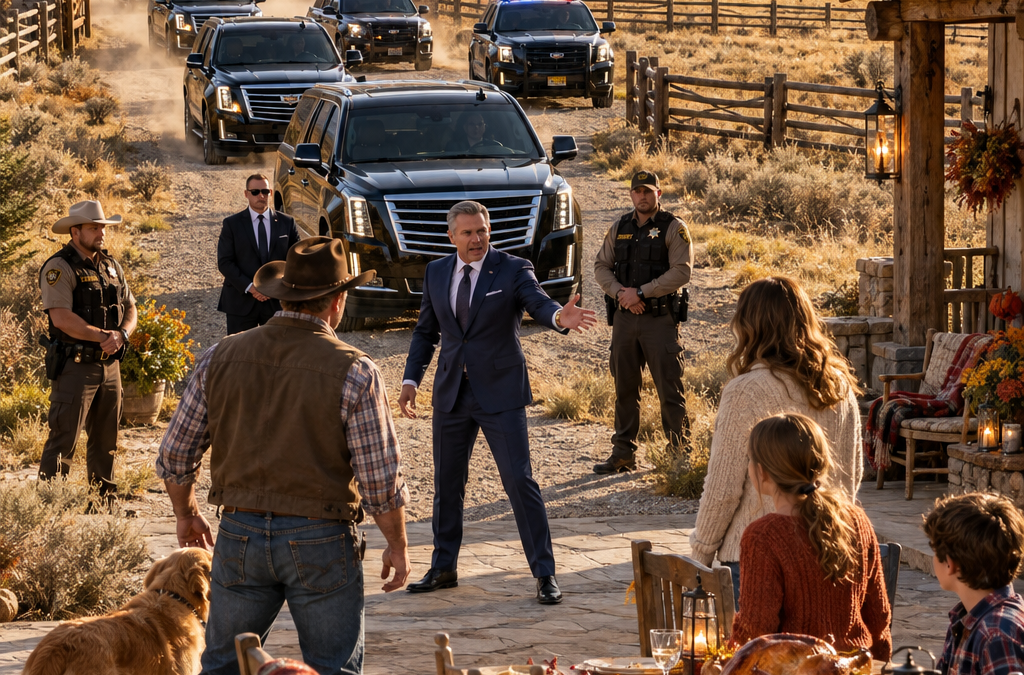
We had just finished carving the turkey when I heard the first engine.
At first, I thought someone had arrived late.
Then another engine followed.
And another.
I looked toward the front window.
A black SUV was coming down the ranch driveway.
Behind it was a silver Mercedes.
Then a white pickup.
Then more vehicles.
They weren’t heading toward the farmhouse as ordinary guests would.
They were moving toward the eastern service road.
I stepped onto the porch.
My stomach tightened.
A procession of luxury SUVs, sedans, and trucks stretched back toward the ranch entrance.
There were dozens of vehicles.
Some carried coolers.
Others had folding chairs strapped to roof racks.
One pickup had several long tables in the bed.
Another carried decorative arrangements.
I could see people dressed for a holiday gathering.
Families.
Children.
Couples in expensive winter coats.
They were coming onto my ranch as though the event had already been approved.
Caleb stepped outside behind me.
“What the hell?”
I stared at the convoy.
“He came.”
“Who?”
“The HOA president.”
The second vehicle stopped near the farmhouse turnout.
Its driver’s door opened.
A tall man stepped out.
He appeared to be about fifty, with carefully styled dark hair, silver at his temples, and the polished appearance of someone who considered wrinkles a personal insult.
Leonard Carter.
He wore a tailored camel-colored overcoat over a charcoal suit.
A white scarf rested neatly around his neck.
His shoes shone despite the gravel beneath them.
He looked more prepared for a luxury hotel reception than a ranch in late November.
He closed the Mercedes door and walked toward me.
“Daniel.”
His voice carried across the yard.
I stepped down from the porch.
“Leonard. What are you doing?”
He looked behind him.
“Coordinating our Thanksgiving celebration.”
“On my property?”
“On the traditional community grounds.”
I stared at him.
“I told you no.”
His smile remained fixed.
“And I explained that the association had already made arrangements.”
“Then you should have changed them.”
He sighed as though speaking to a difficult employee.
“Daniel, I’m going to ask you to be reasonable.”
I glanced at the vehicles.
“How many people did you bring?”
“Residents, family members, and event staff.”
“How many?”
“That’s not particularly relevant.”
“It’s relevant when you’re bringing them onto a working ranch without permission.”
His expression cooled.
“Please lower your voice.”
I hadn’t raised it.
I could hear people talking beside their vehicles.
Some were looking toward the farmhouse.
Others were checking their phones.
A few children were asking why the cars had stopped.
I took a slow breath.
“This event isn’t happening here.”
Leonard’s jaw tightened.
“You’re creating an unnecessary confrontation.”
“No. I told you twice that the property wasn’t available.”
“Residents have been looking forward to this gathering for months.”
“Then why didn’t anybody ask me before planning it?”
“The association doesn’t seek permission for access it already possesses.”
I stared at him.
“Show me the easement.”
His smile disappeared.
“Not this again.”
“Yes. This again.”
He stepped closer.
“You seem to believe that inheriting a large piece of property gives you the right to disregard established community expectations.”
I felt my pulse hammer.
“Inheriting the land gives me ownership. That’s not an expectation. That’s a recorded legal fact.”
His eyes narrowed.
“Your grandfather was difficult. I had hoped you might be more cooperative.”
The words hit harder than they should have.
I took another step toward him.
“Don’t talk about my grandfather.”
Leonard lifted his chin.
“I’m simply explaining that your family has a history of resisting reasonable arrangements.”
“My family has a history of keeping its land.”
He looked past me toward the house.
Through the window, I could see my niece standing beside Emily.
They were watching.
I felt a surge of anger.
This man had come onto my property on Thanksgiving, surrounded by residents, and was now insulting my dead grandfather in front of my family.
I wanted to shout.
I wanted to order everyone out.
Instead, I forced myself to remain still.
“Leonard, take your vehicles back to the subdivision.”
His face hardened.
“I’m afraid that won’t be happening.”
Then I heard another engine.
I turned.
Two sheriff’s vehicles were approaching from the county road.
For one awful second, I thought something had happened nearby.
Then Leonard smiled.
“Good,” he said.
I looked at him.
“Did you call the sheriff?”
“I asked law enforcement to assist with a property-access dispute.”
My stomach dropped.
“You called the police because I wouldn’t let you hold a party on my ranch?”
“I called because you’re unlawfully interfering with established community rights.”
Caleb stepped forward.
“Are you serious?”
Leonard barely looked at him.
“This doesn’t concern you.”
Caleb’s face reddened.
“It concerns me when you bring fifty strangers to my friend’s Thanksgiving dinner.”
I raised one hand.
“Caleb. Let me handle it.”
The sheriff’s vehicles stopped near the barn.
Two deputies stepped out.
One was a broad-shouldered man in his forties with a calm expression.
The other was younger, carrying a notebook.
The older deputy approached.
“Afternoon. I’m Deputy Marcus Hayes. We received a call concerning an access dispute.”
Leonard immediately extended his hand.
“Deputy, Leonard Carter. HOA president.”
Marcus shook it briefly.
Then looked at me.
“And you are?”
“Daniel Bennett. I own the ranch.”
Leonard gave a faint laugh.
“Ownership of the surrounding ranch isn’t the question, Deputy. This concerns established community access.”
Marcus looked between us.
“All right. Let’s slow down. Nobody needs to argue.”
He glanced toward the convoy.
“Mr. Carter, are these vehicles part of your event?”
“Yes.”
“Where are you planning to hold it?”
“Near the eastern pond.”
Marcus turned toward me.
“Mr. Bennett?”
“That pond is on my property. So is the road leading to it. I did not authorize this gathering.”
Leonard interrupted.
“The HOA has historical use rights.”
Marcus raised a hand.
“One at a time.”
He looked at me.
“Do you have property documents available?”
“Yes.”
Leonard smiled.
I couldn’t tell whether he expected the deputy to dismiss me or believed an old HOA map would carry more weight than the deed.
I turned toward the house.
“Give me a minute.”
Inside, everyone had stopped talking.
Emily stood near the kitchen counter.
Her face was pale.
“Daniel, what’s happening?”
“The HOA called the sheriff.”
Aunt Ruth put down her serving spoon.
“Because you won’t let them use the pond?”
“Yes.”
Mark looked toward the window.
“Do you need us outside?”
“No. Keep the kids in here. I’m going to show the deputies the property records.”
I crossed to my grandfather’s office.
The steel filing cabinet stood against the wall.
I opened the drawer and removed the folder marked RANCH DEEDS AND SURVEYS.
My grandfather’s handwriting was still on the label.
For a second, I ran my thumb across the letters.
Then I heard a child’s voice from the kitchen.
“Uncle Daniel, are the police here because somebody did something bad?”
I turned.
My nephew stood beside the doorway.
He was nine.
His eyes were wide.
I crouched.
“No, buddy. There’s a disagreement about the property. We’re going to explain it.”
“Are you in trouble?”
The question hurt.
I swallowed.
“No.”
I hoped I was right.
I returned outside carrying the folder.
Marcus and the younger deputy, whose name was Tyler Morgan, were standing beside Leonard.
Several residents had gathered behind the vehicles.
I heard one woman say, “Is he really stopping the event?”
Another answered, “Leonard said we had permission.”
I ignored them.
I handed Marcus the original recorded deed copy, probate documentation, and county survey.
“This is the ranch property description,” I said. “The pond is here. The eastern service road runs through this parcel.”
Marcus studied the map.
He asked a few questions.
I answered them.
Then he traced the subdivision boundary with one finger.
“Where does Cedar Hollow begin?”
I pointed.
“Here.”
He looked back at the pond.
“And this is the location of the proposed gathering?”
“Yes.”
Marcus examined the documents again.
Then he turned toward Leonard.
“Mr. Carter, where exactly does your HOA have legal access to this property?”
Leonard smiled.
“Through our established community access agreement.”
“Do you have a copy?”
“I have the association’s property map.”
He opened a leather portfolio.
Inside were several glossy pages.
He unfolded one and placed it across the hood of his Mercedes.
The map showed Cedar Hollow Estates with a colored recreational area extending beyond the subdivision boundary.
A dotted line led toward my pond.
Marcus examined it.
“Who prepared this?”
“The developer’s planning department.”
“Is it a recorded easement?”
“It’s part of the community’s official documentation.”
“That wasn’t my question.”
Leonard’s smile weakened.
“The association has used the area for years.”
Marcus pointed toward the map.
“Do you have a deed, recorded easement, or written agreement giving the association access?”
Leonard cleared his throat.
“Our governing documents recognize the area as a community amenity.”
I felt anger flare.
“You put my pond on your map and called it an amenity?”
Leonard turned sharply.
“Daniel, please let the deputy handle this.”
Marcus raised his hand again.
“Both of you.”
He looked back at Leonard.
“An HOA map isn’t the same thing as a legal property right. I need to know what authority you’re relying on.”
Leonard’s face tightened.
“The community has traditionally gathered there.”
“When?”
“For Thanksgiving and other seasonal events.”
I stared at him.
“That’s not true.”
He looked at me.
“Your grandfather wasn’t always aware of community scheduling.”
“My grandfather lived here. He worked this land every day.”
Leonard’s voice sharpened.
“Your family doesn’t have exclusive knowledge of every historical arrangement.”
Marcus stepped between us.
“Enough.”
He looked toward the crowd.
“Until this is clarified, nobody is going farther onto the disputed route or toward the pond.”
Leonard blinked.
“Deputy, that will effectively cancel our event.”
Marcus nodded.
“Then you may need to relocate it.”
“You can’t seriously expect ninety-six households to turn around.”
“I’m not authorizing a crowd to enter property when the owner disputes their right to be there and you can’t produce the document establishing access.”
Leonard looked stunned.
For the first time since I had met him, he seemed unable to find a polished response.
Then he recovered.
“Deputy, this is an established community tradition. Residents have relied on it.”
Marcus looked at him.
“Reliance doesn’t give me authority to disregard a documented property boundary.”
Leonard clenched his jaw.
“Are you refusing to enforce our rights?”
“I’m explaining that a claimed civil access right needs legal support. The documents I’ve seen establish Mr. Bennett’s ownership, and you haven’t shown me the right you’re claiming.”
The younger deputy moved toward the waiting vehicles and began explaining that the road would remain closed to event traffic while the dispute was unresolved.
I watched people react.
Some appeared confused.
Others angry.
A few looked embarrassed.
One man got out of a black SUV and approached.
“We drove forty minutes to get here,” he said.
Leonard immediately pointed toward me.
“Mr. Bennett has decided to block the community’s traditional gathering.”
I stared at him.
Even now, he was trying to turn the residents against me.
The man looked toward the farmhouse.
“Why?”
I took a breath.
“Because this is private ranch property, and I never agreed to host this event.”
He frowned.
“Leonard told us the HOA had rights to the pond.”
“Then he should be able to show you the document granting those rights.”
The man looked at Leonard.
Leonard’s expression hardened.
“The matter is more complicated than he’s making it sound.”
I opened my folder.
“No. It isn’t complicated to ask who owns the land.”
Marcus moved closer.
“Let’s keep this calm.”
I nodded.
The residents slowly began returning to their vehicles.
A woman carrying a covered casserole looked at me with obvious disappointment.
Another man complained that the HOA should have confirmed the location before announcing the event.
I heard children asking why they weren’t going to the pond.
Every voice tightened the knot in my stomach.
I hadn’t wanted any of this.
I had wanted to eat dinner with my family.
Now I was standing in a gravel driveway watching strangers blame me for a holiday gathering I had never agreed to host.
Leonard approached once more.
His face was flushed.
His expensive overcoat hung open.
“Congratulations, Daniel.”
I looked at him.
“What?”
“You’ve ruined Thanksgiving for an entire community.”
I felt something break loose inside me.
“No.”
My voice was quiet.
He stared.
“No?”
“You planned an event on land you don’t own. You ignored my refusal. You brought dozens of vehicles through my gate. Then you called the sheriff and tried to have me treated like the problem.”
His eyes narrowed.
“You’re twisting what happened.”
“No. I’m describing it.”
I stepped closer.
“You ruined their Thanksgiving when you promised them access you couldn’t prove you had.”
He looked toward the residents.
Several were watching.
His face darkened.
“You’ll regret embarrassing me in front of these people.”
Marcus heard him.
“Mr. Carter, I suggest everyone finish leaving peacefully.”
Leonard looked at the deputy.
Then back at me.
For a moment, I thought he might say something worse.
Instead, he turned sharply and walked toward his Mercedes.
I watched the convoy begin moving back toward the county road.
Vehicles turned carefully.
Tires crunched over gravel.
One by one, they disappeared beyond the ranch entrance.
The sheriff’s deputies remained until the crowd had cleared.
Marcus handed back my documents.
“Keep these organized,” he said.
“I will.”
“If the association believes it has an easement, that’s something it can pursue through the appropriate civil process.”
“I understand.”
He looked toward the farmhouse.
“Sorry your holiday got interrupted.”
I managed a tired smile.
“Me too.”
When the sheriff’s vehicles finally left, the ranch fell quiet.
But it wasn’t the same quiet as before.
I could still hear the engines in my head.
The accusations.
The threats.
My nephew asking whether I was in trouble.
I walked back toward the house.
The Thanksgiving table was waiting.
The turkey had cooled.
The gravy had thickened.
The candles were burning low.
Everyone looked at me when I entered.
For a moment, nobody spoke.
Then Aunt Ruth walked over and wrapped her arms around me.
I hadn’t expected that.
I stood stiffly for a second.
Then I hugged her back.
“He would have been proud of you,” she whispered.
I closed my eyes.
“Grandpa?”
“Of course.”
My throat tightened.
I wanted to believe her.
But all I felt was exhausted.
Emily approached.
“Are they gone?”
“Yes.”
“Are you okay?”
I looked around the room.
The children were quiet.
Caleb stood beside the stove, holding a saucepan.
Thomas and Ben waited near the table.
I took a breath.
“Let’s eat.”
We sat down.
I tried to be present.
I passed potatoes.
I laughed when Caleb made a joke about the gravy.
I listened to my niece describe her school play.
But part of me remained outside beside the driveway.
Every time I heard a vehicle in the distance, my body tightened.
Every time someone looked toward the window, I wondered whether Leonard had returned.
Halfway through dinner, Emily reached for my hand beneath the table.
“You did the right thing.”
I looked at her.
“Then why does it feel so bad?”
She glanced at Grandpa’s empty chair.
“Because he would have known exactly what to say.”
I swallowed.
“Yeah.”
She squeezed my hand.
“But you knew what to do.”
Later that evening, after everyone had eaten, we gathered beside the fireplace.
Aunt Ruth told stories about Grandpa’s first years on the ranch.
Caleb remembered the time he got his truck stuck in the south pasture.
Thomas described how Grandpa once spent an entire night repairing a broken water line during a snowstorm.
The children laughed.
For a little while, the tension loosened.
Then the house grew quiet.
Our guests began leaving.
Emily and Mark stayed overnight.
After everyone went to bed, I sat alone at the kitchen table.
My grandfather’s property folder lay beside an empty coffee mug.
I opened it.
The deed was exactly as it had been before the HOA arrived.
The boundary lines hadn’t moved.
The pond hadn’t changed ownership.
The road was still private.
Yet somehow, a man in a tailored coat had managed to turn all of that into a confrontation involving two sheriff’s vehicles and dozens of angry strangers.
I stared at the map.
Then I thought about Leonard’s final words.
You’ll regret embarrassing me.
I didn’t believe he was finished.
The next morning proved me right.
At nine fifteen, a delivery driver came to the farmhouse carrying an envelope.
It bore the letterhead of a law firm representing Cedar Hollow Estates.
I opened it at the kitchen counter.
The letter demanded that I acknowledge the HOA’s alleged historical access rights.
It accused me of improperly obstructing a longstanding community use area.
It warned that the association was prepared to pursue litigation if I continued denying access.
I read the entire letter twice.
Then I laughed.
Not because it was funny.
Because Leonard had finally done something useful.
He had put the claim in writing.
He had identified the route and pond area he believed the HOA could use.
He had asserted that the association possessed a legally enforceable interest.
Now the question could be answered with documents instead of threats.
Emily walked into the kitchen.
“What’s that?”
“A lawyer’s letter.”
Her face tightened.
“From the HOA?”
“Yes.”
“What does it say?”
“They want me to recognize their access rights.”
“Do they have any?”
“Not in the records I’ve seen.”
She looked worried.
“Daniel, this could get expensive.”
I folded the letter.
“I know.”
“Are you going to fight them?”
I looked toward Grandpa’s office.
“Yes.”
She studied me.
“Are you sure?”
I nodded.
“If I let Leonard claim the pond because he planned a Thanksgiving party there, what’s next? The road? The pasture? The old barn?”
Emily said nothing.
I continued.
“He doesn’t get to decide how much of Grandpa’s land I own.”
That afternoon, I called Richard Collins.
I explained everything.
The first phone call.
The formal HOA notice.
The Thanksgiving convoy.
The sheriff’s deputies.
The attorney’s demand.
Richard listened quietly.
Then he asked me to send copies of every document.
“Do not respond directly to their attorney,” he said.
“All right.”
“And don’t engage in arguments with Leonard.”
“That might be difficult.”
“I understand. But from this point forward, we handle the legal claims properly.”
I looked at the folder.
“Can they really claim historical rights just because residents say they’ve used the pond?”
“They can assert a claim. Proving it is another matter. Different kinds of access rights have different legal requirements. We need to examine the recorded instruments, the property history, and whatever evidence they intend to rely on.”
“Grandpa never gave them permission.”
“Then let’s establish that with the records.”
The following Monday, I drove to the county records office.
I carried the ranch parcel numbers, the HOA letter, and my grandfather’s original survey.
The clerk, a woman named Margaret Ellis, recognized my family name.
“Walter Bennett’s grandson?”
“Yes, ma’am.”
She smiled.
“Your grandfather used to come in here whenever somebody changed a fence line.”
I felt a small ache.
“That sounds like him.”
“What can I help you with?”
“I need every recorded document relevant to the eastern ranch boundary, the service road, the pond area, and any claimed access by Cedar Hollow Estates.”
Her smile faded.
“That’s a substantial search.”
“I know.”
We began with the main property deed.
Then the older conveyances.
Then the subdivision records.
Then recorded easements and relevant plats.
I reviewed legal descriptions until the numbers seemed to blur together.
Some documents were decades old.
Others had been recorded only a few years earlier when Cedar Hollow was developed.
The history was consistent.
My grandfather’s ranch had existed long before the subdivision.
The eastern boundary had not shifted.
The pond remained inside the ranch.
The service road crossed private property.
And the recorded documents we located did not grant Cedar Hollow Estates the general access right it was demanding.
I asked Margaret to help me verify the subdivision’s boundary.
She pulled the recorded plat.
We compared it with the ranch survey.
The HOA property ended at the development boundary.
There was no recorded extension reaching my pond.
I leaned back.
“That’s exactly what Grandpa’s records show.”
Margaret nodded.
“The descriptions appear consistent.”
“What about an older easement?”
We continued searching.
Nothing in the relevant county records established the claimed route or recreational access.
No forgotten agreement appeared.
No recorded transfer.
No deed granting the association several acres near the pond.
I understood that the records alone might not eliminate every possible unrecorded claim.
But they gave Richard a strong foundation.
I requested certified copies.
The clerk helped me identify the relevant recording information.
When I finally left the office, I was carrying a stack of documents nearly two inches thick.
I sat in my truck looking at them.
For the first time since Thanksgiving, I felt something close to control.
Leonard had spent weeks speaking as though his authority were self-evident.
Now I had official records describing exactly what the ranch included.
And not one supported his claim.
Richard and I met later that week.
His office smelled of coffee and old books.
He spread the certified documents across a conference table.
He examined the original deed.
The county surveys.
The subdivision plat.
The easement search results.
Then he looked at the HOA’s demand letter.
“Interesting.”
“What?”
“They’ve described the alleged access in broad terms, but they haven’t identified a recorded instrument granting it.”
“Because there isn’t one.”
“That’s what the records we’ve reviewed indicate. We’ll require them to identify whatever legal basis they believe supports the claim.”
I leaned forward.
“Can we stop this before it turns into a lawsuit?”
“We can respond formally and explain the evidence. But that doesn’t mean they’ll accept it.”
I stared at the table.
“Leonard won’t back down.”
Richard looked at me.
“Then a court may have to resolve it.”
I thought about the Thanksgiving dinner.
My sister’s worried face.
My nephew asking whether I was in trouble.
The convoy of vehicles.
The sheriff standing beside Grandpa’s old driveway.
I didn’t want a lawsuit.
I didn’t want to spend months paying attorneys to establish something the deed already showed.
But the alternative was allowing Leonard to keep making claims over property he had never proved the association could use.
“Do what we need to do,” I said.
Richard nodded.
A formal response went to the HOA’s attorney.
It disputed the claimed access right.
It identified the recorded boundaries.
It requested the specific instrument or other legally sufficient evidence supporting the association’s position.
It also demanded that the HOA stop directing unauthorized traffic and events onto the ranch.
I hoped that would end it.
Instead, things got worse.
Within days, neighbors began calling.
One told me that Leonard had accused me of trying to destroy a beloved community tradition.
Another said HOA residents were being warned that I intended to cut off every route near Cedar Hollow.
Neither accusation was true.
I had no interest in the subdivision’s streets.
I wasn’t trying to close legitimate public access.
I wanted the HOA to stop treating my private pond and ranch road as its recreational property.
But Leonard understood something I hadn’t appreciated.
A false story could travel much faster than a certified deed.
One afternoon, I drove into town for supplies.
At the hardware store, a man I barely knew approached me near the counter.
“You’re the guy who called the cops on the Thanksgiving event?”
I stared at him.
“No. The HOA president called the sheriff.”
He frowned.
“That’s not what I heard.”
“I didn’t even know the event was happening until their cars came through my gate.”
The man looked uncertain.
“Leonard said your family had always allowed it.”
I felt my jaw tighten.
“My grandfather never authorized an HOA Thanksgiving celebration at that pond.”
“Well, somebody’s lying.”
I looked at him.
“That’s why I’m asking for the documents.”
He shrugged and walked away.
I stood there with a box of fencing staples in my hand, feeling more alone than I had since the funeral.
Leonard had managed to make me look like the aggressor.
He had brought strangers onto my property.
He had threatened me.
He had called law enforcement.
And now he was telling people I was attacking the community.
I went home angry.
That evening, Caleb stopped by.
He found me in the barn, repairing a hinge that didn’t really need attention.
“You’re going to wear that thing down to nothing.”
I kept tightening the bolt.
“At least this is something I can fix.”
He leaned against the doorway.
“What’s going on?”
I explained the rumors.
He listened.
Then he said, “You can’t control what Leonard tells people.”
“I know.”
“But you can control what you prove.”
I stopped working.
Caleb glanced toward the farmhouse.
“Your grandfather kept records because he knew people could argue about anything. You’re doing the same thing.”
I looked at the wrench in my hand.
“I’m tired of fighting over land that’s already mine.”
“I know.”
“What if they keep doing this?”
“Then make them answer the question somewhere they can’t talk their way around it.”
I understood what he meant.
A courtroom.
I hated the idea.
But I was beginning to see no other way.
The HOA filed suit shortly afterward.
The complaint alleged that the association possessed longstanding access rights across the eastern ranch road and recreational use rights near the pond.
It claimed I had wrongfully interfered with those rights by preventing the Thanksgiving gathering.
It described the access as a community benefit established before I inherited the property.
The lawsuit requested judicial recognition of the association’s claimed rights and relief preventing me from obstructing them.
I read the complaint in Richard’s office.
Every paragraph seemed designed to turn my grandfather’s land into an HOA amenity.
They described the pond as a customary gathering area.
They described the road as an established community route.
They described my refusal as unreasonable interference.
At one point, the complaint referred to the ranch’s change in ownership as though my grandfather’s death had somehow created an opportunity to reconsider existing property rights.
I stared at the page.
“He waited until Grandpa died.”
Richard looked up.
“What?”
“Leonard. He waited until Grandpa wasn’t here to argue with him.”
Richard said nothing.
I continued.
“Grandpa knew the boundaries. He kept all the papers. Leonard never got what he wanted from him.”
I looked toward the window.
“And now he thinks I don’t know enough to stop him.”
Richard folded his hands.
“Then we make sure the court sees the evidence.”
I felt a tightness in my chest.
“What happens if we lose?”
He answered carefully.
“If the association establishes a legally enforceable access right, the court could recognize it. That’s why we need to address every theory they assert, not just the absence of a deed.”
I looked at the complaint.
The idea of losing access control over my own pond frightened me more than I expected.
It wasn’t simply about Thanksgiving.
If the HOA obtained a continuing right to use the road and pond, future events could become routine.
Traffic could increase.
Ranch operations could be disrupted.
Liability and maintenance disputes could follow.
I might have to deal with strangers crossing the property every holiday season.
My grandfather had spent decades protecting the working character of that land.
I could lose control over part of it because an HOA president insisted a community tradition existed.
Richard watched me.
“Daniel, the documents are strong. But litigation requires patience.”
I nodded.
“Then let’s prepare.”
The months that followed were the longest of my life.
I had imagined that inheriting a ranch would mean early mornings, hard work, and occasional evenings watching the sun settle behind the mountains.
Instead, I spent hours organizing exhibits.
Reviewing filings.
Answering questions.
Reconstructing old property records.
The HOA’s attorneys requested information about my grandfather’s use of the eastern acreage.
They asked whether residents had ever been permitted to visit.
Whether vehicles had crossed the ranch.
Whether there had been past community events.
Richard explained that occasional permissive visits and legally enforceable property rights were not the same thing.
But we needed evidence.
And we needed to be honest about the history.
I searched my grandfather’s filing cabinet again.
This time, I looked beyond the formal deeds.
I found ranch maintenance logs.
Old photographs.
Seasonal notes.
Receipts from fencing contractors.
Records of pond repairs.
Calendars with handwritten reminders.
Most were ordinary pieces of family history.
But together, they showed how the land had been used.
One photograph showed my grandfather standing beside the eastern pond in the early 1990s.
There were no houses on the distant hillside.
Only pasture and trees.
Another showed a cattle watering operation near the same area.
A third showed my father and grandfather repairing the road after spring flooding.
Then I found Thanksgiving photographs.
Several decades of them.
Grandpa beside the farmhouse.
Grandpa carving a turkey.
Grandpa standing with relatives near the barn.
Grandpa sitting in the kitchen with a paper plate and a tired smile.
Every year, the holiday belonged to the family.
Not a residential association.
Not a subdivision.
Not an organized community event at the pond.
Some of the photographs were taken before Cedar Hollow existed.
Others were recent enough to show the distant development across the fence.
None showed an HOA gathering on our land.
They didn’t prove that no resident had ever visited or that no temporary permission had ever been granted.
But they contradicted Leonard’s sweeping portrayal of an established annual tradition at the pond, especially when considered with the ranch records and testimony of people who had been there.
I carried the photographs to Richard.
He studied them carefully.
“These are useful.”
“Because they show the pond?”
“Because they establish context and help challenge the historical story the association is telling.”
I handed him Grandpa’s old holiday calendars.
“Look at Thanksgiving.”
Richard turned the pages.
Several entries described family meals, cattle checks, and winter preparations.
Nothing mentioned Cedar Hollow.
He nodded.
“We’ll organize these chronologically.”
I sat down.
“Do you think the judge will care about old family photographs?”
“If they help establish the facts, yes.”
I looked at a picture of Grandpa beside the pond.
He was wearing his old brown jacket.
One hand rested on the fence.
The other held a coffee mug.
I remembered the day.
I had taken the photograph.
He had complained that I was wasting film.
My throat tightened.
Richard noticed.
“Take your time.”
I shook my head.
“I’m fine.”
But I wasn’t.
I had spent months trying to defend my inheritance while still learning how to live without the person who had left it to me.
Every document felt like another goodbye.
Every photograph reminded me that Grandpa wasn’t coming back to explain what happened.
I had to do it myself.
As the hearing approached, Leonard became more aggressive.
The HOA distributed statements to residents describing the dispute as a fight to protect historic community access.
Some homeowners began appearing near the eastern boundary to photograph the ranch.
Others contacted me with questions.
One man asked whether I would reconsider if residents promised not to leave trash.
I told him this wasn’t about litter.
It was about property rights.
A woman offered to organize a smaller Thanksgiving gathering the following year.
I explained that future invitations would have to come from me, not an HOA vote.
She seemed confused.
“But the community has always considered that pond part of our recreational area.”
I looked at her.
“Did anyone show you a deed or easement?”
“No.”
“Then somebody should have.”
She went quiet.
I wasn’t angry at her.
Most residents had purchased homes believing the information provided by their association was accurate.
They weren’t expected to investigate every line on an old ranch survey.
But Leonard had access to the same county records I did.
He had been asked repeatedly to produce proof.
And instead of checking, he had chosen to escalate.
A week before the hearing, I received another message from the HOA’s attorney.
They proposed a settlement.
In exchange for dismissing the lawsuit, I would grant the association a permanent recreational access arrangement over the road and pond.
The document contained restrictions on dates and hours, but it would still create ongoing rights benefiting the subdivision.
I stared at the proposal.
They were offering to stop suing me if I gave them what they had been unable to prove they already possessed.
Richard watched my face.
“What do you think?”
I looked up.
“No.”
“We should consider the costs and risks carefully.”
“I understand.”
“A limited easement could potentially be negotiated under different circumstances.”
“Not after this.”
Richard waited.
I took a breath.
“If Leonard had come to me and asked whether the neighborhood could rent a section of land for one afternoon, I might have considered it. If he’d approached me respectfully, explained the plans, and accepted my answer, none of this would have happened.”
I looked back at the proposal.
“But he told me the choice wasn’t mine. He brought people here against my wishes. He called the sheriff. Then he sued me.”
Richard nodded.
“And your decision?”
“I’m not granting permanent access because somebody tried to intimidate me into it.”
“All right.”
He closed the folder.
“We’ll proceed.”
The night before the hearing, I barely slept.
I walked through the farmhouse long after midnight.
The kitchen was dark.
The fireplace had burned down to embers.
Grandpa’s chair stood beside the window.
I sat in it.
For years, I had listened to him complain about taxes, weather, cattle prices, and people who wanted to build houses where fields used to be.
He could be stubborn.
Sometimes impossible.
But he understood fairness.
He never argued that owning land meant treating other people badly.
He believed being a good neighbor mattered.
He believed helping somebody whose truck broke down mattered.
He believed sharing a meal mattered.
But he also believed nobody had the right to help themselves to another person’s property.
I looked toward the office.
The certified records were arranged inside two binders.
The original family surveys were protected in folders.
The photographs were labeled.
Richard had prepared everything.
Still, I was frightened.
Not of Leonard personally.
Of the possibility that enough confidence, enough money, and enough repetition could somehow turn a false claim into a legal right.
I closed my eyes.
“Grandpa,” I whispered, “I could really use you tomorrow.”
The house remained silent.
I sat there until the first light appeared beyond the fields.
The courthouse was crowded when I arrived.
I hadn’t expected so many people.
Several Cedar Hollow residents stood near the entrance.
A few recognized me.
Some looked away.
Others whispered.
Leonard stood near the courtroom doors with his attorney and two HOA board members.
He was wearing a dark navy suit that looked custom-made.
His shirt was brilliant white.
His shoes shone beneath the fluorescent lights.
His dark hair was slicked neatly back, and his silver watch flashed whenever he moved his hand.
He looked entirely comfortable.
As though the courtroom were simply another place where he expected to give instructions.
When he noticed me, he smiled.
“Daniel.”
I stopped.
“Leonard.”
“Still determined to make this difficult?”
I looked at the binders in my hands.
“I’m determined to establish the truth.”
He chuckled.
“You could have saved everyone a great deal of trouble by accepting a reasonable arrangement.”
“An arrangement I never agreed to?”
“One that would have benefited the entire community.”
“Except the landowner.”
His smile thinned.
“Your grandfather’s generation sometimes struggled to understand modern community planning.”
I felt my jaw tighten.
“Don’t bring him into this.”
Leonard leaned slightly closer.
“Then perhaps you should stop hiding behind his paperwork.”
For a moment, I wanted to hit him.
The anger came so quickly it frightened me.
I imagined shoving him against the wall and demanding that he stop using my grandfather’s name.
Then Richard stepped beside me.
“Daniel. We’re ready.”
I took a breath.
Leonard glanced at my attorney.
His expression shifted.
Richard didn’t smile.
“Mr. Carter,” he said, “we’ll address the documents inside.”
I walked past Leonard without answering.
The courtroom smelled faintly of paper and polished wood.
I sat beside Richard at the table.
Across from us, Leonard arranged his papers carefully.
He leaned toward his attorney and whispered something.
Then he looked toward the gallery.
Several residents nodded at him.
He seemed reassured.
I looked down at the original survey inside my binder.
The same boundary line ran across the page.
The same pond remained inside the ranch.
The same private road approached the eastern fence.
Nothing had changed.
Everything depended on whether the court would recognize that.
When the judge entered, everyone stood.
The hearing began with the HOA’s case.
Their attorney spoke confidently.
He described Cedar Hollow Estates as a carefully planned residential community.
He emphasized the number of families living there.
He discussed traditions, community cohesion, and longstanding recreational expectations.
Then he introduced the association’s maps.
One showed the subdivision.
Another highlighted the eastern access route.
A third shaded the pond area as a community gathering space.
The attorney placed the documents before the judge.
“Your Honor, these materials demonstrate the longstanding understanding that Cedar Hollow residents enjoyed access to the area.”
I watched the judge examine them.
The HOA attorney continued.
“Mr. Bennett inherited the property recently and has attempted to interfere with established community practices that existed before his ownership.”
I felt anger rise.
My ownership was recent.
The family’s ownership was not.
Grandpa had held the ranch long before Cedar Hollow existed.
Richard wrote something on his legal pad.
The attorney continued speaking about the Thanksgiving incident.
He described Leonard’s convoy as a peaceful community gathering.
He suggested that my refusal had unnecessarily escalated the situation.
He mentioned the sheriff’s response as evidence of the disruption.
I stared at the table.
It was almost unrecognizable.
The Thanksgiving I remembered involved a turkey cooling on the dining table while strangers rolled through my gate.
The version being presented to the court sounded like an innocent neighborhood picnic interrupted by an unreasonable ranch owner.
Then Leonard testified.
He walked to the witness stand with the same measured confidence I’d seen the first day.
His voice was smooth.
His answers carefully worded.
He explained that the HOA had historically regarded the pond area as part of its recreational tradition.
He claimed residents had used the route without significant interference.
He described himself as someone attempting to maintain peaceful community relations.
When asked about the Thanksgiving event, he sighed.
“I simply wanted families to enjoy a longstanding holiday tradition.”
The attorney nodded.
“And what happened?”
“Mr. Bennett refused to cooperate. He blocked access and forced the event to be canceled.”
I felt my fingers curl beneath the table.
Leonard continued.
“I tried repeatedly to resolve the misunderstanding, but he remained hostile.”
Richard placed one hand near my binder.
A silent reminder.
Stay calm.
The HOA attorney finished.
For a moment, Leonard looked pleased.
Then Richard stood.
He approached the witness stand with a thin folder.
“Mr. Carter, you’re the president of Cedar Hollow Estates?”
“Yes.”
“And you were president when you contacted my client about the Thanksgiving gathering?”
“Correct.”
“You told him the HOA had a right to use the pond?”
“I explained the community’s longstanding arrangement.”
Richard nodded.
“Did you ask his permission?”
“We believed permission already existed.”
“That’s not what I asked.”
Leonard’s smile faded slightly.
“No. I did not believe new permission was necessary.”
“Did Mr. Bennett tell you he did not consent to the event?”
“He was resistant.”
“Did he say no?”
Leonard hesitated.
“Yes.”
“Did you send him a formal notice afterward?”
“Yes.”
“Did he again dispute the HOA’s claimed rights?”
“Yes.”
Richard looked down at the document.
“Then, despite knowing the current landowner objected, you brought a convoy of residents and vendors onto his ranch?”
Leonard shifted.
“We believed we were exercising established rights.”
“And you called the sheriff?”
“I requested assistance.”
Richard looked up.
“To compel access?”
“To prevent an unnecessary confrontation.”
“Did you expect the deputies to require Mr. Bennett to let the event proceed?”
Leonard paused.
“I expected them to recognize the community’s rights.”
Richard nodded.
“Let’s discuss those rights.”
He returned to the table and opened the first binder.
My heartbeat accelerated.
This was the moment we’d prepared for.
Richard placed the certified county survey before the court.
He identified the eastern boundary.
The subdivision line.
The private service road.
The pond.
He explained how the current recorded documents corresponded to the older family records.
The judge examined the survey.
Then Richard presented the recorded ownership documents.
The legal descriptions established the ranch’s boundaries and my family’s chain of title.
The pond lay inside the ranch.
The disputed access road crossed ranch property.
The Cedar Hollow subdivision ended at its recorded boundary.
Richard allowed the judge time to examine the pages.
Then he introduced the relevant easement records and the results of the county title search.
“Your Honor, the plaintiff association has claimed a recorded or otherwise established right of access. Yet the relevant recorded instruments do not grant this association the access it seeks.”
The courtroom grew quieter.
Richard turned toward Leonard.
“Mr. Carter, have you personally reviewed a recorded easement granting Cedar Hollow residents access across this ranch road?”
Leonard straightened.
“I reviewed the association’s maps.”
“That wasn’t my question.”
His jaw tightened.
“Not a separate easement document, no.”
“Have you seen a recorded agreement granting the association recreational use of the pond?”
“The community’s historical practices—”
“Have you seen such an agreement?”
Leonard hesitated.
“No.”
Richard stepped closer.
“Did you verify the legal basis for the claimed rights before you scheduled the Thanksgiving gathering?”
“We relied on existing association records.”
“Did those records include a signed agreement from Walter Bennett?”
Leonard looked toward his attorney.
“I don’t recall seeing one.”
“Did you locate a recorded conveyance granting your HOA use of the pond?”
“No.”
Richard nodded.
“Yet you told my client he was required to provide access?”
“I believed the association had that authority.”
“Based on a colored map?”
Leonard’s face reddened.
“Based on years of community understanding.”
Richard paused.
“Mr. Carter, understanding and ownership are not the same thing, are they?”
The courtroom was silent.
Leonard looked toward the judge.
“I suppose not.”
I exhaled slowly.
Richard returned to the table.
Then the judge asked the HOA’s attorney a question.
“Counsel, can you show this court the recorded document granting your association access across the defendant’s ranch?”
The attorney looked down.
He opened his folder.
Turned several pages.
Then reached for another binder.
I watched him search.
Paper rustled.
He examined one document.
Then another.
For several seconds, nobody spoke.
Finally, he looked up.
“Your Honor, our claim relies on the association’s historical use and related community documentation.”
The judge remained still.
“That does not answer my question. Do you have a recorded instrument granting the access right you initially described?”
The attorney hesitated.
“Not one specifically conveying the disputed access as an express easement.”
I felt my shoulders loosen slightly.
The judge continued.
“Then you need to establish whatever alternative legal theory you’re asserting with actual evidence.”
The attorney nodded.
He attempted to argue that years of use had created enforceable rights.
Richard responded by addressing the history.
The HOA was relatively new.
The ranch was not.
There was no persuasive evidence that the association had used the pond as claimed for a legally sufficient period or under conditions establishing the rights it sought.
There was no recorded recreational grant.
No written permission agreement creating continuing HOA rights.
No valid conveyance of the disputed land.
And the association’s own documents couldn’t expand its property boundary simply by drawing a colored area across someone else’s parcel.
Then Richard opened the second binder.
“Your Honor, we also have historical photographs and records maintained by Walter Bennett.”
He placed several photographs before the court.
The first showed the eastern pond decades earlier.
The second showed cattle near the same water.
The third showed the ranch road during maintenance work.
Then came the Thanksgiving photographs.
My grandfather beside the farmhouse.
The family gathered around the dining table.
Children playing near the barn.
The ranch in winter.
The pond remaining part of agricultural operations.
Richard explained that the photographs and ranch logs provided evidence of longstanding private use.
They contradicted the suggestion that the pond had always functioned as an HOA holiday venue.
I watched Leonard.
His expression had changed.
The confident smile was gone.
His hands were clasped tightly on the table.
The attorney leaned over and whispered to him.
Leonard shook his head slightly.
Richard presented the dated records showing how the ranch had been operated throughout the relevant period.
Then he asked Leonard about the alleged Thanksgiving tradition.
“Mr. Carter, can you identify a specific year when Cedar Hollow held an authorized Thanksgiving gathering at the Bennett pond?”
Leonard looked uncomfortable.
“There were longstanding discussions about community use.”
“That’s not the same as holding an event.”
“The area was considered available.”
“By whom?”
“The association.”
“Did Walter Bennett agree?”
Leonard paused.
“He was not always receptive to community proposals.”
Richard nodded.
“So the previous owner resisted the HOA’s attempts to use the area?”
“I wouldn’t characterize it that way.”
“Did he ever give the association written authorization for annual Thanksgiving gatherings?”
“Not that I’m aware of.”
“Can you identify a completed Thanksgiving event at that pond?”
Leonard hesitated.
“I don’t have the dates in front of me.”
Richard looked at the judge.
“We have requested that evidence. None has been produced.”
I sat very still.
For months, Leonard had repeated the same claim.
A tradition.
A longstanding arrangement.
A community right.
Now, when asked to identify the events that supposedly established that tradition, he couldn’t do it.
The courtroom seemed to shrink around him.
Richard continued.
“The HOA planned a gathering, represented the area as available, and then attempted to compel access after the owner refused.”
The judge examined the documents again.
The association’s attorney offered additional argument.
He emphasized the benefit to residents.
He argued that the neighborhood had understood the route and pond to be available.
He suggested that recognizing access would avoid future disputes.
But the core problem remained.
The documents didn’t support the claimed right.
And the historical evidence did not establish the alternative rights the HOA needed to prove.
The judge asked further questions.
About the age of the development.
About the recorded subdivision boundary.
About the alleged use.
About the legal requirements for the rights being asserted.
The attorney answered as carefully as he could.
But he had no deed changing the ranch boundary.
No recorded easement granting the broad access claimed.
And no persuasive evidence establishing a separate enforceable right to use the pond.
At last, the judge turned toward me.
“Mr. Bennett, do you wish to clarify anything about the Thanksgiving incident?”
Richard glanced at me.
I stood.
My legs felt unsteady.
“Yes, Your Honor.”
I looked toward the bench.
“I inherited this ranch from my grandfather. He owned it for decades. I grew up here.”
My voice sounded quieter than I expected.
“I wanted Thanksgiving to be a family gathering because it was the first one after his death.”
I paused.
I could feel every person in the courtroom watching.
“Mr. Carter called and said his association intended to use my pond. I told him I hadn’t authorized it. I asked for the document granting access. He never provided one.”
I looked down briefly.
“Then he brought dozens of vehicles onto the property while my family was having dinner.”
The judge listened.
“I wasn’t trying to ruin anyone’s holiday. I just didn’t want strangers using my ranch without permission.”
I swallowed.
“My grandfather spent his life teaching me to respect other people’s land. He also taught me that I didn’t have to surrender my own just because somebody insisted they were entitled to it.”
My throat tightened.
“I don’t want a fight with Cedar Hollow. I want the boundaries respected.”
I sat down.
For several seconds, I couldn’t look at anyone.
Richard placed a hand on the table beside me.
The judge continued reviewing the record.
The waiting was unbearable.
I thought about my grandfather’s old chair.
The farmhouse.
The pond.
The fields stretching toward the mountains.
I imagined a future in which every holiday began with wondering whether HOA vehicles would come through the gate.
I imagined Leonard deciding the ranch road should become a permanent shortcut.
Then the barnyard.
Then the open pasture near the pond.
The thought made me feel sick.
I looked up.
The judge had finished examining the final certified county records.
He began speaking.
The court had considered the association’s claimed rights, the recorded land documents, the historical evidence, and the testimony.
The records established the ranch ownership and the relevant boundary.
The HOA had not demonstrated the express recorded access right it claimed.
Nor had it carried its burden of establishing the alternative rights asserted through historical use.
A community planning map did not itself convey an interest in privately owned land.
And a claimed tradition could not replace the legal requirements for establishing a property right.
I gripped the edge of the table.
The judge continued.
The HOA’s claim was dismissed.
The established property boundaries were to be respected.
The association had no court-recognized right, on the evidence presented, to use my ranch road and pond for its community events.
I stared straight ahead.
For a moment, the words didn’t register.
Then Richard leaned toward me.
“Daniel.”
I turned.
He smiled.
“It’s over.”
I looked back toward the judge.
The decision was real.
The HOA had lost.
The land remained mine.
I closed my eyes.
The relief came so suddenly that I felt dizzy.
Across the aisle, Leonard sat rigidly.
His face was pale.
The polished confidence that had carried him through every phone call, every letter, and every confrontation had disappeared.
His attorney was speaking quietly to him.
Leonard didn’t seem to be listening.
He kept looking at the documents on our table.
The deed.
The county survey.
The historical photographs.
The records he had dismissed as unnecessary.
For the first time, he seemed to understand that the map inside his HOA binder had never been stronger than the actual property records.
I didn’t smile at him.
I didn’t celebrate.
I simply gathered the documents.
Richard shook my hand.
“You did well.”
I looked at him.
“Grandpa kept the records.”
“And you had the determination to use them.”
I nodded.
That was all I could manage.
Outside the courtroom, cold air struck my face.
The sky was bright.
A few clouds drifted above the courthouse roof.
I stood on the steps holding the same deed I’d carried into the building.
The paper hadn’t changed.
The legal description was identical.
The boundary lines were exactly where they’d been before Cedar Hollow Estates existed.
The only difference was that the court had now rejected the HOA’s attempt to claim access.
I looked down at my grandfather’s handwriting on the folder.
And for the first time since his funeral, I felt something other than grief when I thought about him.
Pride.
Not in myself.
In the care he had taken to leave behind a ranch whose ownership could be proved.
Caleb had come to the hearing.
He approached from behind.
“Well?”
I turned.
“It’s done.”
His face broke into a grin.
“Really?”
“The claim was dismissed.”
He let out a long breath.
“Thank God.”
I looked down at the folder.
“Yeah.”
He put one hand on my shoulder.
“Your grandfather would have had a few things to say about Leonard Carter.”
I laughed.
A real laugh.
The first one I’d managed in weeks.
“He sure would.”
We drove back toward the ranch together.
The road curved through open country.
Snow still clung to the north-facing hills.
The fields lay quiet beneath a pale afternoon sky.
When the ranch entrance appeared, I slowed.
The old wooden sign still stood beside the gate.
BENNETT RANCH.
My grandfather had carved the letters himself.
The paint was faded.
One corner had begun to split.
I had been meaning to repair it for months.
Now I looked at it differently.
The sign wasn’t impressive.
It wasn’t polished stone.
It didn’t have decorative lighting.
There was no HOA logo.
No matching landscaping.
Just an old piece of wood identifying land my family had owned for generations.
And it meant more to me than every expensive entrance monument at Cedar Hollow.
I drove through the gate.
For the first time since Thanksgiving, I didn’t glance toward the eastern road expecting trouble.
I didn’t wonder whether another letter would be waiting.
I didn’t think about Leonard’s threats.
I simply drove toward the farmhouse.
When I stepped out, the air smelled of cold earth and pine.
The cattle were grazing near the lower fence.
Smoke rose from the chimney.
Everything looked exactly as it had before the lawsuit.
But something inside me had changed.
The uncertainty was gone.
I had spent months feeling as though my inheritance existed under someone else’s approval.
Now I knew it didn’t.
The ranch was mine.
And the neighboring HOA had been required to respect that.
That evening, I called Emily.
“We won.”
For a moment, she said nothing.
Then I heard her inhale.
“Daniel, are you serious?”
“Yes.”
“The pond?”
“Still private.”
“The road?”
“Still private.”
“And Leonard?”
“His claim was dismissed.”
She laughed.
Then she started crying.
I closed my eyes.
“Em?”
“I’m okay.”
I could hear her wiping her face.
“I just wish Grandpa were here.”
I looked toward his old chair.
“Me too.”
We stayed on the phone for a while.
Then she asked, “What are you going to do now?”
I looked toward the dining table.
I remembered the Thanksgiving dinner interrupted by engines and deputies.
The turkey cooling.
The children frightened.
The empty chair.
Then an idea came to me.
“I’m going to host Thanksgiving again.”
Emily laughed.
“Daniel, Thanksgiving was months ago.”
“I know.”
“You can’t just move a holiday.”
“Watch me.”
She went quiet.
Then she laughed harder.
“What are you planning?”
“A second Thanksgiving dinner.”
“For who?”
“Everyone who helped me get through this.”
I looked toward the kitchen.
“No HOA officials. No arguments. No sheriff’s vehicles. Just family and friends.”
Emily’s voice softened.
“Grandpa would love that.”
I smiled.
“Then we’re doing it.”
The following weekend, the farmhouse filled with people.
Emily and Mark arrived early.
Aunt Ruth brought two pecan pies again.
Caleb showed up carrying a turkey large enough to feed half the county.
Thomas and Ben brought vegetables and homemade bread.
Richard Collins came with his wife.
Even Margaret Ellis from the county records office stopped by briefly after I thanked her for helping locate the documents.
There were no elaborate decorations.
No catered buffet.
No expensive invitations.
Just a long wooden table covered with food.
The fireplace burned.
The windows fogged from the warmth inside.
Children ran through the hallway.
Aunt Ruth scolded Caleb for trying to carve the turkey before everyone had sat down.
For the first time in months, the house sounded like home.
Before we ate, I stood at the end of the table.
Everyone grew quiet.
I looked toward Grandpa’s empty chair.
Then at the people who had come.
“I know this is a strange time of year for Thanksgiving.”
Caleb grinned.
“Any day with pie is Thanksgiving to me.”
Everyone laughed.
I smiled.
“But I wanted to do this because the real Thanksgiving didn’t go the way I hoped.”
Aunt Ruth lowered her eyes.
I continued.
“When Grandpa died, I thought inheriting the ranch meant taking care of fences, fields, cattle, and old buildings. I didn’t understand how much it would also mean protecting what he had spent his life keeping together.”
I paused.
The room was silent.
“I also didn’t realize how many people would stand beside me when things got difficult.”
I looked at Emily.
At Caleb.
At the ranch hands.
At Richard.
“Thank you.”
My voice caught slightly.
“Thank you for helping me keep my grandfather’s home the way he intended.”
Emily wiped her eyes.
I looked toward the empty chair again.
“And I think he’d be happy to see everybody here.”
Aunt Ruth nodded.
“He would.”
I raised my glass.
“To Grandpa.”
Everyone lifted theirs.
“To Grandpa.”
We ate until nobody could move.
The children played near the fireplace.
Richard told a story about the courthouse that made Caleb nearly choke on his drink.
Aunt Ruth insisted everyone take leftovers.
And when the evening ended, I walked onto the porch and listened to the quiet ranch.
No convoy.
No angry HOA president.
No deputies.
Just wind moving across the fields.
I breathed deeply.
This was what Thanksgiving should have been.
Not because I had defeated anyone.
Because the people I loved were inside, and nobody was trying to take control of the place where we had gathered.
A few days later, a black Mercedes appeared at the ranch entrance.
I was repairing a gate near the barn when I heard it approach.
For a moment, my stomach tightened out of habit.
Then I recognized the vehicle.
Leonard Carter.
He parked near the driveway.
This time, he was alone.
No convoy.
No residents.
No HOA board members.
No sheriff’s vehicles.
He stepped out wearing a dark overcoat and polished shoes.
His hair was still perfectly styled.
His clothes still looked expensive.
But he moved differently.
Less confidently.
He approached slowly.
“Daniel.”
I set down the wrench.
“Leonard.”
He stopped several feet away.
“Do you have a moment?”
I studied him.
“For what?”
He glanced toward the farmhouse.
“I wanted to speak privately.”
I folded my arms.
“Go ahead.”
He took a breath.
“I owe you an apology.”
I hadn’t expected that.
I stared at him.
He looked uncomfortable.
“The association handled the Thanksgiving situation badly.”
I said nothing.
He continued.
“I relied on information from old HOA planning records. I assumed the recreational areas marked on our maps reflected rights that had already been established.”
I looked toward the eastern hills.
“And when I asked you for proof?”
He lowered his eyes.
“I should have verified the documents.”
“Yes.”
His jaw tightened slightly.
“I also should not have brought residents onto your property after you refused.”
“No.”
“Or involved the sheriff in an attempt to force the issue.”
I looked at him.
“Do you understand what you did to my family that day?”
He hesitated.
“I know the event was disruptive.”
“Disruptive?”
My voice sharpened.
“My grandfather had been dead three weeks. That was our first Thanksgiving without him. My family was sitting down to dinner when you drove through the gate with an entire neighborhood and two deputies.”
Leonard looked away.
I continued.
“My nephew thought I was going to jail.”
His face changed.
“He asked me whether I had done something bad. In my own kitchen. On my own ranch.”
Leonard swallowed.
“I didn’t know that.”
“You didn’t ask.”
Silence.
The wind moved through the grass beside the barn.
For several seconds, neither of us spoke.
Then Leonard said quietly, “You’re right.”
I looked at him.
He continued.
“I thought I was protecting the association’s interests. But I let that become a question of authority instead of a question of what the records actually established.”
I studied his face.
For the first time, he sounded like someone acknowledging a mistake rather than trying to control the conversation.
He took another breath.
“I’m sorry.”
I considered the words.
An apology couldn’t undo Thanksgiving.
It couldn’t erase the anxiety, legal expenses, or months of uncertainty.
It couldn’t bring my grandfather back.
But it also didn’t need to do those things to be genuine.
“I accept your apology,” I said.
Leonard looked relieved.
Then I continued.
“But the boundary stays exactly where it is.”
He nodded immediately.
“I understand.”
“The pond remains private.”
“Yes.”
“The service road remains part of the ranch.”
“Yes.”
“And if the HOA ever wants permission to use any part of this property, it asks. It doesn’t announce.”
He looked at me.
“Understood.”
I nodded.
“Then we’re clear.”
Leonard extended his hand.
I looked at it for a moment.
Then I shook it.
His grip was less forceful than it had been in his earlier confrontations.
When he turned toward his car, he stopped.
“Your grandfather was a remarkable man.”
I felt something tighten in my chest.
“Yes,” I said. “He was.”
Leonard nodded.
Then he drove away.
I watched until the Mercedes disappeared beyond the gate.
For a long time, I stood beside the barn thinking about what had happened.
The ranch had never been at risk because the boundary lines were unclear.
They were clear.
The deeds were recorded.
The surveys were consistent.
The access route and pond lay inside the family property.
The real danger came from someone deciding that his expectations mattered more than the documented rights of the landowner.
Leonard believed that because his HOA had money, residents, attorneys, and expensive homes, it could impose a tradition on someone else’s property.
He believed a map created for community planning could establish rights the actual deeds never granted.
He believed bringing deputies to my Thanksgiving dinner would make me surrender.
And when that failed, he believed a lawsuit would finish what intimidation had started.
But none of those things changed the land records.
Not the convoy.
Not the threats.
Not the HOA’s attorney.
Not the courtroom full of residents.
The boundaries remained exactly where my grandfather had documented them.
That evening, I walked toward the eastern pond.
The sun was beginning to set.
Cold wind moved through the dry grass.
The sky above the mountains glowed orange and pale pink.
I followed the old ranch road past the lower pasture, then stopped beside the water.
The surface reflected the fading light.
A few ducks moved near the far bank.
Behind me, the service road curved toward the eastern fence.
Beyond that stood Cedar Hollow Estates.
The large homes were visible along the hillside.
Their windows glowed warmly as families prepared for the evening.
I didn’t hate those people.
Most of them had simply believed what their HOA president told them.
They wanted a pleasant Thanksgiving gathering.
They expected someone else to handle the details.
But their expectations had been built on a claim that never belonged to the association.
And when I refused, Leonard tried to turn my right to say no into an act of hostility.
I crouched near the water.
The pond smelled faintly of wet earth and pine.
I remembered coming here with Grandpa when I was a child.
He would sit on an old wooden bench near the bank while I skipped stones across the surface.
Sometimes he talked about the ranch.
Sometimes he said nothing.
Once, when I was about fourteen, I asked him why he cared so much about property lines.
He had just finished repairing a fence near the eastern pasture.
His hands were dirty.
His back hurt.
He looked tired.
“Because knowing what’s yours also means knowing what isn’t,” he told me.
I frowned.
“What’s that supposed to mean?”
He pointed across the fence toward the neighboring property.
“That land belongs to somebody else. I don’t get to take it because it’s convenient. I don’t get to drive across it because it makes my day easier. And I don’t get to tell the owner what to do just because I think my way is better.”
I remember shrugging.
“Seems obvious.”
He laughed.
“It should be.”
Then his expression became serious.
“But you’ll meet people who think having more money or more influence gives them more rights than the person standing next to them.”
“What do you do?”
He looked toward the old fence.
“You learn the rules. You keep your records. You treat people fairly. And when somebody crosses the line, you make them step back.”
I had forgotten that conversation for years.
Now, standing beside the pond, I could remember every word.
I stood and looked toward the ranch.
Three thousand acres stretched beyond the fading light.
Fields.
Barns.
Fences.
Cattle ponds.
Access roads.
The farmhouse where my family had finally enjoyed a peaceful second Thanksgiving.
It was an enormous inheritance.
But I had begun to understand that its value wasn’t measured only in acres.
It was measured in responsibility.
Grandpa had trusted me to care for the land.
To maintain its boundaries.
To protect the people and animals living on it.
And to treat neighbors with the same respect I expected them to show me.
He never taught me to start fights.
He taught me not to surrender something simply because another person demanded it.
I looked toward Cedar Hollow one last time.
The HOA still had its beautiful houses.
Its landscaped entrance.
Its community gatherings.
Its expensive clubhouse.
Nothing prevented those residents from celebrating Thanksgiving together on property they actually had the right to use.
They didn’t need my pond.
They didn’t need my ranch road.
They needed a president willing to respect the difference between a request and a demand.
I slipped my hands into my jacket pockets.
The sun had nearly disappeared.
Far behind me, the farmhouse lights glowed against the darkening fields.
I started walking home.
For months, I had carried the fear that someone could use money, legal threats, and public pressure to take control of a piece of land my grandfather had spent his life protecting.
Now that fear was gone.
The court had rejected the HOA’s claim.
The property boundaries remained intact.
The private pond was still private.
The ranch roads were still ours.
And Leonard Carter had finally learned that being president of a wealthy neighborhood did not make him president of the countryside surrounding it.
When I reached the farmhouse, I stopped on the porch.
Grandpa’s old rocking chair sat beside the front door.
I lowered myself into it.
The wood creaked beneath me.
For a moment, I imagined him sitting there with a cup of coffee, watching the fields and complaining about how early the sun disappeared in November.
I smiled.
“You were right, Grandpa.”
The words came out quietly.
“Keep the records. Respect the boundaries.”
I looked toward the dark ranch road.
“And don’t let anybody talk you out of what belongs to you.”
The house behind me was warm.
The land ahead was quiet.
For the first time since my grandfather died, I felt that I had done something worthy of the trust he placed in me.
I had inherited 3,000 acres.
But the most valuable thing he left me wasn’t the acreage, the farmhouse, or the pond.
It was the understanding that owning land carries an obligation to protect it without forgetting the rights of the people around you.
Leonard Carter tried to turn that responsibility into a fight over power.
He brought an entire neighborhood to my Thanksgiving dinner, threatened me with the sheriff, and dragged me through court because he couldn’t accept one simple word.
No.
In the end, that word held because the facts were on my side.
The ranch belonged to my family.
The HOA had no established right to take its roads or pond.
And no claimed community tradition could replace the documents that proved it.
My grandfather’s boundary lines had survived decades of change.
They survived Leonard Carter, too.
And as I sat on that old porch listening to the wind move across the fields, I finally understood what Grandpa had meant when he said a man didn’t have to fight everyone around him to protect what mattered.
He only had to know where the line stood.
And have the courage to keep it there.








