𝗙𝗨𝗟𝗟 𝗦𝗧𝗢𝗥𝗬 The HOA President Sent Two Police Officers to My Door Over a Lawnmower, and I Realized She Wouldn’t Stop Until She Destroyed Me.
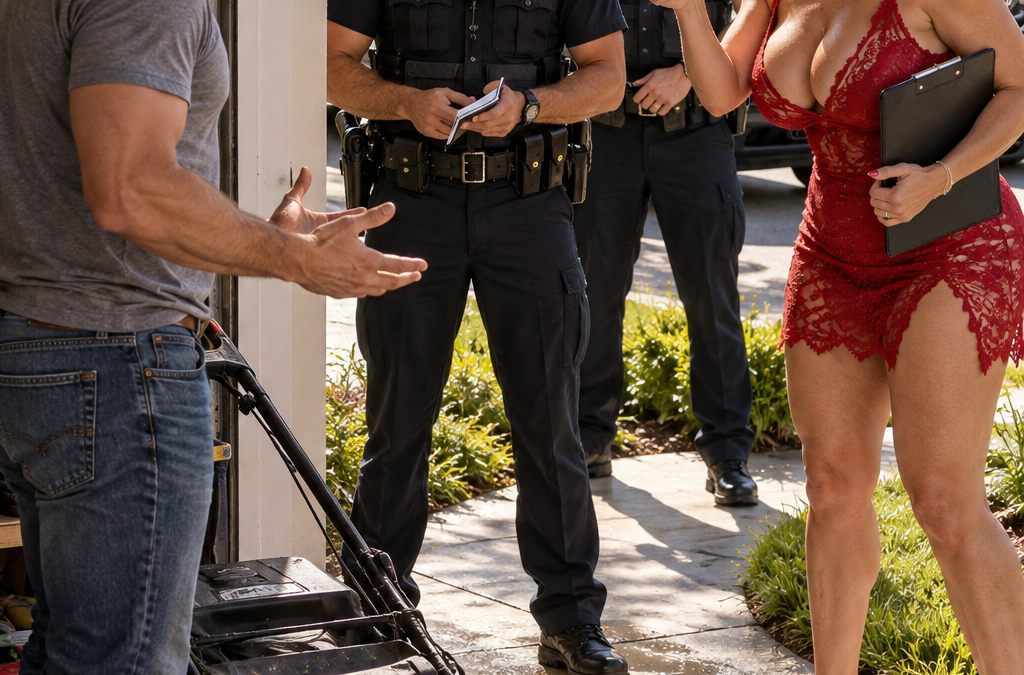
𝗙𝗨𝗟𝗟 𝗦𝗧𝗢𝗥𝗬
Some were overly particular about landscaping. Others held endless meetings about parking or exterior decorations.
But I assumed reasonable rules were a small price to pay for a pleasant place to live.
My house was a modest two-story with a wide front porch, a spacious garage, and a backyard large enough for a vegetable garden.
The kitchen needed updating, and the guest bathroom had plumbing that made an unpleasant noise whenever somebody turned on the faucet.
But the foundation was solid, the roof was in good condition, and the neighborhood seemed peaceful.
I signed the papers.
Moved in.
Unpacked my furniture.
And spent the first few evenings sitting on the porch, feeling like I’d finally found somewhere I could stay for a long time.
That feeling lasted six days.
On the seventh morning, I discovered a white envelope tucked beneath my front door.
At the top was the Willowbrook Estates Homeowners Association letterhead.
Below it were several paragraphs about community standards.
And at the bottom was a violation notice.
UNAPPROVED MAILBOX COLOR.
I stood in my doorway holding the paper.
My mailbox was black.
Apparently, that was the problem.
According to the notice, the approved shade was matte charcoal black.
My mailbox was standard satin black.
I walked down the driveway and examined it.
I looked at it from the left.
Then from the right.
Then I held the violation notice beside it, as though that might somehow explain what I was supposed to see.
It was a black mailbox.
The same black mailbox that had been standing there when I toured the property.
I laughed.
I genuinely thought it was funny.
There had to be someone in the world with more important problems than the precise shade of black on my mailbox.
Then a golf cart rolled slowly around the corner.
It was white, with a small Willowbrook Estates emblem attached to the front.
Behind the wheel sat Deborah Voss.
She drove through the neighborhood the way a security officer might patrol a restricted military installation.
Only instead of watching for genuine danger, she watched for trash cans, flowerpots, grass height, and anything else she could turn into an official complaint.
Her phone rested in a holder near the steering wheel.
A clipboard sat on the passenger seat.
When she saw me beside the mailbox, she slowed down.
Then she stopped.
“Good morning,” she called brightly.
I lifted the letter.
“Morning. Are you the person I should talk to about this?”
She climbed out.
Her red lace dress was so conspicuous against the quiet suburban street that I remember thinking she looked dressed for a cocktail reception rather than a property inspection.
“I’m Deborah Voss,” she said. “President of the Willowbrook Estates Homeowners Association.”
“Nice to meet you. I’m Walker.”
“I know who you are.”
She said it pleasantly, but something about the words made me uncomfortable.
“I see you’ve received your first compliance notice.”
“Apparently.”
She smiled.
“Don’t worry. New residents often need a little guidance.”
I pointed to the mailbox.
“Is there really a problem with the color?”
“Unfortunately, yes.”
“It’s black.”
“Not the approved black.”
I looked at her.
“How different can two shades of black be?”
Her smile tightened slightly.
“We maintain very specific aesthetic standards here.”
“Okay. Is there a paint brand or color code?”
“That information is available in the architectural guidelines.”
“I read the packet before I moved in. I don’t remember a mailbox paint code.”
“Then perhaps you should read it again.”
Her tone remained sweet.
That somehow made it worse.
I considered arguing.
Then I remembered the moving boxes still stacked in my dining room, the work waiting at my office, and the fact that I had no desire to start a neighborhood feud over a mailbox.
“Fine,” I said. “I’ll repaint it.”
Deborah’s smile returned immediately.
“Wonderful. We appreciate cooperative homeowners.”
She moved closer, lightly touching my forearm in a gesture that seemed designed to turn the conversation friendly again.
“Trust me, Mr. Walker. Life is much easier here when everyone understands who’s responsible for maintaining our standards.”
I pulled my arm away gently.
“I’ll take care of the mailbox.”
She tilted her head.
“See that you do.”
Then she climbed back into the golf cart and drove away.
I stood there for another moment, staring at the letter.
I told myself she was simply an overenthusiastic HOA president.
Annoying, maybe.
But harmless.
I bought a small can of paint that afternoon and repainted the mailbox.
It took twenty minutes.
I assumed the problem was over.
Instead, it was the beginning.
The next violation came two weeks later.
TRASH RECEPTACLES LEFT VISIBLE BEYOND APPROVED COLLECTION HOURS.
According to Deborah’s notice, my trash cans had remained at the curb four hours past the permitted window.
The fine was seventy-five dollars.
I remembered the day.
I’d worked late.
By the time I returned home, the trash truck had already come and gone, and the cans were still sitting near the curb.
I rolled them into the garage as soon as I got home.
I had violated the rule.
Technically.
So I paid.
But I noticed that several other houses had trash cans visible after collection day without receiving the same attention.
I mentioned it casually to Deborah when I saw her outside the community center.
She gave me a patronizing smile.
“Mr. Walker, I can’t discuss another homeowner’s compliance history.”
“I’m not asking for their history. I’m asking whether the same rule applies to everyone.”
“Of course.”
“Then why was I the only person fined?”
Her expression cooled.
“Perhaps you should focus on your own property instead of monitoring your neighbors.”
I stared at her.
The woman who spent her afternoons photographing other people’s houses was telling me not to monitor my neighbors.
I almost pointed that out.
Instead, I walked away.
A week later, I received another notice.
This one concerned my grass.
EXCESSIVE LAWN HEIGHT.
The letter claimed my front lawn exceeded the permitted three-inch limit by half an inch.
Deborah had apparently measured it herself.
With a ruler.
I called the HOA office.
She answered personally.
“Willowbrook Estates.”
“Deborah, it’s Walker.”
“Yes?”
“I received another notice.”
“Then I assume you’re calling to confirm when you’ll correct the violation.”
“My grass is barely over three inches.”
“Three and a half.”
“You’re telling me you actually measured it?”
“Of course.”
“With a ruler?”
“Yes.”
I paused.
“Deborah, do you understand how ridiculous this sounds?”
Silence.
Then her voice dropped.
“Excuse me?”
“I’m talking about half an inch of grass.”
“And I’m talking about established community standards.”
“It’s grass.”
“Mr. Walker, rules don’t stop being rules simply because you find them inconvenient.”
“I mow regularly.”
“Then perhaps you should mow more regularly.”
She hung up.
I stood there listening to the dead line.
For the first time, I didn’t feel amused.
I felt watched.
Every notice carried the same signature.
Deborah Voss.
Underneath it, in elaborate cursive, were the words HOA President.
The flourish beneath her name was so dramatic it looked like she was signing a royal decree.
I began wondering how many hours she spent searching for minor violations.
And why she seemed especially interested in mine.
At first, I thought I was being overly sensitive.
Then the neighbors started talking.
Not openly.
Nobody wanted Deborah to hear.
They waited until she was out of sight, then spoke in lowered voices.
One afternoon, I was cleaning my garage when Carla, my next-door neighbor, walked over.
Carla was in her late forties, practical, direct, and one of the few people on the street who didn’t seem impressed by Deborah’s beauty or her title.
She glanced at the HOA notice sitting on my workbench.
“Another one?”
I sighed.
“Grass this time.”
Carla shook her head.
“She’s starting on you.”
“Starting?”
Carla looked toward the street.
“How many notices have you gotten?”
“Three.”
“Then you’re still in the polite stage.”
I laughed without much humor.
“There’s a worse stage?”
She didn’t smile.
“Ask the Petersons.”
“Who are they?”
She hesitated.
“They used to live two streets over.”
“Used to?”
Carla nodded.
“They lost their house.”
I frowned.
“What happened?”
“Unpaid HOA liens. Penalties. Legal fees. Eventually foreclosure.”
I looked at her.
“Over what?”
“That’s the part nobody agrees about.”
“What do you mean?”
“Deborah said they were chronic rule breakers. The Petersons said they were being targeted because they questioned the board.”
I leaned against the garage door.
“Questioned what?”
Carla lowered her voice.
“Money.”
A breeze moved across the driveway.
For some reason, that single word bothered me more than everything else she’d said.
“Money?”
“Association finances. Special assessments. Things that didn’t make sense.”
“What happened when they asked?”
“More fines.”
I looked down at the grass warning.
Carla followed my gaze.
“Listen to me,” she said. “Don’t fight Deborah publicly.”
“Why?”
“Because she controls the board votes. Most of the board either agrees with her or doesn’t want to cross her.”
“That can’t be healthy.”
“It isn’t.”
“Then why doesn’t someone vote her out?”
Carla gave me a sad little smile.
“People with mortgages get nervous when somebody starts threatening their homes.”
I thought about the Petersons.
The way she said their name made it sound like something the neighborhood had collectively agreed not to discuss.
“Are you saying she deliberately ruined them?”
“I’m saying they asked questions, and afterward their lives became very expensive.”
Carla glanced toward the corner.
“Just be careful.”
She returned to her house.
I stood alone in the garage for a long time.
I had moved into Willowbrook expecting peace.
Instead, I was being warned that the association president could make a family lose their house if they challenged her.
That evening, I started a folder.
I labeled it WILLOWBROOK HOA — DOCUMENTATION.
Inside, I placed every notice Deborah had sent.
The mailbox warning.
The trash fine.
The grass citation.
The receipts showing what I’d paid.
I scanned everything into my computer.
I saved the dates.
I recorded when each notice arrived and when I’d responded.
I photographed my lawn, my mailbox, and the location where I stored the trash cans.
It seemed excessive at first.
Then I remembered what Carla had said.
The Petersons had lost their home.
If Deborah intended to keep targeting me, I wanted a record that didn’t depend on anyone’s memory.
Over the next several weeks, I watched the neighborhood differently.
I noticed Deborah driving her golf cart slowly past certain houses.
Sometimes she stopped and photographed a porch.
Sometimes she leaned over a flower bed with her phone.
Once, I watched her spend several minutes examining a neighbor’s driveway while the homeowner stood in the doorway looking miserable.
It wasn’t normal enforcement.
It felt like surveillance.
I also began attending HOA meetings.
Not because I wanted a position on the board.
Because I wanted to understand how the organization worked.
The first meeting was boring.
Landscaping updates.
Maintenance schedules.
Questions about pool access.
Deborah sat at the front in her red lace dress, smiling confidently as she moved through the agenda.
She spoke with practiced authority.
When residents asked simple questions, she answered as though doing them a favor.
When anyone asked for financial details, her tone changed.
One older man questioned a landscaping expense that seemed higher than the previous year.
Deborah smiled.
“Professional services have increased in cost.”
“Can we see the invoices?”
“They’re included in our financial reporting.”
“Not the summary. The actual invoices.”
Her smile faded.
“Those documents are maintained by the board.”
“That’s why I’m asking the board.”
She glanced toward the other members.
Nobody spoke.
Finally, she said, “We’ll consider your request.”
The man sat down.
I watched Deborah make a note on her clipboard.
At the next meeting, the financial statement was presented again.
It showed income from dues and special assessments, followed by broad spending categories.
Maintenance.
Landscaping.
Administrative costs.
Repairs.
But the numbers didn’t seem to reconcile cleanly.
I wasn’t an accountant, but I understood basic arithmetic.
Money coming in.
Money going out.
Balances remaining.
The figures on the summary didn’t explain where every dollar had gone.
When I asked a question about the difference, Deborah looked directly at me.
“Mr. Walker, we’ve already addressed the financial report.”
“I’m asking about the totals.”
“The report has been reviewed.”
“By whom?”
“The appropriate officers.”
“Can homeowners see the underlying statements?”
Her face tightened.
“Are you accusing us of something?”
“No. I’m asking for information.”
“Then I suggest you make a formal request rather than disrupting this meeting.”
I sat down.
Several people looked away.
Carla caught my eye from across the room.
Her expression said everything.
I warned you.
Two days later, Deborah drove past my house three times.
On the third pass, she stopped and photographed my front lawn.
I watched from the window.
The grass had been cut the previous Saturday.
It looked perfectly normal.
That afternoon, another warning appeared.
I didn’t throw it away.
I didn’t call her.
I added it to the folder.
Something about the financial reports kept troubling me.
At each meeting, the summaries looked polished.
But the more I studied the figures, the more questions I had.
Special assessments had been collected for projects I couldn’t clearly identify.
Landscaping costs seemed unusually high.
Certain repairs were described so vaguely that no ordinary homeowner could determine what had actually been done.
I didn’t know whether the records reflected incompetence, careless bookkeeping, or something worse.
But I knew I wanted the actual documents.
Before I could pursue that question, Deborah gave me a much more immediate problem.
It happened on a Tuesday.
The weather was pleasant.
The sky was clear, and the afternoon temperature was mild enough that mowing the lawn sounded better than sitting inside.
I had worked through lunch and finished early.
By three-thirty, I was home.
I changed into jeans and an old T-shirt, drank a glass of water, and checked the time.
3:52 p.m.
The HOA allowed ordinary lawn maintenance during designated daytime hours.
Four o’clock was comfortably within those hours.
I had no intention of disturbing anyone.
I wasn’t using industrial equipment.
I wasn’t running a leaf blower at midnight.
I was simply cutting my grass with a standard residential lawn mower.
At exactly four, I pushed the mower out of the garage.
I checked the oil, adjusted the cutting height to three inches, and started the engine.
The familiar hum filled the driveway.
I worked along the front lawn in straight, overlapping passes.
After the first few minutes, I settled into the rhythm.
Walk.
Turn.
Walk back.
Check the edge.
Keep the lines even.
It was ordinary work.
The kind of thing thousands of homeowners do every afternoon without becoming the subject of a police investigation.
About twenty minutes later, I heard vehicles turning into my driveway.
I looked up.
Two police cruisers had stopped near the curb.
My stomach dropped.
For a moment, I wondered if something had happened to a neighbor.
Then I saw Deborah walking briskly behind the officers.
Her red lace dress caught the afternoon sunlight.
Her clipboard was tucked beneath one arm.
And she was smiling.
I shut off the mower.
The officers approached the front door.
I walked through the garage and opened it when they knocked.
That’s how I found myself standing on my porch, trying to explain why mowing a lawn at four o’clock in the afternoon was not a police matter.
The taller officer introduced himself as Officer Miller.
His partner, Officer Hayes, stood a few feet behind him.
Both appeared professional.
Neither looked particularly pleased to be dealing with an HOA complaint.
“Mr. Walker,” Officer Miller said, “we’re here because of a reported disturbance.”
“I understand. But I was mowing my lawn.”
Deborah stepped forward.
“He knows perfectly well what he was doing.”
I looked at her.
“What exactly was I doing?”
“You were intentionally interfering with an official board meeting.”
“Where?”
“At my residence.”
“How would I even know you were having a meeting?”
“Because community business is regularly conducted in my home.”
“Deborah, your house isn’t even directly beside mine.”
She lifted her chin.
“Sound travels.”
I turned toward Officer Miller.
“Is there a law against mowing the lawn at four in the afternoon?”
“Not generally, sir. We’d need evidence of a specific ordinance violation.”
“I checked the HOA rules. I’m within the permitted hours.”
Deborah interrupted.
“Those hours do not give him permission to deliberately disrupt association business.”
Officer Hayes looked toward her.
“Ma’am, can you describe the disturbance?”
“The lawn mower was extremely loud.”
“How loud?”
“Loud enough to make conversation impossible.”
Officer Miller glanced toward the mower.
It was an ordinary residential machine sitting silently in the garage.
“Was there a public board meeting scheduled?” he asked.
Deborah hesitated.
“It was an administrative meeting.”
“Who attended?”
“The treasurer and I.”
“No other board members?”
“We were handling important financial matters.”
I stared at her.
I remembered seeing her car parked outside her house earlier, along with another vehicle.
But there had been no meeting announcement.
No agenda.
No notice to residents.
The gathering sounded more like a private lunch than an official board meeting.
“Did you have a meeting open to homeowners?” I asked.
Deborah glared at me.
“This is not your concern.”
“It became my concern when you brought police officers to my door.”
Officer Miller raised one hand.
“Let’s keep this calm.”
He looked at his device.
Then he said, “The complaint was received at 3:47 p.m.”
I looked at him.
“Before four?”
“Yes, sir.”
“I didn’t start mowing until four.”
Deborah shifted her weight.
Officer Hayes turned toward me.
“How certain are you?”
“Completely. I checked the time before I started.”
“Do you have anything that supports that?”
I nodded toward the garage.
“I have a security camera facing the driveway.”
Deborah’s eyes flickered toward the camera.
I hadn’t mentioned it to her before.
The camera had been installed for ordinary home security.
It covered the garage entrance, driveway, and part of the front yard.
It recorded whenever motion activated it.
I had no idea whether the footage would be useful, but I knew it would show when I brought the mower outside and started working.
Officer Miller nodded.
“Would you mind showing us?”
“Not at all.”
Deborah immediately stepped forward.
“This is completely unnecessary.”
The officer turned toward her.
“Ma’am, we’re investigating the complaint.”
“I am the HOA president.”
“I understand.”
“My statement should be sufficient.”
Officer Miller looked at her.
“Your position doesn’t change our responsibility to verify the facts.”
I almost smiled.
Deborah didn’t.
We moved into the garage.
I opened the camera application on my phone and found the relevant recording.
At 3:58 p.m., I appeared on screen pushing the mower into position.
At 4:00, the engine started.
The timestamp was clear.
Officer Hayes leaned closer.
“Can you play that again?”
I did.
He nodded.
“Four o’clock.”
Officer Miller looked back toward Deborah.
“Ma’am, the complaint was made thirteen minutes before this activity began.”
Deborah crossed her arms.
“Well, obviously I anticipated what he was about to do.”
The officer blinked.
“You anticipated it?”
“He mows regularly. He knows I conduct community business on Tuesdays.”
I stared at her.
“Are you saying you called the police because you thought I might mow?”
She pointed at me.
“Don’t twist my words.”
Officer Miller spoke firmly.
“Mrs. Voss, we need you to explain exactly what disturbance was occurring when you made the complaint.”
She looked from one officer to the other.
For the first time, her confidence began to crack.
“I knew he was going to start.”
“That’s not what I asked.”
She swallowed.
“The situation was developing.”
“What situation?”
“He was preparing to mow.”
Officer Hayes folded his arms.
“Ma’am, preparing to mow a lawn isn’t a noise violation.”
Deborah’s face flushed.
“You’re missing the point.”
“Then help us understand.”
She straightened.
“I wanted an officer present because I knew he would be disruptive.”
I felt something cold settle in my chest.
She hadn’t called because I was making noise.
She had called because she wanted police officers waiting when I did.
The complaint had been planned.
A trap.
She expected the officers to arrive, see me using the mower, and accept her version of events.
If I hadn’t asked about the timestamp, perhaps the whole encounter would have ended with another warning against me.
And once again, Deborah would have claimed that I was a chronic troublemaker.
Officer Miller looked at his partner.
They exchanged a brief glance.
Then he turned back to Deborah.
“Mrs. Voss, you reported an active noise disturbance before any such disturbance occurred.”
“This is a misunderstanding.”
“You also described an official board meeting that appears to have been a private gathering with the treasurer.”
“It was association business.”
“That doesn’t establish a noise violation.”
Deborah stepped closer.
“Are you seriously taking his side?”
The officer’s expression hardened.
“We’re not taking sides.”
She gestured toward me.
“He has a history of violating HOA regulations!”
“HOA disputes are not automatically police matters.”
“He is deliberately making my job impossible!”
I couldn’t stay silent.
“Your job isn’t to manufacture complaints about people you dislike.”
She spun toward me.
“Shut your mouth!”
The garage went quiet.
Officer Miller looked directly at her.
“Ma’am, lower your voice.”
Deborah froze.
I saw the realization spread across her face.
She was no longer controlling the conversation.
She wasn’t sitting behind a table with the HOA’s letterhead in front of her.
She was standing in my garage, facing two police officers who were more interested in timestamps than titles.
Officer Miller asked her several additional questions.
She contradicted herself twice.
At one point, she said she had heard the mower before calling.
Then she claimed she’d called because she expected the mower to start.
When he reminded her of the time, she looked genuinely trapped.
Finally, he said, “Mrs. Voss, we’re documenting this as a false complaint. Based on the information you’ve provided and the verified timeline, you’re being cited for making a false police report.”
Her mouth fell open.
“What?”
Officer Hayes began completing the paperwork.
“This is ridiculous,” Deborah said.
“Ma’am—”
“I called for help!”
“You reported a disturbance that had not occurred.”
“I was protecting the community!”
Officer Miller remained calm.
“You’re responsible for the accuracy of the information you provide to law enforcement.”
Deborah looked at me.
Her eyes were filled with fury.
“You planned this.”
I almost laughed.
“I planned to mow my lawn.”
Her clipboard slipped slightly in her hands.
She caught it against her hip.
“This isn’t over,” she whispered.
Officer Miller heard her.
“Mrs. Voss, I’d advise you not to make threats.”
She pressed her lips together.
The officers finished their documentation.
They explained the citation and the process for responding to it.
Deborah accepted the paperwork with a trembling hand.
The woman who had spent months issuing fines to other people had just received a citation of her own.
In my driveway.
In front of two police officers.
And the most unbelievable part was that she had summoned them herself.
After Deborah walked away, Officer Miller turned toward me.
“Mr. Walker, you’re free to continue your yard work within the permitted hours.”
I nodded.
“Thank you.”
He paused.
“If you have additional disputes with the HOA, keep documenting them.”
“I’ve been doing that.”
“Good. And if anyone makes another complaint, we’ll evaluate it on the facts.”
They returned to their cruisers.
I stood in the driveway watching them leave.
My lawn mower was still sitting where I’d abandoned it.
The grass was half-cut.
The afternoon sun was shining.
Everything looked completely normal.
Except I had just watched the HOA president receive a citation for trying to use the police against me.
I should have felt victorious.
For about ten minutes, I did.
Then I began thinking about the look on Deborah’s face when Officer Miller mentioned the complaint timestamp.
It wasn’t just embarrassment.
It was panic.
And something about that panic made me wonder what else she was afraid of.
By evening, the neighborhood group chat had exploded.
Someone had seen the police cars.
Someone else had watched Deborah walking home with paperwork in her hand.
A neighbor asked whether there had been a crime.
Another claimed the HOA president had called the police because a homeowner was mowing his lawn.
The story spread faster than I could have imagined.
Carla called me around six.
“Please tell me it’s true.”
“What?”
“Deborah got cited by the police she called on you?”
I looked at the phone.
“Apparently the whole neighborhood already knows.”
Carla burst out laughing.
It was the first time I’d heard her laugh that freely.
“Oh, Walker. I wish I could have seen her face.”
“She wasn’t happy.”
“That woman has been terrorizing this neighborhood for years.”
I sat down at the kitchen table.
“She really called before I started mowing.”
Carla stopped laughing.
“Before?”
“Thirteen minutes before.”
There was a long pause.
“She planned it?”
“Looks that way.”
Carla exhaled.
“That’s worse than I thought.”
I opened my HOA folder.
“Carla, I need to ask you something.”
“What?”
“Those special assessment fees. Do you remember what they were for?”
“Which ones?”
“The bigger charges listed in the financial summaries.”
She thought for a moment.
“There was something about a retaining wall.”
“Where?”
“Supposedly along the back drainage area.”
“Has anyone repaired it?”
“I don’t know.”
“Have you ever seen the wall?”
She was quiet.
Then she said, “Not that I can remember.”
I looked down at my notes from the meetings.
The retaining wall.
I remembered seeing that description in one of the financial summaries.
It had been presented as an important repair required to protect the neighborhood’s common property.
I had assumed the project existed somewhere I hadn’t visited.
But now I wondered.
“Carla, where exactly is this wall supposed to be?”
“I think near the rear boundary.”
“Do you know anyone who’s seen the work?”
“No.”
I heard her shift the phone.
“Walker, what are you thinking?”
I looked at the folder.
“I’m thinking I’d like to know where our money went.”
Her voice lowered.
“Be careful.”
“I am being careful.”
“No. I mean really careful. The Petersons started asking questions about assessments before Deborah went after them.”
I remembered the warning.
And the financial summaries that never quite added up.
And Deborah’s insistence that homeowners should stop asking questions.
“That’s exactly why I need to look.”
That night, I barely slept.
I kept replaying the police encounter.
The false complaint.
The invented board meeting.
The way Deborah had tried to insist that her title made her statement more credible than the camera footage.
It was the same pattern I’d seen in the HOA meetings.
She made an assertion.
She expected everyone to accept it.
And when someone demanded evidence, she treated the question as an attack.
I wondered how many people had been punished because they couldn’t prove what really happened.
At 1:30 in the morning, I sat down at my desk and opened the association’s financial summaries again.
I found the retaining wall assessment.
Then I searched through older notices.
Residents had been charged additional fees for a supposed retaining wall repair project.
The amount collected was substantial.
The statements described landscaping and structural maintenance.
But there were no detailed photographs.
No contractor progress reports in the materials I had seen.
No clear explanation of where the wall stood or what repairs had been completed.
I stared at the entries.
Nearly forty thousand dollars had been collected and allocated.
For a retaining wall that nobody seemed able to identify.
The next morning, I prepared a formal request for the HOA’s financial records covering the previous two years.
I requested complete financial disclosures, vendor invoices, payment records, assessment documentation, board approvals, and available supporting materials for the retaining wall project.
I also checked the relevant public business records and county filings.
I wanted facts.
Not rumors.
Not neighborhood gossip.
Not another argument with Deborah about what she claimed to know.
I submitted the request in writing.
Deborah responded within hours.
Your request is excessive and appears retaliatory following yesterday’s unfortunate misunderstanding with law enforcement.
I read the email twice.
Unfortunate misunderstanding.
That was what she called filing a false police report.
I replied politely.
As a homeowner, I am requesting access to association financial records, including documentation for special assessments collected from residents. Please provide the procedure and date for inspection or copies.
Her response came the next morning.
The board will review your request.
A week passed.
Then another.
I followed up.
Deborah claimed the records were being compiled.
I asked for a date.
She said the association’s administrative workload was unusually heavy.
I requested the records again.
This time I copied the treasurer and the other board members.
For several days, nobody answered.
Then, almost three weeks after my original request, the documents arrived.
There were dozens of pages.
Bank statements.
Transaction summaries.
Assessment records.
Vendor invoices.
Copies of checks and electronic payment confirmations.
I spread everything across my dining room table.
At first glance, the records looked complicated but ordinary.
Payments for landscaping.
Insurance.
Utilities.
Community maintenance.
Legal expenses.
Then I found the retaining wall invoices.
There were several of them.
Each described landscaping and structural repair services.
The vendor name sounded legitimate.
The invoice numbers were neatly organized.
The charges had been split across multiple payments.
But something was wrong.
There was no clear project address.
No detailed work description.
No engineer’s report.
No photographs showing damage or completed repairs.
I went through the entire packet again.
Then I checked the vendor information.
I couldn’t find a legitimate registered business corresponding to the company named on the invoices.
I searched the public records.
Nothing.
I checked the address.
It didn’t match any identifiable operating landscaping company.
I compared the payment information against the banking documents.
My hands went cold.
The nearly forty thousand dollars collected from homeowners for the retaining wall work had been routed through payments that ultimately led to Deborah Voss’s personal account.
I sat motionless.
Then I went back through every transaction.
One invoice.
Another.
Another.
The amounts aligned with the assessment disbursements.
The descriptions repeated variations of the same supposed work.
And the payment trail led toward the woman who had spent months threatening homeowners over minor violations.
I kept hoping there was some explanation I had missed.
Perhaps the vendor operated under another business name.
Perhaps the bank account was a legitimate pass-through arrangement.
Perhaps the association had records that hadn’t been included.
But each new document made the situation worse.
The retaining wall repair appeared to be fictitious.
The company supposedly performing the work didn’t appear to exist.
And money collected from homeowners had ended up in Deborah’s personal account.
I leaned back in my chair.
The house was silent.
Outside, a car passed slowly down the street.
I looked at the invoice in my hand.
Forty thousand dollars.
I thought of the Petersons.
A family who had allegedly lost their home over unpaid HOA liens.
A family whose questions about association finances had been followed by fines and legal action.
I thought about Carla’s warning.
Don’t fight her publicly.
I thought about Deborah measuring my grass with a ruler.
Photographing my mailbox.
Watching my trash cans.
Calling the police before I even started my lawn mower.
Suddenly, the petty violations no longer looked random.
They looked like a method.
Every fine reminded residents that Deborah could make their lives expensive.
Every legal threat made questioning the board more frightening.
Every homeowner who surrendered made the next person less likely to resist.
I couldn’t prove that every citation had been retaliatory.
But I could no longer dismiss the possibility.
And I was terrified by what that meant.
Because if Deborah had retaliated against the Petersons for asking questions, what would she do when she discovered I had traced almost forty thousand dollars to her personal account?
I closed the documents.
Then I made copies.
Digital copies.
Printed copies.
Backups stored somewhere other than my house.
I wasn’t going to let the only evidence sit in a folder Deborah might somehow pressure me to surrender.
The next morning, I called an attorney.
He specialized in real estate disputes and association governance.
I told him I was dealing with an HOA president who had been issuing questionable fines.
He listened.
Then I explained the retaining wall assessment.
His tone changed.
“How much money?”
“Nearly forty thousand dollars.”
“And where did it go?”
“According to the payment records, into her personal account.”
There was silence.
“Are you certain you’re reading the records correctly?”
“That’s why I’m calling you.”
He asked me to send the documents.
Two days later, I sat across from him in his office.
He had arranged the invoices and banking records in neat stacks.
He examined them carefully.
Then he leaned back and gave a short, grim laugh.
“Mr. Walker, this isn’t an ordinary homeowners association dispute.”
I waited.
“This looks like fraud.”
The word settled heavily between us.
“I thought so,” I said.
“Do you know whether the retaining wall exists?”
“I haven’t found evidence that it does.”
“Any contractor records?”
“Not that were provided.”
“Any legitimate business registration for the vendor?”
“None that I could locate.”
He tapped the payment information.
“And you understand that a personal account receiving association funds is a serious issue.”
I nodded.
He looked at me.
“Why did you start investigating?”
I almost smiled.
“She called the police because I mowed my lawn.”
He stared.
“At an unreasonable hour?”
“Four in the afternoon.”
“Was there an ordinance violation?”
“No.”
“What happened?”
“She filed the complaint before I started mowing. The officers cited her for making a false report.”
The attorney looked down at the documents again.
Then he shook his head.
“She brought attention to herself.”
“Yes.”
“And you started asking questions.”
“Yes.”
He folded his hands.
“Well, now those questions need to be answered by more than an HOA board.”
We discussed the legal options.
He explained that the association’s financial conduct could be challenged through civil proceedings.
The suspected fraud could be reported to the appropriate authorities.
And an independent audit could determine whether other association funds had been misused.
He warned me that allegations weren’t the same as convictions.
We had to preserve the evidence, follow proper procedures, and let investigators verify the records.
I agreed.
I wasn’t interested in inventing a crime.
I wanted to know whether Deborah had taken money that belonged to the neighborhood.
And if she had, I wanted her held accountable.
The attorney helped prepare a civil suit, a formal fraud complaint, and a request for an emergency independent HOA audit.
We filed them through the appropriate channels.
I felt sick signing the documents.
Part of me still wanted to walk away.
I knew how expensive disputes could become.
I knew Deborah controlled much of the board.
I knew what people said had happened to the Petersons.
And now I was doing exactly what they’d supposedly done.
Questioning the money.
I returned home that evening and sat alone in the kitchen.
For several minutes, I considered whether I had made a terrible mistake.
My house represented years of work.
I had paid the mortgage faithfully.
I had built savings.
I had chosen Willowbrook because I wanted stability.
Now I was preparing for a legal fight against the woman who controlled the organization that could impose liens against my property.
I pictured the Petersons leaving their home.
I wondered if Deborah would try the same thing with me.
Then my phone vibrated.
It was Carla.
“Did you file something?”
I hesitated.
“Why?”
“Deborah’s telling people you’re trying to bankrupt the association.”
I closed my eyes.
“Of course she is.”
“She’s furious.”
“That’s not surprising.”
“She says you’re harassing the board and spreading criminal accusations.”
“I’m asking for an audit.”
Carla was silent for a moment.
“Walker, I’m worried about you.”
I looked at the documents on my table.
“I’m worried too.”
“Then why keep going?”
I thought about the false police complaint.
The fabricated invoices.
The Petersons.
The homeowners who paid assessments because they trusted the association.
“Because if she’s done what these records suggest, she’ll keep doing it until someone stops her.”
Carla exhaled slowly.
“I wish more people understood that.”
Over the next several days, Deborah launched a campaign to discredit me.
She sent emails to homeowners accusing me of creating unnecessary legal expenses.
She claimed I was attempting to destabilize the HOA after receiving routine violations.
She described the police incident as a misunderstanding.
She insisted the financial records were being misinterpreted by someone with no accounting expertise.
And she repeatedly reminded residents that legal costs could eventually affect everyone’s dues.
The pressure worked.
At least initially.
Neighbors who had previously spoken with me began avoiding conversation.
One man stopped me near the mailbox and asked why I was trying to make everyone pay for my personal feud.
I explained the forty-thousand-dollar assessment.
He looked uncomfortable.
“Deborah says it’s all legitimate.”
“Then an audit should clear it up.”
He glanced toward the street.
“I don’t want my name involved.”
I understood.
But I was tired of watching fear do Deborah’s work for her.
“You don’t have to accuse anybody,” I said. “Just ask where the retaining wall is.”
He didn’t answer.
A few hours later, another HOA warning appeared in my mailbox.
The alleged violation concerned landscaping debris near my garage.
The notice included Deborah’s signature.
I photographed it and added it to the folder.
Then came an administrative notice claiming my repeated communications were disrupting normal association operations.
I forwarded that to my attorney.
He responded directly.
The accusations stopped for several days.
Then Deborah found another way to pressure me.
At a neighborhood gathering, she approached while I was speaking with Carla.
Her red lace dress was unmistakable, and she wore a confident smile that seemed intended for the people watching.
“Mr. Walker,” she said. “I understand you’ve become very interested in our finances.”
Carla fell silent.
I faced Deborah.
“I’ve requested an independent audit.”
“Yes. Your little investigation.”
“It’s not little.”
Her smile thinned.
“You really don’t understand what you’re getting yourself into.”
“I understand the documents.”
“Do you?”
She stepped closer.
“People like you see a few numbers on a spreadsheet and suddenly imagine some grand conspiracy.”
“Then explain the payments.”
“That’s confidential association business.”
“The money came from homeowners.”
“And the board handles those matters.”
“Then the board can explain them.”
She glanced toward Carla.
“I hope you’re not encouraging this nonsense.”
Carla straightened.
“I’m encouraging him to ask reasonable questions.”
Deborah’s eyes narrowed.
“Interesting.”
Then she turned back to me.
“You know, the Petersons thought they could fight the association too.”
The words felt like a deliberate blow.
I kept my voice steady.
“What happened to them?”
“They made poor decisions.”
“Did they?”
“They refused to fulfill their obligations.”
“And lost their home.”
Deborah shrugged.
“Consequences are unfortunate, but necessary.”
I stared at her.
It was the way she said it.
Not with regret.
Not with sympathy for a family that had lost its home.
With satisfaction.
As if their foreclosure had been a useful lesson for everyone else.
She leaned closer.
“I’d hate to see you make the same mistake.”
For a moment, I felt genuine fear.
Not because I believed she was legally unstoppable.
Because I understood she wanted me to believe she was.
I looked her directly in the eyes.
“Then I suggest you cooperate with the audit.”
Her face hardened.
“You have no idea who you’re dealing with.”
“I think I’m starting to.”
I walked away before she could respond.
My legs felt unsteady.
Carla caught up with me near the sidewalk.
“That was a threat.”
“I know.”
“Are you going to tell your lawyer?”
“Yes.”
She touched my arm.
“Please don’t let her scare you into stopping.”
I looked back toward Deborah.
She was standing near her golf cart, watching us.
“I’m trying not to.”
The next community meeting was scheduled for two weeks later.
By then, word of the financial documents had spread through Willowbrook.
The accusations were no longer confined to whispered conversations.
People were asking about the retaining wall.
Some wanted to know where the repair had taken place.
Others wanted to see the invoices.
A few residents began comparing the assessments they had paid with the financial summaries distributed by the board.
And one question kept appearing.
Where was the forty-thousand-dollar retaining wall?
Deborah responded with another email.
She claimed the project involved necessary structural landscaping work that ordinary homeowners might not recognize.
She said the invoices were legitimate.
She accused “disgruntled individuals” of spreading misinformation.
But she still didn’t identify the wall.
And she still didn’t produce a legitimate contractor who could verify the work.
My attorney continued coordinating the civil action and fraud complaint.
An independent audit had been formally requested.
The county authorities had the documentation.
But the upcoming community meeting mattered because the homeowners themselves needed to see what had happened.
I spent several evenings organizing the evidence.
I arranged the assessment notices chronologically.
Then the invoices.
Then the payment records.
Then the available business registration information.
Each document had a date.
Each payment had an amount.
Each claim could be checked.
I rehearsed what I wanted to say.
Not an emotional speech.
Not an attack on Deborah’s appearance or personality.
Facts.
Where was the retaining wall?
Who performed the repair?
Why did the vendor appear nonexistent?
And why had money collected from homeowners reached Deborah’s personal account?
The day before the meeting, my attorney called.
“I’ve reviewed the final packet,” he said. “Everything is organized.”
“Good.”
“Remember, stay focused on what the records establish.”
“I will.”
“Don’t get pulled into an argument about your mailbox or lawn.”
I laughed bitterly.
“That’s all she wants to talk about.”
“Exactly.”
He paused.
“One more thing. You should know that the treasurer may have information we haven’t seen.”
I sat straighter.
“The treasurer?”
“Yes.”
“Has he contacted you?”
“Not directly. But there are indications he may have concerns about how the records were handled.”
I remembered Deborah’s supposed board meeting.
Her private lunch with the treasurer.
The one she claimed my lawn mower had interrupted.
“What kind of concerns?”
“We’ll see what he’s willing to say.”
After the call, I sat quietly for a long time.
The treasurer had been present for at least some of the financial decisions.
If he supported Deborah, he could make the room believe I was misreading the documents.
If he refused to answer, the board could continue claiming the records were legitimate.
But if he knew the truth and was willing to speak, the entire situation could change.
I tried not to build my hopes around it.
I’d already learned how often people remained silent when Deborah was involved.
The meeting began at seven.
By six-thirty, the community center parking lot was nearly full.
Cars lined the nearby streets.
Neighbors arrived in groups, carrying copies of emails and assessment notices.
Some looked angry.
Others looked nervous.
A few stood outside talking in low voices.
I walked in with my attorney, carrying a thick folder.
The room was packed wall to wall.
Every folding chair was occupied.
People stood along the walls.
Some gathered near the back doors.
Carla spotted me and came over.
“I’ve never seen this many people at an HOA meeting.”
“Neither have I.”
She looked at my folder.
“Are you ready?”
I took a breath.
“As ready as I’m going to be.”
Her expression softened.
“Whatever happens tonight, I’m glad you didn’t back down.”
I nodded.
Then I looked toward the front.
Deborah sat behind the meeting table.
She wore her familiar red lace dress, with her blonde hair falling neatly across her shoulders and her clipboard positioned beside a stack of papers.
She looked beautiful, composed, and completely determined to remain in control.
The treasurer sat several chairs away.
He looked exhausted.
His shoulders were rounded, and he kept his eyes on the papers in front of him.
When I looked at him, he glanced away.
Deborah called the meeting to order.
She thanked everyone for attending.
Then she launched into a speech about community unity, respect, and the importance of following established procedures.
She spoke as though the room had gathered to discuss a minor disagreement between neighbors.
Not an allegation that nearly forty thousand dollars had been diverted from HOA funds.
“Recent events,” she said, “have unfortunately created unnecessary tension within our wonderful community.”
She looked toward me.
“Certain homeowners have confused their personal dissatisfaction with evidence of misconduct.”
A few people murmured.
Deborah continued.
“I want to assure everyone that the board remains committed to transparency and responsible financial management.”
I felt Carla shift beside me.
Deborah smiled.
“Now, before we address any speculative allegations, there are several outstanding compliance matters.”
She lifted a paper.
“One concerns recurring landscaping violations at Mr. Walker’s property.”
My attorney leaned toward me.
“Don’t react.”
I stared at the table.
Deborah was doing exactly what he had predicted.
Turning the discussion back toward my lawn.
My mailbox.
My supposed failure to cooperate.
She intended to make me look like an angry homeowner inventing accusations because I resented following the rules.
I waited until she finished the sentence.
Then I stood.
“Before we discuss my lawn,” I said, “let’s discuss the retaining wall that never existed.”
The room went silent.
Deborah looked up sharply.
“Mr. Walker, you are out of order.”
I held up the first document.
“Homeowners were charged special assessments for a retaining wall repair project.”
She reached for her microphone.
“We’ve already addressed this.”
“No,” I said. “You’ve described it. You haven’t explained it.”
Her eyes flashed.
I continued.
“According to the association’s records, nearly forty thousand dollars was collected and paid out for this work.”
I held up the invoice.
“The payments were supposedly made to a landscaping company.”
People leaned forward.
I passed copies down the nearest row.
Others began passing them along.
Paper rustled throughout the room.
I took a breath.
“I searched the available business records for this contractor.”
Deborah interrupted.
“You are not qualified to conduct a business investigation.”
“I’m qualified to read an invoice.”
A few people murmured agreement.
I held up another page.
“I couldn’t find a legitimate registered business corresponding to the vendor named here.”
Deborah’s smile vanished.
“And the payment records indicate that the money was routed to an account belonging to Deborah Voss.”
A collective gasp passed through the room.
Someone said, “What?”
Another person stood to see the document more clearly.
Deborah slammed her hand against the table.
“That is a lie!”
I looked at her.
“Then explain the bank records.”
“You’re manipulating financial information!”
“Then show us the correct information.”
She pointed at me.
“You have no right to accuse me in front of this community!”
I could feel my heartbeat in my throat.
Every instinct told me to sit down.
To let my attorney speak.
To avoid making myself a target.
But I remembered the Petersons.
The false police complaint.
The months of petty fines.
The way Deborah had threatened me in front of Carla.
And I knew that if I sat down now, she would turn my silence into another victory.
I lifted the next invoice.
“This document describes retaining wall reinforcement work.”
I read the description aloud.
Then I held up another.
“This one describes structural landscaping repairs.”
Another.
“This one lists site preparation and material costs.”
I looked around the room.
“Where is the wall?”
Nobody answered.
I turned back to Deborah.
“Which common area was repaired?”
She leaned toward the microphone.
“The project involved the rear drainage boundary.”
“Which section?”
“That information is in our records.”
“Then show us.”
She glared at me.
I held up the invoices again.
“Where are the contractor photographs?”
Silence.
“Where is the work completion report?”
Nothing.
“Where is the permit or engineering documentation for a structural repair of this size?”
Deborah’s face reddened.
“Not every landscaping project requires the documentation you’re demanding!”
My attorney stood.
“Mrs. Voss, the question is whether the work was performed and whether these payments were legitimate.”
She turned on him.
“I don’t need legal lectures in my own meeting.”
He remained calm.
“This meeting belongs to the association’s members.”
Several people nodded.
I looked toward the treasurer.
He sat motionless.
His eyes were fixed on the table.
For a moment, I thought he would remain silent.
Then Deborah made her mistake.
She turned toward him.
“Tell them,” she said sharply. “Tell them the payments were approved.”
The treasurer looked up.
His face was pale.
Deborah waited.
“Go on.”
He swallowed.
The room became completely still.
Finally, he said, “I can’t.”
Deborah blinked.
“What?”
He looked at the invoices in front of him.
“I can’t tell them that.”
Her expression changed.
It was the same expression I had seen in my driveway when the officer confronted her with the 3:47 timestamp.
Panic.
Real panic.
“What are you talking about?” she demanded.
The treasurer slowly stood.
His hands trembled as he gathered several papers.
“I’ve been trying to get answers about these payments for months.”
A murmur spread through the room.
Deborah shook her head.
“Sit down.”
He didn’t.
“I asked for the contractor information.”
“That is confidential board business.”
“I asked where the retaining wall was.”
“You’re embarrassing yourself.”
His voice became stronger.
“And when I questioned the account transfers, you told me to stop.”
Deborah stood.
“That is absolutely false!”
He looked directly at her.
“You threatened me.”
The room erupted.
People began talking over one another.
Someone demanded an explanation.
Another resident shouted that the board should resign.
Deborah grabbed her microphone.
“Order! I am calling this meeting to order!”
But the treasurer continued.
He held up a folder.
“I kept copies.”
I stared at him.
My attorney slowly turned toward the front of the room.
The treasurer opened the folder.
“Emails. Payment records. Notes from our conversations.”
Deborah’s voice rose.
“You had no authority to retain confidential documents!”
“They’re association financial records.”
“You are betraying the board!”
He shook his head.
“No. I was afraid of you.”
Those words silenced the room.
He looked toward the homeowners.
“I should have spoken sooner.”
His voice cracked.
“I knew there were transactions that didn’t make sense. I asked questions privately. I kept trying to resolve it without creating a public scandal.”
He glanced at Deborah.
“Every time I pushed, she reminded me what happened to homeowners who challenged the association.”
My stomach tightened.
The Petersons.
The treasurer had heard the same warnings.
He continued.
“I didn’t know how far it went at first. But I knew I wasn’t being given honest answers.”
He lifted the documents.
“So I started keeping my own records.”
Deborah stared at him.
“You ungrateful coward.”
He flinched.
Then straightened.
“Maybe I was a coward.”
He looked around the room.
“But I’m telling the truth now.”
Carla reached for my arm.
I barely felt it.
For months, Deborah had controlled the narrative because people were afraid to contradict her.
Now the person responsible for helping oversee the association’s finances was publicly refusing to support her story.
The room had changed.
And Deborah knew it.
She tried to regain control.
“This is an accounting error,” she announced.
Several people turned toward her.
“A bookkeeping discrepancy. Nothing more.”
I held up the bank record.
“An accounting error that sent nearly forty thousand dollars to your personal account?”
She pointed at me.
“You don’t understand how reimbursements work!”
“Then show the reimbursement authorization.”
“You’re not entitled to every internal business document!”
“The money came from homeowners.”
She looked toward the treasurer.
“Tell him!”
He shook his head.
“I won’t.”
Deborah’s face twisted.
For a moment, the polished smile and practiced charm disappeared completely.
She looked furious.
Desperate.
And frightened.
“You have no idea what you’ve done,” she hissed at him.
He lowered his eyes.
My attorney stepped forward.
“Mrs. Voss, the association’s members have serious questions about these transactions. The records have already been submitted through formal legal and investigative channels.”
Deborah stared at him.
“What?”
“The financial evidence is part of a civil action, a fraud complaint, and a request for an independent audit.”
Her mouth opened.
Nothing came out.
I looked at her and felt a strange mixture of relief and sadness.
I had spent months being made to feel foolish because I wanted the rules applied fairly.
Now the entire community was watching Deborah struggle to explain financial records she had expected no one to examine.
One resident stood near the back.
“My family paid that special assessment.”
Another woman raised her hand.
“So did we.”
A man in the second row spoke.
“We were told the retaining wall was urgent.”
Another voice followed.
“We were told property values depended on it.”
The questions multiplied.
“Where’s the contractor?”
“Who approved the payments?”
“Why wasn’t this disclosed?”
“How much other money is missing?”
Deborah tried to answer.
Her words became tangled.
First she insisted the work was legitimate.
Then she claimed the records were incomplete.
Then she argued that the treasurer was responsible for reviewing the payments.
When he refused to accept responsibility for transactions he said he’d questioned, she accused him of disloyalty.
Finally, she turned toward me.
“This is your fault!”
Every head turned.
I stood quietly.
She pointed at me with a trembling hand.
“You started all of this because you couldn’t follow simple neighborhood rules!”
I felt anger rise.
But for the first time, I didn’t feel intimidated.
“No, Deborah.”
She opened her mouth.
I continued.
“I repainted my mailbox because you told me to.”
I held up one of the old citations.
“I paid the trash fine because I wanted peace.”
Another paper.
“I kept my grass trimmed because I didn’t want an argument.”
I looked around the room.
“And I was mowing my lawn at four o’clock in the afternoon when you called the police on me.”
Several people nodded.
Deborah’s face reddened.
“You deliberately disrupted my meeting!”
“You called before I started mowing.”
A few residents murmured.
I looked directly at her.
“The police verified that.”
She stared at me.
“And they cited you for making a false report.”
Someone near the back spoke loudly.
“That’s why the police were at Walker’s house?”
I nodded.
“Yes.”
A woman shook her head.
“You called the police over lawn mowing?”
Deborah snapped, “It was more complicated than that!”
I lifted the bank records.
“Everything with you is always more complicated than it needs to be.”
My voice tightened.
“I moved here because I wanted a quiet place to live.”
I looked down at the papers.
“I didn’t know anyone in this room when I arrived. I didn’t have a problem with Deborah. I didn’t want to become involved in HOA politics.”
I raised my eyes.
“But every time I tried to comply, another violation appeared.”
The room was silent.
“I started keeping records because I was afraid I’d end up like the Petersons.”
Several people looked toward Carla.
She lowered her eyes.
I continued.
“I was afraid of losing my home over fines I didn’t understand.”
I took a breath.
“And then I discovered that the same person threatening homeowners over little things couldn’t explain where nearly forty thousand dollars of our money had gone.”
Deborah shook her head.
“You’ve always hated me.”
I stared at her.
“No.”
For a moment, my voice almost broke.
“I didn’t think about you at all until you started punishing me.”
She looked away.
I turned toward the homeowners.
“This isn’t about whether you like me.”
I lifted the financial packet.
“It’s not about whether you like Deborah.”
I set the papers on the table.
“It’s about whether the person controlling our money and enforcing our rules can be held accountable to the people paying for this neighborhood.”
Nobody spoke.
I looked toward the treasurer.
He was still standing.
Then I said the words that had been building inside me for months.
“No one should have to risk losing their house just to ask where their HOA dues went.”
A woman near the front began clapping.
Then another.
Soon the sound spread through the room.
I didn’t smile.
I didn’t raise my hands.
I just stood there, feeling something inside my chest slowly loosen.
For the first time since moving to Willowbrook, I wasn’t alone.
The meeting continued for hours.
Homeowners demanded that the financial records be independently audited.
Board members who had previously remained silent began asking questions.
The treasurer provided the documents he had preserved.
My attorney explained that the suspected fraud would have to be investigated through proper legal channels.
No one could decide criminal guilt in a community center.
But the homeowners could demand accountability from their own association.
And they did.
The board faced pressure to suspend Deborah’s authority pending formal action.
Residents demanded an emergency vote.
The necessary procedures were initiated.
Deborah protested every step.
She insisted she was being persecuted.
She accused me of organizing a personal vendetta.
She claimed the treasurer had betrayed confidential information.
But each accusation sounded weaker than the one before.
People had seen the financial records.
They had heard the questions.
And they had watched her fail to produce a convincing explanation.
When the meeting finally ended, Deborah gathered her clipboard and papers.
I saw her standing near the exit.
For a moment, our eyes met.
She looked exhausted.
Her perfect hair had loosened slightly.
The confidence that had once made her seem untouchable was gone.
She stepped toward me.
My attorney remained beside me.
“This isn’t finished,” she said quietly.
I looked at her.
“You’re right.”
Her eyes narrowed.
I continued.
“The audit still needs to happen. And the authorities still need to review the records.”
She swallowed.
“I did everything for this neighborhood.”
“Then the documents should show that.”
Her face tightened.
She seemed ready to say something cruel.
Instead, she turned away.
I watched her walk through the community center doors.
For months, I’d imagined how satisfying it would feel to watch Deborah lose control.
But standing there, I didn’t feel triumphant.
I felt exhausted.
I thought about the Petersons.
The homeowners who had quietly paid unreasonable fines.
The treasurer who had kept records because he was afraid to speak.
And the people who had trusted the association with their money.
The damage was bigger than my mailbox.
Bigger than my lawn.
Bigger than the false police complaint.
Deborah had made an entire neighborhood afraid of its own governing board.
That couldn’t be repaired with one meeting.
But it could be the beginning.
Carla approached me as people filed out.
“You did it,” she said.
I shook my head.
“Not yet.”
She smiled.
“You got them to listen.”
I looked around the room.
Neighbors were comparing documents.
People who had barely spoken to each other for years were discussing how to fix the association.
“Yeah,” I said quietly. “I guess we did.”
The following month was unlike anything Willowbrook Estates had experienced in years.
The emergency procedures moved forward.
An independent examination of the finances began.
The association reviewed the suspicious invoices and the payments associated with the retaining wall assessment.
The treasurer cooperated with the inquiry.
So did several homeowners.
The records he had preserved helped establish a more complete picture of the transactions.
The purported landscaping company could not be verified as a legitimate contractor performing the work described.
The supposed retaining wall repair lacked evidence of completion.
And the payment trail supported the allegation that nearly forty thousand dollars in association funds had been diverted for Deborah’s personal benefit.
The civil suit continued.
The fraud complaint moved into a formal investigation.
Residents demanded governance reforms so that no future president could control payments, records, enforcement, and board procedures without meaningful oversight.
But the first major decision concerned Deborah herself.
An emergency removal vote was scheduled.
By then, the atmosphere in the neighborhood had shifted.
People were no longer whispering about whether Deborah might punish them.
They were asking why the board had allowed so much power to accumulate in one person’s hands.
The vote was unanimous.
Deborah Voss was removed from the Willowbrook Estates HOA board.
Every title she had used to intimidate residents was gone.
No longer president.
No longer the woman who decided which homeowner deserved punishment.
No longer the person who could hide behind association letterhead whenever someone challenged her.
When the result was announced, the room remained quiet for several seconds.
Then people began applauding.
Carla sat beside me.
She had tears in her eyes.
I looked at her.
“Are you okay?”
She nodded.
“I just never thought I’d see this.”
I understood.
For some homeowners, Deborah’s removal was the end of a long period of fear.
For others, it was the first time they felt comfortable attending a board meeting and asking questions.
For me, it meant something simpler.
I could finally mow my lawn without wondering whether a police cruiser would appear.
The county prosecutors eventually took up the fraud case.
The financial investigation resulted in formal embezzlement charges in addition to the false-report matter arising from Deborah’s call to the police.
The criminal proceedings were not finished immediately.
There were documents to examine.
Witnesses to interview.
Legal arguments to resolve.
I understood that charges were allegations until proven in court.
But the matter was now in the hands of authorities who could investigate independently.
Deborah could no longer dismiss questions by threatening another HOA fine.
She couldn’t order the board to ignore the records.
And she couldn’t use her position to silence homeowners because she no longer held that position.
Then came another development.
Deborah’s house went into foreclosure.
I learned about it from Carla, who had seen the notices and later the bank’s action.
I didn’t know every detail of Deborah’s finances, and I wasn’t interested in inventing explanations.
But the irony was impossible to ignore.
This was the same woman who had reminded homeowners that unpaid obligations could cost them their houses.
The same woman who had used the Petersons’ foreclosure as a warning.
Now her own property was being taken through a foreclosure process.
I remember driving past the house one afternoon.
The front windows were dark.
The flower beds looked neglected.
The golf cart that had once patrolled Willowbrook Estates was nowhere to be seen.
For a moment, I pictured Deborah rolling slowly past my mailbox in her red lace dress, smiling as she told me that life would be easier if I understood who maintained the standards.
I had believed she meant the HOA.
Now I understood that she had meant herself.
And when her authority disappeared, so did the fear that had protected her.
The last update I received was that Deborah was awaiting trial.
She had also been permanently barred from serving on an HOA board again.
I didn’t attend every hearing.
I didn’t spend my evenings searching for stories about her downfall.
I had already lost too much time to that woman.
I wanted my life back.
The new Willowbrook board began rebuilding the association’s procedures.
Financial disclosures became easier for homeowners to review.
Major expenditures required proper documentation.
Special assessments received closer scrutiny.
Residents were encouraged to ask questions without being treated as enemies.
And the enforcement process was revised so that one person’s personal grudges couldn’t so easily become official penalties.
The changes weren’t dramatic.
They were practical.
And that was exactly what the neighborhood needed.
Carla eventually told me that residents were also reconsidering old disputes, including the way the Petersons had been treated.
I hoped their experience would finally receive the careful examination it deserved.
Nothing could erase what they’d endured.
But at least their story was no longer dismissed as proof that homeowners should never question Deborah.
It had become a warning about what happens when an association forgets whom it is supposed to serve.
A few weeks after Deborah’s removal, I was outside mowing the lawn again.
It was another mild afternoon.
The sky was bright.
A light breeze moved through the trees.
I checked the mower height before starting.
Three inches.
Exactly the approved height.
I pushed the mower across the front yard in straight lines, trimming around the sidewalk and mailbox.
Halfway through, Carla came outside.
She watched me for a moment.
Then she called, “Careful, Walker!”
I shut off the mower.
“What?”
She pointed toward the grass.
“Looks like you’re having entirely too much fun. Somebody might call the police.”
I laughed.
For the first time, the joke didn’t make my stomach tighten.
“Don’t give anyone ideas!”
She grinned.
“Maybe I’ll report you for making the rest of us look lazy.”
I shook my head and started the mower again.
When I finished, I stood at the edge of the driveway and looked at the lawn.
It was neat.
Ordinary.
Nothing special.
That was what made the moment feel so good.
I no longer needed to think about Deborah’s ruler.
I didn’t need to wonder whether my trash cans would trigger a punishment.
I didn’t need to watch for her golf cart circling the block.
The neighborhood was quiet.
Not because everyone was frightened into silence.
Because people were finally allowed to live their lives.
That evening, I sat on my front porch with a glass of iced tea.
The same porch where two police officers had once stood while Deborah smiled behind them.
I thought about that afternoon.
The 3:47 complaint.
The four o’clock mowing.
The security camera recording.
The expression on Deborah’s face when she realized the timestamp had exposed her.
At the time, I thought the police citation was the entire story.
A petty HOA president had tried to punish me and ended up receiving a penalty herself.
It would have been easy to stop there.
I could have enjoyed the embarrassment.
Shared the story with neighbors.
Then gone back to minding my own business.
But something about Deborah’s behavior had never made sense.
Her desperation to control people.
Her willingness to invent accusations.
Her need to turn every disagreement into a threat.
Once I examined the finances, the pattern became clearer.
She wasn’t simply a strict woman obsessed with neighborhood appearances.
She had been using the authority of the HOA to discourage questions about money.
And people had paid a devastating price for being afraid to challenge her.
I looked toward the Petersons’ former street.
I couldn’t give them their home back.
I couldn’t undo the years of fines and intimidation that other residents had endured.
But I could take some comfort in knowing the system that had allowed those abuses was finally being confronted.
I had learned something about fear during those months.
Fear doesn’t always arrive as a dramatic threat.
Sometimes it comes as a polite letter.
A fifty-dollar fine.
A warning about grass.
A reminder that an association can place a lien on your home.
Sometimes it comes from a beautiful woman in a red lace dress who smiles while explaining that she’s only enforcing the rules.
And sometimes the most dangerous part isn’t the person making the threat.
It’s the silence of everyone who has already learned what happens when they resist.
I didn’t defeat Deborah by shouting louder than she did.
I didn’t outmaneuver her with a clever insult.
I didn’t need to fabricate an accusation or retaliate against her property.
I kept the letters.
I checked the dates.
I requested the records.
I followed the money.
And when I found something I couldn’t explain, I asked other people to look at it too.
The treasurer eventually found the courage to speak.
The homeowners found the courage to vote.
The investigators followed the evidence.
And Deborah lost the authority she’d treated as her personal property.
I finished my iced tea as the sun dropped behind the houses.
Across the street, someone was washing a car.
A few doors down, children were riding bicycles.
Carla waved from her driveway.
For the first time since moving to Willowbrook Estates, the neighborhood felt like the place I thought I had purchased a home in three months earlier.
Peaceful.
Ordinary.
Safe enough to enjoy without wondering who might be watching.
I stood, stretched, and looked one last time at my freshly cut lawn.
Three inches.
Not a blade taller.
Then I went inside.
And nobody called the police.








