𝗙𝗨𝗟𝗟 𝗦𝗧𝗢𝗥𝗬 The HOA President Sent Three Armed Security Guards to Arrest My Ranch Workers and Demanded I Surrender My Own Property
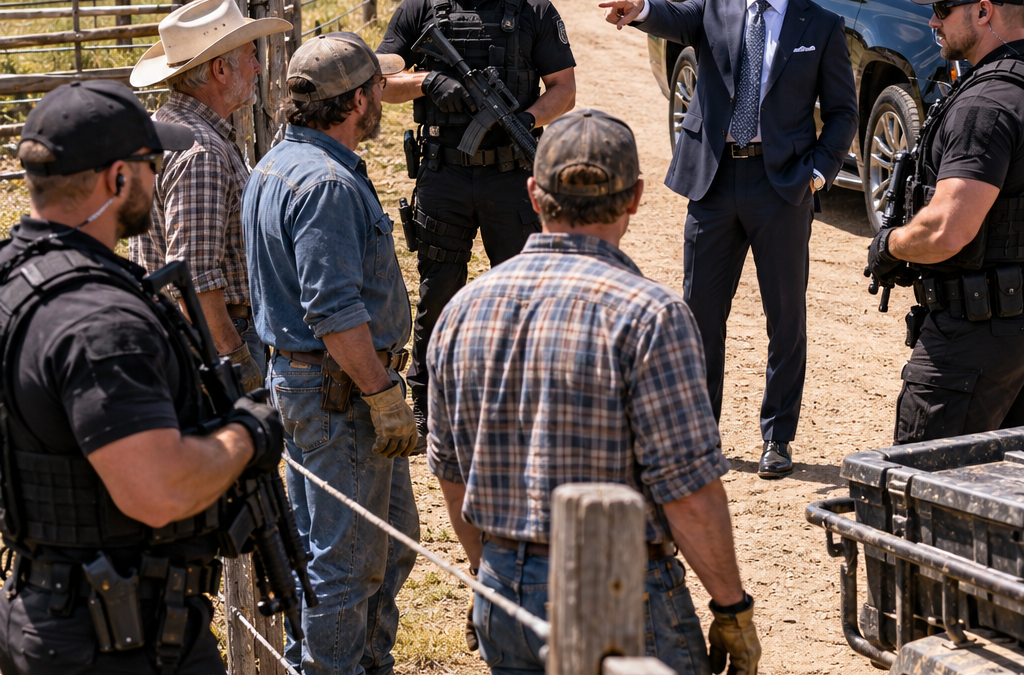
𝗙𝗨𝗟𝗟 𝗦𝗧𝗢𝗥𝗬
He adjusted his watch.
“I suggest you don’t make this difficult.”
I turned back toward the damaged fence.
“I suggest you let me fix it.”
He drove away irritated.
I thought that would be the end of it.
It wasn’t.
A week later, I received a letter from the association’s compliance committee.
The notice described the damaged fence as a visual nuisance affecting nearby residential properties.
It included language about community appearance standards and demanded corrective action.
I almost laughed.
Not because the fence didn’t need repair.
It did.
But because I had already scheduled the work, and the HOA was pretending it had authority to order me around.
I sent a short response.
The property was privately owned.
It was outside the association.
The fence would be repaired according to my maintenance schedule.
I requested that any further demands identify the recorded authority under which the association claimed jurisdiction.
Karen never supplied one.
Instead, another letter arrived.
Then another.
One warned that continued failure to cooperate could require further enforcement.
Another suggested that the condition of my fence interfered with the community’s obligation to maintain neighborhood standards.
The wording grew more aggressive.
The legal foundation never improved.
I filed everything.
Over the years, my profession had taught me that people could argue endlessly about what somebody said, but written records were considerably harder to reinterpret.
So I saved the notices.
I saved my replies.
I kept copies of the property survey and the relevant deed information in a folder inside my office.
I didn’t know that those papers would become important sooner than anyone expected.
The afternoon everything happened began like any other workday.
It was a Thursday in late spring.
The sky was clear, and a steady breeze moved through the grass along the eastern pasture.
Three of my workers had started repairing the damaged fence shortly after lunch.
Luis, my longtime foreman, was directing the job.
He had worked on the ranch for nearly eight years.
He knew the property almost as well as I did, and I trusted him more than I trusted most people who wore expensive suits and claimed to understand land management.
Luis was in his early forties, broad-shouldered, with sun-darkened skin and hands permanently marked by years of physical work.
He was calm under pressure.
That was one of the reasons I valued him.
Working with him were Daniel and Sam.
Daniel was an experienced equipment operator who could look at a sagging fence line and identify the underlying problem before most people even noticed the damage.
Sam was younger, hardworking, and still learning some of the more complicated aspects of ranch maintenance.
The three men had spent the morning removing damaged rails and preparing replacement posts.
By early afternoon, they were installing the new section.
The work was straightforward.
They weren’t clearing somebody else’s land.
They weren’t blocking a public road.
They weren’t crossing into the neighboring development.
They were repairing a fence entirely within my ranch boundary.
I had walked the line with Luis earlier that morning.
We had checked the existing survey markers, confirmed where the replacement posts would stand, and discussed how to avoid disturbing an old drainage channel.
Everything was exactly where it belonged.
“Should be finished before evening,” Luis had told me.
“Good,” I said. “I’d like to move the cattle back over here tomorrow.”
He nodded toward the damaged fence.
“Wouldn’t trust this section until we’re done.”
“Neither would I.”
I handed him the updated work order.
“Call me if anything comes up.”
He smiled.
“Unless the fence decides to argue, I think we’re fine.”
I laughed.
Neither of us imagined that the real argument would arrive in a black SUV.
After lunch, I returned to the farmhouse.
The afternoon was unusually quiet.
I had paperwork to review for work the following morning, along with several ranch invoices that needed attention.
I sat behind the old oak desk in my office.
The room had been my grandfather’s study.
He had kept feed receipts, equipment manuals, tax records, and handwritten notes in the same wooden drawers.
After I inherited the place, I modernized most of the filing system but kept the desk.
Its surface was scratched from decades of use.
There was a small burn mark near the corner where my grandfather had once left a hot soldering tool.
I liked those imperfections.
They reminded me that the ranch had existed long before my career and would hopefully remain long after I was gone.
The window beside the desk overlooked part of the eastern pasture.
I could see the tops of the oak trees and, farther away, a section of the fence Luis and the others were repairing.
The property map lay open on the desk.
I had been comparing an older survey with the updated version because we were planning additional fencing later in the year.
Every line was familiar.
The farmhouse sat near the center of the ranch.
The eastern boundary followed a series of surveyed points beyond the pasture.
The HOA development began on the opposite side.
The fence crew was well inside my property.
There was nothing ambiguous about it.
At approximately two-thirty, I heard the distant sound of a vehicle.
I glanced toward the window.
A black SUV was coming along the ranch access road.
I recognized it immediately.
Karen Whitmore.
He drove slowly, as though inspecting something he believed belonged to him.
I watched the vehicle pass through the open service entrance and continue toward the eastern pasture.
My jaw tightened.
Karen had no appointment.
He hadn’t called.
And he had no reason to be driving into the working section of my ranch.
Then I noticed another vehicle behind him.
A dark security SUV.
My stomach tightened.
Three men wearing matching uniforms got out when the vehicles stopped near the fence crew.
I stood.
For several seconds, I watched through the window.
Karen stepped out first.
Even from a distance, I could recognize his posture.
His shoulders were squared, his chin slightly raised, and his movements carried the deliberate confidence of a man accustomed to being obeyed.
He pointed toward the fence.
Then toward my workers.
The three security guards moved with him.
I frowned.
This was no ordinary visit.
Before I could reach for my phone, Luis called.
I answered immediately.
“Luis?”
His voice was steady.
“Boss, we’ve got a situation.”
I looked out the window.
“I can see Karen’s SUV.”
“He’s here with three private security guards.”
“What does he want?”
“He says we’re trespassing.”
I stared at the phone.
“On my ranch?”
“That’s what I told him.”
I heard shouting in the background.
Karen’s voice.
Sharp.
Impatient.
Then another voice saying something about leaving the property.
Luis lowered his voice.
“He’s telling the guards to remove us.”
I felt anger rise through my chest.
“Has anyone touched you?”
“Not yet.”
“Has anybody threatened you?”
“He told them to arrest Sam.”
I closed my eyes for one second.
Then opened them.
“Listen carefully. Don’t argue. Don’t touch anybody. Stay together and keep your hands visible.”
“Understood.”
“I’m coming.”
I ended the call.
For a moment, I stood completely still.
Not because I was frightened.
Because I knew exactly how quickly a confrontation involving people claiming authority could become dangerous.
I had spent years dealing with individuals who misunderstood the difference between what they wanted and what the law allowed them to do.
I knew what happened when someone with a uniform, a badge, or a powerful title began believing that resistance automatically justified force.
Private security guards were not police officers.
An HOA president was not a sheriff.
And my employees were not trespassers simply because Karen wanted them removed.
But the workers were standing in front of three uniformed guards who had apparently been ordered to detain them.
That created a risk I couldn’t ignore.
I looked down at the property map.
The boundary was unmistakable.
The fence crew was repairing a section on my land.
The road Karen had used to enter belonged to the ranch.
The neighboring HOA controlled none of it.
I reached for the document folder, slipped the current survey and deed description inside, and placed it under my arm.
Then I put on my hat.
I could have walked outside furious.
I wanted to.
The thought of Karen humiliating men who were simply doing their jobs made my blood boil.
Luis had a family.
Daniel had worked through a difficult winter without missing a day.
Sam was trying to establish himself in a profession that demanded both strength and patience.
They deserved to work without being surrounded by strangers threatening arrest.
They trusted me to provide a safe workplace.
That responsibility mattered more than my anger.
So I took one slow breath.
Then I walked out of the farmhouse.
The afternoon sunlight was bright.
A warm wind crossed the pasture.
From where I stood, I could see Karen near the damaged fence.
One security guard stood several feet from Luis.
Another was positioned beside Daniel.
The third was close to Sam.
Karen was speaking loudly enough that his voice carried across the grass.
“I don’t care what your employer told you. You are not authorized to work here!”
Luis stood with his arms relaxed at his sides.
“Sir, this is our employer’s ranch.”
Karen pointed toward the HOA development beyond the trees.
“This entire perimeter is subject to community oversight.”
Daniel glanced toward the survey marker near the fence.
“We’re not on association land.”
Karen’s expression turned ugly.
“Nobody asked for your opinion.”
The security guards shifted uncomfortably.
The oldest guard, who appeared to be supervising the others, held a small radio.
He looked from Karen to the workers.
“Mr. Whitmore, we need to establish the property boundary before taking any action.”
Karen turned toward him.
“I’ve already established it.”
“Sir, we don’t have a site map.”
“You have my authorization.”
I was still too far away to hear every word clearly, but I caught enough.
Karen believed his instructions should settle the question.
The guard didn’t seem entirely convinced.
That was a small relief.
But Karen wasn’t finished.
He stepped toward Sam.
The younger worker was holding a pair of work gloves.
Karen pointed at the gloves, then at the tools lying beside the fence.
“Stop this work immediately.”
Sam looked toward Luis.
Luis shook his head slightly.
“Just stay calm,” he told him.
Karen noticed.
He smiled.
It was a nasty little smile.
“That’s right. You’d better listen to someone.”
He turned toward the nearest security guard.
“Remove him.”
The guard hesitated.
“Sir?”
“I said remove him from the property.”
Sam took a small step backward.
“I’m working here.”
Karen’s voice rose.
“Not anymore.”
The guard looked toward Luis.
“Do you have identification showing you’re authorized to work on this property?”
Luis nodded.
“We have the work order. Our boss owns the ranch.”
“Then show it to me.”
Luis reached carefully toward the folder resting on the tailgate of his truck.
Karen snapped.
“Don’t let him interfere with anything.”
The guard raised one hand.
“Sir, he’s getting the paperwork.”
Karen’s face reddened.
“You’re supposed to be securing this area.”
“We can’t confirm a trespass without knowing who owns the land.”
Karen stepped closer.
His polished shoes sank slightly into the soft soil.
Then he said the words that made the entire situation more serious.
“Arrest him.”
The guard stared at him.
“What?”
“That man. Arrest him for trespassing.”
Luis stopped moving.
Daniel turned his head.
Sam looked toward the farmhouse.
Karen folded his arms.
“I am not going to tolerate open defiance of association authority.”
The senior guard looked distinctly uncomfortable.
“Mr. Whitmore, we’re private security. We can’t make an arrest simply because you instruct us to.”
Karen’s eyes narrowed.
“Then detain him until the police arrive.”
The guard didn’t move.
Karen looked furious.
“Do I need to explain your job to you?”
I was close enough now to see the tension in Luis’s face.
He wasn’t afraid of Karen.
He was worried about what an angry man might persuade someone else to do.
That distinction mattered.
Luis could handle himself.
He had worked around large animals, heavy machinery, and difficult people his entire adult life.
But a physical confrontation with uniformed security guards could end badly for everyone.
He knew it.
And so did I.
I crossed the last stretch of gravel toward the fence.
Karen noticed me.
His expression changed instantly.
The anger disappeared behind a polished smile.
He straightened his jacket.
Adjusted his watch.
And turned toward me as though he had been waiting for my arrival.
“Finally,” he said.
I stopped several feet from him.
“Afternoon, Karen.”
He lifted his chin.
“I assume you’re the owner.”
“You know I am.”
“Then perhaps you can explain why your employees are violating community property restrictions.”
I looked at Luis.
“You all right?”
“Yes, sir.”
“Daniel?”
“I’m fine.”
“Sam?”
The younger man nodded.
“I’m okay.”
I looked at the security guards.
Then back at Karen.
“What exactly is happening here?”
Karen sighed theatrically.
“I was conducting a routine community perimeter inspection when I discovered unauthorized work being performed along our boundary.”
“On whose land?”
He frowned.
“What?”
“Whose land are they standing on?”
Karen pointed toward the fence.
“This area falls under HOA oversight.”
“That wasn’t my question.”
His smile thinned.
“Michael, I’m trying to handle this professionally.”
“Then answer it professionally.”
He stared at me.
I continued.
“Is this your property?”
“It affects our community.”
“Is it owned by the HOA?”
“The boundary is subject to community standards.”
“Is it owned by the HOA?”
Karen’s jaw tightened.
“You are being deliberately difficult.”
I looked at the guards.
“Who told you these men were trespassing?”
The senior guard answered.
“Mr. Whitmore advised us that unauthorized workers were conducting construction on association-controlled property.”
I nodded.
“Did he provide a survey?”
“No, sir.”
“A deed?”
“No.”
“An easement or written agreement granting the association control over this area?”
The guard glanced toward Karen.
“No, sir.”
I looked back at Karen.
“Then why are three security guards standing around my employees as though they’ve committed a crime?”
He lifted his chin.
“Because the association has a duty to protect its property.”
“Your property is on the other side of the boundary.”
His expression hardened.
“That’s your interpretation.”
“No. That’s the recorded survey.”
Karen stepped closer.
“Don’t lecture me about community governance.”
“I’m not discussing community governance. I’m discussing private property.”
He pointed toward the fence.
“Your workers are altering a perimeter structure that affects our development.”
“They’re repairing a fence.”
“Without approval.”
“Your approval isn’t required.”
Karen’s eyes narrowed.
“That’s not how things work here.”
I looked directly at him.
“That’s exactly how private property works.”
For several seconds, neither of us spoke.
The wind moved through the grass.
Behind Karen, one security guard shifted his weight.
Luis remained beside the truck, watching carefully.
Then Karen laughed.
It wasn’t a genuine laugh.
It was the short, contemptuous sound of a man who believed the conversation had become ridiculous because someone had dared contradict him.
“You ranch owners seem to think being outside a subdivision means you can do whatever you want.”
“No,” I said. “I think it means your HOA can’t control land it doesn’t own.”
He waved one hand dismissively.
“Our authority extends to everything affecting the community.”
I almost couldn’t believe what I was hearing.
“Everything?”
“Anything that threatens neighborhood standards.”
“That would include the county road?”
He frowned.
“What?”
“The creek?”
“Don’t be absurd.”
“The neighboring farms?”
“Michael—”
“The sky over your houses?”
His face flushed.
“You’re mocking me.”
“I’m asking where your authority ends.”
He opened his mouth.
Then closed it.
I held up the document folder.
“Because the answer is right here.”
Karen glanced at the papers.
“I don’t need to examine your personal documents.”
“You should have examined them before bringing guards onto my ranch.”
The senior security guard looked toward the folder.
“Sir, may we see the boundary information?”
“Absolutely.”
I opened the survey across the hood of Luis’s truck.
The paper was large enough to show the relevant parcel lines clearly.
I pointed to the eastern boundary.
“This is my ranch.”
Then I moved my finger.
“This is the fence being repaired.”
The guard leaned closer.
I continued.
“The HOA property begins beyond this line.”
Karen moved forward.
“Those maps don’t account for our community’s broader interests.”
I looked at him.
“Broader interests aren’t ownership.”
He adjusted his watch.
“You keep hiding behind technicalities.”
I felt my patience tighten.
“Karen, the difference between your property and mine isn’t a technicality.”
He folded his arms.
“You don’t understand the responsibilities of being a community leader.”
I looked at the men standing beside us.
Then at the ranch stretching behind them.
“No, Karen. I understand responsibility very well.”
My voice was quieter now.
“Responsibility means making sure the people working for you are safe. It means knowing the limits of your authority before you order somebody detained. It means checking the facts before accusing another person of a crime.”
He stared at me.
“Are you implying I’m abusing my position?”
“I’m telling you that you’ve entered my ranch without permission, accused my workers of trespassing, and ordered private security guards to arrest a man on property he was hired to maintain.”
Karen looked toward the guards.
“This is why I wanted law enforcement involved.”
I frowned.
“What do you mean?”
He pulled out his phone.
“I’ve already made a call.”
My stomach tightened.
“To whom?”
“Someone with actual authority.”
I looked at him carefully.
“Are you saying you’ve called the police?”
He smiled.
“I’m saying this matter is about to be settled properly.”
I glanced at Luis.
He looked concerned.
The younger workers stood quietly beside him.
Nobody had moved toward their tools.
The fence remained half-repaired.
Several rails were lying on the ground, and an open section near the drainage channel still needed to be secured before cattle could safely return to the pasture.
Karen wasn’t merely interrupting an argument.
He was stopping necessary work.
And every minute his little demonstration continued was another minute my employees stood under threat instead of doing the jobs I had hired them to perform.
I looked back at Karen.
“If you’ve called law enforcement, that’s fine. But your security guards are not taking my workers anywhere.”
He laughed.
“You don’t get to decide that.”
“Actually, I get to decide who is authorized to work on my property.”
“The association has already determined that their work is unauthorized.”
I looked at the senior guard.
“Have you detained anyone?”
“No, sir.”
“Have you physically restrained anyone?”
“No.”
“Good. Keep it that way.”
Karen stepped forward.
“Don’t give orders to my security team.”
I turned toward him.
“Then stop ordering them to exceed their authority.”
His face reddened.
“You have no idea who you’re dealing with.”
I looked at him for a moment.
Then I asked a question I had been holding back since I arrived.
“Karen, do you know who you’re giving orders to?”
He stared at me.
Then he laughed.
“I don’t care who you think you are.”
The words came quickly.
Arrogantly.
As though my identity couldn’t possibly matter because his title already outranked everyone else present.
I felt something settle inside me.
I had tried to explain the boundary.
I had shown the survey.
I had asked the guards to verify their instructions.
I had given Karen several opportunities to reconsider.
He had rejected every one.
Instead, he kept pushing toward the same outcome.
He wanted my employees removed.
He wanted the fence work stopped.
And he wanted me to accept that his association controlled the property.
I knew the conversation had reached a point where ambiguity could become dangerous.
Then another vehicle appeared at the far end of the ranch road.
It was a county sheriff’s patrol SUV.
Karen turned toward it immediately.
His face brightened.
“There,” he said. “Finally.”
The vehicle approached slowly, keeping clear of the work equipment.
Luis recognized it as one of the sheriff’s office patrol units that occasionally traveled through the surrounding ranch district.
Daniel glanced toward me.
Sam looked relieved.
Karen straightened his jacket and moved toward the road.
He clearly believed the arrival of a uniformed deputy would settle the argument in his favor.
I had seen that expression before.
People sometimes mistook the arrival of law enforcement for confirmation that their complaint was justified.
But officers didn’t exist to enforce whichever side spoke first.
They had to determine what authority actually applied.
The deputy parked near the fence and stepped out.
He looked toward the workers.
Then the security guards.
Then Karen.
“Afternoon. What’s going on?”
Karen immediately stepped forward.
“I’m Karen Whitmore, president of the neighboring homeowners association.”
He extended his hand.
The deputy shook it briefly.
“We have unauthorized workers trespassing on community-controlled land,” Karen continued. “My security team has secured the situation, but the property owner is interfering with enforcement.”
I watched the deputy’s eyes move toward me.
He looked at the ranch equipment.
The unfinished fence.
The survey on the truck hood.
Then back at Karen.
“All right,” he said. “Let’s slow this down.”
Karen looked irritated.
“We need these workers removed.”
The deputy raised one hand.
“I’ll speak with everyone.”
Karen opened his mouth again.
The deputy continued.
“One person at a time.”
I almost smiled.
Almost.
Then the deputy looked toward me.
“Sir, are you the property owner?”
“Yes.”
“Name?”
I gave it.
Then I reached into my jacket and removed my identification case.
I had carried those credentials for years.
They weren’t something I displayed casually.
I didn’t use them to get special treatment at restaurants, win arguments with neighbors, or escape ordinary responsibilities.
They represented a professional obligation I took seriously.
And I had learned long ago that a badge was meaningful only when the person carrying it understood its limits.
I opened the case.
“This is my ranch,” I said. “And for the record, I’m a deputy United States marshal.”
I showed my federal credentials.
The deputy examined them.
His expression changed slightly.
Then he nodded.
Karen stared.
For a moment, he seemed unable to process what he’d heard.
“A what?”
I looked directly at him.
“A deputy U.S. marshal.”
The afternoon fell strangely quiet.
Even the security guards stopped shifting their feet.
Karen’s gaze moved from my credentials to my face.
Then back to the identification case.
His polished smile disappeared.
The color drained from his expression.
For several seconds, he said nothing.
I could almost see him trying to reconcile the man standing in dusty ranch boots and a work jacket with the federal credentials in my hand.
He had apparently decided I was just another rural property owner he could intimidate.
He hadn’t bothered to ask about my background.
He hadn’t bothered to verify the boundary.
And he certainly hadn’t imagined that the man he was ordering around had extensive professional experience dealing with lawful authority, detention, and the limits of enforcement power.
The senior security guard took a step backward.
One of the younger guards lowered his hands.
The third glanced toward the sheriff’s deputy.
Nobody wanted the confrontation to become more serious.
Karen finally found his voice.
“Well,” he said, “I wasn’t aware of your federal position.”
I closed the identification case.
“It doesn’t change who owns this property.”
He blinked.
“What?”
“My badge doesn’t move the boundary. My deed establishes my ownership. Your association either has a legal right here or it doesn’t.”
Karen swallowed.
I continued.
“I didn’t show you my credentials because I think being a federal officer puts me above ordinary property law. I showed them because you keep trying to intimidate my employees with threats of arrest, and I need you to understand that I know the difference between lawful enforcement and private security being pressured to act without authority.”
Karen looked toward the sheriff’s deputy.
“This is being blown completely out of proportion.”
The deputy studied him.
“Mr. Whitmore, let’s establish the facts.”
Karen adjusted his watch.
The movement was quick and nervous.
“I was attempting to protect the community.”
The deputy glanced at the survey.
“Protect it from what?”
“Unauthorized construction.”
“On whose property?”
Karen hesitated.
“The community perimeter.”
“Is that property owned by the association?”
“It affects our development.”
The deputy looked at me.
“Can I see the survey?”
“Of course.”
I unfolded it completely.
The deputy examined the property lines.
Then he looked toward the fence.
The surveyed boundary was straightforward.
The section under repair stood within my ranch.
The HOA development began beyond it.
I showed him the relevant deed description.
Then the established markers identifying the line.
He took his time.
I appreciated that.
The badge in my hand hadn’t settled the matter.
The evidence would.
The deputy looked toward Karen.
“Do you have a document showing that the HOA controls this section?”
Karen shifted his weight.
“Our governing documents grant us authority over perimeter conditions.”
“Do they grant access to this particular ranch parcel?”
Karen didn’t answer immediately.
“I’d have to consult the board.”
The deputy nodded.
“Then you haven’t established that these workers are trespassing.”
Karen’s face tightened.
“They’re creating a condition affecting the neighborhood.”
“That may be something you want to discuss with the owner. It doesn’t automatically give you the right to remove his employees.”
Karen looked toward me.
“This is an unreasonable interpretation.”
I took a slow breath.
“No, Karen. It’s the same property line I’ve been showing you since the first notice.”
He ignored me.
“I have a responsibility to maintain neighborhood standards.”
The deputy answered.
“Within whatever authority the association lawfully has.”
Karen stared at him.
The deputy continued.
“If this fence is on private ranch property, and the workers are here with the owner’s permission, they’re not trespassing simply because the association president objects to the work.”
I looked toward Luis.
His shoulders visibly relaxed.
Daniel lowered his head for a moment.
Sam released a breath.
The three men had stood there calmly while Karen accused them of being criminals.
Now the actual situation was finally being examined.
Karen still wasn’t ready to admit his mistake.
He turned toward the senior security guard.
“Explain why you were instructed to remove the workers.”
The guard looked uncomfortable.
“Sir, you advised us that the workers were trespassing on association property.”
“And?”
“You ordered us to clear the area.”
Karen’s expression hardened.
“Because they were unauthorized.”
The guard hesitated.
Then he said something that changed the atmosphere again.
“You also instructed us to arrest one of them.”
The deputy looked directly at Karen.
“Is that correct?”
Karen’s jaw tightened.
“I used the term in the context of security enforcement.”
The senior guard spoke carefully.
“Mr. Whitmore, you specifically told us to arrest him.”
Silence.
I looked at Sam.
His face had gone pale.
He was trying to remain calm.
But I could see how much the threat had affected him.
He was a young man who had spent the afternoon hauling fence posts and repairing wire.
He had come to work expecting sore hands and a paycheck.
Instead, a stranger in a tailored jacket had surrounded him with uniformed guards and demanded his arrest.
I felt anger tighten my chest.
The deputy turned toward the guards.
“Did anyone physically detain the workers?”
“No, sir,” the senior guard answered.
“Did anyone attempt to handcuff them?”
“No.”
“Good.”
The deputy looked toward Karen.
“Private security personnel don’t gain general police powers because an HOA president tells them to arrest someone. Any authority to detain is limited by applicable law and the actual circumstances. A disagreement over a fence does not give an association unlimited enforcement powers.”
Karen’s lips pressed together.
“I never intended for anyone to be harmed.”
I looked directly at him.
“Then why did you threaten to have Sam arrested?”
His eyes moved toward the younger worker.
For the first time, he seemed to notice him as a person rather than an obstacle.
Sam stood beside the fence with his work gloves in one hand.
Dust covered his jeans.
Sweat darkened the collar of his shirt.
He looked exhausted.
Karen opened his mouth.
Then closed it.
Finally, he said, “I believed the work was unauthorized.”
I nodded.
“And when Luis told you they worked for me?”
Karen looked away.
“When he told you the ranch was private property?”
Silence.
“When he offered to show you the work order?”
Karen’s expression hardened.
“You are turning this into a personal attack.”
I stepped forward slightly.
“No. I’m asking why you were so determined to treat hardworking men like criminals when all you had to do was check a map.”
The words came out sharper than I intended.
I felt every eye turn toward me.
I stopped.
Then I lowered my voice.
“These men have families. They have jobs. They came here to repair a fence that protects livestock and keeps the ranch operating safely.”
I pointed toward the unfinished section.
“That fence needed to be repaired before cattle could return to this pasture. Every minute you’ve kept them standing here has delayed work that actually matters.”
Karen looked toward the broken rails.
I continued.
“You didn’t ask whether anybody was in danger. You didn’t ask whether the fence was on your property. You didn’t ask who authorized the workers.”
I looked directly at him.
“You arrived with three security guards and began issuing orders because you assumed nobody would challenge you.”
His face flushed.
“I was acting as HOA president.”
“That’s the problem.”
He stared at me.
“You thought that title gave you authority over everything surrounding your neighborhood.”
I pointed toward the survey.
“It doesn’t.”
The deputy remained silent.
The security guards watched.
Luis stood beside his truck.
For a moment, I could hear nothing except wind moving through the grass.
Then Karen said quietly, “You don’t understand the pressure I’m under.”
I looked at him.
“What pressure?”
“Residents expect me to protect their property values. They expect the perimeter maintained. They expect standards.”
I held his gaze.
“Then protect the property you’re responsible for.”
He looked away.
“That’s what I was doing.”
“No. You crossed onto somebody else’s land because you wanted control over something you didn’t own.”
His expression tightened.
I continued.
“And when people refused to surrender that control, you threatened them with arrest.”
Karen stared at me.
There was no polished smile left.
No smooth executive confidence.
Only resentment.
He couldn’t deny that his security team had crossed the ranch boundary.
He couldn’t produce a deed or easement giving the association control over the fence.
And he couldn’t explain why he had demanded the arrest of an employee working with the owner’s permission.
For the first time since I’d met him, Karen seemed uncertain about which direction to take.
He looked at the deputy.
Then at the guards.
Then toward the HOA development beyond the trees.
He had arrived expecting obedience.
Now every person standing around him understood that his authority was limited.
The deputy turned toward me.
“Do you want these individuals to leave your property?”
I looked toward Karen.
“Yes. I want the HOA president and his private security team to leave. They’re not authorized to supervise or interfere with the ranch work.”
The deputy nodded.
Then he addressed Karen.
“Mr. Whitmore, the owner has made his position clear. You haven’t established a legal basis to remain here or direct the workers. The appropriate course is to leave and pursue any legitimate concerns through proper channels.”
Karen lifted his chin.
“I reserve the association’s rights.”
“You’re entitled to seek legal advice,” the deputy replied. “That doesn’t authorize further interference today.”
Karen looked furious.
But he had no useful response.
I turned toward Luis.
“Get the crew back to work.”
Luis nodded.
“Yes, sir.”
He looked at Daniel.
“Let’s finish the top rail.”
Daniel picked up his tools.
Sam walked toward the stack of replacement posts.
For a moment, the three men moved cautiously.
They were still aware of the security guards.
Still waiting to see whether Karen would make another demand.
But nobody stopped them.
Luis positioned the next rail.
Daniel checked the alignment.
Sam retrieved the fasteners.
The sound of work returned to the pasture.
A hammer struck wood.
A drill began turning.
The fence repair resumed.
Karen stood there watching, his expensive shoes planted in the dirt.
I could almost feel how much he hated what he was seeing.
The men he had ordered removed were working again.
The security guards he had brought were no longer taking his instructions at face value.
The deputy had declined to enforce his claims.
And the ranch owner he had expected to intimidate was standing beside him with the recorded property documents.
The entire demonstration had collapsed.
Karen turned toward the senior security guard.
“Let’s go.”
The guard hesitated.
Then looked at me.
“Sir, may I say something?”
I nodded.
“Go ahead.”
He removed his sunglasses.
“I apologize for the confrontation. We were told this was association-controlled property and that unauthorized work was taking place.”
I looked at him.
“Did you verify the boundary before coming onto the ranch?”
“No, sir.”
“Did you ask for the recorded documents?”
“No.”
I let the silence sit for a moment.
Then I said, “You should.”
He nodded.
“Understood.”
I looked toward the other two guards.
They were younger.
Both appeared uncomfortable.
“Your job requires good judgment,” I told them. “That includes knowing when someone giving you an order doesn’t actually have the authority to give it.”
One guard nodded.
“Yes, sir.”
“Uniforms don’t change property ownership. They don’t turn an unsupported complaint into probable cause. And they don’t make an HOA rule enforceable against land outside the association.”
The senior guard answered quietly.
“You’re right.”
I looked toward the fence crew.
“Those men were doing their jobs. They didn’t threaten you. They didn’t resist you. They offered to show you the work order.”
He lowered his eyes.
“We should have checked.”
“Yes.”
I didn’t raise my voice.
I didn’t threaten to have the guards arrested.
I wasn’t interested in turning an already foolish confrontation into something worse.
They had made a mistake by accepting Karen’s assertions without verifying the facts.
They needed to recognize that mistake.
And they had.
The senior guard extended his hand.
I shook it.
Then he turned toward the others.
“Back to the vehicle.”
The three men walked toward their SUV.
Karen remained where he was.
He looked toward my workers.
Luis was securing the new rail.
Daniel was measuring the next section.
Sam was gathering the loose tools.
The men didn’t stop to watch Karen leave.
That seemed to irritate him more than anything else.
He had arrived expecting to become the center of their attention.
Instead, he had become an interruption they were trying to put behind them.
I watched him adjust his jacket.
Then his watch.
Then his sunglasses.
For a second, I thought he might say something more.
A warning.
A threat.
A promise to involve the board.
But the deputy was still standing nearby.
The survey remained open on Luis’s truck.
And the workers had already returned to the fence.
Karen looked at me.
“This isn’t how I expected today to go.”
I held his gaze.
“That makes two of us.”
He swallowed.
“I was trying to protect the community.”
I nodded toward the development.
“Then start by respecting the boundaries around it.”
His jaw tightened.
He looked away.
Then he turned and began walking toward his SUV.
His shoes made small, sharp sounds against the gravel.
The security guards followed him quietly.
Nobody spoke.
Nobody tried to stop the fence work.
Nobody threatened my employees.
Karen reached the driver’s door.
He paused with one hand on the handle.
Then he looked back toward the ranch.
I couldn’t read his expression behind the sunglasses.
But I knew what he was seeing.
The fence crew working.
The deputy speaking calmly with me.
The survey spread across the truck hood.
The cattle moving beyond the pasture.
And a property that remained completely outside his control.
He climbed into the SUV.
The engine started.
A few minutes later, both private security vehicles disappeared down the ranch road.
The sheriff’s deputy remained briefly to make certain there was no further disturbance.
He asked a few final questions and made notes about the encounter.
I provided copies of the relevant property information and explained that I had previously received HOA notices concerning the fence.
He looked at the documents.
“Keep everything,” he advised.
“I intend to.”
“If the association has a legitimate civil claim, it can pursue the proper process. But that doesn’t mean private security can come onto your land and remove authorized workers.”
“I understand.”
He nodded.
“And your federal position doesn’t change that basic analysis.”
I appreciated him saying it.
“Exactly.”
He looked toward the repaired fence.
“Looks like your crew has almost finished.”
I followed his gaze.
Luis was checking the alignment of the replacement rails.
“That’s what they were supposed to be doing all afternoon.”
The deputy smiled faintly.
“Then I’ll let you get back to it.”
We shook hands.
He returned to his patrol vehicle.
Soon, the ranch road was quiet again.
I watched the deputy leave.
Then I turned toward the fence.
The afternoon had grown warmer.
A breeze carried the smell of dry grass and fresh-cut wood.
The cattle were grazing near the far side of the pasture.
Everything looked normal.
But I could still feel the tension in my shoulders.
Luis walked toward me.
“You okay, boss?”
I looked at him.
“That was supposed to be my question.”
He gave a tired laugh.
“We’re fine.”
I glanced toward Sam.
The younger man was working quietly beside Daniel.
“How’s he doing?”
Luis followed my gaze.
“Shaken up.”
I nodded.
“Understandably.”
He looked toward the road.
“I’ve never had anybody show up with security guards and tell me I was trespassing on the ranch I work for.”
“Neither have I.”
Luis shook his head.
“He was acting like we were criminals.”
I looked at the place where Karen had stood.
“I know.”
Luis hesitated.
“When he told them to arrest Sam, I thought things might get ugly.”
“So did I.”
He looked surprised.
“You didn’t seem worried.”
I took off my hat and ran a hand through my hair.
“That’s because somebody needed to stay calm.”
He nodded slowly.
I looked toward the unfinished fence.
“Let’s get this done.”
Luis smiled.
“Already on it.”
We walked back toward the work area.
I picked up a measuring tape and helped check the alignment of the final section.
Daniel tightened the fasteners.
Sam carried the last replacement rail into position.
The work resumed with the familiar rhythm of men who knew what they were doing.
For several minutes, nobody mentioned Karen.
I appreciated that.
The ranch didn’t need another speech about property rights.
It needed a repaired fence.
We worked until the final section was secure.
Then Luis stepped backward and examined the line.
“That’s it.”
I looked down the fence.
The posts were straight.
The rails were firm.
The gate opened and closed properly.
The damaged section had been replaced without disturbing the surveyed boundary.
I tested the latch.
Solid.
“Looks good,” I said.
Daniel grinned.
“Would’ve been done earlier without the parade.”
Sam laughed.
It was the first time I’d heard him laugh since the confrontation.
I looked at him.
“You all right?”
He nodded.
“Yeah.”
Then his expression grew serious.
“Can I ask you something?”
“Of course.”
He glanced toward the road.
“Could those guys really have arrested me?”
I considered my answer carefully.
“They had no established basis to arrest you for trespassing on property where you were authorized to work. Private security doesn’t have general police authority just because someone hires them.”
He looked down.
“Karen made it sound like they could.”
“I know.”
Sam swallowed.
“I didn’t want to argue. I thought maybe if I said the wrong thing, they’d put me in handcuffs.”
I felt anger tighten my chest again.
Not at Sam.
At the fact that a young worker had spent part of his afternoon worrying that doing his job might lead to an arrest.
I placed a hand on his shoulder.
“You did exactly what I wanted you to do.”
He looked up.
“You stayed calm. You didn’t threaten anybody. You let Luis contact me.”
He nodded.
“That’s the right way to handle a situation like that. Don’t make it physical unless you have to protect yourself from an immediate threat.”
Sam took a breath.
“Okay.”
I looked toward Daniel and Luis.
“And for the record, none of you did anything wrong today.”
Daniel gave a short nod.
Luis looked relieved.
I continued.
“If anyone from the HOA comes back and tries to interfere with your work, call me immediately. Don’t argue over property law in the middle of a pasture.”
Luis smiled.
“That was my plan.”
“Good.”
I looked around at the completed fence.
“You three finished the job despite all that nonsense. I appreciate it.”
Sam smiled.
“Thanks, boss.”
We gathered the tools.
By the time the work truck was loaded, the sun had started lowering toward the western ridge.
Long shadows stretched across the pasture.
The cattle remained calm.
The fence was secure.
The workday had ended the way it should have.
But I knew the confrontation itself needed to be documented.
That evening, I returned to my office and opened the folder containing Karen’s earlier notices.
I placed the survey on the desk.
Then I wrote down the sequence of events while my memory was fresh.
Karen arrived without permission.
He brought three private security guards.
He accused authorized ranch workers of trespassing.
He ordered them removed.
He instructed the guards to arrest one worker.
He called for law enforcement.
I came outside and identified myself as the owner.
I showed the recorded boundary.
The sheriff’s deputy reviewed the situation.
The guards acknowledged they had not verified ownership before acting on Karen’s instructions.
The confrontation ended without anyone being detained.
I also asked Luis to document what he and the crew had witnessed.
I wasn’t preparing some dramatic revenge against Karen.
I wanted an accurate record.
My career had taught me that a serious disagreement could become even more complicated when people later began remembering events in ways that favored them.
The documents mattered.
So did the witness accounts.
If Karen tried to claim that my workers had threatened his guards, I wanted the sequence preserved.
If the association continued asserting authority over the fence, I wanted every notice available.
And if somebody eventually asked why private security had been brought onto my ranch, I wanted the answer grounded in evidence rather than gossip.
I sat at the desk for a while after finishing.
Outside, the last sunlight faded behind the hills.
The farmhouse was quiet.
I could hear the ceiling fan turning above me.
I looked at the survey.
The boundary line was simple.
A thin mark on paper separating one property from another.
It seemed almost absurd that a person could build so much anger around something so straightforward.
But I knew the dispute had never been entirely about the fence.
Karen wanted control.
The fence was simply where he had chosen to exercise it.
I thought about the way he had stood beside my workers, issuing orders with the certainty of a man who believed nobody could challenge him.
I thought about Sam’s face when he asked whether the guards could arrest him.
That memory bothered me most.
Karen hadn’t merely inconvenienced my employees.
He had made them afraid.
He had turned ordinary ranch work into a confrontation involving uniforms, accusations, and threats of detention.
And he had done it because he couldn’t tolerate someone working on land he wanted to regulate.
I closed the folder.
Then I looked through the window toward the eastern pasture.
The repaired fence stood beyond the trees.
It was almost invisible in the fading light.
Exactly the way a fence should be.
A practical structure doing a practical job.
I wondered how different the afternoon might have been if Karen had simply approached Luis and asked who owned the land.
Or if he had called me before arriving.
Or if he had taken five minutes to examine the survey.
There were countless opportunities for him to stop.
He had ignored every one.
Not because the boundary was hidden.
Not because the records were unavailable.
But because he had decided his authority mattered more than anyone else’s explanation.
That was the part I couldn’t overlook.
I had spent years working as a deputy U.S. marshal.
During that time, I had learned that genuine authority carried restrictions as well as responsibilities.
The law didn’t become optional because an officer was frustrated.
A badge didn’t make every demand reasonable.
And a lawful purpose didn’t excuse unlawful methods.
If anything, authority required more discipline, not less.
Karen had the opposite view.
He believed a title granted him freedom from being questioned.
He interpreted disagreement as defiance.
And when his instructions weren’t obeyed, he escalated.
First letters.
Then warnings.
Then private security.
Then demands for arrest.
The pattern was impossible to ignore.
I realized that the most dangerous part of the afternoon hadn’t been Karen’s anger.
It had been his confidence.
He spoke with such certainty that the security guards initially accepted his description of the property.
He presented his opinion as established fact.
He acted as though the workers’ silence proved guilt.
And he expected his position to transform an ordinary fence repair into an offense.
That kind of confidence could be persuasive.
Especially to people who didn’t have the documents in front of them.
I thought about the older security guard.
He had hesitated.
He had questioned whether his team could make an arrest.
He had asked to see the boundary information.
Those moments of restraint mattered.
Without them, the situation could have escalated into physical confrontation before I reached the fence.
I was grateful it hadn’t.
I had no desire to see anyone injured or arrested over a dispute that should never have existed.
The following morning, I drove out to inspect the fence.
The pasture was quiet.
Dew covered the grass.
A few cattle stood near the water trough, while others grazed along the lower slope.
Luis had already arrived.
He was checking the new gate.
“Morning,” I said.
“Morning, boss.”
“Everything holding?”
“Perfect.”
I walked along the repaired section.
The rails were straight.
The wire was secure.
The posts stood firmly in the ground.
I stopped near the survey marker at the eastern boundary.
It was a small metal monument set into the earth.
Nothing impressive.
Nothing that would catch the attention of somebody driving past.
But it marked the legal separation between my ranch and the neighboring development.
I looked beyond it.
The HOA houses were visible through the trees.
Their roofs stood above carefully maintained yards.
Somewhere over there, Karen was probably preparing for another board meeting.
Perhaps he was already explaining why he’d brought security guards onto my property.
Perhaps he was blaming a misunderstanding.
Perhaps he was telling residents that he’d simply been trying to protect them.
I couldn’t control what he said.
But I could control how I maintained my land.
And I could make certain the truth was documented.
Luis walked up beside me.
“Think he’ll come back?”
I considered the question.
“Not today, I hope.”
Luis looked toward the neighboring development.
“He didn’t look happy when he left.”
“No.”
“You think he’ll apologize?”
I laughed quietly.
“Not without surprising both of us.”
Luis smiled.
Then his expression became serious.
“He really didn’t know what you do?”
“Apparently not.”
“He looked like he’d swallowed a nail when you showed your credentials.”
I shook my head.
“The credentials weren’t the point.”
Luis looked at me.
“The property line was.”
He nodded.
I continued.
“Karen was wrong before he knew who I was. He was wrong when he threatened Sam. He was wrong when he ordered security to remove you.”
I looked toward the fence.
“My job didn’t change any of that.”
Luis was quiet for a moment.
Then he said, “I guess that’s what made him nervous.”
“What?”
“Realizing somebody might actually know the rules better than he did.”
I smiled faintly.
“Maybe.”
We stood there watching the cattle.
The wind moved softly across the pasture.
For several minutes, neither of us spoke.
Then Luis returned to his truck.
There were other jobs waiting.
A drainage ditch needed clearing.
One of the barn doors had developed a problem with its lower hinge.
The cattle would soon need to be moved into the repaired pasture.
The ordinary responsibilities of the ranch had resumed.
And I welcomed every one of them.
During the following days, I heard that several residents had learned what happened.
Some had been nearby when Karen arrived with his security team.
Others had heard about the sheriff’s vehicle.
A few had watched from the edge of the development while my workers returned to the fence.
They hadn’t seen every detail.
But they had seen enough.
Karen had arrived with guards.
The workers hadn’t been removed.
The sheriff hadn’t arrested anyone.
And the ranch owner had continued the repair.
The visible outcome contradicted the impression Karen had tried to create.
I didn’t encourage rumors.
I didn’t call neighbors to boast about the confrontation.
I didn’t put Karen’s humiliation on public display.
I simply returned to managing the ranch.
But the incident had changed something important.
Karen’s claims about his association’s authority were no longer being accepted quite so easily by everyone around him.
People had seen that he could arrive with confidence, uniforms, and demands—and still be wrong.
They had seen the ranch boundary examined.
They had watched my employees return to work.
And they had seen his private security team leave without taking anyone into custody.
The difference between appearance and authority had become difficult to ignore.
One afternoon, a resident from the neighboring development stopped near the public road while I was checking a drainage culvert.
He introduced himself and said he’d heard about the confrontation.
“I didn’t realize the fence was completely on your property,” he said.
“It is.”
He looked toward the ranch.
“Karen made it sound like the association controlled everything along the neighborhood perimeter.”
I nodded.
“That’s the problem.”
The man frowned.
“He’s always been pretty aggressive about enforcing the rules.”
“Inside your community, that’s something the board and residents need to address.”
“And outside it?”
I looked toward the eastern pasture.
“Outside it, he needs a legitimate legal basis before making demands.”
The man was quiet for a moment.
Then he said, “Fair enough.”
We talked briefly about the repaired fence and the cattle.
Then he drove away.
It was an ordinary conversation.
No shouting.
No threats.
No security guards.
Just two neighboring landowners discussing a boundary.
I couldn’t help thinking how much trouble Karen could have avoided if he’d approached the situation the same way.
Weeks passed.
The repaired fence remained in place.
The cattle returned to the eastern pasture.
No private security team came back.
The HOA made no successful attempt to stop the ranch work.
I kept the documents organized and remained prepared to address any legitimate concern through the proper channels.
But the immediate confrontation was over.
And the property remained exactly where it had always been.
Under my ownership and control.
One evening, I walked along the fence line as the sun began setting behind the hills.
The air was warm.
A light breeze moved through the tall grass.
The cattle stood in small groups near the water trough.
The new rails caught the fading sunlight.
I stopped at the place where Karen had ordered Sam’s arrest.
It was such an ordinary patch of ground.
A few tire marks from the work truck.
Some disturbed dirt.
A small pile of gravel near the fence post.
Nothing about the landscape suggested that a few weeks earlier, three security guards had stood there while an HOA president tried to exercise authority he didn’t possess.
I looked toward the farmhouse.
I remembered walking out with the property map under my arm.
I remembered Karen’s smile when he saw me coming.
How certain he had been that the owner would surrender.
How dismissively he had treated my first questions.
How quickly he’d insisted the association controlled the entire perimeter.
And how abruptly his expression changed when he realized he was speaking to someone who understood enforcement authority from years of professional experience.
But the most important moment hadn’t been the reveal of my federal credentials.
That was only when Karen finally began paying attention.
The real turning point came when the property documents were laid out and his claims were examined.
The line didn’t move.
The ownership didn’t change.
My workers didn’t become trespassers because Karen said they were.
And my status as a deputy U.S. marshal didn’t make the ranch more private than it had been the day before.
The law was the same.
The facts were the same.
Only Karen’s understanding of the situation had changed.
I rested a hand on the fence.
My grandfather had built the original sections decades earlier.
He had never imagined that a homeowners association would one day try to regulate the land beyond its own development.
He probably would have found the entire situation ridiculous.
I could almost hear his voice.
Son, a man’s title doesn’t tell you whether he’s right.
He had taught me that lesson long before I wore a badge.
The ranch had taught me patience.
My profession had taught me discipline.
And Karen had reminded me why both mattered.
I knew how easy it would have been to lose my temper that afternoon.
I could have walked outside shouting.
I could have threatened the guards.
I could have displayed my credentials the moment I reached the gate and tried to frighten Karen into silence.
But that would have reduced the dispute to competing demonstrations of power.
It wouldn’t have explained the boundary.
It wouldn’t have protected my workers as effectively as keeping the situation controlled.
And it wouldn’t have taught anyone the difference between legitimate authority and intimidation.
Instead, we relied on evidence.
The deed.
The survey.
The work orders.
The established boundary markers.
The workers’ authorization.
Those were the facts that mattered.
Karen had arrived with a title, an expensive jacket, and three security guards.
He had expected those things to outweigh everything else.
They didn’t.
I looked toward the eastern ridge.
The neighboring development was beginning to light up as evening settled.
Porch lights glowed through the trees.
Vehicles moved slowly along the private streets.
Somewhere inside that neighborhood, Karen still held his HOA title.
He could still preside over meetings.
He could still discuss landscaping rules, maintenance budgets, and community standards.
But none of those responsibilities gave him ownership of my pasture.
None gave him authority to command my employees.
And none entitled him to turn a ranch fence repair into a threat of arrest.
I took off my hat and wiped my forehead.
The day had been long.
There was still work waiting tomorrow.
There always would be.
But as I stood beside the repaired fence, I felt a quiet satisfaction that had nothing to do with Karen’s embarrassment.
My workers were safe.
The fence was finished.
The cattle were secure.
And the ranch remained ours to operate without interference from the association next door.
I thought about Sam’s question.
Could those guys really have arrested me?
That was the part I would remember longest.
Not Karen’s polished shoes.
Not his expression when he saw my credentials.
Not the uncomfortable silence after the deputy reviewed the survey.
I’d remember a young man doing honest work who suddenly found himself afraid that a stranger could have him taken away.
No employer should ignore that.
No property owner should pretend that intimidation becomes acceptable because it comes wrapped in official-looking language.
And no community leader should be allowed to confuse personal ambition with lawful authority.
I started walking back toward the farmhouse.
Behind me, the repaired fence stretched across the pasture.
It wasn’t especially beautiful.
It wasn’t meant to be.
Its purpose was simple.
Keep the cattle where they belonged.
Keep the boundary clear.
Protect the land.
In that respect, it had done exactly what I needed it to do.
Karen had tried to cross a line that afternoon.
Not just the surveyed boundary separating my ranch from his neighborhood.
A more important line.
The line between making a lawful request and trying to force obedience through fear.
He had crossed it when he entered without permission.
He had crossed it again when he accused my workers of trespassing.
And he had crossed it most seriously when he demanded that private security guards arrest a man who had committed no offense.
He had arrived believing confidence was enough.
That an HOA title could substitute for property rights.
That uniforms could substitute for legal authority.
And that the people he targeted would be too intimidated to challenge him.
He was wrong.
The guards eventually understood it.
The sheriff’s deputy confirmed the limits of the authority being claimed.
My workers returned to their jobs.
And Karen left the ranch without accomplishing a single one of his demands.
At the farmhouse, I climbed the porch steps and looked back across the pasture.
The sky had turned deep orange.
Long shadows stretched toward the barn.
The last cattle were moving slowly toward the water.
Everything looked peaceful.
That was all I had wanted from the beginning.
I hadn’t purchased the ranch to fight with an HOA.
I hadn’t hired my employees to become unwilling participants in neighborhood politics.
And I hadn’t spent years serving as a deputy U.S. marshal so I could use my position to win petty personal disputes.
I wanted to work.
To protect the people who depended on me.
To maintain the land my family had spent generations building.
And to live with the quiet satisfaction that came from doing those things well.
Karen had tried to take that ordinary peace away by making my ranch another territory under his control.
He had failed.
I watched the evening light fade from the repaired fence.
Then I opened the farmhouse door.
Before stepping inside, I took one final look toward the eastern boundary.
The fence was straight.
The gate was secure.
The cattle were calm.
My workers had finished their jobs and gone home safely.
The security guards were gone.
The sheriff’s deputy had returned to his duties.
And Karen Whitmore was back inside the only community he had ever been authorized to govern.
I closed the door behind me.
For the first time since the confrontation, the ranch felt completely quiet again.
No shouting.
No threats.
No strangers ordering hardworking men off property they had every right to be on.
Just the familiar sounds of a farmhouse settling into evening.
Karen had arrived believing his HOA presidency gave him power over the entire valley.
He left having learned that a polished appearance, a commanding voice, and three private security uniforms couldn’t turn his demands into law.
I didn’t need him to like me.
I didn’t need him to approve of my ranch.
And I certainly didn’t need his permission to repair a fence on land my grandfather had left me.
The boundary had been there before Karen became president.
It would remain there after his presidency ended.
And no matter how many times he called himself an authority, that boundary would never belong to him simply because he wanted it to.
I turned off the porch light and went inside.
Tomorrow, the cattle would need feeding.
The equipment would need checking.
And another section of fence would eventually need work.
Those were responsibilities I welcomed.
Because they belonged to the ranch.
And the ranch belonged to me.








