𝗙𝗨𝗟𝗟 𝗦𝗧𝗢𝗥𝗬 The HOA President Sent Four Security Guards to Surround My Bankrupt Farm and Ordered Me Off the Land I Had Just Bought
𝗙𝗨𝗟𝗟 𝗦𝗧𝗢𝗥𝗬
I checked the property records.
Not casually.
I didn’t just look at an online map, read the listing description, and assume everything was fine.
I hired a title professional to review the recorded documents.
I examined the deed, property boundaries, access rights, and any restrictions that might affect how the land could be used.
I also obtained the available survey information.
That was how I learned about the neighboring homeowners association.
The eastern side of the farm bordered a residential development called Oakridge Estates.
It was one of those carefully planned communities where every entrance had decorative stone pillars and every street seemed to curve toward another row of expensive houses.
The development had landscaped common areas, ornamental fencing, and an HOA with an extensive collection of rules.
None of that concerned me.
I wasn’t buying a house in Oakridge.
I was buying the farm beside it.
The title records showed the farm as an independent parcel.
It had its own legal description.
Its own access from the county road.
Its own recorded boundaries.
And no recorded agreement placing the farm under the HOA’s governing declaration.
I remember asking the title representative to confirm that point.
“Just to be certain,” I said, “this land isn’t part of Oakridge Estates?”
He examined the documents.
“No. It’s a separate property.”
“And the HOA can’t tell me how to maintain the barns?”
“Not merely because you’re next door. You still have to comply with applicable laws and any valid recorded restrictions, but this parcel isn’t included in the HOA.”
I nodded.
That was exactly what I needed to know.
I wasn’t looking for a fight.
I simply didn’t want to buy a farm and discover that a neighborhood committee could dictate every repair, every fence, and every decision I made.
The recorded documents gave me confidence.
So I completed the purchase.
On the day I received the keys, I drove out to the property alone.
I parked near the farmhouse and sat behind the wheel for almost ten minutes.
The farm was quiet.
Wind moved through the weeds near the old barn.
A loose sheet of metal tapped against the equipment shed.
Somewhere beyond the orchard, a bird called from the trees.
I remember looking at the buildings and feeling a strange combination of pride and fear.
Everything I had worked toward was sitting in front of me.
And nearly everything needed fixing.
I climbed out, walked to the front porch, and placed my hand against the weathered wooden railing.
“All right,” I whispered. “Let’s see what we can save.”
The first few days were exhausting.
I cleared brush from the driveway.
Removed rotten boards from the porch.
Inspected the barn foundations.
Checked the well equipment.
Walked the fence lines.
And began separating what could be repaired from what would eventually have to be replaced.
Every time I fixed one problem, I found another.
The western barn needed roof work.
The farmhouse needed electrical repairs.
Several gates had deteriorated beyond saving.
A drainage ditch behind the equipment shed had filled with soil and leaves.
But none of that frightened me.
Those were ordinary problems.
They were difficult, expensive, and sometimes frustrating, but they made sense.
A broken board needed replacing.
A damaged fence needed repair.
An overgrown field needed clearing.
I could understand those things.
What I didn’t understand was why a man who lived outside my property suddenly believed he had the right to control it.
I met Karen on the fourth afternoon.
I was standing near the main gate, measuring a damaged fence section, when a glossy black SUV slowed on the county road.
The vehicle stopped just beyond the entrance.
The driver’s door opened.
A tall, broad-shouldered man stepped out wearing a charcoal suit that looked far too expensive for a dusty rural road.
He had carefully styled silver-black hair, a precisely trimmed beard, and polished leather shoes that probably hadn’t touched an unpaved surface all week.
His watch caught the sunlight as he adjusted his sleeve.
He looked about fifty.
Everything about him suggested money, authority, and an almost obsessive concern with appearances.
But it was his expression that caught my attention.
He inspected my property with open disapproval.
His eyes moved from the farmhouse to the barn, then across the field toward the equipment shed.
Finally, he looked at me.
“Are you the new owner?”
“Yes.”
He approached the gate.
“I’m Karen, president of the Oakridge Estates Homeowners Association.”
I nodded.
“Afternoon.”
He didn’t smile.
Instead, he looked over my shoulder.
“I understand you’ve purchased this property.”
“That’s right.”
“And you’re planning to restore it?”
“That’s the idea.”
He folded his arms.
“Have you submitted your plans for review?”
I stared at him.
“Review by whom?”
“The HOA.”
I almost laughed.
Then I realized he was serious.
“Karen, this farm isn’t part of Oakridge Estates.”
His expression didn’t change.
“I’m aware of its historical classification.”
I frowned.
“Historical classification?”
“Yes. The previous ownership arrangement.”
I rested the measuring tape against the fence.
“The deed says it’s a separate property.”
He gave me a thin smile.
“Property ownership is only one aspect of responsible land use.”
“Of course. There are county regulations, permits, and things like that.”
“Exactly.”
He stepped closer.
“And there are community standards.”
I looked toward the subdivision.
“Your community standards.”
“Standards that protect the surrounding neighborhood.”
I waited.
He continued.
“Oakridge residents have invested substantial amounts of money in their homes. They expect the surrounding environment to remain attractive, orderly, and secure.”
I glanced behind me.
The barn roof was damaged.
The house needed paint.
The fields were overgrown.
I understood that the property wasn’t beautiful yet.
But I had just bought it.
And nothing about its condition gave the HOA authority to take over.
“Karen, I’m restoring the place.”
“I can see you’ve started moving materials.”
“Yes.”
“And that’s one of our concerns.”
I stared at him.
“Moving materials?”
“Unregulated activity.”
I took a slow breath.
“I’m repairing my own property.”
“Without community coordination.”
“Because I’m not in your community.”
His eyes narrowed.
“That’s a very narrow interpretation of your responsibilities.”
I looked directly at him.
“It’s the interpretation supported by my deed.”
For the first time, his smile disappeared completely.
He straightened his jacket.
“Let me explain something. When one property creates concerns for an established residential community, the association has an obligation to respond.”
“What concerns?”
“Security.”
I glanced around.
“Security?”
“Yes.”
“Has somebody broken into the neighborhood through my farm?”
“Not that I’m aware of.”
“Have I threatened anybody?”
“No.”
“Has anybody reported criminal activity here since I bought it?”
He hesitated.
“That’s not the point.”
“Then what is?”
Karen looked toward the barn.
“An abandoned property can attract undesirable activity.”
“It isn’t abandoned anymore.”
“That remains to be seen.”
I stared at him.
The words felt deliberately insulting.
I had spent almost everything I owned buying the farm.
I’d been working from sunrise until dark trying to restore it.
And this stranger was standing at my gate questioning whether I belonged there.
“Karen, I’m the legal owner. I’m repairing the property. If there’s a legitimate safety issue affecting your neighborhood, I’ll listen.”
He folded his arms.
“Then you’ll cooperate with the association’s oversight.”
“No.”
His expression hardened.
“Excuse me?”
“I said I’ll listen to legitimate concerns. I won’t accept HOA control over land that isn’t part of the HOA.”
The silence between us lasted several seconds.
Karen looked at me as though I’d challenged his authority in front of an entire boardroom.
“You should reconsider that position.”
“Why?”
“Because Oakridge takes security seriously.”
“So do I.”
“Our board is prepared to act.”
“On what authority?”
He gave me a cold smile.
“We’ll see about that.”
Then he turned, walked back to his SUV, and drove away.
I watched the vehicle disappear around the curve.
For a moment, I considered calling after him.
But I stopped myself.
I had too much work to do.
I figured he’d go back to his neighborhood, complain about the new farm owner, and eventually realize that the HOA’s rules ended at its own property line.
That was my second mistake.
The next morning, I woke before sunrise.
The old farmhouse was cold.
I made coffee on a temporary kitchen setup because the main stove still needed repairs.
Then I sat at the table and reviewed my work list.
Replace western gate.
Inspect barn rafters.
Clear drainage ditch.
Meet electrical contractor.
It was a straightforward day.
I put on my work boots, grabbed my gloves, and went outside.
The sky was pale gray.
A light mist hung over the eastern pasture.
The farm was quiet except for birds moving through the trees.
I was carrying tools toward the barn when I heard engines on the gravel road.
Not one.
Two.
I stopped.
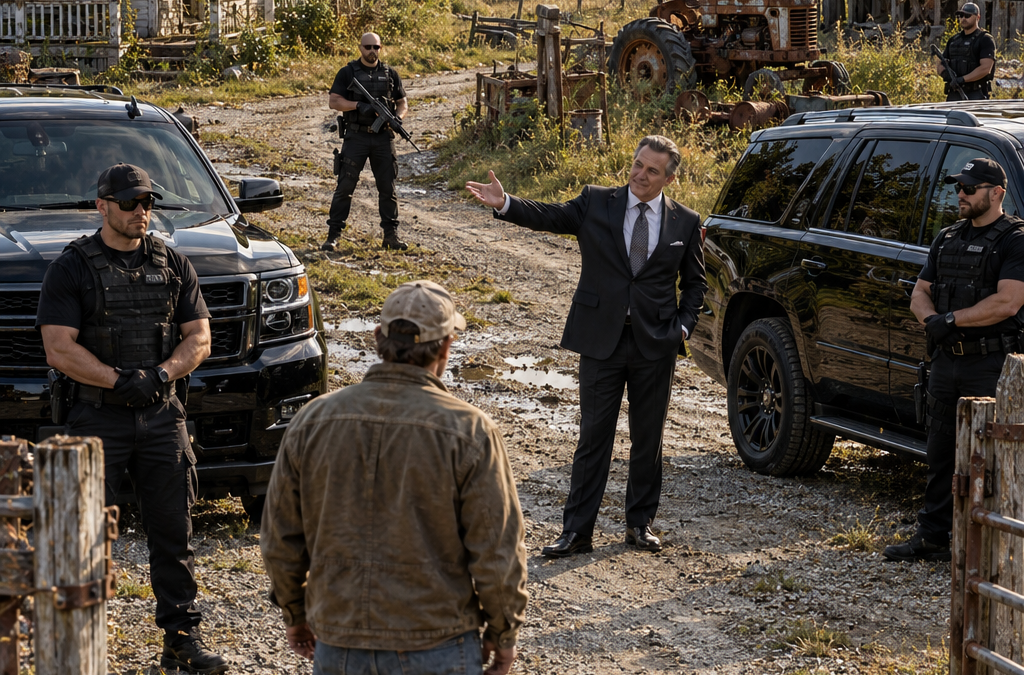
A pair of black SUVs came through the farm entrance.
They weren’t marked as county vehicles.
They weren’t delivery trucks.
They were large, identical security vehicles with tinted windows and small company markings on the doors.
The first stopped near the farmhouse.
The second continued toward the barn.
My stomach tightened.
Both vehicles were well inside my property.
I hadn’t invited anyone.
I walked toward the first SUV.
Before I reached it, the doors opened.
Four men stepped out wearing dark private-security uniforms.
They had radios, utility belts, and company insignia on their shirts.
One carried a clipboard.
Another immediately began looking toward the far fence line.
The third walked toward the barn.
The fourth remained near the main entrance.
They moved with the practiced coordination of people accustomed to working together.
But what disturbed me wasn’t their training.
It was their purpose.
They weren’t approaching the farmhouse to ask a question.
They were spreading across the property.
Establishing positions.
Watching the entrances.
Looking around as if they were responsible for securing the farm.
I felt a cold knot form in my stomach.
Then another vehicle appeared.
Karen’s black SUV.
He stopped just outside the main working area and climbed out.
Today he wore a black suit, a bright white shirt, and a dark tie.
His shoes were spotless.
His hair was slicked back perfectly.
And the expression on his face was almost cheerful.
He looked at the guards.
Then at me.
“Good morning.”
I didn’t answer.
I was watching one of the security men move toward the barn doors.
“Who are these people?”
Karen adjusted his cuffs.
“Professional security personnel.”
“I can see that.”
“They’re here to address the ongoing security concerns.”
I looked toward the nearest guard.
“Who authorized you to enter this property?”
The man paused.
He was heavyset, probably in his forties, with a close-cropped haircut and a serious expression.
He pointed toward Karen.
“We were contracted by the HOA, sir.”
I stared at him.
“This isn’t HOA property.”
He looked toward Karen.
Karen smiled.
“The association has authorized a security response.”
I took a slow breath.
“Karen, you need to tell them to leave.”
He looked almost amused.
“There’s no need to become emotional.”
I looked at the guards again.
One stood near the farmhouse.
Another was beside the equipment shed.
The third had stopped near the barn.
The fourth remained close to the road.
They were positioned around the buildings I was trying to repair.
It felt like being surrounded.
And it was happening less than twenty-four hours after Karen threatened to take action.
“Who told you to spread out like this?” I asked.
The lead guard answered.
“We were instructed to establish a security perimeter.”
I stared at him.
“A perimeter around what?”
“The designated area.”
I looked toward Karen.
“Designated by whom?”
“The HOA,” Karen said.
I felt my hands tighten.
“This is my farm.”
Karen’s expression hardened.
“Your property has become a security concern for our residents.”
“Then report an actual crime.”
“We’re taking preventive measures.”
“On somebody else’s land?”
He stepped closer.
“Michael—”
He stopped himself.
I hadn’t told him my name the day before, but apparently he’d already obtained it from the property records.
That bothered me more than it should have.
He continued.
“You need to understand that Oakridge cannot allow an uncontrolled abandoned property to threaten its residents.”
I looked toward the farmhouse.
“It’s not abandoned.”
“It has been neglected for years.”
“And I’m repairing it.”
“The HOA cannot simply wait and hope you manage the situation responsibly.”
I stared at him.
“So you hired four men to come onto my land without permission?”
He lifted his chin.
“We hired professionals to protect the community.”
I turned toward the guards.
“Let me make something clear. I’m the property owner. None of you have permission to be here.”
The lead guard glanced toward Karen.
Karen immediately spoke.
“The association has authorized your presence. Continue with the assigned positions.”
Something about those words made my stomach turn.
Karen wasn’t merely arguing with me.
He was issuing orders to people standing on my property.
As if I weren’t there.
As if my ownership didn’t matter.
I walked toward the guard near the barn.
“Sir, I need you away from that building.”
He held up one hand.
“We’ve been instructed to monitor the structure.”
“For what?”
“Potential unauthorized activity.”
I almost laughed.
“Unauthorized activity by whom?”
He hesitated.
I pointed toward my chest.
“Me?”
The guard didn’t answer.
I looked back at Karen.
“You’ve hired security guards to monitor me while I repair my own barn?”
Karen adjusted his jacket.
“Your conduct will determine how complicated this becomes.”
I felt anger surge through me.
For a moment, I wanted to shout.
I wanted to tell him exactly what I thought of his ridiculous authority claims.
I wanted to walk up to the nearest SUV and demand that the driver remove it immediately.
But something stopped me.
The uniforms.
The radios.
The four men positioned around the property.
Karen had deliberately created a situation where any angry reaction from me could be described as threatening.
He’d already called the farm a security concern.
If I lost my temper, he’d use it as proof.
So I forced myself to breathe slowly.
Then I asked the simplest question I could think of.
“Where’s your paperwork?”
Karen frowned.
“What paperwork?”
“The document giving your HOA the right to send security onto this farm.”
He looked irritated.
“We have community security policies.”
“That’s not what I asked.”
“The board authorized this operation.”
“Show me a deed, easement, court order, or written agreement granting you access.”
Karen folded his arms.
“We don’t need your permission to protect our residents.”
“You need my permission to enter land you don’t own unless you have some other lawful right.”
He gave me a thin smile.
“That’s your interpretation.”
I stared at him.
“No, Karen. That’s why property boundaries exist.”
The lead guard shifted uncomfortably.
He looked toward the farmhouse.
Then toward the gate.
I could tell he wasn’t entirely comfortable with the situation.
That gave me a little hope.
Maybe the security company had simply been given false information.
Maybe the guards believed the farm belonged to the HOA.
If I showed them the deed, perhaps they’d leave.
I walked toward my truck.
Karen immediately spoke.
“Where are you going?”
“To get my property records.”
He looked suspicious.
“There’s no need for that.”
“Then you shouldn’t have sent people here claiming authority.”
I retrieved the folder I’d prepared during the purchase.
Inside were copies of the recorded deed, survey, and county parcel map.
I carried it back toward the lead guard.
“Look at this.”
He took the survey.
I pointed to the legal boundary.
“This entire farm is a separate parcel.”
The guard studied the map.
I showed him the HOA development boundary.
“Oakridge Estates begins over here.”
He followed the line.
“And where are we standing?”
I pointed to the interior of my property.
“Here.”
His expression changed.
He looked toward Karen.
“Sir, this appears to be outside the association’s property.”
Karen stepped forward.
“You’re not qualified to make legal determinations.”
The guard looked uncomfortable.
“I’m just saying the map—”
“The HOA board has already reviewed the jurisdictional issue,” Karen snapped.
I turned toward him.
“Then show us what the board reviewed.”
He ignored me.
Instead, he looked directly at the guard.
“Continue your assignment.”
The guard hesitated.
I could see the conflict in his face.
He had a client giving orders.
And a property owner telling him those orders were unauthorized.
I decided to make the situation unmistakable.
I looked at all four guards.
“My name is on the deed. I own this property. I am formally telling each of you to leave.”
The man near the equipment shed shifted his weight.
Another looked toward the SUVs.
Karen immediately stepped between us.
“They are not leaving.”
I stared at him.
“That’s not your decision.”
“It is when community safety is involved.”
“You’re not on community property.”
“The farm directly affects our neighborhood.”
“Then stay on your side of the fence.”
His eyes narrowed.
He stepped closer until only a few feet separated us.
“You bought a bankrupt property and suddenly think you can ignore the expectations of an entire community.”
I felt my jaw tighten.
“I bought a farm.”
“A failing farm.”
“One I’m trying to rebuild.”
“Then perhaps you should have considered the community’s interests before making the purchase.”
I stared at him.
The words landed harder than I’d expected.
He wasn’t simply concerned about security.
He resented the fact that someone had bought the farm without asking his approval.
To him, the property had been an abandoned space sitting beside his neighborhood.
An inconvenience waiting to be controlled.
And now I was ruining his plans by treating it like my home.
I looked at the four guards again.
Then back at Karen.
“I’m giving you one last chance to leave peacefully.”
His smile returned.
“Or what?”
I held his gaze.
“Or I’ll call the county sheriff.”
He laughed.
It was a short, confident laugh.
“You’re going to call law enforcement because the HOA is protecting the neighborhood?”
“Yes.”
He spread his hands.
“Go ahead.”
I took out my phone.
For a moment, I expected him to reconsider.
He didn’t.
He stood beside his black SUV, watching me with the smug expression of a man who believed the sheriff would take one look at his suit, his security team, and his HOA title and decide he must be right.
I called the sheriff’s office.
When the dispatcher answered, I explained that several private security guards had entered my farm without permission.
I gave the address.
Explained that I was the owner.
And told her I had asked the guards to leave, but they were refusing.
She asked whether anyone had threatened me.
“Not directly,” I said. “But they’ve spread around the property, and their client is insisting they can stay.”
“Are there weapons visible?”
“Not that I can see.”
“Have you been physically assaulted?”
“No.”
“Are you able to remain somewhere safe while deputies respond?”
“Yes.”
She told me a unit was being sent.
I ended the call.
Then I put the phone away.
Karen was watching me.
“Finished?”
“Yes.”
He smiled.
“Good. Maybe now we can settle this properly.”
I said nothing.
I wasn’t going to give him another argument.
I moved to the porch, where I had a clear view of the driveway and the buildings.
The guards remained spread around the property.
One stood near the barn.
Another remained beside the equipment shed.
Two stayed closer to the entrance.
Every minute seemed longer than the last.
I tried to focus on the facts.
The deed was clear.
The survey was clear.
The HOA boundary was separate.
I hadn’t invited these men.
I’d told them to leave.
That should have been enough.
But knowing you’re right doesn’t necessarily make you feel safe when four uniformed strangers are surrounding your home.
I kept thinking about what might happen if Karen became impatient.
Would he order them to block my vehicle?
Would they prevent a contractor from entering?
Would they try to lock a gate?
The uncertainty was what frightened me.
I had purchased the farm to gain control over my own life.
Now I was standing on the porch wondering whether strangers would allow me to walk into my own barn.
Karen seemed to enjoy every second.
He walked slowly between the SUVs, speaking to the guards and occasionally glancing toward me.
At one point, he pointed toward the eastern fence and said something into his phone.
I couldn’t hear all of it.
But I heard enough.
“Maintain the perimeter until this is resolved.”
I felt my stomach tighten.
Maintain the perimeter.
Around my farm.
On my land.
Without my permission.
He was acting as though he’d already won.
Then I heard another engine.
A county sheriff’s vehicle appeared on the gravel road.
A second followed.
The vehicles came through the farm entrance and stopped near the farmhouse.
Karen turned immediately.
His smile remained.
But I noticed how quickly he adjusted his tie.
The lead SUV’s door opened.
Sheriff Daniels stepped out.
He was in his late fifties, tall and broad-shouldered, with a weathered face and the calm movements of someone who had spent decades dealing with people who believed being loud made them right.
Two deputies followed.
The sheriff looked around.
He saw the black security SUVs.
The guards near the buildings.
Karen standing in his expensive suit.
And me on the farmhouse porch holding a folder.
His expression became serious.
“Who’s the property owner?”
I stepped forward.
“I am.”
He nodded.
“All right. I’m Sheriff Daniels. Tell me what’s happening.”
Before I could answer, Karen hurried toward him.
“Sheriff, I’m Karen, president of Oakridge Estates.”
Daniels looked at him.
“All right.”
“Our association has an urgent security concern involving this property.”
The sheriff glanced toward the barn.
“What concern?”
“The farm has been abandoned for years, and the new owner has begun activities that may affect neighborhood safety.”
I stared at Karen.
He continued.
“The HOA authorized a private security presence to protect residents and maintain a safe perimeter.”
Daniels looked toward the guards.
“On this property?”
“Yes.”
“Does the HOA own this farm?”
Karen hesitated.
“The farm directly borders Oakridge.”
The sheriff waited.
Karen continued.
“The surrounding community has legitimate security interests.”
“That’s not what I asked.”
Karen looked irritated.
Daniels repeated the question.
“Does your association own this property?”
“No, but—”
“Does it have legal authority to occupy it?”
Karen lifted his chin.
“We believe our community security provisions apply.”
The sheriff looked at me.
“Do you have your deed?”
I held up the folder.
“Right here.”
“Let’s see it.”
I walked toward the sheriff’s vehicle and opened the documents across the hood.
The deputies moved closer.
Daniels studied the recorded deed.
Then the survey.
Then the county parcel map.
He followed the property description carefully.
“This farm is a separate parcel?”
“Yes, sir.”
“And you completed the purchase recently?”
“Less than a week ago.”
“Do you have the recorded ownership information?”
I showed him.
He examined it.
Then he looked toward the eastern fence.
“Where’s the HOA boundary?”
I pointed to the survey.
“Beyond that fence line.”
Daniels turned toward one of his deputies.
“Check the county parcel records.”
The deputy walked to his vehicle and retrieved a tablet.
He began comparing the recorded information.
Karen stepped closer.
“Sheriff, I think you’re focusing on the wrong issue.”
Daniels looked at him.
“What issue should I focus on?”
“The security implications.”
“Has a crime been reported here?”
“Not yet.”
“Any documented emergency?”
“The condition of the property creates potential risks.”
“Has the county issued an order requiring security personnel on the farm?”
Karen hesitated.
“Not that I’m aware of.”
Daniels nodded slowly.
“Then let’s determine whether these people have permission to be here.”
Karen’s face tightened.
He glanced toward the guards.
I noticed something change in his expression.
Until that moment, he’d been certain that once the sheriff arrived, the situation would turn in his favor.
Now the questions weren’t going where he expected.
The deputy returned with the county property information.
He showed the sheriff the parcel map.
Daniels compared it with my survey.
Then he looked toward the nearest boundary marker.
“Let’s verify this.”
We walked toward the eastern side of the farm.
The grass was still damp from the morning mist.
One of the deputies followed the fence line, checking the visible markers against the survey.
The second deputy remained near the vehicles.
Karen walked with us, talking almost continuously.
“Oakridge has maintained strict security standards for years.”
Nobody answered.
“Our residents expect immediate action when potential risks arise.”
Daniels continued studying the boundary.
“We can’t simply allow abandoned properties to become security threats.”
I stopped walking.
“Karen, I bought the place last week. I’ve been repairing it every day.”
He turned toward me.
“And those repairs haven’t been reviewed by the association.”
“Because the association doesn’t control my farm.”
“That’s a narrow interpretation.”
Daniels raised one hand.
“Enough.”
His voice wasn’t loud.
But Karen stopped immediately.
The sheriff looked toward the deputy.
“What have you got?”
The deputy pointed to the marker.
“Survey and county map appear consistent. This fence line is inside the owner’s parcel. The Oakridge boundary is beyond it.”
Daniels nodded.
He studied the documents one more time.
Then he looked across the farm.
The old barn.
The equipment shed.
The farmhouse.
The black security vehicles.
Four men standing on land the HOA did not own.
He turned toward Karen.
“Your association’s property begins beyond this boundary.”
Karen folded his arms.
“The neighborhood’s security interests extend farther.”
“Security concerns don’t automatically extend your property rights.”
Karen looked offended.
“Sheriff, surely you understand the need for preventive measures.”
“I understand the need to follow the law.”
He looked toward the guards.
“Who’s in charge of this security team?”
The lead guard stepped forward.
“I am, Sheriff.”
“Your name?”
“Mark Stevens.”
“Who hired you?”
“Oakridge Estates Homeowners Association.”
“Who gave you instructions to enter this farm?”
Stevens glanced toward Karen.
“Mr. Karen.”
Daniels nodded.
“What were your instructions?”
“Establish a perimeter around the property and monitor access points.”
I felt my chest tighten.
Hearing it said aloud was worse than hearing Karen use the same words.
They really had been sent to surround the farm.
Daniels looked at Stevens.
“Did anyone tell you the property belonged to the HOA?”
Stevens hesitated.
“We were told it fell within an HOA security concern area.”
“That’s not what I asked.”
The guard shifted his weight.
“We weren’t given the deed.”
“Did you obtain permission from the owner?”
“No, sir.”
“Did you ask?”
“No.”
“Did the owner tell you to leave?”
Stevens looked at me.
Then back at the sheriff.
“Yes.”
“And you stayed?”
“We were instructed by our client to maintain the perimeter.”
Daniels held his gaze.
“All right.”
There was a long silence.
Then the sheriff looked at Karen.
“Did you tell these men to remain after the owner ordered them off the property?”
Karen straightened.
“I told them to complete their assigned duties.”
“Did you know the owner had withdrawn permission for them to be here?”
“He never granted permission in the first place.”
The words came out before Karen seemed to realize what he’d said.
Nobody spoke.
One deputy looked toward the ground.
The lead guard shifted uncomfortably.
Daniels stared at Karen.
“So you knew they didn’t have permission.”
Karen’s expression changed.
“I knew the HOA had authorized the operation.”
“The HOA isn’t the owner.”
“The association has a responsibility—”
“That responsibility does not give you automatic authority to occupy private property outside your jurisdiction.”
Karen opened his mouth.
Then closed it.
The sheriff turned back toward the security team.
“All right, gentlemen. The property owner has asked you to leave. You’ve seen the deed and boundary information. You have no court order or documented authority to remain. You need to exit the property.”
Stevens nodded.
“Understood, Sheriff.”
He turned toward the other guards.
“Let’s pack up.”
For the first time that morning, I felt real relief.
The men began moving toward their vehicles.
The guard near the equipment shed walked back to the second SUV.
Another left his position near the barn.
Stevens spoke briefly into his radio.
It looked as though the situation was finally ending.
Then Karen stepped forward.
“Hold on.”
Everyone stopped.
He looked directly at Stevens.
“Your contract is with the association.”
Stevens hesitated.
“Sir, the sheriff has instructed us to leave.”
Karen’s face hardened.
“The association hired you to secure this location.”
Daniels turned toward him.
“Karen.”
Karen ignored him.
He addressed the guards again.
“I expect you to fulfill your contractual obligations.”
I felt the relief disappear.
The lead guard looked trapped.
He glanced from Karen to the sheriff.
“Mr. Karen, we can’t remain after the property owner and law enforcement have told us to leave.”
Karen stepped closer.
“You’re not authorized to abandon your assignment.”
Daniels moved between them.
“That’s enough.”
Karen looked furious.
“Sheriff, this is a private contract.”
“That contract doesn’t give your employees the right to trespass.”
“You’re interfering with lawful HOA operations.”
“I’m directing unauthorized personnel to leave private property.”
Karen’s jaw tightened.
For a moment, I thought he might finally give up.
Instead, he looked toward the two guards nearest the barn.
“Maintain your positions until our legal department clarifies the situation.”
The guards hesitated.
One continued toward the vehicle.
The other stopped.
Then the lead guard said something into his radio.
Two men who had begun leaving remained near the barn and main farm road.
Stevens looked toward Karen.
“We need to resolve this.”
Daniels turned toward the guards.
“I have already directed you to leave.”
One of them said, “We were told to hold the perimeter.”
The sheriff’s expression hardened.
“You are now being told by law enforcement that you have no demonstrated authority to remain on this property.”
The guard looked toward Karen.
Karen lifted his chin.
“Do not abandon the secured area.”
I stared at him.
Even now.
Even after the deed.
Even after the county records.
Even after the sheriff’s direct instructions.
He was still trying to control my farm.
Daniels looked at the two guards who had remained.
“Gentlemen, I’m giving you a clear final opportunity to leave voluntarily.”
One guard immediately stepped away.
The other hesitated.
Then he moved back toward the barn entrance.
The lead guard followed him, apparently trying to keep the assigned position occupied while the others prepared to depart.
My stomach dropped.
Daniels watched them carefully.
“Stop right there.”
The men stopped.
“You have been informed that you’re trespassing. You’ve been ordered to leave. You’re choosing to remain.”
Stevens looked uncomfortable.
“Our client has instructed us—”
“Your client doesn’t own this property.”
He said nothing.
The sheriff took a step closer.
“Are you leaving?”
Neither man answered immediately.
I could see the calculation happening.
They were looking at Karen.
Looking at the sheriff.
Trying to decide whose authority mattered more.
Karen stood behind them with his arms folded.
His expression was rigid.
He seemed convinced that if he maintained his position long enough, everyone else would eventually give in.
Then Daniels spoke again.
“Deputies.”
The two deputies approached.
The sheriff looked at the guards.
“You’re being taken into custody for remaining on private property after clear notice and an opportunity to leave.”
For a moment, the entire farm seemed to go silent.
Stevens stared at him.
“You’re arresting us?”
“You’ve been repeatedly directed to leave. The owner has denied permission. The records establish this is private property, and you’ve failed to comply with the lawful trespass warning.”
Karen stepped forward.
“This is outrageous!”
Daniels turned.
“Stay where you are.”
Karen froze.
The deputies moved calmly.
There was no shouting.
No struggle.
No dramatic chase across the pasture.
One guard raised his hands.
The other looked toward the black SUV, then lowered his head.
The deputies placed the two men in custody.
The remaining guards, who had complied with the order to leave, stood beside their vehicles looking stunned.
I watched the arrests without moving.
My hands were cold.
My heart was pounding.
I had called the sheriff because I wanted unauthorized people removed from my property.
I hadn’t expected to stand beside my barn watching two private security guards being taken into custody.
But Karen had continued ordering them to remain after the sheriff made the situation unmistakably clear.
And they had followed those instructions.
That choice had consequences.
Karen seemed unable to accept it.
“You cannot arrest security professionals for doing their jobs!”
Daniels turned toward him.
“They were given clear notice and an opportunity to leave.”
“They were acting under HOA authorization!”
“The HOA cannot authorize entry onto property it doesn’t control.”
“This is a gross misuse of police authority.”
The sheriff’s expression remained calm.
“Karen, I suggest you stop issuing instructions to people on this farm.”
Karen’s face reddened.
He looked toward the deputies.
Then toward the handcuffed guards.
Then back at me.
“This is your fault.”
I stared at him.
“What?”
“You escalated this.”
I felt something inside me turn cold.
“You sent four men onto my property.”
He pointed toward the sheriff’s vehicles.
“You called law enforcement.”
“Because your guards refused to leave.”
“You could have cooperated.”
I took a step toward him.
“With what? Letting your security company surround my home?”
Karen’s eyes flashed.
“You are deliberately undermining neighborhood safety.”
I shook my head.
“No. I’m trying to rebuild a farm.”
He opened his mouth.
I continued.
“I bought a property that had already gone through bankruptcy. The buildings are damaged. The fences need repairs. The fields are overgrown. I’ve been working every day trying to bring this place back.”
My voice tightened.
“And you’ve spent the last two days trying to make me feel like I don’t belong here.”
Karen looked away.
I pointed toward the farmhouse.
“That’s my home now.”
Then toward the barn.
“That’s my responsibility.”
Then toward the boundary fence.
“And that’s where your authority ends.”
For a moment, nobody spoke.
Sheriff Daniels stepped forward.
“Karen, I need to ask you some additional questions.”
Karen straightened immediately.
“I’ve already explained the situation.”
“Not completely.”
The sheriff looked toward the security vehicles.
“Who authorized the expenditure for this operation?”
Karen hesitated.
“The association.”
“Was there a board vote?”
“Security decisions fall within my presidential authority.”
“Was there a written agreement identifying this private farm as a location your security personnel could occupy?”
Karen looked irritated.
“The property presented a community risk.”
“That’s not an answer.”
“I acted in the best interests of Oakridge.”
Daniels held his gaze.
“Why did you believe the HOA could control land it doesn’t own?”
Karen didn’t speak.
The silence stretched.
I watched his face.
For the first time since meeting him, he looked genuinely uncertain.
Not humbled.
Not apologetic.
Just trapped by a question he couldn’t answer without admitting what he’d done.
Finally, he said, “The farm has been vacant for years.”
Daniels nodded slowly.
“And?”
“A vacant property can create security problems.”
“That doesn’t transfer ownership.”
Karen looked toward the farmhouse.
“The neighborhood has always been concerned about the property.”
“Concern isn’t authority.”
Karen shifted his weight.
“We were trying to prevent problems.”
Daniels looked at him.
“Then you should have contacted the owner, reported an actual threat, or pursued whatever lawful remedy applied. You don’t get to send private guards onto someone else’s land and order them to remain after permission is denied.”
Karen lowered his eyes.
The sheriff continued.
“Your HOA’s rules govern property legally subject to those rules. They don’t automatically govern neighboring farms.”
I looked toward the eastern fence.
The line was so ordinary.
Wood posts.
Wire.
Grass growing along the base.
Nothing dramatic.
But that simple boundary had become the center of the entire confrontation.
Karen had treated it like a suggestion.
The law treated it as something that mattered.
Daniels turned toward the remaining guards.
“You two need to remove your vehicles and leave the property.”
They nodded immediately.
“Yes, Sheriff.”
The lead security company representative who hadn’t been detained gathered the equipment.
The guards returned to their SUVs.
Engines started.
One vehicle turned carefully near the farmhouse.
The other followed.
They drove toward the main road under the deputies’ supervision.
I watched the black vehicles disappear past the gate.
For the first time that morning, I could see the entire driveway again.
No security perimeter.
No strangers standing beside the barns.
No radios crackling across the property.
Just gravel, weeds, and an old farm that needed work.
The deputies finished their procedures.
The two detained guards were placed in county vehicles.
Karen stood nearby, silent now.
He looked completely different from the man who had arrived smiling behind his security team.
His expensive suit was still immaculate.
His hair was still perfectly arranged.
But the confidence had vanished.
He had expected the guards to make me surrender control.
Instead, his refusal to respect the boundary had led directly to a criminal trespass investigation.
And he was now part of that investigation.
Daniels spoke to him one final time.
“Karen, we’re documenting your role in directing this operation. I strongly recommend that you preserve any communications, contracts, and instructions related to the security team.”
Karen swallowed.
“Am I under arrest?”
“Not at this time.”
He seemed relieved.
But Daniels continued.
“That doesn’t mean the matter is finished. We’ll review the evidence and determine whether anything else needs to be referred for further action.”
Karen nodded stiffly.
Then the sheriff looked at me.
“Do you have anything else you need to report?”
I took a slow breath.
“No, sir.”
“Did anyone damage the property?”
“Not that I’ve seen.”
“Any threats or physical contact?”
“No direct threats. They positioned themselves around the buildings and refused to leave.”
He nodded.
“We’ll include your statement.”
I looked toward the barn.
Then back at him.
“Can I ask you something?”
“Of course.”
“If they come back?”
“Call us. Don’t confront a group of people if you feel unsafe. Keep your deed and survey available.”
I nodded.
“I will.”
He looked across the farm.
“You’ve got your work cut out for you.”
I let out a tired laugh.
“That might be the understatement of the year.”
Daniels smiled faintly.
“Well, at least now you can get back to it.”
He shook my hand.
Then he returned to his vehicle.
The sheriff’s convoy left a few minutes later.
Karen remained beside his SUV.
For a moment, I thought he might come toward me again.
His hands rested on the open driver’s door.
He looked toward the farmhouse.
Then toward the barn.
Finally, he spoke.
“You’ve made an enemy of the association.”
I felt exhaustion settle over me.
“Karen, I don’t want an enemy.”
He looked at me.
“I wanted a farm.”
His expression tightened.
“You could have avoided all of this by cooperating.”
I stared at him.
“Cooperating with people who had no right to be here?”
“With the neighborhood.”
“The neighborhood didn’t come here. You did.”
He looked away.
I continued.
“You hired the guards. You ordered them onto my property. You told them to stay after I asked them to leave. And you kept giving orders after the sheriff told them to go.”
Karen said nothing.
“Don’t put that on me.”
For several seconds, he stared at the barn.
Then he climbed into his SUV.
The engine started.
He drove away without another word.
I watched until the vehicle disappeared.
Then I stood in the middle of the gravel driveway.
The farm was quiet.
Completely quiet.
I should have felt victorious.
Instead, I felt shaken.
I walked slowly toward the farmhouse.
My boots crunched against the gravel.
Every few steps, I looked back toward the road.
I hated that reaction.
I’d spent years dreaming about owning a quiet place.
Now I had one, and I was checking the entrance because I couldn’t stop imagining another convoy arriving.
When I reached the porch, I sat on the top step.
For several minutes, I did nothing.
The barn roof still needed repairing.
The fence posts were still stacked beside the shed.
My tools were lying where I’d left them when the SUVs appeared.
But I couldn’t bring myself to start working.
The morning had changed something.
Before Karen arrived, the farm’s problems had seemed manageable.
Expensive.
Difficult.
Sometimes overwhelming.
But manageable.
Now I understood that restoring the property would require more than fixing buildings.
I would also have to protect the simple right to make decisions about my own land.
That evening, I walked the entire property boundary.
I checked the main gate first.
Then the eastern fence.
Then the old access road near the orchard.
I examined the survey markers and compared them with the map.
There was no evidence that the security team had damaged anything.
No broken locks.
No cut fencing.
No missing equipment.
That was a relief.
But I still felt unsettled.
At the eastern boundary, I stopped and looked toward Oakridge Estates.
The homes were visible beyond the trees.
Large houses.
Neatly maintained lawns.
Decorative lighting near the subdivision entrance.
It looked peaceful.
I wondered how many residents knew what their president had done.
Maybe they’d been told the farm was dangerous.
Maybe they’d been told I was refusing to cooperate with reasonable safety measures.
Maybe they had no idea four private guards had entered the property that morning.
I couldn’t know.
But I knew one thing.
Whatever Karen had told them, the deed hadn’t changed.
The HOA still ended at the boundary.
The farm still belonged to me.
And I intended to keep it.
The next morning, I received a call from an unfamiliar number.
The woman on the other end introduced herself as Laura Bennett, a member of the Oakridge Estates board.
Her voice was tense.
“I’m calling about what happened yesterday.”
I leaned against the kitchen counter.
“All right.”
“First, I want to say I’m sorry.”
I didn’t answer immediately.
She continued.
“We’ve just learned that private security personnel were sent onto your property.”
“Four of them.”
“Yes.”
“And two were arrested after refusing to leave.”
She exhaled.
“We’re aware.”
I looked toward the farmhouse window.
“Did the board authorize this?”
There was a pause.
“Not in the way it was carried out.”
“What does that mean?”
“Karen raised concerns about the abandoned farm and neighborhood security. But I don’t believe the full board understood that he intended to place guards on property outside the HOA.”
I closed my eyes.
That was exactly what I’d suspected.
Karen had been using the association’s name as though it were his personal authority.
Laura continued.
“We’re reviewing the security contract and the communications that led to this.”
“Good.”
“We also want to verify the property boundaries.”
“I’ve already done that.”
“I understand you have a survey.”
“Yes.”
“Would you be willing to provide a copy?”
I thought about it.
Part of me wanted to tell the board to find the documents itself.
After everything that had happened, I was tired of proving something that had been established before I bought the farm.
But I wanted the dispute ended properly.
So I said, “I’ll send the relevant survey and deed information.”
Laura sounded relieved.
“Thank you.”
I paused.
“Laura, I need you to understand something.”
“I’m listening.”
“I bought this farm because I wanted to rebuild it. I’m not trying to threaten your neighborhood.”
“I understand.”
“I haven’t asked for access to your property. I haven’t interfered with your roads. I haven’t told your residents how to maintain their homes.”
“I know.”
“Then I expect the same respect.”
She was quiet for a moment.
Then she said, “That’s reasonable.”
I looked toward the barn.
“I hope your board understands that.”
After the call, I sent the records.
I also kept a copy of everything.
The purchase documents.
The survey.
The sheriff’s incident information.
The security company’s identification.
My notes about the confrontation.
I didn’t know whether I’d need them again.
But I wasn’t going to be caught unprepared.
Later that afternoon, Laura called back.
The board had reviewed the property records.
The boundaries were clear.
The farm was outside the HOA.
There was no recorded document giving Oakridge authority to occupy it.
Karen’s claim had no foundation in the records they’d examined.
I sat quietly while she explained.
Then she said something I hadn’t realized I needed to hear.
“You’re right. The farm isn’t ours to control.”
I looked down at the kitchen table.
The words were simple.
But after everything that had happened, they felt enormous.
Laura continued.
“We’re notifying the board and the security company that no personnel should enter your property without lawful authorization or your permission.”
“Good.”
“And the association will not be attempting to enforce HOA standards on your farm.”
I exhaled slowly.
“Thank you.”
She hesitated.
“Karen isn’t happy.”
I almost laughed.
“I noticed.”
“We’ll be addressing his decisions internally.”
I didn’t ask for details.
I didn’t need to know every argument taking place in their boardroom.
I cared about the boundary.
The security guards.
And whether anybody intended to try this again.
As long as the association respected my property, I had no interest in becoming involved in its internal politics.
Before ending the call, Laura apologized once more.
I accepted it.
Not because the apology erased what happened.
But because it was the first time someone from the HOA had spoken to me like a neighboring property owner instead of a problem to be controlled.
That evening, I sat on the farmhouse porch with a cup of coffee.
The sun was beginning to set.
Light spilled across the overgrown fields.
The old barn cast a long shadow over the gravel yard.
A breeze moved through the orchard.
For the first time since buying the farm, I allowed myself to imagine what the place might look like a year from now.
The porch repaired.
The barn roof replaced.
The fields cleared.
The fences straight.
Maybe a small vegetable garden behind the house.
Maybe livestock once the pastures were ready.
I didn’t need the property to become perfect.
I just wanted it to become alive again.
I thought about the previous owners.
The bankruptcy.
The years of abandonment.
The empty buildings.
The land had already survived enough.
It didn’t need another fight.
The following morning, I started repairing the western barn.
I climbed a ladder and removed several damaged boards.
The work was slow.
Dust fell from the rafters.
My shoulders ached.
Every tool seemed to be just out of reach when I needed it.
But I didn’t mind.
There was a deep comfort in ordinary physical work.
The kind where effort produced something visible.
A damaged board came off.
A replacement went up.
A loose brace became secure.
The roof was still far from finished, but by late afternoon I could see progress.
I stepped back and examined the repairs.
They weren’t beautiful.
Not yet.
But the barn was becoming stronger.
That was enough.
Over the next several days, I settled into a routine.
Work in the morning.
Repairs through the afternoon.
Boundary checks before sunset.
I kept the main gate secured when I wasn’t expecting visitors.
I replaced a damaged sign near the entrance with a simple one identifying the property as private.
I also marked the approach to the farmhouse so legitimate visitors would know where to go.
I wasn’t trying to turn the place into a fortress.
I didn’t want cameras on every tree or warning signs every twenty feet.
I just wanted clear boundaries and reasonable security.
The irony wasn’t lost on me.
Karen had claimed to be protecting neighborhood security.
Yet his own actions had made me feel less safe on my property than I had when I first arrived.
A real neighbor concerned about an abandoned farm might have asked whether I needed help.
He might have called about a broken fence.
Or reported suspicious activity.
Or simply introduced himself and welcomed the new owner.
Karen had done none of those things.
He had arrived demanding obedience.
Then he sent four men to enforce it.
That difference mattered.
The farm didn’t need an HOA president telling me how to live.
It needed someone willing to repair the roof.
Clear the fields.
Maintain the gates.
And take responsibility when something went wrong.
That’s what I was trying to do.
About a week after the arrests, I received a formal letter from Oakridge Estates.
It was signed by several board members.
The letter acknowledged that the farm was a separate property outside the association’s boundaries.
It confirmed that Oakridge did not possess general regulatory authority over the farm.
And it stated that the association would not authorize further private security activity on my land without a lawful basis.
I read the letter twice.
Then I placed it in the folder with the deed.
It was strange how much paper had accumulated in such a short time.
I’d bought the property with a clean title and clear boundaries.
Within days, I needed a sheriff’s report and a formal HOA acknowledgment just to stop people from pretending those boundaries didn’t exist.
But at least the record was now clear.
A few days later, I saw Karen again.
I was replacing a section of fence near the eastern boundary when his black SUV slowed on the road beyond Oakridge.
He parked near the subdivision side.
For a moment, he remained inside.
Then he stepped out.
He was wearing a dark blue jacket, pressed trousers, and the same polished shoes I’d come to recognize.
His hair was perfectly styled.
His watch gleamed in the sunlight.
But his expression was different.
There was no satisfied smile.
No folder under his arm.
No security team behind him.
He approached the boundary fence.
I set down my hammer.
“Afternoon, Karen.”
He stopped on the other side.
“Good afternoon.”
We stood facing each other for a moment.
Then he looked toward the barn.
“You’ve made progress.”
I glanced over my shoulder.
“Some.”
He nodded.
“The property looks better.”
I waited.
He cleared his throat.
“The board has reviewed the situation.”
“I know.”
“They’ve determined the farm is outside the association’s jurisdiction.”
“That’s what the deed said from the beginning.”
His jaw tightened slightly.
“I suppose.”
I studied him.
He still looked like a man who hated being corrected.
Especially by someone he had underestimated.
But there was something else in his expression now.
Embarrassment.
He glanced toward the farmhouse.
“I didn’t expect the sheriff to handle things the way he did.”
I nodded.
“I noticed.”
Karen looked irritated.
“The situation became unnecessarily dramatic.”
I stared at him.
“Karen, you sent four private security guards onto my property.”
He looked away.
“They were supposed to protect the neighborhood.”
“Then they should’ve stayed in the neighborhood.”
His face tightened.
I continued.
“You told them to surround my farm. You told them to stay after I asked them to leave. And you kept giving orders after the sheriff told them to go.”
He said nothing.
“Two men were arrested because they followed those orders instead of leaving.”
Karen looked toward the road.
“I didn’t anticipate that.”
I took a slow breath.
“That’s the problem.”
He looked back.
“What?”
“You didn’t think about whether you had the right to do any of it.”
His expression hardened.
“I was acting as HOA president.”
I nodded.
“Exactly.”
He frowned.
I stepped closer to the fence.
“You thought your title gave you authority over whatever made the neighborhood uncomfortable.”
Karen opened his mouth.
I continued.
“But the farm wasn’t yours. The deed was clear. The boundary was clear. You knew I was the owner, and you still tried to take control.”
For a moment, his polished confidence returned.
“The condition of the property was a legitimate concern.”
“Then you could’ve contacted the county about a specific violation.”
He looked down.
“You could’ve asked what I planned to repair.”
No answer.
“You could’ve offered to discuss the boundary.”
Karen shifted his weight.
“Instead,” I said, “you sent security guards.”
He finally looked at me.
For the first time, he seemed to understand that no amount of careful language would make his decision reasonable.
He had made a choice.
And it had consequences.
After a long silence, he said, “The board believes the matter should be considered closed.”
I nodded.
“So do I.”
He looked toward the farm.
“You’re going to keep rebuilding?”
“Yes.”
“Even though the property needs so much work?”
I almost smiled.
“That’s why I bought it.”
He studied the barn.
Then the fields.
Then the old farmhouse.
For a moment, he seemed genuinely confused.
As though he couldn’t understand why someone would spend money restoring a place he considered an eyesore.
Finally, he said, “I suppose we have different ideas about what makes property valuable.”
I looked across the farm.
The damaged buildings.
The old trees.
The fields beginning to recover beneath the morning sun.
“That’s probably true.”
He nodded once.
Then he turned toward his SUV.
Before getting in, he looked back.
“I hope there won’t be any more problems.”
I rested one hand on the fence.
“Neither do I.”
He climbed into the vehicle.
The engine started.
And he drove away.
I watched until the black SUV disappeared behind the trees.
Then I picked up my hammer and returned to the fence.
That was the last time Karen came to my property with demands.
No more security vehicles.
No more threats about community standards.
No more claims that the HOA could establish a perimeter around my farm.
The boundary remained where it had always been.
And the association finally behaved as though it understood that.
As the weeks passed, the property began to change.
The western barn became structurally sound again.
I replaced damaged sections of the farmhouse porch.
The main gate opened and closed properly.
The drainage ditch behind the equipment shed finally carried water away instead of allowing it to collect near the foundation.
I cleared a narrow path through the orchard.
Several of the old apple trees were too damaged to save.
But others still had healthy branches.
I pruned them carefully, removed dead wood, and cleared the ground around their trunks.
By the end of the month, the orchard looked less like an abandoned field and more like something that might produce fruit again.
The work was exhausting.
Some evenings, I could barely lift my arms.
There were days when I spent hours repairing something only to discover another problem behind it.
But I kept going.
Every restored board and cleared fence line made the property feel less like the remains of somebody else’s failed dream.
And more like the beginning of mine.
One evening, after finishing work on the farmhouse steps, I walked toward the eastern boundary.
The light was fading.
Beyond the fence, Oakridge Estates glowed softly beneath the evening sky.
Porch lights came on.
Cars moved along the subdivision streets.
Families went about their lives.
The neighborhood was still there.
Nothing about its existence bothered me.
I didn’t resent the homeowners for wanting clean streets or well-maintained houses.
I didn’t resent them for having an HOA.
If people wanted to live under shared rules, that was their decision.
The problem began when Karen decided those rules should control people who had never agreed to them.
He had looked at the bankrupt farm and seen an opportunity to extend his authority.
He assumed neglect meant weakness.
He assumed a new owner would be easy to intimidate.
And he assumed four uniformed guards would make me surrender whatever control he demanded.
He hadn’t expected me to produce the deed.
He hadn’t expected the sheriff to check the boundaries.
And he hadn’t expected the men he’d hired to face consequences for remaining on private property after being clearly told to leave.
His entire plan depended on the assumption that nobody would challenge him.
That assumption failed.
I stopped beside the fence.
One of the original boundary markers stood near the corner.
It was old, weathered, and partially surrounded by grass.
Nothing impressive.
Just a permanent marker showing where one property ended and another began.
I looked at it for a long time.
It struck me that the marker had been there before I bought the farm.
Before Karen sent his guards.
Before the sheriff arrived.
Before anyone argued about security or community standards.
The boundary hadn’t moved.
The deed hadn’t changed.
The truth had been there from the beginning.
All we’d done was force Karen to acknowledge it.
I turned back toward the farmhouse.
The porch light was on.
The repaired steps looked solid.
The roof still needed more work, but the house no longer seemed quite so abandoned.
I walked toward it slowly.
The evening air smelled of cut grass, old wood, and damp soil.
For the first time since the security guards arrived, I wasn’t listening for unfamiliar engines.
I wasn’t checking the road every few minutes.
I wasn’t wondering whether Karen would return with another plan to force me into compliance.
I was simply walking across my farm.
My farm.
Those words meant more to me now than they had on the day I signed the purchase documents.
Back then, ownership had felt like an achievement.
A legal transaction.
The end of years of saving and planning.
Now it felt like responsibility.
It meant protecting the property without becoming the kind of person who believed ownership gave him power over everyone else.
It meant respecting the neighbors’ boundaries while expecting them to respect mine.
And it meant having the courage to stand beside the deed when someone tried to replace it with his own authority.
I reached the porch and sat down.
The old wooden chair creaked beneath me.
Beyond the yard, the barn stood against the darkening sky.
The fields stretched toward the tree line.
I could see the outline of the orchard where I’d worked earlier that week.
The farm was still rough.
Still damaged.
Still a long way from what I wanted it to become.
But it was peaceful.
The silence felt different now.
When I first bought the place, the quiet had been mixed with uncertainty.
I didn’t know whether I could afford the repairs.
I didn’t know whether the land would become productive again.
I didn’t know whether I’d made the biggest mistake of my life.
Then Karen arrived and made everything worse.
For a while, I’d wondered whether the farm would ever feel safe.
Now the property was quiet again.
Not because Karen had granted me permission to live there.
Not because the HOA had decided to be generous.
Because the sheriff had checked the records, the board had acknowledged the boundary, and the unauthorized security operation had ended.
I leaned back in the chair.
A light breeze moved across the porch.
Somewhere beyond the barn, crickets began calling.
I thought about the day the security SUVs arrived.
How they had rolled down my private road as though the farm were already under their control.
How the guards had spread around the buildings.
How Karen had stood behind them, smiling.
He had expected the sight of four uniformed men to make me surrender.
He thought intimidation would accomplish what his HOA rules couldn’t.
Instead, I showed the deed.
Asked them to leave.
Called the sheriff when they refused.
And let the official records establish what Karen had been unwilling to accept.
The two guards who remained after clear warnings had been taken into custody.
The security operation had ended.
The HOA board had formally acknowledged that the farm was outside its jurisdiction.
And Karen had stopped coming to my gate.
I didn’t know what would eventually happen to the criminal cases.
That would be decided through the proper legal process.
I didn’t know what consequences Karen might face within his association.
That was the board’s responsibility.
I only knew what had happened on my land.
The security team was gone.
The property boundary was respected.
And I could finally continue rebuilding.
I stood and walked to the edge of the porch.
The last sunlight was disappearing behind the western trees.
I looked toward the barn.
Tomorrow, I would finish another section of roof.
Then I would work on the northern fence.
After that, I needed to inspect the well again.
There would be more bills.
More repairs.
More exhausting days.
And probably moments when I questioned whether buying the farm had been wise.
But those were problems I had chosen.
They belonged to the life I wanted.
Not to a fifty-year-old HOA president who believed his polished appearance and expensive security contracts gave him ownership of everything nearby.
I smiled faintly.
The farm had survived bankruptcy.
It had survived years of neglect.
And now it had survived an attempted takeover by a man who mistook neighborhood authority for property ownership.
I wasn’t going to let any of that stop me.
I turned off the porch light and stepped inside.
The farmhouse was still unfinished.
The kitchen floor still creaked.
The windows still needed work.
But when I closed the front door, I felt something settle inside me.
For the first time since the day I bought the farm, I wasn’t wondering whether somebody else would show up and tell me I didn’t belong.
I knew I belonged.
The deed said so.
The boundary markers said so.
The sheriff had confirmed it.
And the HOA board had finally admitted it.
Karen had brought four security guards to my farm because he thought surrounding the property would make me surrender control.
Instead, his own orders had brought the sheriff straight to my gate and exposed how little authority he actually possessed.
The farm remained exactly where it had always been.
Outside the HOA.
Inside its recorded boundaries.
And entirely under the control of the man who had lawfully purchased it.
I had come here to rebuild a bankrupt farm.
After everything that happened, that was exactly what I intended to do.
The next morning, I woke before sunrise, pulled on my work boots, grabbed my tools, and walked toward the old barn.
There were no black SUVs waiting at the entrance.
No security guards standing beside the buildings.
No HOA president issuing orders from the driveway.
Only the sound of birds in the trees, the smell of fresh earth, and another long day of honest work ahead of me.
I climbed the ladder, lifted the first board into place, and started rebuilding the farm I’d bought.
One piece at a time.








