𝗙𝗨𝗟𝗟 𝗦𝗧𝗢𝗥𝗬 The HOA President Sent Armed Men to My 100-Year-Old Farmhouse—But She Had No Idea What She Was Walking Into
𝗣𝗔𝗥𝗧 𝟮
There was even a list of approved colors for front doors.
I looked toward our old farmhouse entrance.
Our front door was dark red.
The HOA approved colors were mostly beige, gray, cream, and other shades that seemed determined not to offend anyone.
I laughed.
My wife looked up from her coffee.
“What’s funny?”
I held up the folder.
“Apparently, we’ve joined a homeowners association.”
She frowned.
“What?”
“The subdivision sent us a welcome packet.”
She took the papers.
Read the first page.
Then looked at me.
“We’re not in that neighborhood.”
“Exactly.”
She flipped through the pages.
“Approved porch furniture?”
“Apparently.”
“No visible pickup trucks?”
I grinned.
“Better hide mine.”
She shook her head.
“Somebody made a mistake.”
That seemed obvious.
I tossed the folder into the recycling bin.
I assumed a volunteer had delivered it to the wrong mailbox.
An understandable error.
Our property bordered the development, after all.
I expected that to be the end of it.
Three weeks later, another envelope arrived.
This one was an invoice.
The homeowners association was demanding annual dues.
The amount was substantial enough that I initially thought I’d misunderstood the document.
I checked our address.
Correct.
Our names.
Correct.
The listed property.
My farmhouse.
I read it again.
Then I called the phone number at the bottom.
A woman answered after several rings.
“Homeowners Association Office. This is Katherine.”
Her voice was smooth, confident, and slightly impatient.
“Hi. I think there’s been a mistake with an invoice.”
“What address?”
I gave it to her.
There was a pause.
Then she said, “Oh, yes. The farmhouse.”
Something about her tone made me straighten.
“That’s right.”
“We’ve been expecting to hear from you.”
“Well, I’m calling because the property isn’t part of your subdivision.”
She gave a short laugh.
“I’m aware that the house predates the development.”
“Good. Then you understand why we don’t owe HOA dues.”
“Actually, you do.”
I stared at the phone.
“Excuse me?”
“Your property borders our community. That means it’s subject to neighborhood standards.”
“No, it doesn’t.”
Her voice became colder.
“I’m the HOA president. I assure you I understand our jurisdiction.”
I leaned against the kitchen counter.
“Then you should understand that my property has a separate deed and is not part of your association.”
“You’re adjacent to the development.”
“Yes.”
“And your property affects our neighborhood’s appearance.”
“That doesn’t make me a member.”
She sighed.
It was the kind of exaggerated sigh someone makes when explaining something to a child.
“Sir, we’re trying to maintain a certain standard of living here.”
“That’s fine. Maintain it on your own property.”
There was a pause.
Then she said, “You need to be careful about being uncooperative.”
I stopped leaning against the counter.
“Is that a threat?”
“It’s a reminder that community rules exist for a reason.”
“Not on my land.”
I ended the call.
Then I stood in the kitchen for a moment, trying to decide whether I’d just spoken to a genuinely confused person or someone who understood perfectly well that she was making an unreasonable demand.
My wife came in.
“Who was that?”
“The HOA president.”
“And?”
“She thinks living next to the subdivision means we have to pay them.”
My wife stared.
“That can’t be right.”
“It isn’t.”
“Did you explain?”
“Several times.”
She shook her head.
“Well, she’ll figure it out.”
I hoped so.
But Katherine wasn’t interested in figuring anything out.
She was interested in winning.
Over the following weeks, the invoices continued.
First came another dues notice.
Then a reminder.
Then a late-payment warning.
Additional fees appeared.
Every new letter was more aggressive than the last.
The language shifted from polite requests to demands.
Failure to comply.
Outstanding balance.
Potential enforcement action.
I began keeping the envelopes instead of throwing them away.
My wife suggested we might need them later.
At the time, I thought she was being overly cautious.
I soon learned she was right.
The HOA began sending violation notices.
According to the association, our grass was too long.
That accusation arrived the morning after I’d mowed the yard.
Then they claimed my pickup truck was improperly parked.
It was sitting in my own driveway.
Another notice said our farmhouse’s exterior color wasn’t included in the association’s approved palette.
The color was a traditional farmhouse white that we’d chosen specifically to preserve the building’s character.
Apparently, the HOA preferred the newer houses’ coordinated shades of beige and gray.
I read the notice twice.
Then I laughed.
Not because it was funny.
Because the alternative was getting angry.
My wife stood beside me.
“They want us to repaint the house?”
“Apparently.”
“We just finished painting it.”
“I know.”
“And we’re not even in the HOA.”
“Exactly.”
She looked toward the windows facing the development.
“Why are they doing this?”
I folded the notice.
“Because they think they can.”
For a while, I continued ignoring the letters.
I was busy finishing the trim in the kitchen.
There were still repairs to complete, bills to pay, and a long list of projects that mattered far more than some neighborhood committee’s opinion of my pickup truck.
I figured Katherine would eventually consult the property records.
Someone on the board would realize the mistake.
And the nonsense would stop.
But the letters didn’t stop.
They became more aggressive.
The penalties grew.
The warnings started mentioning liens.
That was when I stopped laughing.
My wife found me sitting at the kitchen table late one evening, surrounded by the notices.
She placed a hand on my shoulder.
“What’s wrong?”
I held up the latest letter.
“They’re threatening our house.”
She took the document.
Her face changed.
“Can they actually do that?”
“They shouldn’t have any legal basis.”
“That’s not what I asked.”
I looked at her.
She was frightened.
And I couldn’t blame her.
We had poured nearly everything we had into restoring the farmhouse.
Our savings.
Our weekends.
Our energy.
Years of plans.
Now someone we’d never agreed to be governed by was sending letters threatening financial action against our home.
I took her hand.
“I’m not going to let them take this place.”
She sat beside me.
“I know.”
But her voice was quiet.
I could tell she wanted to believe it more than she actually did.
The next morning, I called the HOA again.
Katherine answered.
“This is Katherine.”
“It’s the farmhouse owner.”
A pause.
“Oh. You again.”
“I need you to stop sending violation notices.”
“Then bring your property into compliance.”
“My property isn’t in your association.”
“We’ve discussed this.”
“Apparently, we haven’t discussed it enough.”
Her voice sharpened.
“You’re becoming very difficult.”
I looked out at the trees separating our land from the subdivision.
“Katherine, listen carefully. You cannot fine me for parking my truck in my driveway. You cannot dictate the color of my house. And you cannot collect dues from a property that never joined your HOA.”
She laughed softly.
“You seem very confident.”
“I’ve read my deed.”
“Well, you may want to read the association’s authority.”
“Your association doesn’t have authority over my property.”
There was a silence.
Then she said something that made my stomach tighten.
“We’ll see about that.”
The call ended.
I stood there holding the phone.
For the first time, I had the distinct feeling Katherine wasn’t simply mistaken.
She knew I disagreed.
She knew I had evidence.
And she was planning to make an example of me anyway.
I met her in person two weeks later.
It was Saturday morning.
The weather was warm and clear, and I was planting bushes near the restored front porch.
The soil was still damp from rain the previous night.
My shovel sank easily into the ground.
I had been working for about an hour when I heard a strange mechanical buzzing coming up the driveway.
I looked over my shoulder.
A white golf cart was approaching.
At first, I thought some maintenance workers from the subdivision had taken a wrong turn.
Then I noticed the flashing amber lights on the roof.
And the lettering along the side.
HOA COMPLIANCE OFFICERS PATROL SQUAD.
I stopped digging.
The golf cart looked like somebody had tried to turn a recreational vehicle into a police cruiser using aftermarket lights and a decal.
Two men sat inside.
Both wore black uniforms.
Both had tactical-style vests with multiple pouches.
Utility belts hung around their waists, carrying radios, flashlights, and pepper-spray canisters.
Each had a shiny badge pinned prominently to his chest.
They looked like men who’d watched too many police dramas and decided ordinary neighborhood enforcement needed more equipment.
I was still staring when a dark sedan entered the driveway behind them.
The driver’s door opened.
And Katherine stepped out.
She was about forty, with glossy blonde hair falling to her shoulders, bright blue eyes, and carefully applied makeup that made her look ready for a formal event.
She was strikingly beautiful, with a curvy figure and an especially large bust that her preferred clothing seemed designed to emphasize.
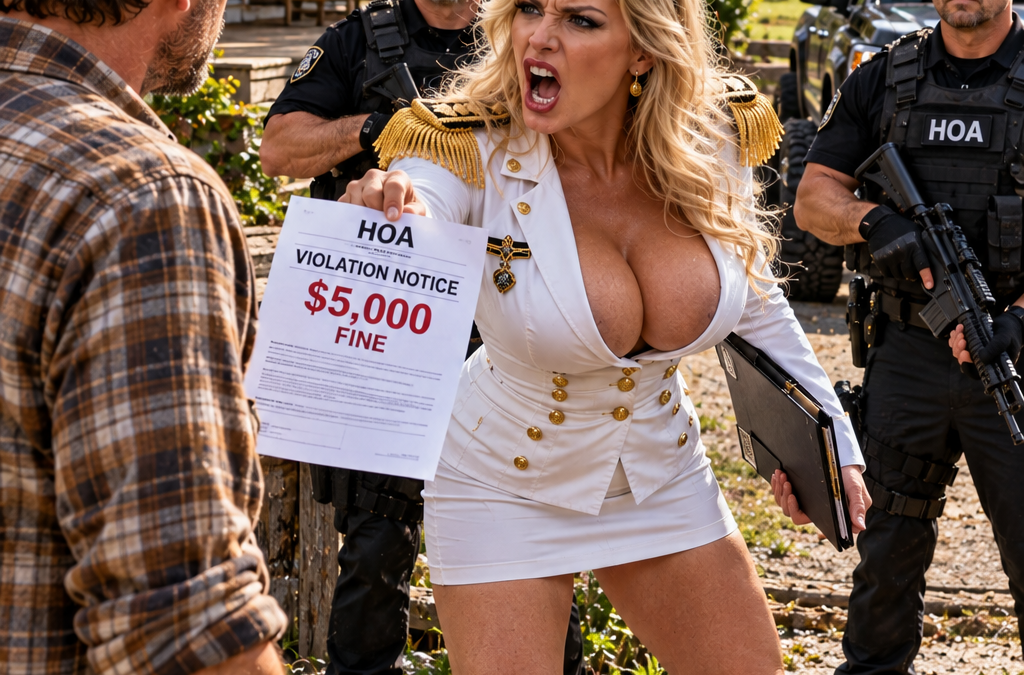
That morning she wore an immaculate, form-fitting white military-style uniform with gold buttons, decorative shoulder details, a narrow belt, and a deep neckline.
It was a dramatic outfit for a suburban driveway.
She moved with deliberate confidence, her white heels clicking against the concrete.
Her smile was polished, almost flirtatious, until she saw the expression on my face.
Then it disappeared.
The two men climbed out of the golf cart and took positions beside her.
Katherine marched toward me.
“Good morning.”
I rested both hands on the top of my shovel.
“Can I help you?”
She stopped several feet away.
“I’m Katherine, president of the neighboring homeowners association.”
“I know who you are.”
“Then you know why we’re here.”
I looked at the golf cart.
Then at the two men.
“No. I really don’t.”
Katherine lifted her chin.
“We are here on official HOA business.”
I glanced toward the road.
“You’re trespassing.”
Her smile vanished.
“Excuse me?”
“This is private property. You don’t have permission to be here.”
One of the men stepped forward.
He was tall and heavyset, with a shaved head and a tactical vest that looked two sizes too small.
“Sir, you need to show some respect.”
I stared at him.
“To whom?”
“To authorized compliance officers.”
I looked at the badge on his chest.
Then back at his face.
“Authorized by whom?”
“The HOA board.”
I laughed once.
I couldn’t help it.
“You’ve got to be kidding me.”
Katherine stepped between us.
“Enough. We are here because you’ve repeatedly ignored official notices.”
“Because your notices don’t apply to me.”
“Your property is in severe violation of community standards.”
“My property isn’t part of your community.”
Her expression hardened.
Then she delivered the sentence that made the entire situation go from irritating to unbelievable.
“We annexed your parcel into the HOA last month.”
I stared at her.
For several seconds, I couldn’t speak.
Then I asked, “You did what?”
“The board held a vote.”
“A vote?”
“Yes.”
“To take control of my private property?”
She crossed her arms.
“To incorporate your parcel into the community’s jurisdiction.”
I looked at the men beside her.
Neither seemed surprised.
Apparently, they’d been told this was normal.
I turned back to Katherine.
“You cannot annex somebody else’s land by holding a neighborhood meeting.”
She tilted her head.
“That decision has already been made.”
“By whom?”
“The board.”
“You don’t own my property.”
“We have a responsibility to protect neighborhood property values.”
I felt anger rise in my chest.
“My farmhouse has been here for almost a hundred years. Your subdivision was built next door to it.”
“And its appearance affects our residents.”
I looked toward the house.
The new roof gleamed in the morning sunlight.
The porch was freshly restored.
The front lawn was neatly mowed.
We had spent years turning a collapsing building into a beautiful home.
Katherine followed my gaze.
“Your paint color is not approved,” she continued. “Your landscaping has not been submitted for review, and your driveway parking violates community standards.”
I shook my head.
“This is insane.”
Her eyes flashed.
“You need to understand that we take enforcement seriously.”
“No, Katherine. You need to understand that your board doesn’t get to vote itself ownership of private land.”
Her cheeks reddened.
She turned sharply toward the man on her right.
“Issue the citation.”
He immediately reached into one of his vest pouches and produced a pad of paper.
I watched in disbelief.
He clicked a pen.
Then began writing.
“Unauthorized landscaping,” he announced.
His partner stood beside him with his hands resting near his utility belt.
“Unapproved exterior paint,” the man continued.
I tightened my grip on the shovel.
“Failure to pay association dues.”
Katherine smiled with satisfaction.
The man tore a page from the pad.
“The total fine is five thousand dollars.”
I stared at the paper.
Five thousand dollars.
For planting bushes on my own land.
For painting my own house.
For refusing to pay fees to an organization I didn’t belong to.
Katherine took a small step toward me.
“Payment is required within ten days.”
“And if I don’t?”
“We’ll place a lien against the property.”
Something cold settled in my stomach.
I knew the threat was legally baseless.
But hearing someone stand in my driveway and casually threaten the home my wife and I had spent years restoring was something different from receiving a ridiculous letter.
This was personal.
I looked at Katherine.
She was smiling.
She seemed to enjoy seeing how much the threat affected me.
I wanted to shout.
I wanted to tell her exactly what I thought of her fake authority and her ridiculous patrol squad.
But I knew that losing my temper would only give her another excuse to portray me as dangerous.
So I lowered my voice.
“You can write whatever you want on that little piece of paper.”
The man stopped writing.
“It doesn’t mean anything.”
Katherine’s smile disappeared.
“You are making a serious mistake.”
“No. You are.”
I pulled my phone from my pocket.
“All three of you have ten seconds to leave my driveway.”
The taller man straightened.
“Sir, we have the authority to—”
“Ten.”
He stopped.
I looked directly at Katherine.
“Nine.”
She folded her arms.
“You wouldn’t dare.”
“Eight.”
I unlocked my phone.
“Seven.”
The two men exchanged glances.
“Six.”
Katherine took a step forward.
“We are conducting official business.”
“Five.”
I opened the phone keypad.
“Four.”
The shorter man slipped the citation pad back into his vest.
“Ma’am,” he said quietly.
Katherine ignored him.
“Three.”
I looked her straight in the eye.
“Two.”
She raised one hand sharply.
“Fine.”
The word came out like a curse.
“We’re leaving.”
I lowered the phone slightly.
Katherine pointed at my house.
“But this is not over.”
I said nothing.
“You will comply eventually.”
I looked toward the road.
“Get off my property.”
Her eyes narrowed.
Then she turned.
The two men followed.
They climbed back into their absurd little golf cart, while Katherine returned to her sedan.
The vehicles backed down my driveway and disappeared toward the subdivision.
I stood there holding my shovel.
The entire encounter had lasted only a few minutes.
But my hands were shaking.
Not from fear of the men.
Not exactly.
I was angry.
Angrier than I’d been in years.
Because someone had come onto my property, dressed two men like law enforcement officers, threatened my home, and acted as though I should be grateful for the privilege.
I walked back toward the porch.
Then stopped and looked over my shoulder.
The driveway was empty.
The farmhouse stood quietly behind me.
Its windows reflected the blue sky.
I thought about the years we’d spent restoring it.
The nights we’d gone to bed exhausted.
The money we’d sacrificed.
The weekends we’d given up.
And I understood something.
Katherine wasn’t going to stop because I asked politely.
She wasn’t going to stop because I explained the law.
She wanted me to surrender.
And I wasn’t going to let her bully us out of our own home.
I went back to planting the bushes.
But I barely noticed what I was doing.
Every few minutes, my thoughts returned to the golf cart.
The uniforms.
The badges.
The pepper spray.
And Katherine’s smug smile when she announced the five-thousand-dollar fine.
By lunchtime, I had made a decision.
I was calling a lawyer.
My wife came home while I was washing dirt off my hands.
She took one look at my face.
“What happened?”
I told her.
Every detail.
The golf cart.
The fake officers.
The annexation claim.
The fine.
The threatened lien.
She listened without interrupting.
When I finished, she stood very still.
“Two men with weapons came onto our property?”
“Pepper spray and tactical gear.”
“And she brought them here?”
“Yes.”
“To threaten you?”
“That’s what it felt like.”
My wife turned toward the front window.
For several seconds, she said nothing.
Then she whispered, “What if I’d been here alone?”
That question stopped me.
I hadn’t considered it.
What if I’d been at work?
What if my wife had been gardening when Katherine arrived with two aggressive men in black uniforms?
Would they have tried to intimidate her?
Would they have approached the porch?
Would they have refused to leave?
My anger turned into something heavier.
Concern.
I reached for her hand.
“That isn’t going to happen.”
She looked at me.
“You can’t promise that.”
She was right.
I couldn’t.
Not yet.
But I could take steps to prevent it.
The following Monday, I met with an attorney.
I brought everything.
The original welcome packet.
The invoices.
The escalating late fees.
The violation notices.
The threats about a lien.
And the security camera footage from Saturday morning.
I’d installed cameras during the restoration because the property had been vacant for years and I wanted to monitor the house and driveway.
At the time, I never imagined they’d become evidence in a dispute with a homeowners association.
My lawyer watched the recording.
At first, he looked skeptical.
Then Katherine announced that the board had annexed my property.
He paused the video.
“Did she really say that?”
I nodded.
“Word for word.”
He watched the rest.
The fake citation.
The five-thousand-dollar fine.
The threat to place a lien.
The uniformed men claiming enforcement authority.
The moment I began calling the police.
When the recording ended, he sat quietly for several seconds.
Then he removed his glasses.
“These people are completely out of line.”
I leaned forward.
“So I’m not crazy?”
“No.”
He tapped the property records I’d brought.
“Your house is not part of their subdivision. Your deed is separate. The association has no basis to impose membership simply because your land is adjacent to theirs.”
I felt my shoulders loosen.
I’d known that.
But hearing it from someone who understood property law was still a relief.
My lawyer continued.
“And this supposed annexation vote doesn’t change anything.”
“What about the fines?”
“Without valid authority over your parcel, they have no basis to enforce those HOA penalties against you.”
He looked back at the paused video.
“Frankly, I’m more concerned about this enforcement squad.”
I nodded.
“That bothered me, too.”
“They’re wearing badges, tactical gear, and carrying defensive equipment while claiming authority they may not have.”
“One of them told me I needed to respect his position.”
My lawyer sighed.
“That’s not how this works.”
We discussed our options.
He recommended putting the association on formal notice that its claims were baseless and that the harassment had to stop.
We also discussed seeking court protection against Katherine and the two men who had entered my property.
I didn’t hesitate.
“Do it.”
He studied me.
“Are you sure?”
I thought about my wife’s question.
What if she’d been home alone?
“Absolutely.”
We prepared a cease-and-desist letter addressed to the HOA board.
It explained that the farmhouse was legally independent from the subdivision.
It demanded that the association stop sending invoices, issuing citations, and making unsupported claims about our property.
It also warned against further harassment or unauthorized entry onto our land.
Separately, we pursued a restraining order against Katherine and the two men.
The process was less complicated than I’d feared, particularly because we had the documents and security footage.
The court reviewed the evidence.
And the order was granted.
Katherine and both men were prohibited from entering our property or contacting me as specified in the order.
When my lawyer called with the news, I was standing in the unfinished upstairs hallway.
I sat down on the top step.
For several seconds, I simply listened to him explain the restrictions.
Then I thanked him.
After the call ended, I stayed there.
The house was quiet.
A breeze moved through the open window.
I could hear my wife working downstairs.
And for the first time since Katherine had begun sending threats, I felt something resembling safety.
We finally had a legal boundary she couldn’t simply redefine with a board vote.
That evening, I showed my wife the paperwork.
She read it carefully.
Then she looked at me.
“So they can’t come here anymore?”
“Not without violating the court order.”
She exhaled.
“Good.”
I watched her place the document on the table.
Then she did something that made my chest tighten.
She smiled.
A real smile.
Not the cautious expression she’d been wearing for weeks.
For the first time in a long time, she seemed to believe we might actually get our lives back.
And for several weeks, we did.
The letters stopped.
No new invoices arrived.
No violation notices.
No threats about liens.
The white golf cart disappeared from the road near our property.
I didn’t see Katherine’s sedan.
And nobody came marching up the driveway wearing tactical gear.
The silence was wonderful.
I finished planting the bushes.
Repaired the remaining trim around the front windows.
Repainted sections of the porch railing.
My wife planted flowers beside the stone walkway.
We spent a Saturday afternoon working in the garden without once discussing the HOA.
That evening, we sat on the wraparound porch with iced tea.
The sun was setting behind the old trees.
The farmhouse looked beautiful in the golden light.
My wife rested her head against my shoulder.
“Remember when we first saw this place?”
I laughed softly.
“When you wanted to burn it down?”
“I never said I wanted to burn it down.”
“You strongly implied it.”
She smiled.
Then looked across the yard.
“I’m glad you talked me into it.”
I squeezed her hand.
“Me too.”
She was quiet for a moment.
Then she asked, “Do you think Katherine is finished?”
I wanted to say yes.
I wanted to believe the restraining order had finally made her understand that her HOA presidency didn’t give her authority over our land.
But I remembered her face when I threatened to call the police.
The way she’d smiled at the thought of placing a lien on our home.
And the certainty with which she’d announced that her board had somehow annexed property it didn’t own.
“I think she’ll be foolish if she isn’t,” I said.
My wife nodded.
Then we watched the sunset.
For a while, life felt normal again.
The garden grew.
The porch furniture arrived.
We began talking about the next restoration project instead of legal documents.
And I stopped expecting trouble every time a vehicle approached the driveway.
That lasted until the morning Katherine made the worst decision of her life.
A storm had passed through the area several days earlier.
The winds had been strong enough to bring down branches, and a few shingles had blown loose from one section of the roof.
I’d arranged to repair the damage.
That morning, I was working on the roof under a clear blue sky.
The air was cool enough to make the job comfortable, and the neighborhood was quiet.
From where I stood, I had a clear view of the driveway and the road beyond our front yard.
I was checking the damaged section when I heard a familiar buzzing sound.
At first, I ignored it.
Then I glanced toward the street.
A white golf cart was approaching.
Amber lights flashed on its roof.
I stopped moving.
The vehicle turned into our driveway.
My stomach dropped.
I knew that golf cart.
I knew the decals.
And I knew exactly who would be inside.
The two men in black tactical uniforms climbed out.
One carried a camera.
The other adjusted his utility belt.
Then a dark sedan pulled in behind them.
Katherine stepped out.
She wore the same style of immaculate white military uniform she’d favored before, its fitted jacket decorated with gold buttons and a deep neckline.
Her blonde hair was perfectly styled.
She held a clipboard beneath one arm.
And she pointed toward my farmhouse as though issuing orders to a military unit.
For several seconds, I stood motionless on the roof.
I couldn’t believe what I was seeing.
They had received the cease-and-desist letter.
They had been named in a court order.
They knew they were prohibited from entering my property.
And yet there they were.
Walking directly into my front yard.
One of the men raised his camera and began taking pictures.
Katherine started writing on her clipboard.
The other man surveyed the house.
I felt a cold rush of anger.
But beneath it was something more serious.
These people were no longer merely pretending to have authority over my land.
They were openly disregarding a court order.
And I had no idea how far they were willing to go.
I climbed down carefully.
Every movement felt painfully slow.
I didn’t want to rush and fall from the roof because three idiots had decided to challenge a judge.
When I reached the ground, I went straight inside.
Picked up my phone.
And called police dispatch.
I explained that three people subject to active restraining orders were on my property.
I provided their names.
Told the dispatcher they had previously trespassed while wearing tactical-style uniforms and badges.
And explained that two of them were again carrying equipment and presenting themselves as HOA enforcement officers.
The dispatcher asked whether anyone was injured.
“No.”
“Have they threatened you?”
“Not yet. But they previously came here to intimidate me, and they’re violating a court order right now.”
She asked me to remain safe and said officers were being sent.
I ended the call.
Then I went to the front porch.
Katherine and her two men were standing in the middle of the yard.
One was taking photographs of the house.
The other stood beside the golf cart.
Katherine was writing furiously on her clipboard.
I stayed near the porch steps.
“Katherine.”
She looked up.
For a brief moment, I saw surprise in her eyes.
Then her expression hardened.
“Oh. There you are.”
I folded my arms.
“I thought the judge made it very clear that you’re not allowed on my property.”
She gave a dismissive laugh.
“We’re conducting an emergency inspection.”
I stared at her.
“You’re what?”
“An emergency inspection.”
“Of my house?”
“Yes.”
“Under whose authority?”
“The HOA board.”
I almost couldn’t believe the words.
She continued without waiting for an answer.
“We received an anonymous complaint about structural hazards on your property.”
I looked toward the house.
The restored roof.
The repaired porch.
The freshly painted siding.
Everything we’d spent years rebuilding.
“And that gives you the right to trespass?”
“We have an obligation to protect community safety.”
“My property isn’t in your community.”
Katherine stepped closer.
“We’ve already settled that issue.”
“No. A court has settled this issue. You’re prohibited from being here.”
Her smile became cold.
“Court orders don’t supersede HOA covenants.”
For a moment, I genuinely didn’t know what to say.
The statement was so absurd that I wondered whether she had convinced herself it was true.
I looked at her carefully.
She wasn’t joking.
She believed that a neighborhood association’s rules outranked an order issued by a judge.
I shook my head.
“Katherine, you’re making this much worse.”
She tilted her chin.
“I’m doing my job.”
“You don’t have a job here.”
Her eyes flashed.
“I am the president of the homeowners association.”
“And this isn’t part of the homeowners association.”
The man holding the camera stepped toward the porch.
“Sir, step back.”
I turned toward him.
“Excuse me?”
He held his shoulders square and lowered his voice.
“You are interfering with an authorized inspection.”
I looked at the badge on his chest.
Then at the pepper-spray canister hanging from his belt.
“You’re not authorized to inspect anything.”
He moved another step closer.
“Do not obstruct us.”
I stayed where I was.
He pointed toward the front door.
“Go inside.”
“No.”
Katherine smiled.
“See? This is exactly the behavior we’ve been documenting.”
I looked at her.
“Document all you want. You’re violating a restraining order.”
The man with the camera interrupted.
“Sir, we are authorized to use force if you obstruct our inspection.”
Everything seemed to become very quiet.
I stared at him.
He had just threatened to use force against me.
On my own property.
While violating a court order.
I could feel my heartbeat in my throat.
For a second, I imagined him reaching for the pepper spray.
I thought about my wife inside the house.
About how quickly an already dangerous confrontation could become worse.
But I also knew I couldn’t let fear push me into doing something reckless.
So I kept my hands visible.
And my voice steady.
“You’re not authorized to use force against me.”
He stared back.
I continued.
“And if you have any sense at all, you’ll stay exactly where you are.”
Katherine let out a sharp laugh.
“Are you threatening my officers?”
“No.”
I looked toward the road.
“I’m telling them they’re about to have a very serious problem.”
She followed my gaze.
“What are you talking about?”
I didn’t answer.
Because at that moment, I heard sirens.
Faint at first.
Then growing louder.
The man with the camera turned toward the street.
His expression changed.
Katherine looked toward the driveway entrance.
Two police cruisers appeared around the bend.
Their lights flashed as they approached.
The vehicles turned into my driveway and stopped in positions that prevented Katherine’s car and the golf cart from simply pulling away.
Four real police officers stepped out.
And the transformation in Katherine’s little patrol squad was immediate.
The man who had just threatened me lowered his camera.
His shoulders dropped.
He took a step backward.
The other man stopped adjusting his utility belt.
For the first time since I’d met them, neither looked intimidating.
They looked frightened.
Katherine, however, stepped forward confidently.
She appeared to believe the arriving officers were there to support her.
I watched her smooth the front of her white jacket.
Then she smiled.
“Officers. Thank goodness you’re here.”
The lead officer approached.
He was tall, broad-shouldered, and carried himself with the quiet authority of someone who didn’t need to prove he was in charge.
He looked at Katherine.
Then at the two men in tactical gear.
Then at their golf cart.
His expression remained completely serious.
“Who called about a trespass?”
“I did,” I said from the porch.
The officer turned toward me.
I walked down the steps carrying the copy of the restraining order I’d retrieved from inside.
“These three individuals are named in this order.”
I handed him the paperwork.
“They’re prohibited from entering my property or contacting me. They came here anyway.”
He studied the document.
Checked the names.
Then looked toward Katherine.
“Ma’am, is this your name?”
She glanced at the paper.
“Yes, but you need to understand—”
“Is this an active court order?”
“Yes, but—”
“And you’re aware of it?”
Katherine straightened.
“Of course I’m aware of it.”
The officer paused.
“Then why are you here?”
She lifted her chin.
“Because I’m the HOA president, and this property falls under our jurisdiction.”
He looked toward the subdivision.
Then back at my farmhouse.
“Ma’am, this appears to be a separate property.”
“It borders our community.”
“That doesn’t automatically put it under your HOA.”
She opened her mouth.
He continued.
“And even if it were part of the association, that wouldn’t give you permission to violate a court order.”
Katherine’s face reddened.
“You don’t understand the situation.”
“Then explain it.”
She gestured toward my house.
“The owner has refused to comply with our regulations.”
I shook my head.
The officer glanced toward me, then returned his attention to Katherine.
“We’re not here to settle an HOA dispute.”
“But—”
“We’re here because you’re allegedly violating a restraining order.”
Katherine looked offended.
“Allegedly?”
“Yes, ma’am.”
She crossed her arms.
“This is outrageous.”
The officer didn’t react.
Instead, he turned toward the two men.
“What exactly are you supposed to be?”
The taller man cleared his throat.
“We’re HOA compliance officers.”
The officer looked him up and down.
“Compliance officers?”
“Yes, sir.”
“With what organization?”
“The homeowners association.”
The officer glanced at the golf cart.
Its amber lights were still flashing.
Then he looked at the badges.
“And what authority do you believe you have?”
The man shifted uncomfortably.
“We enforce community rules.”
“Are you sworn law enforcement officers?”
“No.”
“Do you hold state security licenses?”
The two men exchanged glances.
The shorter one looked at Katherine.
She said nothing.
The taller man swallowed.
“We were appointed by the board.”
The officer stared at him.
“That’s not what I asked.”
There was a long silence.
Then the man said quietly, “No.”
The officer nodded once.
“All right.”
He gestured toward their equipment.
“I need you to keep your hands away from your belts.”
Both men immediately complied.
The officer directed his partners to inspect the equipment and determine what the men were carrying.
The radios and pepper-spray canisters were taken into police custody during the encounter.
The men were told to remove their badges.
They did so without arguing.
I stood near the porch steps, watching.
The contrast was astonishing.
Minutes earlier, those same two men had been issuing commands and threatening to use force.
Now their shoulders were slumped.
Their voices had become quiet.
And the badges they’d displayed so proudly were being removed from their uniforms.
The lead officer examined one of the badges.
Then looked back at them.
“You understand that presenting yourselves as authorized enforcement personnel can have serious consequences?”
Neither answered.
He continued.
“And you’re both named in an active restraining order prohibiting you from entering this property.”
The taller man looked toward Katherine.
“We were told to come here.”
The officer’s expression didn’t change.
“Who told you?”
The man hesitated.
Then pointed toward Katherine.
“She did.”
Katherine spun around.
“Don’t you dare put this on me!”
The shorter man spoke for the first time.
“You said we had authorization.”
“We do!”
“The court order says we can’t be here,” he replied.
Katherine glared at him.
“You’re supposed to follow my instructions.”
The lead officer stepped between them.
“That’s enough.”
For a moment, nobody moved.
Then he turned toward the two men.
“Place your hands behind your backs.”
The taller man stared.
“What?”
“You’re being taken into custody.”
His face went pale.
The shorter man looked as though he might be sick.
Neither resisted.
They turned around.
The officers secured their hands in cuffs.
Then escorted them toward the patrol cars.
I watched them walk across the yard.
Their tactical vests suddenly looked absurd.
Their badges were gone.
Their radios had been taken.
And the men who’d arrived as Katherine’s private enforcement squad were now being led away by the people who actually had law-enforcement authority.
Katherine stared after them.
Her mouth hung open.
Then she began shouting.
“STOP!”
The lead officer turned.
“Ma’am?”
“You cannot arrest them!”
He remained calm.
“Ma’am, step back.”
“They work for me!”
The officer looked at her.
“And?”
“They were following official instructions!”
“That doesn’t make their actions lawful.”
Katherine’s face turned bright red.
“I am the president of the homeowners association!”
The officer took a slow breath.
“Ma’am, you’ve said that several times.”
“Because you don’t seem to understand!”
“I understand perfectly.”
He held up the restraining order.
“You’re named in this order.”
Katherine stared at the document.
“You have to understand the context.”
“You’re prohibited from coming onto this property.”
“We were conducting an emergency inspection!”
“You have no authority to override this order.”
She took a step backward.
For the first time, I saw genuine fear behind her anger.
The officer continued.
“And according to the information we’ve received, you organized today’s visit.”
Katherine opened her mouth.
Then closed it.
The officer looked at her steadily.
“Place your hands behind your back.”
She froze.
“What?”
“You’re under arrest.”
The words seemed to hit her physically.
Her shoulders jerked.
Her eyes widened.
For several seconds, she simply stared.
Then she laughed.
A short, disbelieving sound.
“No.”
The officer remained still.
“Ma’am.”
“No, you can’t.”
“Turn around.”
Katherine shook her head.
“I’m the HOA president.”
The officer’s expression hardened.
“Being the president of a neighborhood association doesn’t put you above the law.”
She glanced toward her two men.
Both were already beside the police cruisers.
She looked toward the subdivision.
Then at me.
Her eyes narrowed with hatred.
“This is your fault.”
I said nothing.
She pointed at me.
“You did this!”
I stood beside the porch.
I wanted to tell her she had brought this on herself.
I wanted to remind her that she’d received legal notice.
That she’d been given every opportunity to stop.
That she’d returned to my property after a judge ordered her to stay away.
But I knew there was nothing useful I could add.
So I stayed silent.
Katherine turned back toward the officer.
“I know my rights!”
“Then comply with the lawful instructions you’re being given.”
She began breathing rapidly.
Her carefully maintained composure was falling apart.
“You are making a huge mistake.”
The officer approached.
“Hands behind your back.”
She hesitated.
Then, reluctantly, turned.
The officer placed her in handcuffs.
The sight was surreal.
The woman who had marched onto my property wearing a pristine white military-style uniform, flanked by two men carrying radios and pepper spray, now stood in my front yard with her wrists secured behind her.
Her blonde hair had fallen across her face.
Her makeup was beginning to smear.
Her heels shifted awkwardly in the grass.
And she was trembling.
Not from cold.
From the realization that her title could no longer protect her.
Then she started shouting again.
“I WILL SUE THIS DEPARTMENT!”
The officer guided her toward the patrol car.
“I’LL HAVE YOUR JOBS!”
Nobody answered.
“DO YOU KNOW WHO I AM?”
The officer opened the rear door.
“Yes, ma’am.”
She twisted toward me.
“YOU’LL REGRET THIS!”
I looked at her.
For a moment, I remembered the first invoice.
The first phone call.
The five-thousand-dollar citation.
The threat to place a lien on our home.
The men standing in my driveway pretending they could enforce rules that didn’t apply to us.
And the fear in my wife’s voice when she’d asked what might happen if she were home alone.
I felt no need to shout back.
Katherine had spent months making demands.
Now someone else was giving the instructions.
And she had no choice but to listen.
The officer helped her into the back seat.
The door closed.
Her shouting became muffled.
I stood in the yard watching.
For a few seconds, the entire world felt strangely still.
The birds were singing.
A breeze moved through the trees.
My farmhouse stood behind me, its restored porch shining in the sunlight.
The same property Katherine had tried to control was now the place where she’d finally encountered a boundary she couldn’t ignore.
One of the officers came over to take my statement.
He asked what had happened before they arrived.
I explained that I’d been working on the roof.
That I’d seen the golf cart and Katherine’s sedan enter the driveway.
That the three individuals had begun photographing and inspecting the property.
And that one of the men had threatened to use force if I interfered.
The officer listened carefully.
Then asked whether I had security footage.
“Yes.”
He looked up.
“Of today?”
“Everything.”
I took out my phone.
The cameras had recorded the vehicles arriving.
The group entering my yard.
The confrontation near the porch.
And most of the interaction before the police arrived.
The officer examined the recording.
Then nodded.
“We’ll need copies.”
“You can have them.”
I hesitated.
“Officer, can I ask you something?”
“Sure.”
“How does somebody convince themselves that an HOA board vote gives them authority over a property they don’t own?”
He looked toward the empty golf cart.
Then back at me.
After a moment, he sighed.
“I couldn’t tell you.”
He finished collecting the information.
Then the officers prepared to leave.
The golf cart remained in my driveway.
So did Katherine’s sedan.
The police vehicles pulled away, carrying all three people who’d arrived so confidently that morning.
I stood watching until the cruisers disappeared.
Then I looked toward the farmhouse.
My wife was standing on the porch.
She had come outside during the police response but had remained away from the confrontation.
Her face was pale.
I walked toward her.
She came down the steps and wrapped her arms around me.
For several seconds, neither of us spoke.
Then she whispered, “Are you okay?”
I nodded.
“Yeah.”
She pulled back.
“Did they really arrest all three?”
“All three.”
She looked toward the driveway.
At the abandoned golf cart.
At Katherine’s car.
Then back at me.
“I can’t believe they came back.”
“Neither can I.”
She shook her head slowly.
“After the restraining order?”
“After the restraining order.”
She closed her eyes.
I put my arm around her.
“It’s over for today.”
She leaned against me.
“I hope it’s over for good.”
I looked at the quiet road.
For the first time, I believed it might be.
The three of them spent that night in custody.
They faced charges connected to the trespass and violation of the court order, along with allegations concerning their unauthorized use of security-style equipment and presentation as enforcement personnel.
I later learned that Katherine had continued insisting she was acting within her authority.
Apparently, even being handcuffed hadn’t convinced her that a homeowners association wasn’t a government agency.
But the evidence was no longer something she could dismiss with a clipboard and a threatening letter.
There was a court order.
There were police reports.
There was security footage.
And there were witnesses.
The situation was no longer a private argument between an old farmhouse owner and an overbearing HOA president.
It had become a legal matter with real consequences.
News traveled quickly through the subdivision.
By the next day, several neighbors had heard about the arrests.
By the end of the week, nearly everyone seemed to know.
I received a call from a friend who lived inside the development.
He’d been watching the HOA’s decisions with growing concern, although until then he hadn’t realized the full extent of Katherine’s behavior toward us.
“You’re not going to believe what’s happening,” he said.
I sat down at the kitchen table.
“Try me.”
“People are furious.”
“About what?”
“Katherine.”
I was quiet.
He continued.
“Most residents had no idea she was using association money for that ridiculous patrol squad.”
I looked toward the driveway.
The golf cart had already been dealt with after the police incident, but I could still picture it sitting there with its flashing amber lights.
“The uniforms?” I asked.
“The gear. The cart. All of it.”
He sounded disgusted.
“People thought the HOA was supposed to maintain common areas and handle neighborhood business. Nobody voted to create a fake police force.”
I rubbed my forehead.
“Believe me, I didn’t vote for one either.”
He gave a short laugh.
Then his voice became serious.
“And now everyone knows she was trying to enforce HOA rules against someone who isn’t even part of the subdivision.”
I looked out the window.
The old trees moved gently in the wind.
“That’s what I’ve been telling her from the beginning.”
“I know.”
He paused.
“There’s going to be a special meeting.”
I leaned back.
“About Katherine?”
“About everything.”
I didn’t attend that meeting.
It wasn’t my association.
I’d spent months explaining that I wasn’t a member, and I had no intention of suddenly participating in its internal politics.
But my friend called afterward and told me what happened.
The room had been packed.
Residents demanded to know why their association dues were being spent on tactical-style equipment and an unofficial enforcement squad.
They wanted to know who approved the uniforms.
Who authorized the golf cart.
Who decided two unlicensed men should patrol the neighborhood carrying pepper spray and badges.
And, most importantly, why the HOA president had used those men to intimidate the owner of a separate property.
Katherine’s supporters tried to defend her.
They argued that she had been protecting property values.
That she cared deeply about the community.
That the situation had been misunderstood.
But the facts were difficult to explain away.
The farmhouse was not part of the development.
The HOA had no legitimate claim to it.
Katherine had ignored a restraining order.
And she had been arrested on someone else’s property while attempting to conduct an unauthorized inspection.
The residents had heard enough.
They voted to remove Katherine from the board.
Immediately.
They also voted to disband the so-called compliance patrol squad.
No more golf cart.
No more fake badges.
No more tactical vests.
No more self-appointed neighborhood enforcers pretending they could threaten homeowners.
When my friend told me the result, I didn’t say anything for a moment.
Then I asked, “She’s really out?”
“Completely.”
“And the patrol squad?”
“Gone.”
I closed my eyes.
I felt a wave of relief so strong that I had to sit quietly for several seconds.
My friend continued.
“The new board wants nothing to do with her.”
I looked toward my wife, who was standing across the kitchen.
She could see something had changed.
I smiled at her.
For the first time in months, the smile came easily.
“That’s good,” I told my friend. “Really good.”
After the meeting, I contacted my lawyer.
He had already been following the case.
We discussed the arrests, the HOA leadership change, and what remained to be resolved.
He advised that we obtain formal written acknowledgment from the new board.
Not a casual verbal promise.
Not a friendly phone call.
Something clear and documented.
I agreed.
He drafted a final letter.
It demanded that the HOA acknowledge my farmhouse was a separate property, independent from its subdivision and not subject to its covenants, fees, or enforcement rules.
It also demanded that the association stop sending bills, citations, and communications asserting authority over our land.
And we requested a written apology.
The new board responded quickly.
Very quickly.
Apparently, the remaining directors were eager to distance themselves from Katherine’s actions.
They reviewed the property records.
Confirmed our deed and boundaries.
And sent a formal letter acknowledging that the farmhouse was not part of the homeowners association.
They confirmed that we owed no HOA dues.
That our exterior paint and landscaping were not subject to association approval.
And that the previous attempts to enforce neighborhood rules against us had been improper.
They also apologized.
In writing.
I read the letter at the kitchen table.
Then I handed it to my wife.
She read every line.
Twice.
When she finished, her eyes were shining.
“They finally admitted it.”
I nodded.
“Yes.”
She looked down at the document.
“All this trouble over something that was true from the beginning.”
I leaned back.
“That’s the part I still can’t understand.”
She placed the letter carefully on the table.
Then reached across and took my hand.
“Can we keep it?”
I smiled.
“Of course.”
“I mean somewhere safe.”
I nodded.
“With the deed.”
She laughed softly.
“Perfect.”
We placed the letter with the property records.
The same records Katherine had ignored from the first day.
My lawyer and I also discussed the possibility of filing a civil lawsuit.
Given the repeated harassment, unsupported financial demands, trespassing, and documented intimidation, he believed we had grounds worth considering.
We talked about legal costs.
Time.
Stress.
And the possibility of recovering damages.
There was a part of me that wanted to pursue it.
I won’t pretend otherwise.
Katherine had threatened our home.
She had made my wife afraid to be alone on our property.
She had brought two intimidating men into our yard and tried to force us into an association we had never joined.
And she had returned after a judge ordered her to stay away.
A lawsuit might have made the consequences even greater.
But when I looked at my wife, I realized something.
We had spent too much of our lives thinking about Katherine already.
Too many nights discussing her letters.
Too many mornings checking the driveway.
Too much energy defending something that should never have been questioned.
I didn’t want the next several years to revolve around her, too.
My wife sat beside me when I explained how I felt.
“We could sue,” I said.
She nodded.
“I know.”
“We might recover some money.”
“Maybe.”
“But I don’t know if I want another fight.”
She looked at me for a long moment.
Then asked, “What do you want?”
I glanced around the kitchen.
The cabinets we’d installed.
The old hardwood floor we’d refinished together.
The sunlight coming through the windows.
“I want to finish this house.”
She smiled slightly.
“What else?”
“I want to sit on the porch without wondering who’s coming up the driveway.”
She nodded.
“And?”
I reached for her hand.
“I want us to enjoy what we built.”
Her eyes softened.
“Then that’s what we should do.”
We decided not to pursue a civil lawsuit.
I know some people would have made a different choice.
Maybe they would have fought for every possible dollar.
Maybe they would have wanted to make an example of the association.
I understand that.
But I was satisfied with the outcome.
Katherine had been arrested.
Her fake enforcement squad was gone.
The HOA had removed her from power.
And the new board had formally acknowledged that our property was independent.
For me, that was enough.
Katherine eventually appeared before a judge to face the consequences of her conduct.
She received a substantial fine and a period of probation.
The case also left a permanent mark on her record.
The woman who had once threatened to place a lien on my farmhouse because she disliked its paint color now had a legal judgment of her own to deal with.
I didn’t attend every proceeding.
I didn’t need to.
My lawyer kept me informed.
And the court records spoke for themselves.
Katherine had been given numerous opportunities to stop.
She could have removed our address from the mailing list after the first phone call.
She could have acknowledged the separate deed.
She could have apologized when her so-called annexation was challenged.
She could have stopped after the first police threat.
She could have respected the restraining order.
At any one of those points, she could have walked away.
Instead, she escalated.
Again and again.
Every time she encountered a boundary, she tried to cross it.
Every time someone told her no, she interpreted it as a challenge to her authority.
And eventually, she crossed a boundary enforced by people she couldn’t intimidate.
That was what ended her little kingdom.
Not a shouting match.
Not a personal threat.
Not some elaborate revenge scheme.
The law.
The same law she’d spent months pretending didn’t apply to her.
Life at the farmhouse changed after that.
Not dramatically.
There was no enormous celebration.
No champagne.
No victory parade down the driveway.
The changes were quieter.
And somehow, that made them more meaningful.
The mail arrived without HOA invoices.
The road stayed peaceful.
No golf carts with flashing lights came creeping toward our property.
No one marched across the lawn with a clipboard.
No one threatened to fine us because our pickup truck was parked in the driveway.
My wife started spending more time in the garden.
She planted flowers along the porch.
Added herbs near the kitchen entrance.
And began planning a small vegetable patch behind the house.
I repaired the remaining window trim.
Finished the kitchen details.
And moved on to smaller projects that didn’t require an attorney’s opinion.
Sometimes, while working outside, I’d catch myself looking toward the subdivision.
Old habits are difficult to break.
For months, I’d associated those streets with letters, threats, and unwanted visitors.
Now they were simply streets.
Families lived there.
Children played.
People walked their dogs.
Most of the residents had never wanted anything to do with Katherine’s strange campaign against us.
Some even waved when they saw me working in the yard.
A few apologized for what had happened.
I told them they had nothing to apologize for.
The people responsible had already faced the consequences.
The new HOA board seemed determined to avoid repeating the mistakes of its predecessor.
They stayed within their actual boundaries.
Focused on shared facilities.
And left my farmhouse alone.
Exactly as they should have done from the beginning.
One Saturday afternoon, several months after Katherine’s arrest, I was working near the front porch.
The weather was warm.
The sky was clear.
I had just finished trimming one of the bushes I’d planted the morning her fake officers first appeared.
I stood back and examined it.
The leaves were healthy.
The shape looked good.
And the flower beds surrounding it were beginning to fill in.
My wife came outside carrying two glasses of iced tea.
She handed me one.
“Looks good.”
I smiled.
“Better than it did.”
She looked toward the bushes.
“Remember when she showed up while you were planting those?”
I laughed quietly.
“Unfortunately.”
She shook her head.
“I still can’t believe she brought those men here.”
I took a sip of tea.
“Neither can I.”
She sat on the porch steps.
I joined her.
For a while, we watched the afternoon sunlight move across the yard.
Then she looked at the house.
“Do you remember what it looked like when we first bought it?”
I followed her gaze.
The farmhouse stood tall and bright.
Its new roof was solid.
The windows were clean.
The porch wrapped around the front and side, supported by the restored columns.
The old brick fireplace was visible through the living room window.
And beyond the house, the trees we’d saved during the restoration cast long shadows across the lawn.
I nodded.
“I remember.”
She smiled.
“You thought you could save it.”
“I hoped I could.”
“And I thought you were completely crazy.”
I laughed.
“You might still be right.”
She leaned against me.
“No.”
For a few moments, neither of us spoke.
Then she said something I’ll never forget.
“I’m glad we didn’t let her take this away from us.”
I looked at her.
She wasn’t talking about the property deed.
Not exactly.
Katherine had never possessed a legitimate claim to our land.
The farmhouse had been ours all along.
What she’d nearly taken was something harder to recover.
The joy of living there.
The pride we’d felt restoring it.
The safety we’d wanted when we first bought the property.
The simple pleasure of coming home and knowing we could close the door behind us.
For months, Katherine had turned those ordinary comforts into sources of anxiety.
We’d started treating every unexpected vehicle as a threat.
Every envelope as a possible demand.
Every knock as the beginning of another confrontation.
It had taken time to stop living that way.
But sitting on the porch beside my wife, looking at the house we’d brought back from the edge of collapse, I finally felt the weight lift.
The farmhouse was still standing.
Our marriage had survived the stress.
The garden was growing.
And no one was coming to tell us what color our front door had to be.
I put my arm around her.
“Neither am I,” I said.
Later that evening, we walked along the edge of the property.
The mature trees separating us from the subdivision rustled in the breeze.
Beyond them stood rows of newer houses with matching rooflines and carefully maintained yards.
They weren’t bad houses.
The people living there weren’t bad people.
Most of them wanted the same things we did.
A peaceful home.
A safe neighborhood.
Somewhere to raise a family or spend the years they’d worked so hard to enjoy.
The problem had never been the subdivision itself.
It had been one woman who confused leadership with ownership.
Katherine had believed that becoming HOA president entitled her to control everyone around her.
She thought a board vote could erase an existing property boundary.
She thought printed citations could create obligations that didn’t exist.
She thought two men with badges and pepper spray could frighten us into surrendering.
And when a court told her to stop, she thought her title mattered more than the judge’s order.
That was her mistake.
She didn’t lose because I was stronger.
She didn’t lose because I had more money.
And she certainly didn’t lose because I enjoyed fighting.
She lost because the authority she claimed was never hers to begin with.
When we reached the old property marker near the tree line, I stopped.
It was a simple metal survey marker.
Nothing impressive.
No fence.
No warning sign.
No dramatic monument.
Just a quiet indication of where one property ended and another began.
I looked at it for a moment.
Then I thought about how much trouble Katherine had caused by refusing to respect something so simple.
A boundary.
Not an insult.
Not a declaration of war.
Just a boundary.
My wife noticed me looking down.
“What are you thinking?”
I smiled.
“That it’s amazing how much trouble one person can cause by refusing to understand where her authority ends.”
She looked at the marker.
Then toward the subdivision.
“Some people really don’t like being told no.”
“No,” I said. “They don’t.”
We continued walking.
The grass was soft beneath our feet.
The last of the sunlight filtered through the branches.
And behind us, the farmhouse stood exactly where it had stood for nearly a century.
Long before Katherine became HOA president.
Long before her board voted to annex land it didn’t own.
Long before two men decided that black tactical vests made them law enforcement officers.
The house had survived abandonment.
Storms.
Decay.
And decades of neglect.
We’d brought it back with patience, money, and hard work.
Katherine had tried to turn that achievement into something we had to defend.
But in the end, she was the one who lost her position, her reputation, and her freedom for a night.
Her fake patrol squad disappeared.
The association admitted its mistake.
And we got what we’d wanted from the very beginning.
To be left alone.
That night, my wife and I sat on the restored porch as darkness settled over the fields.
The porch lights cast a warm glow across the wooden boards.
Crickets chirped in the grass.
A gentle breeze moved through the old trees.
My wife leaned back in her chair and closed her eyes.
For a moment, I watched her.
She looked peaceful.
And I realized that was the real victory.
Not seeing Katherine in handcuffs.
Not hearing that she’d been removed from the HOA board.
Not receiving the formal apology.
Those things mattered.
They brought consequences, accountability, and closure.
But the real victory was this.
My wife could sit on our porch without being afraid.
I could work on my house without worrying that someone would arrive to threaten me.
And we could finally enjoy the home we’d spent years restoring.
I looked out across the yard.
The bushes I’d planted were growing.
The driveway was empty.
The farmhouse was quiet.
And the property line was exactly where it had always been.
Katherine had spent months trying to convince me that her authority extended across that line.
Now she knew better.
I reached for my wife’s hand.
She opened her eyes and smiled.
“Everything okay?”
I looked at the house.
Then at the land surrounding it.
Then back at her.
“Yeah,” I said.
“Everything’s finally okay.”
And for the first time since we’d bought that forgotten old farmhouse, I believed it completely.








