𝗙𝗨𝗟𝗟 𝗦𝗧𝗢𝗥𝗬 The HOA President Sent an Excavator to Steal My Orchard’s Water—Then Dared Me to Stop Her
𝗙𝗨𝗟𝗟 𝗦𝗧𝗢𝗥𝗬
Residents told me she had threatened families over patio furniture, demanded unnecessary landscaping changes, and pressured homeowners to support projects they couldn’t afford.
She kept close allies on the board.
She controlled meeting agendas.
And she had a talent for turning every disagreement into a question of whether someone supported the community.
If you opposed Karen, according to Karen, you opposed progress.
If you questioned her authority, you were selfish.
And if you asked her to produce documentation, she acted as though your request were an insult.
My orchard was not part of Brookstone Hills.
It never had been.
That distinction should have been enough to keep Karen out of my business.
Unfortunately, Karen had never been particularly interested in boundaries.
Our first unpleasant encounter happened months before the excavator appeared.
She drove to my orchard one afternoon in a white luxury SUV and stopped beside the packing shed.
I was checking a tractor when she stepped out.
Her red dress looked almost absurd against the dust and farm equipment.
“Daniel,” she called brightly. “I hope you’re having a wonderful afternoon.”
I wiped my hands on a rag.
“Afternoon, Karen.”
She smiled.
“I wanted to discuss an exciting opportunity.”
Whenever Karen described something as an opportunity, I had learned to expect that it would cost someone else money.
“What kind of opportunity?”
She gestured toward the eastern hills.
“The HOA is improving our lake.”
“Good for the HOA.”
“We’re expanding its landscaping and stabilizing the shoreline.”
“Sounds expensive.”
“It is an important community investment.”
I leaned against the tractor.
“Then I hope the residents are happy with it.”
Her smile tightened.
“Actually, that’s why I’m here.”
She explained that the lake wasn’t maintaining the appearance the board wanted during dry weather.
The exposed shoreline was upsetting homeowners.
One resident had apparently complained that the lake looked more like a muddy construction pit than a luxury amenity.
Karen considered that unacceptable.
“We need a more dependable water source,” she said.
I nodded.
“Then you’ll need to speak with the appropriate water authorities.”
She gave a light laugh.
“That’s already being handled.”
“Then what’s the issue?”
She turned toward the irrigation ditch running along the edge of my property.
“Your channel.”
I stared at her.
“What about it?”
“It carries water directly past the development.”
“Yes.”
“And our lake is nearby.”
“Also yes.”
She smiled as though those two facts settled everything.
“So it makes perfect sense to connect them.”
I straightened.
“Connect them how?”
“A controlled diversion. Nothing major.”
My stomach tightened.
“That ditch supplies my orchard.”
“Of course. But you don’t need every gallon.”
“How would you know?”
Her smile faded.
“Daniel, I’m trying to have a productive conversation.”
“So am I.”
I pointed toward the rows of fruit trees.
“Every irrigation schedule on this property is based on the water available through that channel. You can’t simply decide some of it is extra.”
She folded her arms.
“We’re not talking about taking your entire supply.”
“How much are you talking about?”
“The engineers are working on the details.”
“Then let them finish before you make promises.”
Her expression hardened.
“You don’t seem to understand the significance of this project.”
“I understand that you want water for a decorative lake.”
“For the entire community.”
“The lake doesn’t irrigate my trees.”
She stared at me.
Then she gave me the first warning.
“Daniel, Brookstone Hills has considerable influence in this county. It would be wise not to make yourself an obstacle.”
I looked at her for a long moment.
“Karen, if your project requires water from an established irrigation system, you’ll need proper authorization and an arrangement that respects existing rights.”
She tilted her head.
“That sounds like a refusal.”
“It sounds like the law matters.”
She stepped closer.
“Don’t make this difficult.”
I didn’t move.
“Then don’t make it illegal.”
Her face flushed.
She climbed into her SUV without another word.
That should have been the end of it.
Instead, it became the beginning.
Over the following months, Karen repeatedly brought up the irrigation ditch at public meetings.
I wasn’t a member of her HOA, but several neighbors told me what she was saying.
According to Karen, the orchard was sitting beside an underused community water resource.
According to Karen, the ditch carried more water than the trees could possibly need.
According to Karen, a modern neighborhood shouldn’t have to tolerate an unattractive lake while an old farming operation enjoyed unrestricted access to flowing water.
None of those statements accurately described the legal or technical situation.
But they sounded persuasive to people who didn’t understand irrigation.
The problem with water is that it looks simple until you have to manage it.
People see a channel full of water and assume it’s available.
They don’t see the legal rights connected to its use.
They don’t see the priority arrangements, measuring points, seasonal schedules, or agricultural needs downstream.
They certainly don’t see the years of planning that go into keeping mature fruit trees alive.
Karen saw water passing through a ditch.
And she decided it should be hers.
I sent the HOA a written explanation of the orchard’s irrigation history.
I included copies of the relevant records and requested that any proposal affecting the ditch be reviewed by qualified professionals before construction.
I received no meaningful response.
Karen sent back a letter thanking me for my input and explaining that the board would proceed in the best interests of the community.
That phrase became her favorite excuse.
The best interests of the community.
She used it whenever she wanted something she wasn’t entitled to take.
Then came the morning I heard the excavator.
It was a Tuesday in late summer.
The temperature was already climbing when I stepped outside shortly after seven.
Harvest season was approaching.
The peaches were beginning to color, and the apples had developed enough weight to pull several branches downward.
I was planning to check irrigation lines and finish repairs near the packing shed.
Then I heard the sound.
A deep mechanical rumble.
Followed by the metallic scrape of a bucket cutting through soil.
I stopped walking.
The noise came from the eastern boundary.
Near the irrigation ditch.
For a moment, I wondered whether the county had scheduled maintenance without notifying me.
But the sound was too close.
And too aggressive.
I climbed into my pickup and drove toward the channel.
As I rounded the last bend, I saw the excavator.
Its steel bucket was digging into the bank beside the ditch.
Fresh soil lay in a long pile.
Orange construction cones marked a work area.
Several sections of large pipe rested on wooden supports.
Three workers stood near the excavation.
And beside a white luxury SUV stood Karen.
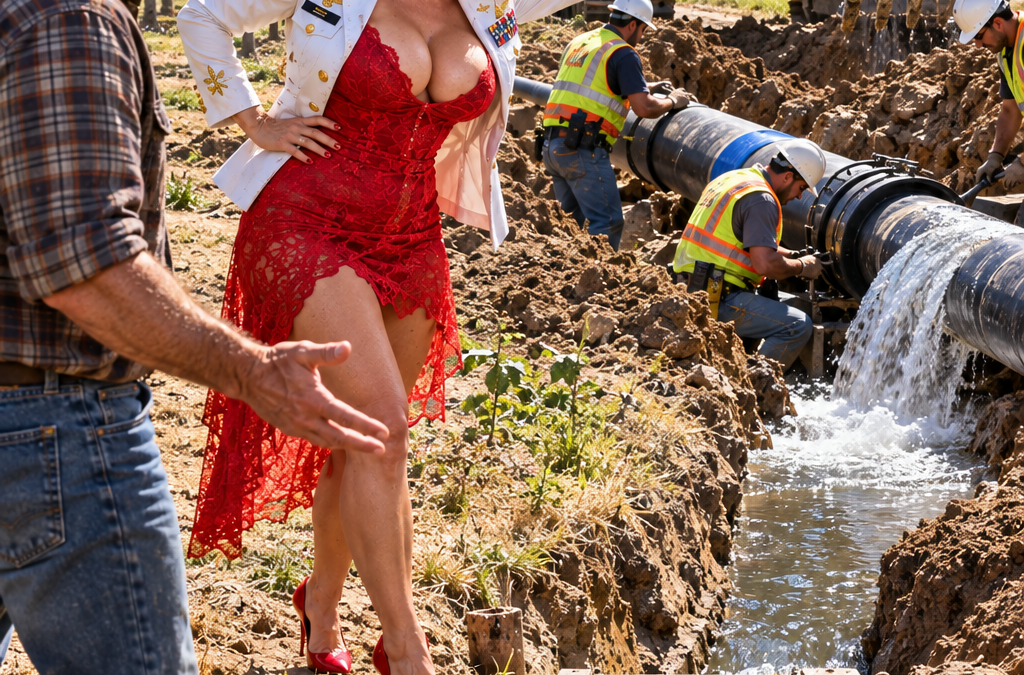
She was wearing her usual red lace dress beneath a lightweight designer jacket.
The dress’s low neckline and fitted shape made her look more prepared for a cocktail party than a construction site.
She had sunglasses perched on her head and a leather folder tucked beneath one arm.
She saw my truck approaching.
Then she smiled.
Not a surprised smile.
A satisfied one.
As though she’d been expecting me to arrive and wanted me to see what she had accomplished.
I parked beside the work area and stepped out.
“What is going on?”
Karen turned toward me.
“Good morning, Daniel.”
I pointed toward the excavator.
“Why is that machine digging beside my irrigation ditch?”
She glanced toward the workers.
“Because construction has started.”
“Construction of what?”
“The Brookstone Hills Lake Enhancement Project.”
I looked at the pipe.
Then at the exposed bank.
“Are you diverting water from this channel?”
“That’s part of the improvement.”
My pulse quickened.
“Who authorized it?”
She opened her folder.
“The board.”
“The HOA board?”
“Obviously.”
I stared at her.
“Karen, the HOA board doesn’t control this ditch.”
Her smile tightened.
“The board approved the project after extensive planning.”
“Then show me the water authorization.”
She pulled out a glossy project map.
It showed the HOA lake, nearby roads, landscaped areas, and a proposed pipe connection from the irrigation channel.
The map was professionally printed.
Colorful.
Detailed.
And completely irrelevant to the question I had asked.
I studied it for a moment.
Then handed it back.
“That’s a project drawing.”
“It’s the approved design.”
“Approved by whom?”
“The HOA.”
“That’s not the same as authorization to use the water.”
Her eyes narrowed.
“You always have to make everything complicated.”
“You’re trying to change a water system that has served this orchard for three generations.”
“And we’re trying to improve an entire neighborhood.”
“Those are two different things.”
She stepped closer.
“Daniel, the community has invested substantial money in this project. Contractors have been scheduled. Equipment has been delivered. We are not stopping construction because you suddenly decided to object.”
“I objected months ago.”
“You expressed concerns.”
“I told you the project required proper authorization.”
She laughed.
“Your personal opinion doesn’t override the board’s decision.”
I felt anger rise in my chest.
Behind her, the excavator swung another load of soil onto the growing pile.
I could see exactly where the pipe was intended to connect.
If they completed the diversion as shown, a significant portion of the channel’s flow could be redirected toward the HOA lake before reaching the orchard’s distribution points.
“Stop the machine,” I said.
Karen folded her arms.
“No.”
“I’m asking you to stop excavation until the water rights are verified.”
“The contractor has instructions.”
“Then I need to speak to whoever is responsible.”
She raised her chin.
“You’re speaking to me.”
“You’re not an irrigation engineer.”
Her expression turned vicious.
“And you’re not going to intimidate me with your little farmer routine.”
I stared at her.
“Little farmer routine?”
She gestured toward the trees.
“You own an old orchard, Daniel. That doesn’t make you more important than hundreds of homeowners.”
“I never said it did.”
“Then stop acting like the entire valley belongs to you.”
I pointed toward the ditch.
“I’m not claiming the entire valley. I’m asking who gave you the right to divert water.”
She slapped the folder shut.
“The board made the decision. Construction is proceeding.”
A worker looked toward us.
The excavator paused briefly.
Karen turned and raised her voice.
“Keep working!”
The operator hesitated.
Then the bucket moved again.
I stood there listening to metal tear through earth.
My grandfather had helped maintain that bank.
My father had repaired it after storms.
I had reinforced sections of it with my own hands.
Karen had arrived with a construction map and decided none of that mattered.
I wanted to grab the keys from the excavator.
I wanted to stand in front of the machine and force everyone to stop.
But I knew doing something reckless could turn a legitimate dispute into a confrontation that distracted from the real issue.
So I stepped back.
I photographed the excavation.
The pipe.
The equipment.
The work area.
The connection point.
I recorded the construction activity from a safe distance.
Karen watched me with obvious contempt.
“Take all the pictures you want,” she said.
“I intend to.”
“They won’t change anything.”
I looked at her.
“We’ll see.”
She gave me a smug smile.
“That’s the problem with people like you, Daniel. You think history gives you more rights than progress.”
I looked toward the orchard.
“No. I think rights have to be established, not invented.”
Then I returned to my truck.
As I drove away, the excavator started digging again.
The sound followed me halfway across the property.
I barely slept that night.
Every time I closed my eyes, I saw the excavator bucket cutting into the ditch bank.
I kept thinking about the proposed pipe.
Its size.
Its location.
The angle at which it would draw water.
And what might happen if the contractor completed the connection without understanding the irrigation requirements downstream.
I called an agricultural consultant I’d worked with before.
He told me to document everything and avoid interfering with the construction equipment.
I reviewed my records.
Then I checked the irrigation schedule.
The orchard was entering a period when water stress could reduce fruit quality and damage trees already carrying heavy crops.
The timing couldn’t have been worse.
By two in the morning, I was sitting at the kitchen table with a cup of cold coffee and my father’s irrigation notebook open in front of me.
The pages smelled faintly of old paper and leather.
His handwriting filled the margins.
Dates.
Flow observations.
Repairs.
Seasonal notes.
He had recorded everything.
I remembered being fifteen and complaining that keeping those records was a waste of time.
My father had looked at me over his glasses.
“One day, somebody might ask you to prove something that’s always been true. You’ll be glad we wrote it down.”
I had laughed at him.
Now I wasn’t laughing.
The next morning, I walked into the orchard shortly after sunrise.
Something was wrong.
I noticed it before I reached the first row.
The leaves on several peach trees had begun curling inward.
A few branches looked dull and tired.
The soil beneath the drip lines felt drier than it should have.
I knelt beside one tree and pushed my fingers into the ground.
The upper layer was almost powdery.
I walked farther down the row.
The same thing.
Then another row.
Then another.
My stomach tightened.
The trees weren’t dead.
Not even close.
But they were stressed.
And mature fruit trees under heavy crop load could deteriorate quickly when their water supply was interrupted during hot weather.
I hurried toward the irrigation channel.
The water level was dramatically lower.
Where the ditch normally carried a steady, dependable flow, a shallow current now moved along the bottom.
I stared at it.
For several seconds, I simply listened to the thin trickle.
Then I walked upstream.
I knew what I would find.
I just didn’t want to believe it.
The new diversion structure had been installed.
A pipe now connected the channel to the route leading toward the HOA lake.
A valve controlled the diversion.
And the water was moving into that pipe before it reached my orchard.
I could hear it rushing through the new connection.
Meanwhile, the original ditch continued downstream with only a fraction of its usual flow.
I stood beside the channel, my fists clenched.
Karen had done it.
She hadn’t merely threatened to divert the water.
She had changed the system.
And my trees were already showing the consequences.
I pulled out my phone.
I photographed the valve from every accessible angle.
The pipe.
The connection.
The water level upstream.
The reduced flow downstream.
The disturbed soil.
The equipment tracks.
I recorded the sound of water moving through the diversion.
Then I photographed the irrigation points serving the orchard.
I didn’t touch the valve.
I didn’t remove the pipe.
I didn’t attempt to reverse the work myself.
I wanted to.
God, I wanted to.
But if I interfered with the setup before an independent official inspected it, Karen could claim I had caused the problem.
And I knew she’d do exactly that.
I returned to the farmhouse and opened the old record cabinet.
Inside were folders dating back decades.
Original survey information.
Irrigation correspondence.
Maintenance records.
Historic photographs.
Water-use documentation.
My grandfather’s notes.
My father’s annual irrigation logs.
I placed them on the kitchen table.
The ditch had been serving the orchard long before Brookstone Hills existed.
The records showed the established agricultural use and the infrastructure associated with it.
They did not mention any HOA lake connection.
Of course they didn’t.
The lake hadn’t existed when most of the records were created.
I found an old photograph from the 1950s.
My grandfather stood beside the channel with a shovel resting against his shoulder.
Behind him were young fruit trees, barely taller than a grown man.
Some of those trees were still producing fruit.
I looked at the photograph for a long time.
Then I looked out the kitchen window toward the orchard.
My grandfather had built something intended to outlast him.
My father had preserved it.
And I was watching the water disappear because a woman who wanted a prettier lake had decided she didn’t need permission.
By midmorning, I was back beside the diversion.
The contractor had returned with two workers.
They were checking the pipe connection and preparing to finish the surrounding earthwork.
Karen arrived shortly afterward.
Her white SUV stopped near the ditch.
She stepped out in the same red lace dress, this time wearing oversized sunglasses and carrying a large leather handbag.
She looked at the work area with visible satisfaction.
“Beautiful,” she said.
I walked toward her.
“Karen, the orchard isn’t receiving enough water.”
She looked annoyed.
“Good morning to you too.”
“The ditch level is down dramatically.”
“That’s called managing resources.”
“No. That’s called diverting water.”
She gave a careless shrug.
“The work is almost finished.”
I stared at her.
“Several rows of trees are already showing stress.”
“Trees are resilient.”
“Not without water.”
She smiled.
“Then perhaps you should invest in a modern irrigation system.”
I felt my jaw tighten.
“This is an irrigation system.”
“An outdated one.”
I pointed toward the channel.
“It worked until you changed it.”
Her expression hardened.
“Don’t blame the HOA because you’ve failed to modernize your farm.”
I stepped closer.
“Show me the authorization.”
She rolled her eyes.
“We’ve already had this conversation.”
“No. You’ve shown me a construction map.”
“Which was approved.”
“By the HOA board.”
“Correct.”
“Not by whoever has authority over the water rights.”
She crossed her arms.
“The HOA attorney reviewed the project.”
“Then show me the document.”
She looked away.
“The paperwork has been handled.”
I turned toward the contractor.
He was standing beside a utility truck, reviewing a clipboard.
“Excuse me.”
He looked up.
“Yes, sir?”
“Are you the contractor responsible for this diversion?”
He glanced toward Karen.
“Yes. My crew is installing the pipe connection.”
“Who authorized you to change the ditch?”
He hesitated.
Then pointed toward Karen.
“The HOA issued the work order.”
Karen stepped forward immediately.
“Everything was approved through the proper channels.”
I kept my attention on the contractor.
“Have you personally seen a recorded water-right authorization for this diversion?”
He looked confused.
“A what?”
“Any document establishing permission to redirect this water.”
He shifted his weight.
“I’ve seen the project drawings.”
“Anything else?”
“The work order.”
“Any easement document?”
He shook his head slowly.
“Not that I recall.”
“Any approval from the appropriate water authority?”
He glanced at Karen again.
“Ma’am?”
Karen’s face tightened.
“The HOA handled all the necessary paperwork.”
I looked back at the contractor.
“Did anyone show you permission to change the existing irrigation flow?”
He swallowed.
Then shook his head.
“No, sir. I was told the approvals were in place.”
Karen spun toward him.
“Don’t make it sound like you did something wrong.”
The contractor looked uncomfortable.
“I’m just answering his question.”
“Then answer it correctly.”
He lowered his clipboard.
“Mrs. Karen, I received a construction work order. That’s what I’m saying.”
She stepped closer.
“And the work order came from the HOA, correct?”
“Yes.”
“Then that’s all you need to know.”
I watched the exchange with growing disbelief.
Karen wasn’t merely refusing to show documentation.
She was trying to intimidate the person she’d hired into pretending he’d seen paperwork he hadn’t seen.
The contractor looked back toward the pipe.
I could tell he was beginning to understand the situation was more serious than he’d been told.
I turned toward Karen.
“The workers aren’t responsible for inventing your authority.”
Her eyes flashed.
“Don’t you dare accuse me of lying.”
“Then show the records.”
“I don’t answer to you.”
“You’ve redirected water away from my orchard.”
“For the benefit of the community!”
“My orchard needs that water.”
“And our lake needs additional water.”
The words came out so casually that for a second I couldn’t respond.
I stared at her.
“Our lake?”
“Yes.”
“You mean the decorative lake outside your clubhouse?”
She lifted her chin.
“The lake contributes to property values, recreation, and the overall quality of life for hundreds of residents.”
I pointed toward my trees.
“Those are living crops.”
“And this is a community investment.”
I felt my voice rising.
“You don’t get to sacrifice my harvest because your residents don’t like looking at mud!”
Karen’s expression turned cold.
“Lower your voice.”
“No.”
She blinked.
I rarely raised my voice.
I avoided arguments whenever possible.
But something about the way she dismissed my orchard made the anger impossible to contain.
“Those trees have been growing here for decades,” I said. “Some of them were planted by my father. I have workers depending on this harvest. I have customers waiting for fruit. I have bills that don’t disappear because your HOA wants a nicer view.”
Karen looked unmoved.
“Everyone has financial responsibilities.”
“Then why should I pay for yours?”
She folded her arms.
“The project benefits the entire community.”
I shook my head.
“Community benefit doesn’t answer who authorized it.”
Her face reddened.
“You keep repeating yourself.”
“Because you keep refusing to answer.”
For a moment, she looked ready to explode.
Then she gave me a hard, deliberate smile.
“Daniel, you need to understand something.”
I said nothing.
“The HOA has substantial resources. We have attorneys, contractors, and hundreds of homeowners supporting this project.”
“That doesn’t create a water right.”
She stepped closer.
“If you interfere with construction, we’ll take appropriate action.”
“Are you threatening me?”
“I’m explaining the consequences of obstruction.”
I looked at the contractor.
He was staring at the ground.
Karen continued.
“The board is already concerned about your hostile behavior. We could seek damages if you delay the project.”
I felt my stomach tighten.
The threat wasn’t surprising.
But the situation was becoming worse with every hour.
My trees needed water.
The diversion was operating.
The contractor was still working.
And Karen was using the HOA’s legal budget as a weapon to discourage me from intervening.
I took a breath.
“Karen, I’m giving you one more opportunity to pause this project voluntarily while the authorization is verified.”
She laughed.
“You’re not giving me anything.”
“Then I’m contacting the county water office.”
Her smile disappeared.
“Go ahead.”
I held her gaze.
“I intend to.”
She leaned toward me.
“You’re going to look very foolish when they discover the board has already handled everything.”
I looked at the shallow ditch.
“Then you should have no problem showing them the paperwork.”
I walked away.
Behind me, Karen shouted at the contractor to finish the work.
That afternoon, I contacted an agricultural irrigation specialist.
I explained the reduced flow, the new connection, and the visible stress in the orchard.
He told me that the situation required immediate attention.
The longer the trees remained under-watered during hot weather, the greater the risk of crop loss and longer-term injury.
He also warned me not to assume that simply closing a valve would resolve everything safely.
The altered system needed to be evaluated.
I understood.
What frightened me wasn’t just losing the current harvest.
It was the possibility of damaging mature trees that could take years to replace.
Fruit trees aren’t disposable.
You don’t plant a replacement on Monday and harvest a full crop on Friday.
They require time.
Care.
Pruning.
Irrigation.
Protection from disease and weather.
Some of my best trees had been producing for decades.
They weren’t just inventory.
They were part of the property’s history.
That evening, I walked the orchard with a notebook.
I marked the affected rows.
Checked the soil.
Photographed the leaves.
Compared the stressed sections with areas still receiving more moisture.
The difference was becoming obvious.
A few trees had drooping branches.
Several leaves were curling at the edges.
Fruit that should have been firm and swelling looked dull.
I knelt beside one of the older apple trees.
My father had planted it the year I graduated from high school.
I remembered standing beside him with a shovel while he adjusted the young trunk.
“Give it time,” he’d told me. “A good tree rewards patience.”
I placed my hand against the bark.
The tree was still alive.
Still strong enough to recover if the water returned soon.
But I couldn’t ignore what might happen if Karen’s diversion remained in place.
I felt helpless.
That was the worst part.
I knew what the trees needed.
I knew where the water was going.
And I was being forced to watch the problem worsen while the woman responsible threatened legal action if I interfered.
That night, I barely ate.
I sat at the kitchen table surrounded by photographs and documents.
I reviewed the original irrigation records again.
My father had kept annual entries for years.
Some were nothing more than numbers.
Others contained notes about droughts, repairs, and difficult seasons.
One entry described a summer when a broken headgate reduced flow for several days.
My father had written:
Water restored before permanent tree damage. Never delay when flow drops unexpectedly.
I stared at that sentence.
It felt like a warning sent forward through time.
I couldn’t wait for Karen to become reasonable.
I needed someone independent to inspect the system.
By the third morning, the orchard looked worse.
I noticed the change immediately.
The peach trees closest to the affected irrigation line were visibly wilting.
Leaves hung at unnatural angles.
The soil had dried farther beneath the surface.
I checked several root zones.
The moisture was lower than I’d ever expected to see under normal irrigation conditions.
I walked from row to row, trying to stay calm.
Every tree I examined made the situation feel more urgent.
The sun was rising.
The forecast called for another hot afternoon.
And the ditch was still carrying far less water than it should.
I stood beneath an old pear tree and looked toward the eastern boundary.
Beyond the orchard, I could see the construction equipment near the diversion.
Farther away lay the HOA’s decorative lake.
Karen was sending water toward an amenity while my crop struggled to survive.
I took out my phone and called the county water office.
A woman answered.
I explained that contractors working for a neighboring HOA had installed a diversion from an established irrigation channel.
I told her the orchard’s water flow had dropped sharply and that the trees were showing visible stress.
Her tone changed.
“Have you documented the installation?”
“Yes.”
“Do you have photographs of the original channel and the diversion?”
“Yes.”
“Historical irrigation records?”
“Decades of them.”
She asked several more questions.
Where was the diversion located?
When had construction begun?
Had the HOA provided authorization documents?
Had the channel been modified?
Had I touched the valve?
I answered carefully.
When I explained that the HOA president had shown me a project map but no recorded water authorization, the woman became quiet.
Then she said, “Mr. Mercer, preserve everything you’ve documented.”
“I have.”
“Do not alter the diversion equipment before an inspector can examine it unless directed by the appropriate authority.”
“I understand.”
“We’ll arrange for someone to inspect the site.”
I looked toward the orchard.
“How soon?”
She hesitated.
“Given the circumstances you’ve described, we’re treating this as urgent.”
I thanked her.
Then I sat on the tailgate of my pickup and stared at the ditch.
For the first time since discovering the diversion, I felt a small measure of hope.
Not relief.
Not yet.
The water was still being redirected.
My trees were still stressed.
But someone outside Karen’s circle of influence was finally going to look at the facts.
I spent the rest of the morning preparing.
I organized the photographs by date.
I copied the irrigation records.
I located the historic surveys and correspondence.
I marked the sections of orchard showing the most severe stress.
I wrote down every conversation I’d had with Karen.
I included the dates when she first proposed the project, the morning construction began, and the moment I discovered the reduced flow.
I didn’t exaggerate anything.
I didn’t need to.
The physical evidence was strong enough.
By early afternoon, a county vehicle pulled into the orchard.
A man in his late fifties climbed out carrying a clipboard, a measuring case, and a camera.
He introduced himself as Inspector Raymond Cole.
He had short gray hair, a sun-weathered face, and the calm manner of someone accustomed to dealing with both complicated equipment and angry property owners.
“Mr. Mercer?”
“That’s me.”
“I’m here about the reported diversion.”
I felt an enormous sense of relief simply hearing those words.
“Thank you for coming.”
He looked toward the orchard.
“Let’s start with the affected area.”
I led him through the first rows.
He examined the leaves.
Checked the soil.
Looked at the irrigation outlets.
Then he asked about the normal schedule.
I showed him the records.
He listened without interrupting.
When I pointed out the difference between the healthy and stressed sections, he took photographs.
“How long has the reduced flow been occurring?” he asked.
“Since the new diversion began operating. I noticed the drop yesterday morning.”
“And construction started the day before?”
“Yes.”
“Any other known problems upstream?”
“Not that I’ve observed.”
He made a note.
Then he looked toward the ditch.
“Let’s inspect the diversion.”
We drove to the eastern boundary.
As we approached, I saw Karen’s white SUV parked near the contractor’s equipment.
My stomach tightened.
She was already there.
Apparently, someone had told her the county was coming.
She stood beside the new pipe connection, wearing her red lace dress and sunglasses, talking to the contractor.
The moment she saw the county vehicle, she straightened.
Then she smiled.
A broad, theatrical smile.
The same one she used at HOA meetings when she wanted everyone to believe she was in complete control.
Inspector Cole stepped out.
Karen immediately approached.
“Inspector! I’m so glad you’re here.”
He nodded politely.
“Ma’am.”
“I’m Karen, president of Brookstone Hills Homeowners Association. I understand Daniel has raised some concerns about our lake improvement project.”
I stared at her.
Concerns.
Three days of reduced irrigation and visibly wilting trees had become concerns.
Cole looked toward the diversion.
“I’m here to inspect the water-system modification.”
Karen smiled.
“Excellent. You’ll see that everything has been professionally planned.”
He opened his clipboard.
“Who authorized the diversion?”
Her smile widened.
“The HOA board.”
Cole looked at her.
“I’m asking about the authorization to alter the water flow.”
She opened her leather folder.
“We have the approved project drawings.”
She handed him the familiar glossy map.
I watched carefully.
Cole examined it.
He didn’t look impressed.
He studied the route of the proposed pipe, the lake, and the connection to the existing ditch.
Then he looked up.
“Does this packet include the recorded water authorization or easement supporting the diversion?”
Karen blinked.
“The board approved the project.”
Cole nodded.
“I understand that. I’m asking about the underlying authorization.”
She tapped the drawing.
“Right there. It’s an approved project.”
“Approved by the HOA?”
“Yes.”
Cole looked at her steadily.
“That establishes the board’s decision to pursue construction. It doesn’t, by itself, establish the right to divert water from this channel.”
Karen’s smile tightened.
“Our attorney reviewed everything.”
“Do you have the relevant authorization document?”
She shifted her weight.
“Not with me.”
I looked at her.
For months, she’d insisted the paperwork was handled.
Now a county inspector was standing in front of her asking to see it.
And suddenly she didn’t have it.
Cole made another note.
“Who actually authorized the change in water flow?”
Karen folded her arms.
“The HOA attorney advised the board that the project was permitted.”
“Was that advice based on a specific recorded right, permit, or easement?”
She hesitated.
“I’m not an attorney.”
“Then I’ll need the documentation your attorney relied upon.”
Her cheeks flushed.
“Inspector, our neighborhood has invested a considerable amount of money in this project.”
Cole remained calm.
“I understand.”
“We have hundreds of residents depending on this improvement.”
“I understand.”
“And our decorative lake has been losing water during the summer.”
He nodded.
“That still doesn’t answer the authorization question.”
Karen stared at him.
For the first time since I’d met her, she looked genuinely offended that someone wasn’t allowing her to change the subject.
She lowered her sunglasses.
“Do you understand who I am?”
Cole looked at his clipboard.
“You told me you’re the HOA president.”
“I represent a major residential development.”
“Then you should be able to provide the records supporting a project of this scale.”
Her lips parted.
I looked away to hide my reaction.
Karen wasn’t accustomed to people speaking to her that directly.
Cole turned toward the contractor.
“Are you responsible for installing this connection?”
“Yes, sir.”
“What documentation were you given?”
The contractor handed him the construction work order and plans.
Cole examined them.
“Did you receive a water-right authorization?”
The contractor shook his head.
“No, sir.”
“An easement permitting the alteration?”
“Not that I saw.”
“Any written direction from the relevant water authority?”
“No, sir.”
Karen stepped forward.
“The contractor isn’t responsible for the legal paperwork.”
Cole looked at her.
“I haven’t said he is.”
“Then stop interrogating him.”
The inspector’s expression hardened slightly.
“Ma’am, I’m establishing what documents were available when this work was performed.”
She opened her mouth.
Then closed it.
The contractor stood quietly beside his truck.
I could see relief in his face.
For two days, Karen had been pressuring him to keep working.
Now someone with actual regulatory responsibility was asking the questions she had tried to avoid.
Cole moved toward the diversion structure.
He examined the valve.
The pipe.
The connection to the ditch.
The construction around the bank.
Then he took photographs.
He used measuring equipment to document the channel and the modified flow path.
He checked the water moving toward the HOA lake.
Then he walked downstream to the point where the remaining flow continued toward my orchard.
The difference was obvious even before he began taking measurements.
Upstream, the channel carried a substantial current.
At the new connection, a significant portion of that flow was entering the HOA’s pipe.
Downstream, the ditch was markedly lower.
Cole stood beside the reduced flow for several seconds.
Then he looked toward the orchard.
“This is the supply serving your trees?”
“Yes.”
He nodded.
“And this is the normal irrigation route identified in your records?”
“Yes.”
He made another note.
Karen walked over.
“Inspector, you’re making this sound like a crisis.”
Cole looked up.
“I’m documenting the flow conditions.”
“The lake needs water too.”
He remained silent.
She continued.
“Our residents pay substantial assessments to maintain that lake. We’ve spent years improving the property. It isn’t fair that a neighboring agricultural operation gets to monopolize the available water.”
I felt my anger rise.
“Monopolize?”
Karen ignored me.
“The community has a right to benefit from local resources.”
Cole closed his measuring case.
“Beneficial use can be relevant under water law, but it doesn’t automatically establish authorization for a new diversion.”
Karen frowned.
“What does that mean?”
“It means the fact that your project serves a community purpose doesn’t, by itself, give the HOA the right to take water already used under an existing arrangement.”
She folded her arms.
“But we’re using it for the public good.”
“That isn’t the only legal question.”
“Then what is?”
Cole spoke slowly and clearly.
“Water rights depend on the applicable state law, recorded rights, priority, permits, existing uses, and other relevant circumstances. We have to verify those things before determining whether this diversion was properly authorized.”
Karen looked toward me.
“He has an old orchard.”
I stared at her.
She continued.
“Why should his trees matter more than hundreds of families?”
Cole answered before I could.
“The relative importance of your preferred use doesn’t let either of you ignore the governing requirements.”
Karen opened her mouth.
Then stopped.
For once, she didn’t interrupt.
Cole looked down at his notes.
“We have an established irrigation system, a recently constructed diversion, a measurable reduction in downstream flow, and evidence of stress in the orchard.”
He looked toward the contractor.
“We also have no authorization document presented at this inspection supporting the new diversion.”
The contractor nodded grimly.
Karen’s face turned pale beneath her makeup.
Cole continued.
“We need to review the records and determine the appropriate next steps. Until then, no further excavation or changes to this setup are to be made without proper direction.”
Karen stiffened.
“You’re stopping our project?”
“I’m instructing the parties to preserve the existing conditions while the relevant records and rights are reviewed.”
“But we’re almost finished!”
“That doesn’t change the need for authorization.”
She pointed toward the lake.
“Do you realize what delays will cost us?”
Cole looked at her.
“Do you realize what an unauthorized diversion could cost other water users?”
The question landed like a hammer.
Karen stared at him.
Then looked toward the orchard.
For the first time, she seemed to understand that someone was taking the damage to my trees seriously.
She turned toward the contractor.
“Don’t just stand there. We have a schedule.”
The contractor looked at Cole.
Then back at Karen.
“I’m stopping the excavation.”
Her eyes widened.
“You work for the HOA!”
“Yes, ma’am. But the inspector has instructed us not to continue.”
Karen’s face twisted with anger.
“I’ll remember this.”
The contractor lowered his clipboard.
“That’s your decision.”
I almost couldn’t believe what I was seeing.
Karen had spent months ordering people around.
She had threatened me.
Pressured the workers.
Dismissed my irrigation records.
And now the contractor she’d hired was refusing to continue without proper authorization.
Not because I had shouted louder.
Not because I had threatened him.
Because a county inspector had examined the situation and required the work to stop pending review.
Karen turned toward me.
“This is your fault.”
I looked at her.
“My fault?”
“You called the county to sabotage our project.”
“I called because my trees are wilting.”
“You could have discussed it with me.”
I stared at her.
“I have been discussing it with you for months.”
She shook her head.
“You’ve been obstructing it for months.”
I stepped closer.
“Karen, I asked you for written authorization. You showed me a project map. I told you the ditch supplied my orchard. You told me to find another way to water the trees. I asked your contractor who approved the work. He said he’d only seen a construction order. And now the county inspector is asking the same questions.”
Her face flushed.
“You’re enjoying this.”
“No.”
I pointed toward the orchard.
“I’m watching my family’s work suffer because you wanted a fuller lake.”
She looked away.
I took a breath.
“Do you know how long it takes to grow a productive apple tree?”
She said nothing.
“Years. Not days. Not weeks. Years of pruning, watering, fertilizing, and protecting it from frost and disease.”
I looked toward the hills.
“My grandfather helped establish that ditch because he understood something you apparently don’t.”
Karen folded her arms.
“And what’s that?”
“Water isn’t a decoration.”
For a moment, the only sound was the shallow current moving through the disturbed channel.
I continued.
“You look at your lake and see property values. I look at this ditch and see whether my orchard survives the season.”
She opened her mouth.
Then closed it.
I had never seen Karen struggle so hard to find something cruel enough to say.
Finally, she turned toward the inspector.
“I expect a written explanation for this interference.”
Cole nodded.
“You’ll receive the appropriate documentation.”
“And I expect the county to recognize the importance of our community investment.”
“We’ll review the relevant records.”
“And I expect—”
“Ma’am.”
His voice was firmer now.
She stopped.
“We’re not resolving the authorization question by listing expectations.”
The contractor looked down.
I could tell he was trying not to react.
Karen stared at Cole as though she had just discovered a new kind of person.
Someone who wasn’t impressed by her title.
Someone who didn’t care how expensive her dress was.
Someone who wasn’t afraid of her HOA attorneys.
And someone who would not accept a construction map as proof of water rights.
Cole turned back toward the ditch.
“I need one more set of photographs before we leave.”
Karen stepped aside.
The contractor shut down the remaining equipment.
The excavator fell silent.
For the first time in three days, there was no mechanical noise coming from the channel.
Only water.
And the distant rustling of dry leaves in my orchard.
That silence nearly brought me to tears.
I hadn’t realized how much the sound of the excavator had been weighing on me.
Every scrape of its bucket had felt like another piece of my family’s work being torn away.
Now it was still.
The damage hadn’t been repaired.
The water hadn’t returned to normal.
But the project was no longer charging forward simply because Karen demanded it.
Inspector Cole finished his measurements and photographs.
Then he asked to review the orchard’s historical records.
I drove him back to the farmhouse.
Karen followed in her SUV.
Of course she did.
She wasn’t going to allow an official conversation to happen without trying to control it.
Inside my office, I spread the records across the table.
Cole examined the documents carefully.
Some were recent.
Others dated back decades.
He asked about the irrigation history.
I explained how the ditch had supplied the orchard through successive generations.
I showed him the maintenance logs and photographs.
I pointed out the established distribution points.
He asked whether the route had changed substantially over the years.
I explained the improvements my father and I had made, along with the records documenting them.
Karen stood near the doorway, her arms folded.
She looked at the old papers with obvious impatience.
“These documents are ancient,” she said.
Cole didn’t look up.
“Historical use is relevant to what I’m reviewing.”
Karen rolled her eyes.
“History shouldn’t prevent necessary development.”
He continued examining the records.
“Development doesn’t erase existing rights merely because it’s newer.”
I watched Karen’s expression tighten.
She looked toward me.
“You’ve been preparing for this.”
I met her gaze.
“My family has been keeping irrigation records since before you were born.”
She gave a bitter laugh.
“So now you’re going to use your grandfather’s paperwork to block our lake?”
“I’m going to use the records to establish what the system has been doing for decades.”
Cole nodded slightly.
“That’s exactly why documentation matters.”
Karen turned away.
For years, she’d treated recordkeeping as something only the HOA could use against homeowners.
She issued notices.
Collected complaints.
Demanded written approvals.
Now the documents were working against her position.
And she hated it.
The inspection concluded later that afternoon.
Cole explained that the county would review the relevant records and coordinate with the appropriate authorities before determining what modifications were permissible.
He made clear that the existing setup needed to be preserved while the investigation proceeded.
The contractor stopped further excavation.
Karen was told not to make additional changes without proper authorization.
I was instructed to continue documenting the orchard’s condition.
As Cole prepared to leave, I asked the question that had been haunting me.
“What about my trees?”
He looked toward the orchard.
“I understand the urgency.”
“Some are visibly wilting.”
“I’ve documented that.”
“How long will the review take?”
He hesitated.
“I don’t want to promise a timeline I can’t guarantee. But the reduced flow and crop stress are part of the situation we’ll be addressing.”
I nodded.
It wasn’t the immediate restoration I wanted.
But it was the first professional acknowledgment that the damage to my orchard mattered.
He placed a hand on the edge of the table.
“Mr. Mercer, keep monitoring the trees. Preserve your records. And let us know if conditions deteriorate further.”
“I will.”
After he left, I stood in the office doorway and watched the county vehicle drive away.
Karen remained beside her SUV.
She looked furious.
The contractor was already preparing to remove some equipment that wasn’t needed to preserve the installation.
The excavator stood motionless near the ditch.
Karen looked toward it.
Then toward her lake.
Then back at me.
“This could have been avoided.”
I stared at her.
“Yes.”
She seemed surprised by my agreement.
I continued.
“If you’d obtained the proper authorization before digging.”
Her face tightened.
“You’re impossible.”
I shook my head.
“No, Karen. I’m simply not yours to order around.”
She stared at me for several seconds.
Then she climbed into her SUV and drove away.
I watched until her vehicle disappeared.
For the first time since the excavator arrived, I felt I might actually have a chance to save the orchard.
But the water problem wasn’t over.
The diverted flow remained under review.
The trees still needed irrigation.
And I had no guarantee the records would resolve the dispute as quickly as the crop required.
The next several days were exhausting.
I walked the orchard at dawn.
I checked the stressed rows.
I photographed changes in the leaves and fruit.
I spoke with irrigation professionals about ways to reduce immediate stress without interfering with the disputed structure.
I arranged temporary supplemental watering where practical and appropriate.
It was expensive.
Time-consuming.
And nowhere near as efficient as the established irrigation system.
But I wasn’t going to watch the trees suffer without doing everything legally available to protect them.
Every bucket, hose, pump, and hour of labor reminded me how unnecessary the situation was.
The ditch had worked before Karen changed it.
Now I was spending money and time compensating for a problem that hadn’t existed a week earlier.
One morning, I found a cluster of small peaches that had dropped beneath a stressed tree.
They were still hard.
Not ripe.
I picked one up.
The skin was warm from the sun.
For a moment, I simply held it.
Then I placed it in my pocket.
I remembered my father’s voice.
“Never assume water will be there tomorrow.”
I had spent my entire life respecting that lesson.
Karen had never bothered to learn it.
That afternoon, a longtime customer stopped by the orchard.
His name was Samuel, and he’d been buying apples from my family since my father ran the operation.
He noticed the stressed trees immediately.
“What’s happened here?”
I explained the diversion.
He listened quietly.
Then shook his head.
“All that for a lake?”
“That’s what the HOA wanted.”
He looked toward the eastern hills.
“Can’t they just let the lake get low?”
I gave a bitter laugh.
“Apparently not.”
Samuel walked toward one of the apple trees and touched a curled leaf.
“Your dad would be furious.”
I nodded.
“He would.”
He looked at me.
“But he’d be proud you’re fighting for it.”
I didn’t trust myself to answer.
For several seconds, we stood quietly beneath the branches.
Then Samuel said, “Don’t let them make you feel like this is just water.”
I looked at him.
“It’s the whole orchard.”
He nodded.
“Exactly.”
After he left, I walked back to the farmhouse and found another message from the county water office.
They were reviewing the historical records alongside the new diversion documentation.
The orchard’s established irrigation history was confirmed in the materials available to them.
The HOA’s connection, by contrast, was a recent project.
That fact didn’t automatically settle every question under the applicable water law.
But it made the distinction between an established use and a newly proposed diversion impossible to ignore.
The HOA would have to demonstrate the appropriate authority for what it wanted to do.
Karen couldn’t simply point to a lake and declare that it needed water.
She would have to produce actual documentation.
I printed the message.
Then placed it beside my father’s irrigation notebook.
For the first time in days, I felt a small amount of the pressure lift.
The evidence was being taken seriously.
And Karen’s project was no longer moving forward on the strength of her personality.
A few days later, the county arranged a follow-up discussion with the parties involved.
The contractor attended.
So did a representative of the HOA board.
Karen arrived in her white SUV, wearing the same red lace dress and an expression that suggested she’d rather be anywhere else.
I noticed immediately that she was no longer smiling.
The inspector began by reviewing the documented condition of the channel.
He described the original irrigation route.
The new diversion.
The flow reduction.
The observed stress in the orchard.
Then he addressed the records.
“The materials reviewed establish a long history of irrigation use associated with Mr. Mercer’s orchard,” he said.
Karen shifted in her chair.
“The HOA’s diversion was constructed much more recently.”
She raised one hand.
“Our lake has existed for years.”
Cole nodded.
“The lake’s existence and this particular diversion are separate questions.”
Karen frowned.
“What does that mean?”
“It means owning or maintaining a lake does not establish authorization to divert water from a neighboring irrigation system.”
She looked toward the board representative.
He avoided her eyes.
Cole continued.
“We have not been provided documentation sufficient to establish that the HOA was authorized to make the diversion as installed.”
Karen’s face tightened.
“Our attorney said it was allowed.”
“Then the underlying legal basis needs to be produced and verified.”
She folded her arms.
“This is becoming ridiculous.”
The board representative finally spoke.
“Karen, did the attorney actually review the existing irrigation rights?”
She turned toward him.
“Of course.”
“Did we receive a written opinion?”
Her eyes narrowed.
“We discussed it.”
“That’s not what I asked.”
I watched her carefully.
For months, Karen had told everyone that the paperwork was handled.
She had used the attorney’s name like a shield.
Now even someone from her own board was asking whether that shield actually existed.
Karen looked down at the table.
“The board believed the ditch was an unused community resource.”
I stared at her.
For a moment, I thought I’d misheard.
“Unused?”
She looked up.
“Excess water. Water that could be put to a more beneficial purpose.”
I leaned forward.
“Karen, that ditch has been irrigating my orchard every growing season for generations.”
She looked away.
Cole spoke.
“That established use is reflected in the records.”
Karen’s cheeks flushed.
She took a breath.
Then, for the first time, she stopped dressing the project in elaborate language.
“We wanted more water for the lake.”
The room became quiet.
She continued, her voice sharper.
“The shoreline looks terrible when the level drops. Residents complain. Property values are affected. The board wanted a permanent solution.”
I stared at her.
There it was.
The truth.
Not a public emergency.
Not a failing irrigation system.
Not an abandoned water resource.
The HOA wanted a fuller decorative lake.
And Karen had decided that my family’s irrigation ditch was the easiest place to get the water.
She looked toward me.
“You don’t understand the pressure homeowners put on me.”
I held her gaze.
“I understand your lake is important to them.”
“Exactly.”
“But the lake doesn’t give you the right to take my orchard’s water.”
She opened her mouth.
I continued.
“You could have requested a formal review. You could have consulted the water authorities before construction. You could have approached me with actual engineering plans and a legitimate proposal.”
Her expression hardened.
“We did approach you.”
“You told me the board had already decided.”
“Because it had!”
I shook my head.
“That’s the problem, Karen. You decided before you knew whether you had the authority.”
The board representative looked down at his papers.
The contractor sat very still.
Cole continued the meeting.
He explained that any redesign needed to respect the applicable water-right requirements and the established irrigation arrangement.
Professional review would be necessary.
The altered structure couldn’t simply remain in service on the assumption that the HOA’s preferred use took priority.
The board representative asked what a compliant alternative might involve.
Cole refused to speculate without further technical and legal review.
He outlined the need for qualified professionals to assess the system, verify rights, and develop any proposed modification through the proper process.
Karen looked increasingly frustrated.
“You’re telling us we spent money on a project we can’t use?”
Cole answered calmly.
“I’m telling you the project must have the appropriate authorization.”
She stared at him.
Then turned toward the contractor.
“Why didn’t you warn us?”
The contractor looked up slowly.
“You gave us an approved construction work order.”
“You should have checked!”
“Ma’am, I asked whether the necessary approvals were in place.”
Karen’s face reddened.
“And I told you they were.”
He nodded.
“Exactly.”
The room fell silent.
I watched Karen’s eyes move from one person to another.
She was searching for someone to blame.
The contractor.
The inspector.
The board representative.
Me.
Anyone but herself.
But the documents were on the table.
The timeline was clear.
The diversion had been built recently.
The orchard’s irrigation history was established.
And the HOA couldn’t demonstrate the authorization Karen had repeatedly claimed existed.
For the first time, her confidence seemed to collapse under the weight of facts she couldn’t bully into submission.
The meeting ended with a clear path forward.
The diversion would have to be addressed through proper engineering and authorization review.
The orchard’s established irrigation flow had to be protected under the applicable requirements.
And any future HOA lake connection would need legitimate approval rather than a board vote pretending to be one.
As everyone gathered their documents, Karen approached me.
Her voice was low.
“You must be very pleased with yourself.”
I looked at her.
“No.”
She gave a bitter smile.
“You’ve delayed a project that hundreds of residents wanted.”
“I’ve protected an irrigation system my family depends on.”
“You’re selfish.”
I took a breath.
“Karen, you watched my trees wilt and told me to find another way to water them.”
She looked away.
I continued.
“You had three days to show me the authorization. You couldn’t. You had months to study the existing records. You didn’t. And you brought an excavator to the ditch before confirming whether you had the right to change it.”
Her eyes flashed.
“You have no idea what it’s like to be responsible for an entire community.”
I looked at her for a long moment.
“Responsibility isn’t doing whatever you want and demanding everyone else accept the consequences.”
Her lips tightened.
I stepped closer.
“Responsibility is knowing when your decisions might hurt somebody else.”
She said nothing.
I looked toward the orchard.
“Your lake can be redesigned. My trees can’t simply be replaced overnight.”
For once, Karen had no answer.
She turned and walked toward her SUV.
Her red dress caught the sunlight as she crossed the gravel.
She climbed inside and slammed the door.
Then she drove away.
I watched the dust settle behind her vehicle.
I didn’t feel victorious.
Not yet.
My orchard was still stressed.
The irrigation flow wasn’t fully restored.
And several days of uncertainty had already cost me time, money, and sleep.
But I finally knew that Karen’s claim of unlimited authority had failed.
The next phase belonged to engineers, records, and lawful procedures.
Not her temper.
Over the following period, the water system was reviewed and the diversion was redesigned under appropriate professional oversight.
The contractor’s work was reassessed.
The original irrigation route was evaluated.
The changes needed to restore the orchard’s supply were identified and carried out through the authorized process.
The HOA could no longer assume that water flowing past its property was available simply because the board wanted to use it.
Any future arrangement would require a legitimate basis and the necessary approvals.
As the work progressed, I continued monitoring the trees.
I didn’t stop worrying until I saw the ditch carrying a dependable flow again.
The morning it happened, I was walking the eastern boundary shortly after sunrise.
The air was cool.
A faint mist hung above the orchard.
I could hear water before I reached the channel.
Not the weak trickle I’d grown accustomed to during the dispute.
A stronger, steadier sound.
I rounded the bend.
And there it was.
Water moving through the original irrigation route toward my orchard.
I stopped walking.
For several seconds, I simply stared.
The current wasn’t dramatic.
There was no flood.
No roaring torrent.
Just the steady movement of water through a channel that had performed the same job for generations.
But to me, it was one of the most beautiful things I’d seen in years.
I knelt beside the bank.
The soil was damp.
The flow was returning to the distribution points.
I reached down and touched the water with my fingers.
It was cold.
Clear.
Moving exactly where it needed to go.
I thought about my grandfather standing beside this ditch with a shovel.
My father teaching me to check the flow.
The long summers of pruning and harvest.
The years when storms damaged the banks and we repaired them by hand.
All the ordinary work that had kept the orchard alive.
Then I thought about Karen pointing at her project map.
“The board approved it.”
As though those four words could erase everything that came before.
I stayed beside the ditch until the sun rose above the eastern ridge.
Then I walked into the orchard.
The trees wouldn’t recover instantly.
Some fruit had already suffered from the stress.
A few branches would need special attention.
And I knew that the season might not be as productive as I’d hoped.
But the worst danger was passing.
The leaves were no longer deteriorating at the same rate.
The soil moisture was improving.
The trees had a real chance to recover.
For the first time since the excavation began, I allowed myself to imagine a harvest.
Not a perfect one.
Not necessarily the one I’d expected before Karen’s project.
But a harvest.
That evening, I sat on the farmhouse porch with my father’s notebook beside me.
I opened to a blank page.
Then I wrote the date.
Beneath it, I added a simple entry.
Established irrigation flow restored following county review and authorized system modifications.
I looked at the sentence.
It seemed too small to describe what had happened.
There was no mention of the sleepless nights.
No mention of Karen’s threats.
No mention of walking beneath wilting trees and wondering whether I was watching years of work disappear.
But the notebook had never been a diary.
It was a record.
And that was the point.
My father had taught me that records mattered because memories could be questioned.
Paper could survive arguments.
Documents could establish facts long after people forgot who had said what.
I closed the notebook and placed it back in the cabinet.
Several weeks later, the HOA requested a formal meeting.
Not Karen alone.
The association.
The message came through proper channels and asked whether I would be willing to discuss a potential water arrangement for the decorative lake.
I read it carefully.
For a moment, I considered refusing.
After everything Karen had done, the idea of sitting down with the HOA again made my stomach tighten.
But the request was different.
It didn’t claim that the board already had authority.
It didn’t demand access to the ditch.
It didn’t threaten me with attorneys.
It acknowledged that any potential arrangement would need to respect existing irrigation use and comply with the applicable requirements.
That mattered.
I agreed to attend, with the understanding that any proposal would have to be reviewed by qualified professionals and the relevant authorities.
The meeting took place in a conference room at the county administration building.
Several HOA representatives attended.
So did professionals involved in reviewing the water system.
Karen was there.
Of course she was.
She wore the same fitted red lace dress, but something about her behavior had changed.
She wasn’t smiling triumphantly.
She wasn’t interrupting every sentence.
And she wasn’t sitting at the table as though she owned everyone in the room.
When I entered, she looked at me briefly.
Then looked away.
The meeting began with a review of the orchard’s irrigation needs and the documented constraints on any new diversion.
An HOA representative explained that the neighborhood still wanted a more reliable source for maintaining the lake’s appearance.
But he acknowledged that the association couldn’t simply take water from the ditch.
Any legitimate arrangement would require further evaluation.
Potential options would have to be considered within the applicable legal and technical framework.
That might mean finding a different source.
It might mean reducing demand.
It might mean pursuing an authorized arrangement if water was legally and physically available without impairing existing rights.
Nobody promised an outcome.
Nobody pretended the matter was simple.
And nobody put a glossy construction map on the table and declared that the board’s vote settled everything.
For the first time, the HOA was behaving like an organization that understood it had responsibilities beyond satisfying its own residents.
I listened.
Then I spoke.
“I’m willing to discuss legitimate proposals,” I said. “But my orchard’s irrigation supply isn’t negotiable through intimidation.”
The representative nodded.
“Understood.”
“I need any future plan reviewed before construction begins.”
“Agreed.”
“And I want a clear record of who is responsible for the approvals, engineering, and costs.”
“That would be part of the process.”
I looked toward Karen.
She sat with her arms folded.
Her expression was tight.
But she didn’t interrupt.
The representative continued.
“We recognize that the previous approach caused serious problems.”
I nodded slowly.
“Yes. It did.”
He looked down at his notes.
“We want to avoid repeating them.”
I appreciated that.
It wasn’t a grand apology.
It wasn’t a dramatic confession.
But it was the first time anyone representing the HOA had acknowledged the actual problem without trying to blame me for it.
Karen finally spoke.
“The lake remains an important community asset.”
I turned toward her.
“I’m sure it does.”
She looked surprised by my calm response.
I continued.
“But its importance doesn’t eliminate the orchard’s existing needs or the authorization requirements.”
Her lips tightened.
For a moment, I expected another argument.
Instead, she looked down at the table.
No threat.
No insult.
No demand that I recognize her authority.
Just silence.
It was a small moment.
But after months of confrontations, it felt enormous.
The meeting ended without any new diversion being authorized.
That was appropriate.
The HOA could pursue a legitimate arrangement if it wanted one.
But it would have to follow the proper process.
No shortcuts.
No midnight changes.
No excavators arriving before the rights were established.
And no assumption that my family’s irrigation system belonged to the neighborhood because Karen wanted it.
As I walked toward the parking lot, Karen came out behind me.
“Daniel.”
I stopped.
She approached slowly.
For once, she didn’t seem eager to start a fight.
“I hope you understand that I was trying to do something good for Brookstone Hills.”
I looked at her.
“I believe you wanted the lake improved.”
She nodded.
“Exactly.”
“But wanting something good for your neighborhood doesn’t give you permission to harm mine.”
Her face tightened.
I continued.
“You could have asked for a legitimate arrangement.”
“We did ask.”
“No. You announced what you intended to do and treated every question as an insult.”
She looked away.
For a moment, I thought she might apologize.
Instead, she sighed.
“Sometimes leadership requires difficult decisions.”
I almost smiled.
She still couldn’t quite admit she’d been wrong.
“Then make them with the right information next time.”
She looked at me.
I continued.
“And before you send another excavator somewhere, make sure you actually have permission.”
Her eyes narrowed slightly.
But she didn’t argue.
She turned and walked toward her SUV.
I watched her leave.
I didn’t need an apology anymore.
Not from her.
The water was back.
The orchard was recovering.
The records had been reviewed.
The construction had been stopped and corrected through the proper process.
And the HOA finally understood that its president couldn’t create water rights by declaring herself in charge.
That was enough.
By the following harvest, the orchard looked much better.
Not every tree produced as much fruit as it should have.
The stress had affected portions of the crop, and I kept careful records of the losses and recovery work.
But most of the trees were healthy.
The irrigation system was functioning again.
And the rows that had frightened me most during the dispute were gradually returning to normal.
One cool morning, I walked through the apple orchard carrying a wooden picking basket.
The branches were heavy with fruit.
Sunlight filtered through the leaves.
The ground smelled of damp soil and fallen apples.
I stopped beside the tree my father had planted when I finished high school.
Its leaves were healthy.
The fruit was firm.
A few apples hung low enough that I could reach them without a ladder.
I picked one.
Turned it in my hand.
Then took a bite.
It was crisp and sweet.
I stood there chewing, looking toward the irrigation ditch.
Water moved steadily through the channel.
The sound was familiar.
Ordinary.
Comforting.
For months, I’d worried that Karen’s project might become the beginning of the orchard’s decline.
That a decorative lake would receive water while generations of fruit trees slowly failed.
That the HOA’s money and influence would matter more than the records my family had preserved.
But the outcome had been different.
Not because Karen suddenly became reasonable.
Not because the HOA generously decided to leave me alone.
Because someone finally asked the question she’d been avoiding from the beginning.
Who authorized the diversion?
It was a simple question.
But it exposed the difference between a board decision and a lawful right.
Karen had believed that approval from her own association was enough to control water passing through an established irrigation system.
She’d mistaken a project map for permission.
She’d mistaken community preference for legal authority.
And she’d mistaken my patience for weakness.
The county inspection forced the situation back to facts.
Where did the water come from?
Where had it historically gone?
What rights and agreements governed its use?
Who authorized the new diversion?
What happened to the downstream flow?
And what had the change done to the orchard?
Those questions mattered more than Karen’s title.
More than the money the HOA had already spent.
More than the complaints about an unattractive lake.
The answers didn’t erase the stress the trees had suffered.
They didn’t refund the sleepless nights.
And they didn’t make Karen’s behavior acceptable.
But they stopped her project from continuing on the strength of intimidation alone.
That was something.
Later that afternoon, I walked back to the farmhouse and opened the old wooden record cabinet.
I placed the latest irrigation documents beside my father’s notebooks.
The folder was thicker now.
It contained the photographs of the excavation.
The reduced flow.
The damaged leaves.
The inspector’s visit.
The records review.
And the documentation of the authorized corrections that restored the irrigation route.
I looked at the old papers and thought about how close I’d come to losing something that had always seemed permanent.
My grandfather had worked to establish that water supply.
My father had protected it.
I had nearly watched it disappear because someone from a neighboring HOA decided that her decorative lake deserved priority.
I closed the cabinet.
Then I walked outside.
The evening sun was settling behind the mountains.
Rows of apple trees stretched across the hillside.
The ditch carried water toward the orchard just as it had for generations.
Far beyond the eastern boundary, the roofs of Brookstone Hills caught the last orange light.
Somewhere inside that development was a decorative lake Karen had once believed mattered more than my family’s livelihood.
Perhaps the HOA would eventually find a lawful way to maintain it at the level residents wanted.
Perhaps it would have to accept seasonal changes.
That was for the association and the proper authorities to determine.
But one thing had finally become clear.
The orchard’s irrigation water was not Karen’s to reallocate.
No matter how loudly she argued.
No matter how expensive her lawyers were.
And no matter how many times she insisted that the board had already voted.
I thought back to the morning I first found her beside the excavator.
She had smiled at me and told me my trees would have to survive with less.
She’d believed the machinery, the contractors, and the authority of her HOA title would be enough to force me aside.
Then a county inspector arrived.
He looked at the ditch.
Measured the flow.
Examined the documents.
And asked the question Karen couldn’t answer.
That was when the balance of power changed.
Not with shouting.
Not with threats.
Not with a dramatic courtroom scene.
With a simple demand for proof.
I walked toward the old apple tree near the center of the orchard.
Its branches swayed gently in the evening breeze.
I rested one hand against the trunk.
The bark was rough beneath my palm.
The tree had survived droughts, storms, frosts, pests, and decades of difficult seasons.
It had nearly suffered because a woman in a red lace dress wanted a bigger lake.
But it was still standing.
And so was the orchard.
I looked toward the irrigation channel one last time.
The water kept moving.
Steady.
Dependable.
Following the route my family had worked for generations to maintain.
I smiled.
Then I picked up my basket and continued down the row.
There was fruit to harvest.
And this time, nobody was going to tell me that my family’s water belonged somewhere else simply because the HOA wanted it.








