𝗙𝗨𝗟𝗟 𝗦𝗧𝗢𝗥𝗬 The HOA President Sent a Tow Truck for My RV at 6 A.M. and Threatened to Take My House If I Fought Back
𝗙𝗨𝗟𝗟 𝗦𝗧𝗢𝗥𝗬
And by the end of the evening, we were talking like we’d known each other for years.
Marcus knew everybody in the neighborhood.
More importantly, he knew the HOA.
The first time he mentioned Karen Voss, he didn’t call him by name.
He called him “the emperor.”
I laughed.
“What emperor?”
Marcus pointed toward the far end of the street.
“Our HOA president.”
I shrugged.
“That bad?”
He looked at me.
“Give him time.”
At first, I thought Marcus was exaggerating.
Then the notes started.
The first one appeared on my mailbox.
A yellow sticky note informed me that the mailbox was angled several degrees away from the approved street alignment.
There was no signature.
Just a typed HOA logo and an instruction to correct the issue.
I stood in the driveway looking at it.
Then I looked at the mailbox.
It seemed perfectly straight.
I adjusted it anyway.
Two weeks later, I received a formal warning because my grass was supposedly half an inch above the neighborhood’s preferred height.
The notice included a photograph taken from the street and a fifty-dollar compliance assessment.
I paid it.
Not because I agreed.
Because I didn’t feel like wasting a Saturday arguing over grass.
Then came another fifty-dollar fine for a decorative planter near my front steps.
Apparently, the planter’s color hadn’t been approved.
I paid that one too.
When I told Marcus, he shook his head.
“You’re training him.”
I laughed.
“Training who?”
“Karen.”
“He’s harmless. Just bored.”
Marcus looked at me for a long moment.
“That’s what everybody thinks at first.”
I should have listened.
Karen was nothing like the harmless neighborhood volunteer I’d imagined.
He was a wealthy-looking, meticulously groomed man who treated the homeowners association as if it were a private corporation and he were its unquestioned chief executive.
He always arrived at meetings in expensive suits.
His hair was perfectly styled.
His shoes reflected the overhead lights.
Even his folders looked more expensive than the office supplies most people bought for an entire year.
But it was his behavior that made people uncomfortable.
He didn’t ask neighbors to correct violations.
He ordered them.
He didn’t describe HOA policies as agreements among homeowners.
He described them as his standards.
His community.
His enforcement procedures.
And when someone disagreed, he became coldly personal.
He had a habit of leaning forward, lowering his voice, and speaking as though the other person were a disobedient employee.
I first experienced that side of him at a neighborhood meeting.
He was discussing exterior maintenance when a retired couple asked why the association had increased certain fees.
Karen smiled.
Then he said, “If you find the responsibilities of community living too demanding, perhaps a neighborhood with fewer standards would suit you better.”
The room went silent.
I remember thinking the response was unnecessarily cruel.
But nobody challenged him.
Not even the other board members.
That should have told me something.
Karen wasn’t merely strict.
He had learned that people would tolerate small humiliations because resisting him seemed more exhausting than paying.
Then he discovered my RV.
The first notice arrived on a Monday morning.
It was stapled to my front door.
The paper stated that recreational vehicles were prohibited on all residential lots under Section 4.2 of the Willow Creek Estates governing regulations.
I stood in my kitchen reading the notice.
Then I read it again.
That couldn’t be right.
I’d checked the rule before buying the house.
I went directly to my office and opened the folder containing the 2015 HOA documents.
There it was.
Section 4.2.
Recreational vehicles could be stored in a side yard if concealed behind approved screening.
No blanket prohibition.
No seven-day limit.
No special exception required.
The language was clear.
My RV was behind a privacy fence that satisfied the published requirements.
I walked outside and looked at it.
The motorhome hadn’t moved.
The fence hadn’t changed.
Nothing about my property was different from the day I’d bought the house.
Only Karen’s interpretation had changed.
I called the HOA office.
A woman answered.
I explained the notice.
She sounded uncomfortable.
“Mr. Ethan, the president has updated the compliance standards.”
“Updated when?”
“Recently.”
“Was there a vote?”
She hesitated.
“You’d have to ask Mr. Voss.”
“Can you send me the amendment?”
“I’ll see what we have.”
Nothing arrived.
Two days later, another warning appeared.
This one gave me seven days to remove the RV.
I decided to attend the next HOA meeting.
I printed the relevant pages from the 2015 documents.
Highlighted Section 4.2.
And placed them in a folder.
I wasn’t angry yet.
I was irritated.
But I still believed a reasonable conversation could solve the problem.
The meeting was held in the community clubhouse.
About thirty residents attended.
Karen sat at the front beneath a framed photograph of Willow Creek’s entrance.
He wore a dark navy suit and a pale blue tie.
Beside him were the treasurer, board secretary, and two committee members.
He began the meeting with a long speech about protecting property values.
Then he moved into enforcement issues.
When homeowners were allowed to speak, I raised my hand.
Karen looked at me.
“Yes, Ethan?”
“I received an RV violation notice.”
His expression changed immediately.
A small, knowing smile appeared.
“I’m aware.”
“I believe the notice is incorrect.”
Several people shifted in their seats.
Karen folded his hands.
“On what basis?”
I held up the original documents.
“Section 4.2 permits RV storage behind approved screening. Mine is parked in the side yard behind a six-foot privacy fence.”
Karen leaned back.
“Those provisions have been updated.”
“Can you show me the amendment?”
His smile tightened.
“The board has already addressed this matter.”
“When?”
“During our compliance revisions.”
“Was there a membership vote?”
Karen looked toward the secretary.
Then back at me.
“The president is authorized to implement operational standards.”
I frowned.
“Operational standards aren’t the same thing as changing recorded property restrictions.”
The room became quiet.
Karen’s expression hardened.
“Are you an attorney, Ethan?”
“No.”
“Then perhaps you should avoid interpreting legal documents in public.”
I felt heat rise into my face.
“I’m reading the section that was provided when I bought my house.”
“And I’m explaining that the association has updated its requirements.”
“Then please provide the update.”
Karen closed the folder in front of him.
“This discussion is becoming repetitive.”
I stared at him.
“I’ve asked one question.”
His voice became colder.
“And you’ve received your answer.”
Several residents looked down.
Marcus, seated near the back, folded his arms.
I could feel the entire room waiting to see whether I’d push harder.
I wanted to.
But I also knew that losing my temper would give Karen exactly what he wanted.
So I nodded.
“Then I’ll submit a formal records request.”
His smile returned.
“You’re welcome to follow the proper procedures.”
I sat down.
The meeting continued.
But I barely heard the rest.
I kept thinking about the way Karen had avoided the question.
He hadn’t said when the rule changed.
He hadn’t identified a vote.
He hadn’t produced a signed amendment.
He had simply insisted that his authority was sufficient.
After the meeting, three residents approached me near the clubhouse entrance.
One was an older woman named Helen.
She spoke quietly.
“Be careful.”
I frowned.
“About what?”
“Karen doesn’t like people questioning his paperwork.”
Another resident glanced toward the building.
“He’s been changing things without proper approval.”
I stared at them.
“What things?”
“Rules. Procedures. Fines.”
Helen lowered her voice.
“Last year, several pages in the compliance handbook were replaced. Nobody remembers voting on the changes.”
Marcus joined us.
“I told you.”
I looked at him.
He wasn’t smiling.
The third resident said something that made my stomach tighten.
“Karen’s been acting like he can rewrite the entire association by himself.”
I looked toward the clubhouse windows.
Karen was still inside, speaking to board members.
His face was calm.
Confident.
Perfectly composed.
And suddenly, the situation looked different.
I wasn’t dealing with a legitimate rule I’d overlooked.
I might be dealing with a rule Karen had invented.
That night, I spread every HOA document I owned across my dining table.
I compared the original handbook with the violation notice.
The wording wasn’t merely different.
It contradicted the recorded restriction.
The version I had received when buying the house permitted RV storage behind screening.
Karen’s notice claimed a complete prohibition.
I searched for amendments in my closing documents.
Nothing.
I checked the HOA portal.
There was a newer policy document, but no vote tally, recorded amendment, or evidence that the required approval procedure had been followed.
I sat back.
For the first time, I felt genuinely uneasy.
A man who controlled the HOA’s paperwork was using that paperwork to threaten my property.
And nobody seemed willing to challenge him.
I opened a new folder on my computer.
I labeled it WILLOW CREEK HOA.
Then I began saving everything.
Photographs of notices.
Copies of emails.
Dates of conversations.
Screenshots from the HOA portal.
Receipts for fines.
Meeting agendas.
I even photographed the RV behind the fence from several angles.
If Karen wanted a paper trail, I would give him one.
The following week, the first serious fine arrived.
Two hundred dollars.
The notice said I had failed to correct a continuing RV violation.
I disputed it immediately.
Karen responded with a short email.
“Continued noncompliance will result in escalating enforcement.”
No explanation.
No amendment.
Just another threat.
A week later, the fine increased to five hundred dollars.
Then came a letter demanding removal within ten days.
The final paragraph made me sit down.
It warned that unpaid assessments could lead to collection proceedings and a lien against my property.
I read those words several times.
A lien.
Against my mortgage-free home.
Because of an RV parked where the original governing documents allowed it.
I’d spent years saving so I could own a house without debt.
That home represented every overtime shift, every canceled vacation, and every time I’d chosen to save money instead of spending it.
Now Karen was threatening its title over a restriction he couldn’t prove had been validly adopted.
I felt sick.
It wasn’t the five hundred dollars.
I could afford that.
It was the possibility that a man with access to HOA records could create a financial claim against the house simply because he disliked me.
I called Marcus.
He answered immediately.
“What’s wrong?”
“Karen’s threatening a lien.”
There was silence.
Then Marcus said, “Over the RV?”
“Yes.”
“That son of a—”
He stopped.
I heard him take a breath.
“Don’t pay anything else.”
“I haven’t.”
“Get a lawyer.”
“I think I have to.”
“You absolutely do.”
The next morning, I contacted a property attorney in Charlotte.
Her name was Priya Shah.
She was a sharp, no-nonsense woman in her late thirties who specialized in real estate disputes, homeowners associations, and civil litigation.
Her office was on the second floor of a modest commercial building.
No marble lobby.
No dramatic artwork.
Just organized files, legal books, and the kind of quiet atmosphere that made me feel somebody there actually did the work.
I placed my documents on her conference table.
She read them carefully.
The original 2015 declaration.
The RV restrictions.
Karen’s violation notices.
The escalating fines.
The threatened lien.
The emails.
The meeting notes.
After nearly twenty minutes, she looked up.
“Where’s the signed amendment?”
I shook my head.
“That’s what I’ve been asking.”
“Do you have evidence it was approved by the required membership vote?”
“No.”
“Any recorded amendment changing the original restriction?”
“Nothing I’ve found.”
She leaned back.
Then she let out a low whistle.
“Ethan, this isn’t ordinary enforcement if he’s knowingly using a fabricated amendment.”
I swallowed.
“What is it?”
“Potentially a paper trail of fraud. At minimum, it’s a serious question about unauthorized amendments and improper assessments.”
I looked down at the folder.
“Can he put a lien on my house?”
“An HOA may have collection rights under valid governing documents and applicable law. That doesn’t mean every fine or assessment is enforceable.”
She leaned forward.
“We need to stop this before he tries to convert a disputed violation into a property claim.”
I nodded.
“What do we do?”
“First, formal records demands. I want the original signed amendment, board and membership minutes, voting records, and the association’s enforcement authority.”
“And if they don’t exist?”
Her expression hardened.
“Then we make sure the court understands that.”
Over the next several days, Priya prepared a formal records request.
It was far more detailed than anything I’d written.
She demanded the original amendment supposedly prohibiting RV storage, evidence of the required approval, the association’s relevant financial and enforcement records, and the documents supporting the threatened lien.
The request went to the HOA’s registered address and its legal representative.
Karen responded within twenty-four hours.
Not with the records.
With another violation notice.
This one accused me of refusing to cooperate with community governance.
The message was unmistakable.
Every time I challenged him, he would increase the pressure.
Priya wasn’t impressed.
“He’s creating more evidence,” she said.
I looked at her.
“That doesn’t make me feel much better.”
“It isn’t supposed to. We’re going to use it.”
The following afternoon, Karen appeared beside my privacy fence.
I was changing the oil in my lawn mower when I heard a camera shutter.
I looked up.
Karen stood near the side yard wearing a light gray suit and holding a clipboard.
He was photographing the RV through the narrow gap beside the gate.
“What are you doing?”
He didn’t lower the camera.
“Documenting continuing violations.”
I stood.
“From my side yard?”
“I’m on the common sidewalk.”
“You’re aiming your camera through my privacy fence.”
He gave me a thin smile.
“Evidence collection is part of enforcement.”
I wiped my hands on a rag.
“Your attorney received Priya’s records request.”
“I’m aware.”
“Then where’s the amendment?”
His smile faded.
“Your legal representative will receive the appropriate response.”
“Good. Because I’m still waiting to see the rule I supposedly broke.”
He lowered the phone.
“Ethan, I’m going to give you one last opportunity to resolve this without further action.”
I looked at him.
“By doing what?”
“Remove the RV.”
“No.”
His jaw tightened.
“You have until Friday.”
I frowned.
“Friday?”
“Yes.”
“And then?”
He tucked the phone into his jacket.
“I’m authorizing removal.”
I stared at him.
“Removal of what?”
“The recreational vehicle.”
I almost laughed.
It sounded too ridiculous to take seriously.
“You’re going to tow my RV out of my fenced side yard?”
“If necessary.”
“Karen, it’s legally parked on private property.”
“According to your interpretation.”
“According to the original recorded documents.”
He stepped closer.
“You think hiring an attorney makes you untouchable?”
“No. I think it means I have somebody who understands the law reviewing your threats.”
His face reddened.
“You are testing the limits of my patience.”
I shook my head.
“Your patience isn’t the issue.”
“Friday, Ethan.”
He pointed toward the RV.
“Don’t say you weren’t warned.”
Then he turned and walked away.
I stood beside the fence watching him go.
My hands were shaking.
Not because I thought Karen was physically dangerous.
Because I realized he was willing to go much further than the ordinary fines I’d originally laughed off.
He had threatened my home.
Now he was threatening to seize a vehicle I’d owned free and clear for eleven years.
And he was doing it with the calm confidence of a man who believed the rules were whatever he said they were.
I called Priya immediately.
I repeated Karen’s threat word for word.
She listened.
Then she asked, “Did he say Friday?”
“Yes.”
“Did he identify a towing company?”
“No.”
“Did he provide a court order?”
“No.”
There was a short silence.
Then she said, “Save a written account of the conversation. I’ll notify the association’s counsel that he’s threatening unauthorized removal.”
I looked toward the RV.
“Can he actually do it?”
“He can hire someone to attempt it. That doesn’t mean he has the legal right.”
I swallowed.
“That’s not reassuring.”
“I know.”
Her voice softened slightly.
“Ethan, I want you to listen carefully. Do not get into a physical confrontation with a tow operator. If someone shows up, document everything and call me immediately.”
“You’re really expecting him to try?”
“I’ve seen people do reckless things when they think authority means never having to hear no.”
I looked through the fence at the motorhome.
For the first time, it didn’t feel safe sitting there.
That evening, Marcus came over.
He found me standing in the driveway, staring at the RV.
“You look terrible.”
“Thanks.”
“I’m serious.”
I rubbed my forehead.
“Karen says he’s towing it Friday.”
Marcus went quiet.
Then he said, “We need to talk.”
I looked at him.
“About what?”
He glanced toward the street.
“Not out here.”
We went inside.
I put coffee on.
Marcus waited until we were seated at the kitchen table before speaking.
“I’ve been asking around about the special assessment.”
I frowned.
“What special assessment?”
“The clubhouse renovation.”
I looked at him.
“There’s a clubhouse renovation?”
“That’s the problem.”
He leaned forward.
“Karen collected special assessments from residents last year. Said the clubhouse needed structural upgrades, equipment replacement, and accessibility improvements.”
I remembered seeing a line item on an HOA statement.
At the time, I’d assumed it was ordinary community maintenance.
“How much?”
Marcus looked at me.
“Nearly forty thousand dollars.”
I stared at him.
“For the clubhouse?”
“That’s what he said.”
I thought about the building.
I’d attended several meetings there.
Nothing looked renovated.
The same old carpet.
The same stained ceiling tiles.
The same broken cabinet in the kitchenette.
I looked at Marcus.
“What happened to the money?”
He shook his head.
“That’s what we’re trying to find out.”
I felt a cold sensation spread through my chest.
Marcus continued.
“I asked the county about the renovation permits. Nothing. I called two contractors Karen claimed were involved. Neither had a contract with the HOA.”
“Are you sure?”
“I have the emails.”
He pulled out his phone.
I read the messages.
One contractor confirmed it had never received an authorized project order.
Another said it had only prepared an estimate.
I looked up.
“Then where did forty thousand dollars go?”
Marcus stared at me.
“Exactly.”
I sat back.
Suddenly, the RV dispute didn’t seem isolated anymore.
Karen had been issuing fines, threatening homeowners, and insisting on absolute control over the association’s records.
Meanwhile, substantial community money had disappeared into a renovation project nobody could verify.
“Does the board know?”
“Some of them. But Karen keeps saying the documentation is being finalized.”
I thought about the missing RV amendment.
The supposed vote.
The changing rules.
The threatening letters.
Then I looked at Marcus.
“You think he’s using these violations to distract people?”
Marcus nodded slowly.
“I think he wants everybody busy defending themselves so nobody has the energy to ask where the money went.”
I felt sick.
If he was right, my RV wasn’t Karen’s real problem.
It was simply another way to intimidate anyone who questioned him.
Marcus leaned closer.
“There’s more.”
I stared at him.
“What?”
“The old treasurer.”
I frowned.
“What about him?”
“Karen forced him out last year.”
“Why?”
“He was asking for bank statements.”
I was silent.
Marcus continued.
“Karen said the treasurer violated internal governance policies and had to be removed.”
I rubbed my face.
“Please tell me you’re joking.”
“I wish I were.”
“Do you have proof?”
“Not yet. But I’m getting there.”
I stared at the table.
I had moved into Willow Creek because I wanted quiet.
Now I was listening to allegations about missing money, falsified rules, and a president who might be using homeowners’ property rights as a weapon.
Marcus studied me.
“You need to tell Priya.”
“I will.”
“And don’t assume Karen’s bluffing about Friday.”
I looked toward the window.
The RV was barely visible behind the fence.
“I stopped assuming that a while ago.”
The next day, I met Priya again.
I brought Marcus.
He laid out everything he’d collected.
Assessment notices.
Emails from contractors.
Photographs of the unchanged clubhouse.
Copies of HOA financial summaries.
And correspondence showing that residents had been asking about the renovation for months.
Priya listened without interrupting.
When Marcus finished, she remained silent for a moment.
Then she asked, “Do you have the old treasurer’s contact information?”
Marcus nodded.
“Yes.”
“Good. I want to speak with him.”
I looked at her.
“Do you think this is connected to my RV?”
“I don’t know yet.”
She tapped the file.
“But I see enough overlapping concerns that I don’t want to treat them as unrelated.”
She looked at me.
“Your immediate priority is protecting the RV and your property.”
I nodded.
“Right.”
“The financial records may involve separate misconduct. We’ll preserve the evidence and make sure it reaches the appropriate investigators.”
Marcus leaned forward.
“Karen won’t release the records voluntarily.”
Priya’s expression hardened.
“Then we pursue the proper procedures to obtain them.”
Over the following days, things moved faster.
The former treasurer, a man named Robert Hayes, agreed to meet with Priya.
He had served on the HOA board for several years before Karen pushed him out.
Robert arrived carrying a battered document case.
He looked exhausted.
But he had kept records.
Board emails.
Meeting notes.
Copies of account summaries.
And a document Karen had used to justify removing him from office.
When Priya examined that document, her expression changed.
She placed it beside the supposed RV prohibition.
Then she looked at Robert.
“Where did this come from?”
He pointed to the board-resolution attachment.
“Karen drafted it.”
I leaned closer.
The formatting was nearly identical.
The headings.
The certification language.
The signature block.
Even an unusual sentence describing the president’s emergency authority appeared in both documents.
Priya compared the two pages carefully.
Then she looked at me.
“Ethan, this is significant.”
I swallowed.
“How significant?”
“If these documents were represented as properly approved when they weren’t, and if signatures or approval records were falsified, we may be looking at a pattern of documentary fraud.”
Robert lowered his eyes.
“I questioned the clubhouse payments.”
Priya looked at him.
“What happened?”
“Karen told the board I was interfering with essential operations. A week later, he produced a resolution saying I’d violated our governance standards.”
“Was the resolution approved?”
Robert shook his head.
“Not at any meeting I attended.”
He pointed toward the page.
“That signature isn’t mine.”
The room went silent.
I stared at the document.
A year earlier, Karen had allegedly used a fabricated board record to remove the person questioning his financial reports.
Now he was using another questionable document to threaten my RV.
This was no longer just an HOA president with an inflated ego.
It looked like a system.
Invent authority.
Punish resistance.
Control the records.
And keep everybody frightened enough to stop asking questions.
Priya gathered the documents.
“We need authenticated copies and statements from the people involved.”
Marcus nodded.
“We’ll help.”
She turned toward me.
“And we need to prepare for Friday.”
My stomach tightened.
“Do you think he’ll actually tow it?”
She looked at Karen’s latest notice.
“I think we should act as though he will.”
By Thursday evening, Priya had prepared an emergency court filing seeking to prevent the threatened removal.
She attached the original governing documents, the disputed amendment, the correspondence, and the evidence showing the RV was legally parked under the recorded restriction.
She also included Karen’s express threat to authorize towing.
I signed the necessary statement.
Then she filed the papers.
It was late when I returned home.
I stood in the driveway looking toward the privacy fence.
The RV was still there.
Its side windows reflected the porch light.
Inside, my fishing gear was packed.
I had already checked the fuel level and loaded the refrigerator.
Under normal circumstances, I’d have been excited about leaving the following afternoon.
Instead, I was wondering whether I should sleep in the RV just to prevent someone from taking it.
I called Priya.
“Should I move it?”
Her answer was careful.
“If you move it voluntarily, that’s your decision. But you aren’t required to surrender a right merely because Karen is threatening to violate it. We’ve asked the court for immediate protection.”
I looked toward the side yard.
“I’m worried.”
“I know.”
“What if the order doesn’t come through in time?”
“Then document whatever happens and call me. Do not put yourself in danger.”
I rubbed my forehead.
“I hate this.”
“I understand.”
There was a pause.
Then she said, “Ethan, you’re not fighting over a parking spot anymore. You’re confronting a person who has repeatedly used questionable authority against homeowners. That makes careful documentation more important, not less.”
I looked down at the driveway.
“All right.”
“Get some rest.”
I almost laughed.
“I’ll try.”
I went inside just after eleven.
I checked the security camera footage.
Saved the latest images.
Then placed my phone beside the bed.
I left the bedroom curtains slightly open.
The RV was visible through the window.
For a long time, I watched its outline in the darkness.
Eventually, exhaustion won.
I fell asleep thinking about the fishing trip.
About quiet water.
About mornings when the only sound was a reel clicking and wind moving through the trees.
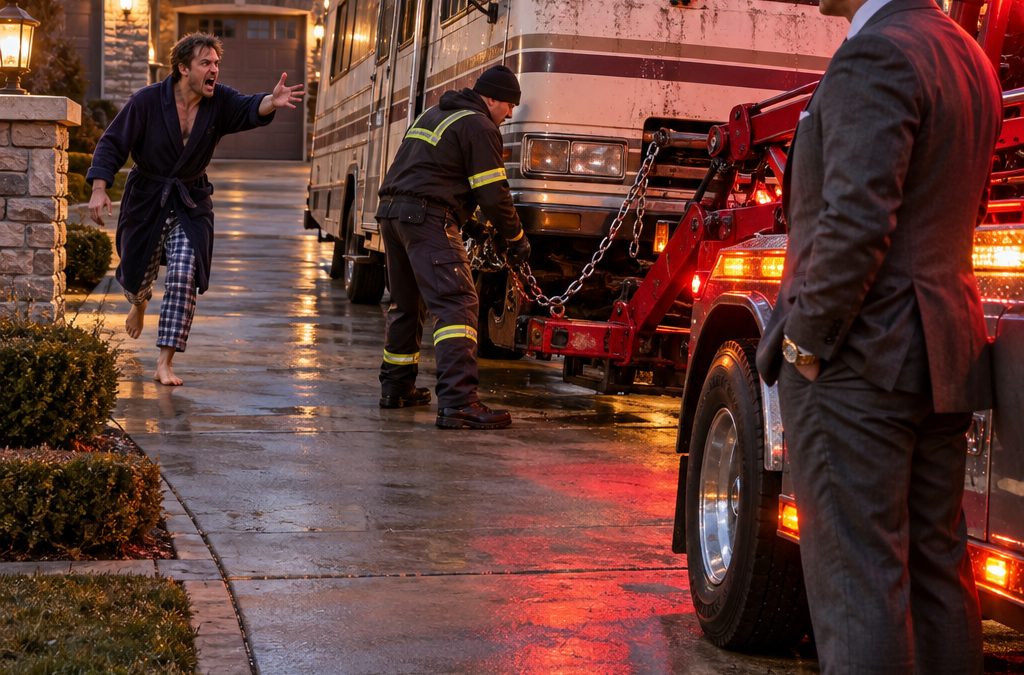
Then, at 5:32 a.m., a heavy engine woke me.
At first, I thought it was a garbage truck.
Then I saw flashing lights.
I sat up.
A tow truck was backing toward the side yard.
For one confused second, I couldn’t understand what I was seeing.
Then I remembered Karen’s threat.
Friday.
I jumped out of bed.
Pulled on my bathrobe.
And ran downstairs.
By the time I opened the front door, the tow operator had already positioned his truck.
One of the side-yard gate panels was open.
A worker was attaching the towing equipment to my RV.
I ran toward them.
“Stop!”
The operator looked up.
“Sir?”
“That’s my vehicle!”
He glanced at a clipboard.
“I’ve got a removal order.”
“From who?”
“The HOA.”
I looked toward the street.
And there stood Karen.
Perfectly dressed.
Perfectly calm.
Watching the scene with unmistakable satisfaction.
I could barely feel the cold concrete beneath my feet.
“Karen, what the hell are you doing?”
He stepped forward.
“Enforcing the rules.”
“There is no valid rule prohibiting that RV!”
“The association has already addressed your objections.”
“You didn’t produce the amendment!”
He smiled.
“Your opportunity to comply has expired.”
The tow operator lowered the lift arm.
Metal scraped against the pavement.
I turned toward him.
“Please. Don’t take it. I’ve owned that RV for eleven years.”
He looked uncomfortable.
“Sir, I just follow the paperwork.”
I pointed toward Karen.
“His paperwork is disputed.”
The driver looked between us.
“That’s not something I can decide.”
Karen folded his arms.
“The vehicle is subject to authorized removal.”
I felt rage surge through me.
I wanted to stand in front of the truck.
I wanted to grab the chains.
I wanted to do anything that would prevent my RV from leaving.
Then I remembered Priya’s warning.
Don’t put yourself in danger.
Don’t create a physical confrontation.
Document everything.
My hands shook as I pulled out my phone.
I started recording.
The tow operator continued.
The chains tightened.
The RV shifted.
I heard the low groan of the equipment taking its weight.
Then the motorhome began moving.
It was a slow, terrible sight.
Eleven years of memories being hauled down my driveway because Karen Voss had decided his authority mattered more than my ownership.
I watched the front wheels roll.
I watched the side mirror pass the privacy fence.
I watched the vehicle I’d maintained for more than a decade become just another object attached to a tow truck.
Karen stood a few feet away.
His expression was almost peaceful.
As though he’d finally corrected an offense that had bothered him for months.
I turned toward him.
“You are going to regret this.”
He looked at me.
“Threats won’t help you, Ethan.”
“I’m not threatening you.”
I held up the phone.
“I’m documenting what you’re doing.”
He adjusted his tie.
“Document whatever you like.”
The truck pulled forward.
The RV followed.
I stood barefoot in my driveway, watching it disappear down the street.
The sound of the engine faded.
Then everything went quiet.
For several seconds, I couldn’t move.
I felt humiliated.
Powerless.
Angry enough that my hands wouldn’t stop shaking.
Marcus appeared at the edge of the driveway wearing jeans and a T-shirt.
He must have heard the truck.
“Ethan?”
I turned.
He looked down the street.
Then at my open side-yard gate.
His expression changed.
“No.”
I nodded.
“He took it.”
Marcus stared.
“Karen actually did it?”
I couldn’t answer.
My throat felt tight.
I looked toward the empty parking area behind the fence.
The concrete was stained where the RV had sat.
A few small pieces of debris remained near the tire marks.
Everything else was gone.
Marcus stepped beside me.
“Call Priya.”
I already had the phone in my hand.
I dialed.
She answered almost immediately.
“Ethan?”
My voice shook.
“They took it.”
A short silence.
“Who?”
“The tow company. Karen was here. He watched them hook it up.”
“Where are you?”
“Home.”
“Are you safe?”
“Yes.”
“Did you confront the driver physically?”
“No.”
“Good.”
I swallowed.
“Priya, they took my RV.”
Her voice became firm.
“Ethan, listen to me.”
I closed my eyes.
She said four words.
“Good. Let her tow.”
Then she corrected herself immediately.
“Let him finish what he’s already done. Don’t chase the truck.”
I stared at the phone.
“What?”
“The emergency application was filed last night. The court has now issued temporary relief. I’m arranging service of the order immediately.”
My knees almost weakened.
“The judge signed it?”
“Yes.”
“Before the tow?”
“The order is effective. The timing and the company’s notice will matter, but we have a direct way to stop further disposition and seek the RV’s return.”
I gripped the phone tighter.
“Can we get it back?”
“That’s exactly what we’re going to do.”
I looked at Marcus.
He was watching me closely.
Priya continued.
“I need you to send the video, the tow company’s name, the work order if you have it, and the location where they’re taking the RV.”
“I have the company name from the truck.”
“Good. We’re contacting the lot.”
I stared down the street.
For the first time that morning, I felt something other than helpless anger.
Hope.
Small.
Fragile.
But real.
Priya’s voice hardened.
“And Ethan?”
“Yes?”
“Save every second of what you recorded. Karen just made the situation much more serious.”
By the time I showered, dressed, and drove toward the impound lot, the morning had become hot and humid.
It was July.
The North Carolina air already felt heavy before nine.
Marcus rode with me.
Neither of us spoke much.
I kept looking at the empty spaces along the road, imagining the tow truck somewhere ahead.
At one red light, Marcus finally said, “I’ve got something else.”
I glanced at him.
“What?”
“Robert found more documents last night.”
My stomach tightened.
“The old treasurer?”
Marcus nodded.
“The forged board resolution. The one Karen used to push him out.”
“What about it?”
“The signature blocks match the RV amendment exactly.”
I stared at the road.
“Exactly?”
“Same wording. Same formatting. Same certification language.”
I swallowed.
“Priya knows?”
“She does. Robert sent everything.”
Marcus looked at me.
“And the financial records are getting worse.”
I turned toward him.
“What do you mean?”
“The clubhouse money. There are payments nobody can explain.”
“How much?”
“Almost the whole forty thousand.”
I gripped the steering wheel.
“Where did it go?”
“Some payments appear to have gone through a contractor connected to Karen’s house.”
I looked at him.
“His house?”
Marcus nodded.
“His kitchen was remodeled last year.”
For a moment, I forgot about the traffic light.
The car behind us honked.
I moved forward.
Marcus continued.
“We’ve got invoices that may tie the renovations together.”
I felt sick.
If the evidence was real, Karen hadn’t merely been issuing improper fines.
He’d been taking community money while threatening homeowners who questioned his records.
The RV dispute had become a weapon in something far bigger.
And now he’d taken the weapon too far.
When we arrived at the impound lot, my RV was parked behind a chain-link fence.
I spotted it immediately.
The white body.
The blue stripe along the side.
The small scratch near the rear storage compartment that I’d never bothered to repaint.
Seeing it there made my chest ache.
It looked out of place among damaged cars and abandoned vehicles.
Like something that had been stolen from its home.
I parked near the office.
Marcus and I climbed out.
Two sheriff’s deputies stood beside a patrol vehicle.
Priya was already there.
She wore a dark blazer and carried a thick legal folder.
When she saw me, she walked over.
“Are you all right?”
I nodded.
“Have you got it?”
She looked toward the RV.
“Yes.”
My throat tightened.
“Can I take it home?”
“We’re getting the release processed. The court order has been served, and the lot has agreed not to move or dispose of the vehicle while the release is arranged.”
I stared at her.
I wanted to believe it.
But after watching the RV disappear from my driveway, I was afraid to trust anything until the keys were back in my hand.
Priya opened her folder.
“The order also addresses the association’s threatened enforcement action. It restricts further removal attempts while the dispute is before the court.”
I swallowed.
“And Karen?”
Her expression changed.
“He has been notified.”
As if she’d summoned him, a pearl-white SUV appeared at the entrance.
It rolled through the open gate and stopped near the office.
Karen climbed out.
He looked immaculate.
White vehicle.
Charcoal suit.
Pale blue shirt.
Gold watch.
Perfect hair.
He surveyed the lot with the satisfied expression of a man arriving to witness the conclusion of a successful operation.
Then he saw Priya.
He saw Marcus.
He saw the deputies.
And finally, he saw me.
His smile faltered.
Only slightly.
But I noticed.
He walked toward us.
“Well,” he said, “I see everyone has gathered.”
Priya stepped forward.
“Mr. Voss.”
He looked at her.
“Counsel.”
She held up the court order.
“We need to discuss the removal you authorized.”
Karen glanced at the papers.
Then at the deputies.
His expression tightened.
“I assume this is some attempt to delay lawful enforcement.”
Priya’s voice remained calm.
“The court has issued temporary relief regarding the disputed HOA enforcement and removal.”
Karen blinked.
“What?”
She handed him a copy.
He read the first page.
Then the second.
His face changed.
“This is ridiculous.”
“Read the order,” she said.
“I know what it says.”
“Then you understand the association cannot continue acting as though the underlying dispute has already been decided in its favor.”
Karen looked toward the RV.
“The vehicle was removed under HOA authority.”
One deputy stepped closer.
“Mr. Voss, we need to ask you about the work order.”
Karen turned.
“And you are?”
“Deputy Lawson.”
Karen lifted his chin.
“I’m the president of Willow Creek Estates.”
Lawson nodded.
“We know.”
Karen seemed reassured.
Then the deputy continued.
“We also know that the RV was removed from a private residential lot under a disputed HOA directive.”
Karen’s smile disappeared.
“The homeowner violated community regulations.”
“Do you have the valid amendment authorizing that enforcement?”
Karen adjusted his jacket.
“The association’s records establish the restriction.”
Priya opened her folder.
“Then why haven’t you produced the signed amendment?”
Karen’s eyes narrowed.
“This is not the place for a legal argument.”
The deputy looked at him.
“We’re not asking you to argue the entire civil case. We’re asking what authority you represented to the towing company.”
Karen glanced toward the office.
He was beginning to look trapped.
“I authorized removal in my official capacity.”
“Did you represent that the association had a valid right to seize the vehicle?”
“The HOA has enforcement authority.”
“Under which document?”
Karen’s face reddened.
He looked toward Priya.
Then toward me.
For the first time in two years, he seemed uncertain about what to say.
I stood quietly beside Marcus.
I had imagined confronting Karen a hundred times.
Shouting at him.
Demanding that he admit what he’d done.
Telling him exactly how much trouble he’d caused.
But seeing him there, surrounded by questions he couldn’t dismiss, I found I didn’t need to speak.
The records were finally doing what I’d hoped they would.
Karen pointed toward the court order.
“This is all based on Ethan’s selective interpretation of outdated documents.”
Priya shook her head.
“The 2015 declaration is recorded. Your alleged amendment has not been authenticated.”
Karen’s expression hardened.
“The board approved it.”
Marcus spoke for the first time.
“Which board?”
Karen turned sharply.
“What?”
Marcus stepped forward.
“Which meeting? Which vote? Which members approved the amendment?”
Karen’s face reddened.
“You’re not part of this enforcement action.”
Marcus folded his arms.
“I’m a member of the association.”
“Then you should understand the importance of following community procedures.”
Marcus gave a humorless laugh.
“I understand them well enough to know you can’t invent votes.”
The silence became uncomfortable.
Karen turned toward the deputies.
“These people have been organizing against me for weeks.”
Lawson remained calm.
“Mr. Voss, we’re interested in the documents and what they show.”
Karen looked furious.
“Residents elected me to protect property values.”
Priya’s expression hardened.
“That doesn’t authorize falsifying governing records.”
Karen stared at her.
For a moment, the perfectly polished man I’d known for two years looked almost frightened.
Then he recovered.
“I won’t dignify that accusation.”
Behind us, the tow operator emerged from the office.
He looked toward Karen.
Then toward my RV.
Then at the deputies.
“Am I going to be paid for this job or not?”
Nobody answered immediately.
The man shook his head.
“Lady—”
He stopped when he saw Karen.
“Sorry. Mister. I once towed a truck out of a wedding reception because the groom forgot where he’d parked. That made more sense than this.”
Marcus let out a startled laugh.
Even I almost smiled.
Karen didn’t.
His face tightened.
“This is not amusing.”
The driver looked at him.
“Neither is getting dragged into somebody else’s lawsuit before breakfast.”
Then he walked away, shaking his head.
The brief humor disappeared when Marcus reached into his folder.
“Deputy, there’s something else you need to see.”
Karen turned toward him.
“What are you doing?”
Marcus didn’t answer.
Three other Willow Creek residents had arrived with Robert Hayes.
They approached carrying folders.
Robert looked older than I remembered.
His face was lined with exhaustion, and his hands trembled slightly as he opened the documents.
He placed the old board resolution beside the RV amendment.
Priya moved closer.
So did the deputies.
Robert pointed to the certification language.
“That first document was used to remove me as treasurer.”
Lawson looked at him.
“Why were you removed?”
“Because I questioned missing money from the clubhouse renovation fund.”
Karen interrupted.
“That’s a lie.”
Robert didn’t look at him.
He continued.
“Mr. Voss produced a board resolution claiming I had violated internal governance policy. The document contained a signature attributed to me.”
He pointed toward the page.
“I never signed it.”
The deputy examined the document.
Robert continued.
“The RV amendment uses the same template, certification language, and approval format.”
Karen stepped closer.
“Those are standard administrative forms.”
Priya looked at him.
“Then produce the corresponding minutes and approval records.”
He didn’t answer.
One of the residents opened another folder.
“We also have the special assessment statements.”
Another added, “And the contractor correspondence.”
The third held up copies of invoices.
“There’s nearly forty thousand dollars that was supposed to go toward the clubhouse.”
Karen’s face turned pale beneath his tan.
“This is completely inappropriate.”
Robert looked directly at him.
“Where’s the money, Karen?”
Karen stared at him.
“That matter is being handled internally.”
Robert’s voice shook.
“I asked you the same question last year.”
“Robert—”
“You removed me from the board.”
“Because you violated policy.”
“What policy?”
Karen said nothing.
Robert pointed to the document.
“The one you made up?”
The words hung in the hot air.
For the first time, I saw something like genuine panic in Karen’s face.
Not irritation.
Not embarrassment.
Fear.
The deputies didn’t immediately declare him guilty.
They began separating the documents, confirming names, and asking questions.
What had been recorded?
Who had signed?
Which bank accounts were involved?
Who had received payments?
Who had authorized the towing company?
I watched the process unfold.
It wasn’t the dramatic courtroom moment I’d imagined.
It was slower.
More careful.
And somehow more devastating.
Karen had spent years making people afraid of his paperwork.
Now the paperwork was being examined by people who wouldn’t accept his title as an answer.
Priya looked toward me.
“Stay here.”
I nodded.
The impound manager approached with release documents.
My RV could be returned under the court’s temporary order and the lot’s agreement.
The vehicle would be inspected before I drove it away.
Any towing and storage costs remained disputed and would be addressed through the legal proceedings.
I barely heard the last part.
I was looking at the gate leading toward the storage area.
My RV was coming home.
Then I heard Karen raise his voice.
“You cannot treat me like a criminal because a handful of disgruntled residents dislike my leadership!”
Deputy Lawson stood directly in front of him.
“Mr. Voss, lower your voice.”
Karen’s jaw clenched.
“I have protected this community for years.”
“Then help us understand the financial records.”
“The records are confidential HOA business.”
“That doesn’t make them exempt from a lawful investigation.”
Karen glanced toward his SUV.
For one strange second, I thought he might walk away.
Another deputy moved toward the parking area.
Lawson remained calm.
“Mr. Voss, investigators have been reviewing allegations concerning the HOA’s financial records and fraudulent filings. We need you to remain available while we verify the warrant information.”
Karen froze.
“What warrant?”
Nobody answered immediately.
A deputy spoke quietly into his radio.
Then Lawson looked at Karen again.
“There’s an active warrant connected to the document-fraud investigation.”
Karen stared at him.
“That’s impossible.”
Lawson continued.
“You’re being taken into custody.”
The words seemed to drain every ounce of confidence from Karen’s body.
His shoulders stiffened.
His hands dropped to his sides.
For a moment, he looked toward me.
Then Marcus.
Then the other residents.
As though one of us might step forward and explain that this was all a misunderstanding.
Nobody did.
The deputy gave him clear instructions.
Karen protested.
“This is outrageous.”
“Sir, turn around.”
“I’m the HOA president.”
“Turn around.”
“My attorney will have something to say about this.”
“You’re entitled to contact counsel.”
Karen looked toward his spotless white SUV.
Then toward the gathered residents.
The deputy repeated the instruction.
This time, Karen complied.
The handcuffs closed around his wrists with a small metallic click.
I will remember that sound for the rest of my life.
Not because I enjoyed hearing it.
Because Karen had spent two years convincing me that I was the person who should be afraid of legal consequences.
He’d threatened liens.
Issued fines.
Invented violations.
And finally arranged for my RV to be hauled away like abandoned property.
Now he was the one standing beside a patrol vehicle, answering questions about forged records and missing community money.
His expensive suit couldn’t protect him.
His polished shoes couldn’t carry him out of the consequences.
And his title no longer made anyone stop asking questions.
He looked at me one final time.
“Ethan, this is your fault.”
I stared at him.
For two years, I’d imagined what I might say if he ever faced accountability.
Something clever.
Something sharp.
Something that would make him feel the same humiliation he’d inflicted on me.
But when the moment came, I felt mostly exhausted.
“No, Karen.”
My voice was quiet.
“You did this.”
He looked away.
The deputies guided him toward the patrol vehicle.
Several neighbors watched silently.
Robert Hayes lowered his head.
Marcus stood beside me, his jaw tight.
And Priya closed the folder she’d been carrying.
“Let’s get your RV,” she said.
I turned toward the impound gate.
For the first time that morning, I allowed myself to breathe.
The manager escorted us inside.
The RV stood near the rear fence.
I walked toward it slowly.
I checked the side panels.
The windows.
The mirrors.
The tires.
The hitch points.
There were fresh scuff marks near the towing connections, but the motorhome appeared otherwise intact.
The manager documented the condition.
Then he handed me the release paperwork.
I signed.
When he gave me back the keys, my throat tightened.
I’d carried that key ring for eleven years.
I knew its weight.
The worn metal.
The small plastic fishing lure hanging beside the ignition key.
I closed my fingers around it.
Then I opened the RV door.
The familiar smell greeted me.
Coffee.
Old upholstery.
A little engine oil.
And the cedar air freshener I’d bought on a trip through Tennessee.
Everything was still there.
My fishing rods rested in their storage compartment.
The tackle box sat near the passenger seat.
A folded blanket lay across the rear bed.
For a moment, I stood inside without moving.
Then I sat in the driver’s seat.
My hands rested on the steering wheel.
I didn’t cry.
Not quite.
But my eyes burned.
I’d spent the morning watching the vehicle disappear from my home.
Now I was sitting inside it again.
And the silence felt almost overwhelming.
Priya climbed into the doorway.
“How is it?”
I swallowed.
“Still mine.”
She smiled.
“Yes.”
I looked toward the dashboard.
“Thank you.”
Her expression softened.
“We’re not finished yet.”
I nodded.
I knew.
The RV was back.
But the fines, the threatened lien, the alleged forged amendment, and the missing clubhouse funds still needed to be resolved.
Karen’s arrest wasn’t the end of the legal process.
It was the beginning of a more serious one.
Still, for that moment, I was grateful to have something tangible back.
I turned the key.
The engine started.
The familiar vibration moved through the steering wheel.
I almost laughed.
Marcus stood outside waiting.
He raised both arms in the air when he heard the motor.
I gave him a tired smile.
Then I drove the RV out of the impound lot.
By the time I returned to Willow Creek, the neighborhood already knew something had happened.
A few residents stood outside their houses.
Others watched from windows.
My side-yard gate was still open.
The parking area was empty.
I backed the RV into the exact spot where it had stood before Karen’s tow truck arrived.
Behind the privacy fence.
On my property.
In compliance with the original recorded rules.
I switched off the engine.
Then I sat there for a moment.
The silence inside the motorhome was comforting.
Outside, the neighborhood was ordinary again.
Birds chirped from the trees.
A lawn mower hummed in the distance.
Somebody was watering flowers across the street.
It seemed impossible that the day had begun with chains and flashing lights.
I climbed out and closed the RV door.
Marcus stood beside the gate.
“Welcome home.”
I smiled.
“Thanks.”
He looked at the motorhome.
“Still planning to go fishing?”
I thought about it.
Then I laughed.
“I might need a day to recover.”
He nodded.
“Fair.”
We closed the gate together.
For the first time in months, I didn’t feel like I was hiding the RV.
I felt like I was protecting something I had every right to keep.
The legal battle that followed was neither quick nor simple.
Within days, investigators began reviewing the HOA’s financial and governance records.
The association’s remaining board members retained independent counsel.
The disputed RV amendment became part of a broader inquiry into how Karen had been approving, certifying, and filing documents.
The clubhouse renovation fund received particular attention.
Nearly forty thousand dollars had been collected from homeowners through special assessments.
The project had supposedly required structural work, interior improvements, and new equipment.
But the clubhouse had barely changed.
Investigators began tracing payments.
They examined contractor invoices.
Bank transfers.
Approval records.
Vendor relationships.
And the timing of Karen’s own home renovations.
What emerged was ugly.
Some of the money collected for the clubhouse had been routed through payments connected to work on Karen’s private residence.
Invoices for kitchen cabinets, countertops, and interior renovations appeared during the same period the HOA claimed it was spending money on the community clubhouse.
Not every payment was immediately explained.
Some required further investigation.
But enough evidence emerged to support criminal charges.
Karen had presented himself as the guardian of neighborhood standards while community funds were being used for his personal benefit.
I remember reading the investigator’s summary and feeling physically sick.
Forty thousand dollars.
Money collected from homeowners who trusted the association.
Money paid by retired couples, working families, and people struggling to keep up with rising household expenses.
All supposedly for a renovation that barely existed.
And while residents were paying those assessments, Karen was issuing fines over mailboxes, grass, planters, and RVs.
He’d made ordinary homeowners afraid to challenge him.
Now I understood why.
The more time people spent defending themselves from enforcement notices, the less attention they had for the association’s finances.
The pattern wasn’t subtle once the documents were laid beside one another.
Robert Hayes questioned the books.
Karen produced a questionable resolution and forced him out.
Residents requested records.
Karen delayed.
I challenged the RV restriction.
Karen escalated the fines.
Priya demanded the signed amendment.
Karen threatened a lien.
Then he arranged the tow.
Each confrontation served the same purpose.
Stop the questions.
Punish resistance.
Protect Karen’s control.
But the tow had created a record he couldn’t quietly file away.
There was a court order.
A towing work order.
Video evidence.
Police reports.
Witness statements.
And the forged-document questions connected to a broader financial investigation.
Karen had expected removing my RV to demonstrate that his authority was absolute.
Instead, it exposed just how much he had been relying on fear.
A week after the impound incident, the HOA board held an emergency meeting.
This time, I wasn’t the only homeowner attending.
The clubhouse was packed.
People stood along the walls.
Others filled the hallway.
Some brought folders of violation notices.
Others carried assessment statements and copies of letters Karen had sent them.
I saw the retired couple he’d humiliated during my first HOA meeting.
I saw a young family who had been fined over their children’s bicycles.
I saw Helen, who had warned me months earlier to be careful.
And I saw Robert Hayes sitting near the front, holding the same battered document case he’d brought to Priya’s office.
Karen wasn’t there.
The association’s attorney opened the meeting.
She explained that the board had reviewed the allegations and taken emergency steps to preserve records and protect association funds.
Karen had been removed from his leadership position through the applicable board procedures.
His authority to issue notices, authorize expenditures, and direct enforcement had been terminated.
An independent financial review was underway.
Several disputed fines were being suspended pending examination.
And the board would seek court guidance where necessary to correct improper actions.
The room erupted.
Some people applauded.
Others demanded explanations.
One resident stood and shouted, “Why didn’t anybody stop him sooner?”
Nobody answered immediately.
Then Robert rose.
His voice was shaky.
“I tried.”
The room became quiet.
He looked around.
“I asked for the bank statements last year. I asked why the clubhouse payments weren’t matching the work.”
He paused.
“And when I kept asking, Karen told everybody I’d violated the rules.”
I watched him struggle to continue.
“I believed somebody would check the records.”
He looked down.
“But people were afraid.”
Helen stood.
“We were all afraid.”
Her voice trembled.
“Every time somebody questioned him, another fine appeared.”
Several people nodded.
I felt something tighten in my chest.
For months, I’d thought the RV dispute was happening to me alone.
Now I understood how many neighbors had been carrying their own versions of the same fear.
Karen hadn’t controlled Willow Creek merely by enforcing rules.
He had controlled it by making resistance feel dangerous.
The attorney asked everyone to submit documentation of disputed assessments and enforcement actions.
Marcus looked toward me.
I nodded.
Our folders were ready.
When the meeting ended, people remained in small groups outside.
Nobody seemed eager to go home.
Neighbors who had barely spoken before were comparing documents, sharing experiences, and realizing how much they’d had in common.
Marcus stood beside me near the parking lot.
“Remember when you said Karen was harmless?”
I looked at him.
“Don’t.”
He grinned.
“Just bored?”
I groaned.
“Marcus.”
He laughed.
“Give him time, I said.”
I shook my head.
“You were right.”
His smile faded slightly.
“Wish I hadn’t been.”
We stood quietly for a moment.
Then I looked toward the clubhouse.
For the first time since moving into Willow Creek, the building felt like it belonged to the residents again.
Not Karen.
Not his private collection of rules.
The people who lived there.
Over the following weeks, Priya continued working on my case.
The court proceedings addressed the invalid RV amendment and the improper enforcement actions taken against me.
The association’s own records became central evidence.
The supposed RV prohibition lacked the approval and recording history necessary to replace the original restriction.
The fines based on it could not stand.
The threatened lien was withdrawn.
The towing authorization was found to be unsupported by the HOA’s lawful enforcement powers.
Ultimately, the financial responsibility for the improper removal was assigned through the civil proceedings.
The towing and storage costs were included in the damages and reimbursement obligations imposed on Karen, rather than being left for me to absorb.
I remember the day Priya called with that result.
I was standing beside the RV checking the tire pressure.
“Ethan, we’ve got the ruling.”
I stopped.
“And?”
“The court has ruled in your favor on the unauthorized enforcement and towing claims.”
For a moment, I couldn’t speak.
Then I asked, “What about the fines?”
“They’re being reversed. The association has also agreed to correct the records and withdraw the threatened collection action.”
I looked toward the privacy fence.
The same fence that had been there when I bought the house.
The same place Karen had insisted was illegal.
I let out a long breath.
“Finally.”
Priya’s voice softened.
“I know.”
I stared at the RV.
“Does this mean he can’t do it again?”
“The court’s orders and the association’s corrective actions should prevent a repeat of this conduct. If anyone attempts something similar, we have the record and enforcement remedies available.”
I nodded.
“Good.”
Then I asked about the broader financial case.
Priya paused.
“That’s still moving through the criminal process. But the evidence is substantial.”
I thanked her.
When the call ended, I sat on the driveway for several minutes.
I wasn’t celebrating yet.
Not because I didn’t feel relief.
Because two years of anxiety had taught me to be cautious.
Every time I’d thought the dispute was almost over, Karen had found another way to escalate it.
But this time was different.
There was a court ruling.
Not a letter from Karen.
Not a questionable board notice.
An actual legal decision.
And that mattered.
Several weeks later, prosecutors formally charged Karen with offenses related to the alleged embezzlement and fraudulent documents.
The charges were supported by evidence collected during the financial investigation.
The clubhouse money had been traced through association accounts and questionable payments, including funds tied to his private kitchen renovation.
The forged governance documents were examined alongside witness statements and approval records.
The case moved forward.
Karen still had the right to defend himself.
A charge wasn’t the same thing as a conviction.
But he was no longer the untouchable president who could threaten homeowners and expect everyone to remain silent.
He had to answer questions under procedures he couldn’t rewrite.
That alone changed Willow Creek.
The HOA also faced civil claims from residents who had paid improper fines and assessments.
Eventually, the affected homeowners pursued coordinated legal action to recover money collected under invalid enforcement practices.
I participated.
So did Marcus.
So did several of the people who had approached me after that first meeting.
The civil proceedings resulted in orders and settlements requiring repayment of improperly collected sums, with applicable interest.
The association had to reconstruct its records, identify affected residents, and correct the accounts.
It was complicated.
There were meetings.
Accountants.
Attorneys.
More paperwork than I ever wanted to see again.
But for once, the paperwork was being used to restore what had been taken.
Not to frighten people into surrendering more.
Karen’s financial situation deteriorated as the cases progressed.
Legal expenses mounted.
Civil liability grew.
His reputation inside Willow Creek disappeared almost overnight.
The man who had once walked through the clubhouse in thousand-dollar suits, speaking as though he personally owned the neighborhood, became the subject of conversations nobody lowered their voices to have.
Eventually, his home was sold amid the financial consequences of the litigation and his mounting obligations.
I remember driving past it one afternoon.
The pearl-white SUV was gone.
The manicured driveway was empty.
A real estate sign stood beside the sidewalk.
I slowed without meaning to.
Then I kept driving.
A year earlier, I might have imagined feeling tremendous satisfaction at seeing that sign.
Karen had threatened my debt-free home over an RV.
Now his own house was no longer his.
The symmetry was impossible to miss.
But the feeling wasn’t what I’d expected.
I didn’t feel joyful.
I felt tired.
And strangely sad that so much damage had been necessary before anybody could make him stop.
I wasn’t sorry he’d faced consequences.
He had earned accountability through his own choices.
But I wished the entire neighborhood hadn’t spent years paying for those choices.
I wished Robert hadn’t been humiliated.
I wished Helen hadn’t been frightened.
I wished I hadn’t stood barefoot in my driveway watching an RV I’d owned for eleven years disappear behind a tow truck.
Most of all, I wished Karen had simply answered my first question honestly.
Where was the signed amendment?
Everything that followed began because he refused to admit he didn’t have one.
By the time the civil cases were resolved, Willow Creek had changed.
The new board didn’t abolish every rule.
Nobody wanted that.
The neighborhood still had common areas to maintain.
Landscaping contracts.
Insurance.
Community expenses.
And legitimate obligations that came with shared property.
But the board adopted clearer procedures.
Proposed rule changes were documented.
Required votes were recorded.
Financial statements were made available through proper channels.
Enforcement notices identified the governing provision supporting each alleged violation.
And no single president could simply replace sections of the association’s records without the required authorization.
Residents began attending meetings again.
Not because they were frightened.
Because they believed their participation mattered.
I started attending occasionally too.
I didn’t become a board member.
After everything that happened, I had no desire to spend my evenings arguing about mailboxes.
But I understood something I hadn’t understood when I first moved in.
A homeowners association wasn’t inherently an enemy.
It was a legal organization whose authority depended on its governing documents, applicable law, and the people entrusted to administer it.
The danger came when someone treated that authority as personal property.
Karen had done exactly that.
He’d confused leadership with ownership.
Disagreement with disobedience.
And accountability with betrayal.
He’d used the HOA’s procedures to punish people who questioned him.
In the end, those procedures couldn’t protect him from the evidence.
One Saturday evening, several months after the RV was returned, I sat in the side yard polishing the motorhome’s exterior.
The sun was beginning to set.
Warm light moved across the privacy fence.
The RV looked better than it had in years.
I’d repaired the small scuff marks from the tow.
Checked the suspension.
Had the undercarriage inspected.
And completed the maintenance I’d postponed during the litigation.
Most importantly, I’d finally taken that fishing trip.
It happened later than planned.
But when I drove out of Willow Creek with the RV behind me, I felt something I’d almost forgotten.
Freedom.
I spent three days near the mountains.
I woke beside the water.
Made coffee while mist rose from the lake.
And sat with a fishing rod in my hands for hours without catching anything particularly impressive.
It was wonderful.
Nobody knocked on the RV door with a violation notice.
Nobody demanded to see an HOA handbook.
Nobody threatened to seize the vehicle.
For the first time in a long time, I was simply enjoying the thing I’d worked so hard to own.
When I returned, I parked it behind the same privacy fence.
Exactly where it had always belonged.
That evening, Marcus walked over carrying two beers.
He stopped beside the open side-yard gate.
“Well, look at that.”
I glanced at him.
“What?”
“The notorious criminal vehicle.”
I laughed.
“Don’t start.”
He walked around the RV, inspecting it dramatically.
“Eleven years of dangerous recreational activity.”
“Marcus.”
“Threat to community values.”
I shook my head.
“You’re enjoying this too much.”
He grinned.
“After everything we went through? Absolutely.”
I reached into the refrigerator and handed him a cold drink.
We carried two lawn chairs into the driveway.
Then I did something small.
Something I’d been thinking about for weeks.
I took a little American flag from the storage compartment and attached it to the RV’s awning.
Marcus watched.
“Making a statement?”
I stepped back.
The flag moved gently in the evening breeze.
“Just reminding myself.”
“Of what?”
I looked toward the house.
“That I earned this.”
Marcus nodded.
For once, he didn’t make a joke.
We sat down.
The sun slipped behind the trees.
The neighborhood was quiet.
A few children rode bicycles along the sidewalk.
Someone walked a dog near the creek.
The ordinary sounds of Willow Creek returned.
After a while, Marcus raised his drink.
“To properly recorded bylaws.”
I laughed.
“To never hearing the phrase ‘architectural compliance’ again.”
He grinned.
“That’s ambitious.”
“Very.”
We clinked bottles.
Then we sat quietly watching the sunset.
Eventually, Marcus leaned back.
“You know what bothers me most?”
I looked at him.
“What?”
“How long everybody let him get away with it.”
I considered that.
“People were trying to protect their homes.”
“I know.”
He stared toward the street.
“But we kept paying fines. Kept avoiding meetings. Kept telling ourselves it was easier not to fight.”
I nodded slowly.
“I did the same thing.”
Marcus looked at me.
“The mailbox.”
“The grass.”
“The planter.”
He shook his head.
“Fifty dollars here. Fifty dollars there.”
I stared at the RV.
“At first, it seemed harmless.”
“Exactly.”
We sat in silence.
Then I said, “That’s how he built the whole thing.”
Marcus turned.
“What do you mean?”
“He started with things small enough that nobody wanted the trouble. A mailbox angle. Half an inch of grass. Something stupid that cost less to pay than to challenge.”
I looked toward the clubhouse in the distance.
“Then he learned people would back down.”
Marcus nodded.
“And when someone didn’t, he made the consequences bigger.”
“Two hundred dollars.”
“Five hundred.”
“A lien.”
I looked at the RV.
“A tow truck.”
Marcus took a slow drink.
Then he said, “Until the consequences got bigger than he could control.”
I nodded.
“Exactly.”
The sky darkened.
The streetlights came on.
Somewhere nearby, a screen door slammed.
I thought about Karen standing beside his white SUV at the impound lot.
His perfect suit.
His polished shoes.
The way he’d looked at me when the deputy asked about the forged records.
For two years, he’d tried to make me believe the system belonged to him.
And for a while, I had almost believed it.
That’s what frightened me most when I thought back.
Not the tow truck.
Not even the lien threat.
The possibility that a man could speak with enough confidence, carry enough official-looking paperwork, and intimidate enough people that nobody stopped to ask whether his authority was real.
I looked at Marcus.
“Do you think we would’ve found the missing money if Karen had just left my RV alone?”
He considered it.
“Maybe.”
I shook my head.
“Robert was already asking questions.”
“True.”
“But Karen kept shutting people down.”
Marcus nodded.
“And then he decided your motorhome was worth starting a war over.”
I laughed softly.
“Apparently.”
We sat for another hour.
Talked about work.
Fishing.
The neighborhood.
And the absurdity of how everything had unfolded.
At one point, Marcus asked whether I regretted moving to Willow Creek.
I thought about it.
Two years earlier, I’d moved into the neighborhood because it looked peaceful.
Then Karen had turned ordinary community living into a constant series of threats.
There had been nights when I wished I’d bought a house somewhere else.
Somewhere without an HOA.
Somewhere I wouldn’t have to save photographs of every notice attached to my door.
But looking around that evening, I realized my feelings had changed.
“I don’t regret the house,” I said.
Marcus nodded.
“Good.”
“I regret underestimating Karen.”
“Fair.”
“And I regret paying those first fines just to avoid trouble.”
He smiled faintly.
“Also fair.”
I looked toward the houses across the street.
“But I don’t regret fighting back.”
Marcus raised his bottle.
“Neither do I.”
The neighborhood continued rebuilding its trust over the following months.
It wasn’t immediate.
People still argued.
They questioned expenditures.
They disagreed about landscaping priorities and maintenance fees.
But the disagreements were happening openly.
Minutes were recorded.
Documents were available.
The board had to explain itself.
That was all most residents had wanted from the beginning.
A community where rules were rules.
Not whatever one man decided they meant that morning.
My own life slowly returned to normal.
I stopped checking the HOA portal every day.
Stopped expecting violation letters in the mailbox.
Stopped worrying that a tow truck might appear whenever I left for work.
The RV remained in the same screened side yard.
I kept maintaining it.
Taking trips.
Making plans.
And adding new memories to the eleven years it already carried.
Sometimes, when I walked past it, I’d remember that July morning.
The flashing lights.
The hydraulic motor.
Karen’s smile.
My bare feet on cold concrete.
The feeling of watching something I loved disappear while being told I had no right to stop it.
Then I’d look at the RV sitting safely behind the fence.
And the memory would lose a little of its power.
I didn’t need to forget what happened.
I just didn’t need to keep living inside it.
One morning, nearly a year after the towing incident, I opened the drawer in my office where I’d stored the HOA paperwork.
It was still full.
Violation notices.
Photographs.
Emails.
Legal correspondence.
Court documents.
Copies of the invalid amendment.
The financial investigation records Priya had shared with me.
And the final papers confirming the resolution of my claims.
I took everything out and spread it across the desk.
For a moment, I stared at the stack.
It was remarkable how much of my life had been consumed by a dispute that should have ended with one sentence.
“My RV is allowed behind the fence.”
Instead, it had taken lawyers, investigators, deputies, court orders, and criminal charges to expose the truth.
I found the very first violation notice.
The paper was slightly curled.
The HOA logo appeared in the upper corner.
Beneath it was Karen’s signature.
I read the accusation.
Then I placed the notice beside the original 2015 rules.
The contradiction was still obvious.
It had always been obvious.
The difference was that now everyone could see it.
I put the documents back into the folder.
Then I labeled the outside.
RESOLVED.
Not because the broader consequences were over for everyone involved.
The criminal process would follow its own course.
People would continue seeking restitution.
The association would spend time repairing its finances and procedures.
But my dispute was finished.
The RV was back.
The improper fines were reversed.
The lien threat was gone.
And Karen no longer controlled the neighborhood.
I closed the drawer.
Then I walked outside.
The morning sunlight was bright.
My lawn needed mowing.
A few leaves had collected along the driveway.
The mailbox was slightly crooked.
I looked at it and laughed.
For a second, I imagined Karen stepping out of his pearl-white SUV with a clipboard, measuring the angle.
Then I remembered he couldn’t do that anymore.
I walked toward the side yard.
The RV sat behind the privacy fence.
Quiet.
Secure.
Exactly where the recorded rules allowed it.
I opened the door and climbed inside.
The familiar smell greeted me.
I sat in the driver’s seat and looked through the windshield.
Eleven years of ownership had turned into twelve.
Then nearly thirteen.
New trips had been added to old memories.
The vehicle wasn’t perfect.
It still needed maintenance.
The upholstery was still outdated.
And there were days when I wondered whether I’d ever stop spending money on repairs.
But it was mine.
Not Karen’s.
Not the HOA’s.
Mine.
I thought about what Priya had said during our first meeting.
“This isn’t enforcement if he’s knowingly using fabricated records.”
At the time, I hadn’t fully understood how far the problem might extend.
I thought we were discussing a bad rule.
A dishonest amendment.
A stubborn HOA president.
I had no idea that the same methods had allegedly been used to remove a treasurer, conceal missing money, and frighten an entire neighborhood into silence.
I didn’t know the clubhouse renovation fund would lead investigators toward Karen’s private kitchen.
I didn’t know the documents would match.
And I certainly didn’t know the man who threatened to put a lien on my mortgage-free home would eventually face the loss of his own.
But I knew something now that I hadn’t known when I first moved in.
Authority didn’t become legitimate because it looked professional.
Karen’s suits were expensive.
His office was organized.
His notices were printed on impressive letterhead.
His signature appeared beneath official-sounding titles.
And he spoke with the certainty of someone who expected everyone else to accept his word.
None of that made a forged amendment valid.
None of it justified taking community money.
And none of it gave him the right to seize my RV.
The truth had been sitting in the original records all along.
We simply had to refuse to stop looking.
I stepped out of the motorhome.
The little American flag still hung from the awning.
A breeze moved through it.
Across the street, Marcus was checking his mailbox.
He looked toward me.
“Morning!”
“Morning!”
He pointed toward the RV.
“Going somewhere?”
I glanced at the motorhome.
Then at the clear sky.
“Thinking about it.”
He grinned.
“Need company?”
I smiled.
“Bring your fishing gear.”
He raised both hands.
“Now you’re talking.”
I laughed and walked back toward the house.
The driveway was quiet.
No tow truck.
No flashing lights.
No clipboard waiting beside the fence.
Just my home.
My RV.
And a neighborhood that had finally learned the difference between serving its residents and controlling them.
Karen Voss had spent two years trying to make me surrender things I legally owned.
He started with fifty-dollar fines.
Then came the invented RV prohibition.
The escalating penalties.
The threatened lien.
And finally, a tow truck arriving before sunrise.
He expected me to be frightened enough to comply.
He never imagined that the paperwork he used to intimidate people would become the evidence that exposed him.
The towing was reversed.
The fraudulent enforcement collapsed.
The missing clubhouse money came under criminal investigation.
The homeowners reclaimed control of their association.
And Karen lost the authority, reputation, and financial security he’d tried so hard to protect through intimidation.
I hadn’t wanted any of that when I moved to Willow Creek.
I’d wanted a quiet place to live and somewhere to park my RV between fishing trips.
In the end, that’s what I got.
But I had to learn something along the way.
A home isn’t truly peaceful simply because the lawns are neat and the streets are quiet.
It’s peaceful when the people who live there know their rights will be respected.
When the rules are real.
When the people enforcing them are accountable.
And when nobody can use an official title to take what doesn’t belong to them.
I closed the RV’s storage compartment, checked the tires one more time, and stepped back.
The motorhome was ready for another trip.
So was I.
I walked into the house, grabbed my fishing rods, and returned to the driveway.
This time, when I looked at the RV, I didn’t remember the tow truck first.
I remembered the mountains.
The lakes.
The quiet mornings.
And the freedom that made me buy it eleven years before Karen ever entered my life.
I unlocked the door, stepped inside, and placed the fishing rods in their usual compartment.
Then I turned the key.
The engine came alive.
And for the first time in a very long while, the sound made me smile without reservation.
I was going fishing.
Nobody needed to approve it.
Nobody was waiting with a violation notice.
And the only person deciding when that RV left my driveway was the man who had paid for it.
Me.








