𝗙𝗨𝗟𝗟 𝗦𝗧𝗢𝗥𝗬 The HOA President Sent a Fake Guard to Throw Me Out of My Own Pool
𝗙𝗨𝗟𝗟 𝗦𝗧𝗢𝗥𝗬
Every notice went in.
Every envelope.
Every email.
Every payment confirmation.
I took photographs of my lawn, mailbox, trash cans, driveway, fence, gate, grill, pool, and yard. I saved the date and time on each file. I made a spreadsheet because old habits die hard. After a career in logistics, I believed in records the way some people believe in prayer.
Two weeks later, the letter arrived that changed everything.
Notice of Intent to Lien — Unauthorized Structure. Fine Balance: $500.
The unauthorized structure was my grill.
A stainless-steel gas grill sitting on my patio exactly where it had sat when the previous owners lived there. I had a photograph from the listing showing it in the same corner.
I read the letter three times.
Then I requested the relevant bylaws in writing.
Deborah stalled.
First, she said the office needed time to retrieve the current enforcement schedule.
Then she rescheduled a records meeting.
Then she canceled again because, according to her email, “board materials were being reorganized.”
I knew stalling when I saw it.
So I went around her.
I drove to the county records office and requested the recorded HOA covenants and amendments for Magnolia Ridge Estates.
The clerk handed me a stack of documents and directed me to a table.
I spent two hours reading.
There was no rule prohibiting my grill.
No patio structure restriction that applied.
No barbecue equipment placement standard.
No fine schedule matching Deborah’s threats.
The recorded bylaws capped ordinary fines at fifty dollars unless a specific enforcement procedure was followed.
Deborah had been charging seventy-five, two hundred, five hundred.
Amounts that existed nowhere in the legal documents.
Not only was my grill allowed, but Deborah had been citing residents under rules that appeared to exist only inside her own head and her clipboard.
I made copies.
I highlighted the relevant sections.
At the next HOA meeting, I brought them with me.
The clubhouse smelled like stale coffee and floor cleaner. About twenty residents sat in folding chairs while Deborah stood at the front, sunglasses perched on her head despite being indoors. Her clipboard rested on the table beside a brass bell she used to call meetings to order, as if Magnolia Ridge were a courthouse and she were the judge.
When homeowner comments opened, I stood.
“My name is Jeff Alvarez. I received a lien threat over an unauthorized structure. I’d like clarification.”
Deborah smiled.
“Of course, Jeff.”
That smile bothered me.
It was too ready.
Too practiced.
I held up the letter.
“The cited violation refers to my backyard grill. I pulled the recorded covenants from the county. I can’t find any rule prohibiting it.”
Deborah tilted her head.
“Community standards evolve.”
A few people shifted in their seats.
I kept my voice level.
“Recorded covenants don’t evolve unless properly amended.”
Her smile hardened.
“Sweetie, perhaps you’re new to HOA procedure.”
Sweetie.
That word landed like a slap.
I was sixty-two years old. I had managed shipping networks across three states, raised a daughter, cared for a dying wife, buried her, sold one house, bought another, and started over alone. I was not a child asking permission to keep a grill.
I looked at her.
“Don’t call me sweetie.”
The room went still.
Deborah’s smile widened.
“Then don’t make accusations you don’t understand.”
I placed the county documents on the table.
“I understand these. I’m asking where your rule is recorded.”
She didn’t look down.
“The board maintains internal enforcement policies.”
“Then produce them.”
“They are not subject to debate at open meetings.”
“Are they subject to homeowners seeing them before you threaten liens?”
A murmur moved through the room.
Deborah tapped one manicured nail on the clipboard.
“This discussion is becoming hostile.”
“No,” I said. “It’s becoming specific.”
Her eyes cooled.
“Be careful, Mr. Alvarez.”
The warning was quiet.
I heard it anyway.
I sat down.
Alan, two rows behind me, whispered, “Now you’ve done it.”
Maybe I had.
But something had shifted.
Deborah no longer looked like an irritating bureaucrat.
She looked like a woman defending a system.
After that meeting, I started attending every one.
I recorded audio openly from my seat. I took notes. I collected agendas. I requested minutes. I watched Deborah steamroll elderly residents who couldn’t afford attorneys, couldn’t handle conflict, or didn’t know the right questions to ask.
Mrs. Patterson was the one who changed something in me.
She was eighty-one, lived alone, and had recently had hip surgery. Her son came twice a week to help with groceries and yard work, but he had his own job and family.
At one meeting, Deborah called Mrs. Patterson’s name.
The old woman stood slowly with a cane.
Deborah looked down at her papers.
“Your front lawn remains noncompliant.”
Mrs. Patterson’s voice trembled.
“My son mowed it Sunday.”
“The photographs show clippings along the walkway.”
“He was coming back to sweep.”
“The violation has continued long enough. Failure to pay outstanding penalties may result in foreclosure action.”
The word seemed to knock the air out of the room.
Mrs. Patterson gripped her cane.
“I just had surgery.”
Deborah’s face remained calm.
“I’m sympathetic. But the HOA cannot suspend standards for personal circumstances.”
Mrs. Patterson looked around as if hoping someone would help.
Most people stared down at their laps.
I stood.
Deborah’s eyes moved to me.
“Mr. Alvarez, this is not your matter.”
“It is if you’re threatening an eighty-one-year-old woman over grass clippings.”
Her smile disappeared.
“Sit down.”
“No.”
A few people gasped.
Deborah leaned toward the microphone.
“You are out of order.”
“And you’re out of excuses.”
The meeting dissolved after that.
Deborah rang her brass bell twice, declared the session adjourned, and swept out of the room with her clipboard pressed against her chest.
Mrs. Patterson cried in the parking lot.
I gave her my number.
That night, I called a lawyer.
Her name was Priya Shah.
She specialized in real estate disputes, HOA abuse, and fraud claims. Her office was small, organized, and lined with file cabinets that looked like they had ruined more than one arrogant person’s week.
I brought her everything.
Three inches of documentation.
Violation letters.
County covenants.
Photographs.
Meeting recordings.
Fine statements.
The lien threat.
Notes from residents.
Mrs. Patterson’s foreclosure warning.
Priya read in silence for nearly an hour.
Then she leaned back.
“Jeff, these aren’t random violations.”
I already knew that, but hearing her say it made my stomach tighten.
“What are they?”
“She’s targeting specific houses deliberately.”
Priya pulled out a map of Magnolia Ridge and asked me to mark every resident who had received aggressive lien or foreclosure threats.
Mrs. Patterson.
The Hendersons.
Me.
A retired couple named the Wades.
A young family on the corner of Maple Loop.
Another widow two streets over.
Priya studied the map.
Then she circled the lots.
Every one sat near the community pool or clubhouse.
Every one was a corner lot, oversized lot, or key access point.
She tapped the map with her pen.
“This is not about grass.”
I looked down.
“What is it about?”
“Control of valuable lots.”
I stared at the circled properties.
The Henderson house. Empty.
Mrs. Patterson’s home. Corner lot near the pool path.
Mine. Large corner lot beside the clubhouse road.
Priya continued.
“Who benefits if these residents sell under pressure?”
I thought about the rumors I had heard.
A resort-style renovation.
Expanded pool area.
Luxury rental cabanas.
A fitness pavilion.
“Deborah has been pushing a pool renovation,” I said.
Priya nodded.
“Who’s the contractor?”
“I don’t know.”
“Find out.”
We found out within a week.
A proposal buried in prior meeting minutes referenced a preliminary renovation concept from Whitfield-Barron Construction.
Barron was Deborah’s brother-in-law.
The idea was to expand the clubhouse and pool area into a larger resort-style amenity zone. The documents described “strategic lot acquisitions” as a potential future phase.
Strategic lot acquisitions.
That phrase made me feel sick.
Eggshell paint.
Grass clippings.
Mailbox posts.
Unauthorized grills.
None of it was petty.
It was pressure.
A land grab wearing a clipboard.
Priya filed a formal complaint with the state HOA regulatory board. She also began the legal process to obtain Magnolia Ridge financial records and communications tied to enforcement, liens, renovations, and contractor proposals.
Deborah must have sensed the walls moving closer.
She escalated hard.
The next notice came certified mail.
Recorded Lien — Unauthorized Fence Height Violation.
Two inches.
She claimed my backyard fence exceeded the approved height by two inches and filed a lien against my house.
I stood in my driveway holding the document while my hands went cold.
She wanted my home over two inches.
Not because the fence mattered.
Because I mattered now.
I had become more dangerous than a noncompliant homeowner.
I had become evidence.
Deborah began appearing near my property more often.
Her golf cart slowed outside my house every morning.
Sometimes she parked across the street, pretending to check common landscaping while facing my driveway.
Once, I saw her at the side fence, peering through a gap toward my pool.
Another time, I watched from my kitchen window as she tried my backyard gate handle.
I opened the back door.
“Can I help you?”
She froze.
Then turned with a perfect smile.
“Routine inspection.”
“That gate is on my property.”
“The HOA has inspection authority.”
“Not without notice. Not inside my fenced yard.”
She lifted her chin.
“What are you hiding, Jeff?”
I walked onto the patio.
“Evidence.”
For once, she did not have a reply.
She left.
I sent the footage to Priya.
Priya’s response was short.
Do not engage alone. Keep recording.
Then Deborah made her fatal mistake.
It happened on a Tuesday morning.
I had just finished swimming laps in my private pool and was standing near the shallow end with a towel around my shoulders when someone started pounding on the gate.
Not knocking.
Pounding.
A man’s voice shouted, “Open up! You are trespassing on community property!”
I turned slowly.
Through the gate slats, I saw a man in a cheap black vest with a silver badge clipped crookedly to the front. The vest had SECURITY printed across it in white letters. It looked like something purchased from a Halloween clearance bin.
He pounded again.
“Open the gate!”
“This is private property,” I called.
“I’m authorized by the HOA to remove you.”
That was the exact moment I knew Deborah had crossed into criminal territory.
My pool sat inside my fenced yard, on my deeded lot, fifteen feet from the property line. There was no shared access. No community easement. No HOA ownership.
And now some rent-a-cop was ordering me to vacate my own backyard.
I picked up my phone and pressed record.
“What’s your name?”
“Kyle.”
“Kyle what?”
“Security officer Kyle.”
“That’s not a last name.”
“Open the gate, sir.”
“Are you licensed?”
He puffed out his chest.
“I’m authorized.”
“By who?”
“HOA President Deborah Whitfield.”
Of course.
Before I could answer, Kyle grabbed the gate and shook it hard.
That’s when he stepped backward, caught his boot on my garden hose, and went down like a sack of potatoes.
He landed directly in Elena’s old flower bed.
Mulch flew.
One of my solar path lights snapped sideways.
From the next yard, Alan burst out laughing so loudly that Kyle’s face turned red.
“Sir,” Kyle shouted from the mulch, “you are interfering with official security action.”
Alan held up his phone.
“Keep going, son. This is the best thing I’ve seen since cable.”
Even I almost laughed.
Almost.
Then I heard sirens.
Real ones.
Two police cruisers rolled up my driveway with lights spinning red and blue across the lawn.
I hadn’t called them yet.
But someone else had.
Priya.
The second Deborah’s fraudulent lien hit the county system, Priya had already notified the appropriate authorities and tied it to the regulatory complaint. When she received my video of Deborah trying the gate, she warned local law enforcement that an unlawful removal attempt might be coming.
She was right.
The officers stepped out.
One was older, broad-shouldered, calm. The other was younger, hand near his belt, eyes moving from Kyle in the flower bed to me in swim trunks.
The older officer said, “What’s going on here?”
Kyle scrambled up.
“Officer, this man is trespassing in a community pool facility.”
I pointed at the patio.
“This is my backyard.”
The younger officer looked around.
Then at the fence.
Then at the house.
Then at Kyle.
“Community pool?”
Kyle nodded aggressively.
“Yes. HOA property.”
I pulled the survey from the plastic folder I had started keeping near the back door after Deborah’s gate incident.
Retirement had made me cautious.
Deborah had made me prepared.
“This is the recorded plat,” I said. “Pool is entirely inside my property line.”
The older officer took it.
While he checked the document, Deborah appeared at the edge of my driveway.
She had not been far away.
She wore white linen pants, oversized sunglasses, and a sleeveless blouse, clutching her clipboard like a shield.
“Officers,” she called, “Magnolia Ridge has common-area access issues under review.”
The older officer looked at her.
“Are you Deborah Whitfield?”
“I am the HOA president.”
“That wasn’t the question.”
Her mouth tightened.
“Yes.”
He glanced toward Kyle.
“Did you send him here?”
“He is a security contractor acting under association authority.”
The officer turned to Kyle.
“License and credentials.”
Kyle blinked.
“What?”
“Security license. Company identification. Authorization paperwork.”
Kyle reached into his vest pocket and pulled out a laminated card that looked like it had been printed at home.
The officer studied it for about three seconds.
“This is not a state security license.”
Kyle looked toward Deborah.
She said, “He is contracted through the HOA.”
The younger officer asked, “Are you armed?”
“No.”
“Are you law enforcement?”
“No.”
“Then why are you banging on a private gate and ordering someone to leave their own property?”
Kyle swallowed.
“I was told it was community property.”
The older officer’s face hardened.
“By her?”
Kyle said nothing.
The officer looked at Deborah.
“Ma’am, impersonating lawful authority or directing someone to forcibly remove a homeowner from private property can become a serious matter.”
Deborah’s smile faltered.
“This is a civil HOA dispute.”
“No,” I said. “This is a man pretending he can remove me from my own backyard.”
The younger officer checked Kyle’s vest and the papers he had dropped near the flower bed.
Then he looked inside Kyle’s car parked at the curb.
“Whose vehicle is that?”
Kyle hesitated.
“Mine.”
“Mind if we look at the documents on the passenger seat?”
Kyle looked at Deborah again.
She said sharply, “This is harassment.”
The older officer responded, “Ma’am, do not interfere.”
Kyle consented, probably too nervous to think clearly.
The officers retrieved a folder from his car.
At first, I assumed it contained fake security paperwork.
It did.
But beneath that was something else.
Financial statements.
HOA ledgers.
Printed account summaries.
A handwritten note with Deborah’s name.
The older officer flipped through the pages, then looked at the younger one.
The air changed.
Deborah sensed it.
“That folder contains confidential HOA material,” she said.
The officer looked at her.
“Then why is it in his car?”
No answer.
Within minutes, Kyle was being placed in handcuffs for impersonating security authority and related unlawful conduct pending investigation.
He looked terrified.
Deborah started shouting.
“You have no idea what you’re doing. This is an HOA matter. He is authorized.”
The older officer turned toward her.
“Ma’am, you need to stop talking until investigators sort this out.”
That was twist three.
Kyle had brought more than a fake badge.
He had brought Deborah’s paper trail.
The folder in his car included HOA financial statements showing reserve-fund transfers and consulting payments that didn’t appear in the public budgets residents had received.
Priya later told me those papers were probably meant for Deborah to review with Kyle or move out of the HOA office before investigators obtained them.
Instead, they landed in a police evidence bag.
Within days, the state regulatory board froze the HOA accounts pending review.
Deborah was suspended from all board duties, then permanently removed.
Investigators searched HOA offices and Deborah’s home office under proper authority.
I watched from across the street as they carried out boxes of records.
Deborah stood on her porch with mascara streaked beneath her sunglasses, screaming that she was being harassed.
No one comforted her.
No one stepped forward.
No one believed the queen anymore.
The investigation uncovered more than Priya had expected.
Deborah had been siphoning maintenance fees and fine revenue into a shell consulting account paid directly to herself.
Over sixty thousand dollars across several years.
She had used invented fines to pressure residents on valuable lots, threatened foreclosure to scare them into selling, and steered renovation discussions toward a construction company connected to her family.
The Henderson foreclosure came back under review.
Mrs. Patterson’s foreclosure threat was voided.
My lien was dissolved almost immediately, stamped fraudulent through the court process and removed from my title.
Priya filed a civil countersuit for wrongful lien, harassment, abuse of HOA authority, and emotional damages.
Deborah’s attorney tried to argue clerical errors.
Then misunderstanding.
Then overzealous enforcement.
But recordings from board meetings showed her citing invented rules.
The county records showed the real bylaws.
The financial statements showed the money.
Kyle’s fake security action showed escalation into criminal conduct.
There was only so much lipstick you could put on a fraud scheme before people noticed the pig.
Six weeks later, Deborah Whitfield pleaded guilty to embezzlement and charges connected to the unlawful security scheme involving Kyle.
She faced restitution, probation, and the real possibility of prison exposure depending on sentencing terms and compliance.
Kyle, to his credit, cooperated. He admitted Deborah had told him my pool belonged to the HOA and that I was a hostile resident refusing to vacate common property.
He was still responsible for what he did, but he had been used.
Deborah had a gift for turning weaker people into tools.
At the next Magnolia Ridge meeting, the clubhouse was packed.
There was no brass bell.
No clipboard throne.
No Deborah at the front.
The temporary board chair read a statement confirming new controls: independent accounting, outside management, homeowner access to records, board approval requirements for liens, and enforcement notices tied only to actual recorded covenants.
Mrs. Patterson sat near the front.
Her foreclosure threat had been cleared. Volunteers from the neighborhood had helped repair her lawn after her surgery. She looked smaller than I remembered, but stronger somehow.
When she stood to speak, the room went silent.
“I thought I was going to lose my home,” she said.
Her voice trembled, but she kept going.
“I was embarrassed. I thought maybe I had failed to keep up. But I was being bullied.”
She looked around the room.
“And I was not the only one.”
No one looked away.
That mattered.
For years, Deborah had kept people isolated.
Every homeowner thought they were alone.
Alone in their shame.
Alone in their fear.
Alone with a letter threatening their house over grass, paint, clippings, or some rule no one could produce.
Once we started comparing papers, her power cracked.
By the end of that meeting, Magnolia Ridge felt different.
Not fixed.
Not yet.
But honest.
People spoke openly.
The Henderson case was referred for review, and while their foreclosure could not be magically undone overnight, the fraudulent assessments tied to it became part of the broader restitution effort.
Mrs. Patterson kept her home free and clear of Deborah’s false claims.
The private pool near the clubhouse reopened under honest management.
My private pool remained, as it had always been, mine.
The first morning I swam after the lien was removed, I stood at the edge longer than usual.
The water was still.
Sunlight moved across the surface in bright, shifting lines.
For months, my backyard had felt watched.
Contested.
Like Deborah’s authority could reach over the fence and rewrite reality.
That morning, it felt quiet again.
I stepped into the pool.
Cool water closed around my legs.
I pushed off from the wall and swam one slow lap.
Then another.
No sirens.
No fake guard at the gate.
No clipboard.
No threats.
Only water, breath, and the soft hum of the filter.
Alan waved from his side yard.
“Any trespassers in there today?”
“Just me.”
“Want me to call security?”
I laughed.
“Only if they bring a real license.”
He grinned.
The garden hose stayed coiled neatly near the flower bed after that.
I considered framing it.
Kyle’s stumble had become neighborhood legend. People repeated the story at meetings, cookouts, and mailbox gatherings.
A fake security guard, a private pool, and a garden hose.
Sometimes justice arrives through subpoenas.
Sometimes it arrives through forensic accounting.
And sometimes it trips a man into mulch on video.
Deborah’s house eventually went up for sale.
I watched the sign appear from my porch.
For a woman who had spent years preaching property values, there was something almost poetic about that quiet stake in her own lawn.
She had tried to take homes from people over inches of grass and imaginary bylaws.
In the end, she lost control of her own.
I didn’t celebrate loudly.
By then, I was too tired for that.
But I did sit outside that evening with a cup of coffee and let myself feel satisfied.
Not cruel.
Not joyful.
Satisfied.
There is a difference.
Magnolia Ridge became closer to the place I thought I had bought.
Neighbors talked more.
Not the whispered warnings from before, but actual conversations.
People shared documents.
Asked questions.
Attended meetings.
The new board discovered quickly that transparency is less glamorous than dictatorship but far less likely to end with investigators carrying boxes out of your office.
The bylaws were reposted online.
The fine schedule was corrected.
Lien procedures were rewritten.
The pool renovation proposal tied to Deborah’s brother-in-law was withdrawn entirely.
No one wanted a resort-style amenity funded by fear.
As for me, I kept my folders.
Every notice.
Every recording.
Every court document.
Every letter voiding the lien.
I didn’t keep them because I wanted to live in the past.
I kept them because paper had nearly been used to steal peace from me, and paper had also helped me take it back.
Deborah thought rules were weapons.
She forgot they could become evidence.
I still swim most mornings.
The pool is not fancy, but it has become sacred to me in a way I never expected.
Not because of the water.
Because of what it represents.
A line.
My property line.
My legal line.
My personal line.
Deborah crossed all three.
And the moment she sent a fake guard to my gate, she crossed into something she could not smile her way out of.
One morning, months after everything settled, Mrs. Patterson stopped by while I was trimming the hedges.
She carried a small paper bag.
“For you,” she said.
Inside was a little ceramic garden gnome wearing swim trunks.
I stared at it.
Then at her.
She smiled.
“I thought your pool needed security.”
I laughed so hard I had to sit down on the porch step.
That gnome now sits near the pool gate, close to the garden hose.
A warning, maybe.
Or a joke.
Or a reminder that ridiculous things can become serious when cruel people are given authority.
Deborah Whitfield used to drive through Magnolia Ridge like she owned every mailbox, every lawn, every fence, every pool, every retired widow’s future.
Now her name is a punchline people say without fear.
The Henderson house is occupied again.
Mrs. Patterson’s lawn is cared for by volunteers when her hip bothers her.
The community pool is open, properly managed, and no longer part of some secret renovation scheme.
And my backyard is quiet.
Exactly as it should have been from the beginning.
I moved to Magnolia Ridge looking for peace.
For a while, Deborah turned it into a war.
But wars end.
Records remain.
And sometimes the tyrant with the clipboard discovers that the person she picked for her next target knows how to keep receipts.
𝗧𝗛𝗘 𝗘𝗡𝗗
The HOA President Sent a Fake Guard to Throw Me Out of My Own Pool
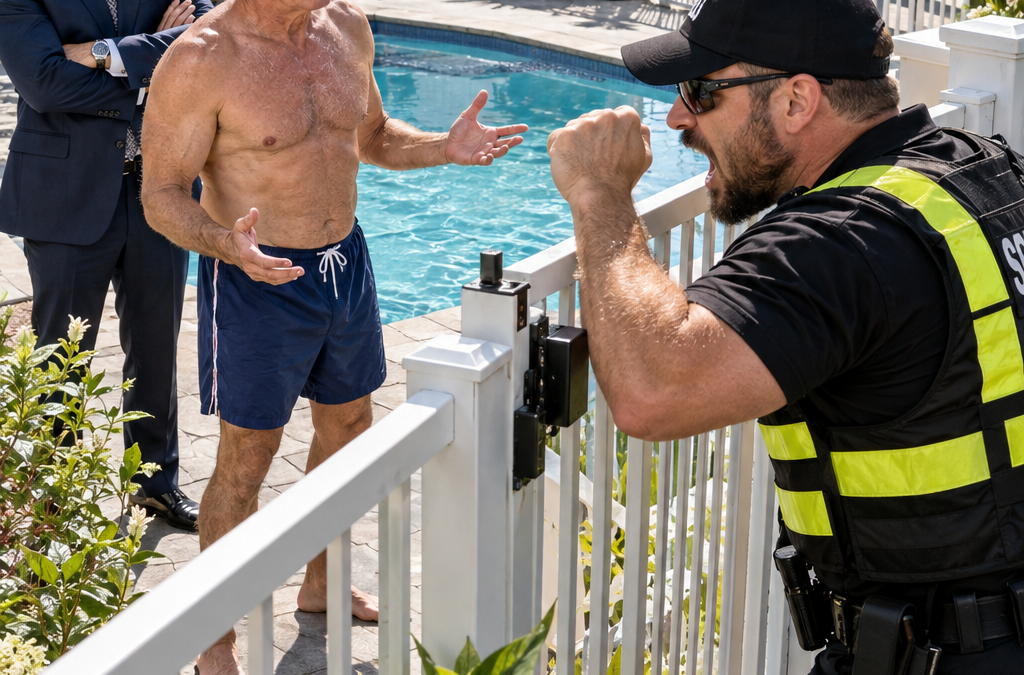
The man in the cheap security vest slammed his fist against my pool gate and ordered me to leave my own backyard. When two real police cruisers rolled up behind him, I realized Deborah Whitfield had finally turned her HOA obsession into a criminal mistake.
My name is Jeff Alvarez, and eight months ago I moved into Magnolia Ridge Estates because I thought I was buying peace.
I was sixty-two, retired from a long career in logistics, and tired in the way a man gets tired after four decades of answering phones, solving other people’s emergencies, and pretending that stress is just part of being useful. My wife had passed three years earlier, my daughter lived in Raleigh with her own family, and I had finally reached the point where I wanted quiet mornings, warm afternoons, and a house that didn’t ask much of me.
Magnolia Ridge looked perfect on paper.
Tree-lined streets. Clean sidewalks. Neat lawns. A clubhouse with a small fitness room. A private community pool across from the mail kiosk. A quiet cul-de-sac where people waved from porches but didn’t pry too much. The real estate listing called it “low-maintenance suburban living with resort-style amenities.”
I didn’t need resort-style anything.
I wanted a backyard, a grill, a little private pool I could float in without hearing traffic, and neighbors who cared more about coffee than conflict.
The house had all of that.
It sat on a corner lot, one of the larger ones near the community pool, with a white vinyl fence around the backyard and a narrow strip of magnolias along the side. The pool was not large, but it was mine. The previous owners had installed it with permits, inspections, and all the paperwork folded neatly into a binder they left on the kitchen counter.
I read everything before closing.
Survey. County permits. Pool inspection. Fence approval. HOA architectural sign-off from five years earlier.
The pool sat entirely inside my property line.
No easement.
No shared access.
No HOA ownership.
Mine.
I thought that would matter.
I had not yet met Deborah Whitfield.
Deborah had been president of the Magnolia Ridge HOA for seven years, and people said her name the way some folks say “storm warning.” Quietly. Carefully. With a glance over the shoulder afterward.
She was in her late fifties, always dressed like she expected to be photographed for a suburban magazine feature about “community leadership.” Pressed blouses, oversized sunglasses, pearl earrings, and a clipboard tucked against her ribs like a badge of office. She drove a white golf cart through the neighborhood most mornings, pausing in front of houses long enough to make curtains twitch.
The first time she came to my door, I was unpacking boxes in the garage.
She didn’t introduce herself so much as announce herself.
“Jeff Alvarez?”
I turned from a stack of tools.
“That’s me.”
“Deborah Whitfield. HOA president.”
She said it with the weight of a judge reading a sentence.
I wiped my hands on a rag. “Nice to meet you.”
Her eyes moved past me, scanning the garage.
“Settling in?”
“Trying to.”
“Magnolia Ridge has standards.”
I smiled because I still believed politeness could prevent nonsense.
“I read the handbook.”
Her mouth lifted slightly.
“Most new residents think they do.”
That should have been my first warning.
Instead, I gave her the benefit of the doubt.
Retirement, I had told myself, would make me patient.
The first violation arrived six days later.
Grass Height Noncompliance — Lawn Exceeds Community Standard by Approximately Three-Quarters of an Inch. Fine: $75.
I stood in my kitchen and laughed.
Three-quarters of an inch.
Not three feet. Not weeds up to the windows. Three-quarters of an inch.
The notice included a blurry photograph taken from the sidewalk, a timestamp, and Deborah’s signature at the bottom. Her handwriting was elegant, looping, almost decorative. It looked too pretty to be attached to something so petty.
I paid the fine.
That was my first mistake.
At the time, seventy-five dollars seemed cheaper than arguing with a woman who measured grass for sport.
Then came the mailbox post.
Apparently, the paint was eggshell white rather than the approved antique white.
I stood beside that mailbox for five minutes, holding the letter and wondering how many human beings alive could tell the difference without a laboratory.
That fine was two hundred dollars.
I paid that one too.
The third notice came for trash cans visible eleven minutes beyond the designated retrieval window.
Eleven minutes.
I had rolled them in after lunch. Deborah claimed collection day standards required removal within a precise window after pickup.
I searched the handbook.
The rule said bins should be removed “promptly.”
Nothing about eleven minutes.
Nothing about a fine.
Still, there was the notice.
Signed.
Stamped.
Filed against my account.
That was when my neighbor Alan Pierce leaned over the fence and said, “You’re on her list.”
Alan was seventy, retired from the postal service, and had the cautious voice of a man who had learned not to speak too loudly outdoors.
“What list?”
“Deborah’s.”
I tossed the notice onto my patio table. “She has a list?”
“She always has a list.”
I laughed because I didn’t want to believe him.
Alan didn’t laugh back.
“She gets a target every year. Sometimes two.”
“A target for what?”
“Fines. Threats. Pressure.”
“That sounds dramatic.”
“Ask the Hendersons.”
I had heard the name once or twice. Their house sat empty at the end of Sycamore Court, grass growing around a bank-auction sign.
“What happened to them?”
Alan lowered his voice.
“Foreclosure.”
“Over HOA fines?”
“Started with lawn clippings. Ended with a lien.”
I looked toward the empty Henderson house.
The auction sign leaned slightly in the yard.
For the first time, Deborah’s letters stopped feeling absurd and started feeling dangerous.
That night, I created a folder on my computer.
I named it MAGNOLIA RIDGE HOA.
Every notice went in.
Every envelope.
Every email.
Every payment confirmation.
I took photographs of my lawn, mailbox, trash cans, driveway, fence, gate, grill, pool, and yard. I saved the date and time on each file. I made a spreadsheet because old habits die hard. After a career in logistics, I believed in records the way some people believe in prayer.
Two weeks later, the letter arrived that changed everything.
Notice of Intent to Lien — Unauthorized Structure. Fine Balance: $500.
The unauthorized structure was my grill.
A stainless-steel gas grill sitting on my patio exactly where it had sat when the previous owners lived there. I had a photograph from the listing showing it in the same corner.
I read the letter three times.
Then I requested the relevant bylaws in writing.
Deborah stalled.
First, she said the office needed time to retrieve the current enforcement schedule.
Then she rescheduled a records meeting.
Then she canceled again because, according to her email, “board materials were being reorganized.”
I knew stalling when I saw it.
So I went around her.
I drove to the county records office and requested the recorded HOA covenants and amendments for Magnolia Ridge Estates.
The clerk handed me a stack of documents and directed me to a table.
I spent two hours reading.
There was no rule prohibiting my grill.
No patio structure restriction that applied.
No barbecue equipment placement standard.
No fine schedule matching Deborah’s threats.
The recorded bylaws capped ordinary fines at fifty dollars unless a specific enforcement procedure was followed.
Deborah had been charging seventy-five, two hundred, five hundred.
Amounts that existed nowhere in the legal documents.
Not only was my grill allowed, but Deborah had been citing residents under rules that appeared to exist only inside her own head and her clipboard.
I made copies.
I highlighted the relevant sections.
At the next HOA meeting, I brought them with me.
The clubhouse smelled like stale coffee and floor cleaner. About twenty residents sat in folding chairs while Deborah stood at the front, sunglasses perched on her head despite being indoors. Her clipboard rested on the table beside a brass bell she used to call meetings to order, as if Magnolia Ridge were a courthouse and she were the judge.
When homeowner comments opened, I stood.
“My name is Jeff Alvarez. I received a lien threat over an unauthorized structure. I’d like clarification.”
Deborah smiled.
“Of course, Jeff.”
That smile bothered me.
It was too ready.
Too practiced.
I held up the letter.
“The cited violation refers to my backyard grill. I pulled the recorded covenants from the county. I can’t find any rule prohibiting it.”
Deborah tilted her head.
“Community standards evolve.”
A few people shifted in their seats.
I kept my voice level.
“Recorded covenants don’t evolve unless properly amended.”
Her smile hardened.
“Sweetie, perhaps you’re new to HOA procedure.”
Sweetie.
That word landed like a slap.
I was sixty-two years old. I had managed shipping networks across three states, raised a daughter, cared for a dying wife, buried her, sold one house, bought another, and started over alone. I was not a child asking permission to keep a grill.
I looked at her.
“Don’t call me sweetie.”
The room went still.
Deborah’s smile widened.
“Then don’t make accusations you don’t understand.”
I placed the county documents on the table.
“I understand these. I’m asking where your rule is recorded.”
She didn’t look down.
“The board maintains internal enforcement policies.”
“Then produce them.”
“They are not subject to debate at open meetings.”
“Are they subject to homeowners seeing them before you threaten liens?”
A murmur moved through the room.
Deborah tapped one manicured nail on the clipboard.
“This discussion is becoming hostile.”
“No,” I said. “It’s becoming specific.”
Her eyes cooled.
“Be careful, Mr. Alvarez.”
The warning was quiet.
I heard it anyway.
I sat down.
Alan, two rows behind me, whispered, “Now you’ve done it.”
Maybe I had.
But something had shifted.
Deborah no longer looked like an irritating bureaucrat.
She looked like a woman defending a system.
After that meeting, I started attending every one.
I recorded audio openly from my seat. I took notes. I collected agendas. I requested minutes. I watched Deborah steamroll elderly residents who couldn’t afford attorneys, couldn’t handle conflict, or didn’t know the right questions to ask.
Mrs. Patterson was the one who changed something in me.
She was eighty-one, lived alone, and had recently had hip surgery. Her son came twice a week to help with groceries and yard work, but he had his own job and family.
At one meeting, Deborah called Mrs. Patterson’s name.
The old woman stood slowly with a cane.
Deborah looked down at her papers.
“Your front lawn remains noncompliant.”
Mrs. Patterson’s voice trembled.
“My son mowed it Sunday.”
“The photographs show clippings along the walkway.”
“He was coming back to sweep.”
“The violation has continued long enough. Failure to pay outstanding penalties may result in foreclosure action.”
The word seemed to knock the air out of the room.
Mrs. Patterson gripped her cane.
“I just had surgery.”
Deborah’s face remained calm.
“I’m sympathetic. But the HOA cannot suspend standards for personal circumstances.”
Mrs. Patterson looked around as if hoping someone would help.
Most people stared down at their laps.
I stood.
Deborah’s eyes moved to me.
“Mr. Alvarez, this is not your matter.”
“It is if you’re threatening an eighty-one-year-old woman over grass clippings.”
Her smile disappeared.
“Sit down.”
“No.”
A few people gasped.
Deborah leaned toward the microphone.
“You are out of order.”
“And you’re out of excuses.”
The meeting dissolved after that.
Deborah rang her brass bell twice, declared the session adjourned, and swept out of the room with her clipboard pressed against her chest.
Mrs. Patterson cried in the parking lot.
I gave her my number.
That night, I called a lawyer.
Her name was Priya Shah.
She specialized in real estate disputes, HOA abuse, and fraud claims. Her office was small, organized, and lined with file cabinets that looked like they had ruined more than one arrogant person’s week.
I brought her everything.
Three inches of documentation.
Violation letters.
County covenants.
Photographs.
Meeting recordings.
Fine statements.
The lien threat.
Notes from residents.
Mrs. Patterson’s foreclosure warning.
Priya read in silence for nearly an hour.
Then she leaned back.
“Jeff, these aren’t random violations.”
I already knew that, but hearing her say it made my stomach tighten.
“What are they?”
“She’s targeting specific houses deliberately.”
Priya pulled out a map of Magnolia Ridge and asked me to mark every resident who had received aggressive lien or foreclosure threats.
Mrs. Patterson.
The Hendersons.
Me.
A retired couple named the Wades.
A young family on the corner of Maple Loop.
Another widow two streets over.
Priya studied the map.
Then she circled the lots.
Every one sat near the community pool or clubhouse.
Every one was a corner lot, oversized lot, or key access point.
She tapped the map with her pen.
“This is not about grass.”
I looked down.
“What is it about?”
“Control of valuable lots.”
I stared at the circled properties.
The Henderson house. Empty.
Mrs. Patterson’s home. Corner lot near the pool path.
Mine. Large corner lot beside the clubhouse road.
Priya continued.
“Who benefits if these residents sell under pressure?”
I thought about the rumors I had heard.
A resort-style renovation.
Expanded pool area.
Luxury rental cabanas.
A fitness pavilion.
“Deborah has been pushing a pool renovation,” I said.
Priya nodded.
“Who’s the contractor?”
“I don’t know.”
“Find out.”
We found out within a week.
A proposal buried in prior meeting minutes referenced a preliminary renovation concept from Whitfield-Barron Construction.
Barron was Deborah’s brother-in-law.
The idea was to expand the clubhouse and pool area into a larger resort-style amenity zone. The documents described “strategic lot acquisitions” as a potential future phase.
Strategic lot acquisitions.
That phrase made me feel sick.
Eggshell paint.
Grass clippings.
Mailbox posts.
Unauthorized grills.
None of it was petty.
It was pressure.
A land grab wearing a clipboard.
Priya filed a formal complaint with the state HOA regulatory board. She also began the legal process to obtain Magnolia Ridge financial records and communications tied to enforcement, liens, renovations, and contractor proposals.
Deborah must have sensed the walls moving closer.
She escalated hard.
The next notice came certified mail.
Recorded Lien — Unauthorized Fence Height Violation.
Two inches.
She claimed my backyard fence exceeded the approved height by two inches and filed a lien against my house.
I stood in my driveway holding the document while my hands went cold.
She wanted my home over two inches.
Not because the fence mattered.
Because I mattered now.
I had become more dangerous than a noncompliant homeowner.
I had become evidence.
Deborah began appearing near my property more often.
Her golf cart slowed outside my house every morning.
Sometimes she parked across the street, pretending to check common landscaping while facing my driveway.
Once, I saw her at the side fence, peering through a gap toward my pool.
Another time, I watched from my kitchen window as she tried my backyard gate handle.
I opened the back door.
“Can I help you?”
She froze.
Then turned with a perfect smile.
“Routine inspection.”
“That gate is on my property.”
“The HOA has inspection authority.”
“Not without notice. Not inside my fenced yard.”
She lifted her chin.
“What are you hiding, Jeff?”
I walked onto the patio.
“Evidence.”
For once, she did not have a reply.
She left.
I sent the footage to Priya.
Priya’s response was short.
Do not engage alone. Keep recording.
Then Deborah made her fatal mistake.
It happened on a Tuesday morning.
I had just finished swimming laps in my private pool and was standing near the shallow end with a towel around my shoulders when someone started pounding on the gate.
Not knocking.
Pounding.
A man’s voice shouted, “Open up! You are trespassing on community property!”
I turned slowly.
Through the gate slats, I saw a man in a cheap black vest with a silver badge clipped crookedly to the front. The vest had SECURITY printed across it in white letters. It looked like something purchased from a Halloween clearance bin.
He pounded again.
“Open the gate!”
“This is private property,” I called.
“I’m authorized by the HOA to remove you.”
That was the exact moment I knew Deborah had crossed into criminal territory.
My pool sat inside my fenced yard, on my deeded lot, fifteen feet from the property line. There was no shared access. No community easement. No HOA ownership.
And now some rent-a-cop was ordering me to vacate my own backyard.
I picked up my phone and pressed record.
“What’s your name?”
“Kyle.”
“Kyle what?”
“Security officer Kyle.”
“That’s not a last name.”
“Open the gate, sir.”
“Are you licensed?”
He puffed out his chest.
“I’m authorized.”
“By who?”
“HOA President Deborah Whitfield.”
Of course.
Before I could answer, Kyle grabbed the gate and shook it hard.
That’s when he stepped backward, caught his boot on my garden hose, and went down like a sack of potatoes.
He landed directly in Elena’s old flower bed.
Mulch flew.
One of my solar path lights snapped sideways.
From the next yard, Alan burst out laughing so loudly that Kyle’s face turned red.
“Sir,” Kyle shouted from the mulch, “you are interfering with official security action.”
Alan held up his phone.
“Keep going, son. This is the best thing I’ve seen since cable.”
Even I almost laughed.
Almost.
Then I heard sirens.
Real ones.
Two police cruisers rolled up my driveway with lights spinning red and blue across the lawn.
I hadn’t called them yet.
But someone else had.
Priya.
The second Deborah’s fraudulent lien hit the county system, Priya had already notified the appropriate authorities and tied it to the regulatory complaint. When she received my video of Deborah trying the gate, she warned local law enforcement that an unlawful removal attempt might be coming.
She was right.
The officers stepped out.
One was older, broad-shouldered, calm. The other was younger, hand near his belt, eyes moving from Kyle in the flower bed to me in swim trunks.
The older officer said, “What’s going on here?”
Kyle scrambled up.
“Officer, this man is trespassing in a community pool facility.”
I pointed at the patio.
“This is my backyard.”
The younger officer looked around.
Then at the fence.
Then at the house.
Then at Kyle.
“Community pool?”
Kyle nodded aggressively.
“Yes. HOA property.”
I pulled the survey from the plastic folder I had started keeping near the back door after Deborah’s gate incident.
Retirement had made me cautious.
Deborah had made me prepared.
“This is the recorded plat,” I said. “Pool is entirely inside my property line.”
The older officer took it.
While he checked the document, Deborah appeared at the edge of my driveway.
She had not been far away.
She wore white linen pants, oversized sunglasses, and a sleeveless blouse, clutching her clipboard like a shield.
“Officers,” she called, “Magnolia Ridge has common-area access issues under review.”
The older officer looked at her.
“Are you Deborah Whitfield?”
“I am the HOA president.”
“That wasn’t the question.”
Her mouth tightened.
“Yes.”
He glanced toward Kyle.
“Did you send him here?”
“He is a security contractor acting under association authority.”
The officer turned to Kyle.
“License and credentials.”
Kyle blinked.
“What?”
“Security license. Company identification. Authorization paperwork.”
Kyle reached into his vest pocket and pulled out a laminated card that looked like it had been printed at home.
The officer studied it for about three seconds.
“This is not a state security license.”
Kyle looked toward Deborah.
She said, “He is contracted through the HOA.”
The younger officer asked, “Are you armed?”
“No.”
“Are you law enforcement?”
“No.”
“Then why are you banging on a private gate and ordering someone to leave their own property?”
Kyle swallowed.
“I was told it was community property.”
The older officer’s face hardened.
“By her?”
Kyle said nothing.
The officer looked at Deborah.
“Ma’am, impersonating lawful authority or directing someone to forcibly remove a homeowner from private property can become a serious matter.”
Deborah’s smile faltered.
“This is a civil HOA dispute.”
“No,” I said. “This is a man pretending he can remove me from my own backyard.”
The younger officer checked Kyle’s vest and the papers he had dropped near the flower bed.
Then he looked inside Kyle’s car parked at the curb.
“Whose vehicle is that?”
Kyle hesitated.
“Mine.”
“Mind if we look at the documents on the passenger seat?”
Kyle looked at Deborah again.
She said sharply, “This is harassment.”
The older officer responded, “Ma’am, do not interfere.”
Kyle consented, probably too nervous to think clearly.
The officers retrieved a folder from his car.
At first, I assumed it contained fake security paperwork.
It did.
But beneath that was something else.
Financial statements.
HOA ledgers.
Printed account summaries.
A handwritten note with Deborah’s name.
The older officer flipped through the pages, then looked at the younger one.
The air changed.
Deborah sensed it.
“That folder contains confidential HOA material,” she said.
The officer looked at her.
“Then why is it in his car?”
No answer.
Within minutes, Kyle was being placed in handcuffs for impersonating security authority and related unlawful conduct pending investigation.
He looked terrified.
Deborah started shouting.
“You have no idea what you’re doing. This is an HOA matter. He is authorized.”
The older officer turned toward her.
“Ma’am, you need to stop talking until investigators sort this out.”
That was twist three.
Kyle had brought more than a fake badge.
He had brought Deborah’s paper trail.
The folder in his car included HOA financial statements showing reserve-fund transfers and consulting payments that didn’t appear in the public budgets residents had received.
Priya later told me those papers were probably meant for Deborah to review with Kyle or move out of the HOA office before investigators obtained them.
Instead, they landed in a police evidence bag.
Within days, the state regulatory board froze the HOA accounts pending review.
Deborah was suspended from all board duties, then permanently removed.
Investigators searched HOA offices and Deborah’s home office under proper authority.
I watched from across the street as they carried out boxes of records.
Deborah stood on her porch with mascara streaked beneath her sunglasses, screaming that she was being harassed.
No one comforted her.
No one stepped forward.
No one believed the queen anymore.
The investigation uncovered more than Priya had expected.
Deborah had been siphoning maintenance fees and fine revenue into a shell consulting account paid directly to herself.
Over sixty thousand dollars across several years.
She had used invented fines to pressure residents on valuable lots, threatened foreclosure to scare them into selling, and steered renovation discussions toward a construction company connected to her family.
The Henderson foreclosure came back under review.
Mrs. Patterson’s foreclosure threat was voided.
My lien was dissolved almost immediately, stamped fraudulent through the court process and removed from my title.
Priya filed a civil countersuit for wrongful lien, harassment, abuse of HOA authority, and emotional damages.
Deborah’s attorney tried to argue clerical errors.
Then misunderstanding.
Then overzealous enforcement.
But recordings from board meetings showed her citing invented rules.
The county records showed the real bylaws.
The financial statements showed the money.
Kyle’s fake security action showed escalation into criminal conduct.
There was only so much lipstick you could put on a fraud scheme before people noticed the pig.
Six weeks later, Deborah Whitfield pleaded guilty to embezzlement and charges connected to the unlawful security scheme involving Kyle.
She faced restitution, probation, and the real possibility of prison exposure depending on sentencing terms and compliance.
Kyle, to his credit, cooperated. He admitted Deborah had told him my pool belonged to the HOA and that I was a hostile resident refusing to vacate common property.
He was still responsible for what he did, but he had been used.
Deborah had a gift for turning weaker people into tools.
At the next Magnolia Ridge meeting, the clubhouse was packed.
There was no brass bell.
No clipboard throne.
No Deborah at the front.
The temporary board chair read a statement confirming new controls: independent accounting, outside management, homeowner access to records, board approval requirements for liens, and enforcement notices tied only to actual recorded covenants.
Mrs. Patterson sat near the front.
Her foreclosure threat had been cleared. Volunteers from the neighborhood had helped repair her lawn after her surgery. She looked smaller than I remembered, but stronger somehow.
When she stood to speak, the room went silent.
“I thought I was going to lose my home,” she said.
Her voice trembled, but she kept going.
“I was embarrassed. I thought maybe I had failed to keep up. But I was being bullied.”
She looked around the room.
“And I was not the only one.”
No one looked away.
That mattered.
For years, Deborah had kept people isolated.
Every homeowner thought they were alone.
Alone in their shame.
Alone in their fear.
Alone with a letter threatening their house over grass, paint, clippings, or some rule no one could produce.
Once we started comparing papers, her power cracked.
By the end of that meeting, Magnolia Ridge felt different.
Not fixed.
Not yet.
But honest.
People spoke openly.
The Henderson case was referred for review, and while their foreclosure could not be magically undone overnight, the fraudulent assessments tied to it became part of the broader restitution effort.
Mrs. Patterson kept her home free and clear of Deborah’s false claims.
The private pool near the clubhouse reopened under honest management.
My private pool remained, as it had always been, mine.
The first morning I swam after the lien was removed, I stood at the edge longer than usual.
The water was still.
Sunlight moved across the surface in bright, shifting lines.
For months, my backyard had felt watched.
Contested.
Like Deborah’s authority could reach over the fence and rewrite reality.
That morning, it felt quiet again.
I stepped into the pool.
Cool water closed around my legs.
I pushed off from the wall and swam one slow lap.
Then another.
No sirens.
No fake guard at the gate.
No clipboard.
No threats.
Only water, breath, and the soft hum of the filter.
Alan waved from his side yard.
“Any trespassers in there today?”
“Just me.”
“Want me to call security?”
I laughed.
“Only if they bring a real license.”
He grinned.
The garden hose stayed coiled neatly near the flower bed after that.
I considered framing it.
Kyle’s stumble had become neighborhood legend. People repeated the story at meetings, cookouts, and mailbox gatherings.
A fake security guard, a private pool, and a garden hose.
Sometimes justice arrives through subpoenas.
Sometimes it arrives through forensic accounting.
And sometimes it trips a man into mulch on video.
Deborah’s house eventually went up for sale.
I watched the sign appear from my porch.
For a woman who had spent years preaching property values, there was something almost poetic about that quiet stake in her own lawn.
She had tried to take homes from people over inches of grass and imaginary bylaws.
In the end, she lost control of her own.
I didn’t celebrate loudly.
By then, I was too tired for that.
But I did sit outside that evening with a cup of coffee and let myself feel satisfied.
Not cruel.
Not joyful.
Satisfied.
There is a difference.
Magnolia Ridge became closer to the place I thought I had bought.
Neighbors talked more.
Not the whispered warnings from before, but actual conversations.
People shared documents.
Asked questions.
Attended meetings.
The new board discovered quickly that transparency is less glamorous than dictatorship but far less likely to end with investigators carrying boxes out of your office.
The bylaws were reposted online.
The fine schedule was corrected.
Lien procedures were rewritten.
The pool renovation proposal tied to Deborah’s brother-in-law was withdrawn entirely.
No one wanted a resort-style amenity funded by fear.
As for me, I kept my folders.
Every notice.
Every recording.
Every court document.
Every letter voiding the lien.
I didn’t keep them because I wanted to live in the past.
I kept them because paper had nearly been used to steal peace from me, and paper had also helped me take it back.
Deborah thought rules were weapons.
She forgot they could become evidence.
I still swim most mornings.
The pool is not fancy, but it has become sacred to me in a way I never expected.
Not because of the water.
Because of what it represents.
A line.
My property line.
My legal line.
My personal line.
Deborah crossed all three.
And the moment she sent a fake guard to my gate, she crossed into something she could not smile her way out of.
One morning, months after everything settled, Mrs. Patterson stopped by while I was trimming the hedges.
She carried a small paper bag.
“For you,” she said.
Inside was a little ceramic garden gnome wearing swim trunks.
I stared at it.
Then at her.
She smiled.
“I thought your pool needed security.”
I laughed so hard I had to sit down on the porch step.
That gnome now sits near the pool gate, close to the garden hose.
A warning, maybe.
Or a joke.
Or a reminder that ridiculous things can become serious when cruel people are given authority.
Deborah Whitfield used to drive through Magnolia Ridge like she owned every mailbox, every lawn, every fence, every pool, every retired widow’s future.
Now her name is a punchline people say without fear.
The Henderson house is occupied again.
Mrs. Patterson’s lawn is cared for by volunteers when her hip bothers her.
The community pool is open, properly managed, and no longer part of some secret renovation scheme.
And my backyard is quiet.
Exactly as it should have been from the beginning.
I moved to Magnolia Ridge looking for peace.
For a while, Deborah turned it into a war.
But wars end.
Records remain.
And sometimes the tyrant with the clipboard discovers that the person she picked for her next target knows how to keep receipts.








