𝗙𝗨𝗟𝗟 𝗦𝗧𝗢𝗥𝗬 The HOA President Sent a Fake Guard to Throw Me Out of My Own Backyard
𝗙𝗨𝗟𝗟 𝗦𝗧𝗢𝗥𝗬
Then she drove away.
The first official notice arrived nine days later.
Grass height violation.
According to Deborah, the front lawn exceeded the approved height by three-quarters of an inch.
Three-quarters.
The letter referenced a “community standard” but did not include the actual rule.
Fine: $100.
I stood in the kitchen reading it and laughed.
That was my first mistake.
I should have taken it seriously from the first envelope.
Instead, I paid it because I was busy settling in, because it was only a hundred dollars, and because I still believed this was small-town bureaucracy with a superiority complex and too much free time.
The second notice arrived the following week.
Mailbox post color violation.
Apparently, the post was eggshell white, while the approved shade was antique white.
Fine: $200.
I held the notice beside the mailbox and stared at the post.
If there was a difference between eggshell and antique white, it was invisible to the human eye and visible only to Deborah Whitfield’s thirst for control.
I called the management office.
A woman named Carla answered.
“Magnolia Ridge Association Management.”
“This is Jeff Alvarez at 219 Bay Laurel Court. I received a fine about my mailbox color.”
“Yes, Mr. Alvarez.”
“Can you send me the approved paint list?”
A pause.
“President Whitfield maintains the physical color swatches.”
“I need the actual written standard.”
“I can request that.”
“You don’t have it?”
“Not in the digital packet.”
I looked out the kitchen window at the mailbox.
“So I’m being fined for not matching a swatch only Deborah has?”
Carla lowered her voice.
“I’ll send your request.”
No written standard ever arrived.
The fines did.
Trash cans visible eleven minutes past the designated retrieval window.
A genuine citation.
Eleven minutes.
I checked my doorbell camera.
The truck came late. I had pulled the cans back shortly after.
It did not matter.
Then came a warning about landscape edging. Then a notice about the brightness of my porch light. Then a complaint that my grill was an unauthorized outdoor structure.
My grill.
A black propane grill on the patio.
Exactly where the previous owner had kept his, judging by the faint marks on the stone.
Fine: $500.
That letter included a lien threat if the balance remained unpaid.
A lien.
Against my house.
Over a grill.
That was when I stopped laughing.
My neighbor Rosa told me the truth first.
Not Rosa from another story. This was Rosa Ellison, a retired school secretary who lived directly across the street. She had silver hair, a sharp walk, and the careful habit of checking both directions before saying anything about Deborah.
She approached me one evening while I was watering a row of hibiscus near the walkway.
“Jeff,” she said softly.
“Evening, Rosa.”
“You’re getting letters, aren’t you?”
I shut off the hose.
“That obvious?”
She glanced toward Deborah’s street.
“She’s started on you.”
“Started what?”
Rosa’s face tightened.
“Don’t fight her unless you’re ready to finish it.”
I frowned.
“People keep talking like she’s the sheriff.”
Rosa looked me dead in the eye.
“She got the Hendersons foreclosed on.”
I stared at her.
“What?”
“Their house on Palmetto Bend. Empty one with the auction sign.”
“I saw that.”
“They didn’t leave because they wanted to. It started with lawn clippings, then fence repairs, then unpaid fines. By the time they found a lawyer, the fees had buried them.”
“That can’t be legal.”
Rosa gave a sad little laugh.
“Legal and expensive are two different wars.”
The next morning, I drove past the Henderson house.
The yard was neat now, probably maintained by the bank.
A white auction sign stood near the curb.
The front porch was empty.
No furniture.
No potted plants.
No welcome mat.
Just a house that looked scrubbed of its family.
I parked across the street and sat there for five minutes.
That was when something changed in me.
I had spent my whole career tracking shipments, resolving discrepancies, finding lost pallets, missing invoices, and fake delivery claims. I knew how paperwork could hide a lie, but I also knew how paperwork could expose one.
So I started documenting.
Every notice.
Every envelope.
Every fine.
Every photo.
Every email.
Every date.
I made folders on my laptop with military precision.
Grass Height.
Mailbox Color.
Trash Cans.
Grill.
Lien Threat.
Bylaw Requests.
I photographed my lawn with a ruler.
I photographed my mailbox in morning and afternoon light.
I photographed the trash cans before and after pickup.
I photographed the grill.
Then I formally requested the bylaws in writing.
Deborah stalled.
First, she said the board secretary had to compile the official packet.
Then the management portal was being updated.
Then she said the current rules had “interpretive supplements” not yet digitized.
Then she rescheduled a meeting with me three times.
She was hoping I would get tired and pay.
Instead, I went to the county recorder’s office.
It took half a morning, one bored clerk, and a computer terminal that looked older than my first marriage, but I found the actual recorded Magnolia Ridge governing documents.
The real ones.
Not Deborah’s version.
Not the “interpretive supplements.”
Not the living, evolving, magical clipboard standards she seemed to pull out of thin air.
The actual bylaws.
I read them that afternoon at my kitchen table.
My grill violated nothing.
My mailbox color violated nothing.
There was no enforceable language supporting half the fines she had sent me.
The so-called community standards she kept referencing existed only inside her own head and on her clipboard.
That was twist one.
Deborah Whitfield was not enforcing rules.
She was inventing them.
I confronted her at the next board meeting.
The clubhouse was a low stucco building near the community pool, with fake tropical plants near the entrance and framed photos of neighborhood events along the hallway. About twenty residents were there that night. Most sat quietly, shoulders rounded, eyes down, like people attending court after already deciding the judge hated them.
Deborah sat at the front table with two board members on either side.
Clipboard.
Sunglasses perched on her head.
Pearl bracelet.
Perfect nails.
The whole uniform of a woman who believed authority was something you could accessorize.
When public comments opened, I stood.
“My name is Jeff Alvarez, 219 Bay Laurel Court. I’m requesting clarification on several fines issued against my property.”
Deborah smiled.
“Mr. Alvarez, you’ve been given explanations.”
“I’ve been given notices. I haven’t been given rules.”
The room shifted.
I held up the county bylaws.
“These are the recorded governing documents. My grill is not prohibited. The mailbox color rule you cited does not appear here. Neither does the trash-can eleven-minute retrieval fine.”
Deborah tilted her head.
“Community standards evolved, sweetie.”
Sweetie.
That word landed like a slap.
I was sixty-two years old, a retired logistics manager, a homeowner in good standing, and she spoke to me like I was a child she had caught tracking mud across her carpet.
I felt heat rise in my chest.
But I kept my voice calm.
“Did the board formally adopt those evolved standards?”
“The board has discretion.”
“Where is that recorded?”
Her smile thinned.
“We are not going to let one new resident derail this meeting.”
“I’m asking because you threatened a lien on my home.”
A low murmur moved through the room.
Deborah’s eyes hardened.
“You were informed of the consequences of noncompliance.”
“With rules that don’t exist.”
She tapped her pen against the table.
“Mr. Alvarez, this discussion is closed.”
I looked around the room.
Several residents avoided my eyes.
One older woman near the back looked like she wanted to speak but was physically afraid to open her mouth.
That was Mrs. Patterson.
I did not know her then.
I would soon.
After that meeting, I began attending every board session.
I recorded audio where legally allowed.
I took notes.
I watched Deborah operate.
She did not simply run meetings. She controlled pressure.
She let allies speak as long as they wanted. She cut critics off after thirty seconds. She accepted vague complaints from people who praised her but demanded written proof from anyone questioning her.
One night, I saw her corner Mrs. Patterson after a meeting.
Mrs. Patterson was eighty-one, recovering from hip surgery, and walking with a cane. Her grass had grown high because she could not get her grandson over to mow until the weekend.
Deborah stood over her near the clubhouse hallway.
“If you ignore the notice, foreclosure proceedings are available to the association.”
Mrs. Patterson’s face went pale.
“I’m not ignoring it. I just need a few days.”
“You’ve had days.”
“I had surgery.”
“Medical issues don’t suspend property obligations.”
I watched Mrs. Patterson grip her cane with both hands.
Something inside me shifted.
Until that moment, I had been an annoyed homeowner defending myself.
Watching Deborah threaten an elderly woman over unmowed grass while she recovered from surgery turned that annoyance into something colder.
Sharper.
I decided Deborah needed a real opponent.
The next morning, I hired Priya Shah.
Priya specialized in HOA fraud and real estate disputes. She was in her late thirties, direct, precise, and completely unimpressed by bullies in board-president clothing.
Her office was clean, bright, and almost painfully organized.
I handed her three inches of documentation.
She read quietly for nearly an hour.
Every few minutes, her eyebrows moved slightly, which I came to understand was Priya’s version of a dramatic reaction.
Finally, she leaned back.
“These fines are not random.”
I sat up.
“What do you mean?”
“She’s targeting specific houses deliberately.”
I frowned.
“Mine?”
“Yours, Mrs. Patterson’s, the Henderson property, and several others.”
“How do you know?”
She turned her screen toward me.
She had pulled a neighborhood parcel map.
Every targeted property was highlighted.
My house.
Mrs. Patterson’s.
The Henderson house.
Three others.
All on desirable corner lots or lots near the community’s private pool and clubhouse.
Priya tapped the screen.
“That pattern is not accidental.”
I stared at the highlighted map.
The pool sat at the center like a blue coin.
All the targeted homes circled it.
Then Priya opened another file.
“Do you know a company called Whitfield Coastal Construction?”
I shook my head.
“Should I?”
“It’s registered to Deborah’s brother-in-law.”
My stomach tightened.
Priya continued.
“There’s a preliminary proposal in county planning discussions for a resort-style renovation concept in your community area. Expanded pool complex, rental cabanas, fitness pavilion, upgraded parking.”
I stared at her.
“Magnolia Ridge is residential.”
“Yes.”
“And those houses are in the way.”
“Yes.”
I felt sick.
The grass.
The mailbox.
The grill.
The two-inch fence issues other people mentioned.
None of it was petty.
It was a calculated land grab wearing a clipboard.
Deborah was trying to clear out residents around the pool so she could push through a renovation contract that would benefit her brother-in-law’s construction company.
For a moment, I felt furious enough to stand.
Then calm settled over me.
Not peace.
Not patience.
A different kind of calm.
The calm of finally understanding exactly what battle you are fighting.
Priya filed a formal complaint with the state HOA regulatory board.
She also began the legal process to obtain Magnolia Ridge’s financial records.
Meanwhile, Deborah escalated.
She filed a lien against my house over an alleged unauthorized fence-height violation.
Two inches.
She claimed my side fence exceeded the approved height by two inches.
I measured it myself.
Then measured my neighbors’ fences.
Half the street varied by more than that.
No one else received a lien.
She wanted my house over two inches.
By then, I understood why.
I was not another rulebreaker to Deborah.
I was her biggest threat.
She started showing up uninvited.
Once, I saw her standing outside my backyard fence, trying to peer through the slats.
Another time, I watched from the kitchen window as she tested the gate handle.
I opened the window.
“Can I help you?”
She jerked back, then recovered.
“Routine inspection.”
“Of my locked backyard?”
“Exterior compliance includes visible areas.”
“My gate isn’t visible from the street.”
Her face tightened.
“You’re becoming very combative, Jeff.”
“And you’re trespassing.”
She smiled.
“Be careful how you use legal words you don’t understand.”
That was the thing about Deborah.
She loved rules, as long as she believed they belonged only to her.
Trespassing apparently did not apply when she was the one touching the gate.
Then she made her fatal mistake.
She hired Kyle.
Kyle was her nephew, though she tried not to say that too loudly. He ran a one-man “security contractor” business out of a rented office suite near a strip mall. His uniform looked like something ordered online at midnight. Black shirt, cheap badge, tactical belt, boots too clean to have ever chased anything more dangerous than a coupon code.
He was unlicensed.
We would learn that quickly.
The day he came to my house, I was sitting on the patio beside my private pool, reading a book I had not managed to enjoy because my phone kept buzzing with updates from Priya.
Deborah’s lien filing had just hit county systems.
Priya had already flagged it as improper and alerted investigators connected to the regulatory complaint.
I did not know how fast things were moving behind the scenes.
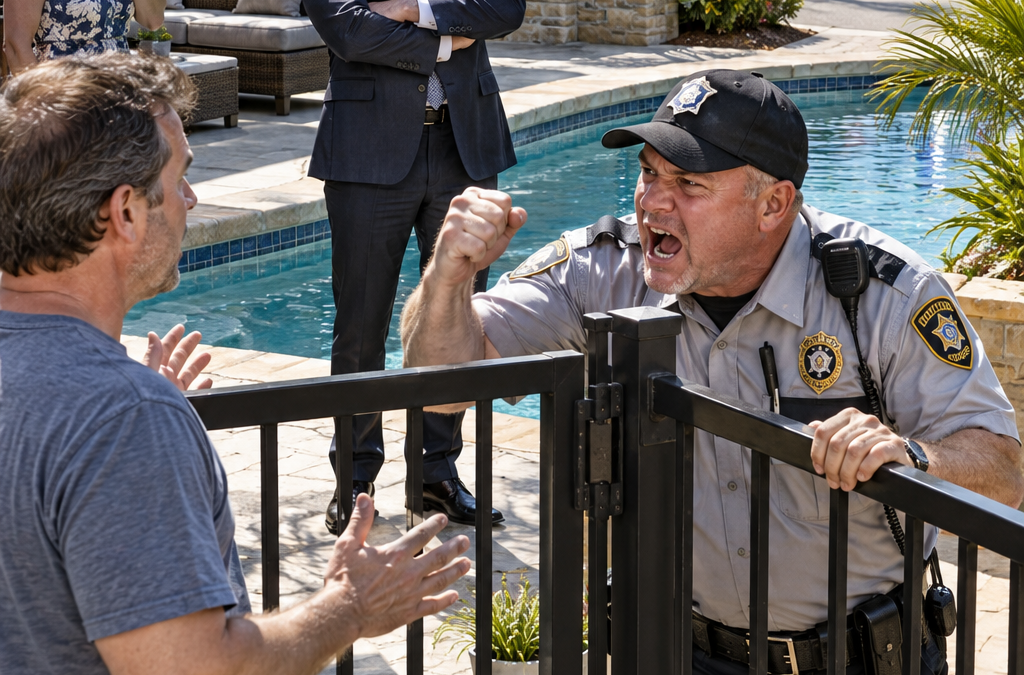
All I knew was that someone started banging on my pool gate.
Hard.
Metal rattling against the latch.
“Mr. Alvarez!” a man shouted. “Open this gate immediately!”
I stood and walked toward the patio steps.
Through the gate, I saw Kyle in his cheap uniform.
Badge clipped to his chest.
Sunglasses.
Clipboard.
Trying very hard to look official.
“Who are you?” I asked.
“Magnolia Ridge security enforcement.”
“That’s not a real answer.”
“You are trespassing on community property.”
I stared at him.
“This is my backyard.”
“This pool has been designated association-controlled pending compliance resolution.”
I almost laughed.
“My private pool?”
“You need to vacate immediately.”
I pulled out my phone and hit record.
“Say that again.”
Kyle puffed up.
“You are ordered to vacate community pool property or face removal.”
Behind him, my neighbor Rosa had stepped onto her porch. Dave, from across the cul-de-sac, was already filming too.
Kyle reached for the gate.
“Do not touch my gate,” I said.
He yanked it anyway.
It held.
He banged again.
“Open up.”
I looked toward the driveway.
That was when I saw the red and blue lights.
Two real police cruisers were rolling up my driveway.
I had not called them.
Someone else had.
Priya.
The moment the illegal lien filing hit the county system, her fraud complaint had triggered active review. When Deborah’s nephew showed up pretending to enforce some imaginary HOA seizure of my pool, Priya had already alerted the authorities that unauthorized security action might be attempted.
Kyle turned when he heard the cruisers.
His confidence disappeared so fast it would have been funny if he had not been standing at my gate threatening to remove me from my own property.
He stepped backward.
And tripped over my garden hose.
Not gracefully.
Not subtly.
He caught one foot, pinwheeled both arms, made a noise like a startled goose, and landed sideways in my flower bed.
Dave laughed so loudly from across the street that one of the officers looked over.
Even in chaos, comedy finds a way.
Kyle scrambled up, dirt on his uniform, trying to recover authority that had face-planted into my marigolds.
The first officer approached.
“Sir, step away from the gate.”
Kyle pointed at me.
“He’s trespassing.”
The officer looked through the gate at me standing beside my patio furniture and private pool.
“On what property?”
“Community pool property.”
I said, “Officer, this is my backyard.”
The officer looked back at Kyle.
“Do you have identification and licensing?”
Kyle fumbled for his wallet.
He produced a business card.
Not a license.
Not proper credentials.
A business card.
The second officer asked, “Are you licensed to provide private security services in this state?”
Kyle opened his mouth.
Closed it.
“I’m contracted through the HOA.”
“That wasn’t the question.”
Kyle looked toward the street as if hoping Deborah would appear and rescue him.
She did not.
The officer examined the fake-looking badge.
“Are you representing yourself as law enforcement?”
“I didn’t say police.”
“You’re wearing a badge and ordering a homeowner off private property.”
“It’s HOA enforcement.”
“Do you have a court order?”
“No.”
“Warrant?”
“No.”
“Proof this pool is common property?”
Kyle hesitated.
Then said, “Mrs. Whitfield said—”
The officer cut him off.
“Turn around.”
Kyle’s face went white.
While cuffing him, the officers searched his vehicle.
That was twist three.
In the passenger seat, they found a folder.
Not just any folder.
HOA financial statements.
Reserve account summaries.
Consulting invoices.
Payment routing records.
Documents Kyle had no legitimate reason to possess.
Priya later told me Deborah had likely sent him with paperwork to justify whatever authority she thought he had. Instead, he had delivered evidence straight into police hands.
The records showed years of reserve funds siphoned into a shell account labeled as consulting services.
Paid directly to Deborah.
Over sixty thousand dollars.
Untouched.
Unreported.
Hidden beneath maintenance fees and vague administrative expenses.
The pool renovation scheme was real.
The targeting was real.
The financial theft was real.
And Deborah had handed investigators the missing bridge by sending her unlicensed nephew to my backyard in a costume-store badge.
Within days, the state regulatory board froze Magnolia Ridge’s HOA accounts.
Deborah was removed from the board permanently.
The embezzlement matter was referred to the county prosecutor.
Investigators arrived at her house on a humid Thursday morning and carried out boxes of records while half the neighborhood watched from sidewalks pretending to check mail.
Deborah stood on her porch in a pale pink blouse, mascara streaked, screaming that this was harassment.
No one moved to comfort her.
Not because everyone hated her.
Because everyone had finally understood her.
The lien against my house was dissolved almost immediately.
Voided as fraudulent.
Priya filed a countersuit for wrongful foreclosure threats, harassment, and emotional damages.
Mrs. Patterson’s case was reopened too. The threats against her home were connected to the same fraudulent pattern, and her property was cleared of the improper claims.
When she called me after receiving confirmation, her voice shook.
“They can’t take it?”
“No, ma’am,” I said. “They can’t take it.”
She cried quietly.
I stayed on the phone until she was ready to hang up.
Six weeks later, Deborah Whitfield pleaded guilty to embezzlement and criminal impersonation-related charges tied to hiring Kyle and directing him to act under false authority.
She faced real prison time.
Not a fine.
Not a warning letter.
Not a sternly worded HOA rebuke.
Real consequences.
The pool reopened under honest management.
A new board was elected.
The first thing they did was publish the actual bylaws on the community website.
The second thing they did was ban any board member from hiring family-connected vendors without full disclosure and resident review.
The third thing they did was send Mrs. Patterson a written apology.
Then they held a neighborhood barbecue by the community pool.
Not my pool.
The actual community pool.
I went because Rosa insisted.
“You’re coming,” she said. “People need to see you relax.”
“I relax.”
“You cataloged your grill photos in alphabetical order.”
“That’s organization.”
“That’s trauma with folders.”
She was not wrong.
That afternoon, Magnolia Ridge felt different.
Kids jumped into the pool. Someone burned hot dogs on the grill. Dave told the story of Kyle falling into my flower bed at least six times, each version more dramatic than the last. By the end, Kyle had apparently performed a full Olympic dive into the marigolds while screaming about maritime law.
Neighbors who had once whispered Deborah’s name now said it laughing.
Not because what happened was small.
Because laughter is what people do when fear finally loses its grip.
Mrs. Patterson sat under an umbrella with a plate of potato salad, looking lighter than I had ever seen her.
Rosa leaned toward me.
“This is what it should have been.”
I looked around.
“Yeah.”
She nodded toward the pool.
“Peaceful retirement.”
I laughed.
“Only took embezzlement, fraud, a fake security guard, and a garden hose.”
“Nothing worth having comes easy.”
Now, months later, Magnolia Ridge is almost ordinary.
The good kind of ordinary.
People argue about sprinkler schedules and pool hours instead of foreclosure threats. The board meetings are boring enough that half the residents stopped attending, which is probably the sign of a functioning HOA.
My grill remains on the patio.
My mailbox is still eggshell white.
My grass is sometimes taller than Deborah would have allowed.
Nobody cares.
Sometimes I sit beside my private pool in the morning with coffee and watch sunlight move across the water. The gate is locked. The flower bed has recovered from Kyle’s dramatic collapse. The garden hose has been replaced because the old one had a permanent kink from catching his boot.
Every now and then, I think about the day Deborah first rolled up in that golf cart.
Clipboard in hand.
Sunglasses on her head.
Already measuring the world by how much of it she could control.
She thought Magnolia Ridge belonged to her because people were afraid of paperwork.
Afraid of liens.
Afraid of legal costs.
Afraid of being the next Henderson family.
For a while, she was right.
Fear kept people quiet.
Then paperwork turned against her.
The real bylaws.
The false fines.
The parcel maps.
The construction connection.
The illegal lien.
The unlicensed security order.
The financial statements in Kyle’s car.
The very system she used to intimidate people became the record that proved what she had done.
That is the funny thing about people who weaponize rules.
They forget rules leave trails.
They forget signatures matter.
Dates matter.
Payments matter.
Authority has boundaries whether they respect them or not.
And sometimes the man they think they can scare out of his backyard has already hired the attorney who knows exactly where to look.
Deborah Whitfield is gone from Magnolia Ridge.
The disgraced dictator of our cul-de-sac, undone by grass clippings, greed, and one fake guard who could not step over a garden hose.
The Henderson house has a new family in it now.
Mrs. Patterson still lives in hers.
And I still live in mine.
The peaceful retirement I bought finally exists.
Not because Deborah gave it to us.
Because the neighborhood took it back.
𝗧𝗛𝗘 𝗘𝗡𝗗
The HOA President Sent a Fake Guard to Throw Me Out of My Own Backyard
The man pounding on my pool gate wore a cheap rent-a-cop uniform and screamed that I was trespassing on community property. Two real police cruisers were already rolling up my driveway, and I had not even called them yet.
My name is Jeff Alvarez, and eight months ago, I thought Magnolia Ridge Estates was going to be my peaceful retirement home.
That was the whole dream.
Peace.
After thirty-two years working logistics for a regional freight company, I wanted quiet mornings, decent neighbors, a little yard to fuss over, and a pool where I could float in silence without hearing forklifts, radios, diesel engines, or supervisors yelling about delayed loads.
I was sixty-two when I bought the house on Bay Laurel Court.
It was not a mansion. It was a one-story stucco home with pale blue shutters, a wide back patio, a small private pool, and just enough landscaping to keep me busy without turning retirement into unpaid farming.
The pool was the reason I signed the papers.
I had spent most of my adult life postponing comfort.
Work first.
Bills first.
Family first.
Emergencies first.
So when I stood in that backyard during the showing and saw the sunlight moving across the water, I let myself imagine mornings with coffee by the patio, afternoons with a book, and evenings when the whole street went quiet except for crickets.
I should have known a neighborhood with an HOA would come with complications.
But I had lived under homeowners associations before. They could be annoying. They could be fussy. They could send letters about mulch color and garbage-bin placement.
I could live with that.
I had no idea Magnolia Ridge was being run like a private kingdom by a woman named Deborah Whitfield.
Deborah introduced herself four days after I moved in.
I was carrying flattened moving boxes to the garage when a golf cart rolled to a stop at the end of my driveway.
It was white, spotless, and had a small Magnolia Ridge Estates decal on the side.
Behind the wheel sat a woman in oversized sunglasses, a pale linen blouse, and white pants so crisp they looked pressed by someone afraid of her.
She lifted one hand without smiling.
“You must be Mr. Alvarez.”
I set the boxes down.
“That’s me.”
“Deborah Whitfield. HOA board president.”
She said it like she expected the title to make me stand straighter.
I walked down the driveway and offered my hand.
“Nice to meet you.”
She looked at my hand for half a second before shaking it.
“Welcome to Magnolia Ridge.”
“Thank you. It’s a beautiful neighborhood.”
“It is,” she said. “Because we work very hard to maintain standards.”
There it was.
The first warning.
A sentence that sounded harmless until you heard the iron underneath it.
She looked past me toward the front lawn.
“Your grass is slightly high.”
I turned.
The grass looked fine.
A little uneven maybe, because I had only been in the house a few days and had not yet hired a lawn service.
“I’m getting a mower delivered this weekend.”
“Community standards require prompt maintenance.”
“Sure. I’ll handle it.”
She lifted a clipboard from the passenger seat.
“I’ll note this as an informal courtesy warning.”
I almost laughed.
“An informal warning?”
“A courtesy warning.”
“For grass?”
“For noncompliance.”
I looked at her.
She smiled.
Not warmly.
Politely.
Like she had already filed me into some category.
I had dealt with people like Deborah at work. People who did not want cooperation. They wanted submission wrapped in the language of procedure.
Still, I was new, and I did not want trouble.
“I appreciate the courtesy,” I said.
Her smile widened just enough to tell me she heard the edge in my voice.
“I’m glad.”
Then she drove away.
The first official notice arrived nine days later.
Grass height violation.
According to Deborah, the front lawn exceeded the approved height by three-quarters of an inch.
Three-quarters.
The letter referenced a “community standard” but did not include the actual rule.
Fine: $100.
I stood in the kitchen reading it and laughed.
That was my first mistake.
I should have taken it seriously from the first envelope.
Instead, I paid it because I was busy settling in, because it was only a hundred dollars, and because I still believed this was small-town bureaucracy with a superiority complex and too much free time.
The second notice arrived the following week.
Mailbox post color violation.
Apparently, the post was eggshell white, while the approved shade was antique white.
Fine: $200.
I held the notice beside the mailbox and stared at the post.
If there was a difference between eggshell and antique white, it was invisible to the human eye and visible only to Deborah Whitfield’s thirst for control.
I called the management office.
A woman named Carla answered.
“Magnolia Ridge Association Management.”
“This is Jeff Alvarez at 219 Bay Laurel Court. I received a fine about my mailbox color.”
“Yes, Mr. Alvarez.”
“Can you send me the approved paint list?”
A pause.
“President Whitfield maintains the physical color swatches.”
“I need the actual written standard.”
“I can request that.”
“You don’t have it?”
“Not in the digital packet.”
I looked out the kitchen window at the mailbox.
“So I’m being fined for not matching a swatch only Deborah has?”
Carla lowered her voice.
“I’ll send your request.”
No written standard ever arrived.
The fines did.
Trash cans visible eleven minutes past the designated retrieval window.
A genuine citation.
Eleven minutes.
I checked my doorbell camera.
The truck came late. I had pulled the cans back shortly after.
It did not matter.
Then came a warning about landscape edging. Then a notice about the brightness of my porch light. Then a complaint that my grill was an unauthorized outdoor structure.
My grill.
A black propane grill on the patio.
Exactly where the previous owner had kept his, judging by the faint marks on the stone.
Fine: $500.
That letter included a lien threat if the balance remained unpaid.
A lien.
Against my house.
Over a grill.
That was when I stopped laughing.
My neighbor Rosa told me the truth first.
Not Rosa from another story. This was Rosa Ellison, a retired school secretary who lived directly across the street. She had silver hair, a sharp walk, and the careful habit of checking both directions before saying anything about Deborah.
She approached me one evening while I was watering a row of hibiscus near the walkway.
“Jeff,” she said softly.
“Evening, Rosa.”
“You’re getting letters, aren’t you?”
I shut off the hose.
“That obvious?”
She glanced toward Deborah’s street.
“She’s started on you.”
“Started what?”
Rosa’s face tightened.
“Don’t fight her unless you’re ready to finish it.”
I frowned.
“People keep talking like she’s the sheriff.”
Rosa looked me dead in the eye.
“She got the Hendersons foreclosed on.”
I stared at her.
“What?”
“Their house on Palmetto Bend. Empty one with the auction sign.”
“I saw that.”
“They didn’t leave because they wanted to. It started with lawn clippings, then fence repairs, then unpaid fines. By the time they found a lawyer, the fees had buried them.”
“That can’t be legal.”
Rosa gave a sad little laugh.
“Legal and expensive are two different wars.”
The next morning, I drove past the Henderson house.
The yard was neat now, probably maintained by the bank.
A white auction sign stood near the curb.
The front porch was empty.
No furniture.
No potted plants.
No welcome mat.
Just a house that looked scrubbed of its family.
I parked across the street and sat there for five minutes.
That was when something changed in me.
I had spent my whole career tracking shipments, resolving discrepancies, finding lost pallets, missing invoices, and fake delivery claims. I knew how paperwork could hide a lie, but I also knew how paperwork could expose one.
So I started documenting.
Every notice.
Every envelope.
Every fine.
Every photo.
Every email.
Every date.
I made folders on my laptop with military precision.
Grass Height.
Mailbox Color.
Trash Cans.
Grill.
Lien Threat.
Bylaw Requests.
I photographed my lawn with a ruler.
I photographed my mailbox in morning and afternoon light.
I photographed the trash cans before and after pickup.
I photographed the grill.
Then I formally requested the bylaws in writing.
Deborah stalled.
First, she said the board secretary had to compile the official packet.
Then the management portal was being updated.
Then she said the current rules had “interpretive supplements” not yet digitized.
Then she rescheduled a meeting with me three times.
She was hoping I would get tired and pay.
Instead, I went to the county recorder’s office.
It took half a morning, one bored clerk, and a computer terminal that looked older than my first marriage, but I found the actual recorded Magnolia Ridge governing documents.
The real ones.
Not Deborah’s version.
Not the “interpretive supplements.”
Not the living, evolving, magical clipboard standards she seemed to pull out of thin air.
The actual bylaws.
I read them that afternoon at my kitchen table.
My grill violated nothing.
My mailbox color violated nothing.
There was no enforceable language supporting half the fines she had sent me.
The so-called community standards she kept referencing existed only inside her own head and on her clipboard.
That was twist one.
Deborah Whitfield was not enforcing rules.
She was inventing them.
I confronted her at the next board meeting.
The clubhouse was a low stucco building near the community pool, with fake tropical plants near the entrance and framed photos of neighborhood events along the hallway. About twenty residents were there that night. Most sat quietly, shoulders rounded, eyes down, like people attending court after already deciding the judge hated them.
Deborah sat at the front table with two board members on either side.
Clipboard.
Sunglasses perched on her head.
Pearl bracelet.
Perfect nails.
The whole uniform of a woman who believed authority was something you could accessorize.
When public comments opened, I stood.
“My name is Jeff Alvarez, 219 Bay Laurel Court. I’m requesting clarification on several fines issued against my property.”
Deborah smiled.
“Mr. Alvarez, you’ve been given explanations.”
“I’ve been given notices. I haven’t been given rules.”
The room shifted.
I held up the county bylaws.
“These are the recorded governing documents. My grill is not prohibited. The mailbox color rule you cited does not appear here. Neither does the trash-can eleven-minute retrieval fine.”
Deborah tilted her head.
“Community standards evolved, sweetie.”
Sweetie.
That word landed like a slap.
I was sixty-two years old, a retired logistics manager, a homeowner in good standing, and she spoke to me like I was a child she had caught tracking mud across her carpet.
I felt heat rise in my chest.
But I kept my voice calm.
“Did the board formally adopt those evolved standards?”
“The board has discretion.”
“Where is that recorded?”
Her smile thinned.
“We are not going to let one new resident derail this meeting.”
“I’m asking because you threatened a lien on my home.”
A low murmur moved through the room.
Deborah’s eyes hardened.
“You were informed of the consequences of noncompliance.”
“With rules that don’t exist.”
She tapped her pen against the table.
“Mr. Alvarez, this discussion is closed.”
I looked around the room.
Several residents avoided my eyes.
One older woman near the back looked like she wanted to speak but was physically afraid to open her mouth.
That was Mrs. Patterson.
I did not know her then.
I would soon.
After that meeting, I began attending every board session.
I recorded audio where legally allowed.
I took notes.
I watched Deborah operate.
She did not simply run meetings. She controlled pressure.
She let allies speak as long as they wanted. She cut critics off after thirty seconds. She accepted vague complaints from people who praised her but demanded written proof from anyone questioning her.
One night, I saw her corner Mrs. Patterson after a meeting.
Mrs. Patterson was eighty-one, recovering from hip surgery, and walking with a cane. Her grass had grown high because she could not get her grandson over to mow until the weekend.
Deborah stood over her near the clubhouse hallway.
“If you ignore the notice, foreclosure proceedings are available to the association.”
Mrs. Patterson’s face went pale.
“I’m not ignoring it. I just need a few days.”
“You’ve had days.”
“I had surgery.”
“Medical issues don’t suspend property obligations.”
I watched Mrs. Patterson grip her cane with both hands.
Something inside me shifted.
Until that moment, I had been an annoyed homeowner defending myself.
Watching Deborah threaten an elderly woman over unmowed grass while she recovered from surgery turned that annoyance into something colder.
Sharper.
I decided Deborah needed a real opponent.
The next morning, I hired Priya Shah.
Priya specialized in HOA fraud and real estate disputes. She was in her late thirties, direct, precise, and completely unimpressed by bullies in board-president clothing.
Her office was clean, bright, and almost painfully organized.
I handed her three inches of documentation.
She read quietly for nearly an hour.
Every few minutes, her eyebrows moved slightly, which I came to understand was Priya’s version of a dramatic reaction.
Finally, she leaned back.
“These fines are not random.”
I sat up.
“What do you mean?”
“She’s targeting specific houses deliberately.”
I frowned.
“Mine?”
“Yours, Mrs. Patterson’s, the Henderson property, and several others.”
“How do you know?”
She turned her screen toward me.
She had pulled a neighborhood parcel map.
Every targeted property was highlighted.
My house.
Mrs. Patterson’s.
The Henderson house.
Three others.
All on desirable corner lots or lots near the community’s private pool and clubhouse.
Priya tapped the screen.
“That pattern is not accidental.”
I stared at the highlighted map.
The pool sat at the center like a blue coin.
All the targeted homes circled it.
Then Priya opened another file.
“Do you know a company called Whitfield Coastal Construction?”
I shook my head.
“Should I?”
“It’s registered to Deborah’s brother-in-law.”
My stomach tightened.
Priya continued.
“There’s a preliminary proposal in county planning discussions for a resort-style renovation concept in your community area. Expanded pool complex, rental cabanas, fitness pavilion, upgraded parking.”
I stared at her.
“Magnolia Ridge is residential.”
“Yes.”
“And those houses are in the way.”
“Yes.”
I felt sick.
The grass.
The mailbox.
The grill.
The two-inch fence issues other people mentioned.
None of it was petty.
It was a calculated land grab wearing a clipboard.
Deborah was trying to clear out residents around the pool so she could push through a renovation contract that would benefit her brother-in-law’s construction company.
For a moment, I felt furious enough to stand.
Then calm settled over me.
Not peace.
Not patience.
A different kind of calm.
The calm of finally understanding exactly what battle you are fighting.
Priya filed a formal complaint with the state HOA regulatory board.
She also began the legal process to obtain Magnolia Ridge’s financial records.
Meanwhile, Deborah escalated.
She filed a lien against my house over an alleged unauthorized fence-height violation.
Two inches.
She claimed my side fence exceeded the approved height by two inches.
I measured it myself.
Then measured my neighbors’ fences.
Half the street varied by more than that.
No one else received a lien.
She wanted my house over two inches.
By then, I understood why.
I was not another rulebreaker to Deborah.
I was her biggest threat.
She started showing up uninvited.
Once, I saw her standing outside my backyard fence, trying to peer through the slats.
Another time, I watched from the kitchen window as she tested the gate handle.
I opened the window.
“Can I help you?”
She jerked back, then recovered.
“Routine inspection.”
“Of my locked backyard?”
“Exterior compliance includes visible areas.”
“My gate isn’t visible from the street.”
Her face tightened.
“You’re becoming very combative, Jeff.”
“And you’re trespassing.”
She smiled.
“Be careful how you use legal words you don’t understand.”
That was the thing about Deborah.
She loved rules, as long as she believed they belonged only to her.
Trespassing apparently did not apply when she was the one touching the gate.
Then she made her fatal mistake.
She hired Kyle.
Kyle was her nephew, though she tried not to say that too loudly. He ran a one-man “security contractor” business out of a rented office suite near a strip mall. His uniform looked like something ordered online at midnight. Black shirt, cheap badge, tactical belt, boots too clean to have ever chased anything more dangerous than a coupon code.
He was unlicensed.
We would learn that quickly.
The day he came to my house, I was sitting on the patio beside my private pool, reading a book I had not managed to enjoy because my phone kept buzzing with updates from Priya.
Deborah’s lien filing had just hit county systems.
Priya had already flagged it as improper and alerted investigators connected to the regulatory complaint.
I did not know how fast things were moving behind the scenes.
All I knew was that someone started banging on my pool gate.
Hard.
Metal rattling against the latch.
“Mr. Alvarez!” a man shouted. “Open this gate immediately!”
I stood and walked toward the patio steps.
Through the gate, I saw Kyle in his cheap uniform.
Badge clipped to his chest.
Sunglasses.
Clipboard.
Trying very hard to look official.
“Who are you?” I asked.
“Magnolia Ridge security enforcement.”
“That’s not a real answer.”
“You are trespassing on community property.”
I stared at him.
“This is my backyard.”
“This pool has been designated association-controlled pending compliance resolution.”
I almost laughed.
“My private pool?”
“You need to vacate immediately.”
I pulled out my phone and hit record.
“Say that again.”
Kyle puffed up.
“You are ordered to vacate community pool property or face removal.”
Behind him, my neighbor Rosa had stepped onto her porch. Dave, from across the cul-de-sac, was already filming too.
Kyle reached for the gate.
“Do not touch my gate,” I said.
He yanked it anyway.
It held.
He banged again.
“Open up.”
I looked toward the driveway.
That was when I saw the red and blue lights.
Two real police cruisers were rolling up my driveway.
I had not called them.
Someone else had.
Priya.
The moment the illegal lien filing hit the county system, her fraud complaint had triggered active review. When Deborah’s nephew showed up pretending to enforce some imaginary HOA seizure of my pool, Priya had already alerted the authorities that unauthorized security action might be attempted.
Kyle turned when he heard the cruisers.
His confidence disappeared so fast it would have been funny if he had not been standing at my gate threatening to remove me from my own property.
He stepped backward.
And tripped over my garden hose.
Not gracefully.
Not subtly.
He caught one foot, pinwheeled both arms, made a noise like a startled goose, and landed sideways in my flower bed.
Dave laughed so loudly from across the street that one of the officers looked over.
Even in chaos, comedy finds a way.
Kyle scrambled up, dirt on his uniform, trying to recover authority that had face-planted into my marigolds.
The first officer approached.
“Sir, step away from the gate.”
Kyle pointed at me.
“He’s trespassing.”
The officer looked through the gate at me standing beside my patio furniture and private pool.
“On what property?”
“Community pool property.”
I said, “Officer, this is my backyard.”
The officer looked back at Kyle.
“Do you have identification and licensing?”
Kyle fumbled for his wallet.
He produced a business card.
Not a license.
Not proper credentials.
A business card.
The second officer asked, “Are you licensed to provide private security services in this state?”
Kyle opened his mouth.
Closed it.
“I’m contracted through the HOA.”
“That wasn’t the question.”
Kyle looked toward the street as if hoping Deborah would appear and rescue him.
She did not.
The officer examined the fake-looking badge.
“Are you representing yourself as law enforcement?”
“I didn’t say police.”
“You’re wearing a badge and ordering a homeowner off private property.”
“It’s HOA enforcement.”
“Do you have a court order?”
“No.”
“Warrant?”
“No.”
“Proof this pool is common property?”
Kyle hesitated.
Then said, “Mrs. Whitfield said—”
The officer cut him off.
“Turn around.”
Kyle’s face went white.
While cuffing him, the officers searched his vehicle.
That was twist three.
In the passenger seat, they found a folder.
Not just any folder.
HOA financial statements.
Reserve account summaries.
Consulting invoices.
Payment routing records.
Documents Kyle had no legitimate reason to possess.
Priya later told me Deborah had likely sent him with paperwork to justify whatever authority she thought he had. Instead, he had delivered evidence straight into police hands.
The records showed years of reserve funds siphoned into a shell account labeled as consulting services.
Paid directly to Deborah.
Over sixty thousand dollars.
Untouched.
Unreported.
Hidden beneath maintenance fees and vague administrative expenses.
The pool renovation scheme was real.
The targeting was real.
The financial theft was real.
And Deborah had handed investigators the missing bridge by sending her unlicensed nephew to my backyard in a costume-store badge.
Within days, the state regulatory board froze Magnolia Ridge’s HOA accounts.
Deborah was removed from the board permanently.
The embezzlement matter was referred to the county prosecutor.
Investigators arrived at her house on a humid Thursday morning and carried out boxes of records while half the neighborhood watched from sidewalks pretending to check mail.
Deborah stood on her porch in a pale pink blouse, mascara streaked, screaming that this was harassment.
No one moved to comfort her.
Not because everyone hated her.
Because everyone had finally understood her.
The lien against my house was dissolved almost immediately.
Voided as fraudulent.
Priya filed a countersuit for wrongful foreclosure threats, harassment, and emotional damages.
Mrs. Patterson’s case was reopened too. The threats against her home were connected to the same fraudulent pattern, and her property was cleared of the improper claims.
When she called me after receiving confirmation, her voice shook.
“They can’t take it?”
“No, ma’am,” I said. “They can’t take it.”
She cried quietly.
I stayed on the phone until she was ready to hang up.
Six weeks later, Deborah Whitfield pleaded guilty to embezzlement and criminal impersonation-related charges tied to hiring Kyle and directing him to act under false authority.
She faced real prison time.
Not a fine.
Not a warning letter.
Not a sternly worded HOA rebuke.
Real consequences.
The pool reopened under honest management.
A new board was elected.
The first thing they did was publish the actual bylaws on the community website.
The second thing they did was ban any board member from hiring family-connected vendors without full disclosure and resident review.
The third thing they did was send Mrs. Patterson a written apology.
Then they held a neighborhood barbecue by the community pool.
Not my pool.
The actual community pool.
I went because Rosa insisted.
“You’re coming,” she said. “People need to see you relax.”
“I relax.”
“You cataloged your grill photos in alphabetical order.”
“That’s organization.”
“That’s trauma with folders.”
She was not wrong.
That afternoon, Magnolia Ridge felt different.
Kids jumped into the pool. Someone burned hot dogs on the grill. Dave told the story of Kyle falling into my flower bed at least six times, each version more dramatic than the last. By the end, Kyle had apparently performed a full Olympic dive into the marigolds while screaming about maritime law.
Neighbors who had once whispered Deborah’s name now said it laughing.
Not because what happened was small.
Because laughter is what people do when fear finally loses its grip.
Mrs. Patterson sat under an umbrella with a plate of potato salad, looking lighter than I had ever seen her.
Rosa leaned toward me.
“This is what it should have been.”
I looked around.
“Yeah.”
She nodded toward the pool.
“Peaceful retirement.”
I laughed.
“Only took embezzlement, fraud, a fake security guard, and a garden hose.”
“Nothing worth having comes easy.”
Now, months later, Magnolia Ridge is almost ordinary.
The good kind of ordinary.
People argue about sprinkler schedules and pool hours instead of foreclosure threats. The board meetings are boring enough that half the residents stopped attending, which is probably the sign of a functioning HOA.
My grill remains on the patio.
My mailbox is still eggshell white.
My grass is sometimes taller than Deborah would have allowed.
Nobody cares.
Sometimes I sit beside my private pool in the morning with coffee and watch sunlight move across the water. The gate is locked. The flower bed has recovered from Kyle’s dramatic collapse. The garden hose has been replaced because the old one had a permanent kink from catching his boot.
Every now and then, I think about the day Deborah first rolled up in that golf cart.
Clipboard in hand.
Sunglasses on her head.
Already measuring the world by how much of it she could control.
She thought Magnolia Ridge belonged to her because people were afraid of paperwork.
Afraid of liens.
Afraid of legal costs.
Afraid of being the next Henderson family.
For a while, she was right.
Fear kept people quiet.
Then paperwork turned against her.
The real bylaws.
The false fines.
The parcel maps.
The construction connection.
The illegal lien.
The unlicensed security order.
The financial statements in Kyle’s car.
The very system she used to intimidate people became the record that proved what she had done.
That is the funny thing about people who weaponize rules.
They forget rules leave trails.
They forget signatures matter.
Dates matter.
Payments matter.
Authority has boundaries whether they respect them or not.
And sometimes the man they think they can scare out of his backyard has already hired the attorney who knows exactly where to look.
Deborah Whitfield is gone from Magnolia Ridge.
The disgraced dictator of our cul-de-sac, undone by grass clippings, greed, and one fake guard who could not step over a garden hose.
The Henderson house has a new family in it now.
Mrs. Patterson still lives in hers.
And I still live in mine.
The peaceful retirement I bought finally exists.
Not because Deborah gave it to us.
Because the neighborhood took it back.








