𝗙𝗨𝗟𝗟 𝗦𝗧𝗢𝗥𝗬 The HOA President Sent a Crane to Destroy My Driveway at Dawn, Claiming He Had the Right to Take My Property
𝗣𝗔𝗥𝗧 𝟮
I didn’t answer.
I didn’t want my son learning that our neighborhood had an enemy.
I especially didn’t want him learning that enemy was an adult who could make his father feel powerless.
Instead, I told him we’d find somewhere else to play.
He nodded, but I could see the disappointment in his face.
That was the first time the HOA stopped feeling like an inconvenience.
It had reached into my family.
Still, I convinced myself that the smartest approach was to avoid confrontation.
I worked in a business where conflict could become expensive quickly.
I knew how liens worked.
I knew how legal fees accumulated.
I knew that a dispute over a few hundred dollars could turn into several thousand if the wrong people became determined enough.
So I kept my head down.
I maintained the lawn.
I brought the trash cans in early.
I checked the mailbox paint twice.
I tried to become the kind of homeowner Coloulton would simply ignore.
That turned out to be impossible.
Because the driveway was next.
The crack appeared after a winter freeze.
It began near the edge closest to the garage, where rainwater had worked its way into a narrow seam.
By early spring, the crack had spread several feet.
It wasn’t catastrophic, but I didn’t like leaving maintenance problems unattended.
I contacted an established concrete contractor.
Before scheduling the repair, I checked the HOA’s approved-vendor list.
The contractor was on it.
I emailed the management office, described the work, and received written acknowledgment that a like-for-like repair using matching gray concrete required no additional architectural approval.
The contractor came on a Thursday.
He removed the damaged section, prepared the base, and poured replacement concrete matching the original dimensions and finish.
For several days, everything looked normal.
Then the concrete cured.
The new section was slightly lighter than the older surface.
Not dramatically.
Fresh concrete usually looks different from concrete that has been exposed to years of weather.
The contractor assured me the appearance would become more uniform over time.
I believed him.
Coloulton apparently saw a different opportunity.
Ten days after the repair, I came home to a violation notice taped to my front door.
The headline read:
UNAUTHORIZED DRIVEWAY ALTERATION.
I read it twice.
Then a third time.
The association claimed the repaired section failed to match the approved community color standard.
It demanded full replacement of the affected driveway surface.
Failure to comply within thirty days could result in escalating fines, legal action, and a lien against my property where permitted by law.
I stood on the front porch, staring at the paper.
A lien.
Over concrete.
Lauren came outside.
“What happened?”
I handed her the notice.
She looked toward the driveway.
“That’s ridiculous.”
“I used their approved contractor.”
“Then call them.”
“I will.”
I called the HOA office the next morning.
This time, I wasn’t laughing.
The receptionist told me Coloulton had personally reviewed the violation.
When he came on the line, I kept my voice measured.
“Denis, there’s been a mistake.”
“Good morning, Mr. Harris.”
“The driveway repair was approved.”
“The repair method was acknowledged. The finished appearance remains subject to our standards.”
“I used the approved contractor.”
“Contractor approval does not excuse noncompliance.”
“The concrete is gray.”
“Not the correct gray.”
I looked through my office window.
“How far off?”
“Visibly.”
“Can you provide the color specification?”
“It’s in the architectural guidelines.”
“I’ve read the guidelines. They specify a uniform appearance. There’s no color code.”
“Interpretation falls within the association’s discretion.”
“You’re threatening my house because you don’t like a shade of concrete.”
“I’m notifying you of your obligations.”
“How much of the driveway do you expect me to replace?”
“The entire affected surface.”
“That could cost thousands.”
“Then I suggest you act promptly.”
I leaned back in my chair.
“You’re seriously threatening a lien over this?”
His voice became colder.
“Mr. Harris, homeowners who repeatedly challenge enforcement create unnecessary expense for the entire community.”
“I haven’t challenged anything until now.”
“You’ve questioned three previous violations.”
“I paid them.”
“And that was appreciated.”
There was a pause.
Then he said, “I would hate to see your financial obligations become more complicated.”
I worked with mortgages every day.
I understood precisely what he was implying.
A disputed association lien could create difficulties when selling or refinancing a home, depending on the circumstances and state law.
Coloulton knew that.
He wasn’t simply demanding a different driveway color.
He was threatening the stability I had spent years building.
I ended the call without agreeing to anything.
That evening, I spread the HOA documents across the kitchen table.
Lauren sat opposite me.
“Are we actually going to replace the driveway?”
“I don’t know.”
“How much?”
“I got a rough estimate. Several thousand, maybe more if they insist on the whole thing.”
She rubbed her forehead.
“We just paid for the repair.”
“I know.”
“Emma needs braces next year. The water heater is making that noise again. We can’t keep paying this man every time he gets upset.”
I looked at the violation notice.
For the first time, I wondered whether paying the earlier fines had been a mistake.
Not because I wanted to fight over everything.
But because I was beginning to understand that Coloulton had no intention of letting us live peacefully.
He wanted obedience.
And every time we gave him some, he demanded more.
The following afternoon, Ruth Bennett stopped me near our mailboxes.
Ruth lived two houses down.
She was in her late sixties, recently retired from teaching, and had lived in Willow Creek longer than almost anyone on our street.
She had always been friendly, but never intrusive.
That day, she looked unusually serious.
“Harris, can I ask you something?”
“Sure.”
“Is Denis bothering you about your driveway?”
I glanced toward my house.
“How did you know?”
“Because he’s been talking about it.”
“To who?”
“Anyone willing to listen.”
I felt embarrassed.
“Well, apparently my concrete is the wrong color.”
Ruth looked down at the repaired section.
Then she gave a humorless laugh.
“You know his driveway was reported last spring?”
I turned toward her.
“What?”
“His own driveway. Same complaint. Uneven color after repairs.”
“Did he get fined?”
“No.”
“How do you know?”
“Because I was the one who reported it.”
That stopped me.
Ruth folded her arms.
“I wasn’t trying to cause trouble. I wanted to see whether the rules applied to him. He told me the color variation was normal weathering and dismissed the complaint.”
I stared at her.
“Normal weathering.”
“Those were his exact words.”
“Did you keep the response?”
Ruth smiled faintly.
“Young man, I taught middle school for thirty-four years. Of course I kept the response.”
She brought me a copy twenty minutes later.
There it was.
An email from Coloulton explaining that minor differences in concrete appearance did not constitute a material architectural violation.
I read that sentence several times.
Then I placed it beside my violation notice.
The contradiction was so obvious it almost seemed impossible.
I wasn’t dealing with strict enforcement.
I was dealing with selective enforcement.
And selective enforcement usually meant the rules were serving someone other than the people they were supposed to protect.
That night, I created a folder on my computer.
HOA RECORDS.
I scanned every notice.
Every payment receipt.
Every email.
I photographed the driveway from several angles.
I saved the contractor’s invoice, the vendor approval, and the original acknowledgment from the association.
Then I started keeping a dated log of every conversation.
It felt excessive at first.
Like preparing a court case over a patch of concrete.
But the next morning, Coloulton reminded me why it was necessary.
I was loading my briefcase into the car when his black sedan pulled up.
He lowered the window.
“Mr. Harris.”
“Denis.”
“I understand you’ve been discussing your violation with neighbors.”
I stopped moving.
“Is that prohibited now?”
His smile tightened.
“Private association matters are best handled through official channels.”
“Ruth told me about your driveway.”
The smile disappeared.
“I don’t appreciate misinformation.”
“She showed me your email.”
He opened the car door and stepped onto the street.
Even at seven-thirty in the morning, he looked immaculate.
Gray trousers.
White shirt.
Dark jacket.
A silk pocket square folded into a perfect triangle.
He adjusted his cuffs before speaking.
“My property was inspected and found compliant.”
“Your email says slight color differences are normal.”
“Different circumstances.”
“What’s different?”
“Mr. Harris, you are not qualified to interpret architectural compliance.”
“I’m qualified to read.”
His expression hardened.
“Be very careful about turning this into a personal dispute.”
“It became personal when you threatened my home.”
He moved closer.
“Nobody is threatening your home. You are choosing not to comply with established standards.”
“Then show me the standard.”
“I don’t have to debate every administrative decision with you.”
“You do if you’re asking me to spend thousands of dollars.”
For a moment, neither of us spoke.
I could hear a sprinkler clicking across the street.
Then Coloulton leaned slightly toward me.
“I’ve managed this neighborhood for years, Mr. Harris. People who cooperate do very well here.”
“And people who don’t?”
His smile returned.
“They usually discover why the rules exist.”
He climbed back into his sedan and drove away.
I stood beside my car long after he disappeared.
His threat wasn’t particularly subtle.
But what bothered me most wasn’t the threat itself.
It was the confidence behind it.
He genuinely believed he could say things like that without consequences.
I filed a formal appeal that afternoon.
I attached the contractor approval, photographs, the architectural guidelines, and Ruth’s email.
I requested a hearing before the board.
I also asked that enforcement be suspended until the appeal was considered.
Forty-three minutes later, Coloulton denied it.
Personally.
No hearing.
No board discussion.
Just a short response stating that the president had reviewed the submission and found no basis to overturn the violation.
I read the email at my desk.
Then I forwarded it to Lauren.
Her reply came almost immediately.
“How can he reject an appeal to a board without letting the board see it?”
I had no answer.
That evening, I pulled out the governing documents again.
Buried in the appeal procedure was a paragraph stating that contested architectural decisions were subject to review by the board at a properly noticed meeting.
The president could recommend a decision.
He could not unilaterally dispose of the appeal.
Coloulton had ignored the process.
I wrote back, quoting the provision.
His response was four words.
“Decision stands. Final notice.”
I sat looking at the screen.
There was something about those four words that changed my understanding of the situation.
Up to that point, I had treated Coloulton like an unreasonable administrator.
Now I saw a man testing how much authority he could exercise before anyone stopped him.
And I was beginning to suspect that the driveway wasn’t the real problem.
A few days later, I visited the hardware store to buy replacement sprinkler heads.
While I was comparing fittings, I recognized the contractor who had repaired a retaining wall near our neighborhood entrance the previous year.
His name was Martin.
We had talked once while he was working.
He remembered me.
“Hey, Willow Creek, right?”
“That’s me.”
“How’s everything over there?”
I gave a dry laugh.
“Depends who you ask.”
He grinned.
“Coloulton still running the place?”
“Unfortunately.”
Martin’s expression changed.
“Careful with that guy.”
I set down the sprinkler fitting.
“Why?”
He glanced toward the end of the aisle.
“Let’s just say certain vendors do very well with him.”
“What do you mean?”
Martin hesitated.
“I bid on some landscaping work last year. Lowest qualified bid, as far as I knew. Never even got a callback.”
“Maybe someone else had better references.”
“Maybe.”
He shrugged.
“But the company they picked? Never saw them doing the work.”
“Who?”
“Something Property Solutions. Coloulton, maybe Colton. I remember the name because it sounded like the president’s.”
I felt my attention sharpen.
“Are you sure?”
“About the name? Close enough. About the work? I drive that road every week. If they landscaped those common areas, they did it invisibly.”
He chuckled, but I didn’t.
“Did you ever ask about it?”
“Once. Denis told me the board had selected a preferred service partner.”
Martin studied my face.
“Why? You having trouble with him?”
“Driveway violation.”
Martin shook his head.
“Of course.”
“What does that mean?”
“Means I wouldn’t be surprised if he already had somebody lined up to fix it.”
I drove home with the sprinkler heads sitting unopened on the passenger seat.
I kept thinking about that company.
Coloulton Property Solutions.
Or Colton.
A vendor receiving association money.
A president who treated the board like a private office.
And a collection of arbitrary fines that seemed designed to keep homeowners intimidated.
None of it proved anything.
But it was enough to make me stop trying to handle the situation alone.
The next morning, I called Priya Anand.
Priya was a real estate attorney whose office was about twenty minutes from Willow Creek.
A colleague had recommended her after she successfully challenged an improperly recorded property lien for one of his clients.
I scheduled a consultation.
When I arrived, she was standing beside a conference table with a legal pad and a cup of tea.
She was younger than I expected, perhaps in her late thirties, with dark hair pulled back neatly and an expression that suggested she didn’t have much patience for unnecessary theatrics.
“Mr. Harris?”
“Please, Harris is fine.”
She shook my hand.
“Then call me Priya.”
I placed my folder on the table.
She looked at its thickness.
“That looks promising.”
“Most people would call it depressing.”
“Those aren’t mutually exclusive.”
I explained the history.
The mailbox.
The trash cans.
The basketball hoop.
The driveway.
The appeal.
Coloulton’s threats.
Priya listened without interrupting, occasionally making notes.
When I finished, she opened the governing documents.
“Let’s start with the actual authority,” she said.
She read for several minutes.
Then she looked up.
“Your president appears to have a very generous opinion of his own powers.”
I almost smiled.
“That’s one way of putting it.”
“He can enforce valid restrictions through authorized procedures. He cannot invent standards, disregard appeal requirements, or impose remedies the governing documents and applicable law don’t permit.”
“So the driveway notice is invalid?”
“Not necessarily every part of it. We need to establish the full record. But the procedural defects are significant, and the conflicting treatment of similar concrete repairs is worth examining.”
I nodded.
She turned another page.
“Now, about the threatened lien. What exactly is he claiming you owe?”
“Right now, fines and future remediation costs.”
“Has the association actually incurred remediation costs?”
“No.”
“Has the board authorized any work?”
“Not that I know of.”
“Then we need to find out what they have authorized.”
I told her about Martin and the vendor.
She put down her pen.
“Do you have the company’s exact name?”
“Not yet.”
“Do you have access to the association’s financial records?”
“Just the annual summary.”
Priya leaned back.
“Then that’s where we begin.”
She explained that the association’s governing documents and applicable state law provided members certain rights to inspect records.
She would request the relevant financial statements, contracts, invoices, board minutes, and enforcement records.
She would also formally challenge the handling of my appeal.
I watched her organize the documents into separate stacks.
For the first time in weeks, I felt like the problem had edges.
It wasn’t an endless series of mysterious rules anymore.
It was a set of documents, decisions, and people who could be required to explain themselves.
Before I left, Priya looked at me.
“One important thing, Harris.”
“What’s that?”
“Do not threaten him. Don’t argue with him in the street. Don’t give him something he can use to paint you as hostile.”
I thought about our last conversation.
“That might be difficult.”
“I know.”
She closed the folder.
“But people who abuse authority often depend on their targets losing control before they do.”
I carried that sentence home with me.
The next two weeks were miserable.
Priya sent the records request.
Coloulton didn’t respond.
After several days, she followed up.
He cited administrative delays.
A week later, he claimed the association’s accountant was unavailable.
Then he said some documents had to be reviewed for confidentiality.
At the same time, enforcement against me continued.
Another notice arrived.
Then another.
The fines increased.
Each letter referred to my refusal to correct a known architectural defect.
One described me as a repeatedly noncompliant owner.
That phrase bothered me more than I expected.
I had lived in the neighborhood peacefully.
I paid my assessments.
I maintained my property.
I had never damaged common areas or threatened a neighbor.
Yet the HOA’s paper trail was gradually transforming me into the problem.
One evening, Lauren found me sitting at the kitchen table long after the children had gone to bed.
The notices were spread in front of me.
“You’re doing it again,” she said.
“Doing what?”
“Reading the same letters like they’re going to change.”
I put one down.
“I keep thinking I’ve missed something.”
“You haven’t.”
“You don’t know that.”
She pulled out the chair beside me.
“Harris, look at me.”
I did.
“This man wants you to feel like there’s no way out.”
I swallowed.
“I’m worried about the house.”
“I know.”
“If he records a lien, it could become a real problem.”
“Then Priya fights it.”
“And if he keeps escalating?”
Lauren didn’t answer immediately.
Then she reached across the table and took my hand.
“We didn’t work fifteen years to buy this place just so one man could decide whether we’re allowed to feel comfortable in it.”
I looked toward the hallway where our children’s bedroom doors were closed.
“I know.”
“Then stop treating his anger like it’s more important than our rights.”
The following morning, Priya called.
“Come to my office,” she said.
“Did you get the records?”
“Some of them.”
“Is that good?”
There was a pause.
“Harris, I think you should see this yourself.”
I arrived thirty minutes later.
Priya had several financial statements arranged across the conference table.
She pointed to a column of payments from the HOA’s reserve and operating accounts.
Landscaping maintenance.
Common-area improvements.
Seasonal planting.
Exterior beautification.
The descriptions sounded ordinary enough.
Then I saw the vendor name.
Coloulton Property Solutions.
I leaned forward.
“That’s the company Martin mentioned.”
“Yes.”
“How much?”
“Enough to warrant a closer look.”
She pointed out recurring invoices for services supposedly performed in different sections of Willow Creek.
Some were paid from the reserve fund.
Others were charged against ordinary maintenance accounts.
What made them suspicious wasn’t just the amount.
It was the repetition.
The descriptions were nearly identical.
Several invoices referenced landscaping work on streets where no corresponding improvements were visible.
One listed extensive planting and irrigation service on our cul-de-sac.
I stared at the date.
“That never happened.”
“Are you sure?”
“Absolutely.”
“Could it have involved something less visible? Underground irrigation? Soil preparation?”
“Not on our street. Nothing was dug up. Nobody came.”
Priya nodded and wrote something down.
Then she showed me the company information she had been able to identify.
The business was linked to Coloulton’s husband, whose surname was Colton, the president’s original family name before he had begun using Coloulton professionally.
The similarity wasn’t a coincidence.
It was a connection.
I felt a cold sensation settle in my stomach.
“So he’s paying his own family?”
“It appears that a company connected to his husband received association payments,” Priya said carefully. “That raises a conflict-of-interest issue. Whether services were actually performed, properly approved, or fraudulently billed requires further investigation.”
I looked at the statements again.
All those maintenance charges.
All that money.
And I thought about the letters taped to my door.
“Do you think he’s targeting me because of this?”
“We can’t establish his motive yet.”
“But the timing.”
“The timing is interesting.”
She slid another document toward me.
“There’s more.”
Several board minutes listed approval of vendor payments.
But the recorded votes were vague.
No detailed contracts were attached to the documents supplied.
One set of minutes described authorization for routine vendor renewals without naming the vendor at all.
I sat back.
“Does the board know?”
“That’s a question we need answered.”
I stared through the conference room window.
Suddenly, the driveway seemed less like a dispute about color and more like part of a much larger problem.
Coloulton had created an atmosphere in which residents were afraid to question him.
He controlled notices, meetings, enforcement, and the flow of information.
Anyone who challenged him became a target.
And while everyone worried about small violations, money was moving through the association with far less scrutiny.
I thought about Ruth’s complaint.
The denied appeal.
The way he had warned me that uncooperative homeowners discovered why rules existed.
It was all beginning to form a pattern.
Priya brought me back to the present.
“We’re going to do two things,” she said.
“Okay.”
“First, we put the association on formal notice that the threatened lien and unauthorized remediation must stop pending proper review.”
“And second?”
“We refer the financial irregularities to the appropriate state oversight authorities.”
I looked at the invoices.
“Could this get him arrested?”
“Possibly, if investigators find evidence of criminal conduct. But our job isn’t to make accusations we can’t support. Our job is to preserve evidence and ensure the right people examine it.”
I nodded.
It was the first time I understood the full difference between what Coloulton had been doing and what Priya intended to do.
He wanted control.
She wanted accountability.
Over the next several days, Priya sent a formal cease-and-desist demand concerning the threatened lien and any unauthorized physical work on my property.
She also submitted a detailed complaint documenting the questionable vendor payments and discrepancies in the association records.
I expected Coloulton to become cautious.
Maybe even quiet.
Instead, he became more aggressive.
A notice announcing an emergency board meeting appeared in residents’ mailboxes.
The stated purpose was to discuss persistent architectural noncompliance and authorize property remediation measures.
My address appeared in the supporting agenda.
I stared at the notice.
Then I called Priya.
“He’s trying to get the board to authorize work on my driveway.”
“I see that.”
“Can he?”
“Not under the powers we’ve identified, and certainly not simply because he declares the work necessary.”
“Then why is he doing it?”
“Because he may believe he can pressure the board into giving him what he wants.”
I looked at the meeting date.
Two nights away.
“Should I attend?”
“Absolutely.”
She paused.
“And I’ll be there with you.”
The meeting took place in the Willow Creek community clubhouse.
It was a low brick building near the entrance, usually reserved for holiday gatherings, children’s birthday parties, and occasional neighborhood events.
That evening, it felt nothing like a community space.
By the time Lauren and I arrived, nearly every chair was occupied.
Word had spread.
People had heard about my driveway.
They had heard about the escalating fines.
Some had also begun asking questions about the association’s finances.
Coloulton stood at the front of the room beside a long folding table.
He wore a midnight-blue suit with a white shirt and burgundy tie.
His hair was perfectly styled.
A gold pen rested beside his leather folder.
He greeted residents with controlled smiles and brief handshakes, projecting the image of a confident executive conducting an important meeting.
But I noticed something different when he saw Priya enter beside me.
His eyes narrowed.
Then his attention dropped to the thick folder in her hand.
For just a second, the smile faltered.
He recovered quickly.
“Mr. Harris,” he said. “I wasn’t aware you were bringing outside counsel.”
Priya stepped forward.
“Priya Anand. I represent Mr. Harris.”
Coloulton looked at her extended hand without taking it.
“This is a private association meeting.”
“My client is a member of the association. I’m here to advise him regarding actions directly affecting his property.”
“Legal counsel is unnecessary.”
“That may be your opinion.”
His jaw tightened.
“We will proceed according to our established procedures.”
Priya gave a small nod.
“I would welcome that.”
We took seats near the front.
Ruth sat behind us.
She leaned forward and whispered, “About time somebody brought a lawyer.”
I almost smiled.
Then the meeting began.
Coloulton called it to order with the smooth confidence of a man who had practiced controlling rooms.
He spoke about community standards.
Property values.
Equal enforcement.
The dangers of allowing individual homeowners to disregard established expectations.
He never mentioned my name at first.
He didn’t need to.
Everyone knew who he meant.
Finally, he displayed photographs of my driveway.
The repaired section appeared slightly lighter in the projected image.
“This,” he announced, “is an example of what happens when homeowners decide that personal preference outweighs collective standards.”
I felt Lauren tense beside me.
Coloulton continued.
“The board has a duty to correct ongoing violations. When residents refuse voluntary compliance, stronger measures become necessary.”
One board member, a quiet man named Thomas Reed, raised his hand.
“Denis, are we voting to impose additional fines?”
“We are considering comprehensive remediation authority.”
Thomas frowned.
“What does that mean?”
“It means the association may arrange corrective work when an owner refuses to act.”
Another board member, Elaine Porter, looked toward the screen.
“On his actual property?”
“Yes.”
“Without his agreement?”
“Under our discretionary enforcement authority.”
Priya stood.
“May I respond?”
Coloulton’s expression changed.
“This is not a courtroom.”
“No,” Priya said. “But you’re asking the board to approve physical alteration of a privately owned driveway. That deserves a clear explanation of the legal authority you’re relying on.”
A murmur moved through the room.
Coloulton folded his hands.
“The bylaws grant the president discretion to enforce architectural standards.”
“Please identify the provision.”
“Section eight.”
Priya opened her folder.
“Section eight addresses assessment collection and administrative enforcement. It doesn’t grant the president authority to demolish private improvements.”
His eyes hardened.
“You’re interpreting it narrowly.”
“I’m reading what it says.”
She turned to another page.
“The architectural enforcement article permits notices, hearings, and authorized remedies consistent with applicable law. It does not transfer ownership of an owner’s driveway to the association.”
Coloulton’s face reddened slightly.
“The board has broad discretion.”
“Broad discretion is not unlimited power.”
The room fell quiet.
Priya continued.
“Mr. Harris requested a formal appeal hearing. The governing documents required board review. Instead, you denied his appeal personally in less than an hour.”
Thomas looked up.
“Wait. There was an appeal?”
Coloulton turned sharply toward him.
“It was reviewed.”
“By whom?” Thomas asked.
“By the president.”
Thomas stared.
“Denis, I thought the board was supposed to hear appeals.”
“Routine administrative matters don’t require full board involvement.”
Priya raised the document.
“Your own procedure says otherwise.”
Elaine leaned toward Thomas.
They exchanged a look.
I recognized it immediately.
It was the expression people wear when they realize a decision supposedly made on their behalf was never actually presented to them.
Coloulton saw it, too.
His hands tightened around the edges of his folder.
“This meeting is becoming unnecessarily adversarial.”
I stood.
“No, Denis. It’s becoming necessary.”
He looked at me with open irritation.
“Mr. Harris, you are not recognized to speak.”
“It’s my driveway you’re discussing.”
“Sit down.”
I stayed standing.
“I hired an approved contractor. I followed the written guidelines. I appealed your notice. You denied it without the board. Then you threatened my home with a lien.”
“Your repeated refusal to comply—”
“I complied with every fine you sent me until this.”
“You have demonstrated a pattern of hostility toward this association.”
I felt my face grow hot.
“Hostility? My son can’t play basketball in our driveway because you called his hoop unsightly. You fined me because my trash cans were outside eleven minutes too long. You threatened my mortgage over concrete that your own contractor approved.”
A few residents nodded.
Coloulton pointed toward me.
“Sit down before I have you removed.”
Priya spoke before I could answer.
“Mr. Coloulton, threatening a member for addressing an agenda item involving his property is not going to help your position.”
He looked around the room.
For the first time, I saw uncertainty behind his anger.
He was used to residents lowering their eyes.
He was used to board members accepting his explanations.
He was used to being the most powerful voice in any HOA meeting.
But now people were asking questions.
Real questions.
Thomas turned toward him.
“Denis, did we ever vote to authorize demolition?”
“Remediation,” Coloulton snapped.
“Whatever you call it. Did we vote?”
“No final action has been taken.”
“Then why does the proposal refer to immediate contractor mobilization?”
Coloulton froze.
Elaine reached for the agenda packet.
“What contractor?”
I looked at Priya.
She looked back at me.
Neither of us spoke.
Then Priya asked, “Has a contractor already been engaged to alter Mr. Harris’s property?”
Coloulton’s expression became unreadable.
“That is an administrative detail.”
“Has one been engaged?” Priya repeated.
He closed his folder.
“This meeting is adjourned.”
Thomas blinked.
“We haven’t voted.”
“The discussion has become disruptive.”
“Denis—”
“Adjourned.”
He picked up his papers and walked toward the side door.
Before leaving, he turned toward me.
His voice was low enough that only the people closest to him could hear.
“You’ve made a serious mistake, Harris.”
I met his eyes.
“What mistake?”
He straightened his jacket.
“Believing you can embarrass me in my own neighborhood.”
Then he walked out.
I stood there, my heart pounding.
My own neighborhood.
That phrase stayed with me.
Not our neighborhood.
Not the community.
His neighborhood.
He had finally said what he believed.
On the drive home, Lauren was unusually quiet.
When we pulled into the garage, she turned toward me.
“I didn’t like the way he looked at you.”
“Neither did I.”
“Do you think he’ll do something?”
I thought about the meeting.
The unanswered question about a contractor.
The way Coloulton had adjourned rather than explain himself.
“I think he’s running out of ways to threaten us.”
Lauren looked toward the driveway.
“That doesn’t mean he’s finished.”
She was right.
Later that night, Priya called.
“I’ve reviewed the agenda materials again,” she said. “I don’t like that contractor language.”
“Neither do I.”
“I’m preparing an emergency court filing to prohibit unauthorized entry and alteration of your driveway.”
“Do we have enough?”
“We have the threatened remediation, the attempted board action, and the unresolved dispute. The court will decide what relief is justified, but we need to act before he does.”
I rubbed my forehead.
“How fast?”
“I’m working on it.”
After the call, I checked the front security camera.
The driveway sat beneath the porch lights, quiet and empty.
I had never imagined that a strip of concrete could become something I felt compelled to protect.
It wasn’t valuable because it was beautiful.
It wasn’t special.
It was gray concrete.
It was where my children drew with sidewalk chalk.
Where Caleb learned to ride a bicycle.
Where Emma practiced getting into the car without dropping her schoolbooks.
Where Lauren and I stood beside moving boxes on the day we became homeowners.
I thought of all those ordinary moments.
Then I thought of Coloulton standing in the clubhouse, calling the neighborhood his own.
And I realized that what he wanted to destroy wasn’t just a driveway.
He wanted to destroy the idea that I could say no to him.
Two mornings later, I received another email.
FINAL ENFORCEMENT NOTICE.
It stated that corrective action would proceed unless the noncompliant condition was resolved.
There was no contractor name.
No board authorization.
No detailed scope of work.
I forwarded it to Priya immediately.
She replied that it would be included in the emergency application.
I spent the rest of that day distracted.
At work, I found myself rereading documents without remembering what they said.
During dinner, Caleb asked whether we could take his basketball hoop out over the weekend.
I told him we’d see.
I hated the disappointment that crossed his face.
That night, Lauren found me standing in the garage.
I was looking at the folded basketball hoop beside the wall.
“You can’t protect everybody from everything,” she said quietly.
“I know.”
“Then stop blaming yourself for his behavior.”
I looked at her.
“I let it go too far.”
“You tried to be reasonable.”
“Reasonable didn’t work.”
“No,” she said. “It didn’t.”
She took my hand.
“But you’re not backing down now.”
I wasn’t.
Still, when I went to bed, I couldn’t shake the feeling that Coloulton was planning something.
At six fifty-eight the next morning, the house was quiet.
Lauren was asleep beside me.
The children had no school that day, so there was no morning rush.
I had just reached toward the bedside table for my phone when I heard a low mechanical rumble outside.
At first, I assumed it was a garbage truck.
Then came the unmistakable squeal of heavy equipment brakes.
A metallic clank.
A hydraulic whine.
Lauren stirred.
“What is that?”
I walked to the window.
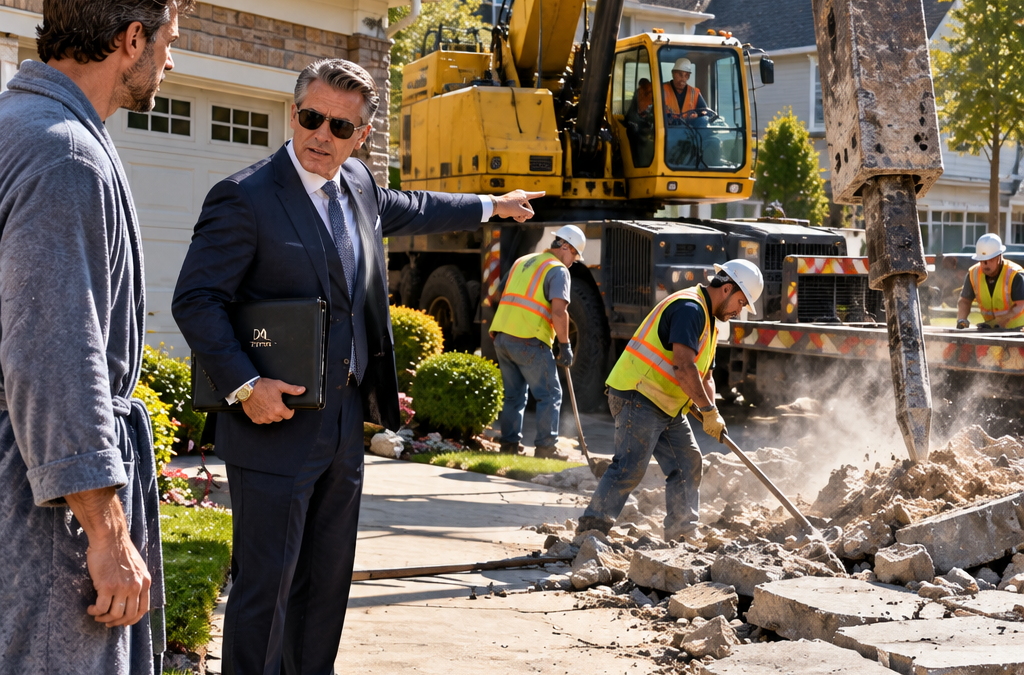
And saw the crane.
It occupied nearly the entire width of the cul-de-sac.
A long steel boom rose above the neighboring houses.
A flatbed trailer waited behind it.
Workers in reflective vests were unloading equipment beside my driveway.
And Denis Coloulton stood in the middle of the operation, pointing toward my house.
For a moment, my mind refused to accept what I was seeing.
Then everything from the previous weeks came rushing back.
The meeting.
The contractor reference.
The threats.
The final notice.
Lauren joined me at the window.
“Oh my God.”
I grabbed my phone.
“Call Priya,” she said.
“I’m doing it.”
Priya answered on the fourth ring.
“Harris?”
“There’s a crane outside my house.”
Silence.
Then her voice changed.
“Explain exactly what you mean.”
“A crane. Heavy equipment. Workers. Coloulton’s here.”
“Are they on your property?”
“Not yet. They’re setting up at the driveway.”
“Do not physically interfere with them.”
“He’s telling them to remove the concrete.”
“Put me on speaker. Get outside, but keep your distance from the machinery. Ask for the court order or written authorization they claim to have.”
I pulled on my bathrobe.
Lauren caught my arm.
“Harris.”
I turned.
She looked frightened.
Not irritated.
Not frustrated.
Frightened.
“What if they start tearing it up?”
I looked toward the driveway.
“Then they’ll have to do it in front of witnesses.”
I stepped outside with my phone in one hand and a coffee mug in the other.
The morning air smelled of damp grass and diesel exhaust.
The crane engine vibrated through the pavement.
One worker was positioning protective pads beneath a stabilizer.
Another was speaking to the operator beside the cab.
Coloulton stood near the edge of my lawn.
He looked absurdly composed.
Charcoal suit.
Silver watch.
Polished shoes.
Not a wrinkle anywhere.
He turned when he saw me.
“Good morning, Mr. Harris.”
I stopped several feet away.
“What is this?”
He smiled.
“Enforcement.”
I stared at the equipment.
“Enforcement requires a crane?”
“The association is correcting a continuing architectural violation.”
“By destroying my driveway?”
“By removing noncompliant material.”
“Who authorized this?”
“The association.”
“Who on the association?”
He sighed.
“We’ve discussed this repeatedly.”
“No. We’ve discussed fines and notices. You never received board approval to demolish anything.”
“I have discretionary authority.”
“Show it to me.”
His expression hardened.
“Mr. Harris, your opportunity to cooperate has passed.”
He turned toward the operator.
“Proceed with the first section.”
I felt my pulse slam against my ribs.
“Stop.”
The operator looked toward me.
Coloulton waved dismissively.
“Ignore him. He’s the noncompliant owner.”
I stepped closer, stopping well outside the work area.
“That’s my property.”
Coloulton pointed toward the driveway.
“This is HOA property now.”
For a second, I thought I had misheard him.
“What did you say?”
He lifted his chin.
“The association has assumed remediation control over this improvement because you refused to comply.”
I stared at him.
“That’s not how property ownership works.”
“It is how enforcement works.”
“No, Denis. It’s how intimidation works.”
His face tightened.
“You are obstructing authorized work.”
“Do you have a court order?”
He blinked.
I repeated the question.
“Do you have a court order authorizing you to tear up my driveway?”
“The bylaws—”
“Do you have a court order?”
“Mr. Harris—”
“Yes or no?”
His jaw moved.
He didn’t answer.
I turned toward the operator.
“Sir, I’m the homeowner. I haven’t authorized demolition, and the board hasn’t approved it. My attorney is on the phone.”
The operator was a broad-shouldered man in his fifties with a weathered face and a fluorescent safety vest.
He took a step away from the crane.
“What’s going on here?”
Coloulton moved toward him.
“This gentleman is in violation of HOA regulations. We have contracted your company to perform corrective work.”
The operator looked at me.
“Are you disputing that?”
“Absolutely.”
He frowned.
“Mr. Coloulton, you told our dispatcher the association had the authority to perform this work.”
“It does.”
Priya’s voice came sharply through the phone.
“May I speak with the contractor?”
I raised the phone.
“You’re on speaker.”
“Sir, my name is Priya Anand. I’m legal counsel for the property owner. This work is disputed, and no consent has been granted by my client. We have initiated emergency legal proceedings regarding unauthorized entry and demolition.”
The operator looked from my phone to Coloulton.
“Do you have the paperwork?”
Coloulton’s eyes flashed.
“I have the contract.”
“Not your contract with us,” the operator said. “The paperwork giving you authority over his driveway.”
Coloulton straightened.
“I’ve already explained.”
“And I’m asking again.”
The operator’s voice had changed.
He wasn’t being rude.
He was being careful.
The kind of careful a man becomes when he realizes he may be standing in the middle of someone else’s lawsuit.
Priya continued.
“Your company has now been informed that the owner disputes authorization for this work. Proceeding without proper legal authority could expose your company to civil liability.”
The operator turned toward his crew.
“Everybody hold position.”
Coloulton spun toward him.
“Excuse me?”
“No work until this gets cleared up.”
“I hired your company.”
“And I intend to get paid for bringing this equipment out here,” the operator said. “But I’m not tearing up a man’s driveway when he says you have no right to touch it.”
Coloulton’s face flushed.
“You are under contract.”
“Then show me the legal authorization.”
“I am the HOA president.”
The operator stared at him.
“That’s not what I asked.”
For the first time since I had met Denis Coloulton, someone outside our neighborhood had refused to treat his title as an answer.
He looked genuinely stunned.
Then his anger returned.
He pointed toward me.
“This homeowner has deliberately defied the association for months. He has been fined repeatedly. He has obstructed our administrative procedures. He has turned a minor architectural violation into a legal spectacle.”
I felt my hands tremble.
Not from fear alone.
From accumulated anger.
All the fines.
All the letters.
All the nights worrying about the house.
The way Caleb had asked whether he’d done something wrong.
The way Lauren had tried to hide her concern when another envelope arrived.
And now this man stood in my yard portraying himself as the victim.
“You want to talk about spectacles?” I asked.
Coloulton turned toward me.
“Excuse me?”
“You brought a crane into a residential street at seven in the morning to destroy a driveway over a shade of gray.”
“This could have been avoided.”
“Yes,” I said. “It could have.”
His mouth tightened.
“You should have complied.”
I looked directly at him.
“No. You should have followed the law.”
By then, several neighbors had come outside.
Ruth stood on her porch holding her phone.
Thomas Reed, the board member from the meeting, was walking quickly toward us.
Other residents watched from driveways and front steps.
Some were recording.
Coloulton noticed them.
His posture changed.
He straightened his tie and adopted his familiar public smile.
“Ladies and gentlemen, please understand that the association is simply maintaining community standards.”
Thomas stopped beside the crane.
“Denis, what are you doing?”
“Thomas. Good morning.”
“Why is there heavy equipment here?”
“We’re performing authorized remediation.”
Thomas stared at him.
“Authorized by whom?”
“The association.”
“No,” Thomas said. “We didn’t vote.”
Coloulton’s smile disappeared.
“Emergency enforcement doesn’t require a separate vote.”
“Where does it say that?”
“Thomas, this is not the time.”
“It’s exactly the time.”
The other board member, Elaine, arrived a moment later.
She looked at the equipment, then at my driveway.
“Denis, tell me this isn’t what it looks like.”
He turned toward her.
“I am protecting the association from a homeowner who has repeatedly refused to meet our standards.”
Elaine’s voice rose.
“You can’t just demolish his driveway.”
“Don’t tell me what I can and cannot do.”
The words came out louder than he intended.
Everyone heard them.
Coloulton looked around.
His face changed as he realized the audience he had once controlled was now watching him lose control.
He lowered his voice.
“I am acting within my authority.”
Thomas shook his head.
“You told us at the meeting no final action had been taken.”
“It hadn’t.”
“Then why did you hire a crane?”
“Because time was running out.”
“Running out for what?”
Coloulton didn’t answer.
Ruth moved closer.
“For him to prove you’re a liar?”
“Mrs. Bennett,” Coloulton snapped, “this matter does not concern you.”
“Oh, I think it concerns all of us.”
A low murmur moved through the neighbors.
I looked toward Ruth.
She was still holding her phone.
Her hand shook slightly, but her voice didn’t.
“You fined me for a flowerpot. You fined the Millers because their holiday lights stayed up one extra day. You fined Harris for a mailbox that looked exactly like everybody else’s. And now you’re bringing demolition equipment into our street?”
“Those were legitimate violations.”
“Then why didn’t you fine yourself when your driveway had the same color difference?”
Coloulton went still.
A few heads turned toward him.
Ruth lifted her phone.
“I still have your email, Denis.”
His expression became cold.
“You are deliberately misrepresenting association decisions.”
“No,” she said. “I’m remembering them.”
Priya spoke through my phone.
“Harris, I need you to listen carefully.”
I moved it closer.
“The court has issued temporary emergency relief. The signed order is being transmitted for service and delivery to the parties.”
I closed my eyes for half a second.
The restraining order.
We had been trying to stop this before Coloulton made his move.
And now the court had acted.
“What does it say?” I asked.
“It prohibits the association and its agents from entering your property to conduct the disputed remediation or damaging the driveway pending further proceedings.”
I looked toward Coloulton.
He was still arguing with Thomas.
“Can you tell him?”
“Yes.”
I raised the phone.
“Denis.”
He ignored me.
“Denis.”
He turned sharply.
“What?”
“Priya has something you need to hear.”
Her voice came through clearly.
“Mr. Coloulton, the court has issued an emergency restraining order prohibiting the disputed demolition activity. You and the contractors must not proceed with the work.”
Coloulton stared at the phone.
Then he laughed.
A short, angry sound.
“How convenient.”
“The order is being formally served.”
“I haven’t received anything.”
“You will.”
He looked toward the operator.
“This is an intimidation tactic. We have a signed contract.”
The operator folded his arms.
“Nobody’s moving that machine.”
Coloulton stepped closer to him.
“I will hold your company responsible for breach of contract.”
“Fine,” the operator said. “Have your lawyer call mine.”
Coloulton’s face turned a dark, mottled red.
For several seconds, he seemed unable to decide whom to threaten next.
Then he turned on me.
“You think you’ve won something?”
I stood still.
“I think my driveway is still here.”
“This isn’t over.”
“No,” I said. “It isn’t.”
His eyes narrowed.
“You have no idea what you’ve started.”
I thought about the financial records sitting in Priya’s office.
The invoices.
The unexplained payments.
The company connected to his husband.
He had no idea how true that sentence was.
I didn’t tell him.
There was no reason to.
Twenty minutes later, a sheriff’s deputy pulled into the cul-de-sac.
The sight of the patrol vehicle made my stomach tighten instinctively.
For weeks, I had worried that Coloulton might somehow use his position to convince authorities I was the one causing trouble.
He had already turned every disagreement into a formal accusation.
But the deputy didn’t approach me first.
He walked toward Coloulton.
“Mr. Denis Coloulton?”
Coloulton straightened immediately.
“Yes. I’m the president of the homeowners association.”
The deputy nodded.
“I have court documents for you.”
The smile vanished.
He handed Coloulton the papers.
“These relate to an emergency restraining order concerning this property.”
Coloulton stared at the first page.
Then he looked toward the deputy.
“This is a civil dispute.”
“Yes, sir.”
“I have enforcement authority under our bylaws.”
“The court order addresses what can happen while that dispute is being resolved.”
Coloulton flipped through the pages.
“I need to speak with our attorney.”
“You’re free to do that.”
“I intend to challenge this.”
“That’s a matter for the court, sir. In the meantime, you need to comply with the order.”
The deputy’s voice remained calm.
No dramatic accusation.
No handcuffs.
No shouting.
Just the simple reality Coloulton had spent months avoiding.
Someone with actual legal authority had told him no.
And this time, he couldn’t overrule the answer.
Around us, neighbors continued filming.
Ruth stood a few feet away, her expression unreadable.
Thomas and Elaine watched in silence.
The crane operator walked back toward his crew.
“Pack it up,” he called.
The workers began securing equipment.
The sound of metal chains echoed through the street.
Coloulton looked at me one last time.
His face was tight with humiliation.
“You’ve embarrassed this entire community.”
I shook my head.
“No, Denis.”
I looked toward the neighbors gathered around us.
“You’ve embarrassed yourself.”
He stepped closer.
For a moment, I thought he might actually try to push past the deputy and confront me.
But then he saw the phones.
He saw Thomas watching.
He saw the crew packing up.
And he stopped.
The deputy glanced toward him.
“Sir, I’d suggest you give everyone some space.”
Coloulton stared at me for another second.
Then he turned and walked toward his sedan.
His polished shoes clicked against the pavement.
He opened the driver’s door, threw the papers onto the passenger seat, and climbed inside.
A moment later, the engine started.
He drove away without looking back.
I stood in the driveway listening to the crane crew secure the last piece of equipment.
My hands were shaking.
Lauren came outside.
She had changed into jeans and a sweatshirt.
Emma and Caleb stood just inside the doorway behind her.
She walked straight toward me.
“Are you okay?”
I nodded.
But when she put her arms around me, something inside my chest loosened.
I hadn’t realized how close I had been to losing control.
Not physically.
Emotionally.
I had spent months trying to be reasonable while a man with a title tried to make me feel as though I didn’t have the right to protect my own home.
And now the machinery was leaving.
The driveway remained untouched.
Lauren held me for several seconds.
Then she stepped back and looked at the concrete.
“All this,” she whispered, “over a driveway.”
I looked toward the end of the street.
“No,” I said.
“It was never just the driveway.”
The emergency order stopped the demolition.
But it didn’t end the fight.
In some ways, the next week was even more difficult.
The crane company’s invoice became another issue.
Coloulton had signed the contract in the association’s name.
Now the vendor wanted payment for mobilization, equipment transportation, and crew time.
The operator had done the right thing by refusing to proceed, but his company had still incurred costs.
And the contract had been signed by the HOA president.
Thomas called me two days later.
“Harris, we’ve got a problem.”
“What kind?”
“Denis committed association funds to the demolition job without board approval.”
“How much?”
“Enough that people are going to be furious.”
I sat down.
“Is he still claiming authority?”
“Of course.”
Thomas sounded exhausted.
“He says the board delegated enforcement responsibilities to him years ago.”
“Did it?”
“Not that anyone can find.”
I thought about Coloulton’s polished speeches.
His insistence that rules were rules.
His certainty that anything he wanted must somehow be authorized.
“What are you going to do?”
“We’ve called a special board meeting.”
“Is he attending?”
“He says he is.”
Thomas paused.
“Harris, I need to tell you something else.”
I waited.
“We’ve been looking at the financial records.”
My stomach tightened.
“What did you find?”
“More questions than answers.”
He didn’t elaborate.
He didn’t have to.
By then, Priya had already submitted the vendor concerns to the appropriate oversight authorities.
We were careful not to turn suspicions into accusations.
But the records were substantial.
And now two board members who had once accepted Coloulton’s recommendations were asking questions of their own.
The atmosphere in Willow Creek changed almost overnight.
People who had previously avoided discussing the HOA began talking openly.
Ruth organized a small gathering in her backyard.
Several residents brought copies of violation notices.
One man had been fined for a garden border that existed when he bought his house.
Another family had been threatened with legal fees over an exterior light fixture that had been approved three years earlier.
A retired couple described paying hundreds of dollars to resolve an alleged landscaping violation without ever receiving a clear explanation.
As I listened, I felt an uncomfortable combination of anger and guilt.
Anger because the pattern was broader than I had imagined.
Guilt because I had spent months believing the problem was mine alone.
Ruth noticed my expression.
“Don’t do that,” she said.
“Do what?”
“Look like you’re responsible for everybody else’s silence.”
I looked across her yard.
“Why didn’t anyone speak up sooner?”
“Some did.”
“What happened?”
“They were told they were troublemakers.”
She glanced toward the other neighbors.
“Most people just want to live in peace. They don’t want every disagreement to become a fight.”
I thought about the first mailbox fine.
How easily I had paid it.
How relieved I’d been to make the issue disappear.
“That’s what he counted on,” I said.
Ruth nodded.
“Exactly.”
The following week, Priya called with news.
The state office responsible for reviewing certain HOA complaints had opened a formal inquiry into the reported financial irregularities.
Investigators were requesting additional documentation concerning the vendor payments and related approvals.
I was in my office when she told me.
For a moment, I couldn’t speak.
“Does that mean they believe money was stolen?”
“Not yet,” she said. “An investigation means the concerns warrant examination. We need to let the evidence speak.”
“Will they contact Denis?”
“They’ll contact the relevant parties.”
I leaned back.
“And the driveway?”
“The temporary order remains in place, and we will continue pursuing appropriate relief against the threatened enforcement.”
I looked at the stack of loan files on my desk.
I should have felt triumphant.
Instead, I felt tired.
The fight had consumed so much of our family’s life that even good news carried the weight of everything that had happened before it.
Priya seemed to understand.
“Harris, I want you to know something.”
“What’s that?”
“You’re not required to prove every financial allegation to establish that your property rights were violated. Those are separate issues.”
I thought about Coloulton’s repeated threats.
The machinery.
The children standing in the doorway.
“I know.”
“Good. Because I don’t want you feeling responsible for carrying the entire investigation on your shoulders.”
I thanked her.
Then I went home early.
Caleb was in the backyard bouncing a basketball.
When he saw me, he stopped.
“Hey, Dad.”
“Hey, buddy.”
He looked toward the driveway.
“Can we put the hoop back?”
I hesitated.
The dispute wasn’t fully resolved yet.
But I was tired of making my children wait for permission to enjoy their own home.
“We’ll talk about it after the court stuff is finished,” I said.
Caleb nodded.
Then he surprised me.
“That HOA man isn’t coming back with the big truck, is he?”
I felt something twist inside me.
“No,” I said. “He’s not.”
“You promise?”
I looked at my son.
I couldn’t promise that unpleasant people would never cause trouble.
I couldn’t promise that a court order would erase every problem.
But I could promise that I would never again stand aside while someone tried to frighten my family out of its rights.
“I promise I’ll do everything I can to keep our home safe.”
He considered that.
Then he handed me the basketball.
“Want to play?”
I took it.
“Absolutely.”
We played in the backyard until the sun began dropping behind the fence.
For the first time in weeks, I went an entire hour without thinking about Denis Coloulton.
The special board meeting took place the following Thursday.
This time, the clubhouse was packed.
People stood along the walls.
Several residents had brought folding chairs from home.
The mood was different from the previous meeting.
There was no quiet deference.
No nervous laughter.
No assumption that Coloulton would explain everything and everyone would go home.
People wanted answers.
He arrived ten minutes before the scheduled start.
Still immaculate.
Still controlled.
A dark gray suit, a crisp shirt, a silver tie.
His hair was perfect.
His expression was not.
He walked toward the front table carrying a leather briefcase.
Thomas was already there.
So was Elaine.
Coloulton placed his briefcase beside the president’s chair.
Thomas spoke quietly.
“Denis, we need to discuss the agenda.”
Coloulton didn’t look at him.
“I have prepared the meeting.”
“The agenda was approved by the board.”
“I am the president.”
“And the board is not your personal staff.”
Several people nearby heard that.
Coloulton turned sharply.
“What did you say?”
Thomas held his gaze.
“We’re following the bylaws tonight.”
I watched from the second row.
Priya sat beside me.
She leaned close enough to whisper.
“That’s new.”
I nodded.
Coloulton wasn’t accustomed to being challenged before he had even opened a meeting.
When proceedings began, Thomas addressed the room.
“The board has received numerous member concerns regarding enforcement procedures, vendor contracts, and recent expenditures.”
Coloulton interrupted.
“These accusations are being promoted by disgruntled homeowners.”
Thomas continued.
“We have also learned that a demolition contractor was engaged for work on privately owned property without a recorded board vote authorizing that expenditure.”
The room stirred.
Coloulton leaned toward the microphone.
“That action was within my delegated authority.”
Elaine opened a binder.
“We’ve reviewed the delegation records. We haven’t found authorization for unilateral demolition of an owner’s property.”
“Because you don’t understand the administrative framework.”
Elaine looked at him.
“Then explain it.”
He stared at her.
She waited.
“Show us the provision,” she said.
It was the same question Priya had asked.
The same question the crane operator had asked.
The same question I’d asked in my bathrobe.
And once again, Coloulton had no answer that matched the authority he claimed.
Instead, he attacked.
He accused Thomas of disloyalty.
He accused Elaine of undermining board unity.
He accused residents of spreading misinformation.
He accused Priya of manufacturing litigation.
And finally, he pointed directly at me.
“This entire crisis began because one homeowner refused to respect community standards.”
I felt Lauren’s hand tighten around mine.
For a moment, I considered staying silent.
I had already spoken at the previous meeting.
Priya had already presented the governing documents.
The board now had its own responsibilities.
But then Coloulton looked at me and added, “Mr. Harris has systematically attempted to destabilize this association because he believes the rules should not apply to him.”
I stood.
The room grew quiet.
Coloulton’s eyes narrowed.
“Here we go again.”
I looked at him.
“You’re right about one thing, Denis.”
He folded his arms.
“This did begin with my driveway.”
I paused.
“But not because I thought I was above the rules.”
I looked around the room.
“I paid every fine you sent me. The mailbox. The trash cans. The basketball hoop. I followed the rules because I believed that’s what good neighbors do.”
Several residents nodded.
“Then I repaired a crack in my driveway using an approved contractor. You decided the concrete was the wrong shade. I asked for clarification. You threatened a lien. I appealed. You denied it without letting the board hear the appeal.”
I turned back toward him.
“When my attorney challenged your authority, you tried to persuade the board to approve demolition. When that failed, you hired a crane and came to my house at seven in the morning.”
Coloulton opened his mouth.
I continued before he could interrupt.
“My wife was afraid. My children were afraid. And you stood on my lawn telling a contractor that my driveway belonged to the HOA.”
The room was completely silent.
I could hear the air conditioner humming above us.
“I didn’t start this because I wanted special treatment.”
My throat tightened.
“I started defending myself because I finally realized you weren’t going to stop.”
I looked toward Thomas and Elaine.
“And if the board had allowed you to destroy my driveway, whose house would have been next?”
No one answered.
They didn’t need to.
Coloulton’s face had gone pale beneath its carefully maintained tan.
He adjusted his cuffs.
“An emotional speech doesn’t change the legal requirements.”
Priya stood beside me.
“Neither does pretending authority exists when the documents say otherwise.”
Thomas raised a hand.
“Let’s return to the agenda.”
Coloulton turned toward him.
“You are allowing this meeting to be hijacked.”
Thomas’s voice remained steady.
“No, Denis. We’re allowing the members to be heard.”
Then he addressed the room.
“The board will vote on a motion to remove Mr. Coloulton from the presidency and suspend his authority to act on behalf of the association pending further proceedings.”
The room erupted.
Some residents gasped.
Others began talking at once.
Coloulton stood so suddenly that his chair scraped against the floor.
“You cannot do that.”
Thomas looked down at the governing documents.
“We can take the actions authorized by our bylaws.”
“I built this association.”
“No,” Elaine said.
Her voice was quiet, but everyone heard it.
“You were elected to serve it.”
Coloulton stared at her.
For a moment, I saw something underneath the expensive suit and carefully controlled expression.
Not confidence.
Not leadership.
Fear.
The fear of a man who had confused holding power with being entitled to it.
His voice dropped.
“After everything I’ve done for this community?”
Elaine shook her head.
“That’s what we’re trying to understand.”
The vote proceeded.
The motion passed.
Coloulton was removed from his leadership position under the association’s governing procedures, with his remaining board status addressed through the required removal process.
He stood at the front of the room, motionless.
Then he closed his briefcase.
The click sounded unusually loud.
“You’ll regret this,” he said.
Thomas didn’t respond.
Coloulton looked toward me.
I met his eyes.
He seemed to be searching for something.
Fear.
Anger.
An excuse for one final confrontation.
I gave him none of it.
He walked out.
And for the first time in the years he had controlled Willow Creek, nobody stood to follow him.
The financial investigation continued after his removal.
Over the following weeks, the board hired an independent accountant to review the association’s records.
The examination focused on vendor contracts, reserve fund expenditures, invoice approvals, and payments to Coloulton Property Solutions.
The more records the board examined, the more serious the concerns became.
Invoices existed for landscaping services that residents couldn’t remember seeing.
Payment authorizations were recorded without adequate supporting documentation.
Contracts involving the company connected to Coloulton’s husband raised questions about conflicts of interest and whether required disclosures had been made.
The board also discovered that some landscaping charges had been described in ways that made them difficult to match to actual work.
It wasn’t simply an issue of poor communication anymore.
It was a financial accountability problem.
At one point, Thomas called me after a particularly difficult board session.
“I don’t know how we let this happen,” he said.
I sat in my garage, looking at the basketball hoop.
“Did anyone question the invoices?”
“Not enough.”
“Why?”
Thomas was quiet.
Then he said, “Because Denis always had an answer.”
I knew exactly what he meant.
Coloulton spoke with the certainty of someone who expected his confidence to substitute for proof.
He used formal language.
He referenced bylaws.
He spoke about fiduciary duties and community protection.
Most people assumed that a man who sounded so certain must know what he was doing.
And whenever anyone questioned him, he made the question itself seem irresponsible.
That was how he operated.
He turned ordinary uncertainty into submission.
“He made everybody feel like challenging him was a violation,” I said.
Thomas sighed.
“Yeah. That’s about right.”
The board provided additional records to the state investigators.
Potential embezzlement involving payments to Colton Property Solutions became one of the matters under examination.
I never pretended I knew what a prosecutor would eventually decide.
An investigation isn’t a conviction.
But I knew the difference between an honest accounting error and a president who had spent months hiding information while using enforcement powers to intimidate homeowners.
And the investigators now had a substantial record to examine.
Within a month of the crane incident, Coloulton was no longer serving on the board.
The association’s new leadership formally withdrew the driveway violation.
The threatened lien was abandoned.
The proposed remediation was canceled.
The board also reviewed the disputed fines that had been imposed against my property.
The earlier mailbox, trash can, and basketball hoop penalties were reversed after review found that enforcement had been inconsistent or procedurally defective.
I received written confirmation.
I held the letter in my hands for a long time.
There was no dramatic language.
No grand apology.
Just a statement acknowledging the withdrawal of the violations and the correction of my account.
But after months of fear, those ordinary words felt extraordinary.
I no longer owed the association money for refusing to destroy a perfectly functional driveway.
No contractor could be dispatched to remove it under Coloulton’s invented authority.
And no president could threaten my home over that concrete without facing the procedures and legal limits that Coloulton had tried to ignore.
Priya called after receiving the board’s confirmation.
“Well,” she said, “your driveway appears to have survived.”
I laughed.
It was the first genuine laugh I’d had about the situation in a long time.
“Just barely.”
“How are you feeling?”
I looked out the window.
The concrete was exactly where it had always been.
“Strangely tired.”
“That’s understandable.”
“I thought I’d feel happier.”
“You’ve been under sustained pressure. Relief doesn’t always arrive as excitement.”
I thought about the morning of the crane.
The workers.
The deputy.
Coloulton standing in my yard.
“I keep replaying it,” I admitted.
“The demolition?”
“Yeah.”
“What part?”
“The moment he told the operator my driveway belonged to the HOA.”
Priya was quiet.
Then she said, “People can make extraordinary claims when they’re accustomed to not being challenged.”
I watched Caleb ride his bicycle past the garage.
“He really believed it.”
“Perhaps.”
“That’s what scares me.”
“What?”
“That he didn’t even need to think about whether he had the right. He just assumed he did.”
Priya paused.
“Which is why the documents mattered. And why you challenged him through the proper channels.”
I looked at the letter in my hand.
“Thank you.”
“You’re welcome, Harris.”
I meant it more deeply than I could express.
Priya hadn’t just prevented a demolition.
She had given my family a way to resist someone who had convinced us resistance was pointless.
That weekend, I took Caleb’s basketball hoop out of the garage.
He was standing beside me when I rolled it onto the driveway.
“Are we allowed?” he asked.
The question hit harder than I expected.
I stopped.
For months, he had watched adults argue about what we could and couldn’t do on our own property.
He had learned to associate our driveway with rules, fines, and fear.
I hated that.
I crouched beside him.
“Buddy, do you remember why we put this away?”
“Because the HOA man said it was ugly.”
“Right.”
“Is he still the boss?”
I looked toward the street.
“No.”
Caleb thought about that.
“Then who’s the boss?”
I smiled.
“Nobody gets to be the boss of everybody just because they want to.”
He considered that answer seriously.
Then he looked at the hoop.
“So we can play?”
I stood.
“Get the ball.”
He ran toward the garage so fast that I barely had time to finish the sentence.
We played for nearly an hour.
Emma joined us.
Lauren sat on the front steps, laughing whenever I missed an easy shot.
At one point, Caleb threw the ball too hard and it bounced across the driveway toward the street.
I chased after it.
When I bent to pick it up, I noticed the seam between the newer and older concrete.
There it was.
The famous color difference.
A faint line separating two ordinary shades of gray.
I stared at it.
For months, that little difference had threatened to consume our savings.
It had brought lawyers into our lives.
It had filled our kitchen with notices.
It had nearly brought a demolition crew onto our property.
And now it looked almost absurdly insignificant.
I rolled the basketball between my hands.
Then I went back to the game.
A few days later, Ruth knocked on our front door.
She was holding a glass pitcher of lemonade and a plate of cookies.
“I figured a household that’s been through a war deserves refreshments,” she said.
Lauren laughed and invited her inside.
We carried the lemonade out to the front porch.
The evening was warm.
A light breeze moved through the trees.
Children were riding bicycles farther down the street.
Someone was grilling in a backyard.
The air smelled faintly of cut grass and charcoal.
It was the kind of evening I had imagined when we bought the house.
Ruth handed me a glass.
“How’s the concrete?”
I looked at the driveway.
“Still gray.”
She laughed.
“Scandalous.”
We sat together for a while.
Then Ruth grew quiet.
“You know, I almost didn’t tell you about Denis’s driveway.”
I turned toward her.
“Why not?”
“Because I was afraid.”
I looked at her.
Ruth Bennett had never struck me as someone easily frightened.
She had taught hundreds of children, survived difficult years, raised a family, and lived alone with the quiet confidence of someone who knew how to take care of herself.
“Of him?”
She nodded.
“Not physically. I wasn’t afraid he’d hurt me. I was afraid he’d make living here miserable.”
I thought about that.
“He was good at it.”
“Very.”
She looked toward the street.
“People like that don’t always need to destroy anything. Sometimes they just need you to believe they could.”
I stared at my lemonade.
That was exactly what Coloulton had done.
He had threatened our home long before the crane arrived.
He had made ordinary life feel conditional.
Conditional on whether he approved.
Conditional on whether we obeyed.
Conditional on whether we were willing to absorb another fine, another insult, another demand.
And eventually, he had stopped pretending the threats were enough.
He had brought machinery.
Ruth touched my arm.
“You did a good thing, Harris.”
“I just wanted him to leave my family alone.”
“Sometimes that’s where good things begin.”
I looked toward the driveway.
Caleb and Emma were drawing with sidewalk chalk.
They had covered part of the concrete with crooked flowers, bright stars, and a large blue dinosaur that looked more like a confused lizard.
Lauren was watching them from the steps.
The basketball hoop stood near the garage.
Nothing about the scene was impressive.
No expensive landscaping.
No perfectly coordinated exterior colors.
No architectural perfection.
Just a family using the space it owned.
And for the first time in a year, I didn’t find myself wondering whether someone was watching from a black sedan with a clipboard.
The neighborhood itself began to change after Coloulton’s departure.
Not overnight.
There were still board meetings.
There were still disagreements.
There were still maintenance assessments and ordinary community responsibilities.
The association didn’t disappear, and I didn’t want it to.
I had never believed that living in a neighborhood meant ignoring everyone else’s interests.
But the new board began doing something that had once seemed almost revolutionary.
It explained its decisions.
Meeting minutes became easier for residents to access.
Vendor contracts received closer review.
Financial summaries included clearer descriptions.
Residents were given meaningful opportunities to raise concerns before enforcement disputes escalated.
The board also reviewed its appeals process so that no president could quietly deny a homeowner’s request for review without following the required procedures.
None of those changes was glamorous.
They didn’t make headlines.
But they mattered.
Because the real danger Coloulton had posed wasn’t his expensive clothes or his sharp tongue.
It was the way he had turned a community institution into an extension of his personality.
When he wanted something, he called it a rule.
When someone resisted, he called it noncompliance.
When questioned, he called himself the association.
And when the board finally challenged him, he treated oversight as betrayal.
I thought about that whenever someone asked why I hadn’t simply replaced the driveway.
It would have been easier, perhaps.
At least in the beginning.
We could have borrowed money.
Used our emergency savings.
Hired another contractor.
Destroyed good concrete to satisfy one man’s demand.
But I knew now that it wouldn’t have ended there.
There would have been another notice.
Another photograph.
Another deadline.
Because Coloulton wasn’t pursuing a perfect driveway.
He was pursuing unquestioned control.
And the only reason the pattern ended was that enough people finally insisted on seeing the authority he claimed to possess.
Months later, I found the original mailbox violation notice while cleaning out a desk drawer.
Two hundred dollars.
Unauthorized exterior color deviation.
I held it beside the HOA’s written decision reversing the charge.
The contrast made me smile.
On one page, a man had declared that my white mailbox post violated the neighborhood’s standards.
On the other, the association admitted the penalty should not have stood.
I put both papers into the same folder.
Not because I intended to spend the rest of my life reliving the fight.
But because I wanted a record of what had happened.
A reminder that official letterhead isn’t the same thing as lawful authority.
That a confident voice doesn’t make a false claim true.
And that a man in an expensive suit can still be nothing more than a bully standing on someone else’s lawn.
The questions surrounding Coloulton Property Solutions remained with the investigators, who would determine what the evidence supported. I had no interest in inventing a final verdict or pretending an accusation was a conviction.
His removal from the board was already a concrete consequence.
The investigation was real.
The association was correcting its practices.
And my family was no longer living under his threats.
That was enough for me to begin moving forward.
One Saturday morning, I woke just after seven.
For a second, the rumble of a delivery truck passing on the main road made my heart jump.
I lay still, remembering hydraulic machinery and steel chains.
Then I heard Caleb laughing downstairs.
Lauren was making pancakes.
Emma was complaining that her brother had used the last of the syrup.
Ordinary noises.
The sounds of a home where people felt safe enough to argue about breakfast.
I went to the bedroom window.
Sunlight stretched across the cul-de-sac.
A neighbor was watering her flowers.
Another was walking his dog.
Ruth stood near her mailbox speaking with Thomas.
My driveway lay beneath the morning light, faintly uneven in color, completely undamaged.
No crane.
No crew.
No man in a tailored suit claiming authority over it.
I stood there for a moment.
Then I went downstairs.
Later that morning, Caleb asked me to play basketball.
I stepped outside with him.
He bounced the ball twice and passed it toward me.
I caught it near the exact spot where Coloulton had ordered the demolition to begin.
“Ready, Dad?”
I looked at the hoop.
Then at my son.
“Ready.”
He grinned.
I took the shot.
The ball struck the backboard, circled the rim, and dropped through.
Caleb cheered.
I laughed.
And somewhere behind us, the neighborhood carried on with its ordinary Saturday morning.
That was what I had wanted from the beginning.
Not revenge.
Not a public spectacle.
Not the satisfaction of watching someone fall.
Just the right to come home, park my car, play basketball with my children, and live without wondering whether an HOA president was preparing another punishment.
Denis Coloulton had spent years acting as though Willow Creek belonged to him.
But the morning his crane stopped at the edge of my driveway, the neighborhood finally began remembering something important.
The association existed to serve the homeowners.
The homeowners did not exist to serve its president.
I looked down at the pale strip of repaired concrete beneath my shoes.
It was still a slightly different shade of gray.
It probably always would be.
And I had never been happier to leave something exactly the way it was.








