𝗙𝗨𝗟𝗟 𝗦𝗧𝗢𝗥𝗬 The HOA President Sent a Bulldozer Toward My Grandfather’s Oak Tree and Demanded I Surrender the Land He Left Me
𝗣𝗔𝗥𝗧 𝟮
I remember squeezing his hand.
I told him not to worry.
I told him nobody was going to take the house.
I meant it.
But I had no idea what kind of fight he was trying to prepare me for.
After the funeral, I moved into the cottage permanently.
I was thirty-four, working remotely as a project coordinator, and exhausted from years of apartment living.
I had imagined the inheritance would give me a chance to rebuild my life somewhere familiar.
The cottage needed work.
The porch steps were uneven.
The kitchen cabinets were old.
The back fence leaned in several places.
But the windows let in beautiful morning light, and the air smelled of wet grass whenever it rained.
On my first morning there, I carried a cup of coffee onto the porch and listened to the birds.
For the first time in months, I felt peaceful.
That peace lasted approximately forty-eight hours.
Karen Whitfield arrived on my second day.
I found her standing near my mailbox with a metal tape measure extended across the lawn.
She was a tall woman in her late fifties, dressed in tailored cream-colored slacks, a pale pink blouse, and expensive shoes entirely unsuitable for walking through grass.
Her blond hair was arranged in a rigid shoulder-length style that didn’t move when the breeze picked up.
Pearl earrings matched the necklace at her throat.
She carried a leather clipboard against one hip and wore the confident expression of someone accustomed to making other people nervous.
When she saw me, she didn’t introduce herself.
She looked at the grass.
“Five and three-quarter inches.”
I blinked.
“Excuse me?”
She straightened.
“Your lawn. Five and three-quarter inches.”
I looked at the tape measure.
“Okay?”
“Our standard is six inches.”
I glanced at the grass.
Then at her.
“Isn’t five and three-quarter inches less than six?”
Her expression tightened.
“Certain blades exceed the measurement when fully upright.”
I stared at her.
“Are you serious?”
She snapped the tape measure closed.
“Very.”
I almost laughed.
Actually, I did laugh.
Not because I intended to insult her.
Because I genuinely thought she was joking.
She looked offended.
“I’m Karen Whitfield, president of the Willow Creek Estates Homeowners Association.”
“Elena Rodriguez.”
“I know who you are.”
That unsettled me slightly.
She continued.
“Your grandfather was a difficult man when it came to community cooperation.”
My smile disappeared.
“My grandfather lived here before the subdivision existed.”
“Precisely the sort of attitude that created unnecessary tension.”
I folded my arms.
“What can I help you with, Mrs. Whitfield?”
“Karen is fine.”
She made a mark on her clipboard.
“I’m conducting a compliance inspection.”
“Of my property?”
“Of properties affecting the appearance of Willow Creek Estates.”
I looked toward the subdivision.
My cottage sat beyond the main row of houses, separated from the development by an older property boundary.
“I don’t belong to the HOA.”
Karen smiled.
“That’s a common misunderstanding.”
“No. My grandfather never joined.”
“Your property benefits from the surrounding community.”
“That doesn’t make it part of the association.”
Her smile sharpened.
“I’m sure we can resolve your confusion before it becomes expensive.”
She turned and walked away.
I stood beside the mailbox, watching her climb into a spotless white SUV parked along the road.
At the time, I thought she was simply an unpleasant neighbor with too much free time.
Four days later, a certified letter arrived.
The envelope bore the Willow Creek Estates HOA seal.
Inside was a formal violation notice.
Lawn maintenance noncompliance.
Fine: two hundred dollars.
I read it twice.
Then I called the number at the bottom.
Karen answered.
“Willow Creek Estates.”
“This is Elena Rodriguez.”
“Yes, Elena.”
“I received a fine for my grass.”
“Correct.”
“My property isn’t part of your HOA.”
There was a pause.
Then she sighed.
“Your grandfather made that argument repeatedly.”
“Because it’s true.”
“Elena, the association has authority over properties that affect our common areas.”
“Can you show me where that authority comes from?”
“It’s addressed in our governing documents.”
“Then send me the section.”
Her tone cooled.
“We do not provide individualized legal education to homeowners who refuse to cooperate.”
I gripped the phone.
“I’m not refusing to cooperate. I’m asking you to explain why you’re fining me.”
“Because you violated community standards.”
“Standards I never agreed to.”
“Then perhaps you should have considered that before accepting the inheritance.”
I couldn’t believe what I was hearing.
For a moment, I simply stood in my kitchen staring at the wall.
Then Karen spoke again.
“Payment is due within fourteen days. Additional penalties may apply.”
She hung up.
I should have contacted an attorney immediately.
I know that now.
But grief makes ordinary decisions feel heavier than they should.
I had funeral expenses, repairs, work deadlines, and a house full of my grandfather’s belongings that I could barely bring myself to sort.
Two hundred dollars felt like an outrageous nuisance.
It didn’t yet feel like the beginning of a campaign to take my land.
So I paid.
I told myself it was cheaper than fighting.
That decision was the first thing Karen learned about me.
I was willing to pay money to make an unpleasant situation disappear.
She interpreted that as weakness.
The next violation arrived eight days later.
Mailbox color.
According to Karen, the red flag on my grandfather’s old metal mailbox was not the approved shade.
I called again.
“Karen, this mailbox has been here for twenty years.”
“Then it’s twenty years overdue for correction.”
“It’s a mailbox.”
“It’s a visible architectural feature.”
I paid the fine.
Then came the shed.
My grandfather’s small wooden tool shed sat behind the cottage, partly concealed by climbing vines.
Karen claimed it lacked architectural approval.
I submitted photographs showing that the structure predated Willow Creek Estates.
She rejected them.
“Historical existence does not establish current compliance.”
Two weeks later, she fined me for an unapproved wind chime.
That one hurt more than I expected.
It was a small brass wind chime hanging beside the porch.
My grandmother had bought it years before she died.
My grandfather never took it down.
Even when the metal began to discolor, he kept it hanging where the breeze could catch it.
I could still remember him sitting outside beneath its gentle ringing.
Karen called it an unauthorized noise-producing ornament.
I stood on the porch holding the notice.
For several minutes, I considered taking it down.
Then I looked at the chime.
I remembered my grandfather’s hands tying the cord around the porch beam after one of the strings had broken.
And I left it where it was.
That was the first fine I refused to pay.
Karen responded by adding late fees.
She also began visiting more frequently.
Sometimes I saw her white SUV parked beside the subdivision entrance.
Other times she walked along the edge of my property, photographing the fence, the shed, or the cottage.
Once, I opened my front door to find her taking pictures of my porch.
“Can I help you?”
She didn’t lower her phone.
“Routine documentation.”
“From my yard?”
“Your property is visible from the community access road.”
“You’re standing beside my front steps.”
She looked down.
Then took one deliberate step backward.
“There. Better?”
I felt heat rise in my face.
“Stop coming onto my property without permission.”
Karen smiled.
“I’m trying to prevent a larger problem, Elena.”
“What larger problem?”
“That depends on how cooperative you decide to be.”
I watched her leave with my stomach twisted into a knot.
That evening, I called a neighbor who lived in Willow Creek Estates and asked about Karen.
The woman lowered her voice immediately.
“Don’t get on her bad side.”
“I think it’s too late.”
She hesitated.
“Karen’s been president for eleven years. Nobody challenges her anymore.”
“Why?”
“Because she makes life miserable for anyone who does.”
“What about the board?”
The woman gave a humorless laugh.
“Karen is the board.”
I didn’t fully understand what she meant.
Not until the contractors arrived.
It happened on a humid afternoon in early summer.
I was working at the kitchen table when I heard a truck engine behind the cottage.
At first, I assumed someone was making a delivery to the subdivision.
Then came the sound of heavy objects hitting the ground.
I walked to the back window.
Three men were unloading lumber from a flatbed truck onto the unfenced rear corner of my property.
One carried a bundle of orange survey stakes.
Another was measuring the ground.
I opened the back door and hurried outside.
“Excuse me!”
The nearest worker looked up.
“Can I help you?”
“What are you doing?”
“Getting ready for the clubhouse extension.”
I stared at him.
“What clubhouse?”
“The Willow Creek community clubhouse.”
I looked toward the neighborhood.
The existing clubhouse stood on association land beyond my property boundary.
It was a one-story building with a small meeting room, restrooms, and a parking lot.
“What does that have to do with my yard?”
The worker glanced at the stakes.
“Ma’am, we’re just following the site plan.”
“Your site plan is on my property.”
A familiar voice answered behind me.
“Actually, Elena, that is precisely what we’re here to clarify.”
Karen Whitfield stood beside her SUV, wearing a white blouse and dark green tailored pants.
Her clipboard was tucked beneath one arm.
I turned toward her.
“Why are there construction workers on my land?”
She smiled.
“The community is expanding its clubhouse facilities.”
“Not on my property.”
“The proposed footprint includes this rear corner.”
“Then the proposal is wrong.”
Karen looked toward the workers.
“Gentlemen, continue unloading.”
I stepped forward.
“Stop.”
The men hesitated.
Karen’s expression hardened.
“Elena, don’t interfere with authorized work.”
“Authorized by whom?”
“The association.”
“This land belongs to me.”
She pulled several documents from her clipboard.
“According to our planning review, the clubhouse expansion requires a minor boundary adjustment.”
“A boundary adjustment?”
“Yes.”
“You can’t adjust somebody else’s property line because you want a bigger building.”
Karen gave a patient little smile.
“Boundaries can be reinterpreted.”
I stared at her.
“No, Karen. They can be surveyed. They can be legally changed. They cannot simply be reinterpreted because you’re standing there with orange stakes.”
One of the workers looked away, clearly uncomfortable.
Karen noticed.
“Please continue,” she repeated.
I stepped between the lumber and my fence.
“Nobody unloads anything else until I see proof that you have a right to be here.”
For a moment, I thought Karen might physically push past me.
Instead, she took out her phone.
“You’re making this unnecessarily difficult.”
“Then show me the deed.”
She stared at me.
I held out my hand.
“Show me the deed that says the HOA owns this corner.”
Her jaw tightened.
“This project was approved through proper channels.”
“That’s not a deed.”
“Elena—”
“Neither is your clipboard.”
The workers stopped unloading.
Karen looked at them, then back at me.
Her smile vanished.
“You are going to regret turning this into a confrontation.”
She ordered the crew to leave their materials.
Then she climbed into her SUV and drove away.
I stood in the backyard shaking with anger.
Orange stakes marked a rectangular section of my land.
Lumber lay near the old fence.
And for the first time, I realized Karen wasn’t simply trying to collect fines.
She wanted something physical.
A piece of my grandfather’s property.
I went inside and opened the folder he had left me.
The deed was old, the paper slightly yellowed, but the legal description was clear.
The rear boundary followed a surveyed line well beyond the corner where the workers had placed their stakes.
I found the accompanying survey.
The clubhouse expansion area was entirely within my property.
Not partly.
Not ambiguously.
Entirely.
I took photographs of the documents, then called the county recorder’s office to confirm the current title information.
The property remained in my name.
There was no recorded conveyance giving the HOA ownership of the disputed corner.
No easement authorizing clubhouse construction.
No boundary agreement.
Nothing.
I emailed Karen the deed and survey.
I kept the message short.
“Your proposed construction area is privately owned land. You do not have permission to enter, grade, build, or store materials on my property. Remove your equipment and stakes immediately.”
She responded the next morning.
“Your objection has been noted. The association will proceed according to its approved development plan.”
Twenty minutes later, I heard machinery behind the cottage.
Construction had resumed.
I ran outside.
The workers had begun removing sections of brush near the boundary.
One was digging a shallow trench.
The contractor showed me a printed site plan bearing the Willow Creek HOA logo.
It depicted the clubhouse expansion extending across my rear lot.
I pointed to the line.
“That’s wrong.”
He shrugged.
“Ma’am, this is what the association gave us.”
“It’s my property.”
“You’ll need to take that up with them.”
I called Karen.
She answered on the third ring.
“Good morning, Elena.”
“Your contractors are digging on my land.”
“Yes. Construction is scheduled.”
“I sent you the survey.”
“And our planning consultant reviewed the situation.”
“Who is your planning consultant?”
She ignored the question.
“You need to understand something. Willow Creek Estates has invested significant resources in this improvement.”
“Then you should have bought land you actually own.”
Her voice dropped.
“Don’t be difficult.”
I looked at the trench.
“Get them off my property.”
“Or what?”
The question was so casual that it took me a moment to answer.
“Or I’ll take legal action.”
Karen laughed.
“Oh, sweetheart. Do you really think you can afford to fight an entire homeowners association?”
Then she hung up.
I stood in the backyard listening to the workers.
For the first time since moving into the cottage, I felt genuinely frightened.
Because Karen wasn’t bluffing about one thing.
Legal battles were expensive.
And I had inherited a modest house, not an unlimited bank account.
That evening, I began examining the HOA records.
The association published newsletters and meeting summaries through an online portal.
I wasn’t a member, but several older newsletters were publicly accessible.
I searched for references to the clubhouse expansion.
The first document I found was a recent announcement claiming the project had received unanimous board approval.
I printed it.
Then I searched older files.
Two years earlier, the same expansion had appeared as a proposed capital improvement.
The minutes recorded objections from homeowners over cost, parking congestion, and property boundary concerns.
The board had voted against the proposal.
Four votes opposed.
Three in favor.
Proposal rejected.
I stared at the page.
Then I compared it with a newer version of the meeting record attached to the current construction packet.
The newer document claimed the expansion had been approved.
It used the same meeting date.
The same list of attendees.
But the voting result was different.
Instead of rejection, it recorded unanimous approval.
Someone had altered the official record.
And the altered version bore Karen Whitfield’s certification.
I felt a cold sensation spread through my chest.
This wasn’t an argument over whether my grass was too tall.
Somebody had rewritten the board’s history to justify building on land the HOA didn’t own.
The following evening, I attended my first Willow Creek board meeting.
The clubhouse was crowded with folding chairs, but almost nobody spoke.
Karen sat at the center of a long table beneath an American flag.
She wore a pale blazer, pearls, and an expression of practiced authority.
When she saw me, she smiled.
“Elena. What a surprise.”
“I have a question about the clubhouse expansion.”
“Questions should be submitted in advance.”
“Then consider this notice.”
Several homeowners turned toward me.
Karen’s eyes narrowed.
“Proceed.”
I held up the original archived minutes.
“The expansion was rejected two years ago.”
Karen folded her hands.
“That’s incorrect.”
“The newsletter archive says four board members voted against it.”
“Our records reflect an updated decision.”
I held up the second document.
“Your updated version uses the same meeting date but changes the vote.”
Karen’s smile remained fixed.
“Administrative corrections are sometimes necessary.”
“You changed a rejected proposal into a unanimous approval.”
A low murmur moved through the room.
Karen tapped her clipboard.
“Be careful with your language.”
“Did the board take another vote?”
She said nothing.
I looked at the other directors.
“Did anyone here approve building the clubhouse on my property?”
One elderly man shifted uncomfortably.
Another board member lowered her eyes.
Nobody answered.
Karen spoke.
“This meeting is not an appropriate forum for personal accusations.”
“Then answer the question.”
Her expression hardened.
“Elena, you are not a member of this association.”
“Exactly. So why are you building on my land?”
The room fell silent.
Karen leaned back.
Then she smiled sweetly.
“Prove it, sweetheart.”
I stared at her.
She continued.
“My word carries considerable weight in this neighborhood.”
I looked around.
Some homeowners avoided my eyes.
Others watched with obvious discomfort.
Nobody spoke.
And in that silence, I finally understood why Karen had survived eleven years in power.
She didn’t need everyone to agree with her.
She only needed them to believe challenging her would make their lives worse.
I left the meeting with the archived minutes in my bag and a sick feeling in my stomach.
Three days later, the lien notice appeared on my door.
It was taped beside the brass wind chime.
The amount stopped me cold.
Nine thousand dollars.
I read the notice while standing on the porch.
The document listed accumulated HOA violations, enforcement penalties, administrative costs, and special assessments.
It claimed the association intended to enforce the debt against my property if I failed to resolve it.
Nine thousand dollars.
For grass.
A mailbox.
A shed.
A wind chime.
And charges I had never authorized or even seen before.
My hands began shaking.
I went inside and called Karen.
She didn’t answer.
Twenty minutes later, her white SUV rolled into my driveway.
I watched from the window as she stepped out carrying another envelope.
She looked almost delighted.
When I opened the door, she smiled.
“Good afternoon, Elena.”
“What is this?”
I held up the notice.
“Your outstanding balance.”
“Nine thousand dollars?”
“Repeated noncompliance becomes expensive.”
“My property isn’t part of your association.”
She sighed.
“We’ve been over that.”
“You have no right to put a lien on my home.”
“That’s a question for legal counsel.”
I stared at her.
She stepped closer.
“Property collection proceedings can be unpleasant. You could lose the entire cottage.”
My throat tightened.
Karen watched my reaction carefully.
Then her voice softened.
“But there’s a simpler solution.”
I said nothing.
She reached into her folder and removed a document.
“A voluntary transfer of the rear corner.”
I looked at the page.
It was a proposed conveyance.
My land.
Her clubhouse.
She placed it on the porch railing.
“Sign this, and I’ll recommend that the association waive your outstanding penalties.”
For several seconds, I couldn’t speak.
Then I looked up.
“You’re threatening my home unless I give you land.”
Karen smiled.
“I’m offering you a reasonable compromise.”
“That’s extortion.”
Her eyes flashed.
“Choose your words carefully.”
“You’re trying to force me to sign over property that belongs to my family.”
“Elena, that corner serves no meaningful purpose to you.”
I looked toward the backyard.
The oak tree stood beyond the cottage, its branches moving gently in the breeze.
“It means something to me.”
Karen followed my gaze.
“That sentimental attachment may prove expensive.”
I felt tears burning behind my eyes.
I hated that she could see them.
She moved closer and lowered her voice.
“Your grandfather was stubborn too.”
My chest tightened.
“Don’t talk about him.”
“He could have made things much easier for himself.”
“Get off my porch.”
Karen’s smile faded.
“You have thirty days.”
“Get off my property.”
She gathered her papers.
“Think carefully, Elena. People lose houses over smaller debts than this.”
Then she walked away.
I stood in the doorway until her SUV disappeared.
Only then did I close the door.
I sat at the kitchen table with the lien notice in front of me.
My grandfather’s photograph hung on the wall.
He was standing beside the oak tree, smiling beneath the brim of an old straw hat.
I stared at the picture.
And for the first time since his death, I cried because I was afraid I might lose the one thing he’d trusted me to protect.
I didn’t sleep that night.
I sat on the porch beneath my grandmother’s wind chime and tried to think.
Part of me wanted to sign the transfer.
It was only a rear corner.
I could tell myself the cottage mattered more.
I could keep the house, avoid a lawsuit, and return to something resembling a normal life.
But every time I imagined signing, I heard Karen’s voice.
Your grandfather was stubborn too.
I knew what surrender would mean.
Karen wouldn’t simply take the land.
She would prove that threatening enough fines and legal action could make people give her whatever she wanted.
And there would be nothing preventing her from doing it again.
At two in the morning, I opened my grandfather’s folder.
I laid the deed on the table.
Beside it, I placed the original survey, the rejected clubhouse minutes, the altered version, and the lien notice.
Then I took out a notebook.
I wrote down every interaction I’d had with Karen.
Dates.
Times.
Witnesses.
Exact statements.
I created separate sections for fines, property boundaries, construction activity, and HOA records.
By sunrise, I had filled twenty pages.
I was still frightened.
But I finally had a plan.
I wasn’t going to beat Karen by shouting louder.
I was going to fight her with documents.
The next morning, I called a land-use attorney named Priya Nair.
Her office was downtown, above a small accounting firm.
She specialized in property disputes, easements, local government matters, and HOA overreach.
I arrived carrying two thick folders.
Priya was a sharp woman in her early forties with dark hair pulled into a low bun and the focused expression of someone who preferred facts to dramatic speeches.
She listened while I explained the fines, the construction, the forged minutes, and the lien threat.
When I finished, she didn’t say anything immediately.
She opened the deed.
Then the survey.
Then the HOA’s governing documents.
She studied them for several minutes.
Finally, she looked up.
“Elena, who told you this property belongs to the association?”
“Karen Whitfield.”
“Do you have a recorded declaration placing the parcel under HOA jurisdiction?”
“No.”
“Any signed agreement from your grandfather?”
“No.”
“Any recorded easement allowing the clubhouse construction?”
“No.”
Priya leaned back.
“Then we need to determine exactly what authority they’re claiming, because I don’t see a legitimate basis for these fines or this construction.”
I felt my shoulders loosen slightly.
“Can they take my house?”
“They can threaten collection action. That doesn’t make the underlying debt valid. And if they’ve knowingly asserted false claims against your title, that creates serious problems for them.”
I looked down at the lien notice.
“She wants the back corner.”
Priya read the proposed transfer.
Her expression changed.
“Did she give you this after threatening foreclosure?”
“Yes.”
“Did she say she’d waive the fines if you signed?”
“Almost exactly those words.”
Priya placed the document flat on her desk.
“Elena, don’t communicate with her directly anymore.”
“Why?”
“Because this is no longer a routine association dispute.”
She picked up the altered board minutes.
“Someone appears to have used false corporate records to support unauthorized construction. They’re asserting a questionable debt against private property and offering to erase it in exchange for a land conveyance.”
She looked directly at me.
“We’re going to investigate who benefits from that conveyance.”
I left her office feeling better than I had in weeks.
For the first time, somebody understood the problem without treating me like a difficult homeowner.
But Priya warned me that the next phase could become more expensive and more hostile.
She was right.
Two days later, Karen sent an email accusing me of interfering with a community improvement project.
She copied the HOA board.
She claimed my resistance had caused construction delays and additional contractor costs.
Then she suggested those costs might be added to my outstanding balance.
I forwarded the email to Priya.
Her response was immediate.
“Do not engage. Save everything.”
Meanwhile, she began examining county property records, corporate filings, vendor contracts, and HOA financial disclosures.
Three days later, she called.
“Elena, can you come in this afternoon?”
Something in her voice made my stomach drop.
“What’s wrong?”
“I found something you need to see.”
When I arrived, she had several documents spread across her conference table.
The first was a business registration.
Whitfield Construction and Development.
Registered owner: Karen Whitfield’s husband.
I stared at the name.
“Her husband?”
Priya nodded.
“The company performing the clubhouse expansion belongs to him.”
I looked at the contract.
The HOA had authorized payments to his company for excavation, materials, engineering coordination, and construction services.
The amounts were substantial.
But the contract had been approved through the same questionable meeting record Karen used to justify the expansion.
I felt sick.
“So she’s paying her own husband to build on my property?”
“That’s what the documents indicate.”
Priya slid another page toward me.
“And there’s more.”
The company had participated in several property transactions involving narrow strips of land near the subdivision.
Some had originally been owned by homeowners who later transferred them under settlement agreements involving HOA disputes.
The parcels had subsequently been incorporated into development projects or transferred through related business entities.
I stared at the records.
“People gave up their land?”
“In several cases, yes.”
“Because of fines?”
“We can’t prove every motive from the deeds alone. But the transactions and enforcement histories raise questions.”
I looked at the documents again.
Then I thought of Karen standing on my porch, offering to forgive nine thousand dollars if I signed away the back corner.
It suddenly made terrible sense.
The fines weren’t just punishment.
They were leverage.
The constant inspections, the escalating penalties, the threatened collection proceedings—all of it could make surrendering a small strip of land seem cheaper than defending a home.
And if the transferred land became part of a profitable development project, Karen’s family stood to benefit.
I felt a bitter laugh escape me.
“The wind chime.”
Priya looked up.
“What?”
“She fined me for my grandmother’s wind chime.”
My voice broke.
“Two hundred dollars because it made noise in the breeze.”
Priya said nothing.
I looked at the stack of records.
“All that time, I thought she was just cruel.”
Priya folded her hands.
“She may be cruel. But the financial records suggest we also need to examine whether she’s been using the association for personal gain.”
I pressed my palms against my eyes.
I remembered how embarrassed I’d felt paying the first fines.
How I had questioned whether I was being unreasonable.
How Karen had smiled every time I backed down.
And I realized that my willingness to avoid conflict had made me easier to pressure.
When I finally looked up, Priya was watching me.
“What do we do?”
Her answer was immediate.
“We stop the construction.”
We filed a formal complaint with the county and sought emergency court relief.
Priya prepared the petition using the deed, survey, contractor records, disputed board minutes, lien documents, and photographs of the encroachment.
She asked the court to halt the work, protect the disputed property, and prevent further damage while the underlying claims were examined.
We also challenged the asserted lien and requested scrutiny of the financial relationships involved.
Karen received notice.
She reacted exactly as Priya predicted.
First came an angry email.
Then a letter from the HOA’s attorney accusing me of obstructing a lawful community project.
Then another notice claiming I would be responsible for construction delays.
Priya handled the responses.
I tried to focus on work.
But every morning, I looked out the kitchen window and saw more construction materials on my grandfather’s land.
The crew continued preparing the area while the emergency application was pending.
Bright stakes marked the proposed building footprint.
Heavy equipment sat beyond the fence.
And the oak tree stood frighteningly close to the area being cleared.
One evening, I walked beneath its branches and placed my hand against the trunk.
The bark was rough and warm from the afternoon sun.
I remembered my grandfather teaching me to climb the lower branches.
I remembered the tire swing.
The family picnics.
The long summers when the world had seemed no larger than the cottage and the field behind it.
“I’m trying, Abuelo,” I whispered.
The wind moved through the leaves.
For a moment, the brass chime on the porch rang behind me.
Then I heard footsteps.
Karen stood near the fence.
She was dressed in dark slacks and a fitted jacket, her pearl necklace bright against the fabric.
“You’ve created quite a mess,” she said.
I turned.
“You shouldn’t be here.”
“I have every right to inspect an active construction site.”
“On my property?”
She sighed.
“You’re still clinging to that argument.”
“Because it’s still my land.”
She glanced toward the oak.
“Do you really think that tree is worth destroying your financial future?”
I felt my throat tighten.
“Leave it alone.”
Karen studied me.
Then she smiled.
“You know, Elena, your grandfather and I had several conversations about this property.”
I stared at her.
“He told me he would never sell.”
“He was unreasonable.”
“He was protecting his home.”
“He was standing in the way of progress.”
I took a step toward her.
“My grandfather worked his entire life for this place. You don’t get to decide that his work means nothing.”
Karen’s smile disappeared.
“You’re confusing sentiment with legal reality.”
“No. You’re confusing power with ownership.”
For the first time, I saw genuine anger in her face.
She leaned closer.
“You should have signed the transfer while the offer was still generous.”
Then she walked away.
The next morning, part of my grandfather’s fence was gone.
I discovered it just after six.
Several posts had been knocked flat.
Old boards lay splintered across the grass.
Deep tire marks cut through the soil.
At first, I simply stared.
Then I ran toward the damage.
The fence had stood there for decades.
My grandfather had repaired it after storms, replaced rotten posts, and kept it standing long after newer fences appeared throughout the subdivision.
Now somebody had crushed a section of it overnight.
I knelt beside a broken post.
The wood had split near the base.
Fresh scrape marks crossed the ground.
It hadn’t collapsed naturally.
A vehicle had struck it.
I took photographs.
Then I called Priya.
“They destroyed the fence.”
She was silent for a second.
“Are you safe?”
“Yes.”
“Don’t move anything. Photograph the damage from multiple angles. I’m contacting the county and updating the emergency filing.”
I looked at the broken boards.
“Karen did this.”
“We need evidence tying her to it.”
I stared at the torn ground.
“Then I’m getting evidence.”
That afternoon, I installed security cameras.
One faced the backyard.
Another covered the side gate.
A third pointed toward the rear property boundary and the construction area.
I adjusted the angles carefully.
The equipment recorded continuously and backed up footage remotely.
I also placed a temporary barrier across the damaged fence opening.
I didn’t expect Karen to stop.
I wanted to see what she did next.
I got my answer the following morning.
At seven-twelve, movement triggered the rear camera.
A contractor’s truck entered the disputed corner.
Three workers climbed out.
Karen arrived minutes later.
She wore a white blouse, beige trousers, and sunglasses.
On the recording, she walked directly to the remaining section of fence.
One worker gestured toward the damaged posts.
Karen pointed toward the property line.
Then she gave a clear instruction.
“Take the rest of it down. We need an unobstructed work area.”
The worker hesitated.
“Ma’am, the owner said this fence is hers.”
Karen waved a hand.
“The association has authorized removal.”
He looked toward the cottage.
“Are you sure?”
Her voice sharpened.
“I’m the HOA president. Do your job.”
I watched from the kitchen window while the workers began pulling down the surviving boards.
My camera recorded everything.
Karen walked along the fence, directing the demolition.
At one point, she pointed toward the oak tree.
The worker looked up at the branches.
He said something I couldn’t hear clearly.
Karen responded loudly enough for the microphone to capture it.
“If it’s in the construction footprint, it comes out.”
My stomach dropped.
I ran outside.
“Stop!”
The workers froze.
Karen turned.
Her expression darkened when she saw my phone in my hand.
“Elena.”
“Get off my property.”
She looked toward the workers.
“Continue.”
“I’m recording this.”
That stopped her.
For a second, she looked toward the camera mounted near the roofline.
Then back at me.
Her face changed.
“You can’t record private business operations without permission.”
“It’s my backyard.”
She stepped toward me.
“You are interfering with contracted work.”
“You’re destroying my fence.”
“An obsolete structure.”
“My grandfather built that fence.”
Karen gave a dismissive shrug.
“Then perhaps he should have built it somewhere else.”
The words hit me like a slap.
I looked at the broken boards.
Then at her.
“You have no idea what you’re doing.”
She smiled.
“Oh, I know exactly what I’m doing.”
I didn’t respond.
I simply raised my phone and made sure the camera was still recording.
Karen’s smile faded.
She turned to the workers.
“Finish clearing the area.”
Then she walked away.
I sent the footage to Priya immediately.
Her response came less than fifteen minutes later.
“This is critical evidence. Preserve the original files. Do not edit them.”
The emergency hearing was scheduled soon afterward.
I thought the court date would finally stop Karen.
But the morning before the hearing, the machinery came closer to the oak.
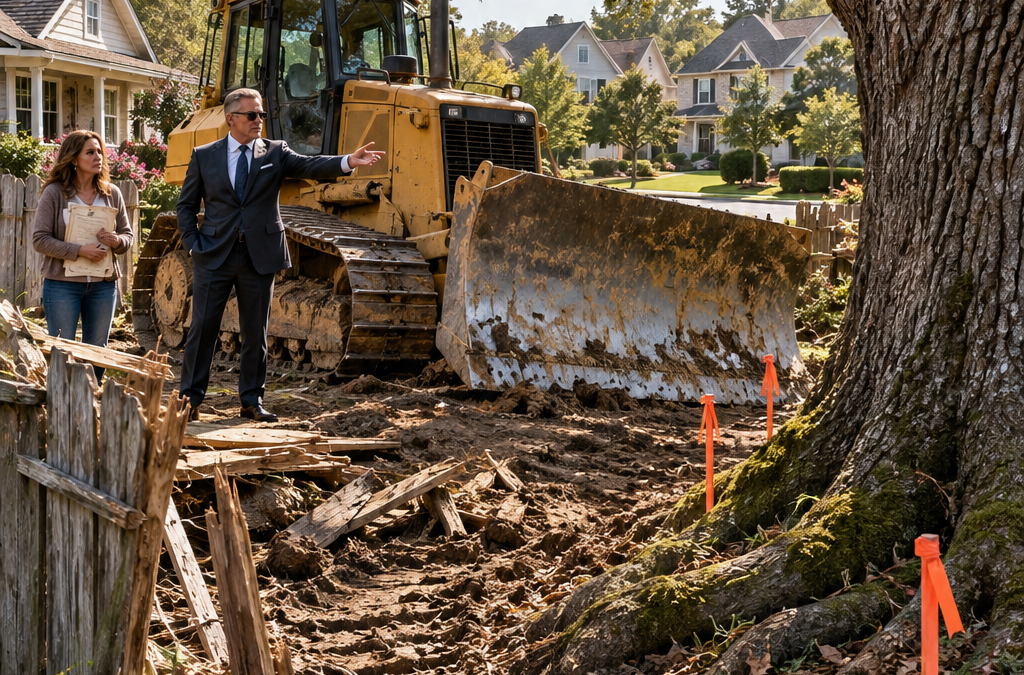
The bulldozer arrived shortly after eight.
I heard the engine before I saw it.
The ground seemed to tremble as it moved across the rear corner.
I ran from the cottage.
The machine pushed loose soil toward the area marked for the clubhouse foundation.
One worker was moving stakes.
Another held a rolled site plan.
And Karen stood beside the equipment, watching with her arms folded.
I shouted for the operator to stop.
He slowed.
Then lowered the blade.
It stopped three feet from the oak tree.
Three feet.
That was all that separated a living part of my family’s history from a steel machine large enough to tear it out of the ground.
Karen turned toward me.
“Elena. You’re making another scene.”
I walked toward her, holding my phone.
“Move that machine away from the tree.”
She glanced at the operator.
“We’re proceeding with the approved plan.”
“You don’t have approval to build here.”
“That matter is being reviewed.”
“Then why are you still working?”
“Because delays are expensive.”
I looked toward the oak.
Roots were exposed where the soil had been disturbed.
A smaller branch lay broken near the trunk.
My chest tightened.
“Karen, please.”
The word escaped before I could stop it.
She noticed.
I saw it in her eyes.
She liked hearing me plead.
She stepped closer.
“Then sign the agreement.”
I stared at her.
“What?”
“The transfer. Sign it today, and we can resolve the assessment balance before things become more complicated.”
I looked from her to the machine.
“You’re holding my property hostage.”
She smiled.
“I’m offering you a final opportunity to cooperate.”
I felt something settle inside me.
The fear was still there.
But underneath it was a colder certainty.
Karen would never stop.
Not if I paid the fines.
Not if I surrendered the corner.
Not if I apologized.
She would simply learn that enough pressure could make me give up anything.
I looked directly at her.
“No.”
Her smile disappeared.
“No?”
“No agreement. No transfer. No more fines. No more pretending you own my land.”
Karen’s jaw tightened.
“You’ll regret that.”
“Maybe.”
I raised my phone.
“But everything you’re doing is being recorded.”
She looked toward the camera, then toward the workers.
The operator remained motionless.
I stepped away from the machine and called Priya.
I told her exactly where the bulldozer was.
Priya contacted the court and the relevant county officials, supplementing the emergency application with the new evidence.
The equipment was halted pending immediate review.
Karen argued with the site supervisor.
I could hear her voice rising from across the yard.
For the first time, the workers weren’t immediately following her instructions.
They looked toward the property markers.
Then toward me.
Then toward the camera.
Finally, the operator shut down the engine.
The sudden silence was overwhelming.
I walked to the oak tree and pressed my hand against the trunk.
The bark was warm beneath my palm.
Three feet.
If I’d arrived a little later, I might have been looking at a broken stump.
That afternoon, I sat in Priya’s office preparing for court.
She spread the evidence across the table.
The original deed.
The survey.
The rejected meeting minutes.
The altered minutes.
The construction contract.
The records connecting Karen’s husband to the project.
The lien documents.
The fence demolition footage.
Photographs of the bulldozer beside the oak.
I looked at the stack.
“It feels like too much.”
Priya shook her head.
“It’s a pattern.”
“What if the judge believes Karen?”
“Then we make sure the judge sees the documents.”
“She has eleven years of people treating her like she’s untouchable.”
Priya looked at me.
“Eleven years of getting her way doesn’t make her right.”
I took a breath.
She leaned forward.
“Elena, tomorrow is not about who is louder. It’s about who can prove the facts.”
I nodded.
But when I drove home that evening, I was terrified.
Because I knew what losing could mean.
The construction could continue.
The tree could be destroyed.
The lien could remain.
And Karen would have confirmation that all her threats had worked.
I barely slept.
Just before dawn, I went outside.
The bulldozer sat motionless beyond the damaged fence.
The oak tree stood against the pale sky.
I walked beneath its branches.
“I’m not giving up,” I whispered.
Then I went inside and got dressed.
Karen arrived at the courthouse looking as though she were attending a charity luncheon.
She wore a tailored navy blazer, cream blouse, pearl necklace, and immaculate low-heeled shoes.
Her blond hair had been freshly styled.
A leather handbag hung from one arm.
She smiled at the clerk.
Smiled at her attorney.
Smiled at two homeowners who had come to observe.
Then she saw me.
Her expression changed for a fraction of a second.
She walked past without speaking.
Priya stood beside me.
“Don’t look at her,” she murmured.
“I’m trying.”
“Look at the evidence.”
I gripped my folder.
My hands were cold.
Several Willow Creek homeowners sat in the rear rows.
I recognized a retired man who had once been fined for a crooked mailbox.
There was also a woman who had avoided eye contact with me at the board meeting.
Now she gave me a small nod.
The gesture steadied me more than I expected.
When the judge entered, everyone stood.
The hearing began with Karen’s attorney describing the dispute as an unfortunate disagreement over historical property boundaries.
He argued that the HOA had acted in good faith based on its planning documents and board approvals.
Karen sat perfectly still, her hands folded on the table.
When the judge asked her to explain the situation, she stood.
“Your Honor, Willow Creek Estates is a respected residential community. We have worked diligently to maintain property values and provide improvements for our homeowners.”
Her voice was smooth.
Almost soothing.
“The clubhouse expansion was approved through the association’s established procedures. Unfortunately, Ms. Rodriguez has misunderstood the historical boundary arrangement.”
She turned slightly toward me.
“She’s emotionally attached to the property, which is understandable. But sentiment cannot replace responsible community planning.”
I felt my face burn.
Priya touched my arm beneath the table.
Karen continued.
“This is simply a boundary misunderstanding that has been exaggerated into a personal dispute.”
The judge looked at the site plan.
“Mrs. Whitfield, do you have a recorded instrument transferring the disputed parcel to the association?”
Karen hesitated.
“The association’s planning records recognize the area as part of the community improvement zone.”
“That wasn’t my question.”
Her smile tightened.
“The boundary has been treated as flexible because of the subdivision’s development history.”
The judge looked up.
“Property boundaries are not generally flexible merely because a proposed improvement would benefit from more space.”
For the first time, Karen looked uncomfortable.
Priya rose.
“Your Honor, we’d like to begin with the recorded deed and survey.”
She presented the documents.
Then she explained how the half-acre parcel had remained privately owned before and after Willow Creek Estates was developed.
She identified the exact boundary.
She showed the clubhouse expansion footprint crossing that line.
She explained that no recorded transfer, easement, or authorized agreement gave the HOA construction rights over my property.
The judge studied the exhibits.
Then looked toward Karen.
“Is there any recorded document contradicting this survey?”
Karen’s attorney shifted.
He referred again to the association’s site plan.
Priya answered immediately.
“A site plan prepared by a contractor cannot transfer title.”
The judge nodded.
“Correct.”
I felt a small breath escape my chest.
It wasn’t victory.
But it was the first time someone in authority had said, plainly, that Karen’s paperwork did not make my land hers.
Priya continued.
She introduced the original archived board minutes.
Then the altered version used to justify the clubhouse expansion.
She placed them side by side.
“Same meeting date,” she said. “Same attendees. Different voting results.”
The judge leaned forward.
“What was the original vote?”
“Four against, three in favor. The proposal was rejected.”
“And the later document?”
“It reports unanimous approval.”
The judge looked at Karen.
“Mrs. Whitfield, how do you explain that?”
Karen adjusted her blazer.
“There was an administrative correction.”
The judge’s voice remained even.
“Was there another vote?”
Karen hesitated.
“The board had extensive discussions.”
“That does not answer the question.”
She glanced toward her attorney.
He began to speak.
The judge raised a hand.
“I am asking whether the board actually approved the expansion at that meeting.”
Karen swallowed.
“The final documentation reflected the board’s intended direction.”
The judge looked down at the original minutes.
“Even though the recorded vote rejected the proposal?”
Karen said nothing.
Priya then presented supporting records showing that the altered version had been certified and circulated under Karen’s authority.
The judge studied them.
The courtroom was very quiet.
I could hear someone behind me shifting in a seat.
Karen’s expression had lost its smooth confidence.
But Priya wasn’t finished.
“Your Honor, we also have evidence of physical destruction of Ms. Rodriguez’s property.”
She requested permission to play the security footage.
The courtroom monitor lit up.
I watched my backyard appear on the screen.
The morning light.
The damaged fence.
The contractors.
Karen walking through the frame.
Her white blouse.
Her sunglasses.
The familiar clipboard.
Then her voice came through the speakers.
“Take the rest of it down. We need an unobstructed work area.”
The judge watched silently.
The worker asked whether the fence belonged to me.
Karen answered.
“The association has authorized removal.”
Then came the words I’d heard with my own ears.
“I’m the HOA president. Do your job.”
I looked toward Karen.
She stared straight ahead.
Her hands were clasped tightly together.
The video continued.
The workers pulled down the remaining fence boards.
Karen pointed toward the oak.
“If it’s in the construction footprint, it comes out.”
Priya paused the footage.
“Your Honor, this conduct occurred after Ms. Rodriguez expressly denied permission and after the association received notice disputing its claimed rights.”
The judge looked at Karen.
“Did you authorize the removal of this fence?”
Karen’s attorney rose.
“Your Honor, we would object to—”
The judge held up a hand.
“The video appears to show Mrs. Whitfield directing the removal. I’m asking whether she disputes that.”
Karen’s face reddened.
“The fence obstructed approved work.”
“That was not the question.”
She swallowed.
“Yes. I directed the crew.”
A quiet murmur moved through the back of the room.
The judge looked back at the exhibit.
“And you did so after being told the fence belonged to Ms. Rodriguez?”
Karen said nothing.
The judge’s expression hardened.
Priya moved to the next set of documents.
“The purported lien and assessment balance provide further evidence of coercion.”
She presented the nine-thousand-dollar notice and the proposed land transfer.
She explained how Karen had offered to waive the entire balance if I surrendered the rear corner.
Then she introduced the HOA’s enforcement records.
The fines had been imposed despite the absence of any recorded authority subjecting my property to the association’s covenants.
Additional penalties had accumulated without a valid underlying basis.
The lien-related paperwork included representations about the property’s status that conflicted with recorded county documents.
The judge read several pages.
Then looked up.
“Mrs. Whitfield, why was this property treated as subject to your association’s enforcement authority?”
Karen’s voice sounded strained.
“Because it affects the community.”
The judge frowned.
“That is not, by itself, a legal basis for imposing assessments.”
Karen shifted.
“We were acting in the neighborhood’s best interests.”
Priya spoke.
“Your Honor, the association’s claimed debt was then used to pressure Ms. Rodriguez into conveying land needed for a project that financially benefited Mrs. Whitfield’s family.”
Karen turned sharply.
“That is a lie.”
Priya calmly placed the construction company registration on the evidence table.
“Whitfield Construction and Development.”
She identified Karen’s husband as the owner.
Then she presented the clubhouse contract.
The judge examined the signature pages.
“Your husband owns the contractor?”
Karen’s jaw tightened.
“He operates a legitimate business.”
“Was that relationship disclosed during the approval process?”
“The board was aware.”
Priya introduced the available conflict-of-interest records.
There was no documented disclosure or valid independent approval of the arrangement.
The altered meeting minutes had been used to support the contract.
And payments to Karen’s husband’s company had already been made from association accounts.
The judge looked at the records.
Then at Karen.
For the first time, he appeared openly incredulous.
“This project was rejected according to the original minutes. A later version claimed approval. Your husband’s company received the contract. And the proposed construction extends onto property your association does not own.”
Karen opened her mouth.
The judge continued.
“Meanwhile, the property owner was threatened with collection action unless she transferred the disputed land.”
Karen’s attorney stood.
“Your Honor, those circumstances have been unfairly characterized.”
The judge turned toward him.
“Counsel, you will have an opportunity to respond. But your client has offered no recorded conveyance, no valid approval record, and no satisfactory explanation for the alteration of these minutes.”
He looked directly at Karen.
“Ma’am, this does not resemble a simple boundary misunderstanding.”
The courtroom was completely silent.
Then Priya introduced the final financial evidence.
During the expedited review, investigators and financial specialists had examined available reserve-account records, disbursements, and vendor payments.
The records showed unexplained transfers and expenditures totaling approximately forty thousand dollars from HOA reserve funds over three years.
Several payments were associated with companies or transactions connected to Karen’s husband.
Others lacked the approvals and supporting documentation required by the association’s own financial procedures.
Priya was careful with her wording.
“These findings are subject to further forensic examination, Your Honor. But the available records reveal serious discrepancies that warrant immediate protection of the association’s assets and referral for investigation.”
The judge studied the documents.
Then looked toward Karen.
“Forty thousand dollars?”
Karen’s voice was barely audible.
“Those expenditures were for community purposes.”
“Where are the authorizations?”
She looked at her attorney.
He began discussing administrative practices and historical board discretion.
The judge interrupted.
“I’m asking about the records.”
No clear answer came.
Behind me, someone whispered.
“I knew that clubhouse fund never added up.”
I didn’t turn around.
My attention was fixed on Karen.
For six months, she’d stood on my property and spoken as though every question had already been answered in her favor.
Now she was being asked the same kind of questions I’d asked.
Where was the authority?
Where was the approval?
Where were the records?
And for the first time, she couldn’t simply fine the person asking.
Priya returned to her seat.
I could barely breathe.
The judge spent several moments reviewing the evidence.
Then he looked at me.
“Ms. Rodriguez.”
I stood.
“Yes, Your Honor.”
“Did you ever authorize this construction?”
“No.”
“Did you agree to convey any portion of the property?”
“No.”
“Did you receive notice that the association intended to remove your fence?”
“No. I told them repeatedly not to touch it.”
He looked down at the photographs of the damaged fence.
“Why was this property important to you?”
For a moment, I couldn’t speak.
I hadn’t expected the question.
I looked at the old deed resting on the table.
“My grandfather built the cottage,” I said.
My voice shook.
“He bought the land before Willow Creek Estates existed. He worked his whole life for it.”
I swallowed.
“He left it to me because he wanted me to have something nobody could take away.”
The courtroom was still.
I continued.
“I didn’t ask the HOA for anything. I didn’t ask them to improve my property. I didn’t ask them to build a clubhouse.”
I looked toward Karen.
“I just wanted to live in my grandfather’s house.”
My eyes filled.
“And every time I told Mrs. Whitfield that the land was mine, she made the punishment bigger.”
I took a breath.
“She fined me for the grass. Then the mailbox. Then the shed. Then my grandmother’s wind chime.”
A faint movement passed through the audience.
“Then she threatened my home. And when I still wouldn’t give her the land, her contractors destroyed my grandfather’s fence and brought a bulldozer within three feet of the oak tree he planted.”
My voice broke.
“That tree is one of the last things I have that still feels like him.”
I wiped my cheek.
“I’m not asking for special treatment. I’m asking to keep what legally belongs to me.”
The judge watched me quietly.
Then he nodded.
“Thank you, Ms. Rodriguez.”
I sat down.
Priya squeezed my hand beneath the table.
Karen stared at the wall.
The judge reviewed the exhibits one final time.
When he spoke, his voice was controlled but unmistakably firm.
“The court finds substantial evidence that the association proceeded with construction beyond its established property rights, relied on materially questionable approval records, and attempted to enforce disputed financial claims against a property not shown to be subject to its governing covenants.”
He paused.
“The destruction of the fence and the threatened removal of the oak tree demonstrate an immediate risk of irreparable harm.”
Karen’s attorney began taking notes rapidly.
The judge continued.
“Construction on the disputed parcel is prohibited effective immediately.”
I gripped the edge of the table.
“The association and its contractors are ordered to cease entry and construction activity on Ms. Rodriguez’s property except as specifically authorized for restoration.”
My eyes filled again.
The judge looked toward Karen.
“The asserted lien and related enforcement claims are restrained pending formal resolution, and the association is directed to take the necessary steps to clear the unsupported encumbrance from the property record.”
Karen shifted in her chair.
The judge wasn’t finished.
“The unlawfully installed improvements must be removed under an approved restoration plan, at the responsible parties’ expense. The damaged area, including the fence line and disturbed soil, must be restored.”
I pressed a hand against my mouth.
The judge continued addressing the governance issues.
Given the evidence of document manipulation, undisclosed financial interests, and threats against a nonmember property owner, the court imposed immediate restrictions on Karen’s ability to exercise authority over the disputed project and association funds.
The enforcement proceedings that followed would permanently remove her from the HOA presidency and prohibit her from serving on another homeowners association board in the county.
The suspected financial misconduct was referred to the appropriate authorities.
Then the judge turned to Karen.
“Mrs. Whitfield, you were entrusted with authority to serve your community. That authority did not give you ownership of private property, permission to falsify governance records, or the right to use financial threats to compel a conveyance.”
Karen stared at him.
He leaned slightly forward.
“You did not misunderstand a boundary. The evidence indicates a deliberate attempt to take property under the color of association authority.”
I heard someone behind me draw a sharp breath.
Karen’s face had gone pale.
For the first time since I’d met her, she looked small.
Not physically.
She still wore the expensive clothes.
Her pearls were still perfectly arranged.
But the confidence that had filled every room she’d entered was gone.
The judge concluded the hearing with directions for compliance, preservation of financial records, and further review.
When we stood, my knees nearly gave way.
Priya caught my arm.
“Elena.”
I looked at her.
“We stopped it.”
I stared at the table.
The deed.
The survey.
The photographs.
The documents my grandfather had told me to keep.
All of them lay scattered across the polished wood.
For months, Karen had laughed at those papers.
Now they had accomplished what shouting never could.
They had made the truth impossible to ignore.
Outside the courthouse, I stood beneath the afternoon sun while Priya spoke with another attorney.
Several homeowners approached me.
The first was the retired man who had been fined for a crooked mailbox.
He smiled.
“Your grandfather would’ve been proud.”
I felt my throat tighten.
“Thank you.”
He glanced toward the courthouse doors.
Then muttered, “Karma has a tape measure too.”
Despite everything, I laughed.
A real laugh.
The kind I hadn’t felt in months.
Another woman stepped forward.
She had attended the earlier board meeting but hadn’t spoken.
“Elena, I’m sorry.”
I looked at her.
“For what?”
“For sitting there while Karen talked to you like that.”
I shook my head.
“You didn’t do anything.”
She looked down.
“That’s the problem. None of us did.”
For a moment, I saw how much damage Karen had done beyond my property.
She had taught an entire neighborhood to remain silent.
To measure its words.
To avoid eye contact.
To believe the safest response to wrongdoing was pretending not to notice.
I reached for the woman’s hand.
“You’re here now.”
She nodded.
Then she squeezed my fingers.
The weeks that followed were exhausting in a different way.
The immediate danger was over, but the legal and financial consequences were still unfolding.
The county reviewed the construction activity.
The HOA was required to preserve its records.
Independent oversight was established while the disputed transactions were examined.
The false enforcement claims against my property were withdrawn and corrected.
The nine-thousand-dollar balance disappeared.
The earlier fines I had paid were refunded after the association acknowledged that my parcel had never been properly subjected to its covenants.
I remember opening the refund notice at my kitchen table.
For several seconds, I simply stared at it.
Two hundred dollars for grass.
More for the mailbox.
More for the shed.
Money I’d paid because Karen made resistance feel more expensive than surrender.
I placed the notice beside my grandfather’s photograph.
“I should’ve listened sooner,” I whispered.
Then I looked at the wind chime hanging outside.
It moved gently in the breeze.
For the first time, I heard its sound without remembering a violation notice.
The investigation into Karen’s financial dealings continued.
Forensic accountants examined the HOA reserve fund, vendor contracts, and related transactions.
Their findings confirmed that approximately forty thousand dollars had been improperly diverted or used through unauthorized arrangements over three years.
The records showed financial activity benefiting interests connected to Karen and her husband.
The clubhouse project was not an isolated misunderstanding.
It was part of a broader pattern of self-dealing and misuse of association authority.
Prosecutors eventually filed embezzlement and fraud charges against Karen and her husband.
Both faced the possibility of substantial prison sentences if convicted.
I didn’t celebrate when I heard.
I sat on my porch and thought about the families who had been pressured into settlements.
About the homeowners who had paid fines they couldn’t afford.
About the people who had spent years believing they were powerless.
And about how easily Karen had transformed a volunteer leadership position into something that resembled ownership over other people’s lives.
What she had done wasn’t merely rude.
It wasn’t just controlling.
It had consequences.
Financial ones.
Legal ones.
Emotional ones.
And finally, consequences for her.
The HOA board was reorganized.
New leadership took over under increased scrutiny.
Financial records were reviewed.
Conflicts of interest had to be disclosed.
Major projects required documented approval.
Homeowners began attending meetings again.
Some still seemed nervous at first.
Years of intimidation didn’t disappear overnight.
But gradually, people began asking questions.
Questions about budgets.
About contracts.
About enforcement.
About why certain decisions had been made without proper votes.
And nobody could simply silence them by threatening another fine.
I watched those changes from the outside.
My property still wasn’t part of Willow Creek Estates.
I had no desire to join.
But I was glad the people living there were beginning to recover some control over their own neighborhood.
The restoration work began after the court-approved plan was finalized.
A different contractor arrived to remove the illegal construction.
This crew had been instructed to follow the recorded property boundary precisely.
They brought survey equipment, restoration materials, and machinery appropriate for removing what Karen’s contractors had installed.
Before beginning, the site supervisor walked the property with me.
He showed me the marked boundary.
Then he pointed toward the oak.
“We’re protecting the root zone,” he said.
I looked at the tree.
“You can guarantee it won’t be damaged?”
“We’ve planned the removal to avoid the trunk and major roots. We’ll stop if we encounter anything unexpected.”
I nodded.
“Please be careful.”
He looked at me for a moment.
Then said, “I understand.”
On the morning the demolition began, I stood near the property line.
The bulldozer was there again.
For a moment, the sight made my stomach tighten.
I remembered Karen’s smile.
Her pearls.
The way she’d gestured toward the tree as though its destruction were an administrative detail.
I remembered standing in the dirt, holding the deed, begging her not to do something that could never be undone.
Then the machine started moving.
This time, it backed away from the oak.
The operator reversed carefully.
Workers dismantled the unauthorized structure.
Boards came down.
Temporary framing was removed.
Construction debris was loaded onto trucks.
The ground where Karen had planned her clubhouse extension slowly opened up again.
I watched every step.
Not because I distrusted the new crew.
Because I needed to see the process with my own eyes.
For months, I’d watched strangers bring materials onto my property while telling me I had no right to stop them.
Now I watched those materials leave.
The difference was difficult to put into words.
When the last section of illegal framing came down, I felt my shoulders relax.
The site supervisor walked over.
“We’ll finish grading and restoring the disturbed area after the remaining debris is cleared.”
I nodded.
“Thank you.”
He looked toward the oak.
“It’s a beautiful tree.”
I smiled faintly.
“My grandfather planted it.”
He glanced at the massive trunk.
“Must’ve been a long time ago.”
“Longer than this neighborhood has existed.”
He nodded.
Then returned to work.
Over the following days, the construction materials disappeared.
The disturbed soil was restored.
The damaged fence was rebuilt along the verified property line using the original layout as a guide.
Where surviving boards could be preserved, they were reused.
Where posts had been destroyed, new ones were installed.
I insisted that the old gate remain.
Its hinges were rusty.
The latch stuck sometimes.
But my grandfather had made it.
I wanted it there.
One afternoon, I found myself standing beside the repaired fence, running my fingers across the rough wood.
The property looked almost the way it had before Karen arrived.
Almost.
There were still marks in the soil.
The grass was patchy.
Some smaller plants had been destroyed.
But the oak stood untouched.
Its branches spread across the afternoon sky.
Sunlight filtered through the leaves, making patterns on the ground.
I walked beneath it.
For a long time, I simply stood there.
Then I placed my palm against the trunk.
I remembered being eight years old, sitting on my grandfather’s shoulders while he pointed toward a bird’s nest high in the branches.
I remembered him showing me how to use a hammer.
How to tighten a loose gate hinge.
How to plant a garden.
How to tell when rain was coming by the smell of the wind.
And I remembered his final warning.
Never trust the woman who runs that board.
I closed my eyes.
“I kept it, Abuelo,” I whispered.
“The land.”
My throat tightened.
“I kept it.”
For months, I’d imagined this moment would feel like triumph.
I thought I’d stand where Karen’s illegal construction had been and feel nothing but satisfaction.
But the emotion that came over me was quieter.
Grief.
Relief.
Exhaustion.
And something I hadn’t felt since before the subdivision’s bulldozer first entered my property.
Peace.
I realized I had spent nearly half a year measuring my life against Karen’s next move.
Every morning, I’d wondered whether another fine would arrive.
Every strange vehicle had made me look outside.
Every knock at the door had raised my pulse.
I’d stopped sitting comfortably on my porch.
I’d stopped sleeping through the night.
I’d even stopped enjoying the sound of my grandmother’s wind chime because Karen had turned it into another reminder that someone was watching.
Now I could hear it again.
Just metal moving in the breeze.
Nothing more.
That evening, I made coffee and carried it onto the porch.
The sun was setting behind the houses of Willow Creek Estates.
A few children were riding bicycles down the lane.
Someone was mowing a lawn.
A dog barked in the distance.
The ordinary sounds of a neighborhood settling into evening.
I looked toward the back corner of my property.
The new fence caught the golden light.
Beyond it, the clubhouse stood where it had always stood, on land the association actually owned.
There was no illegal extension.
No orange stakes.
No pile of lumber waiting to be turned into somebody else’s profit.
And no Karen Whitfield walking through my yard with a clipboard.
A neighbor passed along the road and raised a hand.
“Evening, Elena.”
I waved back.
“Evening.”
That was all.
No warning.
No whisper about Karen.
No nervous glance toward the clubhouse.
Just a neighbor saying hello.
I smiled into my coffee.
A few weeks later, I found another folder while sorting through my grandfather’s belongings.
It had been tucked into the back of an old wooden cabinet.
Inside were photographs of the property taken over several decades.
The cottage when the siding was new.
The garden before the subdivision was built.
The old fence standing straight beneath a summer sky.
And the oak tree when it was still young enough for my grandfather to reach around its trunk with both arms.
I sat on the floor looking through the pictures.
In one photograph, my grandfather stood beside the newly planted tree.
He was smiling.
The cottage was behind him.
There were no neighboring houses.
No streetlights.
No clubhouse.
Just open land and a small sapling.
I turned the photograph over.
In his handwriting were the words:
“For the ones who come after me.”
I stared at them.
Then I cried.
Not the frightened tears I’d shed after Karen threatened foreclosure.
Not the exhausted tears from the courtroom.
These were different.
They came from understanding how much my grandfather had wanted this place to endure.
He hadn’t left me a valuable development opportunity.
He hadn’t left me a bargaining chip.
He had left me a home.
A piece of ground where his work still existed.
Where my grandmother’s wind chime still rang.
Where the oak tree continued growing.
Where the memories of people I loved had somewhere to remain.
Karen had looked at that same land and seen only square footage.
A clubhouse extension.
A financial opportunity.
A transaction she could force through if she applied enough pressure.
She never understood why I wouldn’t sign.
And I no longer needed her to.
By the following spring, the grass had returned to the damaged corner.
The fence stood straight.
New plants were growing beside the old gate.
I hung a fresh rope swing from one of the oak’s lower branches, not because I expected anyone to use it immediately, but because it reminded me of being a child there.
The first time I pushed it, the seat moved slowly through the warm air.
I stood watching it swing.
Then I laughed at myself.
For months, I had fought lawyers, forged documents, false liens, construction crews, and a woman who thought eleven years of HOA authority made her untouchable.
Now I was standing beneath a tree, smiling at an empty swing.
And somehow, that felt like the greater victory.
I had my home.
I had my land.
And I could finally live there without waiting for someone to tell me I didn’t belong.
That evening, I walked to the rear property line as the sun slipped behind Willow Creek Estates.
I rested one hand on the fence.
The oak tree towered above me.
Its branches moved gently against the sky.
I thought about Karen’s final threat.
You could lose this whole property.
She had said it so confidently.
As though my future were something she could decide with a signature and a smile.
I looked back at the cottage.
The porch light glowed.
The wind chime rang.
The windows reflected the fading sunset.
Then I looked at the ground beneath my feet.
My grandfather had spent a lifetime earning the right to call this place his.
Karen had spent six months trying to take that right away from me.
She lost her authority.
Her scheme was exposed.
Her illegal construction was removed.
Her actions brought criminal charges and consequences she had never imagined when she first walked onto my lawn with a tape measure.
And the land was still ours.
I took one final look at the oak tree.
Then I turned toward the cottage and walked home.
For the first time since my grandfather died, I didn’t feel like I was merely living in the house he left behind.
I felt like I was keeping the promise I’d made to him.
And beneath the branches of the tree he planted, with the old fence standing where it belonged, I finally understood what he’d meant when he told me never to apologize for owning what was mine.








