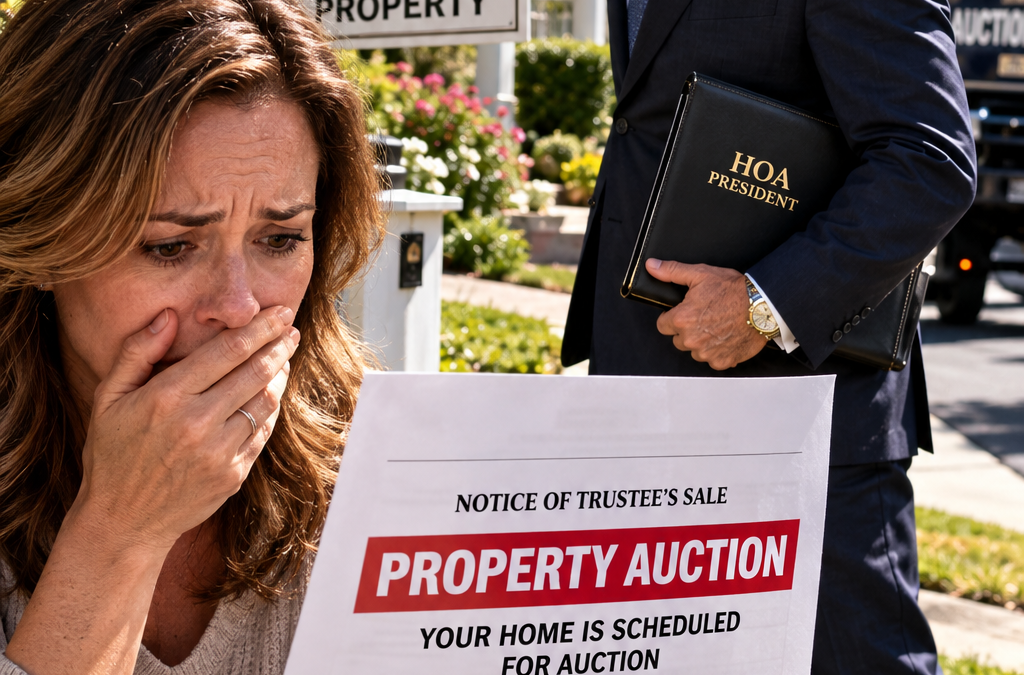
𝗙𝗨𝗟𝗟 𝗦𝗧𝗢𝗥𝗬 The HOA President Put My Home on the Auction Calendar Over a Fine I Never Received
𝗙𝗨𝗟𝗟 𝗦𝗧𝗢𝗥𝗬
Brenda typed something. “The account shows notice was mailed and the fine was assessed after no response.”
“No response? I emailed photos.”
“I see photos in the file,” she said quietly.
“Then why is there a fine?”
There was a pause.
“You’ll need to submit a written appeal.”
“Where was the notice mailed?”
She gave me an address I had not lived at in almost a year.
My old apartment.
My stomach tightened.
“That address is wrong,” I said. “I updated my address with the HOA last September.”
“I’m only reading what’s in this entry.”
“I filled out the form in person.”
Another pause.
“Then include that in your appeal.”
I wanted to believe it was a clerical error.
That was easier.
Mistakes happen. Offices misfile forms. Databases lag. People type old addresses into new records.
But when I looked at the signature on the fine approval, I saw Sandra’s name.
And something cold moved through me.
Because Sandra knew where I lived.
She had taped two handwritten notes to my door.
She had smiled at me across the mailbox just the previous week and said, “Still getting settled after that landscaping issue, Carol?”
She knew.
The fine notice had been sent to the wrong address anyway.
I submitted an appeal.
No response.
The $340 fine became $520 with late fees.
Then $740.
Then administrative charges appeared.
Then legal preparation fees.
By the time the certified letter arrived on that Tuesday morning, the balance had ballooned to $1,240.
I was in my driveway when I signed for the letter.
The mail carrier handed it to me with the blank expression of someone who had delivered too many bad things to too many houses.
I opened it right there.
Notice of foreclosure sale.
My property was scheduled for an HOA lien sale in thirty days unless the debt was paid or legally resolved.
For a moment, the words did not make sense.
I read them again.
Then again.
My hands started shaking.
Eleven years of mortgage payments. Eleven years of repairs, insurance, property taxes, work, worry, and sacrifice. Eleven years of making that house a home for my daughter.
And Sandra Whitfield was trying to put it on an auction calendar over a $340 fine I had never properly received.
I stood there in the driveway, the letter trembling between my fingers, and felt something deeper than fear.
Violation.
That is the only word for it.
It felt like someone had reached into my life and decided my home was just another object to control.
Maya came outside because she saw me standing still too long.
She was seventeen by then, tall, sharp-eyed, and far braver than I had been at her age.
“Mom?”
I tried to fold the letter before she could see it.
Too late.
“What is that?”
“It’s HOA paperwork.”
She took one look at my face.
“Bad paperwork?”
I laughed once, but there was no humor in it.
“Very bad.”
We went inside.
I sat at the kitchen table, spread the letter flat, and explained what I understood.
Maya read it silently.
Then she looked up.
“They can sell our house?”
“They’re trying to say they can.”
“Over grass?”
“Over a fine that started with grass.”
She stared at the paper.
“This is Sandra, isn’t it?”
I did not answer.
I did not need to.
That afternoon, I called an attorney.
His name was James Park, and he practiced real estate and HOA law in a small office twenty minutes away. I had found his name through a coworker who said, “If an HOA is threatening your house, don’t wait. Call somebody who likes paperwork more than they do.”
James was in his early forties, calm, precise, and soft-spoken in a way that made people underestimate him for about five seconds.
I sat across from him the next morning with my documents stacked in a folder.
The foreclosure letter.
The fine statement.
The emails.
Photos of the ornamental grass after trimming.
Photos of the mailbox.
Copies of HOA notices.
And, most important, the address update form I had submitted the previous September.
I kept that form in a fireproof box under my bed.
The box had cost forty dollars at a hardware store after I realized divorce paperwork, tax records, house documents, and Maya’s birth certificate should not be kept in a kitchen drawer.
I had labeled one section simply:
Sandra.
At first, that label had been half sarcasm.
Now it felt prophetic.
James read the foreclosure letter first.
His face changed only slightly.
Then he read the fine history.
Then the address update form.
He stopped.
“Carol,” he said, “where did this come from?”
“I submitted it to the HOA office last September. I asked for a signed copy after they updated my account.”
“Who signed as received?”
“Sandra.”
He looked closer.
“Those are her initials?”
“Yes.”
He leaned back.
For the first time since I had met him, a strange expression crossed his face.
Not amusement.
Not shock.
Interest.
The kind of interest a lawyer gets when he sees a thread that might pull an entire sweater apart.
“Do you know what this means?”
“It means they had my correct address.”
“It means Sandra personally acknowledged your address change.”
I swallowed.
“So the notice was sent to the old address by mistake?”
James tapped the form.
“Maybe. But when the person pushing the fine also signed the corrected address form, mistake becomes harder to accept.”
I looked at the paper.
Sandra’s initials were small, tight, and unmistakable.
S.W.
“She knew,” I whispered.
James nodded.
“She had your correct address. Then the violation notice that triggered escalating fees was mailed somewhere else.”
The room seemed to narrow.
Until then, part of me had still wanted this to be bureaucracy. Carelessness. A bad database. Something frustrating but not personal.
Now it had a shape.
Sandra had known where I lived.
She sent the fine notice to the wrong place anyway.
That was the first twist.
And it changed everything.
James began moving fast.
He filed an emergency motion to halt the foreclosure sale and challenge the lien. He argued lack of proper notice, defective procedure, improper escalation of fees, and serious questions surrounding the HOA’s authority.
Within forty-eight hours, the judge granted a temporary restraining order.
The sale was stopped.
Temporarily.
When James called to tell me, I sat down on the edge of my bed and cried.
Maya found me there.
“What happened?”
“The sale is stopped.”
She froze.
“For real?”
“For now.”
She crossed the room and hugged me so hard I could barely breathe.
That night, we ate takeout on the couch and watched a terrible movie neither of us followed.
For the first time in days, I slept more than three hours.
Sandra responded exactly the way James predicted.
She called an emergency board meeting.
The notice went out by email at 9:00 p.m.
The meeting was scheduled for 7:00 a.m. the next morning.
Its agenda said the board would consider ratification of all enforcement actions concerning my property.
Ratification.
That was a fancy way of saying Sandra wanted the board to bless everything she had already done before the court could examine it too closely.
There was another problem.
She notified only two of the five board members.
The other two, including retired accountant Dale Hoffman, did not find out until I texted them the agenda.
I knew Dale only in passing. He lived three streets over and walked every morning in a wide-brimmed hat. At meetings, he usually sat quietly, reading financial statements while Sandra talked over everyone.
He called me ten minutes after my text.
His voice was tight.
“Carol, where did you get this agenda?”
“It was emailed to residents.”
“I didn’t receive a board notice.”
“You weren’t notified?”
“No.”
“What does that mean?”
“It means Sandra is trying to hold a board meeting without a proper board.”
I heard papers moving on his end.
“I’ve been on this board three years,” he said. “I have never seen meeting notice handled like this.”
“Dale, she’s trying to ratify the foreclosure.”
“I know.”
His voice lowered.
“Something is very wrong.”
Dale did not attend the illegal meeting because he had not been properly noticed as a board member. Neither did another director.
Sandra held it anyway with only two loyal board members present.
They voted to ratify everything.
James laughed when I sent him the minutes.
Not a happy laugh.
A lawyer laugh.
“She made it worse,” he said.
“How?”
“No proper notice. No quorum issue addressed. Interested action taken after litigation began. And look at this.”
He pointed to the minutes Sandra had circulated.
They stated that all board members had been notified.
Dale had already provided written confirmation that he had not.
“Did she lie in the minutes?” I asked.
James looked at me.
“She created another contradiction.”
That was his way of keeping me calm.
Contradiction sounded cleaner than lie.
Dale started pulling financial records that same night.
He had access as treasurer emeritus and current finance committee member, though Sandra had increasingly cut him out of decision-making. He told me she had spent the last year insisting that certain invoices were “president-approved” and did not require further discussion.
“I should have pushed harder,” he told me.
His voice carried both anger and shame.
“We all should have pushed harder.”
“What are you looking for?”
“Patterns.”
By midnight, he found one.
Landscape consulting invoices.
$800 here.
$1,200 there.
Every month.
For over two years.
The payments went to a company called Green Vista Solutions LLC.
At first, the name meant nothing.
Dale traced the registration.
Green Vista Solutions was a Nevada LLC.
Its sole member was Patricia Ogden.
Sandra Whitfield’s sister-in-law.
That was the second twist.
The HOA was not just harassing me.
It had been quietly bleeding money through invoices tied to Sandra’s family.
Over twenty-six months, Green Vista had received approximately $47,000.
The descriptions were vague.
Landscape consulting.
Irrigation review.
Community beautification support.
Seasonal design coordination.
Dale could not find proper bids.
Could not find meaningful work reports.
Could not find board approval for several payments.
He sent everything to James before sunrise.
James called me at 6:12 a.m.
I answered half-asleep and terrified.
“What happened?”
“Nothing bad,” he said. “Not for you.”
I sat up.
“What did Dale find?”
“Enough that I’m amending the countersuit.”
“For what?”
“Financial fraud allegations, breach of fiduciary duty, and related claims. We’ll also seek referral of the records to appropriate authorities.”
I rubbed my eyes.
“James, I just wanted to stop the foreclosure.”
“I know.”
His voice softened.
“But sometimes the document that saves your house opens a locked door.”
By Thursday morning, the neighborhood had changed.
Not visibly.
The lawns were still trimmed. Cars still rolled slowly past the speed bumps. Sprinklers still ticked across front yards.
But underneath, something was moving.
Greg Mason started it.
Greg lived three doors down from me. He was a retired police officer with a square jaw, a bad knee, and a permanent dislike of nonsense. Sandra had fined him $500 two years earlier because his American flag was “oversized relative to community display guidelines.”
Greg had paid it.
Not because he agreed.
Because his wife had been recovering from surgery and he did not have the energy to fight a woman who seemed to enjoy conflict.
When he heard about the foreclosure letter, he knocked on my door.
“I should’ve fought her then,” he said.
“You had enough going on.”
“That’s how she wins.”
He started a group chat that afternoon.
At first, there were six people.
By Thursday night, fourteen.
By Friday morning, twenty-two.
Someone made a spreadsheet.
It was honestly the most organized thing I had ever seen angry suburban homeowners produce.
Columns for name, address, violation, amount, notice method, appeal result, Sandra involvement, supporting documents.
People uploaded photos of letters, payment receipts, screenshots of emails.
A pattern emerged fast.
Not everyone had been targeted. That was important.
Sandra was selective.
Widows. Divorced homeowners. Elderly residents. People planning to sell. Newer owners. Anyone she thought would not fight.
Fines often began small.
Then escalated.
Notices were sometimes sent late or to outdated contact information.
Appeals were denied in brief emails.
Administrative fees appeared with little explanation.
And Green Vista appeared in financial records tied to landscaping complaints that often required homeowners to pay for corrections.
Sandra must have felt the ground shifting.
On Saturday afternoon, my phone rang.
The caller ID showed the HOA office.
I let it ring twice before answering.
“Carol,” Sandra said warmly.
Too warmly.
“I think we’ve had a miscommunication.”
I stood in my kitchen, staring out at my lemon tree.
“A miscommunication?”
“Yes. I’d love to sit down over coffee and resolve this quietly. Woman to woman.”
Woman to woman.
I almost laughed out loud.
This woman had tried to push my house toward a foreclosure sale and now wanted coffee.
“Sandra,” I said carefully, “my attorney has advised me not to discuss this outside formal proceedings.”
Her voice tightened for half a second.
Then softened again.
“Carol, lawyers make everything so hostile.”
“The foreclosure letter did that.”
Silence.
Then she said, “You need to think about your daughter.”
My hand tightened around the phone.
“What did you say?”
“I mean only that litigation is stressful for families.”
There it was.
The threat inside the silk wrapping.
I kept my voice steady.
“Thank you for calling. Future communication can go through James Park.”
I hung up before she could respond.
Then I immediately texted James.
He replied in under two minutes.
Perfect. Do not engage. Court date is Thursday.
I spent Sunday night rereading every document in the fireproof box.
Not because I was panicking.
Because I was preparing.
There is a difference.
Fear scatters your thoughts.
Preparation lines them up.
I read the address update form.
Sandra’s initials.
The old-address mailing record.
The fine ledger.
The bylaw amendment from two years earlier, the one that supposedly gave Sandra unilateral authority to approve administrative fees tied to enforcement actions.
James had flagged that amendment immediately.
“She amended the bylaws to give herself unilateral fee authority,” he had said, reading it with that same dangerous interest. “But the vote record is weak.”
Weak was generous.
The amendment had been passed at a poorly attended meeting, with questionable notice and unclear quorum documentation. It gave the HOA president authority to approve certain administrative enforcement fees without full board review.
Sandra had used that authority like a printing press.
By midnight, I had packed copies of everything into a folder for court.
The originals stayed in the fireproof box.
On Thursday morning, the sky was gray and cold.
Maya insisted on driving with me to the courthouse, though she waited outside during the hearing because she said she would “start yelling if Sandra lied too much.”
I told her that yelling in court was discouraged.
She said, “That’s why I’m staying in the car.”
Sandra arrived with her attorney, a man in an expensive suit who radiated the confidence of someone who had never lost an HOA case and saw no reason to begin that day.
Sandra wore navy blue, pearls, and a solemn expression that looked rehearsed.
She did not look at me.
James did not appear dramatic.
No theatrics. No raised voice. No performance.
He presented the case in three clean layers.
First, the deliberate misaddressing of notices.
He showed the court the address update form I had submitted eight months before the fine notice was mailed. He showed Sandra’s initials in the received column. Then he showed that the fine notice was mailed to my old address anyway.
Second, he challenged the bylaw amendment.
He showed the questionable meeting notice, the missing quorum documentation, and the way Sandra used that amendment to approve escalating administrative fees tied to her own enforcement actions.
Third, he presented the financial records.
Green Vista Solutions.
Patricia Ogden.
Twenty-six months of payments.
Approximately $47,000 in undisclosed or inadequately supported landscape consulting invoices.
The HOA attorney objected four times in the first ten minutes.
The judge overruled him each time.
First with explanation.
Then with less explanation.
By the fourth time, only two words.
“Overruled. Continue.”
Sandra sat rigidly beside her lawyer.
Her face had gone pale beneath her makeup.
Then came the third twist.
The one that broke her.
James called Dale Hoffman.
Dale walked to the stand with a folder in his hands and the solemn face of a man who had spent the last week realizing silence can become complicity.
After answering preliminary questions, he produced the original address update form.
Not my copy.
The HOA’s copy.
It had been preserved in a file Sandra apparently believed no one would pull.
The same document.
My name.
My correct mailing address.
Date stamped.
Received.
Sandra Whitfield’s initials in the column.
James asked, “Mr. Hoffman, whose handwriting appears in the received column?”
Dale looked at the page.
“Sandra Whitfield’s.”
“Are you familiar with her handwriting?”
“Yes. I served on the board with her for years.”
“And does this document indicate the HOA received Ms. Gwyn’s address update before the fine notice was mailed?”
“Yes.”
“How long before?”
“Approximately eight months.”
James let that sit.
Then he asked, “Based on the records you reviewed, was there any legitimate reason for the fine notice to be mailed to Ms. Gwyn’s old address?”
Sandra’s attorney stood.
“Objection.”
The judge looked at him.
“Basis?”
He hesitated.
The judge’s expression hardened.
“Overruled. The witness may answer within the scope of his review.”
Dale swallowed.
“No. I found no legitimate reason.”
James nodded.
“And who approved the enforcement escalation after the notice was mailed to the wrong address?”
Dale looked toward Sandra.
“Sandra Whitfield.”
The courtroom went still.
That was the moment I understood what James had meant.
This was not negligence.
It was a paper trail to her own fraud.
Sandra’s attorney tried to argue that the wrong address was an administrative oversight and that the foreclosure notice was merely part of ordinary collection procedures.
The judge did not look persuaded.
Then James connected the address issue to the fees.
The $340 fine became $1,240 through administrative charges Sandra had approved under an amendment that was itself now under challenge.
Those inflated fees supported the lien.
The lien supported the foreclosure notice.
The foreclosure notice placed my home at risk.
All of it began with a notice Sandra knew had been sent to the wrong place.
The judge asked Sandra’s attorney a simple question.
“Can your client explain why the original fine notice was not mailed to the address acknowledged in the association’s own records?”
Her attorney turned to Sandra.
Sandra whispered something.
He turned back.
“Your Honor, my client does not personally handle every mailing.”
James stood.
“She personally signed the address update, personally approved the fine escalation, and personally signed the lien authorization.”
The judge looked at the documents again.
I could barely breathe.
Maya was outside in the car. Our house was twenty minutes away. The lemon tree needed pruning. The porch light had been flickering for two weeks. Ordinary life was waiting somewhere beyond this courtroom, and everything depended on whether the judge saw what Sandra had tried to do.
He did.
The lien was voided.
The foreclosure action was dismissed.
The judge awarded damages and attorney fees totaling $18,500.
He found serious procedural defects and troubling evidence of intentional notice misconduct.
Then he referred the financial records concerning Green Vista Solutions and related HOA payments to the appropriate state authorities for criminal review, including the California Attorney General’s office.
Sandra made a small sound.
Not a word.
A sound.
Like air leaving a tire.
Before she even left the building, the remaining board members, under pressure from the court findings and the documents now exposed, moved to remove her from her position pending investigation.
She walked out of the courtroom no longer HOA president.
For six years, Sandra Whitfield had controlled Riverside Oaks with notices, fees, procedure, fear, and a smile across the mailbox.
By noon that Thursday, she was just another person under investigation.
I stepped out into the gray morning air feeling hollow.
Not happy yet.
Not victorious.
Just empty in the way you feel after bracing for impact and realizing the crash has passed.
Maya was waiting by the car with two coffees.
She saw my face and froze.
“What happened?”
I took one cup from her.
“We won.”
Her eyes widened.
“For real?”
“For real.”
“The house?”
“Safe.”
She dropped both arms around me, nearly spilling coffee down my coat.
I held her in that courthouse parking lot while people walked around us, and for the first time since the certified letter arrived, I let myself believe we were not going to lose our home.
The aftermath took months.
It always does.
Movies make justice look instant.
Real justice arrives in paperwork, hearings, signatures, corrected ledgers, board votes, refund checks, and emails with attachments that you save in three different places just in case.
The foreclosure record was cleared.
The lien release was recorded.
My account balance was corrected to zero.
James received his fees through the court award.
The damages helped cover the stress, missed work, and costs Sandra had forced into my life, though no amount of money could repay the nights I lay awake imagining strangers bidding on my house.
The HOA hired an outside firm to review its finances.
Green Vista’s invoices became the center of a much larger investigation.
Dale cooperated.
Greg’s spreadsheet became useful.
Residents who had been silent for years finally brought out their own files.
A widow had been charged $900 in fees after Sandra mailed a notice to an outdated email address.
A retired couple had paid $1,700 to avoid a lien over a fence stain dispute that had never been properly voted on.
Another family sold their home after repeated enforcement letters, only to learn later that some charges were unsupported.
Not every complaint became a legal claim.
Not every fine was invalid.
But enough were.
Enough to show Sandra had not been enforcing rules.
She had been weaponizing them.
The new interim board reversed numerous fines, reviewed fee authority, and suspended all unilateral enforcement approvals until proper procedures could be adopted.
Sandra’s longest-serving-president record disappeared from newsletters.
No one mentioned six years of dedicated service anymore.
Riverside Oaks changed slowly.
People began attending meetings.
Real meetings.
Not Sandra’s staged performances where decisions had already been made.
Greg asked questions like he was cross-examining suspects again.
Dale gave financial reports with actual supporting documents.
Maya attended one meeting with me and whispered, “This is the most boring revolution ever.”
She was right.
But boring was good.
Boring meant bylaws were read before votes.
Boring meant notices went to correct addresses.
Boring meant board members asked whether they had authority before threatening someone’s home.
Boring meant no one person got to decide whose life became unbearable.
A few weeks after the court ruling, I opened the fireproof box under my bed.
Inside were the documents that had saved us.
The address form.
The certified letter.
The photos.
The emails.
The meeting notices.
The copies Dale had sent.
I touched the edge of the address update form and looked at Sandra’s initials.
Two small letters.
S.W.
That was all it took.
She had thought those initials were nothing.
A routine mark on a routine form.
But that mark proved she knew.
It proved the fine notice had not simply drifted into the wrong mailbox by accident.
It proved the woman trying to sell my home had personally acknowledged the correct address months earlier.
I put the form back carefully.
Then I closed the box.
Maya leaned against the doorway.
“You’re keeping it forever, aren’t you?”
“Yes.”
“Good.”
She walked into the room and sat on the edge of the bed.
“I used to hate that box.”
I looked at her. “Why?”
“Because every time you opened it, something bad was happening.”
I smiled sadly.
“That’s fair.”
“But now I like it.”
“You do?”
She nodded.
“It’s proof.”
“Of what?”
“That you didn’t just panic. You paid attention.”
I looked down at the box.
For weeks, I had thought of it as storage.
Then evidence.
Now it felt like something else.
A reminder.
Sandra had built her power on the assumption that people would lose papers, forget dates, ignore meeting notices, and pay fees just to make fear go away.
I had nearly done the same.
If I had not kept that signed address form, Sandra might have claimed confusion. She might have said the wrong address was an innocent error. She might have convinced a court that the HOA acted in good faith.
But the document was there.
In her handwriting.
In her initials.
In the box under my bed.
Two months after the ruling, I repainted my mailbox post.
Not because Sandra told me to.
Because California sun is brutal, and the paint genuinely needed refreshing.
I chose the same beige as every other post on the block.
Greg walked by while I worked.
“Careful,” he said. “That color might be emotionally disruptive to the community.”
I laughed.
“Don’t give them ideas.”
He stopped near the curb.
“You doing okay?”
I dipped the brush into the paint.
“Most days.”
“And the other days?”
I looked at the house.
The porch. The windows. The cracked walkway I kept meaning to fix.
“I still think about how close she came.”
Greg nodded.
“She counted on you being too scared to fight.”
“She was almost right.”
“No,” he said. “She misread you.”
I smiled faintly.
“She misread the fireproof box.”
Greg laughed and continued down the sidewalk.
That evening, Maya and I sat on the porch with takeout containers balanced on our knees.
The sun went down behind the roofs across the street, turning Riverside Oaks soft and gold.
For once, the neighborhood looked the way I had hoped it would when I first moved in.
Quiet.
Not because people were afraid.
Just quiet.
Maya took a sip of soda.
“So what happens to Sandra?”
“Investigation continues.”
“Do you think she’ll be charged?”
“I don’t know.”
“Do you want her to be?”
I thought carefully.
“I want the truth established.”
Maya looked at me.
“That sounds like something James would say.”
“It does, doesn’t it?”
She smiled.
I looked down the street.
Sandra’s house had the blinds closed.
No one saw her outside anymore.
The woman who once treated every sidewalk like her personal courtroom had vanished behind curtains and attorney statements.
Part of me wanted a more dramatic ending.
Handcuffs. News cameras. A public apology.
But real life rarely arranges itself for maximum satisfaction.
What I got was enough.
My home was safe.
The lien was gone.
The foreclosure sale was dead.
Sandra had been removed.
The money trail had been handed to people with the authority to investigate it.
And Riverside Oaks finally understood that a board president was not a monarch.
I leaned back in my chair and listened to the evening sprinklers clicking on somewhere down the block.
For eleven years, this house had held my life.
It held Maya’s birthdays, school projects, heartbreaks, late-night talks, flu seasons, college applications, and all the small ordinary moments that make a place yours.
Sandra had seen only leverage.
A fine.
A fee.
A lien.
A sale.
A homeowner she thought she could frighten into silence.
She never understood that I had spent too long fighting for this home to let it disappear because she mailed a notice to the wrong address on purpose.
And she certainly never understood that ordinary people can become very dangerous when they start keeping receipts.
The fireproof box is still under my bed.
The label still says Sandra.
I keep meaning to change it, but I never do.
Because every time I see it, I remember the morning I stood in my driveway with that certified letter shaking in my hands.
I remember the feeling of almost losing everything.
Then I remember the courtroom.
Dale’s voice.
James placing the documents in clean rows.
The judge looking at Sandra’s initials.
Maya waiting by the car with coffee.
And I remember that the truth does not always arrive loudly.
Sometimes it sits quietly in a forty-dollar box under your bed, waiting for the day someone lies badly enough that you finally have to open it.
𝗧𝗛𝗘 𝗘𝗡𝗗
The HOA President Put My Home on the Auction Calendar Over a Fine I Never Received
The certified letter said I had thirty days before my home could be sold out from under me.
By the time I saw Sandra Whitfield’s signature at the bottom, I knew it was not a mistake.
My name is Carol Gwyn, and for eleven years, my little house in Riverside Oaks, California, had been the one stable thing my daughter and I could count on.
That house was not large. It was not impressive in the way homes become impressive in real estate brochures. It had two bedrooms, a narrow kitchen, a patch of backyard with one tired lemon tree, and a front porch just wide enough for two chairs and a potted fern.
But to me, it was everything.
I bought it after my divorce, when Maya was still young enough to sleep with a stuffed rabbit tucked under her arm and old enough to understand that her world had changed. I had spent three years saving the down payment, working overtime whenever I could, cutting every expense that was not necessary, and telling myself that if I could just get us into a house of our own, we would finally be able to breathe.
Riverside Oaks looked safe then.
That was the word everyone used.
Safe.
Quiet streets. Clean sidewalks. Manicured lawns. Neighbors who waved while washing their cars on Sunday mornings. A small clubhouse with pale stucco walls and a community bulletin board filled with bake-sale flyers, irrigation notices, and reminders about seasonal decorations.
It was friendly on the surface.
Underneath, it was suffocating.
I did not understand that at first.
Most people don’t. You see neat lawns and painted mailboxes, and you think order means peace. You don’t ask how many people had to be threatened into maintaining that illusion.
The first years were ordinary enough. I worked. Maya went to school. I fixed what broke, paid my dues on time, and tried to be the kind of homeowner nobody had a reason to complain about.
Then Sandra Whitfield became HOA president.
She had technically been on the board before that, but once she became president, she changed. Or maybe power only revealed what had always been there.
Sandra was in her late fifties, with perfectly sprayed blond hair, sharp red nails, and a smile that never reached her eyes. She dressed like she was headed to a city council hearing even when she was only walking to the mailbox. Pressed blouses. Pearl earrings. Shoes that clicked loudly on the sidewalk.
She carried a leather binder to every meeting, and she always placed it on the table like it contained state secrets.
She had been HOA president for six years, the longest-serving president in Riverside Oaks history. She mentioned that at every annual meeting, every budget discussion, every board vote.
Six years of dedicated service.
That was how she said it.
Like a military decoration.
Most neighbors called her difficult. Some called her strict. A few, only when she was nowhere nearby, called her the queen of Riverside Oaks.
I learned to call her dangerous.
The trouble started small, the way trouble with Sandra always did.
Last April, I came home from work and found a handwritten note taped to my front door.
Not mailed.
Not emailed.
Taped to the glass where anybody walking past could see it.
Carol,
Your ornamental grass exceeds the uniform landscape height allowed under Section 4.7 of the CC&Rs. Please correct immediately to avoid enforcement action.
—Sandra Whitfield, HOA President
I stood on my porch holding my purse, staring at the note.
The ornamental grass was near the walkway, planted by the previous owner before I bought the house. It had been there eleven years. No one had mentioned it before.
I went inside, changed shoes, and came back out with a tape measure.
The grass was four inches over the limit listed in the community guidelines.
Four inches.
I trimmed it that same afternoon.
I even took photos when I finished and emailed them to the HOA office.
Problem solved, I thought.
Two weeks later, another note appeared.
This one concerned my mailbox post.
Sandra claimed it was painted a non-standard color and violated the community’s approved exterior palette.
I walked down the block that evening and looked at every mailbox on my side of the street.
Mine was the same beige as the others.
Same color. Same finish. Same style.
Still, I repainted it.
I was tired. I was busy. Maya was finishing her junior year of high school, and between work, bills, and college applications, I did not have energy to fight over beige paint.
That was how Sandra worked.
She did not begin with the thing that would break you.
She began with something too small to fight.
A note. A warning. A minor inconvenience.
By the time you realized the pattern, you had already taught her that you would comply.
A month later, I received a statement showing a $340 fine.
The description was vague.
Landscape noncompliance, failure to cure.
I called the HOA office immediately.
A woman named Brenda answered. She sounded exhausted before I even gave her my address.
“I corrected the ornamental grass,” I told her. “I sent pictures.”
Brenda typed something. “The account shows notice was mailed and the fine was assessed after no response.”
“No response? I emailed photos.”
“I see photos in the file,” she said quietly.
“Then why is there a fine?”
There was a pause.
“You’ll need to submit a written appeal.”
“Where was the notice mailed?”
She gave me an address I had not lived at in almost a year.
My old apartment.
My stomach tightened.
“That address is wrong,” I said. “I updated my address with the HOA last September.”
“I’m only reading what’s in this entry.”
“I filled out the form in person.”
Another pause.
“Then include that in your appeal.”
I wanted to believe it was a clerical error.
That was easier.
Mistakes happen. Offices misfile forms. Databases lag. People type old addresses into new records.
But when I looked at the signature on the fine approval, I saw Sandra’s name.
And something cold moved through me.
Because Sandra knew where I lived.
She had taped two handwritten notes to my door.
She had smiled at me across the mailbox just the previous week and said, “Still getting settled after that landscaping issue, Carol?”
She knew.
The fine notice had been sent to the wrong address anyway.
I submitted an appeal.
No response.
The $340 fine became $520 with late fees.
Then $740.
Then administrative charges appeared.
Then legal preparation fees.
By the time the certified letter arrived on that Tuesday morning, the balance had ballooned to $1,240.
I was in my driveway when I signed for the letter.
The mail carrier handed it to me with the blank expression of someone who had delivered too many bad things to too many houses.
I opened it right there.
Notice of foreclosure sale.
My property was scheduled for an HOA lien sale in thirty days unless the debt was paid or legally resolved.
For a moment, the words did not make sense.
I read them again.
Then again.
My hands started shaking.
Eleven years of mortgage payments. Eleven years of repairs, insurance, property taxes, work, worry, and sacrifice. Eleven years of making that house a home for my daughter.
And Sandra Whitfield was trying to put it on an auction calendar over a $340 fine I had never properly received.
I stood there in the driveway, the letter trembling between my fingers, and felt something deeper than fear.
Violation.
That is the only word for it.
It felt like someone had reached into my life and decided my home was just another object to control.
Maya came outside because she saw me standing still too long.
She was seventeen by then, tall, sharp-eyed, and far braver than I had been at her age.
“Mom?”
I tried to fold the letter before she could see it.
Too late.
“What is that?”
“It’s HOA paperwork.”
She took one look at my face.
“Bad paperwork?”
I laughed once, but there was no humor in it.
“Very bad.”
We went inside.
I sat at the kitchen table, spread the letter flat, and explained what I understood.
Maya read it silently.
Then she looked up.
“They can sell our house?”
“They’re trying to say they can.”
“Over grass?”
“Over a fine that started with grass.”
She stared at the paper.
“This is Sandra, isn’t it?”
I did not answer.
I did not need to.
That afternoon, I called an attorney.
His name was James Park, and he practiced real estate and HOA law in a small office twenty minutes away. I had found his name through a coworker who said, “If an HOA is threatening your house, don’t wait. Call somebody who likes paperwork more than they do.”
James was in his early forties, calm, precise, and soft-spoken in a way that made people underestimate him for about five seconds.
I sat across from him the next morning with my documents stacked in a folder.
The foreclosure letter.
The fine statement.
The emails.
Photos of the ornamental grass after trimming.
Photos of the mailbox.
Copies of HOA notices.
And, most important, the address update form I had submitted the previous September.
I kept that form in a fireproof box under my bed.
The box had cost forty dollars at a hardware store after I realized divorce paperwork, tax records, house documents, and Maya’s birth certificate should not be kept in a kitchen drawer.
I had labeled one section simply:
Sandra.
At first, that label had been half sarcasm.
Now it felt prophetic.
James read the foreclosure letter first.
His face changed only slightly.
Then he read the fine history.
Then the address update form.
He stopped.
“Carol,” he said, “where did this come from?”
“I submitted it to the HOA office last September. I asked for a signed copy after they updated my account.”
“Who signed as received?”
“Sandra.”
He looked closer.
“Those are her initials?”
“Yes.”
He leaned back.
For the first time since I had met him, a strange expression crossed his face.
Not amusement.
Not shock.
Interest.
The kind of interest a lawyer gets when he sees a thread that might pull an entire sweater apart.
“Do you know what this means?”
“It means they had my correct address.”
“It means Sandra personally acknowledged your address change.”
I swallowed.
“So the notice was sent to the old address by mistake?”
James tapped the form.
“Maybe. But when the person pushing the fine also signed the corrected address form, mistake becomes harder to accept.”
I looked at the paper.
Sandra’s initials were small, tight, and unmistakable.
S.W.
“She knew,” I whispered.
James nodded.
“She had your correct address. Then the violation notice that triggered escalating fees was mailed somewhere else.”
The room seemed to narrow.
Until then, part of me had still wanted this to be bureaucracy. Carelessness. A bad database. Something frustrating but not personal.
Now it had a shape.
Sandra had known where I lived.
She sent the fine notice to the wrong place anyway.
That was the first twist.
And it changed everything.
James began moving fast.
He filed an emergency motion to halt the foreclosure sale and challenge the lien. He argued lack of proper notice, defective procedure, improper escalation of fees, and serious questions surrounding the HOA’s authority.
Within forty-eight hours, the judge granted a temporary restraining order.
The sale was stopped.
Temporarily.
When James called to tell me, I sat down on the edge of my bed and cried.
Maya found me there.
“What happened?”
“The sale is stopped.”
She froze.
“For real?”
“For now.”
She crossed the room and hugged me so hard I could barely breathe.
That night, we ate takeout on the couch and watched a terrible movie neither of us followed.
For the first time in days, I slept more than three hours.
Sandra responded exactly the way James predicted.
She called an emergency board meeting.
The notice went out by email at 9:00 p.m.
The meeting was scheduled for 7:00 a.m. the next morning.
Its agenda said the board would consider ratification of all enforcement actions concerning my property.
Ratification.
That was a fancy way of saying Sandra wanted the board to bless everything she had already done before the court could examine it too closely.
There was another problem.
She notified only two of the five board members.
The other two, including retired accountant Dale Hoffman, did not find out until I texted them the agenda.
I knew Dale only in passing. He lived three streets over and walked every morning in a wide-brimmed hat. At meetings, he usually sat quietly, reading financial statements while Sandra talked over everyone.
He called me ten minutes after my text.
His voice was tight.
“Carol, where did you get this agenda?”
“It was emailed to residents.”
“I didn’t receive a board notice.”
“You weren’t notified?”
“No.”
“What does that mean?”
“It means Sandra is trying to hold a board meeting without a proper board.”
I heard papers moving on his end.
“I’ve been on this board three years,” he said. “I have never seen meeting notice handled like this.”
“Dale, she’s trying to ratify the foreclosure.”
“I know.”
His voice lowered.
“Something is very wrong.”
Dale did not attend the illegal meeting because he had not been properly noticed as a board member. Neither did another director.
Sandra held it anyway with only two loyal board members present.
They voted to ratify everything.
James laughed when I sent him the minutes.
Not a happy laugh.
A lawyer laugh.
“She made it worse,” he said.
“How?”
“No proper notice. No quorum issue addressed. Interested action taken after litigation began. And look at this.”
He pointed to the minutes Sandra had circulated.
They stated that all board members had been notified.
Dale had already provided written confirmation that he had not.
“Did she lie in the minutes?” I asked.
James looked at me.
“She created another contradiction.”
That was his way of keeping me calm.
Contradiction sounded cleaner than lie.
Dale started pulling financial records that same night.
He had access as treasurer emeritus and current finance committee member, though Sandra had increasingly cut him out of decision-making. He told me she had spent the last year insisting that certain invoices were “president-approved” and did not require further discussion.
“I should have pushed harder,” he told me.
His voice carried both anger and shame.
“We all should have pushed harder.”
“What are you looking for?”
“Patterns.”
By midnight, he found one.
Landscape consulting invoices.
$800 here.
$1,200 there.
Every month.
For over two years.
The payments went to a company called Green Vista Solutions LLC.
At first, the name meant nothing.
Dale traced the registration.
Green Vista Solutions was a Nevada LLC.
Its sole member was Patricia Ogden.
Sandra Whitfield’s sister-in-law.
That was the second twist.
The HOA was not just harassing me.
It had been quietly bleeding money through invoices tied to Sandra’s family.
Over twenty-six months, Green Vista had received approximately $47,000.
The descriptions were vague.
Landscape consulting.
Irrigation review.
Community beautification support.
Seasonal design coordination.
Dale could not find proper bids.
Could not find meaningful work reports.
Could not find board approval for several payments.
He sent everything to James before sunrise.
James called me at 6:12 a.m.
I answered half-asleep and terrified.
“What happened?”
“Nothing bad,” he said. “Not for you.”
I sat up.
“What did Dale find?”
“Enough that I’m amending the countersuit.”
“For what?”
“Financial fraud allegations, breach of fiduciary duty, and related claims. We’ll also seek referral of the records to appropriate authorities.”
I rubbed my eyes.
“James, I just wanted to stop the foreclosure.”
“I know.”
His voice softened.
“But sometimes the document that saves your house opens a locked door.”
By Thursday morning, the neighborhood had changed.
Not visibly.
The lawns were still trimmed. Cars still rolled slowly past the speed bumps. Sprinklers still ticked across front yards.
But underneath, something was moving.
Greg Mason started it.
Greg lived three doors down from me. He was a retired police officer with a square jaw, a bad knee, and a permanent dislike of nonsense. Sandra had fined him $500 two years earlier because his American flag was “oversized relative to community display guidelines.”
Greg had paid it.
Not because he agreed.
Because his wife had been recovering from surgery and he did not have the energy to fight a woman who seemed to enjoy conflict.
When he heard about the foreclosure letter, he knocked on my door.
“I should’ve fought her then,” he said.
“You had enough going on.”
“That’s how she wins.”
He started a group chat that afternoon.
At first, there were six people.
By Thursday night, fourteen.
By Friday morning, twenty-two.
Someone made a spreadsheet.
It was honestly the most organized thing I had ever seen angry suburban homeowners produce.
Columns for name, address, violation, amount, notice method, appeal result, Sandra involvement, supporting documents.
People uploaded photos of letters, payment receipts, screenshots of emails.
A pattern emerged fast.
Not everyone had been targeted. That was important.
Sandra was selective.
Widows. Divorced homeowners. Elderly residents. People planning to sell. Newer owners. Anyone she thought would not fight.
Fines often began small.
Then escalated.
Notices were sometimes sent late or to outdated contact information.
Appeals were denied in brief emails.
Administrative fees appeared with little explanation.
And Green Vista appeared in financial records tied to landscaping complaints that often required homeowners to pay for corrections.
Sandra must have felt the ground shifting.
On Saturday afternoon, my phone rang.
The caller ID showed the HOA office.
I let it ring twice before answering.
“Carol,” Sandra said warmly.
Too warmly.
“I think we’ve had a miscommunication.”
I stood in my kitchen, staring out at my lemon tree.
“A miscommunication?”
“Yes. I’d love to sit down over coffee and resolve this quietly. Woman to woman.”
Woman to woman.
I almost laughed out loud.
This woman had tried to push my house toward a foreclosure sale and now wanted coffee.
“Sandra,” I said carefully, “my attorney has advised me not to discuss this outside formal proceedings.”
Her voice tightened for half a second.
Then softened again.
“Carol, lawyers make everything so hostile.”
“The foreclosure letter did that.”
Silence.
Then she said, “You need to think about your daughter.”
My hand tightened around the phone.
“What did you say?”
“I mean only that litigation is stressful for families.”
There it was.
The threat inside the silk wrapping.
I kept my voice steady.
“Thank you for calling. Future communication can go through James Park.”
I hung up before she could respond.
Then I immediately texted James.
He replied in under two minutes.
Perfect. Do not engage. Court date is Thursday.
I spent Sunday night rereading every document in the fireproof box.
Not because I was panicking.
Because I was preparing.
There is a difference.
Fear scatters your thoughts.
Preparation lines them up.
I read the address update form.
Sandra’s initials.
The old-address mailing record.
The fine ledger.
The bylaw amendment from two years earlier, the one that supposedly gave Sandra unilateral authority to approve administrative fees tied to enforcement actions.
James had flagged that amendment immediately.
“She amended the bylaws to give herself unilateral fee authority,” he had said, reading it with that same dangerous interest. “But the vote record is weak.”
Weak was generous.
The amendment had been passed at a poorly attended meeting, with questionable notice and unclear quorum documentation. It gave the HOA president authority to approve certain administrative enforcement fees without full board review.
Sandra had used that authority like a printing press.
By midnight, I had packed copies of everything into a folder for court.
The originals stayed in the fireproof box.
On Thursday morning, the sky was gray and cold.
Maya insisted on driving with me to the courthouse, though she waited outside during the hearing because she said she would “start yelling if Sandra lied too much.”
I told her that yelling in court was discouraged.
She said, “That’s why I’m staying in the car.”
Sandra arrived with her attorney, a man in an expensive suit who radiated the confidence of someone who had never lost an HOA case and saw no reason to begin that day.
Sandra wore navy blue, pearls, and a solemn expression that looked rehearsed.
She did not look at me.
James did not appear dramatic.
No theatrics. No raised voice. No performance.
He presented the case in three clean layers.
First, the deliberate misaddressing of notices.
He showed the court the address update form I had submitted eight months before the fine notice was mailed. He showed Sandra’s initials in the received column. Then he showed that the fine notice was mailed to my old address anyway.
Second, he challenged the bylaw amendment.
He showed the questionable meeting notice, the missing quorum documentation, and the way Sandra used that amendment to approve escalating administrative fees tied to her own enforcement actions.
Third, he presented the financial records.
Green Vista Solutions.
Patricia Ogden.
Twenty-six months of payments.
Approximately $47,000 in undisclosed or inadequately supported landscape consulting invoices.
The HOA attorney objected four times in the first ten minutes.
The judge overruled him each time.
First with explanation.
Then with less explanation.
By the fourth time, only two words.
“Overruled. Continue.”
Sandra sat rigidly beside her lawyer.
Her face had gone pale beneath her makeup.
Then came the third twist.
The one that broke her.
James called Dale Hoffman.
Dale walked to the stand with a folder in his hands and the solemn face of a man who had spent the last week realizing silence can become complicity.
After answering preliminary questions, he produced the original address update form.
Not my copy.
The HOA’s copy.
It had been preserved in a file Sandra apparently believed no one would pull.
The same document.
My name.
My correct mailing address.
Date stamped.
Received.
Sandra Whitfield’s initials in the column.
James asked, “Mr. Hoffman, whose handwriting appears in the received column?”
Dale looked at the page.
“Sandra Whitfield’s.”
“Are you familiar with her handwriting?”
“Yes. I served on the board with her for years.”
“And does this document indicate the HOA received Ms. Gwyn’s address update before the fine notice was mailed?”
“Yes.”
“How long before?”
“Approximately eight months.”
James let that sit.
Then he asked, “Based on the records you reviewed, was there any legitimate reason for the fine notice to be mailed to Ms. Gwyn’s old address?”
Sandra’s attorney stood.
“Objection.”
The judge looked at him.
“Basis?”
He hesitated.
The judge’s expression hardened.
“Overruled. The witness may answer within the scope of his review.”
Dale swallowed.
“No. I found no legitimate reason.”
James nodded.
“And who approved the enforcement escalation after the notice was mailed to the wrong address?”
Dale looked toward Sandra.
“Sandra Whitfield.”
The courtroom went still.
That was the moment I understood what James had meant.
This was not negligence.
It was a paper trail to her own fraud.
Sandra’s attorney tried to argue that the wrong address was an administrative oversight and that the foreclosure notice was merely part of ordinary collection procedures.
The judge did not look persuaded.
Then James connected the address issue to the fees.
The $340 fine became $1,240 through administrative charges Sandra had approved under an amendment that was itself now under challenge.
Those inflated fees supported the lien.
The lien supported the foreclosure notice.
The foreclosure notice placed my home at risk.
All of it began with a notice Sandra knew had been sent to the wrong place.
The judge asked Sandra’s attorney a simple question.
“Can your client explain why the original fine notice was not mailed to the address acknowledged in the association’s own records?”
Her attorney turned to Sandra.
Sandra whispered something.
He turned back.
“Your Honor, my client does not personally handle every mailing.”
James stood.
“She personally signed the address update, personally approved the fine escalation, and personally signed the lien authorization.”
The judge looked at the documents again.
I could barely breathe.
Maya was outside in the car. Our house was twenty minutes away. The lemon tree needed pruning. The porch light had been flickering for two weeks. Ordinary life was waiting somewhere beyond this courtroom, and everything depended on whether the judge saw what Sandra had tried to do.
He did.
The lien was voided.
The foreclosure action was dismissed.
The judge awarded damages and attorney fees totaling $18,500.
He found serious procedural defects and troubling evidence of intentional notice misconduct.
Then he referred the financial records concerning Green Vista Solutions and related HOA payments to the appropriate state authorities for criminal review, including the California Attorney General’s office.
Sandra made a small sound.
Not a word.
A sound.
Like air leaving a tire.
Before she even left the building, the remaining board members, under pressure from the court findings and the documents now exposed, moved to remove her from her position pending investigation.
She walked out of the courtroom no longer HOA president.
For six years, Sandra Whitfield had controlled Riverside Oaks with notices, fees, procedure, fear, and a smile across the mailbox.
By noon that Thursday, she was just another person under investigation.
I stepped out into the gray morning air feeling hollow.
Not happy yet.
Not victorious.
Just empty in the way you feel after bracing for impact and realizing the crash has passed.
Maya was waiting by the car with two coffees.
She saw my face and froze.
“What happened?”
I took one cup from her.
“We won.”
Her eyes widened.
“For real?”
“For real.”
“The house?”
“Safe.”
She dropped both arms around me, nearly spilling coffee down my coat.
I held her in that courthouse parking lot while people walked around us, and for the first time since the certified letter arrived, I let myself believe we were not going to lose our home.
The aftermath took months.
It always does.
Movies make justice look instant.
Real justice arrives in paperwork, hearings, signatures, corrected ledgers, board votes, refund checks, and emails with attachments that you save in three different places just in case.
The foreclosure record was cleared.
The lien release was recorded.
My account balance was corrected to zero.
James received his fees through the court award.
The damages helped cover the stress, missed work, and costs Sandra had forced into my life, though no amount of money could repay the nights I lay awake imagining strangers bidding on my house.
The HOA hired an outside firm to review its finances.
Green Vista’s invoices became the center of a much larger investigation.
Dale cooperated.
Greg’s spreadsheet became useful.
Residents who had been silent for years finally brought out their own files.
A widow had been charged $900 in fees after Sandra mailed a notice to an outdated email address.
A retired couple had paid $1,700 to avoid a lien over a fence stain dispute that had never been properly voted on.
Another family sold their home after repeated enforcement letters, only to learn later that some charges were unsupported.
Not every complaint became a legal claim.
Not every fine was invalid.
But enough were.
Enough to show Sandra had not been enforcing rules.
She had been weaponizing them.
The new interim board reversed numerous fines, reviewed fee authority, and suspended all unilateral enforcement approvals until proper procedures could be adopted.
Sandra’s longest-serving-president record disappeared from newsletters.
No one mentioned six years of dedicated service anymore.
Riverside Oaks changed slowly.
People began attending meetings.
Real meetings.
Not Sandra’s staged performances where decisions had already been made.
Greg asked questions like he was cross-examining suspects again.
Dale gave financial reports with actual supporting documents.
Maya attended one meeting with me and whispered, “This is the most boring revolution ever.”
She was right.
But boring was good.
Boring meant bylaws were read before votes.
Boring meant notices went to correct addresses.
Boring meant board members asked whether they had authority before threatening someone’s home.
Boring meant no one person got to decide whose life became unbearable.
A few weeks after the court ruling, I opened the fireproof box under my bed.
Inside were the documents that had saved us.
The address form.
The certified letter.
The photos.
The emails.
The meeting notices.
The copies Dale had sent.
I touched the edge of the address update form and looked at Sandra’s initials.
Two small letters.
S.W.
That was all it took.
She had thought those initials were nothing.
A routine mark on a routine form.
But that mark proved she knew.
It proved the fine notice had not simply drifted into the wrong mailbox by accident.
It proved the woman trying to sell my home had personally acknowledged the correct address months earlier.
I put the form back carefully.
Then I closed the box.
Maya leaned against the doorway.
“You’re keeping it forever, aren’t you?”
“Yes.”
“Good.”
She walked into the room and sat on the edge of the bed.
“I used to hate that box.”
I looked at her. “Why?”
“Because every time you opened it, something bad was happening.”
I smiled sadly.
“That’s fair.”
“But now I like it.”
“You do?”
She nodded.
“It’s proof.”
“Of what?”
“That you didn’t just panic. You paid attention.”
I looked down at the box.
For weeks, I had thought of it as storage.
Then evidence.
Now it felt like something else.
A reminder.
Sandra had built her power on the assumption that people would lose papers, forget dates, ignore meeting notices, and pay fees just to make fear go away.
I had nearly done the same.
If I had not kept that signed address form, Sandra might have claimed confusion. She might have said the wrong address was an innocent error. She might have convinced a court that the HOA acted in good faith.
But the document was there.
In her handwriting.
In her initials.
In the box under my bed.
Two months after the ruling, I repainted my mailbox post.
Not because Sandra told me to.
Because California sun is brutal, and the paint genuinely needed refreshing.
I chose the same beige as every other post on the block.
Greg walked by while I worked.
“Careful,” he said. “That color might be emotionally disruptive to the community.”
I laughed.
“Don’t give them ideas.”
He stopped near the curb.
“You doing okay?”
I dipped the brush into the paint.
“Most days.”
“And the other days?”
I looked at the house.
The porch. The windows. The cracked walkway I kept meaning to fix.
“I still think about how close she came.”
Greg nodded.
“She counted on you being too scared to fight.”
“She was almost right.”
“No,” he said. “She misread you.”
I smiled faintly.
“She misread the fireproof box.”
Greg laughed and continued down the sidewalk.
That evening, Maya and I sat on the porch with takeout containers balanced on our knees.
The sun went down behind the roofs across the street, turning Riverside Oaks soft and gold.
For once, the neighborhood looked the way I had hoped it would when I first moved in.
Quiet.
Not because people were afraid.
Just quiet.
Maya took a sip of soda.
“So what happens to Sandra?”
“Investigation continues.”
“Do you think she’ll be charged?”
“I don’t know.”
“Do you want her to be?”
I thought carefully.
“I want the truth established.”
Maya looked at me.
“That sounds like something James would say.”
“It does, doesn’t it?”
She smiled.
I looked down the street.
Sandra’s house had the blinds closed.
No one saw her outside anymore.
The woman who once treated every sidewalk like her personal courtroom had vanished behind curtains and attorney statements.
Part of me wanted a more dramatic ending.
Handcuffs. News cameras. A public apology.
But real life rarely arranges itself for maximum satisfaction.
What I got was enough.
My home was safe.
The lien was gone.
The foreclosure sale was dead.
Sandra had been removed.
The money trail had been handed to people with the authority to investigate it.
And Riverside Oaks finally understood that a board president was not a monarch.
I leaned back in my chair and listened to the evening sprinklers clicking on somewhere down the block.
For eleven years, this house had held my life.
It held Maya’s birthdays, school projects, heartbreaks, late-night talks, flu seasons, college applications, and all the small ordinary moments that make a place yours.
Sandra had seen only leverage.
A fine.
A fee.
A lien.
A sale.
A homeowner she thought she could frighten into silence.
She never understood that I had spent too long fighting for this home to let it disappear because she mailed a notice to the wrong address on purpose.
And she certainly never understood that ordinary people can become very dangerous when they start keeping receipts.
The fireproof box is still under my bed.
The label still says Sandra.
I keep meaning to change it, but I never do.
Because every time I see it, I remember the morning I stood in my driveway with that certified letter shaking in my hands.
I remember the feeling of almost losing everything.
Then I remember the courtroom.
Dale’s voice.
James placing the documents in clean rows.
The judge looking at Sandra’s initials.
Maya waiting by the car with coffee.
And I remember that the truth does not always arrive loudly.
Sometimes it sits quietly in a forty-dollar box under your bed, waiting for the day someone lies badly enough that you finally have to open it.








