𝗙𝗨𝗟𝗟 𝗦𝗧𝗢𝗥𝗬 The HOA President Put My Face on Fraud Flyers Across the Neighborhood Before Her Own Paper Trail Turned Against Her
𝗙𝗨𝗟𝗟 𝗦𝗧𝗢𝗥𝗬
I stared at her for half a second, thinking I had misheard.
“It stays on when he comes home before sunrise.”
“Of course,” she said sweetly. “Safety matters. We just ask residents to be mindful of exterior lighting intensity. Oakridge has very peaceful nightscapes.”
Peaceful nightscapes.
I almost laughed.
Instead, I nodded and thanked her again.
After she left, Calvin came out of the kitchen holding an orange from the basket.
“That woman just inspect our porch bulb?”
“Maybe.”
He peeled the orange. “We’ve been here forty-eight hours.”
“She brought muffins.”
“People can bring muffins and still be dangerous.”
He said it jokingly.
Neither of us knew how right he was.
The first violation notice came eleven days later.
A garden hose.
Not stretched across the walkway. Not tangled in the shrubs. Just coiled near the driveway after I watered the new hibiscus plants Calvin had bought for me.
The notice said the hose had been “improperly stored in visible driveway-adjacent space.”
Fine: fifty dollars.
I stood at the kitchen counter reading it with my eyebrows raised.
Fifty dollars.
For a hose.
I almost ignored it, but we had just moved in, and I did not want trouble. I paid it online and wrote a little note in my folder.
Hose fine paid — September 14.
That folder started as ordinary household organization.
Mortgage documents. Insurance papers. HOA packet. Utility confirmations.
Then I added the hose notice.
Then the mailbox notice.
The little metal flag on our mailbox was navy blue. Diane claimed it was the wrong shade of navy. She attached a photo of an approved swatch, but the image was grainy, and when I asked where residents could view the official color chart, the management office said Diane kept the original.
I should have fought harder then.
Instead, I paid another fine.
Calvin leaned against the kitchen doorframe while I filed the receipt.
“How many shades of navy can there be?”
“Apparently enough to fund an HOA.”
He smiled, but he looked tired. His night shifts had been brutal that week. I did not want to add neighborhood stress to the list of things weighing on him.
Then came the porch light citation.
Excessive Exterior Illumination / Light Pollution.
Seventy-five dollars.
That one made me angry.
Calvin left for work at 6:45 p.m. and came home around 7:30 a.m. when he was lucky. Sometimes later. I kept the porch light on so he could see the steps. My mother used that same light when she sat outside before dawn because pain kept her awake.
I emailed Diane.
The porch light is for safety. My husband works night shifts, and my mother has mobility issues.
She replied within sixteen minutes.
Safety accommodations are always considered. However, community standards apply equally to all residents.
Equally.
That word would become important later, because Diane Voss did not believe in equality. She believed in obedience.
I began saving everything.
Every email. Every notice. Every envelope. Every receipt. Every screenshot from the neighborhood portal. Not because I thought I was building a legal case. Because I had spent enough years handling administrative disputes to know that people who rely on confusion hate orderly records.
Then hurricane season came.
Our Gulf Coast town had seen storms before, but that year the first major one missed us by only a narrow turn. The worst of it hit communities south of us. Families were displaced. Roads flooded. Several shelters opened within driving distance.
I saw the first request for diapers in a local volunteer group.
Then bottled water.
Then batteries.
Then adult hygiene supplies.
I posted in the Oakridge neighborhood group asking whether anyone wanted to contribute. Within an hour, six people had responded. By the end of the day, we had volunteers willing to donate supplies, sort items, and transport them.
The obvious location was the clubhouse lawn.
It sat near the entrance, easy for people to access without driving deep into the neighborhood. Residents had used that same lawn for yard sales, bake sales, school fundraisers, and holiday decoration swaps for years.
I sent the board a polite message.
Several residents are organizing a hurricane relief drive for displaced families. We would like to place labeled donation bins on the clubhouse lawn this Saturday from 9 a.m. to 3 p.m. Volunteers will clean up afterward.
Diane replied directly.
Unauthorized use of common areas is prohibited.
I stared at the screen.
Then wrote back.
The clubhouse lawn has been used for resident-organized events many times. We will not sell anything or block access.
Her response came fast.
All donation activities must go through approved channels.
Approved channels.
I should have known there was money behind that phrase.
I called her.
She answered with that polished cheer in her voice.
“Phyllis. I assumed you would have questions.”
“I do. Why can’t we place donation bins on the clubhouse lawn?”
“Because liability must be managed.”
“We’ll have volunteers there the whole time.”
“And chain of custody?”
I paused. “For diapers?”
“Donated goods must be protected from theft, misuse, contamination, and unauthorized redistribution.”
“Diane, these are bottled water packs and baby wipes.”
“Exactly why professional storage and transport are appropriate.”
There it was.
“What professional storage?”
“Voss Secure Storage has partnered with Oakridge before. They can provide approved collection containers, secure temporary storage, and documented delivery.”
I wrote the name down.
“Voss?”
“My brother-in-law owns the company,” she said, as if that were a charming coincidence rather than the most obvious conflict of interest I had heard all year.
“And what do they charge?”
“A modest handling fee.”
“Taken from what?”
“The donation process.”
I went still.
“Diane, these are donations for displaced families.”
“Which is why they must be handled responsibly.”
“They need water, not administrative overhead.”
Her voice cooled.
“Phyllis, enthusiasm is not a substitute for proper procedure.”
“No,” I said. “But compassion is not supposed to be a profit center.”
Silence.
When she spoke again, her sweetness was gone.
“I would be careful about your tone.”
I should have been careful.
Instead, I organized the drive anyway.
Not on the clubhouse lawn. We used my driveway, Rosa’s driveway two houses down, and a rotating line of SUVs. Residents came quietly at first, then openly. By noon, my garage was full of cases of water, diapers, formula, batteries, cleaning supplies, and canned food. Calvin loaded boxes after coming off a twelve-hour shift. My mother sat on the porch with a clipboard, checking items off like a general commanding supply lines.
“That Voss woman come by yet?” she asked.
“Not yet.”
“Shame. I wore lipstick.”
By the end of the weekend, we delivered three full truckloads to a shelter distribution site.
I felt proud.
Tired, but proud.
Diane never forgave it.
Retaliation came disguised as enforcement.
First, a notice saying our donation activity created “traffic irregularities.”
Then a warning about “unapproved storage of bulk goods,” even though the supplies had been gone within forty-eight hours.
Then fines against neighbors who had volunteered.
Rosa received a citation for wind chimes.
The Harpers got fined for chalk drawings their grandchildren had made in the driveway.
A retired teacher named Elaine was cited for holiday lights left up two days past the approved deadline, even though half the neighborhood still had wreaths on doors.
Then Diane targeted my mother’s wheelchair ramp.
The ramp was temporary but sturdy, professionally installed along the side entrance after Mom’s surgery. It did not block the sidewalk. It did not extend into the street. It was there because my mother needed to enter and leave the house safely.
Diane called it an unapproved structural modification.
I sent medical documentation and photographs.
She responded that the board would “review accommodation requests under applicable standards.”
Then she fined us anyway.
That night, Calvin read the notice at the kitchen table and said nothing for a long time.
When he finally spoke, his voice was quiet.
“She’s attacking your mother now.”
“I know.”
“You need a lawyer.”
“Not yet.”
He looked at me.
“Phyllis.”
“I’m building the file.”
He rubbed both hands over his face.
“What if the file isn’t enough?”
I did not answer, because I was afraid of the same thing.
Board meetings became theater.
Diane sat at the front beneath a framed photo of the clubhouse, wielding Robert’s Rules like a club. She interrupted questions. Declared motions out of order. Limited discussion. Claimed resident comments were repetitive, irrelevant, improperly phrased, or disruptive.
When I asked why relief-drive volunteers were being cited selectively, she said, “This board will not entertain accusations.”
When Rosa asked why Voss Secure Storage had been recommended for donations without competitive bids, Diane said, “Vendor relationships are not subject to public interrogation.”
When I asked for the HOA’s financial records, she smiled.
“You’re certainly very interested in money for someone organizing donations.”
The room went silent.
It was the first time she said the accusation close enough for everyone to hear.
My face burned.
“I’m interested in HOA finances because I pay dues.”
“Of course,” she said.
But her eyes were bright.
She had planted the seed.
Two nights later, I found the donation bin outside my garage overturned.
The bin was one of the last ones, holding leftover supplies we were sorting for a second delivery. Diapers had spilled across the driveway. Bottled water rolled under the car. A package of wipes had been torn open, white sheets scattered like feathers across the concrete.
I stood there in the porch light, shaking with anger.
Calvin came outside behind me.
“Security camera?”
I checked.
Our camera had caught only the far edge of the driveway. A shadow moved near the bin, but not enough to identify anyone.
The clubhouse camera pointed toward the street should have captured the approach.
I requested the footage.
Diane responded the next day.
Unfortunately, security footage for that hour appears corrupted.
Of course it was.
I did not accuse her.
Not in writing.
Not yet.
Instead, I requested financial records again.
This time, formally. I cited my right as a homeowner in good standing to inspect association financial documents, vendor contracts, common-area expenditures, printing costs, and board-approved payments.
Diane delayed.
First one week.
Then two.
Then three.
Administrative backlog.
Volunteer availability.
File reconciliation.
Audit preparation.
Delay has a smell when you’ve spent enough years around people hiding things.
By then, my folder had become two folders.
Then a file box.
Then a plastic storage crate.
Calvin called it the Diane Archive.
My mother called it “Exhibit A through Girl, She Tried It.”
Then the flyers appeared.
Mine landed on the porch at seven on a gray Tuesday morning.
I almost stepped on it carrying coffee to the rocking chair.
At first, I thought it was a lawn service advertisement.
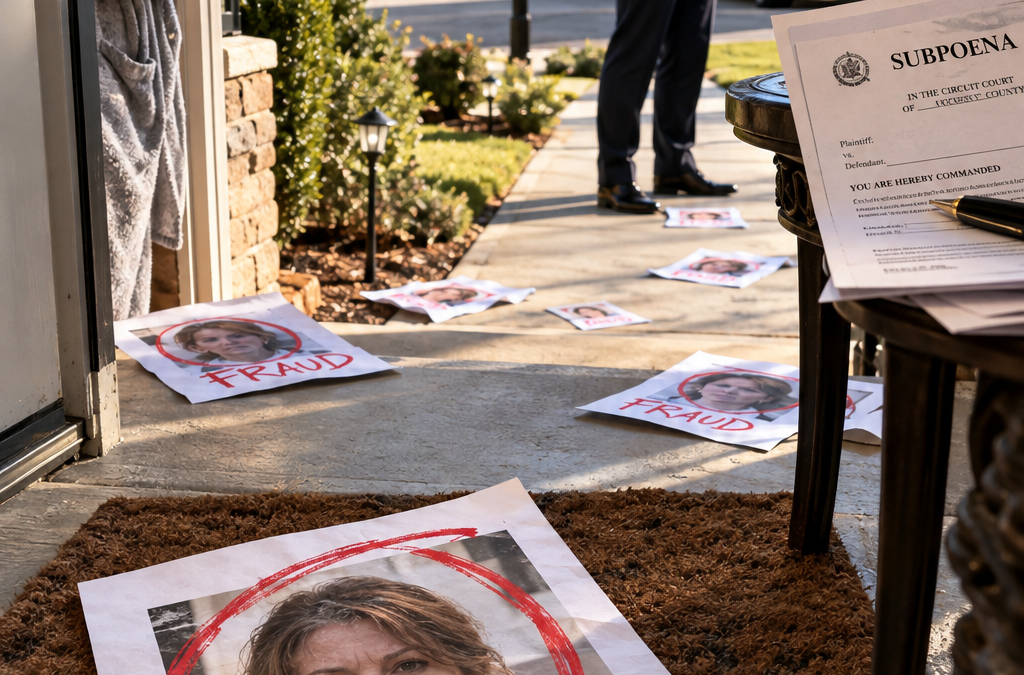
Then I saw my own face.
It had been pulled from a neighborhood picnic photo, cropped too close, printed grainy and unflattering. Someone had circled my face in red marker.
Below it, in thick black letters:
FRAUD.
Under that, in red Sharpie:
WHERE DID THE HURRICANE DONATIONS GO?
My stomach dropped.
I picked it up with two fingers.
For several seconds, the porch seemed to tilt beneath me.
Then Natalie opened the front door behind me.
“Mom?”
I turned too late.
She saw it.
Her face changed in a way I still hate remembering.
“What is that?”
“Go inside, baby.”
“Is that you?”
“Go inside.”
By eight o’clock, neighbors were texting.
The flyers were everywhere.
Stapled to lamp posts. Taped near mailboxes. Slid under windshield wipers. Pinned to the community bulletin board near the clubhouse. Someone had distributed them in a five-block radius, accusing me and the relief team of pocketing hurricane donations.
By noon, Natalie texted from school.
Kids are asking if you stole money.
I sat in my car outside work and cried so hard I could not go inside for ten minutes.
It is one thing to be attacked.
It is another thing to watch the lie reach your child.
Calvin wanted to confront Diane immediately.
I told him no.
“Phyllis, everyone knows this came from her.”
“Knowing isn’t proving.”
“Sometimes proving takes too long.”
“Then we make it faster.”
I drove to the clubhouse and requested the printer logs.
Diane had forgotten something.
Months earlier, during a budget dispute, I had requested records showing print and copier usage because the board kept charging residents for “administrative materials” without itemizing costs. Diane had ignored most of it, but the management portal automatically preserved print logs tied to user codes.
The flyers had a faint machine watermark near the bottom margin.
Most people would not notice.
I did because I had spent too many years looking at office printers that left tiny identifying marks when the drum needed service.
The watermark matched the clubhouse copier.
The same copier Diane logged as “official HOA business only.”
The print job had run at 11:42 p.m.
Under Diane’s access code.
That was the second twist.
Diane had tried to destroy my reputation with anonymous flyers and used the HOA’s own machine to do it.
Paper trails really do cut both ways.
I called a lawyer that afternoon.
Her name was Renata Cole.
Her office was downtown, above a bakery that made the hallway smell like sugar and coffee. She was soft-spoken, with dark curls pulled into a low bun and the calmest expression I had seen in months. Her conference room was cramped, her chairs mismatched, and her legal pads stacked with military precision.
I brought the Diane Archive.
She read for almost two hours.
Violation notices.
Emails.
Donation receipts.
Photographs.
Printer logs.
Flyers.
Storage-company records.
The brother-in-law connection.
The corrupted security-footage response.
The ramp fines.
The volunteer citations.
By the time she finished, I had twisted a tissue into shreds in my lap.
Renata looked up.
Then she smiled.
Not politely.
Not sympathetically.
Like a surgeon who had found the exact source of the bleeding.
“This isn’t a case,” she said. “This is a slam dunk.”
I nearly cried again, but this time from relief.
“What can we do?”
“We file for defamation, tortious interference, and breach of fiduciary duty. We name Diane personally. We name the HOA where the board rubber-stamped or enabled her conduct. We demand preservation of records immediately.”
“Will it stop the flyers?”
“It will make distributing the next one very expensive.”
I laughed through the tears.
Renata slid a box of tissues toward me.
“Mrs. Renner, bullies like Diane rely on people feeling too ashamed to fight lies publicly. We are going to drag the paperwork into daylight.”
Three days later, a process server knocked on my door.
For one terrible second, I thought Diane had filed something against me.
Then he handed me a copy of the subpoena package Renata’s office had served in the case. Diane Voss’s name sat right at the top of the defendant list.
There was something deeply satisfying about seeing her name printed there.
Not as president.
Not as authority.
As defendant.
Karma does not always arrive dramatically.
Sometimes it wears a process server badge and asks you to sign for receipt.
Diane responded the only way she knew how.
She doubled down.
A “community update letter” appeared in mailboxes the next week. It accused me of harassing an elderly board member, creating division, disrupting HOA operations, and using charitable activity to shield myself from accountability.
The elderly board member was Diane.
Sixty-one years old.
When my mother heard that part, she nearly spilled her tea.
“Elderly?” she cackled. “Diane’s younger than my Zumba instructor. She’s not elderly. She’s petty.”
It was the first real laugh we’d had in weeks.
But Renata did not laugh when I sent her the letter.
“Good,” she said.
“Good?”
“She wrote more defamatory statements after receiving notice of litigation.”
“That helps?”
“It helps a lot.”
Discovery began.
Discovery is a strange gift.
It forces liars to keep writing things down.
And writing things down is fatal when the truth is already bleeding through the margins.
Renata subpoenaed printer logs, board communications, vendor contracts, security records, financial statements, storage invoices, and Diane’s emails related to me, the relief drive, and Voss Secure Storage.
Diane fought every request.
Too broad.
Too burdensome.
Irrelevant.
Confidential.
Privileged.
Renata answered every objection with the patience of a woman sharpening knives.
Then the court ordered an independent audit.
That was when the real truth surfaced.
Diane had not merely used clubhouse funds to print flyers.
She had been skimming from HOA reserve accounts for eleven months.
The auditor traced nearly forty thousand dollars diverted into an account connected to Voss Secure Storage, the same brother-in-law’s company Diane had tried to force onto our hurricane relief drive.
The storage contract was not just a conflict of interest.
It was part of the pipeline.
Improper payments. Inflated service fees. Reserve transfers categorized under vague emergency-preparedness expenses. Handling charges. Temporary storage allocations. Documentation that looked official until someone independent compared the dates, amounts, and actual services provided.
Suddenly, everything made sense.
The flyers.
The fines.
The donation-bin sabotage.
The corrupted security footage.
The accusations that I had stolen donations.
It had all been smoke.
Diane needed a scapegoat before anyone looked too closely at the books. My relief drive had accidentally pointed a flashlight at the exact corner where she was hiding the money.
Renata called me after the auditor’s preliminary findings came in.
“Phyllis,” she said, “this is larger than defamation now.”
I was standing in my laundry room, folding Calvin’s scrubs.
“How much larger?”
“Criminal-referral larger.”
I sat down on a basket of towels.
She explained the diverted funds.
The storage account.
The reserve transfers.
The false categorization.
The connection to Diane’s brother-in-law.
I listened without speaking.
When she finished, I said, “She called me a fraud because she was stealing.”
“That is one way to describe the pattern.”
I laughed once, sharply.
Then I cried.
Not because I was weak.
Because for months I had carried the weight of being publicly accused, whispered about, questioned, and humiliated. I had watched my daughter cry over something she did not understand. I had seen my husband come home exhausted and still stand ready to defend me. I had watched my mother pretend not to worry.
And now, finally, the lie had a motive.
Diane had not merely hated me.
She had needed me.
She needed the neighborhood looking at my donation bins instead of her bank transfers.
The local news reporter entered the story because of Rosa.
She denied it, of course.
But Rosa had the exact expression of a woman who knew how to type an anonymous tip without leaving fingerprints.
The reporter’s name was Camille Price, and she caught Diane outside the clubhouse after a board meeting.
“President Voss, can you comment on allegations that hurricane donations were directed toward a company owned by your brother-in-law?”
Diane laughed nervously.
“That is a gross mischaracterization.”
“Did Voss Secure Storage receive HOA-related payments connected to emergency preparedness?”
“I don’t have those figures in front of me.”
“Did you authorize flyers accusing Phyllis Renner of fraud?”
Diane’s hand twisted the strap of her purse.
I watched the clip later in Renata’s office.
That hand told the story before her mouth did.
“This is a simple miscommunication,” Diane said on camera.
Renata paused the video.
“That,” she said, “is not the face of a woman with clean records.”
The board removed Diane within days of receiving the auditor’s findings.
Unanimously.
They called it gross misconduct and breach of fiduciary responsibility to every homeowner in Oakridge Estates.
The emergency meeting was packed.
People stood along the walls, faces tight with anger and embarrassment. Some of the same residents who had avoided my eyes after the flyers now looked openly ashamed. I did not need apologies from all of them, but several came anyway.
Diane sat at the front table, pale and stiff, wearing a navy dress and a pearl necklace.
The acting vice president read the motion.
Diane tried to interrupt.
“You are making a mistake.”
No one responded.
“This board is reacting emotionally to incomplete information.”
Still no one responded.
She looked toward me.
“This woman has manipulated all of you.”
My mother, seated beside me with her walker folded near her chair, leaned over and whispered, “If she says one more word, I’m throwing this peppermint.”
I pressed my lips together to keep from laughing.
The vote passed.
Every board member voted to remove Diane as president.
Her name came off the clubhouse plaque within a single business meeting.
It was almost anticlimactic, watching a label that had given her so much power get unscrewed from a piece of brass.
But removal was not the end.
The county attorney’s office opened a criminal investigation into embezzlement and related financial misconduct after reviewing the auditor’s findings. Because several affected homeowners were elderly and because funds had been extracted through HOA assessments and pressure campaigns, investigators also examined potential elder financial abuse issues.
Diane was not smiling when she sat for deposition.
I was there with Renata.
Diane sat across the table, her lawyer beside her, her hands folded so tightly her knuckles looked white.
For the first hour, she denied intent.
She did not remember who authorized the flyers.
She could not recall the exact storage arrangements.
She relied on others.
She believed the charges were appropriate.
She trusted vendors.
She did not personally review every print job.
Then Renata placed the flyer in front of her.
My face circled in red.
Fraud written beneath it.
Renata’s voice remained soft.
“Mrs. Voss, did you approve this flyer?”
Diane’s jaw tightened.
Her lawyer shifted.
“Answer if you know,” he said.
Diane stared at the flyer.
Something in her expression finally cracked.
“It was meant to distract people,” she whispered.
The room went still.
Renata waited.
Diane’s voice shook.
“Things were getting out of control. Everyone was talking about the donations and the storage company and the records. I thought if people focused on the relief money, they would stop asking about the HOA accounts.”
I sat across from her with a copy of the flyer in my hand and felt something inside me unclench.
Not forgiveness.
Not pity.
Recognition.
The truth had finally entered the room in her own voice.
Renata asked, “So the accusation against Mrs. Renner was not based on evidence that she stole donation funds?”
Diane closed her eyes.
“No.”
My throat tightened.
For months, that word had been all I needed.
No.
No, I had not stolen.
No, the relief drive was not a scam.
No, my daughter should not have been forced to hear children repeat a lie made up by a woman trying to hide her own misconduct.
The settlement came quickly after that.
Diane’s insurer saw the deposition, the audit, the criminal referral, the printer logs, the defamatory update letter, and the flyer.
They did not want a jury.
The settlement was six figures.
More money than I had ever imagined receiving from a neighborhood dispute.
But the most important part was not the money.
It was the written retraction.
Posted communitywide.
Printed.
Emailed.
Mailed.
Pinned to the clubhouse bulletin board.
It stated plainly that there was no evidence I or the relief team had misused hurricane donations. It acknowledged that the flyers were false and defamatory. It confirmed that the donation records had been reviewed and that the relief supplies had been delivered to legitimate recipients.
I made sure Natalie read it.
She stood beside me in the kitchen, scanning the page quietly.
Then she looked up.
“So everyone knows you didn’t do it?”
“Yes.”
Her eyes filled.
“Good.”
That one word nearly broke me.
Diane pleaded guilty months later to embezzlement-related charges. The sentence included restitution and probation, with additional financial penalties and restrictions tied to the HOA misconduct. I did not attend every hearing. I did not need to see her punished in person to know the truth had finally caught her.
The relief drive grew after everything came out.
That surprised me.
I thought people would be embarrassed. Cautious. Afraid to get involved again.
Instead, donations flooded in faster than we could sort them.
Water, diapers, generators, canned food, blankets, medical supplies, pet food. Residents who had once hesitated now showed up with entire carloads. Local businesses contributed. Calvin organized delivery routes. My mother ran the labeling table like a military operation.
Rosa showed up wearing a shirt that said CHAOS COORDINATOR.
“Subtle,” I said.
She smiled. “I’m healing.”
This time, the clubhouse lawn was approved.
No storage company.
No handling fee.
No brother-in-law skimming from the kindness of frightened people.
Just neighbors helping neighbors.
I framed the original flyer.
Not immediately.
At first, I wanted to burn it.
Then one morning, I found it in the file box and realized my hands no longer shook when I looked at it.
So I placed it in a simple black frame and hung it in the hallway outside my office.
Calvin stared at it the first night.
“You sure you want to see that every day?”
“Yes.”
“Why?”
“Because it reminds me what almost worked.”
He looked at me.
I touched the edge of the frame.
“A lie almost worked because it was loud, ugly, and public. The truth had to be patient.”
My mother rolled past us in her wheelchair.
“Also because Diane looked like a raccoon in that printer quality.”
“Mom.”
“What? She chose the copier.”
We laughed.
And it felt good.
Oakridge elected a new board that year.
Transparent. Boring. Fair.
Exactly what an HOA should be.
Meetings ran longer because residents asked real questions and actually received answers. Financials were posted monthly. Vendor contracts required disclosure of family relationships. Common-area use policies were rewritten so charitable activity could not be quietly hijacked for private profit. Accommodation requests for disability access were handled by documented procedure instead of Diane’s personal mood.
For the first time since moving in, I felt at home.
Not because the neighborhood became perfect.
It did not.
People still argued about landscaping. Someone still complained about a dog barking too early. The clubhouse air conditioner broke twice. Rosa accused the new treasurer of buying cheap coffee, which was true and corrected after public pressure.
But ordinary problems felt almost beautiful after months of manufactured fear.
One evening, almost a year after the first flyer, I sat on the porch with Calvin while Natalie rode her bike around the cul-de-sac. Mom sat beside us with a glass of sweet tea, watching the sunset like she personally owned the sky.
The porch light clicked on automatically.
No citation came.
The wheelchair ramp remained exactly where it needed to be.
No one questioned it.
No one called it a structural violation.
Rosa walked by and waved.
“Relief meeting Saturday?” she called.
“Ten o’clock,” I said.
“I’ll bring labels.”
“Bring decent coffee.”
“Talk to the treasurer.”
Calvin laughed quietly beside me.
“What?” I asked.
He looked around the cul-de-sac.
“Nothing. Just nice to hear people complain about normal things.”
He was right.
Normal felt like a gift.
I thought about the morning the flyer landed on my porch. The red circle around my face. The word fraud. Natalie’s expression. Calvin’s anger. My mother pretending not to be scared. The humiliation of walking through a neighborhood wondering who believed the worst about me.
Then I thought about Renata’s office. The printer logs. The audit. Diane’s deposition. The retraction. The new donation bins lined up across the clubhouse lawn.
Patience is not weakness.
Paperwork is not passive.
Quiet stubbornness can look unimpressive while it is saving your life.
Diane Voss thought volume would beat evidence. She thought a red marker and a copier could rewrite reality. She thought if she accused me first, no one would look at her brother-in-law, her contracts, her reserve transfers, or the money disappearing behind the word procedure.
She was wrong.
The loudest lie in Oakridge Estates eventually met the quietest folder.
And the folder won.
I leaned back in my chair and watched Natalie coast down the street, hair flying behind her, the magnolia tree moving softly in the humid evening air.
For the first time since we moved in, I was not bracing for the next notice, the next accusation, the next meeting where Diane would smile and twist the truth into a weapon.
The house felt steady beneath us.
The porch light burned bright.
And nobody had the power to make me ashamed of helping people ever again.
𝗧𝗛𝗘 𝗘𝗡𝗗
The HOA President Put My Face on Fraud Flyers Across the Neighborhood Before Her Own Paper Trail Turned Against Her
The flyer landed on my porch at seven in the morning with my photo circled in red marker and one ugly word written beneath it. Three days later, a process server arrived with Diane Voss’s name printed at the top of a subpoena, and for the first time in months, I understood that karma did not need to shout to be heard.
My name is Phyllis Renner, and eight months before that flyer showed up on my porch, I believed Oakridge Estates would finally give my family peace.
That was all I wanted.
Peace.
Not luxury. Not status. Not some perfect postcard life with trimmed hedges and white porch columns. I wanted a quiet cul-de-sac where my husband could sleep after night shifts, where my daughter could ride her bike without traffic roaring past, and where my mother could sit on the porch in the evenings without hearing sirens every twenty minutes.
We had earned that kind of quiet.
My husband, Calvin, was a hospice nurse. He spent his nights sitting with people at the very edge of life, speaking softly in rooms where families cried into paper cups of hospital coffee. He came home at dawn with the kind of exhaustion sleep does not immediately fix. He needed silence. He needed darkness. He needed a front door that opened into safety.
My mother, Eileen, had moved in with us after her second hip surgery. She was stubborn, funny, and allergic to pity. She used a walker most days and a wheelchair on the bad ones, but she still insisted on folding laundry because, as she said, “I refuse to let this family walk around wrinkled like abandoned curtains.”
My daughter, Natalie, was twelve, old enough to understand more than I wanted her to and young enough that cruelty still stunned her.
So when we found the house on Marigold Court, I let myself hope.
It had a small front porch, a magnolia tree in the side yard, and a cul-de-sac full of houses that looked settled rather than staged. Kids rode scooters near the mailboxes. A retired man waved from his driveway. The lawns were tidy without looking like a golf course. It felt like a neighborhood where people might actually learn one another’s names.
The real estate agent mentioned the HOA in a careful voice.
“Oakridge has rules,” she said.
I laughed. “Everywhere has rules.”
She hesitated just long enough that I should have noticed.
“Some residents find the board president very involved.”
“How involved?”
“She likes things done correctly.”
At the time, that did not frighten me.
I worked as an office administrator for a small medical supply company. My life was built around forms, invoices, deadlines, and people saying, “I swear I sent that last week,” when they absolutely had not. I respected organization. I believed paperwork could prevent misunderstandings when everyone used it honestly.
That was before I met Diane Voss.
She arrived at our door two days after we moved in, carrying a fruit basket and a welcome packet so thick I thought it might include the original county charter.
Diane was sixty-one, though she dressed and carried herself like a woman determined to look ageless through discipline alone. Her blond hair was cut into a precise bob, her makeup was flawless, and her white capri pants somehow remained spotless despite the Gulf Coast humidity. She wore a turquoise necklace that matched her earrings and smiled as if she had practiced in the mirror.
“Phyllis Renner,” she said warmly. “Welcome to Oakridge Estates.”
I wiped my hands on my jeans. “Thank you. That’s kind of you.”
She handed me the basket.
“Just a few things from the board. Muffins, oranges, local honey, and of course the community welcome materials.”
I took the packet.
It felt heavier than the basket.
“Wow.”
She laughed lightly. “We believe informed homeowners make better neighbors.”
“That sounds reasonable.”
“It is,” Diane said. “As long as everyone respects the standards that protect our property values.”
That sentence should have warned me.
Not because standards are bad.
Because people who say “property values” too quickly often mean “control” and hope you will not hear the difference.
Still, I smiled.
We were new. I wanted to start well.
Diane stepped slightly to one side and looked past me toward the hallway, where moving boxes leaned against the wall.
“Settling in?”
“Slowly.”
“I understand. Moves are difficult.”
Her eyes shifted toward the front porch light.
“Your husband works nights, I believe?”
I blinked. “Yes. He’s a nurse.”
“How admirable.”
“It is.”
“The porch light was on quite late last night.”
I stared at her for half a second, thinking I had misheard.
“It stays on when he comes home before sunrise.”
“Of course,” she said sweetly. “Safety matters. We just ask residents to be mindful of exterior lighting intensity. Oakridge has very peaceful nightscapes.”
Peaceful nightscapes.
I almost laughed.
Instead, I nodded and thanked her again.
After she left, Calvin came out of the kitchen holding an orange from the basket.
“That woman just inspect our porch bulb?”
“Maybe.”
He peeled the orange. “We’ve been here forty-eight hours.”
“She brought muffins.”
“People can bring muffins and still be dangerous.”
He said it jokingly.
Neither of us knew how right he was.
The first violation notice came eleven days later.
A garden hose.
Not stretched across the walkway. Not tangled in the shrubs. Just coiled near the driveway after I watered the new hibiscus plants Calvin had bought for me.
The notice said the hose had been “improperly stored in visible driveway-adjacent space.”
Fine: fifty dollars.
I stood at the kitchen counter reading it with my eyebrows raised.
Fifty dollars.
For a hose.
I almost ignored it, but we had just moved in, and I did not want trouble. I paid it online and wrote a little note in my folder.
Hose fine paid — September 14.
That folder started as ordinary household organization.
Mortgage documents. Insurance papers. HOA packet. Utility confirmations.
Then I added the hose notice.
Then the mailbox notice.
The little metal flag on our mailbox was navy blue. Diane claimed it was the wrong shade of navy. She attached a photo of an approved swatch, but the image was grainy, and when I asked where residents could view the official color chart, the management office said Diane kept the original.
I should have fought harder then.
Instead, I paid another fine.
Calvin leaned against the kitchen doorframe while I filed the receipt.
“How many shades of navy can there be?”
“Apparently enough to fund an HOA.”
He smiled, but he looked tired. His night shifts had been brutal that week. I did not want to add neighborhood stress to the list of things weighing on him.
Then came the porch light citation.
Excessive Exterior Illumination / Light Pollution.
Seventy-five dollars.
That one made me angry.
Calvin left for work at 6:45 p.m. and came home around 7:30 a.m. when he was lucky. Sometimes later. I kept the porch light on so he could see the steps. My mother used that same light when she sat outside before dawn because pain kept her awake.
I emailed Diane.
The porch light is for safety. My husband works night shifts, and my mother has mobility issues.
She replied within sixteen minutes.
Safety accommodations are always considered. However, community standards apply equally to all residents.
Equally.
That word would become important later, because Diane Voss did not believe in equality. She believed in obedience.
I began saving everything.
Every email. Every notice. Every envelope. Every receipt. Every screenshot from the neighborhood portal. Not because I thought I was building a legal case. Because I had spent enough years handling administrative disputes to know that people who rely on confusion hate orderly records.
Then hurricane season came.
Our Gulf Coast town had seen storms before, but that year the first major one missed us by only a narrow turn. The worst of it hit communities south of us. Families were displaced. Roads flooded. Several shelters opened within driving distance.
I saw the first request for diapers in a local volunteer group.
Then bottled water.
Then batteries.
Then adult hygiene supplies.
I posted in the Oakridge neighborhood group asking whether anyone wanted to contribute. Within an hour, six people had responded. By the end of the day, we had volunteers willing to donate supplies, sort items, and transport them.
The obvious location was the clubhouse lawn.
It sat near the entrance, easy for people to access without driving deep into the neighborhood. Residents had used that same lawn for yard sales, bake sales, school fundraisers, and holiday decoration swaps for years.
I sent the board a polite message.
Several residents are organizing a hurricane relief drive for displaced families. We would like to place labeled donation bins on the clubhouse lawn this Saturday from 9 a.m. to 3 p.m. Volunteers will clean up afterward.
Diane replied directly.
Unauthorized use of common areas is prohibited.
I stared at the screen.
Then wrote back.
The clubhouse lawn has been used for resident-organized events many times. We will not sell anything or block access.
Her response came fast.
All donation activities must go through approved channels.
Approved channels.
I should have known there was money behind that phrase.
I called her.
She answered with that polished cheer in her voice.
“Phyllis. I assumed you would have questions.”
“I do. Why can’t we place donation bins on the clubhouse lawn?”
“Because liability must be managed.”
“We’ll have volunteers there the whole time.”
“And chain of custody?”
I paused. “For diapers?”
“Donated goods must be protected from theft, misuse, contamination, and unauthorized redistribution.”
“Diane, these are bottled water packs and baby wipes.”
“Exactly why professional storage and transport are appropriate.”
There it was.
“What professional storage?”
“Voss Secure Storage has partnered with Oakridge before. They can provide approved collection containers, secure temporary storage, and documented delivery.”
I wrote the name down.
“Voss?”
“My brother-in-law owns the company,” she said, as if that were a charming coincidence rather than the most obvious conflict of interest I had heard all year.
“And what do they charge?”
“A modest handling fee.”
“Taken from what?”
“The donation process.”
I went still.
“Diane, these are donations for displaced families.”
“Which is why they must be handled responsibly.”
“They need water, not administrative overhead.”
Her voice cooled.
“Phyllis, enthusiasm is not a substitute for proper procedure.”
“No,” I said. “But compassion is not supposed to be a profit center.”
Silence.
When she spoke again, her sweetness was gone.
“I would be careful about your tone.”
I should have been careful.
Instead, I organized the drive anyway.
Not on the clubhouse lawn. We used my driveway, Rosa’s driveway two houses down, and a rotating line of SUVs. Residents came quietly at first, then openly. By noon, my garage was full of cases of water, diapers, formula, batteries, cleaning supplies, and canned food. Calvin loaded boxes after coming off a twelve-hour shift. My mother sat on the porch with a clipboard, checking items off like a general commanding supply lines.
“That Voss woman come by yet?” she asked.
“Not yet.”
“Shame. I wore lipstick.”
By the end of the weekend, we delivered three full truckloads to a shelter distribution site.
I felt proud.
Tired, but proud.
Diane never forgave it.
Retaliation came disguised as enforcement.
First, a notice saying our donation activity created “traffic irregularities.”
Then a warning about “unapproved storage of bulk goods,” even though the supplies had been gone within forty-eight hours.
Then fines against neighbors who had volunteered.
Rosa received a citation for wind chimes.
The Harpers got fined for chalk drawings their grandchildren had made in the driveway.
A retired teacher named Elaine was cited for holiday lights left up two days past the approved deadline, even though half the neighborhood still had wreaths on doors.
Then Diane targeted my mother’s wheelchair ramp.
The ramp was temporary but sturdy, professionally installed along the side entrance after Mom’s surgery. It did not block the sidewalk. It did not extend into the street. It was there because my mother needed to enter and leave the house safely.
Diane called it an unapproved structural modification.
I sent medical documentation and photographs.
She responded that the board would “review accommodation requests under applicable standards.”
Then she fined us anyway.
That night, Calvin read the notice at the kitchen table and said nothing for a long time.
When he finally spoke, his voice was quiet.
“She’s attacking your mother now.”
“I know.”
“You need a lawyer.”
“Not yet.”
He looked at me.
“Phyllis.”
“I’m building the file.”
He rubbed both hands over his face.
“What if the file isn’t enough?”
I did not answer, because I was afraid of the same thing.
Board meetings became theater.
Diane sat at the front beneath a framed photo of the clubhouse, wielding Robert’s Rules like a club. She interrupted questions. Declared motions out of order. Limited discussion. Claimed resident comments were repetitive, irrelevant, improperly phrased, or disruptive.
When I asked why relief-drive volunteers were being cited selectively, she said, “This board will not entertain accusations.”
When Rosa asked why Voss Secure Storage had been recommended for donations without competitive bids, Diane said, “Vendor relationships are not subject to public interrogation.”
When I asked for the HOA’s financial records, she smiled.
“You’re certainly very interested in money for someone organizing donations.”
The room went silent.
It was the first time she said the accusation close enough for everyone to hear.
My face burned.
“I’m interested in HOA finances because I pay dues.”
“Of course,” she said.
But her eyes were bright.
She had planted the seed.
Two nights later, I found the donation bin outside my garage overturned.
The bin was one of the last ones, holding leftover supplies we were sorting for a second delivery. Diapers had spilled across the driveway. Bottled water rolled under the car. A package of wipes had been torn open, white sheets scattered like feathers across the concrete.
I stood there in the porch light, shaking with anger.
Calvin came outside behind me.
“Security camera?”
I checked.
Our camera had caught only the far edge of the driveway. A shadow moved near the bin, but not enough to identify anyone.
The clubhouse camera pointed toward the street should have captured the approach.
I requested the footage.
Diane responded the next day.
Unfortunately, security footage for that hour appears corrupted.
Of course it was.
I did not accuse her.
Not in writing.
Not yet.
Instead, I requested financial records again.
This time, formally. I cited my right as a homeowner in good standing to inspect association financial documents, vendor contracts, common-area expenditures, printing costs, and board-approved payments.
Diane delayed.
First one week.
Then two.
Then three.
Administrative backlog.
Volunteer availability.
File reconciliation.
Audit preparation.
Delay has a smell when you’ve spent enough years around people hiding things.
By then, my folder had become two folders.
Then a file box.
Then a plastic storage crate.
Calvin called it the Diane Archive.
My mother called it “Exhibit A through Girl, She Tried It.”
Then the flyers appeared.
Mine landed on the porch at seven on a gray Tuesday morning.
I almost stepped on it carrying coffee to the rocking chair.
At first, I thought it was a lawn service advertisement.
Then I saw my own face.
It had been pulled from a neighborhood picnic photo, cropped too close, printed grainy and unflattering. Someone had circled my face in red marker.
Below it, in thick black letters:
FRAUD.
Under that, in red Sharpie:
WHERE DID THE HURRICANE DONATIONS GO?
My stomach dropped.
I picked it up with two fingers.
For several seconds, the porch seemed to tilt beneath me.
Then Natalie opened the front door behind me.
“Mom?”
I turned too late.
She saw it.
Her face changed in a way I still hate remembering.
“What is that?”
“Go inside, baby.”
“Is that you?”
“Go inside.”
By eight o’clock, neighbors were texting.
The flyers were everywhere.
Stapled to lamp posts. Taped near mailboxes. Slid under windshield wipers. Pinned to the community bulletin board near the clubhouse. Someone had distributed them in a five-block radius, accusing me and the relief team of pocketing hurricane donations.
By noon, Natalie texted from school.
Kids are asking if you stole money.
I sat in my car outside work and cried so hard I could not go inside for ten minutes.
It is one thing to be attacked.
It is another thing to watch the lie reach your child.
Calvin wanted to confront Diane immediately.
I told him no.
“Phyllis, everyone knows this came from her.”
“Knowing isn’t proving.”
“Sometimes proving takes too long.”
“Then we make it faster.”
I drove to the clubhouse and requested the printer logs.
Diane had forgotten something.
Months earlier, during a budget dispute, I had requested records showing print and copier usage because the board kept charging residents for “administrative materials” without itemizing costs. Diane had ignored most of it, but the management portal automatically preserved print logs tied to user codes.
The flyers had a faint machine watermark near the bottom margin.
Most people would not notice.
I did because I had spent too many years looking at office printers that left tiny identifying marks when the drum needed service.
The watermark matched the clubhouse copier.
The same copier Diane logged as “official HOA business only.”
The print job had run at 11:42 p.m.
Under Diane’s access code.
That was the second twist.
Diane had tried to destroy my reputation with anonymous flyers and used the HOA’s own machine to do it.
Paper trails really do cut both ways.
I called a lawyer that afternoon.
Her name was Renata Cole.
Her office was downtown, above a bakery that made the hallway smell like sugar and coffee. She was soft-spoken, with dark curls pulled into a low bun and the calmest expression I had seen in months. Her conference room was cramped, her chairs mismatched, and her legal pads stacked with military precision.
I brought the Diane Archive.
She read for almost two hours.
Violation notices.
Emails.
Donation receipts.
Photographs.
Printer logs.
Flyers.
Storage-company records.
The brother-in-law connection.
The corrupted security-footage response.
The ramp fines.
The volunteer citations.
By the time she finished, I had twisted a tissue into shreds in my lap.
Renata looked up.
Then she smiled.
Not politely.
Not sympathetically.
Like a surgeon who had found the exact source of the bleeding.
“This isn’t a case,” she said. “This is a slam dunk.”
I nearly cried again, but this time from relief.
“What can we do?”
“We file for defamation, tortious interference, and breach of fiduciary duty. We name Diane personally. We name the HOA where the board rubber-stamped or enabled her conduct. We demand preservation of records immediately.”
“Will it stop the flyers?”
“It will make distributing the next one very expensive.”
I laughed through the tears.
Renata slid a box of tissues toward me.
“Mrs. Renner, bullies like Diane rely on people feeling too ashamed to fight lies publicly. We are going to drag the paperwork into daylight.”
Three days later, a process server knocked on my door.
For one terrible second, I thought Diane had filed something against me.
Then he handed me a copy of the subpoena package Renata’s office had served in the case. Diane Voss’s name sat right at the top of the defendant list.
There was something deeply satisfying about seeing her name printed there.
Not as president.
Not as authority.
As defendant.
Karma does not always arrive dramatically.
Sometimes it wears a process server badge and asks you to sign for receipt.
Diane responded the only way she knew how.
She doubled down.
A “community update letter” appeared in mailboxes the next week. It accused me of harassing an elderly board member, creating division, disrupting HOA operations, and using charitable activity to shield myself from accountability.
The elderly board member was Diane.
Sixty-one years old.
When my mother heard that part, she nearly spilled her tea.
“Elderly?” she cackled. “Diane’s younger than my Zumba instructor. She’s not elderly. She’s petty.”
It was the first real laugh we’d had in weeks.
But Renata did not laugh when I sent her the letter.
“Good,” she said.
“Good?”
“She wrote more defamatory statements after receiving notice of litigation.”
“That helps?”
“It helps a lot.”
Discovery began.
Discovery is a strange gift.
It forces liars to keep writing things down.
And writing things down is fatal when the truth is already bleeding through the margins.
Renata subpoenaed printer logs, board communications, vendor contracts, security records, financial statements, storage invoices, and Diane’s emails related to me, the relief drive, and Voss Secure Storage.
Diane fought every request.
Too broad.
Too burdensome.
Irrelevant.
Confidential.
Privileged.
Renata answered every objection with the patience of a woman sharpening knives.
Then the court ordered an independent audit.
That was when the real truth surfaced.
Diane had not merely used clubhouse funds to print flyers.
She had been skimming from HOA reserve accounts for eleven months.
The auditor traced nearly forty thousand dollars diverted into an account connected to Voss Secure Storage, the same brother-in-law’s company Diane had tried to force onto our hurricane relief drive.
The storage contract was not just a conflict of interest.
It was part of the pipeline.
Improper payments. Inflated service fees. Reserve transfers categorized under vague emergency-preparedness expenses. Handling charges. Temporary storage allocations. Documentation that looked official until someone independent compared the dates, amounts, and actual services provided.
Suddenly, everything made sense.
The flyers.
The fines.
The donation-bin sabotage.
The corrupted security footage.
The accusations that I had stolen donations.
It had all been smoke.
Diane needed a scapegoat before anyone looked too closely at the books. My relief drive had accidentally pointed a flashlight at the exact corner where she was hiding the money.
Renata called me after the auditor’s preliminary findings came in.
“Phyllis,” she said, “this is larger than defamation now.”
I was standing in my laundry room, folding Calvin’s scrubs.
“How much larger?”
“Criminal-referral larger.”
I sat down on a basket of towels.
She explained the diverted funds.
The storage account.
The reserve transfers.
The false categorization.
The connection to Diane’s brother-in-law.
I listened without speaking.
When she finished, I said, “She called me a fraud because she was stealing.”
“That is one way to describe the pattern.”
I laughed once, sharply.
Then I cried.
Not because I was weak.
Because for months I had carried the weight of being publicly accused, whispered about, questioned, and humiliated. I had watched my daughter cry over something she did not understand. I had seen my husband come home exhausted and still stand ready to defend me. I had watched my mother pretend not to worry.
And now, finally, the lie had a motive.
Diane had not merely hated me.
She had needed me.
She needed the neighborhood looking at my donation bins instead of her bank transfers.
The local news reporter entered the story because of Rosa.
She denied it, of course.
But Rosa had the exact expression of a woman who knew how to type an anonymous tip without leaving fingerprints.
The reporter’s name was Camille Price, and she caught Diane outside the clubhouse after a board meeting.
“President Voss, can you comment on allegations that hurricane donations were directed toward a company owned by your brother-in-law?”
Diane laughed nervously.
“That is a gross mischaracterization.”
“Did Voss Secure Storage receive HOA-related payments connected to emergency preparedness?”
“I don’t have those figures in front of me.”
“Did you authorize flyers accusing Phyllis Renner of fraud?”
Diane’s hand twisted the strap of her purse.
I watched the clip later in Renata’s office.
That hand told the story before her mouth did.
“This is a simple miscommunication,” Diane said on camera.
Renata paused the video.
“That,” she said, “is not the face of a woman with clean records.”
The board removed Diane within days of receiving the auditor’s findings.
Unanimously.
They called it gross misconduct and breach of fiduciary responsibility to every homeowner in Oakridge Estates.
The emergency meeting was packed.
People stood along the walls, faces tight with anger and embarrassment. Some of the same residents who had avoided my eyes after the flyers now looked openly ashamed. I did not need apologies from all of them, but several came anyway.
Diane sat at the front table, pale and stiff, wearing a navy dress and a pearl necklace.
The acting vice president read the motion.
Diane tried to interrupt.
“You are making a mistake.”
No one responded.
“This board is reacting emotionally to incomplete information.”
Still no one responded.
She looked toward me.
“This woman has manipulated all of you.”
My mother, seated beside me with her walker folded near her chair, leaned over and whispered, “If she says one more word, I’m throwing this peppermint.”
I pressed my lips together to keep from laughing.
The vote passed.
Every board member voted to remove Diane as president.
Her name came off the clubhouse plaque within a single business meeting.
It was almost anticlimactic, watching a label that had given her so much power get unscrewed from a piece of brass.
But removal was not the end.
The county attorney’s office opened a criminal investigation into embezzlement and related financial misconduct after reviewing the auditor’s findings. Because several affected homeowners were elderly and because funds had been extracted through HOA assessments and pressure campaigns, investigators also examined potential elder financial abuse issues.
Diane was not smiling when she sat for deposition.
I was there with Renata.
Diane sat across the table, her lawyer beside her, her hands folded so tightly her knuckles looked white.
For the first hour, she denied intent.
She did not remember who authorized the flyers.
She could not recall the exact storage arrangements.
She relied on others.
She believed the charges were appropriate.
She trusted vendors.
She did not personally review every print job.
Then Renata placed the flyer in front of her.
My face circled in red.
Fraud written beneath it.
Renata’s voice remained soft.
“Mrs. Voss, did you approve this flyer?”
Diane’s jaw tightened.
Her lawyer shifted.
“Answer if you know,” he said.
Diane stared at the flyer.
Something in her expression finally cracked.
“It was meant to distract people,” she whispered.
The room went still.
Renata waited.
Diane’s voice shook.
“Things were getting out of control. Everyone was talking about the donations and the storage company and the records. I thought if people focused on the relief money, they would stop asking about the HOA accounts.”
I sat across from her with a copy of the flyer in my hand and felt something inside me unclench.
Not forgiveness.
Not pity.
Recognition.
The truth had finally entered the room in her own voice.
Renata asked, “So the accusation against Mrs. Renner was not based on evidence that she stole donation funds?”
Diane closed her eyes.
“No.”
My throat tightened.
For months, that word had been all I needed.
No.
No, I had not stolen.
No, the relief drive was not a scam.
No, my daughter should not have been forced to hear children repeat a lie made up by a woman trying to hide her own misconduct.
The settlement came quickly after that.
Diane’s insurer saw the deposition, the audit, the criminal referral, the printer logs, the defamatory update letter, and the flyer.
They did not want a jury.
The settlement was six figures.
More money than I had ever imagined receiving from a neighborhood dispute.
But the most important part was not the money.
It was the written retraction.
Posted communitywide.
Printed.
Emailed.
Mailed.
Pinned to the clubhouse bulletin board.
It stated plainly that there was no evidence I or the relief team had misused hurricane donations. It acknowledged that the flyers were false and defamatory. It confirmed that the donation records had been reviewed and that the relief supplies had been delivered to legitimate recipients.
I made sure Natalie read it.
She stood beside me in the kitchen, scanning the page quietly.
Then she looked up.
“So everyone knows you didn’t do it?”
“Yes.”
Her eyes filled.
“Good.”
That one word nearly broke me.
Diane pleaded guilty months later to embezzlement-related charges. The sentence included restitution and probation, with additional financial penalties and restrictions tied to the HOA misconduct. I did not attend every hearing. I did not need to see her punished in person to know the truth had finally caught her.
The relief drive grew after everything came out.
That surprised me.
I thought people would be embarrassed. Cautious. Afraid to get involved again.
Instead, donations flooded in faster than we could sort them.
Water, diapers, generators, canned food, blankets, medical supplies, pet food. Residents who had once hesitated now showed up with entire carloads. Local businesses contributed. Calvin organized delivery routes. My mother ran the labeling table like a military operation.
Rosa showed up wearing a shirt that said CHAOS COORDINATOR.
“Subtle,” I said.
She smiled. “I’m healing.”
This time, the clubhouse lawn was approved.
No storage company.
No handling fee.
No brother-in-law skimming from the kindness of frightened people.
Just neighbors helping neighbors.
I framed the original flyer.
Not immediately.
At first, I wanted to burn it.
Then one morning, I found it in the file box and realized my hands no longer shook when I looked at it.
So I placed it in a simple black frame and hung it in the hallway outside my office.
Calvin stared at it the first night.
“You sure you want to see that every day?”
“Yes.”
“Why?”
“Because it reminds me what almost worked.”
He looked at me.
I touched the edge of the frame.
“A lie almost worked because it was loud, ugly, and public. The truth had to be patient.”
My mother rolled past us in her wheelchair.
“Also because Diane looked like a raccoon in that printer quality.”
“Mom.”
“What? She chose the copier.”
We laughed.
And it felt good.
Oakridge elected a new board that year.
Transparent. Boring. Fair.
Exactly what an HOA should be.
Meetings ran longer because residents asked real questions and actually received answers. Financials were posted monthly. Vendor contracts required disclosure of family relationships. Common-area use policies were rewritten so charitable activity could not be quietly hijacked for private profit. Accommodation requests for disability access were handled by documented procedure instead of Diane’s personal mood.
For the first time since moving in, I felt at home.
Not because the neighborhood became perfect.
It did not.
People still argued about landscaping. Someone still complained about a dog barking too early. The clubhouse air conditioner broke twice. Rosa accused the new treasurer of buying cheap coffee, which was true and corrected after public pressure.
But ordinary problems felt almost beautiful after months of manufactured fear.
One evening, almost a year after the first flyer, I sat on the porch with Calvin while Natalie rode her bike around the cul-de-sac. Mom sat beside us with a glass of sweet tea, watching the sunset like she personally owned the sky.
The porch light clicked on automatically.
No citation came.
The wheelchair ramp remained exactly where it needed to be.
No one questioned it.
No one called it a structural violation.
Rosa walked by and waved.
“Relief meeting Saturday?” she called.
“Ten o’clock,” I said.
“I’ll bring labels.”
“Bring decent coffee.”
“Talk to the treasurer.”
Calvin laughed quietly beside me.
“What?” I asked.
He looked around the cul-de-sac.
“Nothing. Just nice to hear people complain about normal things.”
He was right.
Normal felt like a gift.
I thought about the morning the flyer landed on my porch. The red circle around my face. The word fraud. Natalie’s expression. Calvin’s anger. My mother pretending not to be scared. The humiliation of walking through a neighborhood wondering who believed the worst about me.
Then I thought about Renata’s office. The printer logs. The audit. Diane’s deposition. The retraction. The new donation bins lined up across the clubhouse lawn.
Patience is not weakness.
Paperwork is not passive.
Quiet stubbornness can look unimpressive while it is saving your life.
Diane Voss thought volume would beat evidence. She thought a red marker and a copier could rewrite reality. She thought if she accused me first, no one would look at her brother-in-law, her contracts, her reserve transfers, or the money disappearing behind the word procedure.
She was wrong.
The loudest lie in Oakridge Estates eventually met the quietest folder.
And the folder won.
I leaned back in my chair and watched Natalie coast down the street, hair flying behind her, the magnolia tree moving softly in the humid evening air.
For the first time since we moved in, I was not bracing for the next notice, the next accusation, the next meeting where Diane would smile and twist the truth into a weapon.
The house felt steady beneath us.
The porch light burned bright.
And nobody had the power to make me ashamed of helping people ever again.








