𝗙𝗨𝗟𝗟 𝗦𝗧𝗢𝗥𝗬 The HOA President Put a Lien on My House Over a Garden Gnome
𝗙𝗨𝗟𝗟 𝗦𝗧𝗢𝗥𝗬
That was when I started paying attention.
My neighbor Sarah Mitchell was the first person to say the quiet part out loud.
Sarah lived on the other side of my fence. She was thirty-eight, worked from home in marketing, and had a habit of saying exactly what she thought as long as Karen wasn’t within earshot.
One evening, while I was tightening the chains on my supposedly illegal porch swing, she leaned over the fence.
“Welcome to the Diane Tax,” she said.
I looked up.
“The what?”
She grimaced. “Sorry. Old nickname. Before you moved in, some of us called him King Karen. Some called him the Diane Tax because he behaves like every nightmare HOA Karen in one body.”
I laughed.
She didn’t.
“It means if he decides he doesn’t like you, everything costs extra.”
“I’m starting to notice.”
Sarah looked toward the street before continuing.
“He does this to new residents. Young families. Single people. Anyone who doesn’t have friends on the board yet.”
“Why?”
“Because they don’t know how things work here.”
“And how do things work here?”
She lowered her voice.
“They work however Karen says they work.”
I glanced toward his house two streets over.
“You all just let him?”
Sarah’s expression hardened.
“You’re new. Don’t ask that too loudly.”
Something uneasy moved in my stomach.
I wanted to believe she was exaggerating. I wanted to believe Karen was just a polished little tyrant with too much free time and a love of petty power.
Then came the front door letter.
My door was painted a warm slate blue, exactly the color it had been when I bought the house.
Karen’s notice said the only approved front door color for my row was “Cloud Whisper White.”
I stared at that phrase for a long time.
Cloud Whisper White.
I had never heard three words sound more like a scam.
The notice gave me ten days to repaint or face a daily special assessment fine.
I called the HOA office and asked for the bylaw.
Karen answered personally.
“Brent.”
He always said my name like he was making a note of it.
“Karen, I got a notice about my front door.”
“Yes.”
“It was this color when I bought the house.”
“Prior noncompliance does not become permanent compliance.”
“Can you send me the rule?”
“The color standards are under revision.”
I frowned.
“Then how am I violating them?”
“The current board interpretation is clear.”
“I’d still like to see the written bylaw.”
“They’re unavailable to residents until updates are finalized.”
I sat up straighter.
“Unavailable?”
“Temporarily.”
“Legitimate organizations don’t hide their own rulebook.”
Silence.
Then Karen said, softly, “You should be careful how you characterize the board.”
“And you should be careful filing fines under rules you won’t show me.”
His voice turned colder.
“I’ll note your refusal to cooperate.”
He hung up.
An hour later, his golf cart stopped in front of my house.
Karen stepped onto my walkway with his clipboard tucked under one arm. He wore pale gray slacks, a navy polo, and sunglasses with mirrored lenses. The man looked like he had dressed for a country club disciplinary hearing.
I opened the door before he knocked.
“Something else?”
He looked at my front door like it had insulted his bloodline.
“The daily assessment begins Monday.”
“Show me the rule.”
“The board has authority to interpret community standards.”
“Then interpret this. I’m not repainting a door based on a hidden rule.”
His jaw tightened.
“You’re making this unnecessarily difficult.”
“No. You are.”
He took a step closer.
“People move here because Maplerest has standards.”
“People buy homes here because they think they own them.”
For the first time, his polished smile slipped.
Only slightly.
But I saw it.
“You’ll regret taking that tone,” he said.
I believed him.
That night, I created a folder.
Not digital only. A real physical binder too.
I labeled it HOA — WHITFIELD.
Every fine went in.
Every envelope.
Every email.
Every screenshot.
Every photograph.
Every payment receipt.
Every certified letter tracking number.
I had never been a paperwork person. I became one fast.
The first real twist came through Sarah.
Two nights after Karen’s threat, she knocked on my back door with a glass of wine in one hand and a grin she was trying not to show.
“You want to see something funny?”
“I could use funny.”
“Drive past Karen’s house tonight.”
“Why?”
“Front door.”
So I did.
At 9:30 p.m., I walked instead of driving. Maplerest was quiet, the houses glowing softly behind trimmed hedges. Karen’s house sat on a corner lot, larger than mine, with manicured shrubs and landscape lighting aimed perfectly at the brick façade.
And there it was.
His front door.
Bright red.
Not muted red. Not brick red. Not something that could be mistaken for Cloud Whisper White under unusual lighting.
Crimson red.
It glowed under the porch light like a dare.
I stood on the public sidewalk and took a photograph.
Then another.
Then one with the house number visible.
My stomach turned.
This wasn’t about standards.
This was selective enforcement.
A shakedown.
A man with a red door fining me because mine wasn’t white.
The next morning, I filed a formal complaint with the HOA board.
I kept it calm.
I cited the door notice, asked for the written rule, attached photos of other noncompliant doors and porch swings, and requested review of inconsistent enforcement.
Three days later, a certified letter arrived.
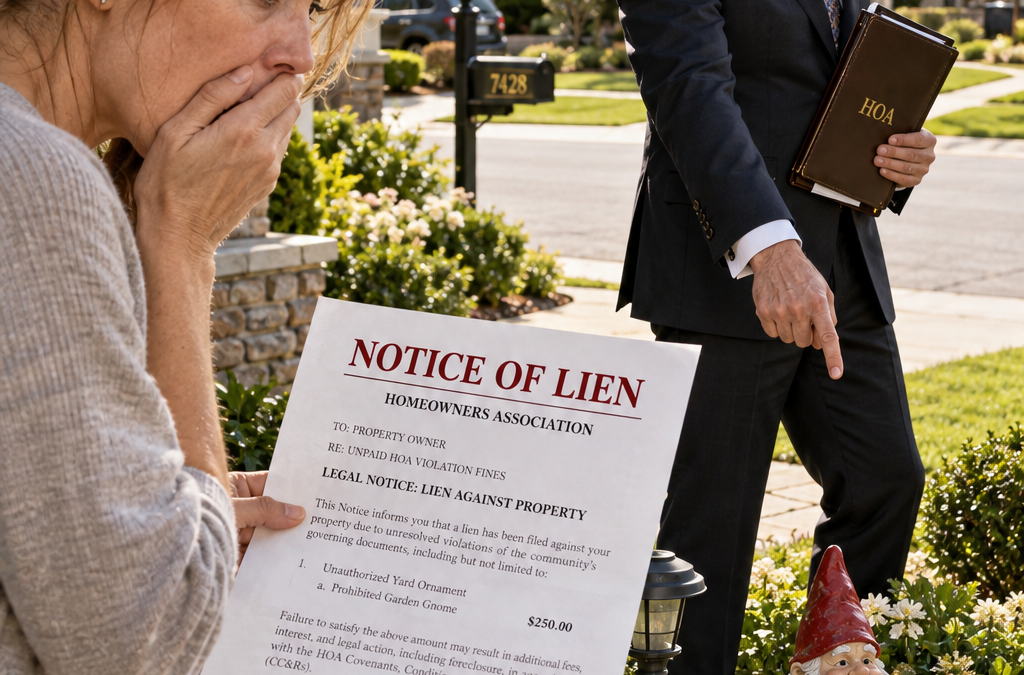
Lien Filing Initiated Against Property for Unpaid Assessments. Total Balance: $1,000. Failure to resolve may result in foreclosure proceedings within ninety days.
I read it twice.
Then a third time.
The words blurred.
Foreclosure.
Against my home.
Over grass, a mailbox, a trash can, a porch swing, a front door, and one small garden gnome I had placed near the walkway because my niece bought it for me as a housewarming gift.
The gnome wore a green hat and held a tiny lantern.
Karen called it “unapproved decorative ornamentation affecting visual uniformity.”
A garden gnome.
They had slapped a lien on my house over a garden gnome and a collection of other nonsense fines, and suddenly none of it felt funny.
My hands shook so hard I had to set the letter on the kitchen table.
I had worked too long to get that house.
Too many double shifts.
Too many cheap meals.
Too many years saying no to vacations and new cars and easy spending because I wanted a place that was mine.
Now Karen Whitfield was threatening to drag my home into foreclosure proceedings with a smile and a clipboard.
I called a lawyer that afternoon.
Her name was Priya Shah.
She was a real estate attorney in Columbus who specialized in HOA disputes, covenant enforcement, and property fraud. A coworker recommended her after his sister fought an HOA over a fence issue.
Priya listened quietly while I explained the fines.
Then she asked, “Do you have documents?”
“Yes.”
“How many?”
“A lot.”
“Good.”
“Good?”
“HOAs love bullying people who don’t document,” she said. “So if you documented everything, you’ve already done the part most homeowners skip.”
That sentence changed everything.
Fear did not disappear.
But it changed shape.
It became instruction.
Document everything.
So I did.
More carefully now.
I photographed Karen’s red door again in daylight.
I photographed the other porch swings.
I obtained county records showing the recorded covenants.
I saved every violation notice to both cloud storage and a hard drive.
I mailed formal requests by certified mail.
I recorded public meetings where permitted.
I asked neighbors to share their notices.
I built timelines.
If Karen wanted a war of paperwork, I would drown him in it.
At the next open board meeting, I stood with my binder under my arm.
The clubhouse was unusually crowded. Sarah sat behind me. So did Mrs. Langford, an older widow who had once paid Karen three hundred dollars over driveway stains. People watched me with the tense curiosity of spectators at a trial.
Karen sat at the front table in a crisp white shirt and charcoal blazer. His sunglasses rested beside his clipboard.
When homeowner comments opened, I stood.
“My name is Brent Calloway. I’d like to ask why my property has received more citations than any other home in Maplerest Estates over the past eighteen months.”
A few people shifted.
Karen looked at me without surprise.
“Do you have evidence for that claim?”
“I have the citations issued to me. I’ve requested the enforcement ledger. You haven’t provided it.”
He smiled.
“Budgets and internal administrative records are confidential.”
“I didn’t ask about budgets. I asked about enforcement.”
“The board’s operations are not subject to interrogation.”
I opened my binder.
“I’m also asking why my front door was cited under a color standard you refuse to produce, while your own front door is bright red.”
The room went completely silent.
Karen’s face didn’t change immediately.
That was impressive.
He smiled like a man used to swallowing poison in public and calling it tea.
“My property complies under legacy approval.”
“Show the approval.”
“That is not relevant to your violations.”
“It becomes relevant when you fine me for the same thing.”
Karen leaned forward.
“Mr. Calloway, you appear determined to make personal accusations instead of resolving your own noncompliance.”
“I’m determined to see the rules you claim I broke.”
He looked toward the board.
“This discussion is closed.”
That was when Harold moved.
Harold Bennett was the oldest board member, a thin man in his late sixties who rarely spoke and usually looked like he wished he could disappear into his chair.
As Karen shuffled papers, Harold slid a folder across the table toward me.
Not dramatically.
Just enough that it crossed the edge.
His eyes did not meet mine.
I looked down.
The folder was plain manila, worn at the corners.
Karen didn’t notice.
I picked it up and sat down.
My heart was pounding.
Sarah leaned forward and whispered, “What is that?”
“I don’t know yet.”
I waited until I was home to open it.
Inside were spreadsheets.
Not handwritten notes.
Actual HOA financial summaries, reserve fund reports, check registers, and vendor payment schedules.
Several pages were highlighted.
The reserve fund had shrunk by nearly sixty thousand dollars over three years.
The line item appeared again and again:
Administrative Consulting Fees — Whitfield Community Consulting LLC.
Whitfield.
My hands went cold.
I searched the company name on the state business registry.
Whitfield Community Consulting LLC was registered under an address I recognized.
Karen’s house.
But not under his name directly.
The registered owner was connected to his mother’s maiden name through an old family trust.
A thin disguise.
Not enough.
I sat at my kitchen table staring at the papers.
The man fining me over a garden gnome had been draining the neighborhood’s emergency fund into a company tied to his own address.
Fine by fine.
Threat by threat.
Residents paid because they were scared.
And the money flowed back to Karen, disguised as legitimate HOA business.
I nearly laughed.
Not because it was funny.
Because the hypocrisy was so large it became absurd.
The man obsessed with everyone else’s front door had been robbing the neighborhood through the back one.
The next morning, I met Harold at a coffee shop thirty minutes away.
He arrived wearing a baseball cap pulled low and looked nervous even before he sat down.
“You shouldn’t have given me that folder if you were worried,” I said.
“I’m not worried for me anymore.”
“What does that mean?”
Harold stirred his coffee though he hadn’t added sugar.
“I’ve tried reporting this twice.”
“To who?”
“County office once. State consumer line once. I didn’t have enough. Karen controls the records. He threatened to sue the board members personally if we disclosed internal financial documents.”
“Can he do that?”
“He can threaten it.”
I thought about the Henderson house.
The empty windows.
The auction sign.
“He scared everyone.”
Harold nodded.
“He had the last board silenced with lawsuits and settlement letters. People got tired. People got afraid.”
“Why help me now?”
He looked at me then.
“Because you’re still standing.”
I didn’t feel like I was.
I felt like a man trying not to drown.
Harold leaned closer.
“You’ll need more than complaints, son.”
“I have a lawyer.”
“Good. You’ll need numbers too. Real numbers. And someone who can explain them.”
So I hired a forensic accountant.
His name was Michael Okafor, a calm, meticulous man who wore rimless glasses and spoke about financial fraud the way electricians talk about faulty wiring: patiently, precisely, and with no tolerance for sloppy work.
He reviewed Harold’s folder, the company registry, the payment schedule, and the reserve fund statements.
After three hours, he looked at me and said, “This is not an accounting mistake.”
My stomach tightened.
“What is it?”
“Potential self-dealing. Possibly embezzlement, depending on what the underlying invoices show.”
“How much?”
“Based on these records alone, close to sixty thousand dollars in questionable transfers.”
I thought about Mrs. Langford paying driveway fines.
Sarah joking about the Diane Tax.
Me staring at a foreclosure threat over a garden gnome.
All that fear had been feeding a company Karen controlled.
Priya and Michael worked together from there.
Priya contacted the state attorney general’s consumer protection division and the relevant HOA oversight office. She prepared a complaint alleging fraudulent fines, selective enforcement, wrongful lien activity, self-dealing, and possible embezzlement.
Meanwhile, Karen doubled down.
He filed another notice.
This time it came from the sheriff’s office.
Notice of Scheduled Foreclosure Auction Proceedings Pending Resolution of HOA Lien.
My knees almost gave out when I read it.
I knew Priya was fighting it.
I knew the lien was legally shaky.
I knew Karen’s whole case rested on fake rules and inflated fines.
But legal knowledge does not stop your body from reacting to the possibility of losing your home.
My home.
The porch where I drank coffee.
The swing he wanted removed.
The little gnome still sitting inside my kitchen window because I refused to let him throw it away.
I called Priya with the notice in my hand.
She answered immediately.
“I was expecting this,” she said.
“You were?”
“He’s trying to scare you before the complaint lands.”
“It’s working.”
“I know.”
That honesty steadied me more than false comfort would have.
“What do I do?”
“You let me file the emergency motion. You do not pay him. You do not negotiate directly. And Brent?”
“Yes?”
“You keep going.”
Panic made me faster.
For the next three days, I barely slept.
I compiled everything into one thick binder.
Fake company filings.
Reserve fund charts.
Fine notices.
Photos of Karen’s red door.
Photos of other porch swings.
Certified mail receipts.
The lien notice.
The foreclosure warning.
Statements from neighbors.
Harold’s notes.
Michael’s preliminary analysis.
Priya’s legal complaint.
One quiet Tuesday afternoon, I sat with Sarah on her porch drinking sweet tea while I sorted copies into labeled sections.
She looked at the stack.
“You know, I would pay money to see Karen’s face if he ever gets audited.”
I laughed for the first time in days.
“That might happen.”
She raised her glass.
“To audits.”
“To audits.”
It turned out to be prophetic.
The night before the scheduled foreclosure action, Priya mailed and electronically submitted copies of the entire binder to the county fraud unit, the state attorney general’s office, the HOA oversight division, and a local investigative reporter who had covered property fraud before.
She also filed the emergency motion to halt the lien-based action.
The next HOA meeting took place forty-eight hours later.
Karen expected a normal meeting.
He arrived in a navy blazer, pale blue shirt, polished loafers, and his usual sunglasses resting on his head. His clipboard was tucked under one arm.
The clubhouse was packed.
More than eighty residents filled the room and spilled into the hallway.
Karen rang his little bell.
“Yes, yes, let’s come to order.”
He seemed irritated by the size of the crowd but not frightened.
Not yet.
He opened with a speech about maintaining standards and protecting property values from “disruptive residents who refuse accountability.”
Everyone knew he meant me.
I sat in the front row beside Priya.
Harold sat at the end of the board table, pale and silent.
Sarah sat behind me.
Mrs. Langford clutched a folder in both hands.
Then the back doors opened.
Two investigators walked in.
One wore a county badge clipped to his belt.
The other carried a folder with the state seal visible on the cover.
The room went silent.
Karen stopped mid-sentence.
The county investigator spoke first.
“Karen Whitfield?”
Karen’s face tightened.
“I’m the HOA president.”
“I asked if you are Karen Whitfield.”
“Yes.”
“We need to speak with you regarding Whitfield Community Consulting LLC and payments from the Maplerest Estates HOA reserve fund.”
For the first time since I had known him, Karen lost control of his face.
The blood drained out of it.
His mouth opened, then closed.
The clipboard slipped from under his arm and clattered across the clubhouse floor.
Every person in that room heard it.
A small plastic-and-leather sound, but it felt like a church bell.
Karen looked down at it as if he couldn’t understand how gravity had betrayed him.
Then came the third twist.
A man in his late twenties stood from the second row.
I recognized him from neighborhood events, though I had never spoken to him.
Marcus Whitfield.
Karen’s adult son.
He had come to the meeting, apparently, expecting to support his father or at least understand the controversy.
He looked shaken.
“Dad,” Marcus said.
Karen turned slowly.
Marcus pointed toward the investigators.
“What are they talking about?”
Karen’s voice came out thin.
“Sit down, Marcus.”
“No. What is Whitfield Community Consulting?”
“This isn’t the time.”
“Is that your company?”
Karen’s jaw worked.
The room held its breath.
Marcus’s voice broke.
“Mom told me people were lying about you.”
Karen’s eyes flashed.
“Your mother doesn’t understand the pressures of leadership.”
Marcus looked disgusted.
“Is this true?”
No answer.
That was answer enough.
Marcus stepped backward like he had been struck.
“Did you steal from these people?”
Karen finally snapped.
“I built this community.”
Marcus stared at him.
Then he said, quietly, “No. You used it.”
He walked out without another word.
The door closed behind him.
Karen watched it shut.
For one second, I almost felt sorry for him.
Almost.
Then I thought of the foreclosure notice on my kitchen table.
The Henderson house.
Mrs. Langford’s trembling hands.
Harold sitting in fear for years.
And the pity vanished.
The investigators asked Karen to provide records immediately. Priya stood and informed the board that the emergency motion had been filed and the lien was being challenged as fraudulent.
Residents began speaking.
One after another.
Mrs. Langford stood and said she had paid twelve hundred dollars in fines after Karen threatened her home.
A young father said he had borrowed money from his parents to pay a driveway fine.
Sarah read aloud the violation she received for a children’s basketball hoop that other families were allowed to keep.
Harold finally stood.
His voice shook.
“I have failed this neighborhood by staying silent too long.”
No one interrupted.
He looked at Karen.
“I was afraid of lawsuits. I was afraid of losing my home. I was afraid of what you could do.”
Karen stared at him with hatred.
Harold kept going.
“But I’m more afraid of letting you keep doing it.”
He moved to suspend Karen pending full investigation.
Another board member seconded.
The vote passed.
Unanimous.
Karen, who loved unanimous decisions when they served him, stood frozen while his own board stripped him of power.
The lien against my house was voided within days.
Not reduced.
Not negotiated.
Voided.
Fraudulent.
The foreclosure action collapsed with it.
I remember opening the court order and sitting down hard on the edge of my bed.
I didn’t cry right away.
I just sat there holding the paper.
Then I thought about how close I had come to losing sleep, money, and years of security because one man believed homeowners were too frightened to check his math.
That was when the tears came.
Quiet ones.
Angry ones.
Relieved ones.
My fines were refunded with interest.
So were many others.
The board suspended all enforcement actions issued under Karen’s disputed rule changes and hired an independent management company to review every fine and lien from the past five years.
The Henderson foreclosure came under legal review, though damage like that is not easy to undo. Their story became part of the broader fraud investigation.
Karen’s family broke apart publicly and painfully.
Word spread that Marcus refused to speak with him after the meeting. His wife moved out within the week. Relatives rejected his requests for emergency cash, especially once they learned the money he wanted might be used to cover what investigators believed had been stolen from neighbors.
There was a rumor he demanded an early inheritance payout from an aunt.
She slammed the door in his face.
I don’t know if that part is true.
I hope it is.
Karen Whitfield was later charged with embezzlement and related financial misconduct. He was permanently barred from serving in HOA leadership statewide after the administrative proceedings concluded. His name was published in the county fraud registry, which felt like a poetic ending for a man who had once used public shame as a weapon against everyone else.
I saw him once after the charges.
He was leaving his house carrying a box of papers while a reporter waited near the curb.
No sunglasses.
No clipboard.
No perfect smile.
He looked older than fifty then.
Not because age had caught him.
Because consequence had.
Our eyes met for half a second.
He looked away first.
I still live in Maplerest Estates.
The door is not Cloud Whisper White.
It is deep forest green now, because I like it and because the new board removed Karen’s fake color rules.
The porch swing still hangs where it belongs.
It creaks in the evening breeze.
The garden gnome is back by the walkway with its little lantern raised toward the street, looking far braver than ceramic has any right to look.
Sarah calls him “Exhibit A.”
Sometimes I sit on the porch after work and watch people walk by. The neighborhood feels different now. Not perfect. No community is perfect. People still argue about parking and lawn care and whether the pool hours should be extended in summer.
But the fear is gone.
That is not a small thing.
People speak at meetings.
They request records.
They read the budgets.
Harold stayed on the board long enough to help clean up the mess, then resigned with an apology at the annual meeting. People gave him a standing ovation. Not because he had been blameless, but because he finally told the truth.
Mrs. Langford brings cookies to meetings now and asks sharper financial questions than anyone else.
Sarah joined the architectural committee just to make sure no one ever again weaponized paint chips.
Priya still sends me updates when the larger case moves forward, though most days I try not to think about Karen unless I have to.
But sometimes, when I see that little gnome near the walkway, I remember the certified letter.
The shaking hands.
The foreclosure threat.
The terror of realizing a person with enough fake authority and enough official-looking paper could reach into your life and try to take something sacred.
Then I remember what stopped him.
Not rage.
Not revenge.
Records.
Neighbors.
One board member brave enough to slide a folder across a table.
One lawyer who knew how to turn fear into filings.
One accountant who could follow money through the shadows.
And one man who finally refused to pay another fine just to keep the peace.
Justice did not come fast.
For six weeks, I lived with a knot in my stomach. I checked the mailbox like it might explode. I woke up at three in the morning imagining auction signs in my yard. I walked through my own house touching doorframes, counters, the porch railing, trying not to picture strangers buying it because Karen Whitfield wanted another consulting payment.
But when justice came, it came complete.
Karen lost his title.
Then his money.
Then his reputation.
Then the family he had lied to.
He tried to take my home over a garden gnome.
In the end, the little gnome stayed.
Karen did not.
That, I think, is the cleanest ending Maplerest could have asked for.
𝗧𝗛𝗘 𝗘𝗡𝗗
The HOA President Put a Lien on My House Over a Garden Gnome
They put a lien on my house over a garden gnome, and for one terrifying week I thought a man with a clipboard might actually steal the home I had worked twenty years to buy. What he never expected was that the smallest thing in my front yard would expose the largest fraud our neighborhood had ever seen.
My name is Brent Calloway, and two years ago I moved into Maplerest Estates because I wanted quiet.
That was all.
Quiet mornings. A decent grocery store nearby. Safe streets. A porch where I could drink coffee before work and listen to nothing more dramatic than sprinklers ticking across lawns. I had spent most of my adult life in rental houses, duplexes, and apartments where every wall seemed too thin and every landlord seemed to discover a new fee when the lease renewal came around.
By the time I was forty-one, I wanted a place that felt permanent.
Maplerest Estates looked like permanence.
The subdivision sat outside Columbus, Ohio, behind a stone entrance sign framed by maple trees and beds of red begonias. The lawns were trimmed into clean green rectangles. The cul-de-sacs were quiet. Mailboxes matched. Children rode scooters in the evenings. People waved when you passed, not too warmly, but enough to make the place seem friendly.
The house itself was modest. Three bedrooms, two baths, a front porch with white columns, and a small backyard shaded by an old oak tree. The previous owners had kept everything neat. The inspection came back clean. The HOA fees seemed reasonable.
I read the packet before closing.
Or at least I thought I did.
The rules looked annoying but manageable. Lawn height. Trash cans. Exterior paint. Mailbox standards. No major structures without approval. Nothing unusual for a planned community.
My realtor said, “The HOA is strict, but it keeps property values up.”
I nodded because at the time, I still believed strict and fair could live in the same house.
I had not yet met Karen Whitfield.
Karen was the president of the Maplerest Estates Homeowners Association, and people said his name with the same tone you use for a toothache you’re trying not to touch.
He was fifty years old, maybe fifty-one, polished in a way that felt almost artificial. Silver-black hair combed back perfectly. Smooth face, no beard, no visible sweat even in August. He wore tailored polo shirts tucked into pressed slacks, expensive loafers, and sunglasses that stayed on his face even when the sky was cloudy.
He drove a white golf cart through the neighborhood every morning with a leather clipboard on the passenger seat.
That clipboard became famous.
It was always with him. Under his arm at meetings. Balanced on the steering wheel of the golf cart. Tucked against his ribs when he approached a front door. People joked that if Karen ever fell into a lake, he would save the clipboard before himself.
But no one joked loudly.
Nobody crossed Karen Whitfield.
Not directly.
Not if they wanted peace.
He ran the HOA board like a private kingdom. Not a community organization. Not a volunteer board. A kingdom. He knew every mailbox, every flower bed, every fence panel, and every resident’s weakness. He had a way of speaking that made ordinary homeowners feel like tenants begging for permission.
The first citation came three weeks after I moved in.
Grass half an inch too tall.
Fine: twenty-five dollars.
I stood in my driveway holding the paper, staring down at a lawn I had mowed four days earlier.
Half an inch.
There was a photograph attached to the notice. My front yard, taken from the sidewalk, with a ruler stuck into the grass like evidence in a murder case.
I laughed.
That was my first mistake.
Not because it was funny.
Because I treated it like something harmless.
I paid the fine online that evening and told myself this was the price of living somewhere neat.
The next notice came two weeks later.
Mailbox color.
Apparently, the black post that had been in front of the house when I bought it was not the approved “charcoal bronze” listed in an architectural addendum.
Fine: fifty dollars.
Then came the trash cans.
I had pulled them in four minutes after the approved pickup retrieval window, according to Karen’s notice.
Four minutes.
Fine: seventy-five dollars.
I paid that one too, though I cursed at my laptop while doing it.
Then came the porch swing.
That one bothered me.
The swing hung from the porch beam when I bought the house. It was white, simple, and sturdy. I spent most evenings there after work, leaning back with a glass of iced tea while the neighborhood settled down around me.
Karen declared it an unapproved exterior structure.
Fine: one hundred dollars.
I walked down the block that evening and counted three identical porch swings.
One belonged to a retired couple named the Grays.
One belonged to a young family with two kids.
One hung from Karen Whitfield’s own side porch, visible through his open gate.
No fines.
No notices.
No removals.
Just mine.
That was when I started paying attention.
My neighbor Sarah Mitchell was the first person to say the quiet part out loud.
Sarah lived on the other side of my fence. She was thirty-eight, worked from home in marketing, and had a habit of saying exactly what she thought as long as Karen wasn’t within earshot.
One evening, while I was tightening the chains on my supposedly illegal porch swing, she leaned over the fence.
“Welcome to the Diane Tax,” she said.
I looked up.
“The what?”
She grimaced. “Sorry. Old nickname. Before you moved in, some of us called him King Karen. Some called him the Diane Tax because he behaves like every nightmare HOA Karen in one body.”
I laughed.
She didn’t.
“It means if he decides he doesn’t like you, everything costs extra.”
“I’m starting to notice.”
Sarah looked toward the street before continuing.
“He does this to new residents. Young families. Single people. Anyone who doesn’t have friends on the board yet.”
“Why?”
“Because they don’t know how things work here.”
“And how do things work here?”
She lowered her voice.
“They work however Karen says they work.”
I glanced toward his house two streets over.
“You all just let him?”
Sarah’s expression hardened.
“You’re new. Don’t ask that too loudly.”
Something uneasy moved in my stomach.
I wanted to believe she was exaggerating. I wanted to believe Karen was just a polished little tyrant with too much free time and a love of petty power.
Then came the front door letter.
My door was painted a warm slate blue, exactly the color it had been when I bought the house.
Karen’s notice said the only approved front door color for my row was “Cloud Whisper White.”
I stared at that phrase for a long time.
Cloud Whisper White.
I had never heard three words sound more like a scam.
The notice gave me ten days to repaint or face a daily special assessment fine.
I called the HOA office and asked for the bylaw.
Karen answered personally.
“Brent.”
He always said my name like he was making a note of it.
“Karen, I got a notice about my front door.”
“Yes.”
“It was this color when I bought the house.”
“Prior noncompliance does not become permanent compliance.”
“Can you send me the rule?”
“The color standards are under revision.”
I frowned.
“Then how am I violating them?”
“The current board interpretation is clear.”
“I’d still like to see the written bylaw.”
“They’re unavailable to residents until updates are finalized.”
I sat up straighter.
“Unavailable?”
“Temporarily.”
“Legitimate organizations don’t hide their own rulebook.”
Silence.
Then Karen said, softly, “You should be careful how you characterize the board.”
“And you should be careful filing fines under rules you won’t show me.”
His voice turned colder.
“I’ll note your refusal to cooperate.”
He hung up.
An hour later, his golf cart stopped in front of my house.
Karen stepped onto my walkway with his clipboard tucked under one arm. He wore pale gray slacks, a navy polo, and sunglasses with mirrored lenses. The man looked like he had dressed for a country club disciplinary hearing.
I opened the door before he knocked.
“Something else?”
He looked at my front door like it had insulted his bloodline.
“The daily assessment begins Monday.”
“Show me the rule.”
“The board has authority to interpret community standards.”
“Then interpret this. I’m not repainting a door based on a hidden rule.”
His jaw tightened.
“You’re making this unnecessarily difficult.”
“No. You are.”
He took a step closer.
“People move here because Maplerest has standards.”
“People buy homes here because they think they own them.”
For the first time, his polished smile slipped.
Only slightly.
But I saw it.
“You’ll regret taking that tone,” he said.
I believed him.
That night, I created a folder.
Not digital only. A real physical binder too.
I labeled it HOA — WHITFIELD.
Every fine went in.
Every envelope.
Every email.
Every screenshot.
Every photograph.
Every payment receipt.
Every certified letter tracking number.
I had never been a paperwork person. I became one fast.
The first real twist came through Sarah.
Two nights after Karen’s threat, she knocked on my back door with a glass of wine in one hand and a grin she was trying not to show.
“You want to see something funny?”
“I could use funny.”
“Drive past Karen’s house tonight.”
“Why?”
“Front door.”
So I did.
At 9:30 p.m., I walked instead of driving. Maplerest was quiet, the houses glowing softly behind trimmed hedges. Karen’s house sat on a corner lot, larger than mine, with manicured shrubs and landscape lighting aimed perfectly at the brick façade.
And there it was.
His front door.
Bright red.
Not muted red. Not brick red. Not something that could be mistaken for Cloud Whisper White under unusual lighting.
Crimson red.
It glowed under the porch light like a dare.
I stood on the public sidewalk and took a photograph.
Then another.
Then one with the house number visible.
My stomach turned.
This wasn’t about standards.
This was selective enforcement.
A shakedown.
A man with a red door fining me because mine wasn’t white.
The next morning, I filed a formal complaint with the HOA board.
I kept it calm.
I cited the door notice, asked for the written rule, attached photos of other noncompliant doors and porch swings, and requested review of inconsistent enforcement.
Three days later, a certified letter arrived.
Lien Filing Initiated Against Property for Unpaid Assessments. Total Balance: $1,000. Failure to resolve may result in foreclosure proceedings within ninety days.
I read it twice.
Then a third time.
The words blurred.
Foreclosure.
Against my home.
Over grass, a mailbox, a trash can, a porch swing, a front door, and one small garden gnome I had placed near the walkway because my niece bought it for me as a housewarming gift.
The gnome wore a green hat and held a tiny lantern.
Karen called it “unapproved decorative ornamentation affecting visual uniformity.”
A garden gnome.
They had slapped a lien on my house over a garden gnome and a collection of other nonsense fines, and suddenly none of it felt funny.
My hands shook so hard I had to set the letter on the kitchen table.
I had worked too long to get that house.
Too many double shifts.
Too many cheap meals.
Too many years saying no to vacations and new cars and easy spending because I wanted a place that was mine.
Now Karen Whitfield was threatening to drag my home into foreclosure proceedings with a smile and a clipboard.
I called a lawyer that afternoon.
Her name was Priya Shah.
She was a real estate attorney in Columbus who specialized in HOA disputes, covenant enforcement, and property fraud. A coworker recommended her after his sister fought an HOA over a fence issue.
Priya listened quietly while I explained the fines.
Then she asked, “Do you have documents?”
“Yes.”
“How many?”
“A lot.”
“Good.”
“Good?”
“HOAs love bullying people who don’t document,” she said. “So if you documented everything, you’ve already done the part most homeowners skip.”
That sentence changed everything.
Fear did not disappear.
But it changed shape.
It became instruction.
Document everything.
So I did.
More carefully now.
I photographed Karen’s red door again in daylight.
I photographed the other porch swings.
I obtained county records showing the recorded covenants.
I saved every violation notice to both cloud storage and a hard drive.
I mailed formal requests by certified mail.
I recorded public meetings where permitted.
I asked neighbors to share their notices.
I built timelines.
If Karen wanted a war of paperwork, I would drown him in it.
At the next open board meeting, I stood with my binder under my arm.
The clubhouse was unusually crowded. Sarah sat behind me. So did Mrs. Langford, an older widow who had once paid Karen three hundred dollars over driveway stains. People watched me with the tense curiosity of spectators at a trial.
Karen sat at the front table in a crisp white shirt and charcoal blazer. His sunglasses rested beside his clipboard.
When homeowner comments opened, I stood.
“My name is Brent Calloway. I’d like to ask why my property has received more citations than any other home in Maplerest Estates over the past eighteen months.”
A few people shifted.
Karen looked at me without surprise.
“Do you have evidence for that claim?”
“I have the citations issued to me. I’ve requested the enforcement ledger. You haven’t provided it.”
He smiled.
“Budgets and internal administrative records are confidential.”
“I didn’t ask about budgets. I asked about enforcement.”
“The board’s operations are not subject to interrogation.”
I opened my binder.
“I’m also asking why my front door was cited under a color standard you refuse to produce, while your own front door is bright red.”
The room went completely silent.
Karen’s face didn’t change immediately.
That was impressive.
He smiled like a man used to swallowing poison in public and calling it tea.
“My property complies under legacy approval.”
“Show the approval.”
“That is not relevant to your violations.”
“It becomes relevant when you fine me for the same thing.”
Karen leaned forward.
“Mr. Calloway, you appear determined to make personal accusations instead of resolving your own noncompliance.”
“I’m determined to see the rules you claim I broke.”
He looked toward the board.
“This discussion is closed.”
That was when Harold moved.
Harold Bennett was the oldest board member, a thin man in his late sixties who rarely spoke and usually looked like he wished he could disappear into his chair.
As Karen shuffled papers, Harold slid a folder across the table toward me.
Not dramatically.
Just enough that it crossed the edge.
His eyes did not meet mine.
I looked down.
The folder was plain manila, worn at the corners.
Karen didn’t notice.
I picked it up and sat down.
My heart was pounding.
Sarah leaned forward and whispered, “What is that?”
“I don’t know yet.”
I waited until I was home to open it.
Inside were spreadsheets.
Not handwritten notes.
Actual HOA financial summaries, reserve fund reports, check registers, and vendor payment schedules.
Several pages were highlighted.
The reserve fund had shrunk by nearly sixty thousand dollars over three years.
The line item appeared again and again:
Administrative Consulting Fees — Whitfield Community Consulting LLC.
Whitfield.
My hands went cold.
I searched the company name on the state business registry.
Whitfield Community Consulting LLC was registered under an address I recognized.
Karen’s house.
But not under his name directly.
The registered owner was connected to his mother’s maiden name through an old family trust.
A thin disguise.
Not enough.
I sat at my kitchen table staring at the papers.
The man fining me over a garden gnome had been draining the neighborhood’s emergency fund into a company tied to his own address.
Fine by fine.
Threat by threat.
Residents paid because they were scared.
And the money flowed back to Karen, disguised as legitimate HOA business.
I nearly laughed.
Not because it was funny.
Because the hypocrisy was so large it became absurd.
The man obsessed with everyone else’s front door had been robbing the neighborhood through the back one.
The next morning, I met Harold at a coffee shop thirty minutes away.
He arrived wearing a baseball cap pulled low and looked nervous even before he sat down.
“You shouldn’t have given me that folder if you were worried,” I said.
“I’m not worried for me anymore.”
“What does that mean?”
Harold stirred his coffee though he hadn’t added sugar.
“I’ve tried reporting this twice.”
“To who?”
“County office once. State consumer line once. I didn’t have enough. Karen controls the records. He threatened to sue the board members personally if we disclosed internal financial documents.”
“Can he do that?”
“He can threaten it.”
I thought about the Henderson house.
The empty windows.
The auction sign.
“He scared everyone.”
Harold nodded.
“He had the last board silenced with lawsuits and settlement letters. People got tired. People got afraid.”
“Why help me now?”
He looked at me then.
“Because you’re still standing.”
I didn’t feel like I was.
I felt like a man trying not to drown.
Harold leaned closer.
“You’ll need more than complaints, son.”
“I have a lawyer.”
“Good. You’ll need numbers too. Real numbers. And someone who can explain them.”
So I hired a forensic accountant.
His name was Michael Okafor, a calm, meticulous man who wore rimless glasses and spoke about financial fraud the way electricians talk about faulty wiring: patiently, precisely, and with no tolerance for sloppy work.
He reviewed Harold’s folder, the company registry, the payment schedule, and the reserve fund statements.
After three hours, he looked at me and said, “This is not an accounting mistake.”
My stomach tightened.
“What is it?”
“Potential self-dealing. Possibly embezzlement, depending on what the underlying invoices show.”
“How much?”
“Based on these records alone, close to sixty thousand dollars in questionable transfers.”
I thought about Mrs. Langford paying driveway fines.
Sarah joking about the Diane Tax.
Me staring at a foreclosure threat over a garden gnome.
All that fear had been feeding a company Karen controlled.
Priya and Michael worked together from there.
Priya contacted the state attorney general’s consumer protection division and the relevant HOA oversight office. She prepared a complaint alleging fraudulent fines, selective enforcement, wrongful lien activity, self-dealing, and possible embezzlement.
Meanwhile, Karen doubled down.
He filed another notice.
This time it came from the sheriff’s office.
Notice of Scheduled Foreclosure Auction Proceedings Pending Resolution of HOA Lien.
My knees almost gave out when I read it.
I knew Priya was fighting it.
I knew the lien was legally shaky.
I knew Karen’s whole case rested on fake rules and inflated fines.
But legal knowledge does not stop your body from reacting to the possibility of losing your home.
My home.
The porch where I drank coffee.
The swing he wanted removed.
The little gnome still sitting inside my kitchen window because I refused to let him throw it away.
I called Priya with the notice in my hand.
She answered immediately.
“I was expecting this,” she said.
“You were?”
“He’s trying to scare you before the complaint lands.”
“It’s working.”
“I know.”
That honesty steadied me more than false comfort would have.
“What do I do?”
“You let me file the emergency motion. You do not pay him. You do not negotiate directly. And Brent?”
“Yes?”
“You keep going.”
Panic made me faster.
For the next three days, I barely slept.
I compiled everything into one thick binder.
Fake company filings.
Reserve fund charts.
Fine notices.
Photos of Karen’s red door.
Photos of other porch swings.
Certified mail receipts.
The lien notice.
The foreclosure warning.
Statements from neighbors.
Harold’s notes.
Michael’s preliminary analysis.
Priya’s legal complaint.
One quiet Tuesday afternoon, I sat with Sarah on her porch drinking sweet tea while I sorted copies into labeled sections.
She looked at the stack.
“You know, I would pay money to see Karen’s face if he ever gets audited.”
I laughed for the first time in days.
“That might happen.”
She raised her glass.
“To audits.”
“To audits.”
It turned out to be prophetic.
The night before the scheduled foreclosure action, Priya mailed and electronically submitted copies of the entire binder to the county fraud unit, the state attorney general’s office, the HOA oversight division, and a local investigative reporter who had covered property fraud before.
She also filed the emergency motion to halt the lien-based action.
The next HOA meeting took place forty-eight hours later.
Karen expected a normal meeting.
He arrived in a navy blazer, pale blue shirt, polished loafers, and his usual sunglasses resting on his head. His clipboard was tucked under one arm.
The clubhouse was packed.
More than eighty residents filled the room and spilled into the hallway.
Karen rang his little bell.
“Yes, yes, let’s come to order.”
He seemed irritated by the size of the crowd but not frightened.
Not yet.
He opened with a speech about maintaining standards and protecting property values from “disruptive residents who refuse accountability.”
Everyone knew he meant me.
I sat in the front row beside Priya.
Harold sat at the end of the board table, pale and silent.
Sarah sat behind me.
Mrs. Langford clutched a folder in both hands.
Then the back doors opened.
Two investigators walked in.
One wore a county badge clipped to his belt.
The other carried a folder with the state seal visible on the cover.
The room went silent.
Karen stopped mid-sentence.
The county investigator spoke first.
“Karen Whitfield?”
Karen’s face tightened.
“I’m the HOA president.”
“I asked if you are Karen Whitfield.”
“Yes.”
“We need to speak with you regarding Whitfield Community Consulting LLC and payments from the Maplerest Estates HOA reserve fund.”
For the first time since I had known him, Karen lost control of his face.
The blood drained out of it.
His mouth opened, then closed.
The clipboard slipped from under his arm and clattered across the clubhouse floor.
Every person in that room heard it.
A small plastic-and-leather sound, but it felt like a church bell.
Karen looked down at it as if he couldn’t understand how gravity had betrayed him.
Then came the third twist.
A man in his late twenties stood from the second row.
I recognized him from neighborhood events, though I had never spoken to him.
Marcus Whitfield.
Karen’s adult son.
He had come to the meeting, apparently, expecting to support his father or at least understand the controversy.
He looked shaken.
“Dad,” Marcus said.
Karen turned slowly.
Marcus pointed toward the investigators.
“What are they talking about?”
Karen’s voice came out thin.
“Sit down, Marcus.”
“No. What is Whitfield Community Consulting?”
“This isn’t the time.”
“Is that your company?”
Karen’s jaw worked.
The room held its breath.
Marcus’s voice broke.
“Mom told me people were lying about you.”
Karen’s eyes flashed.
“Your mother doesn’t understand the pressures of leadership.”
Marcus looked disgusted.
“Is this true?”
No answer.
That was answer enough.
Marcus stepped backward like he had been struck.
“Did you steal from these people?”
Karen finally snapped.
“I built this community.”
Marcus stared at him.
Then he said, quietly, “No. You used it.”
He walked out without another word.
The door closed behind him.
Karen watched it shut.
For one second, I almost felt sorry for him.
Almost.
Then I thought of the foreclosure notice on my kitchen table.
The Henderson house.
Mrs. Langford’s trembling hands.
Harold sitting in fear for years.
And the pity vanished.
The investigators asked Karen to provide records immediately. Priya stood and informed the board that the emergency motion had been filed and the lien was being challenged as fraudulent.
Residents began speaking.
One after another.
Mrs. Langford stood and said she had paid twelve hundred dollars in fines after Karen threatened her home.
A young father said he had borrowed money from his parents to pay a driveway fine.
Sarah read aloud the violation she received for a children’s basketball hoop that other families were allowed to keep.
Harold finally stood.
His voice shook.
“I have failed this neighborhood by staying silent too long.”
No one interrupted.
He looked at Karen.
“I was afraid of lawsuits. I was afraid of losing my home. I was afraid of what you could do.”
Karen stared at him with hatred.
Harold kept going.
“But I’m more afraid of letting you keep doing it.”
He moved to suspend Karen pending full investigation.
Another board member seconded.
The vote passed.
Unanimous.
Karen, who loved unanimous decisions when they served him, stood frozen while his own board stripped him of power.
The lien against my house was voided within days.
Not reduced.
Not negotiated.
Voided.
Fraudulent.
The foreclosure action collapsed with it.
I remember opening the court order and sitting down hard on the edge of my bed.
I didn’t cry right away.
I just sat there holding the paper.
Then I thought about how close I had come to losing sleep, money, and years of security because one man believed homeowners were too frightened to check his math.
That was when the tears came.
Quiet ones.
Angry ones.
Relieved ones.
My fines were refunded with interest.
So were many others.
The board suspended all enforcement actions issued under Karen’s disputed rule changes and hired an independent management company to review every fine and lien from the past five years.
The Henderson foreclosure came under legal review, though damage like that is not easy to undo. Their story became part of the broader fraud investigation.
Karen’s family broke apart publicly and painfully.
Word spread that Marcus refused to speak with him after the meeting. His wife moved out within the week. Relatives rejected his requests for emergency cash, especially once they learned the money he wanted might be used to cover what investigators believed had been stolen from neighbors.
There was a rumor he demanded an early inheritance payout from an aunt.
She slammed the door in his face.
I don’t know if that part is true.
I hope it is.
Karen Whitfield was later charged with embezzlement and related financial misconduct. He was permanently barred from serving in HOA leadership statewide after the administrative proceedings concluded. His name was published in the county fraud registry, which felt like a poetic ending for a man who had once used public shame as a weapon against everyone else.
I saw him once after the charges.
He was leaving his house carrying a box of papers while a reporter waited near the curb.
No sunglasses.
No clipboard.
No perfect smile.
He looked older than fifty then.
Not because age had caught him.
Because consequence had.
Our eyes met for half a second.
He looked away first.
I still live in Maplerest Estates.
The door is not Cloud Whisper White.
It is deep forest green now, because I like it and because the new board removed Karen’s fake color rules.
The porch swing still hangs where it belongs.
It creaks in the evening breeze.
The garden gnome is back by the walkway with its little lantern raised toward the street, looking far braver than ceramic has any right to look.
Sarah calls him “Exhibit A.”
Sometimes I sit on the porch after work and watch people walk by. The neighborhood feels different now. Not perfect. No community is perfect. People still argue about parking and lawn care and whether the pool hours should be extended in summer.
But the fear is gone.
That is not a small thing.
People speak at meetings.
They request records.
They read the budgets.
Harold stayed on the board long enough to help clean up the mess, then resigned with an apology at the annual meeting. People gave him a standing ovation. Not because he had been blameless, but because he finally told the truth.
Mrs. Langford brings cookies to meetings now and asks sharper financial questions than anyone else.
Sarah joined the architectural committee just to make sure no one ever again weaponized paint chips.
Priya still sends me updates when the larger case moves forward, though most days I try not to think about Karen unless I have to.
But sometimes, when I see that little gnome near the walkway, I remember the certified letter.
The shaking hands.
The foreclosure threat.
The terror of realizing a person with enough fake authority and enough official-looking paper could reach into your life and try to take something sacred.
Then I remember what stopped him.
Not rage.
Not revenge.
Records.
Neighbors.
One board member brave enough to slide a folder across a table.
One lawyer who knew how to turn fear into filings.
One accountant who could follow money through the shadows.
And one man who finally refused to pay another fine just to keep the peace.
Justice did not come fast.
For six weeks, I lived with a knot in my stomach. I checked the mailbox like it might explode. I woke up at three in the morning imagining auction signs in my yard. I walked through my own house touching doorframes, counters, the porch railing, trying not to picture strangers buying it because Karen Whitfield wanted another consulting payment.
But when justice came, it came complete.
Karen lost his title.
Then his money.
Then his reputation.
Then the family he had lied to.
He tried to take my home over a garden gnome.
In the end, the little gnome stayed.
Karen did not.
That, I think, is the cleanest ending Maplerest could have asked for.








