𝗙𝗨𝗟𝗟 𝗦𝗧𝗢𝗥𝗬 The HOA President Put a Lien on My Home Over a Shed He Had No Right to Enter
𝗙𝗨𝗟𝗟 𝗦𝗧𝗢𝗥𝗬
Inside were plastic sleeves filled with violation letters, dated photos, notes, receipts, copies of bylaws, and handwritten timelines.
“You keep one too,” he said. “Don’t wait until you need proof to start gathering it.”
I carried the binder home like it might explode.
That night, I began my own folder.
Mailbox reminder.
Grass fine.
Trash-can citation.
Photos of my lawn.
Photos of my trash bin in the garage.
Screenshots of emails.
Dates.
Times.
Notes from conversations.
At first, I still felt foolish.
Like I was preparing for a courtroom battle over grass clippings.
But each week, Dennis gave me another reason to keep going.
A fine for a garden gnome.
It was a small ceramic frog my mother used to keep near her porch steps. Not even a gnome, technically, but the notice called it an unauthorized whimsical lawn figure. Forty dollars.
A warning for a wreath too seasonal.
It was a plain grapevine wreath with dried lavender. Apparently, seasonal decor had a specific display window, and mine suggested spring beyond approved limits.
Then a notice claiming the side fence was out of compliance.
That one made me stop.
The fence had been there when I bought the house. It was old but sturdy, weathered gray, running along the property line beside the shed. I had not touched it.
The violation claimed improper setback and unapproved placement.
I checked my inspection report.
The fence was visible in the photos.
I checked the real estate listing.
There it was again.
Same fence.
Same location.
Then I opened satellite images online and searched the address history.
The first clear photo was eleven years old.
My fence was there.
Same line.
Same shadow.
Same position.
Eleven years.
Long before Dennis Coulton became HOA president.
Long before I moved in.
I printed the satellite photo and brought it to the next board meeting.
The clubhouse was small and smelled faintly of carpet cleaner. About twenty residents sat in folding chairs. Dennis sat at the front table between two board members who looked more like hostages than volunteers.
He wore a charcoal sport coat, a white shirt open at the collar, and a pocket square folded with ridiculous precision.
When homeowner comments opened, I stood.
“My fence violation appears to be incorrect,” I said.
Dennis looked at me over his glasses.
“Ms. Miller, all violations are reviewed before issuance.”
“I have evidence the fence has been in the same location for at least eleven years.”
I held up the satellite photo.
He barely glanced at it.
“Online images can be unreliable.”
“This one is dated. The fence predates my ownership and your presidency.”
A few people shifted in their chairs.
Dennis smiled, turning slightly toward the board.
“Paperwork gets lost.”
The other board members chuckled softly, though neither looked comfortable.
I felt heat rise in my face.
“This isn’t lost paperwork. It’s evidence.”
He waved one hand.
“The board has already noted the violation.”
“Based on what survey?”
“The appropriate documents.”
“I’d like to see them.”
“That request can be made formally.”
“I already made it by email.”
“Then it will be addressed when the office has time.”
His smile stayed perfect.
Mine disappeared.
That smile told me something important.
This was not clumsy bureaucracy.
This was practiced.
Deliberate.
He was not trying to apply rules fairly. He was trying to make people tired enough to stop asking why the rules kept changing.
After that meeting, I stopped reacting and started investigating.
I requested HOA financial records, vendor invoices, and fine ledgers. The homeowners’ documents said members had inspection rights. Dennis delayed the response, then sent partial files.
The numbers did not add up.
Thousands of dollars in landscaping fees.
No matching receipts.
No vendor descriptions.
No proof of work.
No new mulch in common areas.
No tree trimming beyond what neighbors had done themselves.
No explanations.
Just line after line of money leaving the HOA account under vague labels.
Landscape maintenance.
Administrative services.
Compliance review.
Community preservation.
I did not yet know where it went.
I only knew something was wrong.
Then Dennis escalated.
A letter arrived claiming my shed violated setback rules.
My shed.
The little wooden shed in the backyard that had been there when I bought the house, used mostly for garden tools, paint cans, holiday boxes, and things I did not want cluttering the garage.
The letter demanded immediate access for inspection.
Not requested.
Demanded.
I called the HOA office.
Dennis answered himself.
“Maple Ridge Association.”
“This is Hannah Miller.”
“Ah. The shed issue.”
“You cannot demand access to the inside of my locked shed.”
“The board has authority to inspect structures visible from common areas.”
“Visible from outside does not mean you can enter.”
“If you have nothing to hide, this should be simple.”
My hand tightened around the phone.
“That is not how property rights work.”
His voice cooled.
“Hannah, you seem determined to make every correction difficult.”
“You seem determined to make up corrections.”
Silence.
Then he said, “Careful.”
One word.
Soft.
Controlled.
Ugly.
I hung up and wrote down the time.
Two days later, I came home from work and saw the shed door hanging open.
For a second, I could not move.
The lock dangled from the hasp.
Not broken.
Opened.
The door creaked slightly in the wind.
I stood at the back steps with my purse still on my shoulder, heart hammering so hard I felt sick.
Someone had been inside.
I walked slowly across the yard.
The ground was damp from morning rain, and muddy footprints led from the driveway gate to the shed entrance.
Inside, boxes had been shifted.
A plastic tub of Christmas decorations sat open.
Paint cans had been moved.
My father’s old fishing rods leaned crooked against the wall.
Someone had rifled through everything.
I looked down at the muddy prints on the shed floor.
Then I saw something outside near the driveway gate.
A partial footprint.
Smooth sole.
Narrow heel.
A pattern I recognized from Dennis’s pristine white sneakers, the ones he wore during morning inspections because he liked to look casual while threatening people.
My stomach turned.
For one wild second, fear took over.
Then I remembered the cameras.
Months before moving in, the neighborhood had experienced a break-in scare. The seller mentioned it during closing. Someone had entered sheds on three properties. Nothing major had been stolen, but it unsettled me enough that I quietly installed cameras before I finished unpacking.
Not one.
Sixteen.
Small motion cameras inside and outside the shed, tucked behind rafters, shelves, tool hooks, birdhouse trim, and the old light fixture. Every angle. Every corner. All recording to cloud storage.
I had almost felt ridiculous doing it.
Paranoid.
Excessive.
Now I stood in the doorway of that violated shed and thanked every anxious instinct I had ever had.
I went inside the house.
Locked the door.
Opened the camera app.
My hands shook so badly I had to enter the password twice.
The clips were waiting.
10:42 a.m.
Motion detected.
The first camera showed the side gate opening.
Dennis stepped into frame.
He was dressed in a pale blue polo, white sneakers, khaki pants, and sunglasses. No clipboard this time. That made him look more dangerous, not less.
He walked straight to the shed.
No hesitation.
No knock at my door.
No phone call.
He pulled a key from his pocket.
A key.
Not a lockpick.
Not bolt cutters.
A key.
He inserted it into my shed lock and opened the door like he had done it before.
My skin went cold.
I had never given the HOA a key.
The seller had not listed any HOA access key.
Dennis Coulton had no legal right to possess one.
The next angle showed him entering the shed.
He looked around, then laughed under his breath.
“Let’s see what you’re hiding, Hannah.”
I covered my mouth.
He opened boxes.
Moved tools.
Checked behind shelves.
He lifted a tarp, inspected paint cans, and photographed corners with his phone.
Then he muttered, “Come on. There has to be something.”
He knocked over a box.
The contents spilled across the floor.
He did not pick them up.
He found a small stack of scrap wood near the back wall, dragged it toward the center, and positioned it beside an old can of exterior paint.
Then he stepped back and took a photo.
I stopped breathing.
He was staging something.
He spoke again, clearer this time, because he was standing directly under one of the hidden microphones.
“If I can’t find a violation, I’ll make one.”
The room seemed to tilt.
I paused the video.
For several seconds, I just stared at the frozen frame of Dennis Coulton standing inside my locked shed.
A man who had fined me for a wreath.
A man who had smiled at the board and dismissed my evidence.
A man who had threatened me with a lien over four hundred dollars.
He had entered my shed with an unauthorized key and staged a violation.
This was not enforcement.
It was fabrication.
A targeted vendetta dressed in HOA letterhead and fake authority.
I saved the footage in three places.
Then I called Mr. Alvarez.
He arrived ten minutes later carrying lemonade in a glass pitcher like we were about to have a porch visit instead of discuss a crime.
He stepped into my kitchen, saw my face, and set the pitcher down carefully.
“That bad?”
“Worse.”
I played the footage.
He watched without speaking.
When Dennis said the line, Mr. Alvarez closed his eyes.
“If I can’t find a violation, I’ll make one.”
I paused it there.
For a moment, neither of us moved.
Then he opened his eyes and said, “Should we sell tickets to this drama?”
I stared at him.
Then I laughed.
Not because anything was funny.
Because after weeks of fear, that absurd little sentence cracked something open just enough for air to get in.
It was the first genuine smile I had felt in weeks.
A small human moment before the storm.
The next morning, another certified letter arrived.
Official lien filing.
Against my house.
Citing unauthorized shed-structure violations and failure to comply with inspection requirements.
The violations Dennis had staged.
I sat at my kitchen table and read it with a strange calm.
I had crossed into a place beyond ordinary fear.
He had broken into my shed.
He had recorded himself fabricating evidence.
Then he had used that fabrication to file against my home.
This was no longer only about me.
Mr. Alvarez’s binder.
The three families who left before me.
The missing landscaping money.
The fines.
The shed.
The master key.
The false report.
It all belonged to the same machine.
I called a real estate attorney named Marissa Vale.
She was recommended by a friend from work who said, “She scares people politely.”
That turned out to be accurate.
Marissa’s office was downtown, all glass walls, neat files, and a conference table polished enough to reflect the ceiling lights. She was in her early forties, direct, with dark hair pulled back and eyes that did not waste emotion.
I brought everything.
The fines.
The satellite photo.
The financial records.
Mr. Alvarez’s binder.
The lien notice.
The camera footage.
She watched the shed video twice.
The second time, she took notes.
When Dennis said, “If I can’t find a violation, I’ll make one,” Marissa looked up.
“That is helpful.”
“Helpful?”
“For you. Terrible for him.”
She closed the laptop.
“The lien is fraudulent if it rests on fabricated evidence. The unauthorized entry is not simply an HOA dispute. Breaking into a locked structure is a criminal matter.”
“He had a key.”
“That may make it worse, depending on how he obtained it.”
My stomach tightened.
“What do I do now?”
“First, we preserve all original files. Second, we notify the board formally. Third, we challenge the lien. Fourth, we consider police involvement.”
I swallowed.
“Will this get ugly?”
She gave me a look that was almost kind.
“Hannah, it already is.”
She was right.
But ugly was about to become public.
Marissa advised me to request five minutes on the agenda for the next emergency HOA meeting. The meeting had already been called because Dennis planned to discuss my alleged violations and justify the lien.
He thought he would control the room.
He did not know I had sixteen cameras and his own voice ready to fill it.
Word traveled quickly.
By the evening of the meeting, the clubhouse parking lot was full.
People stood near the entrance whispering. Some would not meet my eyes. Others looked at me with the tense anticipation of people who had been waiting years for someone else to say what they were too tired to say.
Mr. Alvarez walked beside me, carrying his binder.
“Ready?” he asked.
“No.”
“Good. Honest answer.”
Inside, every chair was filled.
Dennis sat at the front table wearing a charcoal suit, white shirt, polished shoes, and that gold watch he loved touching when he wanted people to remember he was important. His face looked calm. Almost satisfied.
He opened the meeting by reading my alleged violations aloud.
Grass height.
Trash can.
Unauthorized lawn ornament.
Seasonal wreath.
Fence placement.
Shed setback.
Failure to allow inspection.
Unauthorized storage.
Noncompliance.
Lien enforcement.
He savored every word like a man who had done this a hundred times and expected to win a hundred and one.
Then he said, “This association cannot tolerate residents who believe ownership gives them permission to ignore standards.”
My hands were cold.
Marissa sat beside me, still and composed.
She whispered, “Now.”
I stood.
Dennis looked irritated.
“Homeowner comments will be taken after the president’s report.”
“I was granted five minutes on the agenda.”
His smile tightened.
“I don’t recall approving that.”
Marissa stood.
“It was confirmed in writing by your secretary yesterday.”
She held up the email.
A few residents murmured.
Dennis’s jaw shifted.
“Fine. Five minutes.”
I walked to the front with my laptop.
Every step felt too loud.
I connected it to the projector.
The screen flickered blue.
Then showed the first camera angle: my backyard, timestamped.
Dennis leaned back in his chair.
“What is this?”
I did not answer.
I pressed play.
The room watched Dennis open my side gate.
Cross the yard.
Walk to my shed.
Pull a key from his pocket.
Insert it into my lock.
Open the door.
A sound moved through the room.
Not quite a gasp.
Not yet.
Then the inside camera appeared.
Dennis entered the shed.
Rifled through boxes.
Moved tools.
Opened containers.
Photographed corners.
On screen, he dragged scrap wood beside the paint can and staged the scene.
The room went dead silent.
Then his voice came through the speakers.
“If I can’t find a violation, I’ll make one.”
Gasps rippled across the crowd.
Someone whispered, “Oh my God.”
A woman near the back stood up, hand over her mouth.
Dennis’s face went pale.
Then red.
“That footage is doctored.”
His voice was sharp, too loud.
“Completely doctored.”
I stopped the video and looked at him.
“It came directly from my security system.”
“Lies,” he snapped. “This is defamation.”
Mr. Alvarez stood.
“No, it isn’t.”
Dennis turned toward him.
Mr. Alvarez held up his phone.
“My porch camera captured him entering her side yard at the same timestamp. Same clothes. Same key in his hand.”
He looked at the board.
“I have the file here.”
The room erupted.
Neighbors began shouting.
Some demanded answers.
Others started naming their own fines.
A woman named Carol said Dennis had inspected her garage without permission.
A man from the next street said he had been fined after refusing to sell part of his backyard easement.
Another homeowner asked where the landscaping money had gone.
Dennis slammed his hand on the table.
“Order!”
Nobody listened.
His authority had depended on fear.
The video had broken fear.
Marissa stepped forward.
“My client has filed a legal challenge to the lien and intends to pursue claims for trespass, wrongful lien, and related damages. The board should also preserve all records immediately.”
The vice president, a nervous man named Alan, stared at Dennis.
“Did you have a key to her shed?”
Dennis straightened.
“This is being taken out of context.”
Alan’s voice shook.
“Did you?”
Dennis looked around the room.
For the first time, I saw the polished man disappear.
No charm.
No silk smile.
No king of the cul-de-sac.
Just panic dressed in a suit.
“I acted within my authority.”
The room exploded again.
Alan looked at the other board members.
“We need a vote.”
Dennis turned on him.
“You don’t have the authority.”
Alan swallowed.
“We do.”
The motion was made.
Remove Dennis Coulton as HOA president, effective immediately, pending investigation.
The vote was unanimous.
No appeal.
No mercy.
Dennis sat frozen as the decision passed.
His mouth opened, then closed.
He had spent years deciding other people’s consequences.
Now he had to sit inside one he could not control.
Marissa filed suit the next morning for wrongful lien, trespassing, and damages.
The police report was filed too.
Local news picked up the story within days.
HOA PRESIDENT CAUGHT ON CAMERA IN SHED BREAK-IN.
For a week, Maple Ridge Court had news vans parked near the entrance.
Dennis refused to comment.
His attorney released a statement calling the footage misleading.
Nobody believed it.
Not after hearing his voice.
If I can’t find a violation, I’ll make one.
That sentence became the crack that opened everything else.
Auditors reviewed the HOA accounts.
The missing landscaping money Mr. Alvarez and I had noticed was only the beginning.
Years of fine revenue and maintenance fees had been moved through vague expense categories, then into accounts tied to Dennis personally. Some payments had been disguised as vendor reimbursements. Others were listed as property preservation expenses even when no work had been performed.
Weeks later, formal charges followed.
Trespass-related charges from the shed entry.
Then financial charges after auditors traced missing HOA funds into his personal accounts.
The man who had fined me over a wreath was now facing the kind of consequences no clipboard could erase.
The lien against my house was voided.
In writing.
The shed violation was withdrawn.
The fence violation was cleared.
The garden-gnome fine, the wreath warning, the trash-can charge, all of it was removed from my account.
Other homeowners came forward.
Mr. Alvarez’s binder became evidence in a broader review.
The three families who had left before me were contacted by attorneys.
Some wanted to fight.
Some were too exhausted.
I understood both.
Maple Ridge Court changed after Dennis.
Not instantly.
The board had to be rebuilt.
Financial records had to be reconstructed.
Fines had to be reviewed.
Management had to be replaced.
But the fear lifted first.
You could feel it.
People talked at the mailbox again.
Neighbors who had avoided each other began comparing stories openly.
The clubhouse meetings became messy, honest, and loud in a healthy way.
The new board adopted simple rules.
No inspection inside private property without written consent or legal authority.
No fines without specific covenant citations.
No liens without outside legal review.
No single officer controlling records, money, and enforcement.
No hidden vendor payments.
No master keys.
That last one passed unanimously.
Mr. Alvarez looked at me when it did and mouthed, “Imagine that.”
I nearly laughed.
Months later, I watched from my porch as Dennis carried a single cardboard box to his car.
The same driveway where he once parked his SUV before patrolling the cul-de-sac like he owned every blade of grass.
He looked smaller without the clipboard.
Still polished.
Still expensive.
But diminished.
Neighbors watched from windows and porches.
Nobody shouted.
Nobody clapped.
We simply watched him leave the street he had tried to rule.
He did not look at my house.
That was fine.
I looked at my shed.
The lock had been replaced.
So had the door hardware.
The cameras were still there.
Every single one.
My mother’s rocking chair sat in the living room window behind me, catching the afternoon light.
For the first time since I moved in, the house felt like mine again.
Not a target.
Not a file number.
Not a property Dennis could threaten whenever he needed money or obedience.
Mine.
That evening, Mr. Alvarez came over with lemonade again.
This time, there was no emergency.
No footage to review.
No lien notice on the table.
Just two neighbors sitting on my porch while sprinklers hissed somewhere down the street and kids rode bikes in loops around the cul-de-sac.
He lifted his glass.
“To documentation.”
I smiled.
“To cameras.”
He laughed.
The sound moved easily through the warm air.
Justice did not arrive as one dramatic moment.
It arrived as timestamps.
Audio files.
Bank records.
A neighbor’s binder.
An attorney’s letter.
A board vote.
A court filing.
A police report.
It arrived because I stopped hoping Dennis would become reasonable and started proving exactly what he was doing.
For weeks, I had felt alone.
Standing at my mailbox with shaking hands.
Sitting at board meetings while he smiled through lies.
Opening letters that made my home feel fragile.
But I was never truly alone.
Mr. Alvarez had been collecting proof for years.
Other neighbors had their own stories.
The cameras had seen what Dennis believed no one would ever see.
That was the lesson I carried from it.
People like Dennis do not fear anger.
They know how to twist anger into evidence against you.
They fear records.
Dates.
Documents.
Footage.
The plain, stubborn truth preserved before they can rewrite it.
Maple Ridge Court finally breathed again.
Fines forgiven.
Records cleared.
Money traced.
A president removed.
A shed locked properly.
A home saved.
And when the sun went down that night, I sat in my mother’s rocking chair by the window and listened to the neighborhood settle into the kind of quiet I had wanted from the beginning.
Not fearful quiet.
Not the silence Dennis had enforced with letters and threats.
Real quiet.
The sound of sprinklers.
Children laughing.
A car door closing.
A wind chime somewhere down the street that no one was fined for having.
My phone buzzed once.
A message from Mr. Alvarez.
Should’ve sold tickets.
I laughed so hard I cried.
Then I set the phone down, looked toward the backyard, and saw the shed standing in the last of the daylight.
Ordinary.
Still.
Locked.
The place where Dennis Coulton thought he would manufacture one more violation.
Instead, he manufactured his own downfall.
And this time, every camera was watching.
𝗧𝗛𝗘 𝗘𝗡𝗗
The HOA President Put a Lien on My Home Over a Shed He Had No Right to Enter
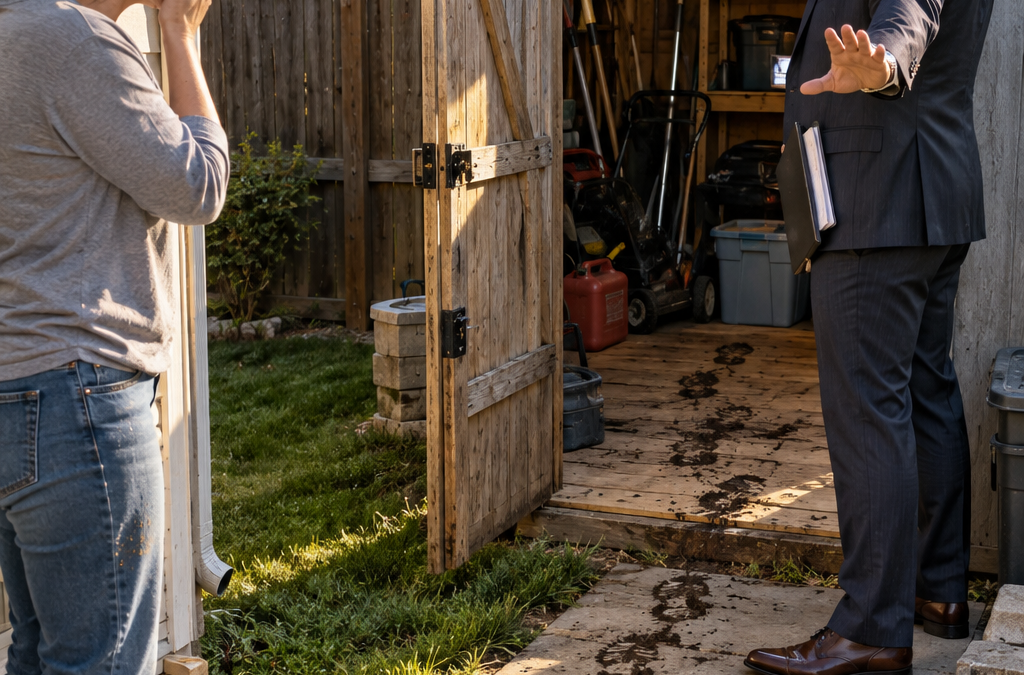
The shed door was still open when I came home, and the muddy prints led from my driveway straight across the floor. He thought he was alone when he used that key, but sixteen hidden cameras were already recording every word.
My name is Hannah Miller, and three months before my life turned into evidence folders, court filings, and a local news headline, Maple Ridge Court was just a quiet street where sprinklers hissed at dawn and kids rode bikes in lazy circles before dinner.
That was why I bought the house.
It was not large.
Two bedrooms, one bathroom, a small kitchen with old cabinets, a narrow backyard, and a weathered garden shed sitting beside the fence. The front porch sagged a little on the left side. The driveway had cracks thin enough to ignore. The upstairs windows stuck when it rained.
But it was mine.
After years of renting rooms, moving apartments, and watching rent rise faster than my paycheck, I had finally signed my name on a deed. I moved in with a modest budget, three borrowed boxes of dishes, my mother’s old rocking chair, and more hope than furniture.
The rocking chair was the first thing I placed in the living room.
It had been hers for almost thirty years, dark wood worn smooth on the arms where her hands used to rest. When she died, it was the only piece of furniture I asked my brothers not to sell. I wanted it near a window. Somewhere morning light could touch it.
That first night in the house, I sat in that chair with a mug of instant coffee and listened to the neighborhood settle around me.
No upstairs footsteps.
No neighbor’s television through the wall.
No landlord’s truck pulling into the driveway without warning.
Just my house.
My quiet.
My beginning.
By sunrise, Dennis Coulton was standing on my porch.
He was fifty years old, though he clearly considered aging something that could be negotiated with money, grooming, and expensive moisturizer. His hair was silver at the temples and combed back so perfectly it looked lacquered. His face was smooth, his beard trimmed close, his shoes polished to a shine even though the sidewalks were still damp from morning sprinklers.
He wore a pale linen blazer, dark slacks, a gold watch, and a smile so sharp it seemed designed more for cutting than greeting.
In one hand, he held a clipboard.
Not a welcome basket.
A clipboard.
“Good morning,” he said. “You must be Hannah.”
I opened the door wider.
“Yes. Hannah Miller.”
“Dennis Coulton. President of the Maple Ridge Court Homeowners Association.”
He said president as if he expected the word to clear traffic.
“Nice to meet you,” I said.
His eyes moved past me into the house, then back to the porch, then toward the mailbox.
“I like to introduce myself personally to new residents,” he said. “It helps avoid confusion later.”
That sentence should have warned me.
“What kind of confusion?”
He gave a soft laugh.
“Most people underestimate how carefully we maintain standards here.”
“I read the HOA packet.”
“Then you know your mailbox is the wrong shade of navy.”
I blinked.
“My mailbox?”
“It should be Coastal Navy 3. Yours appears closer to Colonial Navy 5.”
I stared at him, waiting for the smile to turn into a joke.
It did not.
He tapped his clipboard.
“Easy correction. I’ll mark it as a friendly reminder.”
“Okay,” I said slowly. “I just moved in yesterday.”
“Exactly. Best to start properly.”
He smiled again, then stepped off the porch and walked down my path as if he had finished blessing the property.
I closed the door and looked toward my mother’s rocking chair.
“Well,” I whispered, “that was weird.”
I laughed then.
I did not laugh for long.
The first fine arrived eight days later.
Forty dollars for grass exceeding regulation height.
According to the notice, my lawn had measured half an inch over the approved maximum.
Half an inch.
I stood barefoot in the yard holding the paper, staring at grass that looked no different from my neighbor’s.
I had no lawn mower yet. I had planned to buy one that weekend. So I paid a teenager from two streets over to cut it that afternoon and mailed the forty dollars because it seemed easier than fighting.
A small mistake.
A picky neighborhood.
A man who liked control.
That was how I explained it to myself.
Then came the trash-can notice.
My bin had apparently been left at the curb eleven minutes past the approved pickup window.
Eleven minutes.
The letter included a timestamped photo, as if Dennis had been waiting behind a curtain with a camera and a stopwatch.
That was when Mr. Alvarez stopped me at the mailbox.
He lived next door, in a low brick ranch house with a vegetable garden, faded wind chimes, and a garage full of tools he seemed to know how to fix anything with. He was in his late sixties, retired, and had the kind of careful eyes people get after watching trouble arrive too many times.
“You got one from him, didn’t you?” he asked.
I folded the trash-can notice.
“Apparently I’m eleven minutes too slow.”
Mr. Alvarez did not smile.
“Document everything.”
I looked at him.
“Everything?”
“Every letter. Every photo. Every time he knocks. Every word if you can.”
I gave a nervous laugh.
“That sounds a little intense.”
“He ran off three families before you.”
The laugh stopped.
“What?”
He glanced down the street toward Dennis’s house.
“One couple sold after six months. Another moved before foreclosure paperwork could go through. Third family left in the middle of the night after their fines doubled.”
“Over what?”
“Whatever he could find.”
My mouth went dry.
“You’re serious.”
He nodded.
Then he reached into the canvas grocery bag at his feet and pulled out a thick binder.
“This is mine.”
I stared at it.
“Your what?”
“My insurance policy.”
He placed it in my hands. It was heavy.
Inside were plastic sleeves filled with violation letters, dated photos, notes, receipts, copies of bylaws, and handwritten timelines.
“You keep one too,” he said. “Don’t wait until you need proof to start gathering it.”
I carried the binder home like it might explode.
That night, I began my own folder.
Mailbox reminder.
Grass fine.
Trash-can citation.
Photos of my lawn.
Photos of my trash bin in the garage.
Screenshots of emails.
Dates.
Times.
Notes from conversations.
At first, I still felt foolish.
Like I was preparing for a courtroom battle over grass clippings.
But each week, Dennis gave me another reason to keep going.
A fine for a garden gnome.
It was a small ceramic frog my mother used to keep near her porch steps. Not even a gnome, technically, but the notice called it an unauthorized whimsical lawn figure. Forty dollars.
A warning for a wreath too seasonal.
It was a plain grapevine wreath with dried lavender. Apparently, seasonal decor had a specific display window, and mine suggested spring beyond approved limits.
Then a notice claiming the side fence was out of compliance.
That one made me stop.
The fence had been there when I bought the house. It was old but sturdy, weathered gray, running along the property line beside the shed. I had not touched it.
The violation claimed improper setback and unapproved placement.
I checked my inspection report.
The fence was visible in the photos.
I checked the real estate listing.
There it was again.
Same fence.
Same location.
Then I opened satellite images online and searched the address history.
The first clear photo was eleven years old.
My fence was there.
Same line.
Same shadow.
Same position.
Eleven years.
Long before Dennis Coulton became HOA president.
Long before I moved in.
I printed the satellite photo and brought it to the next board meeting.
The clubhouse was small and smelled faintly of carpet cleaner. About twenty residents sat in folding chairs. Dennis sat at the front table between two board members who looked more like hostages than volunteers.
He wore a charcoal sport coat, a white shirt open at the collar, and a pocket square folded with ridiculous precision.
When homeowner comments opened, I stood.
“My fence violation appears to be incorrect,” I said.
Dennis looked at me over his glasses.
“Ms. Miller, all violations are reviewed before issuance.”
“I have evidence the fence has been in the same location for at least eleven years.”
I held up the satellite photo.
He barely glanced at it.
“Online images can be unreliable.”
“This one is dated. The fence predates my ownership and your presidency.”
A few people shifted in their chairs.
Dennis smiled, turning slightly toward the board.
“Paperwork gets lost.”
The other board members chuckled softly, though neither looked comfortable.
I felt heat rise in my face.
“This isn’t lost paperwork. It’s evidence.”
He waved one hand.
“The board has already noted the violation.”
“Based on what survey?”
“The appropriate documents.”
“I’d like to see them.”
“That request can be made formally.”
“I already made it by email.”
“Then it will be addressed when the office has time.”
His smile stayed perfect.
Mine disappeared.
That smile told me something important.
This was not clumsy bureaucracy.
This was practiced.
Deliberate.
He was not trying to apply rules fairly. He was trying to make people tired enough to stop asking why the rules kept changing.
After that meeting, I stopped reacting and started investigating.
I requested HOA financial records, vendor invoices, and fine ledgers. The homeowners’ documents said members had inspection rights. Dennis delayed the response, then sent partial files.
The numbers did not add up.
Thousands of dollars in landscaping fees.
No matching receipts.
No vendor descriptions.
No proof of work.
No new mulch in common areas.
No tree trimming beyond what neighbors had done themselves.
No explanations.
Just line after line of money leaving the HOA account under vague labels.
Landscape maintenance.
Administrative services.
Compliance review.
Community preservation.
I did not yet know where it went.
I only knew something was wrong.
Then Dennis escalated.
A letter arrived claiming my shed violated setback rules.
My shed.
The little wooden shed in the backyard that had been there when I bought the house, used mostly for garden tools, paint cans, holiday boxes, and things I did not want cluttering the garage.
The letter demanded immediate access for inspection.
Not requested.
Demanded.
I called the HOA office.
Dennis answered himself.
“Maple Ridge Association.”
“This is Hannah Miller.”
“Ah. The shed issue.”
“You cannot demand access to the inside of my locked shed.”
“The board has authority to inspect structures visible from common areas.”
“Visible from outside does not mean you can enter.”
“If you have nothing to hide, this should be simple.”
My hand tightened around the phone.
“That is not how property rights work.”
His voice cooled.
“Hannah, you seem determined to make every correction difficult.”
“You seem determined to make up corrections.”
Silence.
Then he said, “Careful.”
One word.
Soft.
Controlled.
Ugly.
I hung up and wrote down the time.
Two days later, I came home from work and saw the shed door hanging open.
For a second, I could not move.
The lock dangled from the hasp.
Not broken.
Opened.
The door creaked slightly in the wind.
I stood at the back steps with my purse still on my shoulder, heart hammering so hard I felt sick.
Someone had been inside.
I walked slowly across the yard.
The ground was damp from morning rain, and muddy footprints led from the driveway gate to the shed entrance.
Inside, boxes had been shifted.
A plastic tub of Christmas decorations sat open.
Paint cans had been moved.
My father’s old fishing rods leaned crooked against the wall.
Someone had rifled through everything.
I looked down at the muddy prints on the shed floor.
Then I saw something outside near the driveway gate.
A partial footprint.
Smooth sole.
Narrow heel.
A pattern I recognized from Dennis’s pristine white sneakers, the ones he wore during morning inspections because he liked to look casual while threatening people.
My stomach turned.
For one wild second, fear took over.
Then I remembered the cameras.
Months before moving in, the neighborhood had experienced a break-in scare. The seller mentioned it during closing. Someone had entered sheds on three properties. Nothing major had been stolen, but it unsettled me enough that I quietly installed cameras before I finished unpacking.
Not one.
Sixteen.
Small motion cameras inside and outside the shed, tucked behind rafters, shelves, tool hooks, birdhouse trim, and the old light fixture. Every angle. Every corner. All recording to cloud storage.
I had almost felt ridiculous doing it.
Paranoid.
Excessive.
Now I stood in the doorway of that violated shed and thanked every anxious instinct I had ever had.
I went inside the house.
Locked the door.
Opened the camera app.
My hands shook so badly I had to enter the password twice.
The clips were waiting.
10:42 a.m.
Motion detected.
The first camera showed the side gate opening.
Dennis stepped into frame.
He was dressed in a pale blue polo, white sneakers, khaki pants, and sunglasses. No clipboard this time. That made him look more dangerous, not less.
He walked straight to the shed.
No hesitation.
No knock at my door.
No phone call.
He pulled a key from his pocket.
A key.
Not a lockpick.
Not bolt cutters.
A key.
He inserted it into my shed lock and opened the door like he had done it before.
My skin went cold.
I had never given the HOA a key.
The seller had not listed any HOA access key.
Dennis Coulton had no legal right to possess one.
The next angle showed him entering the shed.
He looked around, then laughed under his breath.
“Let’s see what you’re hiding, Hannah.”
I covered my mouth.
He opened boxes.
Moved tools.
Checked behind shelves.
He lifted a tarp, inspected paint cans, and photographed corners with his phone.
Then he muttered, “Come on. There has to be something.”
He knocked over a box.
The contents spilled across the floor.
He did not pick them up.
He found a small stack of scrap wood near the back wall, dragged it toward the center, and positioned it beside an old can of exterior paint.
Then he stepped back and took a photo.
I stopped breathing.
He was staging something.
He spoke again, clearer this time, because he was standing directly under one of the hidden microphones.
“If I can’t find a violation, I’ll make one.”
The room seemed to tilt.
I paused the video.
For several seconds, I just stared at the frozen frame of Dennis Coulton standing inside my locked shed.
A man who had fined me for a wreath.
A man who had smiled at the board and dismissed my evidence.
A man who had threatened me with a lien over four hundred dollars.
He had entered my shed with an unauthorized key and staged a violation.
This was not enforcement.
It was fabrication.
A targeted vendetta dressed in HOA letterhead and fake authority.
I saved the footage in three places.
Then I called Mr. Alvarez.
He arrived ten minutes later carrying lemonade in a glass pitcher like we were about to have a porch visit instead of discuss a crime.
He stepped into my kitchen, saw my face, and set the pitcher down carefully.
“That bad?”
“Worse.”
I played the footage.
He watched without speaking.
When Dennis said the line, Mr. Alvarez closed his eyes.
“If I can’t find a violation, I’ll make one.”
I paused it there.
For a moment, neither of us moved.
Then he opened his eyes and said, “Should we sell tickets to this drama?”
I stared at him.
Then I laughed.
Not because anything was funny.
Because after weeks of fear, that absurd little sentence cracked something open just enough for air to get in.
It was the first genuine smile I had felt in weeks.
A small human moment before the storm.
The next morning, another certified letter arrived.
Official lien filing.
Against my house.
Citing unauthorized shed-structure violations and failure to comply with inspection requirements.
The violations Dennis had staged.
I sat at my kitchen table and read it with a strange calm.
I had crossed into a place beyond ordinary fear.
He had broken into my shed.
He had recorded himself fabricating evidence.
Then he had used that fabrication to file against my home.
This was no longer only about me.
Mr. Alvarez’s binder.
The three families who left before me.
The missing landscaping money.
The fines.
The shed.
The master key.
The false report.
It all belonged to the same machine.
I called a real estate attorney named Marissa Vale.
She was recommended by a friend from work who said, “She scares people politely.”
That turned out to be accurate.
Marissa’s office was downtown, all glass walls, neat files, and a conference table polished enough to reflect the ceiling lights. She was in her early forties, direct, with dark hair pulled back and eyes that did not waste emotion.
I brought everything.
The fines.
The satellite photo.
The financial records.
Mr. Alvarez’s binder.
The lien notice.
The camera footage.
She watched the shed video twice.
The second time, she took notes.
When Dennis said, “If I can’t find a violation, I’ll make one,” Marissa looked up.
“That is helpful.”
“Helpful?”
“For you. Terrible for him.”
She closed the laptop.
“The lien is fraudulent if it rests on fabricated evidence. The unauthorized entry is not simply an HOA dispute. Breaking into a locked structure is a criminal matter.”
“He had a key.”
“That may make it worse, depending on how he obtained it.”
My stomach tightened.
“What do I do now?”
“First, we preserve all original files. Second, we notify the board formally. Third, we challenge the lien. Fourth, we consider police involvement.”
I swallowed.
“Will this get ugly?”
She gave me a look that was almost kind.
“Hannah, it already is.”
She was right.
But ugly was about to become public.
Marissa advised me to request five minutes on the agenda for the next emergency HOA meeting. The meeting had already been called because Dennis planned to discuss my alleged violations and justify the lien.
He thought he would control the room.
He did not know I had sixteen cameras and his own voice ready to fill it.
Word traveled quickly.
By the evening of the meeting, the clubhouse parking lot was full.
People stood near the entrance whispering. Some would not meet my eyes. Others looked at me with the tense anticipation of people who had been waiting years for someone else to say what they were too tired to say.
Mr. Alvarez walked beside me, carrying his binder.
“Ready?” he asked.
“No.”
“Good. Honest answer.”
Inside, every chair was filled.
Dennis sat at the front table wearing a charcoal suit, white shirt, polished shoes, and that gold watch he loved touching when he wanted people to remember he was important. His face looked calm. Almost satisfied.
He opened the meeting by reading my alleged violations aloud.
Grass height.
Trash can.
Unauthorized lawn ornament.
Seasonal wreath.
Fence placement.
Shed setback.
Failure to allow inspection.
Unauthorized storage.
Noncompliance.
Lien enforcement.
He savored every word like a man who had done this a hundred times and expected to win a hundred and one.
Then he said, “This association cannot tolerate residents who believe ownership gives them permission to ignore standards.”
My hands were cold.
Marissa sat beside me, still and composed.
She whispered, “Now.”
I stood.
Dennis looked irritated.
“Homeowner comments will be taken after the president’s report.”
“I was granted five minutes on the agenda.”
His smile tightened.
“I don’t recall approving that.”
Marissa stood.
“It was confirmed in writing by your secretary yesterday.”
She held up the email.
A few residents murmured.
Dennis’s jaw shifted.
“Fine. Five minutes.”
I walked to the front with my laptop.
Every step felt too loud.
I connected it to the projector.
The screen flickered blue.
Then showed the first camera angle: my backyard, timestamped.
Dennis leaned back in his chair.
“What is this?”
I did not answer.
I pressed play.
The room watched Dennis open my side gate.
Cross the yard.
Walk to my shed.
Pull a key from his pocket.
Insert it into my lock.
Open the door.
A sound moved through the room.
Not quite a gasp.
Not yet.
Then the inside camera appeared.
Dennis entered the shed.
Rifled through boxes.
Moved tools.
Opened containers.
Photographed corners.
On screen, he dragged scrap wood beside the paint can and staged the scene.
The room went dead silent.
Then his voice came through the speakers.
“If I can’t find a violation, I’ll make one.”
Gasps rippled across the crowd.
Someone whispered, “Oh my God.”
A woman near the back stood up, hand over her mouth.
Dennis’s face went pale.
Then red.
“That footage is doctored.”
His voice was sharp, too loud.
“Completely doctored.”
I stopped the video and looked at him.
“It came directly from my security system.”
“Lies,” he snapped. “This is defamation.”
Mr. Alvarez stood.
“No, it isn’t.”
Dennis turned toward him.
Mr. Alvarez held up his phone.
“My porch camera captured him entering her side yard at the same timestamp. Same clothes. Same key in his hand.”
He looked at the board.
“I have the file here.”
The room erupted.
Neighbors began shouting.
Some demanded answers.
Others started naming their own fines.
A woman named Carol said Dennis had inspected her garage without permission.
A man from the next street said he had been fined after refusing to sell part of his backyard easement.
Another homeowner asked where the landscaping money had gone.
Dennis slammed his hand on the table.
“Order!”
Nobody listened.
His authority had depended on fear.
The video had broken fear.
Marissa stepped forward.
“My client has filed a legal challenge to the lien and intends to pursue claims for trespass, wrongful lien, and related damages. The board should also preserve all records immediately.”
The vice president, a nervous man named Alan, stared at Dennis.
“Did you have a key to her shed?”
Dennis straightened.
“This is being taken out of context.”
Alan’s voice shook.
“Did you?”
Dennis looked around the room.
For the first time, I saw the polished man disappear.
No charm.
No silk smile.
No king of the cul-de-sac.
Just panic dressed in a suit.
“I acted within my authority.”
The room exploded again.
Alan looked at the other board members.
“We need a vote.”
Dennis turned on him.
“You don’t have the authority.”
Alan swallowed.
“We do.”
The motion was made.
Remove Dennis Coulton as HOA president, effective immediately, pending investigation.
The vote was unanimous.
No appeal.
No mercy.
Dennis sat frozen as the decision passed.
His mouth opened, then closed.
He had spent years deciding other people’s consequences.
Now he had to sit inside one he could not control.
Marissa filed suit the next morning for wrongful lien, trespassing, and damages.
The police report was filed too.
Local news picked up the story within days.
HOA PRESIDENT CAUGHT ON CAMERA IN SHED BREAK-IN.
For a week, Maple Ridge Court had news vans parked near the entrance.
Dennis refused to comment.
His attorney released a statement calling the footage misleading.
Nobody believed it.
Not after hearing his voice.
If I can’t find a violation, I’ll make one.
That sentence became the crack that opened everything else.
Auditors reviewed the HOA accounts.
The missing landscaping money Mr. Alvarez and I had noticed was only the beginning.
Years of fine revenue and maintenance fees had been moved through vague expense categories, then into accounts tied to Dennis personally. Some payments had been disguised as vendor reimbursements. Others were listed as property preservation expenses even when no work had been performed.
Weeks later, formal charges followed.
Trespass-related charges from the shed entry.
Then financial charges after auditors traced missing HOA funds into his personal accounts.
The man who had fined me over a wreath was now facing the kind of consequences no clipboard could erase.
The lien against my house was voided.
In writing.
The shed violation was withdrawn.
The fence violation was cleared.
The garden-gnome fine, the wreath warning, the trash-can charge, all of it was removed from my account.
Other homeowners came forward.
Mr. Alvarez’s binder became evidence in a broader review.
The three families who had left before me were contacted by attorneys.
Some wanted to fight.
Some were too exhausted.
I understood both.
Maple Ridge Court changed after Dennis.
Not instantly.
The board had to be rebuilt.
Financial records had to be reconstructed.
Fines had to be reviewed.
Management had to be replaced.
But the fear lifted first.
You could feel it.
People talked at the mailbox again.
Neighbors who had avoided each other began comparing stories openly.
The clubhouse meetings became messy, honest, and loud in a healthy way.
The new board adopted simple rules.
No inspection inside private property without written consent or legal authority.
No fines without specific covenant citations.
No liens without outside legal review.
No single officer controlling records, money, and enforcement.
No hidden vendor payments.
No master keys.
That last one passed unanimously.
Mr. Alvarez looked at me when it did and mouthed, “Imagine that.”
I nearly laughed.
Months later, I watched from my porch as Dennis carried a single cardboard box to his car.
The same driveway where he once parked his SUV before patrolling the cul-de-sac like he owned every blade of grass.
He looked smaller without the clipboard.
Still polished.
Still expensive.
But diminished.
Neighbors watched from windows and porches.
Nobody shouted.
Nobody clapped.
We simply watched him leave the street he had tried to rule.
He did not look at my house.
That was fine.
I looked at my shed.
The lock had been replaced.
So had the door hardware.
The cameras were still there.
Every single one.
My mother’s rocking chair sat in the living room window behind me, catching the afternoon light.
For the first time since I moved in, the house felt like mine again.
Not a target.
Not a file number.
Not a property Dennis could threaten whenever he needed money or obedience.
Mine.
That evening, Mr. Alvarez came over with lemonade again.
This time, there was no emergency.
No footage to review.
No lien notice on the table.
Just two neighbors sitting on my porch while sprinklers hissed somewhere down the street and kids rode bikes in loops around the cul-de-sac.
He lifted his glass.
“To documentation.”
I smiled.
“To cameras.”
He laughed.
The sound moved easily through the warm air.
Justice did not arrive as one dramatic moment.
It arrived as timestamps.
Audio files.
Bank records.
A neighbor’s binder.
An attorney’s letter.
A board vote.
A court filing.
A police report.
It arrived because I stopped hoping Dennis would become reasonable and started proving exactly what he was doing.
For weeks, I had felt alone.
Standing at my mailbox with shaking hands.
Sitting at board meetings while he smiled through lies.
Opening letters that made my home feel fragile.
But I was never truly alone.
Mr. Alvarez had been collecting proof for years.
Other neighbors had their own stories.
The cameras had seen what Dennis believed no one would ever see.
That was the lesson I carried from it.
People like Dennis do not fear anger.
They know how to twist anger into evidence against you.
They fear records.
Dates.
Documents.
Footage.
The plain, stubborn truth preserved before they can rewrite it.
Maple Ridge Court finally breathed again.
Fines forgiven.
Records cleared.
Money traced.
A president removed.
A shed locked properly.
A home saved.
And when the sun went down that night, I sat in my mother’s rocking chair by the window and listened to the neighborhood settle into the kind of quiet I had wanted from the beginning.
Not fearful quiet.
Not the silence Dennis had enforced with letters and threats.
Real quiet.
The sound of sprinklers.
Children laughing.
A car door closing.
A wind chime somewhere down the street that no one was fined for having.
My phone buzzed once.
A message from Mr. Alvarez.
Should’ve sold tickets.
I laughed so hard I cried.
Then I set the phone down, looked toward the backyard, and saw the shed standing in the last of the daylight.
Ordinary.
Still.
Locked.
The place where Dennis Coulton thought he would manufacture one more violation.
Instead, he manufactured his own downfall.
And this time, every camera was watching.








