𝗙𝗨𝗟𝗟 𝗦𝗧𝗢𝗥𝗬 The HOA President Put a Lien on My Home, but the Numbers Behind Her Fines Didn’t Make Sense
𝗙𝗨𝗟𝗟 𝗦𝗧𝗢𝗥𝗬
Then the trash-bin violation arrived.
My bins had been visible from the street twenty minutes before the approved collection window.
Another seventy-five dollars.
Then a wind-chime complaint.
My mother had given me the small brass chime years before she died.
It hung beside the back patio.
Karen’s notice described it as “repetitive exterior sound affecting communal harmony.”
One hundred dollars.
I called the HOA office.
Karen answered.
“Maple Ridge Homeowners Association.”
“It’s Davis Cole.”
“Yes, Mr. Cole.”
“I have a question about a wind chime.”
“Your violation?”
“Apparently my wind chime is destroying communal harmony.”
There was a pause.
“The language is from our nuisance provision.”
“Has anyone complained?”
“We don’t disclose complainants.”
“Did someone complain?”
“Repeated audible disturbances have been documented.”
“It’s a wind chime.”
“Correct.”
“Outside.”
“Correct.”
“Where wind exists.”
“Mr. Cole, sarcasm isn’t productive.”
I leaned against the kitchen counter.
“Karen, I’m trying to understand why I’ve received four violations in less than two months.”
“Because you’ve had four violations.”
“Or because you’re looking for them.”
Her voice changed slightly.
Not enough to call anger.
Enough to hear it.
“If you maintain your property according to the standards, there won’t be anything to find.”
Then she hung up.
That was when I bought the folder.
At first, it was just practical.
If Karen wanted paperwork, I’d keep paperwork.
I labeled each notice with the date received.
I saved envelopes.
I photographed my lawn before and after mowing.
I saved screenshots of emails.
When Karen cited my flagpole angle, I photographed it with a level.
When she complained about mulch being too close to the sidewalk, I measured the setback.
The folder thickened.
So did my irritation.
But I still assumed the problem was personality.
Karen liked control.
I didn’t.
End of explanation.
Then my neighbor Luis Reyes said something that changed everything.
Luis lived two houses down.
Retired firefighter.
Sixty-three.
Compact man with gray hair, a permanent tan, and the kind of bluntness that comes from spending thirty years around emergencies.
He found me measuring my grass one Saturday morning.
“What are you doing?”
“Trying not to offend national security.”
He laughed.
“Karen?”
“Who else?”
I showed him the latest notice.
He read it.
“Grass?”
“Quarter inch.”
He looked across the street.
“Interesting.”
“What?”
He nodded toward the Henderson house.
The Hendersons had been away for almost a month.
Their lawn was visibly taller than mine.
Weeds grew along the driveway.
A trash container had been sitting beside the garage for days.
“Karen fine them?” I asked.
Luis snorted.
“Never.”
“How do you know?”
“Because Karen likes the Hendersons.”
I looked back at my yard.
“Maybe she’s just been busy.”
Luis gave me a look.
“You’re still new.”
Something about the way he said it bothered me.
That afternoon, I walked the neighborhood.
Not trespassing.
Not peeking through windows.
Just walking sidewalks with my phone.
I started noticing things.
A mailbox painted obvious glossy black.
No violation sticker.
A basketball hoop extending over the sidewalk.
No problem.
Grass at least an inch higher than mine.
Nothing.
Decorative flags.
Oversized planters.
Trash bins visible beside garages.
Wind chimes.
Big ones.
I photographed them.
Then I compared them against the violations Karen had issued me.
Same conduct.
Different enforcement.
Over the next month, I kept collecting examples.
The pattern became impossible to ignore.
Some homeowners seemed practically exempt.
Others received relentless notices.
The favored ones tended to attend Karen’s neighborhood events.
Volunteer for her committees.
Support her board motions.
The people she disliked accumulated paper.
I asked Luis whether anyone had challenged her.
“Some.”
“What happened?”
He looked toward Karen’s house.
“They moved.”
That answer bothered me more than it should have.
“Moved because of HOA fines?”
Luis shrugged.
“People don’t always announce why they’re leaving.”
Then he mentioned the Hendersons.
Not the family currently living in the house across the street.
A previous Henderson family from another section.
“Karen went after them hard,” he said. “Years back.”
“What happened?”
“Foreclosure trouble. They sold.”
“HOA foreclosure?”
“I think so.”
He paused.
“Couple other families too.”
I felt something cold settle in my stomach.
“How many?”
Luis looked at me.
“Three that I remember.”
The next serious letter arrived before I could investigate.
Certified mail.
Karen claimed my unpaid balance had reached four thousand dollars.
I nearly dropped the envelope.
I had stopped paying disputed fines once the selective enforcement became obvious, but four thousand made no sense.
I sat at the kitchen table adding numbers.
Grass.
Mailbox.
Wind chime.
Flagpole.
Trash.
Administrative fees.
Late fees.
Processing charges.
Repeated-offense multipliers.
Somehow a collection of petty violations had become a debt larger than a mortgage payment.
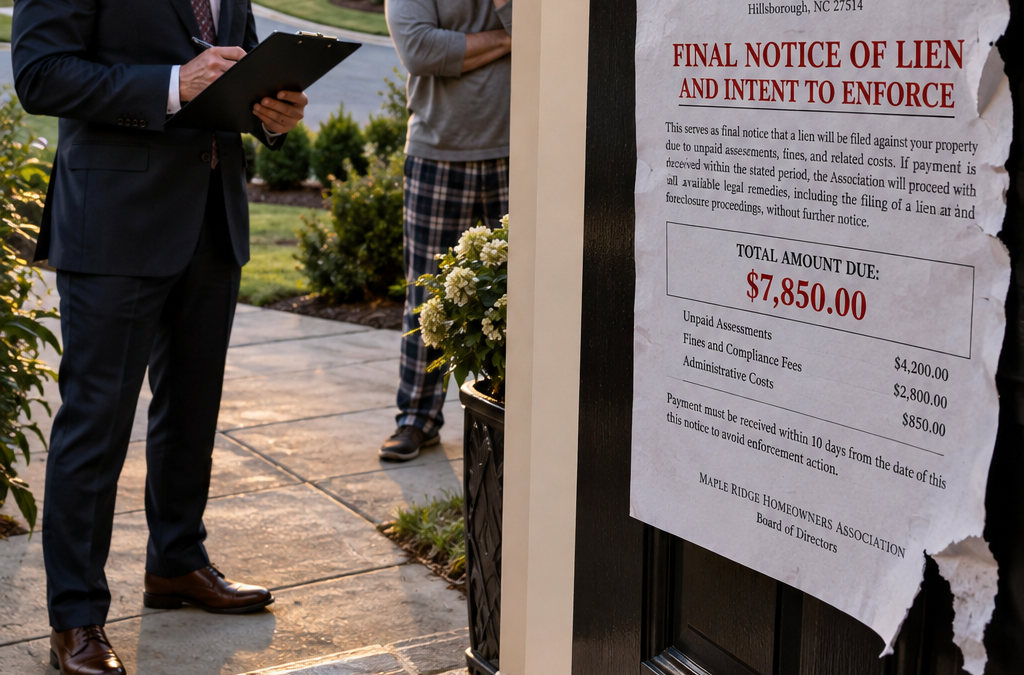
The letter threatened a lien.
Then potential foreclosure remedies.
Thirty days.
I read that line repeatedly.
Thirty days.
I had heard horror stories about HOAs using liens.
I had never imagined one would appear in my mailbox over a wind chime.
I called Karen.
She answered personally.
“Maple Ridge.”
“Why are you handling my account?”
Silence.
Then, “Excuse me?”
“I asked the management company about the fines. They said all questions go through you.”
“As president, I oversee enforcement.”
“Personally?”
“When necessary.”
“Four thousand dollars isn’t a normal enforcement balance.”
“It’s what you owe.”
“According to you.”
“According to association records.”
“Then I’d like to see those records.”
A pause.
“You’ve already received violation notices.”
“I’m asking for the financial records.”
Her voice sharpened.
“Those aren’t relevant to your personal delinquency.”
“Article Twelve, Section Three.”
Silence.
I had the bylaws open in front of me.
“Members have the right to inspect association financial books, supporting records, and disbursement documentation upon reasonable written request.”
Karen said nothing.
“So I’m requesting them.”
“That provision doesn’t give homeowners the right to conduct fishing expeditions.”
“I’m not fishing.”
“Then what exactly are you looking for?”
The question came too quickly.
It was the first time I heard nervousness in her voice.
I smiled without humor.
“I’ll know when I find it.”
She hung up.
I submitted the request in writing that afternoon.
Certified mail.
Email copy.
Article Twelve, Section Three cited at the top.
I requested annual financial statements, reserve ledgers, fine revenue, legal expenditures, vendor payments, delinquency records, and documentation supporting collection actions.
Karen acknowledged receipt.
Then stalled.
First she claimed the treasurer was traveling.
Then records were “being consolidated.”
Then the management company was switching software.
Then several files supposedly required attorney review.
One week became two.
Then three.
Meanwhile, the lien countdown continued.
Twenty-one days.
Seventeen.
Fourteen.
Each morning, I looked at my front door expecting another notice.
I stopped sleeping properly.
I would wake at three in the morning imagining a sheriff’s notice nailed beside the mailbox Karen hated.
I knew foreclosure wasn’t automatic.
I knew there were procedures.
But fear doesn’t care about procedure at three in the morning.
It just whispers the same sentence.
You could lose your house.
On day twelve, I hired Priya Shah.
Her office occupied the third floor of a downtown building overlooking the county courthouse.
She was in her early forties, dressed in a charcoal suit, with dark hair pulled away from her face and an expression that suggested she considered wasted words personally offensive.
I placed my folder on her desk.
She looked at it.
“How long have you lived there?”
“Eighteen months.”
“And that’s eighteen months of correspondence?”
“Unfortunately.”
She opened the folder.
For fifteen minutes, she barely spoke.
She read violation notices.
Compared dates.
Examined photographs.
Opened the lien warning.
Read my records request.
Then she went back to the beginning.
I watched her expression change.
“What?”
She didn’t answer.
“Priya?”
She leaned back.
“This isn’t just harassment.”
My stomach tightened.
“What is it?”
“This looks like a pattern.”
“Meaning?”
She tapped three notices.
“The escalation is too structured.”
“I don’t understand.”
“You get minor fines. You pay them. Enforcement intensifies. You start disputing charges. Administrative penalties increase. Then collection pressure accelerates.”
“That’s what happened.”
“Exactly.”
She looked at me.
“Someone has done this before.”
I remembered Luis.
“Three homeowners.”
“What?”
“My neighbor mentioned three families who had serious disputes with Karen and sold.”
Priya’s expression sharpened.
“Names?”
I gave her what I knew.
She started researching.
That was the beginning of the part that made everything before it look almost innocent.
The first former homeowner was the Martins.
They had owned a house on Cedar Glen Road.
HOA fines accumulated over alleged exterior maintenance and parking violations.
The association recorded a lien.
The Martins sold under financial pressure.
Sale price: well below the neighborhood average.
Buyer?
Ridgeway Property Holdings LLC.
The second family was the Kellners.
Landscaping violations.
Exterior storage.
Architectural penalties.
Lien.
Sale.
Again below market.
Buyer?
Ridgeway Property Holdings LLC.
Then the Hendersons.
Same pattern.
Accumulating fines.
Collection pressure.
Lien proceedings.
Distressed sale.
Same buyer.
I sat across from Priya watching her move between public filings.
My mouth had gone dry.
“Who owns Ridgeway?”
“LLCs usually aren’t that simple.”
She traced the filings.
Registered office.
Formation documents.
Agent information.
Then she stopped.
“What?”
She turned the monitor toward me.
Registered agent: Thomas Whitfield.
I stared at the surname.
“Whitfield?”
Priya nodded.
“Karen’s brother-in-law.”
For a moment, neither of us spoke.
Then I laughed once.
A short, ugly sound.
I remembered Karen standing beside my mailbox telling me rules protected property values.
Of course they did.
Especially if your family could buy distressed homes cheaply after the HOA made them unbearable to own.
My chest tightened.
“This is what she’s doing to me.”
Priya raised a hand.
“We don’t jump beyond the evidence.”
“Three homeowners.”
“I know.”
“Same fines.”
“I know.”
“Same foreclosure pressure.”
“I know.”
“Same company.”
She looked directly at me.
“And that’s why we’re going to prove it properly.”
I stood and walked toward the window.
Traffic moved below us.
People crossed the courthouse plaza carrying coffee.
Everything outside seemed normal.
Inside that office, the home I’d spent nearly twenty years saving for had just become part of something much darker.
“This isn’t petty tyranny,” I said.
“No.”
“She’s mining the neighborhood.”
Priya didn’t answer.
She didn’t need to.
Karen had turned enforcement into acquisition.
Fine people selectively.
Increase penalties.
Threaten their homes.
Push them toward desperation.
Then let a friendly LLC appear when they finally needed to sell.
House by house.
Quietly.
Legally enough on the surface that nobody looked deeper.
I thought about the Martins.
The Kellners.
The Hendersons.
Families I’d never met.
People who may have believed they’d failed somehow.
Maybe they thought they were irresponsible.
Maybe they blamed themselves for not fighting sooner.
All while Karen’s family waited on the other side of the transaction.
I sat down.
“What now?”
“We request the records through the state regulatory process.”
“Karen’s already ignoring me.”
“She can ignore you.”
Priya closed the folder.
“I’ll be harder to ignore.”
We prepared a formal complaint to the state HOA regulatory board.
Every violation went in.
Every photograph.
The selective-enforcement comparisons.
The lien threat.
Karen’s delays.
The distressed property records.
Ridgeway LLC filings.
Thomas Whitfield’s relationship to Karen.
I signed the complaint.
Priya submitted it.
Then we waited.
Karen found out almost immediately.
I never learned exactly who told her.
Priya suspected someone on the HOA board.
Luis had another theory.
“Karen probably has smoke detectors wired to paperwork with her name on it.”
Whatever the source, she came to my house that evening.
I saw her through the window.
Pearl earrings.
Cream blazer.
Clipboard.
Same uniform of authority.
I opened the door but didn’t step outside.
“Davis.”
“Karen.”
“We should talk privately.”
“We are.”
Her eyes flicked toward the street.
“May I come inside?”
“No.”
The smile sharpened.
“I understand you’ve submitted a complaint to the state.”
“I have an attorney now. You should communicate through her.”
“That seems unnecessarily hostile.”
“Putting a lien on my house feels pretty hostile.”
Her jaw tightened.
“This can still be resolved.”
“Great. Remove every unsupported fine and cancel the lien.”
She stared at me.
“Withdraw the complaint.”
“No.”
“Davis.”
“No.”
Her smile returned.
But her eyes had changed.
“That lien becomes very real very soon.”
I felt a chill.
She wasn’t even pretending anymore.
“Are you threatening me?”
“I’m explaining the consequences of your choices.”
“Interesting.”
“What is?”
“The timing.”
Her eyebrows narrowed.
“You’ve ignored my records request for weeks. Now that the state might look at them, you’re standing on my porch offering a deal.”
“You don’t understand how much trouble you’re creating for yourself.”
I leaned against the doorframe.
“Enjoy discovery, Karen.”
The smile disappeared.
For a second, I saw the woman beneath the polished exterior.
Angry.
Cornered.
And absolutely certain I had no right to resist her.
“You think an attorney makes you untouchable?”
“No.”
I looked at her clipboard.
“I think records make you nervous.”
She stepped closer.
“Be careful.”
I lowered my voice.
“Get off my property.”
We stared at each other.
Then she turned.
Her heels clicked sharply down the steps.
I closed the door.
Only after she reached her car did I realize my hands were shaking.
I called Priya immediately.
She listened.
Then said, “Document the conversation.”
“I already wrote down the exact words.”
“Good.”
“She practically admitted retaliation.”
“Don’t exaggerate.”
“She said the lien becomes real if I don’t withdraw.”
“That’s useful.”
I looked through the curtain as Karen drove away.
“Useful isn’t how it felt.”
“I know.”
Then Priya added, “Davis, from now on, don’t open the door to her unless necessary.”
The state regulatory board opened a preliminary investigation within a week.
As part of the review, fine collections tied to the disputed enforcement program were temporarily suspended.
That should have slowed Karen down.
Instead, it made her reckless.
She called an emergency board meeting.
Purpose: “Expedited collection authorization concerning materially delinquent properties.”
There was only one materially delinquent property under active dispute.
Mine.
Karen intended to rush foreclosure authority through the board before the state restrictions fully took effect.
She scheduled the vote for Friday.
Notice went out Wednesday afternoon.
Forty-eight hours.
Priya called me within minutes.
“She made a mistake.”
“What?”
“Read your bylaws.”
I already had them open.
“Emergency votes require seventy-two hours’ notice.”
“Exactly.”
“She only gave forty-eight.”
“Exactly.”
I felt my pulse quicken.
“So the vote can’t happen?”
“She’s going to try.”
“What do we do?”
“Stop it before she can create another layer of paperwork.”
Priya filed for an emergency injunction.
The next hours blurred.
Affidavits.
Attachments.
Exhibits.
My original records request.
The state notice.
The emergency meeting announcement.
The bylaws.
The lien paperwork.
Selective enforcement evidence.
Ridgeway transactions.
I signed documents electronically from my kitchen table.
At 4:36 that afternoon, Priya called.
“We have a temporary order.”
I stood.
“The meeting?”
“They can meet.”
“But?”
“They cannot vote to accelerate collection or foreclosure against you pending the hearing.”
I closed my eyes.
“When’s the hearing?”
“Tuesday.”
Four days.
Four days between me and the first moment Karen would have to explain herself somewhere she couldn’t control the agenda.
I barely slept that weekend.
I practiced testimony at the kitchen table.
I organized photographs chronologically.
I reread every letter.
Sometimes I hated myself for knowing the details so well.
May 4: lawn.
May 19: mailbox.
June 3: trash bins.
June 22: wind chime.
July 11: flagpole.
August 2: landscaping border.
September 17: visible garden hose.
Each one looked ridiculous alone.
Together, they formed pressure.
I ran financial estimates.
Compared fines against dues.
Calculated how quickly four thousand dollars had accumulated.
Priya told me to stop trying to become the lawyer.
“Your job is to tell the truth.”
“I want to be ready.”
“You are ready.”
“What if Karen says I ignored the rules?”
“Some of the rules are real.”
I frowned.
“That’s not exactly encouraging.”
Priya continued.
“This case isn’t about whether your grass was ever one-quarter inch too high. It’s about selective enforcement, fraudulent collection pressure, and potentially coordinated financial misconduct.”
I leaned back.
“Potentially?”
“Until the evidence is complete.”
That evidence arrived Monday afternoon.
Priya called me at work.
“Can you come to my office?”
Her voice was different.
Controlled.
But urgent.
I left immediately.
When I arrived, a man I had never met was sitting across from her conference table.
Late fifties.
Thin.
Wire-rimmed glasses.
Gray suit.
His hands were clasped so tightly that his knuckles were white.
Priya introduced him.
“Daniel Mercer. Maple Ridge’s outside accountant.”
My stomach dropped.
Daniel wouldn’t look directly at me.
Priya closed the door.
“Mr. Mercer has retained independent counsel.”
Daniel swallowed.
“I didn’t know what she was doing at first.”
I sat down slowly.
“Karen?”
He nodded.
“I handled financial statements. Reconciliations. Reserve allocations.”
His voice shook.
“Karen controlled the source information.”
Priya said nothing.
Daniel continued.
“She told me certain transfers were legal expenses associated with distressed-property enforcement.”
“Transfers where?”
He looked at Priya.
She gave him a slight nod.
“Ridgeway Property Holdings.”
The room seemed to tilt.
I leaned forward.
“The company buying foreclosed houses?”
Daniel nodded.
“Some transfers were routed through consulting invoices first.”
“How much?”
His mouth tightened.
“Nearly two hundred thousand dollars over six years.”
I stared at him.
“Two hundred thousand?”
“Just under, based on what I reconstructed.”
My skin went cold.
Priya placed several spreadsheets on the table.
Daniel had brought copies.
Reserve withdrawals.
Legal expense reimbursements.
Consulting transfers.
Payments connected to Ridgeway.
He had also produced internal emails in which Karen directed accounting descriptions and instructed him to classify questionable expenses broadly.
I looked at him.
“Why are you talking now?”
He finally met my eyes.
“Because the state asked for records.”
“That’s not what I asked.”
He looked down.
“I have grandchildren.”
I waited.
“I don’t want to go to jail protecting Karen Whitfield.”
There it was.
Fear.
The same thing she’d been using against homeowners for years.
Except now it had turned inward.
Priya explained that Daniel was prepared to testify.
He would describe the financial flow.
The relationship between fines, collection actions, reserve withdrawals, and Ridgeway.
He would authenticate internal records.
The final piece wasn’t another photograph.
It wasn’t a clever technicality.
It was someone from inside Karen’s system finally refusing to remain silent.
I drove home after dark.
Luis was standing beside my driveway when I arrived.
“You look terrible.”
“Thanks.”
“Big day?”
“Tomorrow will be.”
He leaned against my car.
“You scared?”
I considered lying.
“Yeah.”
He nodded.
“Good.”
“Good?”
“Means you understand what’s at stake.”
I looked toward my house.
The lien notice had left two small holes in the front door.
I’d filled them, but if the porch light hit at the right angle, I could still see the marks.
“What if the judge doesn’t see it?”
Luis shrugged.
“Then your lawyer keeps fighting.”
“What if I lose the house before that?”
“You won’t.”
“You don’t know that.”
“No.”
He looked at me.
“But I know Karen.”
“So?”
“People like her look strongest right before everybody notices they’re standing on nothing.”
I laughed quietly.
“You rehearse that?”
“Been waiting three years.”
Tuesday morning, the courthouse gallery was almost full.
More Maple Ridge homeowners had come than I expected.
Luis sat behind me.
The Martins were there.
So were the Kellners.
The Hendersons had driven almost two hours.
I’d never met them before.
When we were introduced outside the courtroom, Mrs. Henderson hugged me.
Not a polite hug.
The kind people give when grief recognizes itself.
“They did the same thing to you,” she whispered.
I nodded.
Her eyes filled.
“I thought we were stupid.”
That sentence hit me harder than anything Karen had ever said.
“You weren’t.”
She shook her head.
“We should’ve fought.”
“You survived.”
She looked at me.
“Make her explain it.”
“I will.”
Karen arrived fifteen minutes later.
Dark green suit.
Pearls.
Hair perfect.
Leather portfolio.
She entered with two attorneys.
For somebody facing allegations that could destroy her position, she looked remarkably calm.
Then she saw the former homeowners.
Her stride faltered.
Barely.
But I caught it.
So did Priya.
“Don’t stare,” she whispered.
“I’m not.”
“You are.”
The judge entered.
Everyone stood.
The hearing began with procedural matters.
Then Karen’s attorney presented their position.
Aggressive enforcement, he said.
Perhaps imperfect communication.
Perhaps administrative errors.
But lawful.
The HOA had broad authority to enforce community standards.
My unpaid fines were legitimate debts.
The distressed home sales had been voluntary market transactions.
Any connection to Karen’s relatives was incidental.
There was no conspiracy.
No fraudulent scheme.
No improper purpose.
Karen sat beside him, expression composed.
When Priya stood, she didn’t begin with a speech.
She began with grass.
My grass.
Photograph one.
My lawn at four and one-quarter inches.
Fine: fifty dollars.
Then she displayed photographs I had taken that same week.
Other lawns.
Higher.
No fines.
Then mailboxes.
Mine.
Noncompliant black.
Fine.
Other identical black mailboxes.
No action.
Trash cans.
Wind chimes.
Flagpoles.
The pattern.
Karen’s attorney objected that enforcement necessarily involved discretion.
The judge allowed Priya to continue.
Then she introduced the escalation.
The notices.
Late fees.
Administrative charges.
Four-thousand-dollar balance.
Lien threat.
Thirty-day countdown.
My Article Twelve records request.
Karen’s delays.
Then came the distressed homes.
The Martins.
The Kellners.
The Hendersons.
Three different households.
Same progression.
Targeted enforcement.
Increasing fines.
Lien pressure.
Financial distress.
Sale below neighborhood market value.
Same purchaser.
Ridgeway Property Holdings LLC.
Priya introduced the company filing.
Thomas Whitfield.
Karen’s brother-in-law.
The courtroom went silent.
Karen’s attorney stood.
“Family relationship alone proves nothing.”
Priya nodded.
“Agreed.”
She called Daniel Mercer.
Karen’s accountant walked to the witness stand.
I watched Karen.
For the first time all morning, her expression truly changed.
Her attorney leaned toward her.
Karen whispered something urgently.
Daniel was sworn in.
Priya began simply.
“Mr. Mercer, how long have you performed accounting work for Maple Ridge HOA?”
“Nine years.”
“Did Karen Whitfield exercise control over enforcement-related accounting?”
“Yes.”
“Did you process transfers from HOA reserve accounts?”
“Yes.”
“At whose direction?”
“Mrs. Whitfield’s, primarily.”
Priya displayed the first ledger.
“Do you recognize this?”
“Yes.”
“What is it?”
“A reserve transfer record.”
“Destination?”
Daniel swallowed.
“An intermediary vendor account.”
“And after that?”
“Funds were transferred to Ridgeway Property Holdings.”
A murmur moved through the gallery.
Karen’s lawyer objected.
The judge overruled.
Priya continued.
“How much HOA money was ultimately transferred through transactions connected to Ridgeway or related entities during the period you reviewed?”
Daniel looked down at the spreadsheet.
“Approximately one hundred ninety-eight thousand dollars.”
Someone behind me gasped.
Luis’s hand landed briefly on my shoulder.
Priya asked, “Were those payments disclosed to homeowners as transfers benefiting a company represented by Mrs. Whitfield’s brother-in-law?”
“No.”
“Were they authorized by properly documented board votes?”
“Not all of them.”
“How were some categorized?”
“Legal enforcement expenses. Consulting. Reserve preservation. Property stabilization.”
“Did Karen Whitfield instruct you on those descriptions?”
Daniel looked toward Karen.
Then back at Priya.
“Yes.”
Karen’s face had gone pale.
Priya introduced internal emails.
One contained instructions from Karen to classify a Ridgeway-related payment under enforcement consulting.
Another referenced “accelerating delinquent owners.”
Another discussed acquisition opportunities following collection actions.
The language wasn’t dramatic.
That made it worse.
Families reduced to entries.
Delinquencies.
Opportunities.
Assets.
I thought of Mrs. Henderson saying she had believed they were stupid.
My hands tightened beneath the table.
Karen’s attorney cross-examined Daniel aggressively.
“You participated in these transactions.”
“Yes.”
“You signed financial statements.”
“Yes.”
“So you have a strong motive to blame my client.”
Daniel swallowed.
“I followed instructions.”
“Convenient.”
“I brought the emails.”
“To save yourself.”
Daniel looked toward Karen.
Then said quietly, “I’m here because what happened was wrong.”
The courtroom went still again.
Next Priya introduced Karen’s visit to my house.
My contemporaneous notes.
Withdraw the complaint or the lien becomes very real very soon.
Karen denied threatening me.
She characterized the conversation as an effort to resolve delinquent assessments.
Then Priya introduced the emergency meeting notice.
Forty-eight hours.
Bylaws required seventy-two.
The proposed vote would have accelerated foreclosure action against me immediately before state restrictions took effect.
One procedural shortcut after another.
One pressure point after another.
The judge finally asked Karen to stand.
She did.
Still composed.
But only barely.
“Mrs. Whitfield,” he said, “were you aware that Ridgeway Property Holdings acquired three homes following significant HOA enforcement actions?”
“Not in detail.”
“Your brother-in-law is its registered agent.”
“Thomas has many business interests.”
“Did you disclose that relationship to the board?”
“I don’t recall whether a formal disclosure was necessary.”
“Did you direct financial transfers that ultimately benefited Ridgeway?”
Karen’s attorney rose.
The judge looked at him.
“I’ll allow counsel to advise his client. But the question remains.”
They whispered.
Karen finally answered.
“HOA funds were used for legitimate community purposes.”
“That was not my question.”
Her voice tightened.
“Some transactions may have involved related service providers.”
The judge looked down at the documents.
“Nearly two hundred thousand dollars?”
“Over several years.”
“That does not answer the underlying concern.”
Karen’s composure cracked.
“Your Honor, Maple Ridge had serious compliance problems. Homeowners routinely ignored standards. Somebody had to enforce them.”
The judge looked toward the gallery.
Three former families sat behind me.
“Did that enforcement include selectively imposing escalating penalties on specific homeowners?”
“No.”
Priya stood.
“The photographic evidence—”
The judge raised a hand.
“I’ve seen the evidence.”
Karen continued.
“People always complain when consequences reach them personally.”
I felt Luis tense behind me.
The judge studied her.
“And when those consequences resulted in distressed sales, companies connected to your family acquired the properties.”
“At market prices.”
Priya immediately produced appraisal comparisons.
Below market.
Karen’s lawyer objected to characterization.
The judge reviewed the figures himself.
Then he looked back at Karen.
“What you’re describing as enforcement appears, based on the evidence before me, to have operated as targeted financial pressure connected to a property-acquisition scheme.”
Karen’s face hardened.
“That’s not what happened.”
The judge leaned forward.
“Ma’am, targeted fines timed to a fraudulent land-grab scheme aren’t ordinary enforcement.”
The room froze.
Then he added, measured and precise:
“The evidence presented raises serious concerns consistent with coordinated fraudulent conduct and potentially racketeering activity. This court will not permit foreclosure machinery to continue operating while those issues are investigated.”
The gallery gasped.
Not metaphorically.
I heard it.
A collective intake of breath.
Luis squeezed my shoulder.
Then whispered, “I knew that woman was crooked.”
I couldn’t answer.
My throat had closed.
The judge began issuing orders.
First, all collection activity against my property was halted.
The claimed lien was voided pending formal correction and release.
Then the court extended relief to the other affected homeowners whose liens and enforcement actions had been tied to the demonstrated pattern.
The Martins.
The Kellners.
The Hendersons.
Their improper fines and lien-related charges were ordered reviewed and reversed where unsupported.
Restitution was ordered for qualifying losses established through the proceedings.
Then came the order Karen never expected.
Because HOA funds appeared intertwined with the questioned transactions, the judge temporarily froze Maple Ridge’s operating and reserve accounts except for essential expenditures approved under court supervision.
No discretionary transfers.
No legal maneuvering financed through homeowner money.
No more moving funds while regulators and investigators examined the books.
Karen turned toward her attorney.
He whispered rapidly.
She shook her head.
For the first time since I’d known her, she looked afraid.
The judge wasn’t finished.
He ordered preservation of all financial records.
Emails.
Invoices.
Board minutes.
Bank statements.
Vendor agreements.
Lien documentation.
Property acquisition communications.
Nothing could be destroyed, altered, or removed.
The state regulatory investigation would continue.
The financial evidence was referred to appropriate law-enforcement authorities.
When the judge recessed, nobody moved for several seconds.
Then Mrs. Henderson started crying.
Her husband put an arm around her.
Mr. Martin stared at the floor.
The Kellners held hands.
I remained sitting.
I had imagined this moment hundreds of times.
I thought I would feel triumphant.
Instead I felt exhausted.
Deeply.
Physically.
Like I had been holding something heavy for eighteen months and somebody had finally told me I could set it down.
Priya touched my shoulder.
“Davis.”
I looked at her.
“It’s stopped.”
I nodded.
“The lien?”
“Stopped.”
“The foreclosure?”
“Stopped.”
She smiled slightly.
“Go breathe.”
Outside the courthouse, reporters were already gathering.
I avoided them.
Luis and I crossed the plaza together.
“You okay?” he asked.
“I don’t know.”
He laughed.
“That’s probably normal.”
I stopped beside a bench.
“Two hundred thousand dollars.”
He shook his head.
“All those fines.”
“All those families.”
His expression darkened.
“That’s the part.”
I looked back toward the courthouse.
“I kept thinking this was about me.”
“Everybody does when somebody targets them.”
“I thought she hated my mailbox.”
Luis laughed.
“Your mailbox is ugly.”
I stared at him.
He grinned.
“Kidding.”
For the first time in days, I laughed.
Not bitterly.
Not nervously.
Just laughed.
The HOA board held an emergency meeting that afternoon.
Not Karen’s kind.
A real one.
With proper notice waived under the provisions governing immediate fiduciary emergencies and legal counsel present to explain exactly what the court order meant.
Karen attended.
So did most of the neighborhood.
I stood near the back with Luis.
Karen sat at the center table for what would become the last time.
She tried to address the room.
“These allegations do not reflect my years of service—”
A board member interrupted.
“We need to vote.”
Karen stared at him.
“I have the floor.”
“No.”
The word carried through the room.
Simple.
Quiet.
Everything Karen hated.
Another director spoke.
“The financial controls were under your supervision.”
Karen’s face reddened.
“Our accountant has lied to protect himself.”
“Then the investigators will determine that.”
“I built this community.”
A woman near the aisle said, “You terrorized it.”
Karen turned.
“Excuse me?”
The woman stood.
I recognized her.
She had once been fined for decorative stones around her mailbox.
“You made us scared to use our own houses.”
Others began speaking.
Not shouting.
That almost made it more powerful.
One man described hundreds in lawn penalties.
A mother described parking fines issued while her son was home from college.
Another homeowner said Karen threatened a lien after he questioned a landscaping contract.
Years of silence came out in fragments.
Karen kept trying to interrupt.
But every time she did, someone else spoke.
I watched her realize the room no longer feared her.
That was the moment her power actually disappeared.
Not in court.
Not when the accounts froze.
Here.
In a community room full of people who had finally learned they could say no.
The board voted to remove Karen Whitfield as president.
Unanimous.
She demanded a recount.
There wasn’t one.
She claimed the vote violated procedure.
Counsel confirmed it did not.
She threatened to sue.
Nobody backed down.
By evening, Karen was no longer president of Maple Ridge HOA.
Within the regulatory proceedings that followed, she was permanently barred from serving in HOA leadership statewide.
Separate criminal investigations resulted in fraud-related charges connected to the financial scheme and misappropriation of association funds.
The criminal cases took time.
Law moves slower after the dramatic hearing.
Documents had to be authenticated.
Transactions traced.
Witnesses interviewed.
But Karen’s reign ended immediately.
The morning after her removal, I walked outside with coffee.
My mailbox stood at the curb.
Still black.
Not matte charcoal.
Black.
At some point during the previous year, the approved paint had faded.
I had never bothered repainting it.
I stood there looking at it.
Then Luis called from down the street.
“Better fix that.”
I looked at him.
He pointed at the mailbox.
“That’s clearly at least three shades away from communal harmony.”
I laughed.
“Go home, Reyes.”
He grinned.
I sat on my porch.
No clipboard appeared.
No camera.
No violation notice.
Just morning.
Over the next several months, the court-appointed review unraveled the rest.
Maple Ridge’s finances were worse than anyone expected.
Karen had used layers of vendors and vague accounting categories to conceal transactions.
Legal enforcement fees.
Property stabilization.
Consulting.
Administrative recovery.
Words designed to sound ordinary.
Money moving somewhere else.
Nearly two hundred thousand dollars ultimately became part of the disputed financial trail associated with Ridgeway and related interests.
The three former homeowners received restitution orders tied to the unlawful enforcement and acquisition scheme.
Some losses could never be perfectly repaired.
You can’t return years.
You can’t refund nights spent wondering whether your children will have to change schools because you’re losing the house.
You can’t undo the humiliation of neighbors watching foreclosure notices appear.
But the official record finally said what those families had needed someone to say.
They hadn’t failed.
They had been targeted.
Mrs. Henderson came back to Maple Ridge once after the orders were issued.
She stood outside her old house.
The current owners were kind enough to let her walk through the backyard.
I didn’t go with her.
That felt private.
But afterward she stopped at my house.
We sat on the porch.
She looked toward the street.
“We loved it here.”
I didn’t know what to say.
She continued.
“For a long time, I couldn’t drive through this part of town.”
“I’m sorry.”
She smiled sadly.
“Don’t be. You didn’t do it.”
She touched the arm of the chair.
“Karen used to tell us everybody else followed the rules.”
I looked at her.
“She told you that?”
“Constantly.”
Mrs. Henderson laughed softly.
“We thought we were the problem.”
That was Karen’s real weapon.
Not liens.
Not fines.
Isolation.
She made every target believe everyone else was complying.
Everyone else was happy.
Everyone else thought the rules were reasonable.
So if you were drowning, it must be because you had failed.
Once the homeowners started comparing documents, the illusion collapsed.
The new board adopted major changes.
No president could control enforcement alone.
Fine decisions required independent review.
Appeals went before multiple directors.
Financial inspection requests had firm deadlines.
Vendor relationships required conflict-of-interest disclosures.
Lien and foreclosure actions required outside legal review and full board authorization.
Homeowners received regular financial reports.
Reserve withdrawals above a defined threshold required documented votes.
Boring procedures.
Necessary procedures.
The kind of things Karen had treated as obstacles.
Luis attended nearly every meeting.
He enjoyed asking questions Karen would have hated.
One evening, the board discussed repainting community mailboxes.
Luis raised his hand.
“What shade?”
Half the room laughed.
The interim president smiled.
“Whatever color the homeowners approve.”
Luis looked at me.
“Revolutionary.”
I shook my head.
Months passed.
My garden recovered from the period when I’d mostly ignored it.
I planted tomatoes.
Rosemary.
Peppers.
Two hydrangeas.
One died.
My mother would have found that hilarious because I’d killed nearly every hydrangea she’d ever helped me plant.
One Saturday morning, I was kneeling in the dirt when I noticed a brass sound behind me.
The wind chime.
I had almost forgotten it.
During the worst months, I had considered taking it down.
Not because Karen ordered me to.
Because hearing it reminded me of the fines.
Now the breeze moved through it.
Three soft notes.
I sat back on my heels.
For the first time, I heard my mother’s wind chime instead of Karen’s violation.
That mattered more than I expected.
The holes from the lien notice remained in my front door.
I could have repaired them completely.
Instead, I filled them lightly and left the marks visible.
Not as some dramatic memorial.
Mostly because every time I reached for the handle, they reminded me how close I had come to believing official paper more than my own judgment.
The notice looked legitimate.
Seal.
Letterhead.
Legal phrases.
Deadlines.
Numbers.
Karen understood how much authority a document could borrow from formatting.
That was why my folder defeated her.
She used paper to create fear.
We used paper to create evidence.
Every letter she’d signed became part of the record.
Every selective fine.
Every inflated charge.
Every delayed records request.
Every threat.
Her own paperwork mapped the scheme better than any accusation could.
One afternoon, Priya called me.
The final release of lien had been recorded.
“Officially?”
“Officially.”
I leaned back in my chair.
“So there’s nothing against the house?”
“Nothing from Maple Ridge.”
“And the account?”
“Cleared.”
I was silent.
“Davis?”
“I’m here.”
“You okay?”
“Yeah.”
I looked around the living room.
Same sofa.
Same books.
Same sunlight across the floor.
But something inside me had changed.
“Thank you.”
“You did most of the work.”
“No.”
I looked at the folder sitting on the shelf.
“I collected paper.”
“That’s usually how cases are won.”
I laughed.
“What happens to Karen?”
“Criminal proceedings continue. That’s out of our hands.”
“And the ban?”
“Effective.”
“She can’t run another HOA?”
“Not in this state.”
I thought about that.
Somewhere, some neighborhood had just been spared Karen Whitfield measuring its grass.
“That’s comforting.”
Priya paused.
“One more thing.”
“What?”
“Stop obsessively measuring your lawn.”
I laughed.
“I haven’t measured it in months.”
“Progress.”
That evening, I carried a beer outside.
Luis was watering flowers.
He saw me.
“Celebrating?”
“Final lien release.”
He shut off the hose.
Then walked over.
I handed him another beer from the cooler.
We sat on the porch steps.
For a while, neither of us said anything.
The sun was going down behind Willowbend Court.
Kids rode bicycles along the sidewalk.
Somebody was grilling.
A dog barked.
Ordinary neighborhood noise.
Communal disharmony everywhere.
Luis raised his bottle.
“To noncompliant mailboxes.”
I tapped mine against his.
“To paper trails.”
He drank.
Then looked at me.
“You ever think about moving?”
I had.
During the worst nights, constantly.
Sell the house.
Walk away.
Find somewhere without an HOA.
Somewhere Karen couldn’t reach.
“I did.”
“But?”
I looked toward the backyard.
My garden was visible through the side gate.
Tomato vines climbing their cages.
The brass wind chime turning slowly above the patio.
“This is my house.”
Luis nodded.
“Exactly.”
That was the answer.
Karen’s scheme had depended on homeowners deciding the easiest way to end the pressure was to leave.
The Martins left.
The Kellners left.
The Hendersons left.
I didn’t judge them for it.
They did what they needed to survive.
But leaving would have felt wrong for me.
Not because Maple Ridge deserved my loyalty.
Because Karen didn’t deserve my home.
I had spent too many years saying later.
Later I’ll buy.
Later I’ll settle down.
Later I’ll build a garden.
When I finally got here, one woman decided she could turn my home into inventory.
She couldn’t.
A few weeks later, the new HOA president stopped by.
Her name was Rebecca Mills.
She didn’t carry a clipboard.
That alone earned points.
She stood on the sidewalk rather than walking across my lawn.
“Davis?”
“Yes?”
“I wanted to apologize formally on behalf of the association.”
“You don’t have to.”
“I do.”
She looked uncomfortable.
“We failed.”
I waited.
“Some board members suspected Karen’s enforcement was excessive. Nobody understood the full scheme, but we knew people were afraid of her.”
“Why didn’t anyone stop it?”
Rebecca looked toward the street.
“Because Karen always had another explanation.”
She sighed.
“And because challenging her meant becoming the next problem.”
I understood.
That didn’t excuse it.
But I understood.
She handed me an envelope.
Inside was a refund for every improper fine I had paid.
Lawn.
Mailbox.
Trash bins.
Wind chime.
Everything.
I stared at the check.
“You’re giving this back?”
“It was never supposed to be taken.”
I looked at her.
“Thank you.”
She smiled.
Then glanced at my mailbox.
“For the record…”
I followed her eyes.
Still black.
She looked serious.
“It’s definitely not matte charcoal.”
I stared at her.
Then she smiled.
I laughed so hard Luis stepped out of his house to see what happened.
For months, nobody had been able to joke about HOA rules.
Now even that felt like evidence that Karen was really gone.
The criminal cases remained unresolved for some time, and I stopped following every filing.
At first, I checked constantly.
New motion.
New hearing.
New allegation.
Eventually I realized Karen still occupied too much space in my head.
The prosecutors had the records.
The regulators had the accounts.
The courts had jurisdiction.
I had my home.
That needed to be enough.
So I returned to ordinary things.
I repainted the guest bedroom.
Fixed the loose kitchen cabinet.
Built raised beds beside the fence.
Started having neighbors over.
The first backyard dinner made me strangely nervous.
Luis came.
Rebecca came.
Three other families.
At sunset, the wind chime began ringing.
For half a second, every old instinct returned.
Too loud.
Possible violation.
Photograph.
Fine.
Then Luis looked at me.
“You hear that?”
I groaned.
“Don’t.”
“Communal harmony is in serious danger.”
Everyone laughed.
I did too.
And nobody received a letter.
By the following spring, Maple Ridge felt different.
Not perfect.
No neighborhood ever is.
People still argued about parking.
Someone hated the new landscaping contract.
One board meeting lasted nearly three hours because two homeowners disagreed about fence stain.
But disagreement was no longer dangerous.
That was the difference.
People spoke.
Records were available.
Votes were recorded accurately.
The board knew homeowners were watching.
And homeowners knew the board could be questioned.
That shouldn’t feel revolutionary.
But after Karen, it did.
Sometimes new residents ask about the two tiny marks beside my front door.
Most don’t notice them.
When someone does, I usually say, “Old HOA problem.”
That’s enough.
I don’t tell the entire story unless they really want to know.
Because the story isn’t actually about grass.
Or mailbox paint.
Or wind chimes.
It’s not even really about Karen.
It’s about how easy it is for petty authority to become dangerous when nobody checks where the paperwork leads.
Karen understood something ugly.
Most people don’t want conflict.
We have jobs.
Families.
Bills.
Health problems.
Aging parents.
Deadlines.
We don’t have time to spend Tuesday afternoon researching corporate filings because somebody fined us over a trash bin.
So we pay.
We apologize.
We comply.
Then we pay again.
Karen built an empire inside that exhaustion.
Fifty dollars at a time.
Seventy-five dollars at a time.
One frightened homeowner at a time.
Her mistake was assuming nobody would ever put the pieces beside each other.
A lawn fine beside a property sale.
A lien beside an LLC.
A reserve transfer beside a brother-in-law’s company.
A delayed financial request beside an emergency foreclosure vote.
Individually, everything could be explained.
Together, it told one story.
And once that story reached a courtroom, Karen couldn’t measure her way out of it.
One year after the morning the lien notice was nailed to my door, I woke before sunrise.
I made coffee.
Walked outside.
And sat on the porch.
The neighborhood was quiet.
Dew covered the grass.
My grass.
I had no idea how tall it was.
That thought made me smile.
Across the street, a trash bin had been left out overnight.
Two doors down, somebody’s mailbox was definitely glossy black.
A flagpole stood at an angle Karen probably would have considered morally offensive.
Nothing happened.
No white SUV.
No clipboard.
No camera appearing around the corner.
The sun rose slowly above the roofs.
My wind chime moved.
Three soft notes.
I looked at the front door.
The tiny marks from the lien notice were still there.
For a moment, I could hear that hammer again.
Three strikes.
The shock of opening the door.
Four thousand dollars.
Thirty days.
The fear that somebody could convert paperwork into ownership of my life.
Then I looked past the porch toward my garden.
Tomatoes were already climbing the first cages.
The hydrangea I’d replaced was finally growing.
The mailbox stood at the curb in its proudly noncompliant shade of black.
And the house behind me was still mine.
Karen Whitfield had once told me the rules existed to protect property values.
In a way, she taught me something much more important.
A home isn’t protected by obeying every person who claims authority over it.
Sometimes protecting it means asking where that authority came from.
Sometimes it means opening the bylaws.
Sometimes it means pulling corporate filings nobody expects you to read.
Sometimes it means keeping every ridiculous letter because one day the woman signing them may have to explain every word to a judge.
And sometimes justice doesn’t arrive dramatically.
Sometimes it comes as an order stamped by a court clerk.
A frozen bank account.
A released lien.
A refund check.
A quiet porch.
I lifted my coffee.
The breeze moved through the brass chime again.
Nobody complained.
Nobody measured anything.
Nobody knocked.
And for the first time since I had moved to Willowbend Court, the silence didn’t feel like fear.
It felt like home.








