𝗙𝗨𝗟𝗟 𝗦𝗧𝗢𝗥𝗬 The HOA President Put a Lien on My First Home Over a Curb She Never Owned
𝗙𝗨𝗟𝗟 𝗦𝗧𝗢𝗥𝗬
The grass had been cut two days before the notice. The trash bin was out because pickup had been moved earlier for the holiday schedule. The wind chime had been hanging by the porch when I bought the house, and it made the softest sound imaginable, more whisper than chime.
I called the HOA office during lunch.
A woman answered with a tired voice.
“Willow Trace Homeowners Association.”
“Hi, this is Linda Morales at 14 Magnolia Court. I received a few violation notices, and I’d like to see the rulebook they’re based on.”
There was a pause.
“Have you checked your homeowner packet?”
“Yes. These specific rules aren’t in it.”
Another pause.
“You’ll need to speak with Deborah.”
“Okay. Can she send me the current rules?”
“She handles compliance matters directly.”
“Great. Can you transfer me?”
The line clicked.
Then Deborah’s voice came on.
“Linda.”
She said my name like she had been expecting me.
“Hi, Deborah. I wanted to ask about the notices I received.”
“Yes. I assumed you would.”
I frowned.
“I’d like a copy of the current rulebook, please.”
“It’s being updated.”
“Updated how?”
“The board is consolidating standards.”
“So the rules cited in my violation letters are from the updated version?”
“They reflect board interpretation of existing standards.”
“That doesn’t answer my question.”
Her voice cooled.
“Linda, new homeowners often struggle at first. It’s nothing to be embarrassed about.”
“I’m not embarrassed. I’m asking for the rulebook.”
“And I told you it’s being updated.”
“When will it be available?”
“When it is ready.”
I sat back in my chair at work, surrounded by the hum of computers and distant office chatter, feeling my face heat.
“So you’re fining me under rules I can’t review?”
Deborah’s silence lasted just long enough to become a warning.
“You should be careful how you characterize board action.”
I looked at the violation letters on my desk.
“I just want to understand what I’m being fined for.”
“Then comply with the notices.”
She hung up.
That evening, I met Rosa at the mailbox cluster.
Rosa lived across the cul-de-sac, in a white house with red shutters and a porch full of potted herbs. She was in her early forties, with kind eyes and the wary posture of someone who had learned to lower her voice in her own neighborhood.
She watched me pull another HOA envelope from my mailbox.
“Already?”
I looked at her.
“What?”
She nodded at the envelope.
“Deborah.”
I tried to smile.
“Is it that obvious?”
Rosa stepped closer.
“She does this to everyone who doesn’t kiss her ring.”
The phrase sounded dramatic, but her face didn’t.
“What do you mean?”
“She finds a target.”
“A target?”
“Yes. Someone new. Someone busy. Someone single. Someone who won’t know where every rule is buried.”
I looked toward Deborah’s house at the far end of the street. Large brick colonial, white columns, immaculate hedges, spotless driveway.
“I asked for the rulebook.”
Rosa winced.
“That explains it.”
“You’re serious.”
“Very.”
She glanced toward the houses as if Deborah might be listening from behind a curtain.
“I had an old fence dispute two years ago. One loose panel after a storm. Deborah fined me, then late fees, then appeal fees. I’m still paying it off.”
“For a fence panel?”
“For challenging her.”
There it was again.
Not the violation.
The challenge.
Rosa leaned closer.
“Start keeping everything. Every letter, every envelope, every photo. Don’t speak to her alone if you can help it.”
I felt a cold little weight settle in my stomach.
“How bad can this get?”
Rosa looked away.
“Bad enough that people stop fighting.”
That night, I started my folder.
I photographed the lawn.
The trash bin.
The wind chime.
My car parked in my driveway.
I saved emails. I scanned letters. I wrote dates on envelopes. I created a spreadsheet with columns for alleged violation, date received, fine amount, response, evidence, and status.
At first, it felt paranoid.
Then Deborah gave me a reason to be grateful.
The accusation that changed everything arrived three weeks later.
According to the letter, I had been parking on Deborah’s curb.
Her curb.
The notice claimed my vehicle had repeatedly obstructed “the view corridor and curb frontage” directly in front of her home, creating a nuisance and interfering with the quiet enjoyment of her property.
I read it twice.
Then I walked outside and looked at my car.
It was parked in front of my house.
Forty feet away from Deborah’s curb.
In the same place it had been every night.
I checked my phone.
I had timestamped photos from that morning, the day before, and the day before that. My car was visible in front of my own house each time.
Deborah’s notice included no photograph.
Just her statement.
I appealed in writing.
She sent code enforcement anyway.
Two officers arrived the next afternoon while I was cleaning the porch.
They stepped out of a city vehicle, already looking slightly confused.
“Are you Linda Morales?” one asked.
“Yes.”
“We received a complaint about illegal parking and obstruction.”
I pointed toward my Honda.
“That car?”
The younger officer checked his tablet.
“The complaint says vehicle obstructing curb frontage of 2 Magnolia Court.”
“That’s Deborah Whitfield’s house.”
He looked down the street.
Then at my car.
Then back at the tablet.
“That’s not where your car is.”
“It never was.”
The older officer walked toward Deborah’s house, then came back shaking his head.
“Ma’am, this curb is public right-of-way.”
I almost laughed.
“I know.”
He looked toward Deborah’s driveway, where she had appeared with her clipboard.
Deborah marched toward us.
“Officers, thank you for responding. This has been ongoing.”
The older officer held up one hand.
“Mrs. Whitfield, the vehicle is parked legally.”
“It has been obstructing my view corridor.”
“You don’t own the curb.”
Her face tightened.
“I’m president of the HOA.”
“That doesn’t change public right-of-way.”
Deborah’s eyes flicked toward me.
The younger officer added, less tactfully, “Ma’am, you don’t own the sidewalk in front of your own house, let alone hers.”
For a second, the entire cul-de-sac seemed to stop breathing.
Deborah’s face turned the color of a stop sign.
Her clipboard trembled.
I pressed my lips together to keep from smiling.
That was twist number one.
The woman who claimed absolute authority over our street did not even understand the public curb she was trying to control.
I thought embarrassment might end it.
I thought having code enforcement correct her in front of witnesses might make Deborah retreat.
I was wrong.
It made her furious.
Furious people escalate.
The next week, a certified letter arrived in my mailbox.
Two-thousand-dollar fine.
Harassment of a board member.
The alleged harassment was apparently the act of “creating unnecessary law enforcement involvement related to a board officer’s residence.”
In plain English, Deborah accused me of harassing her because she had called code enforcement on herself and lost.
I appealed.
The hearing was held in the clubhouse on a Thursday night.
I arrived with my folder, wearing the navy blouse I used for work presentations because it made me feel composed even when I wasn’t. Rosa came with me and sat in the back.
Deborah sat at the front table.
Beside her were two people I had seen around the neighborhood but had never formally met.
A woman with Deborah’s exact cheekbones and a man who kept checking his watch.
Deborah opened a folder.
“This appeal concerns homeowner misconduct and harassment.”
I stood.
“I object to that description.”
“You may speak when recognized.”
I looked at the two board members.
“Can I ask who is hearing this appeal?”
Deborah smiled.
“This is the board.”
The woman nodded once.
“I’m Marjorie Lang.”
The man sighed.
“Peter Lang.”
I looked from one to the other.
“Are you related to Deborah?”
Marjorie’s eyes narrowed.
“She is my sister.”
Peter said nothing.
I felt the room shift under my feet.
“The entire board is your sister and brother-in-law?”
Deborah folded her hands.
“The board was elected according to our bylaws.”
“How many board seats exist?”
“Three.”
“And all three are held by one family.”
Her smile hardened.
“If you are implying impropriety—”
“I’m implying nothing. I’m stating what I just learned.”
That was twist number two.
This wasn’t a homeowners association.
It was a family business wearing a badge stitched together from bylaws.
The hearing lasted twelve minutes.
They upheld the fine.
Of course they did.
Rosa found me outside afterward.
Her face was pale with anger.
“I should have told you.”
“You knew?”
“Everyone knows.”
“Then how is this allowed?”
She looked toward the clubhouse.
“Her late husband rewrote the bylaws about ten years ago. Nobody challenged them. After he died, Deborah just kept running things.”
“With her sister and brother-in-law?”
“Yes.”
I looked at the lit clubhouse windows.
Inside, Deborah’s silhouette moved behind the blinds.
I stopped being scared that night.
Not completely.
Fear stayed. Fear always stays when someone threatens your home.
But something stronger arrived with it.
Strategy.
I formally requested the HOA’s financial records.
Budget reports.
Bank statements.
Fine ledgers.
Board minutes.
Vendor payments.
Reserve accounts.
Any record related to my fines and the alleged assessment authority.
Every homeowner had legal rights to inspect certain association records, and I cited those rights in writing.
Deborah refused.
Not directly at first.
She said the request was broad.
Then she said the records were under review.
Then she said access was subject to board discretion.
That phrase again.
Board discretion.
In Willow Trace, it meant Deborah’s discretion.
I filed a formal complaint with the state agency that handled community association disputes and nonprofit records complaints. I attached my unanswered requests, the appeal notice, the board relationship issue, and the fines.
While waiting, the letters kept coming.
Four thousand dollars.
Then six.
Each one threatening a lien against my home.
The word lien started appearing in my dreams.
I would wake at 3:00 a.m. with my heart racing, convinced someone had taped a notice to my door. I checked the locks. Then the mailbox. Then my spreadsheet. Then my bank account, as if looking at the numbers could somehow prove the house still belonged to me.
I had never felt unsafe inside a home before.
Not like that.
It wasn’t physical fear.
It was paper fear.
The kind created by envelopes, signatures, official letterhead, and deadlines written by people who know you have to sleep eventually.
By the time the amount reached eight thousand dollars, I called a lawyer.
His name was Marcus Bell.
He specialized in HOA abuse and property disputes, and his office looked like it had been assembled by someone who cared more about winning than decorating. Files stacked on chairs. Legal pads everywhere. A framed newspaper clipping about a homeowner settlement on the wall.
Marcus was a large, calm man with tired eyes and a voice that never hurried.
He read my folder cover to cover.
Every letter.
Every photo.
Every response.
Every appeal document.
Every timestamp.
He read silently for almost an hour while I sat across from him, hands folded so tightly my knuckles hurt.
Then he laughed.
Not loudly.
Just one short laugh under his breath.
I stared at him.
“What?”
“This is one of the sloppiest liens I’ve seen in years.”
I blinked.
“That’s good?”
“For you, yes.”
He tapped the stack of letters.
“She never gave proper statutory notice before threatening lien action. Not once. No valid pre-lien notice, no proper accounting, no hearing process that would survive scrutiny, and this family-board arrangement is a problem all by itself.”
My shoulders dropped for the first time in weeks.
“So she can’t take my house?”
“She can try to create noise. She cannot lawfully foreclose based on this mess without facing consequences.”
I closed my eyes.
The relief made me dizzy.
Marcus kept reading.
“The harassment fine is nonsense. The curb complaint is ridiculous. The record refusal is useful. And if the financials are as bad as this suggests, she may have bigger problems than your case.”
“She has everyone scared.”
“Good. Scared people keep receipts.”
He looked up.
“And you kept excellent receipts.”
Marcus sent a cease and desist letter on my behalf.
It demanded withdrawal of the improper fines, production of records, correction of my account, and preservation of all HOA communications. It also warned Deborah that any further publication of unsupported violations could constitute harassment, defamation, and bad-faith enforcement.
Deborah’s response was to double down.
She posted my alleged violations on the community Facebook page.
Photos of my car.
My wind chime.
My trash bin.
A screenshot of the harassment fine.
She wrote a long post about maintaining standards and protecting the neighborhood from residents who “weaponize government agencies against volunteer board members.”
She thought public shame would pressure me.
It backfired spectacularly.
Rosa commented first.
Linda has proof her car was parked legally. Deborah called code enforcement and lost.
Then Mr. Grant from the corner house commented.
Deborah fined me $600 for a mailbox repair after refusing to show the rule.
Then Priya.
Can the board explain why financial records have not been made available despite formal requests?
Then another neighbor.
Then another.
Within hours, the thread had turned into a public archive of every story people had been too afraid to tell.
Unpaid disputed fines.
Threat letters.
Denied appeals.
Missing records.
Late fees attached to notices never received.
People compared amounts, dates, and language.
A pattern formed.
Not the pattern Deborah wanted everyone to see.
Marcus called me that night.
“Do not comment further.”
“I already didn’t.”
“Good. Screenshot everything.”
“I did.”
“Excellent.”
The state records response came back two days later.
That was twist number three.
The HOA bank account was missing nearly forty thousand dollars.
Forty thousand dollars in maintenance fees and reserve funds.
No matching maintenance.
No new mulch.
No paving.
No clubhouse repair.
No major landscaping.
Nothing residents could point to.
Money out.
No legitimate records explaining where it went.
Marcus reviewed the packet and went quiet.
That frightened me more than his laughter.
“What?”
He flipped one page around.
“Transfers.”
“To who?”
He pointed.
The account names were partial, but the audit notes identified digital payments connected to Deborah’s personal Venmo account.
My mouth went dry.
“She stole it?”
“We don’t use that word until a court or prosecutor does.”
He looked up.
“But this is strong evidence of misappropriation.”
The lawsuit Marcus filed was not small.
It did not only ask to void my lien.
It sought damages and injunctive relief on behalf of homeowners fined without proper notice. It challenged the legality of the enforcement process, the family-controlled board, the denied records, the improper lien threats, and the missing funds.
A class action.
I remember staring at the words before signing.
Class action sounded like something from news stories, not something connected to my little blue-gray house on Magnolia Court.
Marcus slid the pen toward me.
“You sure?”
I thought about the lien letters.
The sleepless nights.
Rosa’s face at the mailbox.
The neighbors on Facebook finally telling the truth.
I signed.
The hearing date came faster than I expected.
The courthouse felt colder than it should have. I sat beside Marcus with my folder in my lap even though he had copies of everything. Rosa sat behind me. Priya was there too. So were several neighbors who had taken time off work because they wanted to see Deborah answer questions under oath.
Deborah arrived in a blazer sharp enough to cut glass.
White.
Tailored.
Perfect.
Her hair was smooth. Her earrings glittered. Her smile was calm, as if the courtroom were just another HOA meeting and the judge another resident she could intimidate with procedure.
Her lawyer sat beside her with three folders and the expression of a man who wished he had six.
The judge began with the lien.
“Counsel, I want to see proof of legal notice.”
Deborah’s lawyer opened one folder.
Then another.
Papers shifted.
A whisper.
Another folder.
Marcus sat still.
The judge waited.
“Your Honor,” Deborah’s lawyer said, “the association provided repeated violation correspondence.”
“That is not what I asked. I asked for proper notice supporting lien action.”
More paper shuffling.
Nothing.
The judge looked over her glasses.
“Do you have it?”
Deborah’s lawyer hesitated.
Marcus stood.
“Your Honor, they do not because it was never sent.”
He laid out the timeline.
The letters.
The missing notices.
The defective appeal.
The family board.
The improper Facebook publication.
The record refusal.
Then he introduced the state auditor’s report.
The courtroom changed.
Missing funds.
Unexplained transfers.
Payments traced to Deborah’s personal Venmo account.
Her smile finally cracked.
In the gallery, Rosa gripped my hand so hard it hurt.
Neither of us moved.
The judge read quietly for what felt like forever.
Then she looked at Deborah.
“Mrs. Whitfield, these are serious matters.”
Deborah’s voice was smaller than I expected.
“There has been confusion in bookkeeping.”
The judge did not blink.
“Forty thousand dollars of confusion?”
No one laughed.
It was not funny.
The judge voided the lien threat on the spot.
No hesitation.
She awarded me legal fees related to the improper enforcement action and referred the missing funds directly to the district attorney’s office for criminal review. She also ordered production of HOA records and temporarily barred the board from further collection action until lawful procedures were established.
I felt the words before I understood them.
Voided.
Legal fees.
Criminal review.
Records.
Barred.
The lien was gone.
The thing that had been sitting on my chest for months lifted so suddenly I almost cried in open court.
Deborah stared at the table.
Rosa squeezed my hand again.
This time, I squeezed back.
That afternoon, Willow Trace held an emergency meeting.
The clubhouse was packed. People stood along the walls. Deborah’s sister looked like she had aged ten years in one day. Her brother-in-law would not meet anyone’s eyes.
The vote to remove Deborah from the board was unanimous.
Even her own family voted yes.
Not courage.
Fear.
They understood that the ship was sinking and they wanted distance from the captain.
I did not care why they did it.
Only that it happened.
Deborah sat in the front row while they stripped away the title she had used like a weapon for years. For once, she had no speech ready. No polished line. No reminder about community harmony.
She simply gathered her purse and walked out through the side door.
No one followed her.
Weeks later, she was formally charged with embezzlement and related financial crimes tied to the missing HOA funds.
The woman who fined me for a wind chime now faced actual prison time.
I wish I could say I felt nothing but satisfaction.
The truth is more complicated.
I was relieved.
Angry.
Exhausted.
Sad for everyone who had paid money they didn’t owe.
Furious for the neighbors who had lost sleep, savings, confidence, and years of peace.
And strangely hollow, because winning did not erase what it had cost to fight.
Justice never feels exactly the way you imagine.
It does not arrive with music.
It arrives with paperwork.
A judge’s gavel.
A stamped order.
A prosecutor’s file.
A long overdue public fall from grace.
That fall changed Willow Trace.
A new board was elected that same season.
For the first time in years, more than twenty people attended voluntarily. Not out of fear. Out of ownership.
Rosa ran.
She said she didn’t want to, then gave a speech so direct and honest that half the room applauded before she finished.
She won easily.
Priya declined to run because, as she put it, “I prefer power without meetings,” but she agreed to join the finance committee.
The first vote the new board passed was full transparency on every dollar spent.
Monthly bank statements.
Open budgets.
Published meeting minutes.
Independent review of all fines issued during Deborah’s presidency.
A real appeal process.
No related-family majority on the board.
No lien action without proper notice, legal review, and a recorded vote.
For the first time since moving in, I sat through an HOA meeting and did not feel my stomach twist.
That should not be remarkable.
But it was.
Marcus later told me my case became a template other lawyers used statewide when challenging abusive HOA fines and defective liens.
I didn’t know what to do with that information.
I was not trying to become a case study.
I was trying to keep my house.
Still, there was something powerful in knowing the folder on my kitchen table might help someone else.
One folder of receipts.
That was what Marcus called it.
One folder of receipts can topple a tyrant.
I still park in front of my own house every night.
Not in front of Deborah’s house.
Not blocking her view.
Not making a point.
Just in front of the house I bought.
The curb across the street sits empty most evenings.
Sometimes when I walk to the mailbox, I look at it and smile.
Not because I hate Deborah, although some days I come close.
I smile because that curb was never hers.
The sidewalk was never hers.
The street was never hers.
The HOA was never supposed to be hers.
And my house was never hers to threaten.
The wind chime is still on my porch.
It moves softly when the air shifts after sunset.
For months, that sound made me anxious because I wondered whether another letter would appear.
Now it sounds like proof.
Proof that I stayed.
Proof that Rosa spoke.
Proof that Priya noticed.
Proof that Marcus knew exactly where the law had been ignored.
Proof that Deborah’s power was never as solid as it looked.
It was built on fear, confusion, and people too tired to ask for the rulebook.
The house feels like mine again now.
Not because the fight never happened.
Because it did.
Because I know exactly what it took to protect it.
Some nights, I stand by the front window after parking my car and look down Magnolia Court.
The flags on porches.
The minivans.
The kids on bikes.
The mailbox cluster.
The empty curb near Deborah’s house.
It looks like the postcard I thought I bought six months earlier.
But I know better now.
Peace is not the absence of conflict.
Sometimes peace is what remains after the people using fear finally lose control.
Justice did not come fast.
It did not come easily.
It did not feel clean while it was happening.
But when it finally arrived, it came with documents, witnesses, a judge who asked the right question, and a paper trail Deborah Whitfield could not smile her way out of.
And every night, when I park legally in front of my own home, I remember the first line of that lien notice and the way my hands shook.
Then I look at my house.
My porch.
My wind chime.
My curb.
And I go inside smiling.
𝗧𝗛𝗘 𝗘𝗡𝗗
The HOA President Put a Lien on My First Home Over a Curb She Never Owned
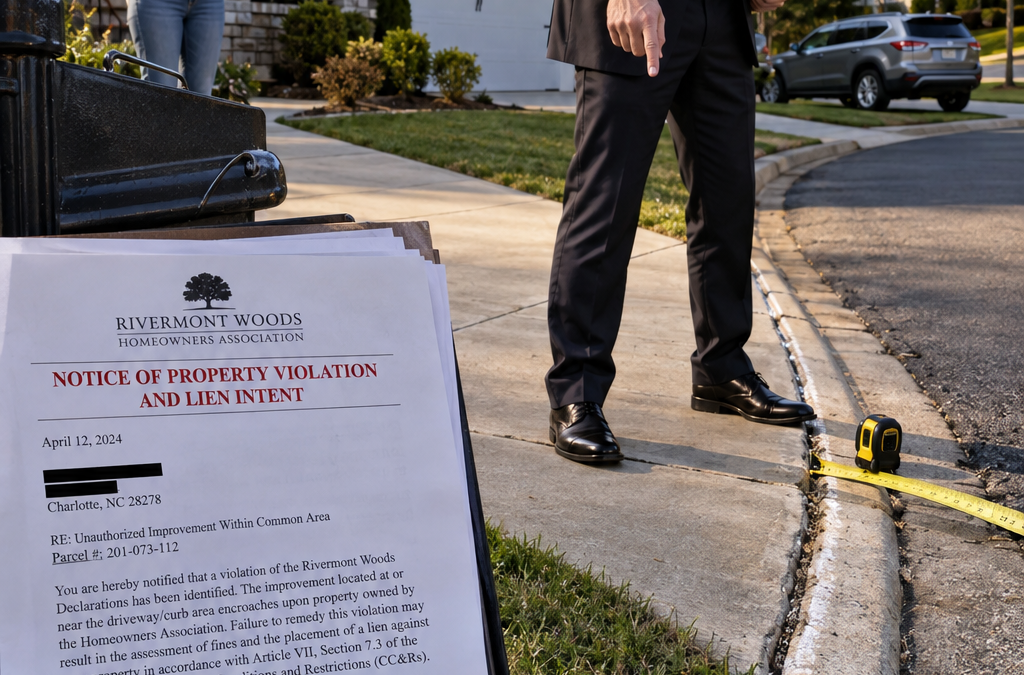
The lien notice hit my mailbox on a Tuesday, and my hands were shaking before I finished the first line. I thought I had bought a quiet first home outside Charlotte, but Deborah Whitfield was about to teach me how quickly a peaceful street could turn into a courtroom.
My name is Linda Morales, and six months before that notice appeared, I was still getting used to the sound of my own key turning in my own front door.
That sounds small unless you have spent most of your adult life renting.
I had lived above a nail salon, in a basement apartment that smelled like old carpet, and once in a duplex where the upstairs neighbor seemed to own bowling balls instead of shoes. Every year, I told myself I was getting closer. Every raise, every tax refund, every extra shift, every dinner I didn’t order out, every vacation I didn’t take—it all went into the same savings account.
House fund.
Two words that kept me disciplined for almost nine years.
So when I finally bought the little blue-gray house in Willow Trace, a quiet cul-de-sac outside Charlotte, North Carolina, I cried in the empty living room before the movers arrived.
Not dramatic movie tears.
Quiet ones.
The kind that come when your body realizes it can stop bracing for the next rent increase.
The house was nothing extravagant. Three bedrooms, two baths, a narrow front porch, a small yard, and a driveway just wide enough for my silver Honda Civic. The kitchen cabinets needed refinishing. The back fence leaned in one corner. The master bedroom carpet was older than I wanted to admit.
But it was mine.
Mine.
I said that word out loud more than once during the first week.
The neighborhood looked like a postcard designed to sell security. Trimmed lawns. Matching flagpoles. Kids on bikes. Little porch wreaths that changed with the season. Mailboxes lined up in neat black rows near the curve of the street. At sunset, the cul-de-sac glowed gold through the trees, and for the first time in years, I felt like I had landed somewhere.
The welcome basket arrived on my third day.
It was sitting on the porch when I came home from work, wrapped in clear plastic with a yellow ribbon tied around the handle. Inside were muffins, jam, a small candle, and a printed card that read: Welcome to Willow Trace.
A woman stepped out from the sidewalk before I could pick it up.
“Linda?”
I looked up.
“Yes.”
She smiled.
“I’m Deborah Whitfield. HOA president.”
Deborah was in her late fifties, sharp as a blade and polished from head to toe. Navy dress, pearl earrings, perfect makeup, smooth blond hair swept into a structured bob. She wore sunglasses on top of her head even though the sun had already softened behind the trees. In one hand she carried a leather folder. In the other, a phone.
Everything about her looked intentional.
Even her smile.
Especially her smile.
“Welcome to Willow Trace,” she said.
“Thank you. This is very kind.”
“We like to make sure new homeowners feel included.”
“That means a lot.”
Her eyes moved past me, over the porch, the flower bed, the driveway, my car, the mailbox.
It took less than three seconds, but I noticed.
“Well,” she said, “I’m sure you’ll settle in beautifully once you learn how we do things here.”
I laughed politely.
“I’m looking forward to it.”
She touched the leather folder against her side.
“If you ever have questions about standards, rules, procedures, or community expectations, you can come to me directly.”
“Good to know.”
Her smile widened.
“We keep a very orderly neighborhood.”
I thought she was being friendly.
That was my first mistake.
The trouble started small, the way trouble always does.
A note on my windshield.
Not even a formal letter at first. Just a white slip tucked beneath the wiper blade on a Monday morning, printed with the Willow Trace HOA logo and the words Courtesy Reminder.
My car was allegedly parked half an inch over an invisible driveway boundary line.
Half an inch.
I stood in my driveway with my purse over one shoulder, coffee in one hand, staring at the note while my car sat exactly where I had parked it every night since moving in.
Half an inch over what?
There was no painted line.
No marker.
No curb cut measurement.
Nothing.
I laughed because it seemed too ridiculous to do anything else.
Who measured a parking space with a ruler and a level?
Deborah did, apparently.
Every morning before her coffee even cooled.
I moved the car slightly closer to the garage and went to work.
That should have been the end of it.
Within two weeks, I had three violation letters.
Grass too long.
Trash bin out four hours early.
Wind chime disturbing aesthetic harmony.
The grass had been cut two days before the notice. The trash bin was out because pickup had been moved earlier for the holiday schedule. The wind chime had been hanging by the porch when I bought the house, and it made the softest sound imaginable, more whisper than chime.
I called the HOA office during lunch.
A woman answered with a tired voice.
“Willow Trace Homeowners Association.”
“Hi, this is Linda Morales at 14 Magnolia Court. I received a few violation notices, and I’d like to see the rulebook they’re based on.”
There was a pause.
“Have you checked your homeowner packet?”
“Yes. These specific rules aren’t in it.”
Another pause.
“You’ll need to speak with Deborah.”
“Okay. Can she send me the current rules?”
“She handles compliance matters directly.”
“Great. Can you transfer me?”
The line clicked.
Then Deborah’s voice came on.
“Linda.”
She said my name like she had been expecting me.
“Hi, Deborah. I wanted to ask about the notices I received.”
“Yes. I assumed you would.”
I frowned.
“I’d like a copy of the current rulebook, please.”
“It’s being updated.”
“Updated how?”
“The board is consolidating standards.”
“So the rules cited in my violation letters are from the updated version?”
“They reflect board interpretation of existing standards.”
“That doesn’t answer my question.”
Her voice cooled.
“Linda, new homeowners often struggle at first. It’s nothing to be embarrassed about.”
“I’m not embarrassed. I’m asking for the rulebook.”
“And I told you it’s being updated.”
“When will it be available?”
“When it is ready.”
I sat back in my chair at work, surrounded by the hum of computers and distant office chatter, feeling my face heat.
“So you’re fining me under rules I can’t review?”
Deborah’s silence lasted just long enough to become a warning.
“You should be careful how you characterize board action.”
I looked at the violation letters on my desk.
“I just want to understand what I’m being fined for.”
“Then comply with the notices.”
She hung up.
That evening, I met Rosa at the mailbox cluster.
Rosa lived across the cul-de-sac, in a white house with red shutters and a porch full of potted herbs. She was in her early forties, with kind eyes and the wary posture of someone who had learned to lower her voice in her own neighborhood.
She watched me pull another HOA envelope from my mailbox.
“Already?”
I looked at her.
“What?”
She nodded at the envelope.
“Deborah.”
I tried to smile.
“Is it that obvious?”
Rosa stepped closer.
“She does this to everyone who doesn’t kiss her ring.”
The phrase sounded dramatic, but her face didn’t.
“What do you mean?”
“She finds a target.”
“A target?”
“Yes. Someone new. Someone busy. Someone single. Someone who won’t know where every rule is buried.”
I looked toward Deborah’s house at the far end of the street. Large brick colonial, white columns, immaculate hedges, spotless driveway.
“I asked for the rulebook.”
Rosa winced.
“That explains it.”
“You’re serious.”
“Very.”
She glanced toward the houses as if Deborah might be listening from behind a curtain.
“I had an old fence dispute two years ago. One loose panel after a storm. Deborah fined me, then late fees, then appeal fees. I’m still paying it off.”
“For a fence panel?”
“For challenging her.”
There it was again.
Not the violation.
The challenge.
Rosa leaned closer.
“Start keeping everything. Every letter, every envelope, every photo. Don’t speak to her alone if you can help it.”
I felt a cold little weight settle in my stomach.
“How bad can this get?”
Rosa looked away.
“Bad enough that people stop fighting.”
That night, I started my folder.
I photographed the lawn.
The trash bin.
The wind chime.
My car parked in my driveway.
I saved emails. I scanned letters. I wrote dates on envelopes. I created a spreadsheet with columns for alleged violation, date received, fine amount, response, evidence, and status.
At first, it felt paranoid.
Then Deborah gave me a reason to be grateful.
The accusation that changed everything arrived three weeks later.
According to the letter, I had been parking on Deborah’s curb.
Her curb.
The notice claimed my vehicle had repeatedly obstructed “the view corridor and curb frontage” directly in front of her home, creating a nuisance and interfering with the quiet enjoyment of her property.
I read it twice.
Then I walked outside and looked at my car.
It was parked in front of my house.
Forty feet away from Deborah’s curb.
In the same place it had been every night.
I checked my phone.
I had timestamped photos from that morning, the day before, and the day before that. My car was visible in front of my own house each time.
Deborah’s notice included no photograph.
Just her statement.
I appealed in writing.
She sent code enforcement anyway.
Two officers arrived the next afternoon while I was cleaning the porch.
They stepped out of a city vehicle, already looking slightly confused.
“Are you Linda Morales?” one asked.
“Yes.”
“We received a complaint about illegal parking and obstruction.”
I pointed toward my Honda.
“That car?”
The younger officer checked his tablet.
“The complaint says vehicle obstructing curb frontage of 2 Magnolia Court.”
“That’s Deborah Whitfield’s house.”
He looked down the street.
Then at my car.
Then back at the tablet.
“That’s not where your car is.”
“It never was.”
The older officer walked toward Deborah’s house, then came back shaking his head.
“Ma’am, this curb is public right-of-way.”
I almost laughed.
“I know.”
He looked toward Deborah’s driveway, where she had appeared with her clipboard.
Deborah marched toward us.
“Officers, thank you for responding. This has been ongoing.”
The older officer held up one hand.
“Mrs. Whitfield, the vehicle is parked legally.”
“It has been obstructing my view corridor.”
“You don’t own the curb.”
Her face tightened.
“I’m president of the HOA.”
“That doesn’t change public right-of-way.”
Deborah’s eyes flicked toward me.
The younger officer added, less tactfully, “Ma’am, you don’t own the sidewalk in front of your own house, let alone hers.”
For a second, the entire cul-de-sac seemed to stop breathing.
Deborah’s face turned the color of a stop sign.
Her clipboard trembled.
I pressed my lips together to keep from smiling.
That was twist number one.
The woman who claimed absolute authority over our street did not even understand the public curb she was trying to control.
I thought embarrassment might end it.
I thought having code enforcement correct her in front of witnesses might make Deborah retreat.
I was wrong.
It made her furious.
Furious people escalate.
The next week, a certified letter arrived in my mailbox.
Two-thousand-dollar fine.
Harassment of a board member.
The alleged harassment was apparently the act of “creating unnecessary law enforcement involvement related to a board officer’s residence.”
In plain English, Deborah accused me of harassing her because she had called code enforcement on herself and lost.
I appealed.
The hearing was held in the clubhouse on a Thursday night.
I arrived with my folder, wearing the navy blouse I used for work presentations because it made me feel composed even when I wasn’t. Rosa came with me and sat in the back.
Deborah sat at the front table.
Beside her were two people I had seen around the neighborhood but had never formally met.
A woman with Deborah’s exact cheekbones and a man who kept checking his watch.
Deborah opened a folder.
“This appeal concerns homeowner misconduct and harassment.”
I stood.
“I object to that description.”
“You may speak when recognized.”
I looked at the two board members.
“Can I ask who is hearing this appeal?”
Deborah smiled.
“This is the board.”
The woman nodded once.
“I’m Marjorie Lang.”
The man sighed.
“Peter Lang.”
I looked from one to the other.
“Are you related to Deborah?”
Marjorie’s eyes narrowed.
“She is my sister.”
Peter said nothing.
I felt the room shift under my feet.
“The entire board is your sister and brother-in-law?”
Deborah folded her hands.
“The board was elected according to our bylaws.”
“How many board seats exist?”
“Three.”
“And all three are held by one family.”
Her smile hardened.
“If you are implying impropriety—”
“I’m implying nothing. I’m stating what I just learned.”
That was twist number two.
This wasn’t a homeowners association.
It was a family business wearing a badge stitched together from bylaws.
The hearing lasted twelve minutes.
They upheld the fine.
Of course they did.
Rosa found me outside afterward.
Her face was pale with anger.
“I should have told you.”
“You knew?”
“Everyone knows.”
“Then how is this allowed?”
She looked toward the clubhouse.
“Her late husband rewrote the bylaws about ten years ago. Nobody challenged them. After he died, Deborah just kept running things.”
“With her sister and brother-in-law?”
“Yes.”
I looked at the lit clubhouse windows.
Inside, Deborah’s silhouette moved behind the blinds.
I stopped being scared that night.
Not completely.
Fear stayed. Fear always stays when someone threatens your home.
But something stronger arrived with it.
Strategy.
I formally requested the HOA’s financial records.
Budget reports.
Bank statements.
Fine ledgers.
Board minutes.
Vendor payments.
Reserve accounts.
Any record related to my fines and the alleged assessment authority.
Every homeowner had legal rights to inspect certain association records, and I cited those rights in writing.
Deborah refused.
Not directly at first.
She said the request was broad.
Then she said the records were under review.
Then she said access was subject to board discretion.
That phrase again.
Board discretion.
In Willow Trace, it meant Deborah’s discretion.
I filed a formal complaint with the state agency that handled community association disputes and nonprofit records complaints. I attached my unanswered requests, the appeal notice, the board relationship issue, and the fines.
While waiting, the letters kept coming.
Four thousand dollars.
Then six.
Each one threatening a lien against my home.
The word lien started appearing in my dreams.
I would wake at 3:00 a.m. with my heart racing, convinced someone had taped a notice to my door. I checked the locks. Then the mailbox. Then my spreadsheet. Then my bank account, as if looking at the numbers could somehow prove the house still belonged to me.
I had never felt unsafe inside a home before.
Not like that.
It wasn’t physical fear.
It was paper fear.
The kind created by envelopes, signatures, official letterhead, and deadlines written by people who know you have to sleep eventually.
By the time the amount reached eight thousand dollars, I called a lawyer.
His name was Marcus Bell.
He specialized in HOA abuse and property disputes, and his office looked like it had been assembled by someone who cared more about winning than decorating. Files stacked on chairs. Legal pads everywhere. A framed newspaper clipping about a homeowner settlement on the wall.
Marcus was a large, calm man with tired eyes and a voice that never hurried.
He read my folder cover to cover.
Every letter.
Every photo.
Every response.
Every appeal document.
Every timestamp.
He read silently for almost an hour while I sat across from him, hands folded so tightly my knuckles hurt.
Then he laughed.
Not loudly.
Just one short laugh under his breath.
I stared at him.
“What?”
“This is one of the sloppiest liens I’ve seen in years.”
I blinked.
“That’s good?”
“For you, yes.”
He tapped the stack of letters.
“She never gave proper statutory notice before threatening lien action. Not once. No valid pre-lien notice, no proper accounting, no hearing process that would survive scrutiny, and this family-board arrangement is a problem all by itself.”
My shoulders dropped for the first time in weeks.
“So she can’t take my house?”
“She can try to create noise. She cannot lawfully foreclose based on this mess without facing consequences.”
I closed my eyes.
The relief made me dizzy.
Marcus kept reading.
“The harassment fine is nonsense. The curb complaint is ridiculous. The record refusal is useful. And if the financials are as bad as this suggests, she may have bigger problems than your case.”
“She has everyone scared.”
“Good. Scared people keep receipts.”
He looked up.
“And you kept excellent receipts.”
Marcus sent a cease and desist letter on my behalf.
It demanded withdrawal of the improper fines, production of records, correction of my account, and preservation of all HOA communications. It also warned Deborah that any further publication of unsupported violations could constitute harassment, defamation, and bad-faith enforcement.
Deborah’s response was to double down.
She posted my alleged violations on the community Facebook page.
Photos of my car.
My wind chime.
My trash bin.
A screenshot of the harassment fine.
She wrote a long post about maintaining standards and protecting the neighborhood from residents who “weaponize government agencies against volunteer board members.”
She thought public shame would pressure me.
It backfired spectacularly.
Rosa commented first.
Linda has proof her car was parked legally. Deborah called code enforcement and lost.
Then Mr. Grant from the corner house commented.
Deborah fined me $600 for a mailbox repair after refusing to show the rule.
Then Priya.
Can the board explain why financial records have not been made available despite formal requests?
Then another neighbor.
Then another.
Within hours, the thread had turned into a public archive of every story people had been too afraid to tell.
Unpaid disputed fines.
Threat letters.
Denied appeals.
Missing records.
Late fees attached to notices never received.
People compared amounts, dates, and language.
A pattern formed.
Not the pattern Deborah wanted everyone to see.
Marcus called me that night.
“Do not comment further.”
“I already didn’t.”
“Good. Screenshot everything.”
“I did.”
“Excellent.”
The state records response came back two days later.
That was twist number three.
The HOA bank account was missing nearly forty thousand dollars.
Forty thousand dollars in maintenance fees and reserve funds.
No matching maintenance.
No new mulch.
No paving.
No clubhouse repair.
No major landscaping.
Nothing residents could point to.
Money out.
No legitimate records explaining where it went.
Marcus reviewed the packet and went quiet.
That frightened me more than his laughter.
“What?”
He flipped one page around.
“Transfers.”
“To who?”
He pointed.
The account names were partial, but the audit notes identified digital payments connected to Deborah’s personal Venmo account.
My mouth went dry.
“She stole it?”
“We don’t use that word until a court or prosecutor does.”
He looked up.
“But this is strong evidence of misappropriation.”
The lawsuit Marcus filed was not small.
It did not only ask to void my lien.
It sought damages and injunctive relief on behalf of homeowners fined without proper notice. It challenged the legality of the enforcement process, the family-controlled board, the denied records, the improper lien threats, and the missing funds.
A class action.
I remember staring at the words before signing.
Class action sounded like something from news stories, not something connected to my little blue-gray house on Magnolia Court.
Marcus slid the pen toward me.
“You sure?”
I thought about the lien letters.
The sleepless nights.
Rosa’s face at the mailbox.
The neighbors on Facebook finally telling the truth.
I signed.
The hearing date came faster than I expected.
The courthouse felt colder than it should have. I sat beside Marcus with my folder in my lap even though he had copies of everything. Rosa sat behind me. Priya was there too. So were several neighbors who had taken time off work because they wanted to see Deborah answer questions under oath.
Deborah arrived in a blazer sharp enough to cut glass.
White.
Tailored.
Perfect.
Her hair was smooth. Her earrings glittered. Her smile was calm, as if the courtroom were just another HOA meeting and the judge another resident she could intimidate with procedure.
Her lawyer sat beside her with three folders and the expression of a man who wished he had six.
The judge began with the lien.
“Counsel, I want to see proof of legal notice.”
Deborah’s lawyer opened one folder.
Then another.
Papers shifted.
A whisper.
Another folder.
Marcus sat still.
The judge waited.
“Your Honor,” Deborah’s lawyer said, “the association provided repeated violation correspondence.”
“That is not what I asked. I asked for proper notice supporting lien action.”
More paper shuffling.
Nothing.
The judge looked over her glasses.
“Do you have it?”
Deborah’s lawyer hesitated.
Marcus stood.
“Your Honor, they do not because it was never sent.”
He laid out the timeline.
The letters.
The missing notices.
The defective appeal.
The family board.
The improper Facebook publication.
The record refusal.
Then he introduced the state auditor’s report.
The courtroom changed.
Missing funds.
Unexplained transfers.
Payments traced to Deborah’s personal Venmo account.
Her smile finally cracked.
In the gallery, Rosa gripped my hand so hard it hurt.
Neither of us moved.
The judge read quietly for what felt like forever.
Then she looked at Deborah.
“Mrs. Whitfield, these are serious matters.”
Deborah’s voice was smaller than I expected.
“There has been confusion in bookkeeping.”
The judge did not blink.
“Forty thousand dollars of confusion?”
No one laughed.
It was not funny.
The judge voided the lien threat on the spot.
No hesitation.
She awarded me legal fees related to the improper enforcement action and referred the missing funds directly to the district attorney’s office for criminal review. She also ordered production of HOA records and temporarily barred the board from further collection action until lawful procedures were established.
I felt the words before I understood them.
Voided.
Legal fees.
Criminal review.
Records.
Barred.
The lien was gone.
The thing that had been sitting on my chest for months lifted so suddenly I almost cried in open court.
Deborah stared at the table.
Rosa squeezed my hand again.
This time, I squeezed back.
That afternoon, Willow Trace held an emergency meeting.
The clubhouse was packed. People stood along the walls. Deborah’s sister looked like she had aged ten years in one day. Her brother-in-law would not meet anyone’s eyes.
The vote to remove Deborah from the board was unanimous.
Even her own family voted yes.
Not courage.
Fear.
They understood that the ship was sinking and they wanted distance from the captain.
I did not care why they did it.
Only that it happened.
Deborah sat in the front row while they stripped away the title she had used like a weapon for years. For once, she had no speech ready. No polished line. No reminder about community harmony.
She simply gathered her purse and walked out through the side door.
No one followed her.
Weeks later, she was formally charged with embezzlement and related financial crimes tied to the missing HOA funds.
The woman who fined me for a wind chime now faced actual prison time.
I wish I could say I felt nothing but satisfaction.
The truth is more complicated.
I was relieved.
Angry.
Exhausted.
Sad for everyone who had paid money they didn’t owe.
Furious for the neighbors who had lost sleep, savings, confidence, and years of peace.
And strangely hollow, because winning did not erase what it had cost to fight.
Justice never feels exactly the way you imagine.
It does not arrive with music.
It arrives with paperwork.
A judge’s gavel.
A stamped order.
A prosecutor’s file.
A long overdue public fall from grace.
That fall changed Willow Trace.
A new board was elected that same season.
For the first time in years, more than twenty people attended voluntarily. Not out of fear. Out of ownership.
Rosa ran.
She said she didn’t want to, then gave a speech so direct and honest that half the room applauded before she finished.
She won easily.
Priya declined to run because, as she put it, “I prefer power without meetings,” but she agreed to join the finance committee.
The first vote the new board passed was full transparency on every dollar spent.
Monthly bank statements.
Open budgets.
Published meeting minutes.
Independent review of all fines issued during Deborah’s presidency.
A real appeal process.
No related-family majority on the board.
No lien action without proper notice, legal review, and a recorded vote.
For the first time since moving in, I sat through an HOA meeting and did not feel my stomach twist.
That should not be remarkable.
But it was.
Marcus later told me my case became a template other lawyers used statewide when challenging abusive HOA fines and defective liens.
I didn’t know what to do with that information.
I was not trying to become a case study.
I was trying to keep my house.
Still, there was something powerful in knowing the folder on my kitchen table might help someone else.
One folder of receipts.
That was what Marcus called it.
One folder of receipts can topple a tyrant.
I still park in front of my own house every night.
Not in front of Deborah’s house.
Not blocking her view.
Not making a point.
Just in front of the house I bought.
The curb across the street sits empty most evenings.
Sometimes when I walk to the mailbox, I look at it and smile.
Not because I hate Deborah, although some days I come close.
I smile because that curb was never hers.
The sidewalk was never hers.
The street was never hers.
The HOA was never supposed to be hers.
And my house was never hers to threaten.
The wind chime is still on my porch.
It moves softly when the air shifts after sunset.
For months, that sound made me anxious because I wondered whether another letter would appear.
Now it sounds like proof.
Proof that I stayed.
Proof that Rosa spoke.
Proof that Priya noticed.
Proof that Marcus knew exactly where the law had been ignored.
Proof that Deborah’s power was never as solid as it looked.
It was built on fear, confusion, and people too tired to ask for the rulebook.
The house feels like mine again now.
Not because the fight never happened.
Because it did.
Because I know exactly what it took to protect it.
Some nights, I stand by the front window after parking my car and look down Magnolia Court.
The flags on porches.
The minivans.
The kids on bikes.
The mailbox cluster.
The empty curb near Deborah’s house.
It looks like the postcard I thought I bought six months earlier.
But I know better now.
Peace is not the absence of conflict.
Sometimes peace is what remains after the people using fear finally lose control.
Justice did not come fast.
It did not come easily.
It did not feel clean while it was happening.
But when it finally arrived, it came with documents, witnesses, a judge who asked the right question, and a paper trail Deborah Whitfield could not smile her way out of.
And every night, when I park legally in front of my own home, I remember the first line of that lien notice and the way my hands shook.
Then I look at my house.
My porch.
My wind chime.
My curb.
And I go inside smiling.








