𝗙𝗨𝗟𝗟 𝗦𝗧𝗢𝗥𝗬 The HOA President Put a Foreclosure Lien on My Paid-Off House While My Daughter Was Still Sleeping Inside
𝗙𝗨𝗟𝗟 𝗦𝗧𝗢𝗥𝗬
I wanted to say yes.
I wanted to tell her that everything was fine.
But the notice was still trembling in my hand.
So I said the only thing I knew I could promise.
“I’m going to take care of it.”
She nodded.
Then she wrapped her arms around my neck.
I held her a little longer than usual.
Over her shoulder, I looked at the house I’d spent fourteen years working to afford.
The front porch.
The white trim.
The little flower bed beside the steps.
The living room where Ellie and I watched movies on Friday nights.
The kitchen where she did homework while I made dinner.
All of it.
And for the first time since buying the place, I was terrified that I might not be able to keep it.
Six months earlier, Maple Ridge Estates had looked like the answer to every difficult year we’d survived.
I still remember the first morning we drove into the neighborhood.
The sky was bright blue.
The streets were lined with maple trees.
White fences surrounded carefully maintained front yards.
A community pool sat behind the clubhouse, and children rode bicycles along the quiet cul-de-sacs.
There were no apartment buildings.
No crowded parking lots.
No neighbors arguing through paper-thin walls.
Everything looked peaceful.
Ellie pressed her face against the passenger window.
“Daddy, look!”
I slowed the truck.
“What?”
“That house has a swing in the backyard!”
I smiled.
“I see it.”
“And there’s a pool!”
“That’s the community pool.”
“Can we swim there?”
“That’s what they told me.”
She turned toward me.
“Really?”
“Really.”
Her smile made every double shift I’d worked feel worth it.
For years, Ellie and I had lived in a cramped apartment above a row of small businesses.
The place wasn’t dangerous, but it was noisy.
Delivery trucks started arriving before sunrise.
The air conditioner barely worked in summer.
Our downstairs neighbor complained whenever Ellie ran across the living room.
After her mother left, the apartment became even smaller.
Or maybe it just felt smaller because there were suddenly only two of us living inside it.
Ellie was five when her mother walked away from our marriage.
I won’t pretend that period was easy.
There were nights when Ellie stood beside the front door waiting for someone who wasn’t coming.
Times when she asked questions I didn’t know how to answer.
Times when I came home from a twelve-hour shift and found her asleep on the couch beside my sister, who helped watch her when my schedule ran late.
I did the best I could.
I learned how to braid hair.
How to pack school lunches that didn’t come home untouched.
How to tell when a stomachache was really worry.
And how to smile through exhaustion because a child shouldn’t have to carry her father’s burdens.
But the apartment never felt like a fresh start.
Too many memories lived there.
Too many evenings when Ellie looked toward the door and went quiet.
I wanted to give her somewhere new.
Somewhere with a backyard.
Somewhere she could invite friends over.
Somewhere she wouldn’t have to ask whether we were going to move again.
So I worked.
And saved.
And worked some more.
When the opportunity came to buy the house in Maple Ridge outright, I used nearly everything I’d set aside.
It wasn’t a mansion.
Three bedrooms.
Two bathrooms.
A modest garage.
A small backyard with a wooden privacy fence.
But it was clean, sturdy, and located near Ellie’s school.
The day I received the keys, I placed them in her palm.
She stared at them.
“What are these?”
“House keys.”
“To our house?”
“Yep.”
She looked up.
“You mean we own it?”
I nodded.
“No landlord?”
“No landlord.”
“Nobody can tell us we have to leave?”
The question caught me off guard.
I crouched beside her.
“This is our home, Ellie.”
She wrapped both arms around my neck so tightly that I almost lost my balance.
That moment stayed with me.
It would return again and again during the months that followed.
Especially when Kieran Whitfield began treating our home like something he could take away with a clipboard and a signature.
We moved in that spring.
The first few days were wonderful.
Ellie chose the bedroom facing the backyard because she could see the big maple tree through the window.
She taped glow-in-the-dark stars to her ceiling.
We assembled her bed together, although she insisted on holding the screwdriver even when it was obvious I was doing most of the work.
On Saturday, we bought two lawn chairs and sat in the backyard eating pizza straight from the box.
Ellie kicked off her shoes and stretched her feet into the grass.
“Daddy?”
“Yeah?”
“I like it here.”
I looked around.
The fence.
The maple tree.
The quiet houses beyond it.
“Me too, baby.”
For the first time in years, I thought we might finally have a chance to live without worrying about the next disaster.
Then Kieran Whitfield knocked on our door.
It happened during our first week.
I was unloading groceries when I heard three sharp knocks.
Not friendly knocks.
Three precise strikes against the wood, followed by silence.
When I opened the door, a man stood on the porch holding a dark leather clipboard.
He appeared to be around fifty, tall and broad through the shoulders, with neatly styled dark hair beginning to silver at the temples.
He wore a tailored navy blazer over a pale blue shirt, expensive slacks, and polished leather loafers.
His watch looked like it cost more than my first car.
Everything about him was immaculate.
Not a loose thread.
Not a wrinkle.
Not a hair out of place.
He smiled with the controlled confidence of somebody accustomed to being obeyed.
“Brad?”
“That’s me.”
“Kieran Whitfield. President of the Maple Ridge Estates Homeowners Association.”
He extended his hand.
I shook it.
“Nice to meet you.”
His grip was firm.
“Welcome to the neighborhood.”
“Thank you.”
He glanced past me into the foyer.
Then toward the driveway.
Then at the yard.
“Beautiful property, isn’t it?”
“We love it.”
“Good. We’re very proud of Maple Ridge.”
He looked down at his clipboard.
“We maintain a high standard here.”
“That’s one of the reasons I bought the house.”
He smiled.
“Excellent.”
Then he stepped off the porch and walked toward the lawn.
Without asking.
I followed him.
He stopped beside the edge of the grass, crouched slightly, and pulled a small metal ruler from his pocket.
At first, I thought he was joking.
Then he pushed the ruler into the grass.
Measured.
Moved two feet.
Measured again.
I stared at him.
“Everything okay?”
He made a note.
“Your lawn height is approaching the upper acceptable limit.”
I looked down.
The grass was neatly cut.
I’d mowed it the day before.
“Seriously?”
He straightened.
“Community standards are not optional.”
I laughed.
Not loudly.
Just a small, involuntary laugh.
Because a fifty-year-old man in an expensive blazer was standing in my front yard measuring grass with a ruler.
His expression changed.
“Something amusing?”
I stopped smiling.
“No. Sorry. It’s just new to me.”
He looked at me for a long moment.
Then wrote something on his clipboard.
“New residents often need time to adjust.”
He started toward the sidewalk.
“Keep the lawn maintained, and we’ll avoid unnecessary enforcement.”
I watched him walk away.
Then went back inside.
Ellie stood near the kitchen doorway.
“Who was that?”
“The neighborhood president.”
“What did he want?”
I smiled.
“To measure our grass.”
She giggled.
“Why?”
I shook my head.
“That’s a very good question.”
I thought the incident would become a funny story we’d tell someday.
I had no idea that Kieran Whitfield had just placed our address on a list of people he considered insufficiently obedient.
The first fine arrived four days later.
Fifty dollars.
Improper trash container placement.
According to the notice, my trash can had remained at the curb four hours after the scheduled pickup.
I read the letter twice.
Then looked at the empty space beside the garage where the can now stood.
Four hours.
The plant had scheduled me for a double shift that day.
I left before sunrise.
By the time I returned, the trash truck had already come and gone.
I moved the can as soon as I got home.
Apparently, that wasn’t fast enough.
I called the HOA office.
A woman answered.
I explained that I’d been at work.
She politely informed me that employment schedules didn’t exempt residents from community standards.
I asked whether there was a warning period.
She said the notice had already been issued.
I stared at the amount.
Fifty dollars.
I could spend more than that taking Ellie out for dinner.
I didn’t want to start a neighborhood fight over something so small.
So I paid it.
I told myself it was annoying but manageable.
Then the second fine arrived.
Exterior paint violation.
The front porch was painted colonial blue.
It had been that color when I purchased the house.
I’d never changed it.
According to the notice, the approved shade was called Ocean Mist.
I looked at my porch.
Then searched online for Ocean Mist.
Every example looked almost identical to the color already on my house.
I called the HOA.
“I’d like to see the approved paint chart.”
The office transferred me.
After several minutes, Whitfield answered.
“Brad.”
His tone suggested he already knew why I was calling.
“Mr. Whitfield, I received a paint violation.”
“Yes.”
“The porch is the same color it was when I bought the house.”
“Standards can change.”
“Can you send me the approved chart?”
“It’s under revision.”
I frowned.
“Under revision?”
“Correct.”
“Then how am I supposed to know whether my porch matches it?”
“The board has established visual standards.”
“Without a published chart?”
His voice cooled.
“Brad, we’ve been running this neighborhood for eleven years. We understand what is acceptable.”
“I just want the correct color.”
“Then I suggest you demonstrate a little trust in the board.”
I looked at the notice.
“Can you at least give me the paint manufacturer’s code?”
There was a pause.
Then he said, “The chart will be distributed when the revision is complete.”
The call ended shortly afterward.
I stood in the kitchen holding my phone.
It seemed impossible.
I was being fined for violating a color standard the president refused to show me.
I began to understand that Whitfield wasn’t particularly interested in helping me comply.
He was interested in reminding me that he could decide whether I had complied.
The next few weeks became an exhausting routine.
Another notice.
Then another.
Mailbox height.
A small garden gnome Ellie had chosen at the hardware store.
Chalk drawings on our driveway.
The mailbox fine claimed the box sat too low.
I measured it.
It was within the postal service’s recommended installation range.
That apparently didn’t matter to Whitfield.
He claimed the HOA had a separate architectural standard.
When I requested the rule, the office sent me a general paragraph about visual consistency.
The garden gnome was even more ridiculous.
Ellie had spotted it while we were buying potting soil.
It was a little ceramic figure wearing a yellow raincoat and holding a blue umbrella.
She thought it looked lonely sitting on the store shelf.
“Can we give him a home?” she asked.
I laughed.
“Where would he live?”
“By the flowers.”
So we bought him.
She named him Mr. Pickles.
He sat beside the front flower bed for six days before Whitfield cited him as an unauthorized decorative structure.
Ellie found the notice before I could hide it.
She read slowly.
“Does this mean Mr. Pickles has to leave?”
I looked at her.
“No, sweetheart. It means Daddy needs to talk to somebody.”
“Did he do something bad?”
“Who?”
“Mr. Pickles.”
I felt my throat tighten.
“No.”
She picked up the little gnome and carried him into her bedroom anyway.
I found him that night sitting on her windowsill.
His tiny ceramic smile faced the room.
I hated that a neighborhood rule had made my daughter feel as though a harmless decoration needed to be hidden.
The chalk fine was worse.
Ellie had spent an entire Saturday drawing a rainbow across the lower part of our driveway.
She added flowers.
A purple butterfly.
A sun with sunglasses.
Then she wrote the words WELCOME HOME, DADDY in bright yellow chalk.
I’d worked overtime that morning.
When I pulled into the driveway, she was waiting beside the drawing with chalk dust on both knees.
“What do you think?”
I climbed out of the truck.
I looked at the rainbow.
The flowers.
The crooked letters.
Then I looked at her.
“I think it’s the best driveway in Maple Ridge.”
She beamed.
I took a picture.
Two days later, a violation notice arrived.
Temporary surface defacement.
The association claimed the drawings interfered with the neighborhood’s appearance standards.
I read the notice at the kitchen table.
Ellie was sitting across from me eating cereal.
She noticed my expression.
“What happened?”
“Nothing you need to worry about.”
She looked at the paper.
“Is it about my rainbow?”
I didn’t answer quickly enough.
Her smile disappeared.
“I can wash it off.”
I set the letter down.
“Ellie—”
“I didn’t know it was bad.”
I moved around the table and crouched beside her chair.
“It wasn’t bad.”
“But the neighborhood man doesn’t like it.”
I swallowed.
“No. He doesn’t.”
She looked toward the driveway.
“I won’t draw anymore.”
That sentence made me angrier than any fine.
I could pay fifty dollars.
I could argue about paint.
I could replace a mailbox or move a garden gnome.
But I couldn’t tolerate watching my daughter become afraid to play outside.
That evening, I walked onto the driveway with a bucket of water.
I stood over the faded chalk rainbow.
The colors had already begun washing away in the rain.
I looked at the words she’d written.
Welcome home, Daddy.
Then I carried the bucket back into the garage.
I wasn’t washing away her drawing for Kieran Whitfield.
Not that night.
The first real crack in Whitfield’s paperwork appeared a week later.
I’d started keeping the violation letters in a kitchen drawer.
One evening, while sorting through them, I noticed something strange.
A notice concerning my mailbox had been mailed two days before the alleged violation date.
At first, I assumed it was a typo.
I checked the envelope.
The postmark was clear.
Then I checked the notice.
The incident supposedly occurred on a Thursday.
The envelope had entered the postal system on Tuesday.
I stared at the two dates.
That wasn’t possible.
Not if the violation had actually been observed on Thursday.
I pulled out another letter.
A trash-can notice.
Same problem.
The envelope had been processed before the alleged incident.
I checked a third.
Again.
Not every letter had the discrepancy.
But several did.
Enough that I stopped believing it was an isolated mistake.
My stomach tightened.
Whitfield wasn’t merely interpreting rules aggressively.
At least some of the notices appeared to have been prepared before the events they claimed to document.
I spread the envelopes across the table.
Then I photographed each postmark beside its corresponding violation notice.
I uploaded the images to a private folder on my computer.
I created a spreadsheet.
Notice date.
Alleged violation date.
Postal processing date.
Amount.
Description.
Then I started photographing everything around the house.
The grass.
The trash cans.
The mailbox.
The porch.
The driveway.
I made sure my phone saved the dates and times.
I took pictures before leaving for work and after returning.
I photographed the garden gnome on Ellie’s windowsill.
I photographed the chalk drawing before the next rain washed it away.
I saved every envelope.
Every email.
Every message from the HOA portal.
I didn’t tell Whitfield what I was doing.
I wanted a complete record before I confronted him again.
For the first time, I began thinking like someone preparing evidence instead of someone asking a bully to be reasonable.
At the next HOA meeting, I attended in person.
The clubhouse looked expensive.
Polished floors.
Leather chairs near the entrance.
Framed photographs of past community events.
A large wooden table at the front where Whitfield sat with the board.
He wore a charcoal suit and a burgundy silk tie.
His hair was perfectly combed.
His expression was calm and confident.
He had been HOA president for eleven years.
Unopposed.
I later learned it wasn’t because everyone admired him.
Nobody wanted the headache of running against him.
The board moved through the agenda quickly.
Pool maintenance.
Landscaping.
Parking reminders.
Then Whitfield opened the floor to questions.
I raised my hand.
He looked toward me.
A faint smile appeared.
“Brad. Yes?”
I stood.
“I’d like to understand how violations are being enforced.”
He folded his hands.
“Which violation?”
“Several. But let’s start with my mailbox.”
He nodded.
“All right.”
“My neighbor’s mailbox is identical to mine. Same post. Same height. Same manufacturer.”
Whitfield’s smile tightened.
“And?”
“I received a fine. My neighbor didn’t.”
“Enforcement circumstances differ.”
“How?”
“Each property is evaluated individually.”
“But the mailboxes are identical.”
He adjusted his cuffs.
“Brad, we’re not going to discuss another homeowner’s account publicly.”
“I’m not asking about their account. I’m asking how the standard is being applied.”
Whitfield smiled at the room.
“New homeowners often struggle with the transition from independent living to a covenant-governed community.”
A few people shifted uncomfortably.
He continued.
“Our goal is education, not punishment.”
I looked at him.
“Then why won’t you provide the paint chart?”
His expression changed.
“We’ve already discussed that.”
“And why were some of my violation notices mailed before the incidents supposedly happened?”
The room went quiet.
Whitfield stared at me.
For the first time, his smile disappeared completely.
Then it returned.
Too quickly.
“Administrative processing dates don’t necessarily correspond with inspection dates.”
“Some letters were postmarked two days before the reported violation.”
He leaned back.
“Brad, this meeting isn’t an appropriate forum for an extended discussion of your personal compliance issues.”
I felt my face grow hot.
“I’m asking about the accuracy of the notices.”
“And I’m telling you that staff can review clerical questions through the normal process.”
He turned toward the agenda.
“Next item.”
I stood there for another moment.
Then sat down.
The meeting continued as though nothing had happened.
But I noticed several homeowners looking toward me.
Not angrily.
Curiously.
Whitfield had answered every question except the one I’d actually asked.
And I knew he had noticed that I was no longer accepting his version of events without checking it.
A week later, Ellie turned nine.
I had promised her a birthday party in our backyard.
Nothing extravagant.
A homemade cake.
Paper decorations.
Pizza.
A few school friends.
We bought purple balloons because purple was her favorite color that month.
Ellie helped me hang them along the fence.
She spent an hour making a paper sign that said HAPPY BIRTHDAY TO ME.
I laughed when I saw it.
“Confident, aren’t we?”
She grinned.
“It’s my birthday.”
“Fair point.”
The party was wonderful.
Eight children.
Two parents who stayed to help.
A little music.
Cupcakes.
Water balloons.
The kids played in the backyard until late afternoon.
There were no loudspeakers.
No fireworks.
No alcohol.
No cars blocking the street.
At five, the guests went home.
By six, I’d cleaned the yard.
Ellie fell asleep on the couch with frosting on her sleeve.
I carried her upstairs.
She stirred as I tucked her into bed.
“Daddy?”
“Yeah?”
“Best birthday ever.”
I kissed her forehead.
“Happy birthday, baby.”
Three days later, an anonymous noise complaint became a five-hundred-dollar fine.
I stood at the kitchen counter reading the notice.
Unreasonable recreational disturbance.
Excessive noise.
Unauthorized gathering.
Five hundred dollars.
For eight children celebrating a birthday in my backyard.
I called the office.
“Who complained?”
The receptionist said the association protected complainant confidentiality.
“Was there a noise measurement?”
She couldn’t tell me.
“Did anyone come to the house?”
She didn’t know.
“Was there a warning?”
She said no warning was required.
I asked for the exact rule.
She directed me to Whitfield.
I called him.
He answered with a sigh.
“Brad.”
“Five hundred dollars for my daughter’s birthday party?”
“The association received a complaint.”
“From whom?”
“That’s confidential.”
“What specifically did we violate?”
“Community noise standards.”
“It was eight kids eating pizza and playing in the backyard.”
“Noise levels are not determined by the number of guests.”
I closed my eyes.
“Did anyone actually measure the noise?”
“We received a credible complaint.”
“Who verified it?”
His voice hardened.
“Brad, you seem to think every rule requires your personal approval.”
“No. I think a five-hundred-dollar fine requires evidence.”
He laughed softly.
“That attitude is going to make things difficult for you.”
I gripped the phone.
“You’re punishing my daughter.”
“I’m enforcing community standards.”
“She turned nine.”
“Happy birthday to her.”
Then he ended the call.
I stood there staring at the phone.
I had never hated a sentence more than those four words.
Happy birthday to her.
So casual.
So polished.
As though he hadn’t just turned one of the happiest days of my daughter’s life into another tool for pressuring me.
That evening, Ellie found me sitting at the kitchen table.
She looked at the paper.
“Another letter?”
I nodded.
“Was the party too loud?”
I didn’t answer.
She climbed into the chair across from me.
“I’m sorry, Daddy.”
I looked up sharply.
“Ellie, no.”
She stared at her hands.
“I shouldn’t have invited so many friends.”
I moved beside her.
“Listen to me.”
She looked up.
“You didn’t do anything wrong.”
“But the man keeps getting mad.”
I took a slow breath.
“Some adults make bad decisions, sweetheart.”
She looked confused.
“Even presidents?”
I almost laughed.
Then I realized she was serious.
“Especially presidents sometimes.”
She leaned against me.
“Can we stay here?”
I held her.
“That’s what I’m working on.”
For the first time, I couldn’t bring myself to promise more than that.
The next afternoon, my neighbor Sam stopped me near the mailboxes.
Sam lived two houses down.
He was a quiet man in his fifties who worked in building maintenance.
We’d spoken several times, mostly about lawn equipment and the weather.
That day, he looked nervous.
He glanced toward the clubhouse road before speaking.
“Brad, can I tell you something?”
“Sure.”
He stepped closer.
“Be careful with Whitfield.”
I gave a tired smile.
“A little late for that.”
Sam didn’t smile.
“I’m serious.”
I looked at him.
He lowered his voice.
“My cousin lived here two years ago.”
“Okay.”
“Whitfield fined him until the balance got so high he couldn’t keep fighting.”
I felt my stomach tighten.
“What happened?”
“Foreclosure.”
I stared at him.
Sam nodded slowly.
“He lost the house.”
For several seconds, I couldn’t speak.
The birthday fine in my pocket suddenly felt heavier.
Sam continued.
“Whitfield doesn’t stop when somebody challenges him. He escalates until they break or leave.”
I looked toward my house.
Ellie was visible through the living room window, sitting on the floor with her homework.
“Why does the board let him?”
Sam gave a bitter laugh.
“Because he’s been president eleven years and nobody wants to fight him.”
“Surely the finances get audited.”
Sam’s expression changed.
“That’s another thing.”
“What?”
“The reserve fund audits have been delayed.”
I frowned.
“Delayed how?”
“Three years running.”
“Three years?”
He nodded.
“Every annual meeting, Whitfield says the accountant needs more time or the reports are being finalized.”
I stared at him.
“Has anyone asked why?”
“Plenty of people.”
“And?”
“He changes the subject.”
I looked toward the clubhouse.
For months, I’d assumed Whitfield was simply a control freak who enjoyed punishing homeowners.
But three years of missing reserve fund audits suggested something else.
Something financial.
Something he didn’t want people examining.
“Thanks, Sam.”
He nodded.
Then looked at me seriously.
“Don’t let him make you think you’re alone.”
I watched him walk away.
Then went inside.
That evening, I pulled up the HOA’s governing documents and the applicable state association disclosure provisions.
I wasn’t a lawyer.
Some of the language was difficult to follow.
But I found rules concerning owners’ access to association financial records.
Bank statements.
Budgets.
Reserve information.
Supporting accounting documents.
The next morning, I sent a formal request to inspect the HOA’s financial records under the applicable disclosure law.
I asked for the missing reserve fund audits and the underlying bank statements.
I requested the relevant periods in writing.
I saved a copy of the request.
Then I sent it by a method that provided proof of delivery.
Whitfield replied three days later.
The message was short.
Request denied at board discretion.
I read it twice.
There was no explanation of a specific legal exemption.
No proposed inspection date.
No offer to provide redacted records.
Just a denial.
I printed it.
Placed it in my folder.
And wrote the date in my notebook.
Whitfield had made his first serious mistake.
Not because I suddenly understood every detail of association law.
But because he had put his refusal in writing.
And a written refusal could be examined by people who knew exactly what the law required.
I didn’t hear from him for four days.
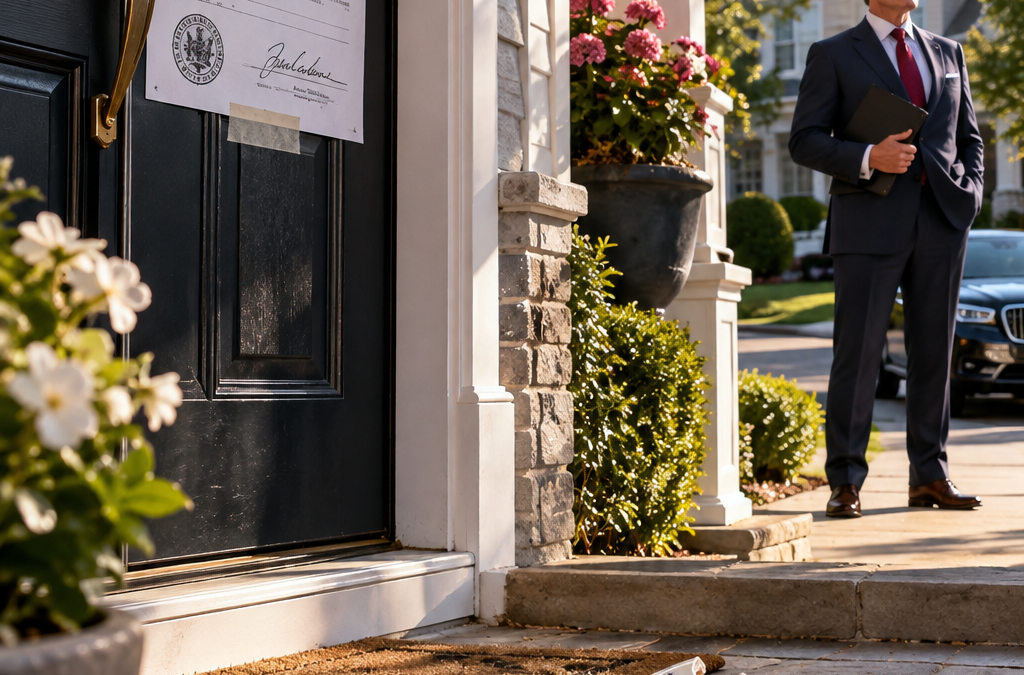
Then, at six on Tuesday morning, somebody taped the lien notice to my door.
Three thousand dollars.
A threatened foreclosure.
And a collection of alleged violations that included charges I’d never received properly.
The first time I saw the notice, I was too frightened to study the details.
After Ellie left for school, I sat at the kitchen table and forced myself to go through it.
The amount had been assembled from fines, penalties, late charges, and enforcement expenses.
Several entries were unfamiliar.
One listed an exterior maintenance violation I’d never seen.
Another referred to an alleged repeat offense on a day when my time-stamped photographs showed nothing unusual.
A third carried a date that didn’t match the corresponding notice.
The list looked official.
But the more I examined it, the less trustworthy it became.
Then I tried to print copies.
My printer jammed halfway through the job.
I opened the paper tray.
Pulled out a crumpled sheet.
Pressed the reset button.
The machine whirred.
Then began feeding paper.
And didn’t stop.
Page after page came out.
Blank sheets.
I stood there watching it.
By the time I shut it off, there were nearly fifty pieces of paper scattered across the floor.
For one ridiculous moment, I started laughing.
I had a three-thousand-dollar lien notice on my kitchen table, a mortgage-free house under threat, and a printer that apparently wanted to contribute to the chaos.
Ellie came into the kitchen.
“Daddy?”
I looked up.
“Yeah?”
“Why are you laughing?”
I pointed at the floor.
“The printer has decided we needed more paper.”
She picked up one blank sheet.
“Can I use these for homework?”
I smiled.
“Take all you want.”
She gathered a stack.
Then held one against her chest.
“Are we okay?”
The question made my smile fade.
I crouched beside her.
“We’re figuring it out.”
She looked at the lien notice.
“Is that the neighborhood man’s letter?”
“Yes.”
“Does he want money again?”
I hesitated.
“Yes.”
She was quiet.
Then she said something I’ll never forget.
“You can have my birthday money.”
I stared at her.
“What?”
“The money Grandma gave me. It’s in my drawer.”
My throat tightened so suddenly that I couldn’t speak.
She continued.
“I don’t need the roller skates right now.”
I pulled her into my arms.
“No, Ellie.”
“But if it helps—”
“No.”
I held her tighter.
“That money is yours. This is an adult problem, and it’s my job to handle it.”
She buried her face against my shoulder.
I looked over her head at the papers scattered across the floor.
Something inside me hardened.
Kieran Whitfield had made my daughter afraid to draw with chalk.
He’d turned her birthday into a financial penalty.
And now she was offering her savings because she thought we might lose our house.
I couldn’t let that continue.
That afternoon, I hired Denise Carter.
Denise was a real estate attorney with years of experience handling association disputes, property liens, and financial misconduct cases.
Her office was downtown, on the second floor of a brick building above a small accounting firm.
I arrived carrying three folders, my laptop, and a cardboard box filled with notices.
Denise greeted me with a firm handshake.
She appeared to be in her forties, with dark hair pulled back neatly and the focused expression of someone who didn’t enjoy wasting time.
“Brad?”
“Yes.”
“Come in.”
I placed the box on her conference table.
She looked at it.
“That’s quite a collection.”
I gave a tired laugh.
“Six months of my life.”
She sat down.
“Start at the beginning.”
So I did.
I told her about buying the house.
About Ellie.
About the grass ruler.
The trash can.
The paint chart.
The mailbox.
Mr. Pickles.
The chalk drawings.
The birthday party.
The postmarks that preceded the alleged violations.
The missing audits.
And the lien notice.
Denise asked questions as I spoke.
Dates.
Amounts.
Names.
Copies of letters.
Proof of payment.
She examined the envelopes carefully.
Then she opened the spreadsheet I’d prepared.
For almost an hour, she barely spoke.
Finally, she looked up.
“Brad.”
I waited.
“This is one of the most thoroughly documented HOA abuse cases I’ve seen.”
I didn’t know whether to feel proud or sick.
She continued.
“Some of these notices raise obvious procedural questions. The date discrepancies are particularly troubling.”
“Can he foreclose?”
She studied the lien notice.
“Not simply because he threatens it. There are legal requirements, and we can challenge the underlying debt and enforcement.”
I swallowed.
“But he’s already filed the lien.”
“Then we move quickly.”
She looked at the records request.
“Did he deny this in writing?”
“Yes.”
She read the response.
Then leaned back.
“Board discretion.”
I nodded.
She shook her head slowly.
“That isn’t a universal exemption from statutory disclosure obligations.”
I felt a small measure of relief.
Then she asked for the governing documents.
I handed them over.
She studied the bylaws.
The amendment procedures.
The financial management provisions.
Then she stopped at a section concerning association contracts.
Her expression changed.
“What?”
She didn’t answer immediately.
Instead, she turned to another page.
“Do you have the HOA’s vendor list?”
“I downloaded the last one I could find.”
I opened the file on my laptop.
She leaned forward.
“Show me the landscaping contractor.”
I scrolled.
A company name appeared.
Crestline Grounds Management LLC.
Denise wrote it down.
Then asked me to open the state business registration records.
We searched the company’s registration.
The address appeared on the screen.
I recognized it.
Not immediately.
But a second later, the connection became obvious.
It matched the address listed for Kieran Whitfield in the HOA’s board directory.
His home.
The landscaping contractor’s registered address was his own house.
I stared at the screen.
“That can’t be right.”
Denise looked at the entry carefully.
“It may be a related-party company.”
She opened another document.
“According to these board records, Whitfield participated in approving the landscaping agreement.”
I felt a chill.
“He approved a contract with his own company?”
“That’s what these documents suggest. We need the full ownership and payment records before drawing final conclusions.”
I looked toward the vendor list.
For months, I’d been thinking about fifty-dollar fines and paint colors.
Now the association president’s address was appearing on the registration of a company receiving neighborhood maintenance money.
Denise folded her hands.
“This needs a closer look.”
The next week was unlike anything I’d experienced before.
Denise sent a formal legal demand for the association’s financial records.
She challenged the disclosure denial.
She requested the contract approval records and payments to Crestline Grounds Management.
She also initiated the steps necessary to contest the lien and prevent enforcement while the underlying charges were reviewed.
I continued working at the plant.
But my mind was rarely there.
Every machine seemed louder.
Every shift felt longer.
I checked my phone during breaks.
I carried the lien notice in my backpack, folded inside a plastic sleeve.
Sometimes I’d take it out and stare at it.
Three thousand dollars.
It wasn’t an amount I couldn’t eventually earn.
But paying it wouldn’t solve the real problem.
Whitfield could invent another violation.
Then another.
The lien made it clear that he intended to keep increasing pressure until I surrendered.
I worried about how long I could afford legal fees.
I worried about whether Denise could stop the foreclosure.
Most of all, I worried about Ellie.
She had started asking permission before doing things she’d never questioned in the apartment.
Could she leave her bicycle near the porch?
Could she invite a friend over?
Could she draw in the driveway?
Could she put Mr. Pickles back in the garden?
Every question felt like another piece of childhood being taken from her.
One Friday evening, I found her sitting on the back steps.
The sun was setting.
Her chalk box rested beside her.
She was turning a blue stick between her fingers.
I sat down.
“What’s on your mind?”
She shrugged.
“Nothing.”
I waited.
Eventually, she looked at me.
“Do you think the neighborhood man hates us?”
I felt my chest tighten.
“No.”
She frowned.
“Then why does he keep being mean?”
I looked toward the fence.
For a long moment, I didn’t know what to say.
I wanted to tell her Whitfield was simply a bully.
That he enjoyed control.
That some people used authority because they liked watching others become afraid.
But she was nine.
She didn’t need my anger.
So I said, “Sometimes people care more about being in charge than being fair.”
She thought about that.
“That’s stupid.”
I smiled sadly.
“Sometimes it is.”
She looked toward the chalk.
“Can I draw again when it’s over?”
I put my arm around her.
“Yes.”
She leaned against me.
“Promise?”
I kissed the top of her head.
“Promise.”
The next morning, Denise called.
“Brad, we have the financial records.”
I sat down immediately.
“What did you find?”
She took a breath.
“More than I expected.”
Through the legal demand and subsequent production, her office had obtained bank statements, payment records, and supporting documents related to the landscaping contract.
The numbers didn’t reconcile with the explanations Whitfield had given homeowners.
There were payments to Crestline Grounds Management.
Repeated payments.
Over several years.
Some were labeled routine landscaping.
Others were listed as special maintenance or beautification expenses.
But the documentation supporting the work was incomplete.
And the company’s registration pointed directly back to Whitfield.
Denise had brought in a forensic accountant to examine the transactions.
The preliminary analysis identified approximately one hundred and twenty thousand dollars paid to the company over four years.
Four years.
One hundred and twenty thousand dollars.
I stared at the kitchen wall.
“You’re telling me he paid himself that much?”
“I’m telling you the association paid a company connected to him approximately that amount, and the records raise serious questions about authorization, disclosure, and whether the work was actually performed as billed.”
I rubbed my forehead.
“Why weren’t the audits completed?”
“That’s one of the questions we’re asking.”
I thought about Sam.
Three years of delayed reserve fund reports.
The missing documents.
Whitfield refusing to release bank statements.
The landscaping contract.
It was beginning to form a pattern.
The association president hadn’t simply been obsessed with controlling people’s mailboxes.
He had also controlled who saw the neighborhood’s finances.
And while residents argued over fifty-dollar fines, a company connected to his own address had received six figures.
Denise’s voice interrupted my thoughts.
“Brad?”
“I’m here.”
“We have enough to request a forensic review through the appropriate state oversight authorities and make a formal criminal referral if the evidence continues to support misappropriation.”
I closed my eyes.
“Do it.”
She was quiet.
“Are you sure?”
I thought about Ellie offering her birthday money.
“Yes.”
The complaint included the missing reserve audits, the denied records request, the vendor registration, the payment history, and the procedural problems surrounding the fines.
Denise also submitted the information to the state office responsible for reviewing association complaints and financial compliance.
The office acknowledged the complaint and began coordinating the appropriate review.
I didn’t celebrate.
Not yet.
Whitfield still controlled the board.
The lien still hung over my house.
And the foreclosure threat hadn’t disappeared.
But for the first time, the dispute had moved beyond his authority.
Someone outside Maple Ridge was examining the records.
That was what he couldn’t tolerate.
The response came almost immediately.
An email arrived from the HOA announcing an emergency board meeting.
The agenda included one item highlighted in bold.
AUTHORIZATION OF FORECLOSURE ENFORCEMENT — WHITFIELD RESIDENCE.
I stared at the screen.
Whitfield wasn’t waiting for the financial review.
He was trying to accelerate the action against my home before the investigation could gain momentum.
I forwarded the email to Denise.
She called within minutes.
“Brad, he’s escalating.”
“I can see that.”
“We’re preparing an emergency challenge to the lien enforcement.”
“Can he push it through at a board meeting?”
“The board can’t simply bypass the law, but he can authorize further action and increase the pressure. We need to stop the process before it gets any farther.”
I sat down.
“Why is he doing this?”
Denise paused.
“Because you asked questions he doesn’t want answered.”
The emergency meeting was scheduled for Thursday evening.
I spent the days before it barely sleeping.
At the plant, I made small mistakes that worried me.
I misplaced a tool.
Forgot a routine entry on a maintenance sheet.
Stood staring at a machine I’d operated for years, unable to remember whether I’d completed the previous check.
My supervisor pulled me aside.
“Brad, what’s going on?”
I hesitated.
Then told him about the house.
He listened.
When I finished, he shook his head.
“Take the afternoon if you need it.”
“I can’t afford to miss work.”
He looked at me.
“You can’t afford to get hurt because your mind isn’t here either.”
I nodded.
Then went home.
Ellie was staying with my sister that evening.
I didn’t want her hearing adults argue about whether her father should lose the house.
Before she left, she stood in the hallway holding her rabbit.
“Daddy?”
“Yeah?”
“Are you going to the meeting?”
I nodded.
“Yes.”
She looked worried.
“Is the mean man going to be there?”
“Probably.”
She reached into her pocket.
Then handed me something.
A folded piece of paper.
I opened it.
She had drawn our house.
The maple tree.
The front porch.
Mr. Pickles beside the flowers.
And two stick figures standing in the driveway.
One tall.
One small.
Above the drawing, in purple letters, she’d written:
OUR HOME.
I looked at it for a long time.
Then at her.
“What’s this for?”
She shrugged.
“So you remember.”
My throat tightened.
“Remember what?”
“That it’s ours.”
I crouched and hugged her.
I didn’t trust myself to speak.
After she left, I placed the drawing inside my document folder.
Right beside the lien notice.
Then I drove to the clubhouse.
The parking lot was nearly full.
Word had spread that the board was considering foreclosure action against a homeowner.
Several neighbors stood near the entrance talking quietly.
When I stepped out of my truck, Sam approached.
“You ready?”
I looked at the clubhouse.
“No.”
He nodded.
“Good answer.”
Then he clapped me on the shoulder.
“You’re not alone.”
Inside, the meeting room was crowded.
More people than I’d ever seen at an HOA meeting.
Residents sat shoulder to shoulder.
Others stood along the walls.
At the front, the board occupied a long wooden table.
Kieran Whitfield sat in the center.
He looked immaculate.
Tailored charcoal suit.
White shirt.
Deep red tie.
Silver-black hair combed perfectly into place.
A dark leather folder rested in front of him.
His hands were folded.
His expression was calm.
When he saw me enter, he smiled.
Not warmly.
Not politely.
It was the smile of someone who believed he’d already won.
I felt my heart pounding.
For a moment, I imagined walking back outside.
Driving home.
Calling Denise and telling her I couldn’t do it.
I was a factory worker.
A single father.
A man who had never wanted anything more complicated than a stable home.
I didn’t belong in a legal battle with an HOA president who had spent eleven years controlling a neighborhood.
Then I felt the folded paper inside my folder.
Ellie’s drawing.
Our home.
I kept walking.
Denise was already seated near the front.
She looked up.
“Brad.”
I sat beside her.
“You have everything?”
She tapped the document binder.
“Everything we need to raise the issue.”
I looked toward Whitfield.
“He’s going to try to embarrass me.”
Denise followed my gaze.
“Then we stick to the records.”
The meeting began at seven.
Whitfield tapped the microphone.
“Good evening, homeowners.”
His voice was smooth.
Practiced.
The same tone he’d used when measuring my grass.
“We’ve called this emergency session to address a serious case of prolonged noncompliance that has now reached the enforcement stage.”
I felt several people glance toward me.
Whitfield continued.
“Maple Ridge Estates depends on consistent standards. When residents refuse to comply, the board has a duty to protect the broader community.”
I gripped my pen.
Denise placed a hand lightly on the folder.
A silent reminder to stay calm.
Whitfield opened his leather binder.
He read the amount.
Three thousand dollars.
He listed the alleged violations.
Trash containers.
Paint.
Mailbox.
Unauthorized decoration.
Driveway markings.
Noise.
Repeat offenses.
Administrative charges.
Then he added the fence.
Six inches above the permitted height.
He described the entire situation as a deliberate refusal to cooperate.
I listened to him turn Ellie’s birthday into evidence against me.
He didn’t mention that she was nine.
He didn’t mention that the party ended before evening.
He didn’t mention that he had refused to provide the paint chart.
Or that several notices had been mailed before their alleged violation dates.
He spoke as though I had spent six months terrorizing the neighborhood with a trash can and a garden gnome.
Then he looked toward me.
“Mr. Brad has been given numerous opportunities to comply.”
My face burned.
He continued.
“Unfortunately, he has chosen hostility, obstruction, and legal threats instead.”
Denise sat very still.
Whitfield looked across the board.
“Given the outstanding balance and repeated refusal to resolve violations, I recommend that the association authorize foreclosure enforcement.”
A murmur moved through the room.
He waited.
Then smiled.
“Any objections to the foreclosure motion?”
Silence.
The kind of silence he’d probably heard a hundred times before.
Board members stared at their papers.
Residents shifted uncomfortably.
No one raised a hand.
Whitfield’s smile widened slightly.
He looked toward me.
For one terrible second, I thought he’d done it.
That my house would become another line in a board meeting record.
Another property controlled by his signature.
Then Denise stood.
“I object.”
Every head turned.
Whitfield blinked.
“I’m sorry?”
Denise placed a binder on the table.
“My name is Denise Carter. I represent Brad, the homeowner whose property is the subject of this motion.”
Whitfield’s smile tightened.
“Counsel, this is an internal association meeting.”
“Then it’s an appropriate place for the board to examine evidence concerning its proposed enforcement action.”
He adjusted his tie.
“We have an agenda.”
“And you have a serious financial disclosure problem.”
The room went quiet.
Whitfield stared at her.
Denise opened the binder.
She removed several printed documents.
Then placed them in front of the board members.
Bank statements.
Vendor payment records.
Company registration information.
Contract approvals.
A four-year transaction summary.
Whitfield’s face changed.
Only slightly at first.
His eyes moved toward the top page.
Then toward Denise.
“What is this?”
She spoke clearly.
“These are records concerning payments made by Maple Ridge Estates to Crestline Grounds Management LLC.”
A board member leaned forward.
“The landscaping company?”
“Yes.”
Denise placed another page beside it.
“This is the company’s registration.”
She pointed to the address.
“That address matches the residence of your HOA president.”
Several people leaned closer.
Whitfield gave a short laugh.
“That’s a gross misrepresentation.”
Denise didn’t look at him.
She addressed the board.
“Over four years, the association paid approximately $120,000 to this company.”
The room became completely silent.
Not the polite silence of people waiting for a meeting to continue.
A stunned silence.
The kind that follows a number nobody expected to hear.
One hundred and twenty thousand dollars.
Four years.
A company registered at Whitfield’s home.
Denise continued.
“The available documents also show that Mr. Whitfield participated in approving the contract, and the association’s financial reporting for multiple years remains incomplete.”
One board member looked sharply toward Whitfield.
“Kieran?”
Whitfield smiled.
But this time the expression looked strained.
“There’s a simple explanation.”
Denise turned toward him.
“We’d welcome a documented one.”
He laughed again.
A nervous, brittle sound.
“These are routine accounting matters.”
“Then where are the completed audits?”
He opened his mouth.
Then stopped.
A resident near the back spoke.
“We’ve been asking that for three years.”
Another voice followed.
“Why wasn’t the contract disclosed?”
Whitfield raised one hand.
“Let’s not turn this into a circus.”
Denise placed another document on the table.
“This is the written denial of my client’s statutory records request.”
The board vice president picked it up.
He read silently.
Then looked at Whitfield.
“You denied access to the bank records?”
“At board discretion.”
The vice president frowned.
“Did the board vote on that?”
Whitfield hesitated.
“I exercised my authority as president.”
“Did we vote?”
Whitfield’s face reddened.
“Not every administrative decision requires a full board vote.”
Denise spoke again.
“The financial records raise serious concerns about undisclosed related-party transactions and possible misappropriation. The appropriate oversight authorities have already been notified.”
Whitfield stared at her.
“What?”
“An external financial review has been requested.”
His smile disappeared.
For the first time since I’d met him, Kieran Whitfield looked frightened.
He turned toward the board.
“This is an attempt to derail legitimate enforcement.”
Denise remained calm.
“The association is being asked to pursue foreclosure over disputed fines while significant financial irregularities involving its president are under review.”
Whitfield pointed toward me.
“He’s doing this because he refuses to follow the rules.”
I felt my heartbeat pounding against my ribs.
Denise looked at him.
“Then explain why multiple violation notices were mailed before the incidents they supposedly documented.”
A board member looked up.
“What?”
Denise opened another section of the binder.
She placed the envelopes beside the corresponding notices.
“Here are the postal processing dates. Here are the alleged incident dates.”
She pointed to the first pair.
“Two days earlier.”
Then the next.
“Again.”
A third.
“Again.”
The vice president leaned forward.
“How is that possible?”
Whitfield swallowed.
“Administrative processing.”
Denise looked directly at him.
“Are you saying your office processed and mailed enforcement notices before the alleged violations occurred?”
Whitfield didn’t answer.
For several seconds, the only sound came from someone shifting a chair near the back.
Then he gave another defensive laugh.
“There are explanations for all of this.”
A board member asked quietly, “Then why haven’t we seen them?”
Whitfield looked toward his closest allies.
Neither met his eyes.
I watched the color drain from his face.
For six months, he’d looked at me as though I were a disobedient child.
He had measured my grass.
Inspected my porch.
Fined my daughter for drawing rainbows.
Turned her birthday into a violation.
Then threatened foreclosure.
Now he was sitting before a room full of homeowners, being asked questions he couldn’t dismiss with another letter.
I had imagined this moment for weeks.
I thought I’d feel victorious.
Instead, I felt sick.
Because I realized how close he’d come.
If I hadn’t saved the envelopes.
If Sam hadn’t mentioned the audits.
If Denise hadn’t followed the landscaping payments.
If I’d simply paid the fines or sold the house.
He might still be smiling at the front of the room.
And another family might have become his next target.
The vice president cleared his throat.
“I move that we suspend consideration of the foreclosure authorization until independent counsel reviews these issues.”
Whitfield turned sharply.
“You cannot be serious.”
The man looked at him.
“Very serious.”
Another board member spoke.
“I second the motion.”
Whitfield leaned forward.
“We are not going to let one disgruntled homeowner hijack this association.”
Sam stood near the back.
“He’s not the only homeowner with questions.”
Several people nodded.
A woman raised her hand.
“My landscaping charges doubled last year. I asked why and never got an answer.”
Another homeowner spoke.
“We’ve requested those audits every year.”
Whitfield struck the table with his palm.
“Order!”
The room fell quiet.
His face was red.
He looked around at the residents who had spent years obeying him.
But something had changed.
Nobody looked frightened anymore.
They looked angry.
The vice president returned to the motion.
The board voted to halt the foreclosure authorization and refer the disputed lien and financial concerns for independent review.
Whitfield opposed it.
But he no longer had the votes to control the room.
Denise leaned toward me.
“That’s the first step.”
I nodded.
My hands were shaking again.
But for a different reason.
Whitfield sat motionless.
His polished appearance remained intact.
The suit.
The tie.
The perfect hair.
But the authority beneath it had cracked.
Before the meeting ended, Denise requested that the board preserve all relevant financial and enforcement records and take immediate action to prevent the disputed lien from being used against my house.
The board agreed to an emergency review of the lien and collection procedures.
Its legal representatives were instructed to address the validity of the charges without further delay.
Whitfield tried one last time.
“You are all making a terrible mistake.”
The vice president looked at him.
“No, Kieran.”
He held up the financial summary.
“The mistake was not asking questions sooner.”
The meeting ended in confusion.
Residents gathered in small groups.
Board members spoke quietly with Denise.
Some people approached me.
A few apologized for believing the accusations against me.
Others wanted to know how to obtain the financial records.
Sam walked over.
He looked at my face.
“You okay?”
I shook my head.
“Not really.”
He nodded.
“Me neither.”
We stood quietly.
Then he said, “But he didn’t get the vote.”
I looked toward the front table.
Whitfield was collecting his papers.
His movements were quick and angry.
“No,” I said.
“He didn’t.”
The next seventy-two hours moved faster than I expected.
The state oversight review began examining the financial discrepancies.
The forensic audit identified substantial amounts that could not be reconciled with documented services and the association’s accounting records.
The relevant bank accounts were frozen through the appropriate legal process that same week to preserve funds while investigators examined the transactions.
The board obtained independent legal advice.
Additional contract records were requested.
Residents demanded explanations.
And Whitfield’s authority inside Maple Ridge began collapsing.
The board formally suspended him from association duties within seventy-two hours of the emergency meeting.
His access to financial decision-making was revoked.
The disputed lien against my property was rescinded, and the association initiated its formal release.
Denise made sure the written release was completed and recorded.
I didn’t accept a verbal promise.
Not after six months of fabricated dates and unexplained charges.
I wanted the lien removed from the property records.
I wanted confirmation.
I wanted something no future HOA president could pretend hadn’t happened.
When Denise called to tell me the release had been recorded, I sat down on the kitchen floor.
Not a chair.
The floor.
I had been standing beside the counter when the words reached me.
“The lien is gone, Brad.”
I gripped the phone.
“Gone?”
“Released. The disputed enforcement has been withdrawn.”
I closed my eyes.
For a moment, I heard nothing.
Then I heard Ellie laughing in the living room.
She was watching a cartoon.
Completely unaware that the thing I’d feared most for weeks had just been lifted from our house.
I leaned against the cabinets.
My throat tightened.
“Thank you.”
Denise was quiet.
Then she said, “Your daughter can sleep in her own room tonight without that foreclosure threat hanging over you.”
I covered my face.
That was when I cried.
Not loudly.
Not dramatically.
Just tears I couldn’t stop.
I had spent months holding everything together because Ellie needed me to be strong.
I’d gone to work.
Paid bills.
Made dinner.
Helped with homework.
Smiled when she asked whether we were okay.
All while wondering whether a man with an HOA title might take the house I’d worked fourteen years to buy.
Now the immediate threat was over.
I sat on the kitchen floor until I could breathe normally again.
Then Ellie appeared in the doorway.
“Daddy?”
I looked up.
She frowned.
“Why are you sitting there?”
I laughed through the tears.
“Because I just got some good news.”
She stepped closer.
“What good news?”
I held out my arms.
She climbed into my lap.
I hugged her.
Then I said, “We don’t have to worry about that letter on the door anymore.”
She pulled back.
“The one from the mean man?”
I nodded.
“Yes.”
Her eyes widened.
“Does that mean we can stay?”
I held her face gently between my hands.
“Yes, sweetheart.”
She stared at me.
Then smiled.
“Really?”
“Really.”
She threw her arms around my neck.
I held her tightly.
And for the first time since moving to Maple Ridge, I felt the promise I’d made when I gave her the house keys becoming real again.
The story wasn’t finished.
The financial investigation continued.
The board still had to examine how Whitfield had controlled contracts and enforcement for years.
But the fight over my house had turned.
The criminal referral moved forward.
Investigators reviewed the payments to Crestline Grounds Management, the missing audit records, and the circumstances surrounding the disputed charges.
The evidence was serious enough that fraud-related criminal charges were filed the following Monday.
Whitfield was arrested and processed.
His booking photograph began circulating almost immediately.
I first saw it in the neighborhood group chat.
For years, the HOA website had displayed a polished portrait of him standing beside the Maple Ridge clubhouse.
Perfect suit.
Perfect hair.
Confident smile.
Now that portrait was being replaced in conversations by a mugshot.
The contrast was startling.
The same man.
The same carefully styled hair.
But no expensive backdrop.
No podium.
No association seal.
No room full of people waiting for him to give instructions.
Just a man facing criminal allegations he could no longer silence with a fine notice.
I stared at the photograph for a long time.
I expected satisfaction.
Maybe even joy.
Instead, I felt an exhausting kind of relief.
The charges were allegations that would have to be proved in court.
I understood that.
But the investigation had moved beyond neighborhood gossip.
The evidence was now being handled by authorities with powers Whitfield couldn’t control.
And for the first time, he was the one expected to answer questions.
Local news picked up the story immediately.
By Friday, three television stations had aired reports.
The headlines all followed the same theme.
An HOA president accused of diverting six figures from homeowners.
A landscaping company tied to his residence.
Missing financial audits.
Disputed fines.
A single father threatened with foreclosure.
A photograph of my house appeared during one report.
Another showed the Maple Ridge entrance sign.
A reporter interviewed residents outside the clubhouse.
Some looked angry.
Others embarrassed.
Several said they had paid fines they never understood because they feared liens and legal costs.
More homeowners began coming forward.
One family had received repeated landscaping charges.
Another had been threatened over exterior decorations.
A retired couple described years of unexplained penalties.
People who’d remained silent began comparing notices.
And the pattern became harder to ignore.
The association’s new leadership announced a broader review of enforcement actions taken during Whitfield’s presidency.
Residents were encouraged to submit records.
Financial documents were preserved.
Past contracts were examined.
Civil lawsuits began emerging from homeowners who believed they had been harmed by improper charges and collection practices.
The legal claims accumulated almost as quickly as Whitfield’s violation letters once had.
I watched one report with Sam sitting beside me.
The reporter described the approximately $120,000 paid to Crestline Grounds Management over four years.
Sam shook his head.
“Four years.”
I nodded.
“Four years.”
“And he kept telling us the reserve reports were delayed because the accountant was busy.”
I looked toward the screen.
Whitfield’s booking photograph appeared beside an image of the HOA clubhouse.
“That’s what we were told.”
Sam leaned back.
“My cousin lost his house while this was happening.”
I looked at him.
“I’m sorry.”
He shook his head.
“For a long time, I thought there wasn’t anything anybody could do.”
I watched the report end.
Then I said, “So did I.”
Whitfield resigned from the board in writing shortly after his suspension.
The resignation was circulated to homeowners through the association’s new management.
It was formal.
Brief.
Carefully worded.
He didn’t admit wrongdoing.
He said he was stepping down to address personal legal matters and avoid further distraction for the community.
I read it once.
Then closed the email.
For eleven years, he’d held that position unopposed.
Now he was leaving it under criminal investigation.
Not because somebody beat him in a popularity contest.
Not because residents suddenly disliked strict rules.
Because the documents had exposed serious questions about what he’d done with their money and authority.
The lawsuits continued.
One afternoon, a news report showed Whitfield receiving legal papers at his own home.
He stood on the porch wearing a dark sweater and pressed trousers.
A process server handed him the documents.
For a moment, he looked toward the camera.
Then toward the papers.
The reporter mentioned that his own porch had previously been the subject of neighborhood complaints about exterior color.
I almost laughed.
The irony was impossible to miss.
The man who’d fined residents over paint shades and decorative details was now receiving legal notices on his own doorstep.
But I didn’t feel the need to celebrate his humiliation.
I’d spent too many nights afraid of losing my house to enjoy watching someone else confront legal trouble.
What mattered was accountability.
The residents deserved answers.
The association deserved transparent finances.
And I deserved to live in the house I’d paid for without being threatened over fabricated violations.
Denise helped me obtain written confirmation that my disputed fines had been canceled.
The lien release was recorded.
The enforcement action had ended.
My property was no longer being treated as security for the three-thousand-dollar balance.
When the final confirmation arrived, I placed it in the folder beside the original lien notice.
For several minutes, I studied the two documents.
The first had made me believe I could lose my home.
The second confirmed that the threat had been removed.
Both looked official.
Both were printed on ordinary paper.
But only one reflected the lawful resolution of the dispute.
I thought about how much power a document could have over a person’s life.
And how important it was to question one that didn’t make sense.
Not every official-looking letter was accurate.
Not every confident person had the authority he claimed.
And not every rule was being enforced for the reason people were told.
I had learned those lessons the hard way.
The neighborhood changed gradually after Whitfield’s removal.
It didn’t become perfect overnight.
There were still rules.
Still meetings.
Still disagreements about landscaping and maintenance.
But the atmosphere shifted.
Residents asked to see the financial reports.
Board members began documenting decisions more carefully.
Contract approvals received greater scrutiny.
People who once avoided HOA meetings started attending.
And nobody seemed willing to accept “board discretion” as an explanation for everything anymore.
At one meeting, the new president announced that the association would provide clearer notice procedures and review questionable enforcement balances.
A resident raised his hand.
“What about the missing audits?”
The president answered directly.
“They’re being addressed through the independent review, and the results will be shared as permitted by law.”
The man nodded.
There was no confrontation.
No threat.
No sarcastic lecture about community standards.
Just a question and an answer.
I remember sitting near the back, almost surprised by how ordinary it felt.
That was all most of us had ever wanted.
A neighborhood association that handled legitimate business without treating homeowners like enemies.
A few weeks later, Sam came over on a Saturday afternoon.
I was repairing a loose board on the backyard fence.
The same fence Whitfield had complained was six inches too tall.
Sam stood beside it with two bottles of lemonade.
“Still illegal?” he asked.
I smiled.
“Depends who you ask.”
He handed me a bottle.
“New board says they’re reviewing the fence rules.”
“Good.”
He looked along the boards.
“Doesn’t look like a menace to civilization.”
I laughed.
“Neither does Mr. Pickles.”
Sam frowned.
“Who?”
“The garden gnome.”
I pointed toward the living room window.
Ellie had returned him to the front flower bed the previous morning.
Yellow raincoat.
Blue umbrella.
Ceramic smile.
Sam burst out laughing.
“That’s what he fined you for?”
“One of many things.”
He shook his head.
Then looked toward the house.
“How’s Ellie?”
I took a drink.
“Better.”
“Good.”
We stood quietly for a moment.
Then Sam said, “My cousin called.”
I looked at him.
“Yeah?”
“He saw the news. He’s talking to an attorney about what happened to his house.”
I nodded slowly.
“I hope he gets some answers.”
Sam looked toward the fence.
“Me too.”
Then he glanced at me.
“You know, Brad, he asked me who started all this.”
I smiled faintly.
“What did you tell him?”
“That a single dad got tired of paying fines for things his daughter did in her own yard.”
I looked down.
For a moment, I couldn’t speak.
Sam clapped me on the shoulder.
“That’s pretty much it, isn’t it?”
I thought about the financial records.
The shell company.
The missing audits.
The criminal charges.
Then I looked toward the house.
“Yeah,” I said quietly.
“Pretty much.”
The most important change happened on an ordinary Sunday afternoon.
There were no reporters.
No police.
No attorneys.
No HOA meetings.
Just warm sunshine and the smell of freshly cut grass.
I was cleaning the garage when Ellie came outside carrying her chalk box.
She stood near the driveway.
“Daddy?”
“Yeah?”
She looked down at the pavement.
“Can I draw?”
I put down the broom.
“Of course.”
She hesitated.
“Even if the neighborhood man doesn’t like it?”
I walked over.
I crouched beside her.
“Sweetheart, you don’t have to be afraid of drawing on our driveway.”
She searched my face.
“Are you sure?”
I nodded.
“Yes.”
She looked at the chalk.
Then back at me.
“Can you help?”
I smiled.
“I thought you’d never ask.”
We sat on the driveway together.
I was terrible at drawing.
Ellie made sure I knew it.
She drew a purple butterfly.
I drew something that looked more like a potato with wings.
She laughed so hard she fell sideways onto the pavement.
“Daddy!”
“What?”
“That’s not a butterfly!”
“Sure it is.”
“It looks like a potato!”
I looked at it.
She was right.
We laughed until my stomach hurt.
Then she drew a rainbow.
A big one.
Stretching almost the entire width of the driveway.
She added flowers.
A yellow sun.
Mr. Pickles standing beneath his umbrella.
And a house with two stick figures in front.
I watched her carefully.
She was smiling.
Not cautiously.
Not with one eye on the street.
Just smiling.
The way a child should when she’s doing something she loves.
I felt something in my chest loosen.
For months, I’d watched Whitfield’s fines change the way Ellie behaved.
She’d stopped drawing.
Stopped asking friends over.
Started worrying that ordinary play could cost us money.
Now she was kneeling in the sunshine with purple chalk on her knees, completely absorbed in making something beautiful.
She looked up.
“Daddy, can you write something?”
“Sure.”
“What?”
She handed me the yellow chalk.
“Write welcome home.”
I swallowed.
Then knelt beside her.
Slowly, carefully, I wrote the words across the pavement.
WELCOME HOME.
Ellie studied them.
Then smiled.
“Perfect.”
I looked toward the house.
The porch.
The windows.
The maple tree.
The fence six inches too tall.
The home I’d paid for through fourteen years of exhausting work.
For a long moment, I couldn’t speak.
Then Ellie put her small hand in mine.
“Are you happy, Daddy?”
I looked at her.
“Very.”
She smiled.
“Me too.”
Later that afternoon, a local news crew arrived to record one final follow-up about the HOA investigation.
They filmed the clubhouse from the street.
Spoke with two homeowners.
Then asked whether I’d be willing to give a short statement.
I agreed.
The reporter stood beside my driveway.
“Brad, after everything that’s happened, how do you feel?”
I looked toward Ellie.
She was sitting near the garage, coloring the last flower in her chalk garden.
Then I looked back at the reporter.
“Relieved.”
She nodded.
“Do you feel vindicated?”
I thought about the word.
Vindicated.
It sounded enormous.
Like something that belonged in a courtroom.
I looked at my house.
“I feel like I can finally come home without wondering what letter is waiting on the door.”
The reporter lowered her microphone slightly.
“Was that the hardest part?”
I nodded.
“The uncertainty.”
I looked toward Ellie again.
“I worked fourteen years to buy this place. I paid for it. I followed the rules I was given. And somehow, within six months, I had a man threatening to take it away because he decided my daughter drawing on our driveway was a violation.”
The reporter listened.
I continued.
“I don’t want special treatment. I don’t want revenge. I want the same thing every homeowner should have.”
“What’s that?”
“A fair process. Honest records. And the right to ask questions without being threatened.”
She nodded.
“Thank you, Brad.”
The interview ended.
The crew packed up.
Their van drove slowly down Alder Court and disappeared around the corner.
I stood on the lawn watching it go.
Then Ellie ran toward me.
“Daddy!”
I turned.
She held up her hands.
They were covered in chalk dust.
“Look!”
I laughed.
“That’s impressive.”
She grinned.
“Purple hands!”
I picked her up.
She wrapped her arms around my neck.
For a moment, we stood together in the front yard.
The afternoon sun touched the roof.
A breeze moved through the maple leaves.
Somewhere nearby, a dog barked.
And I realized that the feeling spreading through my chest wasn’t anger anymore.
It was peace.
Not the kind of peace that comes from pretending nothing bad ever happened.
The kind that comes after you’ve faced something frightening and discovered you don’t have to keep living under it.
Whitfield was gone from the board.
The lien had been released.
The criminal case was moving through the legal system.
Residents were pursuing their own remedies.
And Maple Ridge was finally beginning to operate like the neighborhood I’d believed I was buying into.
That evening, Ellie and I made spaghetti.
She insisted on helping.
Which meant I spent more time cleaning tomato sauce from the counter than actually cooking.
We ate at the kitchen table.
After dinner, she did homework while I washed dishes.
The ordinary rhythm of the evening felt almost miraculous.
No frantic calls to Denise.
No new collection notice.
No deadline hanging over my head.
Just homework.
Dishes.
A little girl humming to herself while she colored the corner of a worksheet.
Before bed, Ellie came into the living room carrying her rabbit.
“Daddy?”
“Yeah?”
“Can we have another birthday party next year?”
I smiled.
“Absolutely.”
“With all my friends?”
“All of them.”
“And balloons?”
“Of course.”
“And music?”
“Yes.”
She thought about it.
Then asked, “Even if the neighborhood man gets mad?”
I looked at her carefully.
“Ellie, the rules still matter. But nobody gets to invent reasons to scare us.”
She nodded slowly.
Then smiled.
“Okay.”
I tucked her into bed.
She pulled the blanket up to her chin.
Then looked toward the window.
“Daddy?”
“One more question?”
She grinned.
“One more.”
“What is it?”
“Can we keep Mr. Pickles outside?”
I laughed.
“Yes.”
“Forever?”
“As long as he survives the weather.”
She smiled.
“Good.”
I turned off the light.
Then stood in the doorway for a moment.
She was already settling beneath the blankets.
Her rabbit tucked beneath one arm.
The room was quiet.
And for the first time in months, I didn’t feel the need to protect her from another piece of paper.
The next morning, I woke before sunrise.
Old habits.
Fourteen years of plant shifts had trained my body to open its eyes long before most of the neighborhood stirred.
I made coffee.
Then walked onto the front porch.
The air was cool.
A few birds were singing in the maple tree.
The street was empty.
I looked down at the spot where my mug had shattered the morning the lien notice appeared.
I’d cleaned the ceramic pieces weeks earlier.
But a faint coffee stain remained between two boards.
I stood over it.
For a moment, I could almost see myself that morning.
Bare feet.
Shaking hands.
Three thousand dollars.
Foreclosure.
The fear that everything I’d worked for might disappear.
Then I looked toward the driveway.
The chalk rainbow was still there.
Faded slightly from the previous night’s dew.
But visible.
Purple.
Yellow.
Blue.
Bright enough to make me smile.
I carried my coffee down the steps.
Mr. Pickles stood beside the flower bed.
His little yellow raincoat caught the morning light.
I looked toward the backyard fence.
Six inches.
That was how this entire nightmare had been presented.
Six inches of wood above an approved height.
But the longer I thought about what happened, the more I understood that the fence had never really been the issue.
Neither had the mailbox.
Or the paint.
Or the garden gnome.
Or Ellie’s chalk drawings.
Those were excuses.
Convenient opportunities to remind people that Kieran Whitfield held power over them.
He’d spent eleven years turning neighborhood standards into a personal system of control.
Residents became afraid to ask questions.
Board members accepted his explanations.
Audits were delayed.
Contracts were approved without proper scrutiny.
And money flowed toward a company connected to his own home.
All while he stood at the front of meetings talking about preserving community values.
He had believed the title of HOA president made him untouchable.
He had believed that a fifty-dollar fine was too small to challenge.
That a five-hundred-dollar fine would make people desperate.
And that a three-thousand-dollar lien would finally make a single father surrender.
He had been wrong.
Not because I was fearless.
I wasn’t.
I was terrified.
I was terrified when the notice appeared.
Terrified when Ellie offered me her birthday money.
Terrified when I sat in the emergency board meeting watching Whitfield smile before the foreclosure vote.
But fear hadn’t made the records disappear.
The postmarks were still there.
The denied records request was still there.
The missing audit reports were still there.
The landscaping company’s registration still matched his address.
And the bank statements still showed the payments.
Once those facts were examined, his carefully constructed authority began coming apart.
I took a slow sip of coffee.
The sun was beginning to rise above the roofs.
Across the street, someone opened a garage door.
A man stepped outside carrying a newspaper.
He looked toward me.
Then waved.
I waved back.
It was such a small thing.
A neighbor greeting another neighbor.
But after six months of watching people avoid eye contact whenever Whitfield walked past, it meant something.
The neighborhood was changing.
Not because the HOA had disappeared.
Not because rules no longer existed.
But because residents were finally being allowed to question the people enforcing them.
And because someone had discovered that the most important part of leadership wasn’t looking impressive in a suit.
It was being accountable.
I looked down at the chalk words near the driveway.
WELCOME HOME.
The letters weren’t straight.
The yellow chalk had smudged in several places.
One corner of the final E was missing.
I smiled anyway.
Ellie had written those same words after we moved in.
Back when neither of us knew how quickly a peaceful neighborhood could become frightening.
She’d written them again after the lien was released.
This time, they meant something different.
The first message had celebrated finally finding a home.
The second celebrated knowing we could keep it.
I finished my coffee.
Then walked back toward the house.
Inside, Ellie was beginning to wake.
I could hear her footsteps upstairs.
A moment later, she called down.
“Daddy?”
“Yeah, baby?”
“Can we have pancakes?”
I smiled.
“Sure.”
“With chocolate chips?”
I laughed.
“Don’t push your luck.”
She giggled.
Then shouted, “Please?”
I looked one last time toward the front door.
No lien notice.
No enforcement letter.
No threat.
Just the morning light falling across the porch.
“All right,” I called back. “Chocolate chips.”
I stepped inside and closed the door.
For fourteen years, I’d worked double shifts because I believed owning a home would give my daughter something stable.
Kieran Whitfield had almost convinced me that stability could be taken away by anyone with enough authority and a willingness to intimidate.
But he had forgotten something.
A house wasn’t merely the object of a foreclosure motion.
To the people living inside, it was every meal at the kitchen table.
Every birthday.
Every drawing.
Every bedtime promise.
Every ordinary morning that made all the hard years worthwhile.
I’d fought because I couldn’t bear to lose those things.
And in the end, the man who believed he could control an entire neighborhood discovered that evidence was stronger than intimidation.
The lien was gone.
My house was safe.
My daughter was drawing again.
And as I stood in the kitchen making chocolate-chip pancakes while Ellie sang upstairs, I finally had the one thing Kieran Whitfield had spent six months trying to take from us.
Peace.








