𝗙𝗨𝗟𝗟 𝗦𝗧𝗢𝗥𝗬 The HOA President Put a $50,000 Price on My Roof Before the County Map Exposed Her
𝗣𝗔𝗥𝗧 𝟮
The notice.
The fine letter.
My parcel map.
My realtor’s emails.
County inspection records.
Solar permits.
Phone call notes.
Dates.
Times.
Names.
I did not know yet that folder would become the most important object I owned.
Karen escalated quickly.
She posted my address on the community Facebook page.
Not my name at first.
Just the address.
Then a photo of my roof taken from across the street.
Her caption said:
Hostile adjacent property owner disregarding Sunridge values and visual harmony.
Visual harmony.
That phrase made me want to throw my phone across the room.
Neighbors who had waved at me for months suddenly got busy when I stepped outside. One man crossed the street instead of passing in front of my house. Someone left a comment calling me selfish. Another said people like me lowered property values.
People like me.
All because of solar panels on a roof outside their HOA.
That was when Mrs. Alvarez slipped the note under my door.
She lived two houses down, technically inside Sunridge. She was in her seventies, small but upright, with silver hair, careful lipstick, and the calm eyes of someone who had seen enough nonsense to recognize the dangerous kind early.
I found her note folded twice on my entry rug.
Don’t fight her alone. She’s done this before.
No signature.
She did not need one.
I looked through the front window and saw her curtains move slightly.
That note was the first crack in Karen’s perfect little kingdom.
I did not understand it yet.
The fines multiplied.
Four thousand.
Then six thousand.
Then a warning about a lien.
A lien on a property that was not even part of the association.
The audacity took my breath away.
I drove to the county recorder’s office the next morning.
The building was squat, beige, cold inside, and filled with people who looked like they were there for divorces, deeds, permits, or bad news. I waited almost forty minutes before a clerk directed me to a records terminal.
I searched Sunridge Estates.
Boundary map.
Amendments.
Filed plats.
Recorded declarations.
It took two hours, but I found it.
The original HOA boundary map filed in 2011.
My lot number was there.
Circled in red ink.
A handwritten note beside it said:
Excluded parcel — not subject to association covenants.
I stared at the screen.
Someone had known.
Years earlier, someone had already flagged my lot as excluded.
The HOA knew, or should have known, that it had no jurisdiction over my house.
I printed three certified copies.
Then I kept digging.
I do not know what made me search Karen’s address.
Maybe anger.
Maybe instinct.
Maybe the way bullies always seem to assume nobody will look back at them.
Her house sat on Desert Marigold Court, two lots beyond the same recorded HOA boundary.
I checked again.
Then again.
Karen Whitfield, queen of community standards, was not legally in her own HOA either.
I nearly spit out my coffee laughing in the records office parking lot.
But laughter did not pay legal fees.
And Karen’s lawyer filed suit anyway.
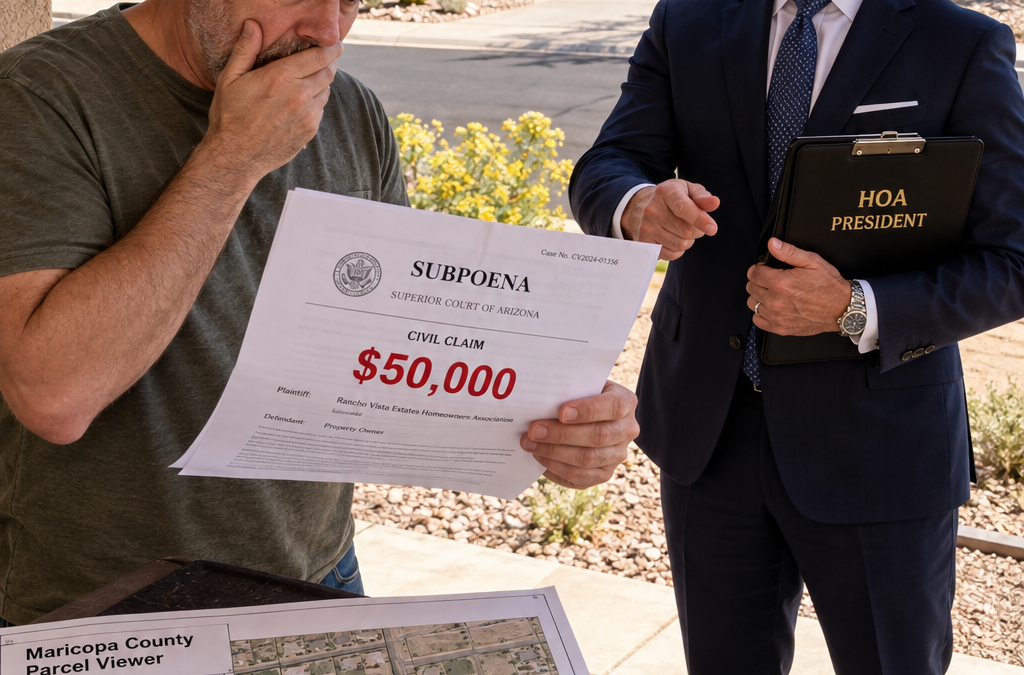
The subpoena arrived the following Tuesday.
Right next to my coffee.
Right where the morning should have been ordinary.
The number was printed in black ink on page two.
$50,000.
Damages.
Back fines.
Legal fees.
Alleged harm to community values.
I sat at my kitchen counter with the packet in front of me and felt my hands shake.
Not because Karen was right.
Because wrong people can still drag you into expensive rooms.
A lawsuit does not have to be valid to frighten you.
It just has to arrive.
That afternoon, I sat across from my attorney, David Morales, with the blue folder open between us and the county map spread across his conference table.
David was in his forties, calm, compact, and direct. He had the face of a man who had watched too many people confuse confidence with legality.
He read the complaint silently.
Then he read the boundary map.
Then he read my realtor’s emails.
Then he leaned back.
“She’s bluffing.”
My stomach tightened.
“She’s suing me for fifty thousand dollars.”
“Yes,” he said. “She’s bluffing with a badge.”
“That doesn’t sound comforting.”
“It’s not supposed to. It means she has used the appearance of authority long enough that people stop checking whether authority exists.”
I looked at the lawsuit.
“Can she win?”
“On these facts? She has a standing problem before we even reach the solar panels.”
“Standing problem?”
“She cannot fine property outside her jurisdiction. The HOA cannot enforce covenants against a parcel excluded from the recorded declaration.”
“And her own house?”
David almost smiled.
“That will be useful.”
I rubbed both hands over my face.
“I thought having the paperwork protected me.”
“It does,” he said. “But only if you’re willing to use it.”
So we used it.
David filed a response challenging the HOA’s standing and demanding dismissal.
Then he requested HOA financial records through discovery.
Karen fought for three straight weeks.
She delayed.
Objected.
Rescheduled.
Claimed records were privileged.
Claimed the requests were burdensome.
Claimed the financial materials had no relevance to my solar panels.
But discovery is a powerful thing when a bully has hidden too much behind official letterhead.
Then Mrs. Alvarez came forward publicly.
She called me one evening and asked if she could meet on my porch.
I found her standing outside my door holding a manila envelope against her chest.
Her hands trembled slightly, but her voice did not.
“You need this,” she said.
“What is it?”
“Something I should have given someone a long time ago.”
Inside were old bank statements, HOA meeting notes, copies of checks, and a handwritten timeline.
Karen had been collecting special landscaping reserve fees while quietly shifting money toward invoices from a contractor connected to her own private pool renovation.
Mrs. Alvarez had been HOA treasurer years before, back when Sunridge was less hostile and the board still functioned like a board. She had suspected something was wrong, but Karen pushed her out before she could finish tracing the accounts.
“I was afraid,” she said.
I looked up from the papers.
“She went after my son’s house first,” Mrs. Alvarez said quietly. “Fines. Notices. Threats. I backed down.”
I did not know what to say.
She looked toward the street.
“Don’t back down.”
That was the second twist.
Karen was not just overreaching on my solar panels.
She had been embezzling from the association for two years.
Bank statements eventually showed $14,000 funneled from HOA accounts into personal contractor invoices tied to her pool renovation.
Fourteen thousand dollars.
While she fined Mr. Davies over eleven minutes.
While she called the Ramirez family’s garden gnome noncompliant.
While she sued me for solar panels on land she did not control.
Suddenly, this was not about my roof anymore.
This was about a woman who had built her throne on stolen bricks.
The courtroom on judgment day was packed.
I expected a quiet hearing.
Instead, half of Sunridge seemed to show up.
Neighbors lined the benches, phones held low, pretending not to record. Mr. Davies sat near the aisle with both hands on his cane. The Ramirez family sat together in the second row. Mrs. Alvarez sat behind me, her envelope now replaced by a neat binder.
Karen arrived in a cream blazer, heels clicking against the floor, blond hair perfect, sunglasses nowhere to be seen.
For once, she had to face the room without them.
Her lawyer tried to argue first that Sunridge had design authority over visible rooflines, even outside technical boundaries, because community aesthetic impact crossed parcel lines.
The judge listened.
Then he asked for the recorded boundary map.
David handed it up.
The judge put on his glasses and read silently.
The room was so quiet I could hear paper shift.
Then he read part of it aloud.
“Excluded parcel — not subject to association covenants.”
Karen’s face tightened.
Her lawyer stood.
“Your Honor, the association’s position is that subsequent community reliance and shared visibility—”
The judge lifted one hand.
“Counsel, is there a recorded amendment including Mr. Johnson’s parcel in the association?”
“No, Your Honor, but—”
“Is there any document signed by Mr. Johnson accepting association obligations?”
“No, Your Honor.”
“Is there a covenant running with his land in favor of Sunridge Estates HOA?”
Her lawyer hesitated.
“No, Your Honor.”
The judge looked down at the complaint.
“Then we have a fundamental standing issue.”
David stood.
“Additionally, Your Honor, we have evidence the HOA president’s own property is similarly outside the recorded association boundary while she has held herself out as president and directed enforcement activity.”
A ripple moved through the room.
Karen turned red.
Her lawyer closed his eyes for half a second.
The judge’s expression did not change, but he looked directly at Karen.
“Mrs. Whitfield, is your residence within the recorded HOA boundary?”
Karen opened her mouth.
Nothing came out.
Her lawyer answered.
“We are reviewing that issue.”
The judge said, “I suspect you are.”
Then came the financial evidence.
David did not present it as the main argument for dismissal, but the judge had allowed limited discussion because Karen’s authority, standing, and credibility were central to the HOA’s claims.
Mrs. Alvarez’s records came in.
Bank statements.
Reserve transfers.
Contractor invoices.
Payments linked to Karen’s personal pool renovation.
The judge read enough aloud for the room to understand.
Karen’s polished smile finally cracked.
Not all at once.
First, her lips pressed together.
Then her jaw tightened.
Then the color drained from her face.
The judge dismissed every fine, every claim, every demand.
“The plaintiff lacks standing to fine or sue over a property outside its jurisdiction,” he said. “The claims are dismissed.”
I felt air leave my chest.
For weeks, I had carried that $50,000 number around like a stone in my ribs.
Now it was gone.
But the real fireworks came that afternoon.
The district attorney’s office announced a criminal investigation into HOA fund misappropriation.
Karen was removed from the board within the week.
Not asked to step aside.
Removed.
Her access to HOA accounts was frozen.
Her authority revoked.
Her emails preserved.
Her records subpoenaed.
The state association oversight office opened its own review, and because her conduct involved false enforcement, unauthorized fines, and alleged financial theft, she was banned from HOA leadership statewide pending further proceedings.
The embezzlement charges carried the possibility of real prison time.
Her real power disappeared faster than anyone expected.
For years, Karen had ruled Sunridge through fear, laminated notices, and the assumption that nobody would dig past her performance of authority.
Then a county map did what no neighbor had managed to do.
It drew a line she could not talk her way across.
I kept my solar panels.
I kept my house.
I kept my sanity, though that one took longer.
A week after the dismissal, Mrs. Alvarez brought tamales to my porch.
She handed me the foil-covered tray like we had won a war, which in a way, we had.
“They’re chicken,” she said. “Not too spicy.”
“Thank you.”
She looked up at my roof.
“They look good.”
“The panels?”
“Yes.”
I laughed. “Karen disagreed.”
“Karen disagreed with joy.”
We sat on the porch while the sun went down behind the rooftops and my meter quietly did its beautiful backward work.
Mr. Davies walked over with a six-pack of root beer.
The Ramirez kids came by to show me a photo of the garden gnome their parents had put back in the yard.
This time, it wore sunglasses.
For the first time since moving in, Larksburg Lane felt like a neighborhood instead of a surveillance zone.
People waved again.
Spoke again.
Compared notes again.
And that was the part Karen never understood.
Fear isolates people.
Evidence brings them back together.
The HOA hired an outside auditor.
Fines issued under Karen’s presidency were reviewed.
Several were reversed.
Residents received notices admitting improper enforcement.
The Ramirez family got their $400 back.
Mr. Davies got his trash-bin fine refunded with a written apology.
Mrs. Alvarez finally stopped blaming herself for staying quiet as long as she had.
Karen’s house went quiet.
No golf cart.
No clipboard.
No sunrise patrol.
No Facebook posts about hostile outsiders.
The woman who had built her identity on control found out control is not the same thing as authority.
Authority has documents.
Boundaries.
Signatures.
Jurisdiction.
And if you stand outside all of them, all the laminated notices in Arizona will not save you.
I still keep the blue folder.
It sits in my office beside the solar permit documents and the certified county map. Sometimes I look at it when my electric bill arrives and shows another month of savings.
That folder reminds me of a simple truth.
Paperwork only protects you if you know what it says.
Karen counted on people being too busy, too scared, or too embarrassed to check.
She counted on the Ramirez family paying.
She counted on Mr. Davies apologizing.
She counted on me removing my panels rather than facing court.
She counted on her title sounding bigger than the recorded boundary map.
She was wrong.
These days, my solar panels sit clean and dark against the roof, soaking up the same Arizona sun Karen tried to use against me.
The meter spins backward.
The house stays cool.
And every time I step onto my porch, I can still hear Mrs. Alvarez laughing softly over tamales, saying Karen Whitfield learned the hard way that laminated notices do not outrank county records.
She was right.
Karen thought she owned the neighborhood.
Turns out, she did not even legally belong to the one she was trying to rule.
𝗧𝗛𝗘 𝗘𝗡𝗗
The HOA President Put a $50,000 Price on My Roof Before the County Map Exposed Her
The subpoena landed on my porch beside my morning coffee, and the number printed on the first page made my hands shake. Fifty thousand dollars, all because Karen Whitfield decided my solar panels offended an HOA I had never legally belonged to.
My name is Johnson, and three months before that subpoena arrived, I was just a man trying to survive an Arizona summer without handing half my paycheck to the electric company.
That was all it was supposed to be.
Solar panels.
A practical decision.
A grown-up decision.
The kind of thing a homeowner does when the thermometer hits one hundred and fourteen degrees before lunch and the air conditioner runs like it’s trying to keep hell out of the living room.
I had bought my house on Larksburg Lane that spring, a small tan stucco place with a red tile roof, gravel landscaping, two stubborn mesquite trees, and a garage that still smelled faintly of sawdust from the previous owner’s workbench.
It sat at the end of a quiet cul-de-sac in a subdivision called Sunridge Estates.
Technically, it was near Sunridge Estates.
That distinction mattered.
My lot was the last parcel before the county line. When the neighborhood was originally mapped, my property had been grandfathered out of the Sunridge Estates Homeowners Association. It shared the road. It shared the general appearance. It shared the view of matching mailboxes and beige walls and tidy desert yards.
But legally, it was outside the HOA boundary.
My realtor told me that twice.
In writing.
She even sent me the parcel map before closing.
I remembered sitting at my kitchen table in my old apartment, looking at the email and thinking I had just hit the homeowner lottery. A house in a clean, quiet neighborhood without HOA control over my roof, driveway, paint, yard, mailbox, porch light, or whatever else bored people with clipboards liked to measure.
That paperwork made me feel protected.
Untouchable, even.
I had no idea how quickly a person like Karen Whitfield could make paperwork feel fragile.
Karen became HOA president about a month after I moved in.
Or maybe she had always been circling power and finally found the right chair empty. I did not follow board politics then. Why would I? I was not a member.
Still, everyone on Larksburg Lane knew her.
You could not miss Karen Whitfield.
She was in her late fifties, with stiff blond hair that never moved in the wind, oversized sunglasses pushed up on her head, and a clipboard always pressed against her chest like a badge. She drove through Sunridge in a white golf cart every morning, slow enough to inspect gravel color, porch pots, hose placement, and trash-bin shadows.
People made jokes at first.
“Here comes the queen.”
“Hide your gnomes.”
“Measure your cactus.”
But the jokes had a nervous edge.
Karen had already fined the Ramirez family four hundred dollars for a small garden gnome she called aesthetically non-compliant.
She fined old Mr. Davies for leaving his trash bin out eleven minutes past the posted retrieval window.
Eleven minutes.
The man was seventy-eight and moved with a cane.
Karen still wrote him up like he had committed treason.
I watched all that from the outside, half amused and half grateful.
Not my HOA, I kept telling myself.
Not my problem.
That kind of sentence always looks foolish in hindsight.
I installed the solar panels in June.
The crew arrived just after sunrise because by noon the roof would be hot enough to cook meat. They were efficient, polite, and very aware of the heat. By ten o’clock, the panels were lined across the rear-facing roof slope, angled cleanly, permitted properly, wired safely, inspected by the county, and ready for activation.
When the system came online, I stood in the garage staring at the monitoring app on my phone.
My meter slowed.
Then reversed.
I actually laughed.
In Arizona, watching your meter spin backward feels like getting revenge on the sun.
For the first time since buying the house, I felt like I had done something smart. Something responsible. Something that belonged to me.
Two weeks later, a laminated notice appeared on my front door.
Laminated.
Like Karen expected future historians to preserve it.
Unauthorized Exterior Modification — Solar Array.
Immediate Removal Required.
I stood on my porch reading it while heat shimmered over the street and cicadas buzzed in the mesquite trees.
Then I laughed out loud.
Not politely.
Not quietly.
A full laugh.
Because I was not in her HOA.
I had the parcel map.
I had the realtor’s email.
I had the closing documents.
What could she possibly do?
I called the HOA office that afternoon.
A woman named Carol answered in a voice already tired of life.
“Sunridge Estates Homeowners Association.”
“This is Johnson on Larksburg Lane. I got a violation notice about solar panels.”
“Address?”
I gave it.
Keyboard clicks.
A pause.
Then another pause.
“That property is listed as adjacent boundary.”
“Adjacent is not included.”
“I’ll need to transfer you.”
“To who?”
“One moment.”
Six minutes of hold music later, Karen Whitfield came on the line.
“Mr. Johnson,” she said.
Not hello.
Not how can I help you.
Just my name, delivered like she had already decided I was guilty.
“Karen, I received a notice claiming my solar panels are unauthorized.”
“That is correct.”
“My parcel is not part of the HOA.”
“Every roofline visible from Sunridge common areas falls under our design authority.”
Her voice was syrupy sweet, rehearsed smooth.
I looked at the email from my realtor open on my laptop.
“That’s not how property law works.”
“That is how our community standards work.”
“Show me the clause in writing.”
“I’ll get back to you.”
“When?”
“When the board completes review.”
“The board has no authority over my lot.”
“Mr. Johnson,” she said, voice cooling, “hostility will not help you.”
“I’m asking for the rule.”
“And I told you we will review it.”
She hung up.
She never sent the clause.
A week later, a letter arrived.
This one was not laminated.
It was printed on thick letterhead, signed by Karen, and written in the kind of language that tries to sound legal while hoping nobody notices it is mostly air.
The fine was $2,000.
Accruing daily interest.
Reason: noncompliance with community exterior standards.
I read the letter standing in my kitchen, the air conditioner humming overhead, sweat still drying on the back of my neck from checking the mail.
That was the moment I stopped laughing.
I started a folder.
A real one.
Not just a digital folder on my computer, though I had that too.
A physical folder, blue, with a label on the tab:
SUNRIDGE / KAREN / SOLAR.
Inside went everything.
The notice.
The fine letter.
My parcel map.
My realtor’s emails.
County inspection records.
Solar permits.
Phone call notes.
Dates.
Times.
Names.
I did not know yet that folder would become the most important object I owned.
Karen escalated quickly.
She posted my address on the community Facebook page.
Not my name at first.
Just the address.
Then a photo of my roof taken from across the street.
Her caption said:
Hostile adjacent property owner disregarding Sunridge values and visual harmony.
Visual harmony.
That phrase made me want to throw my phone across the room.
Neighbors who had waved at me for months suddenly got busy when I stepped outside. One man crossed the street instead of passing in front of my house. Someone left a comment calling me selfish. Another said people like me lowered property values.
People like me.
All because of solar panels on a roof outside their HOA.
That was when Mrs. Alvarez slipped the note under my door.
She lived two houses down, technically inside Sunridge. She was in her seventies, small but upright, with silver hair, careful lipstick, and the calm eyes of someone who had seen enough nonsense to recognize the dangerous kind early.
I found her note folded twice on my entry rug.
Don’t fight her alone. She’s done this before.
No signature.
She did not need one.
I looked through the front window and saw her curtains move slightly.
That note was the first crack in Karen’s perfect little kingdom.
I did not understand it yet.
The fines multiplied.
Four thousand.
Then six thousand.
Then a warning about a lien.
A lien on a property that was not even part of the association.
The audacity took my breath away.
I drove to the county recorder’s office the next morning.
The building was squat, beige, cold inside, and filled with people who looked like they were there for divorces, deeds, permits, or bad news. I waited almost forty minutes before a clerk directed me to a records terminal.
I searched Sunridge Estates.
Boundary map.
Amendments.
Filed plats.
Recorded declarations.
It took two hours, but I found it.
The original HOA boundary map filed in 2011.
My lot number was there.
Circled in red ink.
A handwritten note beside it said:
Excluded parcel — not subject to association covenants.
I stared at the screen.
Someone had known.
Years earlier, someone had already flagged my lot as excluded.
The HOA knew, or should have known, that it had no jurisdiction over my house.
I printed three certified copies.
Then I kept digging.
I do not know what made me search Karen’s address.
Maybe anger.
Maybe instinct.
Maybe the way bullies always seem to assume nobody will look back at them.
Her house sat on Desert Marigold Court, two lots beyond the same recorded HOA boundary.
I checked again.
Then again.
Karen Whitfield, queen of community standards, was not legally in her own HOA either.
I nearly spit out my coffee laughing in the records office parking lot.
But laughter did not pay legal fees.
And Karen’s lawyer filed suit anyway.
The subpoena arrived the following Tuesday.
Right next to my coffee.
Right where the morning should have been ordinary.
The number was printed in black ink on page two.
$50,000.
Damages.
Back fines.
Legal fees.
Alleged harm to community values.
I sat at my kitchen counter with the packet in front of me and felt my hands shake.
Not because Karen was right.
Because wrong people can still drag you into expensive rooms.
A lawsuit does not have to be valid to frighten you.
It just has to arrive.
That afternoon, I sat across from my attorney, David Morales, with the blue folder open between us and the county map spread across his conference table.
David was in his forties, calm, compact, and direct. He had the face of a man who had watched too many people confuse confidence with legality.
He read the complaint silently.
Then he read the boundary map.
Then he read my realtor’s emails.
Then he leaned back.
“She’s bluffing.”
My stomach tightened.
“She’s suing me for fifty thousand dollars.”
“Yes,” he said. “She’s bluffing with a badge.”
“That doesn’t sound comforting.”
“It’s not supposed to. It means she has used the appearance of authority long enough that people stop checking whether authority exists.”
I looked at the lawsuit.
“Can she win?”
“On these facts? She has a standing problem before we even reach the solar panels.”
“Standing problem?”
“She cannot fine property outside her jurisdiction. The HOA cannot enforce covenants against a parcel excluded from the recorded declaration.”
“And her own house?”
David almost smiled.
“That will be useful.”
I rubbed both hands over my face.
“I thought having the paperwork protected me.”
“It does,” he said. “But only if you’re willing to use it.”
So we used it.
David filed a response challenging the HOA’s standing and demanding dismissal.
Then he requested HOA financial records through discovery.
Karen fought for three straight weeks.
She delayed.
Objected.
Rescheduled.
Claimed records were privileged.
Claimed the requests were burdensome.
Claimed the financial materials had no relevance to my solar panels.
But discovery is a powerful thing when a bully has hidden too much behind official letterhead.
Then Mrs. Alvarez came forward publicly.
She called me one evening and asked if she could meet on my porch.
I found her standing outside my door holding a manila envelope against her chest.
Her hands trembled slightly, but her voice did not.
“You need this,” she said.
“What is it?”
“Something I should have given someone a long time ago.”
Inside were old bank statements, HOA meeting notes, copies of checks, and a handwritten timeline.
Karen had been collecting special landscaping reserve fees while quietly shifting money toward invoices from a contractor connected to her own private pool renovation.
Mrs. Alvarez had been HOA treasurer years before, back when Sunridge was less hostile and the board still functioned like a board. She had suspected something was wrong, but Karen pushed her out before she could finish tracing the accounts.
“I was afraid,” she said.
I looked up from the papers.
“She went after my son’s house first,” Mrs. Alvarez said quietly. “Fines. Notices. Threats. I backed down.”
I did not know what to say.
She looked toward the street.
“Don’t back down.”
That was the second twist.
Karen was not just overreaching on my solar panels.
She had been embezzling from the association for two years.
Bank statements eventually showed $14,000 funneled from HOA accounts into personal contractor invoices tied to her pool renovation.
Fourteen thousand dollars.
While she fined Mr. Davies over eleven minutes.
While she called the Ramirez family’s garden gnome noncompliant.
While she sued me for solar panels on land she did not control.
Suddenly, this was not about my roof anymore.
This was about a woman who had built her throne on stolen bricks.
The courtroom on judgment day was packed.
I expected a quiet hearing.
Instead, half of Sunridge seemed to show up.
Neighbors lined the benches, phones held low, pretending not to record. Mr. Davies sat near the aisle with both hands on his cane. The Ramirez family sat together in the second row. Mrs. Alvarez sat behind me, her envelope now replaced by a neat binder.
Karen arrived in a cream blazer, heels clicking against the floor, blond hair perfect, sunglasses nowhere to be seen.
For once, she had to face the room without them.
Her lawyer tried to argue first that Sunridge had design authority over visible rooflines, even outside technical boundaries, because community aesthetic impact crossed parcel lines.
The judge listened.
Then he asked for the recorded boundary map.
David handed it up.
The judge put on his glasses and read silently.
The room was so quiet I could hear paper shift.
Then he read part of it aloud.
“Excluded parcel — not subject to association covenants.”
Karen’s face tightened.
Her lawyer stood.
“Your Honor, the association’s position is that subsequent community reliance and shared visibility—”
The judge lifted one hand.
“Counsel, is there a recorded amendment including Mr. Johnson’s parcel in the association?”
“No, Your Honor, but—”
“Is there any document signed by Mr. Johnson accepting association obligations?”
“No, Your Honor.”
“Is there a covenant running with his land in favor of Sunridge Estates HOA?”
Her lawyer hesitated.
“No, Your Honor.”
The judge looked down at the complaint.
“Then we have a fundamental standing issue.”
David stood.
“Additionally, Your Honor, we have evidence the HOA president’s own property is similarly outside the recorded association boundary while she has held herself out as president and directed enforcement activity.”
A ripple moved through the room.
Karen turned red.
Her lawyer closed his eyes for half a second.
The judge’s expression did not change, but he looked directly at Karen.
“Mrs. Whitfield, is your residence within the recorded HOA boundary?”
Karen opened her mouth.
Nothing came out.
Her lawyer answered.
“We are reviewing that issue.”
The judge said, “I suspect you are.”
Then came the financial evidence.
David did not present it as the main argument for dismissal, but the judge had allowed limited discussion because Karen’s authority, standing, and credibility were central to the HOA’s claims.
Mrs. Alvarez’s records came in.
Bank statements.
Reserve transfers.
Contractor invoices.
Payments linked to Karen’s personal pool renovation.
The judge read enough aloud for the room to understand.
Karen’s polished smile finally cracked.
Not all at once.
First, her lips pressed together.
Then her jaw tightened.
Then the color drained from her face.
The judge dismissed every fine, every claim, every demand.
“The plaintiff lacks standing to fine or sue over a property outside its jurisdiction,” he said. “The claims are dismissed.”
I felt air leave my chest.
For weeks, I had carried that $50,000 number around like a stone in my ribs.
Now it was gone.
But the real fireworks came that afternoon.
The district attorney’s office announced a criminal investigation into HOA fund misappropriation.
Karen was removed from the board within the week.
Not asked to step aside.
Removed.
Her access to HOA accounts was frozen.
Her authority revoked.
Her emails preserved.
Her records subpoenaed.
The state association oversight office opened its own review, and because her conduct involved false enforcement, unauthorized fines, and alleged financial theft, she was banned from HOA leadership statewide pending further proceedings.
The embezzlement charges carried the possibility of real prison time.
Her real power disappeared faster than anyone expected.
For years, Karen had ruled Sunridge through fear, laminated notices, and the assumption that nobody would dig past her performance of authority.
Then a county map did what no neighbor had managed to do.
It drew a line she could not talk her way across.
I kept my solar panels.
I kept my house.
I kept my sanity, though that one took longer.
A week after the dismissal, Mrs. Alvarez brought tamales to my porch.
She handed me the foil-covered tray like we had won a war, which in a way, we had.
“They’re chicken,” she said. “Not too spicy.”
“Thank you.”
She looked up at my roof.
“They look good.”
“The panels?”
“Yes.”
I laughed. “Karen disagreed.”
“Karen disagreed with joy.”
We sat on the porch while the sun went down behind the rooftops and my meter quietly did its beautiful backward work.
Mr. Davies walked over with a six-pack of root beer.
The Ramirez kids came by to show me a photo of the garden gnome their parents had put back in the yard.
This time, it wore sunglasses.
For the first time since moving in, Larksburg Lane felt like a neighborhood instead of a surveillance zone.
People waved again.
Spoke again.
Compared notes again.
And that was the part Karen never understood.
Fear isolates people.
Evidence brings them back together.
The HOA hired an outside auditor.
Fines issued under Karen’s presidency were reviewed.
Several were reversed.
Residents received notices admitting improper enforcement.
The Ramirez family got their $400 back.
Mr. Davies got his trash-bin fine refunded with a written apology.
Mrs. Alvarez finally stopped blaming herself for staying quiet as long as she had.
Karen’s house went quiet.
No golf cart.
No clipboard.
No sunrise patrol.
No Facebook posts about hostile outsiders.
The woman who had built her identity on control found out control is not the same thing as authority.
Authority has documents.
Boundaries.
Signatures.
Jurisdiction.
And if you stand outside all of them, all the laminated notices in Arizona will not save you.
I still keep the blue folder.
It sits in my office beside the solar permit documents and the certified county map. Sometimes I look at it when my electric bill arrives and shows another month of savings.
That folder reminds me of a simple truth.
Paperwork only protects you if you know what it says.
Karen counted on people being too busy, too scared, or too embarrassed to check.
She counted on the Ramirez family paying.
She counted on Mr. Davies apologizing.
She counted on me removing my panels rather than facing court.
She counted on her title sounding bigger than the recorded boundary map.
She was wrong.
These days, my solar panels sit clean and dark against the roof, soaking up the same Arizona sun Karen tried to use against me.
The meter spins backward.
The house stays cool.
And every time I step onto my porch, I can still hear Mrs. Alvarez laughing softly over tamales, saying Karen Whitfield learned the hard way that laminated notices do not outrank county records.
She was right.
Karen thought she owned the neighborhood.
Turns out, she did not even legally belong to the one she was trying to rule.








