𝗣𝗔𝗥𝗧 𝟮 The HOA President Put a $25,000 Lien on My House, but the Three Missing Oak Trees Exposed What She Really Wanted
𝗣𝗔𝗥𝗧 𝟮
A few people shifted in their chairs.
Barbara’s smile cooled.
“Are you accusing this board of misconduct?”
“I’m asking where the rule is.”
“It is in the standards.”
“Can you show me?”
She tapped the laminated rulebook.
“The board does not conduct document review on demand during meetings.”
I stared at her.
“Then when?”
“You may submit a written request.”
“I did.”
“Then you will receive a response in the appropriate order.”
I looked around the room.
No one would meet my eyes except Priya Singh, my neighbor over the back fence. She gave me the smallest shake of her head.
Stop pushing, it said.
I sat down.
The next morning, Priya appeared by the fence with a mug of coffee.
“She’s not done,” she said.
I was tightening a loose screw on the gate hinge.
“Good morning to you too.”
“I mean it, Daniel.”
“I asked a question.”
“That’s how it starts.”
I stood.
Priya lived behind me, diagonally across the property line. She was a systems analyst, sharp as a tack, and usually two steps ahead of whatever the rest of us were just beginning to understand.
“She never picks one house and stops,” she said.
“You make her sound like a storm system.”
“No. Storms leave.”
I looked toward Barbara’s house at the end of the cul-de-sac.
“What happened last time?”
Priya held the mug tighter.
“The Maddox family. Before that, the Ellis couple. Before that, Mr. Chan.”
“What did they do?”
“They argued.”
“That’s it?”
“They challenged her authority.”
I almost laughed, but her face stopped me.
“And?”
“They paid until they couldn’t. Then they sold or settled or disappeared from meetings.”
I frowned.
“I’m not selling my house because Barbara Kesler doesn’t like my mailbox.”
“I hope not.”
Priya took a sip of coffee.
“But start keeping records.”
That was the best advice anyone gave me.
I began saving everything.
Every notice.
Every envelope.
Every email.
Every photo of my yard after mowing.
Every receipt showing repairs.
Every timestamp.
I created a folder on my computer and a physical binder in the kitchen drawer. Marisol would have approved. She had always believed paperwork was self-defense for ordinary people.
At first, I felt silly.
Then Barbara fined me for a trash can.
The notice said my trash bin was left visible after 6:00 p.m. on a Sunday.
The fine was two hundred and fifty dollars.
I laughed out loud in my kitchen because that Sunday, I had been at church.
Not just briefly.
All afternoon.
There had been a luncheon after service, and I had helped carry folding tables into the parish hall. At least twenty people could place me there.
My trash can, meanwhile, had been behind the fence. I knew because my doorbell camera caught me moving it there before I left.
Sloppy.
Careless.
Arrogant.
That was the first time Barbara’s confidence started to look less like authority and more like exposure waiting to happen.
Funny thing about arrogance.
It leaves fingerprints.
I bought a forty-dollar trail camera online.
It was meant for deer hunting, but I pointed it at my own yard, angled toward the side fence and the stretch of lawn Barbara kept photographing. I mounted it low under a shrub where it would blend into the mulch.
Within a month, I had proof.
Barbara Kesler walking my property line after midnight.
Not once.
Four times.
The camera captured her in a dark jacket, flashlight in one hand, phone in the other, stepping carefully along the fence like a woman inspecting stolen goods. She bent near the pickets, took photos, walked toward the oaks, then crouched near the old survey marker behind the middle tree.
At 12:43 a.m., on the clearest clip, she looked over her shoulder, then used her foot to push leaves away from the marker.
The next day, I received a new violation.
Structural encroachment and unauthorized boundary obstruction.
I read the notice twice.
It claimed my fence and three mature oak trees violated a setback line along the shared property boundary.
The three oaks.
Trees I had not planted.
Trees I had not moved.
Trees that had stood there since 1998, older than half the subdivision’s current residents and older than my daughter.
The notice gave me ten days to correct the violation.
I emailed immediately.
Those trees were planted by the original developer and have been part of the property line for decades. Please provide the survey or document supporting your claim.
Barbara replied with one sentence.
The board has verified the encroachment.
No survey.
No document.
No explanation.
Just the board.
Which, in Barbara’s world, usually meant Barbara.
Two days later, I came home from work and found the oaks reduced to stumps.
All three of them.
Cut clean.
Sawdust scattered across the grass.
Branches gone.
Shade gone.
Birds gone.
The backyard looked naked.
For a moment, I could not move.
I stood by the gate with my work bag still over my shoulder, staring at the stumps as if my brain refused to accept that something alive that large could disappear between morning and evening.
Then my hands started shaking.
Not from fear.
From rage.
Those trees had shaded Elena’s graduation party. They had held Marisol’s wind lanterns the last summer she was healthy. They had dropped leaves I complained about every fall and secretly loved because it meant the yard was still doing what yards do.
Barbara had turned them into stumps.
I dialed 911.
The responding officer was polite but cautious. Property disputes involving HOAs have a way of making everyone sound both furious and boring.
I showed him the stumps, the sawdust, the notice, the emails, and the trail camera footage of Barbara walking the line at night.
He stopped being bored.
“You didn’t authorize removal?”
“No.”
“No contractor contacted you?”
“No.”
“Do you know who cut them?”
“I know who wanted them gone.”
He looked at the stumps.
“We’ll document this.”
The county arborist came the next morning.
He was an older man named Wilkes with sunburned ears and a voice that made every sentence sound like bad news.
He inspected the stumps, measured trunk diameter, examined root damage, reviewed the location, and took photos.
“These were healthy mature oaks,” he said.
“I know.”
“Root systems destroyed. Canopy loss substantial.”
He looked toward Barbara’s yard.
“Who ordered this?”
“That’s what I’m trying to prove.”
He wrote in his notebook.
“Replacement value plus canopy loss and related damages, you’re looking at nearly nineteen thousand dollars in tree value alone.”
I stared at him.
“Nineteen thousand?”
“Maybe more if your attorney knows what she’s doing.”
I didn’t have an attorney yet.
By that afternoon, I did.
Her name was Grace Okafor.
She had an office in Atlanta but handled real estate and HOA disputes across the state. Priya had found her through a professional contact and practically ordered me to call.
Grace was direct, calm, and had the kind of expression that made you want to organize your evidence before she asked.
I brought everything.
The fines.
The trash can proof.
The trail camera footage.
The tree notice.
The police report.
The arborist’s preliminary valuation.
The photos of the stumps.
Grace reviewed it all silently.
Then she reached the work order I had obtained from a contractor who had seen the crew cutting the trees. It had Barbara’s signature on it.
One signature.
No committee approval.
No board vote.
No homeowner consent.
Just Barbara Kesler, HOA president, authorizing tree removal along my property line.
Grace stared at it for three seconds.
Then she laughed.
Not kindly.
Not because anything was funny.
Because Barbara had made a mistake so obvious it was almost insulting.
“She just handed you her own conviction,” Grace said.
I leaned forward.
“What?”
Grace turned the document around and tapped the signature.
“Your HOA charter likely has procedure requirements for property alteration, especially anything affecting private property, common areas, trees, or boundary structures. Did you bring the full charter?”
I handed it over.
I had read parts of it before, but not all of it. That night after the trees were cut, unable to sleep, I had gone through the entire thing cover to cover.
Buried on page forty-one was the clause that made my pulse jump.
Any board member ordering, authorizing, or executing property alteration without a documented five-person committee vote and written notice to affected owners shall be personally financially liable for resulting damages.
I had highlighted it.
Grace read it and smiled.
“There it is.”
“She signed alone,” I said.
“Yes.”
“No committee.”
“Yes.”
“No vote.”
“Yes.”
“No notice.”
Grace closed the folder.
“Then we start today.”
We filed for a restraining order against further HOA action.
Then a civil suit for trespass, property destruction, breach of fiduciary duty, malicious enforcement, and damages related to the trees. Grace also sent a preservation letter demanding all HOA records, communications, work orders, contractor payments, inspection reports, and board minutes involving my property.
Barbara responded the way people like Barbara always respond when control begins slipping.
She escalated and called it procedure.
Two days later, the lien notice appeared on my door.
Twenty-five thousand dollars.
Over fines, fees, and “structural compliance costs.”
She was trying to bury me before the court could stop her.
But this time, she miscalculated.
The local news picked up the story.
I still don’t know who called Channel 9. Grace claimed she didn’t. Priya smiled too innocently when I asked. Either way, a reporter named Kelly Barnes stood in front of my stumps that Friday evening while a camera operator filmed my backyard.
The headline ran at six.
HOA President Accused of Destroying Neighbor’s Trees to Expand Own Backyard.
By nine, my phone would not stop buzzing.
Neighbors texted.
Old acquaintances messaged.
People from other subdivisions commented online with their own HOA horror stories.
Barbara issued a statement calling the report misleading.
Then the second wave hit.
Other residents came forward.
Six families.
Six different stories.
Six sets of fines, threats, and suspicious “boundary corrections.”
All connected to properties bordering Barbara’s own lot or the narrow strip of land behind it.
That was the real twist.
I wasn’t her first target.
I was just the first one who fought back with a trail camera instead of a checkbook.
Grace mapped the affected properties.
When she laid the map across her conference table, the pattern was obvious enough to make my skin crawl.
Barbara’s backyard sat cramped between two lots, hemmed in by old developer setbacks and a drainage easement. For years, she had wanted to install a pool. The board had denied her application twice because her available yard space did not meet setback requirements.
But if my property line shifted by eleven feet, and if the Henderson boundary shifted slightly too, Barbara would have enough space.
Eleven feet.
That was what this was about.
Not harmony standards.
Not fence pickets.
Not trees.
Eleven feet of my land so Barbara Kesler could have a pool.
She had not been enforcing rules.
She had been rezoning my yard for herself, one manufactured violation at a time.
I confronted her once before the emergency board meeting.
It happened at the mailbox kiosk.
She was collecting her mail in oversized sunglasses, dressed in white linen like a woman on vacation from accountability.
I walked up slowly.
“Barbara.”
She turned.
“Daniel.”
“I know about the pool.”
Her expression did not change.
But her hand paused inside the mailbox.
“I have no idea what you’re talking about.”
“The boundary complaints. The oak trees. The setback notice.”
She closed the mailbox.
“You’re upset. I understand that.”
“You destroyed three mature trees on my property.”
“The association addressed a structural encroachment.”
“No, Barbara. You tried to steal eleven feet.”
Her smile appeared.
That polished HOA newsletter smile.
“Boundaries are flexible, Daniel.”
I stared at her.
There it was.
Not a denial.
Not surprise.
A philosophy.
Boundaries are flexible.
I thought about the stumps.
About my daughter playing beneath those trees.
About Marisol’s lanterns.
About twenty-five thousand dollars taped to my door like I had done something wrong.
“No,” I said. “They’re not.”
I walked away before my anger made me useful to her.
The emergency board meeting took place five days after the news story aired.
The clubhouse was packed wall to wall. Folding chairs filled the room, people stood along the walls, and someone had opened the back doors because the air conditioning couldn’t keep up.
Barbara sat at the front table.
For once, she did not look untouchable.
She still wore pearls. Still had the perfect hair. Still had her laminated rulebook. But her face was tight, and she kept glancing toward the entrance as if expecting someone worse than angry neighbors to walk through it.
Grace sat beside me.
Priya sat behind us with a folder.
The meeting started badly for Barbara and worsened from there.
She tried her old trick first.
Miscommunication with contractors.
Complex setback issues.
Board discretion.
Unfortunate but necessary enforcement action.
No one bought it.
Not after the news story.
Not after the photos of the stumps.
Not after six other residents had compared notes in a group chat that now had more documents than a small lawsuit.
Then Priya stood.
“I have text messages.”
Barbara looked sharply at her.
“What text messages?”
Priya lifted her phone.
“Messages from your brother-in-law.”
The room shifted.
Barbara’s brother-in-law, a man named Travis, had been the one who cut my trees. He was not licensed for that work. He had been paid cash. And apparently, he had not been paid in full.
Angry people leak things.
Travis had leaked everything.
Priya read aloud.
Barbara telling him which trees to cut.
Barbara telling him not to pull permits.
Barbara saying, “Daniel won’t fight once the lien lands.”
Barbara promising the rest of the cash after “the boundary issue is resolved.”
Barbara referring to “pool clearance.”
That phrase did it.
Pool clearance.
The room erupted.
Barbara struck the table with her palm.
“These messages are taken out of context.”
Grace stood.
“What context makes unauthorized tree removal and cash payment appropriate?”
Barbara glared at her.
“You’re not a member.”
“No,” Grace said. “I’m counsel for the homeowner whose property your client destroyed.”
The HOA board members looked like people realizing they were standing on a collapsing bridge.
The insurance representative sat in the back row, silent, taking notes. The HOA’s insurance company had already begun distancing itself from Barbara’s actions, especially once the story gained attention beyond local news. No insurer wanted to defend a board president accused of cutting a neighbor’s trees to expand her own yard.
One board member, a retired teacher named Mrs. Bell, finally spoke.
“Barbara, did you authorize that work without a committee vote?”
Barbara lifted her chin.
“I acted under emergency authority.”
“What emergency?”
“The encroachment.”
Mrs. Bell looked at me.
“Those trees had been there since 1998.”
Barbara’s mouth tightened.
“The age of a violation does not erase the violation.”
Grace placed the developer landscaping documents on the table.
“They were original developer plantings.”
Silence.
Then the Hendersons stood from the back row.
Mr. Henderson held up a survey.
“And they were on Daniel’s side of the line.”
Barbara looked at him like betrayal itself had entered the room.
Mrs. Bell turned to the other board members.
“I move to remove Barbara Kesler as HOA president immediately and suspend all enforcement actions connected to her pending investigation.”
Another board member seconded before Barbara could speak.
The vote was seven to zero.
Barbara sat motionless.
For years, she had weaponized every HOA privilege available to her. The rulebook, the notices, the fines, the meetings, the fear, the way people avoided her eyes.
All of it vanished in one vote.
She gathered her papers slowly.
Her hands trembled.
No one helped her.
Court moved faster than I expected.
The judge had little patience for Barbara’s explanations.
Grace presented the charter clause, the work order, the lack of committee vote, the lack of notice, the arborist valuation, the survey, the contractor texts, the trail camera footage, and the lien notice filed after legal action began.
Barbara’s attorney tried to frame it as an unfortunate governance mistake.
The judge did not look persuaded.
“Cutting down three mature trees on another person’s property without notice is not governance,” she said. “It is destruction.”
I was awarded the full twenty-five thousand dollars in tree replacement and related damages, plus legal fees and punitive damages for malicious property destruction.
When the judge said punitive damages, Barbara closed her eyes.
I thought I would feel triumphant.
I didn’t.
I thought about the trees.
I would have traded every dollar to have them standing again.
But courtrooms cannot resurrect oaks.
They can only assign value to what someone destroyed.
Barbara faced more than my lawsuit.
A separate criminal referral followed for unpermitted contractor work, falsifying HOA financial records, and possible fraud connected to the cash payment.
Then auditors found the third twist.
Nearly forty thousand dollars in landscaping reserves had been quietly funneled to Travis’s LLC over three years.
Some invoices were vague.
Some duplicated work already billed by legitimate vendors.
Some referenced projects no one could locate.
Barbara’s pool project, my trees, the boundary complaints, the old fines against other residents—all of it became part of a larger investigation into how she had used HOA authority to enrich her family and advance her own property interests.
The woman who once threatened my home over fence pickets ended up with a lawsuit judgment, embezzlement charges, and a for-sale sign on her own lawn.
The day that sign went up, I passed her house slowly.
Not to gloat.
At least, that’s what I told myself.
The yard looked smaller than I remembered.
No pool.
No extra eleven feet.
No queen of Magnolia Court standing in the driveway with a clipboard.
Just a house under pressure.
I thought about how many people had driven past my home while I was afraid and never known what was happening inside.
Then I kept driving.
Spring came quietly.
I planted three new oaks on the original line.
Not saplings so small they would vanish in the grass, but young trees with enough height and presence to feel like a promise. Elena came home for the weekend and helped me plant them.
She stood beside the middle tree, pressing soil around the base with her hands.
“Mom would have liked this,” she said.
My throat tightened.
“She loved the old ones.”
“I know.”
We worked in silence for a while.
Then she looked toward Barbara’s old house.
“Do you hate her?”
I thought about it.
“Yes,” I said honestly. “Some days.”
Elena nodded.
“Fair.”
“But not enough to let her keep living in my head.”
She smiled.
“That sounds like Dad trying to sound wise.”
“It happens occasionally.”
We watered the new trees until the soil darkened around the roots.
Then I took the fresh property survey Grace had ordered and carried it into the garage. I laminated a copy and framed it above my workbench.
Elena laughed when she saw it.
“You framed a survey?”
“Absolutely.”
“That’s the most homeowner thing you’ve ever done.”
“If anyone asks where the line is, I’m charging admission.”
She shook her head, smiling.
But I saw her touch the frame later when she thought I wasn’t looking.
Magnolia Court is quiet again now.
But it is not the old quiet.
The old quiet was fear covered with politeness. Neighbors lowering their voices near fences. People paying fines they knew were wrong because fighting seemed too expensive. Families leaving rather than challenging a woman who treated the HOA like a private court.
The new quiet is different.
People attend meetings.
They ask for documents.
The new board posts minutes on time.
No single officer can issue a fine without review.
No property alteration can happen without written notice, documented votes, and owner acknowledgment.
And Barbara’s laminated rulebook became a joke so common that someone dressed as it for Halloween.
I still miss the oaks.
In the afternoon, the backyard gets too much sun now. The birds have not fully returned. The stumps are gone, but sometimes I still look at the line where the shadows used to fall.
Loss leaves shapes.
Even when justice comes.
But the new trees are growing.
Slowly.
Stubbornly.
Exactly where they belong.
Priya still comes to the fence with coffee.
One morning she looked at the young oaks and said, “They’re doing well.”
“They’re trying.”
“So are you.”
I glanced at her.
She shrugged.
“What? Too sentimental?”
“A little.”
“Fine. Your survey frame is ridiculous.”
“That’s better.”
We laughed.
Across the cul-de-sac, someone started a mower.
A dog barked.
A minivan door slammed.
Ordinary sounds.
Good sounds.
The kind you don’t appreciate until your home stops feeling safe.
Barbara Kesler mailed me a lien notice on a Tuesday and tried to make me believe she had the power to take everything I had built.
She was wrong.
She had a rulebook.
I had records.
She had a title.
I had a survey.
She had fear.
I had neighbors who finally stopped whispering.
And when the truth came out, all her authority collapsed into what it had always been: paperwork, arrogance, and theft dressed up as community standards.
Last week, I stood in my backyard at sunset, watering the three new oaks.
The light came through their young leaves, thin but bright.
I thought about Marisol’s lanterns.
Elena’s graduation party.
The sound of chainsaws.
The judge’s voice.
Barbara’s face when the board voted her out.
All of it was still there somewhere inside me.
But it no longer owned the yard.
The trees did.
The line did.
The truth did.
Magnolia Court is quiet again.
This time, it is the quiet of people who know their rights.
And that feels like winning.
𝗧𝗛𝗘 𝗘𝗡𝗗
The HOA President Put a $25,000 Lien on My House, but the Three Missing Oak Trees Exposed What She Really Wanted
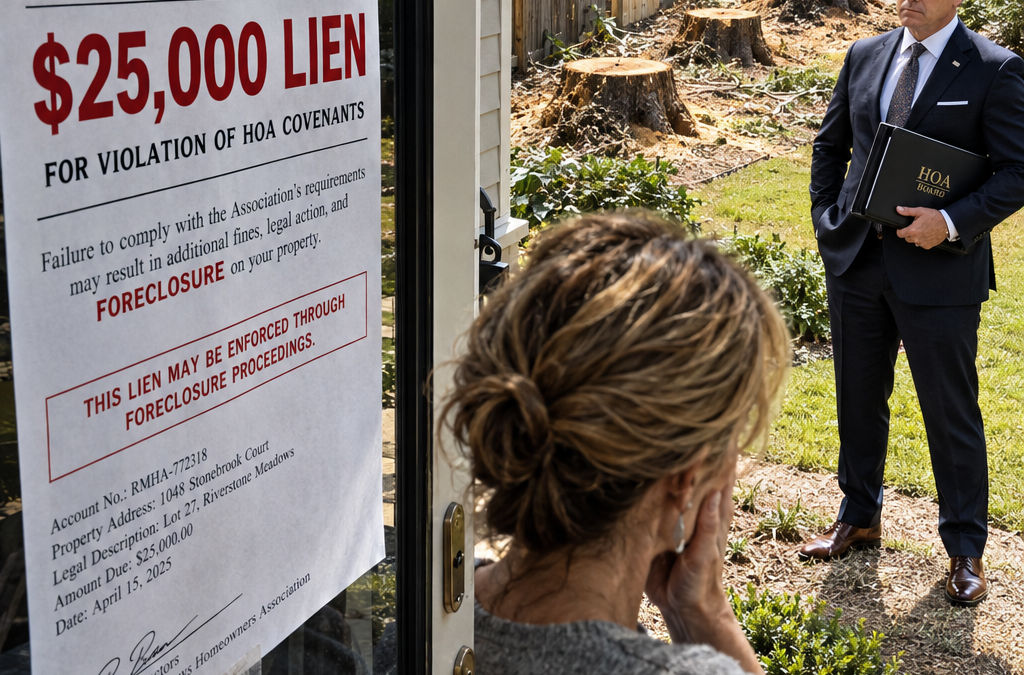
The lien notice was taped to my front door on a Tuesday afternoon, flat against the glass like an eviction warning, and for a few seconds I could not understand how three fence pickets had turned into a twenty-five-thousand-dollar threat against the house I had paid for eleven years straight.
My name is Daniel Reyes.
I live on Magnolia Court in suburban Georgia, in a cul-de-sac so quiet you can hear garage doors opening three houses away. It is the kind of street where flags hang from porches, kids leave bicycles on driveways, and neighbors pretend they are not looking through blinds whenever anything dramatic happens.
For eleven years, nothing dramatic had happened to me there.
I paid my mortgage.
I paid my HOA dues.
I mowed the lawn every Saturday unless it rained.
I kept the bushes trimmed, the gutters clean, the trash cans hidden, and the garage door closed because that was apparently important to the general survival of civilization.
My wife passed away five years before all this started, and Magnolia Court became the place where I learned how to live quietly with her absence. Our daughter, Elena, was already in college by then, and the house felt too large at first. But it was ours. Every room carried a memory. Every repair I made felt like keeping a promise.
So when I found that lien notice on the door, my first thought was not about money.
It was about losing the last place where my family still felt whole.
The paper said I owed the Maple Hollow Homeowners Association twenty-five thousand dollars in accumulated penalties, administrative fees, legal preparation costs, and structural compliance charges.
Twenty-five thousand dollars.
Over violations I had either already disputed, never received proper notice for, or could prove were complete nonsense.
At the bottom, in bold type, was the phrase that made my stomach drop.
Failure to satisfy this balance may result in foreclosure action.
I stood on the porch holding the notice while my hands shook so badly the paper rattled.
Across the street, Mrs. Whitaker was watering her begonias.
Two houses down, a delivery truck idled by the curb.
Everything around me looked normal.
That was the worst part.
The world had not changed, but mine had.
And the signature at the bottom told me exactly who had done it.
Barbara Kesler.
HOA president.
Queen of Magnolia Court.
Sheriff of the cul-de-sac.
A woman with a laminated rulebook and the kind of smile people wear when they are already imagining your apology.
Barbara had run our HOA board for years, and everybody knew better than to cross her.
She was in her early sixties, always perfectly dressed, always carrying a binder, always speaking as if the entire neighborhood existed because she personally allowed it. Her silver hair never moved, even in wind. Her lipstick was always red. Her sunglasses sat low on her nose during inspections, giving her the look of a judge who had already decided guilt before hearing evidence.
She called it leadership.
Most of us called it surviving Barbara.
Before she targeted me, I had considered her irritating but manageable. She sent too many reminders. She loved meetings too much. She corrected people’s mailbox numbers and grass height and wreath sizes like she was protecting national security.
But I had never been on the wrong side of her attention.
Then three fence pickets faded.
That was where it started.
The fence along the left side of my backyard had been there since before I bought the house. It separated my yard from the Henderson property and ran beneath three mature oak trees planted by the original developer in 1998. Those trees were part of the reason I loved the backyard. They threw shade across the grass in the afternoon, dropped acorns every fall, and held birds that woke me before sunrise.
The fence was aging, sure. A few pickets near the middle had weathered faster than the rest. I had already planned to replace them that weekend.
Barbara beat me to it.
The first notice arrived in my mailbox on a Thursday.
Fence surface inconsistency. Three visible pickets not in harmony with approved community appearance standards. Two hundred dollars.
I read it standing beside the mailbox kiosk and actually smiled.
Two hundred dollars over three faded pickets.
I thought it was absurd, but not dangerous.
That was my first mistake.
A few days later, I replaced the pickets, took pictures, and emailed the HOA.
Barbara replied within an hour.
Thank you for the attempted correction. Fine remains due because the violation existed at time of inspection.
Attempted correction.
That phrase bothered me more than the fine.
The pickets were replaced. The fence looked fine. There was nothing attempted about it.
Still, I paid.
I told myself two hundred dollars was cheaper than a fight.
A week later, the mailbox letter came.
Wrong shade of black.
I wish I were making that up.
Barbara claimed my mailbox did not match approved Maple Hollow standards. The problem was I had bought it from the exact same catalog the HOA had recommended years earlier. I still had the receipt, tucked in a folder with old house documents because my late wife, Marisol, never threw away anything related to warranties, tax deductions, or paint colors.
Barbara did not care.
Three hundred dollars.
Then my lawn.
Apparently two inches too tall, according to a rule nobody could find in writing.
I checked the bylaws. The landscaping section said lawns must be “neatly maintained.” No measurement. No inch requirement. No schedule. No definition of too tall.
At the next HOA meeting, I asked about it.
Barbara sat at the front table with her laminated copy of the community guidelines, a floral blazer buttoned at the neck, and a little smile that told me she had been waiting.
“Daniel,” she said, as if addressing a misbehaving child. “The board has discretion to interpret maintenance standards.”
“Discretion means judgment,” I said. “Not making up measurements.”
A few people shifted in their chairs.
Barbara’s smile cooled.
“Are you accusing this board of misconduct?”
“I’m asking where the rule is.”
“It is in the standards.”
“Can you show me?”
She tapped the laminated rulebook.
“The board does not conduct document review on demand during meetings.”
I stared at her.
“Then when?”
“You may submit a written request.”
“I did.”
“Then you will receive a response in the appropriate order.”
I looked around the room.
No one would meet my eyes except Priya Singh, my neighbor over the back fence. She gave me the smallest shake of her head.
Stop pushing, it said.
I sat down.
The next morning, Priya appeared by the fence with a mug of coffee.
“She’s not done,” she said.
I was tightening a loose screw on the gate hinge.
“Good morning to you too.”
“I mean it, Daniel.”
“I asked a question.”
“That’s how it starts.”
I stood.
Priya lived behind me, diagonally across the property line. She was a systems analyst, sharp as a tack, and usually two steps ahead of whatever the rest of us were just beginning to understand.
“She never picks one house and stops,” she said.
“You make her sound like a storm system.”
“No. Storms leave.”
I looked toward Barbara’s house at the end of the cul-de-sac.
“What happened last time?”
Priya held the mug tighter.
“The Maddox family. Before that, the Ellis couple. Before that, Mr. Chan.”
“What did they do?”
“They argued.”
“That’s it?”
“They challenged her authority.”
I almost laughed, but her face stopped me.
“And?”
“They paid until they couldn’t. Then they sold or settled or disappeared from meetings.”
I frowned.
“I’m not selling my house because Barbara Kesler doesn’t like my mailbox.”
“I hope not.”
Priya took a sip of coffee.
“But start keeping records.”
That was the best advice anyone gave me.
I began saving everything.
Every notice.
Every envelope.
Every email.
Every photo of my yard after mowing.
Every receipt showing repairs.
Every timestamp.
I created a folder on my computer and a physical binder in the kitchen drawer. Marisol would have approved. She had always believed paperwork was self-defense for ordinary people.
At first, I felt silly.
Then Barbara fined me for a trash can.
The notice said my trash bin was left visible after 6:00 p.m. on a Sunday.
The fine was two hundred and fifty dollars.
I laughed out loud in my kitchen because that Sunday, I had been at church.
Not just briefly.
All afternoon.
There had been a luncheon after service, and I had helped carry folding tables into the parish hall. At least twenty people could place me there.
My trash can, meanwhile, had been behind the fence. I knew because my doorbell camera caught me moving it there before I left.
Sloppy.
Careless.
Arrogant.
That was the first time Barbara’s confidence started to look less like authority and more like exposure waiting to happen.
Funny thing about arrogance.
It leaves fingerprints.
I bought a forty-dollar trail camera online.
It was meant for deer hunting, but I pointed it at my own yard, angled toward the side fence and the stretch of lawn Barbara kept photographing. I mounted it low under a shrub where it would blend into the mulch.
Within a month, I had proof.
Barbara Kesler walking my property line after midnight.
Not once.
Four times.
The camera captured her in a dark jacket, flashlight in one hand, phone in the other, stepping carefully along the fence like a woman inspecting stolen goods. She bent near the pickets, took photos, walked toward the oaks, then crouched near the old survey marker behind the middle tree.
At 12:43 a.m., on the clearest clip, she looked over her shoulder, then used her foot to push leaves away from the marker.
The next day, I received a new violation.
Structural encroachment and unauthorized boundary obstruction.
I read the notice twice.
It claimed my fence and three mature oak trees violated a setback line along the shared property boundary.
The three oaks.
Trees I had not planted.
Trees I had not moved.
Trees that had stood there since 1998, older than half the subdivision’s current residents and older than my daughter.
The notice gave me ten days to correct the violation.
I emailed immediately.
Those trees were planted by the original developer and have been part of the property line for decades. Please provide the survey or document supporting your claim.
Barbara replied with one sentence.
The board has verified the encroachment.
No survey.
No document.
No explanation.
Just the board.
Which, in Barbara’s world, usually meant Barbara.
Two days later, I came home from work and found the oaks reduced to stumps.
All three of them.
Cut clean.
Sawdust scattered across the grass.
Branches gone.
Shade gone.
Birds gone.
The backyard looked naked.
For a moment, I could not move.
I stood by the gate with my work bag still over my shoulder, staring at the stumps as if my brain refused to accept that something alive that large could disappear between morning and evening.
Then my hands started shaking.
Not from fear.
From rage.
Those trees had shaded Elena’s graduation party. They had held Marisol’s wind lanterns the last summer she was healthy. They had dropped leaves I complained about every fall and secretly loved because it meant the yard was still doing what yards do.
Barbara had turned them into stumps.
I dialed 911.
The responding officer was polite but cautious. Property disputes involving HOAs have a way of making everyone sound both furious and boring.
I showed him the stumps, the sawdust, the notice, the emails, and the trail camera footage of Barbara walking the line at night.
He stopped being bored.
“You didn’t authorize removal?”
“No.”
“No contractor contacted you?”
“No.”
“Do you know who cut them?”
“I know who wanted them gone.”
He looked at the stumps.
“We’ll document this.”
The county arborist came the next morning.
He was an older man named Wilkes with sunburned ears and a voice that made every sentence sound like bad news.
He inspected the stumps, measured trunk diameter, examined root damage, reviewed the location, and took photos.
“These were healthy mature oaks,” he said.
“I know.”
“Root systems destroyed. Canopy loss substantial.”
He looked toward Barbara’s yard.
“Who ordered this?”
“That’s what I’m trying to prove.”
He wrote in his notebook.
“Replacement value plus canopy loss and related damages, you’re looking at nearly nineteen thousand dollars in tree value alone.”
I stared at him.
“Nineteen thousand?”
“Maybe more if your attorney knows what she’s doing.”
I didn’t have an attorney yet.
By that afternoon, I did.
Her name was Grace Okafor.
She had an office in Atlanta but handled real estate and HOA disputes across the state. Priya had found her through a professional contact and practically ordered me to call.
Grace was direct, calm, and had the kind of expression that made you want to organize your evidence before she asked.
I brought everything.
The fines.
The trash can proof.
The trail camera footage.
The tree notice.
The police report.
The arborist’s preliminary valuation.
The photos of the stumps.
Grace reviewed it all silently.
Then she reached the work order I had obtained from a contractor who had seen the crew cutting the trees. It had Barbara’s signature on it.
One signature.
No committee approval.
No board vote.
No homeowner consent.
Just Barbara Kesler, HOA president, authorizing tree removal along my property line.
Grace stared at it for three seconds.
Then she laughed.
Not kindly.
Not because anything was funny.
Because Barbara had made a mistake so obvious it was almost insulting.
“She just handed you her own conviction,” Grace said.
I leaned forward.
“What?”
Grace turned the document around and tapped the signature.
“Your HOA charter likely has procedure requirements for property alteration, especially anything affecting private property, common areas, trees, or boundary structures. Did you bring the full charter?”
I handed it over.
I had read parts of it before, but not all of it. That night after the trees were cut, unable to sleep, I had gone through the entire thing cover to cover.
Buried on page forty-one was the clause that made my pulse jump.
Any board member ordering, authorizing, or executing property alteration without a documented five-person committee vote and written notice to affected owners shall be personally financially liable for resulting damages.
I had highlighted it.
Grace read it and smiled.
“There it is.”
“She signed alone,” I said.
“Yes.”
“No committee.”
“Yes.”
“No vote.”
“Yes.”
“No notice.”
Grace closed the folder.
“Then we start today.”
We filed for a restraining order against further HOA action.
Then a civil suit for trespass, property destruction, breach of fiduciary duty, malicious enforcement, and damages related to the trees. Grace also sent a preservation letter demanding all HOA records, communications, work orders, contractor payments, inspection reports, and board minutes involving my property.
Barbara responded the way people like Barbara always respond when control begins slipping.
She escalated and called it procedure.
Two days later, the lien notice appeared on my door.
Twenty-five thousand dollars.
Over fines, fees, and “structural compliance costs.”
She was trying to bury me before the court could stop her.
But this time, she miscalculated.
The local news picked up the story.
I still don’t know who called Channel 9. Grace claimed she didn’t. Priya smiled too innocently when I asked. Either way, a reporter named Kelly Barnes stood in front of my stumps that Friday evening while a camera operator filmed my backyard.
The headline ran at six.
HOA President Accused of Destroying Neighbor’s Trees to Expand Own Backyard.
By nine, my phone would not stop buzzing.
Neighbors texted.
Old acquaintances messaged.
People from other subdivisions commented online with their own HOA horror stories.
Barbara issued a statement calling the report misleading.
Then the second wave hit.
Other residents came forward.
Six families.
Six different stories.
Six sets of fines, threats, and suspicious “boundary corrections.”
All connected to properties bordering Barbara’s own lot or the narrow strip of land behind it.
That was the real twist.
I wasn’t her first target.
I was just the first one who fought back with a trail camera instead of a checkbook.
Grace mapped the affected properties.
When she laid the map across her conference table, the pattern was obvious enough to make my skin crawl.
Barbara’s backyard sat cramped between two lots, hemmed in by old developer setbacks and a drainage easement. For years, she had wanted to install a pool. The board had denied her application twice because her available yard space did not meet setback requirements.
But if my property line shifted by eleven feet, and if the Henderson boundary shifted slightly too, Barbara would have enough space.
Eleven feet.
That was what this was about.
Not harmony standards.
Not fence pickets.
Not trees.
Eleven feet of my land so Barbara Kesler could have a pool.
She had not been enforcing rules.
She had been rezoning my yard for herself, one manufactured violation at a time.
I confronted her once before the emergency board meeting.
It happened at the mailbox kiosk.
She was collecting her mail in oversized sunglasses, dressed in white linen like a woman on vacation from accountability.
I walked up slowly.
“Barbara.”
She turned.
“Daniel.”
“I know about the pool.”
Her expression did not change.
But her hand paused inside the mailbox.
“I have no idea what you’re talking about.”
“The boundary complaints. The oak trees. The setback notice.”
She closed the mailbox.
“You’re upset. I understand that.”
“You destroyed three mature trees on my property.”
“The association addressed a structural encroachment.”
“No, Barbara. You tried to steal eleven feet.”
Her smile appeared.
That polished HOA newsletter smile.
“Boundaries are flexible, Daniel.”
I stared at her.
There it was.
Not a denial.
Not surprise.
A philosophy.
Boundaries are flexible.
I thought about the stumps.
About my daughter playing beneath those trees.
About Marisol’s lanterns.
About twenty-five thousand dollars taped to my door like I had done something wrong.
“No,” I said. “They’re not.”
I walked away before my anger made me useful to her.
The emergency board meeting took place five days after the news story aired.
The clubhouse was packed wall to wall. Folding chairs filled the room, people stood along the walls, and someone had opened the back doors because the air conditioning couldn’t keep up.
Barbara sat at the front table.
For once, she did not look untouchable.
She still wore pearls. Still had the perfect hair. Still had her laminated rulebook. But her face was tight, and she kept glancing toward the entrance as if expecting someone worse than angry neighbors to walk through it.
Grace sat beside me.
Priya sat behind us with a folder.
The meeting started badly for Barbara and worsened from there.
She tried her old trick first.
Miscommunication with contractors.
Complex setback issues.
Board discretion.
Unfortunate but necessary enforcement action.
No one bought it.
Not after the news story.
Not after the photos of the stumps.
Not after six other residents had compared notes in a group chat that now had more documents than a small lawsuit.
Then Priya stood.
“I have text messages.”
Barbara looked sharply at her.
“What text messages?”
Priya lifted her phone.
“Messages from your brother-in-law.”
The room shifted.
Barbara’s brother-in-law, a man named Travis, had been the one who cut my trees. He was not licensed for that work. He had been paid cash. And apparently, he had not been paid in full.
Angry people leak things.
Travis had leaked everything.
Priya read aloud.
Barbara telling him which trees to cut.
Barbara telling him not to pull permits.
Barbara saying, “Daniel won’t fight once the lien lands.”
Barbara promising the rest of the cash after “the boundary issue is resolved.”
Barbara referring to “pool clearance.”
That phrase did it.
Pool clearance.
The room erupted.
Barbara struck the table with her palm.
“These messages are taken out of context.”
Grace stood.
“What context makes unauthorized tree removal and cash payment appropriate?”
Barbara glared at her.
“You’re not a member.”
“No,” Grace said. “I’m counsel for the homeowner whose property your client destroyed.”
The HOA board members looked like people realizing they were standing on a collapsing bridge.
The insurance representative sat in the back row, silent, taking notes. The HOA’s insurance company had already begun distancing itself from Barbara’s actions, especially once the story gained attention beyond local news. No insurer wanted to defend a board president accused of cutting a neighbor’s trees to expand her own yard.
One board member, a retired teacher named Mrs. Bell, finally spoke.
“Barbara, did you authorize that work without a committee vote?”
Barbara lifted her chin.
“I acted under emergency authority.”
“What emergency?”
“The encroachment.”
Mrs. Bell looked at me.
“Those trees had been there since 1998.”
Barbara’s mouth tightened.
“The age of a violation does not erase the violation.”
Grace placed the developer landscaping documents on the table.
“They were original developer plantings.”
Silence.
Then the Hendersons stood from the back row.
Mr. Henderson held up a survey.
“And they were on Daniel’s side of the line.”
Barbara looked at him like betrayal itself had entered the room.
Mrs. Bell turned to the other board members.
“I move to remove Barbara Kesler as HOA president immediately and suspend all enforcement actions connected to her pending investigation.”
Another board member seconded before Barbara could speak.
The vote was seven to zero.
Barbara sat motionless.
For years, she had weaponized every HOA privilege available to her. The rulebook, the notices, the fines, the meetings, the fear, the way people avoided her eyes.
All of it vanished in one vote.
She gathered her papers slowly.
Her hands trembled.
No one helped her.
Court moved faster than I expected.
The judge had little patience for Barbara’s explanations.
Grace presented the charter clause, the work order, the lack of committee vote, the lack of notice, the arborist valuation, the survey, the contractor texts, the trail camera footage, and the lien notice filed after legal action began.
Barbara’s attorney tried to frame it as an unfortunate governance mistake.
The judge did not look persuaded.
“Cutting down three mature trees on another person’s property without notice is not governance,” she said. “It is destruction.”
I was awarded the full twenty-five thousand dollars in tree replacement and related damages, plus legal fees and punitive damages for malicious property destruction.
When the judge said punitive damages, Barbara closed her eyes.
I thought I would feel triumphant.
I didn’t.
I thought about the trees.
I would have traded every dollar to have them standing again.
But courtrooms cannot resurrect oaks.
They can only assign value to what someone destroyed.
Barbara faced more than my lawsuit.
A separate criminal referral followed for unpermitted contractor work, falsifying HOA financial records, and possible fraud connected to the cash payment.
Then auditors found the third twist.
Nearly forty thousand dollars in landscaping reserves had been quietly funneled to Travis’s LLC over three years.
Some invoices were vague.
Some duplicated work already billed by legitimate vendors.
Some referenced projects no one could locate.
Barbara’s pool project, my trees, the boundary complaints, the old fines against other residents—all of it became part of a larger investigation into how she had used HOA authority to enrich her family and advance her own property interests.
The woman who once threatened my home over fence pickets ended up with a lawsuit judgment, embezzlement charges, and a for-sale sign on her own lawn.
The day that sign went up, I passed her house slowly.
Not to gloat.
At least, that’s what I told myself.
The yard looked smaller than I remembered.
No pool.
No extra eleven feet.
No queen of Magnolia Court standing in the driveway with a clipboard.
Just a house under pressure.
I thought about how many people had driven past my home while I was afraid and never known what was happening inside.
Then I kept driving.
Spring came quietly.
I planted three new oaks on the original line.
Not saplings so small they would vanish in the grass, but young trees with enough height and presence to feel like a promise. Elena came home for the weekend and helped me plant them.
She stood beside the middle tree, pressing soil around the base with her hands.
“Mom would have liked this,” she said.
My throat tightened.
“She loved the old ones.”
“I know.”
We worked in silence for a while.
Then she looked toward Barbara’s old house.
“Do you hate her?”
I thought about it.
“Yes,” I said honestly. “Some days.”
Elena nodded.
“Fair.”
“But not enough to let her keep living in my head.”
She smiled.
“That sounds like Dad trying to sound wise.”
“It happens occasionally.”
We watered the new trees until the soil darkened around the roots.
Then I took the fresh property survey Grace had ordered and carried it into the garage. I laminated a copy and framed it above my workbench.
Elena laughed when she saw it.
“You framed a survey?”
“Absolutely.”
“That’s the most homeowner thing you’ve ever done.”
“If anyone asks where the line is, I’m charging admission.”
She shook her head, smiling.
But I saw her touch the frame later when she thought I wasn’t looking.
Magnolia Court is quiet again now.
But it is not the old quiet.
The old quiet was fear covered with politeness. Neighbors lowering their voices near fences. People paying fines they knew were wrong because fighting seemed too expensive. Families leaving rather than challenging a woman who treated the HOA like a private court.
The new quiet is different.
People attend meetings.
They ask for documents.
The new board posts minutes on time.
No single officer can issue a fine without review.
No property alteration can happen without written notice, documented votes, and owner acknowledgment.
And Barbara’s laminated rulebook became a joke so common that someone dressed as it for Halloween.
I still miss the oaks.
In the afternoon, the backyard gets too much sun now. The birds have not fully returned. The stumps are gone, but sometimes I still look at the line where the shadows used to fall.
Loss leaves shapes.
Even when justice comes.
But the new trees are growing.
Slowly.
Stubbornly.
Exactly where they belong.
Priya still comes to the fence with coffee.
One morning she looked at the young oaks and said, “They’re doing well.”
“They’re trying.”
“So are you.”
I glanced at her.
She shrugged.
“What? Too sentimental?”
“A little.”
“Fine. Your survey frame is ridiculous.”
“That’s better.”
We laughed.
Across the cul-de-sac, someone started a mower.
A dog barked.
A minivan door slammed.
Ordinary sounds.
Good sounds.
The kind you don’t appreciate until your home stops feeling safe.
Barbara Kesler mailed me a lien notice on a Tuesday and tried to make me believe she had the power to take everything I had built.
She was wrong.
She had a rulebook.
I had records.
She had a title.
I had a survey.
She had fear.
I had neighbors who finally stopped whispering.
And when the truth came out, all her authority collapsed into what it had always been: paperwork, arrogance, and theft dressed up as community standards.
Last week, I stood in my backyard at sunset, watering the three new oaks.
The light came through their young leaves, thin but bright.
I thought about Marisol’s lanterns.
Elena’s graduation party.
The sound of chainsaws.
The judge’s voice.
Barbara’s face when the board voted her out.
All of it was still there somewhere inside me.
But it no longer owned the yard.
The trees did.
The line did.
The truth did.
Magnolia Court is quiet again.
This time, it is the quiet of people who know their rights.
And that feels like winning.








