𝗙𝗨𝗟𝗟 𝗦𝗧𝗢𝗥𝗬 The HOA President Put a $14,800 Foreclosure Lien on My Five-Acre Homestead and Gave Me 30 Days to Surrender Everything
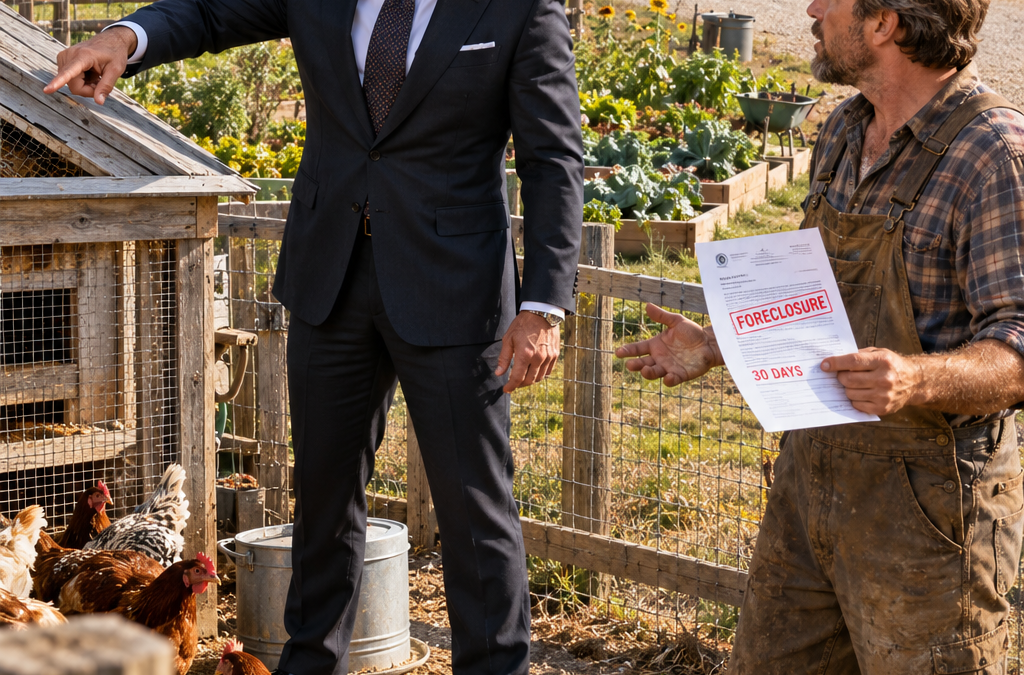
𝗙𝗨𝗟𝗟 𝗦𝗧𝗢𝗥𝗬
The weather was turning.
I had fencing to repair and vegetables to harvest.
So I paid it.
That was my first mistake.
Not because I believed the association had authority.
I simply assumed paying the small amount would make the problem disappear.
I had no interest in fighting with neighbors over chickens.
I thought I was buying peace.
Instead, I was teaching somebody that I could be pressured.
The second fine arrived three weeks later.
Three hundred dollars.
Noncompliant exterior paint.
The notice identified my barn.
My barn.
The same weathered red wooden structure that had stood on the property since 1987.
Its paint had faded naturally over decades of Colorado sun, snow, and wind.
There were darker patches beneath the eaves and lighter boards on the western side.
I’d considered repainting it eventually.
But the roof was sound, the framing was solid, and I had more urgent expenses.
According to the HOA, the barn’s color no longer met community appearance standards.
I stood in front of it holding the notice.
“Noncompliant exterior paint,” I muttered.
I looked at the faded red siding.
Then at the letter.
“Since when?”
The document cited an architectural guideline I’d never received.
I called the number at the bottom.
A woman answered.
I explained that the barn had been red since 1987.
She politely told me that longstanding conditions were not necessarily exempt from updated community standards.
I asked when those standards had changed.
She couldn’t tell me.
I asked for a copy of the relevant rule.
She said the association would send one.
It never arrived.
That bothered me.
But I still believed reasonable people could solve the issue.
I wrote a letter requesting clarification.
I explained that the barn predated the current neighborhood development and that I hadn’t altered its exterior appearance.
I included photographs.
Then I waited.
The response arrived twelve days later.
The $300 fine remained.
No explanation.
Just another payment demand.
I was irritated, but not yet frightened.
The third fine changed that.
Five hundred dollars.
Improper waste management.
The alleged violation was my compost pile.
I had two enclosed compost bins behind the garden.
Vegetable scraps.
Leaves.
Coffee grounds.
Grass clippings.
The material was turned regularly, contained properly, and positioned away from neighboring homes.
There were no piles of household garbage.
No dumping.
No offensive waste.
Just compost.
I had been using the system since I moved in.
The same compost helped feed the vegetables I grew every summer.
Now somebody was treating it as a neighborhood sanitation violation.
I read the notice standing beside the bins.
Then I looked toward the sky.
“Unbelievable.”
I wrote another appeal.
This one was longer.
I included photographs of the enclosed bins and explained how I maintained them.
I asked for the exact covenant provision I had supposedly violated.
I also requested a meeting with the board.
No meeting was scheduled.
Instead, I received another warning that penalties could increase if I failed to correct the condition.
I remember standing in my kitchen afterward, staring at the letter while a pot of coffee brewed beside me.
I still hadn’t met the HOA president.
I only knew his name from the signature at the bottom of every notice.
Sander Hollis.
President.
Cloverdale Meadows Homeowners Association.
I had assumed Sander was some retired businessman with too much free time and a rigid interpretation of neighborhood rules.
I was wrong about only one thing.
He wasn’t retired.
He was very much working.
And his work appeared to involve finding new ways to make my life miserable.
I met him for the first time on a Saturday morning.
A black luxury SUV rolled up my driveway shortly after nine.
The vehicle looked absurdly expensive against the gravel and dust.
Its paint was polished to a mirror finish.
Chrome accents gleamed along the doors.
The driver parked beside my pickup and stepped out.
He was around fifty, tall, broad-shouldered, and carefully groomed.
His dark hair was brushed backward, silver beginning to appear at the temples.
He wore a tailored navy suit, a white shirt, and an expensive silk tie.
His leather shoes looked as though they had never touched an unpaved surface.
A gold watch flashed beneath his cuff.
He closed the SUV door gently, adjusted his jacket, and studied my property with the expression of a man inspecting something that had failed to meet his standards.
I was standing near the chicken coop.
He approached without hesitation.
“Justin Mercer?”
“That’s me.”
He extended his hand.
“Sander Hollis. President of Cloverdale Meadows.”
I shook it.
His grip was firm and unnecessarily prolonged.
He looked past me toward the barn.
“Quite an operation you’ve got here.”
“Thank you.”
He gave a small smile.
“I wouldn’t necessarily call that a compliment.”
I stared at him.
He gestured toward the chicken coop.
“Livestock structures. Compost facilities. Rainwater storage. Unapproved solar installations.”
He spoke as though reading from a criminal indictment.
I folded my arms.
“Is there something specific you came to discuss?”
“Your repeated refusal to comply with community standards.”
“I’ve been appealing those fines.”
“Yes. We’ve received your letters.”
“And?”
“And the board isn’t persuaded.”
I looked toward the barn.
“Did anyone actually read what I sent?”
His smile narrowed.
“Mr. Mercer, the board has considerable experience enforcing neighborhood regulations.”
“That doesn’t answer my question.”
He tilted his head.
“I don’t think you understand how associations work.”
I felt irritation rising.
“I understand that you’ve fined me for a barn that’s been red since 1987.”
“Standards evolve.”
“And for composting.”
“Certain activities are inconsistent with the character of a residential community.”
“This is a five-acre homestead.”
“Within the broader neighborhood environment.”
I glanced toward the distant houses.
“Those homes aren’t even close enough to see my compost bins.”
Hollis looked offended.
“Visibility isn’t the only consideration.”
“Then what is?”
“Community standards.”
He said the phrase with such confidence that I almost laughed.
Instead, I looked at him carefully.
“Mr. Hollis, I’m not trying to cause trouble. I’ve lived here for three years without any complaints from my actual neighbors. If there’s a legitimate issue, I’m willing to discuss it.”
He studied me for several seconds.
Then smiled.
“Good. That’s the attitude I like.”
Something about the way he said it bothered me.
It wasn’t the language of compromise.
It was the language of obedience.
He turned toward his SUV.
“Correct the violations, pay the outstanding balances, and we won’t have further problems.”
Then he drove away.
I stood beside the coop watching the dust settle.
I should have understood the warning.
But I still believed the situation could be repaired with goodwill.
The next morning, I collected twelve fresh eggs.
I arranged them in a clean cardboard carton, carried them to the kitchen, and added a handwritten note.
Mr. Hollis, I hope we can work out these misunderstandings respectfully. These are from the chickens you were concerned about. — Justin.
Then I drove to his house.
It was one of the largest homes in Cloverdale Meadows.
A wide brick residence with stone columns, expensive landscaping, and a fountain near the circular driveway.
Everything looked perfect.
Not a leaf out of place.
Not a blade of grass taller than its neighbor.
I left the eggs on the covered porch and went home.
The next morning, another fine arrived.
Eight hundred dollars.
Solar installation without HOA architectural approval.
I stared at the notice.
The panels had been mounted on the south-facing barn roof for two years.
They were professionally installed.
They produced enough electricity to offset much of the energy I used around the property.
There had never been a complaint about them.
Now the HOA claimed they were unauthorized.
Attached to the notice were photographs.
Clear photographs.
Different angles.
Different days.
One showed the barn from the driveway.
Another showed the panels from the edge of the eastern field.
A third had been taken early in the morning, when the sunlight hit the metal roof.
I examined the dates.
Some were from months earlier.
Long before the newest fine.
I spread them across my kitchen table.
And for the first time, I felt something colder than irritation.
Sander Hollis hadn’t simply noticed a violation.
He had been watching me.
Documenting me.
Collecting evidence.
Waiting.
The eggs hadn’t softened anything.
They had probably convinced him that I was desperate to stay in his good graces.
I looked at the photographs again.
Then at the unpaid notices stacked beside them.
The chicken coop.
The barn.
The compost bins.
The solar panels.
None of it was random anymore.
It was a campaign.
And I was the target.
I called the association hotline that afternoon.
A woman answered with a pleasant voice.
“Cloverdale Meadows. This is Diane.”
I explained the situation.
She listened politely.
Then asked for my address.
When I gave it, there was a slight pause.
“Mr. Mercer.”
“Yes.”
“Your file is extensive.”
“I’ve noticed.”
She didn’t laugh.
I asked how long Hollis had been president.
“Eleven years.”
“Eleven?”
“Yes.”
“And the board supports these fines?”
“That’s the position they’ve communicated.”
“Who’s on the board?”
She hesitated.
Then gave me the names.
Five members.
Three were related to Hollis through his husband’s family.
His sisters-in-law.
I wrote the names down.
For a moment, I simply stared at the paper.
Three of five board members were his relatives.
That didn’t automatically mean wrongdoing.
But it explained why my appeals seemed to vanish into a closed room.
I asked Diane whether the association provided hearings for disputed fines.
She gave me the procedure.
I asked for copies of the governing covenants and all relevant amendments.
She said she would send the request to the board.
Before hanging up, I asked one last question.
“Does anybody ever successfully appeal one of these fines?”
There was a long silence.
Then she said carefully, “I can’t discuss other homeowners’ accounts.”
I understood.
But something in her tone stayed with me.
The fines continued.
Every week, another balance appeared.
Fifty-dollar late fees were added to disputed charges.
Administrative expenses accumulated.
New violations were issued before the previous ones were resolved.
By spring, the claimed balance had grown past $5,000.
I appealed every notice.
In writing.
Certified mail when necessary.
I kept copies.
I requested hearings.
Asked for the exact covenant provisions.
Asked how the fine amounts were calculated.
Asked who had approved the rules.
Most responses were short.
The board had reviewed the matter.
The board found no basis for reversal.
The balance remained due.
I began feeling trapped.
If I paid every fine, I would be draining money meant for property repairs and taxes.
If I refused, the balance kept growing.
The association had turned its own billing system into a weapon.
And I couldn’t find a way to make it stop.
Then came the mailbox.
Two hundred dollars.
Mailbox noncompliance.
I walked down the driveway holding the notice.
My mailbox was ordinary.
A silver metal box mounted on a black post.
USPS-approved.
Functional.
Nothing decorative.
Nothing damaged.
According to the notice, Cloverdale Meadows required an antique bronze finish.
I stared at my mailbox.
Then at the letter.
“Antique bronze?”
I looked around.
The rural road stretched past my property.
A few houses sat in the distance.
No one was complaining about the color of my mailbox.
But Sander Hollis had found another reason to charge me.
That afternoon, I drove to the county recorder’s office.
I requested the original subdivision declaration, recorded covenants, amendments, and available association documents.
I sat at a table with a stack of papers and began reading.
The original governing documents were dated years before I purchased the homestead.
I studied the sections concerning architecture.
Structures.
Landscaping.
Waste disposal.
Property maintenance.
Then I found the mailbox provision.
It had been added six months earlier.
Not through the member approval process described in the governing documents.
Not through a properly documented vote.
The amendment paperwork appeared to have been pushed through administratively.
I read the dates again.
Then I compared them with the association notices.
Something didn’t add up.
I requested the available meeting records.
The amendment referenced approval at a board meeting, but the supporting documentation did not establish the membership vote the governing documents required.
I sat back in my chair.
For months, I’d assumed the HOA was enforcing legitimate rules too aggressively.
Now I was beginning to suspect something worse.
The rules themselves might not have been properly adopted.
I drove home with a thick folder on the passenger seat.
That evening, I bought a new notebook.
On the first page, I wrote:
CLOVERDALE HOA — DOCUMENT EVERYTHING.
Underneath, I made columns.
Date.
Violation.
Amount.
Rule cited.
Supporting evidence.
Appeal submitted.
Response received.
I entered every fine I had received.
Every late fee.
Every letter.
Every phone call.
By midnight, the notebook contained pages of entries.
Seeing everything arranged chronologically changed how I understood the situation.
The violations followed a pattern.
When I appealed one fine, another appeared.
When I requested documentation, enforcement expenses increased.
When I offered compromise, Hollis found another alleged defect.
The system wasn’t encouraging compliance.
It was increasing pressure.
I ordered a trail camera the following morning.
Nothing expensive.
Just a basic weather-resistant model with motion activation.
I mounted it near the equipment shed and aimed it down my driveway toward the entrance.
I wasn’t interested in spying on the neighbors.
I wanted to know who was coming onto my property and when.
Two weeks later, I checked the footage.
At 6:43 on a Tuesday morning, a black SUV appeared at the edge of the road.
A man stepped out.
Dark athletic jacket.
Expensive running shoes.
Perfectly styled silver-black hair.
Sander Hollis.
He walked toward my property line carrying his phone.
Then he began photographing my rain barrels.
He took pictures from several angles.
He moved closer.
Photographed the barn.
The compost area.
Then the chicken coop.
At one point, he bent down to get a better angle of the barrels.
The time stamp remained visible.
6:43 a.m.
I sat at my computer watching the footage.
Hollis looked like a man conducting an inspection.
Except nobody had invited him.
Nobody had scheduled an inspection.
And he wasn’t even pretending to be there on legitimate business.
I replayed the recording.
Then saved a copy.
Later, I learned he attended a Pilates class at seven on weekday mornings.
Apparently, he had found time to inspect my homestead before exercising.
That would have been funny if he weren’t threatening my financial security.
I called my friend Ray that evening.
Ray worked as a paralegal.
He was practical, skeptical, and difficult to impress.
When I told him the story, he laughed at first.
Then I began sending him the documents.
The fine notices.
The appeals.
The alleged amendments.
The photographs.
The trail camera footage.
By the next afternoon, he wasn’t laughing anymore.
He came over after work and sat at my kitchen table.
For nearly two hours, he read.
He made notes.
Compared documents.
Then opened the original covenants again.
Finally, he leaned back and let out a low whistle.
“Justin.”
I looked at him.
“What?”
“Half these fines reference rules that either aren’t in the original covenants or don’t appear to have been properly adopted.”
My stomach tightened.
“Are you sure?”
“I’m not your attorney. I’m not giving you a legal opinion.”
He tapped the documents.
“But I know how to read a recorded instrument. And this is a mess.”
I sat down across from him.
“Then why are they sending me these notices?”
Ray shook his head.
“That’s what you need a lawyer to find out.”
He pointed at the mailbox amendment.
“This one alone raises questions.”
Then he examined the chicken coop notice.
“And where’s the authority for this amount?”
I opened another folder.
“There.”
He read it.
Then frowned.
“That’s a board resolution. Where’s the underlying provision authorizing the board to impose this schedule?”
I didn’t know.
He looked at me.
“You need somebody who handles property disputes. Someone who isn’t afraid of an HOA with a big mouth.”
I thought about Hollis.
His expensive suit.
His carefully controlled smile.
The way he’d stood beside my chicken coop telling me I would have problems if I refused to comply.
Then I looked at the growing stack of bills.
“Can you recommend anyone?”
Ray smiled without humor.
“I know exactly who you need.”
Her name was Clare Nakamura.
Forty-two years old.
Property litigation attorney.
Sharp-eyed, direct, and apparently incapable of wasting a sentence.
Her office was in a modest commercial building about forty minutes from my homestead.
I arrived carrying two folders, the notebook, and a flash drive.
Clare greeted me with a firm handshake.
“Ray says you’ve got a serious HOA problem.”
“I think so.”
She glanced at the folders.
“Let’s see.”
I began explaining.
She held up one hand.
“Start with the first fine. Then we’ll follow the documents.”
That was how we spent the next hour.
I told her about the chicken coop.
The barn.
The compost.
The solar panels.
The mailbox.
The escalating late fees.
The appeals.
The trail camera.
Then I handed her the certified foreclosure notice.
She read it without speaking.
Her expression changed.
“Thirty days?”
“That’s what it says.”
She looked at the amount.
“$14,800?”
“Yes.”
“How much have you actually paid?”
“Fourteen hundred dollars, including payments I made while trying to avoid additional penalties.”
She nodded.
“And you’ve disputed the rest?”
“Every charge.”
She placed the letter on the table.
Then reached for the original HOA documents.
She read for a long time.
At one point, she asked me to identify the location of my property on a map.
I showed her the current parcel diagram.
She made a note.
Then asked for my deed.
I handed it over.
She examined the legal description.
Her eyes narrowed.
“Do you have the original subdivision plat?”
“I have some county maps.”
“I want the recorded plat.”
“Why?”
She didn’t answer immediately.
Instead, she looked back at the deed.
Then she said, “Because before I argue about whether these fines are valid, I want to establish whether the association has any authority over your land at all.”
I stared at her.
That question had never occurred to me.
I had spent eight months arguing over individual rules.
Whether the coop was authorized.
Whether the barn needed painting.
Whether the solar panels violated architectural standards.
I hadn’t considered the possibility that the association had no jurisdiction over my property.
Clare looked at me.
“Justin, if the legal authority isn’t there, every one of these notices has a bigger problem than the fine amount.”
I leaned forward.
“What do we do?”
“We get the original recorded plat and trace the property description.”
She paused.
“Then we follow the money.”
The next several days changed my life.
Clare’s first review found serious inconsistencies in the association’s amendments and enforcement records.
Several fines relied on provisions that could not be traced to validly adopted covenants.
Meeting minutes contained suspicious entries.
Dates did not line up.
Some approvals were recorded as unanimous even though the supporting attendance records raised questions about who had participated.
Then Clare began examining the association’s financial records.
That was where the situation became truly alarming.
The fine revenue was not being handled in the way homeowners had been led to believe.
A significant portion flowed into an account described as the Community Beautification Fund.
That sounded harmless.
Every neighborhood had landscaping expenses.
Tree trimming.
Flower beds.
Entrance maintenance.
But the account’s records raised questions.
Hollis exercised extraordinary control over it.
Over eleven years, nearly $340,000 had passed through the fund.
And Clare found financial connections that did not appear consistent with ordinary community beautification.
Payments related to personal travel.
Trips to Scottsdale.
Expenses associated with renovations to Hollis’s kitchen.
Transactions involving a landscaping company connected to his husband.
The deeper Clare looked, the worse it became.
I sat across from her one afternoon as she spread the documents over the conference table.
“Tell me I’m misunderstanding this.”
She pointed to the financial records.
“Some of the expenditures don’t appear to have legitimate association purposes.”
I stared at the numbers.
“You’re saying he took HOA money?”
“I’m saying the records raise serious evidence of misappropriation. We need a complete audit and the original account statements before the final amounts can be established.”
I looked at the foreclosure notice.
“And he’s trying to take my house.”
Clare’s expression hardened.
“Yes.”
For a moment, neither of us spoke.
Then she said four words that I never forgot.
“This is criminal fraud.”
She let the sentence settle.
Then clarified that investigators and prosecutors would determine which crimes could be proved.
But her assessment of the evidence was unmistakable.
The matter had gone far beyond an unreasonable HOA president.
There were indications of fabricated records, improper charges, and money being diverted from an account intended for community use.
I felt sick.
I’d paid $1,400 because I thought a dispute over chickens wasn’t worth fighting.
Other residents might have paid far more.
And Hollis was still sending notices.
Still collecting fines.
Still threatening liens.
Still wearing expensive suits and presenting himself as the man protecting neighborhood standards.
I leaned back in the chair.
“How long has this been happening?”
Clare looked toward the financial records.
“Potentially years.”
I stared at the table.
Then asked the question I had been afraid to ask.
“Can he actually take my property?”
Clare looked directly at me.
“We’re going to challenge the lien immediately.”
“But can he?”
“First, we need to establish whether the association has any valid basis to enforce its covenants against your parcel.”
She pulled out the deed.
“And I have reason to believe it doesn’t.”
The following morning, Clare obtained the original 1989 subdivision plat.
I was at the homestead when she called.
“Justin, I need you to come in.”
Something in her voice made me stop what I was doing.
“What’s wrong?”
“Nothing with your property.”
She paused.
“I think we’ve found the answer.”
I drove to her office with my heart pounding.
When I arrived, the original plat was spread across the conference table.
It was large, old, and marked with the original subdivision boundaries.
Clare stood beside it.
“Come here.”
I approached.
She pointed to the association boundary.
Then to a separate parcel line.
Then to the road.
“This is Cloverdale Meadows as recorded in 1989.”
I nodded.
“And this is your five-acre tract.”
I leaned closer.
The boundary line was unmistakable.
My property lay outside the subdivision.
Not slightly.
Not ambiguously.
Approximately two hundred feet beyond the recorded HOA boundary.
I stared at the map.
Clare let me look.
Then she spoke.
“Your parcel was never included in the original association property.”
I blinked.
“What?”
“It’s outside the recorded subdivision boundary.”
I looked from the map to my deed.
Then back again.
“The whole property?”
“All five acres.”
“The barn?”
“Outside.”
“The chicken coop?”
“Outside.”
“The compost bins?”
“Outside.”
“The solar panels?”
“Outside.”
I looked at her.
“The mailbox?”
She gave the smallest smile.
“Also outside.”
For several seconds, I couldn’t speak.
Eight months of fines.
Threatening letters.
Appeals.
Late fees.
The foreclosure notice.
All issued by an association that apparently had no governing jurisdiction over my homestead.
Clare pointed to the boundary once more.
“Unless there’s some separate recorded instrument subjecting your parcel to the association that we’ve missed, their own subdivision documents provide no basis for claiming you’re a member.”
She had already searched the relevant recorded history.
No such instrument had appeared.
The conclusion was almost impossible to absorb.
I sat down.
Then I laughed.
At first, it was just a short, disbelieving sound.
Then it became louder.
I laughed so hard that I knocked my coffee off the table.
The cup hit the carpet.
Coffee splashed across the floor.
Clare looked at the mess.
Then at me.
“Well,” she said, “that’s one response.”
I covered my face with both hands.
I wasn’t laughing because anything was funny.
I was laughing because I had spent months being terrified by a man who had never had the authority he claimed.
A man who had fined my chickens.
My compost.
My barn.
My solar panels.
My mailbox.
A man who had photographed my rain barrels before Pilates and threatened to foreclose on my home.
And according to the original recorded plat, he had never been my HOA president at all.
Not for one day.
Not for one inch of my property.
I wiped my eyes.
Clare handed me a tissue.
“Justin.”
I looked up.
“We still have work to do.”
I nodded.
“I know.”
“He’s filed a lien and threatened foreclosure. We need to stop that before the deadline.”
I looked toward the map.
For the first time in eight months, the fear in my chest began to change.
It didn’t disappear.
But something else was growing beneath it.
Determination.
Clare moved quickly.
She prepared an emergency filing to stop enforcement of the disputed lien and threatened foreclosure.
The civil claims included fraud-related allegations, challenges to the association’s claimed authority, and federal civil-rights allegations that would require judicial review.
The urgent request was straightforward.
Preserve the property while the validity of the lien and the HOA’s conduct were examined.
My house could not be treated like collateral for fines imposed by an organization that hadn’t established authority over my land.
The matter reached federal court.
I barely slept while we waited.
Every hour seemed to stretch.
I kept imagining a notice appearing on the front door.
A court date.
A sale.
Some stranger arriving with paperwork saying my home no longer belonged to me.
Thirty days had sounded like plenty of time when I first read the letter.
Now it felt like a clock ticking above my head.
Within forty-eight hours, Judge Ranada Oay granted emergency injunctive relief halting the threatened foreclosure while the dispute proceeded.
Clare called me with the news.
I was standing beside the chicken coop.
“Justin.”
“Yeah?”
“We got the injunction.”
For a second, I couldn’t understand the words.
“The foreclosure?”
“Stopped under the court’s emergency order.”
I leaned against the coop.
My knees felt weak.
I looked toward the house.
The garden.
The barn.
The five acres I’d worked so hard to buy.
Still mine.
At least the immediate threat had been halted.
“Thank you,” I said.
My voice came out rough.
Clare paused.
“Don’t thank me yet. We still need to address the fraud and the damage.”
I closed my eyes.
“But he can’t take the house next month?”
“Not under the threatened proceeding while the injunction remains in effect.”
I breathed out slowly.
Then I looked toward the hens scratching beneath the fence.
For the first time in weeks, I felt hungry.
I hadn’t realized how much fear had been stealing from me.
Sleep.
Appetite.
Concentration.
Even the pleasure of working in my garden.
Every morning had begun with a fear of opening the mailbox.
Every evening had ended with me checking balances and deadlines.
Now the most immediate danger had been stopped.
But Clare was right.
The situation wasn’t over.
Because if Hollis had done this to me, there was no reason to assume I was the only one.
Two days later, I called a Denver television newsroom.
I explained the situation to an investigative producer.
A five-acre homestead.
A $14,800 HOA lien.
Threatened foreclosure.
Years of alleged fines.
A recorded plat showing the property outside the association boundary.
And evidence suggesting the president had been using questionable documents.
The producer asked me to send the records.
I did.
She called back that afternoon.
“We’d like to come out Thursday.”
I looked toward the barn.
“All right.”
The crew arrived in the late morning.
A reporter.
A camera operator.
A producer carrying a folder.
They interviewed me beside the garden.
I showed them the chicken coop.
The compost bins.
The red barn.
The solar panels.
The rain barrels.
Then I brought out the property documents.
The original 1989 subdivision plat.
The deed.
The fine notices.
The foreclosure letter.
The court’s emergency order.
I placed the documents on the worktable beneath the barn awning.
The camera operator filmed each one.
The reporter looked toward the homestead.
“So the HOA has been fining you for eight months?”
“Yes.”
“And your property is outside the association boundary?”
“That’s what the recorded documents establish.”
She looked at the foreclosure notice.
“Fourteen thousand eight hundred dollars?”
“That’s what they demanded.”
“And thirty days to avoid foreclosure?”
“Yes.”
She looked toward the barn.
“What did you supposedly do wrong?”
I gave a tired smile.
“Built a chicken coop. Used solar panels. Composted. Kept my barn red. And apparently owned the wrong color mailbox.”
The reporter stared at me.
Then looked toward the camera operator.
“Can we get that again?”
I repeated the list.
This time without smiling.
Because the absurdity no longer felt harmless.
Each ridiculous charge had been part of a larger campaign that nearly cost me my home.
Then I showed them the trail camera footage.
Sander Hollis.
6:43 a.m.
Walking toward my property line.
Photographing rain barrels.
The reporter watched silently.
Then she asked, “This is the HOA president?”
“Yes.”
“And he was photographing your property even though the records place it outside the association?”
“Yes.”
She looked at the timestamp.
“That’s early.”
I nodded.
“Apparently, neighborhood standards don’t sleep.”
The story was filmed carefully.
They didn’t treat it like a comedy segment.
They understood the stakes.
A homeowner had been threatened with foreclosure over fines that appeared to come from an association with no jurisdiction over his parcel.
And financial records suggested the money trail deserved attention.
The crew later approached Hollis for comment.
I wasn’t there for the entire interview, but I watched the footage afterward.
He stood in his driveway wearing a pastel designer cardigan over a crisp collared shirt.
His hair was immaculate.
His shoes looked expensive.
Behind him, a campaign sign for the upcoming HOA election stood in a flower bed.
RE-ELECT SANDER HOLLIS.
The reporter asked about the recorded plat.
Hollis smiled.
“That map is outdated.”
The reporter asked whether he had a recorded document establishing HOA authority over my parcel.
He adjusted his sleeves.
“Our association has consistently enforced community standards based on the information available.”
She asked whether that included the five-acre tract outside the original subdivision boundary.
Hollis’s smile tightened.
“As I said, the map is outdated.”
The reporter asked whether the board had approved the amendments referenced in the fine notices.
He looked toward the camera.
“I’m not going to discuss internal association business with the media.”
Then she asked about the Beautification Fund.
For one brief second, his expression changed.
The smile faltered.
His eyes moved toward someone standing off-camera.
Then the polished confidence returned.
“Those accounts are maintained in accordance with association policy.”
He ended the interview shortly afterward.
The story aired Friday evening.
I watched it from my living room with Ray sitting beside me.
The report showed the foreclosure notice.
The 1989 plat.
The original deed.
The trail camera footage.
The chicken coop.
The barn.
Then Hollis standing in his driveway insisting that the recorded map was outdated.
Ray stared at the television.
“That’s unbelievable.”
I looked at him.
“Which part?”
“All of it.”
Then he pointed toward the screen.
“That man actually said the original recorded plat was outdated without showing a newer conveyance.”
I leaned back.
“He’s been doing that for months. Making statements as though confidence is evidence.”
Ray shook his head.
The report ended with a statement that the ownership dispute and financial allegations were under legal review.
I turned off the television.
For a moment, neither of us spoke.
Then Ray looked toward the kitchen.
“Got any of those eggs?”
I laughed.
“You’re unbelievable.”
“I’m serious.”
“Help yourself.”
He stood and walked toward the refrigerator.
It was the first ordinary moment I’d experienced in weeks.
I thought the story might bring a few comments.
Maybe a phone call from another homeowner.
Perhaps the HOA would finally admit it had made a mistake.
What happened next was much bigger.
By Saturday morning, Clare’s office had received calls from twelve other residents.
Twelve.
All with their own stories.
Some had paid fines for landscaping changes.
Others for exterior decorations.
Some had been penalized for structures that had existed long before they purchased their homes.
Several described appeal hearings that never seemed to happen.
Others said fines continued accumulating even after they submitted written objections.
The details varied.
The pattern did not.
One couple stood out immediately.
They were retired teachers who had lived in Cloverdale Meadows for more than twenty years.
They were quiet people.
The kind who maintained their lawn, brought homemade food to neighborhood gatherings, and rarely complained about anything.
According to their records, they’d paid more than $6,000 in fines related to unapproved garden art.
I thought I’d misheard.
“Six thousand dollars?”
Clare nodded.
“What kind of art?”
She looked at her notes.
“A ceramic turtle.”
I stared at her.
“A what?”
“A ceramic turtle.”
I leaned back.
Then covered my mouth.
The image was almost too absurd to process.
Two retired teachers had paid more than six thousand dollars because someone had decided a ceramic turtle in their garden violated neighborhood standards.
Clare didn’t smile.
“Justin, they were afraid of liens. They didn’t have the energy or money to fight.”
My amusement disappeared.
I imagined the couple opening notice after notice.
Trying to understand how a harmless decoration had become a financial threat.
Paying because they were afraid of losing the home where they’d planned to spend their retirement.
Then I remembered my own first fine.
One hundred and fifty dollars.
I had paid it for the same reason.
I wanted the problem to go away.
That was how the system worked.
Small pressure first.
Then more.
Then late fees.
Then threats.
Until people stopped asking whether the charges were legitimate and started asking how much they had to pay to make the fear stop.
By Monday, the litigation expanded into a coordinated civil action involving eighteen plaintiffs.
Eighteen families and property owners.
Eighteen sets of records.
Eighteen people who had reached the point where they no longer believed the association would treat them fairly.
The allegations were serious.
Improper fines.
False records.
Misuse of association funds.
Deceptive enforcement practices.
The case was no longer only about my homestead.
It was about how one man had controlled an organization for eleven years and what he had done with that control.
The HOA board held an emergency meeting.
For the first time, the other members faced public pressure that could not be brushed aside with another fine notice.
Homeowners demanded an independent review.
They wanted access to financial records.
They wanted to know why the Beautification Fund had accumulated so much money.
They wanted explanations for amendments that appeared to have been approved without proper votes.
And they wanted to know how an association president had managed to threaten foreclosure against a property outside the original subdivision boundary.
The board voted three to two to cooperate with investigators.
Two of Hollis’s sisters-in-law opposed the decision.
The third voted with the members calling for cooperation.
That single vote told me something important.
Even inside a board dominated by family relationships, the evidence had become too serious to ignore.
Hollis had spent years relying on loyalty.
Now loyalty was beginning to crack.
But the most important witness had not yet spoken.
Her name was Diane.
The woman from the hotline.
The one who had calmly taken my calls while I asked questions about fines and hearings.
I hadn’t thought much about her after our conversations.
She was polite.
Quiet.
Professional.
The kind of employee people barely noticed.
But Diane had been watching Sander Hollis for nine years.
And unlike the board members, she had kept records.
She contacted Clare privately.
At first, she was frightened.
She didn’t want her name public.
She worried about losing her job.
She worried about retaliation.
Most of all, she worried that if she came forward without enough evidence, Hollis would find a way to destroy her credibility.
Clare arranged a confidential meeting.
I wasn’t present.
But she later told me what Diane had brought.
A personal storage drive.
Three thousand files.
Scanned correspondence.
Board minutes.
Fine notices.
Internal spreadsheets.
Financial records.
Amendment drafts.
Email chains.
Documents going back years.
Diane had been quietly preserving them.
Not all at once.
Not as part of some dramatic plan.
She had started because certain documents didn’t match what she remembered.
Then she noticed that meeting minutes changed after meetings.
Vote counts appeared where no vote had been taken.
Fine notices cited rules she couldn’t find in the official record.
Residents were told their appeals had been considered even when Diane couldn’t locate evidence that hearings had occurred.
At first, she thought she was misunderstanding the system.
Then the financial records began troubling her.
Money flowed into the Beautification Fund.
Large balances accumulated.
Expenses were approved with little explanation.
Some payments seemed unrelated to the work the association claimed to be doing.
She began keeping copies.
Then more copies.
Year after year.
Nine years of watching.
Nine years of uncertainty.
Nine years of working beneath a man who treated his authority as unquestionable.
She had said one sentence to Clare that stayed with me.
“I kept copies of everything.”
When Clare told me, I sat silently.
I thought about my phone call to the hotline.
Diane’s quiet voice.
The pause before she answered my questions.
The way she had said she couldn’t discuss other homeowners’ accounts.
I had assumed she was simply following office policy.
Maybe she had been.
But perhaps she had also known that something was terribly wrong and didn’t yet know how to expose it safely.
Her files changed the investigation.
The financial spreadsheet alone was devastating.
Investigators could trace approximately $32,000 in disputed transfers to Hollis’s personal account.
Another $6,000 had gone to a landscaping company owned by his husband.
Other records raised questions about personal travel expenses and home renovation costs charged through the association’s fund.
The Scottsdale trips.
The kitchen remodeling.
The years of accumulating fines.
The dates began connecting.
So did the people.
The board minutes.
The amendments.
The enforcement notices.
The money.
What had once looked like separate complaints from unhappy homeowners was becoming a documented pattern.
Clare called me after reviewing the material.
“Justin, Diane’s evidence may be the strongest thing we’ve seen.”
I was standing beside the garden.
“Stronger than the plat map?”
“The map establishes the lack of authority over your property. Her files help explain what happened inside the association.”
I looked toward the barn.
“Does she know what she’s risking?”
“She does.”
I was quiet for a moment.
Then asked, “Is she safe?”
“She’s getting appropriate legal advice and protection regarding her cooperation.”
I nodded.
That mattered to me.
Because Hollis had spent months trying to intimidate me with fines and foreclosure.
I couldn’t imagine what it had been like for Diane to work under him for nearly a decade.
She had watched what happened to people who questioned his decisions.
She had seen letters sent.
Penalties added.
Residents pressured.
And somehow, she had continued preserving the truth.
I thought about how often powerful people overlook the quietest person in the room.
They assume silence means agreement.
They assume politeness means weakness.
They assume the person taking notes isn’t paying attention.
Diane had been paying attention for nine years.
And now the records were finally speaking.
The following weeks were tense.
Investigators reviewed financial documents.
Attorneys requested records.
The association’s bank accounts and internal procedures came under scrutiny.
Homeowners attended meetings demanding answers.
Hollis continued denying wrongdoing.
He sent statements claiming the accusations were politically motivated.
He suggested disgruntled residents were attempting to undermine his leadership before the upcoming election.
He described the litigation as an attack on neighborhood stability.
But the documents kept accumulating.
And the more the records were examined, the less convincing his explanations became.
One afternoon, I received another envelope from the association.
For a moment, my stomach tightened automatically.
I hated that reaction.
Even after the injunction, I still associated the HOA’s return address with danger.
Inside was a formal notice explaining that enforcement procedures and disputed balances were under review.
No new fine.
No immediate payment demand.
Just an administrative statement.
I placed it beside the others.
The pile was thick now.
Eight months of letters.
Eight months of stress.
Eight months of being treated like a delinquent homeowner by an organization that never had authority over my property.
I looked toward the window.
My chicken coop stood beyond the garden.
The solar panels reflected the afternoon light.
The barn remained weathered red.
And I realized how much time Hollis had stolen from me.
Not just money.
Time.
Mornings spent worrying.
Evenings spent reading covenants.
Hours at county offices.
Days away from work.
Nights lying awake wondering whether I’d lose everything.
Those things couldn’t be refunded as easily as a fine.
But at least the process of holding him accountable was moving forward.
In late October, Clare called me with news that made my heart race.
Investigators were preparing to take formal action.
The timing wasn’t something I controlled.
Neither were the decisions about charges.
Those belonged to the proper authorities.
But I was informed that a significant development was approaching.
By then, the news crew had continued following the case.
I agreed to another interview.
On a cold Wednesday morning, I stood near a news van parked down the street from Hollis’s house.
I wasn’t there to celebrate someone being humiliated.
I was there because the allegations had begun with homeowners being threatened behind closed doors.
Now the consequences were becoming public.
The morning was clear.
The trees along the street had turned yellow and orange.
A faint breeze moved fallen leaves across the pavement.
Hollis’s brick house stood near the end of the block.
The landscaping was immaculate.
The driveway spotless.
The expensive SUV parked beside the garage.
Then two sheriff’s deputies and a federal tax investigator approached the front door.
They climbed the steps.
One deputy knocked.
For several seconds, nothing happened.
Then the door opened.
Sander Hollis appeared.
He was wearing a brightly patterned designer cardigan over a pale collared shirt.
His hair was perfectly styled.
Even at home, he looked as though he expected someone important to arrive.
He spoke briefly with the officers.
Then his eyes moved past them.
Toward the news van.
For half a second, his expression broke.
The smile vanished.
His eyes widened.
His mouth tightened.
It was only a flicker.
Then the polished expression returned.
Habit.
Eleven years of appearing unshakable.
Eleven years of walking into rooms and expecting everyone else to be intimidated.
Even now, he seemed to believe that if he stood straight enough and smiled convincingly enough, the situation might bend around him.
It didn’t.
The authorities proceeded with their official action.
Hollis faced charges including wire fraud, embezzlement-related offenses, and filing false public records.
The charges would still have to be proved through the legal process.
But the man who had threatened to foreclose on my home over chickens and compost was now answering allegations far more serious than any violation he’d ever printed on HOA letterhead.
I stood near the news van watching the front door.
I expected to feel triumphant.
Instead, I felt strangely tired.
I thought about the first $150 fine.
The eggs.
The red barn.
The 6:43 a.m. trail camera footage.
The certified foreclosure notice.
The night I’d sat in Clare’s office staring at the 1989 plat.
The elderly couple with the ceramic turtle.
Diane and her three thousand files.
All of it had led here.
And suddenly, the expensive SUV and immaculate landscaping looked less impressive than they ever had.
Hollis had built his authority on appearances.
The documents had exposed what those appearances concealed.
The criminal investigation continued.
The association’s Beautification Fund was frozen as part of the financial proceedings.
The board voluntarily dissolved its existing operating structure pending further investigation and reorganization under appropriate oversight.
The neighborhood faced an uncomfortable period of sorting through its own records.
Residents needed to know which rules had been validly adopted.
Which fines could be supported.
Which account balances were legitimate.
And how association funds had been used.
For many homeowners, the discoveries were humiliating.
They had trusted the board.
Paid their dues.
Followed the rules.
Accepted fines because they believed the association had the authority to impose them.
Now they were learning that some of the same people who had lectured them about compliance had ignored the rules governing their own conduct.
I didn’t enjoy watching the neighborhood struggle.
Most residents had done nothing wrong.
They were people trying to maintain their homes and live peacefully.
The problem wasn’t the existence of a homeowners association.
The problem was what happened when one man accumulated too much unchecked control and began treating the organization like his personal instrument.
Clare remained focused on my case.
The lien had to be cleared.
The disputed fines had to be resolved.
The money I’d paid had to be recovered.
And the legal record had to establish that Cloverdale Meadows had no governing authority over my homestead.
Those were the outcomes that mattered to me.
The civil case continued after the emergency injunction.
The recorded plat remained central.
My deed remained central.
The association’s inability to establish jurisdiction over the parcel remained central.
Ultimately, the court’s final orders resolved the dispute in my favor.
The invalid charges against my property were set aside.
The lien was removed.
The foreclosure threat ended.
I recovered every dollar of the fines I’d paid.
All $1,400.
My recoverable legal fees were addressed as well.
The court also awarded punitive damages in connection with the proven misconduct.
For months, I had been watching money disappear into a system I couldn’t understand.
Now the financial consequences were finally moving in the other direction.
Hollis’s homeowner’s insurance declined to cover deliberate fraud.
That detail mattered because it made clear that the consequences of intentional wrongdoing could not simply be shifted onto an ordinary insurance policy.
I wasn’t interested in seeing him suffer for the sake of revenge.
But I believed he needed to be held personally accountable for what he had done.
The civil judgment and criminal proceedings served different purposes.
One addressed the harm to property owners.
The other addressed conduct the authorities believed warranted prosecution.
Both were necessary parts of the larger reckoning.
One Friday afternoon, Clare asked me to come to her office.
When I arrived, she had a thick folder waiting on the table.
The final civil order.
Recorded corrections.
Proof that the lien had been released.
The documents confirming the resolution of the disputed charges.
She slid the folder toward me.
“There you go.”
I opened it.
My name appeared on the first page.
Justin Mercer.
The same name that had been printed on the foreclosure notice months earlier.
Only now, the documents established that the association had not been entitled to impose those charges against my property.
I traced one line with my finger.
Then another.
I looked up.
“So it’s finished?”
“Your property dispute is resolved.”
“The lien?”
“Released.”
“The foreclosure?”
“No remaining proceeding under that claim.”
“And they can’t send me another fine for my chicken coop?”
Clare smiled.
“They have no demonstrated HOA jurisdiction over your five-acre parcel.”
I leaned back.
For a moment, I couldn’t speak.
Then I laughed quietly.
Not the wild laughter that had sent coffee spilling across her conference table months earlier.
This was different.
Relief.
Deep enough that it almost hurt.
Clare watched me.
“You okay?”
I nodded.
“Just thinking about how close I came to believing them.”
She closed her pen.
“That’s what intimidation does. It makes people question things they already know.”
I looked at the folder.
“I knew I owned the land.”
“Yes.”
“But after enough fines and letters, I started thinking maybe I’d missed something.”
She nodded.
“That’s why we check the records.”
I looked toward the window.
Then back at her.
“Thank you.”
She gave a small smile.
“Go home, Justin.”
I stood.
“That’s exactly what I’m going to do.”
When I drove back toward Cloverdale, the sky was turning gray.
Low clouds hung above the mountains.
The air smelled like approaching rain.
I followed the familiar road toward the homestead.
The driveway was quiet.
No luxury SUV.
No HOA representative.
No threatening letter waiting on the porch.
I parked beside the barn.
Then I simply sat there.
For months, I had imagined losing the property.
I had pictured strangers walking through the garden.
A foreclosure sign near the mailbox.
Someone telling me I needed to leave the house I’d worked so hard to buy.
I had imagined loading my tools into the pickup and driving away from the place where I’d finally found peace.
Now I looked at the same barn, the same garden, the same chicken coop.
And nothing had been taken.
I stepped out.
The gravel crunched beneath my boots.
One of the hens came running toward the fence when she saw me.
I laughed.
“Yeah, yeah. I know.”
I went inside the coop area and checked the water.
Everything was normal.
No one cared about architectural approval.
No one cared whether the barn was antique red, weathered red, or any other shade.
The hens were concerned only with food.
It was the most reasonable enforcement system I’d encountered in months.
That evening, Ray called.
I answered while standing in the kitchen.
“Well?” he asked.
“It’s done.”
“The lien?”
“Gone.”
“The fines?”
“Reversed.”
He let out a long whistle.
“Man.”
I smiled.
“Yeah.”
He was quiet for a moment.
Then said, “I want some of those eggs.”
I laughed.
“Seriously?”
“The ones that started this whole mess.”
“Ray, the original eggs are long gone.”
“I know. I want their descendants.”
I shook my head.
“I’ll bring you a dozen.”
“Make it two.”
“Don’t push your luck.”
He laughed.
Then his voice softened.
“I’m glad you fought it, Justin.”
I looked toward the barn window.
“So am I.”
After we hung up, I stood quietly in the kitchen.
The sunlight was fading.
A pot of soup simmered on the stove.
The house smelled of onions, garlic, and fresh herbs from the garden.
For the first time in months, the evening didn’t feel like a temporary pause before another confrontation.
It felt like home.
The story spread throughout Cloverdale.
People talked about the HOA president who had fined a man outside his own subdivision.
They talked about the Beautification Fund.
The questionable amendments.
The Scottsdale trips.
The kitchen renovations.
The retired teachers.
And, of course, the ceramic turtle.
That poor turtle became something of a local legend.
The retired couple eventually received relief through the legal proceedings involving their improper fines.
They had spent years feeling embarrassed and powerless over a decoration that should never have become a financial threat.
Now they could laugh about it.
A few weeks later, they bought another ceramic turtle.
A larger one.
They placed it beside the original in their garden.
Then they gave it a name.
Sander.
When Ray told me, I nearly dropped my phone.
“They named the turtle after him?”
“Yep.”
“Which one?”
“The big one.”
I started laughing.
Ray continued.
“Apparently it’s sitting right where the HOA used to complain about the first turtle.”
I shook my head.
“That might be the most Colorado thing I’ve ever heard.”
But beneath the humor was something important.
Those people had spent years afraid to place a ceramic decoration in their own garden.
Now they had two.
And nobody was sending them a threatening letter.
That was the kind of freedom Hollis had never understood.
Not freedom from every rule.
Not permission to harm neighbors.
Just the right to live peacefully without being terrorized by someone who treated a clipboard like a royal decree.
As winter approached, I returned to the routines I’d neglected during the dispute.
I repaired the western fence.
Cleaned the rain gutters.
Prepared the chicken coop for colder weather.
Checked the solar inverter.
Turned compost.
Pulled the last vegetables from the garden.
The work was ordinary.
And I loved every minute.
One morning, I stood beside the barn watching sunlight move across the solar panels.
For months, I’d looked at those panels and thought about the $800 fine.
Now I saw them for what they were.
An investment in the property.
A practical decision.
Something I’d installed because it made sense for my homestead.
I looked toward the compost bins.
Then the chicken coop.
Then the weathered red barn.
Each one had been described in an HOA notice as a violation.
Each one had been used to justify another charge.
And each one was still there.
Unchanged.
The longer I thought about the case, the more I kept returning to Diane.
Not Hollis.
Not the board.
Not even the judge.
Diane.
The woman who had answered the hotline with a pleasant voice and carefully measured words.
Nine years.
She had worked inside that association for nine years.
She had watched decisions being made.
Records being altered.
Fines accumulating.
Homeowners becoming frightened.
And she had quietly preserved the documents.
Three thousand files.
Nine years of evidence.
I tried to imagine the patience that required.
The fear.
The uncertainty.
The temptation to stop caring.
To tell herself it wasn’t her problem.
To close the computer at five and go home.
But she hadn’t.
Something in her told her that the records mattered.
That one day someone might ask the right question.
That one day there might be a lawyer who needed proof.
Or a homeowner who refused to accept another false explanation.
And when that day arrived, Diane was ready.
I found myself thinking about all the people Hollis had overlooked.
The retired teachers.
The maintenance workers.
The homeowners who paid fines because they were afraid.
The quiet assistant sitting behind a desk.
The man on five acres outside the subdivision.
Hollis had spent eleven years assuming his authority made him the most powerful person in every room.
He was wrong.
The most important person might have been the woman scanning documents after work.
The neighbor keeping an old fine notice in a drawer.
The paralegal noticing a missing covenant provision.
The attorney reading a subdivision plat.
Or the surveyor who had recorded the boundary in 1989.
Power wasn’t always loud.
Sometimes it was patient.
Sometimes it looked like a stack of papers.
Sometimes it waited nine years to be believed.
Clare eventually sent me a framed copy of the final court order.
It arrived carefully wrapped, with a short note.
For your barn. Thought you might appreciate a reminder of where the boundary really was.
I laughed when I read it.
Then I carried the frame outside.
The barn was cool and quiet.
The solar inverter hummed softly against the wall.
I chose a spot above it.
Drove two screws into a support board.
And hung the court order.
Then I went back to the house and retrieved a copy of the original 1989 subdivision plat.
I placed it in a simple frame and hung it beside the order.
The two documents looked almost absurd together.
One was the court’s formal resolution of a long dispute.
The other was the old plat map that showed my property had been outside the HOA boundary all along.
Two hundred feet.
That was the distance.
Two hundred feet between my land and the legal boundary of Cloverdale Meadows.
Hollis had crossed that distance with letters, fines, photographs, threats, and a foreclosure notice.
But no amount of paperwork he manufactured could move the recorded line.
I stood in the barn looking at the documents.
Then I thought about the day the certified letter arrived.
My dirty hands.
The vegetable garden.
The $14,800 demand.
The words foreclosure proceedings printed near the bottom.
I remembered sitting on the porch steps feeling as though the ground beneath me had become unstable.
I remembered believing that someone with enough authority might be able to take everything I’d built.
Now the truth was hanging above my solar inverter.
The association had never owned jurisdiction over my property.
The fines were invalid.
The lien was gone.
The foreclosure had been stopped.
The money I’d paid had been returned.
And the people responsible for the fraud were facing consequences that no carefully styled smile could make disappear.
I leaned against the workbench.
For a moment, I thought about what I would say if I ever saw Hollis again.
I imagined him climbing out of his black SUV.
Adjusting his jacket.
Looking across the homestead with that familiar expression of ownership.
I imagined him pointing toward my chicken coop and announcing another violation.
Then I smiled.
I didn’t need to say anything.
The map had already answered him.
That was the most satisfying part.
Not the money.
Not the news coverage.
Not even seeing his confidence disappear when investigators arrived at his door.
It was knowing that the truth had been there from the beginning.
In a public record.
On a survey map.
In a legal description nobody had bothered to check before sending thousands of dollars in fines.
Hollis had built an entire campaign around the assumption that I would never challenge him.
He thought I would pay.
Then pay again.
And again.
Until fear became a habit.
But he’d chosen the wrong property.
And, more importantly, he’d underestimated how much evidence people were willing to preserve once they realized they weren’t alone.
I stepped outside the barn.
The late afternoon sun hung low over the fields.
The chickens moved through their run.
The garden beds were nearly empty for winter.
A faint wind carried the smell of dry grass across the yard.
I looked toward the gravel driveway.
No unfamiliar SUV was approaching.
No man in a tailored suit was coming to tell me that my barn offended neighborhood standards.
No envelope was waiting with another invented violation.
For the first time in nearly a year, I could look across the property without wondering what would be used against me next.
I walked down to the mailbox.
The same mailbox.
Black post.
Silver box.
USPS-approved.
Not a trace of antique bronze.
I opened it.
Inside were a utility statement, a seed catalog, and a handwritten postcard from a friend.
Nothing from Cloverdale Meadows.
I smiled.
Then I closed the box and walked back toward the house.
The sunset was turning the barn a deeper shade of red.
The solar panels caught one last strip of light.
A hen clucked near the fence.
I stopped beside the garden and looked around.
Five acres.
That was all I’d ever wanted.
Five acres where I could work with my hands.
Grow vegetables.
Keep chickens.
Generate some of my own power.
And spend my evenings without anyone telling me that ordinary homestead life was a threat to the neighborhood.
Sander Hollis had tried to turn that simple dream into a financial trap.
He had used fines to create pressure.
Late fees to increase it.
False authority to justify it.
And a foreclosure threat to make me surrender.
But the one thing he had never done was check whether he had the legal right to govern my property.
He had assumed that because he controlled Cloverdale Meadows, he could control me.
He had assumed that the rules he wrote would matter more than the records already filed.
He had assumed that money flowing into an account he controlled would never be traced.
And he had assumed that quiet people would remain quiet forever.
He was wrong about all of it.
I looked toward the barn one last time.
Inside, above the solar inverter, the court order and subdivision plat hung side by side.
I hadn’t put them there to celebrate another man’s downfall.
I put them there because I never wanted to forget what the documents had taught me.
When someone threatens your home, you need more than anger.
You need records.
Dates.
Evidence.
People willing to ask difficult questions.
And the determination to keep going when intimidation makes surrender feel easier.
Ray had helped me recognize the problem.
Clare had helped me fight it.
Diane had helped expose what was happening behind the association’s polished doors.
And the original plat had established the fact that mattered most.
My homestead had never belonged to Cloverdale Meadows.
Not in 1989.
Not when I bought it.
Not when the first fine arrived.
Not when Hollis photographed my rain barrels.
And certainly not when he threatened foreclosure.
I walked toward the house as the evening grew colder.
A light glowed in the kitchen window.
The gravel crunched beneath my boots.
Behind me, the barn stood exactly as it had before the entire nightmare began.
Weathered red.
Solar panels on the south roof.
Chicken coop beside the fence.
Compost bins near the garden.
Rain barrels catching the last of the evening light.
Nothing had changed.
Except now I understood the value of what I’d protected.
And somewhere beyond those fields, a man who once believed he controlled everything was learning that a title, a clipboard, and eleven years of intimidation meant nothing when the records finally came to light.
I stepped onto the porch.
Then I looked back across my five acres and smiled.
Sander Hollis had threatened to take my home.
But he had never been my HOA president.
He was just a stranger who had spent eight months pretending otherwise.
And the one thing he couldn’t fine, rewrite, or foreclose on was the truth.








