𝗙𝗨𝗟𝗟 𝗦𝗧𝗢𝗥𝗬 The HOA President Promised 63 Marina Passes Down My Family’s Private Road—Then She Came for the Gate
𝗣𝗔𝗥𝗧 𝟮
There it was.
Not confusion.
Entitlement.
My family had owned the road and lakefront property long before Pine Ridge Estates existed.
The private road ran from the county highway through a strip of wooded land, down a gradual slope, and ended at our marina.
My grandfather maintained it when it was still gravel.
My father paved the steepest section after a storm washed half the road into a drainage ditch.
I had replaced the electronic gate system eight years earlier.
Every boundary marker had been surveyed.
Every deed recorded.
Every legitimate access user documented.
Pine Ridge had been developed beside us decades later.
For years, nobody objected.
Then lakefront property values exploded.
Suddenly, a private road leading to a private marina wasn’t just a family access route.
It was worth money.
A lot of money.
And Karen understood money.
She leaned toward the gate.
“You can cooperate voluntarily, or we can formalize the transition.”
I stared at her.
“Transition?”
“To HOA management.”
“You’ve already promised passes.”
“Yes.”
“You’ve already told residents they’ll have access.”
“Yes.”
“And you did all that before speaking to the landowner.”
Her lips pressed together.
“We have been trying to speak to you for weeks.”
“You’ve been sending me newsletters.”
“Official notices.”
“Newsletters with bold headings are still newsletters.”
David almost smiled.
Karen saw him.
He stopped.
She turned back to me.
“You’re creating unnecessary conflict.”
“No.”
I shook my head.
“You created sixty-three promises using somebody else’s property.”
That finally cracked her composure.
“You have no idea how much work went into this plan.”
“I believe you.”
“Legal reviewed it.”
“Which legal?”
She paused.
“Our HOA attorney.”
“What recorded instrument did he review?”
Her face hardened again.
“You’ll receive appropriate documentation.”
“When?”
“At the implementation meeting.”
“There will be no implementation meeting.”
“You don’t get to decide that.”
I looked at the keypad.
Then at the road.
Then at the marina visible through the trees.
“Yes, Karen.”
I met her eyes.
“I do.”
She left angry.
I expected a letter.
Instead, the next morning I found a bright red notice attached directly to my gate.
Not mailed.
Not emailed.
Attached to my private gate.
NOTICE OF HOA-MANAGED MARINA ACCESS
Beneath that:
Effective Immediately, Marina Road Access Will Be Administered Through Pine Ridge Estates Homeowners Association.
Then a list of pass numbers.
Sixty-three of them.
Resident names beside each.
I stood there for nearly a minute.
A cold feeling settled in my stomach.
Karen hadn’t merely threatened to take control.
She was creating paperwork designed to make it look as though control had already changed.
That was more dangerous.
If residents showed up believing they held valid access passes, I would suddenly have dozens of people trying to use my private road.
Some would bring vehicles.
Boats.
Trailers.
Guests.
Children.
If I locked them out, Karen could portray me as the unreasonable property owner denying rights they had supposedly purchased through the HOA.
If I let them through, she might later argue that repeated use proved recognized access.
I pulled out my phone.
Photographed the notice from every angle.
Gate.
Date.
Names.
Pass numbers.
HOA logo.
Then I removed it carefully without tearing anything.
My wife came down the road in the golf cart while I was photographing the post.
“What now?”
I handed her the notice.
She read the first paragraph.
Then looked at me.
“They actually issued passes?”
“All sixty-three.”
“Can they do that?”
“No.”
“You sound very certain.”
“I am.”
She looked toward Pine Ridge.
“Karen sounds pretty certain too.”
That was the problem.
Confidence creates chaos when enough people believe it.
I spent the rest of the morning gathering records.
Original deed.
Current deed.
Historical survey.
Most recent boundary confirmation.
Marina operating documents.
Access agreements.
Pass history.
Tax records.
Then I called Martin Ellis, my property attorney.
He listened quietly.
“Sixty-three?”
“All available pass slots.”
“That isn’t accidental.”
“No.”
“Did the HOA collect money?”
“I don’t know.”
“Find out.”
“What difference does it make?”
“A lot.”
I leaned back.
“Can they claim an easement?”
“Anybody can claim anything.”
“You know what I mean.”
“Yes.”
He paused.
“If a recorded easement exists, we’ll find it. If one doesn’t, Karen’s access plan doesn’t manufacture one.”
“What about historical use?”
“Has Pine Ridge ever used the road openly under a claimed right?”
“No.”
“Any agreement with the developer?”
“Not that I know.”
“Any road-maintenance sharing?”
“No.”
“Gate codes?”
“Never.”
“Good.”
I exhaled.
“So we send her a cease-and-desist.”
“Yes.”
“Anything else?”
“Contact the state office that regulates the relevant marina access and property issues.”
That surprised me.
“Why?”
“Because Karen is trying to tie land access to marina passes. I want an independent administrative record before sixty-three residents start driving through your gate.”
That afternoon, I sent the state office a packet.
The red HOA notice.
My deed.
Survey.
Marina documents.
Photographs of the gate.
A short explanation.
I expected bureaucracy.
Two weeks.
Maybe a month.
Instead, an inspector called the following morning.
His name was Thomas Reed.
He had spent more than twenty years working with shoreline access, survey disputes, and marina permitting.
“I’ve reviewed your submission.”
“That was fast.”
“Sixty-three newly issued access passes attached to a private marina gets attention.”
“Good.”
“Are they currently using the road?”
“Not yet.”
“Keep it that way until we verify the records.”
That was exactly what I wanted to hear.
He scheduled an inspection.
Karen learned about it before he arrived.
I still don’t know who told her.
Maybe someone inside the HOA office.
Maybe one of the passholders.
Maybe the state contacted the association for records.
Either way, she drove to my gate the day before the inspection.
Red lace dress.
Blue folder.
No board members this time.
I didn’t open the gate.
She stood outside.
“You contacted the state.”
“Yes.”
She laughed.
Actually laughed.
“You really are determined to embarrass yourself.”
“Probably.”
“The state isn’t going to decide a private HOA access plan.”
“They’re going to inspect the marina and road records.”
“We have legal documentation.”
“Excellent.”
I leaned against the gate.
“Bring it tomorrow.”
“You think the inspector is going to invalidate sixty-three passes because you don’t like Pine Ridge residents?”
“This isn’t about whether I like them.”
“You’ve always acted as though the lake belongs to your family.”
“It does.”
“The lake?”
“The marina parcel and road.”
“Exactly.”
She smiled.
“That attitude is why access reform was necessary.”
I stared at her.
“Access reform?”
“Yes.”
“You mean giving away rights you don’t own.”
“Your family has controlled that corridor for decades.”
“Because my family owns it.”
“You’ve benefited enormously from scarcity.”
Now we were getting somewhere.
I narrowed my eyes.
“Did you charge residents for the passes?”
Her expression changed.
Just enough.
“How much?”
“That information is private HOA business.”
“Karen.”
I stepped closer to the gate.
“Did the HOA collect money based on access to my marina?”
“They paid an amenity assessment.”
I almost laughed.
“How much?”
“That’s irrelevant.”
“No.”
“It is absolutely relevant.”
She folded her arms.
“The board invested in an expanded lake-access program.”
“Using my road.”
“We dispute ownership of the access rights.”
“You haven’t shown me one recorded document.”
“You’ll see everything tomorrow.”
Then she smiled.
“Try not to look so nervous.”
She left.
I wasn’t nervous about the deed.
I was nervous about sixty-three people who may have paid money for something Karen had no right to sell.
That changed the stakes.
Thomas Reed arrived at 8:00 the following morning.
He didn’t come alone.
A survey technician accompanied him.
Their state vehicle carried cases of equipment, rolled maps, and enough files to make Karen’s blue folder look almost decorative.
Thomas introduced himself at the gate.
Then looked toward the road.
“This is the only vehicle entrance?”
“For the marina parcel, yes.”
“Any secondary easement?”
“Not from Pine Ridge.”
“Historic footpath?”
“Nothing recorded that I’m aware of.”
He nodded.
“Let’s walk it.”
Karen arrived before we made it fifty yards.
Black SUV.
David beside her.
HOA attorney in another vehicle.
Karen climbed out and walked toward us quickly.
“You started without the association?”
Thomas looked at her.
“Are you Ms. Whitmore?”
“Karen Whitmore, HOA president.”
She extended her hand.
He shook it.
“We’re inspecting recorded access and boundary conditions.”
“I’ve brought our records.”
“Good.”
She gave me a smug look.
Then followed us.
Thomas started at the gate.
He photographed the boundary monument near the county road.
Checked coordinates.
Compared them with the state survey file.
Then walked slowly downhill.
He examined another monument beside an old stone retaining wall.
My grandfather had rebuilt that wall sometime in the seventies.
The survey pin had been protected inside a square opening ever since.
Karen talked almost continuously.
“The road serves the entire lakefront district.”
Thomas made a note.
“Has Pine Ridge historically maintained it?”
“We’ve contributed to the broader community.”
“That wasn’t my question.”
Karen glanced at me.
“Road maintenance has traditionally been handled privately.”
“By whom?”
She paused.
“My family,” I said.
Thomas noted it.
Karen continued.
“But that’s one reason the new management plan is necessary.”
Thomas looked at her.
“Necessary isn’t the same as authorized.”
Her smile tightened.
“We’re confident about our rights.”
“Good.”
He continued walking.
“Then this should be straightforward.”
At the third marker, Thomas stopped.
It was an old stone boundary monument set several feet off the pavement.
Most people wouldn’t notice it.
He brushed dirt from the top.
Checked a map.
Then looked toward Karen.
She stopped talking.
That was the first time all morning.
Thomas looked at his technician.
“Confirm this point.”
The technician set the equipment.
Waited.
Read coordinates.
Nodded.
Thomas unfolded a survey.
The line on the map ran parallel to the road before wrapping around the marina parcel.
Exactly where my family had always understood it to be.
Karen stepped closer.
“The HOA map places the western community corridor differently.”
Thomas held out his hand.
“Can I see it?”
She opened the blue folder.
There it was.
A glossy Pine Ridge access map.
Colored lines.
Amenity zones.
Trail corridors.
Marina designation.
And one thick blue route labeled:
COMMUNITY MARINA ROAD
My private road.
Thomas laid the HOA map over a copy of the official survey.
The two did not match.
Not even close.
Karen pointed.
“There.”
Thomas looked.
“What?”
“The access corridor.”
“That’s drawn on your planning map.”
“Correct.”
“I need the recorded instrument creating it.”
She blinked.
“Our plan incorporates existing community access.”
“Recorded where?”
“In the Pine Ridge documents.”
“Which document?”
She opened the folder wider.
Pages began moving.
Board resolutions.
Amenity plan.
Marina pass policy.
Resident communications.
A development agreement.
Thomas waited.
Karen pulled out an access agreement.
“This.”
The HOA attorney stepped closer.
“Yes. That’s the controlling access agreement.”
Thomas took it.
Read page one.
Page two.
Legal description.
Exhibit.
Then handed it to his technician.
“Overlay this.”
The technician checked the parcel reference.
Then shook his head.
Thomas looked at Karen.
“This agreement doesn’t cover Marina Road.”
Her face tightened.
“It covers the lake-access corridor.”
“No.”
He pointed toward the legal description.
“It covers an internal Pine Ridge access lane terminating east of this property.”
The attorney intervened.
“With respect, the agreement has historically been interpreted broadly.”
Thomas turned toward him.
“Historical interpretation doesn’t expand a legal description.”
The attorney opened his own briefcase.
“We have additional materials.”
For the next thirty minutes, they produced papers.
Meeting records.
Developer correspondence.
Conceptual maps.
Old amenity brochures.
A title summary.
A shoreline-use memorandum.
Nothing conveyed rights over my road.
Thomas finally looked toward me.
“Do you have your original deed?”
I handed it to him.
He studied the legal description for a long time.
Long enough that even I became nervous.
Then he walked farther down the road.
Karen followed.
So did the attorney.
At the last bend before the lake, Thomas stopped beside another marker.
Beyond it, the marina opened across the water.
Sixty-three pass slots.
Private slips.
A launch area.
Storage.
A small service building.
My family’s land.
Thomas compared the deed against the survey.
Then his technician pulled up an older property record.
Thomas stared at it.
“What did you find?” Karen asked.
He didn’t answer immediately.
Instead, he pointed toward a boundary call tied to the old stone monument.
The road was specifically included within the lakefront parcel.
Not merely an access easement.
Not shared right-of-way.
Property.
My family’s.
The older record confirmed that ownership had remained continuous.
No transfer to the subdivision developer.
No later dedication to Pine Ridge.
No HOA easement.
Nothing.
Thomas looked at me.
Then said something that confused everyone else.
“Judge, look at this boundary.”
Karen turned sharply.
“Judge?”
David stared at me.
Even the HOA attorney looked surprised.
I almost laughed.
Thomas knew my family name from older county records.
Several generations of my family had served locally in civic roles, and somewhere along the way older officials occasionally used “Judge” as an informal courtesy when talking to members of the family.
It wasn’t relevant to ownership.
I wasn’t standing there trying to impress anyone with a title.
The deed mattered.
The survey mattered.
The marker mattered.
Not what Thomas called me.
I stepped beside him.
He pointed toward the map.
“The recorded line takes the entire road and the marina access parcel inside this deed.”
“I know.”
“I wanted you to see how clearly the old record confirms it.”
Karen stepped forward.
“This is inappropriate.”
Thomas looked at her.
“What is?”
“You’re obviously familiar with him.”
“I recognize the family name.”
“So you’re biased.”
“No.”
His voice stayed completely calm.
“I’m reading the official records.”
“Calling him Judge isn’t exactly neutral.”
He nodded.
“Fair enough.”
Then he folded the map.
“So forget the title.”
He pointed toward the stone marker.
“That monument is neutral.”
Then toward my deed.
“That legal description is neutral.”
Then toward the survey.
“That recorded boundary is neutral.”
Karen’s face turned pale.
Thomas looked at her.
“Now I need the HOA’s recorded easement over this road.”
She opened the folder again.
“I already gave you the access agreement.”
“It doesn’t cover this parcel.”
“Our attorney disagrees.”
Thomas turned toward the attorney.
“Do you have another recorded instrument?”
The attorney hesitated.
“We believe contractual rights exist.”
“I didn’t ask what you believe.”
Thomas held out his hand.
“Identify the recorded instrument.”
The attorney opened another document.
Thomas read it.
Shook his head.
“Different parcel.”
Another.
“Internal road.”
Another.
“Developer-owned land east of this boundary.”
Karen’s breathing became more noticeable.
She looked toward David.
“Where is the marina document?”
David blinked.
“What marina document?”
“The original.”
“I don’t know.”
“You were on the committee.”
“Three years ago.”
“You reviewed these.”
“I reviewed the access plan.”
Karen’s voice sharpened.
“Then where is it?”
David looked around.
“I assumed legal had the easement.”
The attorney immediately said, “We never represented that a recorded easement covered this road.”
Karen turned on him.
“You approved the plan.”
“We reviewed the plan language.”
“That’s the same thing.”
“No.”
His answer was quiet.
But devastating.
“It isn’t.”
Silence spread along the marina road.
For the first time, Karen seemed to understand how large the mistake was.
Sixty-three passes.
Sixty-three residents.
Potentially sixty-three amenity assessments.
Promises.
Access schedules.
Marketing.
All built on the assumption that because the HOA wanted the marina road, the HOA somehow had the right to manage it.
Thomas closed his file.
“Here’s where we are.”
Karen stared at him.
“The recorded records place Marina Road and the lakefront parcel within the Bennett family property.”
She opened her mouth.
He held up one hand.
“I’ve reviewed the HOA materials you’ve provided.”
Her mouth closed.
“I have not seen a recorded easement, dedication, transfer, or other instrument giving Pine Ridge Estates control of this road.”
The attorney said, “We reserve the right to provide supplemental documentation.”
“Of course.”
Thomas nodded.
“But until you do, your association should not represent these passes as granting legal access through private property.”
Karen’s face went white.
“Sixty-three residents have already been issued passes.”
“I understand.”
“We collected assessments.”
Thomas looked at her.
“That makes verification more important, not less.”
“You can’t simply invalidate an HOA program.”
“I’m not invalidating a program.”
He pointed toward the gate in the distance.
“I’m telling you a program does not override a recorded property boundary.”
Karen looked toward me.
“You set this up.”
I stared at her.
“What?”
“You called the state knowing they’d take your side.”
Thomas answered before I could.
“No.”
She turned toward him.
“You knew his family.”
“I know hundreds of family names in this county.”
“You called him Judge.”
“And I’ve already explained why that isn’t relevant.”
He picked up my deed.
“This is why the road is private.”
Then the official survey.
“And this.”
Then pointed toward the marker.
“And this.”
His voice remained calm.
“Not because I know his name.”
Karen looked at the HOA attorney.
“Do something.”
He looked exhausted.
“We need to review title.”
“We already reviewed it.”
“No.”
He shook his head.
“We reviewed HOA documents.”
That distinction finally landed.
Karen had spent months staring at Pine Ridge records.
Nobody had gone backward far enough to verify whether Pine Ridge ever possessed the underlying access right.
The association had essentially been studying its own assumptions.
The state office issued its written determination shortly afterward.
The language was careful.
Administrative.
Boring.
And devastating.
The recorded documentation supported continued private control of Marina Road and the associated access parcel.
Pine Ridge’s marina plan could not create access rights over property the association did not own or lawfully control.
Any claimed rights would require a valid recorded instrument.
The sixty-three HOA passes could not be treated as independent authorization to enter my property.
Karen called an emergency board meeting.
This time, I attended with Martin.
The clubhouse was packed.
That was predictable.
Sixty-three passholders alone were enough to fill most of the room.
Some had apparently paid substantial amenity assessments based on Karen’s new marina-access plan.
People were angry.
Not at me initially.
Mostly confused.
Karen stood at the front beneath a slide reading:
MARINA ACCESS UPDATE
Same red lace dress.
Black blazer.
Blonde hair perfect.
But I noticed her hands.
They shook slightly when she adjusted the microphone.
“We are currently addressing an unexpected state-level interpretation concerning Marina Road.”
A man in the front row raised his hand.
“You told us access was guaranteed.”
Karen smiled.
“The HOA acted based on the information available.”
“You charged us.”
“The assessments funded the overall access initiative.”
A woman beside him called out.
“Can we use the marina or not?”
Karen hesitated.
“That is under review.”
The room erupted.
I stayed seated.
Martin leaned toward me.
“Don’t say anything unless necessary.”
“I wasn’t going to.”
“You’re lying.”
“A little.”
Karen struck the gavel.
“Order.”
People quieted slowly.
Then Karen looked directly at me.
“Mr. Bennett has challenged the association’s long-established access understanding.”
I stood before Martin could stop me.
“No.”
The room quieted.
“I challenged sixty-three passes you issued over my private road.”
Karen’s face hardened.
“You know exactly what I mean.”
“I know exactly what the state inspector found.”
“This is still under legal review.”
“Good.”
I looked around.
“Then the legal review should begin with one question.”
Someone asked, “What question?”
I pointed toward Karen’s blue folder.
“Where is the recorded easement?”
Silence.
Karen stepped toward the microphone.
“There are extensive contractual documents.”
“Not what I asked.”
“You are not running this meeting.”
“No.”
I nodded.
“But you’re trying to run my road.”
A few residents laughed.
Karen flushed.
“This isn’t funny.”
“I agree.”
I looked toward the sixty-three residents.
“Some of you apparently paid money because you were told you’d receive marina access.”
Faces hardened.
Karen interrupted.
“That is a gross simplification.”
“Then explain it.”
“The amenity assessment covered planning, administration, safety infrastructure, and access coordination.”
A resident shouted, “You sold me a marina pass.”
Another called, “Me too.”
Then another.
The room got louder.
Karen hit the gavel.
David finally leaned toward his microphone.
“We need to answer the ownership question first.”
Karen turned toward him.
“We are answering it.”
“No.”
He shook his head.
“We’re avoiding it.”
The clubhouse went quiet.
David continued.
“I thought we had an easement.”
Karen stared at him.
“So did everyone.”
“That’s not an answer.”
“Legal approved the plan.”
The HOA attorney was sitting near the side wall.
Every head turned toward him.
He slowly stood.
“I need to clarify something.”
Karen’s expression changed.
“Sit down.”
He ignored her.
“Our office reviewed the access-plan documents prepared by the association.”
A resident asked, “Did you verify ownership of the road?”
He paused.
“No.”
The room exploded.
Karen stepped toward him.
“That is completely misleading.”
“It is accurate.”
“You told us the program was legally defensible.”
“Based on representations that the association held marina-access rights.”
“Because we did.”
He looked at her.
“Where is the instrument?”
Same question.
Again.
Karen had no answer.
Her entire plan was collapsing around one missing piece of paper.
Martin finally stood.
“My client is not asking Pine Ridge to give him anything.”
The room quieted.
“He is asking the HOA to stop giving away something that is already his.”
Karen scoffed.
“That road has benefited this community for decades.”
Martin looked at her.
“Benefit does not equal ownership.”
“Residents have accessed the lake.”
“Through invitation or specific authorization.”
“Which establishes a pattern.”
“No.”
Martin shook his head.
“Permission does not automatically become a permanent public easement because the HOA prefers that interpretation.”
One resident raised his hand.
“What happens to our passes?”
Karen opened her mouth.
David answered first.
“They’re suspended.”
Karen turned.
“You do not have authority to announce that.”
“As a board member, I have authority to move that we stop misrepresenting access until counsel verifies legal rights.”
Susan said, “Second.”
Karen stared at both of them.
“You’re panicking.”
Susan looked almost angry.
“No.”
She gestured toward the room.
“I’m trying to stop this from getting worse.”
The vote happened minutes later.
Four to one.
The marina-access plan was suspended.
Karen voted no.
Of course.
After the meeting, several residents approached me.
I expected anger.
Some were angry.
But not for the reason Karen had predicted.
A man named Robert held up his pass.
“I paid twelve hundred dollars for this.”
I stared at him.
“Twelve hundred?”
“Annual marina-access assessment.”
My jaw tightened.
Another woman said, “We were told the road rights had already been acquired.”
“From whom?”
“Karen never said.”
Robert looked toward her across the room.
“She said the old private arrangement had been replaced.”
That phrase bothered me.
Replaced.
As though private property rights were an outdated policy that could be updated at a board meeting.
I looked at their passes.
Beautifully printed.
Holographic strip.
Number.
HOA logo.
Barcode.
Completely useless without my gate opening.
“I didn’t know you were paying for these.”
Robert sighed.
“I didn’t know you owned the road.”
“That was apparently the problem.”
Martin documented the statements.
The HOA’s internal investigation began within days.
Once the board realized residents had paid assessments tied directly to the marina-access promise, the issue stopped being merely embarrassing.
Money changes urgency.
Board members demanded records.
Who proposed the plan?
Who verified the road?
Who told residents access had been acquired?
Who authorized collection of the assessments?
The paper trail kept leading back to Karen.
She had discovered references to sixty-three historical pass slots in old marina-related material.
Instead of verifying who controlled them, she assumed the passes were a dormant community asset.
Then she built a program around them.
The more residents wanted access, the more confident she became.
Demand became evidence in her mind.
If sixty-three households wanted passes badly enough to pay, surely the HOA should control them.
That wasn’t law.
It was wishful thinking with invoices.
Pine Ridge refunded the marina-access assessments.
That alone cost the association a painful amount of money.
Karen tried to blame the state office.
Then the attorney.
Then old subdivision developers.
Then poor recordkeeping.
Every explanation had one flaw.
I had asked her for the deed or easement before she issued the plan.
She chose not to check.
A few weeks later, Karen came back to my gate.
Alone.
No blue folder.
That was unusual.
I was changing one of the keypad housings.
She stood outside.
“Are you going to open it?”
“No.”
Her lips tightened.
“I want to talk.”
“We’re talking.”
She looked toward the lake.
“You got what you wanted.”
“What did I want?”
“Control.”
I almost laughed.
“My family already had control.”
“That marina could serve hundreds of people.”
“Maybe.”
“And you prefer sixty-three private slots.”
“I prefer deciding what happens on my land.”
“That’s selfish.”
I looked at her.
“You sold sixty-three passes to a road you didn’t own.”
“I didn’t sell the road.”
“You sold access.”
“We believed the HOA held rights.”
“I asked you for proof.”
“You were hostile from the beginning.”
“No.”
I shook my head.
“I asked one question.”
“What?”
“Show me the document.”
She said nothing.
“That was all you ever had to do.”
“We had documents.”
“You had plans.”
“Yes.”
“Karen, plans describe what people want to happen.”
I pointed toward the pavement beneath us.
“Deeds describe who owns this.”
Her face tightened.
“You really enjoy explaining things to me.”
“Not particularly.”
“You humiliated me.”
“I didn’t issue the passes.”
“You called the state.”
“After you attached a management notice to my gate.”
She looked away.
For a moment, I saw something different.
Not remorse exactly.
Exhaustion.
Then she said, “Do you know what those passes could have done for Pine Ridge property values?”
There it was.
Even after everything.
Value.
“That was the point?”
“Of course it was part of the point.”
“How much?”
“What?”
“How much did marina access increase estimated home values?”
She hesitated.
“Depending on the property, potentially tens of thousands.”
Now I understood why she’d fought so hard.
Sixty-three passes multiplied across dozens of high-end homes could create millions in perceived neighborhood value.
To Karen, my road had become an undeveloped financial asset sitting beside Pine Ridge.
She couldn’t stand that somebody else controlled it.
“You thought my family was wasting something valuable.”
“Yes.”
The honesty surprised me.
“And that gave you the right to take it?”
“I didn’t take anything.”
“You changed the gate notice.”
“Temporarily.”
“You issued passes.”
“Under what we believed were rights.”
“You marketed marina access to residents.”
She folded her arms.
“You make everything sound criminal.”
“I make it sound documented.”
She hated that answer.
I finished tightening the keypad housing.
Karen watched.
“Will you ever allow HOA residents access?”
“Individually? Possibly.”
“Through Pine Ridge?”
“Not under your plan.”
“Why?”
“Because the road is private.”
“That isn’t an answer.”
“It is the whole answer.”
She left.
The HOA board formally withdrew the marina-access program the following month.
Their written notice acknowledged that Pine Ridge had not established recorded rights over Marina Road and could not issue independent marina passes through my family’s property.
It also clarified that future lake access would require authorization from the landowner or a valid recorded instrument.
Simple.
Obvious.
Expensive lesson.
Susan became interim HOA president after Karen resigned several weeks later.
Karen publicly called it a personal decision.
Nobody believed that.
The pass scandal had destroyed confidence in her leadership.
Not because residents suddenly hated her.
Because she had promised something concrete.
Lake access.
A marina pass.
A gate code.
And when the paperwork was finally checked, none of it belonged to her.
Susan called before visiting the property.
That alone was an improvement.
“Can I come down to the marina?”
“Yes.”
“Through the gate?”
“That is usually how roads work.”
She laughed.
I gave her a temporary code.
We drove to the lake.
Evening sunlight reflected across the water.
Boats rocked gently against the docks.
Susan stood at the edge.
“I understand why people wanted this.”
“I do too.”
“It’s beautiful.”
“Yes.”
She looked toward the road.
“I also understand why you fought.”
“I wasn’t trying to keep Pine Ridge away because I hate your residents.”
“I know.”
“I was trying to stop the HOA from deciding ownership based on demand.”
Susan nodded.
“We should’ve checked.”
“Yeah.”
She sighed.
“Karen kept saying the old marina-pass system proved we had historical rights.”
“It proved passes existed.”
“That’s what the attorney said.”
“Who controlled the passes matters.”
She smiled sadly.
“We know that now.”
The marina remained private.
I did eventually authorize a small number of additional users.
Not sixty-three.
And not through an HOA decree.
Individual agreements.
Clear terms.
Liability provisions.
Road-maintenance contributions.
Revocable access where appropriate.
Everything documented.
One Pine Ridge family received access because the husband volunteered with the lake rescue unit.
Another because their property had an older legitimate agreement in its chain of title.
A third leased a slip directly.
That was how rights should work.
Specific.
Documented.
Voluntary.
Karen’s plan had tried to replace all of that with one board resolution.
The keypad stayed under my control.
I upgraded the system after the dispute.
Every authorized user had a unique code.
Entries were logged.
No shared HOA master code.
No board override.
No Karen.
The bright red HOA notice went into my records.
I kept it.
Not because I enjoyed remembering the fight.
Because it was a perfect example of how authority can be manufactured visually.
Red paper.
Bold heading.
Official logo.
Pass numbers.
Resident names.
Effective date.
Everything about it looked final.
Except the one thing that actually mattered.
The HOA didn’t own the road.
Years later, my nephew found the notice while helping me organize files.
He read it.
Then looked confused.
“Why did they think they owned Marina Road?”
“They didn’t exactly.”
“What do you mean?”
“They wanted access.”
“So?”
“They found paperwork that made them think they could claim it.”
He frowned.
“But didn’t they check the deed?”
“No.”
“That’s stupid.”
I laughed.
“That’s a simple version.”
“What happened to the sixty-three passes?”
“They were canceled.”
“All of them?”
“Yes.”
“What happened to the people who paid?”
“Refunded.”
“What happened to Karen?”
“She stopped being president.”
He nodded like the universe had restored itself properly.
Then he asked, “What’s an easement?”
I smiled.
That question took longer.
We drove down Marina Road afterward.
I showed him the stone marker where Thomas had stopped.
The one that made Karen go silent.
I showed him where the legal line ran.
Then the marina parcel.
He listened.
At the dock, he asked, “So if the HOA had a real easement, they could’ve used the road?”
“Depending on what it said.”
“Even though we own it?”
“Yes.”
“That sounds confusing.”
“It can be.”
He looked at the water.
“So ownership isn’t always enough.”
“Correct.”
“What matters?”
“Exactly what rights are recorded.”
He nodded.
Then grinned.
“Grandpa would tell me to keep the paperwork.”
I smiled.
“He absolutely would.”
That was the lesson my family had always understood.
Land isn’t protected by memory alone.
Everybody in my family knew Marina Road belonged to us.
That felt obvious.
But obvious isn’t enough when someone arrives with a competing folder.
You keep deeds.
Surveys.
Recorded agreements.
Maps.
You know which rights you’ve granted and which you haven’t.
Because one day somebody may stand at your gate and confidently announce that sixty-three strangers now have legal access to your property.
And confidence can sound frighteningly official.
The state inspector never became part of some dramatic friendship with my family.
I saw Thomas a handful of times afterward.
He remained exactly what he’d been that morning.
A professional reading records.
Once I ran into him at the county office.
He smiled.
“Judge.”
I laughed.
“You caused enough trouble with that.”
He chuckled.
“I heard.”
“Karen thought you were biased.”
“She would’ve thought gravity was biased if the records fell against her.”
I laughed harder.
Then he became serious.
“You know the family name wasn’t why that went your way.”
“I know.”
“You had good records.”
“I know.”
“That’s why.”
That mattered.
I never wanted the story becoming, State inspector recognizes important family and saves private road.
That wasn’t what happened.
The records saved the road.
If my name had been Smith, Martinez, Johnson, Patel, or anything else, the legal description would still have been the same.
The stone marker wouldn’t have moved.
Karen’s missing easement wouldn’t have appeared.
Titles can impress people.
Deeds settle land.
Pine Ridge eventually changed its policies.
Any future HOA program involving outside property required title verification by counsel.
Amenity passes could not be sold until access rights were confirmed.
Board members had to identify whether an asset was HOA-owned, leased, licensed, or merely adjacent.
Again, nothing revolutionary.
Just basic diligence.
The kind Karen had skipped because she was too excited by what the road could be worth.
One summer, Pine Ridge held a neighborhood meeting about constructing its own small lake-access facility on property it actually owned.
Susan invited me as a neighboring landowner.
I attended.
The proposed site was less convenient.
Smaller.
More expensive to develop.
But it belonged to Pine Ridge.
Someone asked whether they could negotiate access through Marina Road during construction.
Susan looked toward me.
“Only if the landowner agrees.”
I smiled.
Progress.
We eventually reached a limited construction-access agreement.
Temporary.
Specific vehicles.
Specific dates.
Insurance.
Road restoration.
Everyone signed.
Nobody pretended a board vote replaced my signature.
When construction ended, the temporary access ended.
That’s how simple the original dispute could have been.
Ask.
Negotiate.
Document.
Respect no.
Karen skipped directly to entitlement.
The private marina never became an HOA amenity.
That disappointed some residents.
Others eventually admitted they had been uncomfortable with how the passes were sold.
Robert, the man who paid twelve hundred dollars, became one of my marina lessees years later.
Legitimately.
He laughed the first time I handed him a real access agreement.
“This is less impressive than Karen’s pass.”
Mine was plain white paper.
No hologram.
No fancy logo.
“Mine works.”
He laughed.
“Good point.”
His family used the marina responsibly.
Helped with spring cleanup.
Contributed to road maintenance.
Never caused trouble.
That was proof the conflict had never been about keeping Pine Ridge people out.
It was about who got to decide.
Ownership matters because decision-making matters.
A road isn’t just pavement.
It carries liability.
Maintenance.
Drainage.
Snow removal.
Traffic.
Emergency access.
Insurance.
Wear.
Security.
One person promising sixty-three additional users changes all of those things.
Karen promised the benefit.
She never planned for the responsibility.
My family would have been left maintaining a road supporting dozens of new users while the HOA collected the value.
That wasn’t community sharing.
That was taking.
The old blue folder Karen carried that first morning eventually appeared during discovery of the HOA records.
Martin showed me a copy of the internal notes.
Karen had written in the margin beside the sixty-three passes:
Full allocation increases amenity value. Avoid partial access model.
Another note said:
Once implemented, resistance becomes unlikely.
That sentence bothered me.
Once implemented, resistance becomes unlikely.
Karen’s strategy had never depended entirely on proving ownership.
It depended on momentum.
Issue the passes.
Notify residents.
Change the gate notice.
Create expectations.
Then make me the person who had to undo everything.
She assumed social pressure would succeed where title documents didn’t.
Sixty-three families would be angry.
The HOA would accuse me of harming their investment.
Maybe I’d negotiate just to make the noise stop.
It was clever.
It was also why photographing that first red notice mattered so much.
Once the state saw the sequence, the plan stopped looking like harmless confusion.
Karen had acted first and planned to sort authority out later.
That’s backwards.
You establish rights first.
Then you exercise them.
Otherwise you’re gambling with someone else’s property.
One autumn evening, long after Karen was gone from the board, I drove slowly down Marina Road.
The gate closed behind me.
Trees along the road had begun turning gold.
At the final bend, the lake appeared between them.
Marina lights reflected across the water.
Boats shifted against their lines.
Everything looked exactly as it had before the HOA decided it was a multimillion-dollar amenity waiting to be claimed.
I parked near the dock and stood by the water.
For weeks during the dispute, every trip down that road felt like an argument.
I would pass the stone marker and think about Karen.
Drive through the gate and think about lawyers.
Look at the marina and think about sixty-three passes.
That evening, I thought about none of it.
The road felt like a road again.
That was what I had wanted.
Not victory.
Normal.
Private property disputes distort ordinary things.
A gate becomes evidence.
A road becomes a legal description.
A stone becomes a boundary monument.
A marina pass becomes a claimed property right.
Then the dispute ends, and those things become ordinary again.
That is peace.
Karen once told me I was selfish for controlling the road.
Maybe she still believes that.
I can live with it.
Private ownership isn’t always popular.
Especially when the property has value other people want.
But popularity doesn’t decide title.
Neither does an HOA board.
Neither does a blue folder.
Neither do sixty-three expensive promises.
Karen thought she could transform my family’s private road into a community amenity by announcing that the transition had already happened.
She expected confidence to create compliance.
Instead, one state inspector walked the road, checked the markers, read the deed, and asked her to identify the recorded instrument giving Pine Ridge access.
That was all.
No shouting.
No dramatic legal trick.
No secret clause.
One question.
Where is the document?
Karen searched page after page.
Her attorney searched too.
They had everything except the thing that mattered.
Ownership.
The sixty-three passes disappeared.
The assessments were refunded.
The HOA notice came off my gate.
My private-property sign went back up.
The keypad remained mine.
Marina Road remained part of our lakefront parcel.
And Pine Ridge learned something my grandfather had known long before a subdivision existed beside us.
You can print a map.
You can promise access.
You can collect money.
You can issue passes.
You can fill a folder with resolutions, policies, diagrams, and legal language.
But none of those things move a property boundary.
For that, you need an actual right.
Karen never had one.
My family did.
And every evening when the gate closes behind me and I see the marina lights reflecting across the lake, I remember exactly why that distinction mattered.
𝗧𝗛𝗘 𝗘𝗡𝗗
The HOA President Promised 63 Marina Passes Down My Family’s Private Road—Then She Came for the Gate
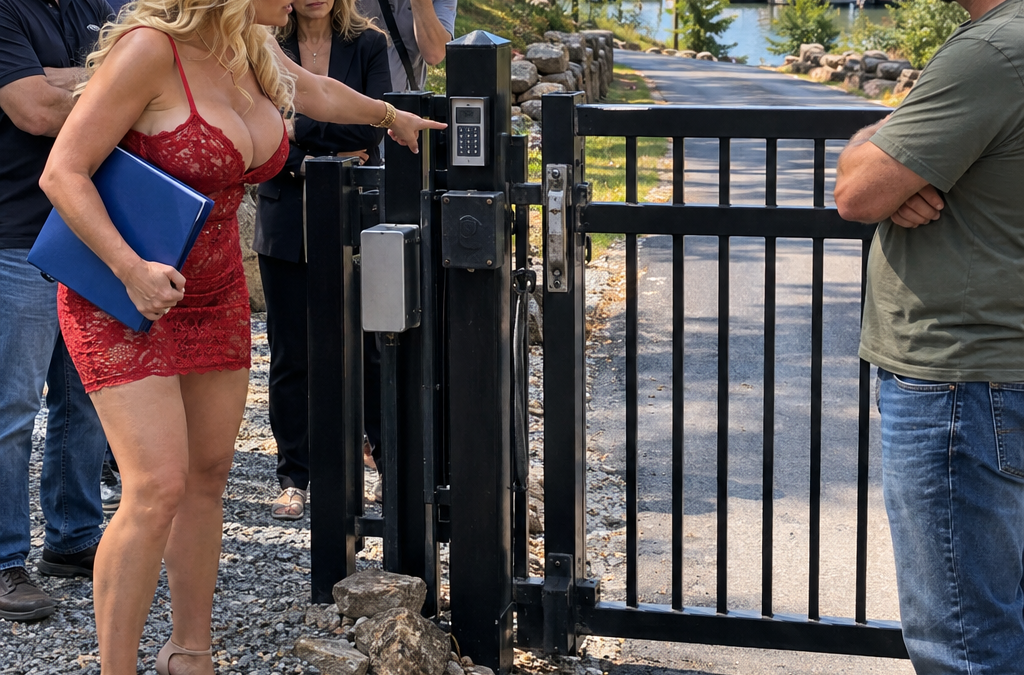
The first thing Karen did when she reached my gate was point at the keypad and tell me it belonged to the HOA now.
Not the road.
Not the marina.
The keypad.
As though taking control of four inches of plastic bolted to a steel post somehow gave her control over everything behind it.
I stood on the other side of the gate with my arms folded while three HOA board members waited behind her and a photographer took pictures of the entrance like they were documenting a property transfer.
Karen Whitmore looked completely at home.
She was forty, blonde, strikingly beautiful, and dressed—as always—in the same tight red lace dress she seemed determined to wear everywhere from board meetings to gravel roads. The dress was low-cut, fitted around her full figure, and so completely unsuited to a private lake road that the contrast would have been funny if she hadn’t been standing there trying to take control of land my family had owned for decades.
Under one arm, she carried a thick blue folder.
That folder worried me more than her smile.
Karen loved paperwork.
She understood that most people saw letterhead, signatures, printed maps, and official-looking tabs and assumed somebody with authority must have approved them.
I had learned the opposite.
Whenever Karen arrived with more paper, I read every line.
She tapped the keypad again.
“We’ll need the current access code.”
I looked at her.
“No.”
Her smile tightened.
“This doesn’t need to become difficult.”
“It isn’t difficult.”
I pointed toward the road behind me.
“This is my family’s private road.”
She glanced toward the asphalt disappearing through the trees toward the lake.
“Not anymore.”
That got my attention.
“What does that mean?”
“The HOA has acquired marina-access rights.”
“From whom?”
“The association.”
I waited.
Karen stared at me as though that answer should have been sufficient.
“Karen, the association can’t acquire rights from itself.”
She sighed.
“You know exactly what I mean.”
“No. I really don’t.”
She opened the folder.
“Our residents now have authorized access to Marina Road and the lake facilities.”
“Show me the document.”
Her expression cooled.
“The board has reviewed everything.”
“Good.”
I held out my hand.
“Show me.”
She ignored it.
Instead, she pointed toward my gate.
“The association will be assuming management of this entrance.”
I laughed once.
Not because anything was funny.
Because the confidence was almost impressive.
“You think you’re taking over my gate?”
“It’s the access point to a community amenity.”
“The marina is not a community amenity.”
“It serves the community.”
“No.”
“It could.”
“That isn’t the same thing.”
Behind Karen, one board member named David looked toward the road and avoided my eyes.
Another, Susan Pike, shifted the folder she was carrying.
Neither appeared as certain as Karen.
That mattered.
I looked at all three.
“Who told you the HOA owns Marina Road?”
Karen stepped forward.
“No one said owns.”
“You said acquired rights.”
“Correct.”
“Then show me the recorded easement.”
Her jaw tightened.
“The access plan is in that folder.”
“That’s not an easement.”
“You haven’t even read it.”
“I don’t need to read an HOA plan to know whether my deed contains an access easement.”
Karen’s smile returned.
It was the expression she used whenever she thought she knew something I didn’t.
“You may want to be careful with statements like that.”
“Why?”
“Because sixty-three residents have already been approved.”
Silence.
I thought I’d misheard her.
“Approved for what?”
“Marina passes.”
I stared at her.
“How many?”
“Sixty-three.”
The number wasn’t random.
That told me immediately this had gone far beyond another HOA complaint.
There were exactly sixty-three marina access passes available under the private system my family had maintained for years.
They corresponded to designated authorized users connected to the lakefront parcel, family properties, leased slips, and limited private-use agreements.
Not sixty-two.
Not sixty-four.
Sixty-three.
Somebody had done research.
Or obtained records they did not understand.
“You promised all sixty-three passes to HOA residents?”
“We allocated them.”
“They aren’t yours to allocate.”
“The board approved the new access structure.”
“The board cannot vote itself ownership of my property.”
Karen’s eyes hardened.
“This marina creates significant value for every home in Pine Ridge.”
“I’m sure it would.”
“Residents have been looking at that lake for years while a handful of people control access.”
“Because the marina is private.”
“Which is precisely the problem.”
There it was.
Not confusion.
Entitlement.
My family had owned the road and lakefront property long before Pine Ridge Estates existed.
The private road ran from the county highway through a strip of wooded land, down a gradual slope, and ended at our marina.
My grandfather maintained it when it was still gravel.
My father paved the steepest section after a storm washed half the road into a drainage ditch.
I had replaced the electronic gate system eight years earlier.
Every boundary marker had been surveyed.
Every deed recorded.
Every legitimate access user documented.
Pine Ridge had been developed beside us decades later.
For years, nobody objected.
Then lakefront property values exploded.
Suddenly, a private road leading to a private marina wasn’t just a family access route.
It was worth money.
A lot of money.
And Karen understood money.
She leaned toward the gate.
“You can cooperate voluntarily, or we can formalize the transition.”
I stared at her.
“Transition?”
“To HOA management.”
“You’ve already promised passes.”
“Yes.”
“You’ve already told residents they’ll have access.”
“Yes.”
“And you did all that before speaking to the landowner.”
Her lips pressed together.
“We have been trying to speak to you for weeks.”
“You’ve been sending me newsletters.”
“Official notices.”
“Newsletters with bold headings are still newsletters.”
David almost smiled.
Karen saw him.
He stopped.
She turned back to me.
“You’re creating unnecessary conflict.”
“No.”
I shook my head.
“You created sixty-three promises using somebody else’s property.”
That finally cracked her composure.
“You have no idea how much work went into this plan.”
“I believe you.”
“Legal reviewed it.”
“Which legal?”
She paused.
“Our HOA attorney.”
“What recorded instrument did he review?”
Her face hardened again.
“You’ll receive appropriate documentation.”
“When?”
“At the implementation meeting.”
“There will be no implementation meeting.”
“You don’t get to decide that.”
I looked at the keypad.
Then at the road.
Then at the marina visible through the trees.
“Yes, Karen.”
I met her eyes.
“I do.”
She left angry.
I expected a letter.
Instead, the next morning I found a bright red notice attached directly to my gate.
Not mailed.
Not emailed.
Attached to my private gate.
NOTICE OF HOA-MANAGED MARINA ACCESS
Beneath that:
Effective Immediately, Marina Road Access Will Be Administered Through Pine Ridge Estates Homeowners Association.
Then a list of pass numbers.
Sixty-three of them.
Resident names beside each.
I stood there for nearly a minute.
A cold feeling settled in my stomach.
Karen hadn’t merely threatened to take control.
She was creating paperwork designed to make it look as though control had already changed.
That was more dangerous.
If residents showed up believing they held valid access passes, I would suddenly have dozens of people trying to use my private road.
Some would bring vehicles.
Boats.
Trailers.
Guests.
Children.
If I locked them out, Karen could portray me as the unreasonable property owner denying rights they had supposedly purchased through the HOA.
If I let them through, she might later argue that repeated use proved recognized access.
I pulled out my phone.
Photographed the notice from every angle.
Gate.
Date.
Names.
Pass numbers.
HOA logo.
Then I removed it carefully without tearing anything.
My wife came down the road in the golf cart while I was photographing the post.
“What now?”
I handed her the notice.
She read the first paragraph.
Then looked at me.
“They actually issued passes?”
“All sixty-three.”
“Can they do that?”
“No.”
“You sound very certain.”
“I am.”
She looked toward Pine Ridge.
“Karen sounds pretty certain too.”
That was the problem.
Confidence creates chaos when enough people believe it.
I spent the rest of the morning gathering records.
Original deed.
Current deed.
Historical survey.
Most recent boundary confirmation.
Marina operating documents.
Access agreements.
Pass history.
Tax records.
Then I called Martin Ellis, my property attorney.
He listened quietly.
“Sixty-three?”
“All available pass slots.”
“That isn’t accidental.”
“No.”
“Did the HOA collect money?”
“I don’t know.”
“Find out.”
“What difference does it make?”
“A lot.”
I leaned back.
“Can they claim an easement?”
“Anybody can claim anything.”
“You know what I mean.”
“Yes.”
He paused.
“If a recorded easement exists, we’ll find it. If one doesn’t, Karen’s access plan doesn’t manufacture one.”
“What about historical use?”
“Has Pine Ridge ever used the road openly under a claimed right?”
“No.”
“Any agreement with the developer?”
“Not that I know.”
“Any road-maintenance sharing?”
“No.”
“Gate codes?”
“Never.”
“Good.”
I exhaled.
“So we send her a cease-and-desist.”
“Yes.”
“Anything else?”
“Contact the state office that regulates the relevant marina access and property issues.”
That surprised me.
“Why?”
“Because Karen is trying to tie land access to marina passes. I want an independent administrative record before sixty-three residents start driving through your gate.”
That afternoon, I sent the state office a packet.
The red HOA notice.
My deed.
Survey.
Marina documents.
Photographs of the gate.
A short explanation.
I expected bureaucracy.
Two weeks.
Maybe a month.
Instead, an inspector called the following morning.
His name was Thomas Reed.
He had spent more than twenty years working with shoreline access, survey disputes, and marina permitting.
“I’ve reviewed your submission.”
“That was fast.”
“Sixty-three newly issued access passes attached to a private marina gets attention.”
“Good.”
“Are they currently using the road?”
“Not yet.”
“Keep it that way until we verify the records.”
That was exactly what I wanted to hear.
He scheduled an inspection.
Karen learned about it before he arrived.
I still don’t know who told her.
Maybe someone inside the HOA office.
Maybe one of the passholders.
Maybe the state contacted the association for records.
Either way, she drove to my gate the day before the inspection.
Red lace dress.
Blue folder.
No board members this time.
I didn’t open the gate.
She stood outside.
“You contacted the state.”
“Yes.”
She laughed.
Actually laughed.
“You really are determined to embarrass yourself.”
“Probably.”
“The state isn’t going to decide a private HOA access plan.”
“They’re going to inspect the marina and road records.”
“We have legal documentation.”
“Excellent.”
I leaned against the gate.
“Bring it tomorrow.”
“You think the inspector is going to invalidate sixty-three passes because you don’t like Pine Ridge residents?”
“This isn’t about whether I like them.”
“You’ve always acted as though the lake belongs to your family.”
“It does.”
“The lake?”
“The marina parcel and road.”
“Exactly.”
She smiled.
“That attitude is why access reform was necessary.”
I stared at her.
“Access reform?”
“Yes.”
“You mean giving away rights you don’t own.”
“Your family has controlled that corridor for decades.”
“Because my family owns it.”
“You’ve benefited enormously from scarcity.”
Now we were getting somewhere.
I narrowed my eyes.
“Did you charge residents for the passes?”
Her expression changed.
Just enough.
“How much?”
“That information is private HOA business.”
“Karen.”
I stepped closer to the gate.
“Did the HOA collect money based on access to my marina?”
“They paid an amenity assessment.”
I almost laughed.
“How much?”
“That’s irrelevant.”
“No.”
“It is absolutely relevant.”
She folded her arms.
“The board invested in an expanded lake-access program.”
“Using my road.”
“We dispute ownership of the access rights.”
“You haven’t shown me one recorded document.”
“You’ll see everything tomorrow.”
Then she smiled.
“Try not to look so nervous.”
She left.
I wasn’t nervous about the deed.
I was nervous about sixty-three people who may have paid money for something Karen had no right to sell.
That changed the stakes.
Thomas Reed arrived at 8:00 the following morning.
He didn’t come alone.
A survey technician accompanied him.
Their state vehicle carried cases of equipment, rolled maps, and enough files to make Karen’s blue folder look almost decorative.
Thomas introduced himself at the gate.
Then looked toward the road.
“This is the only vehicle entrance?”
“For the marina parcel, yes.”
“Any secondary easement?”
“Not from Pine Ridge.”
“Historic footpath?”
“Nothing recorded that I’m aware of.”
He nodded.
“Let’s walk it.”
Karen arrived before we made it fifty yards.
Black SUV.
David beside her.
HOA attorney in another vehicle.
Karen climbed out and walked toward us quickly.
“You started without the association?”
Thomas looked at her.
“Are you Ms. Whitmore?”
“Karen Whitmore, HOA president.”
She extended her hand.
He shook it.
“We’re inspecting recorded access and boundary conditions.”
“I’ve brought our records.”
“Good.”
She gave me a smug look.
Then followed us.
Thomas started at the gate.
He photographed the boundary monument near the county road.
Checked coordinates.
Compared them with the state survey file.
Then walked slowly downhill.
He examined another monument beside an old stone retaining wall.
My grandfather had rebuilt that wall sometime in the seventies.
The survey pin had been protected inside a square opening ever since.
Karen talked almost continuously.
“The road serves the entire lakefront district.”
Thomas made a note.
“Has Pine Ridge historically maintained it?”
“We’ve contributed to the broader community.”
“That wasn’t my question.”
Karen glanced at me.
“Road maintenance has traditionally been handled privately.”
“By whom?”
She paused.
“My family,” I said.
Thomas noted it.
Karen continued.
“But that’s one reason the new management plan is necessary.”
Thomas looked at her.
“Necessary isn’t the same as authorized.”
Her smile tightened.
“We’re confident about our rights.”
“Good.”
He continued walking.
“Then this should be straightforward.”
At the third marker, Thomas stopped.
It was an old stone boundary monument set several feet off the pavement.
Most people wouldn’t notice it.
He brushed dirt from the top.
Checked a map.
Then looked toward Karen.
She stopped talking.
That was the first time all morning.
Thomas looked at his technician.
“Confirm this point.”
The technician set the equipment.
Waited.
Read coordinates.
Nodded.
Thomas unfolded a survey.
The line on the map ran parallel to the road before wrapping around the marina parcel.
Exactly where my family had always understood it to be.
Karen stepped closer.
“The HOA map places the western community corridor differently.”
Thomas held out his hand.
“Can I see it?”
She opened the blue folder.
There it was.
A glossy Pine Ridge access map.
Colored lines.
Amenity zones.
Trail corridors.
Marina designation.
And one thick blue route labeled:
COMMUNITY MARINA ROAD
My private road.
Thomas laid the HOA map over a copy of the official survey.
The two did not match.
Not even close.
Karen pointed.
“There.”
Thomas looked.
“What?”
“The access corridor.”
“That’s drawn on your planning map.”
“Correct.”
“I need the recorded instrument creating it.”
She blinked.
“Our plan incorporates existing community access.”
“Recorded where?”
“In the Pine Ridge documents.”
“Which document?”
She opened the folder wider.
Pages began moving.
Board resolutions.
Amenity plan.
Marina pass policy.
Resident communications.
A development agreement.
Thomas waited.
Karen pulled out an access agreement.
“This.”
The HOA attorney stepped closer.
“Yes. That’s the controlling access agreement.”
Thomas took it.
Read page one.
Page two.
Legal description.
Exhibit.
Then handed it to his technician.
“Overlay this.”
The technician checked the parcel reference.
Then shook his head.
Thomas looked at Karen.
“This agreement doesn’t cover Marina Road.”
Her face tightened.
“It covers the lake-access corridor.”
“No.”
He pointed toward the legal description.
“It covers an internal Pine Ridge access lane terminating east of this property.”
The attorney intervened.
“With respect, the agreement has historically been interpreted broadly.”
Thomas turned toward him.
“Historical interpretation doesn’t expand a legal description.”
The attorney opened his own briefcase.
“We have additional materials.”
For the next thirty minutes, they produced papers.
Meeting records.
Developer correspondence.
Conceptual maps.
Old amenity brochures.
A title summary.
A shoreline-use memorandum.
Nothing conveyed rights over my road.
Thomas finally looked toward me.
“Do you have your original deed?”
I handed it to him.
He studied the legal description for a long time.
Long enough that even I became nervous.
Then he walked farther down the road.
Karen followed.
So did the attorney.
At the last bend before the lake, Thomas stopped beside another marker.
Beyond it, the marina opened across the water.
Sixty-three pass slots.
Private slips.
A launch area.
Storage.
A small service building.
My family’s land.
Thomas compared the deed against the survey.
Then his technician pulled up an older property record.
Thomas stared at it.
“What did you find?” Karen asked.
He didn’t answer immediately.
Instead, he pointed toward a boundary call tied to the old stone monument.
The road was specifically included within the lakefront parcel.
Not merely an access easement.
Not shared right-of-way.
Property.
My family’s.
The older record confirmed that ownership had remained continuous.
No transfer to the subdivision developer.
No later dedication to Pine Ridge.
No HOA easement.
Nothing.
Thomas looked at me.
Then said something that confused everyone else.
“Judge, look at this boundary.”
Karen turned sharply.
“Judge?”
David stared at me.
Even the HOA attorney looked surprised.
I almost laughed.
Thomas knew my family name from older county records.
Several generations of my family had served locally in civic roles, and somewhere along the way older officials occasionally used “Judge” as an informal courtesy when talking to members of the family.
It wasn’t relevant to ownership.
I wasn’t standing there trying to impress anyone with a title.
The deed mattered.
The survey mattered.
The marker mattered.
Not what Thomas called me.
I stepped beside him.
He pointed toward the map.
“The recorded line takes the entire road and the marina access parcel inside this deed.”
“I know.”
“I wanted you to see how clearly the old record confirms it.”
Karen stepped forward.
“This is inappropriate.”
Thomas looked at her.
“What is?”
“You’re obviously familiar with him.”
“I recognize the family name.”
“So you’re biased.”
“No.”
His voice stayed completely calm.
“I’m reading the official records.”
“Calling him Judge isn’t exactly neutral.”
He nodded.
“Fair enough.”
Then he folded the map.
“So forget the title.”
He pointed toward the stone marker.
“That monument is neutral.”
Then toward my deed.
“That legal description is neutral.”
Then toward the survey.
“That recorded boundary is neutral.”
Karen’s face turned pale.
Thomas looked at her.
“Now I need the HOA’s recorded easement over this road.”
She opened the folder again.
“I already gave you the access agreement.”
“It doesn’t cover this parcel.”
“Our attorney disagrees.”
Thomas turned toward the attorney.
“Do you have another recorded instrument?”
The attorney hesitated.
“We believe contractual rights exist.”
“I didn’t ask what you believe.”
Thomas held out his hand.
“Identify the recorded instrument.”
The attorney opened another document.
Thomas read it.
Shook his head.
“Different parcel.”
Another.
“Internal road.”
Another.
“Developer-owned land east of this boundary.”
Karen’s breathing became more noticeable.
She looked toward David.
“Where is the marina document?”
David blinked.
“What marina document?”
“The original.”
“I don’t know.”
“You were on the committee.”
“Three years ago.”
“You reviewed these.”
“I reviewed the access plan.”
Karen’s voice sharpened.
“Then where is it?”
David looked around.
“I assumed legal had the easement.”
The attorney immediately said, “We never represented that a recorded easement covered this road.”
Karen turned on him.
“You approved the plan.”
“We reviewed the plan language.”
“That’s the same thing.”
“No.”
His answer was quiet.
But devastating.
“It isn’t.”
Silence spread along the marina road.
For the first time, Karen seemed to understand how large the mistake was.
Sixty-three passes.
Sixty-three residents.
Potentially sixty-three amenity assessments.
Promises.
Access schedules.
Marketing.
All built on the assumption that because the HOA wanted the marina road, the HOA somehow had the right to manage it.
Thomas closed his file.
“Here’s where we are.”
Karen stared at him.
“The recorded records place Marina Road and the lakefront parcel within the Bennett family property.”
She opened her mouth.
He held up one hand.
“I’ve reviewed the HOA materials you’ve provided.”
Her mouth closed.
“I have not seen a recorded easement, dedication, transfer, or other instrument giving Pine Ridge Estates control of this road.”
The attorney said, “We reserve the right to provide supplemental documentation.”
“Of course.”
Thomas nodded.
“But until you do, your association should not represent these passes as granting legal access through private property.”
Karen’s face went white.
“Sixty-three residents have already been issued passes.”
“I understand.”
“We collected assessments.”
Thomas looked at her.
“That makes verification more important, not less.”
“You can’t simply invalidate an HOA program.”
“I’m not invalidating a program.”
He pointed toward the gate in the distance.
“I’m telling you a program does not override a recorded property boundary.”
Karen looked toward me.
“You set this up.”
I stared at her.
“What?”
“You called the state knowing they’d take your side.”
Thomas answered before I could.
“No.”
She turned toward him.
“You knew his family.”
“I know hundreds of family names in this county.”
“You called him Judge.”
“And I’ve already explained why that isn’t relevant.”
He picked up my deed.
“This is why the road is private.”
Then the official survey.
“And this.”
Then pointed toward the marker.
“And this.”
His voice remained calm.
“Not because I know his name.”
Karen looked at the HOA attorney.
“Do something.”
He looked exhausted.
“We need to review title.”
“We already reviewed it.”
“No.”
He shook his head.
“We reviewed HOA documents.”
That distinction finally landed.
Karen had spent months staring at Pine Ridge records.
Nobody had gone backward far enough to verify whether Pine Ridge ever possessed the underlying access right.
The association had essentially been studying its own assumptions.
The state office issued its written determination shortly afterward.
The language was careful.
Administrative.
Boring.
And devastating.
The recorded documentation supported continued private control of Marina Road and the associated access parcel.
Pine Ridge’s marina plan could not create access rights over property the association did not own or lawfully control.
Any claimed rights would require a valid recorded instrument.
The sixty-three HOA passes could not be treated as independent authorization to enter my property.
Karen called an emergency board meeting.
This time, I attended with Martin.
The clubhouse was packed.
That was predictable.
Sixty-three passholders alone were enough to fill most of the room.
Some had apparently paid substantial amenity assessments based on Karen’s new marina-access plan.
People were angry.
Not at me initially.
Mostly confused.
Karen stood at the front beneath a slide reading:
MARINA ACCESS UPDATE
Same red lace dress.
Black blazer.
Blonde hair perfect.
But I noticed her hands.
They shook slightly when she adjusted the microphone.
“We are currently addressing an unexpected state-level interpretation concerning Marina Road.”
A man in the front row raised his hand.
“You told us access was guaranteed.”
Karen smiled.
“The HOA acted based on the information available.”
“You charged us.”
“The assessments funded the overall access initiative.”
A woman beside him called out.
“Can we use the marina or not?”
Karen hesitated.
“That is under review.”
The room erupted.
I stayed seated.
Martin leaned toward me.
“Don’t say anything unless necessary.”
“I wasn’t going to.”
“You’re lying.”
“A little.”
Karen struck the gavel.
“Order.”
People quieted slowly.
Then Karen looked directly at me.
“Mr. Bennett has challenged the association’s long-established access understanding.”
I stood before Martin could stop me.
“No.”
The room quieted.
“I challenged sixty-three passes you issued over my private road.”
Karen’s face hardened.
“You know exactly what I mean.”
“I know exactly what the state inspector found.”
“This is still under legal review.”
“Good.”
I looked around.
“Then the legal review should begin with one question.”
Someone asked, “What question?”
I pointed toward Karen’s blue folder.
“Where is the recorded easement?”
Silence.
Karen stepped toward the microphone.
“There are extensive contractual documents.”
“Not what I asked.”
“You are not running this meeting.”
“No.”
I nodded.
“But you’re trying to run my road.”
A few residents laughed.
Karen flushed.
“This isn’t funny.”
“I agree.”
I looked toward the sixty-three residents.
“Some of you apparently paid money because you were told you’d receive marina access.”
Faces hardened.
Karen interrupted.
“That is a gross simplification.”
“Then explain it.”
“The amenity assessment covered planning, administration, safety infrastructure, and access coordination.”
A resident shouted, “You sold me a marina pass.”
Another called, “Me too.”
Then another.
The room got louder.
Karen hit the gavel.
David finally leaned toward his microphone.
“We need to answer the ownership question first.”
Karen turned toward him.
“We are answering it.”
“No.”
He shook his head.
“We’re avoiding it.”
The clubhouse went quiet.
David continued.
“I thought we had an easement.”
Karen stared at him.
“So did everyone.”
“That’s not an answer.”
“Legal approved the plan.”
The HOA attorney was sitting near the side wall.
Every head turned toward him.
He slowly stood.
“I need to clarify something.”
Karen’s expression changed.
“Sit down.”
He ignored her.
“Our office reviewed the access-plan documents prepared by the association.”
A resident asked, “Did you verify ownership of the road?”
He paused.
“No.”
The room exploded.
Karen stepped toward him.
“That is completely misleading.”
“It is accurate.”
“You told us the program was legally defensible.”
“Based on representations that the association held marina-access rights.”
“Because we did.”
He looked at her.
“Where is the instrument?”
Same question.
Again.
Karen had no answer.
Her entire plan was collapsing around one missing piece of paper.
Martin finally stood.
“My client is not asking Pine Ridge to give him anything.”
The room quieted.
“He is asking the HOA to stop giving away something that is already his.”
Karen scoffed.
“That road has benefited this community for decades.”
Martin looked at her.
“Benefit does not equal ownership.”
“Residents have accessed the lake.”
“Through invitation or specific authorization.”
“Which establishes a pattern.”
“No.”
Martin shook his head.
“Permission does not automatically become a permanent public easement because the HOA prefers that interpretation.”
One resident raised his hand.
“What happens to our passes?”
Karen opened her mouth.
David answered first.
“They’re suspended.”
Karen turned.
“You do not have authority to announce that.”
“As a board member, I have authority to move that we stop misrepresenting access until counsel verifies legal rights.”
Susan said, “Second.”
Karen stared at both of them.
“You’re panicking.”
Susan looked almost angry.
“No.”
She gestured toward the room.
“I’m trying to stop this from getting worse.”
The vote happened minutes later.
Four to one.
The marina-access plan was suspended.
Karen voted no.
Of course.
After the meeting, several residents approached me.
I expected anger.
Some were angry.
But not for the reason Karen had predicted.
A man named Robert held up his pass.
“I paid twelve hundred dollars for this.”
I stared at him.
“Twelve hundred?”
“Annual marina-access assessment.”
My jaw tightened.
Another woman said, “We were told the road rights had already been acquired.”
“From whom?”
“Karen never said.”
Robert looked toward her across the room.
“She said the old private arrangement had been replaced.”
That phrase bothered me.
Replaced.
As though private property rights were an outdated policy that could be updated at a board meeting.
I looked at their passes.
Beautifully printed.
Holographic strip.
Number.
HOA logo.
Barcode.
Completely useless without my gate opening.
“I didn’t know you were paying for these.”
Robert sighed.
“I didn’t know you owned the road.”
“That was apparently the problem.”
Martin documented the statements.
The HOA’s internal investigation began within days.
Once the board realized residents had paid assessments tied directly to the marina-access promise, the issue stopped being merely embarrassing.
Money changes urgency.
Board members demanded records.
Who proposed the plan?
Who verified the road?
Who told residents access had been acquired?
Who authorized collection of the assessments?
The paper trail kept leading back to Karen.
She had discovered references to sixty-three historical pass slots in old marina-related material.
Instead of verifying who controlled them, she assumed the passes were a dormant community asset.
Then she built a program around them.
The more residents wanted access, the more confident she became.
Demand became evidence in her mind.
If sixty-three households wanted passes badly enough to pay, surely the HOA should control them.
That wasn’t law.
It was wishful thinking with invoices.
Pine Ridge refunded the marina-access assessments.
That alone cost the association a painful amount of money.
Karen tried to blame the state office.
Then the attorney.
Then old subdivision developers.
Then poor recordkeeping.
Every explanation had one flaw.
I had asked her for the deed or easement before she issued the plan.
She chose not to check.
A few weeks later, Karen came back to my gate.
Alone.
No blue folder.
That was unusual.
I was changing one of the keypad housings.
She stood outside.
“Are you going to open it?”
“No.”
Her lips tightened.
“I want to talk.”
“We’re talking.”
She looked toward the lake.
“You got what you wanted.”
“What did I want?”
“Control.”
I almost laughed.
“My family already had control.”
“That marina could serve hundreds of people.”
“Maybe.”
“And you prefer sixty-three private slots.”
“I prefer deciding what happens on my land.”
“That’s selfish.”
I looked at her.
“You sold sixty-three passes to a road you didn’t own.”
“I didn’t sell the road.”
“You sold access.”
“We believed the HOA held rights.”
“I asked you for proof.”
“You were hostile from the beginning.”
“No.”
I shook my head.
“I asked one question.”
“What?”
“Show me the document.”
She said nothing.
“That was all you ever had to do.”
“We had documents.”
“You had plans.”
“Yes.”
“Karen, plans describe what people want to happen.”
I pointed toward the pavement beneath us.
“Deeds describe who owns this.”
Her face tightened.
“You really enjoy explaining things to me.”
“Not particularly.”
“You humiliated me.”
“I didn’t issue the passes.”
“You called the state.”
“After you attached a management notice to my gate.”
She looked away.
For a moment, I saw something different.
Not remorse exactly.
Exhaustion.
Then she said, “Do you know what those passes could have done for Pine Ridge property values?”
There it was.
Even after everything.
Value.
“That was the point?”
“Of course it was part of the point.”
“How much?”
“What?”
“How much did marina access increase estimated home values?”
She hesitated.
“Depending on the property, potentially tens of thousands.”
Now I understood why she’d fought so hard.
Sixty-three passes multiplied across dozens of high-end homes could create millions in perceived neighborhood value.
To Karen, my road had become an undeveloped financial asset sitting beside Pine Ridge.
She couldn’t stand that somebody else controlled it.
“You thought my family was wasting something valuable.”
“Yes.”
The honesty surprised me.
“And that gave you the right to take it?”
“I didn’t take anything.”
“You changed the gate notice.”
“Temporarily.”
“You issued passes.”
“Under what we believed were rights.”
“You marketed marina access to residents.”
She folded her arms.
“You make everything sound criminal.”
“I make it sound documented.”
She hated that answer.
I finished tightening the keypad housing.
Karen watched.
“Will you ever allow HOA residents access?”
“Individually? Possibly.”
“Through Pine Ridge?”
“Not under your plan.”
“Why?”
“Because the road is private.”
“That isn’t an answer.”
“It is the whole answer.”
She left.
The HOA board formally withdrew the marina-access program the following month.
Their written notice acknowledged that Pine Ridge had not established recorded rights over Marina Road and could not issue independent marina passes through my family’s property.
It also clarified that future lake access would require authorization from the landowner or a valid recorded instrument.
Simple.
Obvious.
Expensive lesson.
Susan became interim HOA president after Karen resigned several weeks later.
Karen publicly called it a personal decision.
Nobody believed that.
The pass scandal had destroyed confidence in her leadership.
Not because residents suddenly hated her.
Because she had promised something concrete.
Lake access.
A marina pass.
A gate code.
And when the paperwork was finally checked, none of it belonged to her.
Susan called before visiting the property.
That alone was an improvement.
“Can I come down to the marina?”
“Yes.”
“Through the gate?”
“That is usually how roads work.”
She laughed.
I gave her a temporary code.
We drove to the lake.
Evening sunlight reflected across the water.
Boats rocked gently against the docks.
Susan stood at the edge.
“I understand why people wanted this.”
“I do too.”
“It’s beautiful.”
“Yes.”
She looked toward the road.
“I also understand why you fought.”
“I wasn’t trying to keep Pine Ridge away because I hate your residents.”
“I know.”
“I was trying to stop the HOA from deciding ownership based on demand.”
Susan nodded.
“We should’ve checked.”
“Yeah.”
She sighed.
“Karen kept saying the old marina-pass system proved we had historical rights.”
“It proved passes existed.”
“That’s what the attorney said.”
“Who controlled the passes matters.”
She smiled sadly.
“We know that now.”
The marina remained private.
I did eventually authorize a small number of additional users.
Not sixty-three.
And not through an HOA decree.
Individual agreements.
Clear terms.
Liability provisions.
Road-maintenance contributions.
Revocable access where appropriate.
Everything documented.
One Pine Ridge family received access because the husband volunteered with the lake rescue unit.
Another because their property had an older legitimate agreement in its chain of title.
A third leased a slip directly.
That was how rights should work.
Specific.
Documented.
Voluntary.
Karen’s plan had tried to replace all of that with one board resolution.
The keypad stayed under my control.
I upgraded the system after the dispute.
Every authorized user had a unique code.
Entries were logged.
No shared HOA master code.
No board override.
No Karen.
The bright red HOA notice went into my records.
I kept it.
Not because I enjoyed remembering the fight.
Because it was a perfect example of how authority can be manufactured visually.
Red paper.
Bold heading.
Official logo.
Pass numbers.
Resident names.
Effective date.
Everything about it looked final.
Except the one thing that actually mattered.
The HOA didn’t own the road.
Years later, my nephew found the notice while helping me organize files.
He read it.
Then looked confused.
“Why did they think they owned Marina Road?”
“They didn’t exactly.”
“What do you mean?”
“They wanted access.”
“So?”
“They found paperwork that made them think they could claim it.”
He frowned.
“But didn’t they check the deed?”
“No.”
“That’s stupid.”
I laughed.
“That’s a simple version.”
“What happened to the sixty-three passes?”
“They were canceled.”
“All of them?”
“Yes.”
“What happened to the people who paid?”
“Refunded.”
“What happened to Karen?”
“She stopped being president.”
He nodded like the universe had restored itself properly.
Then he asked, “What’s an easement?”
I smiled.
That question took longer.
We drove down Marina Road afterward.
I showed him the stone marker where Thomas had stopped.
The one that made Karen go silent.
I showed him where the legal line ran.
Then the marina parcel.
He listened.
At the dock, he asked, “So if the HOA had a real easement, they could’ve used the road?”
“Depending on what it said.”
“Even though we own it?”
“Yes.”
“That sounds confusing.”
“It can be.”
He looked at the water.
“So ownership isn’t always enough.”
“Correct.”
“What matters?”
“Exactly what rights are recorded.”
He nodded.
Then grinned.
“Grandpa would tell me to keep the paperwork.”
I smiled.
“He absolutely would.”
That was the lesson my family had always understood.
Land isn’t protected by memory alone.
Everybody in my family knew Marina Road belonged to us.
That felt obvious.
But obvious isn’t enough when someone arrives with a competing folder.
You keep deeds.
Surveys.
Recorded agreements.
Maps.
You know which rights you’ve granted and which you haven’t.
Because one day somebody may stand at your gate and confidently announce that sixty-three strangers now have legal access to your property.
And confidence can sound frighteningly official.
The state inspector never became part of some dramatic friendship with my family.
I saw Thomas a handful of times afterward.
He remained exactly what he’d been that morning.
A professional reading records.
Once I ran into him at the county office.
He smiled.
“Judge.”
I laughed.
“You caused enough trouble with that.”
He chuckled.
“I heard.”
“Karen thought you were biased.”
“She would’ve thought gravity was biased if the records fell against her.”
I laughed harder.
Then he became serious.
“You know the family name wasn’t why that went your way.”
“I know.”
“You had good records.”
“I know.”
“That’s why.”
That mattered.
I never wanted the story becoming, State inspector recognizes important family and saves private road.
That wasn’t what happened.
The records saved the road.
If my name had been Smith, Martinez, Johnson, Patel, or anything else, the legal description would still have been the same.
The stone marker wouldn’t have moved.
Karen’s missing easement wouldn’t have appeared.
Titles can impress people.
Deeds settle land.
Pine Ridge eventually changed its policies.
Any future HOA program involving outside property required title verification by counsel.
Amenity passes could not be sold until access rights were confirmed.
Board members had to identify whether an asset was HOA-owned, leased, licensed, or merely adjacent.
Again, nothing revolutionary.
Just basic diligence.
The kind Karen had skipped because she was too excited by what the road could be worth.
One summer, Pine Ridge held a neighborhood meeting about constructing its own small lake-access facility on property it actually owned.
Susan invited me as a neighboring landowner.
I attended.
The proposed site was less convenient.
Smaller.
More expensive to develop.
But it belonged to Pine Ridge.
Someone asked whether they could negotiate access through Marina Road during construction.
Susan looked toward me.
“Only if the landowner agrees.”
I smiled.
Progress.
We eventually reached a limited construction-access agreement.
Temporary.
Specific vehicles.
Specific dates.
Insurance.
Road restoration.
Everyone signed.
Nobody pretended a board vote replaced my signature.
When construction ended, the temporary access ended.
That’s how simple the original dispute could have been.
Ask.
Negotiate.
Document.
Respect no.
Karen skipped directly to entitlement.
The private marina never became an HOA amenity.
That disappointed some residents.
Others eventually admitted they had been uncomfortable with how the passes were sold.
Robert, the man who paid twelve hundred dollars, became one of my marina lessees years later.
Legitimately.
He laughed the first time I handed him a real access agreement.
“This is less impressive than Karen’s pass.”
Mine was plain white paper.
No hologram.
No fancy logo.
“Mine works.”
He laughed.
“Good point.”
His family used the marina responsibly.
Helped with spring cleanup.
Contributed to road maintenance.
Never caused trouble.
That was proof the conflict had never been about keeping Pine Ridge people out.
It was about who got to decide.
Ownership matters because decision-making matters.
A road isn’t just pavement.
It carries liability.
Maintenance.
Drainage.
Snow removal.
Traffic.
Emergency access.
Insurance.
Wear.
Security.
One person promising sixty-three additional users changes all of those things.
Karen promised the benefit.
She never planned for the responsibility.
My family would have been left maintaining a road supporting dozens of new users while the HOA collected the value.
That wasn’t community sharing.
That was taking.
The old blue folder Karen carried that first morning eventually appeared during discovery of the HOA records.
Martin showed me a copy of the internal notes.
Karen had written in the margin beside the sixty-three passes:
Full allocation increases amenity value. Avoid partial access model.
Another note said:
Once implemented, resistance becomes unlikely.
That sentence bothered me.
Once implemented, resistance becomes unlikely.
Karen’s strategy had never depended entirely on proving ownership.
It depended on momentum.
Issue the passes.
Notify residents.
Change the gate notice.
Create expectations.
Then make me the person who had to undo everything.
She assumed social pressure would succeed where title documents didn’t.
Sixty-three families would be angry.
The HOA would accuse me of harming their investment.
Maybe I’d negotiate just to make the noise stop.
It was clever.
It was also why photographing that first red notice mattered so much.
Once the state saw the sequence, the plan stopped looking like harmless confusion.
Karen had acted first and planned to sort authority out later.
That’s backwards.
You establish rights first.
Then you exercise them.
Otherwise you’re gambling with someone else’s property.
One autumn evening, long after Karen was gone from the board, I drove slowly down Marina Road.
The gate closed behind me.
Trees along the road had begun turning gold.
At the final bend, the lake appeared between them.
Marina lights reflected across the water.
Boats shifted against their lines.
Everything looked exactly as it had before the HOA decided it was a multimillion-dollar amenity waiting to be claimed.
I parked near the dock and stood by the water.
For weeks during the dispute, every trip down that road felt like an argument.
I would pass the stone marker and think about Karen.
Drive through the gate and think about lawyers.
Look at the marina and think about sixty-three passes.
That evening, I thought about none of it.
The road felt like a road again.
That was what I had wanted.
Not victory.
Normal.
Private property disputes distort ordinary things.
A gate becomes evidence.
A road becomes a legal description.
A stone becomes a boundary monument.
A marina pass becomes a claimed property right.
Then the dispute ends, and those things become ordinary again.
That is peace.
Karen once told me I was selfish for controlling the road.
Maybe she still believes that.
I can live with it.
Private ownership isn’t always popular.
Especially when the property has value other people want.
But popularity doesn’t decide title.
Neither does an HOA board.
Neither does a blue folder.
Neither do sixty-three expensive promises.
Karen thought she could transform my family’s private road into a community amenity by announcing that the transition had already happened.
She expected confidence to create compliance.
Instead, one state inspector walked the road, checked the markers, read the deed, and asked her to identify the recorded instrument giving Pine Ridge access.
That was all.
No shouting.
No dramatic legal trick.
No secret clause.
One question.
Where is the document?
Karen searched page after page.
Her attorney searched too.
They had everything except the thing that mattered.
Ownership.
The sixty-three passes disappeared.
The assessments were refunded.
The HOA notice came off my gate.
My private-property sign went back up.
The keypad remained mine.
Marina Road remained part of our lakefront parcel.
And Pine Ridge learned something my grandfather had known long before a subdivision existed beside us.
You can print a map.
You can promise access.
You can collect money.
You can issue passes.
You can fill a folder with resolutions, policies, diagrams, and legal language.
But none of those things move a property boundary.
For that, you need an actual right.
Karen never had one.
My family did.
And every evening when the gate closes behind me and I see the marina lights reflecting across the lake, I remember exactly why that distinction mattered.








