𝗙𝗨𝗟𝗟 𝗦𝗧𝗢𝗥𝗬 The HOA President Parked a Massive Excavator Across My Only Driveway and Threatened to Take My Farm if I Tried to Move It
𝗣𝗔𝗥𝗧 𝟮
I looked out the window at my barn.
“Of course he does.”
I submitted the appeal.
Two weeks later, it was denied.
The letter came from Dean himself.
He wrote that agricultural structures created an inconsistent visual character and that the association had broad discretion to preserve neighborhood harmony.
I wrote back, attaching photographs, survey records, and a copy of my deed.
Dean responded with another fine.
Seventy-five dollars.
Then came a citation for storing feed containers outside the barn.
Another for a section of fencing that supposedly failed to meet the approved appearance standard.
Another because my mailbox remained the wrong shade of white.
The numbers were small enough individually that each one seemed almost absurd.
But the association’s late-fee policy caused unpaid balances to increase every thirty days.
Soon the mailbox account alone showed nearly nine hundred dollars.
I stared at the statement at my kitchen table.
Nine hundred dollars.
For paint.
I called Dean directly.
To my surprise, he answered.
“Whitlock.”
“Dean, it’s Mike. We need to talk about these fines.”
“Your account is delinquent.”
“My account is ridiculous.”
He exhaled slowly.
“Michael, that’s not a productive way to begin a conversation.”
“Then let’s be productive. My property isn’t a regular Briar Glen lot. I’ve sent you the deed and the survey.”
“I’ve reviewed your correspondence.”
“Then you know the rules don’t apply the way you’re claiming.”
“That’s your interpretation.”
“It’s what the documents say.”
There was a small silence.
Then he spoke in a voice so smooth it made me angrier than if he’d shouted.
“Mike, when you purchase property adjacent to a premium residential community, you assume certain responsibilities.”
“I bought my farm before most of those houses existed.”
“And now circumstances have changed.”
“My deed hasn’t.”
“You’re being unnecessarily confrontational.”
I gripped the phone.
“You’re charging me nine hundred dollars over a mailbox.”
“I’m charging you for repeated noncompliance.”
“There’s a difference?”
“There certainly is. One is emotional language. The other is enforceable policy.”
Then he hung up.
I stood in the kitchen holding the phone to my ear long after the call ended.
That was the first time I understood that Dean wasn’t interested in fixing a problem.
He wanted obedience.
And every time I questioned him, he treated the question itself as another violation.
My closest neighbor was a retired locksmith named Sam, though everybody called him S.
He lived in a small brick house just outside Briar Glen’s western gate. He was sixty-eight, broad-shouldered, and had a white beard that made him look like a retired motorcycle mechanic.
He had spent forty years opening doors for people who had lost their keys, locked themselves out, or discovered that someone else had changed the locks.
That background had given him a practical understanding of human nature.
“Most people just want to get inside,” he told me once. “But every so often you meet somebody who gets pleasure out of keeping another person out.”
One morning, S came over for coffee.
He noticed the stack of HOA notices spread across my kitchen table.
“Good Lord, Mike. You starting a paper company?”
“Apparently I’m funding one.”
He picked up the latest statement and read it.
His expression hardened.
“Dean.”
“You know him?”
“Everybody knows him.”
“He’s got a problem with my chicken coop.”
S set down the letter.
“He doesn’t care about your chickens.”
“Then what does he care about?”
S leaned back in his chair.
“Your land.”
I laughed nervously.
“Come on.”
“I’m serious.”
He looked through the kitchen window toward the pasture.
“Dean’s been talking about that parcel for years. Says it’s an eyesore. Says it interrupts the visual continuity of Briar Glen.”
“Visual continuity?”
“Rich-people language for not wanting to see somebody else’s life.”
I smiled despite myself.
S didn’t.
“Listen to me, Mike. Dean isn’t stupid. He knows how to use paperwork. He’ll keep adding fines until the numbers get scary enough that you think selling is easier than fighting.”
I looked down at the notices.
“Why would he want my property that badly?”
S rubbed his chin.
“That’s the part you ought to find out.”
After he left, I drove to the county records office.
At first, I felt foolish.
I was a grown man investigating an HOA president because of a chicken coop and a mailbox.
But two hours later, I found something that changed the way I understood everything.
Ten years earlier, a man named Richard Whitlock had attempted to purchase the farm parcel.
Richard was Dean’s late husband.
The offer had been made before I bought the property, when the original owners were still living there.
They had refused.
A second offer followed, considerably higher than the first.
They refused again.
Later correspondence showed Richard had wanted to combine the farm with a proposed upscale residential expansion.
The farmhouse and existing agricultural buildings would have been demolished.
The land would have become a landscaped private amenity and several premium home sites.
Richard died before the plan went anywhere.
Dean inherited his financial interests and, eventually, became president of the HOA.
I sat in my truck outside the records office, reading copies of the documents.
For months, I’d believed Dean disliked me because I kept chickens.
Now I understood.
My farm represented something his family had failed to acquire.
He didn’t see a home.
He saw unfinished business.
The following Saturday, Dean appeared at my gate while I was repairing a fence.
His SUV was parked partly across the fire lane near the entrance.
I had started photographing every violation notice and every interaction by then, so I took a picture of the SUV before approaching him.
He noticed.
“Taking photographs now?”
“Just keeping records.”
“Of what?”
“Everything.”
He smiled thinly.
“Be careful, Mike. People who obsess over technicalities tend to miss the larger picture.”
“I’ve been looking at the larger picture.”
“Have you?”
“Richard Whitlock tried to buy this property.”
His expression changed.
Only slightly.
But enough.
“That was a private business matter.”
“Was it?”
“Yes.”
“And after he couldn’t buy it, you decided to fine me until I couldn’t afford to keep it?”
Dean looked toward my barn.
“Your property has tremendous potential.”
“That’s not an answer.”
“You should consider how much simpler your life could be if you stopped fighting progress.”
I stepped closer.
“Are you offering to buy my land?”
“I’m suggesting you consider your options.”
“My farm isn’t for sale.”
His smile disappeared.
“Everything has a price, Michael.”
“Not everything.”
For the first time, he looked directly angry.
Not loud.
Not dramatic.
Just cold.
“Then I hope you’ve considered the cost of being difficult.”
He turned and walked back toward his SUV.
I watched him leave, feeling something unpleasant settle in my stomach.
It wasn’t anger anymore.
It was fear.
Because I had finally seen the difference between someone who wanted compliance and someone who wanted possession.
Dean wanted possession.
And he believed he was entitled to it.
Two weeks later, the certified letter arrived.
I was carrying a feed sack into the barn when the postal carrier waved me over.
“Need a signature, Mike.”
I signed, tucked the envelope under my arm, and opened it at the kitchen table.
The letterhead read:
BRIAR GLEN HOMEOWNERS ASSOCIATION
NOTICE OF INTENT TO ENFORCE LIEN AND PURSUE FORECLOSURE
My hands went cold before I reached the third paragraph.
The association claimed I owed $11,000 in fines, administrative fees, interest, legal expenses, and collection costs.
I had thirty days to pay.
If I failed, the association threatened to file a lien and pursue foreclosure against my home.
I read the letter twice.
Then a third time.
I actually laughed.
A single, sharp sound that startled the dog sleeping near the stove.
Eleven thousand dollars.
For a mailbox, a chicken coop, feed containers, and a fence.
Then I saw the final paragraph.
The letter stated that additional enforcement measures could include restrictions on property access, contractor intervention, and recovery of associated expenses.
I stopped laughing.
The farmhouse.
The barn.
The pasture.
Everything I had built after my divorce.
Everything my father had helped me build.
All of it could be dragged into a legal fight I couldn’t afford.
I called the association office.
Allison answered.
“Mike?”
Her voice sounded strained.
“Did Dean authorize this letter?”
“I’m not permitted to discuss collection matters.”
“Eleven thousand dollars, Allison.”
“I understand.”
“No, I don’t think you do. He’s threatening to take my house.”
She lowered her voice.
“Mr. Whitlock says the association has exhausted its informal remedies.”
“Informal remedies? He’s never even come to my house to discuss any of this.”
“I’m sorry.”
I heard a door close in the background.
Then she whispered, “You should get an attorney.”
The line went dead.
I sat staring at the phone.
Until that moment, I had kept trying to reason with Dean.
Now I realized reasoning with him had only given him time to prepare his next move.
I found Priya Shah through a recommendation from a local property surveyor.
Her office was above a small insurance agency in Asheville, and she had the kind of calm, precise manner that made people stop exaggerating around her.
She listened while I explained everything.
The mailbox.
The chicken coop.
The escalating fines.
The old purchase offers.
The foreclosure threat.
She didn’t interrupt.
When I finished, she spread my property documents across her desk.
“Do you have the original deed?”
“Yes.”
“The subdivision declaration?”
“Copies.”
“Any amendments?”
“I brought everything I could find.”
For nearly forty minutes, she read.
I watched her expression become more serious.
Finally, she removed her glasses.
“Mike, when did you purchase the property?”
“Three years ago.”
“And the farm parcel existed before Briar Glen was developed?”
“Decades before.”
“Did you ever sign an agreement accepting the full HOA covenants?”
“No.”
She tapped the deed.
“That’s important.”
“How important?”
“Potentially very.”
I leaned forward.
She turned one page toward me.
“Your property appears subject to a limited agreement involving shared road maintenance and access. But I’m not seeing the language that would automatically subject your agricultural improvements to the neighborhood’s architectural restrictions.”
I stared at her.
“Meaning?”
“Meaning Dean may have been imposing rules that don’t legally apply to your property.”
I felt my pulse accelerate.
“All of them?”
“Not necessarily. We need to verify the full chain of title and every recorded amendment. But several of these fines appear highly questionable.”
“And the foreclosure?”
She glanced at the notice.
“That threat may be much more difficult for the association to support than Dean wants you to believe.”
I leaned back.
For the first time in months, I felt something other than helplessness.
Hope.
It was small and fragile, but it was there.
Priya continued.
“Don’t pay anything else until we’ve reviewed the basis for each charge. Don’t confront him. Don’t touch any association equipment. And document every interaction.”
“I’ve been taking pictures.”
“Good. Keep doing that.”
She folded her hands.
“Mike, people like Dean often rely on the assumption that ordinary homeowners won’t spend money fighting them.”
“He picked the wrong homeowner.”
She gave me a brief smile.
“Let’s make sure we can prove that.”
We began preparing a formal challenge to the fines.
Priya requested accounting records, governing documents, board minutes, and the legal authority Dean claimed justified the foreclosure threat.
The association responded with delays.
First, the records were unavailable.
Then the management office claimed the documents were being reviewed.
Then Dean sent a letter accusing me of pursuing a campaign of intimidation against association leadership.
He warned that further demands for records could constitute harassment.
I brought the letter to Priya.
She read it, sighed, and set it aside.
“He’s trying to make the investigation itself look improper.”
“Can he do that?”
“He can write whatever he wants. Whether it carries legal weight is another matter.”
Then she added something I hadn’t considered.
“Be prepared for him to escalate.”
I asked what she meant.
She looked me directly in the eye.
“When someone uses authority to control another person, resistance often makes them more aggressive before it makes them retreat.”
I remembered that sentence later.
Especially on the morning the excavator arrived.
But first came Allison.
It happened on a rainy Thursday.
I was leaving the hardware store when I saw her standing near my truck.
She looked much younger outside the HOA office. Late twenties, maybe. Her dark hair was damp, and she kept glancing toward the parking lot entrance.
“Mr. Harris?”
“Mike.”
She tried to smile.
“Do you have a minute?”
“Sure.”
She held a small object inside her fist.
“I shouldn’t be doing this.”
I looked around.
“Doing what?”
She opened her hand.
A black thumb drive.
“I copied some files.”
I didn’t reach for it.
“From the association?”
She nodded.
“Why?”
Her eyes filled.
“Because I can’t keep pretending I don’t know what’s happening.”
I felt the rain dripping from the brim of my cap.
“Allison, what are you talking about?”
She looked toward the road again.
“Mr. Whitlock has been changing financial reports before the board sees them.”
I went still.
“What kind of changes?”
“Payments. Vendor accounts. Collections.”
“Why tell me?”
“Because he’s using your property as an example. He keeps saying the board needs to see what happens when residents refuse to cooperate.”
She swallowed.
“And because Mrs. Alvarez isn’t the only person he’s hurt.”
I recognized the name.
Mrs. Alvarez lived near the clubhouse. She was a quiet woman who maintained a beautiful flower garden and rarely spoke at meetings.
“What happened to her?”
Allison shook her head.
“That’s her story.”
She pressed the drive into my palm.
“There are spreadsheets on there. Some invoices. Copies of internal transfers.”
“Are you sure you want me to have this?”
“No.”
Her voice cracked.
“But I want him to stop.”
Then she turned and hurried toward her car.
I sat in my truck for several minutes before plugging the drive into the laptop I kept in my office.
The first spreadsheet looked ordinary.
Monthly association income.
Maintenance expenses.
Legal fees.
Vendor payments.
Then I noticed a recurring account.
WHITLOCK LANDSCAPING CONSULTING.
The transfers were inconsistent in amount but consistent in timing.
Some appeared shortly after large batches of resident fines had been collected.
Others were categorized as landscape oversight, enforcement coordination, or administrative consulting.
I opened the supporting invoices.
Several lacked detailed descriptions.
A few carried approval initials.
Dean’s initials.
I searched the business name.
It was connected to his family.
I kept scrolling.
The amounts accumulated.
Thousands.
Then tens of thousands.
The association had been transferring money into an entity tied to the same man who kept insisting every homeowner must sacrifice for the good of the community.
I sat there staring at the numbers.
I had paid forty dollars to avoid trouble.
Other residents had probably done the same.
Some had paid hundreds.
Some thousands.
And at least some of that money appeared to have traveled through an account bearing Dean’s family name.
My hands started shaking.
I called Priya.
She answered on the third ring.
“Mike?”
“I have something.”
“What kind of something?”
“Financial records.”
“How did you get them?”
“An association employee gave me a copy.”
She was quiet.
“Don’t send them to anyone else yet.”
I swallowed.
“Priya, there are transfers from HOA accounts to a family business associated with Dean.”
“Can you substantiate that?”
“I’ve got spreadsheets and invoices.”
“Preserve the originals. Don’t alter anything. Bring the drive to my office.”
I stared at the screen.
“We have him.”
“Maybe,” she said firmly. “But we’re going to prove it properly.”
That was Priya.
I wanted revenge.
She wanted evidence that could survive a courtroom.
Over the following week, we assembled a clearer picture.
The deed records cast serious doubt on Dean’s claimed authority to enforce the architectural rules against my farm.
The fine calculations contained charges that appeared unsupported even under the HOA’s own written procedures.
The financial records raised questions about undisclosed related-party payments.
Priya advised me not to assume every suspicious transaction was necessarily illegal. But she believed there was enough to demand formal discovery and an independent accounting.
I thought the worst was finally behind me.
Then a white pickup appeared beside my pasture.
Two men were standing near the fence with surveying equipment.
I walked toward them.
“Can I help you?”
One of the men looked up.
“We’re mapping a proposed drainage corridor.”
“On whose property?”
He checked his tablet.
“Yours, apparently.”
I looked at the stakes already placed along the fence.
“Who authorized this?”
“Briar Glen HOA.”
“Did they tell you this is private agricultural land?”
He seemed uncomfortable.
“They said the association holds a shared drainage easement.”
“Can you show me?”
He pulled up a document.
It contained a rough map and an authorization page.
My name was listed as the affected property owner.
There was a signature block beneath it.
I stared at the page.
“I didn’t sign anything.”
The surveyor blinked.
“Sir?”
“I never authorized this.”
He turned the tablet toward himself.
“We were told everything had been approved.”
“By Dean Whitlock?”
“Yes.”
I took photographs of the stakes, the truck, and the document displayed on the tablet.
Then I called Priya.
She told me to instruct the contractors that authorization was disputed and to ask them to leave until the legal status of the easement had been established.
They left without argument.
But Dean called me less than an hour later.
“You interfered with an authorized infrastructure assessment.”
“Those men were on my land.”
“They were performing necessary work.”
“Necessary for whom?”
“For the community.”
“Show me the recorded easement.”
“You’ve become obsessed with paperwork.”
“Funny thing for an HOA president to say.”
His voice sharpened.
“You’re obstructing improvements that affect more than your little collection of animals.”
I felt my jaw tighten.
“My animals live here. So do I.”
“Your property sits at a critical point in the neighborhood’s drainage plan.”
“Then you should have checked that before making plans.”
“Michael, this subdivision represents millions of dollars in residential investment.”
“And my farm represents my home.”
He paused.
Then he said, almost conversationally, “You know, if you were willing to discuss a sale, much of this unpleasantness could disappear.”
I looked through the window at the barn.
There it was again.
The real objective.
“No.”
“You haven’t even heard a figure.”
“I’m not interested.”
“You’re being shortsighted.”
“And you’re trespassing.”
He let out a quiet breath.
“You’re going to regret making this so difficult.”
I ended the call.
That evening, S came over after seeing survey flags near my fence.
I told him everything.
He walked the driveway, studying the entrance.
“Your only way in or out,” he said.
“Unless I want to drive through the pasture and straight into a ravine.”
He nodded.
“You need to be careful.”
“Priya says we’re building a strong case.”
“I’m glad.”
He looked toward the neighborhood gate.
“But Dean doesn’t strike me as the kind of man who waits patiently for a judge to tell him no.”
Neither did I.
The excavator arrived three mornings later.
I heard the engine before sunrise.
At first, I assumed a construction crew was working on one of the new homes.
Heavy equipment wasn’t unusual around Briar Glen.
Then my phone rang.
It was the feed supplier.
“Mike, we’ve got a problem.”
“What kind?”
“There’s a big yellow excavator across your entrance. Driver says we can’t get through.”
I pulled on my boots.
“What?”
“Whole driveway’s blocked. I can’t turn the truck around without backing onto the main road.”
I ran outside.
The machine was enormous.
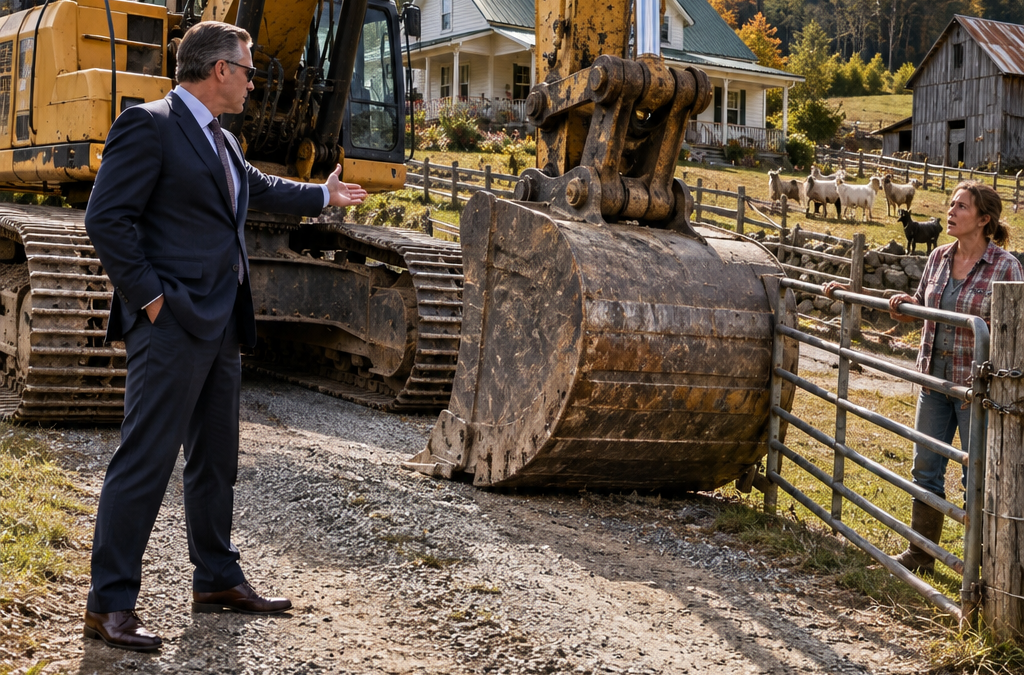
A rented excavator stood sideways across the narrow entrance to my farm. Its steel tracks occupied most of the paved surface, and the boom extended toward the drainage ditch.
The bucket rested near my gate.
There was barely room for a person to squeeze around it.
No vehicle could pass.
My truck was trapped inside.
The feed delivery was trapped outside.
And Dean Whitlock stood beside the excavator wearing a charcoal suit, dark sunglasses, and a pair of spotless leather shoes.
Two contractors waited near a work truck.
Dean looked almost cheerful when he saw me.
“Good morning, Michael.”
I stared at the machine.
“What is this?”
“Preliminary drainage work.”
“Move it.”
He checked his watch.
“The equipment is temporarily positioned for authorized access.”
“Move it, Dean.”
He removed his sunglasses slowly.
“There’s no reason to be hostile.”
“My driveway is blocked.”
“Only temporarily.”
“I have a feed delivery waiting outside.”
“Then perhaps you should have planned around the work schedule.”
I took a step toward him.
“You didn’t give me a work schedule.”
“Notice was provided through the association.”
“I never received notice.”
“That doesn’t invalidate authorization.”
The delivery driver climbed down from his truck.
“Sir, I can’t unload here. I’ve got another stop.”
I looked at the pallet of feed bags.
I had already delayed the order once because of the legal bills.
The animals needed it.
“Can you wait a few minutes?”
He glanced at the excavator.
“I can give you twenty.”
Dean folded his arms.
“Perhaps this will finally demonstrate why cooperation matters.”
I turned toward him.
“You’re doing this on purpose.”
He smiled.
“You’re welcome to believe whatever makes you comfortable.”
Something hot and dangerous rose in my chest.
I wanted to grab him by his expensive jacket and drag him across the driveway.
Instead, I pulled out my phone.
I photographed the excavator.
The equipment identification number.
The rental-company markings.
The position of the tracks.
The blocked road.
Then I recorded a continuous video from the farmhouse gate toward the neighborhood entrance.
Dean watched.
“More photographs?”
“More records.”
He laughed softly.
“You really believe your little collection of pictures is going to change anything?”
I looked at him.
“I believe they might.”
He stepped closer.
“Michael, you seem confused about the situation. The HOA controls this access corridor.”
“Not my driveway.”
“The distinction is more complicated than you understand.”
“Then explain it to a judge.”
His expression hardened.
“Careful.”
That single word changed the air between us.
It wasn’t advice.
It was a threat.
I called Priya.
She answered immediately.
“Mike?”
“He’s here.”
“Who?”
“Dean. With an excavator.”
There was a pause.
“Where?”
“Across my only driveway.”
“Is anyone hurt?”
“No.”
“Are you physically blocked from leaving with a vehicle?”
“Completely.”
“Don’t touch the equipment. Don’t confront the operators. Call the sheriff’s office and explain that a private contractor has obstructed access to your property under a disputed authorization.”
“He’s standing right here.”
“Then keep your distance.”
I could hear her moving papers.
“I’m contacting the association’s counsel. Preserve the video.”
I ended the call.
Dean was watching me.
“Calling your attorney again?”
“Yes.”
“That must be getting expensive.”
I looked straight at him.
“It is.”
“Then perhaps you should reconsider your priorities.”
For one terrible moment, he was right about the money.
My savings had nearly disappeared.
The foreclosure threat hung over the farm.
I had started putting off repairs because every extra dollar seemed destined for legal fees.
Dean had resources I couldn’t match.
He had connections.
He controlled the association’s communications.
And he knew I couldn’t simply abandon the property while animals depended on me.
He saw the hesitation on my face.
His expression softened into something almost sympathetic.
“This doesn’t have to be difficult, Mike.”
I said nothing.
“People make emotional attachments to property. I understand that. But sometimes the sensible business decision is to let go.”
I looked toward the barn.
My father’s barn.
Dean followed my gaze.
“That structure would have to come down, of course. But a clean transfer could spare you considerable expense.”
I felt something inside me go very still.
“You brought an excavator to my driveway to pressure me into selling?”
He adjusted his cuff.
“I’m offering you an opportunity to resolve a long-standing problem.”
“No.”
His eyes narrowed.
“No?”
“My farm isn’t for sale.”
The polished mask slipped.
“Then stop acting surprised when there are consequences.”
I stepped back.
And called the sheriff.
The deputy arrived twenty-five minutes later.
His name was Deputy Collins, a broad-shouldered man with tired eyes and the expression of someone who had already dealt with too many foolish disputes before breakfast.
He parked near the feed truck and walked toward us.
“What’s going on?”
Dean moved first.
“Deputy, I’m Dean Whitlock, president of the Briar Glen Homeowners Association. We’re performing an approved drainage assessment, and this resident has become confrontational.”
Collins looked at the excavator.
Then at my blocked driveway.
Then at Dean.
“Is this the only vehicle access?”
“Yes,” I said.
Dean spoke over me.
“The association has infrastructure responsibilities.”
Collins raised a hand.
“One at a time.”
I showed him my deed, the earlier survey notice, and the photographs I’d taken.
“The contractors were told they had permission to work here. I never gave that permission. My attorney has already disputed the claimed easement.”
Collins turned to Dean.
“Do you have authorization for this work?”
“Certainly.”
“Show me.”
Dean opened a leather portfolio.
He removed several papers and handed them over.
Collins studied the first page.
“Where’s the county permit?”
Dean looked faintly irritated.
“This is association-authorized work.”
“That wasn’t my question.”
“The work is preliminary.”
“Do you have a permit or other authorization allowing you to obstruct this private driveway?”
Dean’s smile flickered.
“It’s a temporary condition.”
“Sir.”
Collins looked up.
“Show me the permit.”
Dean said nothing.
For the first time since I’d met him, he seemed unsure what to say.
Then he pointed to another document.
“This authorization was approved by the HOA board.”
Collins examined it.
At the bottom was a signature attributed to the board secretary.
I leaned closer.
Something looked wrong.
The name was Margaret Ellis.
I knew Margaret.
She was a retired school administrator who lived two streets over and had once brought me homemade peach preserves after buying eggs from me.
Her signature appeared on the annual meeting notices.
I had seen it dozens of times.
The signature on Dean’s document looked nothing like it.
I pointed.
“That isn’t Margaret’s signature.”
Dean turned toward me.
“Stay out of this.”
Collins glanced between us.
“Mr. Whitlock, can you confirm who signed this?”
“Our board secretary.”
“Did you witness the signature?”
“The paperwork was processed through the office.”
“Can I contact her?”
Dean’s face tightened.
“That shouldn’t be necessary.”
Collins handed the document back.
“I think it is.”
At that exact moment, a loud metallic rattle came from behind me.
Biscuit had escaped through the smaller pasture gate.
He trotted toward the excavator with the determined expression of a goat who had discovered an entirely new category of bad decision.
“Biscuit!” I shouted.
He ignored me.
He lowered his head and charged the enormous rubber tire on the contractor’s support trailer beside the machine.
The impact made a sharp thud.
A vehicle alarm erupted from the parked equipment truck.
Biscuit jumped backward, startled by his own achievement, then bleated indignantly at the noise.
For a second, nobody moved.
Then Deputy Collins laughed.
Not a polite chuckle.
A genuine laugh that made him lower his head.
Even one of the contractors grinned.
I should have laughed too.
Under different circumstances, I would have.
But Dean’s face had turned red.
“Control your livestock!” he snapped.
I hurried toward Biscuit and grabbed his collar.
“He’s more cooperative than some people standing here.”
Collins coughed into his hand, still smiling.
That was when Dean changed tactics.
“He threatened me.”
The laughter stopped.
Collins looked at him.
“Excuse me?”
Dean pointed at me.
“This man has been aggressive for weeks. He has harassed association staff, interfered with contractors, and threatened physical violence.”
I stared at him.
“What?”
“He approached me in a threatening manner earlier.”
“That’s a lie.”
Dean turned to Collins.
“There. You can see how volatile he is.”
My heart began pounding.
This wasn’t another fine.
This was an attempt to put a criminal accusation on me.
If Collins believed him, I could end up in handcuffs on my own driveway while Dean stood there pretending to be the victim.
“Deputy,” Dean continued, “I believe he should be arrested for threatening me.”
I felt the blood drain from my face.
“Are you kidding?”
Collins raised his hand.
“Everybody stay calm.”
Dean pressed forward.
“I am the duly elected president of this association. I have witnesses.”
The contractors looked away.
I understood why.
They worked for the company Dean had hired.
Their paychecks depended on staying out of trouble.
“Deputy,” I said carefully, “I haven’t threatened anyone. I’ve been recording.”
Dean laughed.
“Convenient.”
Before I could answer, a familiar voice came from behind the feed truck.
“Actually, I’ve been recording too.”
S stepped into view.
He held his phone in one hand.
He was wearing faded jeans, a brown jacket, and the expression of a man who had just caught a burglar trying to explain why the broken window belonged to him.
Dean stared.
“What are you doing here?”
S shrugged.
“Living next door. Same as always.”
“This is association business.”
“Then it’s a good thing I got the whole business on video.”
He turned to Collins.
“I started filming when the excavator arrived. Got Mr. Whitlock directing the operator into position. Got him telling the crew to keep the driveway blocked until Mike agreed to discuss a settlement.”
Dean moved toward him.
“That recording is unauthorized.”
S didn’t move.
“Public road, Dean. My phone.”
Collins stepped between them.
“Let me see it.”
S opened the video.
I watched Dean on the screen, standing beside the excavator in the gray early-morning light.
His voice came through clearly.
“Position it across the entrance.”
The operator asked whether a delivery truck might need access.
Dean answered, “Then it can wait. Mr. Harris needs to understand that he doesn’t get to dictate terms anymore.”
My stomach tightened.
The video continued.
Dean gave another instruction.
“Don’t move the equipment until I tell you.”
Collins looked up.
“Mr. Whitlock, you said the driveway was blocked accidentally.”
Dean’s jaw worked.
“The recording lacks context.”
S swiped to another clip.
“Here’s the context.”
Dean’s voice played again.
“If Harris wants access restored, he can come to the table and discuss the property.”
The deputy watched the screen in silence.
Then he turned toward Dean.
“You’re going to have this equipment moved immediately.”
Dean straightened.
“Deputy, you don’t understand the legal framework.”
“I understand that you’ve blocked the only driveway to a private residence while trying to pressure the owner over a property dispute.”
“The association has rights.”
“Then exercise them through the proper legal process.”
Dean’s expression became icy.
“This isn’t over.”
Collins didn’t blink.
“Right now, moving that machine is your priority.”
The contractor climbed into the excavator.
The engine roared.
The steel tracks began turning.
And slowly, painfully slowly, the enormous machine backed away from my gate.
I stood beside Biscuit, one hand gripping his collar, while my driveway reappeared inch by inch.
The feed driver gave me a thumbs-up from his cab.
For a moment, I felt like I’d won.
Then Dean walked past me.
He leaned close enough that only I could hear him.
“You’ve made a very serious mistake.”
I turned.
He was already walking away.
The next week made it clear he meant every word.
The association’s attorney sent Priya a new demand letter.
Dean claimed I’d interfered with essential drainage operations, endangered contractors, threatened board leadership, and caused the HOA financial damages.
The association now sought reimbursement for equipment rental, project delays, additional legal work, and supposed emergency mitigation costs.
The new claimed balance exceeded the original eleven thousand dollars.
When Priya called me with the amount, I sat down on the barn steps.
“How much?”
She repeated it.
I stared at the ground.
“He blocked my driveway.”
“I know.”
“He threatened me.”
“I know.”
“And now he’s billing me for the excavator?”
“That’s what the letter says.”
I rubbed my face.
“What happens if he keeps doing this?”
Priya didn’t answer immediately.
Finally, she said, “Then we stop responding only to his accusations.”
I looked up.
“What do you mean?”
“We file our own case.”
She laid out the strategy at our next meeting.
We would challenge the lien and all unsupported charges.
We would seek damages and injunctive relief for harassment and interference with property access.
We would put the disputed authorization documents before the court.
And we would use the financial records to support a demand for an accounting and recovery of misappropriated association funds.
“This won’t be quick,” she warned.
“Nothing about this has been quick.”
“It also won’t be cheap.”
I looked at the folder in front of me.
Inside were photographs of the barn my father and I had built.
I carried them because I sometimes needed to remember what I was fighting for.
“How much more?”
She gave me a figure.
I felt sick.
I could cover part of it.
The rest would mean postponing needed repairs and taking on another financial obligation.
For a moment, I thought about selling.
Not to Dean.
Not directly.
But selling to anyone who would let me walk away.
I imagined packing the farmhouse.
Leaving the barn.
Finding another small place where nobody cared about chicken coops.
The thought hurt more than I expected.
Priya watched me.
“Mike, you need to understand something. Pursuing this is your choice. You don’t owe anyone a heroic stand.”
I looked at her.
“What happens if I stop?”
“We may be able to negotiate.”
“With Dean?”
“Through counsel.”
“And he’d still have the power to do this to somebody else.”
She didn’t answer.
I thought about Allison standing in the rain.
About S filming the driveway.
About Mrs. Alvarez, whoever she really was beneath her quiet smile and carefully tended flower beds.
I thought about my father standing beside the completed barn.
Not bad, Mike.
I took a breath.
“File it.”
Priya nodded.
“Then we’ll do it properly.”
The complaint was filed in county court.
Dean reacted almost immediately.
He sent a neighborhood-wide email describing me as a disgruntled property owner who had launched a baseless legal attack on the HOA.
He claimed I opposed necessary infrastructure improvements.
He accused me of spreading misinformation.
He warned that association funds would have to be diverted from community projects to defend against my reckless conduct.
Within hours, neighbors began calling.
Some were supportive.
Others weren’t.
One man I’d known for two years approached me outside the hardware store.
“Mike, you’re costing all of us money.”
I stared at him.
“Dean threatened to foreclose on my farm.”
“He says you violated the rules.”
“My property isn’t even subject to most of those rules.”
He shook his head.
“That’s what lawyers always say.”
I felt something inside me sink.
Dean didn’t need to convince everyone.
He only needed enough people to believe I was the problem.
A few days later, someone left an unsigned note in my mailbox.
STOP MAKING TROUBLE FOR THE NEIGHBORHOOD.
There was no threat beyond those words.
But I stood in the driveway holding the paper, wondering who had put it there.
The isolation was worse than I’d expected.
I had always been friendly with my neighbors.
I sold eggs to a few families.
I helped clear fallen branches after storms.
I loaned tools without keeping track of who returned them.
Now some people looked away when I waved.
The legal fight had turned my home into a place where I felt watched.
Every unfamiliar vehicle made me look up.
Every envelope made my stomach tighten.
At night, I checked the gate twice.
Sometimes three times.
I hated what Dean was turning me into.
But every time I considered giving up, another piece of evidence surfaced.
Priya obtained additional association records through formal legal procedures.
The financial patterns Allison had shown me became harder to dismiss.
Invoices for landscaping oversight appeared during months when no substantial landscaping work had occurred.
Approval records were incomplete.
Several payments had been authorized without the independent review required by the association’s own policies.
Then the disputed drainage paperwork became even more troubling.
Margaret Ellis, the board secretary, reviewed the authorization Dean had shown Deputy Collins.
She denied signing it.
She provided examples of her genuine signature.
The differences were unmistakable.
Dean claimed an administrative misunderstanding.
Margaret called it something else.
“A lie.”
Her statement came at a terrible time for him.
The annual HOA meeting was only days away.
And Dean had arranged to make my lawsuit the main subject.
S told me not to attend.
“He’s going to turn the room against you.”
“I know.”
“Then why go?”
“Because he’s been talking about me for months.”
S studied me.
“And?”
“I’m tired of being absent from my own defense.”
He sighed.
“Well, then I guess you’d better wear a clean shirt.”
The meeting was held in Briar Glen’s clubhouse.
It was a beautiful building with stone columns, large windows, and an artificial fireplace that flickered behind glass.
The room smelled of expensive coffee and furniture polish.
About eighty residents had gathered.
Dean stood at the front wearing a charcoal blazer and a crisp white shirt.
His hair was perfectly arranged.
A silver watch flashed at his wrist whenever he lifted his hand.
Even after everything he’d done, he still looked like the most respectable person in the room.
That was part of his power.
He understood appearances.
He knew people trusted polished surfaces.
He greeted residents warmly, shook hands, and thanked volunteers.
When he saw me enter with S, his expression barely changed.
“Michael. How nice of you to join us.”
I stopped a few feet away.
“Wouldn’t miss it.”
He smiled.
“Let’s hope tonight remains constructive.”
“That depends on whether you tell the truth.”
A few people nearby turned.
Dean’s smile tightened.
“Please take a seat.”
The meeting began with ordinary business.
Budget figures.
Landscaping contracts.
Road repairs.
Community security.
I listened as Dean described the association’s finances as stable and well managed.
Every mention of financial responsibility made me think about the transfers I’d seen.
Then he changed the slide on the projector.
A photograph of my barn appeared.
My barn.
Displayed in front of eighty neighbors.
Dean stepped beside the screen.
“Unfortunately, the board has recently been forced to address a prolonged compliance dispute involving an adjacent agricultural parcel.”
I felt S shift beside me.
Dean continued.
“Most of our residents understand that community standards require cooperation. Unfortunately, one property owner has chosen repeated confrontation instead.”
The room was quiet.
He clicked to another slide.
Photographs of my chicken coop.
My mailbox.
My feed containers.
He made them look like evidence from a criminal investigation.
“This individual has refused lawful requests, disrupted essential drainage improvements, and initiated expensive litigation against the association.”
A man in the second row muttered something about legal fees.
Dean nodded sympathetically.
“Yes. Unfortunately, the financial burden of defending the community affects every homeowner.”
I stood.
“That’s not true.”
Dean looked toward me.
“Michael, please wait for the public-comment portion.”
“You blocked my only driveway with an excavator.”
He raised his hand.
“Sir.”
“You threatened to take my farm over fines you had no authority to issue.”
A few residents turned toward me.
Dean’s voice became firmer.
“This is precisely the behavior I’ve been describing.”
I felt my face heat.
He wanted me angry.
He wanted everyone to see a shouting farmer confronting a composed professional.
I looked at Priya, who had come with me.
She gave the slightest shake of her head.
I sat down.
Dean smiled.
“Thank you.”
That smile nearly broke me.
He had dragged my home onto a screen, accused me of endangering the neighborhood, and turned my defense into proof of my supposed instability.
Then something unexpected happened.
A woman stood near the back.
Mrs. Alvarez.
She wore a dark cardigan over a floral blouse and held a phone tightly in both hands.
“Mr. Whitlock?”
Dean looked toward her.
“Yes, Elena?”
“I’d like to speak.”
“We’ll have a public-comment period shortly.”
“I’d like to speak now.”
Her voice trembled.
Dean’s expression sharpened.
“Please respect the meeting procedures.”
She looked around the room.
Then she said, “He’s doing to Mike what he did to me.”
The room went quiet.
Dean didn’t move.
“What did you say?”
Mrs. Alvarez swallowed.
“You threatened me.”
“Elena, this isn’t appropriate.”
“You said you’d ruin my family if I kept asking questions.”
A low murmur moved through the audience.
Dean stepped away from the projector.
“That is a serious accusation.”
“I know.”
Her hands were shaking so badly she could barely unlock her phone.
“My son was going through an immigration paperwork issue. He was trying to get everything straightened out. You found out.”
Dean’s face changed.
“That matter is private.”
“You made it your business.”
Her voice grew stronger.
“I asked why the landscaping company kept billing the HOA for work nobody could remember seeing. You told me to stop asking.”
Several residents turned toward Dean.
Mrs. Alvarez lifted her phone.
“You sent me messages. You said if I embarrassed the board, people would find out about my son’s paperwork.”
Dean interrupted.
“I never threatened your son.”
She looked directly at him.
“You said you knew people who could make his life difficult.”
The room was so quiet I could hear the ventilation system humming.
Mrs. Alvarez’s eyes filled with tears.
“My son worked hard. He was scared already. I didn’t know what you might do. So I stopped asking questions.”
She wiped her face.
“I’ve been ashamed of that for years.”
Dean’s voice became cold.
“You’re misrepresenting a private conversation.”
She shook her head.
“No. I’m finally telling the truth about it.”
She read one of the messages aloud.
Not all of it.
Just enough.
Enough for everyone to understand that Dean had used her son’s vulnerability to pressure her into silence.
Then she looked at the board members.
“I kept the messages. Every one.”
Margaret Ellis stood.
“I want them included in the record.”
Dean turned sharply.
“Margaret, sit down.”
She didn’t.
“I’m the board secretary, Dean. I’m asking that her statement be included in the minutes.”
“This is turning into a spectacle.”
Margaret folded her arms.
“Then maybe you shouldn’t have made it one.”
A few people gasped.
Dean stared at her.
For years, he’d apparently been able to control board meetings through confidence, pressure, and carefully managed procedure.
Now the room was slipping away from him.
He looked toward me.
“This is your doing.”
I stood slowly.
“No.”
I looked at Mrs. Alvarez.
“She did this herself.”
Dean pointed at me.
“You’ve been poisoning people against me.”
Priya rose beside me.
“Mr. Whitlock, I suggest you stop making accusations.”
Dean ignored her.
“You’re trying to destroy the association.”
I looked around the clubhouse.
At the worried faces.
At the residents who had paid fines because they feared liens.
At the people who had trusted a man because he wore expensive clothes and spoke with absolute confidence.
Then I looked back at him.
“No, Dean. I’m trying to keep you from destroying the people who live here.”
His face flushed.
“You have no idea what I’ve done for this neighborhood.”
“I know what you’ve done to mine.”
The room went silent again.
For once, Dean had no immediate response.
Margaret requested an emergency review of the association’s finances and legal actions.
Several homeowners demanded an independent audit.
Others asked why a purported board authorization carried a signature the secretary denied writing.
Dean tried to adjourn the meeting.
The room erupted.
People were speaking over one another.
Some demanded answers.
Some demanded his resignation.
A few still defended him, insisting everyone should wait for the court proceedings.
But the unquestioned authority he’d enjoyed was gone.
He looked smaller standing beneath the projector screen.
Not because he’d changed physically.
Because people had finally begun looking at him instead of at the image he’d created.
As S and I walked outside, Mrs. Alvarez approached us.
Her eyes were red.
“I’m sorry, Mike.”
I shook my head.
“You don’t owe me an apology.”
“I should have spoken up before.”
I looked at her trembling hands.
“You spoke when you could.”
She nodded, but I could see how much it had cost her.
Then she said something I didn’t forget.
“I thought if I stayed quiet, he’d leave my family alone.”
I looked back through the clubhouse windows.
Dean stood inside, surrounded by angry residents.
“That’s what he counted on.”
The weeks before court were the hardest of the entire fight.
Not because Dean became louder.
Because he became quieter.
His attorney challenged portions of the evidence.
The association questioned whether I had standing to pursue certain claims involving HOA funds.
There were arguments over financial records, procedural requirements, and whether the disputed drainage authorization had actually caused compensable harm.
Priya spent hours preparing.
The invoices accumulated.
I began waking at three in the morning, running numbers in my head.
How much was left in savings?
What if we lost?
What if the judge believed Dean?
What if some technical requirement I’d never heard of allowed the association to keep the lien?
I had started this fight believing the truth would be enough.
Now I understood that truth had to be documented, authenticated, argued, and presented in a form the court could act upon.
That required time.
Money.
Endurance.
All three were running low.
One afternoon, I found myself standing inside the barn with a tape measure.
I was looking at the west wall, where some of the old framing needed reinforcement.
My father had helped install those boards.
I could still remember the way he braced one end while I drove the screws.
I sat on an overturned bucket.
For the first time, I cried.
Not loudly.
Not dramatically.
Just a tired man sitting in a barn, exhausted from defending something that should never have needed defending.
I was angry at Dean.
But I was also angry at myself.
For paying the first fine.
For laughing off the second.
For thinking a man would stop taking power simply because he’d already taken enough.
Biscuit wandered into the barn and pressed his nose against my arm.
I pushed him away gently.
He came back.
I scratched behind his ears.
“You’re not much help, buddy.”
He chewed the edge of my sleeve.
I laughed through the tears.
Then I looked around the barn.
At the rafters.
At the feed bins.
At the tools hanging on the wall.
At the place where my father had scratched his initials into one of the support posts.
I stood.
And went back to work.
The court hearing took place on a gray morning in Asheville.
I arrived early with Priya.
I wore a dark jacket, clean jeans, and the boots I’d polished the night before.
Dean arrived twenty minutes later.
He looked exactly as I expected.
Tailored blazer.
White shirt.
Expensive watch.
Perfect hair.
He walked beside his attorney with the confidence of a man attending a business luncheon.
When he saw me, he gave a small, almost pitying smile.
I looked away.
Priya leaned toward me.
“Remember, the case isn’t about whether you can outargue him.”
“I know.”
“It’s about the evidence.”
I nodded.
But my hands were sweating.
Inside the courtroom, everything felt colder than I expected.
The wooden benches.
The polished railings.
The quiet voices.
The judge’s chair elevated above us.
For months, Dean had controlled the rooms where we’d confronted each other.
His office.
His board meetings.
His neighborhood.
Now we were somewhere he didn’t control.
And I could tell he didn’t like it.
The court began with the dispute over the HOA’s authority.
Priya presented the original farm deed, the subdivision records, and the limited road-access agreement.
She explained that the farm predated the development and that the architectural restrictions Dean had relied upon had not been shown to apply to my parcel.
Dean’s attorney argued that association authority extended to the property through its relationship with the community’s access road.
The judge examined the documents closely.
Then she asked a question.
“Where is the recorded instrument establishing that this agricultural parcel is subject to the architectural restrictions used to impose these fines?”
Dean’s attorney turned through his papers.
He referenced the community declaration.
The judge looked at the deed again.
“That doesn’t answer my question.”
I glanced at Priya.
She remained still.
The judge continued.
“The road-maintenance agreement establishes certain obligations. It does not, on its face, incorporate every neighborhood architectural covenant.”
Dean shifted in his seat.
His attorney attempted another explanation.
The judge listened.
Then she moved on.
Next came the fines.
Priya presented the mailbox citations, the chicken-coop notices, the repeated penalties, and the calculations that had transformed relatively small assessments into an eleven-thousand-dollar foreclosure threat.
She showed that several charges relied on provisions that were not applicable to my farm.
Others appeared to have been assessed without the notice and hearing procedures the association’s own documents required.
The judge reviewed the collection history.
“Mr. Whitlock,” she said, “were you personally involved in approving these enforcement actions?”
Dean stood.
“Yes, Your Honor. As association president, I had a responsibility to preserve community standards.”
“Did you verify the applicability of these provisions to Mr. Harris’s parcel?”
“Our understanding was that his property benefited from association infrastructure.”
“That wasn’t my question.”
Dean hesitated.
“We relied on our governing authority.”
“Which governing authority?”
He glanced toward his attorney.
For the first time, the man who had always had an answer seemed to be looking for someone else to provide one.
The judge waited.
Dean finally said, “I believed the association had jurisdiction.”
The judge looked down at the documents.
“Belief is not a substitute for a recorded legal obligation.”
I felt my chest tighten.
Not with fear this time.
With the strange shock of hearing someone in authority say aloud what I’d been trying to explain for months.
Then came the excavator.
Priya displayed photographs of the blocked driveway.
She explained that I had no other vehicle access to the farmhouse and that livestock feed could not be delivered while the machine occupied the entrance.
Deputy Collins’s report documented the obstruction and the disputed authorization.
The contractors’ records identified the equipment rental and work order.
Then Priya played S’s video.
Dean’s voice filled the courtroom.
“Position it across the entrance.”
The contractor asked about deliveries.
“Then it can wait.”
The video continued.
“Don’t move the equipment until I tell you.”
I watched the judge’s face.
She didn’t react.
She simply listened.
Then the final statement played.
“If Harris wants access restored, he can come to the table and discuss the property.”
When the screen went dark, the courtroom remained silent.
The judge turned toward Dean.
“Mr. Whitlock, was the equipment positioned to perform immediate drainage work?”
“Yes, Your Honor.”
“Then why did you direct the contractor to keep the access blocked until Mr. Harris agreed to discuss his property?”
Dean cleared his throat.
“That statement has been taken out of context.”
“What context would make blocking a person’s only driveway an appropriate means of encouraging a real estate negotiation?”
Dean opened his mouth.
Closed it.
Then said, “We were trying to achieve cooperation.”
The judge looked at him for a long moment.
“By denying access to his home?”
His attorney stood.
“Your Honor, we would characterize the obstruction as temporary and incidental.”
The judge looked back at the photographs.
“The video suggests otherwise.”
I felt Priya’s hand rest briefly on the table.
A small gesture.
But I knew what it meant.
The evidence was doing what we’d hoped it would do.
The disputed permit came next.
Margaret Ellis testified that she had not signed the board authorization.
She explained the normal approval process and confirmed that she had not participated in any board vote approving the drainage operation on my property.
Dean’s attorney questioned her memory.
Margaret didn’t flinch.
“I spent thirty-two years working in school administration,” she said. “I know the difference between a document I’ve signed and one I haven’t.”
A forensic document examiner discussed the signature discrepancies.
The examiner did not claim to know who had written the signature.
But the evidence supported Margaret’s denial that it was hers.
The judge asked Dean whether he could identify the person who prepared the authorization.
Dean said the paperwork had passed through the management office.
Allison had already testified about the office procedures and the irregular handling of certain records.
When Dean attempted to shift responsibility toward unnamed staff, the judge asked whether he had personally supplied the authorization to Deputy Collins.
He admitted he had.
“And you represented it as valid?”
“Yes.”
“Without confirming that the board secretary had actually signed it?”
Dean stared at the floor.
“I understood it had been approved.”
The judge made a note.
The hearing moved to the financial records.
This was where Dean seemed most uncomfortable.
The spreadsheets Allison had provided had been compared with records obtained through formal discovery.
The relevant banking and accounting documents showed transfers from association funds to Whitlock Landscaping Consulting.
Some invoices corresponded to documented services.
Others did not.
Certain approvals lacked supporting records.
The association’s independent accounting review identified payments that could not be reconciled with legitimate authorized expenses.
Dean maintained that the company provided consulting services.
Priya asked what those services involved.
He listed landscaping strategy, vendor coordination, and community appearance oversight.
She produced invoices.
“Can you identify the work performed on these dates?”
Dean looked at the pages.
“I’d need to review the underlying contracts.”
“The contracts were requested during discovery.”
“Then my counsel can address that.”
Priya nodded.
“Your counsel informed us that no corresponding contracts could be located.”
Dean’s face reddened.
“That doesn’t mean the work wasn’t performed.”
“No,” Priya agreed. “But it does mean you’re asking the association and this court to accept substantial payments without ordinary supporting documentation.”
The judge reviewed the account summaries.
Then she asked a question that made the room fall completely silent.
“Mr. Whitlock, did you disclose your family’s financial interest in this company to the board before approving these payments?”
Dean’s jaw tightened.
“I didn’t believe a formal disclosure was necessary.”
The judge looked up.
“Why not?”
“The services were legitimate.”
“That is a separate issue.”
Dean shifted in his seat.
The judge continued.
“I’m asking whether the board was informed that association funds were being directed to a business connected to you.”
He didn’t answer.
His attorney stood and requested a brief recess.
The judge granted it.
Outside the courtroom, I leaned against a wall.
My legs felt weak.
Priya stood beside me.
“How are you holding up?”
I let out a breath.
“I don’t know.”
“You’re doing fine.”
“He still looks like he thinks he can talk his way out of this.”
She glanced toward the other end of the hallway, where Dean stood speaking urgently with his attorney.
“People who have controlled the process for a long time sometimes have trouble recognizing when they no longer control it.”
S approached carrying three paper cups of coffee.
He handed one to me.
“Thought you could use this.”
“Thanks.”
He looked toward Dean.
“That fellow’s suit probably costs more than my first car.”
I managed a smile.
S leaned closer.
“But it doesn’t seem to be helping much.”
When court resumed, Mrs. Alvarez testified.
I watched her walk toward the witness stand.
She moved carefully, gripping the railing as she stepped up.
Her voice shook at first.
She explained how she’d questioned unusual landscaping expenses during an earlier period of Dean’s presidency.
She described being summoned to a private conversation.
She testified that Dean had referenced her son’s immigration paperwork and suggested that continued criticism could bring unwanted attention to her family.
Then she presented the messages.
Priya asked her why she hadn’t come forward sooner.
Mrs. Alvarez looked down.
“Because I was afraid.”
“Afraid of what?”
“That he would hurt my son.”
Her voice broke.
“I didn’t know what power he really had. I just knew he kept telling people how connected he was.”
Dean stared straight ahead.
Priya gave Mrs. Alvarez a moment.
Then asked, “What changed?”
She looked toward me.
“When I saw him doing the same thing to Mike, I realized staying quiet hadn’t protected anyone. It had only made it easier for him to continue.”
I lowered my eyes.
I hadn’t known how much she was carrying.
And I hadn’t understood how much courage it had taken for her to stand in that clubhouse.
Dean’s attorney argued that the messages were unrelated to my property dispute.
Priya explained their relevance to the allegations involving coercion, retaliation, and misuse of association authority.
The judge admitted the relevant evidence within the issues before the court.
Then she asked Dean directly whether he had referenced Mrs. Alvarez’s son’s immigration situation when she questioned association expenses.
Dean said he had merely expressed concern.
Mrs. Alvarez’s messages told a different story.
The judge studied them for a long time.
When she looked up, her expression was severe.
“Mr. Whitlock, there is a substantial difference between governance and coercion.”
Dean said nothing.
The judge continued.
“An association president is entrusted with limited authority for defined purposes. That authority does not include threatening residents over family circumstances, manufacturing property violations, or obstructing access to a home to pressure an owner into surrendering property.”
I felt my throat close.
She looked toward the financial documents.
“Nor does that office authorize undisclosed diversion of association money into private interests.”
Then she said the words I had been carrying inside me for months.
“This isn’t governance. This is extortion under HOA letterhead.”
Nobody spoke.
Dean’s expression changed.
I had seen him irritated.
Cold.
Threatening.
Condescending.
But until that moment, I’d never seen him look genuinely frightened.
It happened gradually.
His shoulders lowered.
His mouth tightened.
His eyes moved from the judge to his attorney and back again.
As though he were searching for some familiar authority he could invoke.
Some private connection.
Some procedural trick.
Some person who would look at his expensive suit and decide he must be right.
But there was no one left to intimidate.
The court’s rulings followed.
The lien against my farm was declared invalid.
The disputed assessments and associated charges were voided.
The association was ordered to return the improper fines I’d paid, with interest, and to reimburse recoverable costs and damages as determined in the judgment.
The court granted relief preventing further unauthorized enforcement against my property.
The accounting evidence and findings of misconduct supported a substantial monetary judgment and penalties totaling two hundred thousand dollars against Dean, with the allocation and enforcement governed by the court’s orders.
The court also directed that the relevant findings and evidence be referred to the appropriate criminal investigators and prosecutors for review of potential fraud, forgery, and related offenses.
That referral was not a criminal conviction.
Dean would still be entitled to the legal process governing any charges filed against him.
But his ability to hide the evidence behind the authority of the HOA had ended.
The court also ordered steps necessary to protect the association’s records and facilitate the independent financial examination.
The county opened a formal review of the HOA’s financial irregularities and related issues within its authority, while other relevant agencies received the evidence for their own assessment.
Dean’s leadership position collapsed in the aftermath of the findings.
The board removed him from office through its governing procedures.
He was no longer HOA president.
No longer the man who could send a letter and make my stomach knot.
No longer the person whose polished voice could turn an invented violation into a threat against my home.
When the judge finished, I didn’t cheer.
I didn’t raise my arms.
I didn’t look triumphantly toward Dean.
I simply sat there.
For a moment, I couldn’t move.
Priya touched my shoulder.
“Mike.”
I looked at her.
“It’s over?”
She gave me a small, tired smile.
“The major property claims are resolved. There will still be follow-up proceedings and collection work, but your farm is protected.”
I looked down at my hands.
They were shaking.
The same hands that had built the barn.
Fed the chickens.
Repaired the fences.
Signed the first forty-dollar check because I thought paying would make the trouble disappear.
I covered my face.
And cried.
There was nothing graceful about it.
Months of fear, anger, exhaustion, and helplessness came out all at once.
I thought about the sleepless nights.
The threatening letters.
The men standing in my pasture.
The giant excavator blocking the only road home.
I thought about my father.
About the divorce.
About how close I’d come to believing that the only way to protect my peace was to surrender the place where I’d finally found it.
Priya waited until I could breathe again.
Then she handed me a tissue.
“You did the hard part.”
I shook my head.
“No.”
I looked toward S, standing near the back of the courtroom.
Then toward Mrs. Alvarez.
Allison.
Margaret.
The neighbors who had finally decided to speak.
“We did.”
Outside the courthouse, the air smelled of rain.
The clouds were breaking over the mountains, and sunlight touched the wet pavement.
Dean emerged through another door with his attorney.
He wasn’t smiling.
His suit was still perfect.
His hair was still in place.
But the certainty that had always surrounded him was gone.
For a moment, our eyes met.
He looked at me with something I couldn’t immediately identify.
Hatred, perhaps.
Or disbelief.
Maybe he still thought I had stolen something from him.
His authority.
His reputation.
His chance to acquire the farm.
I wondered whether he understood that none of those things had ever belonged to him unconditionally.
He had been trusted with a limited responsibility.
He had mistaken that trust for ownership.
He started toward a waiting vehicle.
Then stopped.
“Michael.”
I turned.
Priya moved slightly closer.
Dean looked at me.
“You’ve ruined years of work.”
I studied him.
He sounded almost wounded.
As though all the legal findings, the financial records, the forged signature, and the blocked driveway were somehow injuries inflicted upon him.
For months, I’d imagined what I would say if this moment ever came.
I’d thought about shouting.
About reminding him of every fine.
Every threat.
Every sleepless night.
But standing there, I found I didn’t need any of it.
“You could have left me alone, Dean.”
His mouth tightened.
“I was trying to improve this community.”
“No.”
I looked directly at him.
“You were trying to own it.”
He turned away.
That was the last conversation I had with Dean Whitlock.
The weeks afterward were quieter than I’d expected.
There were still lawyers and documents.
The invalid lien had to be cleared from the property records.
Payments had to be processed.
The audit continued.
The association’s new leadership reviewed old enforcement actions and began contacting residents whose fines required reconsideration.
The records Priya had helped uncover became part of a much broader accounting examination.
Some residents learned that their penalties had been calculated improperly.
Others discovered they had paid charges for violations that were never adequately documented.
Several former board members resigned.
Margaret remained long enough to help stabilize the records and make sure the new procedures were transparent.
Mrs. Alvarez attended the first meeting under the replacement leadership.
This time, she sat near the front.
Her son continued working through his immigration matters with qualified legal help. The threats that had kept her silent no longer controlled her.
Allison left the management office.
She told me she’d found another job where she hoped she wouldn’t spend her mornings wondering whether doing the right thing would cost her a paycheck.
I thanked her again.
She shook her head.
“I should’ve spoken up sooner.”
I smiled gently.
“You spoke when it mattered.”
As for Dean, the criminal referral remained a serious matter.
Investigators reviewed the documents, the financial transfers, the disputed authorization, and the testimony.
Whether he would ultimately face prosecution and what punishment might follow were questions for the criminal justice system.
I didn’t pretend to know the answer.
But I knew he had lost the office he’d used against us.
The financial consequences were substantial.
His reputation in the neighborhood was shattered.
And he would never again be able to claim that every resident owed him unquestioning obedience simply because his name appeared at the top of HOA letterhead.
My own finances took time to recover.
Winning didn’t erase the months of strain.
There were repairs I’d postponed.
Feed expenses I’d worried over.
Nights when I had lain awake wondering whether the bank balance would last until the next legal bill.
The returned fines, interest, and monetary relief helped.
But the greater change was quieter.
I stopped looking at the mailbox with dread.
I stopped expecting every unfamiliar vehicle to carry another contractor.
I stopped hearing an engine on the road and immediately imagining something terrible.
S still came over for coffee.
One Saturday, he brought a small tin of white paint.
He set it on the kitchen table.
I examined the label.
Alpine White.
I stared at him.
He grinned.
“Thought you might finally want to bring that mailbox into compliance.”
I burst out laughing.
The kind of laughter that comes from somewhere deep in your chest and leaves you struggling to breathe.
I hadn’t laughed like that in months.
“Get out of my house.”
“Just trying to protect property values.”
I threw a dish towel at him.
He caught it.
Then we sat on the porch drinking coffee, watching the goats move lazily across the pasture.
A few days later, I walked the perimeter of the property.
The survey stakes were gone.
The unauthorized drainage work had stopped.
The barn stood exactly where my father and I had built it.
Inside, the rafters caught the late-afternoon light.
I ran my hand across the support post where he’d scratched his initials.
For the first time in a long while, I wasn’t thinking about losing the place.
I was thinking about what I might build next.
That evening, I repaired the small pasture gate Biscuit had learned to open.
He watched me from the other side, chewing thoughtfully.
“You’re the reason I need three locks on everything,” I told him.
He bleated.
I tightened the final hinge.
When I finished, I stepped back and looked toward the driveway.
It was empty.
No excavator.
No black SUV.
No contractor trucks.
No man in an expensive suit telling me that my home was a problem he intended to solve.
Just a narrow strip of pavement winding past the trees toward the farmhouse.
The same driveway my father had helped me finish.
The same road I’d driven down on the day I bought the property, uncertain whether I was making the best decision of my life or another expensive mistake.
Biscuit pushed his head against my leg.
I scratched his forehead.
“You know something, buddy?”
He looked up.
“We’re still here.”
The sun dropped behind the mountains.
The chickens settled into their coop.
A light wind moved through the pasture.
And I stood there at the gate, surrounded by five acres that were ordinary to everyone else and irreplaceable to me.
Dean Whitlock had believed that authority meant the power to decide who belonged.
He’d used fines, threats, forged paperwork, and heavy machinery to make a home feel like a place under siege.
For months, I had been afraid that standing up to him would cost me everything.
It had cost me more than I wanted to pay.
But it hadn’t cost me my home.
I walked back toward the farmhouse as the last light touched the barn roof.
Behind me, Biscuit gave one impatient bleat, demanding dinner.
I turned and laughed.
“All right. I’m coming.”
Then I opened the barn door, reached for the feed bucket, and went about the ordinary business of living on my own land.
For the first time in months, ordinary felt extraordinary.
And when I closed the gate that night, I knew exactly what it meant.
Nobody had the right to take my home simply because they wanted it.
Not with a fine.
Not with a title.
Not with an excavator.
And not with fear.
The farm was mine.
And I was finally free to live on it.








